Reflections on the Theoretical Prerequisites for Initial Oral Antibiotic Treatment for Paediatric Bone and Joint Infections: A Narrative Review

 , , , , and
Abstract
1. Introduction
2. Methodology
3. Rationale for Oral Antibiotic Therapy in Paediatric OAIs
3.1. Identification of the Causative Germ and Its Antibiotic Resistance Profile
3.2. Which Pathogens Are Most Frequently Encountered in Paediatric Bone and Joint Infections?
3.3. Is Intravenous Antibiotic Therapy More Effective than Oral Treatment for OAIs?
3.4. Which Antibiotics Adequately Penetrate Bone Tissue and the Joint Space?
3.5. Availability of Effective Oral Antibiotics for the Causative Pathogen
3.6. Defining the Limits of Oral Antibiotic Therapy and Patient Selection
3.7. The Current Experience of Oral Treatments for Paediatric OAIs
3.7.1. Early-Switch After a Short IV Lead-In: Rationale and Practical Selection
3.7.2. Oral-First (Exclusive Oral Therapy from the Outset): What Do We Actually Know?
3.7.3. How Categorical Should Recommendations Be Today?
3.8. Future Perspectives
4. Conclusions
Author Contributions
Funding
Institutional Review Board Statement
Informed Consent Statement
Data Availability Statement
Acknowledgments
Conflicts of Interest
Appendix A

| Antibiotic | Key PK Properties (Oral Use) | Reported Paediatric/Human PK Data | PK/PD Target | Bone/Joint Penetration | Key Implication for Oral Therapy |
|---|---|---|---|---|---|
| Amoxicillin Amox-clav | Oral F ≈ 70% (adults); 87% (neonates). Short t½ ≈ 1–1.5 h. Non-linear (saturable) absorption at high doses. | PopPK neonates: F = 87%, 1−compartment. NAPPA study: F = 58.7%, Ka = 1.3 h−1 (children). | fT > MIC ≥ 40–50%. 95% PTA at 500 mg TID for MIC ≤ 0.5 mg/L. | Bone/plasma 0.10–0.20. Good synovial fluid penetration. | High-dose oral feasible for K. kingae, streptococci, MSSA if dosing interval ensures fT > MIC. Saturable absorption limits escalation [44,68,82,83]. |
| Cephalexin Cefadroxil | Oral F > 90%. t½: cephalexin 1.1 h, cefadroxil 1.6 h (children). Renal elimination, no significant metabolism. | PopPK in 11 children (OAI). Cephalexin vs. cefadroxil PK in paediatric MSK. | fT > MIC ≥ 40%. Cephalexin 25 mg/kg TID: >95% PTA (MIC ≤ 4). Cefadroxil 40 mg/kg BID: >95% PTA. | Detectable in bone, abscess fluid, synovial fluid. | First-line oral step-down for MSSA OAI. Cefadroxil allows BID dosing. Frequent dosing critical for cephalexin [84,85,86]. |
| Cefuroxime axetil | Oral prodrug; F ≈ 37–52% (variable). Food required. t½ ≈ 1.2 h. | PTA modelling, adults/children. Limited OAI-specific PK data. | fT > MIC ≥ 40–50%. PTA dependent on MIC and formulation. Suspension > tablet. | Cefuroxime IV bone/tissue data available. Oral bone PK data limited. | Variable absorption limits reliability. Less preferred than cephalexin for step-down. Main role: empirical therapy for K. kingae [53,87]. |
| Clindamycin | Oral F = 87.6%, Ka = 0.967 h−1. CL = 15.2 L/h, V = 66.2 L (adult osteomyelitis). t½ ≈ 3 h. | PopPK, 50 adults, osteomyelitis (IV + oral). PopPK PJI (CL/F = 23 L/h). Paediatric-specific PK limited. | fT > MIC ≥ 40–50%. 600 mg TID effective up to 75 kg. Cmin target 2 mg/L. | Bone penetration ≈ 30%. High joint/bone penetration confirmed. | Reliable oral option for MSSA/streptococci when susceptible. D-test required (inducible erm resistance). Excellent bone penetration supports oral-first [88,89,90]. |
| TMP–SMX | TMP oral F ≈95%; SMX 85–90%. Long t½ TMP (8–11 h). Protein binding TMP ≈ 44%. | Well-established paediatric PK. Weight-based: 8–12 mg/kg/day (TMP component). | AUC0–24/MIC. EUCAST breakpoint S. aureus ≤ 2/38 mg/L. No universally accepted numeric OAI target. | Good synovial fluid penetration. Bone penetration documented in adults. | Oral option for MRSA when β-lactams unsuitable. Excellent bioavailability supports oral-first when susceptible [56]. |
| Linezolid | Oral F ≈100%. Vd = 40–50 L; protein binding 31%. Paediatric dose: 10 mg/kg q8–12 h. | PopPK, 112 children (0–12 y). Faster clearance in children; risk of underdosing at MIC ≥ 2 mg/L. | AUC0–24/MIC 80–120 (adults). Dose escalation may be needed in children for MIC ≥ 2 mg/L. | Bone: serum 0.3–1.2. Mean bone concentration > 3.9 mg/L in infected tissue. | True IV–oral equivalence (F = 100%). Oral option for MRSA and VRE when tolerated. Long-term use: myelosuppression risk. TDM advisable [48,91,92,93]. |
| Vancomycin (IV only) | No systemic oral absorption. IV only. Vd ≈ 0.4–1.0 L/kg. Renal elimination. | Well-characterised paediatric PopPK. AUC-guided dosing recommended. | AUC0–24/MIC 400–600 (serious MRSA). TDM mandatory. | Variable bone: serum (0.05–0.60) in adult orthopaedic studies. | IV comparator standard for severe MRSA. AUC-guided dosing not achievable orally; justifies IV route for MRSA [45,70]. |
| Penicillin V Ampicillin | Penicillin V: F 60–73%. Amoxicillin preferred (higher F). Short t½ (0.5–1 h). | Well-established paediatric PK. Weight-based dosing standard. | fT > MIC ≥ 30–50%. TID–QID dosing required (short t½). | Bone:plasma < 0.10 for penicillin. Amoxicillin: better penetration. | Ideal for susceptible streptococci. Amoxicillin preferred over penicillin V (higher F, better bone penetration) [45,94]. |
Appendix B
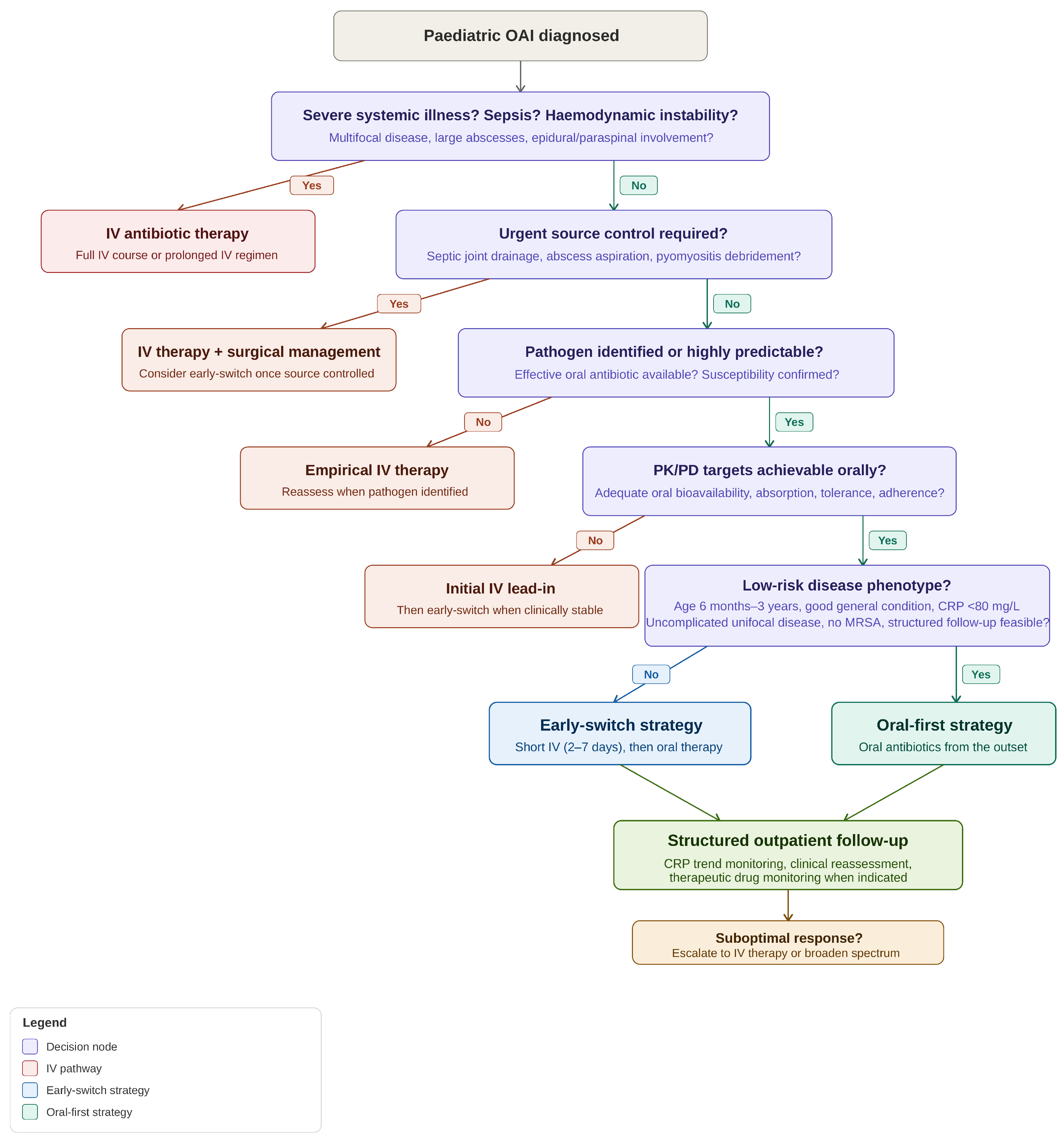
| Characteristic | Early-Switch Strategy | Oral-First Strategy |
|---|---|---|
| Definition | Short initial course of intravenous (IV) antibiotics, typically 2–7 days in uncomplicated cases, before a switch to oral antibiotics [8,9,10,11,12] | Exclusive oral antibiotic therapy from the outset, with no IV lead-in [13,67] |
| Evidence base | Supported by prospective cohorts, randomised trials and guideline-driven clinical practice [9,10,11,12] | Supported by observational outpatient cohorts, registry-based studies [13,67] and emerging randomised trial evidence [77,78] |
| Initial care setting | Inpatient initiation with early transition to outpatient care | Outpatient management from diagnosis |
| Main rationale | Secure early and predictable exposure while reducing IV-related complications and hospital stays | Avoid hospitalisation and IV access when oral exposure is expected to be reliable |
| Clinical status at initiation | Clinical stabilisation is achieved before switching | Good general condition at presentation; no systemic toxicity |
| Inflammatory response | Downward trend in inflammatory markers after IV initiation | Moderate inflammatory burden at onset (CRP < 80 mg/L; ESR/CRP ratio ≥ 0.67) [67] |
| Disease phenotype | Uncomplicated disease; may include cases requiring brief IV stabilisation | Strictly uncomplicated disease (single focus, no large abscesses, no epidural/paraspinal involvement, no cervical spondylodiscitis) |
| Need for source control | Performed or clearly not required before step-down to oral antibiotics | No need for urgent surgical source control (e.g., drainage of a septic joint, aspiration of abscesses or pyomyositis) |
| Pathogen considerations | Pathogen identified or predictable; IV used initially when uncertainty exists | Pathogen identified or highly predictable, with confirmed susceptibility and effective oral option (K. kingae, MSSA, streptococci); no MRSA risk factors |
| PK/PD considerations | IV ensures immediate attainment of PK/PD targets, followed by oral maintenance | Oral dosing must achieve PK/PD targets from the outset |
| Age considerations | Applicable across most paediatric age groups | Usually restricted to 6 months–3 years (up to 5 years for K. kingae); neonates and older children excluded [67] |
| Host factors | May include mild comorbidities | No significant comorbidities or immunodeficiency; no recent trauma, skin infection or surgery at the affected site |
| Follow-up requirements | Structured outpatient follow-up recommended | Mandatory attentive outpatient follow-up with rapid access to reassessments |
| Risk of escalation | Low; the early IV phase allows response assessment | Accepted but minimised by strict selection; rapid IV escalation must be feasible |
| Current positioning | Robust and widely applicable standard clinical pathway in selected children | Promising option for well-defined low-risk subgroups; not universally applicable |
Appendix C
| Criterion | Rationale |
|---|---|
| Age 6 months to 3 years (extendable up to 5 years in cases of confirmed or highly suspected K. kingae infection) | This age window reflects the epidemiological predominance of K. kingae, which is associated with predictable susceptibility and a typically milder disease course |
| Haemodynamically stable child in good general condition | Ensures reliable oral absorption and a low risk of rapid clinical deterioration |
| No underlying chronic diseases or immunodeficiency | Immunocompromised patients may require predictable IV exposure and closer monitoring |
| Adequate oral tolerance and reliable adherence | Oral-first strategies depend critically on sustained and adequate drug intake |
| Moderate inflammatory response (CRP < 80 mg/L; ESR/CRP ratio ≥ 0.67) | A lower inflammatory burden is associated with a reduced likelihood of complicated disease and supports the safety of outpatient management |
| No signs of sepsis or septic shock | Severe systemic illness requires immediate and predictable antimicrobial exposure via the IV route |
| No need for urgent surgical source control (e.g., drainage of a septic joint, aspiration of abscesses or pyomyositis) | When source control is required, an initial IV phase ensures adequate perioperative antimicrobial exposure |
| Uncomplicated infection (single focus, no large abscesses, no epidural or paraspinal extension) | Complicated disease phenotypes carry a higher risk of treatment failure with oral therapy alone |
| No cervical spondylodiscitis | Cervical location carries specific risks warranting closer inpatient monitoring |
| No recent trauma, skin infection or surgery at the affected site | These factors suggest possible inoculation-related infection with a potentially different microbiological profile |
| Pathogen identified or highly predictable, with confirmed susceptibility and an effective oral antibiotic option available (K. kingae, MSSA, streptococci) | Microbiological certainty is a prerequisite for reliable oral antibiotic selection |
| No MRSA risk factors | MRSA infections frequently require IV agents (e.g., vancomycin) with AUC-guided dosing not achievable orally |
| Ability to attend frequent outpatient reassessments | Oral-first strategies rely on the early detection of suboptimal response and the feasibility of rapid escalation |
| Contraindication | Rationale |
|---|---|
| Age outside the validated oral-first window (<6 months or >3–5 years, depending on the pathogen) | Limited evidence and higher PK variability in neonates; different pathogen spectrum in older children |
| Severe systemic illness or a requirement for intensive care | Predictable and immediate systemic exposure is a priority |
| Multifocal osteomyelitis or extensive soft-tissue involvement | Complex disease phenotypes associated with higher failure rates |
| MRSA infection requiring glycopeptides and IV therapy guided by pharmacokinetics | AUC/MIC-guided vancomycin dosing cannot be achieved orally |
| Unknown pathogen with an unpredictable susceptibility profile, precluding reliable oral antibiotic selection | Oral-first strategies presuppose microbiological certainty or high predictability |
| Inability to ensure attentive clinical and biological follow-up | Without structured outpatient monitoring, early detection of treatment failure is compromised |
Appendix D

References
- De Marco, G.; Vazquez, O.; Gavira, N.; Ramadani, A.; Steiger, C.; Dayer, R.; Ceroni, D. Surgery’s role in contemporary osteoarticular infection management. Front. Pediatr. 2022, 10, 1043251, Erratum in Front. Pediatr. 2023, 11, 1170859. https://doi.org/10.3389/fped.2023.1170859. [Google Scholar] [CrossRef] [PubMed]
- Coulin, B.; De Marco, G.; Spyropoulou, V.; Juchler, C.; Vendeuvre, T.; Habre, C.; Tabard-Fougère, A.; Dayer, R.; Steiger, C.; Ceroni, D. Osteoarticular infection in children. Bone Jt. J. 2021, 103-B, 579–583. [Google Scholar] [CrossRef] [PubMed]
- Juchler, C.; Spyropoulou, V.; Wagner, N.; Merlini, L.; Dhouib, A.; Manzano, S.; Tabard-Fougère, A.; Samara, E.; Ceroni, D. The contemporary bacteriologic epidemiology of osteoarticular infections in children in Switzerland. J. Pediatr. 2018, 194, 190–196. [Google Scholar] [CrossRef]
- Samara, E.; Spyropoulou, V.; Tabard-Fougère, A.; Merlini, L.; Valaikaite, R.; Dhouib, A.; Manzano, S.; Juchler, C.; Dayer, R.; Ceroni, D. Kingella kingae and osteoarticular infections. Pediatrics 2019, 144, e20191509. [Google Scholar] [CrossRef]
- Basmaci, R.; Lorrot, M.; Bidet, P.; Doit, C.; Vitoux, C.; Penneçot, G.; Mazda, K.; Bingen, E.; Ilharreborde, B.; Bonacorsi, S. Comparison of clinical and biologic features of Kingella kingae and Staphylococcus aureus arthritis at initial evaluation. Pediatr. Infect. Dis. J. 2011, 30, 902–904. [Google Scholar] [CrossRef] [PubMed]
- Ceroni, D.; Cherkaoui, A.; Combescure, C.; François, P.; Kaelin, A.; Schrenzel, J. Differentiating osteoarticular infections caused by Kingella kingae from those due to typical pathogens in young children. Pediatr. Infect. Dis. J. 2011, 30, 906–909. [Google Scholar] [CrossRef]
- Castellazzi, L.; Mantero, M.; Esposito, S. Update on the management of pediatric acute osteomyelitis and septic arthritis. Int. J. Mol. Sci. 2016, 17, 855. [Google Scholar] [CrossRef]
- Jagodzinski, N.A.; Kanwar, R.; Graham, K.; Bache, C.E. Prospective evaluation of a shortened regimen of treatment for acute osteomyelitis and septic arthritis in children. J. Pediatr. Orthop. 2009, 29, 518–525. [Google Scholar] [CrossRef]
- Peltola, H.; Pääkkönen, M.; Kallio, P.; Kallio, M.J.T.; Osteomyelitis–Septic Arthritis Study Group. Short- versus long-term antimicrobial treatment for acute hematogenous osteomyelitis of childhood: Prospective, randomized trial on 131 culture-positive cases. Pediatr. Infect. Dis. J. 2010, 29, 1123–1128. [Google Scholar] [CrossRef]
- Peltola, H.; Pääkkönen, M.; Kallio, P.; Kallio, M.J.T. Prospective, Randomized Trial of 10 Days versus 30 Days of Antimicrobial Treatment, Including a Short-Term Course of Parenteral Therapy, for Childhood Septic Arthritis. Clin. Infect. Dis. 2009, 48, 1201–1210. [Google Scholar] [CrossRef]
- Saavedra-Lozano, J.; Falup-Pecurariu, O.; Faust, S.N.; Girschick, H.; Hartwig, N.; Kaplan, S.; Lorrot, M.; Mantadakis, E.; Peltola, H.; Rojo, P.; et al. Bone and joint infections. Pediatr. Infect. Dis. J. 2017, 36, 788–799. [Google Scholar] [CrossRef]
- Krzysztofiak, A.; Chiappini, E.; Venturini, E.; Gargiullo, L.; Roversi, M.; Montagnani, C.; Bozzola, E.; Chiurchiu, S.; Vecchio, D.; Castagnola, E.; et al. Italian consensus on the therapeutic management of uncomplicated acute hematogenous osteomyelitis in children. Ital. J. Pediatr. 2021, 47, 179. [Google Scholar] [CrossRef]
- Alcobendas, R.; Remesal, A.; Murias, S.; Nuñez, E.; Calvo, C. Outpatients with acute osteoarticular infections had favourable outcomes when they received just oral antibiotics without intravenous antibiotics. Acta Paediatr. 2018, 107, 1792–1797. [Google Scholar] [CrossRef] [PubMed]
- Pai, M.; McCulloch, M.; Gorman, J.D.; Pai, N.; Enanoria, W.; Kennedy, G.; Tharyan, P.; Colford, J.M., Jr. Systematic reviews and meta-analyses: An illustrated, step-by-step guide. Natl. Med. J. India 2004, 17, 86–95. [Google Scholar]
- Hunter, S.; Chan, H.; Crawford, H.; Baker, J.F. Appropriate antibiotic duration in pediatric bone and joint infection: A systematic review. J. Pediatr. Orthop. Soc. N. Am. 2023, 5, 736. [Google Scholar] [CrossRef] [PubMed]
- Lyon, R.M.; Evanich, J.D. Culture-negative septic arthritis in children. J. Pediatr. Orthop. 1999, 19, 655–659. [Google Scholar] [CrossRef] [PubMed]
- De Marco, G.; Chargui, M.; Coulin, B.; Borner, B.; Steiger, C.; Dayer, R.; Ceroni, D. Kingella kingae osteoarticular infections approached through the prism of the pediatric orthopedist. Microorganisms 2022, 10, 25. [Google Scholar] [CrossRef]
- Ceroni, D.; Dayer, R.; Steiger, C. Are we approaching the end of pediatric culture-negative osteoarticular infections? Future Microbiol. 2019, 14, 917–919. [Google Scholar] [CrossRef]
- Banerjee, R.; Humphries, R. Rapid antimicrobial susceptibility testing methods for blood cultures and their clinical impact. Front. Med. 2021, 8, 635831. [Google Scholar] [CrossRef]
- Han, D.; Li, R.; Shi, J.; Tan, P.; Zhang, R.; Li, J. Liquid biopsy for infectious diseases: A focus on microbial cell-free DNA sequencing. Theranostics 2020, 10, 5501–5513. [Google Scholar] [CrossRef]
- Ahmed, A.A.; Park, S.Y.; Smollin, M.J.; Lindner, M.S.; Sarmiento Clemente, A.; Del Valle Penella, A.; Laufer, P.M.; Sanchez-Vegas, C.; Cotilla, M.R.; Melish, M.E.; et al. Plasma microbial cell-free DNA sequencing for the detection of Kingella kingae pediatric spinal infections. Pediatr. Infect. Dis. J. 2025, 44, 582–588. [Google Scholar] [CrossRef] [PubMed]
- Roversi, M.; Pignatelli, F.; De Marco, G.; Vazquez, O.; Ceroni, D.; Musolino, A.; Cirillo, M.; Lancella, L.; Villani, A.; Krzysztofiak, A.; et al. Multicenter retrospective analysis of 702 pediatric cases of bone and joint infections. Pathogens 2025, 14, 147. [Google Scholar] [CrossRef]
- Kuper, K.M. Intravenous to oral therapy conversion. In Textbook of Competence Assessment Tools for Health-System Pharmacies, 4th ed.; ASHP: Bethesda, MD, USA, 2008; pp. 348–360. [Google Scholar]
- Martinez, M.N.; Amidon, G.L. A mechanistic approach to understanding the factors affecting drug absorption: A review of fundamentals. J. Clin. Pharmacol. 2002, 42, 620–643. [Google Scholar] [CrossRef]
- Olivares-Morales, A.; Hatley, O.J.; Turner, D.; Galetin, A.; Aarons, L.; Rostami-Hodjegan, A. The use of ROC analysis for the qualitative prediction of human oral bioavailability from animal data. Pharm. Res. 2014, 31, 720–730. [Google Scholar] [CrossRef] [PubMed]
- Stielow, M.; Witczyńska, A.; Kubryń, N.; Fijałkowski, Ł.; Nowaczyk, J.; Nowaczyk, A. The bioavailability of drugs—The current state of knowledge. Molecules 2023, 28, 8038. [Google Scholar] [CrossRef] [PubMed]
- Vinarov, Z.; Abdallah, M.; Agundez, J.A.G.; Allegaert, K.; Basit, A.W.; Braeckmans, M.; Ceulemans, J.; Corsetti, M.; Griffin, B.T.; Grimm, M.; et al. Impact of gastrointestinal tract variability on oral drug absorption and pharmacokinetics: An UNGAP review. Eur. J. Pharm. Sci. 2021, 162, 105812. [Google Scholar] [CrossRef] [PubMed]
- Hitt, C.M.; Nightingale, C.H.; Quintiliani, R.; Nicolau, D.P. Streamlining antimicrobial therapy for lower respiratory tract infections. Clin. Infect. Dis. 1997, 24, S231–S237. [Google Scholar] [CrossRef]
- Cyriac, J.M.; James, E. Switch over from intravenous to oral therapy: A concise overview. J. Pharmacol. Pharmacother. 2014, 5, 82–87. [Google Scholar] [CrossRef]
- Onita, T.; Ishihara, N.; Yano, T. PK/PD-Guided Strategies for Appropriate Antibiotic Use in the Era of Antimicrobial Resistance. Antibiotics 2025, 14, 92. [Google Scholar] [CrossRef]
- Ambrose, P.G.; Bhavnani, S.M.; Rubino, C.M.; Louie, A.; Gumbo, T.; Forrest, A.; Drusano, G.L. Pharmacokinetics-Pharmacodynamics of Antimicrobial Therapy. Clin. Infect. Dis. 2007, 44, 79–86, Correction in Clin. Infect. Dis. 2007, 44, 624. https://doi.org/10.1086/511786. [Google Scholar] [CrossRef]
- Craig, W.A.; Ebert, S.C. Killing and regrowth of bacteria in vitro: A review. Scand. J. Infect. Dis. 1990, 74, 63–70. [Google Scholar]
- Vogelman, B.; Craig, W.A. Kinetics of antimicrobial activity. J. Pediatr. 1986, 108, 835–840. [Google Scholar] [CrossRef] [PubMed]
- Craig, W.A. Pharmacodynamics of antimicrobial agents as a basis for determining dosage regimens. Eur. J. Clin. Microbiol. Infect. Dis. 1993, 12, S6–S8. [Google Scholar] [CrossRef]
- Wetzstein, G.A. Intravenous to oral (IV:PO) anti-infective conversion therapy. Cancer Control 2000, 7, 170–176. [Google Scholar] [CrossRef]
- Liu, P.; Müller, M.; Derendorf, H. Rational dosing of antibiotics: The use of plasma concentrations versus tissue concentrations. Int. J. Antimicrob. Agents 2002, 19, 285–290. [Google Scholar] [CrossRef] [PubMed]
- Wald-Dickler, N.; Holtom, P.D.; Phillips, M.C.; Centor, R.M.; Lee, R.A.; Baden, R.; Spellberg, B. Oral Is the New IV. Challenging Decades of Blood and Bone Infection Dogma: A Systematic Review. Am. J. Med. 2022, 135, 369–379.e1. [Google Scholar] [CrossRef]
- Lee, S.L.; Azmi, S.; Wong, P.S. Clinicians’ knowledge, beliefs and acceptance of intravenous-to-oral antibiotic switching. Med. J. Malaysia 2012, 67, 190–198. [Google Scholar]
- Sevinc, F.; Prins, J.M.; Koopmans, R.P.; Langendijk, P.N.; Bossuyt, P.M.; Dankert, J.; Speelman, P. Early switch from intravenous to oral antibiotics. J. Antimicrob. Chemother. 1999, 43, 601–606. [Google Scholar] [CrossRef] [PubMed]
- Fischer, M.A.; Solomon, D.H.; Teich, J.M.; Avorn, J. Conversion from intravenous to oral medications. Arch. Intern. Med. 2003, 163, 2585–2589. [Google Scholar] [CrossRef]
- Gatti, M.; Tedeschi, S.; Zamparini, E.; Pea, F.; Viale, P. Pharmacokinetic and pharmacodynamic considerations for optimizing antimicrobial therapy used to treat bone and joint infections. Expert Opin. Drug Metab. Toxicol. 2023, 19, 511–535. [Google Scholar] [CrossRef]
- Landersdorfer, C.B.; Gwee, A.; Nation, R.L. Clinical pharmacological considerations in an early intravenous to oral antibiotic switch: Are barriers real or simply perceived? Clin. Microbiol. Infect. 2023, 29, 1120–1125. [Google Scholar] [CrossRef]
- Howell, A.; Sutherland, R.; Rolinson, C.N. Penetration of ampicillin and cloxacillin into synovial fluid. Ann. Rheum. Dis. 1972, 31, 537–540. [Google Scholar] [CrossRef]
- Howell, A.; Sutherland, R.; Rolinson, G.N. Effect of protein binding on levels of ampicillin and cloxacillin in synovial fluid. Clin. Pharmacol. Ther. 1972, 13, 724–731. [Google Scholar] [CrossRef]
- Thabit, A.K.; Fatani, D.F.; Bamakhrama, M.S.; Barnawi, O.A.; Basudan, L.O.; Alhejaili, S.F. Antibiotic penetration into bone and joints: An updated review. Int. J. Infect. Dis. 2019, 81, 127–136. [Google Scholar] [CrossRef]
- Koch, B.C.P.; Zhao, Q.; Oosterhoff, M.; van Oldenrijk, J.; Abdulla, A.; de Winter, B.C.M.; Bos, K.; Muller, A.E. The mysteries of target site concentrations of antibiotics in bone and joint infections: What is known? A narrative review. Expert Opin. Drug Metab. Toxicol. 2022, 18, 587–600. [Google Scholar] [CrossRef]
- Boselli, E.; Allaouchiche, B. Diffusion osseuse des antibiotiques. Presse Med. 1999, 28, 2267–2276. [Google Scholar] [PubMed]
- Landersdorfer, C.B.; Bulitta, J.B.; Kinzig, M.; Holzgrabe, U.; Sörgel, F. Penetration of antibacterials into bone: Pharmacokinetic, pharmacodynamic and bioanalytical considerations. Clin. Pharmacokinet. 2009, 48, 89–124. [Google Scholar] [CrossRef]
- Holm, S.; Larsson, S.-E. The penetration of flucloxacillin into cortical and cancellous bone during arthroplasty of the knee. Int. Orthop. 1982, 6, 243–247. [Google Scholar] [CrossRef]
- Yamada, K.; Matsumoto, K.; Tokimura, F.; Okazaki, H.; Tanaka, S. Are bone and serum cefazolin concentrations adequate for antimicrobial prophylaxis? Clin. Orthop. Relat. Res. 2011, 469, 3486–3494. [Google Scholar] [CrossRef] [PubMed]
- Young, S.W.; Zhang, M.; Freeman, J.T.; Vince, K.G.; Coleman, B. Higher cefazolin concentrations with intraosseous regional prophylaxis in total knee arthroplasty. Clin. Orthop. Relat. Res. 2013, 471, 244–249. [Google Scholar] [CrossRef] [PubMed]
- Montreuil, J.; Tanzer, M.; Zhang, Y.L.; Rajda, E.; Avizonis, D.; Hart, A. Tourniquet Use and Local Tissue Concentrations of Cefazolin During Total Knee Arthroplasty: A Randomized Clinical Trial. JAMA Netw. Open 2024, 7, e2429702. [Google Scholar] [CrossRef]
- Hanberg, P.; Bue, M.; Kabel, J.; Jørgensen, A.R.; Jessen, C.; Søballe, K.; Stilling, M. Effects of tourniquet inflation on peri- and postoperative cefuroxime concentrations in bone and tissue. Acta Orthop. 2021, 92, 746–752. [Google Scholar] [CrossRef]
- Zhang, J.; Chen, G.; Yu, X.; Liu, Y.; Li, Z.; Zhang, X.; Zhong, Q.; Xu, R. Higher cefazolin concentrations in synovial fluid following intraosseous regional administration during total knee arthroplasty. Arch. Orthop. Trauma Surg. 2024, 144, 4069–4075. [Google Scholar] [CrossRef] [PubMed]
- Landersdorfer, C.B.; Bulitta, J.B.; Kinzig, M.; Holzgrabe, U.; Sörgel, F. Pharmacokinetics and pharmacodynamics of antibiotics in bone. In Bone and Joint Infections: From Microbiology to Diagnostics and Treatment, 2nd ed.; Wiley: Hoboken, NJ, USA, 2021. [Google Scholar] [CrossRef]
- Sattar, M.A.; Cawley, M.I.; Holt, J.E.; Sankey, M.G.; Kaye, C.M. The penetration of trimethoprim and sulphamethoxazole into synovial fluid. J. Antimicrob. Chemother. 1983, 12, 229–233. [Google Scholar] [CrossRef] [PubMed]
- Preiss, H.; Kriechling, P.; Montrasio, G.; Huber, T.; Janssen, İ.; Moldovan, A.; Lipsky, B. Oral Flucloxacillin for Treating Osteomyelitis: A Narrative Review of Clinical Practice. J. Bone Jt. Infect. 2020, 5, 16–24. [Google Scholar] [CrossRef][Green Version]
- Öbrink-Hansen, K.; Pham, A.D.; Bue, M.; Hanberg, P.; Bendtsen, M.; Slater, J.; Friberg, L.E.; Thorsted, A.; Stilling, M. Population Pharmacokinetics of Flucloxacillin in Bone and Soft Tissue—Standard Dosing is Not Sufficient to Achieve Therapeutic Concentrations. Pharm. Res. 2022, 39, 1633–1643. [Google Scholar] [CrossRef] [PubMed]
- Hernandez, B.N.; Dilworth, T.; Kesner, J.; Ryan, K.; Thelen, H.; Mercier, R.-C. MIC discrepancies between parenteral and oral anti-staphylococcal beta-lactams among methicillin-susceptible Staphylococcus aureus. Chemotherapy 2023, 68, 55–60. [Google Scholar] [CrossRef]
- Sordillo, E.M.; Rendel, M.; Sood, R.; Belinfanti, J.; Murray, O.; Brook, D. Septicemia due to β-lactamase-positive Kingella kingae. Clin. Infect. Dis. 1993, 17, 818–819. [Google Scholar] [CrossRef]
- Birgisson, H.; Steingrimsson, O.; Gudnason, T. Kingella kingae infections in paediatric patients. Scand. J. Infect. Dis. 1997, 29, 495–498. [Google Scholar] [CrossRef]
- Yagupsky, P. Kingella kingae: Carriage, transmission, and disease. Clin. Microbiol. Rev. 2015, 28, 54–79. [Google Scholar] [CrossRef]
- Coulin, B.; De Marco, G.; Vazquez, O.; Spyropoulou, V.; Gavira, N.; Vendeuvre, T.; Tabard-Fougère, A.; Dayer, R.; Steiger, C.; Ceroni, D. Osteoarticular infections in children: Accurately distinguishing between methicillin-susceptible Staphylococcus aureus and Kingella kingae. Microorganisms 2023, 11, 11. [Google Scholar] [CrossRef]
- Saphyakhajon, P.; Joshi, A.Y.; Huskins, W.C.; Henry, N.K.; Boyce, T.G. Empiric antibiotic therapy for acute osteoarticular infections with suspected methicillin-resistant Staphylococcus aureus or Kingella. Pediatr. Infect. Dis. J. 2008, 27, 767. [Google Scholar] [CrossRef]
- Baguley, D.; Lim, E.; Bevan, A.; Pallet, A.; Faust, S.N. Prescribing for children—Taste and palatability affect adherence to antibiotics: A review. Arch. Dis. Child. 2012, 97, 293–297. [Google Scholar] [CrossRef] [PubMed]
- Venables, R.; Batchelor, H.; Hodson, J.; Stirling, H.; Marriott, J. Determination of formulation factors that affect oral medicines acceptability in a domiciliary paediatric population. Int. J. Pharm. 2015, 480, 55–62. [Google Scholar] [CrossRef] [PubMed]
- Alcobendas, R.; Saavedra-Lozano, J.; Díaz, M.; Martín-Rabadán, P.; García-Aparicio, J.; Ramos, J.T. Oral versus intravenous antibiotics for pediatric osteoarticular infection: When and to whom. Pediatr. Infect. Dis. J. 2022, 41, e351–e357. [Google Scholar] [CrossRef]
- Mouton, J.W.; Brown, D.F.J.; Apfalter, P.; Cantón, R.; Giske, C.G.; Ivanova, M.; MacGowan, A.P.; Rodloff, A.; Soussy, C.-J.; Steinbakk, M.; et al. The role of pharmacokinetics/pharmacodynamics in setting clinical MIC breakpoints. Clin. Microbiol. Infect. 2012, 18, E36–E45. [Google Scholar] [CrossRef]
- Drusano, G.L. Antimicrobial pharmacodynamics: Critical interactions of ‘bug and drug’. Nat. Rev. Microbiol. 2004, 2, 289–300. [Google Scholar] [CrossRef]
- Rybak, M.J.; Le, J.; Lodise, T.P.; Levine, D.P.; Bradley, J.S.; Liu, C.; Mueller, B.A.; Pai, M.P.; Wong-Beringer, A.; Rotschafer, J.C.; et al. Therapeutic monitoring of vancomycin. Clin. Infect. Dis. 2020, 71, 1361–1364. [Google Scholar] [CrossRef]
- Islam, S.; Biary, N.; Wrotniak, B. Favorable outcomes with early transition to oral antibiotics for pediatric osteoarticular infections. Clin. Pediatr. 2019, 58, 696–699. [Google Scholar] [CrossRef]
- Roul-Levy, A.; Looten, V.; Bachy, M.; Grimprel, E.; Carbajal, R.; Vialle, R. Oral ambulatory treatment of acute osteomyelitis in children: A case-control study. Pediatr. Emerg. Care 2016, 32, 154–156. [Google Scholar] [CrossRef]
- Barlam, T.F.; Cosgrove, S.E.; Abbo, L.M.; MacDougall, C.; Schuetz, A.N.; Septimus, E.J.; Srinivasan, A.; Dellit, T.H.; Falck-Ytter, Y.T.; Fishman, N.O.; et al. Implementing an antibiotic stewardship program: Guidelines by the Infectious Diseases Society of America and the Society for Healthcare Epidemiology of America. Clin. Infect. Dis. 2016, 62, e51–e77. [Google Scholar] [CrossRef]
- Dellit, T.H.; Owens, R.C.; McGowan, J.E.; Gerding, D.N.; Weinstein, R.A.; Burke, J.P.; Huskins, W.C.; Paterson, D.L.; Fishman, N.O.; Carpenter, C.F.; et al. Infectious Diseases Society of America and the Society for Healthcare Epidemiology of America guidelines for developing an institutional program to enhance antimicrobial stewardship. Clin. Infect. Dis. 2007, 44, 159–177. [Google Scholar] [CrossRef]
- Font, A.; Agüera, M.; Ríos-Barnés, M.; Gamell, A.; Moreno-Romo, D.; López-Ramos, M.G.; Monsonís, M.; Fumadó, V.; Simó-Nebot, S.; Fontecha, C.G.; et al. Impact of paediatric antimicrobial stewardship program in haematogenous bone and joint infections. Eur. J. Pediatr. 2025, 184, 426. [Google Scholar] [CrossRef] [PubMed]
- Howard-Jones, A.R.; Isaacs, D. Systematic review of duration and choice of systemic antibiotic therapy for acute haematogenous bacterial osteomyelitis in children. J. Paediatr. Child Health 2013, 49, 760–768. [Google Scholar] [CrossRef]
- Bybeck Nielsen, A.; Holm, M.; Lindhard, M.S.; Glenthøj, J.P.; Borch, L.; Hartling, U.; Schmidt, L.S.; Rytter, M.J.H.; Rasmussen, A.H.; Damkjær, M.; et al. Oral versus intravenous empirical antibiotics in children and adolescents with uncomplicated bone and joint infections. Lancet Child Adolesc. Health 2024, 8, 625–635. [Google Scholar] [CrossRef]
- Bybeck Nielsen, A.; Holm, M.; Blanche, P.; Nygaard, T.; Nygaard, U.; Danish CHILD Study Group. 1-year follow-up of oral versus intravenous antibiotics in children and adolescents with uncomplicated bone and joint infections: A nationwide, randomised, controlled, non-inferiority trial in Denmark. Lancet Child Adolesc. Health 2025, 9, e10–e11. [Google Scholar] [CrossRef]
- Wicha, S.G.; Märtson, A.-G.; Nielsen, E.I.; Koch, B.C.P.; Friberg, L.E.; Alffenaar, J.-W.; Minichmayr, I.K. From therapeutic drug monitoring to model-informed precision dosing for antibiotics. Clin. Pharmacol. Ther. 2021, 109, 928–941. [Google Scholar] [CrossRef]
- Rashed, A.N.; Jackson, C.; Gastine, S.; Hsia, Y.; Bielicki, J.A.; Standing, J.F.; Tomlin, S.; Sharland, M. Pediatric pharmacokinetics of the antibiotics in the Access and Watch groups of the 2019 WHO model list of essential medicines for children: A systematic review. Expert Rev. Clin. Pharmacol. 2019, 12, 1099–1106. [Google Scholar] [CrossRef] [PubMed]
- Liu, L.; Wang, J.; Zhang, H.; Chen, M.; Cai, Y. Model-informed precision dosing of antibiotics in osteoarticular infections. Infect. Drug Resist. 2022, 15, 99–110. [Google Scholar] [CrossRef] [PubMed]
- Keij, F.M.; Schouwenburg, S.; Kornelisse, R.F.; Preijers, T.; Mir, F.; Degraeuwe, P.; Stolk, L.M.; van Driel, A.; Kenter, S.; van der Sluijs, J.; et al. Oral and intravenous amoxicillin dosing recommendations in neonates: A pooled population pharmacokinetic study. Clin. Infect. Dis. 2023, 77, 1595–1604. [Google Scholar] [CrossRef]
- Barker, C.I.S.; Kipper, K.; Lonsdale, D.O.; Wright, K.; Thompson, G.; Kim, M.; Turner, M.A.; Johnston, A.; Sharland, M.; Standing, J.F. The Neonatal and Paediatric Pharmacokinetics of Antimicrobials study (NAPPA): Investigating amoxicillin, benzylpenicillin, flucloxacillin and piperacillin pharmacokinetics from birth to adolescence. J. Antimicrob. Chemother. 2023, 78, 2148–2161. [Google Scholar] [CrossRef]
- Autmizguine, J.; Watt, K.M.; Théorêt, Y.; Kassir, N.; Laferrière, C.; Parent, S.; Tapiéro, B.; Ovetchkine, P. Pharmacokinetics and pharmacodynamics of oral cephalexin in children with osteoarticular infections. Pediatr. Infect. Dis. J. 2013, 32, 1340–1344. [Google Scholar] [CrossRef]
- Haynes, A.S.; Wei, Z.; Anderson, P.; Scheetz, M.H.; Parker, S.K.; Fish, D.N. Cefadroxil and cephalexin pharmacokinetics and pharmacodynamics in children with musculoskeletal infections. Antimicrob. Agents Chemother. 2024, 68, e00182-24. [Google Scholar] [CrossRef]
- Woods, C.R.; Bradley, J.S.; Chatterjee, A.; Copley, L.A.; Robinson, J.; Kronman, M.P.; Arrieta, A.; Fowler, S.L.; Harrison, C.; Carrillo-Marquez, M.A.; et al. Clinical practice guideline by PIDS and IDSA: 2021 guideline on diagnosis and management of acute hematogenous osteomyelitis in pediatrics. J. Pediatric Infect. Dis. Soc. 2021, 10, 801–844. [Google Scholar] [CrossRef]
- van Dijkman, S.C.; Kamble, P.; Kowalski, J.A.; Della Pasqua, O. Cefuroxime axetil dosing regimens and probability of target attainment in adults and children. Br. J. Clin. Pharmacol. 2025, 91, 3213–3224. [Google Scholar] [CrossRef]
- Bouazza, N.; Pestre, V.; Jullien, V.; Curis, E.; Urien, S.; Salmon, D.; Tréluyer, J.-M. Population pharmacokinetics of clindamycin orally and intravenously administered in patients with osteomyelitis. Br. J. Clin. Pharmacol. 2012, 74, 971–977. [Google Scholar] [CrossRef] [PubMed]
- Mimram, L.; Magréault, S.; Kerroumi, Y.; Salmon, D.; Kably, B.; Marmor, S.; Jannot, A.-S.; Jullien, V.; Zeller, V. Population pharmacokinetics of orally administered clindamycin to treat prosthetic joint infections: A prospective study. Antibiotics 2022, 11, 1462. [Google Scholar] [CrossRef] [PubMed]
- Zeller, V.; Desplaces, N. Antibiothérapie des infections ostéoarticulaires à pyogènes chez l’adulte: Principes et modalités. Rev. Rhum. 2006, 73, 183–190. [Google Scholar] [CrossRef]
- Li, S.-C.; Ye, Q.; Xu, H.; Zhang, L.; Wang, Y. Population pharmacokinetics and dosing optimization of linezolid in pediatric patients. Antimicrob. Agents Chemother. 2019, 63, e02387-18. [Google Scholar] [CrossRef]
- Kutscha-Lissberg, F.; Hebler, U.; Muhr, G.; Köller, M. Linezolid penetration into bone and joint tissues infected with methicillin-resistant staphylococci. Antimicrob. Agents Chemother. 2003, 47, 3964–3966. [Google Scholar] [CrossRef]
- Welshman, I.R.; Sisson, T.A.; Jungbluth, G.L.; Stalker, D.J.; Hopkins, N.K. Linezolid absolute bioavailability and the effect of food on oral bioavailability. Biopharm. Drug Dispos. 2001, 22, 91–97. [Google Scholar] [CrossRef] [PubMed]
- Craig, W.A. Pharmacokinetic/pharmacodynamic parameters: Rationale for antibacterial dosing of mice and men. Clin. Infect. Dis. 1998, 26, 1–10. [Google Scholar] [CrossRef] [PubMed]
Disclaimer/Publisher’s Note: The statements, opinions and data contained in all publications are solely those of the individual author(s) and contributor(s) and not of MDPI and/or the editor(s). MDPI and/or the editor(s) disclaim responsibility for any injury to people or property resulting from any ideas, methods, instructions or products referred to in the content. |
© 2026 by the authors. Licensee MDPI, Basel, Switzerland. This article is an open access article distributed under the terms and conditions of the Creative Commons Attribution (CC BY) license.
Share and Cite
Rodriguez, P.; Khan, A.; Marco, G.D.; Vazquez, O.; Tsoupras, A.; Ramadani, A.; Steiger, C.; Dayer, R.; Ceroni, D. Reflections on the Theoretical Prerequisites for Initial Oral Antibiotic Treatment for Paediatric Bone and Joint Infections: A Narrative Review. Antibiotics 2026, 15, 353. https://doi.org/10.3390/antibiotics15040353
Rodriguez P, Khan A, Marco GD, Vazquez O, Tsoupras A, Ramadani A, Steiger C, Dayer R, Ceroni D. Reflections on the Theoretical Prerequisites for Initial Oral Antibiotic Treatment for Paediatric Bone and Joint Infections: A Narrative Review. Antibiotics. 2026; 15(4):353. https://doi.org/10.3390/antibiotics15040353
Chicago/Turabian StyleRodriguez, Pablo, Ahmer Khan, Giacomo De Marco, Oscar Vazquez, Andreas Tsoupras, Ardian Ramadani, Christina Steiger, Romain Dayer, and Dimitri Ceroni. 2026. "Reflections on the Theoretical Prerequisites for Initial Oral Antibiotic Treatment for Paediatric Bone and Joint Infections: A Narrative Review" Antibiotics 15, no. 4: 353. https://doi.org/10.3390/antibiotics15040353
APA StyleRodriguez, P., Khan, A., Marco, G. D., Vazquez, O., Tsoupras, A., Ramadani, A., Steiger, C., Dayer, R., & Ceroni, D. (2026). Reflections on the Theoretical Prerequisites for Initial Oral Antibiotic Treatment for Paediatric Bone and Joint Infections: A Narrative Review. Antibiotics, 15(4), 353. https://doi.org/10.3390/antibiotics15040353