Microwave-Assisted Synthesis of Imidazole-Based Chalcones: Modulating Antimicrobial Activity Through Alkoxy Substitutions

 , ,
, ,  and
and
Abstract
1. Introduction
2. Results and Discussion
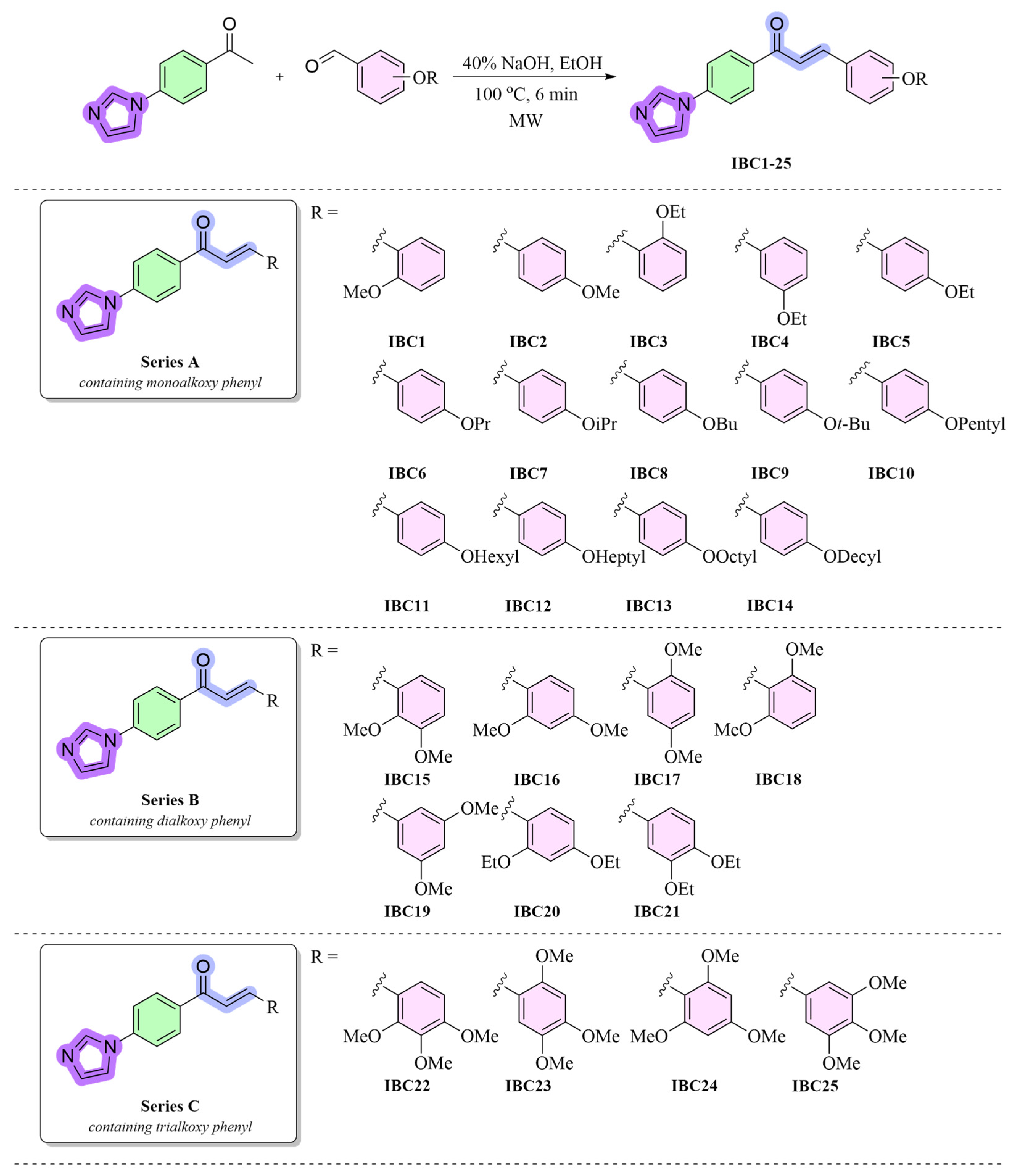
2.1. Design Strategy and Chemistry
2.2. Antibacterial and Antifungal Activity Evaluation
2.2.1. Determination of Minimum Inhibitory Concentrations (MIC)
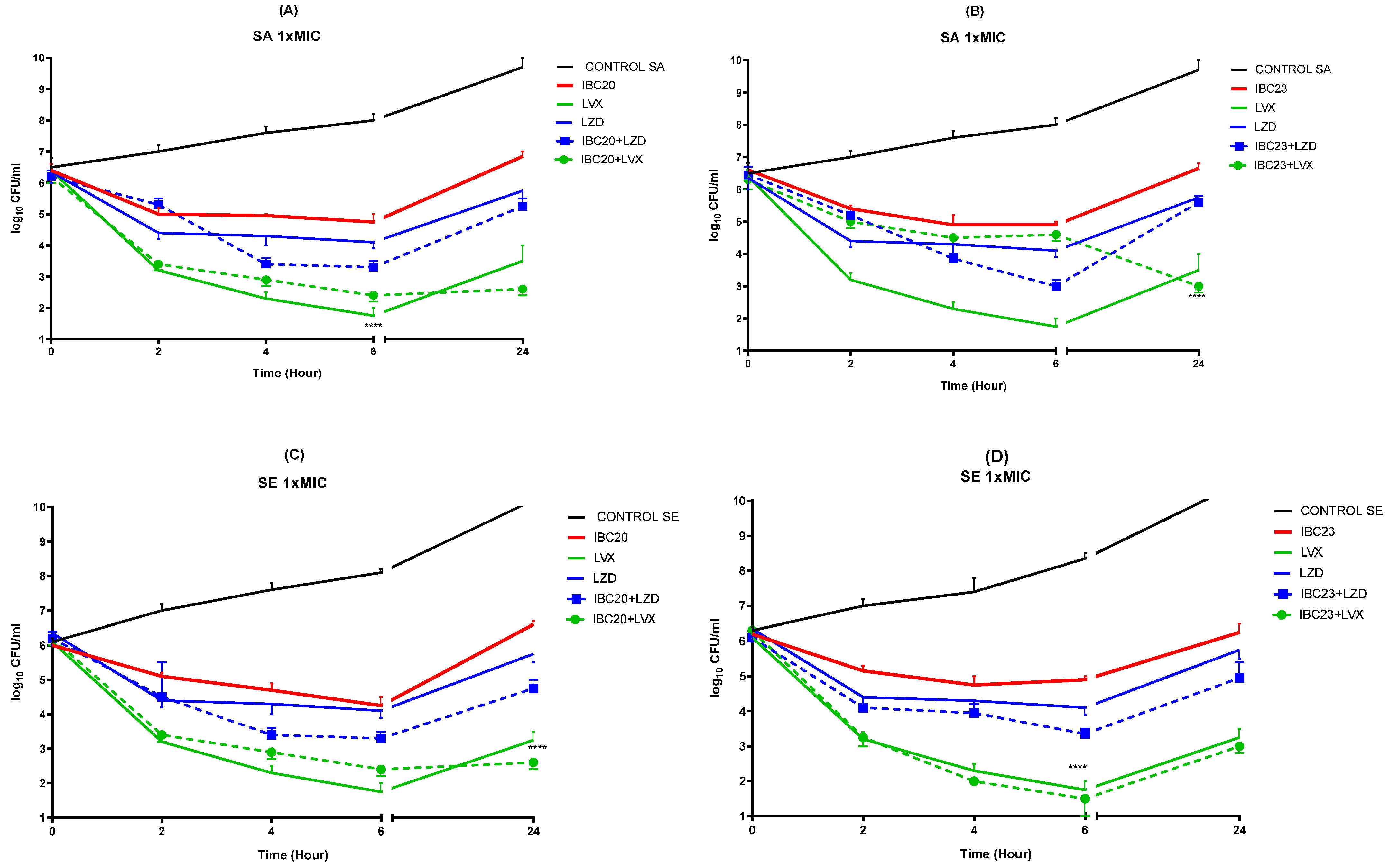
2.2.2. Determination of Time-Kill Curve Kinetic Study
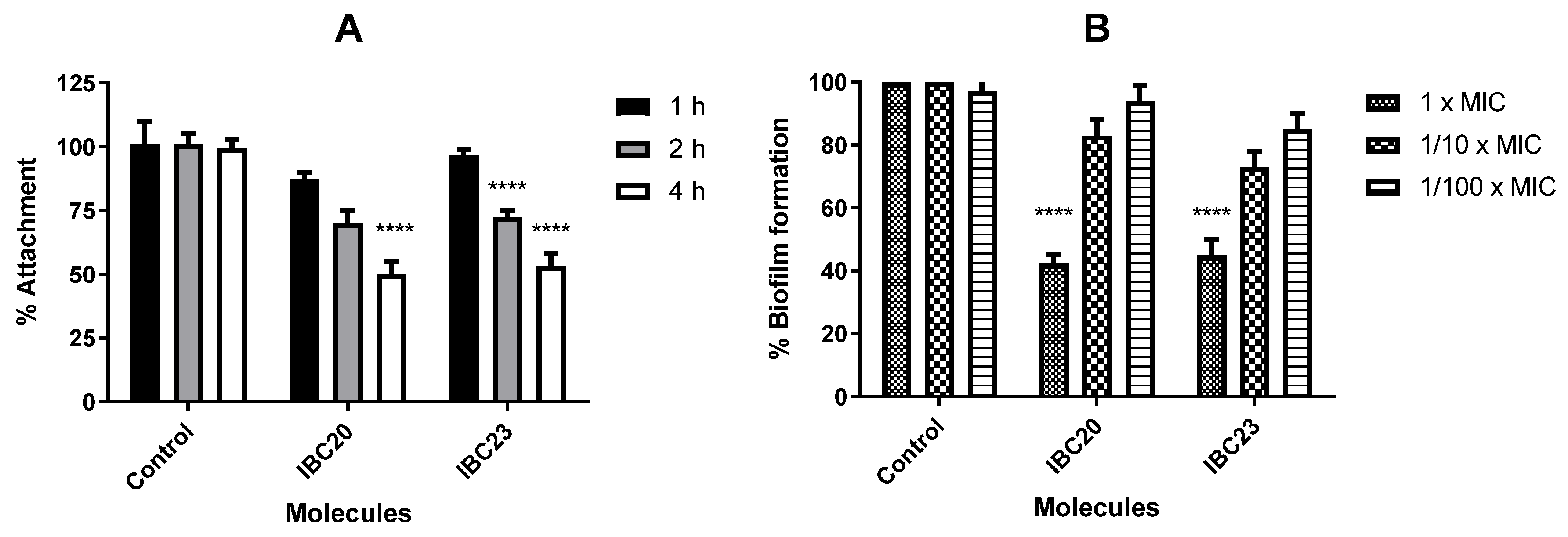
2.2.3. Evaluation of the In Vitro Antibiofilm Activity
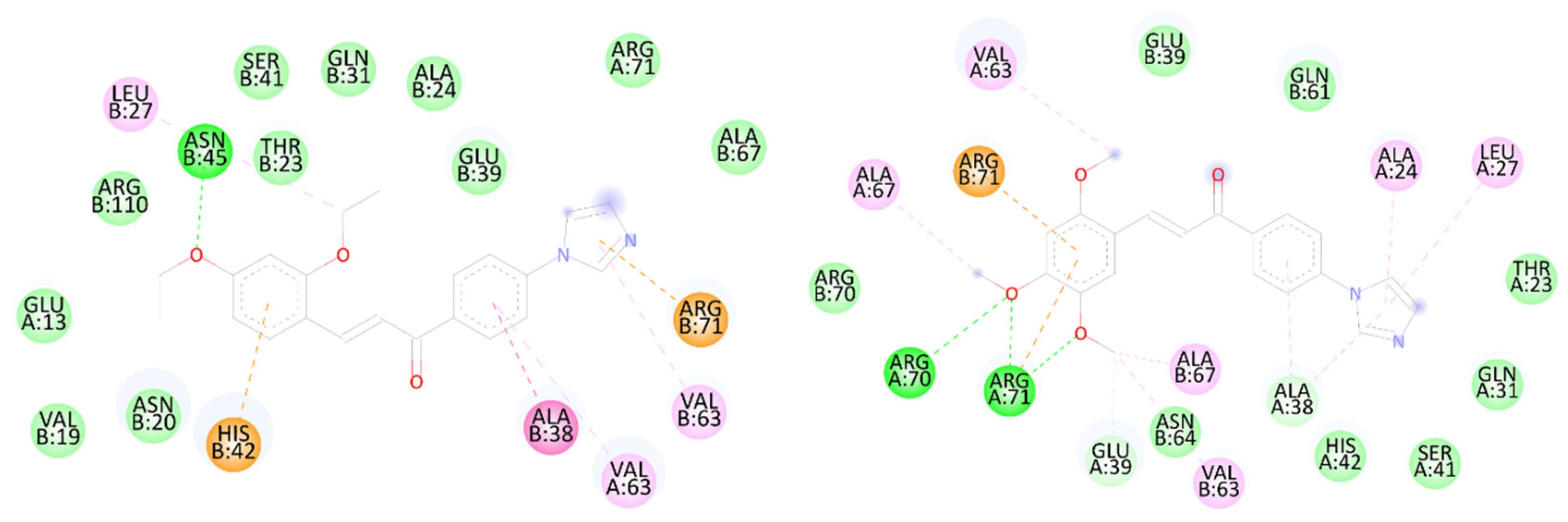
2.2.4. In Silico Molecular Docking Studies
2.2.5. In Silico Drug-Likeness and ADME Analysis
3. Conclusions
4. Experimental
4.1. Chemicals and Apparatus
4.2. General Procedure for the Synthesis of the Imidazole-Based Chalcones (IBC1-25)
4.2.1. 1-(4-(1H-Imidazol-1-yl)phenyl)-3-(2-methoxyphenyl)prop-2-en-1-one (IBC1) [35]
4.2.2. 1-(4-(1H-Imidazol-1-yl)phenyl)-3-(4-methoxyphenyl)prop-2-en-1-one (IBC2) [35]
4.2.3. 1-(4-(1H-Imidazol-1-yl)phenyl)-3-(2-ethoxyphenyl)prop-2-en-1-one (IBC3)
4.2.4. 1-(4-(1H-Imidazol-1-yl)phenyl)-3-(3-ethoxyphenyl)prop-2-en-1-one (IBC4)
4.2.5. 1-(4-(1H-Imidazol-1-yl)phenyl)-3-(4-ethoxyphenyl)prop-2-en-1-one (IBC5)
4.2.6. 1-(4-(1H-imidazol-1-yl)phenyl)-3-(4-propoxyphenyl)prop-2-en-1-one (IBC6)
4.2.7. 1-(4-(1H-imidazol-1-yl)phenyl)-3-(4-isopropoxyphenyl)prop-2-en-1-one (IBC7)
4.2.8. 1-(4-(1H-imidazol-1-yl)phenyl)-3-(4-butoxyphenyl)prop-2-en-1-one (IBC8)
4.2.9. 1-(4-(1H-imidazol-1-yl)phenyl)-3-(4-(tert-butoxy)phenyl)prop-2-en-1-one (IBC9)
4.2.10. 1-(4-(1H-imidazol-1-yl)phenyl)-3-(4-(pentyloxy)phenyl)prop-2-en-1-one (IBC10)
4.2.11. 1-(4-(1H-imidazol-1-yl)phenyl)-3-(4-(hexyloxy)phenyl)prop-2-en-1-one (IBC11)
4.2.12. 1-(4-(1H-imidazol-1-yl)phenyl)-3-(4-(heptyloxy)phenyl)prop-2-en-1-one (IBC12)
4.2.13. 1-(4-(1H-imidazol-1-yl)phenyl)-3-(4-(octyloxy)phenyl)prop-2-en-1-one (IBC13)
4.2.14. 1-(4-(1H-imidazol-1-yl)phenyl)-3-(4-(decyloxy)phenyl)prop-2-en-1-one (IBC14)
4.2.15. 1-(4-(1H-imidazol-1-yl)phenyl)-3-(2,3-dimethoxyphenyl)prop-2-en-1-one (IBC15)
4.2.16. 1-(4-(1H-imidazol-1-yl)phenyl)-3-(2,4-dimethoxyphenyl)prop-2-en-1-one (IBC16) [51]
4.2.17. 1-(4-(1H-imidazol-1-yl)phenyl)-3-(2,5-dimethoxyphenyl)prop-2-en-1-one (IBC17)
4.2.18. 1-(4-(1H-imidazol-1-yl)phenyl)-3-(2,6-dimethoxyphenyl)prop-2-en-1-one (IBC18)
4.2.19. 1-(4-(1H-imidazol-1-yl)phenyl)-3-(3,5-dimethoxyphenyl)prop-2-en-1-one (IBC19)
4.2.20. 1-(4-(1H-imidazol-1-yl)phenyl)-3-(2,4-diethoxyphenyl)prop-2-en-1-one (IBC20)
4.2.21. 1-(4-(1H-imidazol-1-yl)phenyl)-3-(3,4-diethoxyphenyl)prop-2-en-1-one (IBC21)
4.2.22. 1-(4-(1H-imidazol-1-yl)phenyl)-3-(2,3,4-trimethoxyphenyl)prop-2-en-1-one (IBC22)
4.2.23. 1-(4-(1H-imidazol-1-yl)phenyl)-3-(2,4,5-trimethoxyphenyl)prop-2-en-1-one (IBC23) [52]
4.2.24. 1-(4-(1H-imidazol-1-yl)phenyl)-3-(2,4,6-trimethoxyphenyl)prop-2-en-1-one (IBC24) [53]
4.2.25. 1-(4-(1H-imidazol-1-yl)phenyl)-3-(3,4,5-trimethoxyphenyl)prop-2-en-1-one (IBC25) [28]
4.3. Biological Studies
4.3.1. Determination of Biological Activity
4.3.2. Determination of Time-Kill Curves
4.3.3. Determination of the Antibiofilm Activity
4.3.4. Statistical Analysis
4.4. Molecular Docking, In Silico Drug-likeness, and ADMET Analysis
Supplementary Materials
Author Contributions
Funding
Institutional Review Board Statement
Informed Consent Statement
Data Availability Statement
Conflicts of Interest
References
- Olender, D.; Skóra, B.; Kasprzak, M.; Kujawski, J.; Sowa-Kasprzak, K.; Pawełczyk, A.; Muszalska-Kolos, I.; Szychowski, K.A. Carboxychalcones Based on Terephthalaldehydic Acid as Potential Neuroprotective Agents. Synthesis, Computational Study and Biological Evaluation. ACS Omega 2025, 10, 19860–19872. [Google Scholar] [CrossRef]
- Kong, Q.D.; Yang, Y.S. Recent advances in antibacterial agents. Bioorg. Med. Chem. Lett. 2021, 35, 127799. [Google Scholar] [CrossRef]
- Wright, G.D. Opportunities for natural products in 21st century antibiotic discovery. Nat. Prod. Rep. 2017, 34, 694–701. [Google Scholar] [CrossRef] [PubMed]
- Dai, J.; Han, R.; Xu, Y.; Li, N.; Wang, J.; Dan, W. Recent progress of antibacterial natural products: Future antibiotics candidates. Bioorg. Chem. 2020, 101, 103922. [Google Scholar] [CrossRef] [PubMed]
- De Vita, S.; Terracciano, S.; Bruno, I.; Chini, M.G. From Natural Compounds to Bioactive Molecules through NMR and In Silico Methodologies. Eur. J. Org. Chem. 2020, 2020, 6297–6317. [Google Scholar] [CrossRef]
- von Nussbaum, F.; Brands, M.; Hinzen, B.; Weigand, S.; Häbich, D. Antibacterial Natural Products in Medicinal Chemistry—Exodus or Revival? Angew. Chem. Int. Ed. 2006, 45, 5072–5129. [Google Scholar] [CrossRef]
- Kirst, H.A. Developing new antibacterials through natural product research. Expert Opin. Drug Discov. 2013, 8, 479–493. [Google Scholar] [CrossRef]
- Veve, M.P.; Wagner, J.L. Lefamulin: Review of a Promising Novel Pleuromutilin Antibiotic. Pharmacother. J. Hum. Pharmacol. Drug Ther. 2018, 38, 935–946. [Google Scholar] [CrossRef]
- Kappe, C.O. Controlled Microwave Heating in Modern Organic Synthesis. Angew. Chem. Int. Ed. 2004, 43, 6250–6284. [Google Scholar] [CrossRef]
- Kappe, C.O. My Twenty Years in Microwave Chemistry: From Kitchen Ovens to Microwaves that aren’t Microwaves. Chem. Rec. 2019, 19, 15–39. [Google Scholar] [CrossRef]
- Nain, S.; Singh, R.; Ravichandran, S. Importance of Microwave Heating In Organic Synthesis. Adv. J. Chem. Sect. A 2019, 2, 94–104. [Google Scholar] [CrossRef]
- Mazumder, R.; Ichudaule; Ghosh, A.; Deb, S.; Ghosh, R. Significance of Chalcone Scaffolds in Medicinal Chemistry. Top. Curr. Chem. 2024, 382, 22. [Google Scholar] [CrossRef]
- Mezgebe, K.; Melaku, Y.; Mulugeta, E. Synthesis and Pharmacological Activities of Chalcone and Its Derivatives Bearing N-Heterocyclic Scaffolds: A Review. ACS Omega 2023, 8, 19194–19211. [Google Scholar] [CrossRef] [PubMed]
- Homerin, G.; Nica, A.S.; Farce, A.; Dubois, J.; Ghinet, A. Ultrasounds-mediated 10-seconds synthesis of chalcones as potential farnesyltransferase inhibitors. Bioorg. Med. Chem. Lett. 2020, 30, 127149. [Google Scholar] [CrossRef] [PubMed]
- Yadav, A.; Sharma, V.; Singh, G. Anti-Inflammatory Potential of Chalcone Related Compounds: An Updated Review. Chemistryselect 2024, 9, e202401321. [Google Scholar] [CrossRef]
- WalyEldeen, A.A.; Sabet, S.; El-Shorbagy, H.M.; Abdelhamid, I.A.; Ibrahim, S.A. Chalcones: Promising therapeutic agents targeting key players and signaling pathways regulating the hallmarks of cancer. Chem.-Biol. Interact. 2023, 369, 110297. [Google Scholar] [CrossRef]
- Rammohan, A.; Reddy, J.S.; Sravya, G.; Rao, C.N.; Zyryanov, G.V. Chalcone synthesis, properties and medicinal applications: A review. Environ. Chem. Lett. 2020, 18, 433–458. [Google Scholar] [CrossRef]
- Batovska, D.I.; Todorova, I.T. Trends in utilization of the pharmacological potential of chalcones. Curr. Clin. Pharmacol. 2010, 5, 1–29. [Google Scholar] [CrossRef]
- Zhuang, C.; Zhang, W.; Sheng, C.; Zhang, W.; Xing, C.; Miao, Z. Chalcone: A Privileged Structure in Medicinal Chemistry. Chem. Rev. 2017, 117, 7762–7810. [Google Scholar] [CrossRef]
- Chen, J.; Li, Y.; Yang, L.-Q.; Li, Y.-Z.; Nan, Z.-B.; Gao, K. Biological activities of flavonoids from pathogenic-infected Astragalus adsurgens. Food Chem. 2012, 131, 546–551. [Google Scholar] [CrossRef]
- Kabir, E.; Uzzaman, M. A review on biological and medicinal impact of heterocyclic compounds. Results Chem. 2022, 4, 100606. [Google Scholar] [CrossRef]
- Kalaria, P.N.; Karad, S.C.; Raval, D.K. A review on diverse heterocyclic compounds as the privileged scaffolds in antimalarial drug discovery. Eur. J. Med. Chem. 2018, 158, 917–936. [Google Scholar] [CrossRef]
- Singh, A.; Debnath, R.; Chawla, V.; Chawla, P.A. Heterocyclic compounds as xanthine oxidase inhibitors for the management of hyperuricemia: Synthetic strategies, structure–activity relationship and molecular docking studies (2018–2024). RSC Med. Chem. 2024, 15, 1849–1876. [Google Scholar] [CrossRef]
- Choudhary, D.; Kumar, B.; Chandrasekaran, B.; Singh, T.G.; Kaur, R.; Aldahish, A.; Vasudevan, R.; Balaji, P. Microwave-Assisted Synthesis of Morpholine-Based Chalcones as Reversible MAO-A Inhibitors in the Management of Mental Depression. Pharmaceuticals 2025, 18, 309. [Google Scholar] [CrossRef]
- Tomar, V.; Bhattacharjee, G.; Kamaluddin; Ashok, K. Synthesis and antimicrobial evaluation of new chalcones containing piperazine or 2,5-dichlorothiophene moiety. Bioorg. Med. Chem. Lett. 2007, 17, 5321–5324. [Google Scholar] [CrossRef] [PubMed]
- Thillainayagam, M.; Anbarasu, A.; Ramaiah, S. Comparative molecular field analysis and molecular docking studies on novel aryl chalcone derivatives against an important drug target cysteine protease in Plasmodium falciparum. J. Theor. Biol. 2016, 403, 110–128. [Google Scholar] [CrossRef]
- Liu, X.L.; Xu, Y.J.; Go, M.L. Functionalized chalcones with basic functionalities have antibacterial activity against drug sensitive Staphylococcus aureus. Eur. J. Med. Chem. 2008, 43, 1681–1687. [Google Scholar] [CrossRef] [PubMed]
- Awasthi, S.K.; Mishra, N.; Kumar, B.; Sharma, M.; Bhattacharya, A.; Mishra, L.C.; Bhasin, V.K. Potent antimalarial activity of newly synthesized substituted chalcone analogs in vitro. Med. Chem. Res. 2009, 18, 407–420. [Google Scholar] [CrossRef]
- Li, J.; Li, D.; Xu, Y.; Guo, Z.; Liu, X.; Yang, H.; Wu, L.; Wang, L. Design, synthesis, biological evaluation, and molecular docking of chalcone derivatives as anti-inflammatory agents. Bioorg. Med. Chem. Lett. 2017, 27, 602–606. [Google Scholar] [CrossRef]
- Taylor, A.E.; Hering, M.; Elsegood, M.R.J.; Teat, S.J.; Weaver, G.W.; Arroo, R.R.J.; Kaiser, M.; Maeser, P.; Bhambra, A.S. Novel 4-[4-(4-methylpiperazin-1-yl)phenyl]-6-arylpyrimidine derivatives and their antitrypanosomal activities against T.brucei. Bioorg. Med. Chem. Lett. 2024, 109, 129825. [Google Scholar] [CrossRef] [PubMed]
- Osmaniye, D.; Kaya Cavusoglu, B.; Saglik, B.N.; Levent, S.; Acar Cevik, U.; Atli, O.; Ozkay, Y.; Kaplancikli, Z.A. Synthesis and Anticandidal Activity of New Imidazole-Chalcones. Molecules 2018, 23, 831. [Google Scholar] [CrossRef]
- Ceyhun, İ.; Karaca, Ş.; Osmaniye, D.; Sağlık, B.N.; Levent, S.; Özkay, Y.; Kaplancıklı, Z.A. Design and synthesis of novel chalcone derivatives and evaluation of their inhibitory activities against acetylcholinesterase. Arch. Pharm. 2022, 355, e2100372. [Google Scholar] [CrossRef]
- Tabassum, K.; Ekta, P.; Kavitkumar, P. Imidazole and Pyrazole: Privileged Scaffolds for Anti-Infective Activity. Mini-Rev. Org. Chem. 2018, 15, 459–475. [Google Scholar] [CrossRef]
- Karaj, E.; Dlamini, S.; Koranne, R.; Sindi, S.H.; Perera, L.; Taylor, W.R.; Viranga Tillekeratne, L.M. Pharmacophore optimization of imidazole chalcones to modulate microtubule dynamics. Bioorg. Chem. 2022, 122, 105700. [Google Scholar] [CrossRef]
- Hussain, T.; Zia-ur-Rehman, M.; Zaheer, M.; Ashraf, C.M.; Bolte, M. 1-[4-(1H-Imidazol-1-yl)Phenyl]-3-Phenylprop-2-En-1-Ones—A Potential Pharmacophore Bearing Anti-Leishmanial Activity. J. Chem. Res. 2016, 40, 199–204. [Google Scholar] [CrossRef]
- Elkanzi, N.A.A.; Hrichi, H.; Alolayan, R.A.; Derafa, W.; Zahou, F.M.; Bakr, R.B. Synthesis of Chalcones Derivatives and Their Biological Activities: A Review. ACS Omega 2022, 7, 27769–27786. [Google Scholar] [CrossRef] [PubMed]
- Mulani, M.S.; Kamble, E.E.; Kumkar, S.N.; Tawre, M.S.; Pardesi, K.R. Emerging Strategies to Combat ESKAPE Pathogens in the Era of Antimicrobial Resistance: A Review. Front. Microbiol. 2019, 10, 539. [Google Scholar] [CrossRef]
- Saravolatz, L.D.; Pawlak, J. In vitro activity of fosfomycin alone and in combination against Staphylococcus aureus with reduced susceptibility or resistance to methicillin, vancomycin, daptomycin or linezolid. J. Antimicrob. Chemother. 2022, 78, 238–241. [Google Scholar] [CrossRef]
- Peris, M.C.; Martínez, A.; Ortíz, M.P.; Sheth, C.C.; Veses, V. Icariin in Combination with Amoxycillin-Clavulanate and Ampicillin, but Not Vancomycin, Increases Antibiotic Sensitivity and Growth Inhibition against Methicillin-Resistant Staphylococcus aureus. Antibiotics 2022, 11, 233. [Google Scholar] [CrossRef]
- Ledger, E.V.K.; Sabnis, A.; Edwards, A.M. Polymyxin and lipopeptide antibiotics: Membrane-targeting drugs of last resort. Microbiology 2022, 168, 001136. [Google Scholar] [CrossRef]
- Lázár, V.; Snitser, O.; Barkan, D.; Kishony, R. Antibiotic combinations reduce Staphylococcus aureus clearance. Nature 2022, 610, 540–546. [Google Scholar] [CrossRef]
- Roy, R.; Tiwari, M.; Donelli, G.; Tiwari, V. Strategies for combating bacterial biofilms: A focus on anti-biofilm agents and their mechanisms of action. Virulence 2018, 9, 522–554. [Google Scholar] [CrossRef] [PubMed]
- Fey, P.D.; Olson, M.E. Current concepts in biofilm formation of Staphylococcus epidermidis. Future Microbiol. 2010, 5, 917–933. [Google Scholar] [CrossRef] [PubMed]
- Arciola, C.R.; Campoccia, D.; Montanaro, L. Implant infections: Adhesion, biofilm formation and immune evasion. Nat. Rev. Microbiol. 2018, 16, 397–409. [Google Scholar] [CrossRef]
- Lovering, A.L.; Lin, L.Y.; Sewell, E.W.; Spreter, T.; Brown, E.D.; Strynadka, N.C. Structure of the bacterial teichoic acid polymerase TagF provides insights into membrane association and catalysis. Nat. Struct. Mol. Biol. 2010, 17, 582–589. [Google Scholar] [CrossRef] [PubMed]
- Chang, Y.-M.; Jeng, W.-Y.; Ko, T.-P.; Yeh, Y.-J.; Chen, C.K.-M.; Wang, A.H.-J. Structural study of TcaR and its complexes with multiple antibiotics from Staphylococcus epidermidis. Proc. Natl. Acad. Sci. USA 2010, 107, 8617–8622. [Google Scholar] [CrossRef]
- Vuppala, S.; Kim, J.; Joo, B.S.; Choi, J.M.; Jang, J. A Combination of Pharmacophore-Based Virtual Screening, Structure-Based Lead Optimization, and DFT Study for the Identification of S. epidermidis TcaR Inhibitors. Pharmaceuticals 2022, 15, 635. [Google Scholar] [CrossRef]
- Tong, S.Y.C.; Davis, J.S.; Eichenberger, E.; Holland, T.L.; Fowler, V.G. Staphylococcus aureus Infections: Epidemiology, Pathophysiology, Clinical Manifestations, and Management. Clin. Microbiol. Rev. 2015, 28, 603–661. [Google Scholar] [CrossRef]
- Nandhini, P.; Kumar, P.; Mickymaray, S.; Alothaim, A.S.; Somasundaram, J.; Rajan, M. Recent Developments in Methicillin-Resistant Staphylococcus aureus (MRSA) Treatment: A Review. Antibiotics 2022, 11, 606. [Google Scholar] [CrossRef]
- Dadgostar, P. Antimicrobial Resistance: Implications and Costs. Infect. Drug Resist. 2019, 12, 3903–3910. [Google Scholar] [CrossRef]
- Yadav, N.; Dixit, S.K.; Bhattacharya, A.; Mishra, L.C.; Sharma, M.; Awasthi, S.K.; Bhasin, V.K. Antimalarial activity of newly synthesized chalcone derivatives in vitro. Chem. Biol. Drug Des. 2012, 80, 340–347. [Google Scholar] [CrossRef] [PubMed]
- Ravindra, M.V.; Suvarna, S.; Kumar, C.S.A. Synthesis of N-Acetyl-3,5-Diaryl-2-pyrazolines from Natural Precursor 2,4,5-Trimethoxy Benzaldehyde (Asaronaldehyde): An Anticancer Studies. Russ. J. Org. Chem. 2023, 59, S84–S93. [Google Scholar] [CrossRef]
- Fu, D.-J.; Li, J.-H.; Li, P.; Cui, Z.-W.; Zhang, S.-Y.; Li, J.-F. Antiproliferative Evaluation In Vitro of a New Chalcone Inducing Apoptosis by ROS Generation Against MGC-803 Cells. Pharm. Chem. J. 2019, 53, 539–543. [Google Scholar] [CrossRef]
- M100-ED35; Performance Standards for Antimicrobial Susceptibility Testing. Clinical and Laboratory Standards Institute (CLSI): Wayne, PA, USA, 2025.
- CLSI M27; Reference Method for Broth Dilution Antifungal Susceptibility Testing of Yeasts. Clinical and Laboratory Standards Institute (CLSI): Wayne, PA, USA, 2022.
- CLSI M26; Methods for Determining Bactericidal Activity of Antimicrobial Agents. National Committee for Clinical Laboratory Standards (NCCLS): Wayne, PA, USA, 1999.
- Kara, E.M.; Bayrak, N.; Yildirim, H.; Yildiz, M.; Celik, B.O.; Tuyun, A.F. Chlorinated plastoquinone analogs that inhibit Staphylococcus epidermidis and Candida albicansgrowth. Folia Microbiol. 2020, 65, 785–795. [Google Scholar] [CrossRef] [PubMed]
- Mataraci, E.; Dosler, S. In Vitro Activities of Antibiotics and Antimicrobial Cationic Peptides Alone and in Combination against Methicillin-Resistant Staphylococcus aureus Biofilms. Antimicrob. Agents Chemother. 2012, 56, 6366–6371. [Google Scholar] [CrossRef]
- Eberhardt, J.; Santos-Martins, D.; Tillack, A.F.; Forli, S. AutoDock Vina 1.2.0: New Docking Methods, Expanded Force Field, and Python Bindings. J. Chem. Inf. Model. 2021, 61, 3891–3898. [Google Scholar] [CrossRef]
- Trott, O.; Olson, A.J. AutoDock Vina: Improving the speed and accuracy of docking with a new scoring function, efficient optimization, and multithreading. J. Comput. Chem. 2010, 31, 455–461. [Google Scholar] [CrossRef]
- Hanwell, M.D.; Curtis, D.E.; Lonie, D.C.; Vandermeersch, T.; Zurek, E.; Hutchison, G.R. Avogadro: An advanced semantic chemical editor, visualization, and analysis platform. J. Cheminform. 2012, 4, 17. [Google Scholar] [CrossRef]
- Dassault Systèmes. BIOVIA Discovery Studio Visualizer v.21.1.0; Dassault Systèmes: Vélizy-Villacoublay, France, 2017. [Google Scholar]
- Daina, A.; Michielin, O.; Zoete, V. SwissADME: A free web tool to evaluate pharmacokinetics, drug-likeness and medicinal chemistry friendliness of small molecules. Sci. Rep. 2017, 7, 42717. [Google Scholar] [CrossRef]



| IDs | Microorganisms | ||||||||||
| Gram-Negative Bacteria (MIC, μg/mL) | Gram-Positive Bacteria (MIC, μg/mL) | Fungi (MIC, μg/mL) | |||||||||
| P. aeruginosa | E. coli | K. pneumoniae | P. mirabilis | S. aureus | S. epidermidis | E. faecalis | C. albicans | C. parapsilosis | C. tropicalis | ||
| Monoalkoxy Substituted | IBC1 | - | - | - | - | - | - | - | - | - | - |
| IBC2 | - | - | - | - | - | - | - | - | - | - | |
| IBC3 | - | - | - | - | - | - | - | 312.50 | - | - | |
| IBC4 | - | - | - | - | - | - | - | 312.50 | - | - | |
| IBC5 | 625 | 312.50 | - | - | 19.53 | 39.06 | - | 156.25 | 78.12 | - | |
| IBC6 | - | - | - | - | - | - | - | - | - | - | |
| IBC7 | - | - | - | - | - | - | - | - | - | - | |
| IBC8 | - | - | - | - | - | - | - | - | - | - | |
| IBC9 | - | - | - | - | - | - | - | - | - | - | |
| IBC10 | - | - | - | - | - | - | - | 312.50 | 625 | - | |
| IBC11 | - | - | - | - | - | - | - | - | - | - | |
| IBC12 | - | - | - | - | - | - | - | - | - | - | |
| IBC13 | - | - | - | - | - | - | - | - | - | - | |
| IBC14 | - | - | - | - | - | - | - | - | - | - | |
| Dialkoxy Substituted | IBC15 | - | 625 | - | - | - | - | - | - | - | - |
| IBC16 | - | - | - | - | - | - | - | - | - | - | |
| IBC17 | - | - | - | - | - | - | - | 156.25 | - | - | |
| IBC18 | 625 | 312.50 | - | - | 39.06 | 39.06 | - | 156.25 | 156.25 | - | |
| IBC19 | - | - | - | - | 125 | - | - | - | - | - | |
| IBC20 | - | 312.50 | 625 | - | 39.06 | 9.76 | - | 156.25 | 78.12 | 156.25 | |
| IBC21 | 625 | 625 | - | - | 39.06 | 39.06 | - | 156.25 | 156.25 | 39.06 | |
| Trialkoxy Substituted | IBC22 | - | - | - | - | 625 | - | - | 312.50 | 625 | - |
| IBC23 | 312.50 | 156.25 | 312.50 | - | 78.12 | 19.53 | 312.50 | 156.25 | 78.12 | - | |
| IBC24 | - | 625 | - | - | 19.53 | 156.25 | - | 156.25 | 78.12 | 39.06 | |
| IBC25 | - | - | - | - | 250 | - | - | - | - | - | |
| Reference Drugs | Ceftazidime | 2.44 | - | - | - | - | - | - | - | - | - |
| Cefuroxime-Na | - | 4.88 | 4.88 | 2.44 | 1.22 | - | - | - | - | - | |
| Cefuroxime | - | - | - | - | - | 9.76 | - | - | - | - | |
| Amikacin | - | - | - | - | - | - | 128 | - | - | - | |
| Clotrimazole | - | - | - | - | - | - | - | 4.88 | - | - | |
| Amphotericin B | - | - | - | - | - | - | - | - | 0.5 | 1 | |
| Code | Parameter | S. epidermidis TcaR PDB ID: 3KP4 | S. epidermidis Wall Teichoic Acid Polymerase TagF PDB ID: 3L7L |
| IBC20 | Estimated free energy of binding (kcal/mol) | −8.1 | −7.6 |
| IBC23 | Estimated free energy of binding (kcal/mol) | −7.9 | −7.7 |
| Cefuroxime | Estimated free energy of binding (kcal/mol) | −8.1 | −7.7 |
| Property | IBC20 | IBC23 |
|---|---|---|
| MW | 362 | 364 |
| TPSA (Å2) | 53.35 | 62.58 |
| HBA | 4 | 5 |
| HBD | 0 | 0 |
| XlogP3 | 4.21 | 3.35 |
| LogS | −4.62 | −4.21 |
| GI Absorption | High | High |
| BBB permanent | Yes | Yes |
| Pgp substrate | No | No |
| Lipinski | Yes (0 violation) | Yes (0 violation) |
| Ghose | Yes | Yes |
| Veber | Yes | Yes |
| Egan | Yes | Yes |
| Muegge | Yes | Yes |
| Bioavailability score | 0.55 | 0.55 |
| CYP1A2, CYP2C19, CYP2C9, CYP2D6, CYP3A4 | Yes, Yes, Yes, Yes, Yes | Yes, Yes, Yes, No, Yes |
Disclaimer/Publisher’s Note: The statements, opinions and data contained in all publications are solely those of the individual author(s) and contributor(s) and not of MDPI and/or the editor(s). MDPI and/or the editor(s) disclaim responsibility for any injury to people or property resulting from any ideas, methods, instructions or products referred to in the content. |
© 2026 by the authors. Licensee MDPI, Basel, Switzerland. This article is an open access article distributed under the terms and conditions of the Creative Commons Attribution (CC BY) license.
Share and Cite
Mammadov, E.; Bayrak, N.; Beyazit, N.; Mataraci-Kara, E.; TuYuN, A.F. Microwave-Assisted Synthesis of Imidazole-Based Chalcones: Modulating Antimicrobial Activity Through Alkoxy Substitutions. Antibiotics 2026, 15, 310. https://doi.org/10.3390/antibiotics15030310
Mammadov E, Bayrak N, Beyazit N, Mataraci-Kara E, TuYuN AF. Microwave-Assisted Synthesis of Imidazole-Based Chalcones: Modulating Antimicrobial Activity Through Alkoxy Substitutions. Antibiotics. 2026; 15(3):310. https://doi.org/10.3390/antibiotics15030310
Chicago/Turabian StyleMammadov, Elnar, Nilüfer Bayrak, Neslihan Beyazit, Emel Mataraci-Kara, and Amaç Fatih TuYuN. 2026. "Microwave-Assisted Synthesis of Imidazole-Based Chalcones: Modulating Antimicrobial Activity Through Alkoxy Substitutions" Antibiotics 15, no. 3: 310. https://doi.org/10.3390/antibiotics15030310
APA StyleMammadov, E., Bayrak, N., Beyazit, N., Mataraci-Kara, E., & TuYuN, A. F. (2026). Microwave-Assisted Synthesis of Imidazole-Based Chalcones: Modulating Antimicrobial Activity Through Alkoxy Substitutions. Antibiotics, 15(3), 310. https://doi.org/10.3390/antibiotics15030310