Etiologic Patterns and Evolution of Healthcare-Associated Infections in the Pandemic and Post-Pandemic Periods: A County-Level Multicenter Study from Southeastern Romania

 , , , , ,
Abstract
1. Introduction
2. Results
2.1. Demographic and Clinical Characteristics of the Patients
2.2. Type of Hospital Ward and Period of Hospitalization
2.3. Types of Healthcare-Associated Infections
2.4. Etiology of Healthcare-Associated Infections
2.5. Medical History and Prior Exposures Among CDI Patients
2.6. Discharge Status
2.7. Distribution of Patients by Ward Type and Etiology
2.8. Distribution of Patients by Discharge Status and Etiology
2.9. Mortality and Factors Associated with HAI-Attributable Death
3. Discussion
3.1. Demographic and Clinical Characteristics
3.2. Distribution of Cases Across Hospital Wards
3.3. Types of HAIs During and After the COVID-19 Pandemic
3.4. Etiology of Healthcare-Associated Infections
3.5. Clinical Progress and Discharge Status
3.6. Relationship Between HAIs and In-Hospital Mortality
3.7. Risk Factors for HAIs and Clostridioides Difficile Infection
3.8. Exposure to Antibiotics, Concurrent Treatments, and the Diagnosis of CDI
3.9. Limitations
4. Materials and Methods
4.1. Study Design and Population
4.2. Variables Analyzed
4.3. Statistical Analysis
4.4. Aims of the Study
4.5. Statement of Ethics
5. Conclusions
Author Contributions
Funding
Institutional Review Board Statement
Informed Consent Statement
Data Availability Statement
Conflicts of Interest
Abbreviations
| HAIs | Healthcare-associated infections |
| IQR | Interquartile range |
| p | p-value |
| ICU | Intensive care unit |
| CVC-associated infections | Central venous catheter-associated infections |
| PIVC-associated infections | Peripheral intravenous catheter-associated infections |
| CDI | Clostridioides difficile infection |
| GE | Gastroenteritis |
| UTI | Urinal tract infection |
| ED | Emergency department |
| PCR | Polymerase chain reaction |
| ECDC | European Centre for Disease Prevention and Control |
| IBM | International Business Machines |
| SPSS | Statistical Package for the Social Sciences |
| MDR infections | Multidrug-resistant infections |
| spp | Species |
| SARS-CoV-2 | Severe Acute Respiratory Syndrome Coronavirus 2 |
| COVID-19 | Coronavirus Disease 2019 |
| WHO | World Health Organization |
| AB | Antibiotherapy |
| Last 3M | Last 3 months |
References
- Abubakar, U.; Awaisu, A.; Khan, A.H.; Alam, K. Impact of COVID-19 pandemic on healthcare-associated infections: A systematic review and meta-analysis. Antibiotics 2023, 12, 1600. [Google Scholar] [CrossRef]
- Dobrović, K.; Škrobo, T.; Selec, K.; Jelić, M.; Čivljak, R.; Peršec, J.; Sakan, S.; Bušić, N.; Mihelčić, A.; Hleb, S.; et al. Healthcare-associated bloodstream infections due to multidrug-resistant Acinetobacter baumannii in a COVID-19 intensive care unit: A single-center retrospective study. Microorganisms 2023, 11, 774. [Google Scholar] [CrossRef]
- Mateescu, D.M.; Ilie, A.C.; Cotet, I.; Guse, C.; Muresan, C.O.; Pah, A.M.; Badalica-Petrescu, M.; Iurciuc, S.; Craciun, M.-L.; Avram, A.; et al. Global burden of bloodstream infections in COVID-19: Prevalence, antimicrobial resistance, and mortality risk. Viruses 2025, 17, 1353. [Google Scholar] [CrossRef] [PubMed]
- Coman, A.; Pop, D.; Mureșan, F.; Oprescu, F.; Fjaagesund, S. Surveillance and reporting of hospital-associated infections: A document analysis of Romanian healthcare legislation evolution over 20 years. Healthcare 2025, 13, 229. [Google Scholar] [CrossRef] [PubMed]
- Hashad, N.; Stewart, D.; Perumal, D.; Abdulrazzaq, N.; Tonna, A.P. Impact of COVID-19 on antimicrobial stewardship programme implementation in hospitals: An exploration informed by the Consolidated Framework for Implementation Research. J. Hosp. Infect. 2022, 129, 144–152. [Google Scholar] [CrossRef] [PubMed]
- Voinea, C.; Mocanu, E.; Dantes, E.; Jurja, S.; Neculai, A.M.; Crăciun, A.; Rugina, S. Burden of healthcare-associated infections on mortality among COVID-19 hospitalized patients. J. Clin. Med. 2025, 14, 8279. [Google Scholar] [CrossRef]
- Montrucchio, G.; Grillo, F.; Balzani, E.; Gavanna, G.; Sales, G.; Bonetto, C.; Simonetti, U.; Zanierato, M.; Fanelli, V.; Filippini, C.; et al. Impact of multidrug-resistant bacteria in a cohort of COVID-19 critically ill patients: Data from a prospective observational study conducted in a high-antimicrobial-resistance-prevalence center. J. Clin. Med. 2025, 14, 410. [Google Scholar] [CrossRef]
- Voinea, C.; Mocanu, E.; Opariuc-Dan, C.; Dantes, E.; Gache, A.C.; Rugina, S. Global lessons from COVID-19: Regional variations in the management of hospital-acquired infections during and post-pandemic. J. Clin. Med. 2025, 14, 6654. [Google Scholar] [CrossRef]
- Isigi, S.S.; Parsa, A.D.; Alasqah, I.; Mahmud, I.; Kabir, R. Predisposing factors of nosocomial infections in hospitalized patients in the United Kingdom: Systematic review. JMIR Public Health Surveill. 2023, 9, e43743. [Google Scholar] [CrossRef]
- Raoofi, S.; Pashazadeh Kan, F.; Rafiei, S.; Hosseinipalangi, Z.; Noorani Mejareh, Z.; Khani, S.; Abdollahi, B.; Talab, F.S.; Sanaei, M.; Zarabi, F. Global prevalence of nosocomial infection: A systematic review and meta-analysis. PLoS ONE 2023, 18, e0274248. [Google Scholar] [CrossRef]
- Moolasart, V.; Srijareonvijit, C.; Charoenpong, L.; Kongdejsakda, W.; Anugulruengkitt, S.; Kulthanmanusorn, A.; Thienthong, V.; Usayaporn, S.; Kaewkhankhaeng, W.; Rueangna, O.; et al. Prevalence and risk factors of healthcare-associated infections among hospitalized pediatric patients: A point prevalence survey in Thailand, 2021. Children 2024, 11, 738. [Google Scholar] [CrossRef]
- Dias, S.P.; Brouwer, M.C.; van de Beek, D. Sex and gender differences in bacterial infections. Infect. Immun. 2022, 90, e00283-22. [Google Scholar] [CrossRef]
- Bârlean, M.C.; Scutariu, M.M.; Crețu, C.I.; Bobu, L.; Platon, A.L.; Tărăboanță-Gamen, A.; Macovei, G. Gender profile of healthcare-associated infections in Oral and Maxillofacial Surgery Clinic Iași (2011–2018). Rom. J. Oral Rehabil. 2023, 15, 4. [Google Scholar]
- Stewart, S.; Robertson, C.; Pan, J.; Kennedy, S.; Haahr, L.; Manoukian, S.; Mason, H.; Kavanagh, K.; Graves, N.; Dancer, S.; et al. Impact of healthcare-associated infection on length of stay. J. Hosp. Infect. 2021, 114, 23–31. [Google Scholar] [CrossRef] [PubMed]
- Bedada, A.T.; Imana, R.Y.; Wodajeneh, H.B. Prevalence and associated factors of hospital-acquired infection among surgical patients at Adama Hospital Medical College, Ethiopia. Sci. Rep. 2025, 15, 45003. [Google Scholar] [CrossRef]
- Iancu, D.; Moldovan, I.; Țilea, B.; Voidăzan, S. Evaluating healthcare-associated infections in public hospitals: A cross-sectional study. Antibiotics 2023, 12, 1693. [Google Scholar] [CrossRef]
- Vasile, C.C.; Gheorghe, L.A.; Chivu, C.D.; Anghel, M.A.M.; Mîinea, Ș.E.; Pițigoi, D.; Crăciun, M.-D. Clostridioides difficile infections and antibiotherapy: Results of four years of observation in a Romanian tertiary hospital. Microorganisms 2024, 12, 2490. [Google Scholar] [CrossRef] [PubMed]
- Despotovic, A.; Milosevic, B.; Cirkovic, A.; Vujovic, A.; Cucanic, K.; Cucanic, T.; Stevanovic, G. Impact of COVID-19 on the profile of hospital-acquired infections in adult intensive care units. Antibiotics 2021, 10, 1146. [Google Scholar] [CrossRef]
- Martins, C.; Lima, D.; Cortez Ferreira, M.; Verdelho Andrade, J.; Dias, A. Healthcare-associated infections in pediatric patients: A decade of experience in an intensive care unit. Acta Med. Port. 2025, 38, 23–31. [Google Scholar] [CrossRef]
- Dashti, A.S.; Kadivar, M.R.; Tabatabai, A.; Zand, F.; Salami, S.; Ezadpanah, S.; Shirvani, F.; Seifi, K.; Zarei, N. Prevalence of healthcare-associated infections in pediatric wards of Namazee Teaching Hospital in Shiraz: A Comparison with the Whole Hospital. Arch. Pediatr. Infect. Dis. 2019, 7, e83488. [Google Scholar]
- Gajic, I.; Jovicevic, M.; Popadic, V.; Trudic, A.; Kabic, J.; Kekic, D.; Ilic, A.; Klasnja, S.; Hadnadjev, M.; Popadic, D.; et al. Emergence of multidrug-resistant bacteria causing healthcare-associated infections in COVID-19 patients: A retrospective multicentre study. J. Hosp. Infect. 2023, 137, 1–7. [Google Scholar] [CrossRef]
- Hlinkova, S.; Moraucikova, E.; Lesnakova, A.; Strzelecka, A.; Littva, V. Central line associated bloodstream infections in critically ill patients during and before the COVID-19 pandemic. Healthcare 2023, 11, 2415. [Google Scholar] [CrossRef]
- Wicky, P.H.; Dupuis, C.; Cerf, C.; Siami, S.; Cohen, Y.; Laurent, V.; Mourvillier, B.; Reignier, J.; Goldgran-Toledano, D.; Schwebel, C.; et al. Ventilator-associated pneumonia in COVID-19 patients admitted to intensive care units: Relapse, therapeutic failure and attributable mortality—A multicentric observational study from the OutcomeRea Network. J. Clin. Med. 2023, 12, 1298. [Google Scholar] [CrossRef]
- Ganam, S.; Sher, T.; Assy, R.; Bickel, A.; Khoury, A.; Ronit, L.; Kakiashvili, E. Assessing the impact of enhanced hygiene precautions during the COVID-19 pandemic on surgical site infection risk in abdominal surgeries. BMC Surg. 2024, 24, 253. [Google Scholar] [CrossRef] [PubMed]
- Werneburg, G.T. Catheter-associated urinary tract infections: Current challenges and future prospects. Res. Rep. Urol. 2022, 14, 109–133. [Google Scholar] [CrossRef] [PubMed]
- Alshammari, I.T.; Alruwaili, Y. Prevalence, microbiological profile, and risk factors of healthcare-associated infections in intensive care units: A retrospective study in Aljouf, Saudi Arabia. Microorganisms 2025, 13, 1916. [Google Scholar] [CrossRef]
- Ponce-Alonso, M.; Sáez de la Fuente, J.; Rincón-Carlavilla, A.; Moreno-Núñez, P.; Martínez-García, L.; Escudero-Sánchez, R.; Pintor, S.; García-Fernández, S.; Cobo, J. Impact of the coronavirus disease 2019 (COVID-19) pandemic on nosocomial Clostridioides difficile infection. Infect. Control. Hosp. Epidemiol. 2021, 42, 406–410. [Google Scholar] [CrossRef]
- Kafazi, A.; Apostolopoulou, E.; Andreou, E.; Gavala, A.; Stefanidis, E.; Antoniadou, F.; Stylianou, C.; Katsoulas, T.; Myrianthefs, P. Device-associated infections in adult intensive care units: A prospective surveillance study. Acta Microbiol. Hell. 2025, 70, 15. [Google Scholar] [CrossRef]
- Hema, A.; Somé, S.A.; Kaboré, O.; Sanou, S.; Poda, A.; Meda, Z.C.; Ouedraogo, A.S.; Savadogo, L. Risk and outcomes of healthcare-associated infections in three hospitals in Bobo Dioulasso, Burkina Faso, 2022: A longitudinal study. PLoS ONE 2025, 20, e0307346. [Google Scholar] [CrossRef]
- Xie, L.; Xia, K.; Xu, X.; Zhu, M.; Li, H.; Wang, J.; Chen, M. Mortality burden and epidemiology of procedure- and device-related healthcare-associated infections in the United States, 1999–2023: A CDC WONDER analysis. Front. Public. Health 2025, 13, 1689828. [Google Scholar] [CrossRef] [PubMed]
- Slimings, C.; Riley, T.V. Antibiotics and healthcare facility-associated Clostridioides difficile infection: Systematic review and meta-analysis—2020 update. J. Antimicrob. Chemother. 2021, 76, 1676–1688. [Google Scholar] [CrossRef] [PubMed]
- Di Bella, S.; Sanson, G.; Monticelli, J.; Zerbato, V.; Principe, L.; Giuffrè, M.; Pipitone, G.; Luzzati, R. Clostridioides difficile infection: History, epidemiology, risk factors, prevention, clinical manifestations, treatment, and future options. Clin. Microbiol. Rev. 2024, 37, e00135-23. [Google Scholar] [CrossRef] [PubMed]
- Viprey, V.F.; Clark, E.; Davies, K.A. Diagnosis of Clostridioides difficile infection and impact of testing. J. Med. Microbiol. 2024, 73, 001939. [Google Scholar] [CrossRef] [PubMed]
- European Centre for Disease Prevention and Control. Point Prevalence Survey of Healthcare-Associated Infections and Antimicrobial Use in European Acute Care Hospitals, 2022–2023; Publications Office of the European Union: Luxembourg, 2024.



| Parameter (N, %) | Total | Pandemic | Post-Pandemic | p |
|---|---|---|---|---|
| N, % | 3929 (100%) | 1754 (44.6%) | 2175 (55.4%) | - |
| Age (Median (IQR)) | 67 (55–76) | 66 (55–75) | 68 (55–76) | 0.260 ** |
| Gender (Male) | 2051 (52.2%) | 961 (54.8%) | 1090 (50.1%) | 0.004 * |
| Environment (Urban) | 2722 (69.4%) | 1246 (71.2%) | 1476 (69.4%) | 0.028 * |
| Hospitalization period (Median (IQR)) | 15 (10–22) | 16 (10–24) | 14 (9–21) | <0.001 * |
| Discharge status | ||||
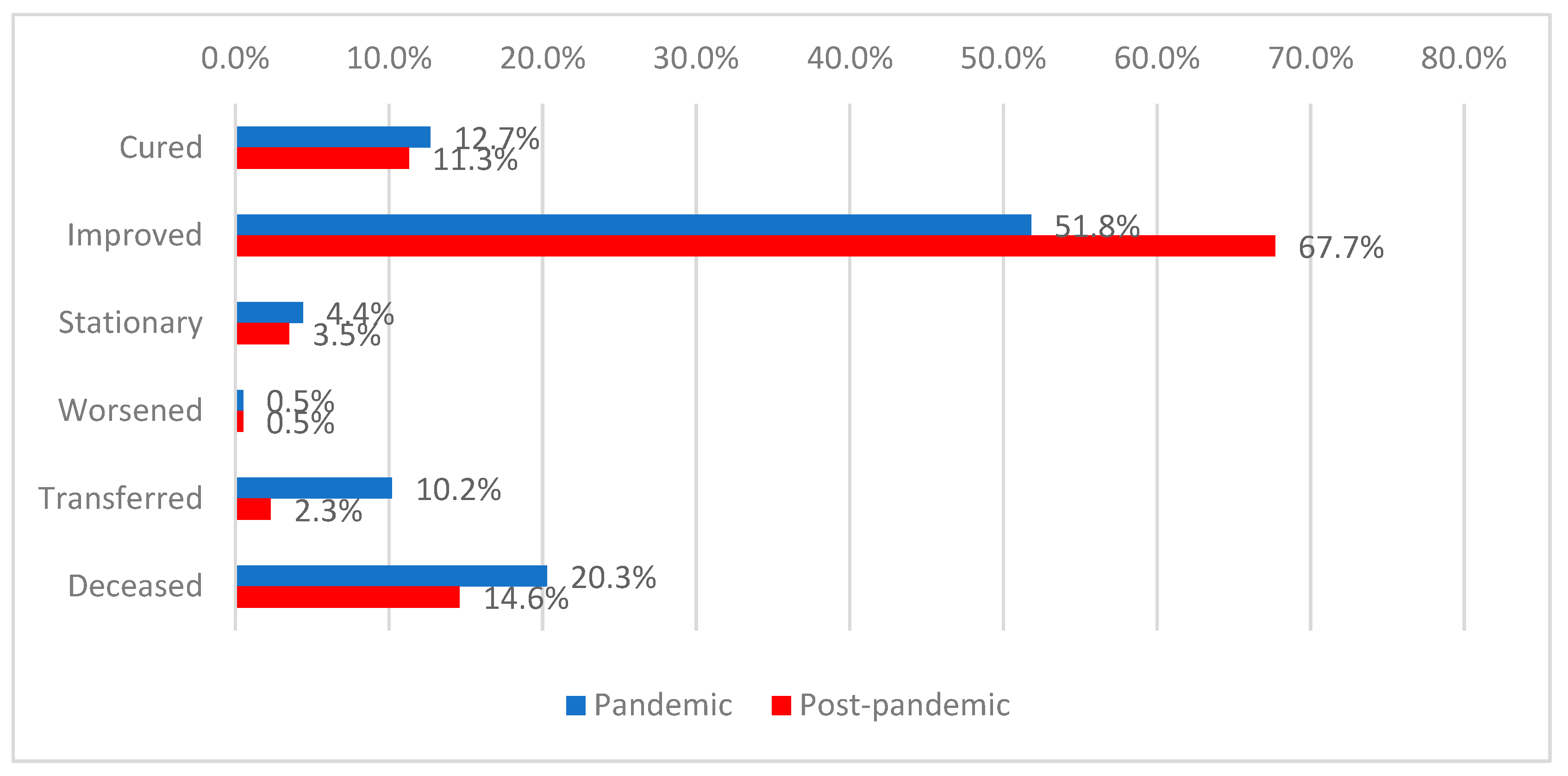
| Cured | 375 (12%) | 200 (12.7%) | 175 (11.3%) | <0.001 * |
| Improved | 1864 (59.7%) | 814 (51.8%) | 1050 (67.7%) | <0.001 * |
| Stationary | 125 (4%) | 69 (4.4%) | 55 (3.5%) | <0.001 * |
| Worsened | 16 (0.5%) | 8 (0.5%) | 8 (0.5%) | <0.001 * |
| Transferred | 196 (6.3%) | 160 (10.2%) | 36 (2.3%) | <0.001 * |
| Deceased | 545 (17.5%) | 319 (20.3%) | 226 (14.6%) | <0.001 * |
| Cause of death | ||||
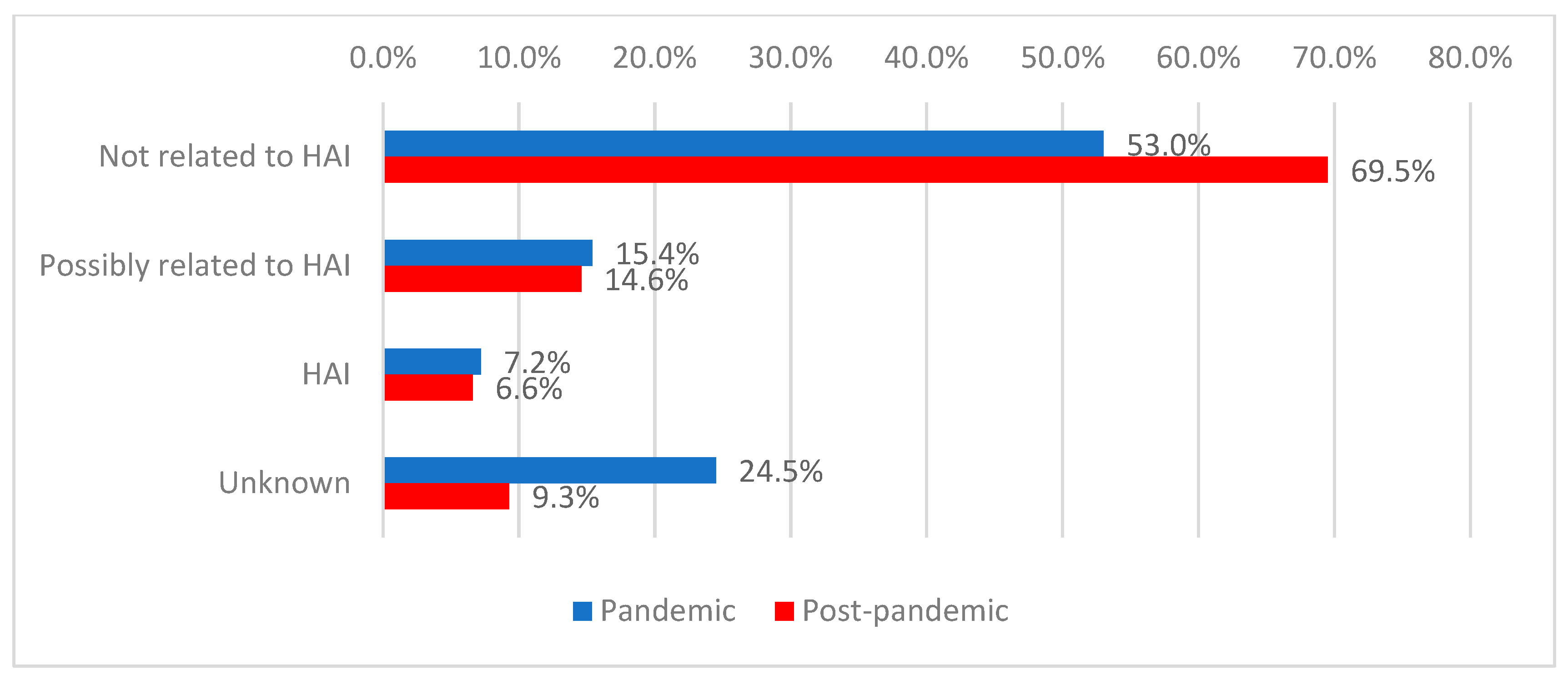
| Not related to HAIs | 326 (59.8%) | 169 (53%) | 157 (69.5%) | <0.001 * |
| Possibly related to HAIs | 82 (15%) | 49 (15.4%) | 33 (14.6%) | <0.001 * |
| HAIs | 38 (7%) | 23 (7.2%) | 15 (6.6%) | <0.001 * |
| Unknown | 99 (18.2%) | 78 (24.5%) | 21 (9.3%) | <0.001 * |
| HAI risk factors | ||||
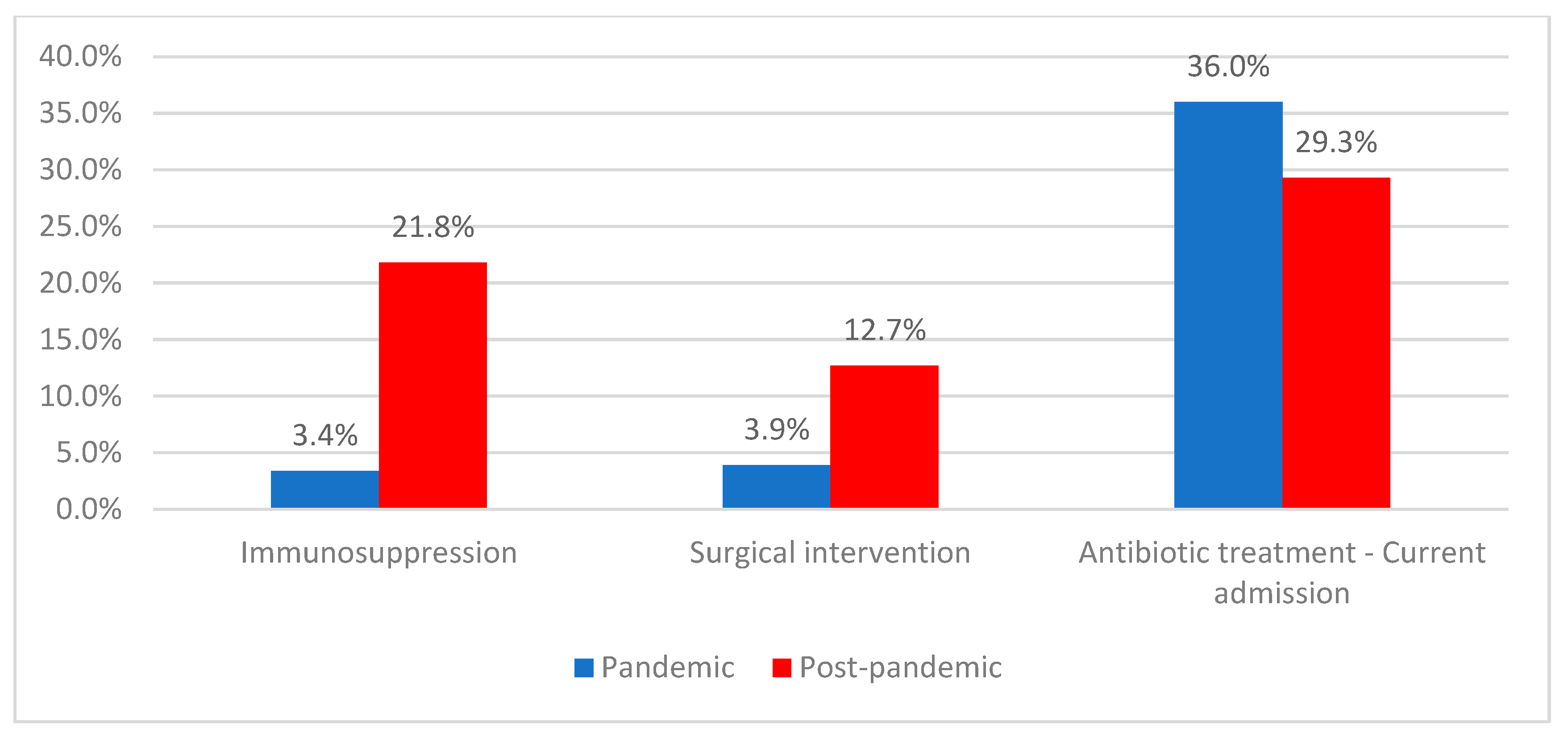
| Immunosuppression | 534 (13.6%) | 60 (3.4%) | 474 (21.8%) | <0.001 * |
| Surgical intervention | 346 (8.8%) | 69 (3.9%) | 277 (12.7%) | <0.001 * |
| Parameter (N, %) | Total | Pandemic | Post-Pandemic | p |
|---|---|---|---|---|
| N, % | 3929 (100%) | 1754 (44.6%) | 2175 (55.4%) | - |
| Section type | ||||
| ICU | 163 (4.1%) | 106 (6%) | 57 (2.6%) | <0.001 * |
| Medical | 3061 (77.9%) | 1339 (76.3%) | 1722 (79.2%) | <0.001 * |
| Surgical | 574 (14.6%) | 251 (14.3%) | 323 (14.9%) | <0.001 * |
| Pediatric | 109 (2.8%) | 51 (2.9%) | 58 (2.7%) | <0.001 * |
| Emergency department | 22 (0.6%) | 7 (0.4%) | 15 (0.7%) | <0.001 * |
| HAI type | ||||
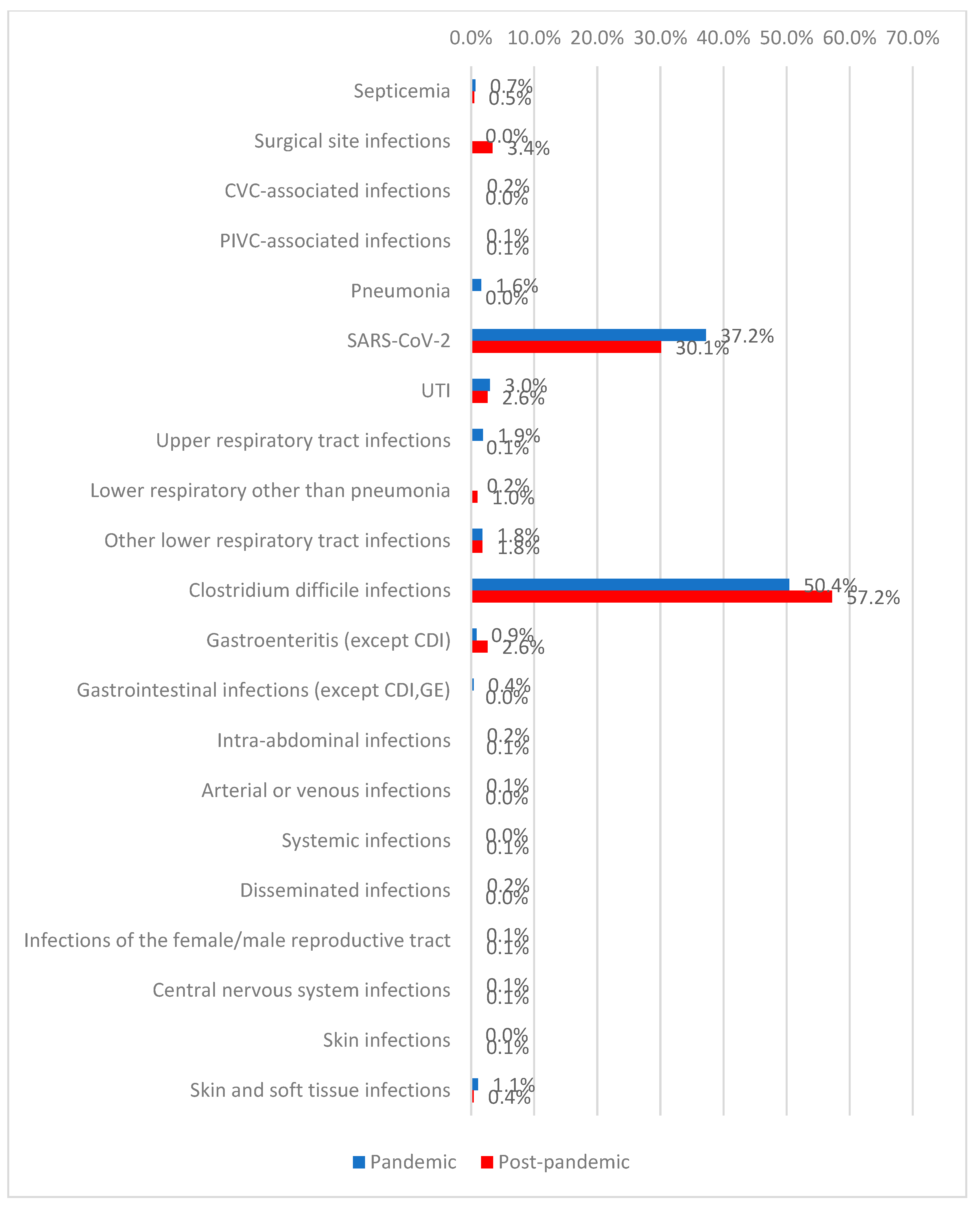
| Septicemia | 23 (0.6%) | 13 (0.7%) | 10 (0.5%) | <0.001 * |
| Surgical site infections | 73 (1.9%) | 0 (0%) | 73 (3.4%) | <0.001 * |
| CVC-associated infections | 3 (0.1%) | 3 (0.2%) | 0 (0%) | <0.001 * |
| PIVC-associated infections | 2 (0.1%) | 1 (0.1%) | 1 (0.1%) | <0.001 * |
| Pneumonia | 28 (0.7%) | 28 (1.6%) | 0 (0%) | <0.001 * |
| SARS-CoV-2 | 1306 (33.2%) | 652 (37.2%) | 654 (30.1%) | <0.001 * |
| UTI | 108 (2.7%) | 52 (3%) | 56 (2.6%) | <0.001 * |
| Upper respiratory tract infections | 36 (0.9%) | 33 (1.9%) | 3 (0.1%) | <0.001 * |
| Lower respiratory other than pneumonia | 25 (0.6%) | 4 (0.2%) | 21 (1%) | <0.001 * |
| Other lower respiratory tract infections | 70 (1.8%) | 31 (1.8%) | 39 (1.8%) | <0.001 * |
| Clostridioides difficile infections | 2128 (54.2%) | 884 (50.4%) | 1244 (57.2%) | <0.001 * |
| Gastroenteritis (except CDI) | 73 (1.9%) | 16 (0.9%) | 57 (2.6%) | <0.001 * |
| Gastrointestinal infections (except CDI, GE) | 7 (0.2%) | 7 (0.4%) | 0 (0%) | <0.001 * |
| Intra-abdominal infections | 4 (0.1%) | 3 (0.2%) | 1 (0.1%) | <0.001 * |
| Arterial or venous infections | 2 (0.1%) | 2 (0.1%) | 0 (0%) | <0.001 * |
| Systemic infections | 1 (0.1%) | 0 (0%) | 1 (0.1%) | <0.001 * |
| Disseminated infections | 3 (0.1%) | 3 (0.2%) | 0 (0%) | <0.001 * |
| Infections of the female/male reproductive tract | 4 (0%) | 1 (0.1%) | 3 (0.1%) | <0.001 * |
| Central nervous system infections | 4 (0.1%) | 2 (0.1%) | 2 (0.1%) | <0.001 * |
| Skin infections | 2 (0.1%) | 0 (0%) | 2 (0.1%) | <0.001 * |
| Skin and soft tissue infections | 27 (0.7%) | 19 (1.1%) | 8 (0.4%) | <0.001 * |
| Etiology | ||||
| Unique | 3817 (97.1%) | 1708 (97.4%) | 2109(97%) | 0.500 * 0.500 * |
| Multiple | 112 (2.9%) | 46 (2.6%) | 66 (3%) | |
| Etiology—Type of germ | ||||
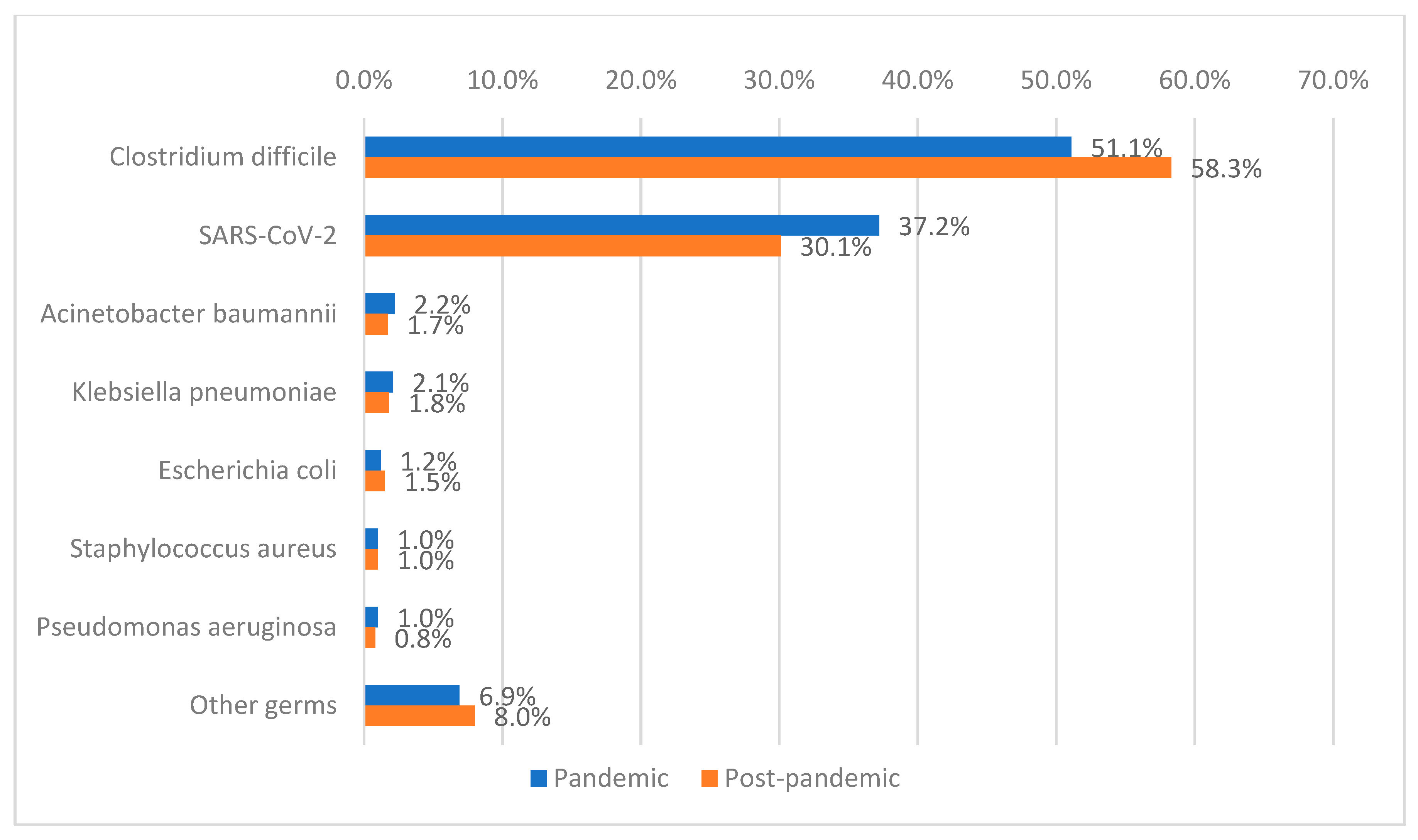
| Clostridioides difficile | 2164 (55.1%) | 896 (51.1%) | 1268 (58.3%) | <0.001 * |
| SARS-CoV-2 | 1306 (33.2%) | 652 (37.2%) | 654 (30.1%) | <0.001 * |
| Acinetobacter baumannii | 77 (2%) | 39 (2.2%) | 38 (1.7%) | 0.299 * |
| Klebsiella pneumoniae | 76 (1.9%) | 36 (2.1%) | 40 (1.8%) | 0.643 * |
| Escherichia coli | 53 (1.3%) | 21 (1.2%) | 32 (1.5%) | 0.490 * |
| Staphylococcus aureus | 39 (1%) | 17 (1%) | 22 (1%) | 1.000 * |
| Pseudomonas aeruginosa | 35 (0.9%) | 17 (1%) | 18 (0.8%) | 0.733 * |
| Other germs | 296 (7.5%) | 121 (6.9%) | 175 (8%) | 0.182 * |
| Parameter (N, %) | Total | Pandemic | Post-Pandemic | p |
|---|---|---|---|---|
| N, % | 3929 (100%) | 1754 (44.6%) | 2175 (55.4%) | - |
| CDI—Hospitalization within last year (N = 1052) | ||||
| <4 weeks ago | 793 (75.4%) | 277 (74.3%) | 516 (76%) | 0.759 * |
| 4–12 weeks ago | 160 (15.2%) | 58 (15.5%) | 102 (15%) | 0.759 * |
| >12 weeks ago | 99 (9.4%) | 38 (10.2%) | 61 (9%) | 0.759 * |
| Antibiotic treatment—Current admission | 1269 (32.3%) | 631 (36%) | 638 (29.3%) | <0.001 * |
| Antibiotic treatment—Current admission | ||||
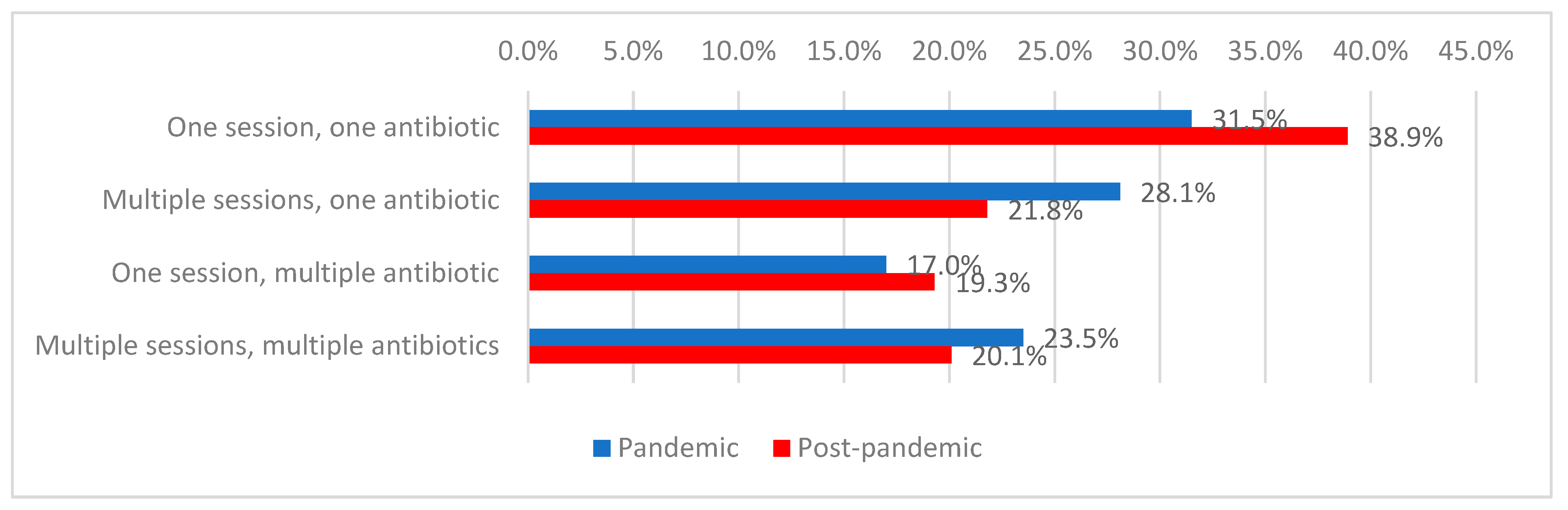
| One session, one antibiotic | 447 (35.2%) | 199 (31.5%) | 248 (38.9%) | 0.006 * |
| Multiple sessions, one antibiotic | 316 (24.9%) | 177 (28.1%) | 139 (21.8%) | 0.006 * |
| One session, multiple antibiotics | 230 (18.1%) | 107 (17%) | 123 (19.3%) | 0.006 * |
| Multiple sessions, multiple antibiotics | 276 (21.7%) | 148 (23.5%) | 128 (20.1%) | 0.006 * |
| Antibiotic treatment—Last 3 months | 631 (16.1%) | 300 (17.1%) | 331 (15.2%) | 0.116 * |
| Antibiotic treatment—Last 3 months | ||||
| One session, one antibiotic | 250 (39.6%) | 108 (36%) | 142 (42.9%) | 0.271 * |
| Multiple sessions, one antibiotic | 128 (20.3%) | 63 (21%) | 65 (19.6%) | 0.271 * |
| One session, multiple antibiotics | 126 (20%) | 61 (20.3%) | 65 (19.6%) | 0.271 * |
| Multiple sessions, multiple antibiotics | 127 (20.1%) | 68 (22.7%) | 59 (17.8%) | 0.271 * |
| Treatment in the last 3 months | ||||
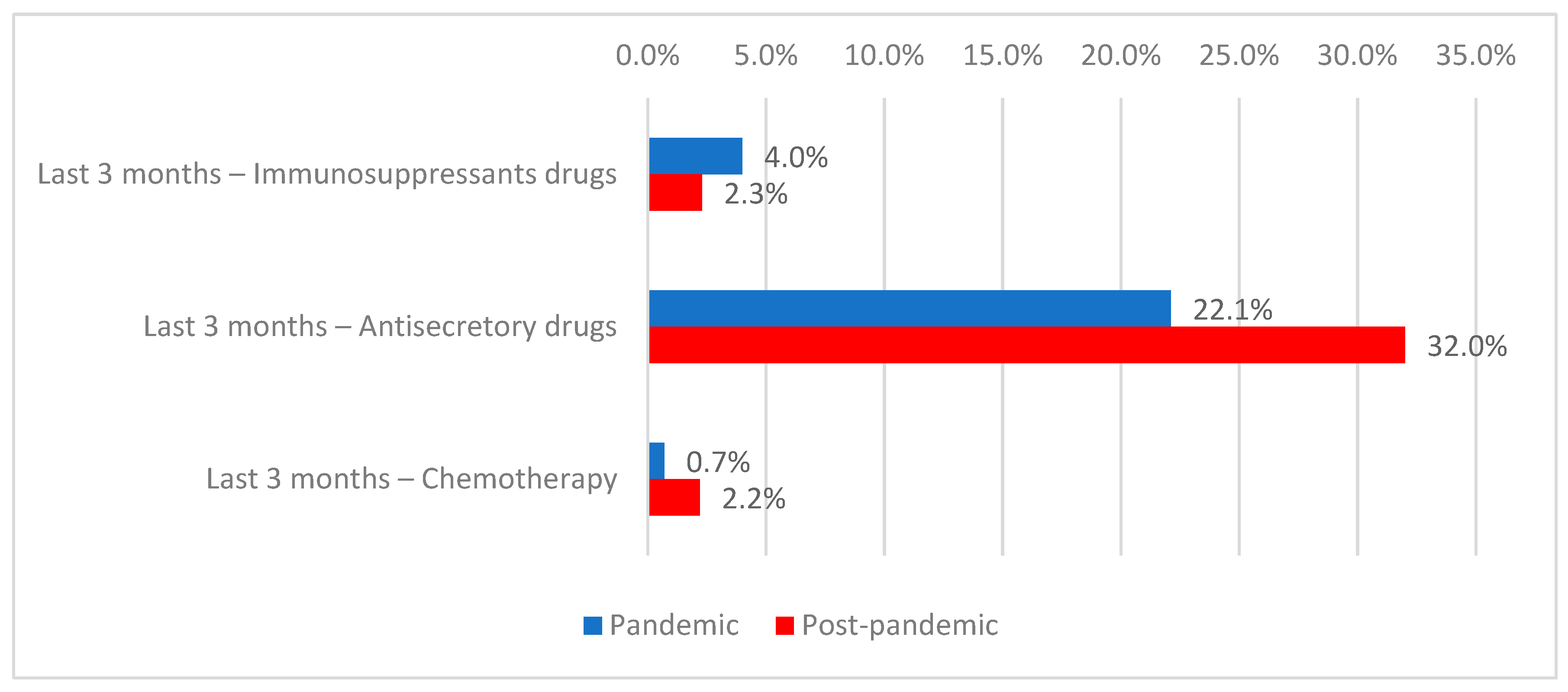
| Immunosuppressant drugs | 119 (3%) | 70 (4%) | 49(2.3%) | 0.002 * |
| Antisecretory drugs | 1083 (27.6%) | 387 (22.1%) | 696 (32%) | <0.001 * |
| Chemotherapy | 60(1.5%) | 13 (0.7%) | 47 (2.2%) | <0.001 * |
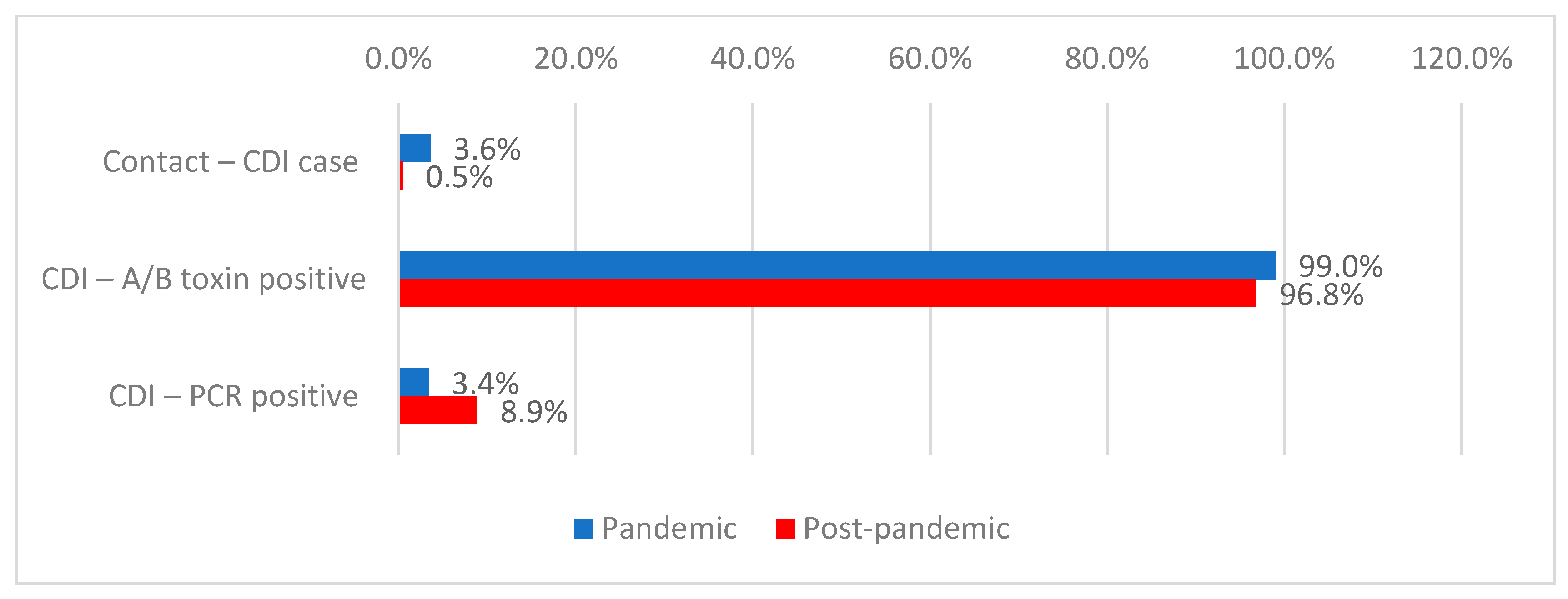
| Contact—CDI case (N = 2128) | 38 (1.8%) | 32 (3.6%) | 6 (0.5%) | <0.001 * |
| Laboratory tests for CDI | ||||
| A/B toxin positive (N = 2128) | 2079 (97.7%) | 875 (99%) | 1204 (96.8%) | 0.001 * |
| PCR positive (N = 2128) | 141 (6.6%) | 30 (3.4%) | 111 (8.9%) | <0.001 * |
| Colonoscopy—Pseudomembranous colitis appearance (N = 2128) | 9 (0.2%) | 2 (0.1%) | 7 (0.3%) | 0.314 * |
| Histopathological exam (N = 2128) | 2 (0.1%) | 0 (0%) | 2 (0.1%) | 0.506 * |
| Total Study Group | ||||||
|---|---|---|---|---|---|---|
| Section/Etiology | ICU (Nr.,%) | Medical (Nr.,%) | Surgical (Nr.,%) | Pediatric (Nr.,%) | Emergency (Nr.,%) | p * |
| Clostridioides difficile | 79 | 1718 | 324 | 24 | 19 | |
| (48.5%) | (56.1%) | (56.4%) | (22%) | (86.4%) | <0.001 | |
| SARS-CoV-2 | 8 | 1001 | 160 | 7 | 3 | <0.001 |
| (4.9%) | (32.7%) | (27.9%) | (6.4%) | (13.6%) | ||
| Acinetobacter baumannii | 28 | 33 | 10 | 6 | 0 | <0.001 |
| (17.2%) | (1.1%) | (1.7%) | (5.5%) | (0%) | ||
| Klebsiella pneumoniae | 18 | 38 | 14 | 6 | 0 | <0.001 |
| (11%) | (1.2%) | (2.4%) | (5.5%) | (0%) | ||
| Escherichia coli | 1 (0.6%) | 31 (1%) | 19 (3.3%) | 2 (1.8%) | 0 (0%) | 0.002 |
| Staphylococcus aureus | 5 (3.1%) | 24 (0.8%) | 7 (1.2%) | 3 (2.8%) | 0 (0%) | 0.021 |
| Pseudomonas aeruginosa | 5 (3.1%) | 24 (0.8%) | 5 (0.9%) | 1 (0.9%) | 0 (0%) | 0.096 |
| Other germs | 41 (25.2%) | 271 (8.9%) | 53 (9.2%) | 63 (57.8%) | 0 (0%) | <0.001 |
| Pandemic admission | ||||||
| Clostridioides difficile | 48 | 713 | 114 | 17 | 4 | |
| (45.3%) | (53.2%) | (45.4%) | (33.3%) | (57.1%) | <0.007 | |
| SARS-CoV-2 | 5 | 436 | 888 | 3 | 3 | <0.001 |
| (4.7%) | (32.6%) | (35.1%) | (5.9%) | (42.9%) | ||
| Acinetobacter baumannii | 16 | 14 | 4 | 5 | 0 | <0.001 |
| (15.1%) | (1%) | (1.6%) | (9.8%) | (0%) | ||
| Klebsiella pneumoniae | 11 | 15 | 6 | 4 | 0 | <0.001 |
| (10.4%) | (1.1%) | (2.4%) | (7.8%) | (0%) | ||
| Escherichia coli | 1 (0.9%) | 10 (0.7%) | 8 (3.2%) | 2 (3.9%) | 0 (0%) | 0.009 |
| Staphylococcus aureus | 4 (3.8%) | 10 (0.7%) | 2 (0.8%) | 1 (2%) | 0 (0%) | 0.052 |
| Pseudomonas aeruginosa | 3 (2.8%) | 13 (1%) | 1 (0.4%) | 0 (0%) | 0 (0%) | 0.278 |
| Other germs | 31 (29.2%) | 155 (11.6%) | 33 (13.1%) | 21 (14.2%) | 0 (0%) | <0.001 |
| Post-pandemic admission | ||||||
| Clostridioides difficile | 31 | 1005 | 210 | 7 | 15 | |
| (54.4%) | (58.4%) | (65%) | (12.1%) | (100%) | <0.001 | |
| SARS-CoV-2 | 3 | 565 | 72 | 4 | 0 | <0.001 |
| (5.3%) | (32.8%) | (22.3%) | (6.9%) | (0%) | ||
| Acinetobacter baumannii | 12 | 19 | 6 | 1 | 0 | <0.001 |
| (21.1%) | (1.1%) | (1.9%) | (1.7%) | (0%) | ||
| Klebsiella pneumoniae | 7 | 23 | 8 | 2 | 0 | <0.001 |
| (12.3%) | (1.3%) | (2.5%) | (3.4%) | (0%) | ||
| Escherichia coli | 0 (0%) | 21 (1.2%) | 11 (3.4%) | 0 (0%) | 0 (0%) | 0.085 |
| Staphylococcus aureus | 1 (1.8%) | 14 (0.8%) | 5 (1.5%) | 2 (3.4%) | 0 (0%) | 0.128 |
| Pseudomonas aeruginosa | 2 (3.5%) | 11 (0.6%) | 4 (1.2%) | 1 (1.7%) | 0 (0%) | 0.081 |
| Other germs | 10 (17.5%) | 116 (6.7%) | 20 (6.2%) | 42 (72.4%) | 0 (0%) | <0.001 |
| Total Study Group | |||||||
|---|---|---|---|---|---|---|---|
| Status/Etiology | Cured (Nr.,%) | Improved (Nr.,%) | Stationary (Nr.,%) | Worsened (Nr.,%) | Transfer (Nr.,%) | Deceased (Nr.,%) | p * |
| Clostridioides difficile | 226 | 994 | 52 | 10 | 29 | 323 | <0.001 |
| (60.3%) | (53.3%) | (41.9%) | (62.5%) | (14.8%) | (59.2%) | ||
| SARS-CoV-2 | 61 | 622 | 58 | 3 | 138 | 130 | <0.001 |
| (16.3%) | (33.4%) | (46.8%) | (18.8%) | (70.4%) | (23.8%) | ||
| Acinetobacter baumannii | 6 | 17 | 3 | 1 | 2 | 33 | <0.001 |
| (1.6%) | (0.9%) | (2.4%) | (6.3%) | (1%) | (6%) | ||
| Klebsiella pneumoniae | 5 | 33 | 1 | 1 | 1 | 16 | 0.125 |
| (1.3%) | (1.8%) | (0.8%) | (6.3%) | (0.5%) | (2.9%) | ||
| Escherichia coli | 11 (2.9%) | 26 (1.4%) | 0 (0%) | 0 (0%) | 1 (0.5%) | 4 (0.7%) | 0.082 |
| Staphylococcus aureus | 6 (1.6%) | 19 (1%) | 2 (1.6%) | 0 (0%) | 3 (1.5%) | 6 (1.1%) | 0.719 |
| Pseudomonas aeruginosa | 6 (1.6%) | 18 (1%) | 0 (0%) | 0 (0%) | 3 (1.5%) | 2 (0.4%) | 0.298 |
| Other germs | 63 (16.8%) | 185 (9.9%) | 14 (11.3%) | 2 (12.5%) | 22 (11.2%) | 62 (11.4%) | 0.013 |
| Pandemic admission | |||||||
| Clostridioides difficile | 128 | 476 | 19 | 4 | 9 | 167 | |
| (64%) | (58.5%) | (27.5%) | (50%) | (5.6%) | (52.4%) | <0.001 | |
| SARS-CoV-2 | 22 | 208 | 39 | 2 | 124 | 75 | <0.001 |
| (11%) | (25.6%) | (56.5%) | (25%) | (77.5%) | (23.5%) | ||
| Acinetobacter baumannii | 5 | 8 | 2 | 0 | 2 | 20 | <0.001 |
| (2.5%) | (1%) | (2.9%) | (0%) | (1.3%) | (6.3%) | ||
| Klebsiella pneumoniae | 3 | 16 | 0 | 1 | 1 | 12 | 0.060 |
| (1.5%) | (2%) | (0%) | (12.5%) | (0.6%) | (3.8%) | ||
| Escherichia coli | 7 (3.5%) | 9 (1.1%) | 0 (0%) | 0 (0%) | 1 (0.6%) | 4 (1.3%) | 0.188 |
| Staphylococcus aureus | 3 (1.5%) | 9 (1.1%) | 0 (0%) | 0 (0%) | 2 (1.3%) | 3 (0.9%) | 0.941 |
| Pseudomonas aeruginosa | 6 (3%) | 6 (0.7%) | 0 (0%) | 0 (0%) | 3 (1.9%) | 1 (0.3%) | 0.051 |
| Other germs | 32 (16%) | 99 (12.2%) | 11 (15.9%) | 2 (25%) | 21 (13.1%) | 50 (15.7%) | 0.345 |
| Post-pandemic admission | |||||||
| Clostridioides difficile | 98 | 518 | 33 | 6 | 20 | 156 | |
| (56%) | (49.3%) | (60%) | (75%) | (55.6%) | (68.7%) | <0.001 | |
| SARS-CoV-2 | 39 | 414 | 19 | 1 | 14 | 55 | <0.001 |
| (22.3%) | (39.4%) | (34.5%) | (12.5%) | (38.9%) | (24.2%) | ||
| Acinetobacter baumannii | 1 | 9 | 1 | 1 | 0 | 13 | <0.001 |
| (0.6%) | (0.9%) | (1.8%) | (12.5%) | (0%) | (5.7%) | ||
| Klebsiella pneumoniae | 2 | 17 | 1 | 0 | 0 | 4 | 0.938 |
| (1.1%) | (1.6%) | (1.8%) | (0%) | (0%) | (1.8%) | ||
| Escherichia coli | 4 (2.3%) | 17 (1.6%) | 0 (0%) | 0 (0%) | 0 (0%) | 0 (0%) | 0.275 |
| Staphylococcus aureus | 3 (1.7%) | 10 (1%) | 2 (3.6%) | 0 (0%) | 1 (2.8%) | 3 (1.3%) | 0.219 |
| Pseudomonas aeruginosa | 0 (0%) | 12 (1.1%) | 0 (0%) | 0 (0%) | 0 (0%) | 1 (0.4%) | 0.677 |
| Other germs | 31 (17.7%) | 86 (8.2%) | 3 (5.5%) | 0 (0%) | 1 (2.8%) | 12 (5.3%) | 0.001 |
| Parameter | Multivariable | |
|---|---|---|
| OR (95% C.I.) | p | |
| Medical section | 1.93 (1.09–3.43) | 0.024 |
| Clostridium difficile | 1.45 (0.61–3.46) | 0.392 |
| SARS-CoV-2 | 4.52 (2.16–9.45) | <0.001 |
| AB-Admission | 0.37 (0.18–0.74) | 0.005 |
| Last 3M-AB | 0.68 (0.30–1.51) | 0.346 |
| Last 3M-Antisecretory | 0.90 (0.45–1.79) | 0.766 |
Disclaimer/Publisher’s Note: The statements, opinions and data contained in all publications are solely those of the individual author(s) and contributor(s) and not of MDPI and/or the editor(s). MDPI and/or the editor(s) disclaim responsibility for any injury to people or property resulting from any ideas, methods, instructions or products referred to in the content. |
© 2026 by the authors. Licensee MDPI, Basel, Switzerland. This article is an open access article distributed under the terms and conditions of the Creative Commons Attribution (CC BY) license.
Share and Cite
Voinea, C.; Mocanu, E.; Dantes, E.; Jurja, S.; Neculai, A.-M.; Craciun, A.; Serbanescu, L.; Dascalu, A.-M.; Mehedinti, M.C.; Rugina, S. Etiologic Patterns and Evolution of Healthcare-Associated Infections in the Pandemic and Post-Pandemic Periods: A County-Level Multicenter Study from Southeastern Romania. Antibiotics 2026, 15, 214. https://doi.org/10.3390/antibiotics15020214
Voinea C, Mocanu E, Dantes E, Jurja S, Neculai A-M, Craciun A, Serbanescu L, Dascalu A-M, Mehedinti MC, Rugina S. Etiologic Patterns and Evolution of Healthcare-Associated Infections in the Pandemic and Post-Pandemic Periods: A County-Level Multicenter Study from Southeastern Romania. Antibiotics. 2026; 15(2):214. https://doi.org/10.3390/antibiotics15020214
Chicago/Turabian StyleVoinea, Corina, Elena Mocanu, Elena Dantes, Sanda Jurja, Ana-Maria Neculai, Aurora Craciun, Lucian Serbanescu, Ana-Maria Dascalu, Mihaela Cezarina Mehedinti, and Sorin Rugina. 2026. "Etiologic Patterns and Evolution of Healthcare-Associated Infections in the Pandemic and Post-Pandemic Periods: A County-Level Multicenter Study from Southeastern Romania" Antibiotics 15, no. 2: 214. https://doi.org/10.3390/antibiotics15020214
APA StyleVoinea, C., Mocanu, E., Dantes, E., Jurja, S., Neculai, A.-M., Craciun, A., Serbanescu, L., Dascalu, A.-M., Mehedinti, M. C., & Rugina, S. (2026). Etiologic Patterns and Evolution of Healthcare-Associated Infections in the Pandemic and Post-Pandemic Periods: A County-Level Multicenter Study from Southeastern Romania. Antibiotics, 15(2), 214. https://doi.org/10.3390/antibiotics15020214