
The Antimicrobial Peptide C14R Is Active Against All Pathogenic Species of the ESKAPE Group

 , ,
, ,  ,
,  ,
,  , and
, and
Abstract
1. Introduction
2. Results
3. Discussion
4. Materials and Methods
4.1. Bacterial Strains and Cultivation
4.2. Antimicrobial Peptide C14R
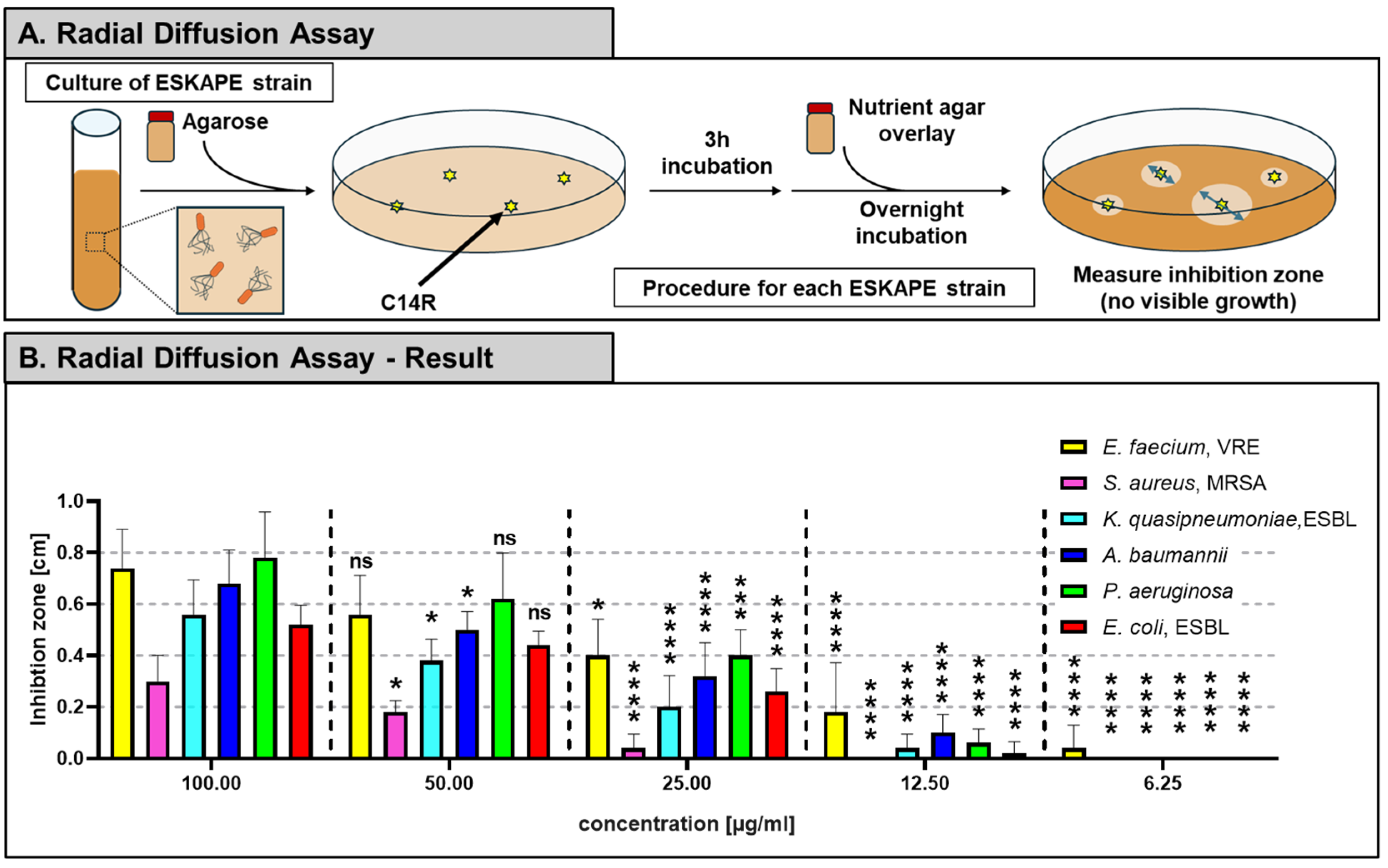
4.3. Radial Diffusion Assay
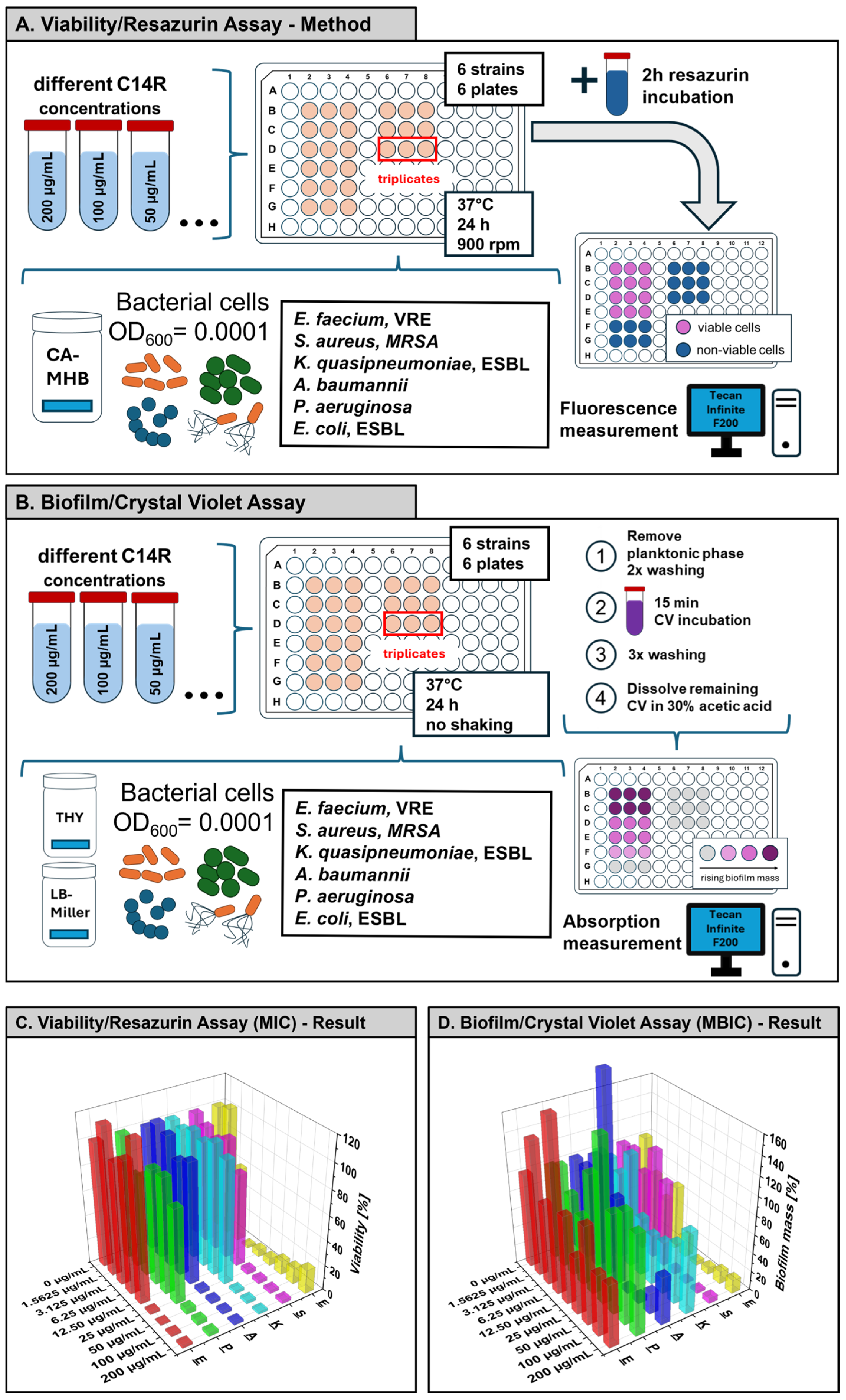
4.4. Viability/Resazurin Assay
4.5. Biofilm/Crystal Violet Assay
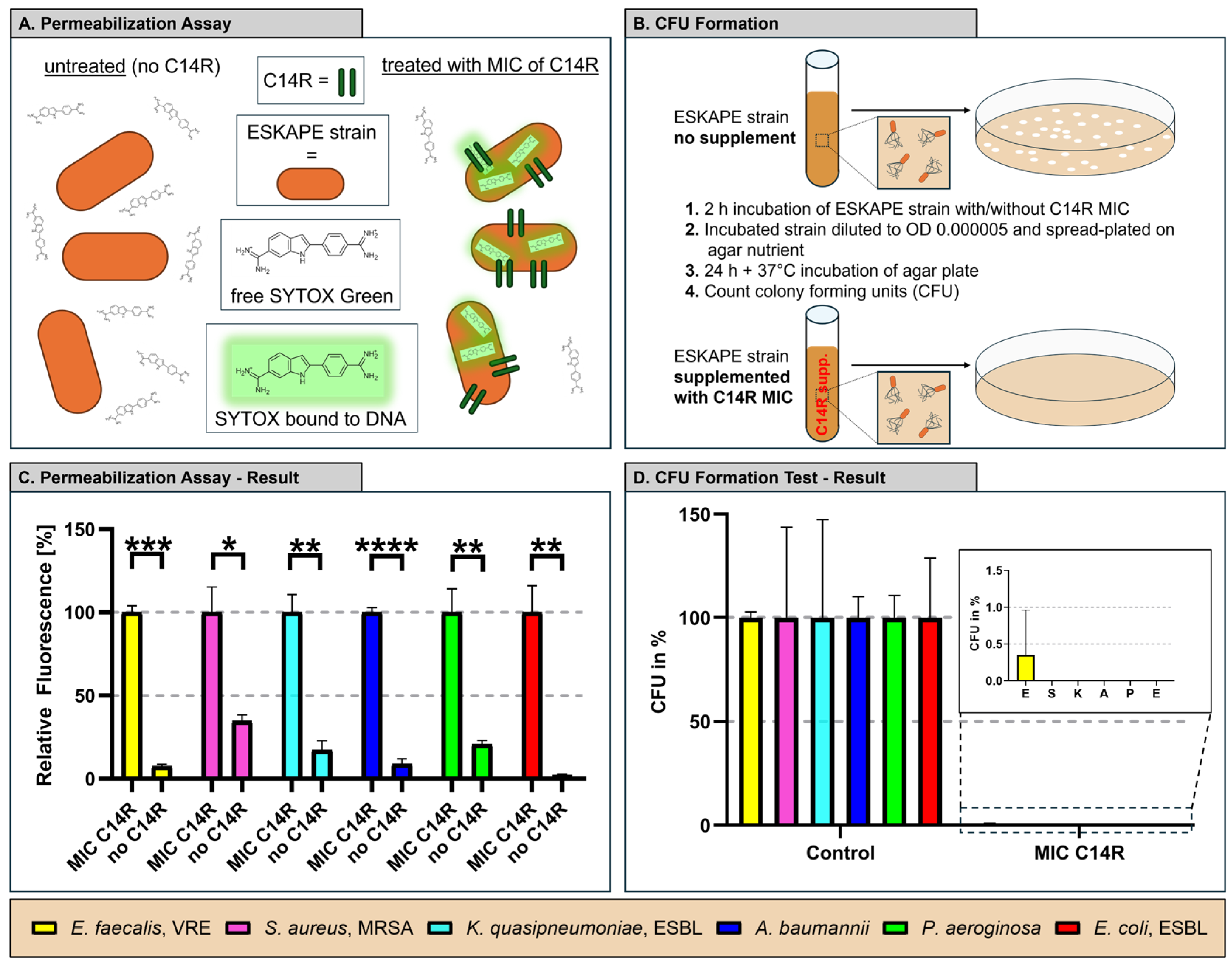
4.6. Colony Forming Unit (CFU) Assay
4.7. SYTOX Green Membrane Permeabilization Assay
4.8. Statistical Analysis
Author Contributions
Funding
Institutional Review Board Statement
Informed Consent Statement
Data Availability Statement
Conflicts of Interest
References
- Infectious Diseases Society of America (IDSA). As Antibiotic Discovery Stagnates: A Public Health Crisis Brews—Bad Bugs, No Drugs. Available online: https://www.idsociety.org/globalassets/idsa/policy--advocacy/current_topics_and_issues/antimicrobial_resistance/10x20/statements/070104-as-antibiotic-discovery-stagnates-a-public-health-crisis-brews.pdf (accessed on 12 February 2026).
- Boucher, H.W.; Talbot, G.H.; Bradley, J.S.; Edwards, J.E.; Gilbert, D.; Rice, L.B.; Scheld, M.; Spellberg, B.; Bartlett, J. Bad Bugs, No Drugs: No ESKAPE! An Update from the Infectious Diseases Society of America. Clin. Infect. Dis. 2009, 48, 1–12. [Google Scholar] [CrossRef] [Scilit]
- Peterson, L.R. Bad Bugs, No Drugs: No ESCAPE Revisited. Clin. Infect. Dis. 2009, 49, 992–993. [Google Scholar] [CrossRef] [Scilit]
- Rice, L.B. Federal Funding for the Study of Antimicrobial Resistance in Nosocomial Pathogens: No ESKAPE. J. Infect. Dis. 2008, 197, 1079–1081. [Google Scholar] [CrossRef] [Scilit] [PubMed]
- Woh, P.Y.; Zhang, X. The Burden of ESKAPE Pathogen-Related Hospital-Acquired Infections: Clinical and Financial Perspective from a Systematic Review. J. Hosp. Infect. 2025, 162, 377–385. [Google Scholar] [CrossRef] [Scilit] [PubMed]
- Navidinia, M. The Clinical Importance of Emerging ESKAPE Pathogens in Nosocomial Infections. Arch. Adv. Biosci. 2016, 7, 43–57. [Google Scholar]
- Miller, W.R.; Arias, C.A. ESKAPE Pathogens: Antimicrobial Resistance, Epidemiology, Clinical Impact and Therapeutics. Nat. Rev. Microbiol. 2024, 22, 598–616. [Google Scholar] [CrossRef] [Scilit]
- Ayobami, O.; Brinkwirth, S.; Eckmanns, T.; Markwart, R. Antibiotic Resistance in Hospital-Acquired ESKAPE-E Infections in Low- and Lower-Middle-Income Countries: A Systematic Review and Meta-Analysis. Emerg. Microbes Infect. 2022, 11, 443–451. [Google Scholar] [CrossRef] [Scilit]
- Rabi, M. The Global (Health) Governance of Antimicrobial Resistance. Globalizations 2024, 21, 1518–1538. [Google Scholar] [CrossRef] [Scilit]
- Nakagawa, J.; Matsuhashi, M. Molecular Divergence of a Major Peptidoglycan Synthetase with Transglycosylase—Transpeptidase Activities in Escherichia coli—Penicillin-Binding Protein 1Bs. Biochem. Biophys. Res. Commun. 1982, 105, 1546–1553. [Google Scholar] [CrossRef] [Scilit]
- Reynolds, P.E. Structure, Biochemistry and Mechanism of Action of Glycopeptide Antibiotics. Eur. J. Clin. Microbiol. Infect. Dis. 1989, 8, 943–950. [Google Scholar] [CrossRef] [Scilit]
- Tomioka, S.; Ishino, F.; Tamaki, S.; Matsuhashi, M. Formation of Hyper-Crosslinked Peptidoglycan with Multiple Crosslinkages by a Penicillin-Binding Protein, 1A, of Escherichia coli. Biochem. Biophys. Res. Commun. 1982, 106, 1175–1182. [Google Scholar] [CrossRef] [Scilit]
- Beck, W.D.; Berger-Bächi, B.; Kayser, F.H. Additional DNA in Methicillin-Resistant Staphylococcus Aureus and Molecular Cloning of Mec-Specific DNA. J. Bacteriol. 1986, 165, 373–378. [Google Scholar] [CrossRef] [Scilit] [PubMed]
- Deurenberg, R.H.; Stobberingh, E.E. The Evolution of Staphylococcus Aureus. Infect. Genet. Evol. 2008, 8, 747–763. [Google Scholar] [CrossRef] [Scilit] [PubMed]
- Nandhini, P.; Kumar, P.; Mickymaray, S.; Alothaim, A.S.; Somasundaram, J.; Rajan, M. Recent Developments in Methicillin-Resistant Staphylococcus Aureus (MRSA) Treatment: A Review. Antibiotics 2022, 11, 606. [Google Scholar] [CrossRef] [Scilit] [PubMed]
- Ito, T.; Hiramatsu, K. Acquisition of Methicillin Resistance and Progression of Multiantibiotic Resistance in Methicillin-Resistant Staphylococcus aureus. Yonsei Med. J. 1998, 39, 526. [Google Scholar] [CrossRef] [Scilit]
- Lade, H.; Kim, J.-S. Molecular Determinants of β-Lactam Resistance in Methicillin-Resistant Staphylococcus Aureus (MRSA): An Updated Review. Antibiotics 2023, 12, 1362. [Google Scholar] [CrossRef] [Scilit]
- Ambade, S.S.; Gupta, V.K.; Bhole, R.P.; Khedekar, P.B.; Chikhale, R.V. A Review on Five and Six-Membered Heterocyclic Compounds Targeting the Penicillin-Binding Protein 2 (PBP2A) of Methicillin-Resistant Staphylococcus Aureus (MRSA). Molecules 2023, 28, 7008. [Google Scholar] [CrossRef] [Scilit]
- Jawade, H.A.; Motaweq, Z.Y.; Rasool, H.D.; Hussain, F.H. Study of Antibiotic Resistance in ESKAPE Bacteria Using β-Lactamase and ESBL Genes. J. Angiother. 2024, 8, 1–10. [Google Scholar] [CrossRef] [Scilit]
- Ramatla, T.; Mafokwane, T.; Lekota, K.; Monyama, M.; Khasapane, G.; Serage, N.; Nkhebenyane, J.; Bezuidenhout, C.; Thekisoe, O. “One Health” Perspective on Prevalence of Co-Existing Extended-Spectrum β-Lactamase (ESBL)-Producing Escherichia coli and Klebsiella Pneumoniae: A Comprehensive Systematic Review and Meta-Analysis. Ann. Clin. Microbiol. Antimicrob. 2023, 22, 88. [Google Scholar] [CrossRef] [Scilit]
- Farber, B.; Moellering, R.C. The Third Generation Cephalosporins. Bull. N. Y. Acad. Med. 1982, 58, 696–710. [Google Scholar]
- Jacoby, G.A.; Carreras, I. Activities of Beta-Lactam Antibiotics against Escherichia Coli Strains Producing Extended-Spectrum Beta-Lactamases. Antimicrob. Agents Chemother. 1990, 34, 858–862. [Google Scholar] [CrossRef] [Scilit]
- Kawamura, K.; Nagano, N.; Suzuki, M.; Wachino, J.; Kimura, K.; Arakawa, Y. ESBL-Producing Escherichia coli and Its Rapid Rise among Healthy People. Food Saf. 2017, 5, 122–150. [Google Scholar] [CrossRef] [Scilit]
- Vila, J.; Martí, S.; Sánchez-Céspedes, J. Porins, Efflux Pumps and Multidrug Resistance in Acinetobacter Baumannii. J. Antimicrob. Chemother. 2007, 59, 1210–1215. [Google Scholar] [CrossRef] [Scilit] [PubMed]
- Yao, S.; Yu, J.; Zhang, T.; Xie, J.; Yan, C.; Ni, X.; Guo, B.; Cui, C. Comprehensive Analysis of Distribution Characteristics and Horizontal Gene Transfer Elements of BlaNDM-1-Carrying Bacteria. Sci. Total Environ. 2024, 946, 173907. [Google Scholar] [CrossRef] [Scilit] [PubMed]
- Xu, C.; Li, X.; Zhang, Y.; Li, Y.; Li, Y.; Zhang, R.; Dong, N. Interorder Horizontal Gene Transfer of Tet (X3) between Acinetobacter Spp. and Enterobacteriaceae. Antimicrob. Agents Chemother. 2025, 69, e0194524. [Google Scholar] [CrossRef] [Scilit]
- Fukuoka, T.; Ohya, S.; Narita, T.; Katsuta, M.; Iijima, M.; Masuda, N.; Yasuda, H.; Trias, J.; Nikaido, H. Activity of the Carbapenem Panipenem and Role of the OprD (D2) Protein in Its Diffusion through the Pseudomonas Aeruginosa Outer Membrane. Antimicrob. Agents Chemother. 1993, 37, 322–327. [Google Scholar] [CrossRef] [Scilit]
- Elsner, H.-A.; Sobottka, I.; Mack, D.; Laufs, R.; Claussen, M.; Wirth, R. Virulence Factors of Enterococcus Faecalis and Enterococcus Faecium Blood Culture Isolates. Eur. J. Clin. Microbiol. Infect. Dis. 2000, 19, 39–42. [Google Scholar] [CrossRef] [Scilit]
- Livermore, D.M. Multiple Mechanisms of Antimicrobial Resistance in Pseudomonas Aeruginosa: Our Worst Nightmare? Clin. Infect. Dis. 2002, 34, 634–640. [Google Scholar] [CrossRef] [Scilit]
- Oliveira Júnior, N.G.; Souza, C.M.; Buccini, D.F.; Cardoso, M.H.; Franco, O.L. Antimicrobial Peptides: Structure, Functions and Translational Applications. Nat. Rev. Microbiol. 2025, 23, 687–700. [Google Scholar] [CrossRef] [Scilit]
- Pei, H.; Bao, K.; Han, T.; Cao, X. Comprehensive Insights into Microbial-Derived Antimicrobial Peptides (AMPs): Classification, Mechanisms, Applications, and Purification Strategies. Crit. Rev. Biotechnol. 2025, 45, 1652–1679. [Google Scholar] [CrossRef] [Scilit]
- Hancock, R.E.W.; Sahl, H.-G. Antimicrobial and Host-Defense Peptides as New Anti-Infective Therapeutic Strategies. Nat. Biotechnol. 2006, 24, 1551–1557. [Google Scholar] [CrossRef] [Scilit]
- Luo, Y.; Song, Y. Mechanism of Antimicrobial Peptides: Antimicrobial, Anti-Inflammatory and Antibiofilm Activities. Int. J. Mol. Sci. 2021, 22, 11401. [Google Scholar] [CrossRef] [Scilit] [PubMed]
- Erdem Büyükkiraz, M.; Kesmen, Z. Antimicrobial Peptides (AMPs): A Promising Class of Antimicrobial Compounds. J. Appl. Microbiol. 2022, 132, 1573–1596. [Google Scholar] [CrossRef] [Scilit] [PubMed]
- Maron, B.; Rolff, J.; Friedman, J.; Hayouka, Z. Antimicrobial Peptide Combination Can Hinder Resistance Evolution. Microbiol. Spectr. 2022, 10, e0097322. [Google Scholar] [CrossRef] [Scilit] [PubMed]
- Mildenberger, V.; Alpízar-Pedraza, D.; Martell-Huguet, E.M.; Krämer, M.; Bolotnikov, G.; Otero-Gonzalez, A.J.; Weil, T.; Rodriguez-Alfonso, A.; Preising, N.; Ständker, L.; et al. The Designed Pore-Forming Antimicrobial Peptide C14R Combines Excellent Activity Against the Major Opportunistic Human Pathogen Pseudomonas Aeruginosa with Low Cytotoxicity. Pharmaceuticals 2024, 17, 83. [Google Scholar] [CrossRef] [Scilit]
- Vélez, N.; Argel, A.; Kissmann, A.-K.; Alpízar-Pedraza, D.; Escandón, P.; Rosenau, F.; Ständker, L.; Firacative, C. Pore-Forming Peptide C14R Exhibits Potent Antifungal Activity against Clinical Isolates of Candida Albicans and Candida Auris. Front. Cell. Infect. Microbiol. 2024, 14, 1389020. [Google Scholar] [CrossRef] [Scilit]
- Walter, J.-C.; Kissmann, A.-K.; Gruber, D.; Alpízar-Pedraza, D.; Martell-Huguet, E.M.; Preising, N.; Rodriguez-Alfonso, A.; Ständker, L.; Kleber, C.; Knoll, W.; et al. Antimicrobial Activity of the Peptide C14R Against Ab Initio Growing and Preformed Biofilms of Candida albicans, Candida parapsilosis and Candidozyma auris. Biomolecules 2025, 15, 322. [Google Scholar] [CrossRef] [Scilit]
- Firacative, C.; Vélez, N.; Kissmann, A.-K.; Alpízar-Pedraza, D.; Walter, J.-C.; Ständker, L.; Rosenau, F. Broad Antifungal Spectrum of the Pore-Forming Peptide C14R Against Cryptococcus and Candida Species from the WHO Fungal Priority Pathogens List. Pathogens 2025, 14, 511. [Google Scholar] [CrossRef] [Scilit]
- Venkateswaran, P.; Vasudevan, S.; David, H.; Shaktivel, A.; Shanmugam, K.; Neelakantan, P.; Solomon, A.P. Revisiting ESKAPE Pathogens: Virulence, Resistance, and Combating Strategies Focusing on Quorum Sensing. Front. Cell. Infect. Microbiol. 2023, 13, 1159798. [Google Scholar] [CrossRef] [Scilit]
- Weinstein, M.P. Performance Standards for Antimicrobial Susceptibility Testing: Supplement M100; Clinical and Laboratory Standards Institute: Malvern, PA, USA, 2020; ISBN 9781684400676. [Google Scholar]
- Rima, M.; Rima, M.; Fajloun, Z.; Sabatier, J.-M.; Bechinger, B.; Naas, T. Antimicrobial Peptides: A Potent Alternative to Antibiotics. Antibiotics 2021, 10, 1095. [Google Scholar] [CrossRef] [Scilit]
- Di Stasi, A.; de Pascale, L.; Morici, M.; Wilson, D.N.; Scocchi, M.; Mardirossian, M. Designing New Chimeric Proline-Rich Antimicrobial Peptides to Enhance Efficacy Toward the ESKAPE+E: Beyond Sequence Extension. Biomolecules 2025, 15, 776. [Google Scholar] [CrossRef] [Scilit] [PubMed]
- Salim, S.A.; Mohan, M.S.; Forgia, N.; Busi, S. Medical Importance of ESKAPE Pathogens. In ESKAPE Pathogens; Springer Nature: Singapore, 2024; pp. 1–32. [Google Scholar]
- Ma, Y.; Wang, C.; Li, Y.; Li, J.; Wan, Q.; Chen, J.; Tay, F.R.; Niu, L. Considerations and Caveats in Combating ESKAPE Pathogens against Nosocomial Infections. Adv. Sci. 2020, 7, 1901872. [Google Scholar] [CrossRef] [Scilit] [PubMed]
- Zhong, L.; Zhang, S.; Tang, K.; Zhou, F.; Zheng, C.; Zhang, K.; Cai, J.; Zhou, H.; Wang, Y.; Tian, B.; et al. Clinical Characteristics, Risk Factors and Outcomes of Mixed Candida Albicans/Bacterial Bloodstream Infections. BMC Infect. Dis. 2020, 20, 810. [Google Scholar] [CrossRef] [Scilit] [PubMed]
- Da Silva, J.; Leal, E.C.; Carvalho, E. Bioactive Antimicrobial Peptides as Therapeutic Agents for Infected Diabetic Foot Ulcers. Biomolecules 2021, 11, 1894. [Google Scholar] [CrossRef] [Scilit]
- Flamm, R.K.; Rhomberg, P.R.; Simpson, K.M.; Farrell, D.J.; Sader, H.S.; Jones, R.N. In Vitro Spectrum of Pexiganan Activity When Tested against Pathogens from Diabetic Foot Infections and with Selected Resistance Mechanisms. Antimicrob. Agents Chemother. 2015, 59, 1751–1754. [Google Scholar] [CrossRef] [Scilit]
- Kissmann, A.-K.; Mildenberger, V.; Krämer, M.; Alpízar-Pedraza, D.; Martell-Huguet, E.M.; Perez-Erviti, J.A.; Cetinkaya, A.; Pietrasik, J.; Otero-Gonzalez, A.J.; Firacative, C.; et al. Anti-Biofilm Peptides Can Rescue Fluconazole and Amphotericin B Efficacies against Candida Albicans. Sci. Rep. 2025, 15, 24593. [Google Scholar] [CrossRef] [Scilit]
- Fateh, R.; Ali, Q. Therapeutic Advances against Uropathogenic E. Coli: From Beta-Lactamase Inhibition to Anti-Biofilm Agents; IntechOpen: London, UK, 2025. [Google Scholar]
- Fan, R.; Cheng, Y.; Wang, R.; Zhang, T.; Zhang, H.; Li, J.; Song, S.; Zheng, A. Thermosensitive Hydrogels and Advances in Their Application in Disease Therapy. Polymers 2022, 14, 2379. [Google Scholar] [CrossRef] [Scilit]
- Kraemer, M.; Bellion, M.; Kissmann, A.-K.; Herberger, T.; Synatschke, C.V.; Bozdogan, A.; Andersson, J.; Rodriguez, A.; Ständker, L.; Wiese, S.; et al. Aptamers as Novel Binding Molecules on an Antimicrobial Peptide-Armored Composite Hydrogel Wound Dressing for Specific Removal and Efficient Eradication of Pseudomonas Aeruginosa. Int. J. Mol. Sci. 2023, 24, 4800. [Google Scholar] [CrossRef] [Scilit]
- Amann, V.; Kissmann, A.-K.; Krämer, M.; Krebs, I.; Perez-Erviti, J.A.; Otero-Gonzalez, A.J.; Morales-Vicente, F.; Rodríguez, A.; Ständker, L.; Weil, T.; et al. Increased Activities against Biofilms of the Pathogenic Yeast Candida Albicans of Optimized Pom-1 Derivatives. Pharmaceutics 2022, 14, 318. [Google Scholar] [CrossRef] [Scilit]
- O’Toole, G.A. Microtiter Dish Biofilm Formation Assay. J. Vis. Exp. 2011, 47, 2437. [Google Scholar] [CrossRef] [Scilit]



| Microorganism | MIC [µg/mL] | MBIC [µg/mL] |
|---|---|---|
| E. faecium, VRE | 3.44 | 22.05 |
| S. aureus, MRSA | 14.72 | 15.02 |
| K. quasipneumoniae, ESBL | 45.15 | n.a. |
| A. baumannii | 23.10 | n.a. |
| P. aeruginosa | 30.08 | n.a. |
| E. coli, ESBL | 24.55 | n.a. |
Disclaimer/Publisher’s Note: The statements, opinions and data contained in all publications are solely those of the individual author(s) and contributor(s) and not of MDPI and/or the editor(s). MDPI and/or the editor(s) disclaim responsibility for any injury to people or property resulting from any ideas, methods, instructions or products referred to in the content. |
© 2026 by the authors. Licensee MDPI, Basel, Switzerland. This article is an open access article distributed under the terms and conditions of the Creative Commons Attribution (CC BY) license.
Share and Cite
Gruber, D.; Vogel, V.; Walter, J.-C.; Bolotnikov, G.; Rodríguez, A.; Preising, N.; Ständker, L.; Firacative, C.; Spellerberg, B.; Kissmann, A.-K.; et al. The Antimicrobial Peptide C14R Is Active Against All Pathogenic Species of the ESKAPE Group. Antibiotics 2026, 15, 211. https://doi.org/10.3390/antibiotics15020211
Gruber D, Vogel V, Walter J-C, Bolotnikov G, Rodríguez A, Preising N, Ständker L, Firacative C, Spellerberg B, Kissmann A-K, et al. The Antimicrobial Peptide C14R Is Active Against All Pathogenic Species of the ESKAPE Group. Antibiotics. 2026; 15(2):211. https://doi.org/10.3390/antibiotics15020211
Chicago/Turabian StyleGruber, Daniel, Verena Vogel, Jan-Christoph Walter, Grigory Bolotnikov, Armando Rodríguez, Nico Preising, Ludger Ständker, Carolina Firacative, Barbara Spellerberg, Ann-Kathrin Kissmann, and et al. 2026. "The Antimicrobial Peptide C14R Is Active Against All Pathogenic Species of the ESKAPE Group" Antibiotics 15, no. 2: 211. https://doi.org/10.3390/antibiotics15020211
APA StyleGruber, D., Vogel, V., Walter, J.-C., Bolotnikov, G., Rodríguez, A., Preising, N., Ständker, L., Firacative, C., Spellerberg, B., Kissmann, A.-K., & Rosenau, F. (2026). The Antimicrobial Peptide C14R Is Active Against All Pathogenic Species of the ESKAPE Group. Antibiotics, 15(2), 211. https://doi.org/10.3390/antibiotics15020211