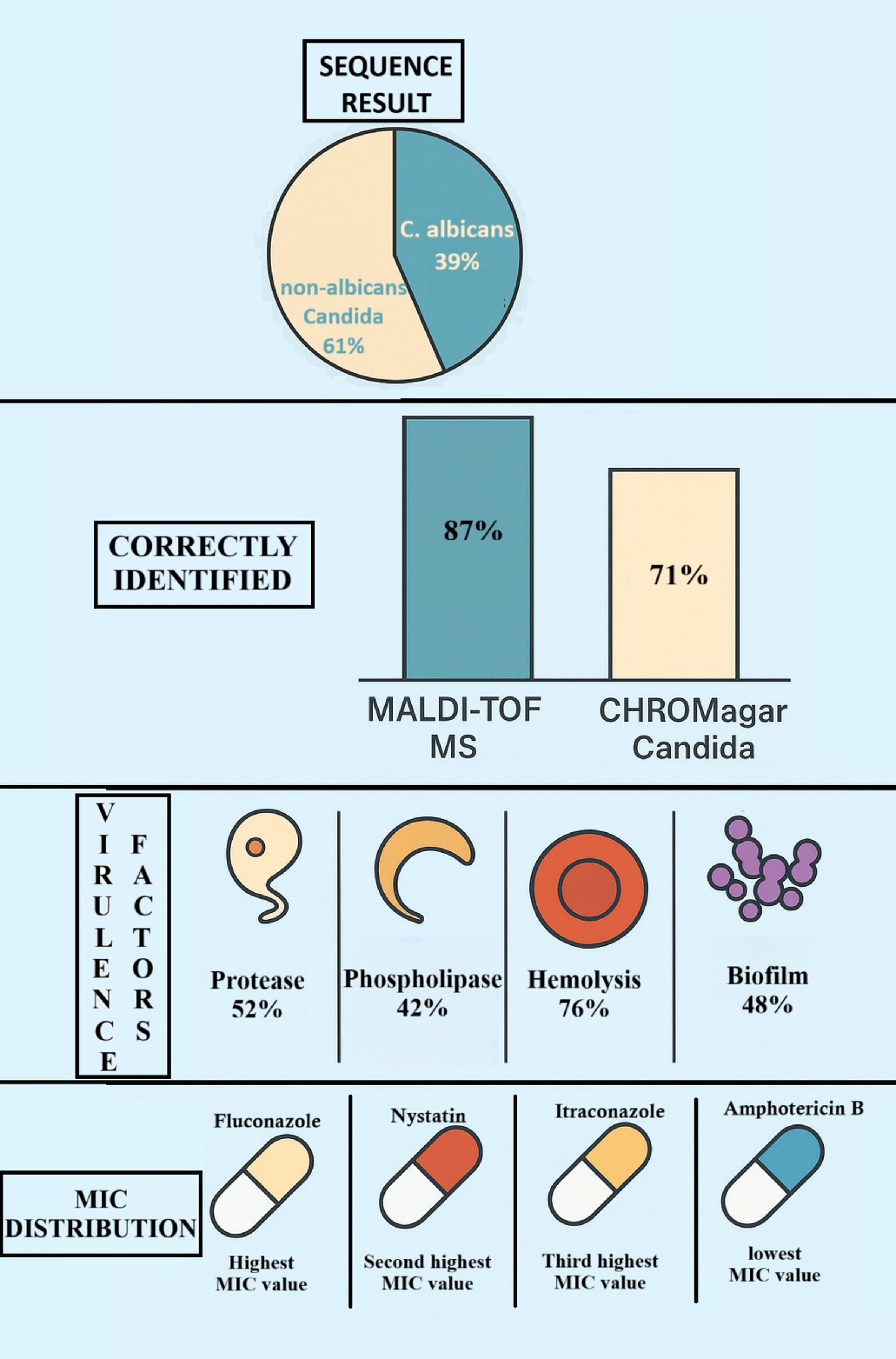

Molecular Identification, Virulence Factors, and Antifungal Susceptibility Profiles of Candida Isolates from Clinical Samples of Intensive Care Patients

Abstract
1. Introduction
2. Results
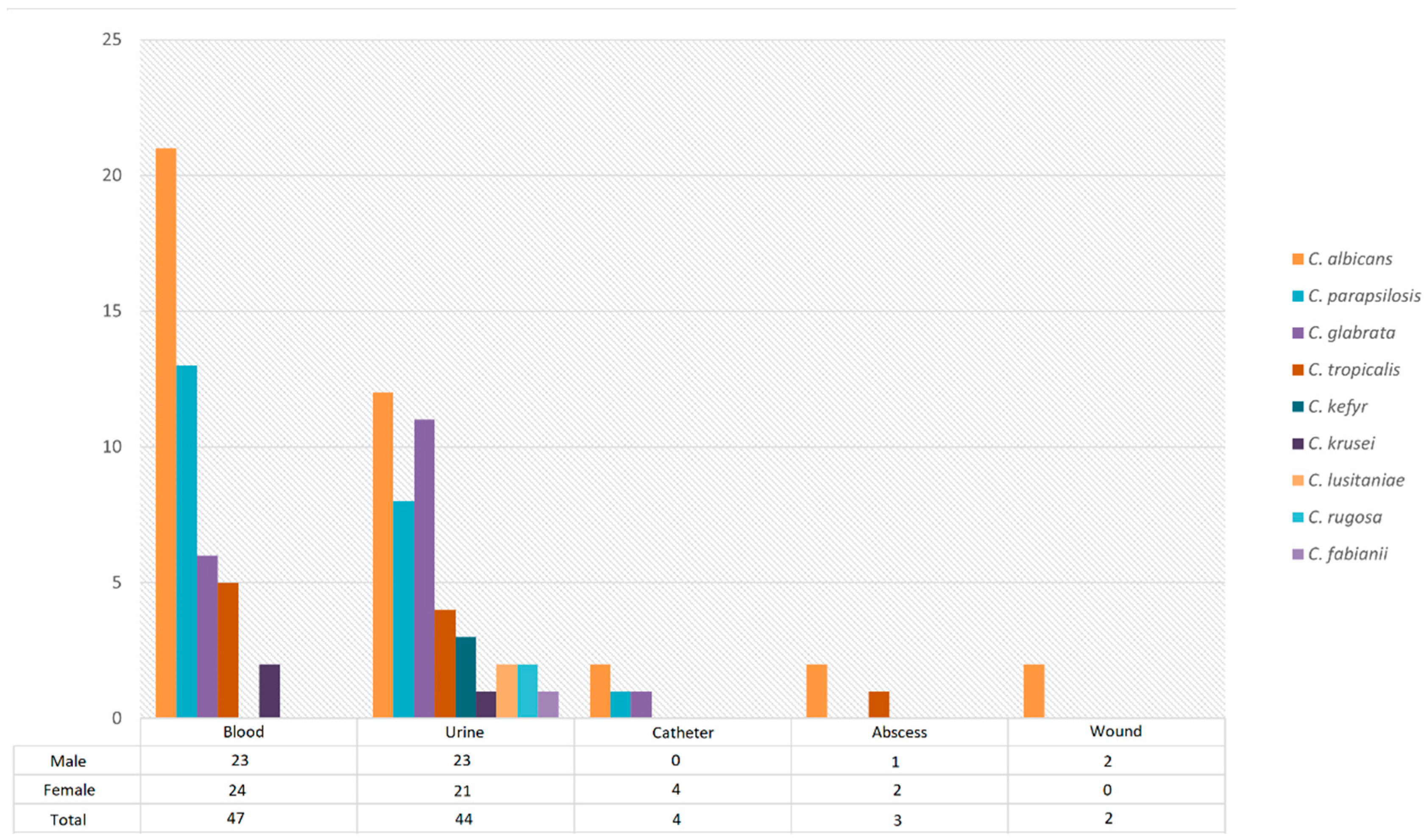
2.1. Patient Characteristics and Specimen Distribution
2.2. Species Identification and Method Comparison
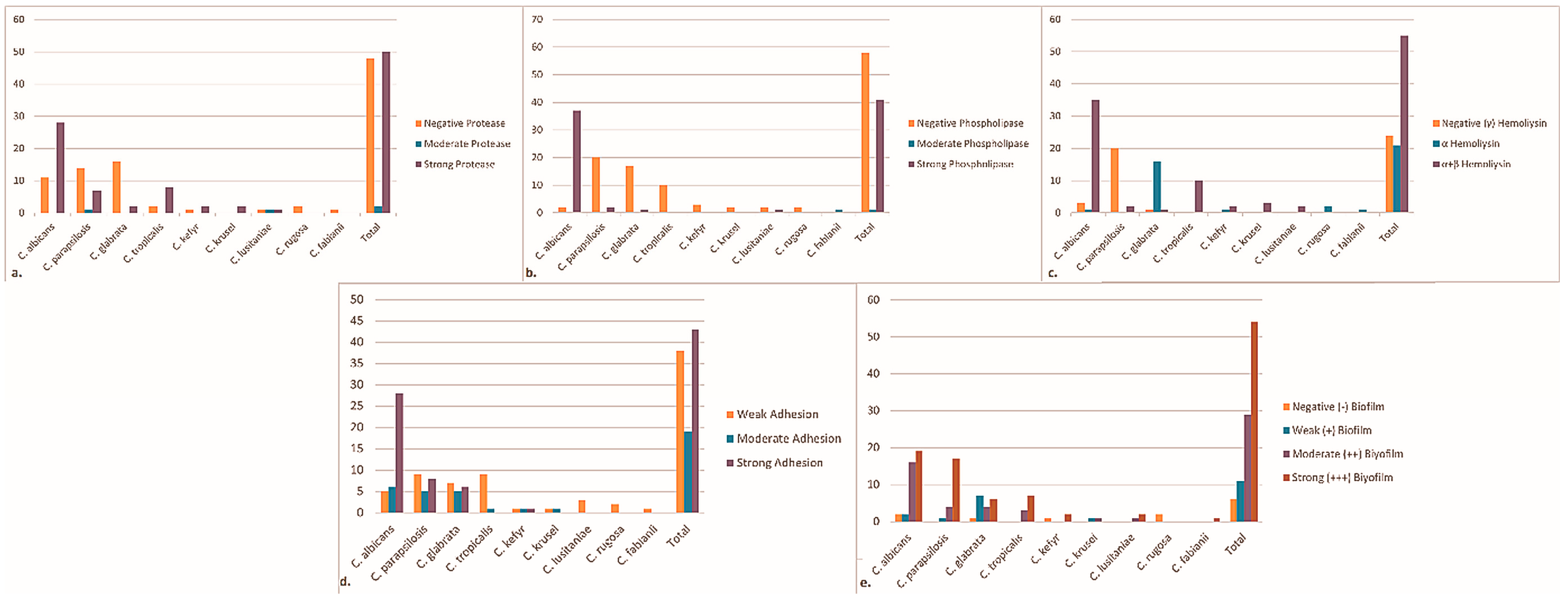
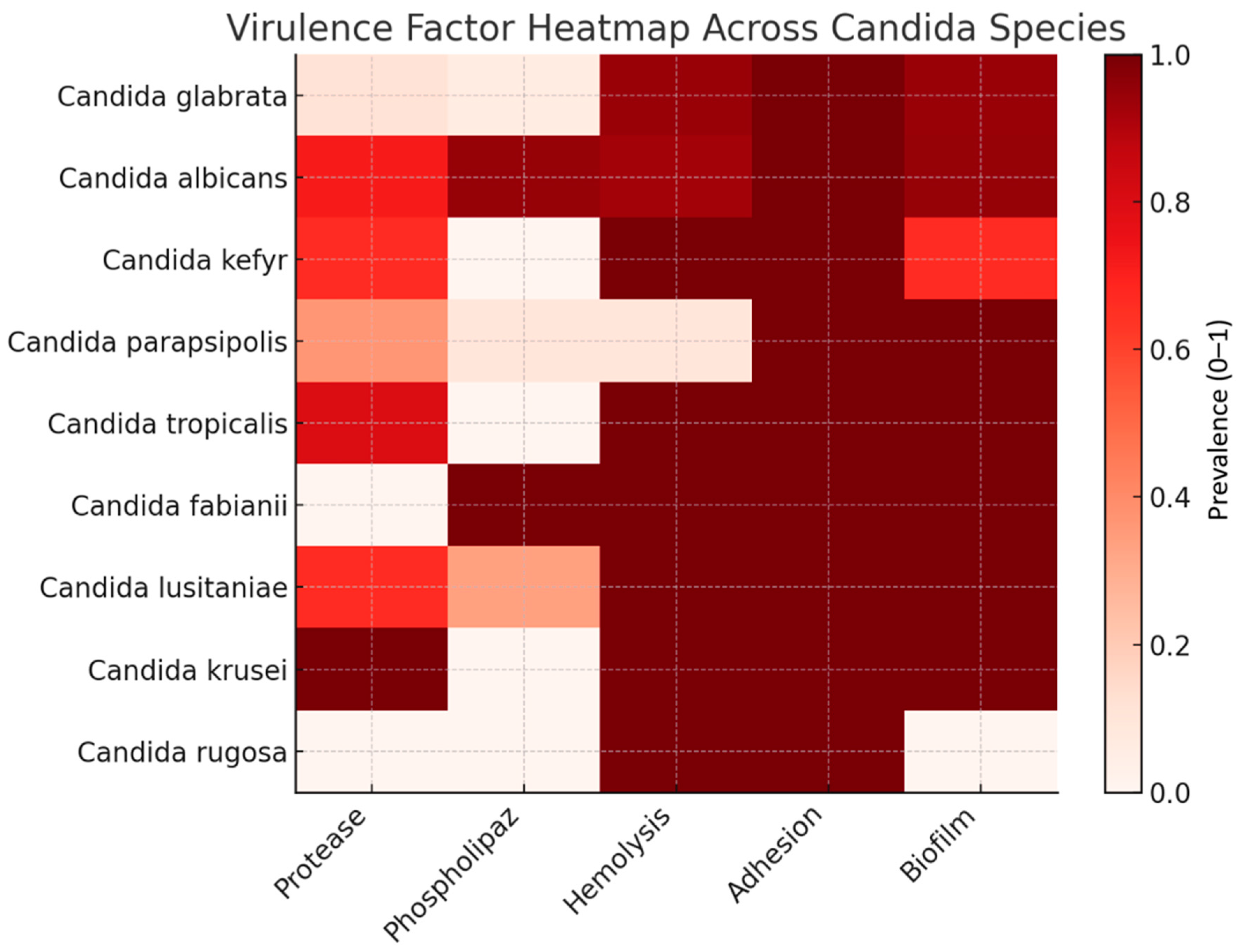
2.3. Virulence Factor Profiles
2.4. Statistical Evaluation of Virulence Traits
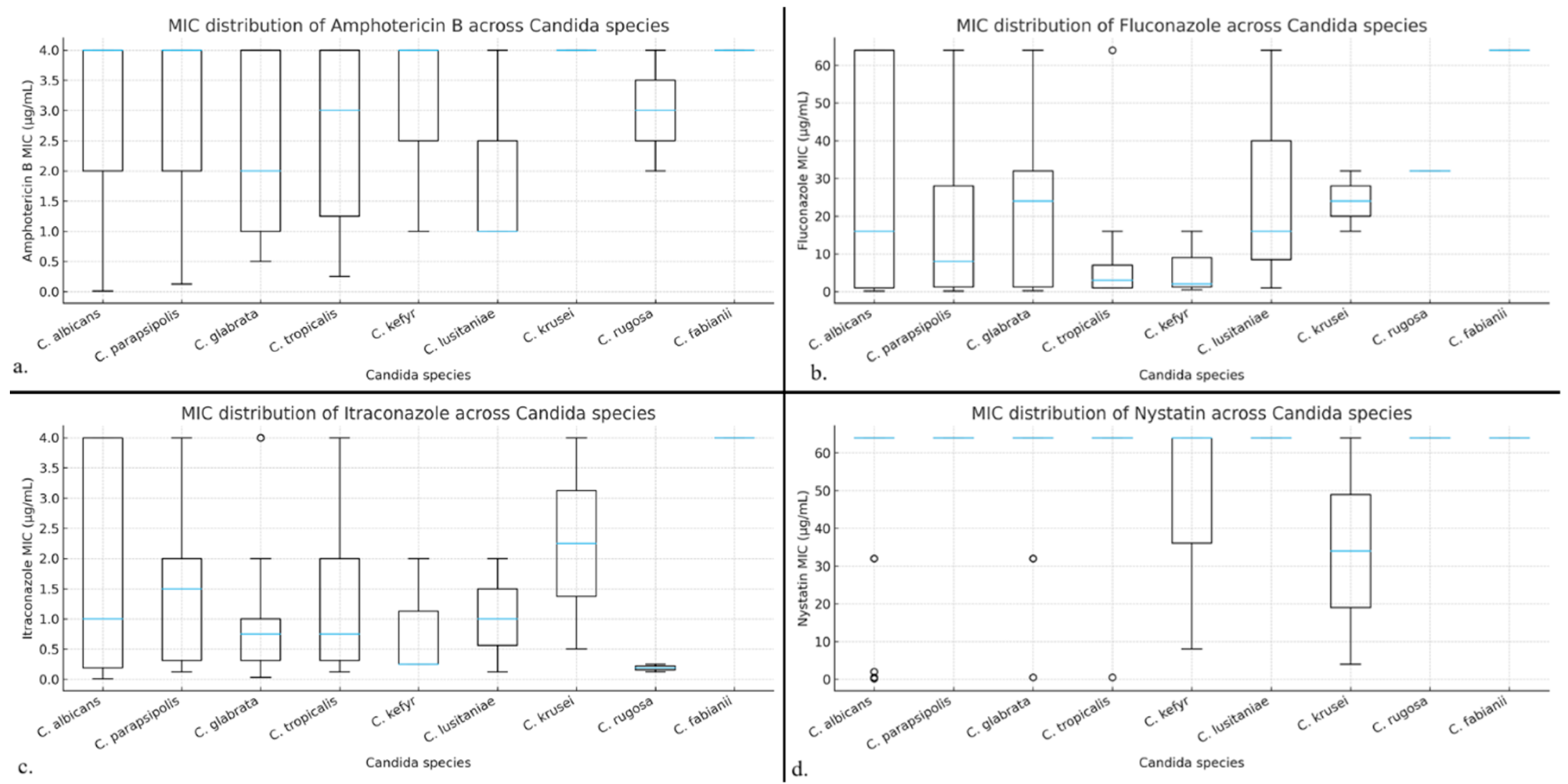
2.5. Antifungal Susceptibility Profiles
3. Discussion
4. Materials and Methods
4.1. Collection of Candida Isolates
4.2. Candida Chromogenic Agar Medium
4.3. MALDI-TOF MS Analysis
4.4. PCR and Sequencing
4.5. Virulence Factor and Antifungal Activity Assays
5. Conclusions
Author Contributions
Funding
Institutional Review Board Statement
Data Availability Statement
Conflicts of Interest
References
- Pappas, P.G.; Lionakis, M.S.; Arendrup, M.C.; Ostrosky-Zeichner, L.; Kullberg, B.J. Invasive Candidiasis. Nat. Rev. Dis. Primers 2018, 4, 18026. [Google Scholar] [CrossRef] [PubMed]
- Fernández-Manteca, M.G.; Ocampo-Sosa, A.A.; de Alegría-Puig, C.R.; Roiz, M.P.; Rodríguez-Grande, J.; Madrazo, F.; Calvo, J.; Rodríguez-Cobo, L.; López-Higuera, J.M.; Fariñas, M.C.; et al. Automatic classification of Candida species using Raman spectroscopy and machine learning. Spectrochim. Acta A Mol. Biomol. Spectrosc. 2023, 290, 122270. [Google Scholar] [CrossRef] [PubMed]
- Pfaller, M.A.; Castanheira, M. Nosocomial Candidiasis: Antifungal Stewardship and the Importance of Rapid Diagnosis. Med. Mycol. 2015, 54, myv076. [Google Scholar] [CrossRef]
- McCarty, T.P.; White, C.M.; Pappas, P.G. Candidemia and Invasive Candidiasis. Infect. Dis. Clin. N. Am. 2021, 35, 389–413. [Google Scholar] [CrossRef] [PubMed]
- Scharmann, U.; Kirchhoff, L.; Chapot, V.l.S.; Dziobaka, J.; Verhasselt, H.L.; Stauf, R.; Buer, J.; Steinmann, J.; Rath, P. Comparison of four commercially available chromogenic media to identify Candida albicans and other medically relevant Candida species. Mycoses 2020, 63, 823–831. [Google Scholar] [CrossRef]
- Nishimoto, A.T.; Sharma, C.; Rogers, P.D. Molecular and genetic basis of azole antifungal resistance in the opportunistic pathogenic fungus Candida albicans. J. Antimicrob. Chemother. 2020, 75, 257–270. [Google Scholar] [CrossRef]
- Brown, G.D.; Denning, D.W.; Gow, N.A.R.; Levitz, S.M.; Netea, M.G.; White, T.C. Hidden Killers: Human Fungal Infections. Sci. Transl. Med. 2012, 4, 165rv13. [Google Scholar] [CrossRef]
- Denning, D.W. Global incidence and mortality of severe fungal disease. Lancet Infect. Dis. 2024, 24, e428–e438. [Google Scholar] [CrossRef]
- Ahmad, S.; Alfouzan, W. Candida auris: Epidemiology, Diagnosis, Pathogenesis, Antifungal Susceptibility, and Infection Control Measures to Combat the Spread of Infections in Healthcare Facilities. Microorganisms 2021, 9, 807. [Google Scholar] [CrossRef]
- Çiçek, B.; Yılmaz, H.; Mutlu Yılmaz, E.; Esen, Ş.; Birinci, A. Candida Epidemiyolojisindeki Değişikliklerin Araştırılması. Mikrobiyol Bul. 2015, 49, 423–431. [Google Scholar] [CrossRef]
- Saiprom, N.; Wongsuk, T.; Oonanant, W.; Sukphopetch, P.; Chantratita, N.; Boonsilp, S. Characterization of Virulence Factors in Candida Species Causing Candidemia in a Tertiary Care Hospital in Bangkok, Thailand. J. Fungi 2023, 9, 353. [Google Scholar] [CrossRef]
- Chander, J.; Singla, N.; Sidhu, S.K.; Gombar, S. Epidemiology of Candida blood stream infections: Experience of a tertiary care centre in North India. J. Infect. Dev. Ctries. 2013, 7, 670–675. [Google Scholar] [CrossRef]
- Lewis, R.E.; Fothergill, A.W. Antifungal Agents. In Diagnosis and Treatment of Human Mycoses; Humana Press: Totowa, NJ, USA, 2008; pp. 105–133. [Google Scholar] [CrossRef]
- Mete, B.; Zerdali, E.Y.; Aygun, G.; Saltoglu, N.; Balkan, I.I.; Karaali, R.; Kaya, S.Y.; Karaismailoglu, B.; Kaya, A.; Urkmez, S.; et al. Change in species distribution and antifungal susceptibility of candidemias in an intensive care unit of a university hospital (10-year experience). Eur. J. Clin. Microbiol. Infect. Dis. 2021, 40, 325–333. [Google Scholar] [CrossRef] [PubMed]
- Pu, S.; Niu, S.; Zhang, C.; Xu, X.; Qin, M.; Huang, S.; Zhang, L. Epidemiology, antifungal susceptibilities, and risk factors for invasive candidiasis from 2011 to 2013 in a teaching hospital in southwest China. J. Microbiol. Immunol. Infect. 2017, 50, 97–103. [Google Scholar] [CrossRef] [PubMed]
- Patterson, L.; McMullan, R.; Harrison, D.A. Individual risk factors and critical care unit effects on Invasive Candida Infection occurring in critical care units in the UK: A multilevel model. Mycoses 2019, 62, 790–795. [Google Scholar] [CrossRef] [PubMed]
- Pfaller, M.A.; Diekema, D.J.; Gibbs, D.L.; Newell, V.A.; Ellis, D.J.; Tullio, V.; Rodloff, A.C.; Fu, W.; Ling, T.A.; Global Antifungal Surveillance Group. Results from the ARTEMIS DISK Global Antifungal Surveillance Study, 1997 to 2007: A 10.5-Year Analysis of Susceptibilities of Candida Species to Fluconazole and Voriconazole as Determined by CLSI Standardized Disk Diffusion. J. Clin. Microbiol. 2010, 48, 1366–1377. [Google Scholar] [CrossRef]
- Marak, M.B.; Dhanashree, B. Antifungal Susceptibility and Biofilm Production of Candida spp. Isolated from Clinical Samples. Int. J. Microbiol. 2018, 2018, 7495218. [Google Scholar] [CrossRef]
- Melo, A.S.; Bizerra, F.C.; Freymüller, E.; Arthington-Skaggs, B.A.; Colombo, A.L. Biofilm production and evaluation of antifungal susceptibility amongst clinical Candida spp. isolates, including strains of the Candida parapsilosis complex. Med. Mycol. 2011, 49, 253–262. [Google Scholar] [CrossRef]
- Çetin, E.S.; Kaya, S.; Pakbaş, İ.; Demirci, M. Yoğun Bakım Ünitelerinde Yatan Hastalardan İzole Edilen Mikroorganizmalar ve Antibiyotik Duyarlılıkları. İnönü Üniv. Tıp Fak. Derg. 2007, 14, 69–73. [Google Scholar]
- Hazırolan, G.; Yildiran, D.; Baran, I.; Mumcuoğlu, I.; Aksu, N. Yatan hasta örneklerinden izole edilen Candida izolatlarinin tür dağilimlarinin ve antifungal duyarlilik profillerinin değerlendirilmesi. Turk Hij. Deney. Biyol. Derg. 2015, 72, 17–26. [Google Scholar] [CrossRef]
- Batçık, Ş.; Bahçeci, İ.; Kazancıoğlu, L.; Kazdal, H.; Özcan, M. Candida Species and Antifungal Susceptibility Isolated in Intensive Care Units: A Three-year Study. Van Tıp Derg. 2021, 28, 459–465. [Google Scholar] [CrossRef]
- Sariguzel, F.M.; Unuvar, G.K.; Kucukoglu, O.; Parkan, O.M.; Koc, A.N. Identification, molecular characterization, and antifungal susceptibility of Cyberlindnera fabianii strains isolated from urinary tract. J. Med. Mycol. 2023, 33, 101429. [Google Scholar] [CrossRef] [PubMed]
- Hachem, R.; Hanna, H.; Kontoyiannis, D.; Jiang, Y.; Raad, I. The changing epidemiology of invasive candidiasis. Cancer 2008, 112, 2493–2499. [Google Scholar] [CrossRef] [PubMed]
- Pincus, D.H.; Orenga, S.; Chatellier, S. Yeast identification—Past, present, and future methods. Med Mycol. 2007, 45, 97–121. [Google Scholar] [CrossRef]
- Burton, M.J.; Swiatlo, E.; Shah, P. Misidentification of Candida parapsilosis as C famata in a Clinical Case of Vertebral Osteomyelitis. Am. J. Med. Sci. 2011, 341, 71–73. [Google Scholar] [CrossRef]
- Borman, A.M.; Szekely, A.; Palmer, M.D.; Johnson, E.M. Assessment of Accuracy of Identification of Pathogenic Yeasts in Microbiology Laboratories in the United Kingdom. J. Clin. Microbiol. 2012, 50, 2639–2644. [Google Scholar] [CrossRef]
- Coleman, D.C.; Sullivan, D.J.; Bennett, D.E.; Moran, G.P.; Barry, H.J.; Shanley, D.B. Candidiasis. AIDS 1997, 11, 557–567. [Google Scholar] [CrossRef]
- Williams, D.; Lewis, M. Isolation and identification of Candida from the oral cavity. Oral Dis. 2000, 6, 3–11. [Google Scholar] [CrossRef]
- Campanha, N.; Neppelenbroek, K.; Spolidorio, D.; Spolidorio, L.; Pavarina, A. Phenotypic methods and commercial systems for the discrimination between C. albicans and C. dubliniensis. Oral Dis. 2005, 11, 392–398. [Google Scholar] [CrossRef]
- Nerurkar, V.; Khan, S.; Kaatngal, S.; Bhatia, S. Identifying Candida and Other Yeast- Like Fungi: Utility of an Identification Algorithm in Resource Limited Setting. J. Clin. Diagn. Res. 2014, 8, DC1–DC4. [Google Scholar] [CrossRef]
- Vecchione, A.; Florio, W.; Celandroni, F.; Barnini, S.; Lupetti, A.; Ghelardi, E. Comparative evaluation of six chromogenic media for presumptive yeast identification. J. Clin. Pathol. 2017, 70, 1074–1078. [Google Scholar] [CrossRef]
- Meena, S.; Mohanty, A.; Kaistha, N.; Sasirekha, U.; Meena, J. Comparative Assessment of Matrix-assisted Laser Desorption Ionization-time of Flight Mass Spectrometry (MALDI-TOF-MS) and Conventional Methods in the Identification of Clinically Relevant Yeasts. Cureus 2021, 13, e15607. [Google Scholar] [CrossRef]
- Lacroix, C.; Gicquel, A.; Sendid, B.; Meyer, J.; Accoceberry, I.; François, N.; Morio, F.; Desoubeaux, G.; Chandenier, J.; Kauffmann-Lacroix, C.; et al. Evaluation of two matrix-assisted laser desorption ionization-time of flight mass spectrometry (MALDI-TOF MS) systems for the identification of Candida species. Clin. Microbiol. Infect. 2014, 20, 153–158. [Google Scholar] [CrossRef] [PubMed]
- Keçeli, S.A.; Dündar, D.; Tamer, G.S. Comparison of Vitek Matrix-assisted Laser Desorption/Ionization Time-of-Flight Mass Spectrometry Versus Conventional Methods in Candida Identification. Mycopathologia 2016, 181, 67–73. [Google Scholar] [CrossRef] [PubMed]
- Chen, J.; Hu, N.; Xu, H.; Liu, Q.; Yu, X.; Zhang, Y.; Huang, Y.; Tan, J.; Huang, X.; Zeng, L. Molecular Epidemiology, Antifungal Susceptibility, and Virulence Evaluation of Candida Isolates Causing Invasive Infection in a Tertiary Care Teaching Hospital. Front. Cell. Infect. Microbiol. 2021, 11, 721439. [Google Scholar] [CrossRef] [PubMed]
- Seneviratne, C.J.; Wong, S.S.W.; Yuen, K.Y.; Meurman, J.H.; Pärnänen, P.; Vaara, M.; Samaranayake, L.P. Antifungal Susceptibility and Virulence Attributes of Bloodstream Isolates of Candida from Hong Kong and Finland. Mycopathologia 2011, 172, 389–395. [Google Scholar] [CrossRef]
- Dabiri, S.; Shams-Ghahfarokhi, M.; Razzaghi-Abyaneh, M. Comparative analysis of proteinase, phospholipase, hydrophobicity and biofilm forming ability in Candida species isolated from clinical specimens. J. Mycol. Med. 2018, 28, 437–442. [Google Scholar] [CrossRef]
- Pandey, N.; Gupta, M.K.; Tilak, R. Extracellular hydrolytic enzyme activities of the different Candida spp. isolated from the blood of the Intensive Care Unit-admitted patients. J. Lab. Physicians 2018, 10, 392–396. [Google Scholar] [CrossRef]
- Ramos, L.d.S.; Barbedo, L.S.; Braga-Silva, L.A.; Santos, A.L.S.D.; Pinto, M.R.; Sgarbi, D.B.d.G. Protease and phospholipase activities of Candida spp. isolated from cutaneous candidiasis. Rev. Iberoam. Micol. 2015, 32, 122–125. [Google Scholar] [CrossRef]
- Nouraei, H.; Pakshir, K.; ZareShahrabadi, Z.; Zomorodian, K. High detection of virulence factors by Candida species isolated from bloodstream of patients with candidemia. Microb. Pathog. 2020, 149, 104574. [Google Scholar] [CrossRef]
- Silva-Dias, A.; Miranda, I.M.; Branco, J.; Monteiro-Soares, M.; Pina-Vaz, C.; Rodrigues, A.G. Adhesion, biofilm formation, cell surface hydrophobicity, and antifungal planktonic susceptibility: Relationship among Candida spp. Front. Microbiol. 2015, 6, 205. [Google Scholar] [CrossRef] [PubMed]
- Alpay, Y.; Ağalar, C.; Karabıçak, N.; Kılıç, D.; Kaygusuz, S.; Ayaşlıoğlu, E.; Esen, B. Investigation of Biofilm Formation in Albicans and Non-Albicans Candida Species Obtained from Clinical Specimens and Distribution by Species. Kocaeli Tıp Dergisi 2017, 6, 23–27. [Google Scholar]
- Agwan, V.; Butola, R.; Madan, M. Comparison of biofilm formation in clinical isolates of Candida species in a tertiary care center, North India. Indian J. Pathol. Microbiol. 2015, 58, 475. [Google Scholar] [CrossRef] [PubMed]
- Tüzüner, U.; İnci, R. Candida türlerinde biyofilm oluşumunun modifiye mikroplak ve modifiye XTT redüksiyon yöntemleri ile saptanması. Ege Tıp Dergisi 2017, 56, 178–182. [Google Scholar] [CrossRef][Green Version]
- Das, A.; Singh, V.; Maurya, K.; Sen, M.; Agarwal, J. Candida biofilm-A medical havoc: Prospective study among the patients in tertiary health care centre in North India. Int. J. Med. Microbiol. Trop. Dis. 2020, 4, 109–112. [Google Scholar] [CrossRef]
- ElFeky, D.S.; Gohar, N.M.; El-Seidi, E.A.; Ezzat, M.M.; AboElew, S.H. Species identification and antifungal susceptibility pattern of Candida isolates in cases of vulvovaginal candidiasis. Alex. J. Med. 2016, 52, 269–277. [Google Scholar] [CrossRef]
- Zeng, Z.; Ding, Y.; Tian, G.; Yang, K.; Deng, J.; Li, G.; Liu, J. A seven-year surveillance study of the epidemiology, antifungal susceptibility, risk factors and mortality of candidaemia among paediatric and adult inpatients in a tertiary teaching hospital in China. Antimicrob. Resist. Infect. Control 2020, 9, 133. [Google Scholar] [CrossRef]
- Pelit, S.; Uzun, M. Yoğun bakım ünitelerinde yatan hastalara ait çeşitli klinik örneklerden izole edilen Candida suşlarında tür dağılımının ve antifungal duyarlılıkların araştırılması. J. Crit. Intensive Care 2016, 7, 49–52. [Google Scholar] [CrossRef]
- Al-Dorzi, H.M.; Sakkijha, H.; Khan, R.; Aldabbagh, T.; Toledo, A.; Ntinika, P.; Al Johani, S.M.; Arabi, Y.M. Invasive Candidiasis in Critically Ill Patients: A Prospective Cohort Study in Two Tertiary Care Centers. J. Intensiv. Care Med. 2020, 35, 542–553. [Google Scholar] [CrossRef]
- Erdem, F.; Ertem, G.T.; Oral, B.; Karakoç, E.; Demiröz, A.P.; Tülek, N. Candida Türlerine Bağlı Nozokomiyal Enfeksiyonların Epidemiyolojik ve Mikrobiyolojik Açıdan Değerlendirilmesi. Mikrobiyol Bul. 2012, 46, 637–648. [Google Scholar]
- Zaidi, K.U.; Mani, A.; Thawani, V.; Mehra, A. Total Protein Profile and Drug Resistance in Candida albicans Isolated from Clinical Samples. Mol. Biol. Int. 2016, 2016, 4982131. [Google Scholar] [CrossRef] [PubMed]
- Bayona, J.V.M.; García, C.S.; Palop, N.T.; Cardona, C.G. Evaluation of a novel chromogenic medium for Candida spp. identification and comparison with CHROMagar™ Candida for the detection of Candida auris in surveillance samples. Diagn. Microbiol. Infect. Dis. 2020, 98, 115168. [Google Scholar] [CrossRef] [PubMed]
- Tokak, S.; Kılıç, I.H.; Horasanlı, J.E.; Mutlu, E.G.; Taşbent, F.E.; Karagöz, I.D. Vaginal candidiasis in Konya area: Etiology, risk factors, virulence patterns, and antifungal susceptibility. Rev. Rom. Med. Lab. 2021, 29, 201–215. [Google Scholar] [CrossRef]
- Yokoyama, K.; Biswas, S.K.; Miyaji, M.; Nishimura, K. Identification and Phylogenetic Relationship of the Most Common Pathogenic Candida Species Inferred from Mitochondrial Cytochrome b Gene Sequences. J. Clin. Microbiol. 2000, 38, 4503–4510. [Google Scholar] [CrossRef]
- Staib, F. Serum-proteins as nitrogen source for yeastlike fungi. Med. Mycol. 1965, 4, 187–193. [Google Scholar] [CrossRef]
- Faria-Gonçalves, P.; Oliveira, A.S.; Gaspar, C.; Rodrigues, L.; Palmeira-De-Oliveira, R.; Martinez-De-Oliveira, J.; Gonçalves, T.; Palmeira-De-Oliveira, A.; Rolo, J. Vulvovaginal Candida albicans Clinical Isolates’ Resistance to Phagocytosis In-Vitro. Life 2022, 12, 838. [Google Scholar] [CrossRef]
- Price, M.F.; Wilkinson, I.D.; Gentry, L.O. Plate method for detection of phospholipase activity in Candida albicans. Med. Mycol. 1982, 20, 7–14. [Google Scholar] [CrossRef]
- Luo, G.; Samaranayake, L.P.; Yau, J.Y.Y. Candida Species Exhibit Differential In Vitro Hemolytic Activities. J. Clin. Microbiol. 2001, 39, 2971–2974. [Google Scholar] [CrossRef]
- Murat, S.; Alp, G.; Alatalı, C.; Uzun, M. In Vitro Evaluation of Adhesion of Candida albicans on CAD/CAM PMMA-Based Polymers. J. Prosthodont. 2019, 28, 873–879. [Google Scholar] [CrossRef]
- Růžička, F.; Holá, V.; Votava, M.; Tejkalová, R.; Horvát, R.; Heroldová, M.; Woznicová, V. Biofilm detection and the clinical significance of Staphylococcus epidermidis isolates. Folia Microbiol. 2004, 49, 596–600. [Google Scholar] [CrossRef]
- Musinguzi, B.; Akampurira, A.; Derick, H.; Turyamuhika, L.; Mwesigwa, A.; Mwebesa, E.; Mwesigye, V.; Kabajulizi, I.; Sekulima, T.; Ocheng, F.; et al. Extracellular hydrolytic enzyme activities and biofilm formation in Candida species isolated from people living with human immunodeficiency virus with oropharyngeal candidiasis at HIV/AIDS clinics in Uganda. Microb. Pathog. 2025, 199, 107232. [Google Scholar] [CrossRef]
- EUCAST Definitive Document E.Def 7.4 Method for the Determination of Broth Dilution Minimum Inhibitory Concentrations of Antifungal Agents for Yeasts; European Committee on Antimicrobial Susceptibility Testing: Växjö, Sweden, 2023.



| Candida Species | Sequence | MALDI-TOF MS | CCA | ||
|---|---|---|---|---|---|
| Number of Species | Specificity | Misidentified | Specificity | Misidentified | |
| Candida albicans | 39 | 34 (%87.8) | C. glabrata (%7.70) C. parapsilosis (%2.56) C. tropicalis (%2.56) | 31 (%79.48) | C. tropicalis (%12.82) C. parapsilosis (%5.12) C. glabrata (%2.56) |
| Candida parapsilosis | 22 | 18 (%81.82) | C. albicans (%9.09) C. glabrata (%9.09) | 18 (%81.81) | C. albicans (%4.55) C. glabrata (%4.55) C. tropicalis (%9.09) |
| Candida glabrata | 18 | 16 (%88.90) | C. albicans (%5.55) C. parapsilosis (%5.55) | 12 (%66.67) | C. parapsilosis (%33.33) |
| Candida tropicalis | 10 | 10 (%100) | - | 8 (%80) | C. albicans (%10) C. glabrata (%10) |
| Candida kefyr (Kluvyeromyces marxianus) | 3 | 3 (%100) | - | - | C. glabrata (%100) |
| Candida krusei (Pichia kudriavzevii) | 2 | 2 (%100) | - | 2 (%100) | - |
| Candida lusitaniae (Clavispora lusitaniae) | 3 | 1 (%66.67) | C. albicans (%33.33) | - | C. glabrata (%100) |
| Candida rugosa (Diutina rugosa) | 2 | 2 (%100) | - | - | C. parapsilosis (%50) C. albicans (%50) |
| Candida fabianii (Cyberlindnera fabianii) | 1 | 1 (%100) | - | - | C. parapsilosis (%100) |
| Species | n | Inclusion Status | Justification |
|---|---|---|---|
| Candida albicans | 39 | Included | Adequate sample size (n ≥ 10) |
| Candida parapsilosis | 22 | Included | Adequate sample size (n ≥ 10) |
| Candida glabrata | 18 | Included | Adequate sample size (n ≥ 10) |
| Candida tropicalis | 10 | Included | Adequate sample size (n ≥ 10) |
| Candida kefyr | 3 | Excluded | n < 5, zero MIC variance |
| Candida lusitaniae | 3 | Excluded | n < 5, chi-square invalid |
| Candida krusei | 2 | Excluded | n < 5, regression separation |
| Candida rugosa | 2 | Excluded | n < 5, unreliable inference |
| Candida fabianii | 1 | Excluded | n < 5, insufficient variability |
| Virulence Factor | χ2 | p-Value | Interpretation |
|---|---|---|---|
| Protease | 21.56 | 3.2 × 10⁻⁵ | Highly significant |
| Phospholipase | 64.40 | <0.0001 | Extremely significant |
| Hemolysis | 11.10 | 0.011 | Significant |
| Adhesion | 0.00 | 1.00 | Universal positivity |
| Biofilm | 1.75 | 0.626 | No significant difference |
| Antifungal | H Statistic | p-Value | Interpretation |
|---|---|---|---|
| Amphotericin B | 1.96 | 0.580 | No significant difference |
| Fluconazole | 2.89 | 0.408 | No significant difference |
| Itraconazole | 0.43 | 0.933 | No significant difference |
| Nystatin | 4.77 | 0.189 | No significant difference |
Disclaimer/Publisher’s Note: The statements, opinions and data contained in all publications are solely those of the individual author(s) and contributor(s) and not of MDPI and/or the editor(s). MDPI and/or the editor(s) disclaim responsibility for any injury to people or property resulting from any ideas, methods, instructions or products referred to in the content. |
© 2026 by the authors. Licensee MDPI, Basel, Switzerland. This article is an open access article distributed under the terms and conditions of the Creative Commons Attribution (CC BY) license.
Share and Cite
Çelik, Z.; Kılıç, İ.H.; Tokak, S.; Esenkaya Taşbent, F. Molecular Identification, Virulence Factors, and Antifungal Susceptibility Profiles of Candida Isolates from Clinical Samples of Intensive Care Patients. Antibiotics 2026, 15, 197. https://doi.org/10.3390/antibiotics15020197
Çelik Z, Kılıç İH, Tokak S, Esenkaya Taşbent F. Molecular Identification, Virulence Factors, and Antifungal Susceptibility Profiles of Candida Isolates from Clinical Samples of Intensive Care Patients. Antibiotics. 2026; 15(2):197. https://doi.org/10.3390/antibiotics15020197
Chicago/Turabian StyleÇelik, Zeynep, İbrahim Halil Kılıç, Semih Tokak, and Fatma Esenkaya Taşbent. 2026. "Molecular Identification, Virulence Factors, and Antifungal Susceptibility Profiles of Candida Isolates from Clinical Samples of Intensive Care Patients" Antibiotics 15, no. 2: 197. https://doi.org/10.3390/antibiotics15020197
APA StyleÇelik, Z., Kılıç, İ. H., Tokak, S., & Esenkaya Taşbent, F. (2026). Molecular Identification, Virulence Factors, and Antifungal Susceptibility Profiles of Candida Isolates from Clinical Samples of Intensive Care Patients. Antibiotics, 15(2), 197. https://doi.org/10.3390/antibiotics15020197