Development of AWaRe-Based Quality Indicators to Assess the Appropriateness of Antibiotic Prescribing in Primary Healthcare in South Africa

 ,
,  ,
,  , , , , , , , , , , and
Abstract
1. Introduction
2. Results
2.1. The Rating Process
2.2. Median Scores and Level of Consensus for Round 2
2.3. Round 2 Outcomes of Indicators Rated for Appropriateness and Feasibility
2.4. Final Set of Quality Indicators Rated Appropriate and Feasible in the Second Round
3. Discussion
4. Materials and Methods
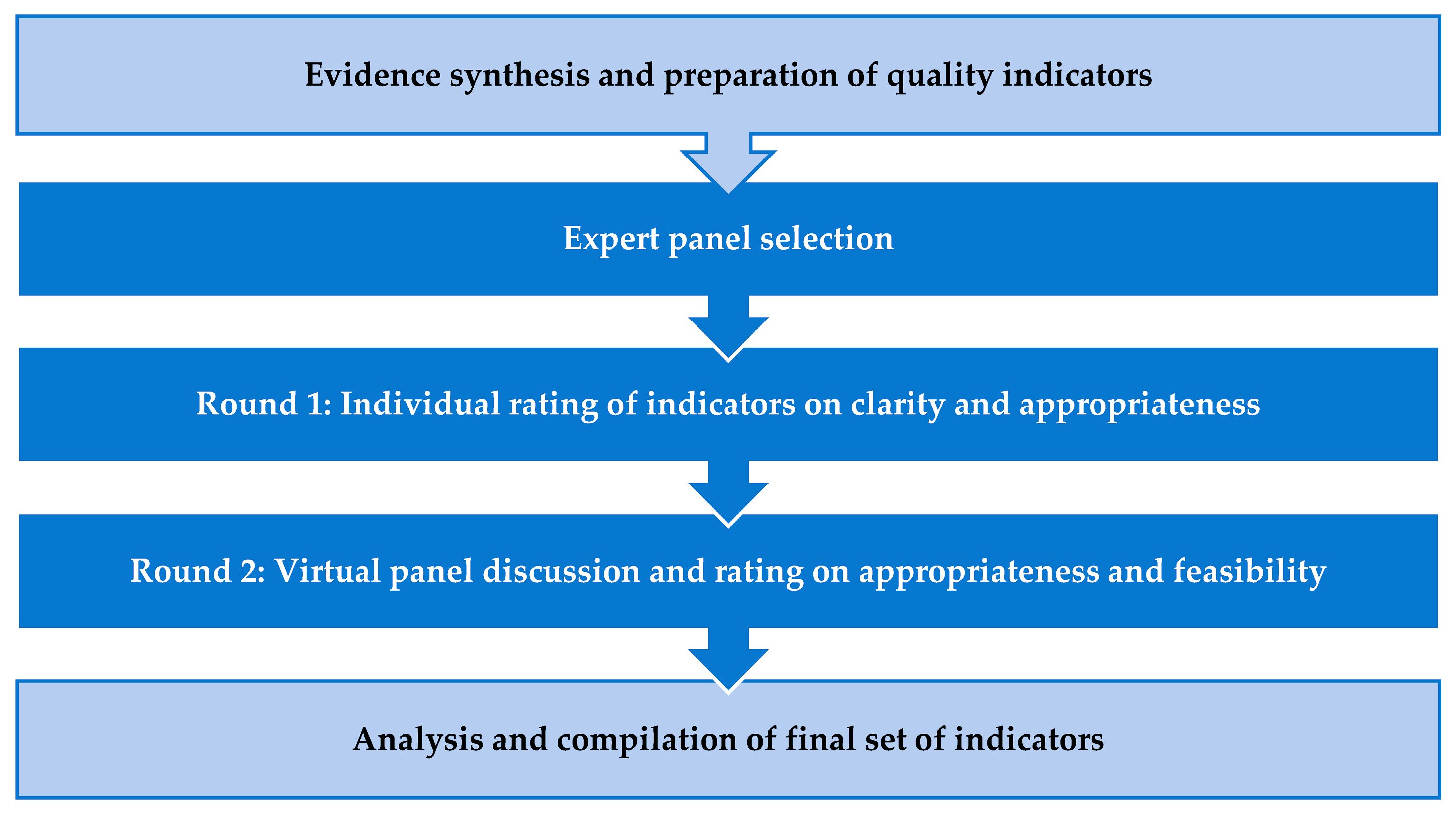
4.1. Evidence Synthesis and Preparation of Quality Indicators
- (1)
- A published review of indicators for appropriate antibiotic use aligned to the WHO AWaRe system published in collaboration with SGUL, London, United Kingdom [54].
- (2)
- Quality indicators and quantity metrics for optimal antibiotic use based on the WHO AWaRe system, developed as part of the global ‘Antimicrobial resistance, prescribing and consumption Data to Inform country antibiotic guidance and Local Action’ (ADILA) project [76]. The indicators were developed using two discrete consensus technique methodologies [75].
- (3)
- Data from the Antibiotic Prescribing in Primary Healthcare Point Prevalence Survey (APC-PPS) conducted at eight PHC clinics in the North-West and Gauteng provinces in South Africa between November 2023 and October 2024, undertaken to better understand current presentation rates of clinical infections and antibiotic prescribing patterns for infections at PHCs [83,107]. The results of the APC-PPS showed that acute cough and sexually transmitted infections were the most reported infection presentations at PHCs [93]. This resulted in the development of additional indicators to measure the appropriateness of antibiotic prescribing for acute cough and sexually transmitted infections using guidance from the AWaRe Book [50].
4.2. Expert Panel Selection and Composition
4.3. Round 1: Rating Clarity and Appropriateness
4.4. Round 2: Consensus Meeting and Rating Appropriateness and Feasibility
4.5. Data Analysis
5. Conclusions
Supplementary Materials
Author Contributions
Funding
Institutional Review Board Statement
Informed Consent Statement
Data Availability Statement
Acknowledgments
Conflicts of Interest
References
- Budd, E.; Cramp, E.; Sharland, M.; Hand, K.; Howard, P.; Wilson, P.; Wilcox, M.; Muller-Pebody, B.; Hopkins, S. Adaptation of the WHO Essential Medicines List for national antibiotic stewardship policy in England: Being AWaRe. J. Antimicrob. Chemother. 2019, 74, 3384–3389. [Google Scholar] [CrossRef]
- Booton, R.D.; Meeyai, A.; Alhusein, N.; Buller, H.; Feil, E.; Lambert, H.; Mongkolsuk, S.; Pitchforth, E.; Reyher, K.K.; Sakcamduang, W.; et al. One Health drivers of antibacterial resistance: Quantifying the relative impacts of human, animal and environmental use and transmission. One Health 2021, 12, 100220. [Google Scholar] [CrossRef] [PubMed]
- Uddin, T.M.; Chakraborty, A.J.; Khusro, A.; Zidan, B.R.M.; Mitra, S.; Bin Emran, T.; Dhama, K.; Ripon, K.H.; Gajdács, M.; Sahibzada, M.U.K.; et al. Antibiotic resistance in microbes: History, mechanisms, therapeutic strategies and future prospects. J. Infect. Public Health 2021, 14, 1750–1766. [Google Scholar] [CrossRef] [PubMed]
- World Health Organization. Antimicrobial Resistance and Primary Health Care; World Health Organization: Geneva, Switzerland, 2018; Available online: https://iris.who.int/items/ed44e9fa-8f84-490c-8a60-b4422a642e4f (accessed on 21 January 2026).
- Bankar, N.J.; Ugemuge, S.; Ambad, R.S.; Hawale, D.V.; Timilsina, D.R. Implementation of Antimicrobial Stewardship in the Healthcare Setting. Cureus 2022, 14, e26664. [Google Scholar] [CrossRef]
- Hanif, M.; Sultan, M.; Raza, A.; Asad, M.J.; Sultana, T.; Hussain, M.I.; Wajid, U. Antibiotics Overuse and Its Consequences: Raising Awareness and Promoting Responsible Use. Hist. Med. 2024, 10, 1909–1919. [Google Scholar] [CrossRef]
- Lubanga, A.F.; Bwanali, A.N.; Kambiri, F.; Harawa, G.; Mudenda, S.; Mpinganjira, S.L.; Singano, N.; Makole, T.; Kapatsa, T.; Kamayani, M.; et al. Tackling antimicrobial resistance in sub-Saharan Africa: Challenges and opportunities for implementing the new people-centered WHO guidelines. Expert Rev. Anti-Infect. Ther. 2024, 22, 379–386. [Google Scholar] [CrossRef]
- The Lancet. Antimicrobial resistance: An agenda for all. Lancet 2024, 403, 2349. [Google Scholar] [CrossRef]
- Ajulo, S.; Awosile, B. Global antimicrobial resistance and use surveillance system (GLASS 2022): Investigating the relationship between antimicrobial resistance and antimicrobial consumption data across the participating countries. PLoS ONE 2024, 19, e0297921. [Google Scholar] [CrossRef] [PubMed]
- Abejew, A.A.; Wubetu, G.Y.; Fenta, T.G. Relationship between Antibiotic Consumption and Resistance: A Systematic Review. Can. J. Infect. Dis. Med. Microbiol. 2024, 2024, 9958678. [Google Scholar] [CrossRef]
- Klein, E.Y.; Impalli, I.; Poleon, S.; Denoel, P.; Cipriano, M.; Van Boeckel, T.P.; Pecettad, S.; Klein, E.Y.; Bloom, D.E.; Nandia, A. Global trends in antibiotic consumption during 2016–2023 and future projections through 2030. Proc. Natl. Acad. Sci. USA 2024, 121, e2411919121. [Google Scholar] [CrossRef]
- Murray, C.J.; Ikuta, K.S.; Sharara, F.; Swetschinski, L.; Aguilar, G.R.; Gray, A.; Han, C.; Bisignano, C.; Rao, P.; Wool, E.; et al. Global burden of bacterial antimicrobial resistance in 2019: A systematic analysis. Lancet 2022, 399, 629–655. [Google Scholar] [CrossRef]
- Totaro, V.; Guido, G.; Cotugno, S.; De Vita, E.; Asaduzzaman, M.; Patti, G.; Segala, F.V.; Putoto, G.; Frallonardo, L.; Farkas, F.B.; et al. Antimicrobial Resistance in Sub-Saharan Africa: A Comprehensive Landscape Review. Am. J. Trop. Med. Hyg. 2025, 113, 253–263. [Google Scholar] [CrossRef]
- Lewnard, J.A.; Charani, E.; Gleason, A.; Hsu, L.Y.; Khan, W.A.; Karkey, A.; Chandler, C.I.R.; Mashe, T.; Khan, E.M.; Bulabula, A.N.H.; et al. Burden of bacterial antimicrobial resistance in low-income and middle-income countries avertible by existing in-terventions: An evidence review and modelling analysis. Lancet 2024, 403, 2439–2454. [Google Scholar] [CrossRef]
- Sartorius, B.; Gray, A.P.; Weaver, N.D.; Aguilar, G.R.; Swetschinski, L.R.; Ikuta, K.S.; Mestrovic, T.; Chung, E.; Wool, E.E.; Han, C.; et al. The burden of bacterial antimicrobial resistance in the WHO African region in 2019: A cross-country systematic analysis. Lancet Glob. Health 2024, 12, e201–e216. [Google Scholar] [CrossRef]
- World Health Organization. WHO Global Antimicrobial Resistance and Use Surveillance System (GLASS); World Health Organization: Geneva, Switzerland, 2025; Available online: https://www.who.int/publications/i/item/9789240116337 (accessed on 21 January 2026).
- Tornimbene, B.; Eremin, S.; Abednego, R.; Abualas, E.O.; Boutiba, I.; Egwuenu, A.; Fuller, W.; Gahimbare, L.; Githii, S.; Kasambara, W.; et al. Global Antimicrobial Resistance and Use Surveillance System on the African continent: Early implementation 2017–2019. Afr. J. Lab. Med. 2022, 11, 1594. [Google Scholar] [CrossRef]
- Bertagnolio, S.; Dobreva, Z.; Centner, C.M.; Olaru, I.D.; Donà, D.; Burzo, S.; Huttner, B.D.; Chaillob, A.; Gebreselassie, N.; Wi, D.; et al. WHO global research priorities for antimicrobial resistance in human health. Lancet Microbe 2024, 5, 100902. [Google Scholar] [CrossRef]
- Boltena, M.T.; Woldie, M.; Siraneh, Y.; Steck, V.; El-Khatib, Z.; Morankar, S. Adherence to evidence-based implementation of antimicrobial treatment guidelines among prescribers in sub-Saharan Africa: A systematic review and meta-analysis. J. Pharm. Policy Pract. 2023, 16, 137. [Google Scholar] [CrossRef] [PubMed]
- Saleem, Z.; Mekonnen, B.A.; Orubu, E.S.; Islam, A.; Nguyen, T.T.P.; Ubaka, C.M.; Buma, D.; Thuy, N.D.T.; Sant, Y.; Sono, T.M.; et al. Current access, availability and use of antibiotics in primary care among key low- and middle-income countries and the policy implications. Expert Rev. Anti Infect. Ther. 2025, 15, 1–42. [Google Scholar] [CrossRef] [PubMed]
- Klein, E.Y.; Milkowska-Shibata, M.; Tseng, K.K.; Sharland, M.; Gandra, S.; Pulcini, C.; Laxminarayan, R. Assessment of WHO antibiotic consumption and access targets in 76 countries, 2000–2015: An analysis of pharmaceutical sales data. Lancet Infect. Dis. 2021, 21, 107–115. [Google Scholar] [CrossRef]
- ESCMID. Over 3 Million Children Died from Antimicrobial Resistance-Related Infections in 2022, Major Study Shows. 2025. Available online: https://a-p-p-a.org/pdf/over-3-million-children-died-from-antimicrobial-resistance-related-infections-in-2022.pdf (accessed on 21 January 2026).
- Chua, A.Q.; Verma, M.; Hsu, L.Y.; Legido-Quigley, H. An analysis of national action plans on antimicrobial resistance in Southeast Asia using a governance framework approach. Lancet Reg. Health West. Pac. 2021, 7, 100084. [Google Scholar] [CrossRef] [PubMed]
- WHO Global Action Plan on Antimicrobial Resistance. 2015. Available online: https://apps.who.int/iris/bitstream/handle/10665/193736/9789241509763_eng.pdf?sequence=1 (accessed on 20 November 2025).
- Fuller, W.L.; Aboderin, A.O.; Yahaya, A.; Adeyemo, A.T.; Gahimbare, L.; Kapona, O.; Hamzat, O.T.; Bassoum, O. Gaps in the implementation of national core elements for sustainable antimicrobial use in the WHO-African region. Front. Antibiot. 2022, 1, 1047565. [Google Scholar] [CrossRef]
- Willemsen, A.; Reid, S.; Assefa, Y. A review of national action plans on antimicrobial resistance: Strengths and weaknesses. Antimicrob. Resist. Infect. Control 2022, 11, 90. [Google Scholar] [CrossRef]
- Patel, J.; Harant, A.; Fernandes, G.; Mwamelo, A.J.; Hein, W.; Dekker, D.; Sridhar, D. Measuring the global response to antimicrobial resistance, 2020–2021: A systematic governance analysis of 114 countries. Lancet Infect. Dis. 2023, 23, 706–718. [Google Scholar] [CrossRef]
- Godman, B.; Egwuenu, A.; Wesangula, E.; Schellack, N.; Kalungia, A.C.; Tiroyakgosi, C.; Kgatlwane, J.; Mwita, J.C.; Patrick, O.; Niba, L.L.; et al. Tackling antimicrobial resistance across sub-Saharan Africa: Current challenges and implications for the future. Expert Opin. Drug Saf. 2022, 21, 1089–1111. [Google Scholar] [CrossRef]
- Mendelson, M. There’s Another Pandemic We Should Be Focused on: Antibiotic-Resistant Infections—Millions of People Are Now Dying Every Year Because of Bad Practices and South Africa Is One of the Worst Culprits. 2022. Available online: https://www.groundup.org.za/article/antibiotic-resistance-pandemic-getting-steadily-worse-we-need-fix-it/ (accessed on 18 November 2025).
- Mendelson, M.; van Vuuren, M.; Govind, C.; Brink, A.J.; Schellack, N.; du Plessis, N.M.; Davies, M.-A.; Arnab, P.; Aucamp, M.; Blockman, N.; et al. Urgent Need to Reinstate a National Action Plan and Scientific Advisory Body on Antimicrobial Resistance in South Africa. 19 June 2025. Available online: https://groundup.org.za/media/uploads/documents/open_letter_to_minister_motsoaledi_final-20250619.pdf (accessed on 22 November 2025).
- Shabangu, K.; Essack, S.Y.; Duma, S.E. Barriers to implementing National Action Plans on antimicrobial resistance using a One Health Approach: Policymakers’ perspectives from South Africa and Eswatini. J. Glob. Antimicrob. Resist. 2023, 33, 130–136. [Google Scholar] [CrossRef]
- Sharland, M.; Pulcini, C.; Harbarth, S.; Zeng, M.; Gandra, S.; Mathur, S.; Magrini, N. Classifying antibiotics in the WHO Essential Medicines List for optimal use-be AWaRe. Lancet Infect. Dis. 2018, 18, 18–20. [Google Scholar] [CrossRef]
- Sulis, G.; Sayood, S.; Katukoori, S.; Bollam, N.; George, I.; Yaeger, L.H.; Chavez, M.A.; Tetteh, E.; Yarrabelli, S.; Pulcini, C.; et al. Exposure to World Health Organization’s AWaRe antibiotics and isolation of multidrug resistant bacteria: A systematic review and meta-analysis. Clin. Microbiol. Infect. 2022, 28, 1193–1202. [Google Scholar] [CrossRef] [PubMed]
- Sulis, G.; Daniels, B.; Kwan, A.; Gandra, S.; Daftary, A.; Das, J.; Pai, M. Antibiotic overuse in the primary health care setting: A secondary data analysis of standardised patient studies from India, China and Kenya. BMJ Glob. Health 2020, 5, e003393. [Google Scholar] [CrossRef] [PubMed]
- Alam, M.; Saleem, Z.; Haseeb, A.; Qamar, M.U.; Sheikh, A.; Abuhussain, S.S.A.; Iqbal, M.S.; Raees, F.; Chigome, A.; Cook, A.; et al. Tackling antimicrobial resistance in primary care facilities across Pakistan: Current challenges and implications for the future. J. Infect. Public Health 2023, 16, 97–110. [Google Scholar] [CrossRef] [PubMed]
- Department of Health, Republic of South Africa. Surveillance for Antimicrobial Resistance and Consumption of Antibiotics in South Africa 2018–2022; The National Department of Health (NDoH) of the Republic of South Africa: Pretoria, South Africa, 2024. Available online: https://www.nicd.ac.za/wp-content/uploads/2024/04/South-African-AMR-Surveillance-Report-2022.pdf (accessed on 21 November 2025).
- United Nations. Political Declaration of the High-Level Meeting on Antimicrobial Resistance; United Nations: Manhattan, NY, USA, 2024; Available online: https://www.un.org/pga/wp-content/uploads/sites/108/2024/09/FINAL-Text-AMR-to-PGA.pdf (accessed on 21 November 2025).
- Duffy, E.; Ritchie, S.; Metcalfe, S.; Van Bakel, B.; Thomas, M.G. Antibacterials dispensed in the community comprise 85–95% of total human antibacterial consumption. J. Clin. Pharm. Ther. 2018, 43, 59–64. [Google Scholar] [CrossRef]
- Sharland, M.; Zanichelli, V.; Ombajo, L.A.; Bazira, J.; Cappello, B.; Chitatanga, R.; Chuki, P.; Gandra, S.; Getahun, H.; Harbarth, S.; et al. The WHO essential medicines list AWaRe book: From a list to a quality improvement system. Clin. Microbiol. Infect. 2022, 28, 1533–1535. [Google Scholar] [CrossRef]
- Song, Q.; Li, J.; Zhou, P.; Chen, R.; Liu, Z.; Li, H.; Yin, X. Worldwide antibiotic prescription practices in primary care and associated factors: A systematic review and meta-analysis. Am. J. Infect. Control 2025, 53, 1137–1143. [Google Scholar] [CrossRef]
- Farley, E.; Stewart, A.; Davies, M.A.; Govind, M.; Van den Bergh, D.; Boyles, T.H. Antibiotic use and resistance: Knowledge, attitudes and perceptions among primary care prescribers in South Africa. S. Afr. Med. J. 2018, 108, 763–771. [Google Scholar] [CrossRef]
- Truter, I.; Knoesen, B.C. Perceptions towards the prescribing of antibiotics by pharmacists and the use of antibiotics in primary care in South Africa. J. Infect. Dev. Ctries. 2018, 12, 115–119. [Google Scholar] [CrossRef]
- Balliram, R.; Sibanda, W.; Essack, S.Y. The knowledge, attitudes and practices of doctors, pharmacists and nurses on antimicrobials, antimicrobial resistance and antimicrobial stewardship in South Africa. S. Afr. J. Infect. Dis. 2021, 36, 262. [Google Scholar] [CrossRef]
- Govender, T.; Suleman, F.; Perumal-Pillay, V.A. Evaluating the implementation of the standard treatment guidelines (STGs) and essential medicines list (EML) at a public South African tertiary institution and its associated primary health care (PHC) facilities. J. Pharm. Policy Pract. 2021, 14, 105. [Google Scholar] [CrossRef]
- Alabi, M.E.; Essack, S.Y. Antibiotic prescribing amongst South African general practitioners in private practice: An analysis of a health insurance database. JAC Antimicrob. Resist. 2022, 4, dlac101. [Google Scholar] [CrossRef] [PubMed]
- De Vries, E.; Johnson, Y.; Willems, B.; Bedeker, W.; Ras, T.; Coetzee, R.; Rembo, Y.; Brink, A. Improving primary care antimicrobial stewardship by implementing a peer audit and feedback intervention in Cape Town community healthcare centres. South Afr. Med. J. 2022, 112, 812–818. [Google Scholar] [CrossRef] [PubMed]
- Lagarde, M.; Blaauw, D. Levels and determinants of overprescribing of antibiotics in the public and private primary care sectors in South Africa. BMJ Glob. Health 2023, 8, e012374. [Google Scholar] [CrossRef] [PubMed]
- Wieters, I.; Johnstone, S.; Makiala-Mandanda, S.; Poda, A.; Akoua-Koffi, C.; Abu Sin, M.; Eckmanns, T.; Galeone, V.; Kabore, F.N.; Kahwata, F.; et al. Reported antibiotic use among patients in the multicenter ANDEMIA infectious diseases surveillance study in sub-saharan Africa. Antimicrob. Resist. Infect. Control 2024, 13, 9. [Google Scholar] [CrossRef]
- World Health Organization. Strengthening Primary Health Care-Oriented Health Systems to Address Antimicrobial Resistance: Policy Brief. 2025. Available online: https://www.who.int/publications/i/item/9789240111929 (accessed on 18 November 2025).
- Zanichelli, V.; Sharland, M.; Cappello, B.; Moja, L.; Getahun, H.; Pessoa-Silva, C.; Sati, H.; van Weezenbeek, C.; Balkhy, H.; Simão, M.; et al. The WHO AWaRe (Access, Watch, Reserve) antibiotic book and prevention of antimicrobial resistance. Bull. World Health Organ. 2023, 101, 290–296. [Google Scholar] [CrossRef]
- Moja, L.; Zanichelli, V.; Mertz, D.; Gandra, S.; Cappello, B.; Cooke, G.S.; Chuki, P.; Harbarth, S.; Pulcini, C.; Mendelson, M.; et al. WHO’s essential medicines and AWaRe: Recommendations on first- and second-choice antibiotics for empiric treatment of clinical infections. Clin. Microbiol. Infect. 2024, 30, S1–S51. [Google Scholar] [CrossRef] [PubMed]
- Saleem, Z.; Moore, C.E.; Kalungia, A.C.; Schellack, N.; Ogunleye, O.; Chigome, A.; Chowdhury, K.; Kitutu, F.E.; Massele, A.; Ramdas, N.; et al. Status and implications of the knowledge, attitudes and practices towards AWaRe antibiotic use, resistance and stewardship among low- and middle-income countries. JAC Antimicrob. Resist. 2025, 7, dlaf033. [Google Scholar] [CrossRef]
- Namugambe, J.S.; Heath, A.; Almadhoon, H.; Campbell, S.; Godman, B.; Sharland, M.; Cook, A. P95 Assessing the feasibility of implementing AWaRe-based quality indicators into existing antimicrobial use surveillance systems: A data re-use strategy. JAC Antimicrob. Resist. 2025, 7, dlaf230. [Google Scholar] [CrossRef]
- Funiciello, E.; Lorenzetti, G.; Cook, A.; Goelen, J.; Moore, C.E.; Campbell, S.M.; Godman, B.; Tong, D.; Huttner, B.; Chuki, P.; et al. Identifying AWaRe indicators for appropriate antibiotic use: A narrative review. J. Antimicrob. Chemother. 2024, 79, 3063–3077. [Google Scholar] [CrossRef]
- Le Maréchal, M.; Tebano, G.; A Monnier, A.; Adriaenssens, N.; Gyssens, I.C.; Huttner, B.; Milanič, R.; Schouten, J.; Benić, M.S.; Versporten, A.; et al. Quality indicators assessing antibiotic use in the outpatient setting: A systematic review followed by an international multidisciplinary consensus procedure. J. Antimicrob. Chemother. 2018, 73, vi40–vi49. [Google Scholar] [CrossRef]
- Kim, B.; Lee, M.J.; Park, S.Y.; Moon, S.M.; Song, K.-H.; Kim, T.H.; Kim, E.S.; Bin Kim, H. Development of key quality indicators for appropriate antibiotic use in the Republic of Korea: Results of a modified Delphi survey. Antimicrob. Resist. Infect. Control 2021, 10, 48. [Google Scholar] [CrossRef]
- de Bie, S.; Kaguelidou, F.; Verhamme, K.M.C.; De Ridder, M.; Picelli, G.; Straus, S.M.J.M.; Giaquinto, C.; Stricker, B.H.; Bielicki, J.; Sharland, M.; et al. Using Prescription Patterns in Primary Care to Derive New Quality Indicators for Childhood Community Antibiotic Prescribing. Pediatr. Infect. Dis. J. 2016, 35, 1317–1323. [Google Scholar] [CrossRef] [PubMed]
- Leung, V.; Langford, B.J.; Ha, R.; Schwartz, K.L. Metrics for evaluating antibiotic use and prescribing in outpatient settings. JAC Antimicrob. Resist. 2021, 3, dlab098. [Google Scholar] [CrossRef] [PubMed]
- Saleem, Z.; Godman, B.; Cook, A.; Khan, M.A.; Campbell, S.M.; Seaton, R.A.; Siachalinga, L.; Haseeb, A.; Amir, A.; Kurdi, A.; et al. Ongoing Efforts to Improve Antimicrobial Utilization in Hospitals among African Countries and Implications for the Future. Antibiotics 2022, 11, 1824. [Google Scholar] [CrossRef]
- March-López, P.; Madridejos, R.; Tomas, R.; Boix-Palop, L.; Arcenillas, P.; Gómez, L.; Padilla, E.; Xercavins, M.; Martinez, L.; Massats, Ú.; et al. Applicability of outpatient quality indicators for appropriate antibiotic use in a primary health care area: A point prevalence survey. Antimicrob. Agents Chemother. 2020, 64, 10. [Google Scholar] [CrossRef] [PubMed]
- van den Eijnde, S.E.J.D.; van der Linden, P.D.; van der Velden, A.W. Diagnosis-linked antibiotic prescribing quality indicators: Demonstrating feasibility using practice-based routine primary care data, reliability, validity and their potential in antimicrobial stewardship. J. Antimicrob. Chemother. 2024, 79, 767–773. [Google Scholar] [CrossRef] [PubMed]
- Vellinga, A.; Luke-Currier, A.; Garzón-Orjuela, N.; Aabenhus, R.; Anastasaki, M.; Balan, A.; Böhmer, F.; Lang, V.B.; Chlabicz, S.; Coenen, S.; et al. Disease-Specific Quality Indicators for Outpatient Antibiotic Prescribing for Respiratory Infections (ESAC Quality Indicators) Applied to Point Prevalence Audit Surveys in General Practices in 13 European Countries. Antibiotics 2023, 12, 572. [Google Scholar] [CrossRef]
- Chigome, A.; Ramdas, N.; Skosana, P.; Cook, A.; Schellack, N.; Campbell, S.; Lorenzetti, G.; Saleem, Z.; Godman, B.; Meyer, J.C. A Narrative Review of Antibiotic Prescribing Practices in Primary Care Settings in South Africa and Potential Ways Forward to Reduce Antimicrobial Resistance. Antibiotics 2023, 12, 1540. [Google Scholar] [CrossRef] [PubMed]
- Ncube, N.B.; Solanki, G.C.; Kredo, T.; Lalloo, R. Antibiotic prescription patterns of South African general medical practitioners for treatment of acute bronchitis. S. Afr. Med. J. 2017, 107, 119–122. [Google Scholar] [CrossRef][Green Version]
- Gasson, J.; Blockman, M.; Willems, B. Antibiotic prescribing practice and adherence to guidelines in primary care in the Cape Town Metro District, South Africa. S. Afr. Med. J. 2018, 108, 304–310. [Google Scholar] [CrossRef]
- Mathibe, L.J.; Zwane, N.P. Unnecessary antimicrobial prescribing for upper respiratory tract infections in children in Pietermaritzburg, South Africa. Afr. Health Sci. 2020, 20, 1133–1142. [Google Scholar] [CrossRef]
- Saleem, Z.; Sheikh, S.; Godman, B.; Haseeb, A.; Afzal, S.; Qamar, M.U.; Imam, M.T.; Abuhussain, S.S.A.; Sharland, M. Increasing the use of the WHO AWaRe system in antibiotic surveillance and stewardship programmes in low- and middle-income countries. JAC Antimicrob. Resist. 2025, 7, dlaf031. [Google Scholar] [CrossRef]
- van den Bosch, C.M.A.; Geerlings, S.E.; Natsch, S.; Prins, J.M.; Hulscher, M.E.J.L.; Perls, T.M. Quality indicators to measure appropriate antibiotic use in hospitalized adults. Clin. Infect. Dis. 2015, 60, 281–291. [Google Scholar] [CrossRef]
- Dresser, L.D.; Bell, C.M.; Steinberg, M.; Ferguson, N.D.; Lapinsky, S.; Lazar, N.; Murphy, P.; Singh, J.M.; Morris, A.M. Use of a structured panel process to define antimicrobial prescribing appropriateness in critical care. J. Antimicrob. Chemother. 2018, 73, 246–249. [Google Scholar] [CrossRef]
- Saust, L.T.; Bjerrum, L.; Arpi, M.; Hansen, M.P. Quality indicators for the diagnosis and antibiotic treatment of acute respiratory tract infections in general practice: A RAND Appropriateness Method. Scand. J. Prim. Health Care 2017, 35, 192–200. [Google Scholar] [CrossRef]
- Saust, L.T.; Siersma, V.D.; Bjerrum, L.; Hansen, M.P. Development of quality indicators for the diagnosis and treatment of urinary tract infections in general practice: A RAND appropriateness method. BMJ Open Qual. 2023, 12, 2156. [Google Scholar] [CrossRef]
- Gutiérrez-Urbón, J.M.; Gil-Navarro, M.V.; Moreno-Ramos, F.; Núñez-Núñez, M.; Paño-Pardo, J.R.; Periáñez-Párraga, L. Indicators of the hospital use of antimicrobial agents based on consumption. Farm. Hosp. 2019, 43, 94–100. [Google Scholar] [PubMed]
- O’Riordan, F.; Shiely, F.; Byrne, S.; Fleming, A. Quality indicators for hospital antimicrobial stewardship programmes: A systematic review. J. Antimicrob. Chemother. 2021, 76, 1406–1419. [Google Scholar] [CrossRef]
- Esposito, S.; Rigotti, E.; Argentiero, A.; Caminiti, C.; Castagnola, E.; Lancella, L.; Venturini, E.; De Luca, M.; La Grutta, S.; Lima, M.; et al. Antimicrobial Prophylaxis for Urologic Procedures in Paediatric Patients: A RAND/UCLA Appropriateness Method Consensus Study in Italy. Antibiotics 2022, 11, 296. [Google Scholar] [CrossRef] [PubMed]
- Heath, A.; Goelen, J.; Chuki, P.; Cook, A.; Djukic, F.; Do, N.T.T.; Funiciello, E.; Gaundra, S.; Godman, B.; Khalaf, Y.M.; et al. Development of AWaRe antibiotic quality indicators for optimal use. medRxiv 2025, preprint. Available online: https://www.medrxiv.org/content/10.1101/2025.10.24.25338539v1.full.pdf (accessed on 21 January 2026). [CrossRef]
- City St George’s Antibiotic Policy Group. ADILA: Quality Indicators Development of AWaRe (Access, Watch, Reserve) Antibiotic Quality Indicators for Optimal Use. 2025. Available online: https://antibioticpolicy.org/project/adila/quality-indicators/ (accessed on 2 December 2025).
- Guma, S.P.; Godman, B.; Campbell, S.M.; Mahomed, O. Determinants of the Empiric Use of Antibiotics by General practitioners in South Africa: Observational, Analytic, Cross-Sectional Study. Antibiotics 2022, 11, 1423. [Google Scholar] [CrossRef]
- Sharma, S.; Tandlich, R.; Docrat, M.; Srinivas, S. Antibiotic procurement and ABC analysis for a comprehensive primary health care clinic in the Eastern Cape province, South Africa. S. Afr. J. Infect. Dis. 2020, 35, 134. [Google Scholar] [CrossRef]
- Wushouer, H.; Yu, J.; Du, K.; Ko, W.; Li, W.; Zhang, K.; Chen, S.; Zheng, B.; Shi, L.; Guan, X. Evaluation of appropriateness of antibiotic prescribing in primary healthcare institutions in China using proxy indicator. Lancet Reg. Health West. Pac. 2024, 49, 101132. [Google Scholar] [CrossRef]
- Vlahović-Palčevski, V.; Gyssens, I.C. Chapter 3—Quality Indicators and Quantity Metrics of Antibiotic Use. In Antimicrobial Stewardship; Pulcini, C., Ergönül, Ö., Can, F., Beović, B., Eds.; Academic Press: Cambridge, UK, 2017; pp. 29–37. [Google Scholar]
- Schoffelen, T.; Schouten, J.; Hoogerwerf, J.; Quirós, A.M.; May, L.; Oever, J.T.; Hulscher, M. Quality indicators for appropriate antimicrobial therapy in the emergency department: A pragmatic Delphi procedure. Clin. Microbiol. Infect. 2021, 27, 210–214. [Google Scholar] [CrossRef] [PubMed]
- Department of Health, Republic of South Africa. Standard Treatment Guidelines and Essential Medicines List for South Africa. Primary Healthcare Level; The National Department of Health for the Republic of South Africa: Pretoria, South Africa, 2024. Available online: https://www.health.gov.za/wp-content/uploads/2025/07/Primary-Healthcare-Standard-Treatment-Guidelines-and-Essential-Medicines-List-8th-Edition-2024.pdf (accessed on 21 November 2025).
- World Health Organization. The WHO AWaRe (Access, Watch, Reserve) Antibiotic Book—Infographics; World Health Organization: Geneva, Switzerland, 2022; Available online: https://www.who.int/publications/i/item/WHO-MHP-HPS-EML-2022.02 (accessed on 20 November 2025).
- Chigome, M.A.; Vambe, M.S.; Kganyago, M.K.; Meyer, P.J.; Campbell, P.S.; Godman, P.B.; Skosana, P.; Schellack, N.; Cuningham, W.; Goelen, J.; et al. Point prevalence surveys of acute infection presentation and antibiotic prescribing in selected primary healthcare facilities in North-West and Gauteng provinces of South Africa. Int. J. Infect. Dis. 2025, 152, 107689. [Google Scholar] [CrossRef]
- Crowley, T.; Gray, A.L.; Geyer, N. Nurse prescribing and dispensing in South Africa: Gaps in the current legislative framework. Health SA Gesondheid 2024, 29, 2582. [Google Scholar] [CrossRef]
- Van Hecke, O.; Adegoke, Y.; Allwood, M.; von Pressentin, K.; Namane, M.; Butler, C.; Mendelson, M.; Coetzee, R. Impact of pharmacist-prescriber partnerships to track antibiotic prescribing in publicly funded primary care in the Cape Town metropole, South Africa: An implementation study. S. Afr. Med. J. 2024, 114, e1914. [Google Scholar] [CrossRef]
- Avent, M.L.; Cosgrove, S.E.; Price-Haywood, E.G.; Van Driel, M.L. Antimicrobial stewardship in the primary care setting: From dream to reality? BMC Fam. Pract. 2020, 21, 134. [Google Scholar] [CrossRef]
- Peiffer-Smadja, N.; Descousse, S.; Courrèges, E.; Nganbou, A.; Jeanmougin, P.; Birgand, G.; Lénaud, S.; Beaumont, A.-L.; Durand, C.; Delory, T.; et al. Implementation of a Clinical Decision Support System for Antimicrobial Prescribing in Sub-Saharan Africa: Multisectoral Qualitative Study. J. Med. Internet Res. 2024, 26, e45122. [Google Scholar] [CrossRef] [PubMed]
- Neto, V.; Estrela, M.; Ribeiro, A.F.; Novais, A.; Neves, C.; Zapata-Cachafeiro, M.; Figueiras, A.; Roque, F.; Herdeiro, M.T. Tackling antibiotic resistance—Insights from eHealthResp’s educational interventions. NPJ Prim. Care Respir. Med. 2024, 34, 37. [Google Scholar] [CrossRef]
- Mahomed, O.H.; Naidoo, S.; Asmall, S.; Taylor, M. Improving the quality of nurse clinical documentation for chronic patients at primary care clinics: A multifaceted intervention. Curationis 2015, 38, 1497. [Google Scholar] [CrossRef] [PubMed]
- Kolawole, O. Non-compliant health record-keeping in South Africa: Judicial responses, and progress towards a digital remedy. Afr. J. Inf. Commun. 2024, 2024, 1–19. [Google Scholar] [CrossRef]
- Nkoane, N.L. Experiences of operational managers regarding record keeping by new professional nurses in public hospitals in the North West province, South Africa. Health SA Gesondheid 2023, 28, 2257. [Google Scholar] [CrossRef] [PubMed]
- Van Hecke, O.; Butler, C.; Mendelson, M.; Tonkin-Crine, S. Introducing new point-of-care tests for common infections in publicly funded clinics in South Africa: A qualitative study with primary care clinicians. BMJ Open 2019, 9, e029260. [Google Scholar] [CrossRef]
- Lekhan, V.M.; Puchkova, N.V.; Zaiarskyi, M.I. Problems of antimicrobial resistance in the primary health care system (results of the sociological study). Wiad. Lek. 2025, 78, 981–987. [Google Scholar] [CrossRef]
- Adriaenssens, N.; Coenen, S.; Tonkin-Crine, S.; Verheij, T.J.; Little, P.; Goossens, H. European Surveillance of Antimicrobial Consumption (ESAC): Disease-specific quality indicators for outpatient antibiotic prescribing. BMJ Qual. Saf. 2011, 20, 764–772. [Google Scholar] [CrossRef]
- Alkhazali, I.E.; Nik Ab Rahman, N.H.; Alrawashdeh, A.; Fauzi, M.H. Development of respiratory disease quality indicators for pediatric patients in Jordanian emergency departments: A RAND/UCLA appropriateness method. J. Emerg. Crit. Care Med. 2024, 9. [Google Scholar] [CrossRef]
- Fitch, K.; Bernstein María, S.J.; Aguilar, D.; Burnand, B.; Lacalle, J.R.; Lázaro, P.; van het Loo, M.; McDonnell, J.; Vader, J.; Kahan, J.P. The RAND/UCLA Appropriateness Method User’s Manual; The RAND Corporation: Santa Monica, CA, USA, 2001; Available online: https://www.rand.org/pubs/monograph_reports/MR1269.html (accessed on 21 January 2026).
- National Department of Health Republic of South Africa. Ideal Clinic Manual, Version 19; National Department of Health Republic of South Africa: Pretoria, South Africa, 2025. Available online: https://knowledgehub.health.gov.za/node/956 (accessed on 21 January 2026).
- Borek, A.J.; Wanat, M.; Sallis, A.; Ashiru-Oredope, D.; Atkins, L.; Beech, E.; Hopkins, S.; Jones, L.; McNulty, C.; Shaw, K.; et al. How Can National Antimicrobial Stewardship Interventions in Primary Care Be Improved? A Stakeholder Consultation. Antibiotics 2019, 8, 207. [Google Scholar] [CrossRef] [PubMed]
- O’Connor, N.; Breen, R.; Carton, M.; Mc Grath, I.; Deasy, N.; Collins, C.; Vellinga, A. Improving the quality of antibiotic prescribing through an educational intervention delivered through the out-of-hours general practice service in Ireland. Eur. J. Gen. Pract. 2020, 26, 119–124. [Google Scholar] [CrossRef] [PubMed]
- Kandeel, A.; Palms, D.L.; Afifi, S.; Kandeel, Y.; Etman, A.; Hicks, L.A.; Talaat, M. An educational intervention to promote appropriate antibiotic use for acute respiratory infections in a district in Egypt—Pilot study. BMC Public Health 2019, 19, 498. [Google Scholar] [CrossRef]
- Rocha, V.; Estrela, M.; Neto, V.; Roque, F.; Figueiras, A.; Herdeiro, M.T. Educational Interventions to Reduce Prescription and Dispensing of Antibiotics in Primary Care: A Systematic Review of Economic Impact. Antibiotics 2022, 11, 1186. [Google Scholar] [CrossRef] [PubMed]
- Brown, B. Delphi Process: A Methodology Used for the Elicitation of Opinions of Experts; RAND Corporation: Santa Monica, CA, USA, 1968; Available online: https://www.rand.org/pubs/papers/P3925.html (accessed on 21 January 2026).
- Campbell, S.M.; Braspenning, J.; Hutchinson, A.; Marshall, M. Research methods used in developing and applying quality indicators in primary care. Qual. Saf. Health Care 2002, 11, 358–364. [Google Scholar] [CrossRef]
- Broder, M.S.; Gibbs, S.N.; Yermilov, I. An Adaptation of the RAND/UCLA Modified Delphi Panel Method in the Time of COVID-19. J. Healthc. Leadersh. 2022, 14, 63–70. [Google Scholar] [CrossRef]
- Sparks, J.B.; Klamerus, M.L.; Caverly, T.J.; E Skurla, S.; Hofer, T.P.; A Kerr, E.; Bernstein, S.J.; Damschroder, L.J. Planning and Reporting Effective Web-Based RAND/UCLA Appropriateness Method Panels: Literature Review and Preliminary Recommendations. J. Med. Internet Res. 2022, 24, e33898. [Google Scholar] [CrossRef]
- Cook, A.; Goelen, J.; Moore, C.E.; Martin, J.; Pouwels, K.B.; Sharland, M. A pilot protocol for surveillance of infection and antibiotic prescribing in primary healthcare across the globe: Antibiotic Prescribing in Primary Healthcare Point Prevalence Survey (APC-PPS). Wellcome Open Res. 2025, 10, 26. [Google Scholar] [CrossRef] [PubMed]
- Maluleke, T.M.; Maluleke, M.T.; Ramdas, N.; Jeli’c, A.G.; Kurdi, A.; Chigome, A.; Campbell, S.M.; Markovi’c-Pekovi’c, V.; Schellack, N.; Godman, B.; et al. Prevalence and Associated Factors for Purchasing Antibiotics Without a Prescription Among Patients in Rural South Africa: Implications for Addressing Antimicrobial Resistance. Antibiotics 2025, 14, 1273. [Google Scholar] [CrossRef] [PubMed]


| Infection Categories | |||||||||
|---|---|---|---|---|---|---|---|---|---|
| RTI | LUTI | SSTI | Diarrhea & Enteric Fever | STI | Bacterial Eye | Dental | General | Total | |
| Indicators (n) | 19 | 11 | 13 | 9 | 12 | 8 | 9 | 8 | 89 |
| Appropriateness: Number (%) of indicators per median score | |||||||||
| Median 7–9 (appropriate) | 19 (100%) | 11 (100%) | 13 (100%) | 9 (100%) | 12 (100%) | 8 (100%) | 9 (100%) | 8 (100%) | 89 (100%) |
| Appropriateness: Number (%) of indicators per level of consensus | |||||||||
| Agreement | 16 (84.2%) | 9 (81.8%) | 11 (84.6%) | 7 (77.8%) | 12 (100%) | 5 (62.5%) | 9 (100%) | 9 (100%) | 77 (86.5%) |
| Equivocal | 3 (15.8%) | 2 (18.2%) | 2 (15.4%) | 2 (22.2%) | 0 | 3 (37.5%) | 0 | 0 | 12 (13.5%) |
| Feasibility: Number (%) of indicators per median score | |||||||||
| Median 4–6 (equivocal) | 0 | 0 | 0 | 0 | 2 (16.7%) | 0 | 0 | 2 (25%) | 4 (4.5%) |
| Median 7–9 (feasible) | 19 (100%) | 11 (100%) | 13 (100%) | 9 (100%) | 10 (83.3%) | 8 (100%) | 9 (100%) | 6 (75%) | 85 (95.5%) |
| Feasibility: Number (%) of indicators per level of consensus | |||||||||
| Agreement | 17 (89.5%) | 10 (90.9%) | 13 (100%) | 6 (66.7%) | 9 (75%) | 7 (87.5%) | 9 (100%) | 4 (50%) | 75 (84.3%) |
| Equivocal | 2 (10.5%) | 1 (9.1%) | 0 | 3 (33.3%) | 3 (25%) | 1 (12.5%) | 0 | 4 (50%) | 14 (15.7%) |
| Infection (Number of Indicators) | No. | Statement | Appropriateness | Feasibility | ||||
|---|---|---|---|---|---|---|---|---|
| Med | LOC | A (%) ҂ | Med | LOC | A (%) ҂ | |||
| RTI (n = 19) | 1 | Proportion of all patients presenting with any acute RTI given an oral antibiotic | 9 | E | 60% | 8 | A | 100% |
| 2 | Proportion of all patients presenting with any acute RTI given oral amoxicillin | 8 | A | 100% | 8 | A | 100% | |
| 3 | Proportion of all patients presenting with any acute RTI given any oral Access antibiotic (including amoxicillin) | 8 | A | 100% | 8 | A | 100% | |
| 4 | Proportion of all patients presenting with any acute RTI given any oral Watch antibiotic | 8 | A | 100% | 7 | A | 100% | |
| 5 | Proportion of patients presenting with bronchitis given an oral antibiotic | 8 | A | 100% | 7 | E | 50% | |
| 6 | Proportion of patients with any ear/sinus/throat infection (not pneumonia) given an oral antibiotic | 8 | A | 100% | 8 | A | 100% | |
| 7 | Proportion of patients with any ear/sinus/throat infection (not pneumonia) at high risk * of severe complications given an oral antibiotic | 8 | A | 100% | 8 | E | 70% | |
| 8 | Proportion of patients with any ear/sinus/throat infection (not pneumonia) at high risk * of severe complications given amoxicillin | 8 | A | 100% | 8 | A | 80% | |
| 9 | Proportion of patients with any ear/sinus/throat infection (not pneumonia) at high risk * of severe complications given any oral Access antibiotic (including amoxicillin) | 8 | A | 100% | 8 | A | 100% | |
| 10 | Proportion of patients at lower risk of a bacterial respiratory tract infection given an oral antibiotic | 8 | A | 100% | 7 | A | 80% | |
| 11 | Proportion of patients with acute RTIs given the duration in days of oral antibiotics recommended in the WHO AWaRe Antibiotic Book | 8 | A | 100% | 8 | A | 100% | |
| 12 | Proportion of patients with acute RTIs prescribed the total daily dose of oral antibiotics recommended in the WHO AWaRe Antibiotic Book | 9 | E | 60% | 7 | A | 90% | |
| 13 | Proportion of patients with bacterial RTIs given oral Access or Watch antibiotics | 8 | A | 100% | 7 | A | 90% | |
| 14 | Proportion of patients (no relevant comorbidities) presenting with acute cough who should be prescribed oral antibiotics ‡ | 7 | A | 90% | 7 | A | 80% | |
| 14a | Proportion of patients (no relevant comorbidities) presenting with acute cough, who met WHO AWaRe guidelines for antibiotic prescription † | 8 | A | 100% | 7 | A | 80% | |
| 15 | Proportion of patients (no relevant comorbidities) presenting with acute cough prescribed Access antibiotics | 8 | A | 100% | 8 | A | 100% | |
| 16 | Proportion of patients (no relevant comorbidities) presenting with acute cough prescribed Watch antibiotics | 8 | A | 100% | 8 | A | 100% | |
| 17 | Proportion of acute cough cases with documented bacterial indications (clinical justification for antibiotic use where the documented signs are suggestive of bacterial infection, e.g., fever > 38 °C, purulent sputum, dyspnea, or suspected pneumonia) | 9 | A | 90% | 8 | A | 90% | |
| 18 | Proportion of antibiotics prescribed for acute cough that are aligned with treatment guidelines (e.g., acute cough if pneumonia is suspected) | 7 | E | 60% | 8 | A | 100% | |
| LUTI (n = 11) | 19 | Proportion of patients presenting with lower urinary tract infection (UTI) given an oral antibiotic ‡ | 8 | A | 80% | 8 | A | 100% |
| 19a | Proportion of patients presenting with LUTI given an antibiotic † | 9 | A | 90% | 8 | A | 100% | |
| 20 | Proportion of low-risk * patients with positive urine test (positive urine leucocytes/leucocyte esterase or positive urine culture), but no UTI symptoms (e.g., no dysuria, no increased urinary urgency and frequency, no lower abdominal pain or discomfort or sometimes visible hematuria), given oral antibiotics ‡ | 8 | E | 70% | 8 | E | 70% | |
| 20a | Proportion of low-risk * patients with positive urine test (positive urine leucocytes/leucocyte esterase or positive urine culture), but no UTI symptoms (e.g., no dysuria, no increased urinary urgency and frequency, no lower abdominal pain or discomfort or sometimes visible hematuria), given antibiotics † | 9 | A | 90% | 8 | A | 90% | |
| 21 | Proportion of patients presenting with LUTI given any oral Access antibiotic ‡ | 8 | A | 80% | 8 | A | 100% | |
| 21a | Proportion of patients presenting with LUTI given any Access antibiotic † | 8 | A | 100% | 8 | A | 100% | |
| 22 | Proportion of patients with LUTI given oral Watch antibiotics ₶ | 8 | A | 90% | 8 | A | 100% | |
| 23 | Proportion of patients presenting with LUTI given any oral Watch antibiotic ₶ | 8 | A | 90% | 8 | A | 90% | |
| 24 | Proportion of patients presenting with LUTIs given the duration in days of oral antibiotics recommended in the WHO AWaRe Antibiotic Book ‡ | 9 | E | 60% | 8 | A | 100% | |
| 24a | Proportion of patients presenting with LUTIs given the duration in days of antibiotics recommended in the WHO AWaRe Antibiotic Book † | 9 | A | 100% | 8 | A | 100% | |
| 25 | Proportion of patients presenting with LUTI prescribed the total daily dose of oral antibiotics recommended in the WHO AWaRe Antibiotic Book | 8 | A | 90% | 8 | A | 100% | |
| SSTI (n = 13) | 26 | Proportion of patients presenting with acute lymphadenitis given an oral antibiotic | 8 | A | 100% | 8 | A | 90% |
| 27 | Proportion of patients presenting with higher risk * (of bacterial infection) acute lymphadenitis given an oral antibiotic | 9 | E | 60% | 7 | A | 90% | |
| 28 | Proportion of patients presenting with higher risk * (of bacterial infection) acute lymphadenitis given any oral Access antibiotic | 9 | A | 80% | 7 | A | 90% | |
| 29 | Proportion of patients presenting with higher risk * (of bacterial infection) acute lymphadenitis given any oral Watch antibiotic | 8 | A | 100% | 7 | A | 80% | |
| 30 | Proportion of patients with lower risk (of bacterial infection) acute lymphadenitis given oral antibiotics | 8 | A | 90% | 7 | A | 90% | |
| 31 | Proportion of patients presenting with acute lymphadenitis given the duration in days of oral antibiotics recommended in the WHO AWaRe Antibiotic Book | 9 | A | 90% | 8 | A | 80% | |
| 32 | Proportion of patients presenting with acute lymphadenitis prescribed the total daily dose of oral antibiotics recommended in the WHO AWaRe Antibiotic Book | 9 | A | 90% | 8 | A | 80% | |
| 33 | Proportion of patients presenting with mild ** SSTIs given an oral antibiotic | 8 | A | 100% | 7 | A | 90% | |
| 34 | Proportion of patients presenting with mild ** SSTIs given a topical antibiotic | 8 | A | 90% | 8 | A | 90% | |
| 35 | Proportion of patients presenting with mild ** SSTIs given any oral Access antibiotic | 8 | A | 90% | 7 | A | 90% | |
| 36 | Proportion of patients presenting with mild ** SSTIs given any oral Watch antibiotic | 9 | E | 70% | 7 | A | 90% | |
| 37 | Proportion of patients presenting with mild ** SSTIs given the duration in days of oral antibiotics recommended in the WHO AWaRe Antibiotic Book | 9 | A | 90% | 8 | A | 90% | |
| 38 | Proportion of patients presenting with mild ** SSTIs prescribed the total daily dose of oral antibiotics recommended in the WHO AWaRe Antibiotic Book | 8 | A | 90% | 8 | A | 90% | |
| Diarrhea & enteric fever (n = 9) | 39 | Proportion of all patients presenting with high-risk * acute infectious non-bloody diarrhea given any oral Watch antibiotic | 8 | A | 100% | 7 | A | 90% |
| 40 | Proportion of all patients presenting with acute infectious non-bloody diarrhea given oral antibiotics | 9 | E | 70% | 8 | E | 70% | |
| 41 | Proportion of all patients presenting with high-risk * acute infectious non-bloody diarrhea given any oral Access antibiotic | 9 | E | 70% | 7 | A | 90% | |
| 42 | Proportion of otherwise healthy patients presenting with acute infectious non-bloody diarrhea given an oral antibiotic | 9 | A | 80% | 7 | A | 90% | |
| 43 | Proportion of patients presenting with high-risk * acute infectious non-bloody diarrhea given the duration in days of oral antibiotics recommended in the WHO AWaRe Antibiotic Book | 8 | A | 90% | 7 | A | 90% | |
| 44 | Proportion of patients presenting with high-risk * acute infectious non-bloody diarrhea prescribed the total daily dose of oral antibiotics recommended in the WHO AWaRe Antibiotic Book | 8 | A | 90% | 7 | A | 90% | |
| 45 | Proportion of patients with acute bloody infectious diarrhea given oral Access or Watch antibiotics | 8 | A | 100% | 8 | A | 80% | |
| 46 | Proportion of patients with acute bloody infectious diarrhea given oral Access antibiotics | 9 | A | 90% | 8 | E | 70% | |
| 47 | Proportion of patients with acute bloody infectious diarrhea given oral Watch antibiotics | 9 | A | 80% | 8 | E | 70% | |
| STI (n = 12) | 48 | Proportion of patients (adults and young people aged over 12 years) presenting with uncomplicated chlamydial urogenital infection (not pregnant) treated with oral Access antibiotics | 9 | A | 90% | 6 | E | 50% |
| 49 | Proportion of patients (adults and young people aged over 12 years) presenting with uncomplicated chlamydial urogenital infection (not pregnant) treated with oral Watch antibiotics | 9 | A | 90% | 6 | E | 50% | |
| 50 | Proportion of patients (adults and young people aged over 12 years) presenting with uncomplicated chlamydial urogenital infection prescribed the doses and durations for antibiotics recommended in the WHO AWaRe Antibiotic Book ‡ | 8 | A | 100% | 7 | A | 90% | |
| 50a | Proportion of patients (adults and young people aged over 12 years) presenting with uncomplicated chlamydial urogenital infection prescribed the doses for antibiotics recommended in the WHO AWaRe Antibiotic Book † | 9 | A | 80% | 7 | A | 90% | |
| 50b | Proportion of patients (adults and young people aged over 12 years) presenting with uncomplicated chlamydial urogenital infection prescribed the durations for antibiotics recommended in the WHO AWaRe Antibiotic Book † | 9 | A | 80% | 7 | A | 90% | |
| 51 | Proportion of patients (adults and young people aged over 12 years) presenting with genital, anorectal or oropharyngeal gonococcal infection who are treated with first line single therapy | 9 | A | 80% | 7 | A | 80% | |
| 52 | Proportion of patients (adults and young people aged over 12 years) presenting with gonococcal infection who are treated with first line dual therapy | 9 | A | 90% | 7 | E | 70% | |
| 53 | Proportion of patients (adults and young people aged over 12 years) presenting with gonococcal infection who are retreated if symptoms persist after 5 days of adequate treatment | 9 | A | 80% | 7 | A | 80% | |
| 54 | Proportion of patients (adults and young people aged over 12 years) presenting with gonococcal infection who are retreated with Access antibiotics if symptoms persist after 5 days of adequate treatment | 8 | A | 100% | 7 | A | 90% | |
| 55 | Proportion of patients (adults and young people aged over 12 years) presenting with early or late syphilis treated with first-line Access antibiotics | 8 | A | 100% | 8 | A | 100% | |
| 56 | Proportion of patients (adults and young people aged over 12 years) presenting with early or late syphilis treated with any Watch antibiotics | 8 | A | 100% | 7 | A | 90% | |
| 57 | Proportion of patients presenting with genital discharge/STI prescribed antibiotics with complete documentation of symptoms, history, diagnosis, tests, etc. | 8 | A | 100% | 7 | A | 90% | |
| Bacterial eye (n = 8) | 58 | Proportion of patients presenting with eye infection given an oral antibiotic | 8 | E | 70% | 7 | E | 60% |
| 58a | Proportion of patients with eye infections prescribed topical antibiotics recommended in the WHO AWaRe Antibiotic Book ⮾ | 8 | A | 100% | 8 | A | 90% | |
| 58b | Proportion of patients with bacterial eye infections prescribed topical antibiotics recommended in the WHO AWaRe Antibiotic Book ⮾ | 9 | A | 90% | 8 | A | 80% | |
| 59 | Proportion of patients presenting with bacterial eye infections given the duration in days of oral antibiotics recommended in the WHO AWaRe Antibiotic Book | 8 | A | 100% | 8 | A | 90% | |
| 60 | Proportion of patients with bacterial eye infections prescribed the total daily dose of oral antibiotics recommended in the WHO AWaRe Antibiotic Book | 8 | A | 100% | 8 | A | 90% | |
| 61 | Proportion of patients with eye infections prescribed the total daily dose of oral antibiotics recommended in the WHO AWaRe Antibiotic Book | 7 | A | 90% | 8 | A | 90% | |
| 62 | Proportion of patients presenting with eye infection at high risk * of severe complications given any oral Access antibiotic | 9 | E | 60% | 7 | A | 90% | |
| 63 | Proportion of patients presenting with eye infection at high risk * of severe complications given any oral Watch antibiotic | 9 | E | 70% | 7 | A | 90% | |
| Dental (n = 9) | 64 | Proportion of otherwise healthy adults presenting with dental infections given an oral antibiotic | 8 | A | 100% | 8 | A | 90% |
| 65 | Proportion of otherwise healthy adults presenting with severe ** dental infections given an oral antibiotic | 9 | A | 90% | 8 | A | 90% | |
| 66 | Proportion of patients presenting with dental infections at high risk * of severe complications given an oral antibiotic | 8 | A | 100% | 7 | A | 90% | |
| 67 | Proportion of patients presenting with dental infections at high risk * of severe complications given amoxicillin | 8 | A | 100% | 7 | A | 90% | |
| 68 | Proportion of patients presenting with dental infections at high risk * of severe complications given any oral Access antibiotic (including amoxicillin) | 8 | A | 90% | 7 | A | 80% | |
| 69 | Proportion of patients with lower risk (of bacterial infection) dental infections given oral antibiotics | 8 | A | 100% | 7 | A | 90% | |
| 70 | Proportion of patients presenting with dental infections given the duration in days of oral antibiotics recommended in the WHO AWaRe Antibiotic Book | 8 | A | 90% | 8 | A | 100% | |
| 71 | Proportion of patients with dental infections prescribed the total daily dose of oral antibiotic recommended in the WHO AWaRe Antibiotic Book | 8 | A | 100% | 8 | A | 100% | |
| 72 | Proportion of patients with dental infections given oral Watch antibiotics | 8 | A | 100% | 8 | A | 100% | |
| General (n = 8) | 73 | Allergy status of the patient including timing, nature and severity of previous exposure/possible allergic reactions to antibiotics and the name/s of the antibiotic should be documented in the medical records ‡ | 9 | A | 90% | 5 | E | 50% |
| 73a | Allergy status of the patient to any antibiotic should be documented in the medical records † | 9 | A | 100% | 8 | A | 100% | |
| 74 | Any toxicity/adverse reaction to an antibiotic (including type, duration of symptoms, time of onset since antibiotic administration) should be documented in medical records | 9 | A | 100% | 5 | E | 40% | |
| 75 | Use of oral Access and Watch antibiotics (split by AWaRe group) measured in DID in primary care | 9 | A | 90% | 7 | E | 70% | |
| 76 | At least 80% of total oral antibiotic use in primary care should be Access antibiotics | 9 | A | 90% | 8 | A | 100% | |
| 77 | Percentage of total oral Access antibiotic use | 9 | A | 90% | 8 | A | 90% | |
| 78 | Ratio of oral amoxicillin measured in DID in primary care to all oral antibiotics in primary care measured in DID excluding amoxicillin (including amoxicillin-clavulanic acid) ‡ | 8 | A | 100% | 8 | A | 90% | |
| 78a | Ratio of oral amoxicillin measured in DID in primary care to all other oral antibiotics in primary care measured in DID excluding amoxicillin (including amoxicillin-clavulanic acid) † | 8 | A | 100% | 7 | E | 70% | |
| Infection (n/N; %) | No. | Statement |
|---|---|---|
| RTI (13/19; 68.4%) | 1. | Proportion of all patients presenting with any acute RTI given oral amoxicillin |
| 2. | Proportion of all patients presenting with any acute RTI given any oral Access antibiotic including amoxicillin | |
| 3. | Proportion of all patients presenting with any acute respiratory tract infection (RTI) given any oral Watch antibiotic | |
| 4. | Proportion of patients with any ear/sinus/throat infection (not pneumonia) given an oral antibiotic | |
| 5. | Proportion of patients with any ear/sinus/throat infection (not pneumonia) at high risk * of severe complications given amoxicillin | |
| 6. | Proportion of patients with any ear/sinus/throat infection (not pneumonia) at high risk * of severe complications given any oral Access antibiotic (including amoxicillin) | |
| 7. | Proportion of patients at lower risk of a bacterial respiratory tract infection given an oral antibiotic | |
| 8. | Proportion of patients with acute RTIs given the duration in days of oral antibiotics recommended in the WHO AWaRe Antibiotic Book | |
| 9. | Proportion of patients with bacterial RTIs given oral Access or Watch antibiotics | |
| 10. | Proportion of patients (no relevant comorbidities) presenting with acute cough, who met WHO AWaRe guidelines for antibiotic prescription | |
| 11. | Proportion of patients (no relevant comorbidities) presenting with acute cough prescribed Access antibiotics | |
| 12. | Proportion of patients (no relevant comorbidities) presenting with acute cough prescribed Watch antibiotics | |
| 13. | Proportion of acute cough cases with documented bacterial indications (clinical justification for antibiotic use where the documented signs are suggestive of bacterial infection, e.g., fever > 38 °C, purulent sputum, dyspnea, or suspected pneumonia) | |
| LUTI (6/11; 54.5%) | 14. | Proportion of patients presenting with LUTI given an antibiotic. |
| 15. | Proportion of low-risk patients * with positive urine test (positive urine leucocytes/leucocyte esterase or positive urine culture), but no UTI symptoms (e.g., no dysuria, no increased urinary urgency and frequency, no lower abdominal pain or discomfort or sometimes visible hematuria), given antibiotics | |
| 16. | Proportion of patients presenting with LUTI given any Access antibiotic | |
| 17. | Proportion of patients with LUTI given oral Watch antibiotics | |
| 18. | Proportion of patients presenting with LUTIs given the duration in days of antibiotics recommended in the WHO AWaRe Antibiotic Book | |
| 19. | Proportion of patients presenting with LUTI prescribed the total daily dose of oral antibiotics recommended in the WHO AWaRe Antibiotic Book | |
| SSTI (11/13; 84.6%) | 20. | Proportion of patients presenting with acute lymphadenitis given an oral antibiotic |
| 21. | Proportion of patients presenting with higher risk * (of bacterial infection) acute lymphadenitis given any oral Access antibiotic | |
| 22. | Proportion of patients presenting with higher risk * (of bacterial infection) acute lymphadenitis given any oral Watch antibiotic | |
| 23. | Proportion of patients with lower risk (of bacterial infection) acute lymphadenitis given oral antibiotics | |
| 24. | Proportion of patients presenting with acute lymphadenitis given the duration in days of oral antibiotics recommended in the WHO AWaRe Antibiotic Book | |
| 25. | Proportion of patients presenting with acute lymphadenitis prescribed the total daily dose of oral antibiotics recommended in the WHO AWaRe Antibiotic Book | |
| 26. | Proportion of patients presenting with mild * SSTIs given an oral antibiotic | |
| 27. | Proportion of patients presenting with mild * SSTIs given a topical antibiotic | |
| 28. | Proportion of patients presenting with mild * SSTIs given any oral Access antibiotic | |
| 29. | Proportion of patients presenting with mild * SSTIs given the duration in days of oral antibiotics recommended in the WHO AWaRe Antibiotic Book | |
| 30. | Proportion of patients presenting with mild * SSTIs prescribed the total daily dose of oral antibiotics recommended in the WHO AWaRe Antibiotic Book | |
| Diarrhea & enteric fever (5/9; 55.6%) | 31. | Proportion of all patients presenting with high-risk * acute infectious non-bloody diarrhea given any oral Watch antibiotic |
| 32. | Proportion of otherwise healthy patients presenting with acute infectious non-bloody diarrhea given an oral antibiotic | |
| 33. | Proportion of patients presenting with high-risk * acute infectious non-bloody diarrhea given the duration in days of oral antibiotics recommended in the WHO AWaRe Antibiotic Book | |
| 34. | Proportion of patients presenting with high-risk * acute infectious non-bloody diarrhea prescribed the total daily dose of oral antibiotics recommended in the WHO AWaRe Antibiotic Book | |
| 35. | Proportion of patients with acute bloody infectious diarrhea given oral Access or Watch antibiotics | |
| STI (8/12; 66.7%) | 36. | Proportion of patients (adults and young people aged over 12 years) presenting with uncomplicated chlamydial urogenital infection prescribed the doses for antibiotics recommended in the WHO AWaRe Antibiotic Book |
| 37. | Proportion of patients (adults and young people aged over 12 years) presenting with uncomplicated chlamydial urogenital infection prescribed the durations for antibiotics recommended in the WHO AWaRe Antibiotic Book | |
| 38. | Proportion of patients (adults and young people aged over 12 years) presenting with genital, anorectal or oropharyngeal gonococcal infection who are treated with first line single therapy | |
| 39. | Proportion of patients (adults and young people aged over 12 years) presenting with gonococcal infection who are retreated if symptoms persist after 5 days of adequate treatment | |
| 40. | Proportion of patients (adults and young people aged over 12 years) presenting with gonococcal infection who are retreated with Access antibiotics if symptoms persist after 5 days of adequate treatment | |
| 41. | Proportion of patients (adults and young people aged over 12 years) presenting with early or late syphilis treated with first line Access antibiotics | |
| 42. | Proportion of patients (adults and young people aged over 12 years) presenting with early or late syphilis treated with any Watch antibiotics | |
| 43. | Proportion of patients presenting with genital discharge/STI prescribed antibiotics with complete documentation of symptoms, history, diagnosis, tests, etc. | |
| Bacterial eye (5/8; 62.5%) | 44. | Proportion of patients presenting with bacterial eye infections given the duration in days of oral antibiotics recommended in the WHO AWaRe Antibiotic Book |
| 45. | Proportion of patients with bacterial eye infections prescribed the total daily dose of oral antibiotics recommended in the WHO AWaRe Antibiotic Book | |
| 46. | Proportion of patients with eye infections prescribed the total daily dose of oral antibiotics recommended in the WHO AWaRe Antibiotic Book | |
| 47. | Proportion of patients with eye infections prescribed topical antibiotics recommended in the WHO AWaRe Antibiotic Book | |
| 48. | Proportion of patients with bacterial eye infections prescribed topical antibiotics recommended in the WHO AWaRe Antibiotic Book | |
| Dental (9/9; 100%) | 49. | Proportion of otherwise healthy adults presenting with dental infections given an oral antibiotic |
| 50. | Proportion of otherwise healthy adults presenting with severe ** dental infections given an oral antibiotic | |
| 51. | Proportion of patients presenting with dental infections at high risk * of severe complications given an oral antibiotic | |
| 52. | Proportion of patients presenting with dental infections at high risk * of severe complications given amoxicillin | |
| 53. | Proportion of patients presenting with dental infections at high risk * of severe complications given any oral Access antibiotic (including amoxicillin) | |
| 54. | Proportion of patients with lower risk (of bacterial infection) dental infections given oral antibiotics | |
| 55. | Proportion of patients presenting with dental infections given the duration in days of oral antibiotics recommended in the WHO AWaRe Antibiotic Book | |
| 56. | Proportion of patients with dental infections prescribed the total daily dose of oral antibiotic recommended in the WHO AWaRe Antibiotic Book | |
| 57. | Proportion of patients with dental infections given oral Watch antibiotics | |
| General (4/8; 50%) | 58. | Allergy status of the patient to any antibiotic should be documented in the medical records |
| 59. | At least 80% of total oral antibiotic use in primary care should be Access antibiotics | |
| 60. | Percentage of total oral Access antibiotic use | |
| 61. | Ratio of oral amoxicillin measured in DID in primary care to all oral antibiotics in primary care measured in DID, excluding amoxicillin (including amoxicillin-clavulanic acid) |
| Definitions | |
|---|---|
| Key Terms | |
| Appropriateness | The extent to which an indicator is beneficial, effective, and evidence-based (or clinically indicated) when applied to the ‘average’ patient in primary care |
| Feasibility | The practicality of implementing the indicator in routine clinical practice (i.e., is it feasible from a human, data, workforce and financial perspective in the South African context?) |
| Clarity | The degree to which the indicator is clearly and precisely defined, unambiguous, and easily understood by clinicians and stakeholders |
| Rating scores for appropriateness and feasibility (9-point Likert scale) | |
| 1 | Completely inappropriate/infeasible (no exceptions ever) |
| 2 | Very inappropriate/infeasible: rare exceptions |
| 3 | Inappropriate/infeasible: some exceptions |
| 4 | Equivocal but inappropriate/infeasible for many |
| 5 | Equivocal |
| 6 | Equivocal but appropriate/feasible for some |
| 7 | Appropriate/feasible: some exceptions |
| 8 | Very appropriate/feasible: rare exceptions |
| 9 | Completely appropriate/feasible (no exceptions ever) |
| Levels of appropriateness and feasibility | |
| 1–3 | Inappropriate/infeasible |
| 4–6 | Equivocal |
| 7–9 | Appropriate/feasible |
| Levels of consensus | |
| Agreement (A) | ≥80% rated within ±1 of the median |
| Disagreement (D) | ≥33% rated in both 1–3 and 7–9 score ranges |
| Equivocal (E) | Neither disagreement nor agreement (no consensus) |
Disclaimer/Publisher’s Note: The statements, opinions and data contained in all publications are solely those of the individual author(s) and contributor(s) and not of MDPI and/or the editor(s). MDPI and/or the editor(s) disclaim responsibility for any injury to people or property resulting from any ideas, methods, instructions or products referred to in the content. |
© 2026 by the authors. Licensee MDPI, Basel, Switzerland. This article is an open access article distributed under the terms and conditions of the Creative Commons Attribution (CC BY) license.
Share and Cite
Chigome, A.K.; Meyer, J.C.; Brink, A.; Essack, S.; Bronkhorst, E.; Dawood, H.; Johnson, Y.; Coetzee, R.; Maphathwana, C.; Phaho, M.; et al. Development of AWaRe-Based Quality Indicators to Assess the Appropriateness of Antibiotic Prescribing in Primary Healthcare in South Africa. Antibiotics 2026, 15, 196. https://doi.org/10.3390/antibiotics15020196
Chigome AK, Meyer JC, Brink A, Essack S, Bronkhorst E, Dawood H, Johnson Y, Coetzee R, Maphathwana C, Phaho M, et al. Development of AWaRe-Based Quality Indicators to Assess the Appropriateness of Antibiotic Prescribing in Primary Healthcare in South Africa. Antibiotics. 2026; 15(2):196. https://doi.org/10.3390/antibiotics15020196
Chicago/Turabian StyleChigome, Audrey K., Johanna C. Meyer, Adrian Brink, Sabiha Essack, Elmien Bronkhorst, Halima Dawood, Yasmina Johnson, Renier Coetzee, Chuma Maphathwana, Moloko Phaho, and et al. 2026. "Development of AWaRe-Based Quality Indicators to Assess the Appropriateness of Antibiotic Prescribing in Primary Healthcare in South Africa" Antibiotics 15, no. 2: 196. https://doi.org/10.3390/antibiotics15020196
APA StyleChigome, A. K., Meyer, J. C., Brink, A., Essack, S., Bronkhorst, E., Dawood, H., Johnson, Y., Coetzee, R., Maphathwana, C., Phaho, M., Malebaco, P., Nhlapo, N., Djukic, F., Heath, A., Cook, A., Kumar, G., Campbell, S. M., Godman, B., & Mendelson, M. (2026). Development of AWaRe-Based Quality Indicators to Assess the Appropriateness of Antibiotic Prescribing in Primary Healthcare in South Africa. Antibiotics, 15(2), 196. https://doi.org/10.3390/antibiotics15020196