Review

A Rare Intruder: Neonatal Meningoencephalitis by Edwardsiella tarda Requiring Systemic and Intrathecal Antibiotics and Repeated Neurosurgery


1
Neonatal Intensive Care Unit, “Bambino Gesù” Children’s Hospital IRCCS, 00165 Rome, Italy
2
Functional and Interventional Neuroradiology Unit, “Bambino Gesù” Children’s Hospital IRCCS, 00165 Rome, Italy
3
Neuroradiology Unit, NESMOS Department, “Sant’Andrea” Hospital, “Sapienza” University, 00189 Rome, Italy
4
Faculty of Medicine and Surgery, UniCamillus, Saint Camillus International University of Health Sciences, 00131 Rome, Italy
5
Child Neurology, Epilepsy and Movement Disorders, “Bambino Gesù” Children’s Hospital IRCCS, 00165 Rome, Italy
6
Neurosurgery Unit, “Bambino Gesù” Children’s Hospital IRCCS, 00165 Rome, Italy
7
Infectious Diseases Unit, “Bambino Gesù” Children’s Hospital IRCCS, 00165 Rome, Italy
8
Microbiology and Diagnostic Immunology Unit, “Bambino Gesù” Children’s Hospital IRCCS, 00165 Rome, Italy
9
Division of Metabolic Diseases and Drug Biology, “Bambino Gesù” Children’s Hospital IRCCS, 00165 Rome, Italy
10
Division of Neonatology and Neonatal Intensive Care Unit, “SS. Annunziata” Hospital, 87100 Cosenza, Italy
*
Authors to whom correspondence should be addressed.
Antibiotics 2026, 15(1), 59; https://doi.org/10.3390/antibiotics15010059

Submission received: 7 November 2025 / Revised: 2 December 2025 / Accepted: 4 December 2025 / Published: 5 January 2026
(This article belongs to the Special Issue Neonatal Infection: Antibiotics for Prevention and Treatment)

Abstract

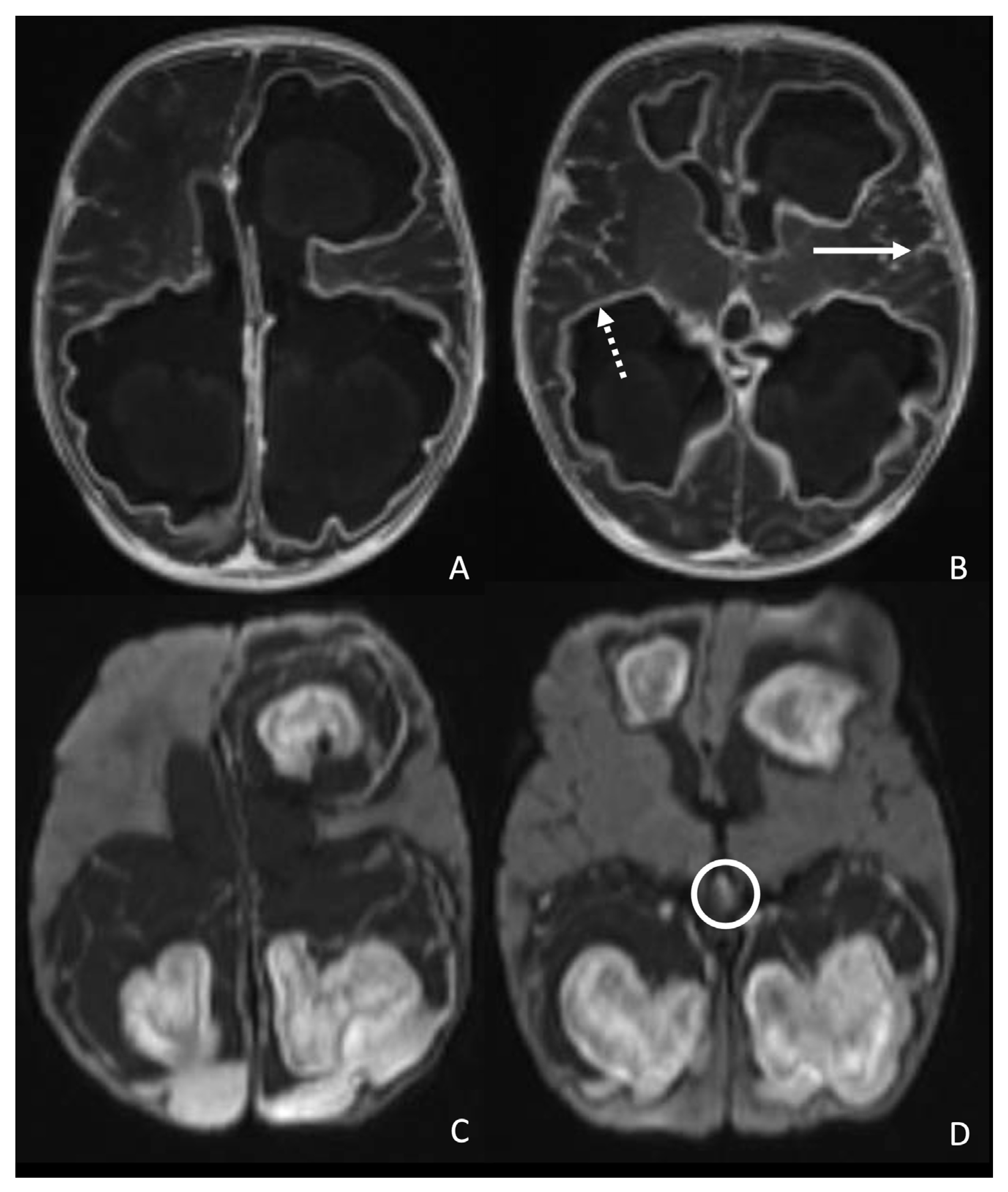
Background/Objectives: Edwardsiella tarda is a rare Gram-negative pathogen that uncommonly infects humans. Neonatal infections are extremely rare but often severe, with a high incidence of central nervous system (CNS) complications. Case presentation: We report a term neonate born via spontaneous vaginal delivery who developed systemic signs of infection within 18 h of life. Blood and cerebrospinal fluid (CSF) cultures grew Edwardsiella tarda. CSF analysis revealed severe meningoencephalitis. Maternal stool culture was also positive for E. tarda, suggesting vertical transmission. Despite initial systemic antibiotic therapy with ampicillin, gentamicin, and ceftriaxone, neuroimaging revealed progressive multifocal brain abscesses. The infant underwent a series of neurosurgical procedures, including bilateral drainage of abscesses, Rickham reservoir placement and ventriculoperitoneal shunting. A revised antibiotic regimen, including systemic meropenem and trimethoprim-sulfamethoxazole plus intrathecal gentamicin, was administered. At six months, the infant showed mild motor delay with lower limb hypertonia and was under close neurosurgical and developmental follow-up. Methods: We conducted a literature review of 12 published neonatal E. tarda infections, including our case. Results: Most infected infants presented within 72 h of life and exhibited CNS involvement. Mortality was 25%, and 44% of survivors experienced long-term neurologic sequelae. Conclusions: Edwardsiella tarda infection in neonates is rare but potentially devastating. Early suspicion, culture confirmation, aggressive antibiotic therapy, and multidisciplinary care, including neurosurgical management, are essential for improving outcomes.
Keywords: brain abscess; pregnancy; Enterobacterales; Edwardsiella; vertical transmission; neonatal sepsis; intrathecal antibiotics; review; case report brain abscess; pregnancy; Enterobacterales; Edwardsiella; vertical transmission; neonatal sepsis; intrathecal antibiotics; review; case report