

Targeting of Bacteria Using Amylase-Degradable, Copper-Loaded Starch Nanoparticles

 ,
,  and
and
Abstract
1. Introduction
2. Results & Discussion
2.1. Particle Preparation and Characterization
2.2. Antibacterial Efficacy
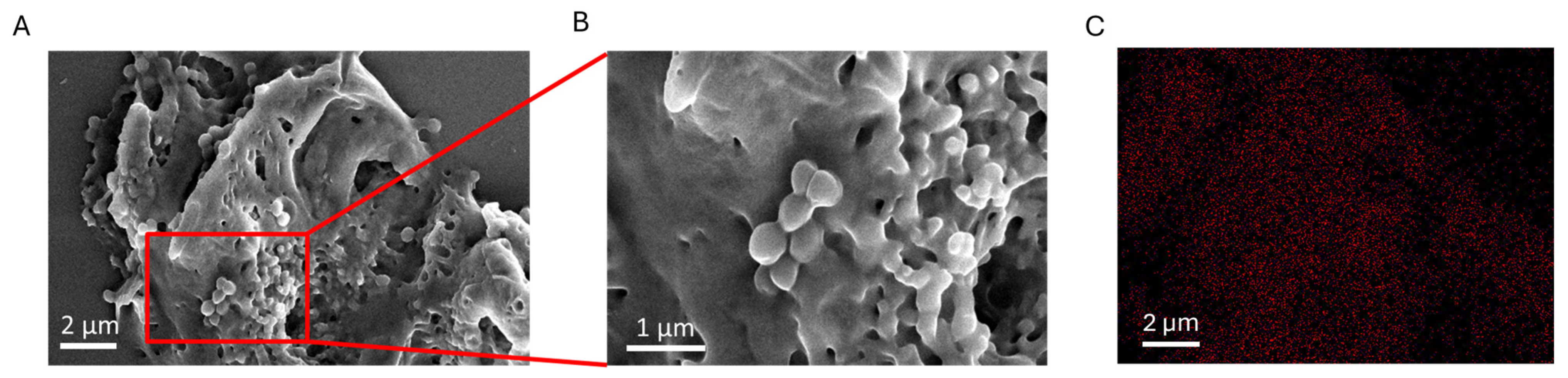
2.3. Strong Interactions Between CuStNPs and S. aureus
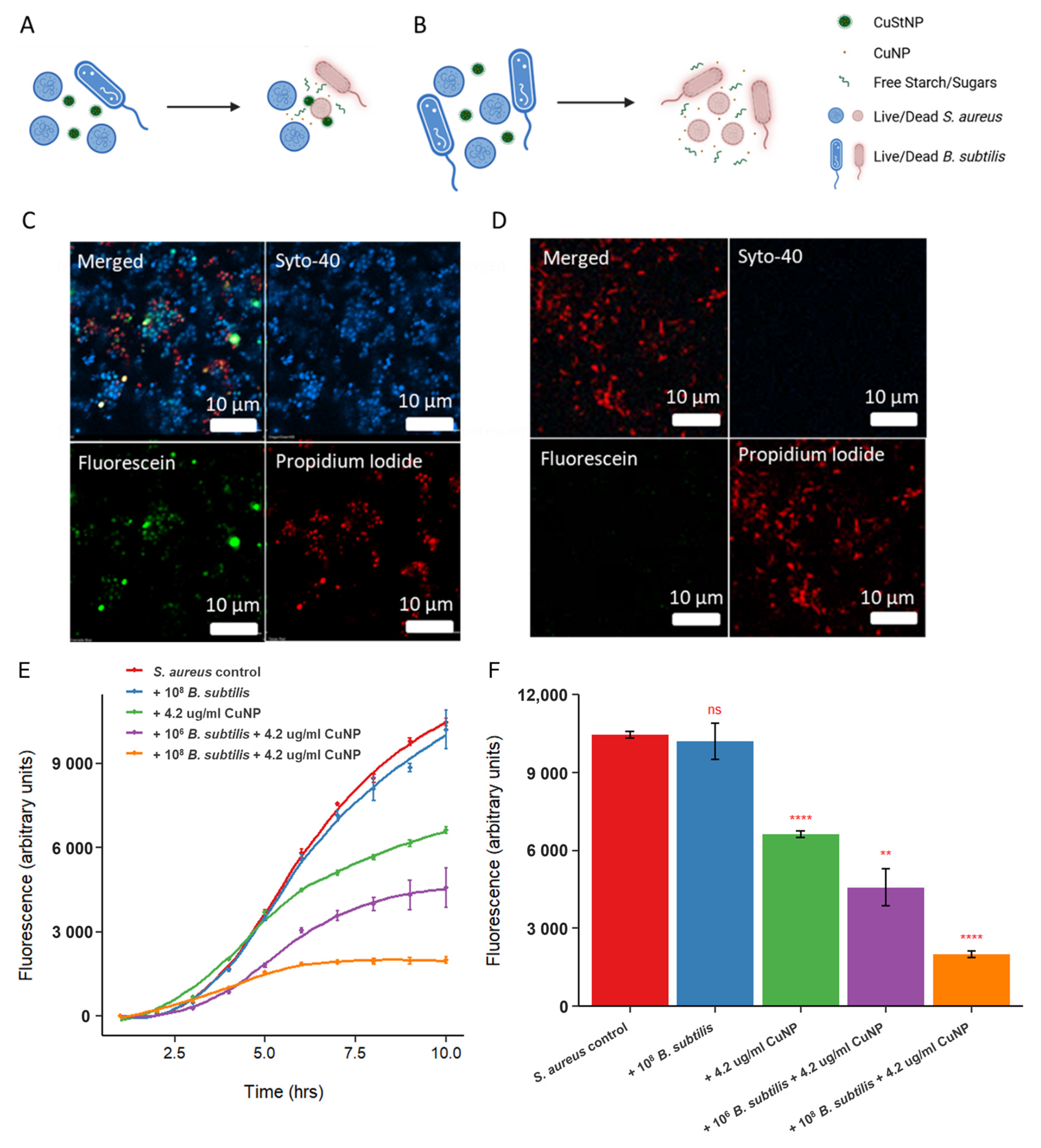
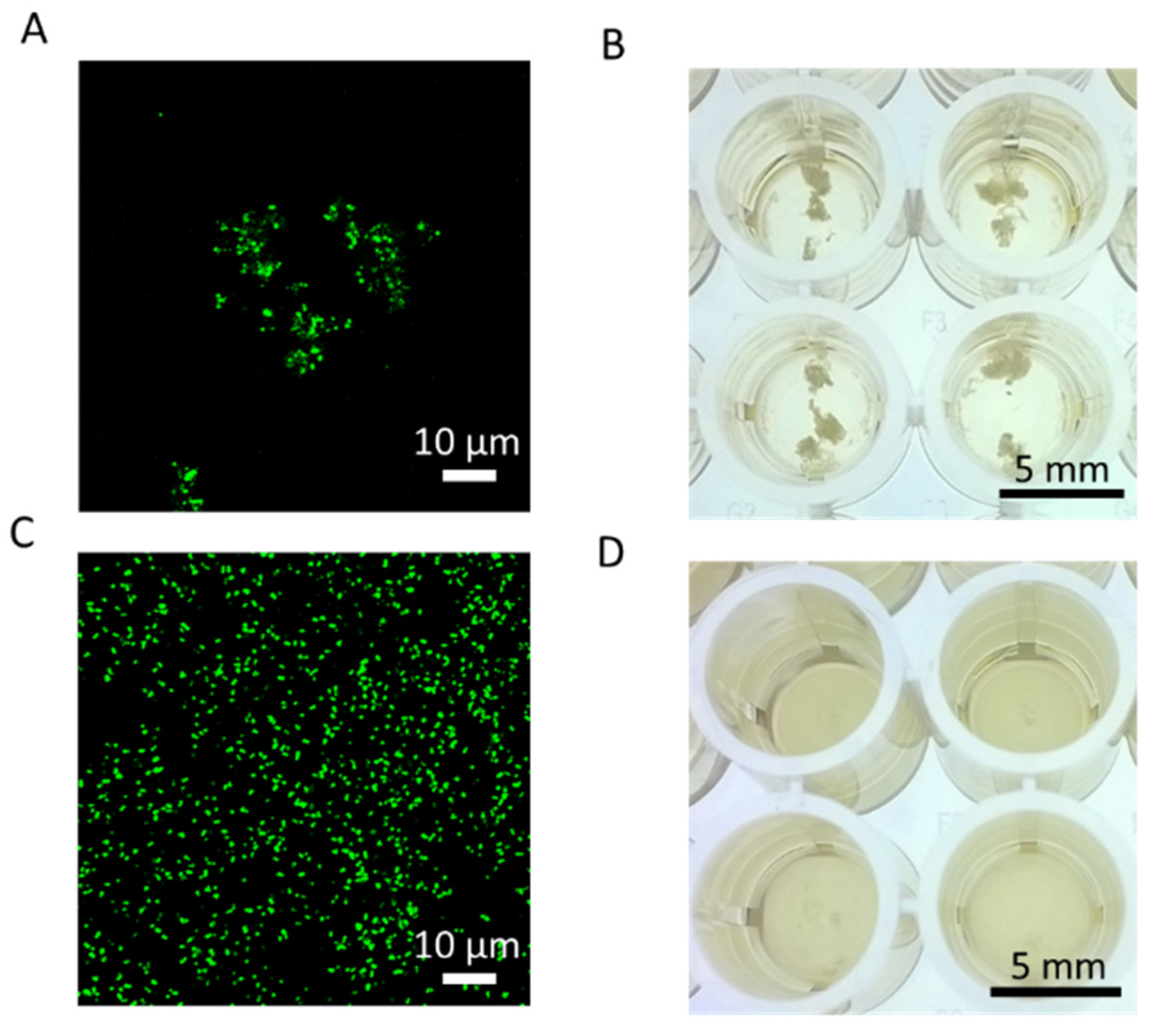
2.4. Co-Culture of Amylase and Non-Amylase Producing Species
2.5. Study Limitations and Future Directions
3. Conclusions
4. Materials and Methods
4.1. Materials
4.2. Bacterial Strains, Media, & Growth Conditions
4.3. Preparation & Characterization of Copper–Starch Nanoparticles
4.3.1. Electrohydrodynamic Jetting of Copper Starch Nanoparticles
4.3.2. Particle Size and Charge Characterization
4.3.3. Electron Microscopy
4.3.4. Inductively Coupled Plasma—Orbital Emission Spectroscopy (ICP-OES) Evaluation of Copper Loading
4.4. Bacterial Culture Studies
4.4.1. Bacterial Growth Curves
4.4.2. Quantitative Culture
4.4.3. Iodine Test for Starch Degradation
4.4.4. Confocal Microscopy
Supplementary Materials
Author Contributions
Funding
Institutional Review Board Statement
Informed Consent Statement
Data Availability Statement
Acknowledgments
Conflicts of Interest
Abbreviations
| EHD | Electrohydrodynamic jetting |
| StNPs | Starch Nanoparticles |
| CuNPs | Copper Nanoparticles |
| CuStNPs | Cupper Starch Nanoparticles |
| SEM | Scanning electron microscopy |
| TEM | Transmission electron microscopy |
| ICP-OES | Inductively Coupled Plasma—Orbital Emission Spectroscopy |
| TSB | Tryptic soy broth |
| TSBG | Tryptic soy broth with glucose |
| EDX | Energy-Dispersive X-ray Spectroscopy |
References
- Russo, C.A.; Andrews, R.M. The National Hospital Bill: The Most Expensive Conditions, by Payer, 2004. In Healthcare Cost and Utilization Project (HCUP) Statistical Briefs; Agency for Healthcare Research and Quality (US): Rockville MD, USA, 2006. [Google Scholar]
- Rhee, C.; Dantes, R.; Epstein, L.; Murphy, D.J.; Seymour, C.W.; Iwashyna, T.J.; Kadri, S.S.; Angus, D.C.; Danner, R.L.; Fiore, A.E.; et al. Incidence and Trends of Sepsis in US Hospitals Using Clinical vs Claims Data, 2009–2014. JAMA 2017, 318, 1241–1249. [Google Scholar] [CrossRef] [PubMed]
- Current HAI Progress Report: 2023 National and State Healthcare-Associated Infections Progress Report. 2024. Available online: https://arpsp.cdc.gov/profile/national-progress-2023/united-states (accessed on 1 October 2025).
- Abban, M.K.; Ayerakwa, E.A.; Mosi, L.; Isawumi, A. The burden of hospital acquired infections and antimicrobial resistance. Heliyon 2023, 9, e20561. [Google Scholar] [CrossRef] [PubMed]
- Odoom, A.; Donkor, E.S. Prevalence of Healthcare-Acquired Infections Among Adults in Intensive Care Units: A Systematic Review and Meta-Analysis. Health Sci. Rep. 2025, 8, e70939. [Google Scholar] [CrossRef] [PubMed]
- Rogers, E.; Alderdice, F.; McCall, E.; Jenkins, J.; Craig, S. Reducing nosocomial infections in neonatal intensive care. J. Matern.-Fetal Neonatal Med. 2010, 23, 1039–1046. [Google Scholar] [CrossRef]
- Spellberg, B.; Guidos, R.; Gilbert, D.; Bradley, J.; Boucher, H.W.; Scheld, W.M.; Bartlett, J.G.; Edwards, J., Jr.; Infectious Diseases Society of America. The epidemic of antibiotic-resistant infections: A call to action for the medical community from the Infectious Diseases Society of America. Clin. Infect. Dis. 2008, 46, 155–164. [Google Scholar] [CrossRef]
- Irfan, M.; Almotiri, A.; AlZeyadi, Z.A. Antimicrobial Resistance and Its Drivers—A Review. Antibiotics 2022, 11, 1362. [Google Scholar] [CrossRef]
- Palermo, E.F.; Kuroda, K. Structural determinants of antimicrobial activity in polymers which mimic host defense peptides. Appl. Microbiol. Biotechnol. 2010, 87, 1605–1615. [Google Scholar] [CrossRef]
- Marin, S.; Vlasceanu, G.M.; Tiplea, R.E.; Bucur, I.R.; Lemnaru, M.; Marin, M.M.; Grumezescu, A.M. Applications and toxicity of silver nanoparticles: A recent review. Curr. Top. Med. Chem. 2015, 15, 1596–1604. [Google Scholar] [CrossRef]
- Pal, S.; Tak, Y.K.; Song, J.M. Does the antibacterial activity of silver nanoparticles depend on the shape of the nanoparticle? A study of the Gram-negative bacterium Escherichia coli. Appl. Environ. Microbiol. 2007, 73, 1712–1720. [Google Scholar] [CrossRef]
- Yoon, K.-Y.; Hoon Byeon, J.; Park, J.-H.; Hwang, J. Susceptibility constants of Escherichia coli and Bacillus subtilis to silver and copper nanoparticles. Sci. Total Environ. 2007, 373, 572–575. [Google Scholar] [CrossRef]
- Qi, L.; Xu, Z.; Jiang, X.; Hu, C.; Zou, X. Preparation and antibacterial activity of chitosan nanoparticles. Carbohydr. Res. 2004, 339, 2693–2700. [Google Scholar] [CrossRef] [PubMed]
- Ruparelia, J.P.; Chatterjee, A.K.; Duttagupta, S.P.; Mukherji, S. Strain specificity in antimicrobial activity of silver and copper nanoparticles. Acta Biomater. 2008, 4, 707–716. [Google Scholar] [CrossRef]
- McGuffie, M.J.; Hong, J.; Bahng, J.H.; Glynos, E.; Green, P.F.; Kotov, N.A.; Younger, J.G.; VanEpps, J.S. Zinc oxide nanoparticle suspensions and layer-by-layer coatings inhibit staphylococcal growth. Nanomedicine 2016, 12, 33–42. [Google Scholar] [CrossRef] [PubMed]
- Kadiyala, U.; Turali-Emre, E.S.; Bahng, J.H.; Kotov, N.A.; VanEpps, J.S. Unexpected insights into antibacterial activity of zinc oxide nanoparticles against methicillin resistant Staphylococcus aureus (MRSA). Nanoscale 2018, 10, 4927–4939. [Google Scholar] [CrossRef] [PubMed]
- Gao, W.; Thamphiwatana, S.; Angsantikul, P.; Zhang, L. Nanoparticle approaches against bacterial infections. Wiley Interdiscip. Rev. Nanomed. Nanobiotechnol. 2014, 6, 532–547. [Google Scholar] [CrossRef]
- Maeda, H. Vascular permeability in cancer and infection as related to macromolecular drug delivery, with emphasis on the EPR effect for tumor-selective drug targeting. Proc. Jpn. Acad. Ser. B Phys. Biol. Sci. 2012, 88, 53–71. [Google Scholar] [CrossRef]
- Radovic-Moreno, A.F.; Lu, T.K.; Puscasu, V.A.; Yoon, C.J.; Langer, R.; Farokhzad, O.C. Surface Charge-Switching Polymeric Nanoparticles for Bacterial Cell Wall-Targeted Delivery of Antibiotics. ACS Nano 2012, 6, 4279–4287. [Google Scholar] [CrossRef]
- Kell, A.J.; Stewart, G.; Ryan, S.; Peytavi, R.; Boissinot, M.; Huletsky, A.; Bergeron, M.G.; Simard, B. Vancomycin-Modified Nanoparticles for Efficient Targeting and Preconcentration of Gram-Positive and Gram-Negative Bacteria. ACS Nano 2008, 2, 1777–1788. [Google Scholar] [CrossRef]
- Furukawa, H.; Shimojyo, R.; Ohnishi, N.; Fukuda, H.; Kondo, A. Affinity selection of target cells from cell surface displayed libraries: A novel procedure using thermo-responsive magnetic nanoparticles. Appl. Microbiol. Biotechnol. 2003, 62, 478–483. [Google Scholar] [CrossRef]
- Zhou, Y.; Drummond, D.C.; Zou, H.; Hayes, M.E.; Adams, G.P.; Kirpotin, D.B.; Marks, J.D. Impact of single-chain Fv antibody fragment affinity on nanoparticle targeting of epidermal growth factor receptor-expressing tumor cells. J. Mol. Biol. 2007, 371, 934–947. [Google Scholar] [CrossRef]
- Chang, Y.C.; Yang, C.Y.; Sun, R.L.; Cheng, Y.F.; Kao, W.C.; Yang, P.C. Rapid single cell detection of Staphylococcus aureus by aptamer-conjugated gold nanoparticles. Sci. Rep. 2013, 3, 1863. [Google Scholar] [CrossRef] [PubMed]
- Zhang, L.; Pornpattananangku, D.; Hu, C.M.; Huang, C.M. Development of nanoparticles for antimicrobial drug delivery. Curr. Med. Chem. 2010, 17, 585–594. [Google Scholar] [CrossRef] [PubMed]
- Cook, J.; Hagemann, T. Tumour-associated macrophages and cancer. Curr. Opin. Pharmacol. 2013, 13, 595–601. [Google Scholar] [CrossRef] [PubMed]
- Leuschner, F.; Dutta, P.; Gorbatov, R.; Novobrantseva, T.I.; Donahoe, J.S.; Courties, G.; Lee, K.M.; Kim, J.I.; Markmann, J.F.; Marinelli, B.; et al. Therapeutic siRNA silencing in inflammatory monocytes in mice. Nat. Biotechnol. 2011, 29, 1005–1010. [Google Scholar] [CrossRef]
- Toti, U.S.; Guru, B.R.; Hali, M.; McPharlin, C.M.; Wykes, S.M.; Panyam, J.; Whittum-Hudson, J.A. Targeted delivery of antibiotics to intracellular chlamydial infections using PLGA nanoparticles. Biomaterials 2011, 32, 6606–6613. [Google Scholar] [CrossRef]
- Misra, R.; Acharya, S.; Dilnawaz, F.; Sahoo, S.K. Sustained antibacterial activity of doxycycline-loaded poly (D, L-lactide-co-glycolide) and poly (ε-caprolactone) nanoparticles. Nanomedicine 2009, 4, 519–530. [Google Scholar] [CrossRef]
- Thamphiwatana, S.; Gao, W.; Pornpattananangkul, D.; Zhang, Q.; Fu, V.; Li, J.; Li, J.; Obonyo, M.; Zhang, L. Phospholipase A2-responsive antibiotic delivery via nanoparticle-stabilized liposomes for the treatment of bacterial infection. J. Mater. Chem. B 2014, 2, 8201–8207. [Google Scholar] [CrossRef]
- Dinda, G.; Halder, D.; Mitra, A. Catalytic and antibacterial activity of copper nanoparticle-starch composite. Adv. Mater. Proc. 2018, 3, 2–7. [Google Scholar] [CrossRef]
- Hasanin, M.; Al Abboud, M.A.; Alawlaqi, M.M.; Abdelghany, T.M.; Hashem, A.H. Ecofriendly Synthesis of Biosynthesized Copper Nanoparticles with Starch-Based Nanocomposite: Antimicrobial, Antioxidant, and Anticancer Activities. Biol. Trace Elem. Res. 2022, 200, 2099–2112. [Google Scholar] [CrossRef]
- Hou, X.; Wang, H.; Geng, W.; Yang, L.; Wang, J. The effect of the modified starch with side chain on the morphology of copper particles and the antibacterial properties of starch/copper composite material. Int. J. Biol. Macromol. 2024, 283, 137488. [Google Scholar] [CrossRef]
- Villanueva, M.E.; Diez, A.M.; Gonzalez, J.A.; Perez, C.J.; Orrego, M.; Piehl, L.; Teves, S.; Copello, G.J. Antimicrobial Activity of Starch Hydrogel Incorporated with Copper Nanoparticles. ACS Appl. Mater. Interfaces 2016, 8, 16280–16288. [Google Scholar] [CrossRef] [PubMed]
- Jones, N.A.; Chang, S.R.; Troske, W.J.; Clarkson, B.H.; Lahann, J. Nanoparticle-Based Targeting and Detection of Microcavities. Adv. Heal Mater. 2017, 6, 1600883. [Google Scholar] [CrossRef] [PubMed]
- Jones, N.A.; Pan, L.-C.; Flannagan, S.E.; Jones, K.A.; Lukashova, L.; Wightman, L.; Chang, S.-R.; Jones, G.; Tenuta, L.M.A.; González-Cabezas, C.; et al. Targeted enamel remineralization with mineral-loaded starch particles. JADA Found. Sci. 2024, 3, 100041. [Google Scholar] [CrossRef] [PubMed]
- Murray, R.K.; Martin, A.E.; Zipkowitz, S.; Jahan, N.; Davis, T.D.; Redman, W.K. alpha-Amylase-Mediated Antibiotic Degradation and Sequestration in Pseudomonas aeruginosa Biofilm Therapy. Antibiotics 2025, 14, 941. [Google Scholar] [CrossRef]
- Konsula, Z.; Liakopoulou-Kyriakides, M. Hydrolysis of starches by the action of an α-amylase from Bacillus subtilis. Process Biochem. 2004, 39, 1745–1749. [Google Scholar] [CrossRef]
- Priest, F.G. Extracellular enzyme synthesis in the genus Bacillus. Bacteriol. Rev. 1977, 41, 711–753. [Google Scholar] [CrossRef]
- Ben, L. Environmental Sources of Amylase-Producing Bacteria and Their Industrial Applications. J. Bacteriol. Parasitol. 2024, S28, 11. [Google Scholar]
- Misra, A.C.; Bhaskar, S.; Clay, N.; Lahann, J. Multicompartmental Particles for Combined Imaging and siRNA Delivery. Adv. Mater. 2012, 24, 3850–3856. [Google Scholar] [CrossRef]
- Sokolovskaya, E.; Rahmani, S.; Misra, A.C.; Bräse, S.; Lahann, J. Dual-Stimuli-Responsive Microparticles. ACS Appl. Mater. Interfaces 2015, 7, 9744–9751. [Google Scholar] [CrossRef]
- Misra, A.C.; Luker, K.E.; Durmaz, H.; Luker, G.D.; Lahann, J. CXCR4-Targeted Nanocarriers for Triple Negative Breast Cancers. Biomacromolecules 2015, 16, 2412–2417. [Google Scholar] [CrossRef]
- Rahmani, S.; Park, T.H.; Dishman, A.F.; Lahann, J. Multimodal delivery of irinotecan from microparticles with two distinct compartments. J. Control Release 2013, 172, 239–245. [Google Scholar] [CrossRef] [PubMed]
- Rahmani, S.; Ross, A.M.; Park, T.H.; Durmaz, H.; Dishman, A.F.; Prieskorn, D.M.; Jones, N.; Altschuler, R.A.; Lahann, J. Dual Release Carriers for Cochlear Delivery. Adv. Heal Mater. 2016, 5, 94–100. [Google Scholar] [CrossRef] [PubMed]
- Gao, D.; Zhou, J.G. Designs and applications of electrohydrodynamic 3D printing. Int. J. Bioprint 2019, 5, 172. [Google Scholar] [CrossRef] [PubMed]
- Mehta, P.; Haj-Ahmad, R.; Rasekh, M.; Arshad, M.S.; Smith, A.; van der Merwe, S.M.; Li, X.; Chang, M.W.; Ahmad, Z. Pharmaceutical and biomaterial engineering via electrohydrodynamic atomization technologies. Drug Discov. Today 2017, 22, 157–165. [Google Scholar] [CrossRef]
- Raje, P.; Murmu, N.C. A Review on Electrohydrodynamic-Inkjet Printing Technology. 2014. Available online: https://scispace.com/papers/a-review-on-electrohydrodynamic-inkjet-printing-technology-2nv5h5f77v (accessed on 1 October 2025).
- Lin, Q.; Liu, Y.; Zhou, L.; Ji, N.; Xiong, L.; Sun, Q. Green preparation of debranched starch nanoparticles with different crystalline structures by electrostatic spraying. Food Hydrocoll. 2022, 127, 107513. [Google Scholar] [CrossRef]
- Bloembergen, S.; McLennan, I.J.; Leeuwen, J.; Lee, D.I. Ongoing developments in biolatex binders with a very low carbon footprint for paper and board manufacturing. In Proceedings of the Appita Annual Conference, Melbourne, Australia, 18–21 April 2010; pp. 363–369. [Google Scholar]
- Chin, S.F.; Pang, S.C.; Tay, S.H. Size controlled synthesis of starch nanoparticles by a simple nanoprecipitation method. Carbohydr. Polym. 2011, 86, 1817–1819. [Google Scholar] [CrossRef]
- Le Corre, D.; Bras, J.; Dufresne, A. Starch Nanoparticles: A Review. Biomacromolecules 2010, 11, 1139–1153. [Google Scholar] [CrossRef]
- Shi, A.-M.; Li, D.; Wang, L.-J.; Li, B.-Z.; Adhikari, B. Preparation of starch-based nanoparticles through high-pressure homogenization and miniemulsion cross-linking: Influence of various process parameters on particle size and stability. Carbohydr. Polym. 2011, 83, 1604–1610. [Google Scholar] [CrossRef]
- Yu, D.; Xiao, S.; Tong, C.; Chen, L.; Liu, X. Dialdehyde starch nanoparticles: Preparation and application in drug carrier. Chin. Sci. Bull. 2007, 52, 2913–2918. [Google Scholar] [CrossRef]
- Schindelin, J.; Arganda-Carreras, I.; Frise, E.; Kaynig, V.; Longair, M.; Pietzsch, T.; Preibisch, S.; Rueden, C.; Saalfeld, S.; Schmid, B.; et al. Fiji: An open-source platform for biological-image analysis. Nat. Methods 2012, 9, 676–682. [Google Scholar] [CrossRef]
- Gill, S.R.; Fouts, D.E.; Archer, G.L.; Mongodin, E.F.; Deboy, R.T.; Ravel, J.; Paulsen, I.T.; Kolonay, J.F.; Brinkac, L.; Beanan, M.; et al. Insights on evolution of virulence and resistance from the complete genome analysis of an early methicillin-resistant Staphylococcus aureus strain and a biofilm-producing methicillin-resistant Staphylococcus epidermidis strain. J. Bacteriol. 2005, 187, 2426–2438. [Google Scholar] [CrossRef]
- Payne, D.E.; Martin, N.R.; Parzych, K.R.; Rickard, A.H.; Underwood, A.; Boles, B.R. Tannic acid inhibits Staphylococcus aureus surface colonization in an IsaA-dependent manner. Infect. Immun. 2013, 81, 496–504. [Google Scholar] [CrossRef]
- Te Riele, H.; Michel, B.; Ehrlich, S.D. Single-stranded plasmid DNA in Bacillus subtilis and Staphylococcus aureus. Proc. Natl. Acad. Sci. USA 1986, 83, 2541–2545. [Google Scholar] [CrossRef]
- Pang, Y.Y.; Schwartz, J.; Thoendel, M.; Ackermann, L.W.; Horswill, A.R.; Nauseef, W.M. agr-Dependent Interactions of Staphylococcus aureus USA300 with Human Polymorphonuclear Neutrophils. J. Innate Immun. 2010, 2, 546–559. [Google Scholar] [CrossRef]
- Mulvey, M.A.; Schilling, J.D.; Hultgren, S.J. Establishment of a persistent Escherichia coli reservoir during the acute phase of a bladder infection. Infect. Immun. 2001, 69, 4572–4579. [Google Scholar] [CrossRef]
- Khater, F.; Balestrino, D.; Charbonnel, N.; Dufayard, J.F.; Brisse, S.; Forestier, C. In Silico Analysis of Usher Encoding Genes in Klebsiella pneumoniae and Characterization of Their Role in Adhesion and Colonization. PLoS ONE 2015, 10, e0116215. [Google Scholar] [CrossRef]
- Calderón-Domínguez, G.; Cuellar-Sánchez, V.; Salgado-Cruz, M.P.; García-Borquez, A.; Morales-Sánchez, E.; García-Hernández, A.B.; Farrera-Rebollo, R.R.; González-Vázquez, M.; Serrano-Villa, F.S. Starch Biodegradable Films Produced by Electrospraying. In Starch—Evolution and Recent Advances; Ochubiojo Emeje, M.O., Ed.; IntechOpen: London, UK, 2021. [Google Scholar]
- Bhattacharjee, S. DLS and zeta potential—What they are and what they are not? J. Control. Release 2016, 235, 337–351. [Google Scholar] [CrossRef]
- Xiao, Z.; Storms, R.; Tsang, A. A quantitative starch-iodine method for measuring alpha-amylase and glucoamylase activities. Anal. Biochem. 2006, 351, 146–148. [Google Scholar] [CrossRef] [PubMed]


Disclaimer/Publisher’s Note: The statements, opinions and data contained in all publications are solely those of the individual author(s) and contributor(s) and not of MDPI and/or the editor(s). MDPI and/or the editor(s) disclaim responsibility for any injury to people or property resulting from any ideas, methods, instructions or products referred to in the content. |
© 2026 by the authors. Licensee MDPI, Basel, Switzerland. This article is an open access article distributed under the terms and conditions of the Creative Commons Attribution (CC BY) license.
Share and Cite
Jones, N.A.; Kadiyala, U.; Serratos, B.; VanEpps, J.S.; Lahann, J. Targeting of Bacteria Using Amylase-Degradable, Copper-Loaded Starch Nanoparticles. Antibiotics 2026, 15, 56. https://doi.org/10.3390/antibiotics15010056
Jones NA, Kadiyala U, Serratos B, VanEpps JS, Lahann J. Targeting of Bacteria Using Amylase-Degradable, Copper-Loaded Starch Nanoparticles. Antibiotics. 2026; 15(1):56. https://doi.org/10.3390/antibiotics15010056
Chicago/Turabian StyleJones, Nathan A., Usha Kadiyala, Benjamin Serratos, J. Scott VanEpps, and Joerg Lahann. 2026. "Targeting of Bacteria Using Amylase-Degradable, Copper-Loaded Starch Nanoparticles" Antibiotics 15, no. 1: 56. https://doi.org/10.3390/antibiotics15010056
APA StyleJones, N. A., Kadiyala, U., Serratos, B., VanEpps, J. S., & Lahann, J. (2026). Targeting of Bacteria Using Amylase-Degradable, Copper-Loaded Starch Nanoparticles. Antibiotics, 15(1), 56. https://doi.org/10.3390/antibiotics15010056