


The Role of Genomics in Advancing and Standardising Bacteriophage Therapy

Abstract
1. Introduction
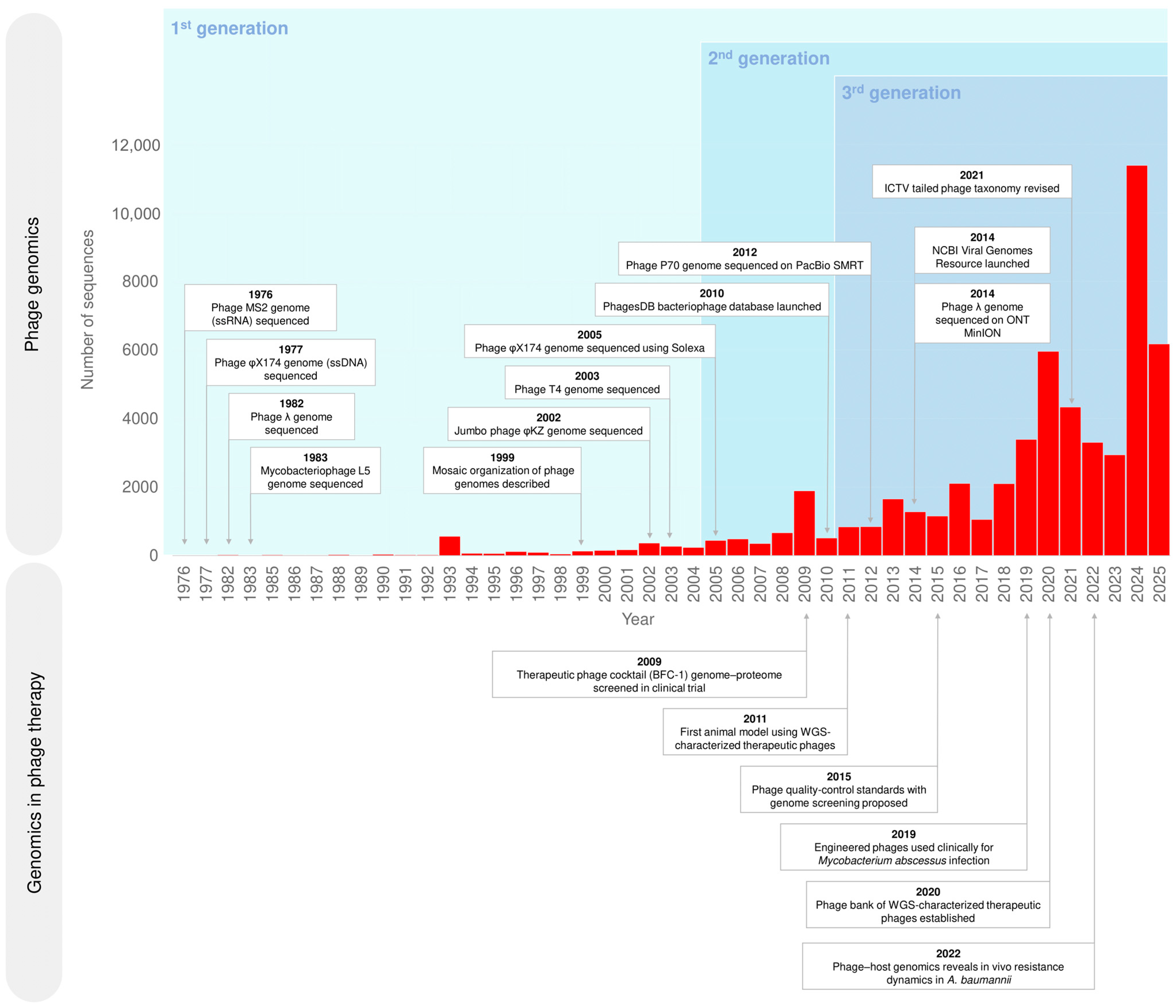
2. Phage Genomics in Historical Perspective
3. Genomic Analysis as the Basis for Selecting Safe Therapeutic Phages
4. Predicting Phage Efficacy Through Genomic Analysis
5. Genomics-Driven Personalisation in Phage Therapy
6. Conclusions and Future Directions
Author Contributions
Funding
Institutional Review Board Statement
Informed Consent Statement
Data Availability Statement
Conflicts of Interest
Abbreviations
| AAI | average amino acid identity |
| AMR | antimicrobial resistance |
| ANI | average nucleotide identity |
| ARGs | antibiotic resistance genes |
| att | attachment sites (attP/attB) |
| BACPHLIP | BACterioPHage LIfestyle Predictor |
| CARD | Comprehensive Antibiotic Resistance Database |
| CRISPR | clustered regularly interspaced short palindromic repeats |
| EMA | European Medicines Agency |
| FDA | Food and Drug Administration |
| HGT | horizontal gene transfer |
| ICTV | International Committee on Taxonomy of Viruses |
| IND | investigational new drug |
| MDR | multidrug-resistant |
| MGEs | mobile genetic elements |
| ML | machine learning |
| NCBI | National Center for Biotechnology Information |
| ORFs | open reading frames |
| RBP | receptor-binding protein |
| SMART | split–modify–assemble–reboot (phage genome engineering platform) |
| SNPs | single nucleotide polymorphisms |
| VFDB | Virulence Factor Database |
| VIBRANT | Virus Identification By iteRative ANnoTation |
| VIRIDIC | Virus Intergenomic Distance Calculator |
| WGS | whole-genome sequencing |
| WTA | wall teichoic acids |
| DNA | deoxyribonucleic acid |
References
- Murray, C.J.L.; Ikuta, K.S.; Sharara, F.; Swetschinski, L.; Aguilar, G.R.; Gray, A.; Han, C.; Bisignano, C.; Rao, P.; Wool, E.; et al. Global Burden of Bacterial Antimicrobial Resistance in 2019: A Systematic Analysis. Lancet 2022, 399, 629–655. [Google Scholar] [CrossRef]
- World Health Organization (WHO). Global Antibiotic Resistance Surveillance Report 2025; WHO: Geneva, Switzerland, 2025; ISBN 9789240116337. Available online: https://www.who.int/publications/i/item/9789240116337 (accessed on 22 December 2025).
- Hatfull, G.F.; Dedrick, R.M.; Schooley, R.T. Phage Therapy for Antibiotic-Resistant Bacterial Infections. Annu. Rev. Med. 2022, 73, 197–211. [Google Scholar] [CrossRef]
- Li, M.; Wang, H.; Chen, L.; Guo, G.; Li, P.; Ma, J.; Chen, R.; Du, H.; Liu, Y.; Zhang, W. Identification of a Phage-Derived Depolymerase Specific for KL47 Capsule of Klebsiella pneumoniae and Its Therapeutic Potential in Mice. Virol. Sin. 2022, 37, 538–546. [Google Scholar] [CrossRef]
- Mardiana, M.; Teh, S.-H.; Tsai, Y.-C.; Yang, H.-H.; Lin, L.-C.; Lin, N.-T. Characterization of a Novel and Active Temperate Phage vB_AbaM_ABMM1 with Antibacterial Activity against Acinetobacter baumannii Infection. Sci. Rep. 2023, 13, 11347. [Google Scholar] [CrossRef]
- d’Hérelle, F. Sur le rôle du microbe filtrant bactériophage dans la dysenterie bacillaire. C. R. Acad. Sci. 1918, 167, 970–972. [Google Scholar]
- d’Hérelle, F. Du rôle du microbe filtrant bactériophage dans la fièvre typhoïde. C. R. Acad. Sci. 1919, 168, 631–634. [Google Scholar]
- Société de Biologie (Paris, France). Comptes Rendus des Séances de la Société de Biologie; Masson et Cie: Paris, France, 1921; Volume 85. [Google Scholar]
- Gratia, A. Des relations numériques entre bactéries lysogènes et particules de bactériophages. In Annales de l’Institut Pasteur; Masson Publishing: Broomall, PA, USA, 1936; Volume 57. [Google Scholar]
- Gordillo Altamirano, F.L.; Barr, J.J. Phage Therapy in the Postantibiotic Era. Clin. Microbiol. Rev. 2019, 32, e00066-18. [Google Scholar] [CrossRef]
- Li, S.; Wei, B.; Xu, L.; Cong, C.; Murtaza, B.; Wang, L.; Li, X.; Li, J.; Xu, M.; Yin, J.; et al. A Novel Saclayvirus Acinetobacter baumannii Phage Genomic Analysis and Effectiveness in Preventing Pneumonia. Appl. Microbiol. Biotechnol. 2024, 108, 428. [Google Scholar] [CrossRef]
- Fiers, W.; Contreras, R.; Duerinck, F.; Haegeman, G.; Iserentant, D.; Merregaert, J.; Min Jou, W.; Molemans, F.; Raeymaekers, A.; Van Den Berghe, A.; et al. Complete Nucleotide Sequence of Bacteriophage MS2 RNA: Primary and Secondary Structure of the Replicase Gene. Nature 1976, 260, 500–507. [Google Scholar] [CrossRef]
- Sanger, F.; Air, G.M.; Barrell, B.G.; Brown, N.L.; Coulson, A.R.; Fiddes, C.A.; Hutchison, C.A.; Slocombe, P.M.; Smith, M. Nucleotide Sequence of Bacteriophage Phi X174 DNA. Nature 1977, 265, 687–695. [Google Scholar] [CrossRef] [PubMed]
- Sanger, F.; Coulson, A.R.; Hong, G.F.; Hill, D.F.; Petersen, G.B. Nucleotide Sequence of Bacteriophage λ DNA. J. Mol. Biol. 1982, 162, 729–773. [Google Scholar] [CrossRef]
- Miller, E.S.; Kutter, E.; Mosig, G.; Arisaka, F.; Kunisawa, T.; Rüger, W. Bacteriophage T4 Genome. Microbiol. Mol. Biol. Rev. 2003, 67, 86–156. [Google Scholar] [CrossRef]
- Hatfull, G.F.; Sarkis, G.J. DNA Sequence, Structure and Gene Expression of Mycobacteriophage L5: A Phage System for Mycobacterial Genetics. Mol. Microbiol. 1993, 7, 395–405. [Google Scholar] [CrossRef]
- Mesyanzhinov, V.V.; Robben, J.; Grymonprez, B.; Kostyuchenko, V.A.; Bourkaltseva, M.V.; Sykilinda, N.N.; Krylov, V.N.; Volckaert, G. The Genome of Bacteriophage φKZ of Pseudomonas aeruginosa. J. Mol. Biol. 2002, 317, 1–19. [Google Scholar] [CrossRef] [PubMed]
- Hendrix, R.W.; Smith, M.C.M.; Burns, R.N.; Ford, M.E.; Hatfull, G.F. Evolutionary Relationships among Diverse Bacteriophages and Prophages: All the World’s a Phage. Proc. Natl. Acad. Sci. USA 1999, 96, 2192–2197. [Google Scholar] [CrossRef] [PubMed]
- Margulies, M.; Egholm, M.; Altman, W.E.; Attiya, S.; Bader, J.S.; Bemben, L.A.; Berka, J.; Braverman, M.S.; Chen, Y.-J.; Chen, Z.; et al. Genome Sequencing in Microfabricated High-Density Picolitre Reactors. Nature 2005, 437, 376–380. [Google Scholar] [CrossRef]
- Rodriguez, R.; Krishnan, Y. Genesis of Next-Generation Sequencing. Nat. Biotechnol. 2023, 41, 1709–1715. [Google Scholar] [CrossRef] [PubMed]
- Schmuki, M.M.; Erne, D.; Loessner, M.J.; Klumpp, J. Bacteriophage P70: Unique Morphology and Unrelatedness to Other Listeria Bacteriophages. J. Virol. 2012, 86, 13099–13102. [Google Scholar] [CrossRef]
- Mikheyev, A.S.; Tin, M.M.Y. A first look at the oxford nanopore minion sequencer. Mol. Ecol. Resour. 2014, 14, 1097–1102. [Google Scholar] [CrossRef]
- Russell, D.A.; Hatfull, G.F. PhagesDB: The Actinobacteriophage Database. Bioinformatics 2017, 33, 784–786. [Google Scholar] [CrossRef]
- Brister, J.R.; Ako-adjei, D.; Bao, Y.; Blinkova, O. NCBI Viral Genomes Resource. Nucleic Acids Res. 2015, 43, D571–D577. [Google Scholar] [CrossRef]
- Bouras, G.; Nepal, R.; Houtak, G.; Psaltis, A.J.; Wormald, P.-J.; Vreugde, S. Pharokka: A Fast Scalable Bacteriophage Annotation Tool. Bioinformatics 2023, 39, btac776. [Google Scholar] [CrossRef] [PubMed]
- McNair, K.; Zhou, C.; Dinsdale, E.A.; Souza, B.; Edwards, R.A. PHANOTATE: A Novel Approach to Gene Identification in Phage Genomes. Bioinformatics 2019, 35, 4537–4542. [Google Scholar] [CrossRef] [PubMed]
- Cresawn, S.G.; Bogel, M.; Day, N.; Jacobs-Sera, D.; Hendrix, R.W.; Hatfull, G.F. Phamerator: A Bioinformatic Tool for Comparative Bacteriophage Genomics. BMC Bioinform. 2011, 12, 395. [Google Scholar] [CrossRef] [PubMed]
- Meier-Kolthoff, J.P.; Göker, M. VICTOR: Genome-Based Phylogeny and Classification of Prokaryotic Viruses. Bioinformatics 2017, 33, 3396–3404. [Google Scholar] [CrossRef]
- Villarroel, J.; Kleinheinz, K.A.; Jurtz, V.I.; Zschach, H.; Lund, O.; Nielsen, M.; Larsen, M.V. HostPhinder: A Phage Host Prediction Tool. Viruses 2016, 8, 116. [Google Scholar] [CrossRef]
- Moraru, C.; Varsani, A.; Kropinski, A.M. VIRIDIC—A Novel Tool to Calculate the Intergenomic Similarities of Prokaryote-Infecting Viruses. Viruses 2020, 12, 1268. [Google Scholar] [CrossRef]
- Wang, R.H.; Yang, S.; Liu, Z.; Zhang, Y.; Wang, X.; Xu, Z.; Wang, J.; Li, S.C. PhageScope: A Well-Annotated Bacteriophage Database with Automatic Analyses and Visualizations. Nucleic Acids Res. 2023, 52, 756–761. [Google Scholar] [CrossRef]
- Cook, R.; Brown, N.; Redgwell, T.; Rihtman, B.; Barnes, M.; Clokie, M.; Stekel, D.J.; Hobman, J.; Jones, M.A.; Millard, A. INfrastructure for a PHAge REference Database: Identification of Large-Scale Biases in the Current Collection of Cultured Phage Genomes. Phage 2021, 2, 214–223. [Google Scholar] [CrossRef]
- Millard, A.; Denise, R.; Lestido, M.; Thomas, M.T.; Webster, D.; Turner, D.; Sicheritz-Pontén, T. taxMyPhage: Automated Taxonomy of dsDNA Phage Genomes at the Genus and Species Level. Phage 2025, 6, 5–11. [Google Scholar] [CrossRef]
- Zhou, Y.; Liang, Y.; Lynch, K.H.; Dennis, J.J.; Wishart, D.S. PHAST: A Fast Phage Search Tool. Nucleic Acids Res. 2011, 39, W347–W352. [Google Scholar] [CrossRef]
- Arndt, D.; Grant, J.R.; Marcu, A.; Sajed, T.; Pon, A.; Liang, Y.; Wishart, D.S. PHASTER: A Better, Faster Version of the PHAST Phage Search Tool. Nucleic Acids Res. 2016, 44, W16–W21. [Google Scholar] [CrossRef] [PubMed]
- Wishart, D.S.; Han, S.; Saha, S.; Oler, E.; Peters, H.; Grant, J.R.; Stothard, P.; Gautam, V. PHASTEST: Faster than PHASTER, Better than PHAST. Nucleic Acids Res. 2023, 51, W443–W450. [Google Scholar] [CrossRef] [PubMed]
- Bradley, D.E. Ultrastructure of Bacteriophage and Bacteriocins. Bacteriol. Rev. 1967, 31, 230–314. [Google Scholar] [CrossRef]
- Adams, M.H.; Wade, E. Classification of bacterial viruses: Characteristics of the T1, D20 species of coli-dysentery phages. J. Bacteriol. 1955, 70, 253–259. [Google Scholar] [CrossRef] [PubMed]
- Ackermann, H.-W. 5500 Phages Examined in the Electron Microscope. Arch. Virol. 2007, 152, 227–243. [Google Scholar] [CrossRef]
- Adams, M.H. Bacteriophages; Interscience Publishers: New York, NY, USA, 1959. [Google Scholar]
- Turner, D.; Kropinski, A.M.; Adriaenssens, E.M. A Roadmap for Genome-Based Phage Taxonomy. Viruses 2021, 13, 506. [Google Scholar] [CrossRef]
- Turner, D.; Shkoporov, A.N.; Lood, C.; Millard, A.D.; Dutilh, B.E.; Alfenas-Zerbini, P.; van Zyl, L.J.; Aziz, R.K.; Oksanen, H.M.; Poranen, M.M.; et al. Abolishment of Morphology-Based Taxa and Change to Binomial Species Names: 2022 Taxonomy Update of the ICTV Bacterial Viruses Subcommittee. Arch. Virol. 2023, 168, 74. [Google Scholar] [CrossRef]
- Jeon, J.; Park, J.-H.; Yong, D. Efficacy of Bacteriophage Treatment against Carbapenem-Resistant Acinetobacter baumannii in Galleria Mellonella Larvae and a Mouse Model of Acute Pneumonia. BMC Microbiol. 2019, 19, 70. [Google Scholar] [CrossRef]
- Fang, Q.; Feng, Y.; McNally, A.; Zong, Z. Characterization of Phage Resistance and Phages Capable of Intestinal Decolonization of Carbapenem-Resistant Klebsiella pneumoniae in Mice. Commun. Biol. 2022, 5, 48. [Google Scholar] [CrossRef]
- Rimon, A.; Yerushalmy, O.; Belin, J.; Alkalay-Oren, S.; Gavish, L.; Coppenhagen-Glazer, S.; Hazan, R. Six Novel Pseudomonas aeruginosa Phages: Genomic Insights and Therapeutic Potential. Phage 2025, 6, 32–40. [Google Scholar] [CrossRef]
- Kornienko, M.; Fisunov, G.; Bespiatykh, D.; Kuptsov, N.; Gorodnichev, R.; Klimina, K.; Kulikov, E.; Ilina, E.; Letarov, A.; Shitikov, E. Transcriptional Landscape of Staphylococcus aureus Kayvirus Bacteriophage vB_SauM-515A1. Viruses 2020, 12, 1320. [Google Scholar] [CrossRef] [PubMed]
- Gorodnichev, R.B.; Volozhantsev, N.V.; Krasilnikova, V.M.; Bodoev, I.N.; Kornienko, M.A.; Kuptsov, N.S.; Popova, A.V.; Makarenko, G.I.; Manolov, A.I.; Slukin, P.V.; et al. Novel Klebsiella pneumoniae K23-Specific Bacteriophages from Different Families: Similarity of Depolymerases and Their Therapeutic Potential. Front. Microbiol. 2021, 12, 669618. [Google Scholar] [CrossRef] [PubMed]
- Golomidova, A.; Kupriyanov, Y.; Gabdrakhmanov, R.; Gurkova, M.; Kulikov, E.; Belalov, I.; Uskevich, V.; Bespiatykh, D.; Letarova, M.; Efimov, A.; et al. Isolation, Characterization, and Unlocking the Potential of Mimir124 Phage for Personalized Treatment of Difficult, Multidrug-Resistant Uropathogenic E. Coli Strain. Int. J. Mol. Sci. 2024, 25, 12755. [Google Scholar] [CrossRef]
- O’Flaherty, S.; Coffey, A.; Edwards, R.; Meaney, W.; Fitzgerald, G.F.; Ross, R.P. Genome of Staphylococcal Phage K: A New Lineage of Myoviridae Infecting Gram-Positive Bacteria with a Low G+C Content. J. Bacteriol. 2004, 186, 2862–2871. [Google Scholar] [CrossRef]
- Cui, Z.; Shen, W.; Wang, Z.; Zhang, H.; Me, R.; Wang, Y.; Zeng, L.; Zhu, Y.; Qin, J.; He, P.; et al. Complete Genome Sequence of Klebsiella pneumoniae Phage JD001. J. Virol. 2012, 86, 13843. [Google Scholar] [CrossRef]
- Li, P.; Chen, B.; Song, Z.; Song, Y.; Yang, Y.; Ma, P.; Wang, H.; Ying, J.; Ren, P.; Yang, L.; et al. Bioinformatic Analysis of the Acinetobacter baumannii Phage AB1 Genome. Gene 2012, 507, 125–134. [Google Scholar] [CrossRef]
- Stevens, R.H.; Ektefaie, M.R.; Fouts, D.E. The Annotated Complete DNA Sequence of Enterococcus Faecalis Bacteriophage φEf11 and Its Comparison with All Available Phage and Predicted Prophage Genomes. FEMS Microbiol. Lett. 2011, 317, 9–26. [Google Scholar] [CrossRef] [PubMed]
- Merabishvili, M.; Pirnay, J.-P.; Verbeken, G.; Chanishvili, N.; Tediashvili, M.; Lashkhi, N.; Glonti, T.; Krylov, V.; Mast, J.; Van Parys, L.; et al. Quality-Controlled Small-Scale Production of a Well-Defined Bacteriophage Cocktail for Use in Human Clinical Trials. PLoS ONE 2009, 4, e4944. [Google Scholar] [CrossRef]
- Morello, E.; Saussereau, E.; Maura, D.; Huerre, M.; Touqui, L.; Debarbieux, L. Pulmonary Bacteriophage Therapy on Pseudomonas aeruginosa Cystic Fibrosis Strains: First Steps Towards Treatment and Prevention. PLoS ONE 2011, 6, e16963. [Google Scholar] [CrossRef]
- Pirnay, J.-P.; Blasdel, B.G.; Bretaudeau, L.; Buckling, A.; Chanishvili, N.; Clark, J.R.; Corte-Real, S.; Debarbieux, L.; Dublanchet, A.; De Vos, D.; et al. Quality and Safety Requirements for Sustainable Phage Therapy Products. Pharm. Res. 2015, 32, 2173–2179. [Google Scholar] [CrossRef] [PubMed]
- Blasco, L.; López-Hernández, I.; Rodríguez-Fernández, M.; Pérez-Florido, J.; Casimiro-Soriguer, C.S.; Djebara, S.; Merabishvili, M.; Pirnay, J.-P.; Rodríguez-Baño, J.; Tomás, M.; et al. Case Report: Analysis of Phage Therapy Failure in a Patient with a Pseudomonas aeruginosa Prosthetic Vascular Graft Infection. Front. Med. 2023, 10, 1199657. [Google Scholar] [CrossRef] [PubMed]
- Liu, M.; Hernandez-Morales, A.; Clark, J.; Le, T.; Biswas, B.; Bishop-Lilly, K.A.; Henry, M.; Quinones, J.; Voegtly, L.J.; Cer, R.Z.; et al. Comparative Genomics of Acinetobacter baumannii and Therapeutic Bacteriophages from a Patient Undergoing Phage Therapy. Nat. Commun. 2022, 13, 3776. [Google Scholar] [CrossRef]
- Yang, Y.; Tan, X.; Xiong, M.; Liu, Z.; Lu, S.; Ge, H.; Gao, R.; Zhang, J.; Luo, X.; Zhou, C.; et al. A Case Report of Bacteriophage Therapy for the Treatment of Lung Infection Due to Carbapenem-Resistant Pseudomonas aeruginosa. Sci. Rep. 2025, 15, 33512. [Google Scholar] [CrossRef]
- Stellfox, M.E.; Fernandes, C.; Shields, R.K.; Haidar, G.; Hughes Kramer, K.; Dembinski, E.; Mangalea, M.R.; Arya, G.; Canfield, G.S.; Duerkop, B.A.; et al. Bacteriophage and Antibiotic Combination Therapy for Recurrent Enterococcus faecium Bacteremia. mBio 2024, 15, e03396-23. [Google Scholar] [CrossRef]
- Yerushalmy, O.; Khalifa, L.; Gold, N.; Rakov, C.; Alkalay-Oren, S.; Adler, K.; Ben-Porat, S.; Kraitman, R.; Gronovich, N.; Shulamit Ginat, K.; et al. The Israeli Phage Bank (IPB). Antibiotics 2020, 9, 269. [Google Scholar] [CrossRef] [PubMed]
- Pirnay, J.-P.; Verbeken, G.; Ceyssens, P.-J.; Huys, I.; De Vos, D.; Ameloot, C.; Fauconnier, A. The Magistral Phage. Viruses 2018, 10, 64. [Google Scholar] [CrossRef]
- Yang, Q.; Le, S.; Zhu, T.; Wu, N. Regulations of Phage Therapy across the World. Front. Microbiol. 2023, 14, 1250848. [Google Scholar] [CrossRef]
- Sacher, J.C.; Zheng, J.; Lin, R.C.Y. Data to Power Precision Phage Therapy: A Look at the Phage Directory–Phage Australia Partnership. Phage 2022, 3, 112–115. [Google Scholar] [CrossRef]
- Żaczek, M.; Weber-Dąbrowska, B.; Międzybrodzki, R.; Łusiak-Szelachowska, M.; Górski, A. Phage Therapy in Poland—A Centennial Journey to the First Ethically Approved Treatment Facility in Europe. Front. Microbiol. 2020, 11, 1056. [Google Scholar] [CrossRef]
- Resch, G.; Brives, C.; Debarbieux, L.; Hodges, F.E.; Kirchhelle, C.; Laurent, F.; Moineau, S.; Martins, A.F.M.; Rohde, C. Between Centralization and Fragmentation: The Past, Present, and Future of Phage Collections. Phage 2024, 5, 22–29. [Google Scholar] [CrossRef]
- Hatfull, G.F. Phage Therapy for Nontuberculous Mycobacteria: Challenges and Opportunities. Pulm. Ther. 2022, 9, 91–107. [Google Scholar] [CrossRef] [PubMed]
- Willy, C.; Bugert, J.J.; Classen, A.Y.; Deng, L.; Düchting, A.; Gross, J.; Hammerl, J.A.; Korf, I.H.E.; Kühn, C.; Lieberknecht-Jouy, S.; et al. Phage Therapy in Germany—Update 2023. Viruses 2023, 15, 588. [Google Scholar] [CrossRef] [PubMed]
- Niazi, S.K. Bacteriophage Therapy: Discovery, Development, and FDA Approval Pathways. Pharmaceuticals 2025, 18, 1115. [Google Scholar] [CrossRef]
- Shang, J.; Tang, X.; Sun, Y. PhaTYP: Predicting the Lifestyle for Bacteriophages Using BERT. Brief. Bioinform. 2022, 24, bbac487. [Google Scholar] [CrossRef]
- Hockenberry, A.J.; Wilke, C.O. BACPHLIP: Predicting Bacteriophage Lifestyle from Conserved Protein Domains. PeerJ 2021, 9, e11396. [Google Scholar] [CrossRef] [PubMed]
- Liu, B.; Zheng, D.; Jin, Q.; Chen, L.; Yang, J. VFDB 2019: A Comparative Pathogenomic Platform with an Interactive Web Interface. Nucleic Acids Res. 2019, 47, D687–D692. [Google Scholar] [CrossRef]
- Blum, M.; Andreeva, A.; Florentino, L.C.; Chuguransky, S.R.; Grego, T.; Hobbs, E.; Pinto, B.L.; Orr, A.; Paysan-Lafosse, T.; Ponamareva, I.; et al. InterPro: The Protein Sequence Classification Resource in 2025. Nucleic Acids Res. 2025, 53, D444–D456. [Google Scholar] [CrossRef]
- Mistry, J.; Chuguransky, S.; Williams, L.; Qureshi, M.; Salazar, G.A.; Sonnhammer, E.L.L.; Tosatto, S.C.E.; Paladin, L.; Raj, S.; Richardson, L.J.; et al. Pfam: The Protein Families Database in 2021. Nucleic Acids Res. 2021, 49, D412–D419. [Google Scholar] [CrossRef]
- Söding, J.; Biegert, A.; Lupas, A.N. The HHpred Interactive Server for Protein Homology Detection and Structure Prediction. Nucleic Acids Res. 2005, 33, W244–W248. [Google Scholar] [CrossRef]
- Nayfach, S.; Camargo, A.P.; Schulz, F.; Eloe-Fadrosh, E.; Roux, S.; Kyrpides, N.C. CheckV Assesses the Quality and Completeness of Metagenome-Assembled Viral Genomes. Nat. Biotechnol. 2021, 39, 578–585. [Google Scholar] [CrossRef]
- Guo, J.; Bolduc, B.; Zayed, A.A.; Varsani, A.; Dominguez-Huerta, G.; Delmont, T.O.; Pratama, A.A.; Gazitúa, M.C.; Vik, D.; Sullivan, M.B.; et al. VirSorter2: A Multi-Classifier, Expert-Guided Approach to Detect Diverse DNA and RNA Viruses. Microbiome 2021, 9, 37. [Google Scholar] [CrossRef] [PubMed]
- Kieft, K.; Zhou, Z.; Anantharaman, K. VIBRANT: Automated Recovery, Annotation and Curation of Microbial Viruses, and Evaluation of Viral Community Function from Genomic Sequences. Microbiome 2020, 8, 90. [Google Scholar] [CrossRef]
- Papudeshi, B.; Roach, M.J.; Mallawaarachchi, V.; Bouras, G.; Grigson, S.R.; Giles, S.K.; Harker, C.M.; Hutton, A.L.K.; Tarasenko, A.; Inglis, L.K.; et al. Sphae: An Automated Toolkit for Predicting Phage Therapy Candidates from Sequencing Data. Bioinform. Adv. 2024, 5, vbaf004. [Google Scholar] [CrossRef]
- Evseev, P.V.; Shneider, M.M.; Kolupaeva, L.V.; Kasimova, A.A.; Timoshina, O.Y.; Perepelov, A.V.; Shpirt, A.M.; Shelenkov, A.A.; Mikhailova, Y.V.; Suzina, N.E.; et al. New Obolenskvirus Phages Brutus and Scipio: Biology, Evolution, and Phage-Host Interaction. Int. J. Mol. Sci. 2024, 25, 2074. [Google Scholar] [CrossRef]
- Chen, J.; Feng, J.; Cui, X.; Huang, L.; Du, B.; Xia, Y.; Xue, G.; Feng, Y.; Ke, Y.; Zhao, H.; et al. Genomic Analysis and Therapeutic Efficacy Evaluation of Bacteriophage PK2420 for Pneumonia Caused by Hypervirulent Klebsiella pneumoniae (K20 Serotype). mSystems 2025, 10, e01632-24. [Google Scholar] [CrossRef] [PubMed]
- Azam, A.H.; Sato, K.; Miyanaga, K.; Nakamura, T.; Ojima, S.; Kondo, K.; Tamura, A.; Yamashita, W.; Tanji, Y.; Kiga, K. Selective bacteriophages reduce the emergence of resistant bacteria in bacteriophage-antibiotic combination therapy. Microbiol. Spectr. 2024, 12, e0042723. [Google Scholar] [CrossRef] [PubMed]
- Santamaría-Corral, G.; Pagán, I.; Aguilera-Correa, J.J.; Esteban, J.; García-Quintanilla, M. A Novel Bacteriophage Infecting Multi-Drug- and Extended-Drug-Resistant Pseudomonas aeruginosa Strains. Antibiotics 2024, 13, 523. [Google Scholar] [CrossRef]
- Zhao, P.; Zhao, W.; Zhai, X.; He, Y.; Shu, W.; Qiao, G. Biological Characterization and Genomic Analysis of a Novel Methicillin-Resistant Staphylococcus aureus Phage, SauPS-28. Microbiol. Spectr. 2024, 12, e00295-23. [Google Scholar] [CrossRef]
- Landy, A. The λ Integrase Site-Specific Recombination Pathway. Microbiol. Spectr. 2015, 3, 91–118. [Google Scholar] [CrossRef]
- McLeod, S.M.; Waldor, M.K. Characterization of XerC- and XerD-Dependent CTX Phage Integration in Vibrio cholerae. Mol. Microbiol. 2004, 54, 935–947. [Google Scholar] [CrossRef] [PubMed]
- Freeman, V.J. Studies on the virulence of bacteriophage-infected strains of Corynebacterium diphtheriae. J. Bacteriol. 1951, 61, 675–688. [Google Scholar] [CrossRef] [PubMed]
- Li, X.; Han, Y.; Zhao, W.; Xiao, Y.; Huang, S.; Li, Z.; Fan, F.; Liang, W.; Kan, B. Diversity and Complexity of CTXΦ and Pre-CTXΦ Families in Vibrio cholerae from Seventh Pandemic. Microorganisms 2024, 12, 1935. [Google Scholar] [CrossRef]
- Sui, X.; Wang, S.; Yang, X.; Zhang, P.; Sun, H.; Bai, X.; Xiong, Y. Characterization of Seven Shiga Toxin Phages Induced from Human-Derived Shiga Toxin-Producing Escherichia Coli. Microorganisms 2025, 13, 783. [Google Scholar] [CrossRef] [PubMed]
- Nepal, R.; Houtak, G.; Bouras, G.; Feizi, S.; Shaghayegh, G.; Shearwin, K.; Ramezanpour, M.; Psaltis, A.J.; Wormald, P.; Vreugde, S. A φSa3int (NM3) Prophage Domestication in Staphylococcus aureus Leads to Increased Virulence Through Human Immune Evasion. MedComm 2025, 6, e70313. [Google Scholar] [CrossRef]
- Gu, J.; Zhang, X.; Liu, T.; Guo, Y. Isolation and Characterization of a Lytic Phage PaTJ Against Pseudomonas aeruginosa. Viruses 2024, 16, 1816. [Google Scholar] [CrossRef]
- Wang, Z.; Yang, X.; Wang, H.; Wang, S.; Fang, R.; Li, X.; Xing, J.; Wu, Q.; Li, Z.; Song, N. Characterization and Efficacy against Carbapenem-Resistant Acinetobacter baumannii of a Novel Friunavirus Phage from Sewage. Front. Cell. Infect. Microbiol. 2024, 14, 1382145. [Google Scholar] [CrossRef]
- Zeng, H.; Wang, Y.; Tian, Y.; Yao, X.; Li, Y.; Xu, L.; Yang, X.; Zhang, X.; Ma, J. Functional and Genomic Analysis of Enterococcus Phage A155: A Potential Agent for Reducing VRE Gut Colonization. Virol. J. 2025, 22, 263. [Google Scholar] [CrossRef]
- Wang, K.; Xu, J.; Li, X.; Zhu, P.; Suo, R.; Lu, X.; Luo, H.; Chen, L.; Wen, R.; Zheng, C.; et al. Evolutionary Selection of Trimethoprim-Resistant dfrA Genes in Lytic Phages Affects Phage and Host Fitness during Infection. Sci. Adv. 2025, 11, eadt4817. [Google Scholar] [CrossRef]
- Alcock, B.P.; Raphenya, A.R.; Lau, T.T.Y.; Tsang, K.K.; Bouchard, M.; Edalatmand, A.; Huynh, W.; Nguyen, A.-L.V.; Cheng, A.A.; Liu, S.; et al. CARD 2020: Antibiotic Resistome Surveillance with the Comprehensive Antibiotic Resistance Database. Nucleic Acids Res. 2020, 48, D517–D525. [Google Scholar] [CrossRef]
- Singh, S.; Le, N.Q.K.; Wang, C. VF-Pred: Predicting Virulence Factor Using Sequence Alignment Percentage and Ensemble Learning Models. Comput. Biol. Med. 2024, 168, 107662. [Google Scholar] [CrossRef] [PubMed]
- Chen, C.; Xu, Y.; Ouyang, J.; Xiong, X.; Łabaj, P.P.; Chmielarczyk, A.; Różańska, A.; Zhang, H.; Liu, K.; Shi, T.; et al. VirulentHunter: Deep Learning-Based Virulence Factor Predictor Illuminates Pathogenicity in Diverse Microbial Contexts. Brief. Bioinform. 2025, 26, bbaf271. [Google Scholar] [CrossRef]
- Grigson, S.R.; Bouras, G.; Dutilh, B.E.; Olson, R.D.; Edwards, R.A. Computational Function Prediction of Bacteria and Phage Proteins. Microbiol. Mol. Biol. Rev. 2025, 89, e00022-25. [Google Scholar] [CrossRef] [PubMed]
- Smith, D.L.; Rooks, D.J.; Fogg, P.C.; Darby, A.C.; Thomson, N.R.; McCarthy, A.J.; Allison, H.E. Comparative Genomics of Shiga Toxin Encoding Bacteriophages. BMC Genom. 2012, 13, 311. [Google Scholar] [CrossRef]
- Kahánková, J.; Pantůček, R.; Goerke, C.; Růžičková, V.; Holochová, P.; Doškař, J. Multilocus PCR Typing Strategy for Differentiation of Staphylococcus aureus Siphoviruses Reflecting Their Modular Genome Structure. Environ. Microbiol. 2010, 12, 2527–2538. [Google Scholar] [CrossRef] [PubMed]
- Kornienko, M.; Bespiatykh, D.; Malakhova, M.; Gorodnichev, R.; Kuptsov, N.; Shitikov, E. PCR Assay for Rapid Taxonomic Differentiation of Virulent Staphylococcus aureus and Klebsiella pneumoniae Bacteriophages. Int. J. Mol. Sci. 2023, 24, 4483. [Google Scholar] [CrossRef]
- Klumpp, J.; Dunne, M.; Loessner, M.J. A Perfect Fit: Bacteriophage Receptor-Binding Proteins for Diagnostic and Therapeutic Applications. Curr. Opin. Microbiol. 2023, 71, 102240. [Google Scholar] [CrossRef]
- Tran, V.N.; Burrows, L.L. Steering the Course: Targeting and Exploiting Surface Receptors in Phage Therapy. J. Bacteriol. 2025, e0037525. [Google Scholar] [CrossRef]
- Chapot-Chartier, M.-P. Interactions of the Cell-Wall Glycopolymers of Lactic Acid Bacteria with Their Bacteriophages. Front. Microbiol. 2014, 5, 236. [Google Scholar] [CrossRef]
- Leprince, A.; Mahillon, J. Phage Adsorption to Gram-Positive Bacteria. Viruses 2023, 15, 196. [Google Scholar] [CrossRef]
- Stephan, M.S.; Broeker, N.K.; Saragliadis, A.; Roos, N.; Linke, D.; Barbirz, S. In Vitro Analysis of O-Antigen-Specific Bacteriophage P22 Inactivation by Salmonella Outer Membrane Vesicles. Front. Microbiol. 2020, 11, 510638. [Google Scholar] [CrossRef] [PubMed]
- Haudiquet, M.; Le Bris, J.; Nucci, A.; Bonnin, R.A.; Domingo-Calap, P.; Rocha, E.P.C.; Rendueles, O. Capsules and Their Traits Shape Phage Susceptibility and Plasmid Conjugation Efficiency. Nat. Commun. 2024, 15, 2032. [Google Scholar] [CrossRef]
- Chaturongakul, S.; Ounjai, P. Phage–Host Interplay: Examples from Tailed Phages and Gram-Negative Bacterial Pathogens. Front. Microbiol. 2014, 5, 442. [Google Scholar] [CrossRef]
- Duerkop, B.A.; Huo, W.; Bhardwaj, P.; Palmer, K.L.; Hooper, L.V. Molecular Basis for Lytic Bacteriophage Resistance in Enterococci. mBio 2016, 7, e01304-16. [Google Scholar] [CrossRef]
- Subedi, D.; Gordillo Altamirano, F.; Deehan, R.; Perera, A.; Patwa, R.; Kostoulias, X.; Korneev, D.; Blakeway, L.; Macesic, N.; Peleg, A.Y.; et al. Rational Design of a Hospital-Specific Phage Cocktail to Treat Enterobacter Cloacae Complex Infections. Nat. Microbiol. 2025, 10, 2702–2719. [Google Scholar] [CrossRef]
- Squeglia, F.; Maciejewska, B.; Łątka, A.; Ruggiero, A.; Briers, Y.; Drulis-Kawa, Z.; Berisio, R. Structural and Functional Studies of a Klebsiella Phage Capsule Depolymerase Tailspike: Mechanistic Insights into Capsular Degradation. Structure 2020, 28, 613–624.e4. [Google Scholar] [CrossRef]
- Magill, D.J.; Skvortsov, T.A. DePolymerase Predictor (DePP): A Machine Learning Tool for the Targeted Identification of Phage Depolymerases. BMC Bioinform. 2023, 24, 208. [Google Scholar] [CrossRef]
- Concha-Eloko, R.; Stock, M.; Baets, B.D.; Briers, Y.; Sanjuán, R.; Domingo-Calap, P.; Boeckaerts, D. DepoScope: Accurate Phage Depolymerase Annotation and Domain Delineation Using Large Language Models. PLoS Comput. Biol. 2024, 20, e1011831. [Google Scholar] [CrossRef] [PubMed]
- Vieira, M.F.; Duarte, J.; Domingues, R.; Oliveira, H.; Dias, O. PhageDPO: A Machine-Learning Based Computational Framework for Identifying Phage Depolymerases. Comput. Biol. Med. 2025, 188, 109836. [Google Scholar] [CrossRef] [PubMed]
- Boeckaerts, D.; Stock, M.; Ferriol-González, C.; Oteo-Iglesias, J.; Sanjuán, R.; Domingo-Calap, P.; De Baets, B.; Briers, Y. Prediction of Klebsiella Phage-Host Specificity at the Strain Level. Nat. Commun. 2024, 15, 4355. [Google Scholar] [CrossRef]
- Krusche, J.; Beck, C.; Lehmann, E.; Gerlach, D.; Daiber, E.; Mayer, C.; Müller, J.; Onallah, H.; Würstle, S.; Wolz, C.; et al. Characterization and Host Range Prediction of Staphylococcus aureus Phages through Receptor-Binding Protein Analysis. Cell Rep. 2025, 44, 115369. [Google Scholar] [CrossRef] [PubMed]
- Gonzales, M.E.M.; Ureta, J.C.; Shrestha, A.M.S. PHIStruct: Improving Phage–Host Interaction Prediction at Low Sequence Similarity Settings Using Structure-Aware Protein Embeddings. Bioinformatics 2024, 41, btaf016. [Google Scholar] [CrossRef] [PubMed]
- Tesson, F.; Hervé, A.; Mordret, E.; Touchon, M.; d’Humières, C.; Cury, J.; Bernheim, A. Systematic and Quantitative View of the Antiviral Arsenal of Prokaryotes. Nat. Commun. 2022, 13, 2561. [Google Scholar] [CrossRef]
- Payne, L.J.; Meaden, S.; Mestre, M.R.; Palmer, C.; Toro, N.; Fineran, P.C.; Jackson, S.A. PADLOC: A Web Server for the Identification of Antiviral Defence Systems in Microbial Genomes. Nucleic Acids Res. 2022, 50, W541–W550. [Google Scholar] [CrossRef] [PubMed]
- Isaev, A.; Drobiazko, A.; Sierro, N.; Gordeeva, J.; Yosef, I.; Qimron, U.; Ivanov, N.V.; Severinov, K. Phage T7 DNA Mimic Protein Ocr Is a Potent Inhibitor of BREX Defence. Nucleic Acids Res. 2020, 48, 5397–5406. [Google Scholar] [CrossRef]
- Pawluk, A.; Bondy-Denomy, J.; Cheung, V.H.W.; Maxwell, K.L.; Davidson, A.R. A New Group of Phage Anti-CRISPR Genes Inhibits the Type I-E CRISPR-Cas System of Pseudomonas aeruginosa. mBio 2014, 5, e00896-14. [Google Scholar] [CrossRef]
- Vlot, M.; Houkes, J.; Lochs, S.J.A.; Swarts, D.C.; Zheng, P.; Kunne, T.; Mohanraju, P.; Anders, C.; Jinek, M.; van der Oost, J.; et al. Bacteriophage DNA Glucosylation Impairs Target DNA Binding by Type I and II but Not by Type V CRISPR–Cas Effector Complexes. Nucleic Acids Res. 2018, 46, 873–885. [Google Scholar] [CrossRef]
- Egido, J.E.; Costa, A.R.; Aparicio-Maldonado, C.; Haas, P.-J.; Brouns, S.J.J. Mechanisms and Clinical Importance of Bacteriophage Resistance. FEMS Microbiol. Rev. 2021, 46, fuab048. [Google Scholar] [CrossRef]
- Murtazalieva, K.; Mu, A.; Petrovskaya, A.; Finn, R.D. The Growing Repertoire of Phage Anti-Defence Systems. Trends Microbiol. 2024, 32, 1212–1228. [Google Scholar] [CrossRef]
- Gaborieau, B.; Vaysset, H.; Tesson, F.; Charachon, I.; Dib, N.; Bernier, J.; Dequidt, T.; Georjon, H.; Clermont, O.; Hersen, P.; et al. Prediction of Strain Level Phage–Host Interactions across the Escherichia Genus Using Only Genomic Information. Nat. Microbiol. 2024, 9, 2847–2861. [Google Scholar] [CrossRef]
- Zschach, H.; Larsen, M.V.; Hasman, H.; Westh, H.; Nielsen, M.; Międzybrodzki, R.; Jończyk-Matysiak, E.; Weber-Dąbrowska, B.; Górski, A. Use of a Regression Model to Study Host-Genomic Determinants of Phage Susceptibility in MRSA. Antibiotics 2018, 7, 9. [Google Scholar] [CrossRef]
- Moller, A.G.; Winston, K.; Ji, S.; Wang, J.; Hargita Davis, M.N.; Solís-Lemus, C.R.; Read, T.D. Genes Influencing Phage Host Range in Staphylococcus aureus on a Species-Wide Scale. mSphere 2021, 6, e01263-20. [Google Scholar] [CrossRef] [PubMed]
- Kim, M.K.; Chen, Q.; Echterhof, A.; Pennetzdorfer, N.; McBride, R.C.; Banaei, N.; Burgener, E.B.; Milla, C.E.; Bollyky, P.L. A Blueprint for Broadly Effective Bacteriophage-Antibiotic Cocktails against Bacterial Infections. Nat. Commun. 2024, 15, 9987. [Google Scholar] [CrossRef] [PubMed]
- Koncz, M.; Stirling, T.; Hadj Mehdi, H.; Méhi, O.; Eszenyi, B.; Asbóth, A.; Apjok, G.; Tóth, Á.; Orosz, L.; Vásárhelyi, B.M.; et al. Genomic Surveillance as a Scalable Framework for Precision Phage Therapy against Antibiotic-Resistant Pathogens. Cell 2024, 187, 5901–5918.e28. [Google Scholar] [CrossRef]
- Gordillo Altamirano, F.; Forsyth, J.H.; Patwa, R.; Kostoulias, X.; Trim, M.; Subedi, D.; Archer, S.K.; Morris, F.C.; Oliveira, C.; Kielty, L.; et al. Bacteriophage-Resistant Acinetobacter baumannii Are Resensitized to Antimicrobials. Nat. Microbiol. 2021, 6, 157–161. [Google Scholar] [CrossRef]
- Chen, C.; Krzyżewska-Dudek, E.; Patpatia, S.; Dulipati, V.; Mapelli, S.N.; Meral, A.; Kotimaa, J.; Kiljunen, S.; Meri, S. Antibiotic-Resistant Acinetobacter baumannii Can Be Killed by a Combination of Bacteriophages and Complement. Med. Microbiol. Immunol. 2025, 214, 40. [Google Scholar] [CrossRef]
- Moulton-Brown, C.E.; Friman, V.-P. Rapid Evolution of Generalized Resistance Mechanisms Can Constrain the Efficacy of Phage-Antibiotic Treatments. Evol. Appl. 2018, 11, 1630–1641. [Google Scholar] [CrossRef]
- Burmeister, A.R.; Fortier, A.; Roush, C.; Lessing, A.J.; Bender, R.G.; Barahman, R.; Grant, R.; Chan, B.K.; Turner, P.E. Pleiotropy Complicates a Trade-off between Phage Resistance and Antibiotic Resistance. Proc. Natl. Acad. Sci. USA 2020, 117, 11207–11216. [Google Scholar] [CrossRef]
- Dedrick, R.M.; Guerrero-Bustamante, C.A.; Garlena, R.A.; Russell, D.A.; Ford, K.; Harris, K.; Gilmour, K.C.; Soothill, J.; Jacobs-Sera, D.; Schooley, R.T.; et al. Engineered Bacteriophages for Treatment of a Patient with a Disseminated Drug-Resistant Mycobacterium abscessus. Nat. Med. 2019, 25, 730–733. [Google Scholar] [CrossRef]
- Nick, J.A.; Dedrick, R.M.; Gray, A.L.; Vladar, E.K.; Smith, B.E.; Freeman, K.G.; Malcolm, K.C.; Epperson, L.E.; Hasan, N.A.; Hendrix, J.; et al. Case Study: Host and Pathogen Response to Bacteriophage Engineered Against Mycobacterium abscessus Lung Infection. Cell 2022, 185, 1860–1874.e12. [Google Scholar] [CrossRef] [PubMed]
- Little, J.S.; Dedrick, R.M.; Freeman, K.G.; Cristinziano, M.; Smith, B.E.; Benson, C.A.; Jhaveri, T.A.; Baden, L.R.; Solomon, D.A.; Hatfull, G.F. Bacteriophage Treatment of Disseminated Cutaneous Mycobacterium Chelonae Infection. Nat. Commun. 2022, 13, 2313. [Google Scholar] [CrossRef]
- Dedrick, R.M.; Smith, B.E.; Cristinziano, M.; Freeman, K.G.; Jacobs-Sera, D.; Belessis, Y.; Whitney Brown, A.; Cohen, K.A.; Davidson, R.M.; van Duin, D.; et al. Phage Therapy of Mycobacterium Infections: Compassionate Use of Phages in 20 Patients With Drug-Resistant Mycobacterial Disease. Clin. Infect. Dis. 2023, 76, 103–112. [Google Scholar] [CrossRef]
- Sundermann, A.J.; Rosa, R.; Harris, P.N.A.; Snitkin, E.; Javaid, W.; Moore, N.M.; Hayden, M.K.; Allen, K.; Rodino, K.; Peacock, S.J.; et al. Pathogen Genomics in Healthcare: Overcoming Barriers to Proactive Surveillance. Antimicrob. Agents Chemother. 2025, 69, e01479-24. [Google Scholar] [CrossRef] [PubMed]
- Osei Sekyere, J. Next-Generation Sequencing in Infectious-Disease Diagnostics: Economic, Regulatory, and Clinical Pathways to Adoption. Microbiologyopen 2025, 14, e70104. [Google Scholar] [CrossRef]
- Rossen, J.W.A.; Friedrich, A.W.; Moran-Gilad, J. Practical Issues in Implementing Whole-Genome-Sequencing in Routine Diagnostic Microbiology. Clin. Microbiol. Infect. 2018, 24, 355–360. [Google Scholar] [CrossRef] [PubMed]
- Bretaudeau, L.; Tremblais, K.; Aubrit, F.; Meichenin, M.; Arnaud, I. Good Manufacturing Practice (GMP) Compliance for Phage Therapy Medicinal Products. Front. Microbiol. 2020, 11, 1161. [Google Scholar] [CrossRef]
- Turner, D.; Adriaenssens, E.M.; Tolstoy, I.; Kropinski, A.M. Phage Annotation Guide: Guidelines for Assembly and High-Quality Annotation. Phage 2021, 2, 170–182. [Google Scholar] [CrossRef] [PubMed]
- Cui, L.; Watanabe, S.; Miyanaga, K.; Kiga, K.; Sasahara, T.; Aiba, Y.; Tan, X.-E.; Veeranarayanan, S.; Thitiananpakorn, K.; Nguyen, H.M.; et al. A Comprehensive Review on Phage Therapy and Phage-Based Drug Development. Antibiotics 2024, 13, 870. [Google Scholar] [CrossRef] [PubMed]
- Sharma, C.M.; Vogel, J. Differential RNA-Seq: The Approach behind and the Biological Insight Gained. Curr. Opin. Microbiol. 2014, 19, 97–105. [Google Scholar] [CrossRef]
- Brandão, A.; Pires, D.P.; Coppens, L.; Voet, M.; Lavigne, R.; Azeredo, J. Differential transcription profiling of the phage LUZ19 infection process in different growth media. RNA Biol. 2021, 18, 1778–1790. [Google Scholar] [CrossRef]
- Kornienko, M.; Bespiatykh, D.; Gorodnichev, R.; Abdraimova, N.; Shitikov, E. Transcriptional Landscapes of Herelleviridae Bacteriophages and Staphylococcus aureus during Phage Infection: An Overview. Viruses 2023, 15, 1427. [Google Scholar] [CrossRef] [PubMed]
- De Smet, J.; Zimmermann, M.; Kogadeeva, M.; Ceyssens, P.-J.; Vermaelen, W.; Blasdel, B.; Bin Jang, H.; Sauer, U.; Lavigne, R. High Coverage Metabolomics Analysis Reveals Phage-Specific Alterations to Pseudomonas aeruginosa Physiology during Infection. ISME J. 2016, 10, 1823–1835. [Google Scholar] [CrossRef] [PubMed]
- Han, M.-L.; Nang, S.C.; Lin, Y.-W.; Zhu, Y.; Yu, H.H.; Wickremasinghe, H.; Barlow, C.K.; Creek, D.J.; Crawford, S.; Rao, G.; et al. Comparative Metabolomics Revealed Key Pathways Associated with the Synergistic Killing of Multidrug-Resistant Klebsiella pneumoniae by a Bacteriophage-Polymyxin Combination. Comput. Struct. Biotechnol. J. 2022, 20, 485–495. [Google Scholar] [CrossRef] [PubMed]
- Hendrix, H.; Zimmermann-Kogadeeva, M.; Zimmermann, M.; Sauer, U.; De Smet, J.; Muchez, L.; Lissens, M.; Staes, I.; Voet, M.; Wagemans, J.; et al. Metabolic Reprogramming of Pseudomonas aeruginosa by Phage-Based Quorum Sensing Modulation. Cell Rep. 2022, 38, 110372. [Google Scholar] [CrossRef]
- Gencay, Y.E.; Jasinskytė, D.; Robert, C.; Semsey, S.; Martínez, V.; Petersen, A.Ø.; Brunner, K.; de Santiago Torio, A.; Salazar, A.; Turcu, I.C.; et al. Engineered Phage with Antibacterial CRISPR–Cas Selectively Reduce E. Coli Burden in Mice. Nat. Biotechnol. 2024, 42, 265–274. [Google Scholar] [CrossRef]
- Roberts, A.; Adler, B.A.; Cress, B.F.; Doudna, J.A.; Barrangou, R. Phage-Based Delivery of CRISPR-Associated Transposases for Targeted Bacterial Editing. Proc. Natl. Acad. Sci. USA 2025, 122, e2504853122. [Google Scholar] [CrossRef]
- Zheng, X.; Wang, X.; Li, P.; Zhou, Y.; Zhu, X.; Hu, Z.; Wang, H.; Chen, M.; Huo, X.; Liu, Y.; et al. The Change of Long Tail Fibers Expanded the Host Range of a T5-like Salmonella Phage and Its Application in Milk. BMC Microbiol. 2025, 25, 169. [Google Scholar] [CrossRef]
- Fishman, C.B.; Crawford, K.D.; Bhattarai-Kline, S.; Poola, D.; Zhang, K.; González-Delgado, A.; Rojas-Montero, M.; Shipman, S.L. Continuous Multiplexed Phage Genome Editing Using Recombitrons. Nat. Biotechnol. 2025, 43, 1299–1310. [Google Scholar] [CrossRef]
- Ipoutcha, T.; Racharaks, R.; Huttelmaier, S.; Wilson, C.J.; Ozer, E.A.; Hartmann, E.M. A Synthetic Biology Approach to Assemble and Reboot Clinically Relevant Pseudomonas aeruginosa Tailed Phages. Microbiol. Spectr. 2024, 12, e02897-23. [Google Scholar] [CrossRef]
- Zhang, H.; Zhu, R.; Wang, Z.; He, R.; Zhang, Y.; Luan, J.; Yan, Y.; Zhang, Y.; Wang, H. Programming Virulent Bacteriophages by Developing a Multiplex Genome Engineering Method. mBio 2025, 16, e03582-24. [Google Scholar] [CrossRef]
- Ko, C.-C.; Sikkema, A.P.; Lauer, M.J.; Amarh, E.D.; Garlena, R.A.; Russell, D.A.; Chew, N.; Li, T.; Harrison, I.M.; Ellefson, J.; et al. Genome Synthesis, Assembly, and Rebooting of Therapeutically Useful High G + C% Mycobacteriophages. Proc. Natl. Acad. Sci. USA 2025, 122, e2523871122. [Google Scholar] [CrossRef]
- Nair, A.; Khairnar, K. Genetically Engineered Phages for Therapeutics: Proceed with Caution. Nat. Med. 2019, 25, 1028. [Google Scholar] [CrossRef] [PubMed]
- Anomaly, J. The Future of Phage: Ethical Challenges of Using Phage Therapy to Treat Bacterial Infections. Public Health Ethics 2020, 13, 82–88. [Google Scholar] [CrossRef] [PubMed]
- Łobocka, M.; Dąbrowska, K.; Górski, A. Engineered Bacteriophage Therapeutics: Rationale, Challenges and Future. BioDrugs 2021, 35, 255–280. [Google Scholar] [CrossRef] [PubMed]


| Estimated Parameter | Genomic Features Assessed | Limitations | Required Criteria | Tools |
|---|---|---|---|---|
| Life cycle (exclusion of lysogeny) | Markers of lysogeny: integrase, repressor and excisionase genes; attachment (att) sites | Integrases may be non-functional; att sites may be falsely detected; machine-learning (ML)-based classifiers are probabilistic—when predictions conflict with | Strictly lytic phage; no markers of lysogeny | PhaTYP [69], BACPHLIP [70] |
| Virulence factors | Genes encoding virulence determinants; domain architecture of the encoded proteins | Databases are incomplete; domain mosaicism can produce borderline matches; interpretation requires consideration of genomic context and the full domain composition of the protein | Absence of genes encoding virulence factors | Pharokka [25], VFDB [71] |
| Antibiotic resistance genes (ARGs) | Full-length ARGs and their operons; functionally relevant domains (e.g., dihydrofolate reductase, DHFR) | High rate of false-positive hits due to conserved domains | Absence of ARGs | Pharokka [25] |
| High-risk hypothetical proteins | Hypothetical open reading frames (ORFs) with toxin-like or regulatory motifs; structural predictions | Large number of ORFs without homologues; structural predictions may be inaccurate; residual risk of cryptic toxin-like motifs remains | Absence of suspicious high-risk hypothetical ORFs | InterPro [72], Pfam [73], HHpred [74] |
| Taxonomy | ANI/AAI and intergenomic distances; membership in clades with or without documented molecular risks | Taxonomic assignment serves only as an approximate indicator of risk: there is substantial genetic and functional heterogeneity within taxa, and clade boundaries defined by different tools often do not coincide | Membership in a taxon with no known molecular risk factors | VIRIDIC [30], taxMyPhage [33], PhageScope [31] |
| Genetic stability | Concordance of WGS data with the reference; absence of single nucleotide polymorphisms (SNPs)/indels in RBPs and lysis modules and of major genomic rearrangements; no evidence of mixed populations | Subclonal variants may be below the detection threshold; cryptic minor clones may persist | Production-batch genome is stable; no rearrangements or contaminations detected | Whole-genome resequencing with read mapping, variant calling and comparative genomics |
Disclaimer/Publisher’s Note: The statements, opinions and data contained in all publications are solely those of the individual author(s) and contributor(s) and not of MDPI and/or the editor(s). MDPI and/or the editor(s) disclaim responsibility for any injury to people or property resulting from any ideas, methods, instructions or products referred to in the content. |
© 2026 by the authors. Licensee MDPI, Basel, Switzerland. This article is an open access article distributed under the terms and conditions of the Creative Commons Attribution (CC BY) license.
Share and Cite
Abdraimova, N.; Shitikov, E.; Kornienko, M. The Role of Genomics in Advancing and Standardising Bacteriophage Therapy. Antibiotics 2026, 15, 55. https://doi.org/10.3390/antibiotics15010055
Abdraimova N, Shitikov E, Kornienko M. The Role of Genomics in Advancing and Standardising Bacteriophage Therapy. Antibiotics. 2026; 15(1):55. https://doi.org/10.3390/antibiotics15010055
Chicago/Turabian StyleAbdraimova, Narina, Egor Shitikov, and Maria Kornienko. 2026. "The Role of Genomics in Advancing and Standardising Bacteriophage Therapy" Antibiotics 15, no. 1: 55. https://doi.org/10.3390/antibiotics15010055
APA StyleAbdraimova, N., Shitikov, E., & Kornienko, M. (2026). The Role of Genomics in Advancing and Standardising Bacteriophage Therapy. Antibiotics, 15(1), 55. https://doi.org/10.3390/antibiotics15010055