
Article

Occurrence of Antibiotic Resistance in Lacticaseibacillus paracasei and Lactiplantibacillus plantarum Strains Isolated from Traditional Sardinian Fermented Food

1
Department of Agriculture, University of Sassari, Viale Italia 39, 07100 Sassari, Italy
2
Department of Agricultural Sciences, University of Naples Federico II, Via Università 100, 80055 Naples, Italy
*
Author to whom correspondence should be addressed.
Antibiotics 2026, 15(1), 18; https://doi.org/10.3390/antibiotics15010018
Submission received: 22 November 2025 / Revised: 17 December 2025 / Accepted: 19 December 2025 / Published: 22 December 2025

Abstract

Background: This study investigated the phenotypic and genotypic antibiotic resistance profiles of 50 Lactic Acid Bacteria (LAB) strains—25 Lactiplantibacillus plantarum and 25 Lacticaseibacillus paracasei—isolated from traditional Sardinian fermented foods of animal origin. Methods: The sensitivity of the isolates to antibiotics such as β-lactams, tetracyclines, aminoglycosides, macrolides, phenicols, and glycopeptides was initially assessed using disc diffusion and minimum inhibitory concentration (MIC) tests. Subsequently, PCR analyses were performed on both genomic DNA and plasmid DNA to detect blaZ, tet(W), strA, aac(6′)-Ie–aph(2″)-Ia, and vanX genes associated with resistance to ampicillin, tetracycline, streptomycin, gentamicin, and vancomycin. Results: The analysis revealed that L. plantarum strains frequently carried the tet(W) gene on the chromosome and strA on plasmids, while vanX was detected in most strains as a chromosomal determinant. By contrast, L. paracasei strains exhibited a predominantly plasmid-mediated distribution of resistance genes. For example, strA, aac(6′)-Ie–aph(2″)-Ia and blaZ were often found on plasmids, whereas vanX remained chromosomally encoded. Phenotypic assays confirmed high intrinsic resistance to vancomycin in both species, with L. plantarum showing a higher overall frequency and diversity of resistant phenotypes compared to L. paracasei. Conclusions: The co-occurrence of multiple resistance determinants, including plasmid-encoded ones, in most strains suggests that even autochthonous isolates from artisanal products may represent potential reservoirs for transmissible resistance genes.

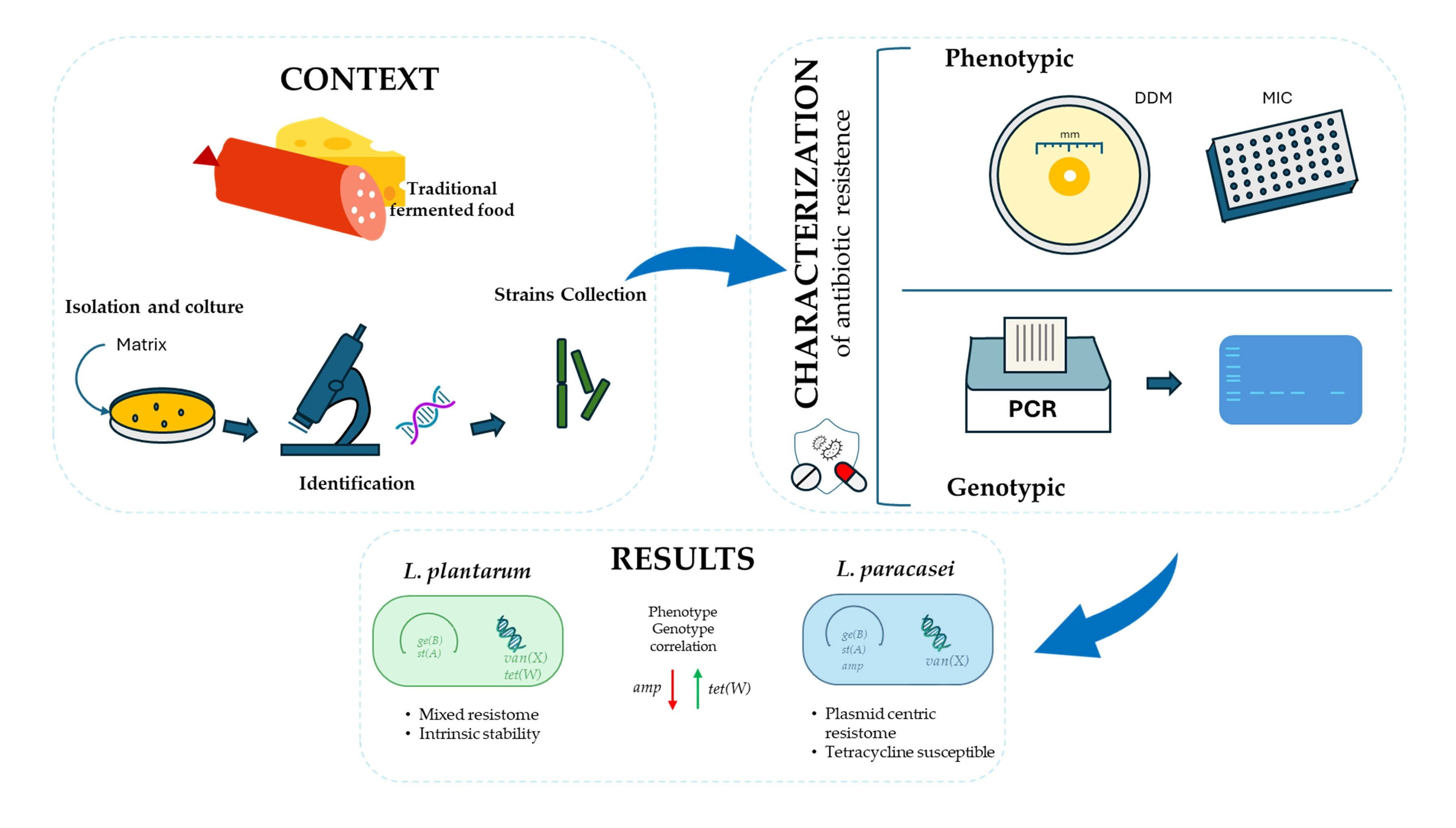
Graphical Abstract

1. Introduction

Antibiotics are among the most important therapeutic agents for the treatment of bacterial infections, having drastically reduced morbidity and mortality worldwide since their discovery [1]. However, the rapid emergence and dissemination of antibiotic resistance in human and veterinary medicine has become one of the most critical global health challenges [2,3]. Of particular concern is the spread of multidrug-resistant microorganisms that can evade multiple antibiotic classes used to treat them, as widely documented by several authoritative agencies [4,5]. For example, in Europe especially in Southern countries such as Italy, the latest ECDC report confirms persistently high resistance rates in major classes including fluoroquinolones, aminoglycosides and β-lactams [6].
Bacteria have evolved a variety of mechanisms to survive antibiotic pressure, including both intrinsic and acquired resistance. The relative predominance of these mechanisms depends on the type of antibiotic, its cellular target, and whether resistance determinants are chromosomal or carried by mobile genetic elements such as plasmids or transposons [7,8]. Horizontal gene transfer (HGT) plays a crucial role in this process, allowing resistance genes to move between taxonomically distant bacteria through conjugation, transformation, or transduction. The plasmid-mediated transfer of antibiotic resistance genes, in particular, has been identified as one of the main drivers of the global spread of antimicrobial resistance [9,10].
Although antibiotic resistance has historically been associated with pathogenic microorganisms, more attention is now being paid to non-pathogenic food-associated bacteria, including Lactic Acid Bacteria (LAB). These microorganisms, widely used in the production of fermented foods, are generally recognized as safe (GRAS) by the Food and Drug Administration (FDA) and hold Qualified Presumption of Safety (QPS) status according to the European Food Safety Authority (EFSA). However, they may act as reservoirs of resistance genes, some of which can be mobilized and potentially transferred to pathogenic or commensal bacteria within the food chain [11,12,13].
The potential threat to human health resulting from the inappropriate or excessive use of antibiotics in food-producing animals and in veterinary medicine is substantial [14], representing one of the most significant food safety risks associated with foods of animal origin.
Antibiotic consumption in cattle and poultry is increasing globally and, in developing countries, is feared to increase by 67% by 2030 [15].
In Europe in the decade from 2011 to 2021 there was a decline in the use of antibiotics in livestock by 47% (European Medicines Agency); evidently the legislative provisions aimed at regulating the use of antibiotics in veterinary medicine issued by the EU are proving effective. For instance, since 2006 the use of antibiotics as growth promoters has been prohibited (E.U. Regulation 1831/2003/EC). Recent EFSA, ECDC and EMA analyses indicate that reduced veterinary antibiotic use has been accompanied by declines in antimicrobial-resistant Campylobacter, Salmonella and commensal E. coli in several EU Member States, indicating a measurable impact on AMR trends [16]. Despite the implementation of these strategies, the surveillance on antibiotic resistance threat remains high, so much so that the same Authority strongly suggests further investigation of the non-pathogenic microorganisms as LAB involved in food fermentation.
Numerous fermented dairy and meat products rich in live lactobacilli could represent a vehicle for the entry of microorganisms into the human body. For instance, through the ingestion of fermented foods, lactobacilli can reach the gastrointestinal tract in numbers greater than 108 CFU/mL [17], where they can interact with the resident microbiota and transfers genetic material, including genes of resistance to antibiotics [18].
Assessing the spread of antibiotic resistance in food-borne LAB is essential to verify the following: (1) the safety of using the microorganisms themselves; (2) the microbiological safety of the products; and (3) the potential risks throughout the entire food supply chain.
In this context, this study analyzed 50 isolates (25 Lactiplantibacillus plantarum and 25 Lacticaseibacillus paracasei) obtained from artisanal Sardinian sausages and cheeses, respectively, to investigate the safety, stability and potential transferability of their antibiotic-resistance determinants. These species were selected because they are predominant in these two traditional products and are commonly investigated for their potential use as starter cultures; therefore, assessing their safety is particularly relevant.
To achieve this, phenotypic and genotypic approaches were applied combining disc diffusion, MIC testing, and PCR-based gene detection on both chromosomal and plasmid DNA.

2. Results

In this work, phenotypic and genotypic antibiotic susceptibility of Lactobacillus strains isolated from animal-based food were analyzed. Overall, Lactiplantibacillus plantarum exhibited greater intra-species variability in antibiotic susceptibility, while Lacticaseibacillus paracasei showed more homogeneous resistance patterns, characterized by a predominance of plasmid-encoded determinants.

2.1. Phenotypic Antibiotic Susceptibility of L. plantarum Strains

The 25 Lactiplantibacillus plantarum strains isolated from traditional fermented meat exhibited heterogeneous antibiotic resistance profiles when tested by Agar-overlay Disc Diffusion (ADD) (Table 1). All isolates were resistant to vancomycin, as no inhibition zones were observed. In contrast, all strains were fully susceptible to chloramphenicol and erythromycin, showing inhibition halos greater than 18 mm (diameter), which served as quality controls. These results indicate the absence of phenotypic resistance to both antibiotics, and therefore no further MIC or genetic analyses were performed for these compounds.
In addition, variable susceptibility to β-lactam, aminoglycoside, and tetracycline antibiotics were revealed. Regarding ampicillin resistance (halo ≤ 12 mm), were displayed 3 isolates (12%) susceptible (S), 12 isolates (48%) moderately susceptible (MS), and 10 isolates (40%) resistant (R). Gentamicin resistance was detected in 14 isolates (56%), whereas the remaining 11 strains (44%) were fully susceptible by ADD. MIC testing revealed values exceeding the highest concentration (256 µg/mL). L. plantarum showed a mixed susceptibility profile for Streptomycin, with 8 isolates (32%) susceptible, 8 (32%) moderately susceptible, and 9 (36%) resistant. MIC values (64 µg/mL) were measurable only in four isolates, indicating MICs above the assay breakpoint. All L. plantarum isolates showed reduced susceptibility to tetracycline, with 18 out of 25 isolates (72%) classified as resistant (R) and 7 out of 25 (28%) as moderately susceptible (MS), and none fully susceptible (S). Only a few isolates exhibited measurable MIC values below the breakpoint (32 µg/mL), indicating susceptibility to tetracycline. For several strains, bacterial growth persisted at the highest antibiotic concentration tested, indicating MIC values > 256 µg/mL.
Overall, the comparison between ADD and MIC testing revealed method-dependent differences in the interpretation of susceptibility for several antibiotics. Notably, gentamicin showed a discrepancy of 44% between the two assays, with isolates classified as susceptible by ADD displayed MIC values that exceeded the highest concentration tested. A similar inconsistency was observed for streptomycin, for which eight isolates, corresponding to 32% of the dataset, classified as susceptible by ADD were instead resistant according to MIC testing. A further discrepancy was detected for tetracycline, where five isolates, representing 20% of the dataset, classified as resistant by ADD were instead susceptible according to MIC values. These findings highlight that the two phenotypic methods may not always provide concordant classification.

2.2. Phenotypic Antibiotic Susceptibility of L. paracasei Strains

The Lacticaseibacillus paracasei (n = 25) strains isolated from traditional dairy products exhibited a more uniform resistance profile than L. plantarum (Table 2). All isolates were resistant to vancomycin, gentamicin, and streptomycin, as confirmed by both ADD and MIC assays. L. paracasei isolates showed reduced susceptibility to ampicillin, with 22 out of 25 isolates (88%) classified as resistant (R) and 2 out of 25 (8%) as moderately susceptible (MS), and 1 out of 25 (4%) as fully susceptible (S). However, MIC testing, confirmed susceptibility for only a few isolates, highlighting a marked discrepancy between the two phenotypic methods. All isolates were susceptible to tetracycline (halo ≥ 19 mm, MIC 4 µg/mL), except for 9BC3, which showed a slightly reduced halo but still within the susceptible range. For L. paracasei, additional discrepancies between ADD and MIC testing were also observed. In the case of ampicillin, ten isolates, corresponding to 40% of the dataset, showed non-concordant classifications, with one strain classified as susceptible by ADD displaying an MIC value > 256 µg/mL and nine strains classified as resistant by ADD displaying MICs below the breakpoint threshold. Four isolates (16%) classified as susceptible by ADD showed MIC values exceeding the highest concentration tested for tetracycline, indicating resistance and further highlighting the lack of concordance between the two phenotypic methods.

2.3. Resistance Genes in Genomic and Plasmid DNA

The results of gene distribution patterns between chromosomal and plasmid DNA in both L. plantarum and L. paracasei strains are shown in Table 3 and Table 4.
Overall, L. plantarum exhibited heterogeneous antibiotic susceptibility and a mixed genetic architecture of resistance determinants, with both chromosomal and plasmid localization. The tet(W) gene, which was present in all 25 isolates, was located exclusively on the chromosome, which confirms that it is not mobile in these strains.
The presence of plasmid-associated strA in 20 strains is consistent with previous surveys reporting aminoglycoside resistance determinants in foodborne Lactobacillus spp., which are frequently located on plasmids or associated with mobile genetic elements [19]. The aac(6′)-Ie–aph(2″)-Ia gene was present in 13 strains, predominantly on plasmids (12/13) and only rarely on the chromosome (1/13). The blaZ gene, associated with β-lactam resistance, was detected in 6 isolates, all plasmid-borne. Finally, vanX, the glycopeptide resistance determinant, was found in 17 isolates, mostly on chromosomal DNA (16/17) and in a single case on a plasmid.
The predominance of tet(W) in the chromosome and the plasmid occurrence of strA and blaZ suggest a dual strategy of stable inheritance and potential horizontal gene transfer within this L. plantarum species.
A clear relationship was observed between the presence of specific genes and the corresponding phenotypic resistance, particularly for strA, aac(6′)-Ie–aph(2″)-Ia and tet(W). Phenotypic-genotypic concordance for vanX displayed similarly good agreement, though not complete, and the only marked difference was observed for ampicillin.
Genotypic analysis conducted on L. paracasei strains revealed the following distribution of resistance genes (Table 4).
The tet(W) gene was absent in all isolates, in agreement with the observed tetracycline susceptibility. The strA gene was detected in 24 isolates, located predominantly on plasmid DNA (18/24) and in a smaller number on the chromosome (6/24). The aac(6′)-Ie–aph(2″)-Ia gene was found in 14 isolates, all plasmid-borne, whereas blaZ was detected in 11 isolates, also exclusively plasmidial. Finally, the vanX gene, associated with glycopeptide resistance, was detected in 18 isolates, all located on chromosomal DNA.
L. paracasei strains displayed consistent intrinsic resistance to vancomycin and aminoglycosides as well as a plasmid-linked pattern of β-lactam resistance, while remaining largely susceptible to tetracycline. Approximately 63% of detected genes were found on plasmid, suggesting a higher potential for horizontal transfer than L. plantarum, although no mobile or conjugative elements were identified.
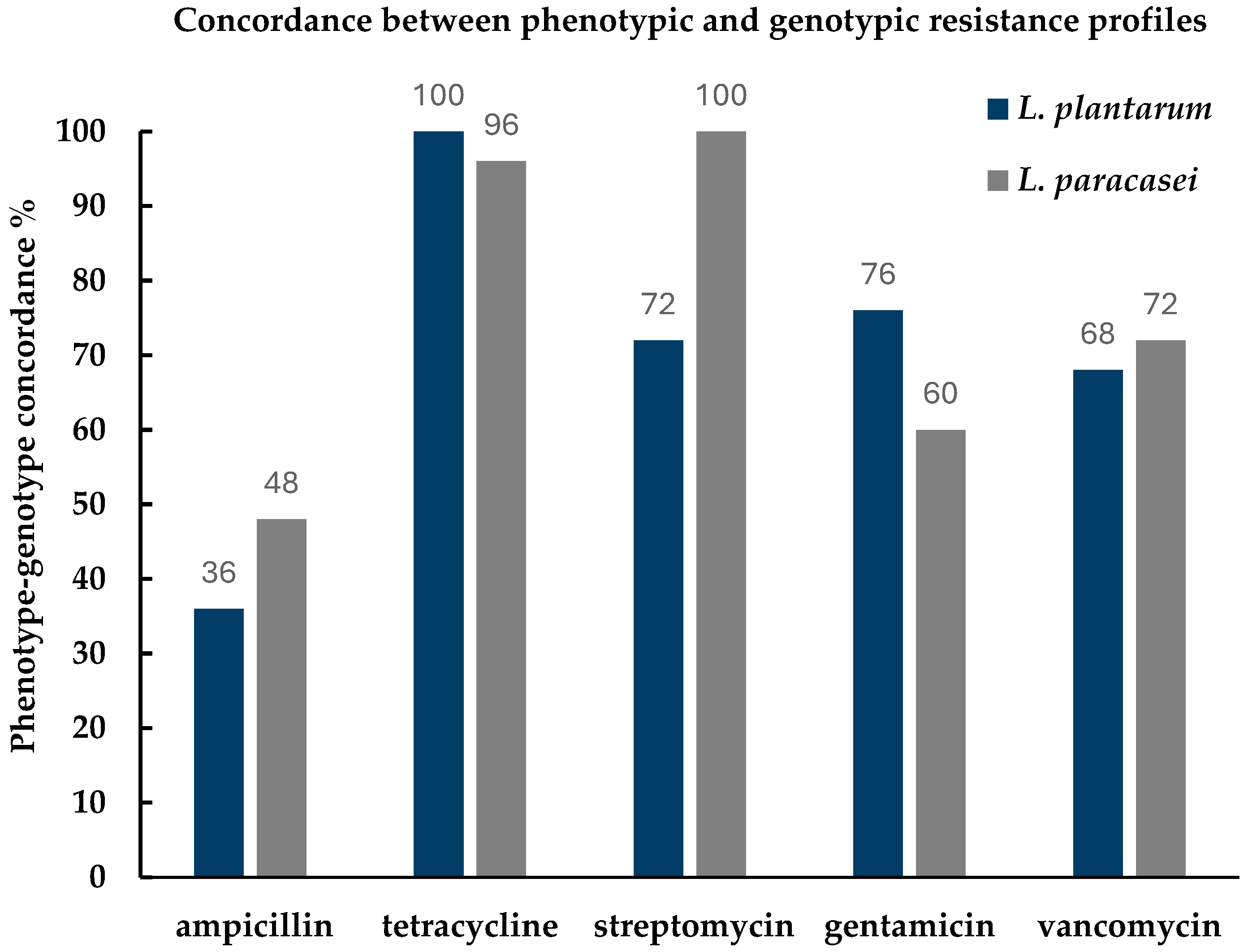
ADD phenotypic values were used to assess the agreement between phenotype and genotype. Concordance percentages were calculated by considering the ADD phenotypic data and PCR detection of the corresponding gene on the total number of strains per species (n = 25).
The overall concordance between phenotype and genotype varied across resistance determinants. A high level of agreement was observed for streptomycin and tetracycline in L. paracasei whose presence strongly matched. For gentamycin and vancomycin, the concordance was slightly less consistent, with some mismatches emerging, ampicillin showed the lowest level of agreement in both Lactobacillus species (Figure 1).

3. Discussion

The food chain is considered one of the main reservoirs and transmission routes of antibiotic resistance genes (ARGs) [20,21,22]. Also, Lactic Acid Bacteria (LAB), which reach the gastrointestinal tract in high cell densities through the consumption of fermented products, may contribute to the spread or maintenance of resistant determinants within the human microbiota [23,24].
Furthermore, the physic-chemical conditions typical of fermented foods such as pH, salt concentrations, and technological stressors may modulate ARG expression and facilitate gene exchange among coexisting microorganisms [25,26]. Recent surveys on LAB from traditional foods indicate that resistance is not uncommon and often gene associated. As reported in the literature, 40.7% of LAB isolates from dairy products in Northern Italy harbored at least one antibiotic resistance gene, chiefly tetracycline determinants such as tet(K) and tet(M), while intrinsic vancomycin non-susceptibility was nearly universal in Lactobacillus and Leuconostoc species [27].
In this study, Lactiplantibacillus plantarum and Lacticaseibacillus paracasei strains were isolated from specific traditional Sardinian fermented products. L. plantarum strains originated from spontaneously fermented sheep sausages, while L. paracasei strains were obtained from Casizolu, a traditional pasta-filata cheese produced from raw cow’s milk through natural lactic fermentation.
When comparing phenotypic results, minor discrepancies between ADD and MIC may occur because the two assays differ in their principles and interpretative criteria. ADD relies on antibiotic diffusion and halo diameter thresholds, whereas MIC determines inhibition based on a quantitative concentration gradient. As reported for LAB, medium composition, diffusion behavior and growth kinetics can influence halo formation and lead to borderline or non-overlapping classifications between methods [28]. In our dataset, ADD and MIC showed overall good agreement, with only occasional divergences, reflecting known methodological limitations in cross-method concordance.
Both lactobacilli species exhibited species-specific resistance patterns reflecting distinct resistance architectures, with a mixed chromosomal–plasmid distribution in L. plantarum and a predominantly plasmid-associated pattern in L. paracasei. At the same time, the detection of plasmid-associated genes indicates that these populations remain connected to the broader resistome and may retain a limited but non-negligible potential for gene mobilization under specific conditions [29].
During the initial PCR screening performed on total DNA extracted from colonies, several resistance genes showed weak or absent amplification despite the corresponding phenotypic resistance. Since total-DNA preparations may contain plasmid sequences at very low relative abundance, as reported in previous studies [30,31], plasmid DNA was subsequently extracted from all strains. This analysis was part of the planned workflow to determine the genomic location of the resistance determinants, and the use of plasmid-enriched templates allowed consistent detection of the target genes and their assignment to either the chromosomal or plasmid fraction.
Overall, the comparison between phenotypic and genotypic profiles revealed a generally good level of concordance although some mismatches were identified especially for ampicillin. Inconsistencies emerged, where resistant lactobacilli lacked detectable genes or susceptible strains carried them. Several explanations can be proposed: (i) the PCR screening targeted only a limited set of loci [32]; (ii) sequence variability in autochthonous isolates might have led to primer mismatches, causing false negatives [33]; (iii) some genes may be weakly expressed or silent under laboratory conditions, resulting in genotypic positivity without a corresponding phenotype [19]; and (iv) alternative intrinsic mechanisms, such as cell wall modifications, efflux pumps, or metabolic compensation, may confer resistance independently of the tested genes [34]; (v) PCR may also miss low-copy genes or plasmids present below the detection threshold, leading to false negatives [35].
These discrepancies between the genotypic analysis by PCR and the phenotype methods have already been reported in research conducted on LAB from poultry and swine meat products [36]. Similarly, Campedelli et al. [33] obtained different results between phenotypes and genotypes for vancomycin in Lactobacilli sp. The authors assume that as reported above could be due to the presence of alternative resistance mechanisms or to alteration of gene expression.
Most Lactobacillus species exhibit intrinsic resistance to aminoglycosides and vancomycin, as widely documented in the literature.
Overall, our results indicate that all lactobacilli strains were resistant to vancomycin, a well-established intrinsic trait of many LAB species. As widely documented in the literature, this resistance is associated with D-Ala–D-Lac–type modifications of the peptidoglycan terminus, which reduce vancomycin binding [37,38,39]. Because this intrinsic mechanism does not rely on the vanX locus, the presence of vanX is not predictive of phenotypic resistance, thereby explaining the observed phenotype–genotype discordance [34]. This trait is encoded chromosomally and is considered non-transferable according to EFSA guidelines [40]. Tetracycline resistance was also detected in several isolates of L. plantarum and none of L. paracasei showed resistance. The tet(W) gene was consistently identified at the chromosomal level in L. plantarum, confirming its non-transferable nature and supporting previous findings that reported tet(W) as one of the most common determinants in lactobacilli from fermented foods [34,41].
L. plantarum and L. paracasei strains each harbored multiple plasmid-associated resistance genes (e.g., strA, aac(6′)-Ie–aph(2″)-Ia, blaZ), although this trait was more pronounced in L. paracasei. Intrinsic resistance to aminoglycosides, such as gentamicin and streptomycin, is widespread among Lactobacillus species and is mainly attributable to reduced permeability of the cell envelope and low affinity of ribosomal targets for these antibiotics, rather than to the acquisition of specific resistance genes [33,41].
Although some resistance genes were located on plasmids, no experiments were performed to assess the presence of conjugative elements, transposons, or other mobility-associated features. Therefore, our data do not provide any experimental evidence for gene mobility, and no conclusions can be drawn regarding the horizontal transfer potential of these plasmids. However, evidence from Toomey et al. (2010) reported the transfer of tet(M) from L. plantarum isolated from a pork abattoir to Lactococcus lactis and Enterococcus faecalis strains can occur under optimized laboratory conditions [12].
This study may provide important information concerning the safe traits of L. plantarum and L. paracasei strains isolated from traditional Sardinian fermented foods. Despite some limitations, including the restricted selection of antibiotics and primers used in this screening, the results revealed a preliminary distinct, species-specific architectures: L. plantarum displayed mainly chromosomally encoded and intrinsic resistances, while L. paracasei carried several plasmid-associated but non-conjugative determinants. These structural differences likely reflect the ecological and technological contexts of isolation meat-derived environments for L. plantarum and dairy matrices for L. paracasei. In these contexts, different antimicrobial exposures and microbial communities may exert distinct selective pressures on resistance maintenance and gene organization [42].
From a One Health perspective, these results suggest the surveillance of technologically relevant and QPS-listed LAB remains crucial, considering their wide use as starter or adjunct cultures and their natural presence in fermented foods of both plant and animal origin [43,44,45]. This is because it is essential to preserve microbial biodiversity and product quality; however, it is also necessary to ensure that traditional fermentation ecosystems do not become hidden reservoirs of antibiotic resistance.

4. Materials and Methods

4.1. Bacterial Isolates and Growth Conditions

A total of 50 LAB strains, including 25 L. plantarum and 25 L. paracasei, were used in this study. These isolates were originally obtained from traditional Sardinian fermented meat and dairy products by standard culture-based procedures on MRS agar, and species-level identification was performed through phenotypic characterization and confirmed by 16S rRNA gene sequencing, as described in references [46,47].
For the present experiments, strains were grown in MRS (Man Rogosa and Sharpe) medium (Oxoid, Milan, Italy) at 32 °C for 48 h under anaerobic conditions (Gas-Pack; Oxoid, Milan, Italy).

4.2. Phenotypic Antibiotics Susceptibility Testing

The antibiotics selected for the analysis of antimicrobial resistance included several agents considered as basic requirements for initial screening [40] and were chosen as representatives of the antimicrobial classes most commonly used in veterinary and food-related settings.

4.2.1. Assessment by Agar Overlay Disc Diffusion

The antibiotic susceptibility screening initially was performed by Agar-overlay Disc Diffusion (ADD) method following the general procedure described by Huys et al., with minor adaptations [28].
Briefly, paper discs impregnated of ampicillin (10 μg), gentamicin (10 μg), streptomycin (10 μg), tetracycline (30 μg) or, vancomycin (30 μg) were placed onto solidified LSM (90% IsoSensitest medium, 10% MRS broth) agar plates inoculated with a bacteria concentration corresponding to 1 McFarland turbidity standard (~3 × 10⁸ CFU/mL) and allowed to solidify at room temperature. After that, the plates were overlaid with 3 mL of MRS soft agar (0.7% agar, p/v), at 50 °C) and incubated for 24 h at 30 °C under anaerobiosis conditions. The inhibition halo diameters were measured and results (average of three determinations) were expressed in terms of resistance (R), moderate susceptibility (MS), or susceptibility (S), according to interpretative standards detailed in Table 5 [48].

4.2.2. Determination of the Minimum Inhibitory Concentration (MIC)

In addition, antibiotics susceptibility as the lowest concentration of each antibiotic that inhibits the visible growth of bacteria (MIC, Minimum Inhibitory Concentration) were cross validated by MIC Test Strips (Liofilchem, Roseto degli Abruzzi, Italy) according to the manufacturer’s instructions that report same range (0.016–256 µg/mL) for all antibiotics tested in this study. Briefly, bacterial suspensions with a turbidity equivalent to McFarland standard 1 (~3 × 10⁸ CFU/mL) were prepared and inoculated in LSM consisting of 90% IsoSensitest broth (Oxoid, Milan, Italy), 10% MRS broth supplemented with 1.5% agar (Oxoid, Milan, Italy). When the test strip is applied onto an inoculated agar surface, the preformed exponential gradient (across 15 two-fold dilutions like those of a conventional MIC method) of the antimicrobial agent was transferred into the agar matrix.
After 24 h of incubation, a symmetrical inhibition ellipse centered along the strip was formed. The MIC was read directly from the scale in terms of µg/mL, at the point where the edge of the inhibition ellipse intersects with the MIC test strip. MIC values were compared with MIC breakpoints of Lactobacillus spp. defined by EFSA 2012 [40].

4.3. Detection of Antibiotic Resistance Genes in Genomic and Plasmid DNA

Detection of antibiotic resistance genes was performed by colony PCR, consisting of direct amplification using, as template, a bacterial colony resuspended in 50 µL of sterile water [36]. Plasmid DNA was obtained using Eurogold plasmid Miniprep kit (Euroclone) according to the manufacturer’s instructions. The DNA concentration, integrity and purity were assessed by spectrophotometric measurements using SPECTROstar Nano Microplate Reader (BMG Labtech, Ortenberg, Germany). All the DNA samples were stored at −20 °C.
The presence of resistance genes was determined by PCR amplification using the primers listed in Table 6. The amplification reaction was performed in 25 µL volume, containing 5 µL of the template DNA (approximately 20–50 ng per reaction), 5 mM MgCl2, 100 µM DNTPs, and 5 U TAQ DNA polymerase (Invitrogen). The reaction mix was incubated for 5 min at 94 °C and then amplified for 35 cycles consisting in 1 min at 94 °C, 1 min at 50 °C or 55 °C for primers annealing, 1 min at 72 °C followed by 10 min at 72 °C for the final extension. PCR products were separated by 1% agarose gel electrophoresis, stained by SYBR safe (Invitrogen, Thermo Fisher Scientific, Waltham, MA, USA) and visualized with Chemi Doc XRS imaging system (BioRad Laboratories, Milan, Italy). Each PCR run included a no-template control (NTC) to exclude contamination, whereas positive control strains were not used in this assay.

Author Contributions

Conceptualization, N.P.M. and A.N.; experimental design G.C. and N.P.M.; investigation M.C.; analysis, M.E.M. and G.C.; data curation, A.N. and G.B.; writing—original draft preparation, G.C. and M.C.; writing—review and editing, G.B. and N.P.M.; funding acquisition, N.P.M. All authors have read and agreed to the published version of the manuscript.

Funding

This research received no external funding.

Data Availability Statement

The original contributions presented in this study are included in the article. Further inquiries can be directed to the corresponding author.

Conflicts of Interest

The authors declare no conflicts of interest.

References

  1. Dhingra, S.; Rahman, N.A.A.; Peile, E.; Rahman, M.; Sartelli, M.; Hassali, M.A.; Islam, T.; Islam, S.; Haque, M. Microbial resistance movements: An overview of global public health threats posed by antimicrobial resistance, and how best to counter. Front. Public Health 2020, 8, 535668. [Google Scholar] [CrossRef] [PubMed]
  2. Palma, E.; Tilocca, B.; Roncada, P. Antimicrobial Resistance in Veterinary Medicine: An Overview. Int. J. Mol. Sci. 2020, 21, 1914. [Google Scholar] [CrossRef] [PubMed]
  3. Rhouma, M.; Soufi, L.; Cenatus, S.; Archambault, M.; Butaye, P. Current Insights Regarding the Role of Farm Animals in the Spread of Antimicrobial Resistance from a One Health Perspective. Vet. Sci. 2022, 9, 480. [Google Scholar] [CrossRef]
  4. Klein, E.Y.; Van Boeckel, T.P.; Martinez, E.M.; Pant, S.; Gandra, S.; Levin, S.A.; Goossens, H.; Laxminarayan, R. Global increase and geographic convergence in antibiotic consumption between 2000 and 2015. Proc. Natl. Acad. Sci. USA 2018, 115, E3463–E3470. [Google Scholar] [CrossRef]
  5. Antimicrobial Resistance Collaborators. Global burden of bacterial antimicrobial resistance in 2019: A systematic analysis. Lancet 2022, 399, 629–655. [Google Scholar] [CrossRef] [PubMed]
  6. European Centre for Disease Prevention and Control (ECDC); World Health Organization (WHO) Regional Office for Europe. Antimicrobial Resistance Surveillance in Europe 2023–2021 Data; ECDC: Stockholm, Sweden, 2023; ISBN 978-92-890-5853-7. Available online: https://www.ecdc.europa.eu/en/publications-data/antimicrobial-resistance-surveillance-europe-2023-2021-data (accessed on 15 April 2025).
  7. Aslam, B.; Wang, W.; Arshad, M.I.; Khurshid, M.; Muzammil, S.; Rasool, M.H.; Nisar, M.A.; Alvi, R.F.; Aslam, M.A.; Qamar, M.U.; et al. Antibiotic resistance: A rundown of a global crisis. Infect. Drug Resist. 2018, 11, 1645–1658. [Google Scholar] [CrossRef]
  8. Munita, J.M.; Arias, C.A. Mechanisms of antibiotic resistance. Microbiol. Spectr. 2016, 4. [Google Scholar] [CrossRef]
  9. Partridge, S.R.; Kwong, S.M.; Firth, N.; Jensen, S.O. Mobile genetic elements associated with antimicrobial resistance. Clin. Microbiol. Rev. 2018, 31, e00088-17. [Google Scholar] [CrossRef]
  10. Meng, M.; Li, Y.; Yao, H. Plasmid-Mediated Transfer of Antibiotic Resistance Genes in Soil. Antibiotics 2022, 11, 525. [Google Scholar] [CrossRef]
  11. Mathur, S.; Singh, R. Antibiotic resistance in lactic acid bacteria: A review. Int. J. Food Microbiol. 2005, 105, 281–295. [Google Scholar] [CrossRef]
  12. Toomey, N.; Bolton, D.; Fanning, S. Characterization and transferability of antibiotic resistance genes from lactic acid bacteria isolated from Irish pork and beef abattoirs. Res. Microbiol. 2010, 161, 127–135. [Google Scholar] [CrossRef]
  13. Gueimonde, M.; Sánchez, B.; de los Reyes-Gavilán, C.G.; Margolles, A. Antibiotic resistance in probiotic bacteria. Front. Microbiol. 2013, 4, 202. [Google Scholar] [CrossRef] [PubMed]
  14. Baynes, R.E.; Dedonder, K.; Kissell, L.; Mzyk, D.; Marmulak, T.; Smith, G.; Tell, L.; Gehring, R.; Davis, J.; Riviere, J.E. Health Concerns and Management of Select Veterinary Drug Residues. Food Chem. Toxicol. 2016, 88, 112–122. [Google Scholar] [CrossRef] [PubMed]
  15. Van Boeckel, T.P.; Brower, C.; Gilbert, M.; Grenfell, B.T.; Levin, S.A.; Robinson, T.P.; Teillant, A.; Laxminarayan, R. Global Trends in Antimicrobial Use in Food Animals. Proc. Natl. Acad. Sci. USA 2015, 112, 5649–5654. [Google Scholar] [CrossRef] [PubMed]
  16. European Centre for Disease Prevention and Control (ECDC); European Food Safety Authority (EFSA); European Medicines Agency (EMA). Third joint inter-agency report on integrated analysis of consumption of antimicrobial agents and occurrence of antimicrobial resistance in bacteria from humans and food-producing animals in the EU/EEA: JIACRA III 2016-2018. EFSA J. 2021, 19, e06712. [Google Scholar] [CrossRef]
  17. Ali, A.A. Use of Starter Cultures of Lactic Acid Bacteria and Yeasts in the Preparation of Kisra, a Sudanese Fermented Food. Pak. J. Nutr. 2009, 8, 1349–1353. [Google Scholar] [CrossRef]
  18. Talon, R.; Leroy, S. Diversity and safety hazards of bacteria involved in meat fermentations. Meat Sci. 2011, 89, 303–309. [Google Scholar] [CrossRef]
  19. Devirgiliis, C.; Zinno, P.; Perozzi, G. Update on antibiotic resistance in foodborne Lactobacillus and Lactococcus species. Front. Microbiol. 2013, 4, 301. [Google Scholar] [CrossRef]
  20. Singer, R.S.; Finch, R.; Wegener, H.C.; Bywater, R.; Walters, J.; Lipsitch, M. Antibiotic resistance—The interplay between antibiotic use in animals and human beings. Lancet Infect. Dis. 2003, 3, 47–51. [Google Scholar] [CrossRef]
  21. Morel, C. Transmission of Antimicrobial Resistance from Livestock Agriculture to Humans and from Humans to Animals; OECD Food, Agriculture and Fisheries Papers; OECD Publishing: Paris, France, 2019; Volume 133, pp. 1–43. [Google Scholar] [CrossRef]
  22. Stefańska, I.; Jóźwiak-Piasecka, K.; Garbowska, M.; Binek, M.; Kwiecień, E.; Rzewuska, M. Antimicrobial Susceptibility of Lactic Acid Bacteria Strains of Potential Use as Feed Additives—The Basic Safety and Usefulness Criterion. Front. Vet. Sci. 2021, 8, 687071. [Google Scholar] [CrossRef]
  23. Vinayamohan, P.G.; Viju, L.S.; Joseph, D.; Venkitanarayanan, K. Fermented foods as a potential vehicle of antimicrobial-resistant bacteria and genes. Fermentation 2023, 9, 688. [Google Scholar] [CrossRef]
  24. Rezac, S.; Kok, C.R.; Heermann, M.; Hutkins, R. Fermented Foods as a Dietary Source of Live Organisms. Front. Microbiol. 2018, 9, 1785. [Google Scholar] [CrossRef] [PubMed]
  25. McMahon, M.A.S.; Blair, I.S.; Moore, J.E.; McDowell, D.A. The rate of horizontal transmission of antibiotic resistance plasmids is increased in food-preservation-stressed bacteria. J. Appl. Microbiol. 2007, 103, 1883–1888. [Google Scholar] [CrossRef]
  26. Giacometti, F.; Shirzad-Aski, H.; Ferreira, S. Antimicrobials and Food-Related Stresses as Selective Factors for Antibiotic Resistance along the Farm to Fork Continuum. Antibiotics 2021, 10, 671. [Google Scholar] [CrossRef]
  27. Floris, I.; Battistini, R.; Tramuta, C.; Garcia-Vozmediano, A.; Musolino, N.; Scardino, G.; Masotti, C.; Brusa, B.; Orusa, R.; Serracca, L.; et al. Antibiotic resistance in lactic acid bacteria from dairy products in Northern Italy. Antibiotics 2025, 14, 375. [Google Scholar] [CrossRef]
  28. Huys, G.; D’Haene, K.; Swings, J. Influence of the culture medium on antibiotic susceptibility testing of food-associated lactic acid bacteria with the agar overlay disc diffusion method. Lett. Appl. Microbiol. 2002, 34, 402–406. [Google Scholar] [CrossRef]
  29. Cui, Y.; Hu, T.; Qu, X.; Zhang, L.; Ding, Z.; Dong, A. Plasmids from Food Lactic Acid Bacteria: Diversity, Similarity, and New Developments. Int. J. Mol. Sci. 2015, 16, 13172–13202. [Google Scholar] [CrossRef] [PubMed]
  30. Li, A.-D.; Li, L.-G.; Zhang, T. Exploring antibiotic resistance genes and metal resistance genes in plasmid metagenomes from wastewater treatment plants. Front. Microbiol. 2015, 6, 1025. [Google Scholar] [CrossRef]
  31. Heuer, H.; Binh, C.T.T.; Jechalke, S.; Kopmann, C.; Zimmerling, U.; Kröger-Recklenfort, E.; Ledger, T.; González, B.; Top, E.; Smalla, K. IncP-1ε plasmids are important vectors of antibiotic resistance genes in agricultural systems: Diversification driven by class 1 integron gene cassettes. Front. Microbiol. 2012, 3, 2. [Google Scholar] [CrossRef] [PubMed]
  32. Álvarez-Cisneros, Y.M.; Ponce-Alquicira, E. Antibiotic Resistance in Lactic Acid Bacteria. Antimicrobial Resistance—A Global Threat; IntechOpen: London, UK, 2019. [Google Scholar] [CrossRef]
  33. Campedelli, I.; Mathur, H.; Salvetti, E.; Clarke, S.; Rea, M.C.; Torriani, S.; Ross, R.P.; Hill, C.; O’Toole, P.W. Genus-Wide Assessment of Antibiotic Resistance in Lactobacillus spp. Appl. Environ. Microbiol. 2019, 85, e01738-18. [Google Scholar] [CrossRef]
  34. Ammor, M.S.; Flórez, A.B.; van Hoek, A.H.A.M.; de los Reyes-Gavilán, C.G.; Aarts, H.J.M.; Margolles, A.; Mayo, B. Molecular Characterization of Intrinsic and Acquired Antibiotic Resistance in Lactic Acid Bacteria and Bifidobacteria. J. Mol. Microbiol. Biotechnol. 2008, 14, 6–15. [Google Scholar] [CrossRef]
  35. Bergkessel, M.; Guthrie, C. Colony PCR. In Laboratory Methods in Enzymology: DNA; Lorsch, J., Ed.; Methods in Enzymology; Academic Press: San Diego, CA, USA, 2013; Volume 529, pp. 299–309. [Google Scholar] [CrossRef]
  36. Aquilanti, L.; Garofalo, C.; Osimani, A.; Silvestri, G.; Vignaroli, C.; Clementi, F. Isolation and Molecular Characterization of Antibiotic-Resistant Lactic Acid Bacteria from Poultry and Swine Meat Products. J. Food Prot. 2007, 70, 557–565. [Google Scholar] [CrossRef] [PubMed]
  37. Zhang, S.; Oh, J.-H.; Alexander, L.M.; Özçam, M.; van Pijkeren, J.P. D-Alanyl-D-Alanine Ligase as a Broad-Host-Range Counterselection Marker in Vancomycin-Resistant Lactic Acid Bacteria. J. Bacteriol. 2018, 200, e00607-17. [Google Scholar] [CrossRef]
  38. Duche, R.T.; Singh, A.; Wandhare, A.G.; Sangwan, V.; Sihag, M.K.; Nwagu, T.N.T.; Panwar, H.; Ezeogu, L.I. Antibiotic Resistance in Potential Probiotic Lactic Acid Bacteria of Fermented Foods and Human Origin from Nigeria. BMC Microbiol. 2023, 23, 142. [Google Scholar] [CrossRef] [PubMed]
  39. Rossi, F.; Di Renzo, T.; Preziuso, M.; Zotta, T.; Iacumin, L.; Coppola, R.; Reale, A. Survey of Antibiotic Resistance Traits in Strains of Lactobacillus casei/paracasei/rhamnosus Isolated from Foods. Ann. Microbiol. 2015, 65, 1763–1769. [Google Scholar] [CrossRef]
  40. EFSA Panel on Additives and Products or Substances used in Animal Feed (FEEDAP). Guidance on the assessment of bacterial susceptibility to antimicrobials of human and veterinary importance. EFSA J. 2012, 10, 2740. [Google Scholar] [CrossRef]
  41. Abriouel, H.; Casado Muñoz, M.D.C.; Lavilla Lerma, L.; Pérez Montoro, B.; Bockelmann, W.; Pichner, R.; Kabisch, J.; Cho, G.-S.; Franz, C.M.A.P.; Gálvez, A.; et al. New insights in antibiotic resistance of Lactobacillus species from fermented foods. Food Res. Int. 2015, 78, 465–481. [Google Scholar] [CrossRef]
  42. Valan Arasu, M.; Jung, M.W.; Kim, D.H.; Park, H.S.; Ilavenil, S.; Al-Dhabi, N.A.; Choi, K.C. Identification and Phylogenetic Characterization of Novel Lactobacillus plantarum Species and Their Metabolite Profiles in Grass Silage. Ann. Microbiol. 2015, 65, 15–25. [Google Scholar] [CrossRef]
  43. Mangia, N.P.; Murgia, M.A.; Garau, G.; Sanna, M.P.; Deiana, P. Influence of selected LAB cultures on the evolution of free amino acids, free fatty acids and Fiore Sardo cheese microflora during ripening. Food Microbiol. 2008, 25, 366–377. [Google Scholar] [CrossRef]
  44. Garcia-Gonzalez, N.; Battista, N.; Prete, R.; Corsetti, A. Health-Promoting Role of Lactiplantibacillus plantarum Isolated from Fermented Foods. Microorganisms 2021, 9, 349. [Google Scholar] [CrossRef]
  45. Moiseenko, K.V.; Begunova, A.V.; Savinova, O.S.; Bairamashvili, D.I.; Dlusskaya, E.A.; Zelenkova, N.F.; Cepeda, A.; Ivanova, E.P. Biochemical and Genomic Characterization of Two New Strains of Lacticaseibacillus paracasei Isolated from the Traditional Corn-Based Beverage of South Africa, Mahewu, and Their Comparison with Strains Isolated from Kefir Grains. Foods 2023, 12, 223. [Google Scholar] [CrossRef]
  46. Mangia, N.P.; Cottu, M.; Mura, M.E.; Murgia, M.A.; Blaiotta, G. Technological parameters, anti-Listeria activity, biogenic amines formation and degradation ability of Lactiplantibacillus plantarum strains isolated from sheep-fermented sausage. Microorganisms 2021, 9, 1895. [Google Scholar] [CrossRef]
  47. Mangia, N.P.; Fancello, F.; Deiana, P. Microbiological characterization using combined culture dependent and independent approaches of Casizolu pasta filata cheese. J. Appl. Microbiol. 2016, 120, 329–345. [Google Scholar] [CrossRef] [PubMed]
  48. Charteris, W.P.; Kelly, P.M.; Morelli, L.; Collins, J.K. Antibiotic Susceptibility of Potentially Probiotic Lactobacillus Species. J. Food Prot. 1998, 61, 1636–1643. [Google Scholar] [CrossRef] [PubMed]
  49. Vakulenko, S.B.; Donabedian, S.M.; Voskresenskiy, A.M.; Zervos, M.J.; Lerner, S.A.; Chow, J.W. Multiplex PCR for detection of aminoglycoside resistance genes in enterococci. Antimicrob. Agents Chemother. 2003, 47, 1423–1426. [Google Scholar] [CrossRef]
  50. Ouoba, L.I.I.; Lei, V.; Jensen, L.B. Resistance of Potential Probiotic Lactic Acid Bacteria and Bifidobacteria of African and European Origin to Antimicrobials: Determination and Transferability of the Resistance Genes to Other Bacteria. Int. J. Food Microbiol. 2008, 121, 217–224. [Google Scholar] [CrossRef] [PubMed]
  51. Villedieu, A.; Diaz-Torres, M.L.; Hunt, N.; McNab, R.; Spratt, D.A.; Wilson, M.; Mullany, P. Prevalence of Tetracycline Resistance Genes in Oral Bacteria. Antimicrob. Agents Chemother. 2003, 4, 878–882. [Google Scholar] [CrossRef]
  52. Liu, C.; Zhang, Z.-Y.; Dong, K.; Yuan, J.-P.; Guo, X.-K. Antibiotic Resistance of Probiotic Strains of Lactic Acid Bacteria Isolated from Marketed Foods and Drugs. Biomed. Environ. Sci. 2009, 22, 401–412. [Google Scholar] [CrossRef]
Figure 1. Phenotype–genotype concordance (%) for antibiotic resistance in Lactiplantibacillus plantarum and Lacticaseibacillus paracasei. Bars represent the percentage of isolates showing matching phenotypic (ADD) and genotypic (PCR) resistance profiles for each antibiotic tested (ampicillin, tetracycline, streptomycin, gentamicin, vancomycin).
Antibiotics 15 00018 g001
Table 1. Phenotypic susceptibility to antibiotics in L. plantarum strains.
ChloranphenicolErytromycinAmpicillinTetracyclineStreptomycinGentamicinVancomycin
L. Plantarum
Strains
a ADD
b MIC (mg/L)a ADD
b MIC (mg/L)a ADD
b MIC (mg/L)a ADD
b MIC (mg/L)a ADD
b MIC (mg/L)a ADD
b MIC (mg/L)a ADD
b MIC (mg/L)
PT 0-2(S)n.p.(S)n.p.(S)0.38(MS)>256(S)96(R)>256(R)>256
PT 0-4(S)n.p.(S)n.p.(S)0.38(MS)>256(S)128(R)>256(R)>256
PT 1-7(S)n.p.(S)n.p.(R)>256(R)>256(R)96(R)>256(R)>256
PT 1-8(S)n.p.(S)n.p.(R)>256(R)>256(S)>256(S)>256(R)>256
PT 2-3(S)n.p.(S)n.p.(MS)1.5(R)12(MS)>256(S)>256(R)>256
PT 3-9(S)n.p.(S)n.p.(MS)1.5(MS)16(R)>256(S)>256(R)>256
PT 5-5(S)n.p.(S)n.p.(R)>256(R)>256(R)>256(R)>256(R)>256
PT 5-6(S)n.p.(S)n.p.(R)>256(R)>256(R)>256(R)>256(R)>256
PT 5-9(S)n.p.(S)n.p.(R)>256(R)>256(R)>256(R)>256(R)>256
PT 5-10(S)n.p.(S)n.p.(R)>256(R)>256(R)>256(R)>256(R)>256
PT 7-3(S)n.p.(S)n.p.(R)>256(R)1.5(R)>256(R)>256(R)>256
PT 9-1(S)n.p.(S)n.p.(R)>256(R)>256(MS)>256(R)>256(R)>256
PT 9-2(S)n.p.(S)n.p.(R)>256(R)1(R)>256(R)>256(R)>256
PT 9-3(S)n.p.(S)n.p.(MS)0.94(R)1.5(MS)>256(S)>256(R)>256
PT 9-8(S)n.p.(S)n.p.(MS)0.94(R)>256(S)>256(S)>256(R)>256
PT 9-11(S)n.p.(S)n.p.(MS)0.94(MS)0.75(S)>256(S)>256(R)>256
PT 13-3(S)n.p.(S)n.p.(MS)0.38(MS)>256(S)>256(S)>256(R)>256
PT 18-1(S)n.p.(S)n.p.(MS)0.38(R)>256(MS)>256(R)>256(R)>256
PT 18-2(S)n.p.(S)n.p.(MS)0.38(R)>256(MS)>256(R)>256(R)>256
PT 18-3(S)n.p.(S)n.p.(MS)0.38(R)>256(MS)>256(R)>256(R)>256
PT 18-6(S)n.p.(S)n.p.(MS)0.125(MS)1.5(S)>256(S)>256(R)>256
PT 18-8(S)n.p.(S)n.p.(S)0.38(MS)>256(MS)>256(S)>256(R)>256
PT 18-9(S)n.p.(S)n.p.(R)>256(R)8(MS)128(R)>256(R)>256
PT 23-1(S)n.p.(S)n.p.(MS)0.5(R)>256(R)>256(S)>256(R)>256
PT 23-2(S)n.p.(S)n.p.(MS)0.38(MS)4(S)>256(S)>256(R)>256
a, Disc Diffusion Method, based on standards mentioned in Section 4, strains were characterized as either susceptible (S), moderately susceptible (MS), or resistant (R) to each antibiotic tested; b, Minimum inhibitory concentration (MIC); n.p., not performed; MIC > 256 µg/mL means a value exceeding the upper limit of the assay.
Table 2. Phenotypic susceptibility to antibiotics in L. paracasei strains.
ChloranphenicolErytromycinAmpicillinTetracyclineStreptomycinGentamicinVancomicin
L. paracasei
Strains
a ADD
b MIC (mg/L)a ADD
b MIC (mg/L)a ADD
b MIC (mg/L)a ADD
b MIC (mg/L)a ADD
b MIC (mg/L)a ADD
b MIC (mg/L)a ADD
b MIC (mg/L)
18AC1(S)n.p.(S)n.p.(S)>256(S)>256(R)>256(R)>256(R)>256
19AC2(S)n.p.(S)n.p.(R)2(S)0.25(R)>256(R)>256(R)>256
20AC1(S)n.p.(S)n.p.(R)1.5(S)0.19(R)>256(R)>256(R)>256
22AC2(S)n.p.(S)n.p.(R)>256(S)>256(R)>256(R)>256(R)>256
23AC3(S)n.p.(S)n.p.(R)1.5(S)0.25(R)>256(R)>256(R)>256
25AC3(S)n.p.(S)n.p.(R)0.75(S)0.38(R)>256(R)>256(R)>256
26AC3(S)n.p.(S)n.p.(MS)>256(S)>256(R)>256(R)>256(R)>256
29AC3(S)n.p.(S)n.p.(R)2(S)0.25(R)>256(R)>256(R)>256
38BC1(S)n.p.(S)n.p.(R)>256(S)>256(R)>256(R)>256(R)>256
39BC1(S)n.p.(S)n.p.(R)2(S)0.5(R)>256(R)>256(R)>256
32AC4(S)n.p.(S)n.p.(R)1.5(S)0.25(R)>256(R)>256(R)>256
7BC3(S)n.p.(S)n.p.(R)2(S)0.5(R)>256(R)>256(R)>256
34AC3(S)n.p.(S)n.p.(R)1.5(S)0.25(R)>256(R)>256(R)>256
35AC3(S)n.p.(S)n.p.(R)0.38(S)0.25(R)>256(R)>256(R)>256
36AC3(S)n.p.(S)n.p.(R)3(S)0.25(R)>256(R)>256(R)>256
2AM1(S)n.p.(S)n.p.(R)2(S)0.5(R)>256(R)>256(R)>256
5AM1(S)n.p.(S)n.p.(R)1.5(S)0.19(R)>256(R)>256(R)>256
3AM1(S)n.p.(S)n.p.(R)1.5(S)0.38(R)>256(R)>256(R)>256
6ACu2(S)n.p.(S)n.p.(R)3(S)0.25(R)>256(R)>256(R)>256
7ACu2(S)n.p.(S)n.p.(R)>256(S)0.5(R)>256(R)>256(R)>256
9BC3(S)n.p.(S)n.p.(MS)>256(MS)3(R)>256(R)>256(R)>256
10AM3(S)n.p.(S)n.p.(R)2(S)0.25(R)>256(R)>256(R)>256
11AM3(S)n.p.(S)n.p.(R)1.5(S)0.19(R)>256(R)>256(R)>256
12AM3(S)n.p.(S)n.p.(R)>256(S)1(R)>256(R)>256(R)>256
13AM3(S)n.p.(S)n.p.(R)>256(S)0.19(R)>256(R)>256(R)>256
a, Disc Diffusion Method; b, based on standards mentioned in Section 4, strains were characterized as either susceptible (S), moderately susceptible (MS), or resistant (R) to each antibiotic tested; c, Minimum inhibitory concentration (MIC) n.p., not performed; MIC > 256 µg/mL means a value exceeding the upper limit of the assay.
Table 3. Detection and localization of antibiotics resistance genes in L. plantarum.
L. plantarum
Strains
GenomicsPlasmids
PT 0-2tet(W), vanXaac(6′)-Ie–aph(2″)-Ia, strA
PT 0-4tet(W), vanXaac(6′)-Ie–aph(2″)-Ia, strA
PT 1-7tet(W), vanXstrA
PT 1-8tet(W), vanX-
PT 2-3tet(W)aac(6′)-Ie–aph(2″)-Ia, strA
PT 3-9tet(W), vanXblaZ, aac(6′)-Ie–aph(2″)-Ia, strA
PT 5-5tet(W), vanXaac(6′)-Ie–aph(2″)-Ia, strA
PT 5-6tet(W)aac(6′)-Ie–aph(2″)-Ia, strA
PT 5-9tet(W)blaZ, strA
PT 5-10tet(W)blaZ, strA
PT 7-3tet(W), vanXblaZ, strA
PT 9-1aac(6′)-Ie–aph(2″)-Ia, tet(W), vanXstrA
PT 9-2tet(W)blaZ, aac(6′)-Ie–aph(2″)-Ia, strA, vanX
PT 9-3tet(W)-
PT 9-8tet(W)strA
PT 9-11tet(W)strA
PT 13-3tet(W)strA
PT 18-1tet(W), vanXaac(6′)-Ie–aph(2″)-Ia, strA
PT 18-2tet(W), vanXaac(6′)-Ie–aph(2″)-Ia, strA
PT 18-3tet(W), vanXaac(6′)-Ie–aph(2″)-Ia, strA
PT 18-6tet(W), vanXblaZ
PT 18-8tet(W), vanXaac(6′)-Ie–aph(2″)-Ia, strA
PT 18-9tet(W), vanXaac(6′)-Ie–aph(2″)-Ia, strA
PT 23-1tet(W), vanX-
PT 23-2tet(W), vanX-
Table 4. Detection and localization of antibiotics resistance genes in L. paracasei.
L. paracasei StrainsGenomicsPlasmids
18AC1-aac(6′)-Ie–aph(2″)-Ia, strA
19AC2strA-
20AC1strA-
22AC1-strA
23AC3-aac(6′)-Ie–aph(2″)-Ia, strA
23AC3vanXblaZ, strA
26AC3vanXstrA
29AC3strA-
38BC1strA, vanXblaZ, aac(6′)-Ie–aph(2″)-Ia
39BC1vanXblaZ, aac(6′)-Ie–aph(2″)-Ia, strA
32AC4vanXaac(6′)-Ie–aph(2″)-Ia, strA
7BC3strA, vanX-
34AC3strA-
35AC3vanXblaZ, strA
36AC3strA, vanX-
2AM1vanXblaZ, aac(6′)-Ie–aph(2″)-Ia, strA
5AM1vanXblaZ, aac(6′)-Ie–aph(2″)-Ia, strA
3AM1vanXblaZ, aac(6′)-Ie–aph(2″)-Ia, strA
6ACu2vanXaac(6′)-Ie–aph(2″)-Ia, strA
7ACu2vanXblaZ, aac(6′)-Ie–aph(2″)-Ia, strA
9BC3vanXblaZ, strA
10AM3vanXaac(6′)-Ie–aph(2″)-Ia, strA
11AM3vanXblaZ, aac(6′)-Ie–aph(2″)-Ia, strA
12AM3vanXaac(6′)-Ie–aph(2″)-Ia, strA
13AM3vanXblaZ, strA
Table 5. Antibiotics tested and interpretive standards associated with Agar-overlay Disc Diffusion method (ADD).
ClassesAntibiotics Inhibition Halo Diameter (mm)
RMSS
β-lactamsAmpicillin (10 μg) 1213–15 16
TetracyclinesTetracycline (30 μg) 1415–18 19
AminoglycosidesStreptomycin (10 μg) 1112–14 15
AminoglycosidesGentamicin (10 μg) 12- 13
GlycopeptidesVancomycin (30 μg) 1415–16 17
PhenicolsChloramphenicol (30 μg) 1314–17 18
MacrolidesErythromycin (15 μg) 1314–17 18
R, resistant; MS, moderate susceptibility; S, susceptibility.
Table 6. Lists of primers to detect antibiotic resistance genes.
Resistence GeneTarget AntibioticForward Primer Reverse PrimerT (°C)bpReference
aac(6′)-Ie–aph(2″)-Iagentamicin5′CAGAGCCTTGGGAAGATGAAG3′5′CCTCGTGTAATTCATGTTCTGGC3′50348[49]
strAstreptomycin5′ATCCTTCGGCGCGATTTTG3′5′GCAGCGCAATGACATTCTTG3′50282[50]
blaZampicillin5′TAGGTTCAGATTGGCCCTTAG3′5′ACTTCAACACCTGCTGCTTTC3′50240[36]
tet(W)tetracycline5′GAGAGCCTGCTATATGCCAGC5′5′GGGCGTATCCACAATGTTAAC3′55168[51]
vanXvancomycin5′TCGCGGTAGTCCCACCATTCGTT3′5′AAATCATCGTTGACCTGCGTTAT3′55454[52]
Note: T (°C) is temperature of annealing used for PCR; bp is the expected amplicon size.
Disclaimer/Publisher’s Note: The statements, opinions and data contained in all publications are solely those of the individual author(s) and contributor(s) and not of MDPI and/or the editor(s). MDPI and/or the editor(s) disclaim responsibility for any injury to people or property resulting from any ideas, methods, instructions or products referred to in the content.