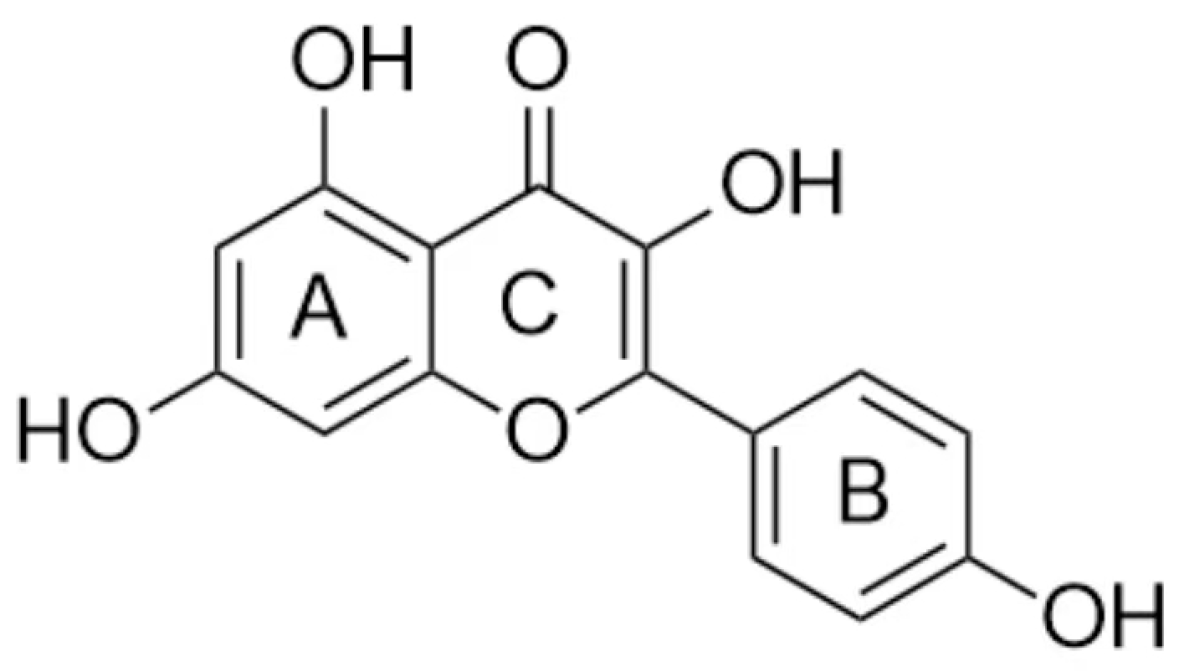
Advances in Kaempferol: Extraction, Biosynthesis, and Application with Antibacterial Agents

Abstract
1. Introduction
2. Sources of Kaempferol
2.1. Extraction from Plants, Fruits, and Other Species
2.1.1. Conventional Organic Solvent Extraction
2.1.2. Supercritical Fluid Extraction (SFE)
2.1.3. Molecular Imprinting Technique (MIT)
2.1.4. Ultrasound-Assisted Extraction (UE)
2.1.5. Microwave-Assisted Extraction (MAE)
2.2. Biosynthesis
2.2.1. Biosynthesis of Kaempferol in Plants
2.2.2. Microbial Synthesis
Microbial Synthesis in E. coli
Microbial Synthesis in S. cerevisiae
Microbial Synthesis in Streptomyces albus (S. albus) and Streptomyces coelicolor (S. coelicolor)
3. Antibacterial Activity of Kaempferol
3.1. Anti Gram-Negative Bacteria
3.1.1. Antibacterial Activity Against Microcystis Aeruginosa (M. Aeruginosa)
3.1.2. Antibacterial Activity Against Pseudomonas aeruginosa (P. aeruginosa)
3.1.3. Antibacterial Activity Against Salmonella typhimurium (S. typhimurium)
3.1.4. Antibacterial Activity Against Xanthomonas spp.
3.1.5. Antibacterial Activity Against Porphyromonas gingivalis (P. gingivalis)
3.1.6. Antibacterial Activity Against Vibrio cholerae
3.1.7. Antibacterial Activity Against Helicobacter pylori (H. pylori)
3.1.8. Antibacterial Activity Against E. coli
3.1.9. Antibacterial Activity Against Acinetobacter baumannii
3.1.10. Antibacterial Activity Against Klebsiella pneumoniae (K. pneumoniae)
3.1.11. Antibacterial Activity Against Proteus mirabilis
3.2. Anti Gram-Positive Bacteria
3.2.1. Antibacterial Activity Against Streptococcus pneumoniae (S. pneumoniae)
3.2.2. Antibacterial Activity Against Streptococcus mutans (S. mutans)
3.2.3. Antibacterial Activity Against Listeria monocytogenes (L. monocytogenes)
3.2.4. Antibacterial Activity Against Staphylococcus aureus and Staphylococcus epidermidis
3.2.5. Antibacterial Activity Against Mycobacterium tuberculosis (M. tuberculosis)
3.2.6. Antibacterial Activity Against Enterococcus
3.2.7. Antibacterial Activity Against Bacillus cereus (B. cereus)
3.2.8. Antibacterial Activity Against Bacillus subtilis (B. subtilis)
3.2.9. Antibacterial Activity Against Micrococcus luteus (M. luteus)
3.2.10. Antibacterial Activity Against Propionibacterium acnes (P. acnes)
3.3. Antifungal Activity
3.3.1. Against Candida parapsilosis (C. parapsilosis)
3.3.2. Against Candida albicans (C. albicans)
4. Synergistic Antibacterial Activity
4.1. Combination with Fluoroquinolones Against S. aureus
4.2. Combination with Colistin Against Gram-Negative Bacteria
4.3. Combination with Penicillin Against S. aureus
4.4. Combination with Azithromycin Against S. aureus
4.5. Combination with Fluconazole Against Candida albicans (C. albicans)
4.6. Combination with Aminoglycosides
4.7. Combination with Ceftiofur
4.8. Combination with Clindamycin
5. Antibacterial Effect of Kaempferol Nanoagent
5.1. Lecithin/Chitosan Nanoparticles with Kaempferol Against Fusarium oxysporium
5.2. Silver Nanoparticles–Kaempferol (AgNP-K) Against S. aureus
5.3. Chitosan/Sodium Tripolyphosphate Nanoparticles–Kaempferol Against S. aureus
5.4. Fucoidan-Modified Kaempferol-Loaded Glycyrrhizic Acid Lipid Nanovesicles (Fu-GaLip@KP) Against H. pylori
5.5. Flavonol-Loaded Cationic Gold Nanoparticles Against S. aureus and E. coli
5.6. Polyhydroxybutyrate–Chitosan–Kaempferol Nanocrystals (PHB-Cs-KAE-NCs) Against S. aureus and A. baumanni
6. Structure–Activity Relationship of Kaempferol
7. Conclusions and Prospective
Author Contributions
Funding
Institutional Review Board Statement
Informed Consent Statement
Data Availability Statement
Conflicts of Interest
References
- Painuli, S.; Semwal, P.; Sharma, R.; Akash, S. Superbugs or Multidrug Resistant Microbes: A New Threat to the Society. Health Sci. Rep. 2023, 6, e1480. [Google Scholar] [CrossRef] [PubMed]
- Murray, C.J.L.; Ikuta, K.S.; Sharara, F.; Swetschinski, L.; Aguilar, G.R.; Gray, A.; Han, C.; Bisignano, C.; Rao, P.; Wool, E.; et al. Global Burden of Bacterial Antimicrobial Resistance in 2019: A Systematic Analysis. Lancet 2022, 399, 629–655. [Google Scholar] [CrossRef]
- Zhao, W.; Cross, A.R.; Crowe-McAuliffe, C.; Weigert-Munoz, A.; Csatary, E.E.; Solinski, A.E.; Krysiak, J.; Goldberg, J.B.; Wilson, D.N.; Medina, E.; et al. The Natural Product Elegaphenone Potentiates Antibiotic Effects against Pseudomonas Aeruginosa. Angew. Chem. Int. Ed. Engl. 2019, 58, 8581–8584. [Google Scholar] [CrossRef]
- Rossiter, S.E.; Fletcher, M.H.; Wuest, W.M. Natural Products as Platforms To Overcome Antibiotic Resistance. Chem. Rev. 2017, 117, 12415–12474. [Google Scholar] [CrossRef]
- Lewis, K.; Lee, R.E.; Brötz-Oesterhelt, H.; Hiller, S.; Rodnina, M.V.; Schneider, T.; Weingarth, M.; Wohlgemuth, I. Sophisticated Natural Products as Antibiotics. Nature 2024, 632, 39–49. [Google Scholar] [CrossRef]
- Patridge, E.; Gareiss, P.; Kinch, M.S.; Hoyer, D. An Analysis of FDA-Approved Drugs: Natural Products and Their Derivatives. Drug Discov. Today 2016, 21, 204–207. [Google Scholar] [CrossRef]
- Tohge, T.; de Souza, L.P.; Fernie, A.R. Current Understanding of the Pathways of Flavonoid Biosynthesis in Model and Crop Plants. J. Exp. Bot. 2017, 68, 4013–4028. [Google Scholar] [CrossRef]
- Mishra, S.; Gandhi, D.; Tiwari, R.R.; Rajasekaran, S. Beneficial Role of Kaempferol and Its Derivatives from Different Plant Sources on Respiratory Diseases in Experimental Models. Inflammopharmacology 2023, 31, 2311–2336. [Google Scholar] [CrossRef]
- Alseekh, S.; Perez de Souza, L.; Benina, M.; Fernie, A.R. The Style and Substance of Plant Flavonoid Decoration; towards Defining Both Structure and Function. Phytochemistry 2020, 174, 112347. [Google Scholar] [CrossRef] [PubMed]
- Yang, L.; Gao, Y.; Bajpai, V.K.; El-Kammar, H.A.; Simal-Gandara, J.; Cao, H.; Cheng, K.-W.; Wang, M.; Arroo, R.R.J.; Zou, L.; et al. Advance toward Isolation, Extraction, Metabolism and Health Benefits of Kaempferol, a Major Dietary Flavonoid with Future Perspectives. Crit. Rev. Food Sci. Nutr. 2023, 63, 2773–2789. [Google Scholar] [CrossRef] [PubMed]
- Tang, R.; Lin, L.; Liu, Y.; Li, H. Bibliometric and Visual Analysis of Global Publications on Kaempferol. Front. Nutr. 2024, 11, 1442574. [Google Scholar] [CrossRef] [PubMed]
- Tucak, M.; Horvat, D.; Cupic, T.; Krizmanic, G.; Tomas, V.; Ravlic, M.; Popovic, S. Forage Legumes as Sources of Bioactive Phytoestrogens for Use in Pharmaceutics: A Review. Curr. Pharm. Biotechnol. 2018, 19, 537–544. [Google Scholar] [CrossRef]
- Bittar, V.P.; Silva Borges, A.L.; Justino, A.B.; Carrillo, M.S.P.; Mateus Duarte, R.F.; Silva, N.B.S.; Gonçalves, D.S.; Prado, D.G.; Araújo, I.A.C.; Martins, M.M.; et al. Bioactive Compounds from the Leaves of Maytenus Ilicifolia Mart. Ex Reissek: Inhibition of LDL Oxidation, Glycation, Lipid Peroxidation, Target Enzymes, and Microbial Growth. J. Ethnopharmacol. 2024, 319, 117315. [Google Scholar] [CrossRef]
- Topcagic, A.; Cavar Zeljkovic, S.; Karalija, E.; Galijasevic, S.; Sofic, E. Evaluation of Phenolic Profile, Enzyme Inhibitory and Antimicrobial Activities of Nigella sativa L. Seed Extracts. Bosn. J. Basic. Med. Sci. 2017, 17, 286–294. [Google Scholar] [CrossRef]
- Toma, C.-C.; Olah, N.-K.; Vlase, L.; Mogoșan, C.; Mocan, A. Comparative Studies on Polyphenolic Composition, Antioxidant and Diuretic Effects of Nigella sativa L. (Black Cumin) and Nigella damascena L. (Lady-in-a-Mist) Seeds. Molecules 2015, 20, 9560–9574. [Google Scholar] [CrossRef]
- Siniawska, M.; Bąbelewski, P.; Turkiewicz, I.P.; Wojdyło, A. Profiling of Polyphenolic Compounds Using LC-ESI-QTOF-MS/MS in Fruits of the Sorbus Subgenus as a Valuable Source of Polyphenolic Compounds. Food Chem. 2026, 498, 147178. [Google Scholar] [CrossRef] [PubMed]
- Peng, J.; Li, X.; Yuan, M.; Tang, Y.; Qiao, T.; Li, J.; Yu, H.; Zhang, M.; Li, X.; Lan, Y. Optimization of Extraction Methods, Component Identification of Bound Polyphenols from Sea-Buckthorn Pomace, and Its Ameliorative Effects on Oxidative Stress in Sleep-Deprived Mice. Food Chem. 2026, 498, 147018. [Google Scholar] [CrossRef] [PubMed]
- Loukili, E.H.; Elrherabi, A.; Hbika, A.; Elbouzidi, A.; Taibi, M.; Merzouki, M.; Bouhrim, M.; Shahat, A.A.; Noman, O.M.; Azougay, A.; et al. Chemical Analysis, Antihyperglycemic Properties and Enzyme Inhibition of Opuntia dillenii (Ker Gawl.) Haw.: A Detailed Analysis of Pulp and Peel Extracts. J. Pharm. Anal. 2025, 15, 101320. [Google Scholar] [CrossRef] [PubMed]
- Liu, H.; Yang, Z.; Chen, Q.; Zhang, H.; Liu, Y.; Wu, D.; Shao, D.; Wang, S.; Hao, B. The Flavonoid Extract of Polygonum viviparum L. Alleviates Dextran Sulfate Sodium-Induced Ulcerative Colitis by Regulating Intestinal Flora Homeostasis and Uric Acid Levels Through Inhibition of PI3K/AKT/NF-κB/IL-17 Signaling Pathway. Antioxidants 2025, 14, 1206. [Google Scholar] [CrossRef]
- Francis, J.A.; Rumbeiha, W.; Nair, M.G. Constituents in Easter Lily Flowers with Medicinal Activity. Life Sci. 2004, 76, 671–683. [Google Scholar] [CrossRef]
- Lin, Y.-L.; Shen, C.-C.; Huang, Y.-J.; Chang, Y.-Y. Homoflavonoids from Ophioglossum petiolatum. J. Nat. Prod. 2005, 68, 381–384. [Google Scholar] [CrossRef]
- Li, M.-M.; Wang, K.; Pan, Z.-H.; Chen, X.-Q.; Peng, L.-Y.; Li, Y.; Cheng, X.; Zhao, Q.-S. Two New Sesquiterpene Glucosides from Dennstaedtia scabra (WALL.) MOORE. Chem. Pharm. Bull. 2009, 57, 1123–1125. [Google Scholar] [CrossRef] [PubMed]
- Haraguchi, H.; Ishikawa, H.; Sanchez, Y.; Ogura, T.; Kubo, Y.; Kubo, I. Antioxidative Constituents in Heterotheca Inuloides. Bioorganic Med. Chem. 1997, 5, 865–871. [Google Scholar] [CrossRef] [PubMed]
- Hidalgo Báez, D.; De Los Ríos, C.; Crescente, O.; Caserta, A. Antibacterial and Chemical Evaluation of Chromolaena Moritziana. J. Ethnopharmacol. 1998, 59, 203–206. [Google Scholar] [CrossRef] [PubMed]
- Zhang, Y.; Zhao, L.; Shi, Y.-P. Separation and Determination of Flavonoids in Ixeridium Gracile by Capillary Electrophoresis. J. Chromatogr. Sci. 2007, 45, 600–604. [Google Scholar] [CrossRef]
- Kim, D.-K. Antioxidative Components from the Aerial Parts of Lactuca scariola L. Arch. Pharm. Res. 2001, 24, 427–430. [Google Scholar] [CrossRef]
- Choi, S.Z.; Choi, S.U.; Lee, K.R. Pytochemical Constituents of the Aerial Parts Fromsolidago Virga-Aurea Var. Gigantea. Arch. Pharm. Res. 2004, 27, 164–168. [Google Scholar] [CrossRef]
- Süzgeç, S.; Meriçli, A.H.; Houghton, P.J.; Çubukçu, B. Flavonoids of Helichrysum Compactum and Their Antioxidant and Antibacterial Activity. Fitoterapia 2005, 76, 269–272. [Google Scholar] [CrossRef]
- Kwak, J.H.; Kang, M.W.; Roh, J.H.; Choi, S.U.; Zee, O.P. Cytotoxic Phenolic Compounds from Chionanthus Retusus. Arch. Pharm. Res. 2009, 32, 1681–1687. [Google Scholar] [CrossRef]
- Youssef, F.S.; Altyar, A.E.; Omar, A.M.; Ashour, M.L. Phytoconstituents, In Vitro Anti-Infective Activity of Buddleja Indica Lam., and In Silico Evaluation of Its SARS-CoV-2 Inhibitory Potential. Front. Pharmacol. 2021, 12, 619373. [Google Scholar] [CrossRef]
- Chatzopoulou, A.; Karioti, A.; Gousiadou, C.; Lax Vivancos, V.; Kyriazopoulos, P.; Golegou, S.; Skaltsa, H. Depsides and Other Polar Constituents from Origanum dictamnus L. and Their in Vitro Antimicrobial Activity in Clinical Strains. J. Agric. Food Chem. 2010, 58, 6064–6068. [Google Scholar] [CrossRef] [PubMed]
- Bai, N.; He, K.; Roller, M.; Lai, C.-S.; Shao, X.; Pan, M.-H.; Ho, C.-T. Flavonoids and Phenolic Compounds from Rosmarinus Officinalis. J. Agric. Food Chem. 2010, 58, 5363–5367. [Google Scholar] [CrossRef] [PubMed]
- Pistelli, L.; Noccioli, C.; Giachi, I.; Dimitrova, B.; Gevrenova, R.; Morelli, I.; Potenza, D. Lupane-Triterpenes from Bupleurum flavum. Nat. Prod. Res. 2005, 19, 783–788. [Google Scholar] [CrossRef]
- Chien, M.M.; Svoboda, G.H.; Schiff, P.L.; Slatkin, D.J.; Knapp, J.E. Chemical Constituents of Echites hirsuta (Apocynaceae). J. Pharm. Sci. 1979, 68, 247–249. [Google Scholar] [CrossRef]
- Umehara, K.; Nemoto, K.; Ohkubo, T.; Miyase, T.; Degawa, M.; Noguchi, H. Isolation of a New 15-Membered Macrocyclic Glycolipid Lactone, Cuscutic Resinoside A from the Seeds of Cuscuta chinensis: A Stimulator of Breast Cancer Cell Proliferation. Planta Med. 2004, 70, 299–304. [Google Scholar] [CrossRef]
- Ye, M.; Yan, Y.; Guo, D. Characterization of Phenolic Compounds in the Chinese Herbal Drug Tu-Si-Zi by Liquid Chromatography Coupled to Electrospray Ionization Mass Spectrometry. Rapid Comm. Mass. Spectrom. 2005, 19, 1469–1484. [Google Scholar] [CrossRef]
- Deng, S.; Palu, A.K.; West, B.J.; Su, C.X.; Zhou, B.-N.; Jensen, J.C. Lipoxygenase Inhibitory Constituents of the Fruits of Noni (Morinda citrifolia ) Collected in Tahiti. J. Nat. Prod. 2007, 70, 859–862. [Google Scholar] [CrossRef] [PubMed]
- Cimanga, R.K.; Kambu, K.; Tona, L.; Hermans, N.; Apers, S.; Totté, J.; Pieters, L.; Vlietinck, A.J. Cytotoxicity and in Vitro Susceptibility of Entamoeba Histolytica to Morinda Morindoides Leaf Extracts and Its Isolated Constituents. J. Ethnopharmacol. 2006, 107, 83–90. [Google Scholar] [CrossRef]
- Majinda, R.R.T.; Motswaledi, M.; Waigh, R.D.; Waterman, P.G. Phenolic and Antibacterial Constftuents of Vahila capensis. Planta Medica 1997, 63, 268–270. [Google Scholar] [CrossRef]
- Huang, H.-C.; Syu, K.-Y.; Lin, J.-K. Chemical Composition of Solanum nigrum Linn Extract and Induction of Autophagy by Leaf Water Extract and Its Major Flavonoids in AU565 Breast Cancer Cells. J. Agric. Food Chem. 2010, 58, 8699–8708. [Google Scholar] [CrossRef]
- Martini, N.D.; Katerere, D.R.P.; Eloff, J.N. Biological Activity of Five Antibacterial Flavonoids from Combretum erythrophyllum (Combretaceae). J. Ethnopharmacol. 2004, 93, 207–212. [Google Scholar] [CrossRef]
- Calzada, F. Additional Antiprotozoal Constituents from Cuphea pinetorum, a Plant Used in Mayan Traditional Medicine to Treat Diarrhoea. Phytother. Res. 2005, 19, 725–727. [Google Scholar] [CrossRef]
- Amakura, Y.; Yoshimura, M.; Sugimoto, N.; Yamazaki, T.; Yoshida, T. Marker Constituents of the Natural Antioxidant Eucalyptus Leaf Extract for the Evaluation of Food Additives. Biosci. Biotechnol. Biochem. 2009, 73, 1060–1065. [Google Scholar] [CrossRef]
- Chen, K.-C.; Chuang, C.-M.; Lin, L.-Y.; Chiu, W.-T.; Wang, H.-E.; Hsieh, C.-L.; Tsai, T.; Peng, R.Y. The Polyphenolics in the Aqueous Extract of Psidium guajava Kinetically Reveal an Inhibition Model on LDL Glycation. Pharm. Biol. 2010, 48, 23–31. [Google Scholar] [CrossRef][Green Version]
- Cai, L.; Wu, C.D. Compounds from Syzygium aromaticum Possessing Growth Inhibitory Activity Against Oral Pathogens. J. Nat. Prod. 1996, 59, 987–990. [Google Scholar] [CrossRef]
- Van Elswijk, D.A.; Schobel, U.P.; Lansky, E.P.; Irth, H.; Van Der Greef, J. Rapid Dereplication of Estrogenic Compounds in Pomegranate (Punica granatum) Using on-Line Biochemical Detection Coupled to Mass Spectrometry. Phytochemistry 2004, 65, 233–241. [Google Scholar] [CrossRef]
- Tomaino, A.; Martorana, M.; Arcoraci, T.; Monteleone, D.; Giovinazzo, C.; Saija, A. Antioxidant Activity and Phenolic Profile of Pistachio (Pistacia vera L., Variety Bronte) Seeds and Skins. Biochimie 2010, 92, 1115–1122. [Google Scholar] [CrossRef]
- Abou-Shoer, M.; Ma, G.-E.; Li, X.-H.; Koonchanok, N.M.; Geahlen, R.L.; Chang, C.-J. Flavonoids from Koelreuteria henryi and Other Sources as Protein-Tyrosine Kinase Inhibitors. J. Nat. Prod. 1993, 56, 967–969. [Google Scholar] [CrossRef] [PubMed]
- Lin, W.-H.; Deng, Z.-W.; Lei, H.-M.; Fu, H.-Z.; Li, J. Polyphenolic Compounds from the Leaves of Koelreuteria paniculata Laxm. J. Asian Nat. Prod. Res. 2002, 4, 287–295. [Google Scholar] [CrossRef] [PubMed]
- Arriaga, A.M.C.; Mesquita, A.C.D.; Pouliquen, Y.B.M.; Lima, R.A.D.; Cavalcante, S.H.; Carvalho, M.G.D.; Siqueira, J.A.D.; Alegrio, L.V.; Braz-Filho, R. Chemical Constituents of Simarouba Versicolor. An. Acad. Bras. Ciênc. 2002, 74, 415–424. [Google Scholar] [CrossRef] [PubMed]
- Salvador, M.J.; Ferreira, E.O.; Mertens-Talcott, S.U.; De Castro, W.V.; Butterweck, V.; Derendorf, H.; Dias, D.A. Isolation and HPLC Quantitative Analysis of Antioxidant Flavonoids from Alternanthera Tenella Colla. Z. Für Naturforschung C 2006, 61, 19–25. [Google Scholar] [CrossRef]
- Djouossi, M.G.; Tamokou, J.-D.; Ngnokam, D.; Kuiate, J.-R.; Tapondjou, L.A.; Harakat, D.; Voutquenne-Nazabadioko, L. Antimicrobial and Antioxidant Flavonoids from the Leaves of Oncoba spinosa Forssk. (Salicaceae). BMC Complement. Altern. Med. 2015, 15, 134. [Google Scholar] [CrossRef]
- Kataoka, M.; Hirata, K.; Kunikata, T.; Ushio, S.; Iwaki, K.; Ohashi, K.; Ikeda, M.; Kurimoto, M. Antibacterial Action of Tryptanthrin and Kaempferol, Isolated from the Indigo Plant (Polygonum tinctorium Lour.), against Helicobacter Pylori -Infected Mongolian Gerbils. J. Gastroenterol. 2001, 36, 5–9. [Google Scholar] [CrossRef] [PubMed]
- Parveen, Z.; Deng, Y.; Saeed, M.K.; Dai, R.; Ahamad, W.; Yu, Y.H. Antiinflammatory and Analgesic Activities of Thesium chinense Turcz Extracts and Its Major Flavonoids, Kaempferol and Kaempferol-3-O-glucoside. Yakugaku Zasshi 2007, 127, 1275–1279. [Google Scholar] [CrossRef] [PubMed]
- Loizzo, M.R.; Said, A.; Tundis, R.; Hawas, U.W.; Rashed, K.; Menichini, F.; Frega, N.G.; Menichini, F. Antioxidant and Antiproliferative Activity of Diospyros lotus L. Extract and Isolated Compounds. Plant Foods Hum. Nutr. 2009, 64, 264–270. [Google Scholar] [CrossRef]
- Corradi, E.; De Mieri, M.; Cadisch, L.; Abbet, C.; Hamburger, M.; Potterat, O. New Acylated Flavonol Glycosides and a Phenolic Profile of Pritzelago alpina, a Forgotten Edible Alpine Plant. Chem. Biodivers. 2016, 13, 188–197. [Google Scholar] [CrossRef]
- Manguro, L.O.A.; Ugi, I.; Lemmen, P.; Hermann, R. Flavonol Glycosides of Warburgia ugandensis Leaves. Phytochemistry 2003, 64, 891–896. [Google Scholar] [CrossRef]
- Arot Manguro, L.O.; Ugi, I.; Hermann, R.; Lemmen, P. Flavonol and Drimane-Type Sesquiterpene Glycosides of Warburgia stuhlmannii Leaves. Phytochemistry 2003, 63, 497–502. [Google Scholar] [CrossRef]
- Sumino, M.; Sekine, T.; Ruangrungsi, N.; Igarashi, K.; Ikegami, F. Ardisiphenols and Other Antioxidant Principles from the Fruits of Ardisia colorata. Chem. Pharm. Bull. 2002, 50, 1484–1487. [Google Scholar] [CrossRef]
- Rocha, L.; Marston, A.; Potterat, O.; Kaplan, M.A.C.; Stoeckli-Evans, H.; Hostettmann, K. Antibacterial Phloroglucinols and Flavonoids from Hypericum brasiliense. Phytochemistry 1995, 40, 1447–1452. [Google Scholar] [CrossRef] [PubMed]
- Nguemeving, J.R.; Azebaze, A.G.B.; Kuete, V.; Eric Carly, N.N.; Beng, V.P.; Meyer, M.; Blond, A.; Bodo, B.; Nkengfack, A.E. Laurentixanthones A and B, Antimicrobial Xanthones from Vismia laurentii. Phytochemistry 2006, 67, 1341–1346. [Google Scholar] [CrossRef]
- Kuete, V.; Nguemeving, J.R.; Beng, V.P.; Azebaze, A.G.B.; Etoa, F.-X.; Meyer, M.; Bodo, B.; Nkengfack, A.E. Antimicrobial Activity of the Methanolic Extracts and Compounds from Vismia laurentii De Wild (Guttiferae). J. Ethnopharmacol. 2007, 109, 372–379. [Google Scholar] [CrossRef]
- Fuentes-Alventosa, J.M.; Rodríguez, G.; Cermeño, P.; Jiménez, A.; Guillén, R.; Fernández-Bolaños, J.; Rodríguez-Arcos, R. Identification of Flavonoid Diglycosides in Several Genotypes of Asparagus from the Huétor-Tájar Population Variety. J. Agric. Food Chem. 2007, 55, 10028–10035. [Google Scholar] [CrossRef]
- Pellegrini, N.; Chiavaro, E.; Gardana, C.; Mazzeo, T.; Contino, D.; Gallo, M.; Riso, P.; Fogliano, V.; Porrini, M. Effect of Different Cooking Methods on Color, Phytochemical Concentration, and Antioxidant Capacity of Raw and Frozen Brassica Vegetables. J. Agric. Food Chem. 2010, 58, 4310–4321. [Google Scholar] [CrossRef] [PubMed]
- Hertog, M.G.; Hollman, P.C.; Katan, M.B. Content of Potentially Anticarcinogenic Flavonoids of 28 Vegetables and 9 Fruits Commonly Consumed in the Netherlands. J. Agric. Food Chem. 1992, 40, 2379–2383. [Google Scholar] [CrossRef]
- Justesen, U.; Knuthsen, P.; Leth, T. Quantitative Analysis of Flavonols, Flavones, and Flavanones in Fruits, Vegetables and Beverages by High-Performance Liquid Chromatography with Photo-Diode Array and Mass Spectrometric Detection. J. Chromatogr. A 1998, 799, 101–110. [Google Scholar] [CrossRef]
- Franke, A.A.; Custer, L.J.; Arakaki, C.; Murphy, S.P. Vitamin C and Flavonoid Levels of Fruits and Vegetables Consumed in Hawaii. J. Food Compos. Anal. 2004, 17, 1–35. [Google Scholar] [CrossRef]
- Kevers, C.; Falkowski, M.; Tabart, J.; Defraigne, J.-O.; Dommes, J.; Pincemail, J. Evolution of Antioxidant Capacity during Storage of Selected Fruits and Vegetables. J. Agric. Food Chem. 2007, 55, 8596–8603. [Google Scholar] [CrossRef] [PubMed]
- Lugast, A.; Hóvári, J. Flavonoid Aglycons in Foods of Plant Origin I. Vegetables. Acta Aliment. 2000, 29, 345–352. [Google Scholar] [CrossRef]
- Mattila, P.; Astola, J.; Kumpulainen, J. Determination of Flavonoids in Plant Material by HPLC with Diode-Array and Electro-Array Detections. J. Agric. Food Chem. 2000, 48, 5834–5841. [Google Scholar] [CrossRef] [PubMed]
- Chu, Y.; Chang, C.; Hsu, H. Flavonoid Content of Several Vegetables and Their Antioxidant Activity. J. Sci. Food Agric. 2000, 80, 561–566. [Google Scholar] [CrossRef]
- Lako, J.; Trenerry, V.; Wahlqvist, M.; Wattanapenpaiboon, N.; Sotheeswaran, S.; Premier, R. Phytochemical Flavonols, Carotenoids and the Antioxidant Properties of a Wide Selection of Fijian Fruit, Vegetables and Other Readily Available Foods. Food Chem. 2007, 101, 1727–1741. [Google Scholar] [CrossRef]
- Young, J.E.; Zhao, X.; Carey, E.E.; Welti, R.; Yang, S.-S.; Wang, W. Phytochemical Phenolics in Organically Grown Vegetables. Mol. Nutr. Food Res. 2005, 49, 1136–1142. [Google Scholar] [CrossRef] [PubMed]
- Arai, Y.; Watanabe, S.; Kimira, M.; Shimoi, K.; Mochizuki, R.; Kinae, N. Dietary Intakes of Flavonols, Flavones and Isoflavones by Japanese Women and the Inverse Correlation between Quercetin Intake and Plasma LDL Cholesterol Concentration. J. Nutr. 2000, 130, 2243–2250. [Google Scholar] [CrossRef]
- Bilyk, A.; Sapers, G.M. Distribution of Quercetin and Kaempferol in Lettuce, Kale, Chive, Garlic Chive, Leek, Horseradish, Red Radish, and Red Cabbage Tissues. J. Agric. Food Chem. 1985, 33, 226–228. [Google Scholar] [CrossRef]
- Huang, Z.; Wang, B.; Eaves, D.H.; Shikany, J.M.; Pace, R.D. Phenolic Compound Profile of Selected Vegetables Frequently Consumed by African Americans in the Southeast United States. Food Chem. 2007, 103, 1395–1402. [Google Scholar] [CrossRef]
- Huber, L.S.; Hoffmann-Ribani, R.; Rodriguez-Amaya, D.B. Quantitative Variation in Brazilian Vegetable Sources of Flavonols and Flavones. Food Chem. 2009, 113, 1278–1282. [Google Scholar] [CrossRef]
- Olsen, H.; Aaby, K.; Borge, G.I.A. Characterization and Quantification of Flavonoids and Hydroxycinnamic Acids in Curly Kale (Brassica oleracea L. Convar. acephala Var. sabellica) by HPLC-DAD-ESI-MSn. J. Agric. Food Chem. 2009, 57, 2816–2825. [Google Scholar] [CrossRef]
- Hertog, M.G.L.; Hollman, P.C.H.; Venema, D.P. Optimization of a Quantitative HPLC Determination of Potentially Anticarcinogenic Flavonoids in Vegetables and Fruits. J. Agric. Food Chem. 1992, 40, 1591–1598. [Google Scholar] [CrossRef]
- Arabbi, P.R.; Genovese, M.I.; Lajolo, F.M. Flavonoids in Vegetable Foods Commonly Consumed in Brazil and Estimated Ingestion by the Brazilian Population. J. Agric. Food Chem. 2004, 52, 1124–1131. [Google Scholar] [CrossRef]
- Bilyk, A.; Cooper, P.L.; Sapers, G.M. Varietal Differences in Distribution of Quercetin and Kaempferol in Onion (Allium cepa L.) Tissue. J. Agric. Food Chem. 1984, 32, 274–276. [Google Scholar] [CrossRef]
- Ewald, C.; Fjelkner-Modig, S.; Johansson, K.; Sjöholm, I.; Åkesson, B. Effect of Processing on Major Flavonoids in Processed Onions, Green Beans, and Peas. Food Chem. 1999, 64, 231–235. [Google Scholar] [CrossRef]
- Sellappan, S.; Akoh, C.C. Flavonoids and Antioxidant Capacity of Georgia-Grown Vidalia Onions. J. Agric. Food Chem. 2002, 50, 5338–5342. [Google Scholar] [CrossRef]
- Sampson, L.; Rimm, E.R.I.C.; Hollman, P.C.; de Vries, J.H.; Katan, M.B. Flavonol and Flavone Intakes in US Health Professionals. J. Am. Diet. Assoc. 2002, 102, 1414–1420. [Google Scholar] [CrossRef]
- Martínez-Sánchez, A.; Gil-Izquierdo, A.; Gil, M.I.; Ferreres, F. A Comparative Study of Flavonoid Compounds, Vitamin C, and Antioxidant Properties of Baby Leaf Brassicaceae Species. J. Agric. Food Chem. 2008, 56, 2330–2340. [Google Scholar] [CrossRef]
- Nuutila, A.M.; Kammiovirta, K.; Oksman-Caldentey, K.-M. Comparison of Methods for the Hydrolysis of Flavonoids and Phenolic Acids from Onion and Spinach for HPLC Analysis. Food Chem. 2002, 76, 519–525. [Google Scholar] [CrossRef]
- Kuti, J.O.; Konuru, H.B. Antioxidant Capacity and Phenolic Content in Leaf Extracts of Tree Spinach (Cnidoscolus spp.). J. Agric. Food Chem. 2004, 52, 117–121. [Google Scholar] [CrossRef]
- Justesen, U.; Knuthsen, P. Composition of Flavonoids in Fresh Herbs and Calculation of Flavonoid Intake by Use of Herbs in Traditional Danish Dishes. Food Chem. 2001, 73, 245–250. [Google Scholar] [CrossRef]
- Trichopoulou, A.; Vasilopoulou, E.; Hollman, P.; Chamalides, C.; Foufa, E.; Kaloudis, T.; Kromhout, D.; Miskaki, P.; Petrochilou, I.; Poulima, E.; et al. Nutritional Composition and Flavonoid Content of Edible Wild Greens and Green Pies: A Potential Rich Source of Antioxidant Nutrients in the Mediterranean Diet. Food Chem. 2000, 70, 319–323. [Google Scholar] [CrossRef]
- Maas, M.; Hensel, A.; Costa, F.B.D.; Brun, R.; Kaiser, M.; Schmidt, T.J. An Unusual Dimeric Guaianolide with Antiprotozoal Activity and Further Sesquiterpene Lactones from Eupatorium perfoliatum. Phytochemistry 2011, 72, 635–644. [Google Scholar] [CrossRef] [PubMed]
- Prasasty, V.D.; Cindana, S.; Ivan, F.X.; Zahroh, H.; Sinaga, E. Structure-Based Discovery of Novel Inhibitors of Mycobacterium tuberculosis CYP121 from Indonesian Natural Products. Comput. Biol. Chem. 2020, 85, 107205. [Google Scholar] [CrossRef]
- Schmitzer, V.; Veberic, R.; Slatnar, A.; Stampar, F. Elderberry (Sambucus nigra L.) Wine: A Product Rich in Health Promoting Compounds. J. Agric. Food Chem. 2010, 58, 10143–10146. [Google Scholar] [CrossRef]
- Sharififar, F.; Yassa, N.; Mozaffarian, V. Bioactivity of Major Components from the Seeds of Bunium persicum (Boiss.) Fedtch. Pak. J. Pharm. Sci. 2010, 23, 300–304. [Google Scholar]
- Ollanketo, M.; Riekkola, M.-L. Column-Switching Technique for Selective Determination of Flavonoids in Finnish Berry Wines by High-Performance Liquid Chromatography with Diode Array Detection. J. Liq. Chromatogr. Relat. Technol. 2000, 23, 1339–1351. [Google Scholar] [CrossRef]
- Crublet, M.-L.; Long, C.; Sévenet, T.; Hadi, H.A.; Lavaud, C. Acylated Flavonol Glycosides from Leaves of Planchonia grandis. Phytochemistry 2003, 64, 589–594. [Google Scholar] [CrossRef]
- Aung, H.H.; Chia, L.S.; Goh, N.K.; Chia, T.F.; Ahmed, A.A.; Pare, P.W.; Mabry, T.J. Phenolic Constituents from the Leaves of the Carnivorous Plant Nepenthes gracilis. Fitoterapia 2002, 73, 445–447. [Google Scholar] [CrossRef] [PubMed]
- Jung, C.H.; Kim, J.H.; Hong, M.H.; Seog, H.M.; Oh, S.H.; Lee, P.J.; Kim, G.J.; Kim, H.M.; Um, J.Y.; Ko, S.-G. Phenolic-Rich Fraction from Rhus verniciflua Stokes (RVS) Suppress Inflammatory Response via NF-κB and JNK Pathway in Lipopolysaccharide-Induced RAW 264.7 Macrophages. J. Ethnopharmacol. 2007, 110, 490–497. [Google Scholar] [CrossRef]
- Violaa, H.; Wolfman, C.; de Steina, M.L.; Wasowskib, C.; Pefiab, C.; Medinaa, J.H. Isolation of Pharmacologically Active Benzodiazepine Receptor Ligands from Tibia tomentosa (Tiliaceae). J. Ethnopharmacol. 1994, 44, 47–53. [Google Scholar] [CrossRef] [PubMed]
- Pattamadilok, D.; Suttisri, R. Seco-Terpenoids and Other Constituents from Elateriospermum tapos. J. Nat. Prod. 2008, 71, 292–294. [Google Scholar] [CrossRef] [PubMed]
- Öksüz, S.; Gürek, F.; Lin, L.; Gil, R.R.; Pezzuto, J.M.; Cordell, G.A. Aleppicatines A and B from Euphorbia aleppica. Phytochemistry 1996, 42, 473–478. [Google Scholar] [CrossRef]
- Sousa, M.; Ousingsawat, J.; Seitz, R.; Puntheeranurak, S.; Regalado, A.; Schmidt, A.; Grego, T.; Jansakul, C.; Amaral, M.D.; Schreiber, R.; et al. An Extract from the Medicinal Plant Phyllanthus acidus and Its Isolated Compounds Induce Airway Chloride Secretion: A Potential Treatment for Cystic Fibrosis. Mol. Pharmacol. 2007, 71, 366–376. [Google Scholar] [CrossRef]
- Yang, R.-Y.; Lin, S.; Kuo, G. Content and Distribution of Flavonoids among 91 Edible Plant Species. Asia Pac. J. Clin. Nutr. 2008, 17, 275. [Google Scholar] [PubMed]
- Penna, C.; Marino, S.; Vivot, E.; Cruañes, M.C.; Muñoz, J.d.D.; Cruañes, J.; Ferraro, G.; Gutkind, G.; Martino, V. Antimicrobial Activity of Argentine Plants Used in the Treatment of Infectious Diseases. Isolation of Active Compounds from Sebastiania Brasiliensis. J. Ethnopharmacol. 2001, 77, 37–40. [Google Scholar] [CrossRef] [PubMed]
- Zhang, X.; Hung, T.M.; Phuong, P.T.; Ngoc, T.M.; Min, B.-S.; Song, K.-S.; Seong, Y.H.; Bae, K. Anti-Inflammatory Activity of Flavonoids from Populus davidiana. Arch. Pharm. Res. 2006, 29, 1102–1108. [Google Scholar] [CrossRef] [PubMed]
- Jung, H.A.; Jung, M.J.; Kim, J.Y.; Chung, H.Y.; Choi, J.S. Inhibitory Activity of Flavonoids from Prunus davidiana and Other Flavonoids on Total ROS and Hydroxyl Radical Generation. Arch. Pharm. Res. 2003, 26, 809–815. [Google Scholar] [CrossRef]
- Nowak, R.; Gawlik-Dziki, U. Polyphenols of Rosa L. Leaves Extracts and Their Radical Scavenging Activity. Z. Für Naturforschung C 2007, 62, 32–38. [Google Scholar] [CrossRef]
- Suntornsuk, L.; Anurukvorakun, O. Precision Improvement for the Analysis of Flavonoids in Selected Thai Plants by Capillary Zone Electrophoresis. Electrophoresis 2005, 26, 648–660. [Google Scholar] [CrossRef]
- Giannasi, D.E.; Niklas, K.J. Flavonoid and Other Chemical Constituents of Fossil Miocene Celtis and Ulmus (Succor Creek Flora). Science 1977, 197, 765–767. [Google Scholar] [CrossRef]
- Fang, X.-K.; Gao, J.; Zhu, D.-N. Kaempferol and Quercetin Isolated from Euonymus alatus Improve Glucose Uptake of 3T3-L1 Cells without Adipogenesis Activity. Life Sci. 2008, 82, 615–622. [Google Scholar] [CrossRef]
- Yang, H.; Protiva, P.; Cui, B.; Ma, C.; Baggett, S.; Hequet, V.; Mori, S.; Weinstein, I.B.; Kennelly, E.J. New Bioactive Polyphenols from Theobroma grandiflorum (“Cupuaçu”). J. Nat. Prod. 2003, 66, 1501–1504. [Google Scholar] [CrossRef]
- Nsonde Ntandou, G.F.; Banzouzi, J.T.; Mbatchi, B.; Elion-Itou, R.D.G.; Etou-Ossibi, A.W.; Ramos, S.; Benoit-Vical, F.; Abena, A.A.; Ouamba, J.M. Analgesic and Anti-Inflammatory Effects of Cassia siamea Lam. Stem Bark Extracts. J. Ethnopharmacol. 2010, 127, 108–111. [Google Scholar] [CrossRef]
- Calvo, T.R.; Cardoso, C.R.P.; Da Silva Moura, A.C.; Dos Santos, L.C.; Colus, I.M.S.; Vilegas, W.; Varanda, E.A. Mutagenic Activity of Indigofera truxillensis and I. suffruticosa Aerial Parts. Evid. Based Complement. Altern. Med. 2011, 2011, 323276. [Google Scholar] [CrossRef]
- Krauze-Baranowska, M. Flavonoids from the Genus Taxus. Z. Für Naturforschung C 2004, 59, 43–47. [Google Scholar] [CrossRef]
- Calzada, F.; Correa-Basurto, J.; Barbosa, E.; Mendez-Luna, D.; Yepez-Mulia, L. Antiprotozoal Constituents from Annona cherimola Miller, a Plant Used in Mexican Traditional Medicine for the Treatment of Diarrhea and Dysentery. Pharmacogn. Mag. 2017, 13, 148–152. [Google Scholar]
- Rodríguez Galdón, B.; Rodríguez Rodríguez, E.M.; Díaz Romero, C. Flavonoids in Onion Cultivars (Allium cepa L.). J. Food Sci. 2008, 73, C599–C605. [Google Scholar] [CrossRef]
- Keyhanian, S.; Stahl-Biskup, E. Phenolic Constituents in Dried Flowers of Aloe vera (Aloe barbadensis) and Their in Vitro Antioxidative Capacity. Planta Med. 2007, 73, 599–602. [Google Scholar] [CrossRef]
- Xu, J.; Li, X.; Zhang, P.; Li, Z.-L.; Wang, Y. Antiinflammatory Constituents from the Roots of Smilax bockii Warb. Arch. Pharm. Res. 2005, 28, 395–399. [Google Scholar] [CrossRef] [PubMed]
- Jiang, R.-W.; Zhou, J.-R.; Hon, P.-M.; Li, S.-L.; Zhou, Y.; Li, L.-L.; Ye, W.-C.; Xu, H.-X.; Shaw, P.-C.; But, P.P.-H. Lignans from Dysosma versipellis with Inhibitory Effects on Prostate Cancer Cell Lines. J. Nat. Prod. 2007, 70, 283–286. [Google Scholar] [CrossRef] [PubMed]
- Marín, C.; Boutaleb-Charki, S.; Díaz, J.G.; Huertas, O.; Rosales, M.J.; Pérez-Cordon, G.; Guitierrez-Sánchez, R.; Sánchez-Moreno, M. Antileishmaniasis Activity of Flavonoids from Consolida oliveriana. J. Nat. Prod. 2009, 72, 1069–1074. [Google Scholar] [CrossRef]
- Je Ma, C.; Jung, W.J.; Lee, K.Y.; Kim, Y.C.; Sung, S.H. Calpain Inhibitory Flavonoids Isolated from Orostachys japonicus. J. Enzym. Inhib. Med. Chem. 2009, 24, 676–679. [Google Scholar] [CrossRef] [PubMed]
- Song, E.; Kim, J.; Kim, J.; Cho, H.; Nan, J.; Sohn, D.; Ko, G.; Oh, H.; Kim, Y. Hepatoprotective Phenolic Constituents of Rhodiola sachalinensis on Tacrine-induced Cytotoxicity in Hep G2 Cells. Phytother. Res. 2003, 17, 563–565. [Google Scholar] [CrossRef]
- Richwagen, N.; Lyles, J.T.; Dale, B.L.F.; Quave, C.L. Antibacterial Activity of Kalanchoe mortagei and K. fedtschenkoi Against ESKAPE Pathogens. Front. Pharmacol. 2019, 10, 67. [Google Scholar] [CrossRef]
- Saleem, M.; Kim, H.J.; Jin, C.; Lee, Y.S. Antioxidant Caffeic Acid Derivatives from Leaves Ofparthenocissus tricuspidata. Arch. Pharm. Res. 2004, 27, 300–304. [Google Scholar] [CrossRef] [PubMed]
- Kumar, D.; Gupta, J.; Gupta, A.; Kumar, S.; Arya, R. A Review on Chemical and Biological Properties of Cayratia trifolia Linn. (Vitaceae). Pharmacogn. Rev. 2011, 5, 184. [Google Scholar] [CrossRef]
- Yin, F.; Zhang, Y.; Yang, Z.; Cheng, Q.; Hu, L. Triterpene Saponins from Gynostemma cardiospermum. J. Nat. Prod. 2006, 69, 1394–1398. [Google Scholar] [CrossRef] [PubMed]
- Mazimba, O.; Majinda, R.R.T.; Modibedi, C.; Masesane, I.B.; Cencič, A.; Chingwaru, W. Tylosema esculentum Extractives and Their Bioactivity. Bioorganic Med. Chem. 2011, 19, 5225–5230. [Google Scholar] [CrossRef]
- Nguyen, T.-T.; Ketha, A.; Hieu, H.V.; Tatipamula, V.B. In Vitro Antimycobacterial Studies of Flavonols from Bauhinia vahlii Wight and Arn. 3 Biotech 2021, 11, 128. [Google Scholar] [CrossRef]
- Singh, R.; Singh, B.; Singh, S.; Kumar, N.; Kumar, S.; Arora, S. Anti-Free Radical Activities of Kaempferol Isolated from Acacia nilotica (L.) Willd. Ex. Del. Toxicology Vitr. 2008, 22, 1965–1970. [Google Scholar] [CrossRef]
- Costa-Lotufo, L.V.; Jimenez, P.C.; Wilke, D.V.; Leal, L.K.A.M.; Cunha, G.M.A.; Silveira, E.R.; Canuto, K.M.; Viana, G.S.B.; Moraes, M.E.A.; Moraes, M.O.D.; et al. Antiproliferative Effects of Several Compounds Isolated from Amburana cearensis A. C. Smith. Z. Für Naturforschung C 2003, 58, 675–680. [Google Scholar] [CrossRef] [PubMed]
- Terreaux, C.; Wang, Q.; Ioset, J.-R.; Ndjoko, K.; Grimminger, W.; Hostettmann, K. Complete LC/MS Analysis of a Tinnevelli Senna Pod Extract and Subsequent Isolation and Identification of Two New Benzophenone Glucosides. Planta Med. 2002, 68, 349–354. [Google Scholar] [CrossRef]
- Jiang, H.; Zhan, W.Q.; Liu, X.; Jiang, S.X. Antioxidant Activities of Extracts and Flavonoid Compounds from Oxytropis falcate Bunge. Nat. Prod. Res. 2008, 22, 1650–1656. [Google Scholar] [CrossRef] [PubMed]
- Xiang, W.; Li, R.-T.; Mao, Y.-L.; Zhang, H.-J.; Li, S.-H.; Song, Q.-S.; Sun, H.-D. Four New Prenylated Isoflavonoids in Tadehagi triquetrum. J. Agric. Food Chem. 2005, 53, 267–271. [Google Scholar] [CrossRef]
- Sharaf, M. Chemical Constituents from the Seeds of Trifolium alexandrinum. Nat. Prod. Res. 2008, 22, 1620–1623. [Google Scholar] [CrossRef] [PubMed]
- Papiez, M.; Gancarczyk, M.; Bilińska, B. The Compounds from the Hollyhock Extract (Althaea rosea Cav. Var. Nigra) Affect the Aromatization in Rat Testicular Cells in Vivo and in Vitro. Folia Histochem. Cytobiol. 2002, 40, 353–359. [Google Scholar]
- Panou, E.; Graikou, K.; Tsafantakis, N.; Sakellarakis, F.N.; Chinou, I. Flavonoids of the Aerial Parts of Helianthemum Glomeratu. Sci. Pharm. 2024, 92, 42. [Google Scholar] [CrossRef]
- Li, J.; Huang, H.; Zhou, W.; Feng, M.; Zhou, P. Anti-Hepatitis B Virus Activities of Geranium carolinianum L. Extracts and Identification of the Active Components. Biol. Pharm. Bull. 2008, 31, 743–747. [Google Scholar] [CrossRef]
- Şeker, M.E.; Ay, E.; Aktaş Karaçelik, A.; Hüseyinoğlu, R.; Efe, D. First Determination of Some Phenolic Compounds and Antimicrobial Activities of Geranium ibericum subsp. Jubatum: A Plant Endemic to Turkey. Turk. J. Chem. 2021, 45, 60–70. [Google Scholar] [CrossRef]
- Williams, C.A.; Harborne, J.B.; Newman, M.; Greenham, J.; Eagles, J. Chrysin and Other Leaf Exudate Flavonoids in the Genus Pelargonium. Phytochemistry 1997, 46, 1349–1353. [Google Scholar] [CrossRef]
- Rochfort, S.J.; Imsic, M.; Jones, R.; Trenerry, V.C.; Tomkins, B. Characterization of Flavonol Conjugates in Immature Leaves of Pak Choi [Brassica rapa L. Ssp. chinensis L. (Hanelt.)] by HPLC-DAD and LC-MS/MS. J. Agric. Food Chem. 2006, 54, 4855–4860. [Google Scholar] [CrossRef]
- Bennett, R.N.; Rosa, E.A.S.; Mellon, F.A.; Kroon, P.A. Ontogenic Profiling of Glucosinolates, Flavonoids, and Other Secondary Metabolites in Eruca sativa (Salad Rocket), Diplotaxis erucoides (Wall Rocket), Diplotaxis tenuifolia (Wild Rocket), and Bunias orientalis (Turkish Rocket). J. Agric. Food Chem. 2006, 54, 4005–4015. [Google Scholar] [CrossRef]
- Tomas-Barberan, F.A.; Garcia-Grau, M.M.; Tomas-Lorente, F. Flavonoid Concentration Changes in Maturing Broad Bean Pods. J. Agric. Food Chem. 1991, 39, 255–258. [Google Scholar] [CrossRef]
- Romani, A.; Vignolini, P.; Galardi, C.; Mulinacci, N.; Benedettelli, S.; Heimler, D. Germplasm Characterization of Zolfino Landraces (Phaseolus vulgaris L.) by Flavonoid Content. J. Agric. Food Chem. 2004, 52, 3838–3842. [Google Scholar] [CrossRef] [PubMed]
- Milbury, P.E.; Chen, C.-Y.; Dolnikowski, G.G.; Blumberg, J.B. Determination of Flavonoids and Phenolics and Their Distribution in Almonds. J. Agric. Food Chem. 2006, 54, 5027–5033. [Google Scholar] [CrossRef] [PubMed]
- Shan, B.; Cai, Y.Z.; Sun, M.; Corke, H. Antioxidant Capacity of 26 Spice Extracts and Characterization of Their Phenolic Constituents. J. Agric. Food Chem. 2005, 53, 7749–7759. [Google Scholar] [CrossRef] [PubMed]
- Inocencio, C.; Rivera, D.; Alcaraz, F.; Tomás-Barberán, F.A. Flavonoid Content of Commercial Capers (Capparis spinosa, C. sicula and C. orientalis) Produced in Mediterranean Countries. Eur. Food Res. Technol. 2000, 212, 70–74. [Google Scholar] [CrossRef]
- Zheng, W.; Wang, S.Y. Oxygen Radical Absorbing Capacity of Phenolics in Blueberries, Cranberries, Chokeberries, and Lingonberries. J. Agric. Food Chem. 2003, 51, 502–509. [Google Scholar] [CrossRef]
- Dabeek, W.M.; Marra, M.V. Dietary Quercetin and Kaempferol: Bioavailability and Potential Cardiovascular-Related Bioactivity in Humans. Nutrients 2019, 11, 2288. [Google Scholar] [CrossRef]
- Dragovic-Uzelac, V.; Delonga, K.; Levaj, B.; Djakovic, S.; Pospisil, J. Phenolic Profiles of Raw Apricots, Pumpkins, and Their Purees in the Evaluation of Apricot Nectar and Jam Authenticity. J. Agric. Food Chem. 2005, 53, 4836–4842. [Google Scholar] [CrossRef]
- Dragovic-Uzelac, V.; Pospišil, J.; Levaj, B.; Delonga, K. The Study of Phenolic Profiles of Raw Apricots and Apples and Their Purees by HPLC for the Evaluation of Apricot Nectars and Jams Authenticity. Food Chem. 2005, 91, 373–383. [Google Scholar] [CrossRef]
- Dragovicuzelac, V.; Levaj, B.; Mrkic, V.; Bursac, D.; Boras, M. The Content of Polyphenols and Carotenoids in Three Apricot Cultivars Depending on Stage of Maturity and Geographical Region. Food Chem. 2007, 102, 966–975. [Google Scholar] [CrossRef]
- Lugasi, A.; Takács, M. Flavonoid Aglycons in Foods of Plant Origin II. Fresh and Dried Fruits. Acta Aliment. 2002, 31, 63–71. [Google Scholar] [CrossRef]
- Bilyk, A.; Sapers, G.M. Varietal Differences in the Quercetin, Kaempferol, and Myricetin Contents of Highbush Blueberry, Cranberry, and Thornless Blackberry Fruits. J. Agric. Food Chem. 1986, 34, 585–588. [Google Scholar] [CrossRef]
- Jakobek, L.; Šeruga, M.; Novak, I.; Medvidović-Kosanović, M. Flavonols, Phenolic Acids and Antioxidant Activity of Some Red Fruits. Dtsch. Lebensm. Rundsch. 2007, 103, 369–377. [Google Scholar]
- Mertz, C.; Cheynier, V.; Günata, Z.; Brat, P. Analysis of Phenolic Compounds in Two Blackberry Species (Rubus glaucus and Rubus adenotrichus) by High-Performance Liquid Chromatography with Diode Array Detection and Electrospray Ion Trap Mass Spectrometry. J. Agric. Food Chem. 2007, 55, 8616–8624. [Google Scholar] [CrossRef] [PubMed]
- Sellappan, S.; Akoh, C.C.; Krewer, G. Phenolic Compounds and Antioxidant Capacity of Georgia-Grown Blueberries and Blackberries. J. Agric. Food Chem. 2002, 50, 2432–2438. [Google Scholar] [CrossRef] [PubMed]
- Hoffmann-Ribani, R.; Huber, L.S.; Rodriguez-Amaya, D.B. Flavonols in Fresh and Processed Brazilian Fruits. J. Food Compos. Anal. 2009, 22, 263–268. [Google Scholar] [CrossRef]
- Kirakosyan, A.; Seymour, E.M.; Llanes, D.E.U.; Kaufman, P.B.; Bolling, S.F. Chemical Profile and Antioxidant Capacities of Tart Cherry Products. Food Chem. 2009, 115, 20–25. [Google Scholar] [CrossRef]
- Häkkinen, S.H.; Kärenlampi, S.O.; Heinonen, I.M.; Mykkänen, H.M.; Törrönen, A.R. Content of the Flavonols Quercetin, Myricetin, and Kaempferol in 25 Edible Berries. J. Agric. Food Chem. 1999, 47, 2274–2279. [Google Scholar] [CrossRef]
- Chun, O.K.; Kim, D.-O.; Moon, H.Y.; Kang, H.G.; Lee, C.Y. Contribution of Individual Polyphenolics to Total Antioxidant Capacity of Plums. J. Agric. Food Chem. 2003, 51, 7240–7245. [Google Scholar] [CrossRef]
- Ayerza, R.; Coates, W. Some Quality Components of Four Chia (Salvia hispanica L.) Genotypes Grown under Tropical Coastal Desert Ecosystem Conditions. Asian J. Plant Sci. 2009, 8, 301. [Google Scholar] [CrossRef]
- Mikkonen, T.P.; Määttä, K.R.; Hukkanen, A.T.; Kokko, H.I.; Törrönen, A.R.; Kärenlampi, S.O.; Karjalainen, R.O. Flavonol Content Varies among Black Currant Cultivars. J. Agric. Food Chem. 2001, 49, 3274–3277. [Google Scholar] [CrossRef] [PubMed]
- Määttä, K.R.; Kamal-Eldin, A.; Törrönen, A.R. High-Performance Liquid Chromatography (HPLC) Analysis of Phenolic Compounds in Berries with Diode Array and Electrospray Ionization Mass Spectrometric (MS) Detection: Ribes Species. J. Agric. Food Chem. 2003, 51, 6736–6744. [Google Scholar] [CrossRef]
- Lee, J.; Finn, C.E. Anthocyanins and Other Polyphenolics in American Elderberry (Sambucus canadensis) and European Elderberry (S. nigra) Cultivars. J. Sci. Food Agric. 2007, 87, 2665–2675. [Google Scholar] [CrossRef]
- Le, K.; Chiu, F.; Ng, K. Identification and Quantification of Antioxidants in Fructus Lycii. Food Chem. 2007, 105, 353–363. [Google Scholar] [CrossRef]
- Karadeniz, F.; Durst, R.W.; Wrolstad, R.E. Polyphenolic Composition of Raisins. J. Agric. Food Chem. 2000, 48, 5343–5350. [Google Scholar] [CrossRef]
- Mullen, W.; Marks, S.C.; Crozier, A. Evaluation of Phenolic Compounds in Commercial Fruit Juices and Fruit Drinks. J. Agric. Food Chem. 2007, 55, 3148–3157. [Google Scholar] [CrossRef]
- Hertog, M.G.L.; Hollman, P.C.H.; Van De Putte, B. Content of Potentially Anticarcinogenic Flavonoids of Tea Infusions, Wines, and Fruit Juices. J. Agric. Food Chem. 1993, 41, 1242–1246. [Google Scholar] [CrossRef]
- Lombardi-Boccia, G.; Lucarini, M.; Lanzi, S.; Aguzzi, A.; Cappelloni, M. Nutrients and Antioxidant Molecules in Yellow Plums (Prunus domestica L.) from Conventional and Organic Productions: A Comparative Study. J. Agric. Food Chem. 2004, 52, 90–94. [Google Scholar] [CrossRef]
- Kuti, J.O. Antioxidant Compounds from Four Opuntia Cactus Pear Fruit Varieties. Food Chem. 2004, 85, 527–533. [Google Scholar] [CrossRef]
- Mullen, W.; Stewart, A.J.; Lean, M.E.J.; Gardner, P.; Duthie, G.G.; Crozier, A. Effect of Freezing and Storage on the Phenolics, Ellagitannins, Flavonoids, and Antioxidant Capacity of Red Raspberries. J. Agric. Food Chem. 2002, 50, 5197–5201. [Google Scholar] [CrossRef] [PubMed]
- Määttä-Riihinen, K.R.; Kamal-Eldin, A.; Törrönen, A.R. Identification and Quantification of Phenolic Compounds in Berries of Fragaria and Rubus Species (Family Rosaceae). J. Agric. Food Chem. 2004, 52, 6178–6187. [Google Scholar] [CrossRef] [PubMed]
- Wang, S.Y.; Lin, H.-S. Compost as a Soil Supplement Increases the Level of Antioxidant Compounds and Oxygen Radical Absorbance Capacity in Strawberries. J. Agric. Food Chem. 2003, 51, 6844–6850. [Google Scholar] [CrossRef] [PubMed]
- Papagiannopoulos, M.; Wollseifen, H.R.; Mellenthin, A.; Haber, B.; Galensa, R. Identification and Quantification of Polyphenols in Carob Fruits (Ceratonia siliqua L.) and Derived Products by HPLC-UV-ESI/MSn. J. Agric. Food Chem. 2004, 52, 3784–3791. [Google Scholar] [CrossRef]
- Chang, Q.; Wong, Y.-S. Identification of Flavonoids in Hakmeitau Beans (Vigna sinensis) by High-Performance Liquid Chromatography−Electrospray Mass Spectrometry (LC-ESI/MS). J. Agric. Food Chem. 2004, 52, 6694–6699. [Google Scholar] [CrossRef]
- Gil, M.I.; Ferreres, F.; Ortiz, A.; Subra, E.; Tomas-Barberan, F.A. Plant Phenolic Metabolites and Floral Origin of Rosemary Honey. J. Agric. Food Chem. 1995, 43, 2833–2838. [Google Scholar] [CrossRef]
- Kenjerić, D.; Mandić, M.L.; Primorac, L.; Čačić, F. Flavonoid Pattern of Sage (Salvia officinalis L.) Unifloral Honey. Food Chem. 2008, 110, 187–192. [Google Scholar] [CrossRef]
- Yao, L.; Jiang, Y.; D’Arcy, B.; Singanusong, R.; Datta, N.; Caffin, N.; Raymont, K. Quantitative High-Performance Liquid Chromatography Analyses of Flavonoids in Australian Eucalyptus Honeys. J. Agric. Food Chem. 2004, 52, 210–214. [Google Scholar] [CrossRef]
- Tomas-Lorente, F.; Garcia-Viguera, C.; Ferreres, F.; Tomas-Barberan, F.A. Phenolic Compounds Analysis in the Determination of Fruit Jam Genuineness. J. Agric. Food Chem. 1992, 40, 1800–1804. [Google Scholar] [CrossRef]
- Zafrilla, P.; Ferreres, F.; Tomás-Barberán, F.A. Effect of Processing and Storage on the Antioxidant Ellagic Acid Derivatives and Flavonoids of Red Raspberry (Rubus idaeus) Jams. J. Agric. Food Chem. 2001, 49, 3651–3655. [Google Scholar] [CrossRef]
- Da Silva Pinto, M.; Lajolo, F.M.; Genovese, M.I. Bioactive Compounds and Antioxidant Capacity of Strawberry Jams. Plant Foods Hum. Nutr. 2007, 62, 127–131. [Google Scholar] [CrossRef] [PubMed]
- Revilla, E.; Alonso, E.; Estrella, M.I. Analysis of Flavonol Aglycones in Wine Extracts by High Performance Liquid Chromatography. Chromatographia 1986, 22, 157–159. [Google Scholar] [CrossRef]
- Rodríguez-Delgado, M.-Á.; González-Hernández, G.; Conde-González, J.-E.; Pérez-Trujillo, J.-P. Principal Component Analysis of the Polyphenol Content in Young Red Wines. Food Chem. 2002, 78, 523–532. [Google Scholar] [CrossRef]
- Rodrıguez-Delgado, M.A.; Malovana, S.; Perez, J.P.; Borges, T.; Montelongo, F.G. Separation of Phenolic Compounds by High-Performance Liquid Chromatography with Absorbance and Fluorimetric Detection. J. Chromatogr. A 2001, 912, 249–257. [Google Scholar] [CrossRef]
- Tsanova-Savova, S.; Ribarova, F. Free and Conjugated Myricetin, Quercetin, and Kaempferol in Bulgarian Red Wines. J. Food Compos. Anal. 2002, 15, 639–645. [Google Scholar] [CrossRef]
- Rechner, A.R.; Wagner, E.; Van Buren, L.; Van De Put, F.; Wiseman, S.; Rice-Evans, C.A. Black Tea Represents a Major Source of Dietary Phenolics Among Regular Tea Drinkers. Free Radic. Res. 2002, 36, 1127–1135. [Google Scholar] [CrossRef]
- Burns, J.; Gardner, P.T.; O’Neil, J.; Crawford, S.; Morecroft, I.; McPhail, D.B.; Lister, C.; Matthews, D.; MacLean, M.R.; Lean, M.E.J.; et al. Relationship among Antioxidant Activity, Vasodilation Capacity, and Phenolic Content of Red Wines. J. Agric. Food Chem. 2000, 48, 220–230. [Google Scholar] [CrossRef]
- Stecher, G.; Huck, C.W.; Popp, M.; Bonn, G.K. Determination of Flavonoids and Stilbenes in Red Wine and Related Biological Products by HPLC and HPLC–ESI–MS–MS. Fresenius J. Anal. Chem. 2001, 371, 73–80. [Google Scholar] [CrossRef]
- La Torre, G.L.; Saitta, M.; Vilasi, F.; Pellicanò, T.; Dugo, G. Direct Determination of Phenolic Compounds in Sicilian Wines by Liquid Chromatography with PDA and MS Detection. Food Chem. 2006, 94, 640–650. [Google Scholar] [CrossRef]
- Liza, M.S.; Abdul Rahman, R.; Mandana, B.; Jinap, S.; Rahmat, A.; Zaidul, I.S.M.; Hamid, A. Supercritical Carbon Dioxide Extraction of Bioactive Flavonoid from Strobilanthes crispus (Pecah Kaca). Food Bioprod. Process. 2010, 88, 319–326. [Google Scholar] [CrossRef]
- Nie, R.; Zhang, Y.; Zhang, H.; Jin, Q.; Wu, G.; Wang, X. Effect of Different Processing Methods on Physicochemical Properties, Chemical Compositions and in Vitro Antioxidant Activities of Paeonia lactiflora Pall Seed Oils. Food Chem. 2020, 332, 127408. [Google Scholar] [CrossRef] [PubMed]
- Yuan, Y.; Zheng, S.; Zeng, L.; Deng, Z.; Zhang, B.; Li, H. The Phenolic Compounds, Metabolites, and Antioxidant Activity of Propolis Extracted by Ultrasound-Assisted Method. J. Food Sci. 2019, 84, 3850–3865. [Google Scholar] [CrossRef] [PubMed]
- Gwiazdowska, D.; Waśkiewicz, A.; Juś, K.; Marchwińska, K.; Frąk, S.; Popowski, D.; Pawlak-Lemańska, K.; Uwineza, P.A.; Gwiazdowski, R.; Padewska, D.; et al. Antimicrobial and Antibiofilm Activity of Origanum vulgare Extracts Obtained by Supercritical Fluid Extraction Under Various Extraction Conditions. Molecules 2024, 29, 5823. [Google Scholar] [CrossRef]
- Wang, Y.; Ying, L.; Sun, D.; Zhang, S.; Zhu, Y.; Xu, P. Supercritical Carbon Dioxide Extraction of Bioactive Compounds from Ampelopsis grossedentata Stems: Process Optimization and Antioxidant Activity. Int. J. Mol. Sci. 2011, 12, 6856–6870. [Google Scholar] [CrossRef]
- Mikšovsky, P.; Kornpointner, C.; Parandeh, Z.; Goessinger, M.; Bica--Schröder, K.; Halbwirth, H. Enzyme-Assisted Supercritical Fluid Extraction of Flavonoids from Apple Pomace (Malus×domestica). ChemSusChem 2024, 17, e202301094. [Google Scholar] [CrossRef]
- Cai, P.; Zhao, Y.; Ruan, J. Preparation of Magnetic Molecularly Imprinted Polymers for Selective Isolation and Determination of Kaempferol and Protoapigenone in Macrothelypteris torresiana. Curr. Med Sci. 2014, 34, 845–855. [Google Scholar] [CrossRef]
- He, Y.; Wang, J.; Wang, S. Rapid Detection of Kaempferol Using Surface Molecularly Imprinted Mesoporous Molecular Sieves Embedded with Carbon Dots. Int. J. Anal. Chem. 2020, 5819062. [Google Scholar] [CrossRef]
- Cheng, Y.; Nie, J.; Liu, H.; Kuang, L.; Xu, G. Synthesis and Characterization of Magnetic Molecularly Imprinted Polymers for Effective Extraction and Determination of Kaempferol from Apple Samples. J. Chromatogr. A 2020, 1630, 461531. [Google Scholar] [CrossRef] [PubMed]
- Sun, Y.; Yin, X.; Zhang, L.; Cao, M. Preparation and Evaluation of Photo-Responsive Hollow SnO2 Molecularly Imprinted Polymers for the Selective Recognition of Kaempferol. Anal. Methods 2021, 13, 925–932. [Google Scholar] [CrossRef]
- Li, X.; Row, K.H. Preparation of Deep Eutectic Solvent-Based Hexagonal Boron Nitride-Molecularly Imprinted Polymer Nanoparticles for Solid Phase Extraction of Flavonoids. Microchim. Acta 2019, 186, 753. [Google Scholar] [CrossRef]
- Erol, E. Quantitative Analysis of Bioaccessible Phenolic Compounds in Aegean Bee Bread Using LC--HRMS Coupled with a Human Digestive System Model. Chem. Biodivers. 2024, 21, e202301497. [Google Scholar] [CrossRef]
- Wójciak, M.; Pacuła, W.; Tyszczuk-Rotko, K.; Ziemlewska, A.; Zagórska-Dziok, M.; Nizioł-Łukaszewska, Z.; Patryn, R.; Pacian, A.; Sowa, I. Comparative Analysis of Polyphenol-Rich Extracts from Hamamelis virginiana Leaves and Bark: ROS Scavenging and Anti-Inflammatory Effects on Skin Cells. Molecules 2025, 30, 3572. [Google Scholar] [CrossRef]
- Yeong, Y.L.; Pang, S.F.; Putranto, A.; Gimbun, J. Optimisation of Microwave-Assisted Extraction (MAE) of Anthraquinone and Flavonoids from Senna alata (L.) Roxb. Nat. Prod. Res. 2022, 36, 3756–3760. [Google Scholar] [CrossRef]
- Lin, T.-K.; Leu, J.-Y.; Lai, Y.-L.; Chang, Y.-C.; Chung, Y.-C.; Liu, H.-W. Application of Microwave-Assisted Water Extraction (MAWE) to Fully Realize Various Physiological Activities of Melaleuca quinquenervia Leaf Extract. Plants 2024, 13, 3362. [Google Scholar] [CrossRef]
- Pei, J.; Chen, A.; Dong, P.; Shi, X.; Zhao, L.; Cao, F.; Tang, F. Modulating Heterologous Pathways and Optimizing Fermentation Conditions for Biosynthesis of Kaempferol and Astragalin from Naringenin in Escherichia coli. J. Ind. Microbiol. Biotechnol. 2019, 46, 171–186. [Google Scholar] [CrossRef]
- Bangar, S.P.; Chaudhary, V.; Sharma, N.; Bansal, V.; Ozogul, F.; Lorenzo, J.M. Kaempferol: A Flavonoid with Wider Biological Activities and Its Applications. Crit. Rev. Food Sci. Nutr. 2023, 63, 9580–9604. [Google Scholar] [CrossRef]
- Lyu, X.; Zhao, G.; Ng, K.R.; Mark, R.; Chen, W.N. Metabolic Engineering of Saccharomyces cerevisiae for De Novo Production of Kaempferol. J. Agric. Food Chem. 2019, 67, 5596–5606. [Google Scholar] [CrossRef] [PubMed]
- Dong, Y.; Wei, W.; Li, M.; Qian, T.; Xu, J.; Chu, X.; Ye, B.-C. De Novo Biosynthesis of Quercetin in Yarrowia Lipolytica through Systematic Metabolic Engineering for Enhanced Yield. Bioresour. Bioprocess. 2025, 12, 5. [Google Scholar] [CrossRef]
- Routray, W.; Orsat, V. Microwave-Assisted Extraction of Flavonoids: A Review. Food Bioprocess. Technol. 2012, 5, 409–424. [Google Scholar] [CrossRef]
- Wang, Y.; Chen, S.; Yu, O. Metabolic Engineering of Flavonoids in Plants and Microorganisms. Appl. Microbiol. Biotechnol. 2011, 91, 949–956. [Google Scholar] [CrossRef] [PubMed]
- Duan, L.; Ding, W.; Liu, X.; Cheng, X.; Cai, J.; Hua, E.; Jiang, H. Biosynthesis and Engineering of Kaempferol in Saccharomyces cerevisiae. Microb. Cell Fact. 2017, 16, 165. [Google Scholar] [CrossRef] [PubMed]
- Xu, P.; Ranganathan, S.; Fowler, Z.L.; Maranas, C.D.; Koffas, M.A.G. Genome-Scale Metabolic Network Modeling Results in Minimal Interventions That Cooperatively Force Carbon Flux towards Malonyl-CoA. Metab. Eng. 2011, 13, 578–587. [Google Scholar] [CrossRef] [PubMed]
- Wu, J.; Yu, O.; Du, G.; Zhou, J.; Chen, J. Fine-Tuning of the Fatty Acid Pathway by Synthetic Antisense RNA for Enhanced (2 S)-Naringenin Production from l-Tyrosine in Escherichia coli. Appl. Environ. Microbiol. 2014, 80, 7283–7292. [Google Scholar] [CrossRef]
- Rodriguez, A.; Strucko, T.; Stahlhut, S.G.; Kristensen, M.; Svenssen, D.K.; Forster, J.; Nielsen, J.; Borodina, I. Metabolic Engineering of Yeast for Fermentative Production of Flavonoids. Bioresour. Technol. 2017, 245, 1645–1654. [Google Scholar] [CrossRef]
- Jan, R.; Asaf, S.; Paudel, S.; Lubna; Lee, S.; Kim, K.-M. Discovery and Validation of a Novel Step Catalyzed by OsF3H in the Flavonoid Biosynthesis Pathway. Biology 2021, 10, 32. [Google Scholar] [CrossRef]
- Wang, L.; Luo, Y.; Wu, Y.; Liu, Y.; Wu, Z. Fermentation and Complex Enzyme Hydrolysis for Improving the Total Soluble Phenolic Contents, Flavonoid Aglycones Contents and Bio-Activities of Guava Leaves Tea. Food Chem. 2018, 264, 189–198. [Google Scholar] [CrossRef]
- Wu, M.; Gong, D.-C.; Yang, Q.; Zhang, M.-Q.; Mei, Y.-Z.; Dai, C.-C. Activation of Naringenin and Kaempferol through Pathway Refactoring in the Endophyte Phomopsis liquidambaris. ACS Synth. Biol. 2021, 10, 2030–2039. [Google Scholar] [CrossRef]
- Marín, L.; Gutiérrez-del-Río, I.; Entrialgo-Cadierno, R.; Villar, C.J.; Lombó, F. De Novo Biosynthesis of Myricetin, Kaempferol and Quercetin in Streptomyces albus and Streptomyces coelicolor. PLoS ONE 2018, 13, e0207278. [Google Scholar] [CrossRef] [PubMed]
- Pan, C.; Qin, H.; Yan, M.; Qiu, X.; Gong, W.; Luo, W.; Guo, H.; Han, X. Environmental Microcystin Exposure Triggers the Poor Prognosis of Prostate Cancer: Evidence from Case-Control, Animal, and in Vitro Studies. J. Environ. Sci. 2023, 127, 69–81. [Google Scholar] [CrossRef] [PubMed]
- Li, J.; Li, R.; Li, J. Current Research Scenario for Microcystins Biodegradation—A Review on Fundamental Knowledge, Application Prospects and Challenges. Sci. Total Environ. 2017, 595, 615–632. [Google Scholar] [CrossRef]
- Kong, F.; Zhao, Q.; Wen, W.; He, P.; Shao, L. Allelopathic Effects and Mechanism of Kaempferol on Controlling Microcystis Aeruginosa Blooms. Mar. Pollut. Bull. 2025, 217, 118116. [Google Scholar] [CrossRef]
- Ngnokam Jouogo, D.C.; Eckhardt, P.; Tamokou, J.-D.-D.; Matsuete Takongmo, G.; Voutquenne-Nazabadioko, L.; Opatz, T.; Tapondjou, L.A.; Ngnokam, D.; Teponno, R.B. A New Phenolic Glycoside from the Leaves of Flacourtia flavescens Willd. Nat. Prod. Res. 2024, 38, 2737–2747. [Google Scholar] [CrossRef]
- Ayhan, B.S.; Yalçin, E.; Çavuşoğlu, K. In-Silico Receptor Interactions, Phytochemical Fingerprint and Biological Activities of Matricaria chamomilla Flower Extract and the Main Components. Sci. Rep. 2025, 15, 28875. [Google Scholar] [CrossRef]
- He, S.; Deng, Q.; Liang, B.; Yu, F.; Yu, X.; Guo, D.; Liu, X.; Dong, H. Suppressing Alpha-Hemolysin as Potential Target to Screen of Flavonoids to Combat Bacterial Coinfection. Molecules 2021, 26, 7577. [Google Scholar] [CrossRef] [PubMed]
- Rekha, P.D.; Vasavi, H.S.; Vipin, C.; Saptami, K.; Arun, A.B. A Medicinal Herb Cassia alata Attenuates Quorum Sensing in Chromobacterium violaceum and Pseudomonas aeruginosa. Lett. Appl. Microbiol. 2017, 64, 231–238. [Google Scholar] [CrossRef] [PubMed]
- Ibrahim, B.; Reis, A.; Arın, U.E.; Muhammed, M.T.; Önem, E. Investigation of the Antibacterial Activity of Rhamnus cathartica L. and Its Anti-QS Potential on Pseudomonas aeruginosa PAO1. Nat. Prod. Res. 2025, 39, 4762–4774. [Google Scholar] [CrossRef]
- Wang, J.; Zhang, L.; Fu, L.; Pang, Z. Kaempferol Mitigates Pseudomonas Aeruginosa-Induced Acute Lung Inflammation Through Suppressing GSK3β/JNK/c-Jun Signaling Pathway and NF-κB Activation. Pharmaceuticals 2025, 18, 322. [Google Scholar] [CrossRef]
- Wang, P.; Xiang, M.; Luo, M.; Liu, H.; Zhou, X.; Wu, Z.; Liu, L.; Li, Z.; Yang, S. Novel Piperazine-Tailored Ursolic Acid Hybrids as Significant Antibacterial Agents Targeting Phytopathogens Xanthomonas oryzae Pv. oryzae and X. axonopodis Pv. citri Probably Directed by Activation of Apoptosis. Pest. Manag. Sci. 2020, 76, 2746–2754. [Google Scholar] [CrossRef]
- Ji, Q.-T.; Mu, X.-F.; Hu, D.-K.; Fan, L.-J.; Xiang, S.-Z.; Ye, H.-J.; Gao, X.-H.; Wang, P.-Y. Fabrication of Host–Guest Complexes between Adamantane-Functionalized 1,3,4-Oxadiazoles and β-Cyclodextrin with Improved Control Efficiency against Intractable Plant Bacterial Diseases. ACS Appl. Mater. Interfaces 2022, 14, 2564–2577. [Google Scholar] [CrossRef]
- Li, A.-P.; He, Y.-H.; Zhang, S.-Y.; Shi, Y.-P. Antibacterial Activity and Action Mechanism of Flavonoids against Phytopathogenic Bacteria. Pestic. Biochem. Physiol. 2022, 188, 105221. [Google Scholar] [CrossRef]
- Patra, J.K.; Kim, E.S.; Oh, K.; Kim, H.-J.; Kim, Y.; Baek, K.-H. Antibacterial Effect of Crude Extract and Metabolites of Phytolacca americana on Pathogens Responsible for Periodontal Inflammatory Diseases and Dental Caries. BMC Complement. Altern. Med. 2014, 14, 343. [Google Scholar] [CrossRef]
- Le Sage, F.; Meilhac, O.; Gonthier, M.-P. Anti-Inflammatory and Antioxidant Effects of Polyphenols Extracted from Antirhea borbonica Medicinal Plant on Adipocytes Exposed to Porphyromonas gingivalis and Escherichia coli Lipopolysaccharides. Pharmacol. Res. 2017, 119, 303–312. [Google Scholar] [CrossRef]
- Yeon, M.J.; Lee, M.H.; Kim, D.H.; Yang, J.Y.; Woo, H.J.; Kwon, H.J.; Moon, C.; Kim, S.-H.; Kim, J.-B. Anti-Inflammatory Effects of Kaempferol on Helicobacter pylori-Induced Inflammation. Biosci. Biotechnol. Biochem. 2019, 83, 166–173. [Google Scholar] [CrossRef]
- Eftekhari, M.; Ardekani, M.R.S.; Amin, M.; Saeedi, M.; Akbarzadeh, T.; Khanavi, M. Anti-Helicobacter Pylori Compounds from Oliveria decumbens Vent. through Urease Inhibitory In-Vitro and In-Silico Studies. Biosci. Biotechnol. Biochem. 2021, 20, 476–489. [Google Scholar]
- Yang, R.; Li, J.; Wang, J.; Wang, Y.; Ma, F.; Zhai, R.; Li, P. Kaempferol Inhibits the Growth of Helicobacter pylori in a Manner Distinct from Antibiotics. J. Food Biochem. 2022, 46, e14210. [Google Scholar] [CrossRef] [PubMed]
- Yi, R.; Wang, F.-B.; Tan, F.; Long, X.; Pan, Y.; Zhao, X. Intervention Effects of Lotus Leaf Flavonoids on Gastric Mucosal Lesions in Mice Infected with Helicobacter pylori. RSC Adv. 2020, 10, 23510–23521. [Google Scholar] [CrossRef] [PubMed]
- Asadi, G.S.; Abdizadeh, R.; Abdizadeh, T. Investigation of a Set of Flavonoid Compounds as Helicobacter pylori Urease Inhibitors: Insights from in Silico Studies. J. Biomol. Struct. Dyn. 2025, 43, 2366–2388. [Google Scholar] [CrossRef]
- Qing, L.; Li, S.; Yan, S.; Wu, C.; Yan, X.; He, Z.; Chen, Q.; Huang, M.; Shen, C.; Wang, S.; et al. Anti-Helicobacter pylori Activity of Fagopyrum tataricum (L.) Gaertn. Bran Flavonoids Extract and Its Effect on Helicobacter pylori-induced Inflammatory Response. Food Sci. Nutr. 2023, 11, 3394–3403. [Google Scholar] [CrossRef] [PubMed]
- Wang, Y.; Wang, S.L.; Zhang, J.Y.; Song, X.N.; Zhang, Z.Y.; Li, J.F.; Li, S. Anti-Ulcer and Anti-Helicobacter pylori Potentials of the Ethyl Acetate Fraction of Physalis alkekengi L. Var. franchetii (Solanaceae) in Rodent. J. Ethnopharmacol. 2018, 211, 197–206. [Google Scholar] [CrossRef]
- Tan, A.; Scortecci, K.C.; Cabral De Medeiros, N.M.; Kukula-Koch, W.; Butler, T.J.; Smith, S.M.; Boylan, F. Plukenetia Volubilis Leaves as Source of Anti-Helicobacter pylori Agents. Front. Pharmacol. 2024, 15, 1461447. [Google Scholar] [CrossRef]
- González, A.; Salillas, S.; Velázquez-Campoy, A.; Espinosa Angarica, V.; Fillat, M.F.; Sancho, J.; Lanas, Á. Identifying Potential Novel Drugs against Helicobacter pylori by Targeting the Essential Response Regulator HsrA. Sci. Rep. 2019, 9, 11294. [Google Scholar] [CrossRef]
- Yeganegi, M.; Tabatabaei Yazdi, F.; Mortazavi, S.A.; Asili, J.; Alizadeh Behbahani, B.; Beigbabaei, A. Equisetum telmateia Extracts: Chemical Compositions, Antioxidant Activity and Antimicrobial Effect on the Growth of Some Pathogenic Strain Causing Poisoning and Infection. Microb. Pathog. 2018, 116, 62–67. [Google Scholar] [CrossRef]
- Attallah, N.G.M.; El-Sherbeni, S.A.; El-Kadem, A.H.; Elekhnawy, E.; El-Masry, T.A.; Elmongy, E.I.; Altwaijry, N.; Negm, W.A. Elucidation of the Metabolite Profile of Yucca gigantea and Assessment of Its Cytotoxic, Antimicrobial, and Anti-Inflammatory Activities. Molecules 2022, 27, 1329. [Google Scholar] [CrossRef]
- Özçelik, B.; Orhan, I.; Toker, G. Antiviral and Antimicrobial Assessment of Some Selected Flavonoids. Z. Für Naturforschung C 2006, 61, 632–638. [Google Scholar] [CrossRef]
- Christopoulou, C.; Graikou, K.; Chinou, I. Chemosystematic Value of Chemical Constituents from Scabiosa hymettia (Dipsacaceae). Chem. Biodivers. 2008, 5, 318–323. [Google Scholar] [CrossRef]
- Wu, T.; Zang, X.; He, M.; Pan, S.; Xu, X. Structure–Activity Relationship of Flavonoids on Their Anti-Escherichia coli Activity and Inhibition of DNA Gyrase. J. Agric. Food Chem. 2013, 61, 8185–8190. [Google Scholar] [CrossRef] [PubMed]
- Mouzié, C.M.; Guefack, M.-G.F.; Kianfé, B.Y.; Serondo, H.U.; Ponou, B.K.; Siwe-Noundou, X.; Teponno, R.B.; Krause, R.W.M.; Kuete, V.; Tapondjou, L.A. A New Chalcone and Antimicrobial Chemical Constituents of Dracaena Stedneuri. Pharmaceuticals 2022, 15, 725. [Google Scholar] [CrossRef] [PubMed]
- Tajuddeen, N.; Sani Sallau, M.; Muhammad Musa, A.; James Habila, D.; Muhammad Yahaya, S. Flavonoids with Antimicrobial Activity from the Stem Bark of Commiphora pedunculata (Kotschy & Peyr.) Engl. Nat. Prod. Res. 2014, 28, 1915–1918. [Google Scholar] [CrossRef] [PubMed]
- Meccatti, V.M.; Martins, K.M.C.; Ramos, L.D.P.; Pereira, T.C.; De Menezes, R.T.; Marcucci, M.C.; Abu Hasna, A.; De Oliveira, L.D. Synergistic Antibiofilm Action of Cinnamomum verum and Brazilian Green Propolis Hydroethanolic Extracts against Multidrug-Resistant Strains of Acinetobacter baumannii and Pseudomonas aeruginosa and Their Biocompatibility on Human Keratinocytes. Molecules 2023, 28, 6904. [Google Scholar] [CrossRef]
- Šuran, J.; Cepanec, I.; Mašek, T.; Starčević, K.; Tlak Gajger, I.; Vranješ, M.; Radić, B.; Radić, S.; Kosalec, I.; Vlainić, J. Nonaqueous Polyethylene Glycol as a Safer Alternative to Ethanolic Propolis Extracts with Comparable Antioxidant and Antimicrobial Activity. Antioxidants 2021, 10, 978. [Google Scholar] [CrossRef]
- Nganou, B.K.; Simo Konga, I.; Fankam, A.G.; Bitchagno, G.T.M.; Sonfack, G.; Nayim, P.; Celik, I.; Koyutürk, S.; Kuete, V.; Tane, P. Guttiferone BL with Antibacterial Activity from the Fruits of Allanblackia gabonensis. Nat. Prod. Res. 2019, 33, 2638–2646. [Google Scholar] [CrossRef]
- Chen, C.-C.; Huang, C.-Y. Inhibition of Klebsiella Pneumoniae DnaB Helicase by the Flavonol Galangin. Protein J. 2011, 30, 59–65. [Google Scholar] [CrossRef]
- Man, T.; Yu, H.; Li, L.; Nie, W.; Wang, C. Integrative Network Pharmacology and Experimental Validation of Multi-Target Synergy against Multidrug-Resistant Klebsiella Pneumoniae via PI3K/AKT-MAPK Pathway Disruption. Naunyn Schmiedeberg’s Arch. Pharmacol. 2025, 1–15. [Google Scholar] [CrossRef]
- Wasupalli, G.K.; Bhoi, N.; Sahoo, D.R.; Mishra, M.; Gartia, P.; Rath, S.; Naik, B.B.; Naik, P.K. Phytochemical Profiling and Bioactivity Assessment of Entada scandens Stem Extract: Insights Into Its Antioxidant, Antimicrobial, and Anticancer Activities. Chem. Biodivers. 2025, 22, e00771. [Google Scholar] [CrossRef]
- Brooks, L.R.K.; Mias, G.I. Streptococcus pneumoniae’s Virulence and Host Immunity: Aging, Diagnostics, and Prevention. Front. Immunol. 2018, 9, 1366. [Google Scholar] [CrossRef]
- Lucas, R.; Czikora, I.; Sridhar, S.; Zemskov, E.; Gorshkov, B.; Siddaramappa, U.; Oseghale, A.; Lawson, J.; Verin, A.; Rick, F.; et al. Mini-Review: Novel Therapeutic Strategies to Blunt Actions of Pneumolysin in the Lungs. Toxins 2013, 5, 1244–1260. [Google Scholar] [CrossRef] [PubMed]
- Bolken, T.C.; Franke, C.A.; Jones, K.F.; Zeller, G.O.; Jones, C.H.; Dutton, E.K.; Hruby, D.E. Inactivation of the srtA Gene in Streptococcus gordonii Inhibits Cell Wall Anchoring of Surface Proteins and Decreases In Vitro and In Vivo Adhesion. Infect. Immun. 2001, 69, 75–80. [Google Scholar] [CrossRef] [PubMed]
- Mazmanian, S.K.; Liu, G.; Ton-That, H.; Schneewind, O. Staphylococcus aureus Sortase, an Enzyme That Anchors Surface Proteins to the Cell Wall. Science 1999, 285, 760–763. [Google Scholar] [CrossRef]
- He, H.; Sun, S.; Zhang, M.; Shou, L. Research on Erchen Tang in the Treatment of Community-Acquired Pneumonia Based on Chemical Molecular Mechanisms of Quercetin and Kaempferol: PI3K/AKT/NF-κB Protein Signaling. Int. J. Biol. Macromol. 2025, 311, 144071. [Google Scholar] [CrossRef]
- Guan, X.; Zhou, Y.; Liang, X.; Xiao, J.; He, L.; Li, J. Effects of Compounds Found in Nidus Vespae on the Growth and Cariogenic Virulence Factors of Streptococcus mutans. Microbiol. Res. 2012, 167, 61–68. [Google Scholar] [CrossRef] [PubMed]
- Zeng, Y.; Nikitkova, A.; Abdelsalam, H.; Li, J.; Xiao, J. Activity of Quercetin and Kaemferol against Streptococcus mutans Biofilm. Arch. Oral. Biol. 2019, 98, 9–16. [Google Scholar] [CrossRef]
- Radoshevich, L.; Cossart, P. Listeria Monocytogenes: Towards a Complete Picture of Its Physiology and Pathogenesis. Nat. Rev. Microbiol. 2018, 16, 32–46. [Google Scholar] [CrossRef]
- Wang, T.; Liu, B.; Zhang, C.; Fang, T.; Ding, Y.; Song, G.; Zhang, S.; Shi, L.; Deng, X.; Wang, J. Kaempferol-Driven Inhibition of Listeriolysin O Pore Formation and Inflammation Suppresses Listeria Monocytogenes Infection. Microbiol. Spectr. 2022, 10, e01810–e01822. [Google Scholar] [CrossRef] [PubMed]
- Vallejo, C.V.; Minahk, C.J.; Rollán, G.C.; Rodríguez--Vaquero, M.J. Inactivation of Listeria monocytogenes and Salmonella Typhimurium in Strawberry Juice Enriched with Strawberry Polyphenols. J. Sci. Food Agric. 2021, 101, 441–448. [Google Scholar] [CrossRef] [PubMed]
- Mokhtar, M.; Soukup, J.; Donato, P.; Cacciola, F.; Dugo, P.; Riazi, A.; Jandera, P.; Mondello, L. Determination of the Polyphenolic Content of a Capsicum annuum L. Extract by Liquid Chromatography Coupled to Photodiode Array and Mass Spectrometry Detection and Evaluation of Its Biological Activity. J. Sep. Sci. 2015, 38, 171–178. [Google Scholar] [CrossRef]
- Hazni, H.; Ahmad, N.; Hitotsuyanagi, Y.; Takeya, K.; Choo, C.-Y. Phytochemical Constituents from Cassia alata with Inhibition against Methicillin-Resistant Staphylococcus aureus (MRSA). Planta Med. 2008, 74, 1802–1805. [Google Scholar] [CrossRef]
- Morimoto, Y.; Aiba, Y.; Miyanaga, K.; Hishinuma, T.; Cui, L.; Baba, T.; Hiramatsu, K. CID12261165, a Flavonoid Compound as Antibacterial Agents against Quinolone-Resistant Staphylococcus aureus. Sci. Rep. 2023, 13, 1725. [Google Scholar] [CrossRef]
- Lv, R.; Cai, Z.; Sun, Z.; Zhang, W.; Wang, J.; Bian, Y.; Li, Z.; Liu, X. Flavonols Interrupt Internalized Bacteria Hijacking Cellular Responses via Suppressing Oxidative Stress Induced Cellular Apoptotic Death. Int. J. Antimicrob. Agents 2025, 66, 107595. [Google Scholar] [CrossRef]
- Liu, J.; Wen, J.; Lu, J.; Zhou, H.; Wang, G. Kaempferol and Kaempferin Alleviate MRSA Virulence by Suppressing β-Lactamase and Inflammation. Molecules 2025, 30, 4132. [Google Scholar] [CrossRef]
- World Health Organization. Global Tuberculosis Report 2024, 1st ed.; World Health Organization: Geneva, Switzerland, 2024; ISBN 978-92-4-010153-1. [Google Scholar]
- Nzila, A.; Ma, Z.; Chibale, K. Drug Repositioning in the Treatment of Malaria and TB. Future Med. Chem. 2011, 3, 1413–1426. [Google Scholar] [CrossRef]
- Ortiz De Montellano, P.R. Potential Drug Targets in the Mycobacterium Tuberculosis Cytochrome P450 System. J. Inorg. Biochem. 2018, 180, 235–245. [Google Scholar] [CrossRef]
- Islam, S.; Salekeen, R.; Ashraf, A. Computational Screening of Natural MtbDXR Inhibitors for Novel Anti-Tuberculosis Compound Discovery. J. Biomol. Struct. Dyn. 2024, 42, 3593–3603. [Google Scholar] [CrossRef] [PubMed]
- Karimi, E.; Jaafar, H.Z.E.; Ahmad, S. Phytochemical Analysis and Antimicrobial Activities of Methanolic Extracts of Leaf, Stem and Root from Different Varieties of Labisa Pumila Benth. Molecules 2011, 16, 4438–4450. [Google Scholar] [CrossRef] [PubMed]
- Xu, N.; Du, L.; Chen, Y.; Zhang, J.; Zhu, Q.; Chen, R.; Peng, G.; Wang, Q.; Yu, H.; Rao, L. Lonicera japonica Thunb. as a Promising Antibacterial Agent for Bacillus cereus ATCC14579 Based on Network Pharmacology, Metabolomics, and in Vitro Experiments. RSC Adv. 2023, 13, 15379–15390. [Google Scholar] [CrossRef]
- Lim, Y.-H.; Kim, I.-H.; Seo, J.-J. In Vitro Activity of Kaempferol Isolated from the Impatiens Balsamina Alone and in Combination with Erythromycin or Clindamycin against Propionibacterium acnes. J. Microbiol. 2007, 45, 473–477. [Google Scholar]
- Rocha, M.F.G.; Sales, J.A.; Da Rocha, M.G.; Galdino, L.M.; De Aguiar, L.; Pereira-Neto, W.D.A.; De Aguiar Cordeiro, R.; Castelo-Branco, D.D.S.C.M.; Sidrim, J.J.C.; Brilhante, R.S.N. Antifungal Effects of the Flavonoids Kaempferol and Quercetin: A Possible Alternative for the Control of Fungal Biofilms. Biofouling 2019, 35, 320–328. [Google Scholar] [CrossRef] [PubMed]
- Yordanov, M.; Dimitrova, P.; Patkar, S.; Saso, L.; Ivanovska, N. Inhibition of Candida Albicans Extracellular Enzyme Activity by Selected Natural Substances and Their Application in Candida Infection. Can. J. Microbiol. 2008, 54, 435–440. [Google Scholar] [CrossRef]
- Falcão--Silva, V.S.; Silva, D.A.; Souza, M.D.F.V.; Siqueira--Junior, J.P. Modulation of Drug Resistance in Staphylococcus aureus by a Kaempferol Glycoside from Herissantia tiubae (Malvaceae). Phytother. Res. 2009, 23, 1367–1370. [Google Scholar] [CrossRef]
- Liu, M.-H.; Otsuka, N.; Noyori, K.; Shiota, S.; Ogawa, W.; Kuroda, T.; Hatano, T.; Tsuchiya, T. Synergistic Effect of Kaempferol Glycosides Purified from Laurus Nobilis and Fluoroquinolones on Methicillin-Resistant Staphylococcus aureus. Biol. Pharm. Bull. 2009, 32, 489–492. [Google Scholar] [CrossRef] [PubMed]
- Zhou, H.; Xu, M.; Guo, W.; Yao, Z.; Du, X.; Chen, L.; Sun, Y.; Shi, S.; Cao, J.; Zhou, T. The Antibacterial Activity of Kaempferol Combined with Colistin against Colistin-Resistant Gram-Negative Bacteria. Microbiol. Spectr. 2022, 10, e02265-22. [Google Scholar] [CrossRef]
- Gadar, K.; De Dios, R.; Kadeřábková, N.; Prescott, T.A.K.; Mavridou, D.A.I.; McCarthy, R.R. Disrupting Iron Homeostasis Can Potentiate Colistin Activity and Overcome Colistin Resistance Mechanisms in Gram-Negative Bacteria. Commun. Biol. 2023, 6, 937. [Google Scholar] [CrossRef]
- He, X.; Zhang, W.; Cao, Q.; Li, Y.; Bao, G.; Lin, T.; Bao, J.; Chang, C.; Yang, C.; Yin, Y.; et al. Global Downregulation of Penicillin Resistance and Biofilm Formation by MRSA Is Associated with the Interaction between Kaempferol Rhamnosides and Quercetin. Microbiol. Spectr. 2022, 10, e02782-22. [Google Scholar] [CrossRef] [PubMed]
- Gao, L.; Tang, Z.; Li, T.; Wang, J. Combination of Kaempferol and Azithromycin Attenuates Staphylococcus aureus-Induced Osteomyelitis via Anti-Biofilm Effects and by Inhibiting the Phosphorylation of ERK1/2 and SAPK. Pathog. Dis. 2021, 79, ftab048. [Google Scholar] [CrossRef]
- Shao, J.; Zhang, M.; Wang, T.; Li, Y.; Wang, C. The Roles of CDR1, CDR2, and MDR1 in Kaempferol-Induced Suppression with Fluconazole-Resistant Candida albicans. Pharm. Biol. 2016, 54, 984–992. [Google Scholar] [CrossRef]
- Cruz, B.G.; Dos Santos, H.S.; Bandeira, P.N.; Rodrigues, T.H.S.; Matos, M.G.C.; Nascimento, M.F.; De Carvalho, G.G.C.; Braz-Filho, R.; Teixeira, A.M.R.; Tintino, S.R.; et al. Evaluation of Antibacterial and Enhancement of Antibiotic Action by the Flavonoid Kaempferol 7-O-β-D-(6″-O-Cumaroyl)-Glucopyranoside Isolated from Croton piauhiensis Müll. Microb. Pathog. 2020, 143, 104144. [Google Scholar] [CrossRef]
- Li, P.-C.; Tong, Y.-C.; Xiao, X.-L.; Fan, Y.-P.; Ma, W.-R.; Liu, Y.-Q.; Zhuang, S.; Qing, S.-Z.; Zhang, W.-M. Kaempferol Restores the Susceptibility of ESBLs Escherichia coli to Ceftiofur. Front. Microbiol. 2024, 15, 1474919. [Google Scholar] [CrossRef]
- Suman, S.K.; Chandrasekaran, N.; Priya Doss, C.G. Micro-Nanoemulsion and Nanoparticle-Assisted Drug Delivery against Drug-Resistant Tuberculosis: Recent Developments. Clin. Microbiol. Rev. 2023, 36, e0008823. [Google Scholar] [CrossRef]
- Ilk, S.; Saglam, N.; Özgen, M. Kaempferol Loaded Lecithin/Chitosan Nanoparticles: Preparation, Characterization, and Their Potential Applications as a Sustainable Antifungal Agent. Artif. Cells Nanomed. Biotechnol. 2017, 45, 907–916. [Google Scholar] [CrossRef] [PubMed]
- Hairil Anuar, A.H.; Abd Ghafar, S.A.; Mohamad Hanafiah, R.; Lim, V.; Mohd Pazli, N.F.A. Critical Evaluation of Green Synthesized Silver Nanoparticles-Kaempferol for Antibacterial Activity Against Methicillin-Resistant Staphylococcus aureus. Int. J. Nanomed. 2024, 19, 1339–1350. [Google Scholar] [CrossRef]
- Bharathi, D.; Ranjithkumar, R.; Nandagopal, J.G.T.; Djearamane, S.; Lee, J.; Wong, L.S. Green Synthesis of Chitosan/Silver Nanocomposite Using Kaempferol for Triple Negative Breast Cancer Therapy and Antibacterial Activity. Environ. Res. 2023, 238, 117109. [Google Scholar] [CrossRef]
- Mohamed Yunus Saleem, N.F.; Soundhararajan, R.; Srinivasan, H. Antimicrobial Potential of Floral Extract-Decorated Nanoparticles against Food-Borne Pathogens. Discov. Nano 2025, 20, 103. [Google Scholar] [CrossRef] [PubMed]
- Ilk, S.; Sağlam, N.; Özgen, M.; Korkusuz, F. Chitosan Nanoparticles Enhances the Anti-Quorum Sensing Activity of Kaempferol. Int. J. Biol. Macromol. 2017, 94, 653–662. [Google Scholar] [CrossRef]
- Zhang, S.; Ma, S.; Hao, S.; Pan, J.; Li, Y.; Yuan, G.; Li, P.; Hu, H.; Yu, S. Fucoidan-Modified Antibiotic-Free Nanovesicles: A Multidimensional Approach to Eradicate Intracellular and Extracellular Helicobacter pylori and Restore Gastrointestinal Homeostasis. Int. J. Biol. Macromol. 2025, 307, 141786. [Google Scholar] [CrossRef] [PubMed]
- Li, X.; Xu, R.; Shi, L.; Ni, T. Design of Flavonol-Loaded Cationic Gold Nanoparticles with Enhanced Antioxidant and Antibacterial Activities and Their Interaction with Proteins. Int. J. Biol. Macromol. 2023, 253, 127074. [Google Scholar] [CrossRef]
- Govindaraju, S.; Roshini, A.; Lee, M.-H.; Yun, K. Kaempferol Conjugated Gold Nanoclusters Enabled Efficient for Anticancer Therapeutics to A549 Lung Cancer Cells. Int. J. Nanomed. 2019, 14, 5147–5157. [Google Scholar] [CrossRef] [PubMed]
- Farjam, H.; Mohammadi, S.; Larijani, K.; Hosseini, S. Green Synthesis Gold Nanoparticle from Rosa damascena: Antioxidant, Antimicrobial, Cytotoxic Activities on Nerve Cells and Inhibitory Effects on Parkinson’s Disease. Artif. Cells Nanomed. Biotechnol. 2025, 53, 543–556. [Google Scholar] [CrossRef]
- Rofeal, M.; El-Malek, F.A.; Qi, X. In Vitro Assessment of Green Polyhydroxybutyrate/Chitosan Blend Loaded with Kaempferol Nanocrystals as a Potential Dressing for Infected Wounds. Nanotechnology 2021, 32, 375102. [Google Scholar] [CrossRef]
- Nandhini, P.; Gupta, P.K.; Mahapatra, A.K.; Das, A.P.; Agarwal, S.M.; Mickymaray, S.; Alothaim, A.S.; Rajan, M. In-Silico Molecular Screening of Natural Compounds as a Potential Therapeutic Inhibitor for Methicillin-Resistant Staphylococcus aureus Inhibition. Chem. Biol. Interact. 2023, 374, 110383. [Google Scholar] [CrossRef]
- Liu, G.-S.; Chen, H.-A.; Chang, C.-Y.; Chen, Y.-J.; Wu, Y.-Y.; Widhibrata, A.; Yang, Y.-H.; Hsieh, E.-H.; Delila, L.; Lin, I.-C.; et al. Platelet-Derived Extracellular Vesicle Drug Delivery System Loaded with Kaempferol for Treating Corneal Neovascularization. Biomaterials 2025, 319, 123205. [Google Scholar] [CrossRef]


| Species | References |
|---|---|
| Maytenus ilicifolia Mart | [13] |
| Nigella sativa | [14,15] |
| Sorbus | [16] |
| Sea buckthorn pomace | [17] |
| Opuntia dillenii | [18] |
| Polygonum viviparum L. | [19] |
| Easter lily | [20] |
| Ophioglossum petiolatum | [21] |
| Dennstaedtia scabra | [22] |
| Heterotheca inuloides | [23] |
| Chromolaena moritziana | [24] |
| Ixeridium gracile | [25] |
| Lactuca scariola | [26] |
| Solidago virga-aurea | [27] |
| Helichrysum compactum | [28] |
| Chionanthus retusus | [29] |
| Buddleja indica Lam. | [30] |
| Origanum dictamnus L. | [31] |
| Rosmarinus officinalis | [32] |
| Bupleurum flavum | [33] |
| Echites hirsuta | [34] |
| Cuscuta chinensis | [35] |
| Cuscuta australis | [36] |
| Morinda citrifolia | [37] |
| Morinda morindoides | [38] |
| Vahlia capensis | [39] |
| Solanum nigrum | [40] |
| Combretum erythrophyllum | [41] |
| Cuphea pinetorum | [42] |
| Eucalyptus globulus | [43] |
| Psidium guajava | [44] |
| Syzygium aromaticum | [45] |
| Punica granatum | [46] |
| Pistacia vera | [47] |
| Koelreuteria henryi | [48] |
| Koelreuteria paniculata | [49] |
| Simarouba versicolor | [50] |
| Alternanthera tenella | [51] |
| Oncoba spinosa | [52] |
| Polygonum tinctorium | [53] |
| Thesium chinense | [54] |
| Diospyros lotus. | [55] |
| Pritzelago alpina | [56] |
| Warburgia ugandensis | [57] |
| Warburgia stuhlmannii | [58] |
| Ardisia colorata | [59] |
| Hypericum brasiliense | [60] |
| Vismia laurentii | [61,62] |
| Asparagus | [42,63] |
| Broccoli | [64,65,66,67,68,69,70] |
| Chinese cabbage (Brassica rapa) | [67,69,71,72,73] |
| Cabbage (Brassica oleracea) | [65,69,71,74] |
| Kale (Brassica oleracea) | [65,66,69,75,76,77,78] |
| Leeks (Allium ampeloprasum) | [65,66,68,69,75,79] |
| Lettuce (Lactuca sativa var. logifolia) | [73] |
| Lettuce (Lactuca sativa var. crispa) | [68,71,72,73,74,75,80] |
| Lettuce (Lactuca sativa var. capitata) | [65,67,69,75] |
| Onions (Allium cepa or Allium fistulosum) | [65,66,67,68,69,72,76,77,79,80,81,82,83,84] |
| Mizuna (Japanese mustard) | [85] |
| Spinach (Spinacia oleracea) | [65,67,68,69,71,74,86] |
| Tree spinach (Cnidoscolus aconitifolius) | [87] |
| Water spinach | [71,72] |
| Chives (Alliumschoenoprasum) | [75,88,89] |
| Dill weed (Anethum graveolens) | [69,88] |
| Foeniculi Fructus, leaves | [89] |
| Europatorium perfoliatum | [90] |
| Pluchea indica | [91] |
| Sambucus nigra | [92] |
| Bunium persicum | [93] |
| Empetrum nigrum L. | [94] |
| Echites hirsuta | [34] |
| Planchonia grandis | [95] |
| Nepenthes gracilis | [96] |
| Rhus verniciflua | [97] |
| Eucalyptus spp. | [43] |
| Tilia tomentosa | [98] |
| Elateriospermum tapos | [99] |
| Euphorbia aleppica | [100] |
| Phyllanthus acidus | [101] |
| Sauropus androgynus | [102] |
| Sebastiania brasiliensis | [103] |
| Populus davidiana | [104] |
| Rhamnus nakaharai | [104] |
| Prunus davidiana | [105] |
| Rosa spp. | [106] |
| Rosa hybrids | [107] |
| Zelkova oregoniana | [108] |
| Euonymus alatus | [109] |
| Theobroma grandiflorum | [110] |
| Cassia siamea | [111] |
| Indigofera suffruticosa | [112] |
| Indigofera truxillensis | [112] |
| Taxus baccata | [113] |
| Annona cherimola Miller | [114] |
| Allium cepa | [115] |
| aloe vera (Aloe barbadensis) | [116] |
| Lilium longiflorum | [20] |
| Smilax bockii | [117] |
| Dysosma versipellis | [118] |
| Consolida oliveriana | [119] |
| Orostachys japonicus | [120] |
| Rhodiola sachalinensis | [121] |
| Kalanchoe fedtschenkoi | [122] |
| Parthenocissus tricuspidata | [123] |
| Cayratia trifolia Linn | [124] |
| Gynostemma cardiospermum | [125] |
| Tylosema esculentum | [126] |
| Bauhinia vahlii | [127] |
| Acacia nilotica | [128] |
| Amburana cearensis | [129] |
| Cassia angustifolia | [130] |
| Oxytropis falcate | [131] |
| Tadehagi triquetrum | [132] |
| Trifolium alexandrinum | [133] |
| Althaea rosea | [134] |
| Helianthemum glomeratum | [135] |
| Geranium carolinianum | [136] |
| Geranium ibericum subs. jubatum | [137] |
| Pelargonium quercifolium | [138] |
| Brassica rapa | [139] |
| Bunias orientalis | [140] |
| Diplotaxis erucoides | [140] |
| Diplotaxis tenuifolia | [140] |
| Broad bean pod, raw | [141] |
| Common bean [white], whole, raw | [142] |
| Almond | [143] |
| Cumin | [144] |
| Cloves | [144] |
| Caraway | [144] |
| Capers | [145] |
| Lingonberry | [146] |
| Blueberry | [147] |
| Cherry | [147] |
| Cranberry | [147] |
| Apricots (Prunus armeniaca) | [65,68,148,149,150] |
| Bananas, raw (Musa acuminata Colla) | [68,72,151] |
| Bilberry, raw | [151,152,153,154,155] |
| Blueberries (Vaccinium spp.) | [67,155] |
| Cashew apple | [156] |
| Cherries (Prunus avium) | [65,68,72,151,153,157] |
| Chokeberry | [153,158] |
| Cranberries (Vaccinium macrocarpon) | [149,159,160] |
| Cranberry sauce | [67] |
| Currants | [65,66,151,153,158,161,162] |
| Elderberries (Sambucuss) | [163] |
| Goji berry | [164] |
| Gooseberries (Ribes spp.) | [151,158] |
| Grapefruit (Citrus paradisi) | [66] |
| Grapes (Vitis vinifera) | [65,68,151,165] |
| Juice, sour cherry | [157] |
| Juice, cranberry cocktail, bottled | [25,67,166] |
| Juice, grape, | [67,167] |
| Lemons (Citrus limon) | [68,151] |
| Lingonberries | [66,146,158] |
| Mangos (Mangifera indica) | [67,72] |
| Melons (Cucumis melo) | [68,84,151] |
| Nectarines (Prunus persica var. nucipersica) tina | [68] |
| Oranges (Citrus sinensis) | [67,68,74,151,156] |
| Papayas (Carica papaya | [67,72] |
| Pitanga (Eugenia uniflora) | [156] |
| Plum (Prunus domestica) | [67,68,69,168] |
| Prickly pears (Opuntia spp.) | [169] |
| Raisins (Vitis vinifera) | [67,165] |
| Red raspberry | [170] |
| Strawberries (Fragaria Xananassa) | [65,66,67,68,74,151,153,156,158,171,172] |
| Watermelon (Citrullus lanatus) | [72,74,151] |
| Arugula (Eruca sativa) | [77,85] |
| Beans (Phaseolus vulgaris) | [65,67,68,74,82] |
| Brussels sprouts (Brassica oleracea) | [59,61,64] |
| Carrots (Daucus carota) | [65,68,69,72,74] |
| Cauliflower | [64] |
| Celery (Apium graveolens) | [68] |
| Chicory (Cichorium intybus) | [65,80] |
| Collards (Brassica oleracea var. viridis) | [73,76] |
| Corn poppy | [89] |
| Cress (Lepidium sativum) | [88] |
| Cucumber (Cucumis sativus) | [65,68,69,71,72,74] |
| Doc (Rumex spp.) | [89] |
| Eggplant | [67,72] |
| Endive (Cichorium endivia) | [65,79] |
| Garlic (Allium sativum) | [68] |
| Ginger (Zingiber zerumbet) | [72] |
| Hartwort, leaves | [89] |
| Horseradish | [69,72,75] |
| Lettuce (Lactuca sativa var. capitata) | [75] |
| Nelumbo nucifera | [74] |
| Lovage, leaves | [88] |
| Mung beans (Vigna radiata) | [74] |
| Mustard greens (Brassica juncea) | [72,76] |
| Nalta jute | [74] |
| Pako fern (Athyrium esculentum) | [72] |
| Parsley (Petroselinum crispum) | [66,69,74,77,88] |
| Peas | [67,82] |
| Peppers (Capsicum annuum) | [65,68,69,74,80] |
| Potato (Solanum tuberosum) | [71,74] |
| Sweet potato (Ipomoea batatas) | [67,71,72,76] |
| Purslane (Portulaca oleracea) | [65,76] |
| Queen Anne’s Lace, leaves | [89] |
| Radishes (Raphanus sativus) | [74] |
| Diplotaxis tenuifolia | [85] |
| Rutabagas (Brassica napus var. napobrassica) | [65,69,76] |
| Sauerkraut | [65] |
| Turnip greens (Brassica rapa) | [65] |
| Watercress (Nasturtium officinale) | [67,85,88] |
| Watercress, steamed | [72] |
| Chia seeds | [160] |
| Nuts, almonds (Prunus dulcis) | [143] |
| Soybeans, green (Glycine max) | [74] |
| Yardlong bean | [67] |
| Beans (Phaseolus vulgaris, cv. Zolfino) (Phoaseolus vulgaris, cv. Zolfino) | [72,142] |
| Broad beans (fava beans) | [65] |
| Carob (Ceratonia siliqua) | [173] |
| Cowpeas (Vigna unguiculata Subsp. Sinensis) | [174] |
| Locust bean powder | [173] |
| Greek greens pie | [89] |
| Honey, mixed varieties | [175,176,177] |
| Jams and preserves, apricot | [149,178] |
| Jams and preserves, grape | [67] |
| Jams and preserves, guava | [67] |
| Jams and preserves, peach | [178] |
| Jams and preserves, raspberry | [179] |
| Jams and preserves, strawberry | [178,180] |
| Alcoholic beverages | [94,167,181,182,183,184] |
| Black tea | [66,70,84,167,185] |
| White wine | [181,183] |
| Blackcurrant wine | [67,85,88] |
| Red wine | [181,182,183,184,186,187,188] |
Disclaimer/Publisher’s Note: The statements, opinions and data contained in all publications are solely those of the individual author(s) and contributor(s) and not of MDPI and/or the editor(s). MDPI and/or the editor(s) disclaim responsibility for any injury to people or property resulting from any ideas, methods, instructions or products referred to in the content. |
© 2025 by the authors. Licensee MDPI, Basel, Switzerland. This article is an open access article distributed under the terms and conditions of the Creative Commons Attribution (CC BY) license (https://creativecommons.org/licenses/by/4.0/).
Share and Cite
Wei, X.; Wang, W.; Hu, R.; Gao, X.; Li, B.; Bai, Y.; Zhang, J. Advances in Kaempferol: Extraction, Biosynthesis, and Application with Antibacterial Agents. Antibiotics 2025, 14, 1254. https://doi.org/10.3390/antibiotics14121254
Wei X, Wang W, Hu R, Gao X, Li B, Bai Y, Zhang J. Advances in Kaempferol: Extraction, Biosynthesis, and Application with Antibacterial Agents. Antibiotics. 2025; 14(12):1254. https://doi.org/10.3390/antibiotics14121254
Chicago/Turabian StyleWei, Xiaojuan, Weiwei Wang, Rongbin Hu, Xun Gao, Bing Li, Yubin Bai, and Jiyu Zhang. 2025. "Advances in Kaempferol: Extraction, Biosynthesis, and Application with Antibacterial Agents" Antibiotics 14, no. 12: 1254. https://doi.org/10.3390/antibiotics14121254
APA StyleWei, X., Wang, W., Hu, R., Gao, X., Li, B., Bai, Y., & Zhang, J. (2025). Advances in Kaempferol: Extraction, Biosynthesis, and Application with Antibacterial Agents. Antibiotics, 14(12), 1254. https://doi.org/10.3390/antibiotics14121254