Functional Potential of Red Dragon Fruit (Hylocereus polyrhizus) Juice By-Products as a Natural Feed Additive for Juvenile Red Seabream (Pagrus major): Implications for Antibiotic-Free Aquaculture

Abstract
1. Introduction
2. Results
2.1. Growth Performance and Feed Utilization
2.2. Proximate Composition
2.3. Plasma Biochemical Indices
2.4. Antioxidant Enzyme and Lysozyme Activities
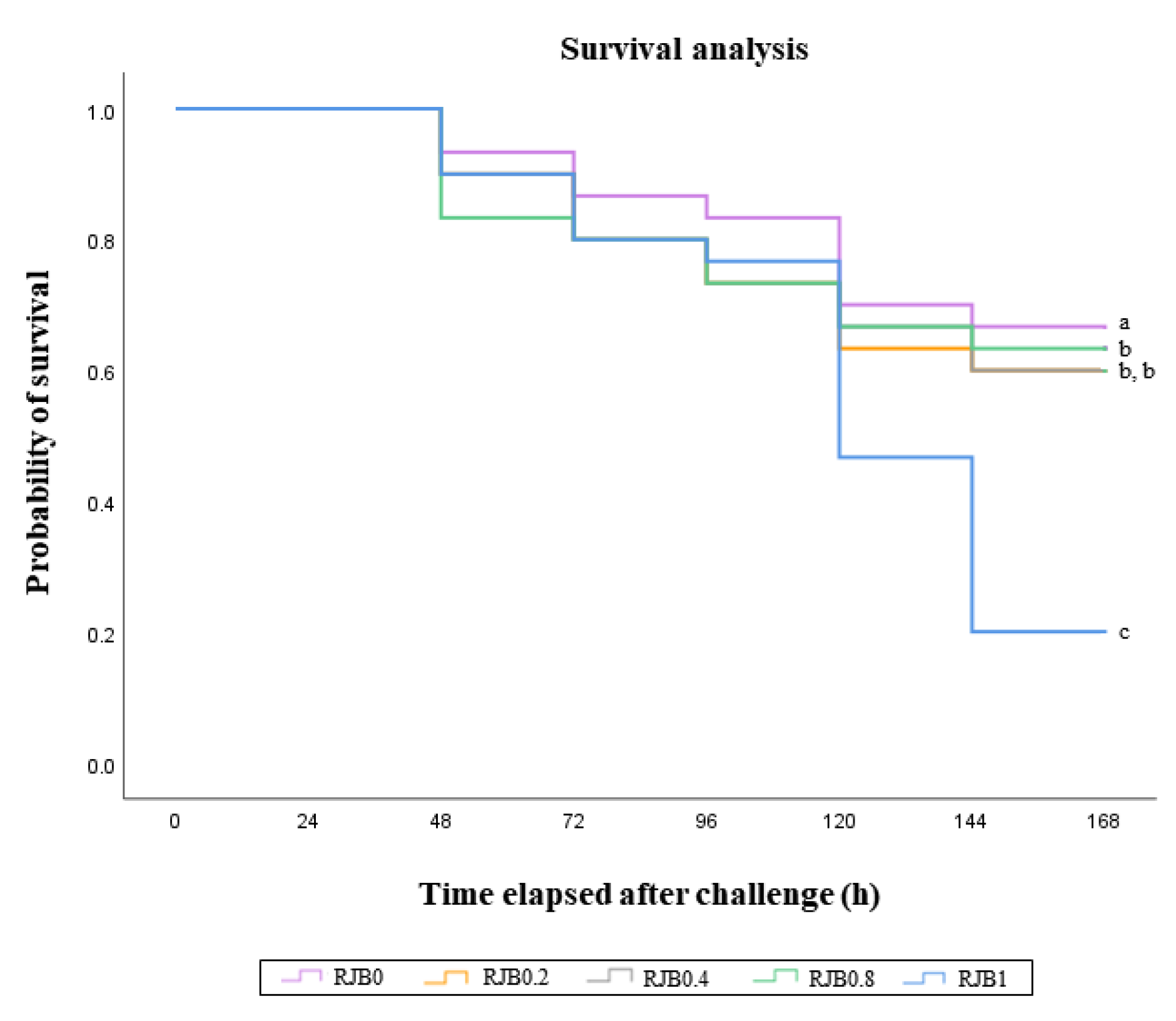
2.5. Resistance Against Edwardsiella Tarda Infection
3. Discussion
4. Materials and Methods
4.1. Preparation of Red Dragon Fruit Juice By-Products (RJB)
4.2. Functional Compounds and Antioxidant Capacity of RJB
4.3. Determination of Functional Compounds and Antioxidant Activity of RJB
4.4. Preparation of Experimental Diets
4.5. Experimental Fish and Rearing Conditions
4.6. Growth Performance and Biometric Measurements
4.7. Blood Sampling
4.8. Proximate Composition Analysis
4.9. Plasma Biochemical Analysis
4.10. Antioxidant Response
4.11. Lysozyme Activity
4.12. Bacterial Challenge Test
4.13. Statistical Analysis
5. Conclusions
Author Contributions
Funding
Institutional Review Board Statement
Informed Consent Statement
Data Availability Statement
Conflicts of Interest
References
- Yousefi, M.; Hoseini, S.M.; Kulikov, E.V.; Babichev, N.V.; Bolshakova, M.V.; Shopinskaya, M.I.; Rogov, R.V.; Zharov, A.N. Effects of dietary pomegranate peel supplementation on growth performance and biochemical responses of common carp, Cyprinus carpio, to chronic crowding stress. Aquac. Rep. 2023, 30, 101532. [Google Scholar] [CrossRef]
- Costas, B.; Araglo, C.; Mancera, J.M.; Dinis, M.T.; Conceillo, L.E. High stocking density induces crowding stress and affects amino acid metabolism in Senegalese sole Solea senegalensis (Kaup 1858) juveniles. Aquac. Res. 2008, 39, 1–9. [Google Scholar] [CrossRef]
- Liu, B.; Liu, Y.; Sun, G. Effects of stocking density on growth performance and welfare-related physiological parameters of Atlantic salmon Salmo salar L. in recirculating aquaculture system. Aquac. Res. 2017, 48, 2133–2144. [Google Scholar] [CrossRef]
- Sandeep, T.R.; Sravya, M.V.N.; Simhachalam, G. Phytobiotics in finfish and shellfish: A systematic review. Discov. Anim. 2025, 2, 74. [Google Scholar] [CrossRef]
- Dawood, M.A.O.; Abo-Al-Ela, H.G.; Hasan, M.T. Modulation of transcriptomic profile in aquatic animals: Probiotics, prebiotics and synbiotics scenarios. Fish Shellfish Immunol. 2020, 97, 268–282. [Google Scholar] [CrossRef]
- Leyva-López, N.; Lizárraga-Velázquez, C.E.; Hernández, C.; Sánchez-Gutiérrez, E.Y. Exploitation of agro-industrial waste as potential source of bioactive compounds for aquaculture. Foods 2020, 9, 843. [Google Scholar] [CrossRef] [PubMed]
- Singh, B.; Singh, J.P.; Kaur, A.; Singh, N. Phenolic composition, antioxidant potential and health benefits of citrus peel. Food Res. Int. 2020, 132, 109114. [Google Scholar] [CrossRef]
- Pulgar, R.; Mandakovic, D.; Salgado, P.; Venegas, L.; Ortiz, D.; Peña-Neira, Á.; Wacyk, J. Micro-encapsulated grape pomace extract (MGPE) as a feed additive improves growth performance, antioxidant capacity, and shifts the gut microbiome of rainbow trout. Aquaculture 2021, 544, 737129. [Google Scholar] [CrossRef]
- Van Doan, H.; Hoseinifar, S.H.; Harikrishnan, R.; Khamlor, T.; Punyatong, M.; Tapingkae, W.; El-Haroun, E. Impacts of pineapple peel powder on growth performance, innate immunity, disease resistance, and relative immune gene expression of Nile tilapia, Oreochromis niloticus. Fish Shellfish Immunol. 2021, 114, 311–319. [Google Scholar] [CrossRef]
- Stintzing, F.C.; Schieber, A.; Carle, R. Betacyanins in fruits from redpurple pitaya, Hylocereus polyrhizus (Weber) Britton and Rose. Food Chem. 2002, 77, 101–106. [Google Scholar] [CrossRef]
- Setiawan, N.A.; Shintawati, R.; Priyandoko, D. The role of red dragon fruit peel (Hylocereus polyrhizus) to improvement blood lipid levels of hyperlipidaemia male mice. J. Phys. Conf. Ser. 2018, 1013, 012167. [Google Scholar] [CrossRef]
- Wybraniec, S.; Mizrahi, Y. Fruit flesh betacyanin pigments in Hylocereus cacti. J. Agric. Food Chem. 2002, 50, 6086–6089. [Google Scholar] [CrossRef] [PubMed]
- Rebecca, O.P.S.; Boyce, A.N.; Chandran, S. Pigment identification and antioxidant properties of red dragon fruit (Hylocereus polyrhizus). Afr. J. Biotechnol. 2010, 9, 1450–1454. [Google Scholar] [CrossRef]
- Stintzing, F.C.; Schieber, A.; Carle, R. Evaluation of colour properties and chemical quality parameters of cactus juices. Eur. Food Res. Technol. 2003, 216, 303–311. [Google Scholar] [CrossRef]
- Le Bellec, F.; Vaillant, F.; Imbert, E. Pitahaya (Hylocereus spp.): A new fruit crop, a market with a future. Fruits 2006, 61, 237–250. [Google Scholar] [CrossRef]
- Kanner, J.; Harel, S.; Granit, R. Betalains—A new class of dietary cationized antioxidants. J. Agric. Food Chem. 2001, 49, 5178–5185. [Google Scholar] [CrossRef]
- Tripathi, M.; Diwan, D.; Shukla, A.C.; Gaffey, J.; Pathak, N.; Dashora, K.; Gupta, V.K. Valorization of dragon fruit waste to value-added bioproducts and formulations: A review. Crit. Rev. Biotechnol. 2024, 44, 1061–1079. [Google Scholar] [CrossRef]
- Jalgaonkar, K.; Mahawar, M.K.; Bibwe, B.; Kannaujia, P. Postharvest profile, processing and waste utilization of dragon fruit (Hylocereus spp.): A review. Food Rev. Int. 2022, 38, 733–759. [Google Scholar] [CrossRef]
- Hwang, H.K.; Kim, K.D.; Park, M.W.; Han, S.J.; Kang, Y.J.; Kim, E.O.; Kim, D.H. Effects of Dietary Lipid Level on Growth and Body Composition of Juvenile Red Sea Bream (Pagurus major) during Winter. Kor. J. Fish Aquat. Sci. 2009, 42, 344–348. [Google Scholar] [CrossRef][Green Version]
- KOSIS (Korean Statistical Information Service). Survey on the Status of Aquaculture; KOSIS: Daejeon, Republic of Korea, 2025. [Google Scholar]
- Song, J.W.; Park, S.H.; Lee, C.R.; Lee, K.J. Effects of Dietary Supplementation of a Citrus By-product on Growth Performance, Innate Immunity and Tolerance of Low Water Temperature in Red Seabream Pagrus major. Kor. J. Fish Aquat. Sci. 2013, 46, 399–406. [Google Scholar] [CrossRef]
- Go, G.M.; Oh, S.L.; Satoh, S. Effects of the dietary supplementation of fermented cactus fruit (Opuntia ficus-indica) fluid on the growth of red sea bream, Pagrus major. J. Aquac. 2007, 20, 1–6. [Google Scholar]
- Kasapidou, E.; Sossidou, E.; Mitlianga, P. Fruit and vegetable co-products as functional feed ingredients in farm animal nutrition for improved product quality. Agriculture 2015, 5, 1020–1034. [Google Scholar] [CrossRef]
- Itrat, N.; Hasanath, S.A.F.; Ali, A. Mushrooms as Natural Antioxidants and Their Role in Oxidative Stress Management. In Mushroom Bioactives: Bridging Food, Biotechnology, and Nanotechnology for Health and Innovation; Springer: Cham, Switzerland, 2025; pp. 45–67. [Google Scholar]
- Priatni, S.; Pradita, A. Stability study of betacyanin extract from red dragon fruit (Hylocereus polyrhizus) peels. Procedia Chem. 2015, 16, 438–444. [Google Scholar] [CrossRef]
- Zakaria, N.N.A.; Mohamad, A.Z.; Harith, Z.T.; Rahman, N.A.; Daud, M.F. Antioxidant and antibacterial activities of red (Hylocereus polyrhizus) and white (Hylocereus undatus) dragon fruits. J. Trop. Resour. Sustain. Sci. (JTRSS) 2022, 10, 9–14. [Google Scholar] [CrossRef]
- Hendra, R.; Masdeatresa, L.; Almurdani, M.; Abdulah, R.; Haryani, Y. Antifungal activity of red dragon peel (Hylocereus polyrhizus). In IOP Conference Series: Materials Science and Engineering; IOP Publishing: Bristol, UK, 2020; Volume 833, p. 012014. [Google Scholar] [CrossRef]
- Le, N.L. Functional compounds in dragon fruit peels and their potential health benefits: A review. Int. J. Food. Sci. Technol. 2022, 57, 2571–2580. [Google Scholar] [CrossRef]
- Xuan, C.L.; Nguyen, V.L.; Wannavijit, S.; Outama, P.; Khongdee, N.; Sutthi, N.; Nguyen, V.V.; Hoseinifar, S.H.; Srisapoome, P.; Van Doan, H. Modulation of growth, immunity, and immune--antioxidant gene expression in Nile tilapia, Oreochromis niloticus, culture under biofloc system by dragon fruit, Hylocereus undatus, peel powder. J. World Aquac. Soc. 2024, 55, e13088. [Google Scholar] [CrossRef]
- Hu, X.; Ma, W.; Zhang, D.; Tian, Z.; Yang, Y.; Huang, Y.; Hong, Y. Application of natural antioxidants as feed additives in aquaculture: A review. Biology 2025, 14, 87. [Google Scholar] [CrossRef]
- Taştan, Y.; Salem, M.O.A. Use of phytochemicals as feed supplements in aquaculture: A review on their effects on growth, immune response, and antioxidant status of finfish. J. Agric. Prod. 2021, 2, 32–43. [Google Scholar] [CrossRef]
- Ban, C.; Tian, X.; Lu, Q.; Lounglawan, P.; Wen, G. Enhancing rumen fermentation and bacteria community in Sika deer (Cervus nippon) through varying levels of Dragon fruit Peel polyphenolic extract: An in vitro study. Animals 2024, 14, 1139. [Google Scholar] [CrossRef]
- Sayago-Ayerdi, S.; García-Martínez, D.L.; Ramírez-Castillo, A.C.; Ramírez-Concepción, H.R.; Viuda-Martos, M. Tropical fruits and their co-products as bioactive compounds and their health effects: A review. Foods 2021, 10, 1952. [Google Scholar] [CrossRef]
- Bulfon, C.; Volpatti, D.; Galeotti, M. Current research on the use of plant–derived products in farmed fish. Aquac. Res. 2015, 46, 513–551. [Google Scholar] [CrossRef]
- Pereira, R.; Basto, A.; Pintado, M.; Valente, L.M.P.; Velasco, C. Inclusion of Pineapple By-Products as Natural Antioxidant Sources in Diets for European Sea Bass (Dicentrarchus labrax). Antioxidants 2025, 14, 333. [Google Scholar] [CrossRef]
- Fukada, H.; Furutani, T.; Shimizu, R.; Masumoto, T. Effects of yuzu (Citrus junos) peel from waste as an aquaculture feed supplement on growth, environmental load, and dark muscle discoloration in yellowtail Seriola quinqueradiata. J. Aquat. Food Prod. Technol. 2014, 23, 511–521. [Google Scholar] [CrossRef]
- Peña, E.; Badillo--Zapata, D.; Viana, M.T.; Correa--Reyes, G. Use of grape pomace in formulated feed for the rainbow trout fry, Oncorhynchus mykiss (Walbaum, 1792). J. World Aquac. Soc. 2020, 51, 542–550. [Google Scholar] [CrossRef]
- Hamed, H.S.; Abdel-Tawwab, M. Dietary pomegranate (Punica granatum) peel mitigated the adverse effects of silver nanoparticles on the performance, haemato-biochemical, antioxidant, and immune responses of Nile tilapia fingerlings. Aquaculture 2021, 540, 736742. [Google Scholar] [CrossRef]
- Lee, D.Y.; Lee, T.H.; Lee, C.H.; Oh, H.Y.; Kim, H.S. Effect of Blueberry Pomace Supplementation in Diet on Growth, Feed Utilization, Antioxidant Enzyme Activity and Challenge Test with Streptococcus iniae of Juvenile Black Rockfish Sebastes schlegelii. J. Korean Soc. Fisher. Mar. Sci. Edu. 2022, 34, 435–445. [Google Scholar] [CrossRef]
- Dawood, M.A.; Koshio, S.; Esteban, M.Á. Beneficial roles of feed additives as immunostimulants in aquaculture: A review. Rev. Aquac. 2018, 10, 950–974. [Google Scholar] [CrossRef]
- Mansour, A.T.; Espinosa, C.; Morshidy, S.; Esteban, M.Á. The potential role of photobiotic in enhancing liver antioxidant status as determined by enzyme scavenging activity and molecular mechanisms in Gilthead seabream (Sparus aurata) teleost. Anim. Rep. 2025, 1, 14–27. [Google Scholar] [CrossRef]
- Phinyo, M.; Sangarun, P.; Wangkahart, E.; Sujipuri, K. Effects of banana flower powder (Musa sp.) supplementation on growth performance, whole body composition, antioxidant and immune responses, gene expression and liver histology in Nile tilapia (Oreochromis niloticus). Anim. Feed Sci. Technol. 2024, 308, 115882. [Google Scholar] [CrossRef]
- Laein, S.S.; Salari, A.; Shahsavani, D.; Baghshani, H. Effect of supplementation with lemon (Citrus lemon) pomace powder on the growth performance and antioxidant responses in common carp (Cyprinus carpio). J. Biol. Environ. Sci. 2021, 15, 47–54. [Google Scholar]
- Qiang, J.; Khamis, O.A.M.; Jiang, H.J.; Cao, Z.M.; He, J.; Tao, Y.F.; Bao, J.W. Effects of dietary supplementation with apple peel powder on the growth, blood and liver parameters, and transcriptome of genetically improved farmed tilapia (GIFT, Oreochromis niloticus). PLoS ONE 2019, 14, e0224995. [Google Scholar] [CrossRef]
- Lee, T.H.; Kim, K.T.; Oh, H.Y.; Park, S.Y.; Lee, G.J.; Kim, H.S.; Kim, H.S. Effect of Blood Orange (Citrus sinensis L. Osbeck) Peel Waste as a Feed Additive on the Growth Performance, Digestive Enzyme Activity, Antioxidant Capacity, and Immune Response in Juvenile Black Rockfish (Sebastes schlegelii). Antioxidants 2024, 13, 1452. [Google Scholar] [CrossRef]
- Hoseinifar, S.H.; Yousefi, S.; Van Doan, H.; Ashouri, G.; Gioacchini, G.; Maradonna, F.; Carnevali, O. Oxidative stress and antioxidant defense in fish: The implications of probiotic, prebiotic, and synbiotics. Rev. Fish. Sci. Aquac. 2020, 29, 198–217. [Google Scholar] [CrossRef]
- Zheng, J.L.; Zeng, L.; Shen, B.; Xu, M.Y.; Zhu, A.Y.; Wu, C.W. Antioxidant defenses at transcriptional and enzymatic levels and gene expression of Nrf2-Keap1 signaling molecules in response to acute zinc exposure in the spleen of the large yellow croaker Pseudosciaena crocea. Fish Shellfish Immunol. 2016, 52, 1–8. [Google Scholar] [CrossRef]
- Al-Khalaifah, H.S.; Khalil, A.A.; Amer, S.A.; Shalaby, S.I.; Badr, H.A.; Farag, M.F.; Abdel Rahman, A.N. Effects of dietary doum palm fruit powder on growth, antioxidant capacity, immune response, and disease resistance of African catfish, Clarias gariepinus (B.). Animals 2020, 10, 1407. [Google Scholar] [CrossRef]
- Saurabh, S.; Sahoo, P.K. Lysozyme: An important defence molecule of fish innate immune system. Aquac. Res. 2008, 39, 223–239. [Google Scholar] [CrossRef]
- Biller, J.D.; Takahashi, L.S. Oxidative stress and fish immune system: Phagocytosis and leukocyte respiratory burst activity. An. Acad. Bras. Ciências 2018, 90, 3403–3414. [Google Scholar] [CrossRef] [PubMed]
- Harikrishnan, R.; Thamizharasan, S.; Devi, G.; Van Doan, H.; Kumar, T.T.A.; Hoseinifar, S.H.; Balasundaram, C. Dried lemon peel enriched diet improves antioxidant activity, immune response and modulates immuno-antioxidant genes in Labeo rohita against Aeromonas sorbia. Fish Shellfish Immunol. 2020, 106, 675–684. [Google Scholar] [CrossRef] [PubMed]
- Outama, P.; Le Xuan, C.; Wannavijit, S.; Lumsangkul, C.; Linh, N.V.; Montha, N.; Van Doan, H. Modulation of growth, immune response, and immune-antioxidant related gene expression of Nile tilapia (Oreochromis niloticus) reared under biofloc system using mango peel powder. Fish Shellfish Immunol. 2022, 131, 1136–1143. [Google Scholar] [CrossRef] [PubMed]
- Zheng, W.J.; Hu, Y.H.; Sun, L. The two Dps of Edwardsiella tarda are involved in resistance against oxidative stress and host infection. Fish Shellfish Immunol. 2011, 31, 985–992. [Google Scholar] [CrossRef]
- Moreno, M.I.N.; Isla, M.I.; Sampietro, A.R.; Vatuone, M.A. Comparison of the free radical-scavenging activity of propolis from several regions of Argentina. J. Ethnopharmacol. 2000, 71, 109–114. [Google Scholar] [CrossRef]
- Gutfinger, T. Polyphenols in olive oils. J. Am. Oil Chem. Soc. 1981, 58, 966–968. [Google Scholar] [CrossRef]
- Blois, M.S. Antioxidant determinations by the use of a stable free radical. Nature 1958, 181, 1199–1200. [Google Scholar] [CrossRef]
- Re, R.; Pellegrini, N.; Proteggente, A.; Pannala, A.; Yang, M.; Rice-Evans, C. Antioxidant activity applying an improved ABTS radical cation decolorization assay. Free Radic. Biol. Med. 1999, 26, 1231–1237. [Google Scholar] [CrossRef] [PubMed]
- AOAC. Official Methods of Analysis of Association of Official Analytical Chemists International, 18th ed.; AOAC: Gaithersburg, MD, USA, 2005. [Google Scholar]
- Lange, S.; Gudmundsdottir, B.K.; Magnadottir, B. Humoral immune parameters of cultured Atlantic halibut (Hippoglossus hippoglossus L.). Fish Shellfish Immunol. 2001, 11, 523–535. [Google Scholar] [CrossRef]


| Experimental Diets | RJB0 | RJB0.2 | RJB0.4 | RJB0.8 | RJB1 | p-Value |
|---|---|---|---|---|---|---|
| IBW 1 (g/fish) | 6.2 ± 0.01 a | 6.2 ± 0.00 a | 6.2 ± 0.00 a | 6.2 ± 0.00 a | 6.2 ± 0.00 a | - |
| FBW 2 (g/fish) | 30.6 ± 0.32 a | 31.3 ± 1.03 a | 28.7 ± 2.09 a | 26.7 ± 1.32 a | 27.4 ± 2.73 a | 0.310 |
| WG 3 (g/fish) | 24.4 ± 0.32 a | 25.1 ± 1.03 a | 22.5 ± 2.09 a | 20.5 ± 1.33 a | 21.1 ± 2.73 a | 0.316 |
| SGR 4 (%/day) | 3.39 ± 0.023 a | 3.43 ± 0.069 a | 3.24 ± 0.149 a | 3.09 ± 0.106 a | 3.12 ± 0.218 a | 0.325 |
| Survival (%) | 92.2 ± 1.11 a | 90.0 ± 1.92 a | 92.2 ± 1.11 a | 94.4 ± 2.94 a | 93.3 ± 3.33 a | 0.720 |
| FC 5 (g/fish) | 25.5 ± 0.89 a | 23.4 ± 0.96 a | 23.4 ± 2.21 a | 22.0 ± 1.44 a | 22.9 ± 1.14 a | 0.524 |
| FE 6 | 0.96 ± 0.042 a | 1.09 ± 0.073 a | 0.97 ± 0.016 a | 0.95 ± 0.013 a | 0.93 ± 0.076 a | 0.301 |
| CF 7 | 1.90 ± 0.101 a | 1.93 ± 0.051 a | 1.93 ± 0.030 a | 1.89 ± 0.043 a | 1.79 ± 0.073 a | 0.551 |
| VSI 8 | 2.23 ± 0.078 a | 2.13 ± 0.066 a | 2.04 ± 0.114 a | 2.04 ± 0.052 a | 2.08 ± 0.117 a | 0.557 |
| HIS 9 | 1.88 ± 0.243 a | 1.63 ± 0.054 a | 1.95 ± 0.123 a | 1.73 ± 0.104 a | 1.61 ± 0.051 a | 0.339 |
| Experimental Diets | RJB0 | RJB0.2 | RJB0.4 | RJB0.8 | RJB1 | p-Value |
|---|---|---|---|---|---|---|
| Moisture (%) | 70.1 ± 0.05 a | 70.0 ± 0.07 a | 70.4 ± 0.16 a | 70.1 ± 0.20 a | 70.4 ± 0.14 a | 0.281 |
| Crude protein (%) | 17.8 ± 0.02 a | 17.6 ± 0.06 a | 17.6 ± 0.07 a | 17.8 ± 0.07 a | 17.6 ± 0.04 a | 0.114 |
| Crude lipid (%) | 6.7 ± 0.16 a | 6.5 ± 0.04 a | 6.4 ± 0.08 a | 6.4 ± 0.12 a | 6.7 ± 0.05 a | 0.106 |
| Ash (%) | 4.3 ± 0.11 a | 4.6 ± 0.08 a | 4.3 ± 0.10 a | 4.6 ± 0.13 a | 4.4 ± 0.16 a | 0.388 |
| Experimental Diets | RJB0 | RJB0.2 | RJB0.4 | RJB0.8 | RJB1 | p-Value |
|---|---|---|---|---|---|---|
| AST 1 (U/L) | 44.3 ± 5.84 a | 31.7 ± 3.76 a | 64.3 ± 13.45 a | 33.3 ± 4.63 a | 44.0 ± 15.82 a | 0.227 |
| ALT 2 (U/L) | 8.3 ± 0.88 a | 6.7 ± 0.33 a | 9.0 ± 1.15 a | 6.0 ± 0.58 a | 9.3 ± 2.33 a | 0.321 |
| T-CHO 3 (mg/dL) | 239.7 ± 15.06 a | 251.0 ± 3.46 a | 242.0 ± 10.07 a | 236.0 ± 6.81 a | 236.3 ± 20.83 a | 0.917 |
| GLU 4 (mg/dL) | 75.0 ± 15.01 a | 100.0 ± 4.04 a | 100.0 ± 13.45 a | 78.7 ± 8.21 a | 86.7 ± 5.49 a | 0.330 |
| TP 5 (g/dL) | 4.2 ± 0.17 a | 4.0 ± 0.13 a | 3.9 ± 0.06 a | 3.7 ± 0.09 a | 3.7 ± 0.20 a | 0.122 |
| Experimental Diets | RJB0 | RJB0.2 | RJB0.4 | RJB0.8 | RJB1 | p-Value |
|---|---|---|---|---|---|---|
| SOD 1 (U/mL) | 2.3 ± 0.10 a | 2.4 ± 0.11 a | 2.4 ± 0.21 a | 2.5 ± 0.08 a | 2.7 ± 0.05 a | 0.278 |
| CAT 2 (nmol/min/mL) | 258.7 ± 6.39 a | 269.2 ± 7.49 a | 279.0 ± 8.36 ab | 309.0 ± 17.10 ab | 336.0 ± 14.29 b | 0.009 |
| GSH 3 (µM) | 16.7 ± 0.43 a | 16.5 ± 0.80 a | 19.3 ± 0.95 ab | 20.6 ± 0.60 ab | 23.0 ± 1.99 b | 0.005 |
| Lysozyme (U/mL) | 0.061 ± 0.007 a | 0.068 ± 0.004 ab | 0.089 ± 0.013 ab | 0.095 ± 0.004 ab | 0.123 ± 0.024 b | 0.048 |
| RJB Composition | |||||
|---|---|---|---|---|---|
| Chemical compounds | |||||
| Total phenolics (gallic acid mg/100 g) | 23.96 ± 9.78 | ||||
| Total flavonoids (quercetin mg/g) | 16.49 ± 8.34 | ||||
| Radical scavenging activities | |||||
| Concentration (μg/mL) | 2000 | 1000 | 500 | 250 | IC50 |
| DPPH 1 (%) | 49.43 | 27.95 | 16.36 | 6.68 | 4.8 |
| ABTS 2 (%) | 36.15 | 21.78 | 12.12 | 5.32 | 5.0 |
| Experimental Diets | |||||
|---|---|---|---|---|---|
| RJB0 | RJB0.2 | RJB0.4 | RJB0.8 | RJB1 | |
| Jackmackerel meal | 60 | 60 | 60 | 60 | 60 |
| Dehulled soybean meal | 11 | 11 | 11 | 11 | 11 |
| Wheat flour | 19.5 | 19.3 | 19.1 | 18.7 | 18.2 |
| RJB 1 | 0 | 0.2 | 0.4 | 0.8 | 1 |
| Fish oil | 3.5 | 3.5 | 3.5 | 3.5 | 3.5 |
| Soybean oil | 3.5 | 3.5 | 3.5 | 3.5 | 3.5 |
| Vitamin premix 2 | 1 | 1 | 1 | 1 | 1 |
| Mineral premix 3 | 1 | 1 | 1 | 1 | 1 |
| Choline | 0.5 | 0.5 | 0.5 | 0.5 | 0.5 |
| Proximate composition (%) | |||||
| Dry matter | 93.7 | 93.6 | 92.9 | 93.6 | 92.7 |
| Crude protein | 51.7 | 50.8 | 52.1 | 51.7 | 52.2 |
| Crude lipid | 13.1 | 12.9 | 13.6 | 13.5 | 14.1 |
| Ash | 12.2 | 12.6 | 13.1 | 12.8 | 12.6 |
Disclaimer/Publisher’s Note: The statements, opinions and data contained in all publications are solely those of the individual author(s) and contributor(s) and not of MDPI and/or the editor(s). MDPI and/or the editor(s) disclaim responsibility for any injury to people or property resulting from any ideas, methods, instructions or products referred to in the content. |
© 2025 by the authors. Licensee MDPI, Basel, Switzerland. This article is an open access article distributed under the terms and conditions of the Creative Commons Attribution (CC BY) license (https://creativecommons.org/licenses/by/4.0/).
Share and Cite
Oh, H.Y.; Kim, K.-T.; Lee, T.H.; Kang, D.Y.; Kwon, D.-H.; Kim, Y.W.; Kim, H.S. Functional Potential of Red Dragon Fruit (Hylocereus polyrhizus) Juice By-Products as a Natural Feed Additive for Juvenile Red Seabream (Pagrus major): Implications for Antibiotic-Free Aquaculture. Antibiotics 2025, 14, 1096. https://doi.org/10.3390/antibiotics14111096
Oh HY, Kim K-T, Lee TH, Kang DY, Kwon D-H, Kim YW, Kim HS. Functional Potential of Red Dragon Fruit (Hylocereus polyrhizus) Juice By-Products as a Natural Feed Additive for Juvenile Red Seabream (Pagrus major): Implications for Antibiotic-Free Aquaculture. Antibiotics. 2025; 14(11):1096. https://doi.org/10.3390/antibiotics14111096
Chicago/Turabian StyleOh, Hwa Yong, Ki-Tae Kim, Tae Hoon Lee, Da Ye Kang, Do-Hyun Kwon, Young Wook Kim, and Hee Sung Kim. 2025. "Functional Potential of Red Dragon Fruit (Hylocereus polyrhizus) Juice By-Products as a Natural Feed Additive for Juvenile Red Seabream (Pagrus major): Implications for Antibiotic-Free Aquaculture" Antibiotics 14, no. 11: 1096. https://doi.org/10.3390/antibiotics14111096
APA StyleOh, H. Y., Kim, K.-T., Lee, T. H., Kang, D. Y., Kwon, D.-H., Kim, Y. W., & Kim, H. S. (2025). Functional Potential of Red Dragon Fruit (Hylocereus polyrhizus) Juice By-Products as a Natural Feed Additive for Juvenile Red Seabream (Pagrus major): Implications for Antibiotic-Free Aquaculture. Antibiotics, 14(11), 1096. https://doi.org/10.3390/antibiotics14111096