Article

A Comparison of Causative Pathogens in Bone and Prosthetic Joint Infections: Implications for Antimicrobial Therapy †

by
Annalise Unsworth
1,2,
Bernadette Young
1,
Matthew Scarborough
1 and
Martin McNally
1,*
1
The Bone Infection Unit, Nuffield Orthopaedic Centre, Oxford University Hospitals, Oxford OX3 7HE, UK
2
St Vincent’s Hospital Clinical School, University of New South Wales, Sydney 2010, Australia
*
Author to whom correspondence should be addressed.
This paper is an extended version of our abstract published in Unsworth, A.; McNally, M.; Young, B.; Scarborough, M. A comparison of causative microbial pathogens in osteomyelitis and prosthetic joint infection, a retrospective observational cohort study. In Proceedings of the 42nd Annual Meeting of the European Bone and Joint Society, Barcelona, Spain, 26–27 September 2024.
Antibiotics 2024, 13(12), 1125; https://doi.org/10.3390/antibiotics13121125

Submission received: 29 October 2024 / Revised: 19 November 2024 / Accepted: 20 November 2024 / Published: 23 November 2024

Abstract

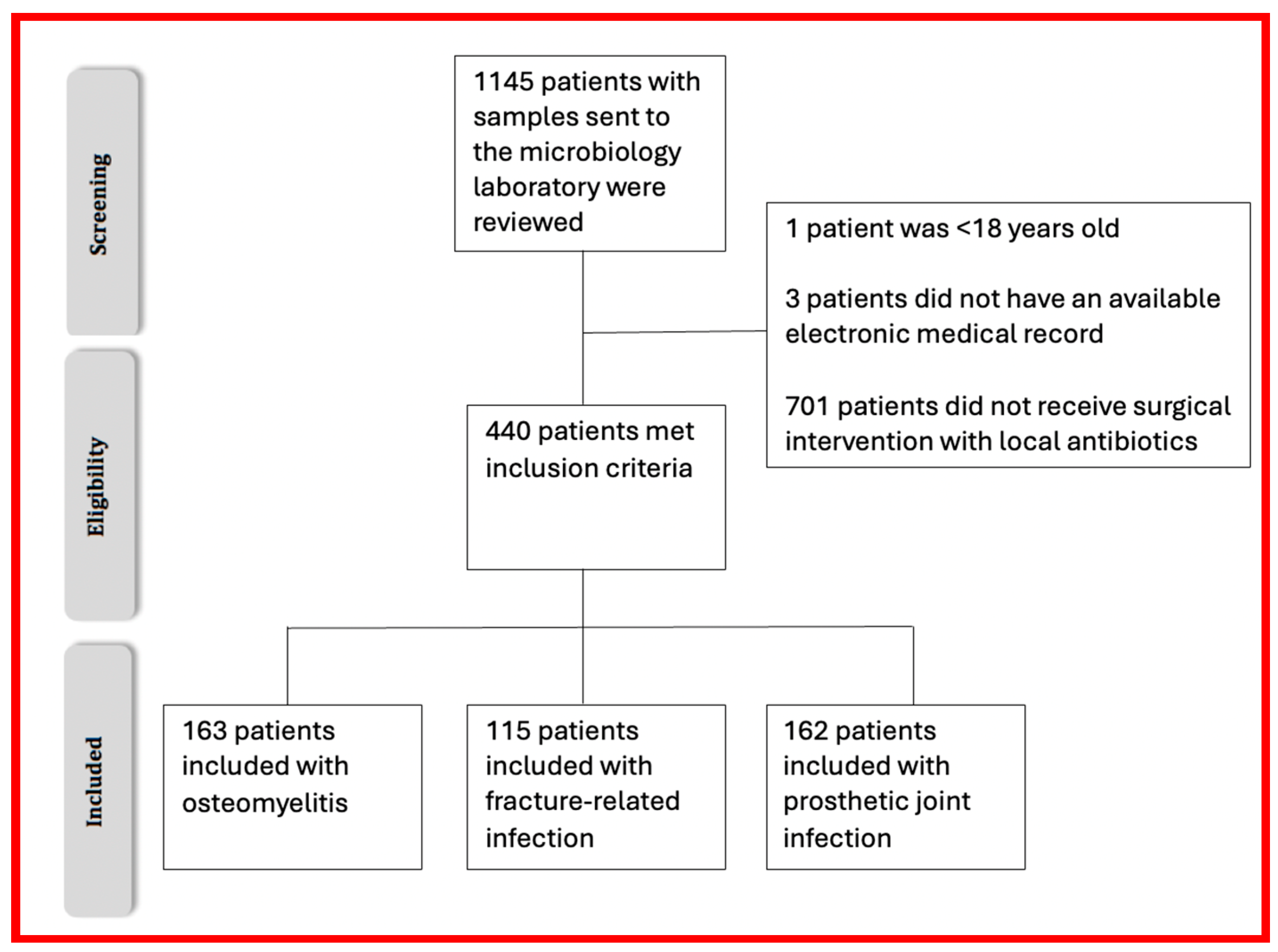
Background: The microbiological profile of bone and joint infections is important for determining the empiric choice of both systemic and local antimicrobial therapy. This study assessed whether there was a difference in the bacterial species that were isolated on culture in osteomyelitis (OM), fracture-related infection (FRI) or prosthetic joint infection (PJI). This was a retrospective, observational cohort study of patients who had surgical intervention for PJI or OM or FRI with a positive microbial culture between 2019 and 2022. Methods: Data including patient demographics, the site of injury, JS-BACH score, organism classification and antibiotic resistance to vancomycin and gentamicin were extracted from the medical records. Results: A total of 440 patients were included in this study: 163 patients with osteomyelitis, 109 with fracture-related infection with fixation implants and 168 with prosthetic joint infection. The patients with PJI were older, more likely to be female and had a higher BMI and ASA score compared to those with OM. Patients with PJI were more likely to have a higher JS-BACH score and more complex infections. Staphylococcus aureus was the most commonly isolated organism in all three groups. It was more frequently isolated in osteomyelitis than in PJI (p = 0.016). In both osteomyelitis and FRI, after Staphylococcus aureus, the next most common organisms were Gram-negatives, whilst for PJIs, the most commonly isolated organisms were Staphylococcus aureus, followed by coagulase-negative Staphylococci and then Streptococcus species. The rates of other organisms were broadly similar between the three groups. When adjusted for confounders, including symptom duration, JS-BACH score, the location of injury, age and BMI, there was no statistically significant difference in the presence of Staphylococcus aureus (OR = 0.765; 95% CI 0.633–1.232; p = 0.465) or polymicrobial infection (OR = 1.175; 95% CI 0.803–1.721; p = 0.407). Conclusions: Causative pathogens are similar across bone and joint infections and are independent of the presence of prosthetic material.
Keywords: fracture-related infection; FRI; bone infection; osteomyelitis; prosthetic joint infection; PJI; microbiology; antibiotic resistance fracture-related infection; FRI; bone infection; osteomyelitis; prosthetic joint infection; PJI; microbiology; antibiotic resistance