Article

Wearable-Derived Axis-Specific Motor Signatures of ADHD Symptoms in Children and Adolescents

1
Department of Physical Education, Bozhou University, Bozhou 236800, China
2
Department of Sport Science, College of Natural Sciences, Jeonbuk National University, Jeonju 54896, Republic of Korea
*
Author to whom correspondence should be addressed.
Biosensors 2026, 16(6), 323; https://doi.org/10.3390/bios16060323
Submission received: 21 April 2026 / Revised: 25 May 2026 / Accepted: 30 May 2026 / Published: 2 June 2026

Abstract

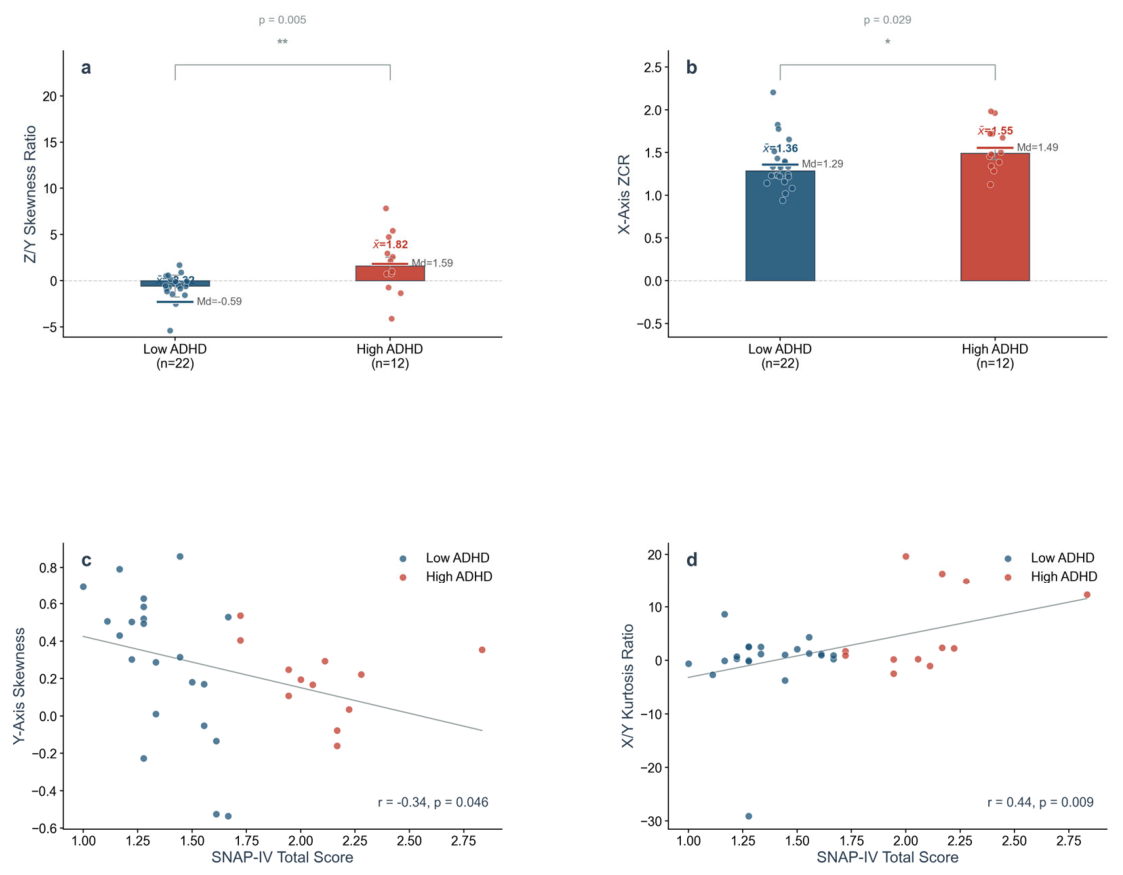
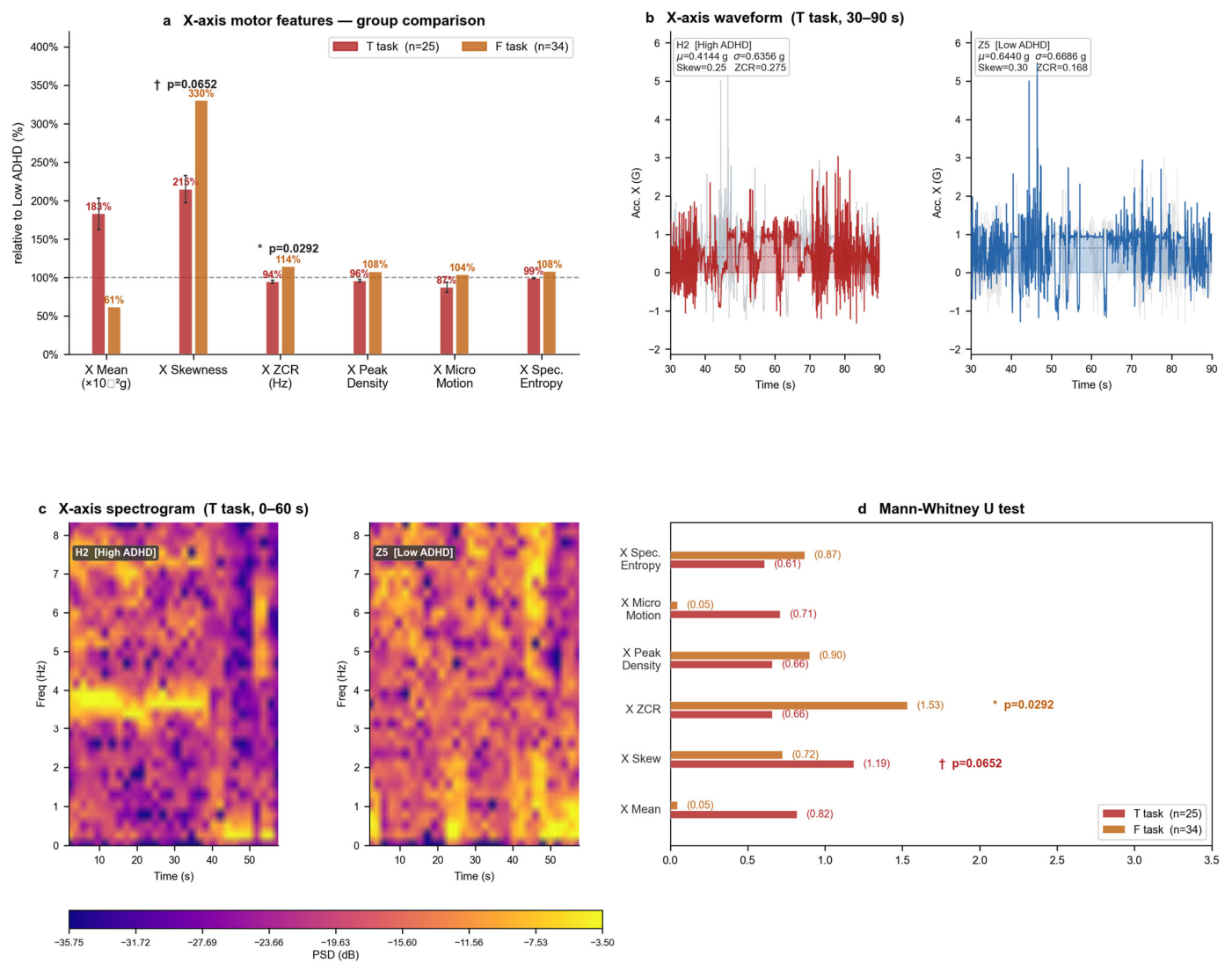
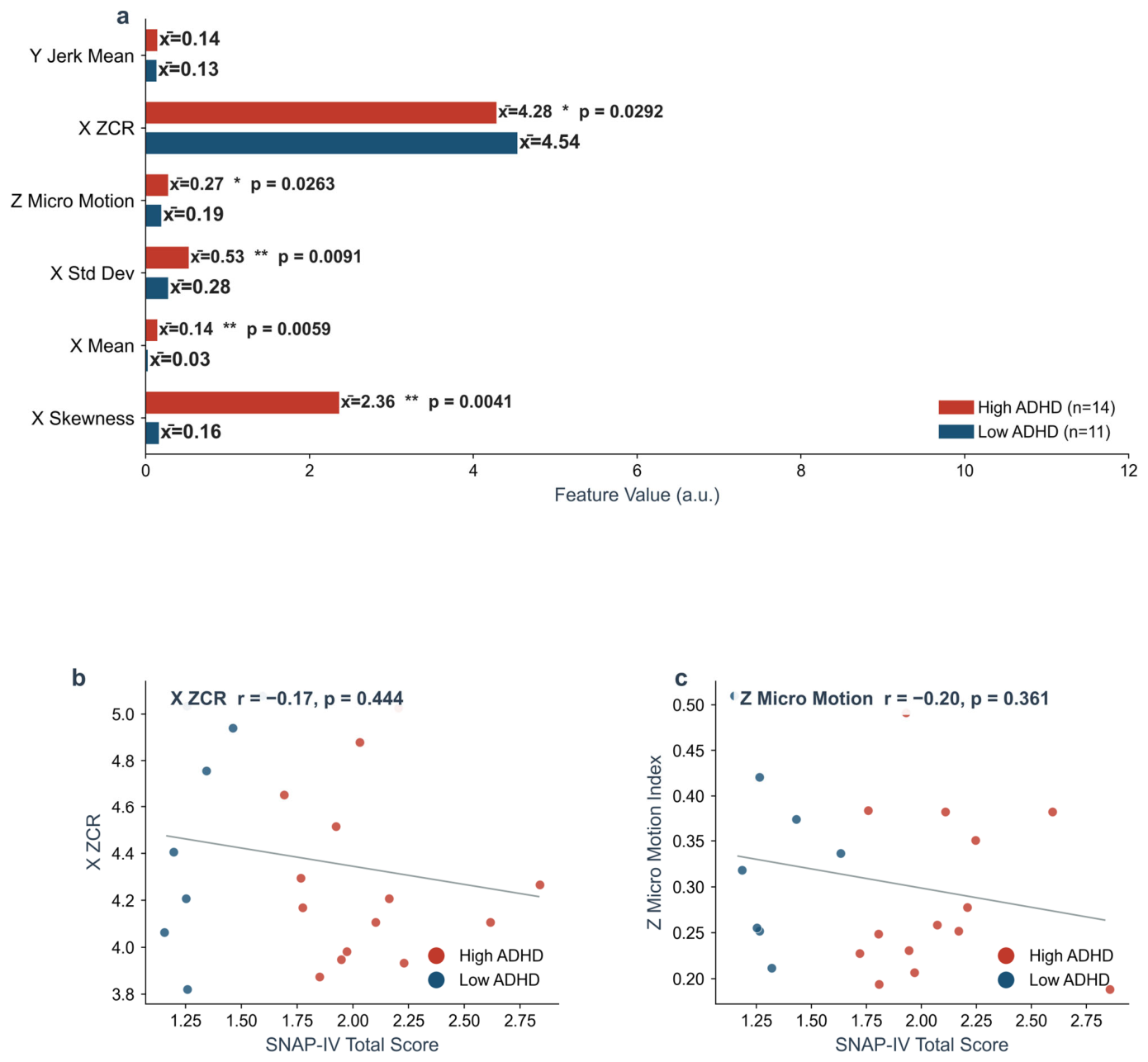
ADHD is typically assessed through reports from parents, teachers, or clinicians, but these reports may not fully capture how motor behavior is organized at the signal level. This cross-sectional study examined whether X-axis acceleration features derived from a wearable device could provide preliminary evidence of ADHD symptom-related motor-pattern differences in children and adolescents. Primary school children aged 6–13 years wore an Apple Watch Series 7, and X-axis accelerometer signals were used to extract features reflecting waveform distribution, zero-crossing rate, micro-motion, and local movement fragmentation. ADHD symptoms and broader emotional and behavioral difficulties were assessed using the SNAP-IV and SDQ. The results showed that the X-axis zero-crossing rate was the most robust feature differentiating the High ADHD and Low ADHD groups across the T-task and F-task recordings. X-axis zero-crossing rate reached statistical significance (p = 0.029), indicating more frequent short-interval switching between positive and negative acceleration directions in children with higher ADHD symptom levels. This finding suggests that directional switching or local movement fragmentation in X-axis acceleration may be a sensitive movement characteristic associated with ADHD symptoms. In addition, X-axis skewness showed a consistent directional tendency, with higher values in the High ADHD group; this effect was marginal in the T-task recording (p = 0.065), suggesting a possible tendency toward waveform asymmetry or distributional imbalance during longer movement recording. Overall, these findings provide preliminary evidence that ADHD symptom-related motor differences may be reflected in the organization of X-axis acceleration signals, particularly in directional switching indexed by zero-crossing rate and, to a lesser extent, waveform asymmetry indexed by skewness. Given the cross-sectional design, symptom-based grouping, modest sample size, and incomplete recording-context control, these results should be interpreted cautiously and require confirmation in larger, diagnostically characterized samples with standardized wearable-recording protocols.
Keywords: ADHD; wearable accelerometry; motor behavior; movement fragmentation; adolescents; digital phenotyping ADHD; wearable accelerometry; motor behavior; movement fragmentation; adolescents; digital phenotyping