Article

A Flexible Wearable Glucose Sensor for Noninvasive Diabetes Screening: Functional Equivalence and Model Interpretability


1
Beijing Key Laboratory of Environment and Aging, Department of Epidemiology and Health Statistics, School of Public Health, Capital Medical University, Beijing 100069, China
2
Beijing Physical Examination Center, Beijing 100050, China
3
Aerospace Information Research Institute, Chinese Academy of Sciences, Beijing 100094, China
4
National Institute for Data Science in Health and Medicine, Capital Medical University, Beijing 100069, China
5
School of Medical and Health Sciences, Edith Cowan University, Perth 6027, Australia
*
Author to whom correspondence should be addressed.
These authors contributed equally to this work.
Biosensors 2026, 16(4), 214; https://doi.org/10.3390/bios16040214
Submission received: 6 February 2026 / Revised: 17 March 2026 / Accepted: 6 April 2026 / Published: 10 April 2026
(This article belongs to the Section Biosensors and Healthcare)

Abstract

Real-world evidence for wearable noninvasive glucose monitoring (NIGM) remains limited. To evaluate the functional equivalence of a wearable NIGM device and explore its utility for T2DM and prediabetes screening. In this multicenter study, 12-h daytime glucose profiles obtained by a flexible reverse iontophoresis-based electrochemical sensor were compared with capillary glucose using functional equivalence. Subgroup analyses were conducted. Screening models of T2DM and prediabetes were developed using elastic net and Logistic regression. A total of 135 participants (mean age 35.3 years; 60.0% female) were included, and no serious device-related adverse events were reported. Compared to the capillary measurements, functional equivalence was confirmed (T = −6.537 < threshold = −2.081) in the general population but not in older adults or T2DM patients. The T2DM noninvasive screening model demonstrated discrimination and reclassification performance comparable to those of the capillary-based model (AUC: 0.906 vs. 0.850, NRI: 0.044, IDI: −0.078, p > 0.05). Functional principal component scores facilitated the identification of prediabetes (AUC = 0.760). The device demonstrated acceptable accuracy and functional equivalence with reference methods. Its capability to detect T2DM and early glycemic anomalies supports its feasibility as a wearable, interpretative adjunct tool for large-scale screening in free-living populations.

1. Introduction

Diabetes imposes a substantial and growing global public health burden. In 2024, an estimated 589 million adults aged 20 to 79 years were living with diabetes, and this number is projected to reach 853 million by 2050 [1]. Notably, a substantial proportion remains undiagnosed, and delayed detection of diabetes is associated with a greater risk of microvascular and macrovascular complications, which underscores the need to expand population-level screening and longitudinal monitoring [2,3]. International consensus statements, including those from the American Diabetes Association, recommend that continuous glucose monitoring (CGM) metrics be considered to characterize daily glycemia and inform treatment decisions [4]. However, adherence to venous sampling or fingerstick capillary testing is limited by pain and inconvenience, and CGM uptake in routine care is constrained by cost, coverage, and supply, as well as wearability, which restricts scalable access to high-quality continuous glucose data, particularly in asymptomatic or low-risk populations [5,6,7].
Against this backdrop, noninvasive glucose monitoring (NIGM) has attracted attention because it avoids skin puncture and supports long-term wear [8,9]. Most optical, physiologic-signal-based, thermal, and electromagnetic approaches estimate glucose indirectly from surrogate signals. These techniques generally require calibration and can vary with individual physiology and environmental conditions [10,11]. An alternative strategy is to extract interstitial fluid (ISF) across intact skin and measure glucose electrochemically [12,13]. ISF glucose closely follows blood glucose with only a short, physiology-dependent lag of a few minutes, suggesting that if extraction efficiency and calibration are well controlled, transdermal ISF sampling can generate numerically interpretable glucose readouts [14,15]. In addition, many noninvasive glucose monitoring systems are designed mainly for hospital or other supervised settings, which limits their usefulness for population-level screening and glycemic monitoring in free-living conditions, where comfort, economy, and portability are as important as measurement accuracy for users [16].
The current evaluation framework for NIGM technologies primarily relies on point-to-point accuracy metrics, such as the mean absolute relative difference (MARD) [17]. Due to physiological lag in glucose measurement and the susceptibility of noninvasive interfaces to microenvironmental variations, isolated point-in-time comparisons may lead to overestimation of errors, thereby obscuring the sensor’s capability to capture dynamic glucose fluctuations [18]. More significantly, for large-scale population screening and early diabetes risk identification, clinical value may rely more heavily on assessing glucose fluctuation morphology and trend consistency [19]. Consequently, novel evaluation dimensions—such as functional equivalence testing—are required to assess the screening efficacy of noninvasive devices in real-world settings at the overall curve level [20].
Our research team has previously developed a NIGM device incorporating flexible electrochemical sensing and reverse iontophoresis (RI), with preliminary on-body studies confirming its accuracy [21,22]. However, its performance may be constrained when applied in uncontrolled, free-living environments. Consequently, our study aims to evaluate the device’s performance in real-world short-term glucose monitoring and disease screening, with specific objectives to: (1) explore functional equivalence between noninvasive and capillary glucose measurements and (2) analyze the device’s performance in screening participants at high risk for type 2 diabetes mellitus (T2DM) and prediabetes.

2. Materials and Methods

2.1. Study Setting and Population

This multicenter study recruited 150 adults from the University of Chinese Academy of Sciences and the Beijing Physical Examination Center in China, between 13 January and 15 June 2025. Eligible participants included adults with normal or abnormal glycemic status, without major surgery or trauma within the preceding three months, and without known secondary causes of glucose abnormalities. After excluding one participant with unavailable fasting venous glucose due to hypoglycemia and 14 participants with incomplete or invalid data due to operational problems, 135 participants were included for the main analyses.
The study was approved by the Ethics Committee of Capital Medical University (2024SY034) and the Beijing Physical Examination Center (BJTJZX-005), and was registered with the China Clinical Trial Registry (ChiCTR2400093042). All participants provided written informed consent.

2.2. Wearable NIGM Devices and Glucose Measurements

The factory-calibrated wearable NIGM device, MicroTED, developed jointly by the University of Chinese Academy of Sciences and Capital Medical University, was a flexible wearable system that integrated RI for ISF extraction with a low-cost cellulose paper-based electrochemical glucose sensor [21]. The system comprised a disposable sensing patch and a reusable electronic module featuring Bluetooth communication and a 3.7 V/300 mAh lithium-ion battery, enabling over 12 h of continuous operation. Based on prior design of experiments optimization, the RI extraction was configured with a pulsed direct current waveform delivering a 100 µA microcurrent. The specific parameters were set at a 12 V maximum amplitude, 1 kHz frequency, and 10% duty cycle to ensure efficient ISF sampling while minimizing skin irritation. To enhance measurement stability against skin matrix effects, the device employed a real-time monitoring module that continuously measured the surface water content of the extraction electrode, extraction current, and extraction voltage in situ. A Kalman filter algorithm was utilized in the post-signal processing of these sensor data to effectively remove noise and ensure the reliability of the extraction status. Previous pilot validation in 6 volunteers (4.5-h duration) demonstrated high agreement with a commercial glucometer. Further mechanisms could be found in the previous report [21].
Continuous noninvasive monitoring was initiated after an overnight fast (>8 h) and spanned a 12-h daytime period with readings obtained approximately every 30 min. To validate glycemic trends, concurrent reference capillary glucose levels were measured 6 times daily (pre- and 2-h post-prandial) using commercial glucometers (ACCU-CHEK Performa, Basel, Switzerland). Throughout the session, participants maintained unrestricted daily activities to simulate a free-living environment.

2.3. Definition of T2DM and Prediabetes Status

T2DM risk status was defined based on self-reported diabetes status and current use of antidiabetic medication, in combination with venous fasting plasma glucose ≥ 7.0 mmol/L or glycated hemoglobin (HbA1c) ≥ 6.5%, which was used for risk screening [23]. To evaluate the capability of MicroTED in early risk identification, prediabetes was defined as venous fasting plasma glucose between 6.1 and 6.9 mmol/L or HbA1c between 5.7% and 6.4%, without T2DM [24].

2.4. Covariates and User Experience

Covariates included sociodemographic factors (age, sex, marital status, education, and ethnicity), lifestyle behaviors (smoking, alcohol consumption, sleep duration, napping, staying up late, regular exercise, and sweet preference), anthropometric measures (body mass index [BMI], waist-to-hip ratio [WHR], systolic blood pressure, diastolic blood pressure, and resting pulse), disease history (self-reported hypertension, and family history of T2DM), and laboratory factors (venous fasting glucose and HbA1c).
Participants were also asked to report adverse events or any device-related discomfort during the study period. User experience was assessed using a five-point comfort rating scale, which was summarized as overall comfort and discomfort. All measurements underwent strict quality-control procedures to ensure data reliability. Detailed variable definitions, comfort rating procedures, and quality control methods are provided in the Supplementary Materials.

2.5. Statistical Analysis

Continuous variables were reported as mean ± standard deviation (SD) and compared using Student’s t-test. Categorical variables were presented as counts and percentages and compared using the χ2 test. The accuracy of noninvasive glucose vs. venous glucose measurements was evaluated using the mean absolute relative differences (MARD) and Clarke error grid analyses.

2.5.1. Functional Equivalence Testing for Short-Term Glycemic Profile

Each participant contributed multiple noninvasive glucose measurements (median 22; range 7–27) and up to 6 paired capillary glucose values during the monitoring period (Figure S1). To account for irregular sampling intervals, individual glucose trajectories were reconstructed using functional principal component analysis via the conditional expectation method [25]. Eigenfunctions explaining >99% of the total variance were retained to describe the major temporal patterns in glucose variation [26].
Equivalence between noninvasive and capillary glucose curves was assessed using a functional equivalence test based on maximal deviation [20]. Equivalence bounds were defined as ±1.11 mmol/L when the capillary glucose was <5.6 mmol/L and ±20% otherwise [27,28]. A test statistic was constructed as the maximum deviation of glucose difference beyond the prespecified bounds, and functional equivalence was declared when the observed statistic fell below the 5th percentile of the bootstrap distribution. More details are provided in the Supplementary Materials.
To evaluate the robustness, subgroup analyses were performed stratified by age (<45 years vs. ≥45 years), sex (male vs. female), T2DM status (yes vs. no), and trial site (Subcenter A vs. Subcenter B). Sensitivity analyses were conducted by re-evaluating equivalence using alternative, tighter (±15%/0.83 mmol/L) and wider (±30%/1.67 mmol/L) acceptance boundaries.

2.5.2. Noninvasive Model Development for T2DM and Prediabetes Risk Screening

Participants were randomly assigned to a training set and a validation set at a 7:3 ratio using stratified sampling to ensure a balanced distribution of T2DM cases. Variable selection was performed using elastic net regularization, combining L1 penalty and L2 penalty to select features with the optimal mixing percentage (α) and penalty strength (λ) determined via 10-fold cross-validation. Multivariable Logistic models were developed to identify individuals at higher risk of T2DM to explore the potential screening utility of noninvasive glucose measurements.
Model discrimination was assessed using the area under the receiver operating characteristic curve (AUC) with 95% confidence intervals (CIs). A nomogram was developed based on the final model to facilitate individualized assessment of T2DM risk and decision curve analysis (DCA) to explore utility. To compare screening performance, a parallel capillary-based model was developed, and the incremental value of noninvasive glucose was assessed using net reclassification improvement (NRI) and integrated discrimination improvement (IDI). The Shapley Additive exPlanations (SHAP) analysis was employed to visualize feature contributions.
Given the limited sample size of T2DM cases, we used 10-times repeated 5-fold cross-validation to revalidate the robustness of screening models. To further validate the MicroTED utility for detecting occult T2DM, which was a critical real-world screening scenario, we performed a targeted analysis excluding participants with a self-reported history of diabetes or current use of hypoglycemic agents. In the “undiagnosed population” (n = 125), the discrimination performance of the noninvasive model was re-evaluated to confirm its robustness. Furthermore, to assess the potential for early identification, a secondary screening model was constructed to distinguish individuals with prediabetes among those excluding T2DM cases.
Missing values in questionnaire variables were imputed using multiple imputation by chained equations. All statistical analyses were performed using R software (version 4.4.1), with significance set at p < 0.05.

3. Results

3.1. Participant Characteristics

Among the 135 participants, 21 (15.6%) individuals were diagnosed with T2DM. The mean age was 35.34 (SD: 14.78) years, and 81 (60.0%) participants were female. As shown in Table 1, participants with T2DM were older, married, had lower educational attainment, reported never staying up late, and were more likely to have hypertension compared with glucose-normal individuals (all p < 0.05). No serious device-related adverse events were observed. 110 (81.5%) participants reported the device as overall comfortable; only 8 (5.9%) individuals reported discomfort. Based on the 135 paired observations, the overall MARD was 15.13% (95%CI: 12.38%, 18.39%), specifically 14.61% (95%CI: 11.83%, 17.97%) for fasting venous glucose < 7.0 mmol/L and 26.40% (95%CI: 15.85%, 35.34%) for ≥7.0 mmol/L. All fasting glucose pairs were within Clarke’s clinically acceptable zones (Zone A: 114/135, 84.44% [95%CI: 77.39%, 89.59%]; Zone B: 21/135, 15.56% [95%CI: 10.41%, 22.61%]), as shown in Figure S2.

3.2. Equivalence of Short-Term Glycemic Profiles

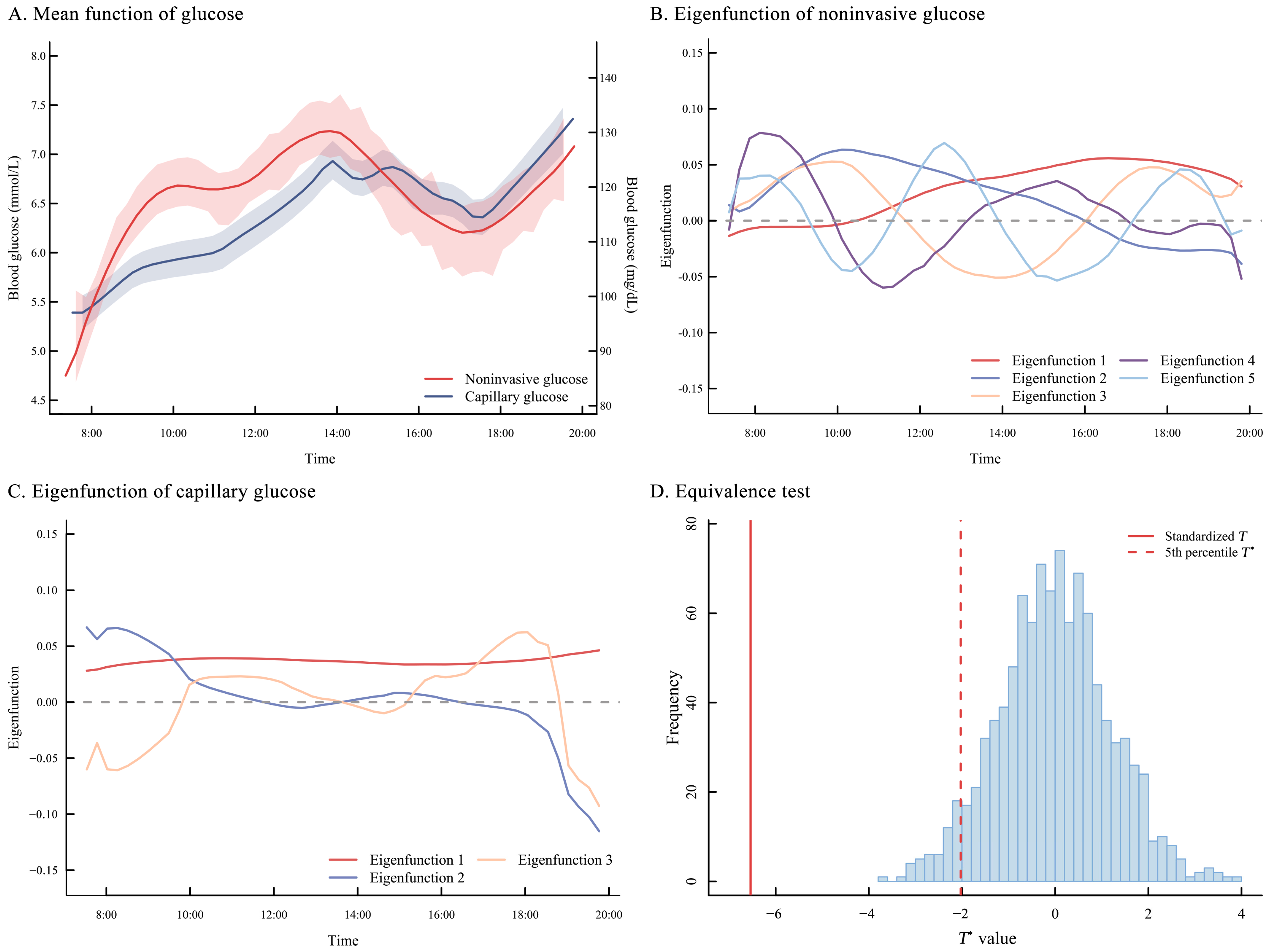
The mean functions of noninvasive and capillary glucose demonstrated broadly similar temporal trends, characterized by an initial rise, a subsequent decline, and a later increase (Figure 1A). The reconstructed noninvasive and capillary glucose curves were adequately represented by five eigenfunctions (explaining 99.86% of the total variance) and three eigenfunctions (explaining 99.27% of the variance), respectively (Figure 1B,C). The first eigenfunctions of both noninvasive and capillary glucose curves displayed relatively stable trajectories with slight upward trends over the 12 h; the second eigenfunction of the noninvasive glucose transitioned from positive to negative around 16:00, indicating the shift from morning to evening; the third eigenfunction exhibited alternating positive and negative phases, reflecting localized fluctuations; the others captured the remaining short-term variations. Corresponding eigenvalues and cumulative variance proportions are listed in Table S1.
The functional equivalence test rejected the null hypothesis (observed T = −6.537 < threshold T = −2.081), indicating that noninvasive and capillary glucose curves were statistically equivalent (Figure 1D).
Subgroup analyses revealed that functional equivalence was supported among participants aged < 45 years, glucose-normal individuals, both male and female, and across all trial sites. In contrast, equivalence could not be established in participants aged ≥ 45 years (observed T = −0.957 > threshold T = −1.174) or those with T2DM (observed T = 2.760 > threshold T = −2.672), as seen in Figure S3. Results remained similar when using alternative bounds: for ±15% (0.83 mmol/L), the observed T was −2.651 (threshold T = −2.081); and for ±30% (1.67 mmol/L), the observed T was −13.733 (threshold T = −1.156), indicating that equivalence was supported under all alternative specifications.

3.3. Noninvasive Model of Disease Screening

3.3.1. Noninvasive Screening for T2DM Risk

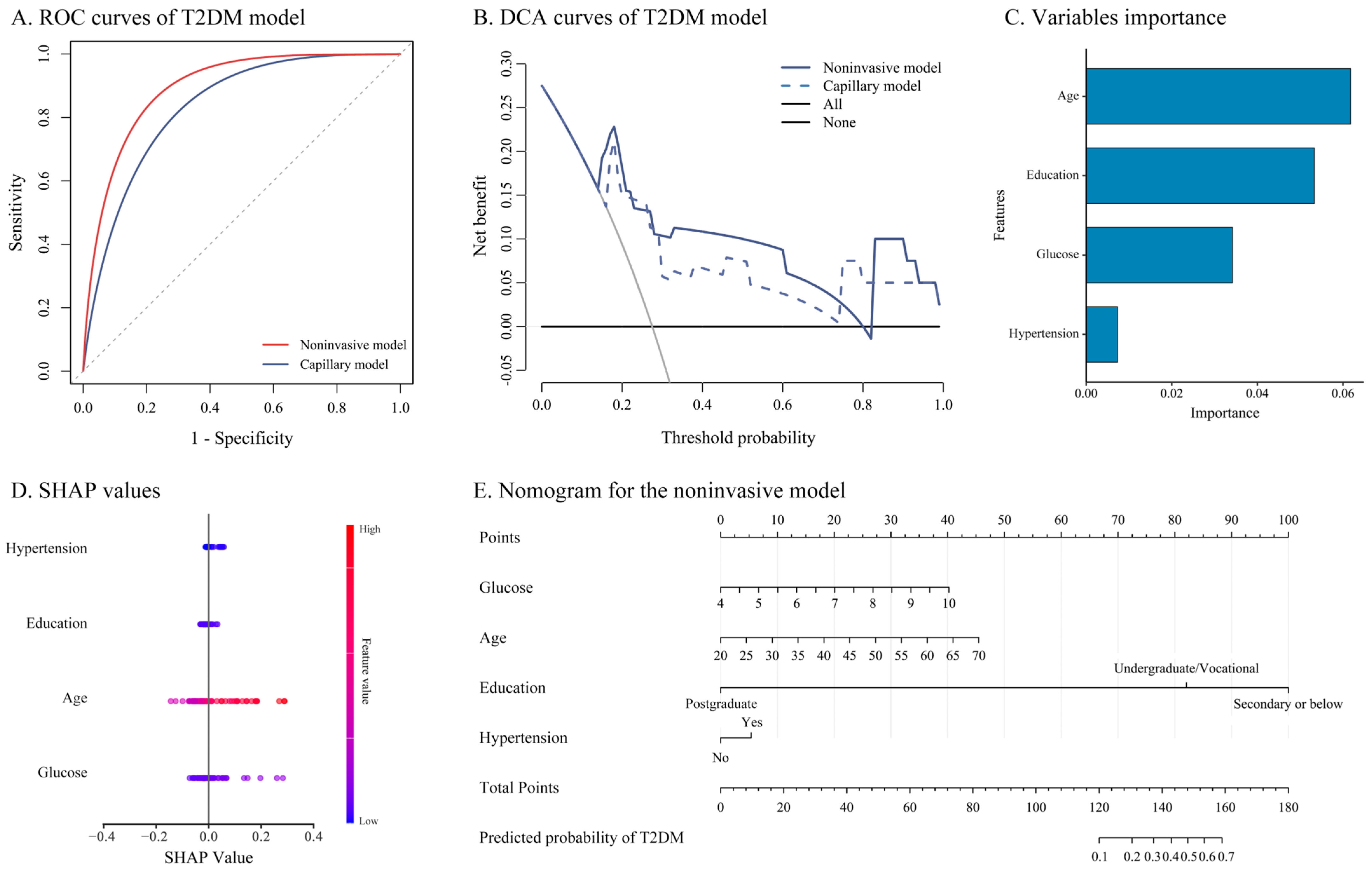
Baseline characteristics of the training and validation sets are shown in Table S2. Under the mixing percentage (α = 0.6) and penalty parameter (λ = 0.149) corresponding to the one-standard-error criterion, we selected four variables: noninvasive fasting glucose, age, education, and hypertension (Figure S4). As seen in Figure 2A and Table 2, the AUCs of the noninvasive model (0.906 [95%CI: 0.800, 1.000]) and the capillary model (0.850 [95%CI: 0.706, 0.993]) did not differ significantly (p = 0.124). Consistently, no statistically significant differences were observed for NRI (0.044, p = 0.566) or IDI (−0.078, p = 0.073). Additional information on the validation and training sets is provided in Table S3.
The accuracy, sensitivity, and specificity were 0.825 (95%CI: 0.672, 0.927), 0.889 (95%CI: 0.518, 0.997), and 0.806 (95%CI: 0.625, 0.925), respectively. DCA indicated that the noninvasive model yielded a higher net benefit than either treating all or treating none (Figure 2B). According to the feature importance ranking (Figure 2C), noninvasive fasting glucose was identified as a key predictor, ranking third after age and education. Elevated glucose levels contributed to the increased risk of T2DM (Figure 2D). The nomogram of the noninvasive model is shown in Figure 2E.
The results of repeated cross-validation analysis were similar to the main analyses. Specifically, the AUCs of the noninvasive and capillary models were 0.844 (95%CI: 0.814, 0.873) and 0.830 (95%CI: 0.797, 0.863), respectively (Table S4).

3.3.2. Screening Performance in the Undiagnosed Population

As for participants without self-reported diabetes or hypoglycemia medication (n = 125), the AUC of the noninvasive T2DM model was 0.794 (95%CI: 0.677, 0.912), which remained similar to the capillary model (AUC = 0.772, p = 0.619; NRI = 0.044, p = 0.295; IDI = −0.027, p = 0.439; Table S5).

3.3.3. Noninvasive Screening for Prediabetes Risk

Excluding individuals with diabetes, we constructed a screening model for prediabetes (n = 114), randomly dividing the dataset into training and validation sets at a 7:3 ratio (Table S6). Under the mixing percentage (α = 0.5) and penalty parameter (λ = 0.171) corresponding to the one-standard-error criterion, we selected six variables: second and third principal components of noninvasive glucose, age, hypertension, ethnicity, and alcohol consumption (Figure S5). The AUC, accuracy, sensitivity, and specificity were 0.760 (95%CI: 0.572, 0.948), 0.735 (95%CI: 0.556, 0.871), 0.889 (95%CI: 0.518, 0.997), and 0.680 (95%CI: 0.465, 0.851) (Table S7).

4. Discussion

The multicenter study evaluated the performance and screening utility of a novel wearable NIGM system, MicroTED, under free-living conditions. Our findings demonstrate that the device offered acceptable measurement accuracy and high comfort. We discovered that the short-term noninvasive glycemic profiles were statistically equivalent to reference capillary glucose trends in the general population, although discrepancies were observed in older adults and patients with T2DM. Furthermore, the MicroTED-based screening model achieved excellent discrimination for identifying T2DM risk, comparable to the capillary model, and demonstrated potential for early prediabetes detection using dynamic glucose trajectory features. Taken together, these results indicate that MicroTED serves as a promising, accessible tool for large-scale T2DM screening and early risk identification.
T2DM and prediabetes are often detected only after years of unrecognized dysglycemia, and global estimates suggest that roughly 43% of adults living with diabetes remain undiagnosed [2,29]. Prolonged hyperglycemia can precede clinical diagnosis by about 4–7 years, during which time people may already develop microvascular damage and present with retinopathy, neuropathy, or nephropathy at their first clinical contact [30]. These observations point to a substantial window in which earlier detection and intervention could prevent or delay complications. In principle, regular glucose testing could help identify high-risk individuals earlier. Still, adherence to repeated capillary glucose testing is often poor because testing is painful, inconvenient, and disruptive to daily life [31]. In routine care, glucose monitoring therefore depends on a combination of fingerstick testing and CGM [4]. CGM uses a subcutaneous sensor to measure interstitial glucose continuously, provides detailed glucose profiles, and is recommended in contemporary standards of care for many people with diabetes, yet use in everyday practice remains limited because devices are costly, require prescription and user training, and rely on transcutaneous sensors that can cause discomfort, skin reactions, and alarm burden [32,33]. To address both access and wearability, we developed MicroTED. This soft, patch-like, entirely noninvasive glucose monitoring device uses reverse iontophoresis with on-skin electrochemistry rather than a subcutaneous sensor. It is designed for comfortable daytime wear without skin puncture [21]. In our study, the device was generally well tolerated, and most participants reported that it was comfortable to wear and did not interfere with usual daily activities. Additionally, our findings show that the wearable device based on reverse iontophoresis with on-skin electrochemistry (RIOSE) can provide both fasting glucose values and 12-h daytime glycemic profiles without skin penetration, with performance comparable to invasive approaches. In addition, the device performed well in screening for T2DM. These findings suggest a potential role for entirely noninvasive glucose monitoring in population screening for previously unrecognized diabetes or high-risk dysglycemia, and in longitudinal risk monitoring and day-to-day feedback, particularly for people with limited access to conventional invasive testing.
Noninvasive glucose monitoring has been explored for several decades using electrochemical, optical, and electromagnetic approaches, but many devices tested to date have shown only moderate accuracy and practical limitations when evaluated in ambulatory humans [34,35]. RI devices, such as the GlucoWatch biographer, were among the earliest systems to provide automated on-body readouts by extracting interstitial glucose through intact skin. Yet, they required frequent fingerstick calibration and showed median relative absolute differences of about 16–21% versus reference glucose, with poorer performance during hypoglycemia [36,37]. Regulatory and clinical reports also described an overall lag of roughly 15–20 min between GlucoWatch readings and blood glucose and iontophoresis-related skin irritation, which together limited user acceptance and contributed to withdrawal from the market [36,37,38]. More recent optical and electromagnetic noninvasive devices, including Raman spectroscopy-based systems, have reported mean absolute relative differences of about 10–14%, with most paired values in Clarke or consensus error grid zones A and B [10,16,39]. However, these devices have mainly been evaluated as research prototypes in small clinical or laboratory studies or protocolized home-use trials (typically ≈20–160 participants, often with established diabetes), usually requiring hours-long individualized calibration and being assessed over limited monitoring periods ranging from a few days to several weeks, rather than in large, unsupervised everyday use [10,39]. In this context, given that the MicroTED noninvasive device provided glucose readings comparable to capillary measurements, it may offer a practical option for day-to-day self-monitoring and for noninvasive identification of individuals at increased risk for T2DM. However, it is essential to note that laboratory-based testing will still be required to confirm T2DM and to guide treatment decisions.
In subgroup analyses, device performance was broadly similar across sex and study centers, with fasting MicroTED readings and 12-h daytime profiles showing comparable agreement with invasive reference measures. These findings support the robustness of the RIOSE approach across different populations and implementation sites. By contrast, both absolute accuracy and curve-level concordance were attenuated among participants with established T2DM and in older adults. This pattern is biologically plausible. Chronic hyperglycemia in T2DM is associated with structural and functional changes in the skin, including reduced stratum corneum hydration, thickening of the stratum corneum, altered barrier function, and impaired cutaneous microcirculation, all of which can modify interstitial fluid composition and hinder transdermal extraction [40,41]. Aging itself is also accompanied by a decline in skin barrier function, decreased hydration and elasticity, and microvascular dysfunction, which may further reduce the efficiency and stability of RI-based sampling [41,42]. In addition, the physiological lag time between interstitial fluid and blood glucose levels is increased when the rate of change in blood glucose exceeds the limited rate of capillary diffusion [43]. People with long-standing T2DM often have greater glycemic variability and may receive glucose-lowering therapies that induce rapid glucose excursions, as well as a reduced rate of glucose transport into the interstitial fluid of subcutaneous tissue compared to healthy individuals [44,45]. All of these factors may exacerbate discrepancies between a transdermal signal and venous or capillary reference values. Notably, when we restricted analyses to participants without known T2DM at baseline, agreement between noninvasive and invasive measures improved compared with the overall cohort. Taken together, these findings suggest that this entirely noninvasive patch may be most informative for describing daytime glucose patterns and for identifying adults without known T2DM who may have previously unrecognized T2DM or high-risk dysglycemia and therefore warrant confirmatory testing. Notably, because only a small number of older adults and participants with T2DM were included, statistical power for these subgroups was limited. Device performance in these groups remains uncertain and should be evaluated in larger, dedicated studies.
The robust discrimination capability of the noninvasive model for T2DM, which proved statistically comparable to capillary models even in undiagnosed populations, highlights its potential as a barrier-free screening tool. The integration of SHAP analyses further confirmed that the model captures genuine physiological risk patterns driven by glucose levels, age, and education, which is similar to previous studies [46,47]. Uniquely, the continuous nature of NIGM allowed for the extraction of dynamic trajectory features, namely functional principal components, facilitating the identification of prediabetes, which often presents with subtle glycemic variability preceding fasting hyperglycemia [48,49]. Specifically, the “positive to negative” shift in the second functional principal component of noninvasive glucose indicates differences in glucose changes from morning to evening, which might reflect short-term rhythmic variations; the “positive-negative-positive” oscillations in the third principal component might reflect meal-driven excursions and postprandial recovery, while its derivative function reflects the rates of fluctuation and recovery. Notably, although the sensitivity of the prediabetes model was high, specificity and PPV were modest, which might limit the screening efficiency of the model. From a clinical perspective, an entirely noninvasive patch such as MicroTED is best considered an adjunct to standard laboratory and capillary-based glucose testing rather than a replacement. In adults without known T2DM, particularly those who feel well but have risk factors such as a family history of diabetes or excess adiposity, brief daytime wear in primary care or community settings could provide a simple snapshot of glucose behavior and help identify individuals who should be referred for diagnostic evaluation or closer surveillance [23,50]. Noninvasive patches could also be incorporated into digital health or population risk-assessment programs to extend glucose profiling beyond people who currently receive CGM or perform frequent self-monitoring, especially where access to invasive technologies is limited. These potential applications should be evaluated in pragmatic studies that embed the patch into routine care and examine its impact on referral patterns, time to diagnosis, patient experience, and costs compared with existing strategies.
This study has several strengths. First, its multicenter design and the use of venous plasma glucose as the laboratory reference enhance the reliability and generalizability of the findings. Second, we comprehensively evaluated device performance by combining fasting glucose measurements with a 12-h continuous monitoring period and employed advanced functional data analysis to address irregular and sparse sampling, enabling a more accurate comparison of glucose trajectories.
Nevertheless, several limitations should be acknowledged. First, the study population was relatively young, and the number of participants with T2DM was small, which may have reduced generalizability and partly accounted for the lower accuracy and reduced equivalence observed in older adults (≥45 years) and individuals with T2DM. Future studies involving more heterogeneous and clinically representative populations are warranted. Second, the monitoring duration was relatively short. Due to the general-population nature of our research and constraints in device availability, only a single 12-h daytime session was recorded, without nocturnal measurements or repeated assessments across multiple days. Longer-term monitoring will be essential to characterize glycemic patterns better. Third, because prolonged venous blood sampling is challenging in free-living individuals, capillary glucose measurements served as the reference. Although this method is widely adopted and clinically validated for self-monitoring, the substitution may nonetheless introduce measurement variability. In addition, inter-individual differences in skin physiology, including factors such as temperature, sweating, and hydration status that may influence RI-based glucose extraction [51], were not assessed and require further study. Finally, given the sparse nature of our current reference glucose data, we plan to systematically collect high-frequency blood glucose measurements in future studies, which will allow us to accurately quantify the specific, dynamic physiological lag times between interstitial fluid and blood glucose across varying glycemic states, and to explore the integration of predictive algorithms to dynamically align noninvasive signals for real-time glucose monitoring.

5. Conclusions

This multicenter study validates the performance of the MicroTED system, an entirely noninvasive glucose monitor integrating reverse iontophoresis and electrochemical sensing. The device demonstrated acceptable accuracy and functional equivalence to capillary glucose trends in the general population. Notably, the noninvasive screening model achieved robust discrimination for T2DM risk and showed promise for early prediabetes identification through dynamic glycemic features. These findings suggest the device serves as a painless and accessible adjunct tool for population-level screening and risk identification in free-living settings, not a replacement modality for standard glucose monitoring or confirmatory laboratory testing. Future research should focus on optimizing algorithms for older adults and evaluating the system’s long-term health economic impact in diverse populations.

Supplementary Materials

The following supporting information can be downloaded at https://www.mdpi.com/article/10.3390/bios16040214/s1, Supplemental methods; Table S1: The eigenvalue and FVE for FPCs of noninvasive and capillary glucose.; Table S2: Characteristics comparison between training and validation sets for T2DM modeling; Table S3: Results of screening models for T2DM risk; Table S4: Performance of noninvasive and capillary screening models based on repeated cross-validation; Table S5: Comparison of noninvasive and capillary screening models (n = 125); Table S6: Characteristics comparison between training and validation sets for prediabetes modeling; Table S7: Results of the screening model for prediabetes risk; Figure S1: Multi-time-point blood glucose data density; Figure S2: Clarke error grid analysis for paired fasting glucose measurements; Figure S3: Subgroup analyses of equivalence testing; Figure S4: LASSO regression coefficient paths and cross-validation for optimal lambda selection for T2DM modeling; Figure S5: LASSO regression coefficient paths and cross-validation for optimal lambda selection for prediabetes modeling.

Author Contributions

Conceptualization, X.G.; methodology, P.W., X.C., Z.F., Z.Z. and G.Z.; software, W.X., H.L. and S.C.; validation, P.W., Y.H. and X.C.; formal analysis, W.X. and J.W.; investigation, S.C., Y.H. and G.Z.; data curation, H.L. and Y.H.; writing—original draft preparation, W.X. and J.W.; writing—review and editing, Z.F., Z.Z. and X.G.; supervision, G.Z. and X.G.; funding acquisition, X.G. All authors have read and agreed to the published version of the manuscript.

Funding

This research was funded by the Capital’s Funds for Health Improvement and Research, CFH 2024-1G-4261, and the Program of the Natural Science Foundation of China, No. 82373683.

Institutional Review Board Statement

The study was conducted in accordance with the Declaration of Helsinki, and approved by the Ethics Committee of Capital Medical University (protocol code 2024SY034 approved on 17 July 2024) and the Beijing Physical Examination Center (protocol code BJTJZX-005 approved on 25 September 2024).

Informed Consent Statement

Informed consent was obtained from all subjects involved in the study.

Data Availability Statement

The data presented in this study are available upon request from the corresponding author due to privacy and ethical reasons.

Acknowledgments

We are grateful to all participants, investigators, and workers for their contributions to the data curation and data release in our study. The authors have reviewed and edited the output and take full responsibility for the content of this publication.

Conflicts of Interest

The authors declare no conflicts of interest.

Abbreviations

The following abbreviations are used in this manuscript:
CGMContinuous glucose monitoring
DCADecision curve analysis
IDIIntegrated discrimination improvement
ISFInterstitial fluid
MARDMean absolute relative difference
NIGMNoninvasive glucose monitoring
NRINet reclassification improvement
RIReverse-iontophoresis
RIOSEReverse iontophoresis with on-skin electrochemistry
SHAPSHapley Additive exPlanations
T2DMType 2 diabetes mellitus

References

  1. Duncan, B.B.; Magliano, D.J.; Boyko, E.J. IDF Diabetes Atlas 11th edition 2025: Global prevalence and projections for 2050. Nephrol. Dial. Transplant. 2025, 41, 4–10. [Google Scholar] [CrossRef]
  2. Ogurtsova, K.; Guariguata, L.; Barengo, N.C.; Ruiz, P.L.; Sacre, J.W.; Karuranga, S.; Sun, H.; Boyko, E.J.; Magliano, D.J. IDF diabetes Atlas: Global estimates of undiagnosed diabetes in adults for 2021. Diabetes Res. Clin. Pract. 2022, 183, 109118. [Google Scholar] [CrossRef] [PubMed]
  3. Lai, C.C.; Chang, B.C.; Hwang, L.C. Presence of coronary artery disease in adults with newly detected diabetes mellitus. BMC Cardiovasc. Disord. 2025, 25, 76. [Google Scholar] [CrossRef]
  4. Twigg, S.; Lim, S.; Yoo, S.H.; Chen, L.; Bao, Y.; Kong, A.; Yeoh, E.; Chan, S.P.; Robles, J.; Mohan, V.; et al. Asia-Pacific perspectives on the role of continuous glucose monitoring in optimizing diabetes management. J. Diabetes Sci. Technol. 2024, 18, 1460–1471. [Google Scholar] [CrossRef]
  5. Barchiesi, M.A.; Calabrese, A.; Costa, R.; Di Pillo, F.; D’Uffizi, A.; Tiburzi, L.; Zahid, E. Continuous glucose monitoring in type 2 diabetes: A systematic review of barriers and opportunities for care improvement. Int. J. Qual. Health Care 2025, 37, mzaf046. [Google Scholar] [CrossRef]
  6. American Diabetes Association Professional Practice Committee. 7. Diabetes technology: Standards of care in diabetes-2025. Diabetes Care 2024, 48, S146–S166. [Google Scholar] [CrossRef]
  7. Alkabbani, W.; Cromer, S.J.; Kim, D.H.; Paik, J.M.; Bykov, K.; Munshi, M.; Wexler, D.J.; Patorno, E. Overall uptake and racial, ethnic, and socioeconomic disparities in the use of continuous glucose monitoring devices among insulin-treated older adults with type 2 diabetes. Diabetes Care 2025, 48, 1377–1385. [Google Scholar] [CrossRef] [PubMed]
  8. Wang, M.; Zheng, J.; Zhang, G.; Lu, S.; Zhou, J. Wearable electrochemical glucose sensors for fluid monitoring: Advances and challenges in non-invasive and minimally invasive technologies. Biosensors 2025, 15, 309. [Google Scholar] [CrossRef]
  9. Singh, R.; Nema, P.; Purohit, A.; Vishwakarma, S.; Tantuway, S.; Namdeo, P.; Kumar, A.; Soni, V.; Kashaw, S.K. Advancements in glucose biosensors: Innovations for wearable and real-time monitoring. Talanta 2026, 299, 129045. [Google Scholar] [CrossRef]
  10. Pors, A.; Rasmussen, K.G.; Inglev, R.; Jendrike, N.; Philipps, A.; Ranjan, A.G.; Vestergaard, V.; Henriksen, J.E.; Nørgaard, K.; Freckmann, G.; et al. Accurate post-calibration predictions for noninvasive glucose measurements in people using confocal Raman spectroscopy. ACS Sens. 2023, 8, 1272–1279. [Google Scholar] [CrossRef]
  11. Loyola-Leyva, A.; Hernández-Vidales, K.; Loyola-Rodríguez, J.P.; González, F.J. Noninvasive glucose measurements through transcutaneous Raman spectroscopy: A review. J. Diabetes Sci. Technol. 2024, 18, 460–469. [Google Scholar] [CrossRef]
  12. Zhu, W.; Yu, H.; Pu, Z.; Guo, Z.; Zheng, H.; Li, C.; Zhang, X.; Li, J.; Li, D. Effect of interstitial fluid pH on transdermal glucose extraction by reverse iontophoresis. Biosens. Bioelectron. 2023, 235, 115406. [Google Scholar] [CrossRef]
  13. Wang, Q.; Jiao, C.; Chen, W.; Li, L.; Zhang, X.; Guo, Z.; Hu, L.; Fan, Y. Reusable gallium-based electrochemical sensor for efficient glucose detection. Biosens. Bioelectron. 2025, 268, 116858. [Google Scholar] [CrossRef]
  14. Sun, T.; Liu, J.; Chen, C.J. Calibration algorithms for continuous glucose monitoring systems based on interstitial fluid sensing. Biosens. Bioelectron. 2024, 260, 116450. [Google Scholar] [CrossRef] [PubMed]
  15. Zhu, W.; Yu, H.; Li, W.; Li, X.; Zheng, H.; Li, C.; Zhang, X.; Jin, C.; Wang, M.; Hou, J.; et al. pH calibration allows accurate glucose detection in interstitial fluid via reverse iontophoresis. Nat. Commun. 2025, 16, 10413. [Google Scholar] [CrossRef]
  16. Zhang, Y.; Zhang, L.; Wang, L.; Shao, S.; Tao, B.; Hu, C.; Chen, Y.; Shen, Y.; Zhang, X.; Pan, S.; et al. Subcutaneous depth-selective spectral imaging with mμSORS enables noninvasive glucose monitoring. Nat. Metab. 2025, 7, 421–433. [Google Scholar] [CrossRef]
  17. Qureshi, M.R.A.; Bain, S.C.; Luzio, S.; Handy, C.; Fowles, D.J.; Love, B.; Wareham, K.; Barlow, L.; Dunseath, G.J.; Crane, J.; et al. Using artificial intelligence to improve the accuracy of a wrist-worn, noninvasive glucose monitor: A pilot study. J. Diabetes Sci. Technol. 2025, 19, 1546–1553. [Google Scholar] [CrossRef] [PubMed]
  18. Eichenlaub, M.; Stephan, P.; Waldenmaier, D.; Pleus, S.; Rothenbühler, M.; Haug, C.; Hinzmann, R.; Thomas, A.; Jendle, J.; Diem, P.; et al. Continuous glucose deviation interval and variability analysis (CG-DIVA): A novel approach for the statistical accuracy assessment of continuous glucose monitoring systems. J. Diabetes Sci. Technol. 2024, 18, 857–865. [Google Scholar] [CrossRef]
  19. Sugimoto, H.; Hironaka, K.I.; Nakamura, T.; Yamada, T.; Miura, H.; Otowa-Suematsu, N.; Fujii, M.; Hirota, Y.; Sakaguchi, K.; Ogawa, W.; et al. Improved detection of decreased glucose handling capacities via continuous glucose monitoring-derived indices. Commun. Med. 2025, 5, 103. [Google Scholar] [CrossRef]
  20. Dette, H.; Kokot, K. Bio-equivalence tests in functional data by maximum deviation. Biometrika 2020, 108, 895–913. [Google Scholar] [CrossRef]
  21. Sun, T.; Zhang, Y.; Jiao, Y.; Chen, C.J.; Liu, J.T. Micro interstitial fluid extraction and detection device integrated with the optimal extraction conditions for noninvasive glucose monitoring. Biosens. Bioelectron. 2023, 237, 115515. [Google Scholar] [CrossRef]
  22. Zhao, R.; Wang, C.; Lu, F.; Du, L.; Fang, Z.; Guo, X.; Liu, J.-T.; Chen, C.-J.; Zhao, Z. A flexible interdigital electrode used in skin penetration promotion and evaluation with electroporation and reverse iontophoresis synergistically. Sensors 2018, 18, 1431. [Google Scholar] [CrossRef]
  23. American Diabetes Association Professional Practice Committee. 2. Diagnosis and classification of diabetes: Standards of care in diabetes-2025. Diabetes Care 2025, 48, S27–S49. [Google Scholar] [CrossRef]
  24. Sandforth, L.; Kullmann, S.; Sandforth, A.; Fritsche, A.; Jumpertz-von Schwartzenberg, R.; Stefan, N.; Birkenfeld, A.L. Prediabetes remission to reduce the global burden of type 2 diabetes. Trends Endocrinol. Metab. 2025, 36, 899–916. [Google Scholar] [CrossRef]
  25. Yao, F.; Müller, H.-G.; Wang, J.-L. Functional data analysis for sparse longitudinal data. J. Am. Stat. Assoc. 2005, 100, 577–590. [Google Scholar] [CrossRef]
  26. Gertheiss, J.; Rügamer, D.; Liew, B.X.W.; Greven, S. Functional data analysis: An introduction and recent developments. Biom. J. 2024, 66, e202300363. [Google Scholar] [CrossRef] [PubMed]
  27. ISO 15197; In Vitro Diagnostic Test Systems—Requirements for Blood-Glucose Monitoring Systems for Self-Testing in Managing Diabetes Mellitus. International Organization for Standardization: Geneva, Switzerland, 2013.
  28. O’Connor, M.Y.; Flint, K.L.; Sabean, A.; Ashley, A.; Zheng, H.; Yan, J.; Steiner, B.A.; Anandakugan, N.; Calverley, M.; Bartholomew, R. Accuracy of continuous glucose monitoring in the hospital setting: An observational study. Diabetologia 2024, 67, 2650–2659. [Google Scholar] [CrossRef] [PubMed]
  29. Teufel, F.; Orgutsova, K.; Genitsaridi, I.; Carrillo-Larco, R.M.; Varghese, J.S.; Marcus, M.E.; Sacre, J.W.; Sajjadi, S.F.; Chiwanga, F.; Manne-Goehler, J.; et al. Global, regional, and national estimates of undiagnosed diabetes in adults: Findings from the 2025 IDF Diabetes Atlas. Diabetes Care 2026, 49, 490–496. [Google Scholar] [CrossRef]
  30. Kim, S.; Jeon, B. Disability-related disparities in health outcomes among newly diagnosed diabetic patients: A retrospective cohort. BMC Public Health 2024, 24, 2207. [Google Scholar] [CrossRef] [PubMed]
  31. Gee, J.S.; Rosario, N.; Garey, K.W.; Asias-Dinh, B. Effectiveness of continuous glucose monitoring in a pharmacist-run collaborative drug therapy management service for underserved individuals with diabetes: Q quasi-experimental study. Clin. Diabetes 2025, 43, 554–560. [Google Scholar] [CrossRef]
  32. Tanenbaum, M.L.; Commissariat, P.V. Barriers and facilitators to diabetes device adoption for people with type 1 diabetes. Curr. Diab. Rep. 2022, 22, 291–299. [Google Scholar] [CrossRef] [PubMed]
  33. Maizel, J.; Walker, A.F.; Walls, A.; Pasquel, F.J.; Haller, M.J.; Bruggeman, B.S. A qualitative analysis of provider-level barriers to prescribing diabetes technology. J. Diabetes Res. 2025, 2025, 8873848. [Google Scholar] [CrossRef]
  34. Tang, L.; Chang, S.J.; Chen, C.J.; Liu, J.T. Non-invasive blood glucose monitoring technology: A review. Sensors 2020, 20, 6925. [Google Scholar] [CrossRef]
  35. Lee, J.E.; Sridharan, B.; Kim, D.; Sung, Y.; Park, J.H.; Lim, H.G. Continuous glucose monitoring: Minimally and non-invasive technologies. Clin. Chim. Acta 2025, 575, 120358. [Google Scholar] [CrossRef]
  36. The Diabetes Research in Children Network (DirecNet) Study Group. Accuracy of the GlucoWatch G2 Biographer and the continuous glucose monitoring system during hypoglycemia: Experience of the Diabetes Research in Children Network. Diabetes Care 2004, 27, 722–726. [Google Scholar] [CrossRef]
  37. Eastman, R.C.; Chase, H.P.; Buckingham, B.; Hathout, E.H.; Fuller-Byk, L.; Leptien, A.; Van Wyhe, M.M.; Davis, T.L.; Fermi, S.J.; Pechler, H.; et al. Use of the GlucoWatch biographer in children and adolescents with diabetes. Pediatr. Diabetes 2002, 3, 127–134. [Google Scholar] [CrossRef]
  38. Hathout, E.; Patel, N.; Southern, C.; Hill, J.; Anderson, R.; Sharkey, J.; Hadley-Scofield, M.; Tran, L.; Leptien, A.; Lopatin, M.; et al. Home use of the GlucoWatch G2 biographer in children with diabetes. Pediatrics 2005, 115, 662–666. [Google Scholar] [CrossRef] [PubMed]
  39. Pors, A.; Korzeniowska, B.; Rasmussen, M.T.; Lorenzen, C.V.; Rasmussen, K.G.; Inglev, R.; Philipps, A.; Zschornack, E.; Freckmann, G.; Weber, A.; et al. Calibration and performance of a Raman-based device for non-invasive glucose monitoring in type 2 diabetes. Sci. Rep. 2025, 15, 10226. [Google Scholar] [CrossRef]
  40. Dorf, N.; Maciejczyk, M. Skin manifestations in diabetes-what is new? Front. Med. 2025, 12, 1640144. [Google Scholar] [CrossRef]
  41. Man, M.Q.; Wakefield, J.S.; Mauro, T.M.; Elias, P.M. Alterations in epidermal function in type 2 diabetes: Implications for the management of this disease. J. Diabetes 2022, 14, 586–595. [Google Scholar] [CrossRef]
  42. Woo, Y.R.; Kim, H.S. Interaction between the microbiota and the skin barrier in aging skin: A comprehensive review. Front. Physiol. 2024, 15, 1322205. [Google Scholar] [CrossRef]
  43. Barua, S.; Wierzchowska-McNew, R.; Deutz, N.E.P.; Sabharwal, A. Discordance between postprandial plasma glucose measurement and continuous glucose monitoring. Am. J. Clin. Nutr. 2022, 116, 1059–1069. [Google Scholar] [CrossRef] [PubMed]
  44. Chlup, R.; Krejci, J.; O’Connell, M.; Sebestova, B.; Plicka, R.; Jezova, L.; Brozova, T.; Doubravova, B.; Zalesakova, H.; Durajkova, E.; et al. Glucose concentrations in blood and tissue-a pilot study on variable time lag. Biomed. Pap. Med. Fac. Univ. Palacky. Olomouc Czech Repub. 2015, 159, 527–534. [Google Scholar] [CrossRef] [PubMed]
  45. Merino, J.; Linenberg, I.; Bermingham, K.M.; Ganesh, S.; Bakker, E.; Delahanty, L.M.; Chan, A.T.; Capdevila Pujol, J.; Wolf, J.; Al Khatib, H.; et al. Validity of continuous glucose monitoring for categorizing glycemic responses to diet: Implications for use in personalized nutrition. Am. J. Clin. Nutr. 2022, 115, 1569–1576. [Google Scholar] [CrossRef]
  46. Lu, K.; Kornas, K.; Rosella, L.C. Predictive modelling of diabetes risk in population groups defined by socioeconomic and lifestyle factors in Canada: A cross-sectional study. Int. J. Public Health 2024, 69, 1607060. [Google Scholar] [CrossRef]
  47. Karunarathna, T.S.; Liang, Z. Development of non-invasive continuous glucose prediction models using multi-modal wearable sensors in free-living conditions. Sensors 2025, 25, 3207. [Google Scholar] [CrossRef]
  48. Hall, H.; Perelman, D.; Breschi, A.; Limcaoco, P.; Kellogg, R.; McLaughlin, T.; Snyder, M. Glucotypes reveal new patterns of glucose dysregulation. PLoS Biol. 2018, 16, e2005143. [Google Scholar] [CrossRef]
  49. Bergman, M.; Manco, M.; Satman, I.; Chan, J.; Schmidt, M.I.; Sesti, G.; Vanessa Fiorentino, T.; Abdul-Ghani, M.; Jagannathan, R.; Kumar Thyparambil Aravindakshan, P.; et al. International Diabetes Federation Position Statement on the 1-hour post-load plasma glucose for the diagnosis of intermediate hyperglycaemia and type 2 diabetes. Diabetes Res. Clin. Pract. 2024, 209, 111589. [Google Scholar] [CrossRef]
  50. Davidson, K.W.; Barry, M.J.; Mangione, C.M.; Cabana, M.; Caughey, A.B.; Davis, E.M.; Donahue, K.E.; Doubeni, C.A.; Krist, A.H.; Kubik, M.; et al. Screening for prediabetes and type 2 diabetes: US preventive services task force recommendation statement. J. Am. Med. Assoc. 2021, 326, 736–743. [Google Scholar] [CrossRef]
  51. Piersanti, A.; Littero, M.; Del Giudice, L.L.; Marcantoni, I.; Burattini, L.; Tura, A.; Morettini, M. Variability of the skin temperature from wrist-worn device for definition of novel digital biomarkers of glycemia. Sensors 2025, 25, 4038. [Google Scholar] [CrossRef]
Figure 1. Functional representations and equivalence test of glucose profiles. Notes: (A) was the mean functions of noninvasive and capillary glucose, with shaded areas indicating corresponding 95%CIs; (B) was the first five eigenfunctions of noninvasive glucose; (C) was the first three eigenfunctions of capillary glucose; and (D) was standardized observed statistic (T) and the bootstrap distribution of the test statistic (T*) in functional equivalence testing.
Biosensors 16 00214 g001
Figure 2. Screening models for T2DM risk. Notes: (A) was the ROCs of noninvasive and capillary models; (B) was the DCA curves of the noninvasive and capillary model; (C) was SHAP value ranking of the variables in the noninvasive model; (D) was the SHAP honeycomb diagram of the noninvasive model; and (E) was the nomogram of the noninvasive model, including the fasting glucose, age, marital status, and education. Abbreviations: ROC, receiver operating characteristic; T2DM, type 2 diabetes mellitus; DCA, decision curve analysis; SHAP, SHapley Additive exPlanations.
Biosensors 16 00214 g002
Table 1. Baseline characteristics for individuals.
CharacteristicsOverall
(n = 135)
T2DMp-Value
No (n = 114)Yes (n = 21)
Trial site 0.069
 Subcenter A82 (60.74)65 (57.02)17 (80.95)
 Subcenter B53 (39.26)49 (42.98)4 (19.05)
Age, years35.34 (14.78)32.64 (12.77)50.00 (16.57)<0.001
Sex 0.594
 Male54 (40.00)44 (38.60)10 (47.62)
 Female81 (60.00)70 (61.40)11 (52.38)
Marital status 0.003
 Married54 (40.00)39 (34.21)15 (71.43)
 Other81 (60.00)75 (65.79)6 (28.57)
Education <0.001
 Secondary or below20 (14.81)9 (7.89)11 (52.38)
 Undergraduate or vocational67 (49.63)58 (50.88)9 (42.86)
 Postgraduate48 (35.56)47 (41.23)1 (4.76)
Ethnicity 0.493
 Han124 (91.85)106 (92.98)18 (85.71)
 Other ethnic minorities11 (8.15)8 (7.02)3 (14.29)
Smoking >0.999
 Yes12 (8.89)10 (8.77)2 (9.52)
 No123 (91.11)104 (91.23)19 (90.48)
Alcohol consumption 1.000
 Yes6 (4.44)5 (4.39)1 (4.76)
 No129 (95.56)109 (95.61)20 (95.24)
Sleep duration 0.979
 7–8 h per day80 (59.26)67 (58.77)13 (61.90)
 Others55 (40.74)47 (41.23)8 (38.10)
Napping 0.530
 ≤2 days per week85 (62.96)70 (61.40)15 (71.43)
 ≥3 days per week50 (37.04)44 (38.60)6 (28.57)
Staying up status 0.007
 Never34 (25.19)23 (20.18)11 (52.38)
 Sometimes35 (25.92)32 (28.07)3 (14.29)
 Always66 (48.89)59 (51.75)7 (33.33)
Exercise 0.673
 Never27 (20.00)24 (21.05)3 (14.29)
 Sometimes60 (44.44)49 (42.99)11 (52.38)
 Always48 (35.56)41 (35.96)7 (33.33)
Sweety preference 0.230
 Yes37 (27.41)34 (29.82)3 (14.29)
 No98 (72.59)80 (70.18)18 (85.71)
Venous glucose, mmol/L5.11 (0.94)4.85 (0.45)6.48 (1.56)<0.001
Noninvasive glucose, mmol/L5.11 (1.22)4.96 (1.19)5.95 (1.04)<0.001
HbA1c, %5.81 (0.90)5.53 (0.43)7.33 (1.20)<0.001
BMI, kg/m223.28 (5.45)22.91 (5.39)25.27 (5.49)0.068
WHR, cm/cm0.83 (0.09)0.82 (0.09)0.86 (0.11)0.093
Pulse, bpm73.36 (9.37)73.65 (9.68)71.81 (7.51)0.410
Hypertension 0.002
 Yes15 (11.11)8 (7.02)7 (33.33)
 No120 (88.89)106 (92.98)14 (66.67)
Family history of T2DM 0.173
 Yes12 (8.89)8 (7.02)4 (19.05)
 No123 (91.11)106 (92.98)17 (80.95)
Perceived comfort of the device 0.709
 Overall comfort110 (81.48)94 (82.46)16 (76.19)
 Discomfort8 (5.93)7 (6.14)1 (4.76)
 Missing17 (12.59)13 (11.40)4 (19.05)
Notes: Data are presented as mean ± SD or n (%). Abbreviations: T2DM, type 2 diabetes mellitus; BMI, body mass index; WHR, waist-to-hip ratio.
Table 2. Comparison of noninvasive and capillary models for T2DM.
Estimate95%CIp-Value
AUC 0.124
 Capillary model0.8500.706–0.993
 Noninvasive model0.9060.800–1.000
NRI 0.566
 Capillary modelRef.
 Noninvasive model0.044−0.106–0.194
IDI 0.073
 Capillary modelRef.
 Noninvasive model−0.078−0.163–0.007
Notes: the capillary and noninvasive models included fasting glucose, age, education, and hypertension. Abbreviations: CI, confidence interval; AUC, the area under the curve; NRI, net reclassification improvement; IDI, integrated discrimination improvement.
Disclaimer/Publisher’s Note: The statements, opinions and data contained in all publications are solely those of the individual author(s) and contributor(s) and not of MDPI and/or the editor(s). MDPI and/or the editor(s) disclaim responsibility for any injury to people or property resulting from any ideas, methods, instructions or products referred to in the content.