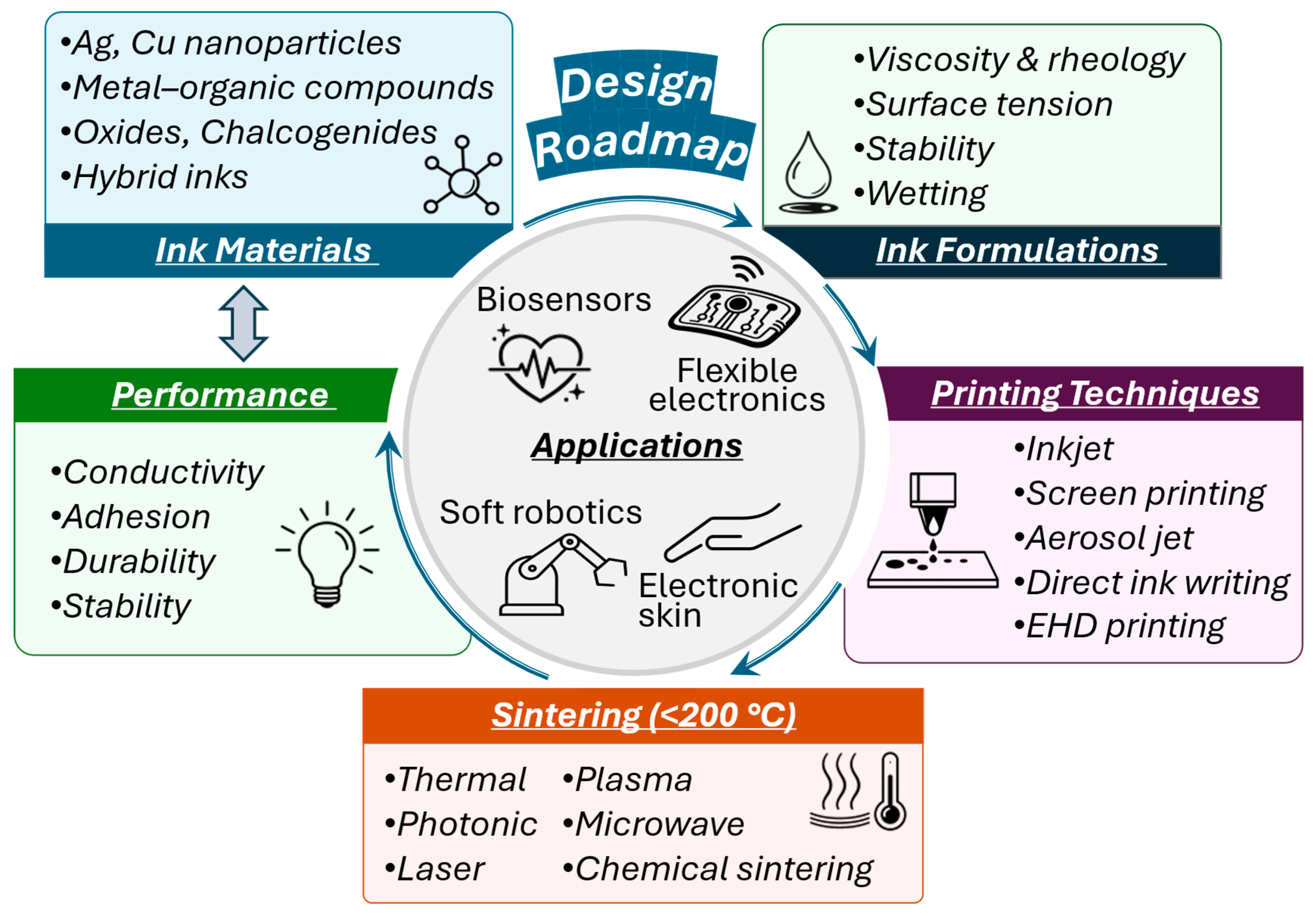
Low-Temperature Sintering Inks for Printed Bioelectronics: Materials, Mechanisms, and Emerging Ideas

 ,
,  , , , , and
Abstract
1. Introduction
2. Low-Temperature Sintering Inks
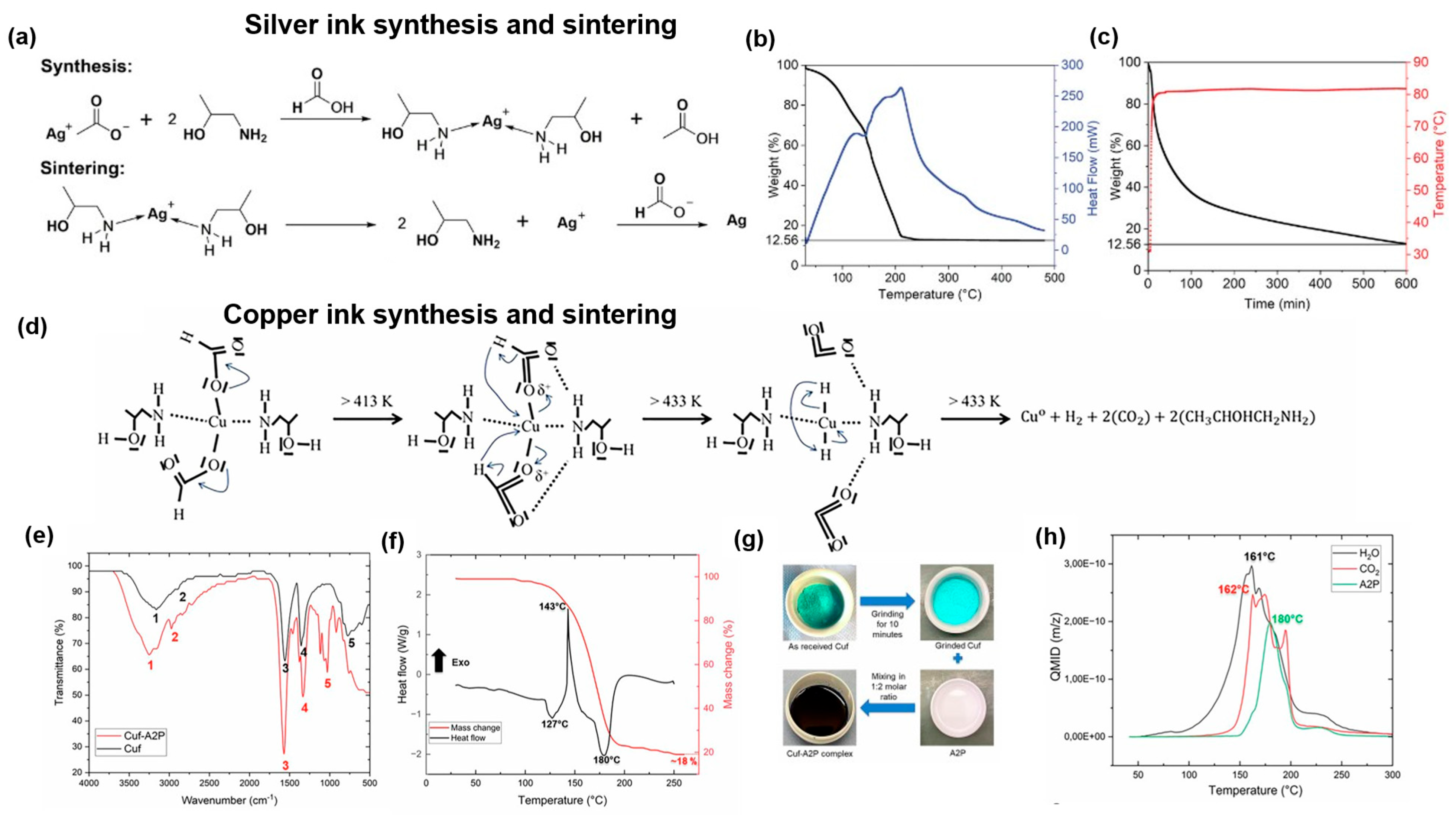
2.1. Metal Inks
- (1)
- Ag inks
- (2)
- Cu inks
- (3)
- Au, Ni, and other metal inks
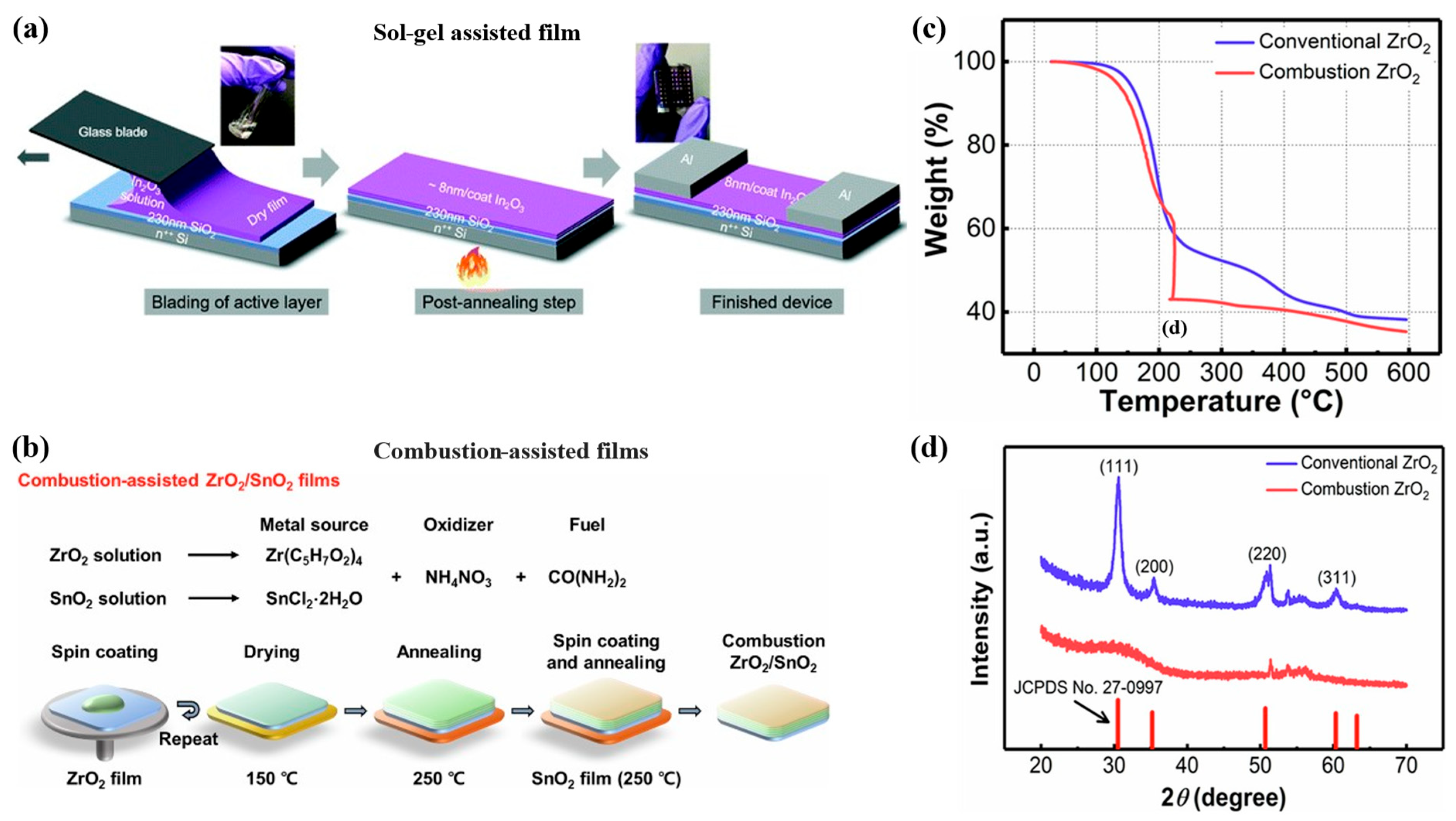
2.2. Metal Oxide Inks
- (1)
- Sol-gel condensation
- (2)
- Combustion-assisted oxide formation

- (3)
- Peroxides and nitrates
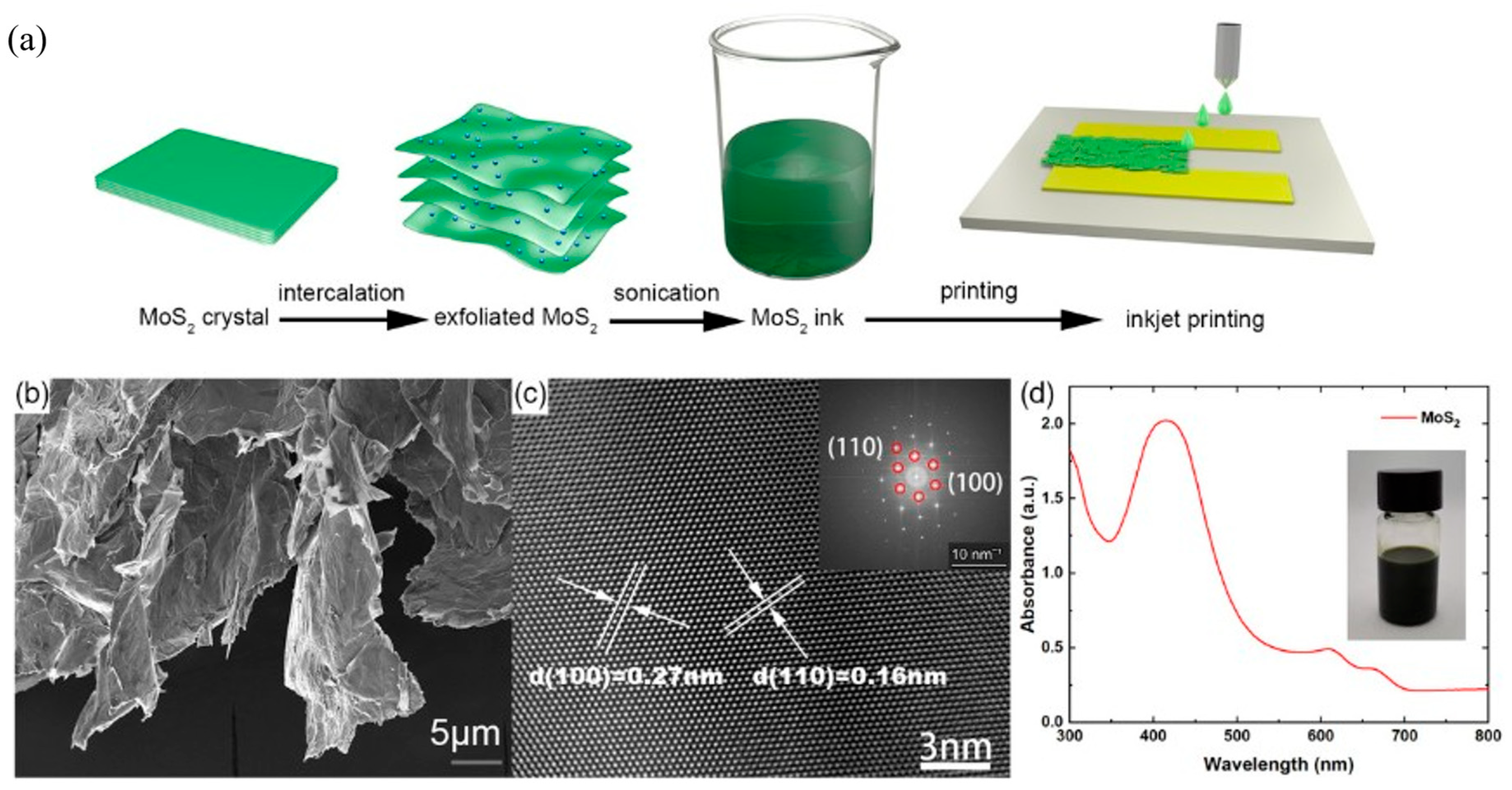
2.3. Metal Chalcogenide Inks
2.4. Nanoparticle Inks Synthesized with Biobased Polymers
2.5. Conductive Polymer Inks
2.6. Emerging Material Inks
3. Low-Temperature Sintering/Curing Process and Mechanism
3.1. Thermal Curing (<200 °C): Convection/Hotplate/IR
- (1)
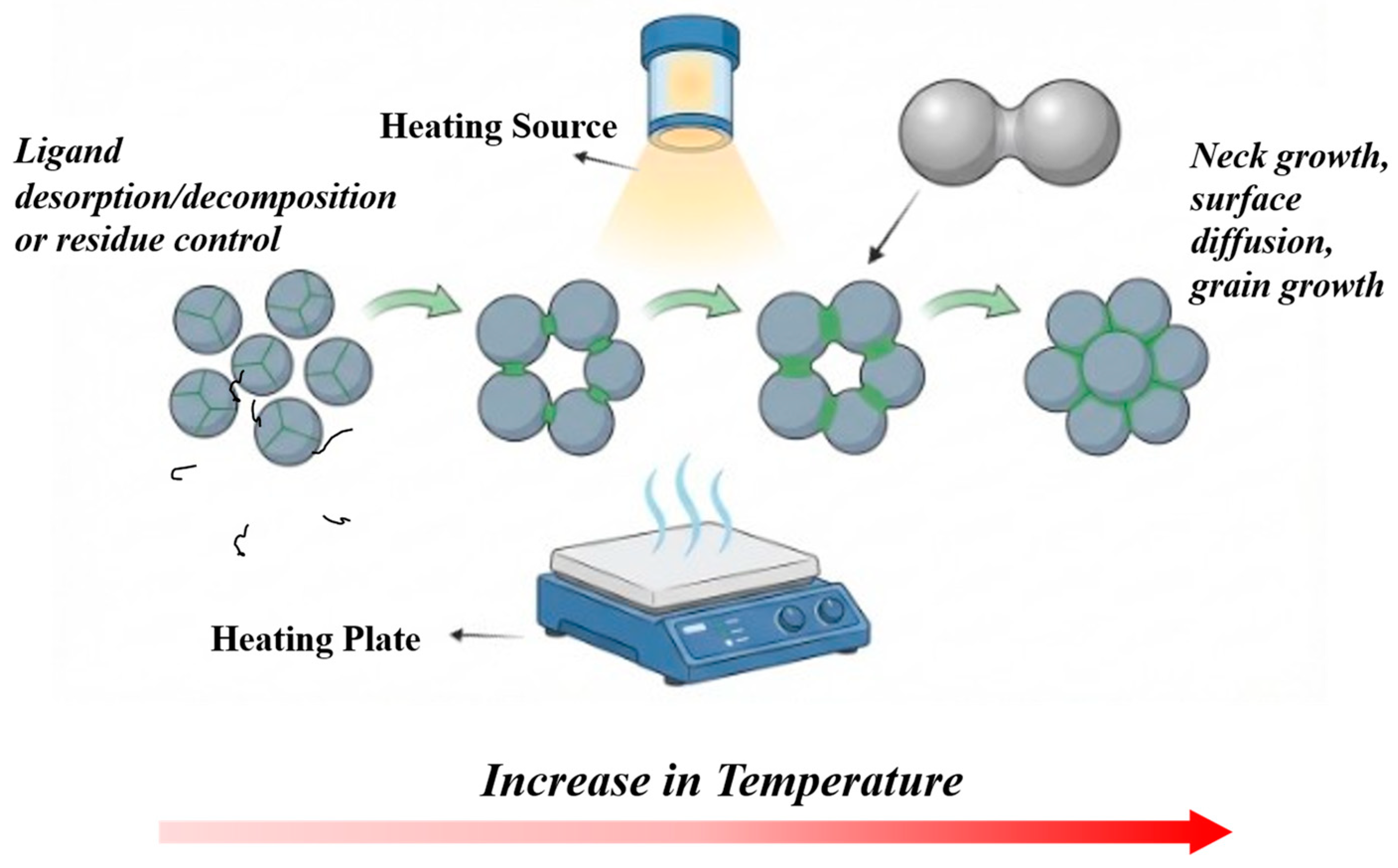
- Densification
- (2)
- Organic removal: ligand desorption and residue control
- (3)
- Emerging conversion and densification pathways
3.2. Photonic Sintering
3.3. Laser Sintering
3.4. Plasma and Microwave Sintering
3.5. Chemical Sintering
3.6. Trade-Offs Among Low-Temperature Sintering Approaches for Biosensor Fabrication
3.7. Impact of Sintering-Induced Microstructure on Biosensor Performance
3.8. Practical Challenges in Sintering-Compatible Integration of Bio-Functional Layers
4. Applications
4.1. Biochemical Sensors
- (1)
- Biological Fluid-Based Sensors
- (2)
- Metabolite Sensor (Glucose and Lactate Sensors)
- (3)
- pH Sensor
- (4)
- Cholesterol Sensor
- (5)
- Acetone (Diabetes-Related) Sensors
- (6)
- Alcohol Detection Sensors

| Ink Material, Electrodes, and their role | Printing and Processing Conditions | Substrate | Sensing Mechanism/Transduction | Performance Metrics | Target Analyte -- Sensor Type |
|---|---|---|---|---|---|
| Ag/AgCl reference electrodes, gold working electrodes, and carbon counter electrodes integrated with enzyme-functionalized sensing layers (e.g., glucose oxidase) | Screen printing/microfabrication, low temperature curing <100 °C | PET/flexible polymer | Potentiometric ion-selective electrode (ISE) for chloride detection, Enzymatic amperometric detection | Real-time monitoring of sweat biomarkers during sedentary conditions; demonstrated quantitative correlation between sweat glucose and blood glucose trends | Multi-analyte (sweat/saliva) -- Biological fluid-based platforms [215] |
| Carbon working electrode ink + Ag/AgCl reference ink | Screen printing; curing 60–90 °C | Temporary tattoo/PET | Enzymatic amperometric detection using lactate oxidase | Linear response 0–20 mM lactate | Lactate (sweat) -- Lactate biosensor [216] |
| Conductive Ag ink and CuO catalytic WE | Inkjet; screen printing, CuO annealing: 150–300 °C | Flexible polymer | Electrocatalytic oxidation on CuO surface | Linear-detecting range of 0.05–18.45 mM and the detection limit of ∼0.5 μM (S/N = 3) sensitivity 2762.5 μAm M−1 cm−2 | Glucose -- Glucose (CuO non-enzymatic) [212] |
| Ag/AgCl reference and CuO pH film (optional) | Screen printing; inkjet, 80–150 °C | PET | Potentiometric measurement based on Nernst equation | Near-Nernstian slope (~59 mV/pH); reference stability critical | pH (H+) -- pH (electrochemical) [222] |
| Ag ink for conductivity enhancement and Cu2O | Wet chemical bath deposition (CBD) technique, screen printing, and hybrid nanostructure deposition | 200–400 °C (rigid); <200 °C (flexible variants) | Enzymatic electrochemical oxidation | Enzyme-free; nanostructure-dependent sensitivity; sensitivity (12,140.06 μAmM−1 cm−2) low detection limit (0.057 mM) and fast response | Cholesterol -- Cholesterol (enzymatic) [226] |
| Ag ink for interconnect | Screen printing, 100–150 °C; biolayer: RT | Temporary tattoo | Enzymatic amperometric detection | Direct vs. metabolite detection; multi-day monitoring; drift-sensitive | Ethanol/EtG -- Alcohol (enzymatic/EtG) [234] |
| Ag electrodes and CuO sensing film | Inkjet; screen printing 150–350 °C (oxide); photonic curing preferred | Flexible polymer | Chemi-resistive gas sensing via surface adsorption | Sub-ppm detection; humidity sensitivity; temperature modulation | Acetone -- Acetone (metal oxide) [230] |
4.2. Biophysical Sensing
- (1)
- Hydration and Dehydration Sensors
- (2)
- Temperature sensors
- (3)
- Motion and activity sensors
- (4)
- Pressure and strain sensors
| Ink Material, Electrodes, and Their Role | Printing and Processing Conditions | Substrate | Measured type | Sensing Mechanism/Transduction | Performance Metrics | Biosensor Type |
|---|---|---|---|---|---|---|
| Ag Interdigitated electrodes | Screen printing 80–150 °C | PET | Skin conductivity by Skin hydration | Impedance-based hydration tracking; sweat-rate dependent | Real-time hydration monitoring | Hydration/Impedance [238] |
| Ag Resistive serpentine heater and Cu resistive traces (oxidation risk) | Screen printing; inkjet 100–150 °C | Elastomer | Skin temperature | Thermoresistive sensing; fast response; low power | Sensitivity ~0.01 °C | Temperature [20,240] |
| Ag Stretchable conductive traces | Screen printing; aerosol jet 80–150 °C | Textile | Mechanical deformation. Motion/bending | High gauge factor; fatigue durability; flexible substrates | High durability (>1000 cycles) | Motion/Strain [30,242] |
| Ag electrode arrays and Cu Conductive interconnects | Screen printing; aerosol jet 80–150 °C | Elastomer | Mechanical force | Piezoresistive/capacitive modes; wearable integration | Gauge factor 10–20 | Pressure [243,244] |
4.3. Electrophysiological Sensors
- (1)
- Electrocardiography (ECG)
- (2)
- Electromyography (EMG)
- (3)
- Electrooculography (EOG)
- (4)
- Electroencephalogram (EEG)
- (5)
- Photoplethysmography (PPG)
4.4. Design Guidelines for Biosensor Fabrication
4.5. Challenges
5. Outlook and Future Research Direction
5.1. Performance–Processing Tradeoffs
5.2. Materials Sustainability and Cost
5.3. Integration and Multilayer Device Complexity
5.4. Industrial Translation and Manufacturing Scalability
5.5. Emerging Opportunities in Materials and Data-Driven Design
Author Contributions
Funding
Institutional Review Board Statement
Informed Consent Statement
Data Availability Statement
Acknowledgments
Conflicts of Interest
References
- Lewis, J.A.; Ahn, B.Y. Three-dimensional printed electronics. Nature 2015, 518, 42–43. [Google Scholar] [CrossRef]
- Kamyshny, A.; Magdassi, S. Conductive nanomaterials for printed electronics. Small 2014, 10, 3515–3535. [Google Scholar] [CrossRef]
- Hales, S.; Tokita, E.; Neupane, R.; Ghosh, U.; Elder, B.; Wirthlin, D.; Kong, Y.L. 3D printed nanomaterial-based electronic, biomedical, and bioelectronic devices. Nanotechnology 2020, 31, 172001. [Google Scholar] [CrossRef] [PubMed]
- Chopra, J. Analysis of lithography based approaches in development of semi conductors. arXiv 2015, arXiv:1502.05887. [Google Scholar] [CrossRef]
- Kim, D.; Moon, J. Highly conductive ink jet printed films of nanosilver particles for printable electronics. Electrochem. Solid-State Lett. 2005, 8, J30. [Google Scholar] [CrossRef]
- Beedasy, V.; Smith, P.J. Printed electronics as prepared by inkjet printing. Materials 2020, 13, 704. [Google Scholar] [CrossRef]
- Tay, R.Y.; Song, Y.; Yao, D.R.; Gao, W. Direct-ink-writing 3D-printed bioelectronics. Mater. Today 2023, 71, 135–151. [Google Scholar] [CrossRef]
- Yi, H.; Liu, Y.; Cao, H.; Luo, J.; Dong, X.; An, J.; Chua, C.K. Material and process integrated innovations in Aerosol Jet Printing: A review. Mater. Today 2025, 91, 431–458. [Google Scholar] [CrossRef]
- Kirscht, T.; Bera, A.; Marander, M.; Grota, C.; Liu, F.; Jiang, S. Smaller is better: Reducing silver nanoparticle size without excess ligands enhances conductivity and flexibility in printed thin films. npj Flex. Electron. 2025, 9, 113. [Google Scholar] [CrossRef]
- Huang, Y.; Jiang, L.; Marander, M.; Maddineni, S.P.; Qin, H.; Jiang, S.; Hill, C.W.; Seol, M.L.; Chen, Y.C.D. Memory Manufacture Under Microgravity (MMuM): In-Space Manufactured ZnO-Based Resistive Random Access Memory for Emerging Computing Application. Adv. Electron. Mater. 2025, 11, 2500114. [Google Scholar] [CrossRef]
- Perelaer, J.; Smith, P.J.; Mager, D.; Soltman, D.; Volkman, S.K.; Subramanian, V.; Korvink, J.G.; Schubert, U.S. Printed electronics: The challenges involved in printing devices, interconnects, and contacts based on inorganic materials. J. Mater. Chem. 2010, 20, 8446–8453. [Google Scholar] [CrossRef]
- Trung, T.Q.; Lee, N.E. Flexible and stretchable physical sensor integrated platforms for wearable human-activity monitoringand personal healthcare. Adv. Mater. 2016, 28, 4338–4372. [Google Scholar] [CrossRef]
- Nyein, H.Y.Y.; Gao, W.; Shahpar, Z.; Emaminejad, S.; Challa, S.; Chen, K.; Fahad, H.M.; Tai, L.-C.; Ota, H.; Davis, R.W. A wearable electrochemical platform for noninvasive simultaneous monitoring of Ca2+ and pH. ACS Nano 2016, 10, 7216–7224. [Google Scholar] [CrossRef]
- Perelaer, J.; Klokkenburg, M.; Hendriks, C.E.; Schubert, U.S. Microwave flash sintering of inkjet-printed silver tracks on polymer substrates. Adv. Mater. 2009, 21, 4830–4834. [Google Scholar] [CrossRef]
- Heikenfeld, J.; Jajack, A.; Rogers, J.; Gutruf, P.; Tian, L.; Pan, T.; Li, R.; Khine, M.; Kim, J.; Wang, J. Wearable sensors: Modalities, challenges, and prospects. Lab A Chip 2018, 18, 217–248. [Google Scholar] [CrossRef]
- Kim, J.; Campbell, A.S.; de Ávila, B.E.-F.; Wang, J. Wearable biosensors for healthcare monitoring. Nat. Biotechnol. 2019, 37, 389–406. [Google Scholar] [CrossRef]
- Castrejón-Pita, J.; Martin, G.; Hoath, S.; Hutchings, I. A simple large-scale droplet generator for studies of inkjet printing. Rev. Sci. Instrum. 2008, 79, 075108. [Google Scholar] [CrossRef] [PubMed]
- Han, Y.; Wei, C.; Dong, J. Droplet formation and settlement of phase-change ink in high resolution electrohydrodynamic (EHD) 3D printing. J. Manuf. Process. 2015, 20, 485–491. [Google Scholar] [CrossRef]
- Zhang, Y.; Chen, X.; Liu, F.; Li, L.; Dai, J.; Liu, T. Enhanced Coffee-Ring Effect via Substrate Roughness in Evaporation of Colloidal Droplets. Adv. Condens. Matter Phys. 2018, 2018, 9795654. [Google Scholar] [CrossRef]
- Kim, D.-H.; Lu, N.; Ma, R.; Kim, Y.-S.; Kim, R.-H.; Wang, S.; Wu, J.; Won, S.M.; Tao, H.; Islam, A. Epidermal electronics. Science 2011, 333, 838–843. [Google Scholar] [CrossRef]
- Gao, W.; Emaminejad, S.; Nyein, H.Y.Y.; Challa, S.; Chen, K.; Peck, A.; Fahad, H.M.; Ota, H.; Shiraki, H.; Kiriya, D. Fully integrated wearable sensor arrays for multiplexed in situ perspiration analysis. Nature 2016, 529, 509–514. [Google Scholar] [CrossRef] [PubMed]
- Oh, B.; Baek, S.; Nam, K.S.; Sung, C.; Yang, C.; Lim, Y.-S.; Ju, M.S.; Kim, S.; Kim, T.-S.; Park, S.-M. 3D printable and biocompatible PEDOT: PSS-ionic liquid colloids with high conductivity for rapid on-demand fabrication of 3D bioelectronics. Nat. Commun. 2024, 15, 5839. [Google Scholar] [CrossRef]
- Park, J.; Kim, J.; Kim, S.-Y.; Cheong, W.H.; Jang, J.; Park, Y.-G.; Na, K.; Kim, Y.-T.; Heo, J.H.; Lee, C.Y. Soft, smart contact lenses with integrations of wireless circuits, glucose sensors, and displays. Sci. Adv. 2018, 4, eaap9841. [Google Scholar] [CrossRef]
- Lee, G.H.; Kang, H.; Chung, J.W.; Lee, Y.; Yoo, H.; Jeong, S.; Cho, H.; Kim, J.-Y.; Kang, S.-G.; Jung, J.Y. Stretchable PPG sensor with light polarization for physical activity–permissible monitoring. Sci. Adv. 2022, 8, eabm3622. [Google Scholar] [CrossRef] [PubMed]
- Kim, J.; Ghaffari, R.; Kim, D.-H. The quest for miniaturized soft bioelectronic devices. Nat. Biomed. Eng. 2017, 1, 0049. [Google Scholar] [CrossRef]
- Ray, T.R.; Choi, J.; Bandodkar, A.J.; Krishnan, S.; Gutruf, P.; Tian, L.; Ghaffari, R.; Rogers, J.A. Bio-integrated wearable systems: A comprehensive review. Chem. Rev. 2019, 119, 5461–5533. [Google Scholar] [CrossRef]
- Wang, J. Electrochemical glucose biosensors. Chem. Rev. 2008, 108, 814–825. [Google Scholar] [CrossRef]
- Hu, L.; Kim, H.S.; Lee, J.-Y.; Peumans, P.; Cui, Y. Scalable coating and properties of transparent, flexible, silver nanowire electrodes. ACS Nano 2010, 4, 2955–2963. [Google Scholar] [CrossRef]
- Ma, S.; Wan, Z.a.; Wang, C.; Song, Z.; Ding, Y.; Zhang, D.; Chan, C.L.J.; Shu, L.; Huang, L.; Yang, Z.; et al. Ultra-Sensitive and Stable Multiplexed Biosensors Array in Fully Printed and Integrated Platforms for Reliable Perspiration Analysis. Adv. Mater. 2024, 36, 2311106. [Google Scholar] [CrossRef]
- Chi, Y.; Jiang, S.; Wang, J. Fabrication and Performance of Nano-Silver Conductive Ink-Based Flexible Wearable Sensors. ACS Appl. Nano Mater. 2025, 8, 20776–20791. [Google Scholar] [CrossRef]
- Li, X.; Li, X.; Wang, M.; Zheng, R.; Jin, Y.; Gu, Z. Flexible and strain conductive cotton yarn enabled by low-temperature sintering of silver paste with multifunctional sensing capability in human motion detection and wearable applications. Chem. Eng. J. 2023, 471, 144843. [Google Scholar] [CrossRef]
- Turner, A.P. Biosensors: Sense and sensibility. Chem. Soc. Rev. 2013, 42, 3184–3196. [Google Scholar] [CrossRef]
- Sassolas, A.; Blum, L.J.; Leca-Bouvier, B.D. Immobilization strategies to develop enzymatic biosensors. Biotechnol. Adv. 2012, 30, 489–511. [Google Scholar] [CrossRef]
- Justino, C.I.; Freitas, A.C.; Pereira, R.; Duarte, A.C.; Santos, T.A.R. Recent developments in recognition elements for chemical sensors and biosensors. TrAC Trends Anal. Chem. 2015, 68, 2–17. [Google Scholar] [CrossRef]
- Torrisi, F.; Hasan, T.; Wu, W.; Sun, Z.; Lombardo, A.; Kulmala, T.S.; Hsieh, G.-W.; Jung, S.; Bonaccorso, F.; Paul, P.J. Inkjet-printed graphene electronics. ACS Nano 2012, 6, 2992–3006. [Google Scholar] [CrossRef] [PubMed]
- Secor, E.B.; Lim, S.; Zhang, H.; Frisbie, C.D.; Francis, L.F.; Hersam, M.C. Gravure printing of graphene for large-area flexible electronics. Adv. Mater. 2014, 26, 4533–4538. [Google Scholar] [CrossRef] [PubMed]
- Cummins, G.; Desmulliez, M.P. Inkjet printing of conductive materials: A review. Circuit World 2012, 38, 193–213. [Google Scholar] [CrossRef]
- Allen, M.L.; Aronniemi, M.; Mattila, T.; Alastalo, A.; Ojanperä, K.; Suhonen, M.; Seppä, H. Electrical sintering of nanoparticle structures. Nanotechnology 2008, 19, 175201. [Google Scholar] [CrossRef]
- Mrig, S.; Bhide, M.A.; Zhou, Y.; Stanton, N.; Wang, J.; Douglas, S.P.; Tinker, H.R.; Mears, K.L.; Bakewell, C.M.; Knapp, C.E. Unraveling the Steric Link to Copper Precursor Decomposition: A Multi-Faceted Study for the Printing of Flexible Electronics. Small Methods 2023, 7, 2300038. [Google Scholar] [CrossRef]
- Niu, Y.; Han, Y.; Cheng, H.; Xiong, Z.; Luo, B.; Ma, T.; Li, L.; Liu, S.; Chen, X.; Yi, C. Synthesized silver nanoparticles decorated reduced graphene oxide/silver ink for aerosol jet printed conformal temperature sensor with a wide sensing range and excellent stability. J. Mater. Res. Technol. 2023, 25, 873–886. [Google Scholar] [CrossRef]
- Liu, D.; Liu, Z.; Feng, S.; Gao, Z.; Chen, R.; Cai, G.; Bian, S. Wearable microfluidic sweat chip for detection of sweat glucose and pH in long-distance running exercise. Biosensors 2023, 13, 157. [Google Scholar] [CrossRef]
- Heikenfeld, J.; Jajack, A.; Feldman, B.; Granger, S.W.; Gaitonde, S.; Begtrup, G.; Katchman, B.A. Accessing analytes in biofluids for peripheral biochemical monitoring. Nat. Biotechnol. 2019, 37, 407–419. [Google Scholar] [CrossRef]
- Trau, D.; Renneberg, R. Encapsulation of glucose oxidase microparticles within a nanoscale layer-by-layer film: Immobilization and biosensor applications. Biosens. Bioelectron. 2003, 18, 1491–1499. [Google Scholar] [CrossRef] [PubMed]
- Sato, K.; Takahashi, S.; Anzai, J.-i. Layer-by-layer thin films and microcapsules for biosensors and controlled release. Anal. Sci. 2012, 28, 929–938. [Google Scholar] [CrossRef] [PubMed]
- Erdogan, Z.K.; Desai, K.; Baldwin, G.S.; Polizzi, K.M. Coexistence and collaboration: Engineering encapsulation for whole-cell biosensors. Trends Biotechnol. 2025. [Google Scholar] [CrossRef]
- Liu, G.; Lv, Z.; Batool, S.; Li, M.Z.; Zhao, P.; Guo, L.; Wang, Y.; Zhou, Y.; Han, S.T. Biocompatible material-based flexible biosensors: From materials design to wearable/implantable devices and integrated sensing systems. Small 2023, 19, 2207879. [Google Scholar] [CrossRef]
- Lu, T.; Ji, S.; Jin, W.; Yang, Q.; Luo, Q.; Ren, T.-L. Biocompatible and long-term monitoring strategies of wearable, ingestible and implantable biosensors: Reform the next generation healthcare. Sensors 2023, 23, 2991. [Google Scholar] [CrossRef]
- Someya, T.; Bao, Z.; Malliaras, G.G. The rise of plastic bioelectronics. Nature 2016, 540, 379–385. [Google Scholar] [CrossRef]
- Trung, T.Q.; Lee, N.E. Recent progress on stretchable electronic devices with intrinsically stretchable components. Adv. Mater. 2017, 29, 1603167. [Google Scholar] [CrossRef] [PubMed]
- Kim, R.-H.; Kim, D.-H.; Xiao, J.; Kim, B.H.; Park, S.-I.; Panilaitis, B.; Ghaffari, R.; Yao, J.; Li, M.; Liu, Z. Waterproof AlInGaP optoelectronics on stretchable substrates with applications in biomedicine and robotics. Nat. Mater. 2010, 9, 929–937. [Google Scholar] [CrossRef]
- Heller, A.; Feldman, B. Electrochemical glucose sensors and their applications in diabetes management. Chem. Rev. 2008, 108, 2482–2505. [Google Scholar] [CrossRef] [PubMed]
- Wilson, R.; Turner, A. Glucose oxidase: An ideal enzyme. Biosens. Bioelectron. 1992, 7, 165–185. [Google Scholar] [CrossRef]
- Walker, S.B.; Lewis, J.A. Reactive silver inks for patterning high-conductivity features at mild temperatures. J. Am. Chem. Soc. 2012, 134, 1419–1421. [Google Scholar] [CrossRef]
- Perelaer, J.; Jani, R.; Grouchko, M.; Kamyshny, A.; Magdassi, S.; Schubert, U.S. Plasma and microwave flash sintering of a tailored silver nanoparticle ink, yielding 60% bulk conductivity on cost-effective polymer foils. Adv. Mater. 2012, 24, 3993–3998. [Google Scholar] [CrossRef]
- Bandodkar, A.J.; Wang, J. Non-invasive wearable electrochemical sensors: A review. Trends Biotechnol. 2014, 32, 363–371. [Google Scholar] [CrossRef]
- Ghosh, S.; Neupane, R.; Sahu, D.; Teng, J.; Kong, Y. The continuous actuation of liquid metal with a 3D-printed electrowetting device. Med X 2025, 3, 9. [Google Scholar] [CrossRef]
- Kong, Y.L.; Hales, S.; John, S.H.; Xin, Y. Near-field microwave 3d printing of functional devices. U.S. Patent Application No. 18/862,392, 2025. [Google Scholar]
- Grouchko, M.; Kamyshny, A.; Ben-Ami, K.; Magdassi, S. Synthesis of copper nanoparticles catalyzed by pre-formed silver nanoparticles. J. Nanoparticle Res. 2009, 11, 713–716. [Google Scholar] [CrossRef]
- Magdassi, S.; Grouchko, M.; Kamyshny, A. Copper nanoparticles for printed electronics: Routes towards achieving oxidation stability. Materials 2010, 3, 4626–4638. [Google Scholar] [CrossRef] [PubMed]
- Kamyshny, A.; Steinke, J.; Magdassi, S. Metal-based inkjet inks for printed electronics. Open Appl. Phys. J. 2011, 4, 1. [Google Scholar] [CrossRef]
- Dearden, A.L.; Smith, P.J.; Shin, D.Y.; Reis, N.; Derby, B.; O’Brien, P. A low curing temperature silver ink for use in ink-jet printing and subsequent production of conductive tracks. Macromol. Rapid Commun. 2005, 26, 315–318. [Google Scholar] [CrossRef]
- Smith, P.; Shin, D.-Y.; Stringer, J.; Derby, B.; Reis, N. Direct ink-jet printing and low temperature conversion of conductive silver patterns. J. Mater. Sci. 2006, 41, 4153–4158. [Google Scholar] [CrossRef]
- Grieshaber, D.; MacKenzie, R.; Vörös, J.; Reimhult, E. Electrochemical biosensors-sensor principles and architectures. Sensors 2008, 8, 1400–1458. [Google Scholar] [CrossRef]
- Dincer, C.; Bruch, R.; Costa-Rama, E.; Fernández-Abedul, M.T.; Merkoçi, A.; Manz, A.; Urban, G.A.; Güder, F. Disposable sensors in diagnostics, food, and environmental monitoring. Adv. Mater. 2019, 31, 1806739. [Google Scholar] [CrossRef] [PubMed]
- Magdassi, S. The Chemistry of Inkjet Inks; World Scientific: Singapore, 2009. [Google Scholar]
- Perelaer, J.; Abbel, R.; Wünscher, S.; Jani, R.; van Lammeren, T.; Schubert, U.S. Roll-to-roll compatible sintering of inkjet printed features by photonic and microwave exposure: From non-conductive ink to 40% bulk silver conductivity in less than 15 seconds. Adv. Mater. 2012, 24, 2620. [Google Scholar] [CrossRef]
- Kamyshny, A.; Magdassi, S. Conductive nanomaterials for 2D and 3D printed flexible electronics. Chem. Soc. Rev. 2019, 48, 1712–1740. [Google Scholar] [CrossRef] [PubMed]
- Xu, S.; Zhang, Y.; Jia, L.; Mathewson, K.E.; Jang, K.-I.; Kim, J.; Fu, H.; Huang, X.; Chava, P.; Wang, R. Soft microfluidic assemblies of sensors, circuits, and radios for the skin. Science 2014, 344, 70–74. [Google Scholar] [CrossRef] [PubMed]
- Silva, H.D.; Bezerra, S.C.; Rube, M.; Araújo, J.F.; Sebeloue, M.; Freire, R.C.; Tamarin, O. Interdigitated Capacitive Biosensors as Accessible Sensors: A Literature Review. IEEE Access 2025, 13, 202315–202339. [Google Scholar] [CrossRef]
- Ghavipanjeh, A.; Sadeghzadeh, S. Cellulose-Based Laser-Induced Graphene: Progress and Prospects. Polym. Rev. 2026, 1–64. [Google Scholar] [CrossRef]
- Hu, L.; Pasta, M.; La Mantia, F.; Cui, L.; Jeong, S.; Deshazer, H.D.; Choi, J.W.; Han, S.M.; Cui, Y. Stretchable, porous, and conductive energy textiles. Nano Lett. 2010, 10, 708–714. [Google Scholar] [CrossRef]
- De, S.; Coleman, J.N. Are there fundamental limitations on the sheet resistance and transmittance of thin graphene films? ACS Nano 2010, 4, 2713–2720. [Google Scholar] [CrossRef]
- Gao, J.; Hua, Z.; Xu, S.; Wan, H.; Zhi, Z.; Chen, X.; Fan, S. Amperometric gas sensors based on screen printed electrodes with porous ceramic substrates. Sens. Actuators B Chem. 2021, 342, 130045. [Google Scholar]
- Niu, X.; Li, Y.; Tang, J.; Hu, Y.; Zhao, H.; Lan, M. Electrochemical sensing interfaces with tunable porosity for nonenzymatic glucose detection: A Cu foam case. Biosens. Bioelectron. 2014, 51, 22–28. [Google Scholar] [CrossRef]
- Soleymani, L.; Li, F. Mechanistic challenges and advantages of biosensor miniaturization into the nanoscale. ACS Sens. 2017, 2, 458–467. [Google Scholar] [CrossRef]
- Jang, D.; Kim, D.; Moon, J. Influence of fluid physical properties on ink-jet printability. Langmuir 2009, 25, 2629–2635. [Google Scholar] [CrossRef] [PubMed]
- Nallan, H.C.; Sadie, J.A.; Kitsomboonloha, R.; Volkman, S.K.; Subramanian, V. Systematic design of jettable nanoparticle-based inkjet inks: Rheology, acoustics, and jettability. Langmuir 2014, 30, 13470–13477. [Google Scholar] [CrossRef]
- Kirscht, T.; Jiang, L.; Liu, F.; Jiang, X.; Marander, M.; Ortega, R.; Qin, H.; Jiang, S. Silver nano-inks synthesized with biobased polymers for high-resolution electrohydrodynamic printing toward in-space manufacturing. ACS Appl. Mater. Interfaces 2024, 16, 44225–44235. [Google Scholar] [CrossRef] [PubMed]
- He, B.; Yang, S.; Qin, Z.; Wen, B.; Zhang, C. The roles of wettability and surface tension in droplet formation during inkjet printing. Sci. Rep. 2017, 7, 11841. [Google Scholar] [CrossRef] [PubMed]
- Liu, W.; Watt, A. Solvodynamic printing as a high resolution printing method. Sci. Rep. 2019, 9, 10766. [Google Scholar] [CrossRef]
- Bard, A.J.; Faulkner, L.R. Electrochemical Methods: Fundamentals and Applications; Wiley: New York, NY, USA, 2001. [Google Scholar]
- Grouchko, M.; Kamyshny, A.; Mihailescu, C.F.; Anghel, D.F.; Magdassi, S. Conductive inks with a “built-in” mechanism that enables sintering at room temperature. ACS Nano 2011, 5, 3354–3359. [Google Scholar] [CrossRef]
- Magdassi, S.; Grouchko, M.; Berezin, O.; Kamyshny, A. Triggering the sintering of silver nanoparticles at room temperature. ACS Nano 2010, 4, 1943–1948. [Google Scholar] [CrossRef]
- Wakuda, D.; Hatamura, M.; Suganuma, K. Novel method for room temperature sintering of Ag nanoparticle paste in air. Chem. Phys. Lett. 2007, 441, 305–308. [Google Scholar] [CrossRef]
- Okada, S.; Nakahara, Y.; Watanabe, M.; Tamai, T.; Kobayashi, Y.; Yajima, S. Room-Temperature Sintering of Tri-n-Octylphosphine-Oxide-Capped Silver Nanoparticle Paste by Dipping into an Organic Solvent Containing a Sintering Agent. J. Phys. Chem. C 2019, 123, 14118–14125. [Google Scholar] [CrossRef]
- Jang, S.; Rahman, M. Effect of sintering atmospheres on printed silver nanoparticle patterns for flexible electronics application. Appl. Phys. A 2021, 127, 769. [Google Scholar] [CrossRef]
- Zhang, Z.; Zhang, X.; Xin, Z.; Deng, M.; Wen, Y.; Song, Y. Synthesis of monodisperse silver nanoparticles for ink-jet printed flexible electronics. Nanotechnology 2011, 22, 425601. [Google Scholar] [CrossRef]
- Agarwala, S.; Goh, G.L.; Dinh Le, T.-S.; An, J.; Peh, Z.K.; Yeong, W.Y.; Kim, Y.-J. Wearable bandage-based strain sensor for home healthcare: Combining 3D aerosol jet printing and laser sintering. ACS Sens. 2018, 4, 218–226. [Google Scholar] [CrossRef]
- Vaseem, M.; Lee, K.M.; Hong, A.-R.; Hahn, Y.-B. Inkjet printed fractal-connected electrodes with silver nanoparticle ink. ACS Appl. Mater. Interfaces 2012, 4, 3300–3307. [Google Scholar] [CrossRef]
- Chen, L.; Yuan, H.; Xiao, X.; Cao, J.; Wu, L.; Ye, Y.; Shen, R. Highly efficient electric-thermal conversion of Silver/PVP composites for micro initiators by direct ink writing. Sens. Actuators A Phys. 2024, 374, 115457. [Google Scholar] [CrossRef]
- Zope, K.R.; Cormier, D.; Williams, S.A. Reactive silver oxalate ink composition with enhanced curing conditions for flexible substrates. ACS Appl. Mater. Interfaces 2018, 10, 3830–3837. [Google Scholar] [CrossRef] [PubMed]
- Zhou, Y.; Xu, Z.; Bai, H.; Knapp, C.E. Room Temperature Electronic Functionalization of Thermally Sensitive Substrates by Inkjet Printing of a Reactive Silver-Based MOD Ink. Adv. Mater. Technol. 2023, 8, 2201557. [Google Scholar] [CrossRef]
- Mohan, N.; Ahuir-Torres, J.I.; Kotadia, H.R.; Elger, G. Laser sintering of Cu particle-free inks for high-performance printed electronics. npj Flex. Electron. 2025, 9, 18. [Google Scholar] [CrossRef]
- Xu, W.; Wang, T. Synergetic Effect of Blended Alkylamines for Copper Complex Ink To Form Conductive Copper Films. Langmuir 2017, 33, 82–90. [Google Scholar] [CrossRef]
- Paquet, C.; Lacelle, T.; Liu, X.; Deore, B.; Kell, A.J.; Lafrenière, S.; Malenfant, P.R. The role of amine ligands in governing film morphology and electrical properties of copper films derived from copper formate-based molecular inks. Nanoscale 2018, 10, 6911–6921. [Google Scholar] [CrossRef] [PubMed]
- Farraj, Y.; Grouchko, M.; Magdassi, S. Self-reduction of a copper complex MOD ink for inkjet printing conductive patterns on plastics. Chem. Commun. 2015, 51, 1587–1590. [Google Scholar] [CrossRef]
- Marchal, W.; Mattelaer, F.; Van Hecke, K.; Briois, V.; Longo, A.; Reenaers, D.; Elen, K.; Detavernier, C.; Deferme, W.; Van Bael, M. Effectiveness of ligand denticity-dependent oxidation protection in copper MOD inks. Langmuir 2019, 35, 16101–16110. [Google Scholar] [CrossRef] [PubMed]
- Li, W.; Li, L.; Li, F.; Kawakami, K.; Sun, Q.; Nakayama, T.; Liu, X.; Kanehara, M.; Zhang, J.; Minari, T. Self-Organizing, Environmentally Stable, and Low-Cost Copper–Nickel Complex Inks for Printed Flexible Electronics. ACS Appl. Mater. Interfaces 2022, 14, 8146–8156. [Google Scholar] [CrossRef]
- Sheng, A.; Islam, A.; Khuje, S.; Yu, J.; Tsang, H.; Bujanda, A.; Ren, S. Molecular copper decomposition ink for printable electronics. Chem. Commun. 2022, 58, 9484–9487. [Google Scholar] [CrossRef]
- Yang, W.; Yan, X.; Guo, Z.; Wang, Y.; List-Kratochvil, E.J. Air-Sinterable Copper Precursor Inks via Mixed Bidentate/Tridentate Ligands: Synergistic Oxidation Resistance and High Conductivity. Inorg. Chem. 2025, 64, 17817–17828. [Google Scholar] [CrossRef]
- Schoner, C.; Tuchscherer, A.; Blaudeck, T.; Jahn, S.F.; Baumann, R.R.; Lang, H. Particle-free gold metal–organic decomposition ink for inkjet printing of gold structures. Thin Solid Film. 2013, 531, 147–151. [Google Scholar] [CrossRef]
- Nitta, K.; Ishizumi, K.; Shimizu, Y.; Terashima, K.; Ito, T. One-step gold line fabrication from particle-free inorganic salt-based ink via atmospheric pressure nonequilibrium plasma-assisted inkjet printing. Mater. Chem. Phys. 2021, 258, 123836. [Google Scholar] [CrossRef]
- Blasco, E.; Müller, J.; Müller, P.; Trouillet, V.; Schön, M.; Scherer, T.; Barner-Kowollik, C.; Wegener, M. Fabrication of Conductive 3D Gold-Containing Microstructures via Direct Laser Writing. Adv. Mater. 2016, 28, 3592–3595. [Google Scholar] [CrossRef] [PubMed]
- Maiorano, E.; Gianvittorio, S.; Lanzi, M.; Tonelli, D.; Pick, H.; Lesch, A. Print-Light-Synthesis of Gold Thin Film Electrodes for Electrochemical Sensing. Adv. Mater. Technol. 2023, 8, 2202039. [Google Scholar] [CrossRef]
- Xie, W.; Li, X.; Zhang, M.; Zhu, Q.; Sun, X. Formulating nickel metal organic decomposition ink with low sintering temperature and high conductivity for ink jet printing applications. J. Mater. Sci. Mater. Electron. 2023, 34, 1872. [Google Scholar] [CrossRef]
- Li, L.; Arai, S.; Kumada, M.; Yasuda, T.; Sakamoto, K.; Kawakami, K.; Yoshio, M.; Minari, T. Synergistically Coordinated Ni Complex Ink for Low-Temperature and Highly Reliable Printed Electronics. Adv. Funct. Mater. 2025, 36, e25338. [Google Scholar] [CrossRef]
- Lai, C.Y.; Cheong, C.F.; Mandeep, J.S.; Abdullah, H.B.; Amin, N.; Lai, K.W. Synthesis and characterization of silver nanoparticles and silver inks: Review on the past and recent technology roadmaps. J. Mater. Eng. Perform. 2014, 23, 3541–3550. [Google Scholar] [CrossRef]
- Tan, H.W.; An, J.; Chua, C.K.; Tran, T. Metallic nanoparticle inks for 3D printing of electronics. Adv. Electron. Mater. 2019, 5, 1800831. [Google Scholar] [CrossRef]
- Trindade, G.F.; Wang, F.; Im, J.; He, Y.; Balogh, A.; Scurr, D.; Gilmore, I.; Tiddia, M.; Saleh, E.; Pervan, D. Residual polymer stabiliser causes anisotropic electrical conductivity during inkjet printing of metal nanoparticles. Commun. Mater. 2021, 2, 47. [Google Scholar] [CrossRef]
- Douglas, S.P.; Mrig, S.; Knapp, C.E. MODs vs. NPs: Vying for the future of printed electronics. Chem.–A Eur. J. 2021, 27, 8062–8081. [Google Scholar] [CrossRef]
- Yang, W.; List-Kratochvil, E.J.; Wang, C. Metal particle-free inks for printed flexible electronics. J. Mater. Chem. C 2019, 7, 15098–15117. [Google Scholar] [CrossRef]
- Matsuhisa, N.; Kaltenbrunner, M.; Yokota, T.; Jinno, H.; Kuribara, K.; Sekitani, T.; Someya, T. Printable elastic conductors with a high conductivity for electronic textile applications. Nat. Commun. 2015, 6, 7461. [Google Scholar] [CrossRef]
- Xu, X.; Liu, Z.; He, P.; Yang, J. Screen printed silver nanowire and graphene oxide hybrid transparent electrodes for long-term electrocardiography monitoring. J. Phys. D Appl. Phys. 2019, 52, 455401. [Google Scholar] [CrossRef]
- Chen, J.-J.; Lin, G.-Q.; Wang, Y.; Sowade, E.; Baumann, R.R.; Feng, Z.-S. Fabrication of conductive copper patterns using reactive inkjet printing followed by two-step electroless plating. Appl. Surf. Sci. 2017, 396, 202–207. [Google Scholar] [CrossRef]
- Song, S.M.; Cho, S.M. Copper Ion Inks Capable of Screen Printing and Intense Pulsed-Light Sintering on PET Substrates. ACS Appl. Electron. Mater. 2022, 4, 1882–1890. [Google Scholar] [CrossRef]
- Mohan, N.; Ahuir-Torres, J.I.; Bhogaraju, S.K.; Webler, R.; Kotadia, H.R.; Erdogan, H.; Elger, G. Decomposition mechanism and morphological evolution of in situ realized Cu nanoparticles in Cu complex inks. New J. Chem. 2024, 48, 6796–6808. [Google Scholar] [CrossRef]
- Choi, Y.-H.; Lee, J.; Kim, S.J.; Yeon, D.-H.; Byun, Y. Highly conductive polymer-decorated Cu electrode films printed on glass substrates with novel precursor-based inks and pastes. J. Mater. Chem. 2012, 22, 3624–3631. [Google Scholar] [CrossRef]
- Dong, Y.; Lin, Z.; Li, X.; Zhu, Q.; Li, J.-G.; Sun, X. A low temperature and air-sinterable copper–diamine complex-based metal organic decomposition ink for printed electronics. J. Mater. Chem. C 2018, 6, 6406–6415. [Google Scholar] [CrossRef]
- Park, J.-H.; Lee, J.-W.; Ma, Y.-W.; Kang, B.-S.; Hong, S.-M.; Shin, B.-S. Direct Laser Interference Ink Printing Using Copper Metal–Organic Decomposition Ink for Nanofabrication. Nanomaterials 2022, 12, 387. [Google Scholar] [CrossRef] [PubMed]
- Nabi, S.; Amirov, A.; Isaev, A.; Suleymanov, S.; Ataev, M.; Kakagasanov, M. Key Aspects of the Processes of Thermal Decomposition of Complex Compounds of Copper Formate for Low-Temperature Printed Electronics. II. The Solvent Effect. ACS Appl. Electron. Mater. 2023, 5, 4635–4642. [Google Scholar] [CrossRef]
- Sui, Y.; Dai, Y.; Liu, C.C.; Sankaran, R.M.; Zorman, C.A. A New Class of Low-Temperature Plasma-Activated, Inorganic Salt-Based Particle-Free Inks for Inkjet Printing Metals. Adv. Mater. Technol. 2019, 4, 1900119. [Google Scholar] [CrossRef]
- Leung, T.S.-W.; Ramon, E.; Martínez-Domingo, C. Low-Temperature Plasma Sintering of Inkjet-Printed Metal Salt Decomposition Inks on Flexible Substrates. Adv. Eng. Mater. 2023, 25, 2200834. [Google Scholar] [CrossRef]
- Farr, N.T.H.; Davies, M.; Nohl, J.; Abrams, K.J.; Schäfer, J.; Lai, Y.; Gerling, T.; Stehling, N.; Mehta, D.; Zhang, J.; et al. Revealing The Morphology of Ink and Aerosol Jet Printed Palladium-Silver Alloys Fabricated from Metal Organic Decomposition Inks. Adv. Sci. 2024, 11, 2306561. [Google Scholar] [CrossRef]
- Miller, C.E.; Edwards, J.; Matsumura, C.; Schneider, M.M.; Eley, S.; Mathaudhu, S.N.; Hildreth, O.J. Combinatorial Printing of Iron and Cobalt Reactive Inks to Produce Magnetic Amorphous and Nanocrystalline Metals. ACS Appl. Nano Mater. 2024, 7, 27052–27063. [Google Scholar] [CrossRef]
- Fink, S.; Dahmen, L.; Steinhoff, M.K.; Stollenwerk, J.; Vedder, C. Laser-based, direct formation of thin copper–nickel alloy films with low thermal coefficient of resistivity. J. Appl. Phys. 2022, 132, 205301. [Google Scholar] [CrossRef]
- Banger, K.K.; Yamashita, Y.; Mori, K.; Peterson, R.; Leedham, T.; Rickard, J.; Sirringhaus, H. Low-temperature, high-performance solution-processed metal oxide thin-film transistors formed by a ‘sol–gel on chip’process. Nat. Mater. 2011, 10, 45–50. [Google Scholar] [CrossRef]
- Hwan Hwang, Y.; Seo, J.-S.; Moon Yun, J.; Park, H.; Yang, S.; Ko Park, S.-H.; Bae, B.-S. An ‘aqueous route’for the fabrication of low-temperature-processable oxide flexible transparent thin-film transistors on plastic substrates. NPG Asia Mater. 2013, 5, e45. [Google Scholar] [CrossRef]
- Kim, M.-G.; Kanatzidis, M.G.; Facchetti, A.; Marks, T.J. Low-temperature fabrication of high-performance metal oxide thin-film electronics via combustion processing. Nat. Mater. 2011, 10, 382–388. [Google Scholar] [CrossRef]
- Mazran, E.; Oleg, K.; George, A. Structural and Electrical Characterization of SiO2 Gate Dielectrics Deposited from Solutions at Moderate Temperatures in Air. ACS Appl. Mater. Interfaces 2017, 9, 529–536. [Google Scholar]
- Park, J.W.; Kang, B.H.; Kim, H.J. A review of low-temperature solution-processed metal oxide thin-film transistors for flexible electronics. Adv. Funct. Mater. 2020, 30, 1904632. [Google Scholar] [CrossRef]
- Lee, W.-J.; Kwak, T.; Choi, J.-G.; Park, S.; Yoon, M.-H. Solution-processed metal oxide dielectric films: Progress and outlook. APL Mater. 2021, 9, 120701. [Google Scholar] [CrossRef]
- Cochran, E.A.; Woods, K.N.; Johnson, D.W.; Page, C.J.; Boettcher, S.W. Unique chemistries of metal-nitrate precursors to form metal-oxide thin films from solution: Materials for electronic and energy applications. J. Mater. Chem. A 2019, 7, 24124–24149. [Google Scholar] [CrossRef]
- Hennek, J.W.; Smith, J.; Yan, A.; Kim, M.-G.; Zhao, W.; Dravid, V.P.; Facchetti, A.; Marks, T.J. Oxygen “getter” effects on microstructure and carrier transport in low temperature combustion-processed a-InXZnO (X= Ga, Sc, Y, La) transistors. J. Am. Chem. Soc. 2013, 135, 10729–10741. [Google Scholar] [CrossRef] [PubMed]
- Felix, J.; Vu, P.D.; Ralf, A.; Claudia, B.; Ulrich, K. High-Quality Solution-Processed Silicon Oxide Gate Dielectric Applied on Indium Oxide Based Thin-Film Transistors. ACS Appl. Mater. Interfaces 2015, 7, 14011–14017. [Google Scholar]
- Kirmani, A.R.; Roe, E.F.; Stafford, C.M.; Richter, L.J. Role of the electronically-active amorphous state in low-temperature processed In 2 O 3 thin-film transistors. Mater. Adv. 2020, 1, 167–176. [Google Scholar] [CrossRef]
- Ichinose, I.; Senzu, H.; Kunitake, T. A surface sol− gel process of TiO2 and other metal oxide films with molecular precision. Chem. Mater. 1997, 9, 1296–1298. [Google Scholar] [CrossRef]
- Bretos, I.; Jiménez, R.; Ricote, J.; Calzada, M.L. Photochemistry in the low-temperature processing of metal oxide thin films by solution methods. Chem.–A Eur. J. 2020, 26, 9277–9291. [Google Scholar] [CrossRef] [PubMed]
- Heo, S.J.; Yoon, D.H.; Jung, T.S.; Kim, H.J. Recent advances in low-temperature solution-processed oxide backplanes. J. Inf. Disp. 2013, 14, 79–87. [Google Scholar] [CrossRef]
- Kim, Y.-H.; Heo, J.-S.; Kim, T.-H.; Park, S.; Yoon, M.-H.; Kim, J.; Oh, M.S.; Yi, G.-R.; Noh, Y.-Y.; Park, S.K. Flexible metal-oxide devices made by room-temperature photochemical activation of sol–gel films. Nature 2012, 489, 128–132. [Google Scholar] [CrossRef] [PubMed]
- Mancinelli, A.; Bolat, S.; Kim, J.; Romanyuk, Y.E.; Briand, D. Deep-UV-enhanced approach for low-temperature solution processing of IZO transistors with high-k AlO x/YAlO x Dielectric. ACS Appl. Electron. Mater. 2020, 2, 3141–3151. [Google Scholar] [CrossRef]
- Su, B.-Y.; Chu, S.-Y.; Juang, Y.-D.; Chen, H.-C. High-performance low-temperature solution-processed InGaZnO thin-film transistors via ultraviolet-ozone photo-annealing. Appl. Phys. Lett. 2013, 102, 192101. [Google Scholar] [CrossRef]
- Pujar, P.; Gandla, S.; Gupta, D.; Kim, S.; Kim, M.G. Trends in low-temperature combustion derived thin films for solution-processed electronics. Adv. Electron. Mater. 2020, 6, 2000464. [Google Scholar] [CrossRef]
- Song, L.; Schenk, T.; Defay, E.; Glinsek, S. Highly conductive low-temperature combustion-derived transparent indium tin oxide thin film. Mater. Adv. 2021, 2, 700–705. [Google Scholar] [CrossRef]
- Jang, B.; Kim, J.; Lee, J.; Park, G.; Yang, G.; Jang, J.; Kwon, H.-J. Combustion-assisted low-temperature ZrO2/SnO2 films for high-performance flexible thin film transistors. npj Flex. Electron. 2024, 8, 74. [Google Scholar] [CrossRef]
- Siddique, F.; Gonzalez-Cortes, S.; Mirzaei, A.; Xiao, T.; Rafiq, M.; Zhang, X. Solution combustion synthesis: The relevant metrics for producing advanced and nanostructured photocatalysts. Nanoscale 2022, 14, 11806–11868. [Google Scholar] [CrossRef] [PubMed]
- Park, J.H.; Yoo, Y.B.; Lee, K.H.; Jang, W.S.; Oh, J.Y.; Chae, S.S.; Lee, H.W.; Han, S.W.; Baik, H.K. Boron-doped peroxo-zirconium oxide dielectric for high-performance, low-temperature, solution-processed indium oxide thin-film transistor. ACS Appl. Mater. Interfaces 2013, 5, 8067–8075. [Google Scholar] [CrossRef]
- Xia, G.; Wang, S. Rapid and facile low-temperature solution production of ZrO2 films as high-k dielectrics for flexible low-voltage thin-film transistors. Ceram. Int. 2019, 45, 16482–16488. [Google Scholar] [CrossRef]
- Koutsiaki, C.; Koutsogeorgis, D.C.; Kalfagiannis, N. Physicochemical analysis of nanoscale metal oxide thin film precursors via infrared spectroscopic ellipsometry. J. Phys. Chem. C 2023, 127, 15876–15886. [Google Scholar] [CrossRef]
- Bretos, Í.; Jiménez, R.; Ricote, J.; Calzada, M.L. Low-temperature solution approaches for the potential integration of ferroelectric oxide films in flexible electronics. IEEE Trans. Ultrason. Ferroelectr. Freq. Control 2020, 67, 1967–1979. [Google Scholar] [CrossRef]
- Wang, S.; Yao, S.; Lin, J.; Xia, G. Eco-friendly, low-temperature solution production of oxide thin films for high-performance transistors via infrared irradiation of chloride precursors. Ceram. Int. 2019, 45, 9829–9834. [Google Scholar] [CrossRef]
- Valenzuela-López, J.Y.; Millán-Franco, M.A.; Suárez-Campos, G.; Camacho-Cáceres, J.; Rodríguez-Castañeda, C.A.; Moreno-Romero, P.M.; Torres-Herrera, D.M.; Sotelo-Lerma, M.; Hu, H. Influence of nickel precursor solutions on nickel oxide thin film formation and photovoltaic properties of air-processed inverted perovskite solar cells. Opt. Mater. 2024, 149, 115082. [Google Scholar] [CrossRef]
- Jeong, S.; Lee, J.-Y.; Lee, S.S.; Choi, Y.; Ryu, B.-H. Impact of metal salt precursor on low-temperature annealed solution-derived Ga-doped In2O3 semiconductor for thin-film transistors. J. Phys. Chem. C 2011, 115, 11773–11780. [Google Scholar] [CrossRef]
- Hopfield, J. Exciton states and band structure in CdS and CdSe. J. Appl. Phys. 1961, 32, 2277–2281. [Google Scholar] [CrossRef]
- Norris, D.J.; Efros, A.L.; Rosen, M.; Bawendi, M.G. Size dependence of exciton fine structure in CdSe quantum dots. Phys. Rev. B 1996, 53, 16347. [Google Scholar] [CrossRef]
- YousefiAmin, A.; Killilea, N.A.; Sytnyk, M.; Maisch, P.; Tam, K.C.; Egelhaaf, H.-J.; Langner, S.; Stubhan, T.; Brabec, C.J.; Rejek, T. Fully printed infrared photodetectors from PbS nanocrystals with perovskite ligands. ACS Nano 2019, 13, 2389–2397. [Google Scholar] [CrossRef] [PubMed]
- Hines, M.A.; Scholes, G.D. Colloidal PbS nanocrystals with size-tunable near-infrared emission: Observation of post-synthesis self-narrowing of the particle size distribution. Adv. Mater. 2003, 15, 1844–1849. [Google Scholar] [CrossRef]
- Hendricks, M.P.; Campos, M.P.; Cleveland, G.T.; Jen-La Plante, I.; Owen, J.S. A tunable library of substituted thiourea precursors to metal sulfide nanocrystals. Science 2015, 348, 1226–1230. [Google Scholar] [CrossRef] [PubMed]
- Bera, A.; Mandal, D.; Goswami, P.N.; Rath, A.K.; Prasad, B.L. Generic and scalable method for the preparation of monodispersed metal sulfide nanocrystals with tunable optical properties. Langmuir 2018, 34, 5788–5797. [Google Scholar] [CrossRef]
- Mandal, D.; Goswami, P.N.; Rath, A.K. Colossal photo-conductive gain in low temperature processed TiO2 films and their application in quantum dot solar cells. Appl. Phys. Lett. 2017, 110, 123902. [Google Scholar] [CrossRef]
- Liu, M.; Voznyy, O.; Sabatini, R.; García de Arquer, F.P.; Munir, R.; Balawi, A.H.; Lan, X.; Fan, F.; Walters, G.; Kirmani, A.R. Hybrid organic–inorganic inks flatten the energy landscape in colloidal quantum dot solids. Nat. Mater. 2017, 16, 258–263. [Google Scholar] [CrossRef]
- Wang, Y.; Liu, Z.; Huo, N.; Li, F.; Gu, M.; Ling, X.; Zhang, Y.; Lu, K.; Han, L.; Fang, H. Room-temperature direct synthesis of semi-conductive PbS nanocrystal inks for optoelectronic applications. Nat. Commun. 2019, 10, 5136. [Google Scholar] [CrossRef]
- Liu, Y.; Li, F.; Shi, G.; Liu, Z.; Lin, X.; Shi, Y.; Chen, Y.; Meng, X.; Lv, Y.; Deng, W. PbSe quantum dot solar cells based on directly synthesized semiconductive inks. ACS Energy Lett. 2020, 5, 3797–3803. [Google Scholar] [CrossRef]
- Xie, H.; Zhang, Y.; Bai, Y.; Li, H.; Lei, D.; Huang, H.; Zhang, A.P. Direct Printing of Micropatterned Plasmonic Au Nanoparticle/MoS2 Heterostructure for Ultrasensitive Surface-Enhanced Raman Spectroscopy Sensing. Small Methods 2026, 10, e01968. [Google Scholar] [CrossRef]
- Can, T.T.T.; Ko, H.-L.; Choi, W.-S. EHD-jet patterned MoS2 on a high-k dielectric for high mobility in thin film transistor applications. Nanotechnology 2021, 32, 245710. [Google Scholar] [CrossRef]
- Savjani, N.; Brent, J.R.; O’Brien, P. AACVD of Molybdenum Sulfide and Oxide Thin Films From Molybdenum (V)-based Single-source Precursors. Chem. Vap. Depos. 2015, 21, 71–77. [Google Scholar] [CrossRef]
- Higgins, E.P.; McAdams, S.G.; Hopkinson, D.G.; Byrne, C.; Walton, A.S.; Lewis, D.J.; Dryfe, R.A. Room-temperature production of nanocrystalline molybdenum disulfide (MoS2) at the Liquid− Liquid interface. Chem. Mater. 2019, 31, 5384–5391. [Google Scholar] [CrossRef]
- Kim, J.; Kwon, S.; Cho, D.-H.; Kang, B.; Kwon, H.; Kim, Y.; Park, S.O.; Jung, G.Y.; Shin, E.; Kim, W.-G. Direct exfoliation and dispersion of two-dimensional materials in pure water via temperature control. Nat. Commun. 2015, 6, 8294. [Google Scholar] [CrossRef]
- Wang, J.; Liu, B. Electronic and optoelectronic applications of solution-processed two-dimensional materials. Sci. Technol. Adv. Mater. 2019, 20, 992–1009. [Google Scholar] [CrossRef]
- Kong, L.; Li, G.; Su, Q.; Zhang, X.; Liu, Z.; Liao, G.; Sun, B.; Shi, T. Inkjet-printed, large-area, flexible photodetector array based on electrochemical exfoliated MoS2 film for photoimaging. Adv. Eng. Mater. 2023, 25, 2200946. [Google Scholar] [CrossRef]
- Aguzin, A.; Dominguez-Alfaro, A.; Criado-Gonzalez, M.; Velasco-Bosom, S.; Picchio, M.L.; Casado, N.; Mitoudi-Vagourdi, E.; Minari, R.J.; Malliaras, G.G.; Mecerreyes, D. Direct ink writing of PEDOT eutectogels as substrate-free dry electrodes for electromyography. Mater. Horiz. 2023, 10, 2516–2524. [Google Scholar] [CrossRef]
- Lopez-Larrea, N.; Criado-Gonzalez, M.; Dominguez-Alfaro, A.; Alegret, N.; Agua, I.d.; Marchiori, B.; Mecerreyes, D. Digital light 3D printing of PEDOT-based photopolymerizable inks for biosensing. ACS Appl. Polym. Mater. 2022, 4, 6749–6759. [Google Scholar] [CrossRef] [PubMed]
- Massetti, M.; Zhang, S.; Harikesh, P.C.; Burtscher, B.; Diacci, C.; Simon, D.T.; Liu, X.; Fahlman, M.; Tu, D.; Berggren, M. Fully 3D-printed organic electrochemical transistors. npj Flex. Electron. 2023, 7, 11. [Google Scholar] [CrossRef]
- Shan, X.; Feng, W.; Cui, Z.; Guo, M.; Huang, H.; Wang, J.; Zhu, X.; Yuan, R.; Cao, Y.; Wang, B.; et al. Ubiquitous Liquid Metal 3D Printing: From Gas, Liquid to Rigid Media. Adv. Funct. Mater. 2025, 35, 2421571. [Google Scholar] [CrossRef]
- Zou, Z.; Chen, Y.; Yuan, S.; Luo, N.; Li, J.; He, Y. 3D Printing of Liquid Metals: Recent Advancements and Challenges. Adv. Funct. Mater. 2023, 33, 2213312. [Google Scholar] [CrossRef]
- Lee, S.; Lee, G.-H.; Kang, I.; Jeon, W.; Kim, S.; Ahn, Y.; Kim, C.Y.; Kwon, D.A.; Dickey, M.D.; Park, S.; et al. Phase-change metal ink with pH-controlled chemical sintering for versatile and scalable fabrication of variable stiffness electronics. Sci. Adv. 2025, 11, eadv4921. [Google Scholar] [CrossRef]
- Najafabadi, S.A.N.; Huang, C.; Betlem, K.; van Voorthuizen, T.A.; de Smet, L.C.P.M.; Ghatkesar, M.K.; van Dongen, M.; van der Veen, M.A. Advancements in Inkjet Printing of Metal- and Covalent-Organic Frameworks: Process Design and Ink Optimization. ACS Appl. Mater. Interfaces 2025, 17, 11469–11494. [Google Scholar] [CrossRef]
- Liu, Y.; Fischer, F.; Hu, H.; Gliemann, H.; Natzeck, C.; Schwotzer, M.; Rainer, C.; Lemmer, U.; Wöll, C.; Breitung, B.; et al. Inkjet Printed Metal–Organic Frameworks for Non-Volatile Memory Devices Suitable for Printed RRAM. Adv. Funct. Mater. 2025, 35, 2412372. [Google Scholar] [CrossRef]
- Sarkar, S.K.; Gupta, H.; Gupta, D. Flash light sintering of silver nanoink for inkjet-printed thin-film transistor on flexible substrate. IEEE Trans. Nanotechnol. 2017, 16, 375–382. [Google Scholar] [CrossRef]
- Vandevenne, G.; Marchal, W.; Verboven, I.; Drijkoningen, J.; D’Haen, J.; Van Bael, M.K.; Hardy, A.; Deferme, W. A study on the thermal sintering process of silver nanoparticle inkjet inks to achieve smooth and highly conducting silver layers. Phys. Status Solidi (A) 2016, 213, 1403–1409. [Google Scholar] [CrossRef]
- Grasso, S.; Biesuz, M.; Zoli, L.; Taveri, G.; Duff, A.I.; Ke, D.; Jiang, A.; Reece, M.J. A review of cold sintering processes. Adv. Appl. Ceram. 2020, 119, 115–143. [Google Scholar] [CrossRef]
- Lv, J.; Thangavel, G.; Xin, Y.; Gao, D.; Poh, W.C.; Chen, S.; Lee, P.S. Printed sustainable elastomeric conductor for soft electronics. Nat. Commun. 2023, 14, 7132. [Google Scholar] [CrossRef] [PubMed]
- You, F.; Qu, Q.; Tang, C.; Yuan, S.; Tai, Y.; Zhang, D.; Tang, J.; Yakubov, K.; Zeng, G.; Zhang, H. Research on the modification of ink by introducing silver and SiO2@ Ag composite nanoparticles. Mater. Res. Express 2025, 12, 125008. [Google Scholar] [CrossRef]
- Yang, W.; Hermerschmidt, F.; Mathies, F.; List-Kratochvil, E.J. Comparing low-temperature thermal and plasma sintering processes of a tailored silver particle-free ink. J. Mater. Sci. Mater. Electron. 2021, 32, 6312–6322. [Google Scholar] [CrossRef]
- Mallick, M.M.; Franke, L.; Rösch, A.G.; Geßwein, H.; Eggeler, Y.M.; Lemmer, U. Photonic Curing Enables Ultrarapid Processing of Highly Conducting β-Cu2− δSe Printed Thermoelectric Films in Less Than 10 ms. ACS Omega 2022, 7, 10695–10700. [Google Scholar] [CrossRef] [PubMed]
- Gilshtein, E.; Pfeiffer, S.; Siegrist, S.; Vlnieska, V.; Graule, T.; Romanyuk, Y.E. Photonic sintering of oxide ceramic films: Effect of colored FexOy nanoparticle pigments. Ceramics 2022, 5, 351–361. [Google Scholar] [CrossRef]
- Li, X.; Lei, M.; Mu, Q.; Ren, K. Thermo-mechanical modeling of thermal stress during multi-cycle intense pulsed light sintering of thick conductive wires on 3D printed dark substrate. Results Phys. 2023, 44, 106192. [Google Scholar] [CrossRef]
- Gerlein, L.F.; Taherian, M.H.; Bolduc, M. A Review of Photonic Sintering of Non-Oxide Ceramics for Printed Electronics. Materials 2025, 18, 2404. [Google Scholar] [CrossRef] [PubMed]
- Somers, N.; Ozmen, E.; Losego, M.D. Additive manufacturing of porous ceramics: Direct processing through phosphate condensation and photonic irradiation. Am. Ceram. Soc. Bull. 2025, 104, 30–34. [Google Scholar]
- Hwang, E.; Hong, J.; Yoon, J.; Hong, S. Direct writing of functional layer by selective laser sintering of nanoparticles for emerging applications: A review. Materials 2022, 15, 6006. [Google Scholar] [CrossRef]
- Vaghasiya, H.; Krause, S.; Lelonek, M.; Miclea, P.-T. Shaping the spatial intensity profiles of ultra-short lasers for enhanced selective thin film processing in the fabrication of silicon membrane filters. Opt. Eng. 2025, 64, 031005. [Google Scholar] [CrossRef]
- Moser, D.; Fish, S.; Beaman, J.; Murthy, J. Multi-layer computational modeling of selective laser sintering processes. In Proceedings of the ASME International Mechanical Engineering Congress and Exposition; American Society of Mechanical Engineers: New York, NY, USA, 2014; p. V02AT02A008. [Google Scholar]
- Lee, H.; Kwon, J.; Shin, W.S.; Kim, H.R.; Shin, J.; Cho, H.; Han, S.; Yeo, J.; Hong, S. Large-area compatible laser sintering schemes with a spatially extended focused beam. Micromachines 2017, 8, 153. [Google Scholar] [CrossRef]
- Mayer, E.; Stichel, T.; Roth, S.; Neermann, S.; Franke, J.; Schmidt, M. Generation of printed electronics on thermal sensitive substrates by laser assisted sintering of nanoparticle inks. In Proceedings of the 2021 14th International Congress Molded Interconnect Devices (MID); IEEE: New York, NY, USA, 2021; pp. 1–7. [Google Scholar]
- Olevsky, E.A.; Rolfing, S.M.; Maximenko, A.L. Flash (ultra-rapid) spark-plasma sintering of silicon carbide. Sci. Rep. 2016, 6, 33408. [Google Scholar] [CrossRef]
- Munir, Z.A. 1000 at 1000: The effect of electric field and pressure on the synthesis and consolidation of materials: A review of the spark plasma sintering method. J. Mater. Sci. 2020, 55, 15365–15366. [Google Scholar] [CrossRef]
- Bykov, Y.V.; Egorov, S.V.; Eremeev, A.G.; Kholoptsev, V.V.; Plotnikov, I.V.; Rybakov, K.I.; Sorokin, A.A. On the mechanism of microwave flash sintering of ceramics. Materials 2016, 9, 684. [Google Scholar] [CrossRef]
- Peng, P.; Li, L.; Guo, W.; Hui, Z.; Fu, J.; Jin, C.; Liu, Y.; Zhu, Y. Room-temperature joining of silver nanoparticles using potassium chloride solution for flexible electrode application. J. Phys. Chem. C 2018, 122, 2704–2711. [Google Scholar] [CrossRef]
- Michal, D.; Janda, M.; Řeboun, J. Sintering of Printed Ag on Ceramic Substrates with the Use of Formic Acid. In Proceedings of the 2021 44th International Spring Seminar on Electronics Technology (ISSE); IEEE: New York, NY, USA, 2021; pp. 1–6. [Google Scholar]
- Hermerschmidt, F.; Burmeister, D.; Ligorio, G.; Pozov, S.M.; Ward, R.; Choulis, S.A.; List-Kratochvil, E.J. Truly low temperature sintering of printed copper ink using formic acid. Adv. Mater. Technol. 2018, 3, 1800146. [Google Scholar] [CrossRef]
- Liu, J.; Chen, H.; Ji, H.; Li, M. Highly conductive Cu–Cu joint formation by low-temperature sintering of formic acid-treated Cu nanoparticles. ACS Appl. Mater. Interfaces 2016, 8, 33289–33298. [Google Scholar] [CrossRef] [PubMed]
- Liu, J.; Ji, H.; Wang, S.; Li, M. The low temperature exothermic sintering of formic acid treated Cu nanoparticles for conductive ink. J. Mater. Sci. Mater. Electron. 2016, 27, 13280–13287. [Google Scholar] [CrossRef]
- Dai, X.; Xu, W.; Zhang, T.; Wang, T. Self-reducible Cu nanoparticles for conductive inks. Ind. Eng. Chem. Res. 2018, 57, 2508–2516. [Google Scholar] [CrossRef]
- Hajalilou, A.; Silva, A.F.; Lopes, P.A.; Parvini, E.; Majidi, C.; Tavakoli, M. Biphasic Liquid Metal Composites for Sinter-Free Printed Stretchable Electronics. Adv. Mater. Interfaces 2022, 9, 2101913. [Google Scholar] [CrossRef]
- Kamarzaman, F.F.; Abdullah, M.M.A.B.; Fansuri, H.; Jamil, N.H.; Tanthanuch, W.; Mydin, M.A.O.; Ediati, R.; Nabialek, M.; Zainol, M.R.R.M.A. Optimizing Cu2+ adsorption with low-temperature sintered dolomite-based geopolymer. Case Stud. Constr. Mater. 2025, 22, e04794. [Google Scholar] [CrossRef]
- Escobedo Araque, P.; Carvajal Rodríguez, M.Á.; Banqueri Ozáez, J.; Martínez Olmos, A.; Capitán Vallvey, L.F.; Palma López, A.J. Comparative Study of Inkjet-Printed Silver Conductive Traces With Thermal and Electrical Sintering. IEEE Access 2018, 7, 1909–1919. [Google Scholar] [CrossRef]
- Lee, D.-G.; Kim, D.K.; Moon, Y.-J.; Moon, S.-J. Effect of temperature on electrical conductance of inkjet-printed silver nanoparticle ink during continuous wave laser sintering. Thin Solid Film. 2013, 546, 443–447. [Google Scholar] [CrossRef]
- Layani, M.; Kamyshny, A.; Magdassi, S. Transparent conductors composed of nanomaterials. Nanoscale 2014, 6, 5581–5591. [Google Scholar] [CrossRef]
- Jayakumar, A.; Mohan, C.; Varghese, O.K. One-dimensional semiconducting nanomaterials: Toxicity and clinical applications. In Biomedical Applications and Toxicity of Nanomaterials; Springer: Berlin/Heidelberg, Germany, 2023; pp. 51–81. [Google Scholar]
- Arakawa, T.; Dao, D.V.; Mitsubayashi, K. Biosensors and Chemical Sensors for Healthcare Monitoring: A Review. IEEJ Trans. Electr. Electron. Eng. 2022, 17, 626–636. [Google Scholar] [CrossRef]
- Zhu, C.; Yang, G.; Li, H.; Du, D.; Lin, Y. Electrochemical Sensors and Biosensors Based on Nanomaterials and Nanostructures. Anal. Chem. 2015, 87, 230–249. [Google Scholar] [CrossRef]
- Nawrocki, R.A.; Jin, H.; Lee, S.; Yokota, T.; Sekino, M.; Someya, T. Self-adhesive and ultra-conformable, sub-300 nm dry thin-film electrodes for surface monitoring of biopotentials. Adv. Funct. Mater. 2018, 28, 1803279. [Google Scholar] [CrossRef]
- Ahmad, R.; Vaseem, M.; Tripathy, N.; Hahn, Y.-B. Wide linear-range detecting nonenzymatic glucose biosensor based on CuO nanoparticles inkjet-printed on electrodes. Anal. Chem. 2013, 85, 10448–10454. [Google Scholar] [CrossRef]
- Xiang, L.; Wang, Z.; Liu, Z.; Weigum, S.E.; Yu, Q.; Chen, M.Y. Inkjet-Printed Flexible Biosensor Based on Graphene Field Effect Transistor. IEEE Sens. J. 2016, 16, 8359–8364. [Google Scholar] [CrossRef]
- Gao, F.; Liu, C.; Zhang, L.; Liu, T.; Wang, Z.; Song, Z.; Cai, H.; Fang, Z.; Chen, J.; Wang, J. Wearable and flexible electrochemical sensors for sweat analysis: A review. Microsyst. Nanoeng. 2023, 9, 1. [Google Scholar] [CrossRef]
- Emaminejad, S.; Gao, W.; Wu, E.; Davies, Z.A.; Yin Yin Nyein, H.; Challa, S.; Ryan, S.P.; Fahad, H.M.; Chen, K.; Shahpar, Z. Autonomous sweat extraction and analysis applied to cystic fibrosis and glucose monitoring using a fully integrated wearable platform. Proc. Natl. Acad. Sci. USA 2017, 114, 4625–4630. [Google Scholar] [CrossRef]
- Jia, W.; Bandodkar, A.J.; Valdés-Ramírez, G.; Windmiller, J.R.; Yang, Z.; Ramírez, J.; Chan, G.; Wang, J. Electrochemical tattoo biosensors for real-time noninvasive lactate monitoring in human perspiration. Anal. Chem. 2013, 85, 6553–6560. [Google Scholar] [CrossRef] [PubMed]
- Sophocleous, M.; Atkinson, J.K. A review of screen-printed silver/silver chloride (Ag/AgCl) reference electrodes potentially suitable for environmental potentiometric sensors. Sens. Actuators A Phys. 2017, 267, 106–120. [Google Scholar] [CrossRef]
- Shin, S.; Liu, R.; Yang, Y.; Lasalde-Ramírez, J.A.; Kim, G.; Won, C.; Min, J.; Wang, C.; Fan, K.; Han, H. A bioinspired microfluidic wearable sensor for multiday sweat sampling, transport, and metabolic analysis. Sci. Adv. 2025, 11, eadw9024. [Google Scholar] [CrossRef]
- Abrar, M.A.; Dong, Y.; Lee, P.K.; Kim, W.S. Bendable electro-chemical lactate sensor printed with silver nano-particles. Sci. Rep. 2016, 6, 30565. [Google Scholar] [CrossRef]
- Wang, Y.; Chen, Y. A flexible zinc-ion battery based on the optimized concentrated hydrogel electrolyte for enhanced performance at subzero temperature. Electrochim. Acta 2021, 395, 139178. [Google Scholar] [CrossRef]
- Boček, Ž.; Dragun, D.D.; Offner, L.; Krivačić, S.; Meštrović, E.; Kassal, P. Flexible Inkjet-Printed pH Sensors for Application in Organ-on-a-Chip Biomedical Testing. Biosensors 2026, 16, 38. [Google Scholar] [CrossRef]
- Ha, J.-H.; Jeong, Y.; Ahn, J.; Hwang, S.; Jeon, S.; Kim, D.; Ko, J.; Kang, B.; Jung, Y.; Choi, J. A wearable colorimetric sweat pH sensor-based smart textile for health state diagnosis. Mater. Horiz. 2023, 10, 4163–4171. [Google Scholar] [CrossRef]
- Narwal, V.; Deswal, R.; Batra, B.; Kalra, V.; Hooda, R.; Sharma, M.; Rana, J. Cholesterol biosensors: A review. Steroids 2019, 143, 6–17. [Google Scholar] [CrossRef]
- Min, J.Y.; Kim, D.; Kim, S.J. A novel approach to analysis of electroosmotic pumping through rectangular-shaped microchannels. Sens. Actuators B Chem. 2006, 120, 305–312. [Google Scholar] [CrossRef]
- Khaliq, N.; Rasheed, M.A.; Cha, G.; Khan, M.; Karim, S.; Schmuki, P.; Ali, G. Development of non-enzymatic cholesterol bio-sensor based on TiO2 nanotubes decorated with Cu2O nanoparticles. Sens. Actuators B Chem. 2020, 302, 127200. [Google Scholar] [CrossRef]
- Kumar, B.; Sinha, S.K. Development of a highly sensitive non-enzymatic electrochemical cholesterol biosensor based on Ag with Cu2O nanomaterial deposited on TiO2 nanotubes. Measurement 2024, 232, 114707. [Google Scholar] [CrossRef]
- Sha, M.A.; Meenu, P.C.; Haspel, H.; Kónya, Z. Metal-based non-enzymatic systems for cholesterol detection: Mechanisms, features, and performance. RSC Adv. 2024, 14, 24561–24573. [Google Scholar]
- Aydin, R.; Kahveci, O.; Akkaya, A.; Şahin, B.n.; Ayyıldız, E. Conductometric Flexible CuO-Based Sweat-Loss Monitoring Sensor for Future Wearable Technology in Healthcare. ACS Omega 2023, 8, 42576–42585. [Google Scholar] [CrossRef] [PubMed]
- Andrysiewicz, W.; Krzeminski, J.; Skarżynski, K.; Marszalek, K.; Sloma, M.; Rydosz, A. Flexible gas sensor printed on a polymer substrate for sub-ppm acetone detection. Electron. Mater. Lett. 2020, 16, 146–155. [Google Scholar] [CrossRef]
- Chen, J.; Pan, X.; Boussaid, F.; McKinley, A.; Fan, Z.; Bermak, A. Breath level acetone discrimination through temperature modulation of a hierarchical ZnO gas sensor. IEEE Sens. Lett. 2017, 1, 1–4. [Google Scholar] [CrossRef]
- Yin, Z.; Yang, Y.; Hu, C.; Li, J.; Qin, B.; Yang, X. Wearable respiratory sensors for health monitoring. NPG Asia Mater. 2024, 16, 8. [Google Scholar] [CrossRef]
- Campbell, A.S.; Kim, J.; Wang, J. Wearable electrochemical alcohol biosensors. Curr. Opin. Electrochem. 2018, 10, 126–135. [Google Scholar] [CrossRef] [PubMed]
- Biscay, J.; Findlay, E.; Dennany, L. Electrochemical monitoring of alcohol in sweat. Talanta 2021, 224, 121815. [Google Scholar] [CrossRef] [PubMed]
- Panneer Selvam, A.; Muthukumar, S.; Kamakoti, V.; Prasad, S. A wearable biochemical sensor for monitoring alcohol consumption lifestyle through Ethyl glucuronide (EtG) detection in human sweat. Sci. Rep. 2016, 6, 23111. [Google Scholar] [CrossRef] [PubMed]
- Ma, H.; Cheng, P.; Chen, C.; Geng, X.; Yang, K.; Lv, F.; Ma, J.; Jiang, Y.; Liu, Q.; Su, Y. Highly selective wearable alcohol homologue sensors derived from Pt-coated truncated octahedron Au. ACS Sens. 2022, 7, 3067–3076. [Google Scholar] [CrossRef]
- Alafeef, M.; Dighe, K.; Moitra, P.; Pan, D. Rapid, Ultrasensitive, and Quantitative Detection of SARS-CoV-2 Using Antisense Oligonucleotides Directed Electrochemical Biosensor Chip. ACS Nano 2020, 14, 17028–17045. [Google Scholar] [CrossRef]
- Belabbaci, N.A.; Anaadumba, R.; Alam, M.A.U. Recent advancements in wearable hydration-monitoring technologies: Scoping review of sensors, trends, and future directions. JMIR Mhealth Uhealth 2025, 13, e60569. [Google Scholar] [CrossRef]
- Es Sebar, L.; Bonaldo, S.; Cristaldi, L.; Franchin, L.; Grassini, S.; Iannucci, L.; Lombardo, L.; Mineo, C.; Neviani, A.; Restelli, L. New Insights on Hydration Monitoring in Elderly Patients by Interdigitated Wearable Sensors. Sensors 2025, 25, 7081. [Google Scholar] [CrossRef] [PubMed]
- Ursem, R.; Steijlen, A.; Parrilla, M.; Bastemeijer, J.; Bossche, A.; De Wael, K. Worth your sweat: Wearable microfluidic flow rate sensors for meaningful sweat analytics. Lab A Chip 2025, 25, 1296–1315. [Google Scholar] [CrossRef] [PubMed]
- Al-Qahtani, A.M.; Ali, S.; Khan, A.; Bermak, A. Performance optimization of wearable printed human body temperature sensor based on silver interdigitated electrode and carbon-sensing film. Sensors 2023, 23, 1869. [Google Scholar] [CrossRef]
- Khan, S.; Ali, S.; Khan, A.; Bermak, A. Wearable printed temperature sensors: Short review on latest advances for biomedical applications. IEEE Rev. Biomed. Eng. 2021, 16, 152–170. [Google Scholar] [CrossRef]
- Zavanelli, N.; Kwon, K.; Yeo, W.-H. Printed strain sensors for motion recognition: A review of materials, fabrication methods, and machine learning algorithms. IEEE Open J. Eng. Med. Biol. 2023, 6, 353–381. [Google Scholar] [CrossRef] [PubMed]
- Qi, X.; Luo, J.; Liu, H.; Fan, S.; Ren, Z.; Wang, P.; Yu, S.; Wei, J. Flexible strain sensors based on printing technology: Conductive inks, substrates, printability, and applications. Materials 2025, 18, 2113. [Google Scholar] [CrossRef]
- Rauf, S.; Bilal, R.M.; Li, J.; Vaseem, M.; Ahmad, A.N.; Shamim, A. Fully screen-printed and gentle-to-skin wet ECG electrodes with compact wireless readout for cardiac diagnosis and remote monitoring. ACS Nano 2024, 18, 10074–10087. [Google Scholar] [CrossRef]
- Jung, H.-C.; Moon, J.-H.; Baek, D.-H.; Lee, J.-H.; Choi, Y.-Y.; Hong, J.-S.; Lee, S.-H. CNT/PDMS composite flexible dry electrodesfor long-term ECG monitoring. IEEE Trans. Biomed. Eng. 2012, 59, 1472–1479. [Google Scholar] [CrossRef]
- Kwak, M.K.; Suh, K.; Jeong, H. Rational design and enhanced biocompatibility of a dry adhesive medical skin patch. Adv. Mater. 2011, 23, 3949–3953. [Google Scholar] [CrossRef]
- Lin, C.-T.; Liao, L.-D.; Liu, Y.-H.; Wang, I.-J.; Lin, B.-S.; Chang, J.-Y. Novel dry polymer foam electrodes for long-term EEG measurement. IEEE Trans. Biomed. Eng. 2010, 58, 1200–1207. [Google Scholar] [CrossRef]
- Son, D.; Kang, J.; Vardoulis, O.; Kim, Y.; Matsuhisa, N.; Oh, J.Y.; To, J.W.; Mun, J.; Katsumata, T.; Liu, Y. An integrated self-healable electronic skin system fabricated via dynamic reconstruction of a nanostructured conducting network. Nat. Nanotechnol. 2018, 13, 1057–1065. [Google Scholar] [CrossRef] [PubMed]
- Li, J.; Wang, Y.; Liu, L.; Xu, S.; Liu, Y.; Leng, J.; Cai, S. A biomimetic soft lens controlled by electrooculographic signal. Adv. Funct. Mater. 2019, 29, 1903762. [Google Scholar] [CrossRef]
- Kwon, D.A.; Lee, S.; Kim, C.Y.; Kang, I.; Park, S.; Jeong, J.-W. Body-temperature softening electronic ink for additive manufacturing of transformative bioelectronics via direct writing. Sci. Adv. 2024, 10, eadn1186. [Google Scholar] [CrossRef] [PubMed]
- Soekadar, S.; Witkowski, M.; Gómez, C.; Opisso, E.; Medina, J.; Cortese, M.; Cempini, M.; Carrozza, M.C.; Cohen, L.; Birbaumer, N. Hybrid EEG/EOG-based brain/neural hand exoskeleton restores fully independent daily living activities after quadriplegia. Sci. Robot. 2016, 1, eaag3296. [Google Scholar] [CrossRef]
- Imani, S.; Bandodkar, A.J.; Mohan, A.V.; Kumar, R.; Yu, S.; Wang, J.; Mercier, P.P. A wearable chemical–electrophysiological hybrid biosensing system for real-time health and fitness monitoring. Nat. Commun. 2016, 7, 11650. [Google Scholar] [CrossRef]
- Mishra, S.; Kim, Y.-S.; Intarasirisawat, J.; Kwon, Y.-T.; Lee, Y.; Mahmood, M.; Lim, H.-R.; Herbert, R.; Yu, K.J.; Ang, C.S. Soft, wireless periocular wearable electronics for real-time detection of eye vergence in a virtual reality toward mobile eye therapies. Sci. Adv. 2020, 6, eaay1729. [Google Scholar] [CrossRef]
- Kwon, Y.; Kim, J.; Kim, H.; Kang, T.W.; Lee, J.; Jang, S.S.; Lee, Y.; Yeo, W.-H. Printed nanomaterials for all-in-one integrated flexible wearables and bioelectronics. ACS Appl. Mater. Interfaces 2024, 16, 68016–68026. [Google Scholar] [CrossRef]
- Kwon, Y.-T.; Kim, Y.-S.; Kwon, S.; Mahmood, M.; Lim, H.-R.; Park, S.-W.; Kang, S.-O.; Choi, J.J.; Herbert, R.; Jang, Y.C. All-printed nanomembrane wireless bioelectronics using a biocompatible solderable graphene for multimodal human-machine interfaces. Nat. Commun. 2020, 11, 3450. [Google Scholar] [CrossRef]
- Xu, Y.; De la Paz, E.; Paul, A.; Mahato, K.; Sempionatto, J.R.; Tostado, N.; Lee, M.; Hota, G.; Lin, M.; Uppal, A. In-ear integrated sensor array for the continuous monitoring of brain activity and of lactate in sweat. Nat. Biomed. Eng. 2023, 7, 1307–1320. [Google Scholar] [CrossRef]
- Rosati, G.; Cisotto, G.; Sili, D.; Compagnucci, L.; De Giorgi, C.; Pavone, E.F.; Paccagnella, A.; Betti, V. Inkjet-printed fully customizable and low-cost electrodes matrix for gesture recognition. Sci. Rep. 2021, 11, 14938. [Google Scholar] [CrossRef] [PubMed]
- Mahmood, M.; Mzurikwao, D.; Kim, Y.-S.; Lee, Y.; Mishra, S.; Herbert, R.; Duarte, A.; Ang, C.S.; Yeo, W.-H. Fully portable and wireless universal brain–machine interfaces enabled by flexible scalp electronics and deep learning algorithm. Nat. Mach. Intell. 2019, 1, 412–422. [Google Scholar] [CrossRef]
- Lee, J.H.; Kim, H.; Hwang, J.-Y.; Chung, J.; Jang, T.-M.; Seo, D.G.; Gao, Y.; Lee, J.; Park, H.; Lee, S. 3D printed, customizable, and multifunctional smart electronic eyeglasses for wearable healthcare systems and human–machine interfaces. ACS Appl. Mater. Interfaces 2020, 12, 21424–21432. [Google Scholar] [CrossRef] [PubMed]
- Mandala, S.; Di, T.C. ECG parameters for malignant ventricular arrhythmias: A comprehensive review. J. Med. Biol. Eng. 2017, 37, 441–453. [Google Scholar] [CrossRef] [PubMed]



| Material | Sintering Temperature (°C)/References | Resistivity | Key Features |
|---|---|---|---|
| Ag (nanoparticle based) | 25 [82,83,84,85,86] | ~3.84–15.7 µΩ·cm (~2–10× bulk Ag) | Chemical sintering, no external heating required, compatible with temperature-sensitive substrates |
| 150–350 [9,78] | ~2.8–6 µΩ·cm (~2–4× bulk Ag) | HEC capping agent, biobased polymer, high solids loading (40 wt%), good bending endurance | |
| >300–350 [5,87,88,89,90] | ~5–14.2 µΩ·cm (~3–10× bulk Ag) | PVP capping agent, commercially common, robust, higher thermal budget | |
| Ag (particle free) | 25–200 [61,62,91,92] | ~1.5–4.8 µΩ·cm (~1–2× bulk Ag) | Reactive Ag metal–organic decomposition (MOD) (oxalate/diamine), particle free, reduced printing issues, no polymer dispersant required |
| Cu (particle free) | 130–180 [39,93,94,95,96,97,98,99,100] | ~3–5 µΩ·cm (~2–3× bulk Cu) | Cu MOD (formate + amine/alkanolamine), lower T than Cu nanoparticles, ligand design controls oxidation |
| ≤200 [98,100] | ~3–10 µΩ·cm (≈2–6× bulk Cu) | Air-sinterable Cu precursor (mixed ligands), dual-/multi-ligand strategy, improved air stability | |
| Gold (particle free) | 150–280 (thermal); Room temperature (photo) [101,102,103,104] | ~5–10 µΩ·cm (~2–4× bulk Au) | Au MOD or HAuCl4-based ink, excellent chemical stability and biocompatibility |
| Nickel (particle free) | >200 (or ~180 with dual-ligand) [105,106] | ~50–150 µΩ·cm (~7–20× bulk Ni) | Ni MOD (formate-amine complex), self-reducible in inert atmosphere; dual-ligand lowers T |
| Methods | Advantages | Limitations | Applications |
|---|---|---|---|
| Thermal Curing: 60–150 °C; 30 min typical | Uniform performance; conductivities 30–40% of bulk Ag; resistivities as low as 13.38 µΩ·cm | Residual porosity; skin formation risk; requires careful temperature control | Flexible electronics; conductive circuits [178,179,181,182,183] |
| Photonic Sintering: Xenon flash lamps; >500 °C (mili second pulses) | High-speed processing: substrate remains cool; enables roll-to-roll manufacturing | Dependent on ink optical properties; limited for wide-bandgap materials | High-throughput manufacturing; roll-to-roll processing [184,185,186,187,188] |
| Laser Sintering: Selective beam scanning; variable power/speed | Spatial selectivity; micro-scale patterning; substrate-friendly | Heat-affected zone in multilayers; wavelength-dependent efficiency | Micro-patterns; selective metallization [189,190,191,192,193] |
| Plasma Sintering: Pulsed electric field; seconds timescale | Ionic stripping removes oxides; near-theoretical densities; rapid mass transport | Requires specialized equipment; limited to powder compacts | Ceramics densification [194,195] |
| Microwave Flash Sintering: seconds timescale | Exponential energy absorption; instantaneous densification | Requires threshold temperature; thermal runaway control needed | Ceramics densification [194,196] |
| Chemical Sintering: RT–200 °C; reducing agents, acids, chlorides | Room-temperature capable; 20% bulk Ag conductivity; compatible with plastics | Cu oxidation sensitivity; requires controlled atmosphere for some systems | Temperature-sensitive substrates; biosensors [53,82,83,84,85,86,96,197,198,199,200,201,202] |
| Cold Sintering Process: <300 °C; transient liquid phase; low pressure | Dissolution–precipitation mechanism; near-theoretical densities | Requires pressure application; limited material compatibility | Ceramics; composite co-processing [180] |
| MOD Ink: RT; self-decomposing Ag complexes | No thermal processing; highly conductive; thermally sensitive substrate compatible | Specialized ink formulation required; limited to reactive metal complexes | Wearable biosensors; electronic skin [92] |
| Liquid Metal: RT; no post-processing required | Fluidic bridging; 3D surface adaptable; no sintering needed | Limited material selection; oxide layer management needed | Stretchable electronics; variable stiffness devices [173,174,175,203] |
| Solution Sintering: Reactive binders (e.g., VegPU) | 350% stretchability; ~12,833 S/cm conductivity | Binder chemistry optimization; interfacial reaction control required | Soft electronics [178,181] |
| Electrical Sintering: Applied electric field | Rapid localized heating; energy-efficient | Requires conductive pathways; potential for non-uniform heating | Nanoparticle structures [38] |
| Sintering Method [References] | Temperature (°C)/Energy Input | Processing Time | Microstructural Characteristics | Advantages | Limitations |
|---|---|---|---|---|---|
| Thermal [90,179,193,205] | 80–200 °C (convection, hotplate, IR) | Min-Hrs. | Gradual particle neck growth; moderate porosity; relatively uniform films | Simple processing scalable for roll-to-roll manufacturing; good film uniformity | Long exposure to heat may damage polymer substrates or degrade biomolecules |
| Photonic [184,185,187,188] | Xenon flash lamp pulses (>500 °C locally, ms duration) | Milli-seconds (ms) | Rapid nanoparticle fusion; dense surface layer; minimal substrate heating | Compatible with flexible substrates; extremely fast processing; high conductivity | Requires strong optical absorption of inks; possible thermal stress and cracking |
| Laser [88,93,125,189,190] | Localized laser heating | Seconds | Highly localized densification; precise microstructures | Spatial selectivity enables multilayer device fabrication without damaging adjacent bio-layers | Equipment complexity; limited throughput for large-area devices |
| Chemical [30,82,84,175] | RT–150 °C | Min | Particle coalescence via ligand removal or surface reduction; sometimes porous structures | Excellent compatibility with bio-functional layers; suitable for enzyme-based biosensors | Possible chemical residues; control of reaction uniformity required |
| Plasma [54,121,122,183,194,206] | Low bulk temperature; plasma-activated surfaces | Seconds | Surface oxide removal; enhanced particle diffusion; dense metallic networks | Rapid processing; improved conductivity for oxide-contaminated nanoparticles | Plasma exposure may degrade organic functional layers or polymer substrates |
| Microwave sintering [207,208] | Rapid dielectric heating | Seconds–minutes | Internal volumetric heating; rapid densification | Energy efficient; fast heating rates | Non-uniform heating depending on material dielectric properties |
| Electrode Material | Fabrication Method and Sintering Temp. | Substrate and Sensing Mechanism | Key Features | Application and References |
|---|---|---|---|---|
| Ag flakes | Screen printing; 80 °C | Textile; ionic conduction at electrode–tissue interface | Rubbery stretchability-gradient substrate stretched to 110%, and a wearable electromyogram sensor printed onto a textile garment | EMG device [112] |
| Ag/AgCl | Screen printing; 80 °C | Textile; electrochemical bio-potential detection | Wearable devices track the wearer’s physicochemical, electrophysiological status. | ECG and sweat-lactate levels [252] |
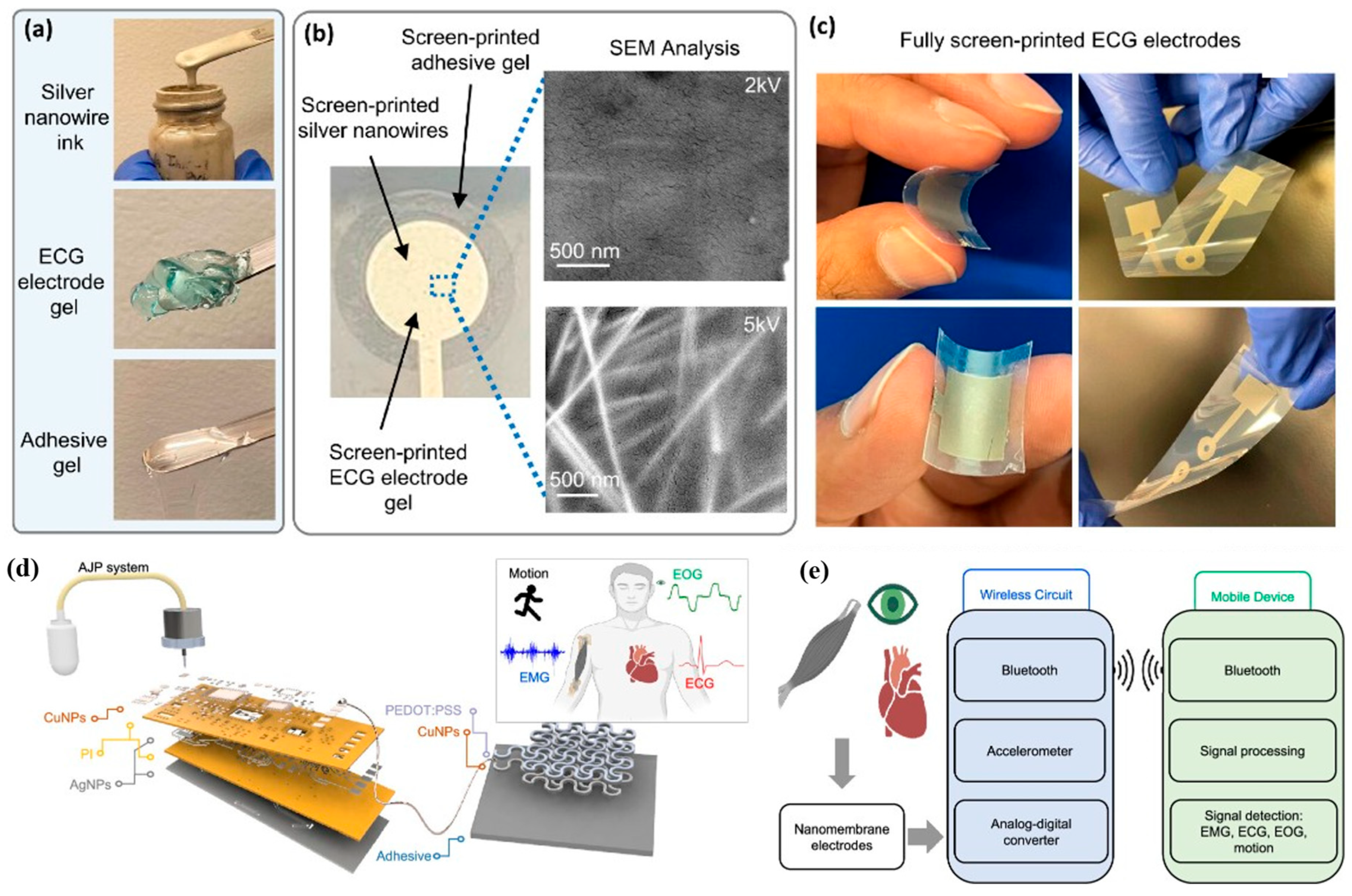
| Ag | Aerosol jet printing; 130–200 °C 200 °C best | Elastomer; eye tracking in virtual reality | Ultrathin, aerosol jet–printed Ag nanoparticle EOG electrode system that is soft, stretchable, and wireless, enabling high-accuracy real-time eye vergence detection for VR-based ocular therapy | EOG [253] |
| Cu NP and Ag NP | Aerosol jet printing; IPL sintering | Polyimide; electrochemical bio-potential detection | Detect multiple physiological signal | EMG, ECG, EOG, motions [254] |
| Functionalized conductive graphene ink | Aerosol jet printing; 100 °C (active material) 250 °C (curing the substrate) | Elastomer; ionic conduction at electrode–tissue interface | key technological advancements are the use of a functionalized conductive graphene with enhanced biocompatibility, anti-oxidation, and solderability, which allows a wireless flexible circuit. | EMG [255] |
| Commercial Ag flakes | Screen printing; 60–80 °C | Elastomer; amperometric detection using lactate oxidase | A fully in-ear integrated sensor for monitoring brain-state and dynamic lactate-concentration changes for the detection or monitoring of neurodegenerative diseases. | EEG, EOG, and electrodermal activity, lactate in sweat [256] |
| Ag NP | Inkjet printing; RT Chemical sintering | Elastomer; ionic conduction at electrode–tissue interface | Multi-channel sEMG signals ensured consistent values across repetitions in every participant | EMG [257] |
| Cu/Ga composite ink (bulk Ga and Cu powder) | Screen printing; 50 °C | PI; PPG signal | ultrathin epi-dermal PPG sensor and a wireless optoelectronic device capable of converting between flexible and rigid configurations for biomedical applications. | PPG [250] |
| Ag NP | Aerosol jet printing; 50 °C | PDMS; ionic–electronic coupling at electrode–skin interface | fully portable and wireless brain–machine interface in which flexible scalp electronics | EEG [258] |
| CNT/PDMS | Screen printing; 60–80 °C | Elastomer; amperometric detection using lactate oxidase | 3D-printed smart eyeglasses | EEG, EOG [259] |
| Ag NW | Screen printing; 80 °C | Elastomer; electrochemical bio-potential detection | Fully screen-printed wet ECG electrodes for both monitoring and diagnostic purpose. | ECG [244] |
| Ag NWs/GO | Screen printing; 130 °C | Elastomer; electrochemical bio-potential detection | Fully screen-printed transparent wet ECG electrodes | ECG [113] |
Disclaimer/Publisher’s Note: The statements, opinions and data contained in all publications are solely those of the individual author(s) and contributor(s) and not of MDPI and/or the editor(s). MDPI and/or the editor(s) disclaim responsibility for any injury to people or property resulting from any ideas, methods, instructions or products referred to in the content. |
© 2026 by the authors. Licensee MDPI, Basel, Switzerland. This article is an open access article distributed under the terms and conditions of the Creative Commons Attribution (CC BY) license.
Share and Cite
Bera, A.; Liu, F.; Marander, M.R.; Ortega, R.; Malkawi, A.M.A.; Dey, U.K.; Sandhu, R.; Collins, T.P.; Jiang, S. Low-Temperature Sintering Inks for Printed Bioelectronics: Materials, Mechanisms, and Emerging Ideas. Biosensors 2026, 16, 206. https://doi.org/10.3390/bios16040206
Bera A, Liu F, Marander MR, Ortega R, Malkawi AMA, Dey UK, Sandhu R, Collins TP, Jiang S. Low-Temperature Sintering Inks for Printed Bioelectronics: Materials, Mechanisms, and Emerging Ideas. Biosensors. 2026; 16(4):206. https://doi.org/10.3390/bios16040206
Chicago/Turabian StyleBera, Abhijit, Fei Liu, Matthew R. Marander, Ricardo Ortega, Ahmad Mustafa Ahmad Malkawi, Utsav Kumar Dey, Ritinder Sandhu, Tyler P. Collins, and Shan Jiang. 2026. "Low-Temperature Sintering Inks for Printed Bioelectronics: Materials, Mechanisms, and Emerging Ideas" Biosensors 16, no. 4: 206. https://doi.org/10.3390/bios16040206
APA StyleBera, A., Liu, F., Marander, M. R., Ortega, R., Malkawi, A. M. A., Dey, U. K., Sandhu, R., Collins, T. P., & Jiang, S. (2026). Low-Temperature Sintering Inks for Printed Bioelectronics: Materials, Mechanisms, and Emerging Ideas. Biosensors, 16(4), 206. https://doi.org/10.3390/bios16040206