A One-Pot CRISPR/Cas12a-Based Platform for Contamination-Free Nucleic Acid Amplification Detection


Abstract
1. Introduction
2. Materials and Methods
2.1. Materials
2.2. PCR Reaction and Melting Curve Analysis
- (a)
- For a typical PCR reaction, a 10 μL reaction solution was prepared by mixing 5.0 μL of PCR mix (2×) with 0.4 μM forward primer (PAM-FP), 0.4 μM reverse primer (PAM-RP), the DNA binding dye EvaGreen (1×), and 1.0 μL of the Listeria monocytogenes (L. monocytogenes) template. The standard PCR was performed using the MyGo Pro real-time PCR instrument, initiating at 95 °C for 5 min, followed by 30 cycles of 95 °C for 15 s, 57 °C for 15 s, and 68 °C for 30 s.
- (b)
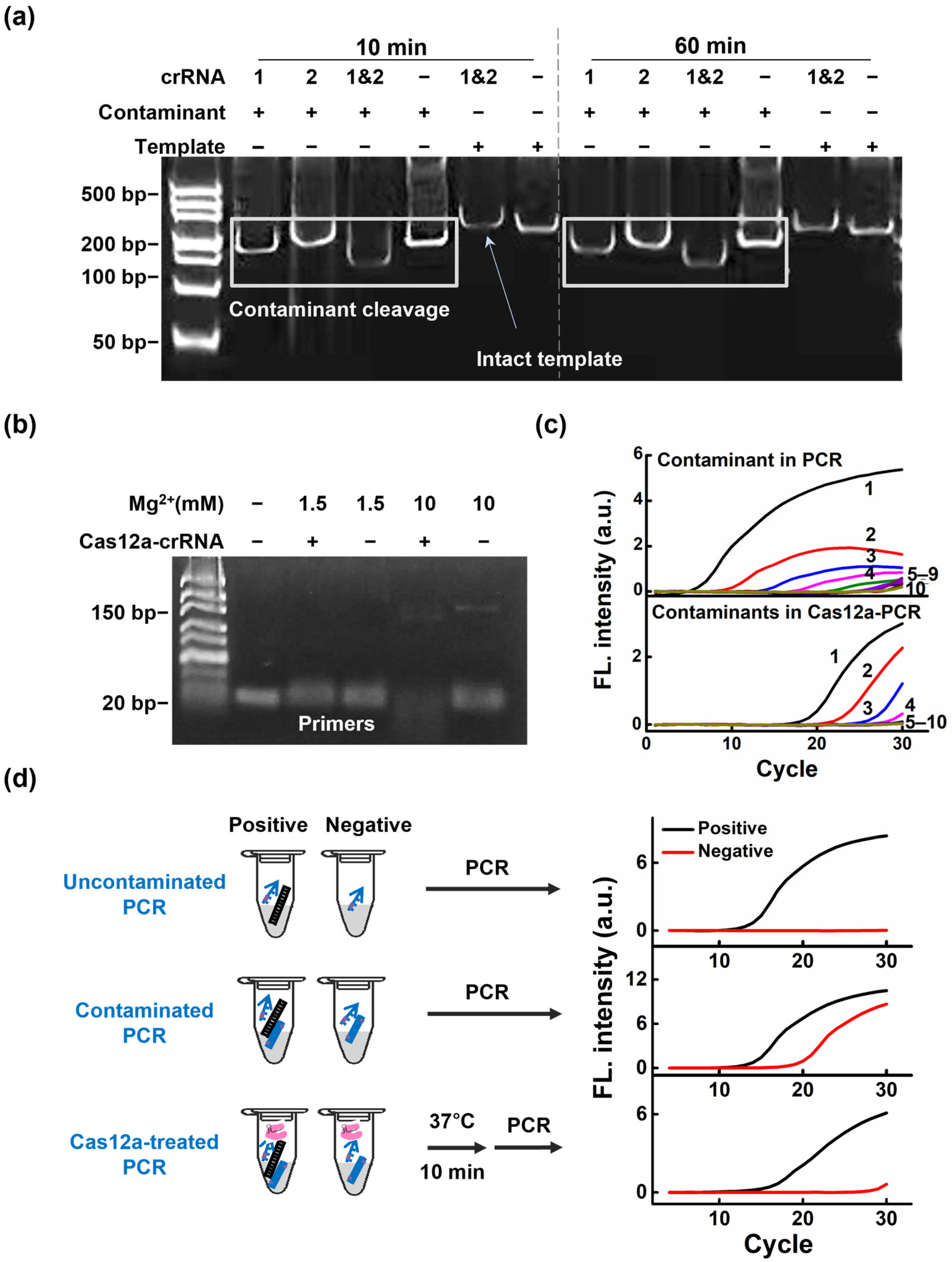
- The PAM-PCR experiment was performed with a 10 μL reaction volume comprising 5.0 μL of PCR mix (2×), 0.4 μM PAM-FP, 0.4 μM PAM-RP, the DNA binding dye EvaGreen (1×), 0.1 μM Cas12a, 0.05 μM crRNA1 and crRNA2, and 10 U of recombinant RNase inhibitor. LbCas12a-crRNA1 & 2 complexes were pre-assembled by mixing and incubating for 5 min at 37 °C. Then, the target DNA of L. monocytogenes (1 μL) was incorporated into the mixture. The PAM-PCR was initiated on the MyGo Pro real-time PCR device at 37 °C for 10 min, and the remaining steps were the same as the PCR procedure described above.
- (c)
- The UDG assay in the PCR system was performed with a 10 μL reaction volume comprising 0.02 U/μL of UDG, 0.75 mM dUTP, and 3 mM MgCl2, as well as other reagents used in PCR. The reaction was performed under the same conditions as the PAM-PCR described above.
- (d)
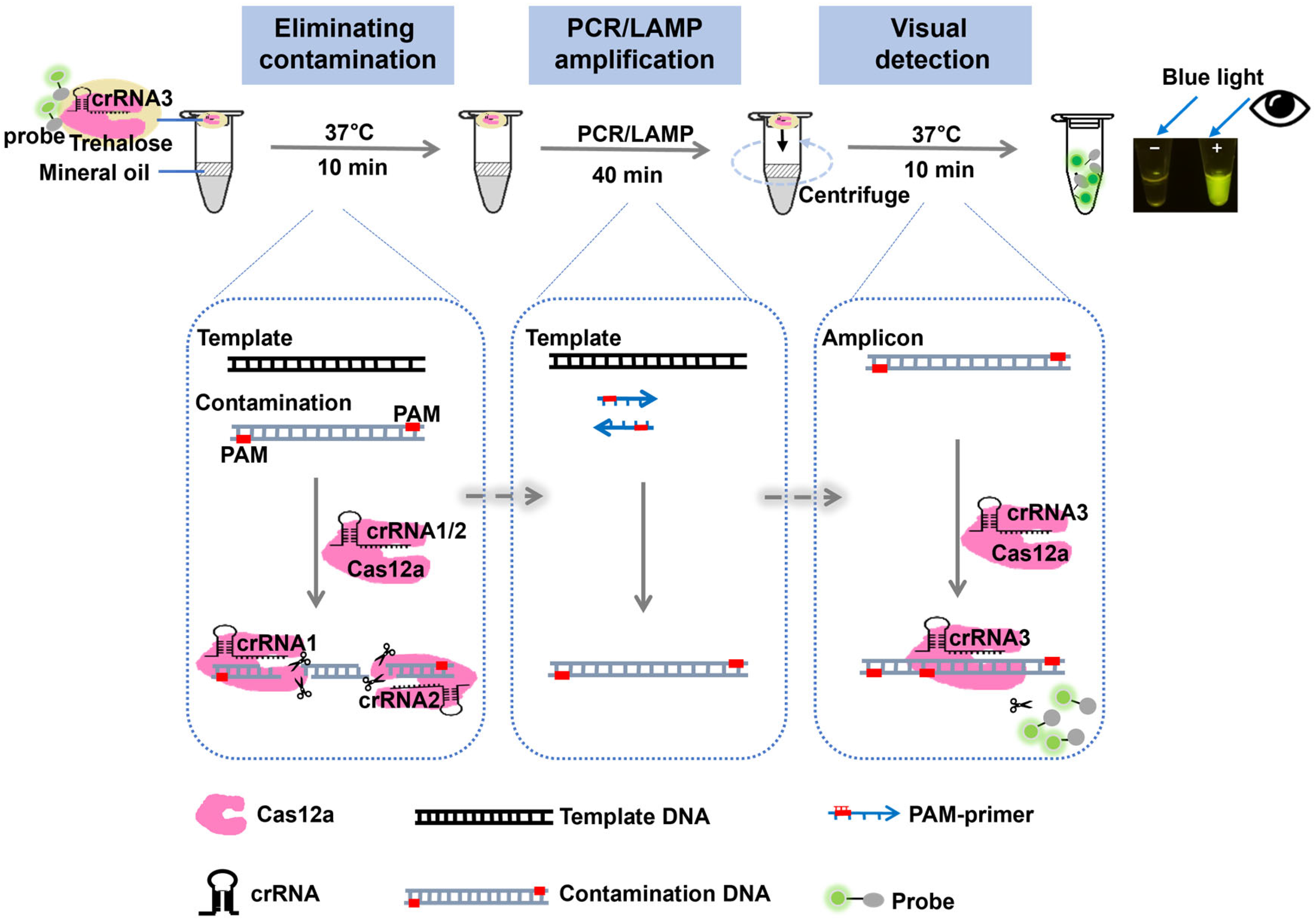
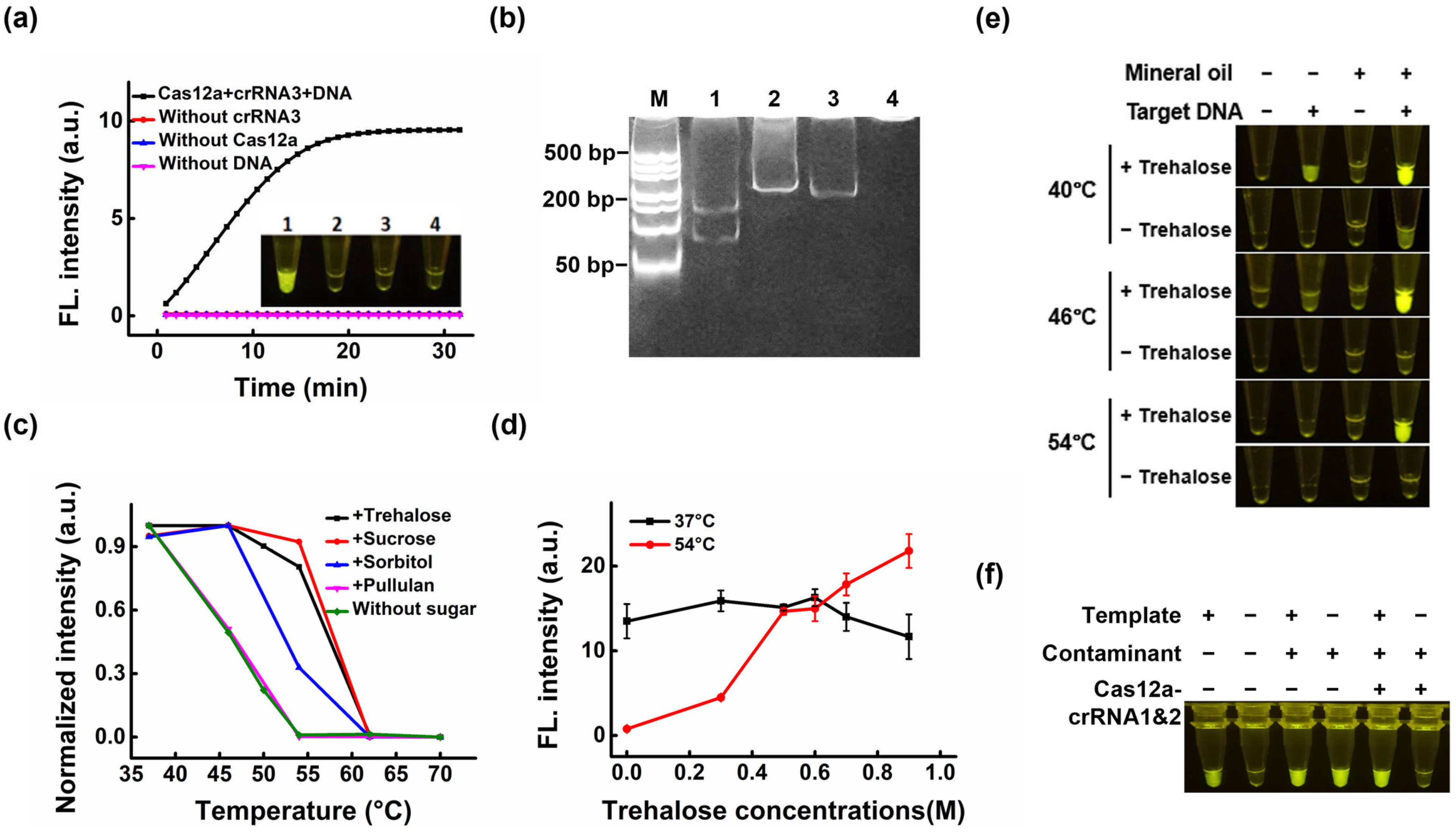
- To achieve one-pot visual detection, a 10 μL mixture comprising PCR mix (1×) with 0.4 μM PAM-FP, 0.4 μM PAM-RP, 0.1 μM Cas12a, 0.05 μM crRNA1 and crRNA2, and 10 U of recombinant RNase inhibitor was introduced to the lower section of the reaction tube. Additionally, a 6 μL liquid droplet of the Cas12a-detection complex, containing 0.6 M trehalose, 0.1 μM Cas12a, 1× NEBuffer 2.1, 100 nM fluorophore–quencher–labeled ssDNA reporters (ssDNA probes), and 0.1 μM crRNA3, was placed on the cap of the reaction tube. The reagent at the bottom was covered with 5 μL of mineral oil to limit heat transfer. Unless otherwise indicated, all steps were the same as the PAM-PCR procedure described above. Then, the Cas12a cleavage system, which was placed in advance on the tube cap, was mixed with the amplification product at the bottom of the tube by manually turning and shaking the tube. The reaction was permitted to continue for 10 min at 37 °C. Finally, a fluorescence change was observed using a blue light transmission instrument. To ensure the reliability of our method, all experiments were performed in triplicate.
2.3. LAMP Reaction and Melting Curve Analysis
- (a)
- For a typical LAMP reaction, a 10 μL reaction solution was prepared by adding 1× LAMP amplification buffer, 0.8 M betaine, 0.1 μM forward primer (F3), 0.1 μM backward primer (B3), 0.8 μM forward inner primer (FIP), 0.8 μM backward inner primer (BIP), 4.5 mM MgSO4, 3.2 U of Bst 2.0 WarmStart DNA polymerase, 1.4 mM dNTP mix, 1.0 μL of the template (L. monocytogenes), and 0.25 μL of EvaGreen (20×). LAMP was performed on the PCR instrument (MyGo Pro) at 65 °C for 45 min.
- (b)
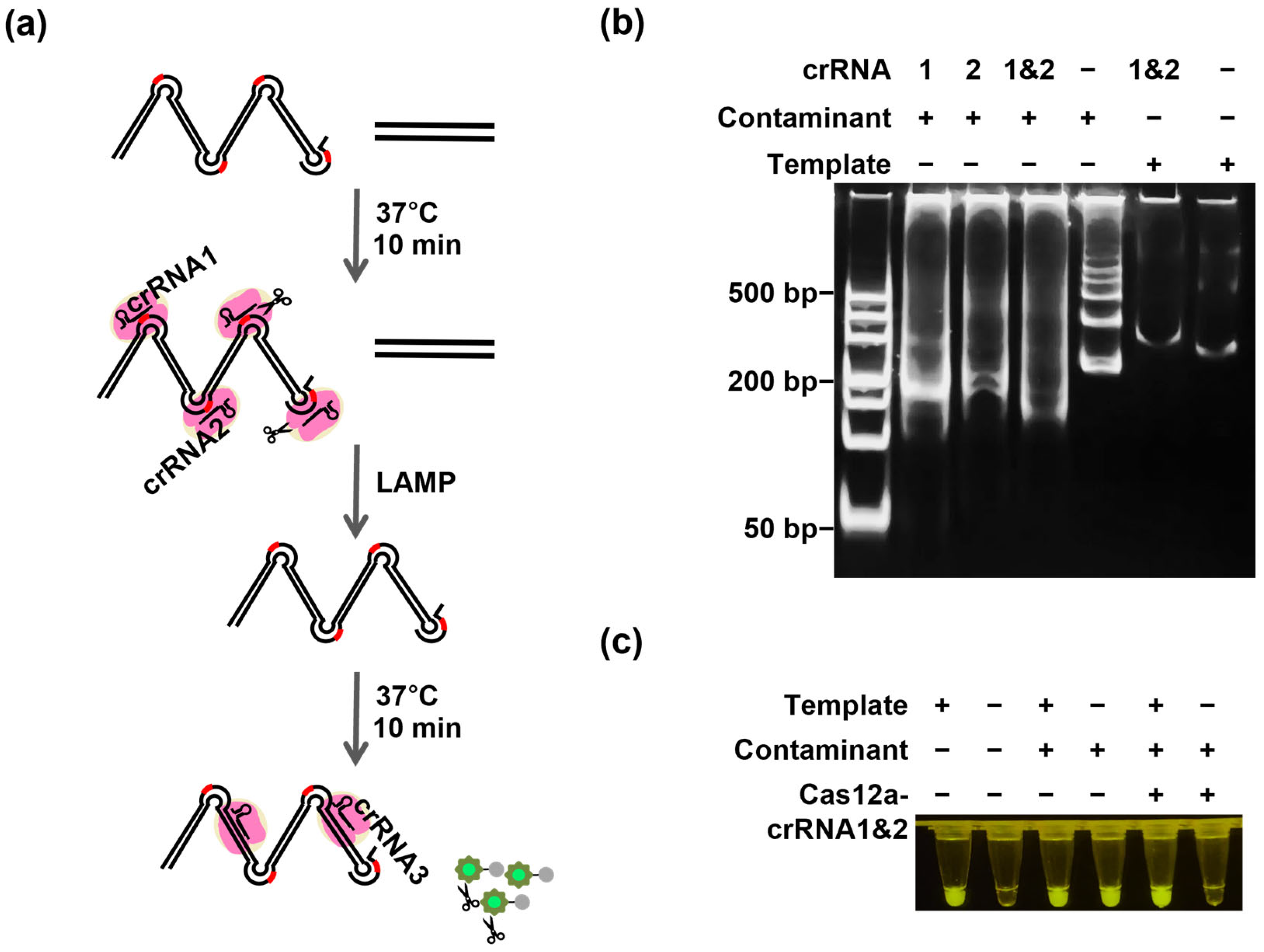
- The PAM-LAMP experiments were executed with a 10 μL reaction volume comprising 1× LAMP amplification buffer, 0.8 M betaine, 0.1 μM F3, 0.1 μM B3, 0.8 μM FIP, 0.8 μM BIP, 3.2 U of Bst 2.0 WarmStart DNA polymerase, 1.4 mM dNTP mix, 0.1 μM Cas12a, 0.25 μL of EvaGreen (20×), 0.05 μM crRNA1 and crRNA2, and 10 U of recombinant RNase inhibitor. LbCas12a-crRNA1 & 2 complexes were pre-assembled by mixing and incubating for 5 min at 37 °C. Then, the target DNA of L. monocytogenes (1 μL) was incorporated into the solution mixture. The PAM-LAMP reactions were tested at 37 °C for 10 min, followed by a 45 min incubation at 65 °C.
- (c)
- To achieve one-pot visual detection, a 10 μL reaction solution comprising 1× LAMP mix with 0.8 M betaine, 0.1 μM F3 and B3, 0.8 μM FIP and BIP, 3.2 U of Bst 2.0 WarmStart DNA polymerase, 1.4 mM dNTP mix, 0.1 μM Cas12a, 0.05 μM crRNA1 and crRNA2, and 10 U of recombinant RNase inhibitor was introduced to the lower section of the reaction tube. Additionally, a 6 μL liquid droplet of the Cas12a-detection complex, which contained 0.6 M trehalose, 0.1 μM Cas12a, 1× NEBuffer 2.1, 100 nM ssDNA probes, and 0.1 μM crRNA3, was placed on the cap of the reaction tube. The mixture at the bottom of the tube was covered with 5 μL of mineral oil to limit heat transfer. Following a 10 min incubation at 37 °C and a subsequent 45 min incubation at 62 °C, the Cas12a system was combined with the amplification product by manually inverting and shaking the tube. The reaction was then allowed to proceed for 10 min at 37 °C. Finally, the fluorescence change was observed using a blue light transmission instrument. To ensure the reliability of our method, all experiments were performed in triplicate.
2.4. Cas12a Activity Assay
2.5. Analysis of the Effects of Sugar Solutions on Cas12a Thermostability
3. Results and Discussion
3.1. The Principle and Feasibility of the Established Method
3.2. Establishment of a Contamination-Free Single-Tube PCR Assay
3.3. Establishment of a Visual Single-Tube PCR Assay
3.4. Closed-Tube Visual Detection of Contamination-Free PCR Amplification
3.5. Application of Cas12a-crRNA for Digesting Carryover Contamination in a LAMP Assay
3.6. Discussion
4. Conclusions
Supplementary Materials
Author Contributions
Funding
Institutional Review Board Statement
Informed Consent Statement
Data Availability Statement
Conflicts of Interest
References
- Liu, Y.; Li, B.; Liu, B.; Zhang, K. Single-particle optical imaging for ultrasensitive bioanalysis. Biosensors 2022, 12, 1105. [Google Scholar] [CrossRef] [PubMed]
- Younes, N.; Al-Sadeq, D.W.; Al-Jighefee, H.; Younes, S.; Al-Jamal, O.; Daas, H.I.; Yassine, H.M.; Nasrallah, G.K. Challenges in laboratory diagnosis of the novel coronavirus SARS-CoV-2. Viruses 2020, 12, 582. [Google Scholar] [CrossRef] [PubMed]
- Aslanzadeh, J. Preventing PCR amplification carryover contamination in a clinical laboratory. Ann. Clin. Lab. Sci. 2004, 34, 389–396. [Google Scholar]
- Borst, A.; Box, A.; Fluit, A. False-positive results and contamination in nucleic acid amplification assays: Suggestions for a prevent and destroy strategy. Eur. J. Clin. Microbiol. Infect. Dis. 2004, 23, 289–299. [Google Scholar] [CrossRef] [PubMed]
- Kim, S.-H.; Lee, S.-Y.; Kim, U.; Oh, S.-W. Diverse methods of reducing and confirming false-positive results of loop-mediated isothermal amplification assays: A review. Anal. Chim. Acta 2023, 1280, 341693. [Google Scholar] [CrossRef]
- Gefrides, L.A.; Powell, M.C.; Donley, M.A.; Kahn, R. UV irradiation and autoclave treatment for elimination of contaminating DNA from laboratory consumables. Forensic Sci. Int. Genet. 2010, 4, 89–94. [Google Scholar] [CrossRef]
- Mukama, O.; Nie, C.; Habimana, J.d.D.; Meng, X.; Ting, Y.; Songwe, F.; Al Farga, A.; Mugisha, S.; Rwibasira, P.; Zhang, Y.; et al. Synergetic performance of isothermal amplification techniques and lateral flow approach for nucleic acid diagnostics. Anal. Biochem. 2020, 600, 113762. [Google Scholar] [CrossRef]
- Lin, M.; Yue, H.; Tian, T.; Xiong, E.; Zhu, D.; Jiang, Y.; Zhou, X. Glycerol additive boosts 100-fold sensitivity enhancement for one-pot RPA-CRISPR/Cas12a assay. Anal. Chem. 2022, 94, 8277–8284. [Google Scholar] [CrossRef]
- Wang, Y.; Liu, D.; Deng, J.; Wang, Y.; Xu, J.; Ye, C. Loop-mediated isothermal amplification using self-avoiding molecular recognition systems and antarctic thermal sensitive uracil-DNA-glycosylase for detection of nucleic acid with prevention of carryover contamination. Anal. Chim. Acta 2017, 996, 74–87. [Google Scholar] [CrossRef]
- Hu, Y. Regulatory concern of polymerase chain reaction (PCR) carryover contamination. In Polymerase Chain Reaction for Biomedical Applications; IntechOpen: Rijeka, Croatia, 2016; pp. 57–68. [Google Scholar] [CrossRef]
- Jinek, M.; Chylinski, K.; Fonfara, I.; Hauer, M.; Doudna, J.A.; Charpentier, E. A programmable dual-RNA-guided DNA endonuclease in adaptive bacterial immunity. Science 2012, 337, 816–821. [Google Scholar] [CrossRef]
- Huai, C.; Li, G.; Yao, R.; Zhang, Y.; Cao, M.; Kong, L.; Jia, C.; Yuan, H.; Chen, H.; Lu, D.; et al. Structural insights into DNA cleavage activation of CRISPR-Cas9 system. Nat. Commun. 2017, 8, 1375. [Google Scholar] [CrossRef]
- Bao, Y.; Jiang, Y.; Xiong, E.; Tian, T.; Zhang, Z.; Lv, J.; Li, Y.; Zhou, X. CUT-LAMP: Contamination-free loop-mediated isothermal amplification based on the CRISPR/Cas9 cleavage. ACS Sens. 2020, 5, 1082–1091. [Google Scholar] [CrossRef] [PubMed]
- Lin, W.; Tian, T.; Jiang, Y.; Xiong, E.; Zhu, D.; Zhou, X. A CRISPR/Cas9 eraser strategy for contamination-free PCR end-point detection. Biotechnol. Bioeng. 2021, 118, 2053–2066. [Google Scholar] [CrossRef]
- Swarts, D.C.; Jinek, M. Cas9 versus Cas12a/Cpf1: Structure-function comparisons and implications for genome editing. Wiley Interdiscip. Rev. RNA 2018, 9, e1481. [Google Scholar] [CrossRef]
- Safari, F.; Zare, K.; Negahdaripour, M.; Barekati-Mowahed, M.; Ghasemi, Y. CRISPR Cpf1 proteins: Structure, function and implications for genome editing. Cell Biosci. 2019, 9, 36. [Google Scholar] [CrossRef] [PubMed]
- Wang, P.; Guo, B.; Zhang, X.; Wang, Y.; Yang, G.; Shen, H.; Gao, S.; Zhang, L. One-pot molecular diagnosis of acute hepatopancreatic necrosis disease by recombinase polymerase amplification and CRISPR/Cas12a with specially designed crRNA. J. Agric. Food Chem. 2023, 71, 6490–6498. [Google Scholar] [CrossRef] [PubMed]
- Xie, Y.; Jiang, K.; Zhang, Y.; Cao, L.; Guo, X.; Shi, J.; Ding, X.; Yin, K. Enhanced two-step LAMP-CRISPR assay with an engineered Zst polymerase for contamination-free and ultrasensitive DNA detection. Anal. Chem. 2024, 96, 15493–15502. [Google Scholar] [CrossRef]
- Qian, C.; Wang, R.; Wu, H.; Zhang, F.; Wu, J.; Wang, L. Uracil-mediated new photospacer-adjacent motif of Cas12a to realize visualized DNA detection at the single-copy level free from contamination. Anal. Chem. 2019, 91, 11362–11366. [Google Scholar] [CrossRef]
- Wu, F.; Lu, C.; Hu, W.; Guo, X.; Chen, J.; Luo, Z. Rapid visual detection of Vibrio parahaemolyticus by combining LAMP-CRISPR/Cas12b with heat-labile uracil-DNA glycosylase to eliminate carry-over contamination. J. Zhejiang-Univ. B 2023, 24, 749–754. [Google Scholar] [CrossRef] [PubMed]
- Zhu, C.; Zhang, F.; Li, H.; Chen, Z.; Yan, M.; Li, L.; Qu, F. CRISPR/Cas systems accelerating the development of aptasensors. TrAC Trends Anal. Chem. 2023, 158, 116775. [Google Scholar] [CrossRef]
- Long, K.; Cao, G.; Qiu, Y.; Yang, N.; Chen, J.; Yang, M.; Hou, C.; Huo, D. Hybridization chain reaction circuit controller: CRISPR/ Cas12a conversion amplifier for miRNA-21 sensitive detection. Talanta 2024, 266, 125130. [Google Scholar] [CrossRef]
- Fuchs, R.T.; Curcuru, J.; Mabuchi, M.; Yourik, P.; Robb, G.B. Cas12a trans-cleavage can be modulated in vitro and is active on ssDNA, dsDNA, and RNA. 2019; preprint. [Google Scholar] [CrossRef]
- Fozouni, P.; Son, S.; de León Derby, M.D.; Knott, G.J.; Gray, C.N.; D’Ambrosio, M.V.; Zhao, C.; Switz, N.A.; Kumar, G.R.; Stephens, S.I.; et al. Amplification-free detection of SARS-CoV-2 with CRISPR-Cas13a and mobile phone microscopy. Cell 2021, 184, 323–333.e9. [Google Scholar] [CrossRef]
- Chen, Y.; Zong, N.; Ye, F.; Mei, Y.; Qu, J.; Jiang, X. Dual-CRISPR/Cas12a-assisted RT-RAA for ultrasensitive SARS-CoV-2 detection on automated centrifugal microfluidics. Anal. Chem. 2022, 94, 9603–9609. [Google Scholar] [CrossRef]
- Zeng, M.; Ke, Y.; Zhuang, Z.; Qin, C.; Li, L.Y.; Sheng, G.; Yin, J. Harnessing multiplex crRNA in the CRISPR/Cas12a system enables an amplification-free DNA diagnostic platform for ASFV detection. Anal. Chem. 2022, 94, 10805–10812. [Google Scholar] [CrossRef] [PubMed]
- Wang, Z.; Qi, J.; Goddard, J.M. Concentrated sugar solutions protect lactase from thermal inactivation. Int. Dairy J. 2021, 123, 105168. [Google Scholar] [CrossRef]
- Liu, Y.; Lee, J.; Mansfield, K.M.; Ko, J.H.; Sallam, S.; Wesdemiotis, C.; Maynard, H.D. Trehalose glycopolymer enhances both solution stability and pharmacokinetics of a therapeutic protein. Bioconjugate Chem. 2017, 28, 836–845. [Google Scholar] [CrossRef]
- Lee, J.; Ko, J.H.; Lin, E.-W.; Wallace, P.; Ruch, F.; Maynard, H.D. Trehalose hydrogels for stabilization of enzymes to heat. Polym. Chem. 2015, 6, 3443–3448. [Google Scholar] [CrossRef]
- Spiess, A.-N.; Mueller, N.; Ivell, R. Trehalose is a potent PCR enhancer: Lowering of DNA melting temperature and thermal stabilization of taq polymerase by the disaccharide trehalose. Clin. Chem. 2004, 50, 1256–1259. [Google Scholar] [CrossRef] [PubMed]
- Jahanshahi-Anbuhi, S.; Pennings, K.; Leung, V.; Liu, M.; Carrasquilla, C.; Kannan, B.; Li, Y.; Pelton, R.; Brennan, J.D.; Filipe, C.D.M. Pullulan encapsulation of labile biomolecules to give stable bioassay tablets. Angew. Chem. Int. Ed. Engl. 2014, 53, 6155–6158. [Google Scholar] [CrossRef]
- Prajapati, V.D.; Jani, G.K.; Khanda, S.M. Pullulan: An exopolysaccharide and its various applications. Carbohydr. Polym. 2013, 95, 540–549. [Google Scholar] [CrossRef]
- Jadhav, S.B.; Singhal, R.S. Pullulan-complexed α-amylase and glucosidase in alginate beads: Enhanced entrapment and stability. Carbohydr. Polym. 2014, 105, 49–56. [Google Scholar] [CrossRef]
- Jahanshahi-Anbuhi, S.; Kannan, B.; Leung, V.; Pennings, K.; Liu, M.; Carrasquilla, C.; White, D.; Li, Y.; Pelton, R.H.; Brennan, J.D.; et al. Simple and ultrastable all-inclusive pullulan tablets for challenging bioassays. Chem. Sci. 2016, 7, 2342–2346. [Google Scholar] [CrossRef]
- Jain, N.K.; Roy, I. Trehalose and protein stability. Curr. Protoc. Protein Sci. 2010, 59, 4.9.1–4.9.12. [Google Scholar] [CrossRef]
- Carninci, P.; Nishiyama, Y.; Westover, A.; Itoh, M.; Nagaoka, S.; Sasaki, N.; Okazaki, Y.; Muramatsu, M.; Hayashizaki, Y. Thermostabilization and thermoactivation of thermolabile enzymes by trehalose and its application for the synthesis of full length cDNA. Proc. Natl. Acad. Sci. USA 1998, 95, 520–524. [Google Scholar] [CrossRef]
- Notomi, T.; Okayama, H.; Masubuchi, H.; Yonekawa, T.; Watanabe, K.; Amino, N.; Hase, T. Loop-mediated isothermal amplification of DNA. Nucleic Acids Res. 2000, 28, e63. [Google Scholar] [CrossRef] [PubMed]
- Hsieh, K.; Mage, P.L.; Csordas, A.T.; Eisenstein, M.; Soh, H.T. Simultaneous elimination of carryover contamination and detection of DNA with uracil-DNA-glycosylase-supplemented loop-mediated isothermal amplification (UDG-LAMP). Chem. Commun. 2014, 50, 3747–3749. [Google Scholar] [CrossRef]
- Sun, K.; Liu, Y.; Tang, Q.; Ma, B.; Zhang, B.; Fu, X.; Fu, X.; Yu, J.; Liu, C.; Yan, J.; et al. CADLAB: A contamination-free, Argonaute-enhanced, dual detection of plant viruses via lateral flow assay biosensors system. Sens. Actuators B 2025, 426, 137045. [Google Scholar] [CrossRef]
- Zhang, T.; Zhao, W.; Zhao, W.; Si, Y.; Chen, N.; Chen, X.; Li, S.; Hou, S.; Yang, M.; Lin, Q. Universally stable and precise CRISPR-LAMP detection platform for precise multiple respiratory tract virus diagnosis including mutant SARS-CoV-2 spike N501Y. Anal. Chem. 2021, 93, 16184–16193. [Google Scholar] [CrossRef]
- Wen, J.; Ren, L.; He, Q.; Bao, J.; Zhang, X.; Pi, Z.; Zhang, X.; Zhang, C.; Zhu, G.; Tan, W. Contamination-free V-shaped ultrafast reaction cascade transferase signal amplification driven CRISPR/Cas12a magnetic relaxation switching biosensor for bacteria detection. Biosens. Bioelectron. 2023, 219, 114790. [Google Scholar] [CrossRef] [PubMed]
- Yu, J.X.; Karakasidis, S.; Zhou, G.; Huang, W. Adventitious virus contamination testing: Massively parallel sequencing. Bioprocess. J. 2013, 12, 18–24. [Google Scholar] [CrossRef]


Disclaimer/Publisher’s Note: The statements, opinions and data contained in all publications are solely those of the individual author(s) and contributor(s) and not of MDPI and/or the editor(s). MDPI and/or the editor(s) disclaim responsibility for any injury to people or property resulting from any ideas, methods, instructions or products referred to in the content. |
© 2026 by the authors. Licensee MDPI, Basel, Switzerland. This article is an open access article distributed under the terms and conditions of the Creative Commons Attribution (CC BY) license.
Share and Cite
Tantai, W.; Xu, Q.; Zhang, W.; Li, Y.; Liu, H. A One-Pot CRISPR/Cas12a-Based Platform for Contamination-Free Nucleic Acid Amplification Detection. Biosensors 2026, 16, 170. https://doi.org/10.3390/bios16030170
Tantai W, Xu Q, Zhang W, Li Y, Liu H. A One-Pot CRISPR/Cas12a-Based Platform for Contamination-Free Nucleic Acid Amplification Detection. Biosensors. 2026; 16(3):170. https://doi.org/10.3390/bios16030170
Chicago/Turabian StyleTantai, Wei, Qinfeng Xu, Wenjuan Zhang, Yanni Li, and Hao Liu. 2026. "A One-Pot CRISPR/Cas12a-Based Platform for Contamination-Free Nucleic Acid Amplification Detection" Biosensors 16, no. 3: 170. https://doi.org/10.3390/bios16030170
APA StyleTantai, W., Xu, Q., Zhang, W., Li, Y., & Liu, H. (2026). A One-Pot CRISPR/Cas12a-Based Platform for Contamination-Free Nucleic Acid Amplification Detection. Biosensors, 16(3), 170. https://doi.org/10.3390/bios16030170