Communication

A Label-Free G-Quadruplex/Thioflavin T Fluorescent Sensor for ClO Detection: Implications for Stress-Induced Hypertension Biomarker Analysis

1
School of Life Sciences and Medicine, Shandong University of Technology, Zibo 255000, China
2
College of Agriculture and Bioengineering, Heze University, Heze 274015, China
*
Authors to whom correspondence should be addressed.
Biosensors 2026, 16(3), 169; https://doi.org/10.3390/bios16030169
Submission received: 28 January 2026 / Revised: 11 March 2026 / Accepted: 17 March 2026 / Published: 18 March 2026

Abstract

The objective of this study is to develop a label-free fluorescent sensor for the quantitative detection of hypochlorite ions (ClO) and validate its applicability in biological samples, particularly exploring the potential of ClO as a biomarker for stress-induced hypertension (SIH). Male Sprague-Dawley rats (8 weeks old, 250–300 g) were used to establish the SIH model. A guanine-rich (G-rich) signal DNA sequence (S-DNA) was rationally designed, with a ClO-responsive phosphorothioate (PS) moiety integrated into the probe architecture. In the absence of ClO, the S-DNA folds into a stable G-quadruplex structure, which specifically binds to ThT and triggers a significant enhancement of the dye’s fluorescence intensity. Upon introduction of ClO, the specific hydrolysis reaction between the PS moiety and ClO induces cleavage of the S-DNA into two discrete fragments, thereby abrogating G-quadruplex formation and resulting in a remarkable quenching of ThT fluorescence. This proposed method exhibits excellent anti-interference capability against other reactive oxygen species (ROS) and achieves a low detection limit of 41.2 nM for ClO. Furthermore, this strategy was successfully applied to the quantitative determination of endogenous ClO in human cells and the plasma of stress-induced hypertensive (SIH) rats, highlighting its substantial potential for clinical and physiological research.

1. Introduction

Hypochlorous acid (HClO) is a key reactive oxygen species (ROS) in biological systems. Accumulating evidence has demonstrated that aberrantly elevated levels of ClO in organisms can trigger oxidative stress responses, which are closely associated with the pathogenesis of various diseases, including tissue damage, inflammation, cardiovascular disorders, neurodegenerative diseases, and cancer [1,2,3]. Consequently, the accurate and selective detection of ClO concentrations in biological matrices is of paramount significance for elucidating related physiological and pathological mechanisms.
To date, various analytical techniques have been established for ClO detection, such as colorimetry, electrochemical analysis, chemiluminescence, and chromatography [4,5,6]. Among these methods, fluorescent probes offer distinct advantages, including high sensitivity, excellent resolution, simple operation, and rapid response, making them promising tools for ClO sensing [7]. Until now, multiple fluorescent probes have been reported for ClO detection, each with its own advantages and drawbacks [8,9,10,11]. The main drawbacks of these fluorescence methods are complex synthetic methods and interference from other ROS [6,12,13,14]. Thus, the development of a rapid, efficient, and highly selective fluorescent method for ClO detection remains an urgent need.
Phosphorothioate (PS) is an oligonucleotide in which the oxygen atom normally linking two consecutive nucleotides is replaced by sulfur and which resists degradation by cellular enzymes [15]. Recent studies have revealed that the specific reaction between PS and ClO can trigger the cleavage of DNA backbones, resulting in DNA fragmentation [16,17,18]. Thioflavin T (ThT), a water-soluble benzothiazole dye, has been extensively utilized as a fluorescent reporter for G-quadruplex structures, as it can specifically bind to G-quadruplexes formed by G-rich oligonucleotides and exhibit a dramatic fluorescence enhancement [19]. Due to its low cost, minimal background signal, good water solubility, and ease of use, ThT-based fluorescent probes have gained widespread attention in biosensing applications [19,20]. Previously, we reported a turn-on sensing method for ClO based on a G-quadruplex/ThT platform [21]. However, the reliance on DNA hybridization makes its detection performance highly susceptible to temperature, pH, and ionic strength, which interfere with strand displacement and G-quadruplex formation and thus limit practical applications. To overcome these limitations, we herein develop a rapid, label-free, and hybridization-free fluorescent strategy for the quantitative detection of ClO. By ingeniously integrating ThT-triggered G-quadruplex formation with the specific oxidative cleavage of PS-modified DNA toward ClO, the proposed platform avoids the tedious and environment-sensitive DNA hybridization process, thus featuring improved robustness, faster response, and greater potential for real-sample analysis. To test if the sensor works in biological samples and if ClO can be an SIH biomarker, we used male SD rats. These rats a reliable hypertension model with well-understood cardiovascular systems, similar to humans in oxidative stress and blood pressure control. This means our findings from rats can help understand ClO’s role in human SIH.

2. Experimental Section

2.1. Materials and Reagents

The G-rich signal DNA sequence (S-DNA): 5′-GGGTAGGG*CGGGTTGG-3′, (* represents the phosphorothioate linkage) was synthesized by Sangon Biotechnology Co., Ltd. (Shanghai, China). NaClO was purchased from Macklin Reagent (Shanghai, China). Thioflavin T (ThT) was purchased from Sigma-Aldrich (St. Louis, MO, USA). All other reagents were of analytical-reagent grade. Ultra-pure water (18.25 MΩ·cm−1) was used in all experiments.

2.2. Apparatus

All fluorescence measurements were carried out on the INFINITEEPLEX Multifunctional Microplate Reader (Tecan Austria GmbH, Grödig, Austria). ThT was selected as the fluorescent dye, with an excitation wavelength of 425 nm and an optimal emission wavelength of 490 nm. For sample fluorescence detection, the excitation wavelength was set at 425 nm, and the emission wavelength range was 450–600 nm.

2.3. Reaction Condition Optimization

To achieve optimal detection performance, key experimental parameters, including S-DNA concentration and ThT concentration, were optimized. The fluorescence quenching efficiency (Q%) was used as the evaluation index, calculated according to the following equation:
Q % = F 0 F F 0 × 100 %
where F0 represents the fluorescence intensity in the absence of ClO, and F denotes the fluorescence intensity after the addition of ClO.

2.4. Quantitative Analysis of ClO

Under the optimized conditions, quantitative analysis of ClO was performed. The reaction system (100 μL) consisted of 20 mM Tris-HCl buffer (pH 7.5), 500 nM S-DNA, 20 μM ThT, and various concentrations of ClO (0, 0.05, 0.1, 0.25, 0.5, 1, 2.5, 5, 10, and 25 μM). After incubation at room temperature for 5 min, fluorescence measurements were carried out.

2.5. Determination of Intracellular ClO Level in Human Cells

Human colorectal cancer cell line HCT-15 (from ATCC) were cultured in RPMI-1640 medium containing 10% FBS and penicillin-streptomycin at 37 °C in a humidified atmosphere with 5% CO2. After 24 h of incubation, ~1 × 10⁶ cells were collected, and the cell suspension was centrifuged at 2000× g at 4 °C for 10 min. The supernatant was discarded, and the cell pellets were lysed with 100 μL RIPA lysis buffer. Under optimized conditions, intracellular ClO content was quantified by fluorescence assay. Briefly, the reaction mixture was prepared with 100 μL of 1× reaction buffer (20 mM Tris-HCl, pH 7.5), 20 μM ThT, 500 nM S-DNA, and appropriate cell lysate. After 5 min incubation at room temperature, fluorescence signals were detected for ClO concentration calculation.

2.6. ClO Levels in Plasma of Rats with Stress-Induced Hypertension (SIH)

The SIH rat model was established following previously reported protocols [22]. Male Sprague-Dawley rats (8 weeks old, 250–300 g) were purchased from Jinan Pengyue Experimental Animal Co., Ltd. (Jinan, China). and individually housed in a pathogen-free facility at Heze University under controlled conditions (50–60% relative humidity, 12 h light/dark cycle, 23 ± 1 °C) with ad libitum food and water. The minimum number of animals was used to minimize distress. SIH models were established per previous protocols: rats were placed in 22 × 22 × 28 cm mesh-bottomed cages and exposed to unpredictable electric foot shocks (35–80 V, 100 ms pulse width, 2–30 s intervals) plus 88–98 dB buzzer noise (conditioned stimulus) for 2 h twice daily (9–11 am, 3–5 pm) for 15 days. Control rats were housed in identical cages without stress exposure. Femoral arterial blood pressure was monitored using the AD Instruments PowerLab system. Rats were anesthetized using pentobarbital sodium (60 mg/kg, i.p.), after which their abdominal cavities were opened, and blood was collected from the inferior vena cava into EDTA-containing blood tubes. The collected blood was centrifuged at 3000× g for 10 min to harvest the plasma. Under optimized experimental conditions, the reaction mixture was prepared by combining 90 μL of 20 mM Tris-HCl buffer (pH 7.5), 500 nM S-DNA, 20 μM Thioflavin T (ThT), and 10 μL of plasma. Subsequent fluorescence analysis was performed to quantify the ClO concentration in the samples. The study complied with the National Institutes of Health’s Guidelines (Publication No. 85-23, 1996 revision) and was approved by Heze University’s Ethics Committee. Animals were randomly allocated to control or SIH groups using a random number table generated by GraphPad Prism 9.0. No exclusion criteria were applied.

3. Results

3.1. Experimental Principle

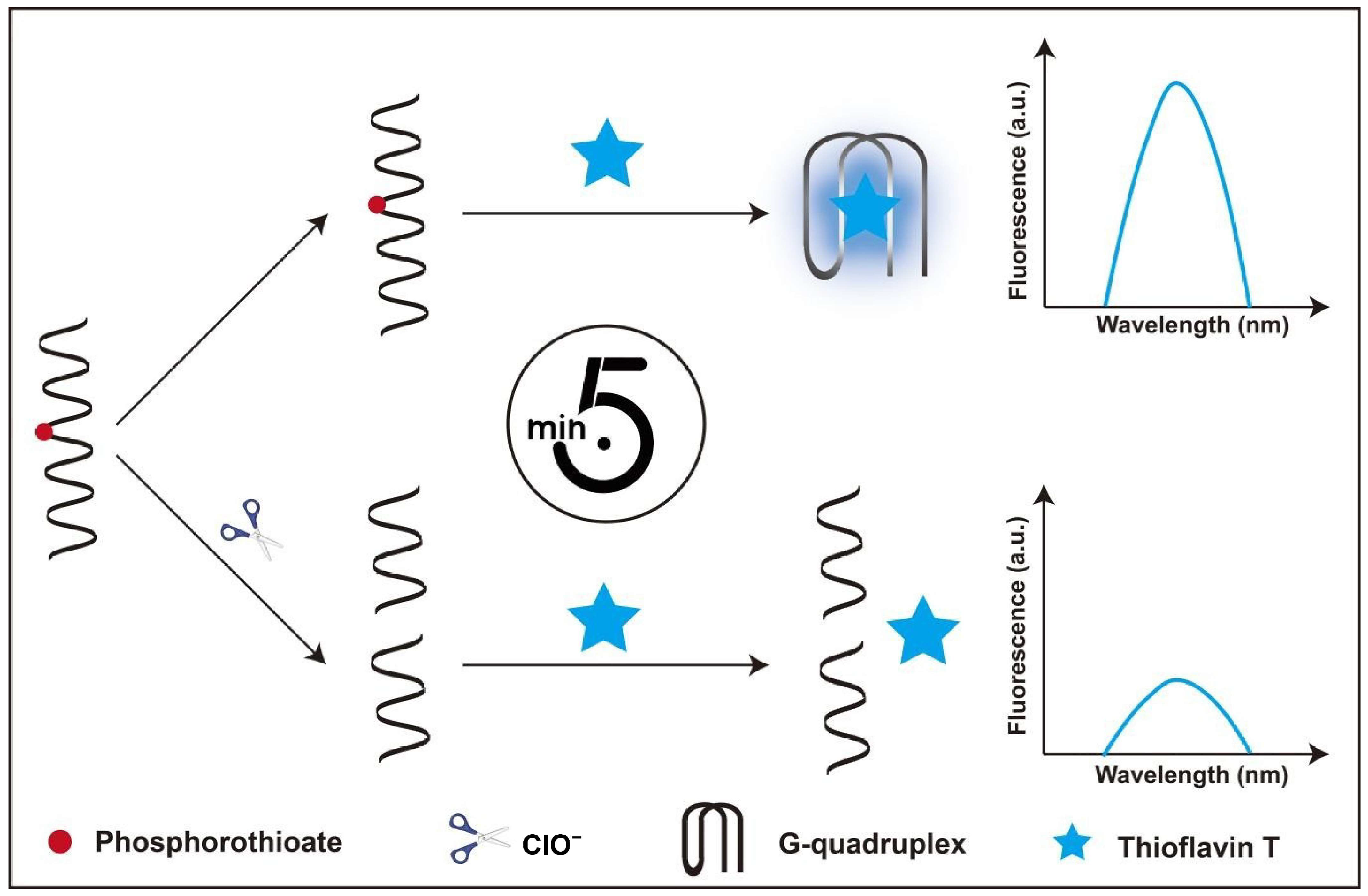
Based on the specific cleavage of PS-modified DNA by ClO and the fluorescence enhancement of ThT upon binding to G-quadruplexes, a label-free fluorescent sensing platform for ClO was constructed (Figure 1). In the absence of ClO, ThT binds to the G-quadruplex structure formed by the S-DNA, leading to a strong fluorescence signal. In the presence of ClO, the PS linkage in the S-DNA undergoes hydrolysis, resulting in cleavage of the S-DNA into two fragments. This cleavage prevents the formation of G-quadruplex structure, thereby reducing the binding between ThT and the S-DNA and causing a significant decrease in fluorescence intensity at 490 nm. Thus, the concentration of ClO can be quantitatively determined according to the change in fluorescence intensity.

3.2. Feasibility Test of the Strategy

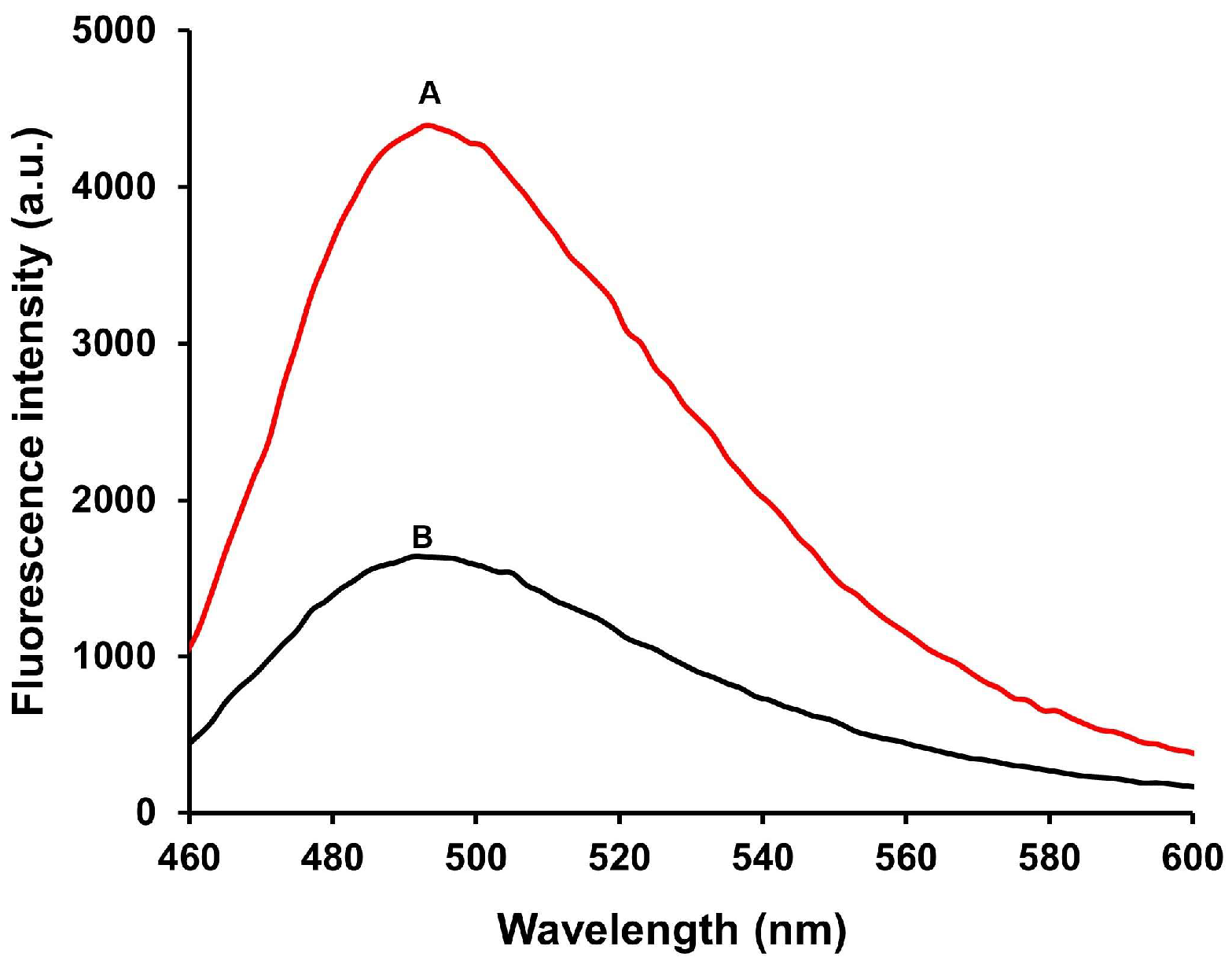
The feasibility of the proposed method was verified by comparing the fluorescence spectra of the system in the absence and in the presence ClO (Figure 2). In the absence of ClO (curve A), the system exhibited a high fluorescence intensity, indicating the formation of the G-quadruplex/ThT complex. In the presence of 50 μM ClO (curve B), a significant reduction in fluorescence intensity was observed, confirming that ClO induces cleavage of the PS-modified S-DNA, which disrupts G-quadruplex formation. These results demonstrate that the proposed method is simple, effective, sensitive, and rapid for ClO detection.

3.3. Reaction Condition Optimization

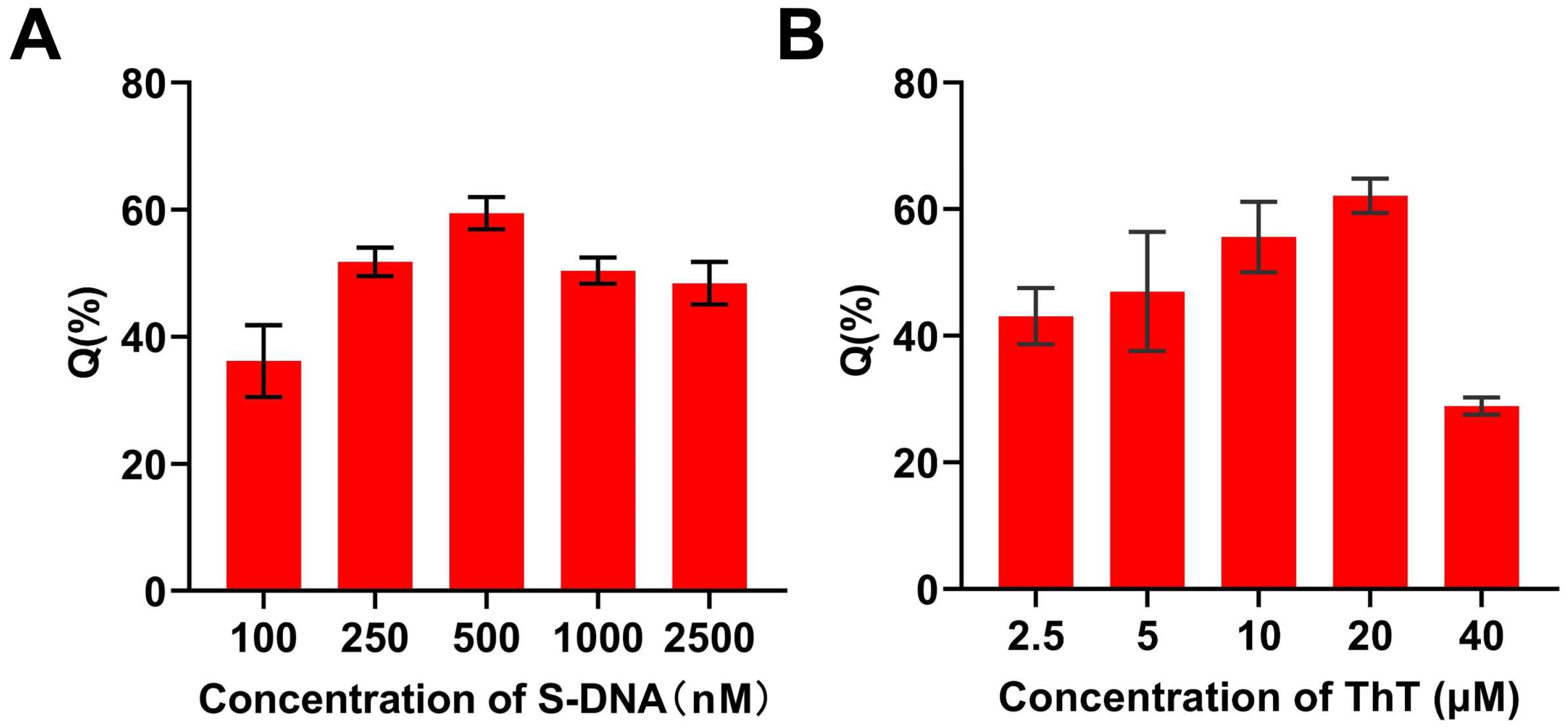
To improve the detection sensitivity, the concentrations of S-DNA and ThT were optimized. As shown in Figure 3A, the fluorescence quenching efficiency (Q%) increased with increasing S-DNA concentration and reached a maximum at 500 nM. Further increases in S-DNA concentration did not significantly improve the Q%, so 500 nM was selected as the optimal S-DNA concentration. For ThT, the Q% increased with increasing concentration up to 20 μM (Figure 3B), after which it decreased. This decrease in Q% is attributed to an increased fluorescence background caused by the high concentration of ThT. Therefore, 20 μM was chosen as the optimal ThT concentration for subsequent experiments.

3.4. Quantitative Analysis of ClO

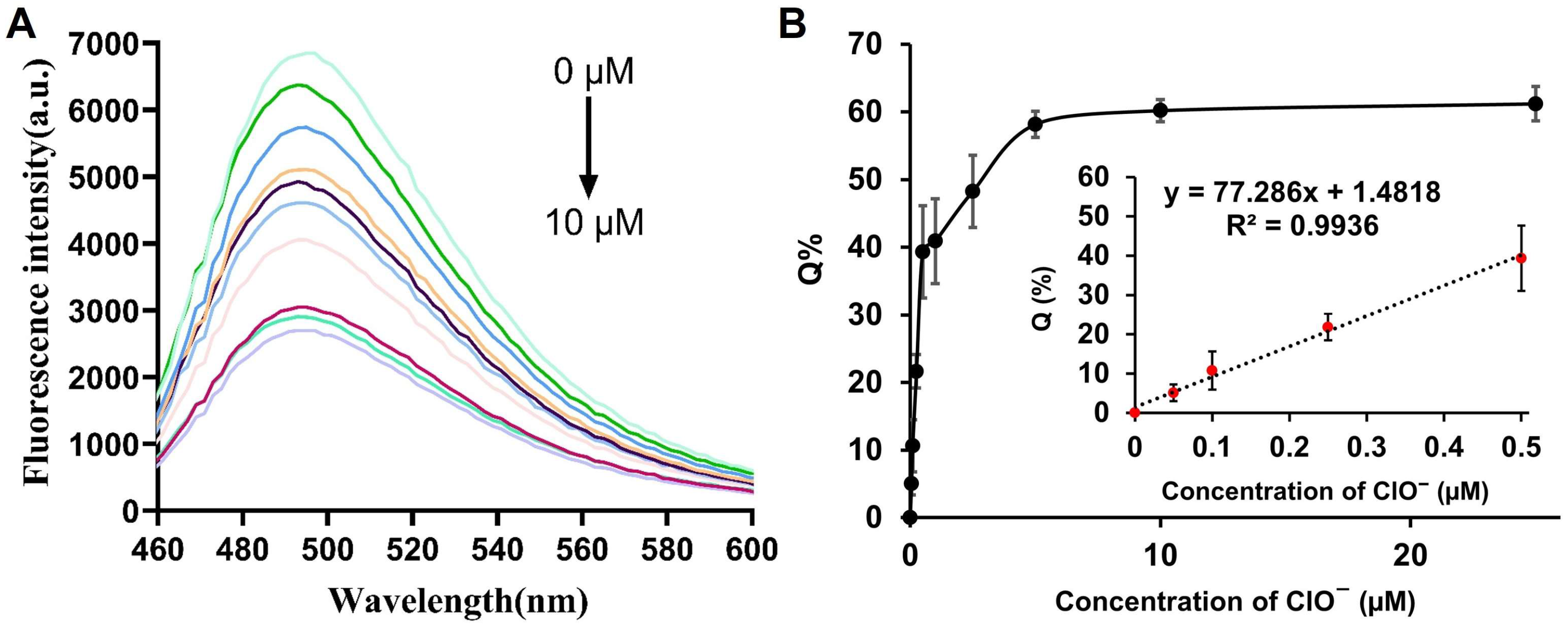
Under the optimized conditions, the quantitative performance of the method for ClO detection was evaluated. As shown in Figure 4A, the fluorescence intensity at 490 nm gradually decreased with increasing ClO concentration in the range of 0–25 μM. The Q% exhibited a good linear relationship with ClO concentration (Figure 4B). Notably, at low ClO concentrations (0–0.5 μM), a linear correlation was observed between the fluorescence intensity and ClO concentration with a correlation coefficient (R2) of 0.9936 (inset of Figure 4B). Based on the calculation formula for the Limit of Detection (LOD), which is defined as 3.3 times the standard deviation (σ) divided by the slope (S) of the calibration curve, the detection limit of our method is 41.2 nM. The sensitivity of our assay was higher than that of other previously reported fluorescent ClO detection methods (Table 1) [21,23,24,25,26,27,28]. Furthermore, the total reaction time of our assay was 5 min, which was much shorter than that of fluorescent ClO detection methods.

3.5. Specific Analysis

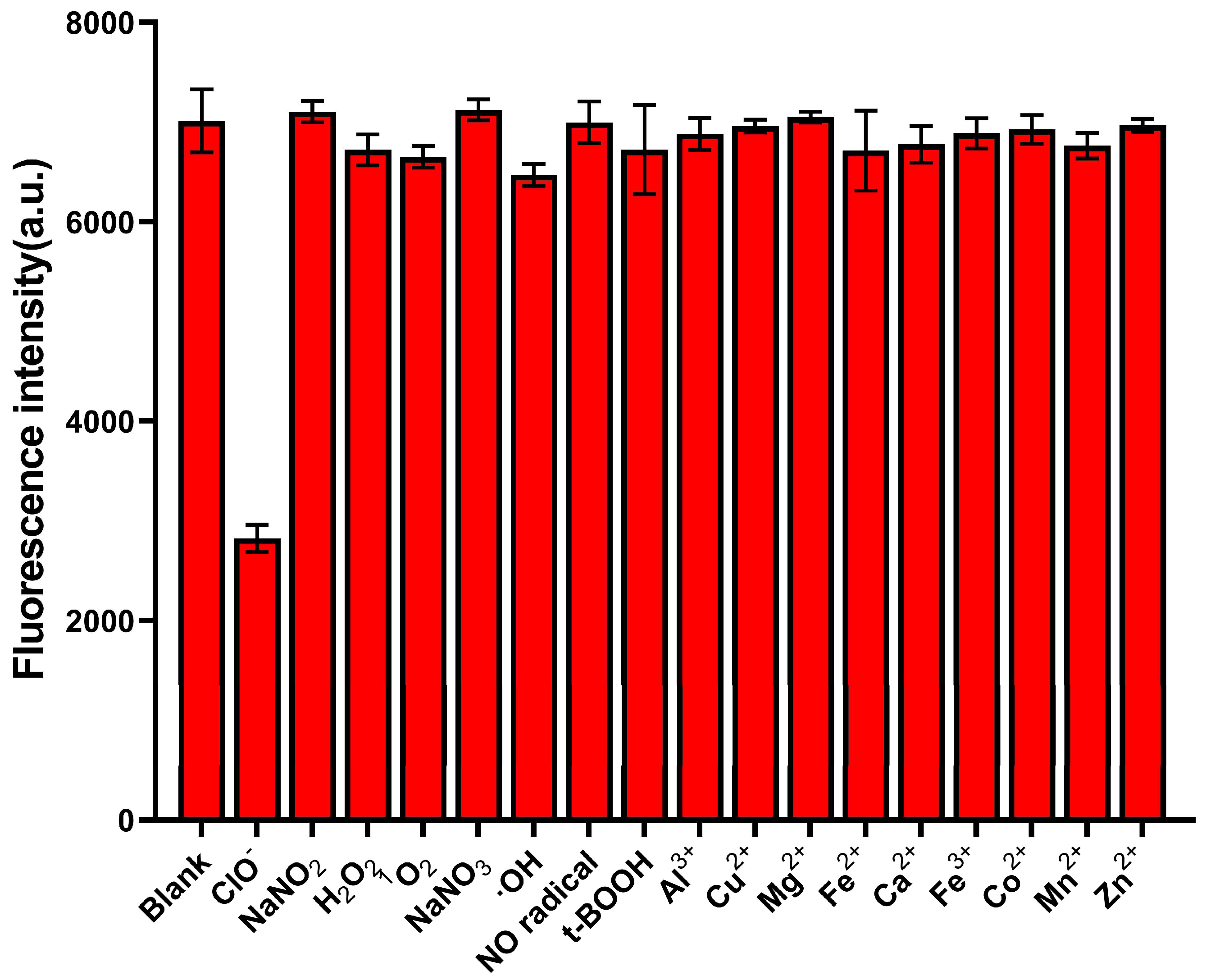
The specificity of this method towards ClO was evaluated. Neither the other relevant ROS (25 μM NaNO2; H2O2; 1O2; NaNO3; ·OH; NO radical; t-BOOH) nor biologically relevant metal ions (25 μM Al3+; Cu2+; Mg2+; Fe2+; Ca2+; Fe3+; Co2+; Mn2+; Zn2+) led to significant fluorescence changes (Figure 5). By contrast, the fluorescence intensity decreased markedly after adding ClO, indicating the excellent specificity of the method for ClO.

3.6. Analysis of ClO in Human Cells

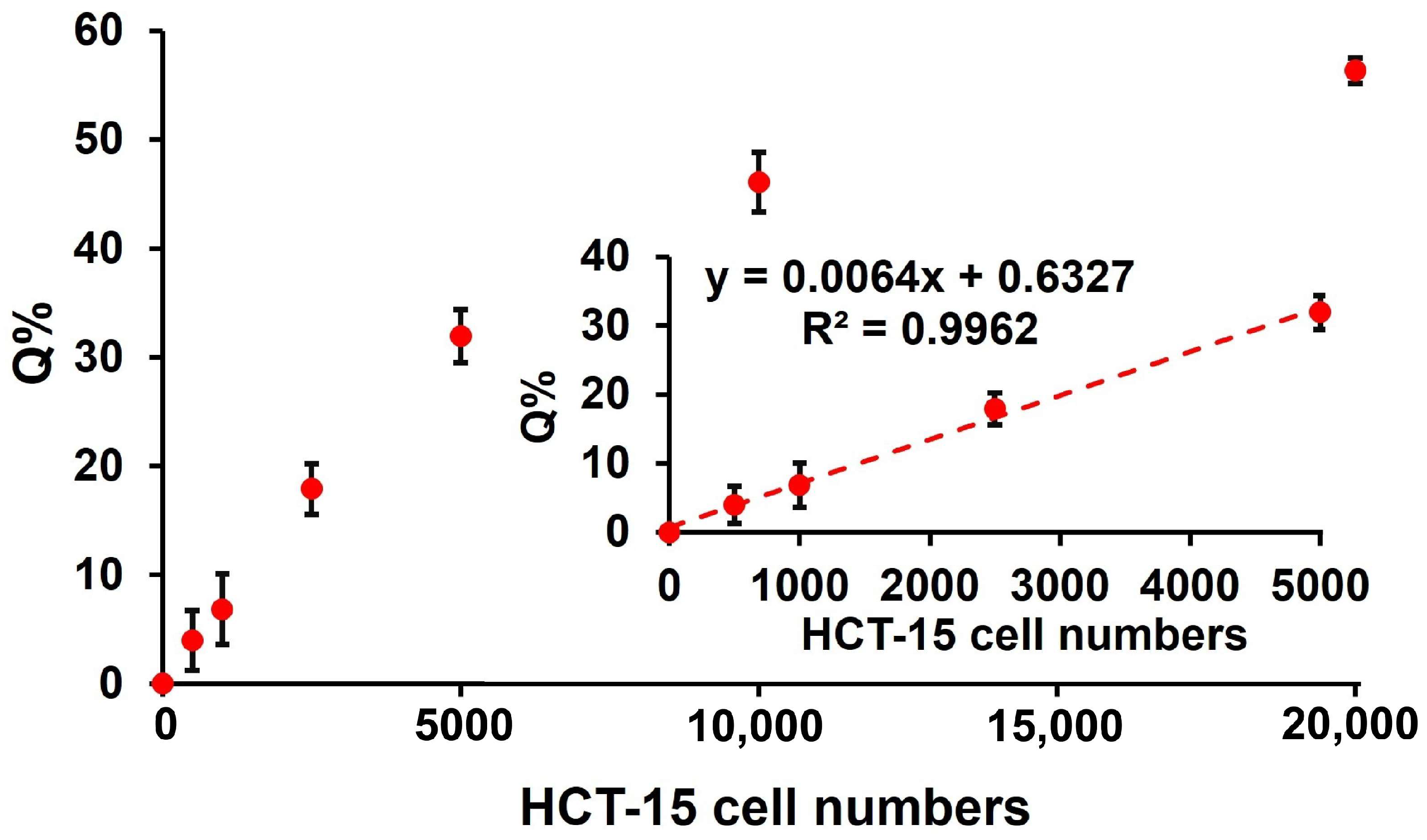
To test the method’s applicability to human cells, we applied it to lysates of the colorectal cancer line HCT-15. The calibration curve was linear over the range of 0–5000 cells (Figure 6), with a regression equation of y = −0.4536x + 7058.7 and a correlation coefficient (R2) of 0.9963, where x represents the number of HCT-15 cells and y corresponds to the fluorescence intensity. These data indicate that the assay can reliably quantify ClO in human cells.

3.7. Investigation of ClO Levels in Plasma of Rats Exhibiting SIH

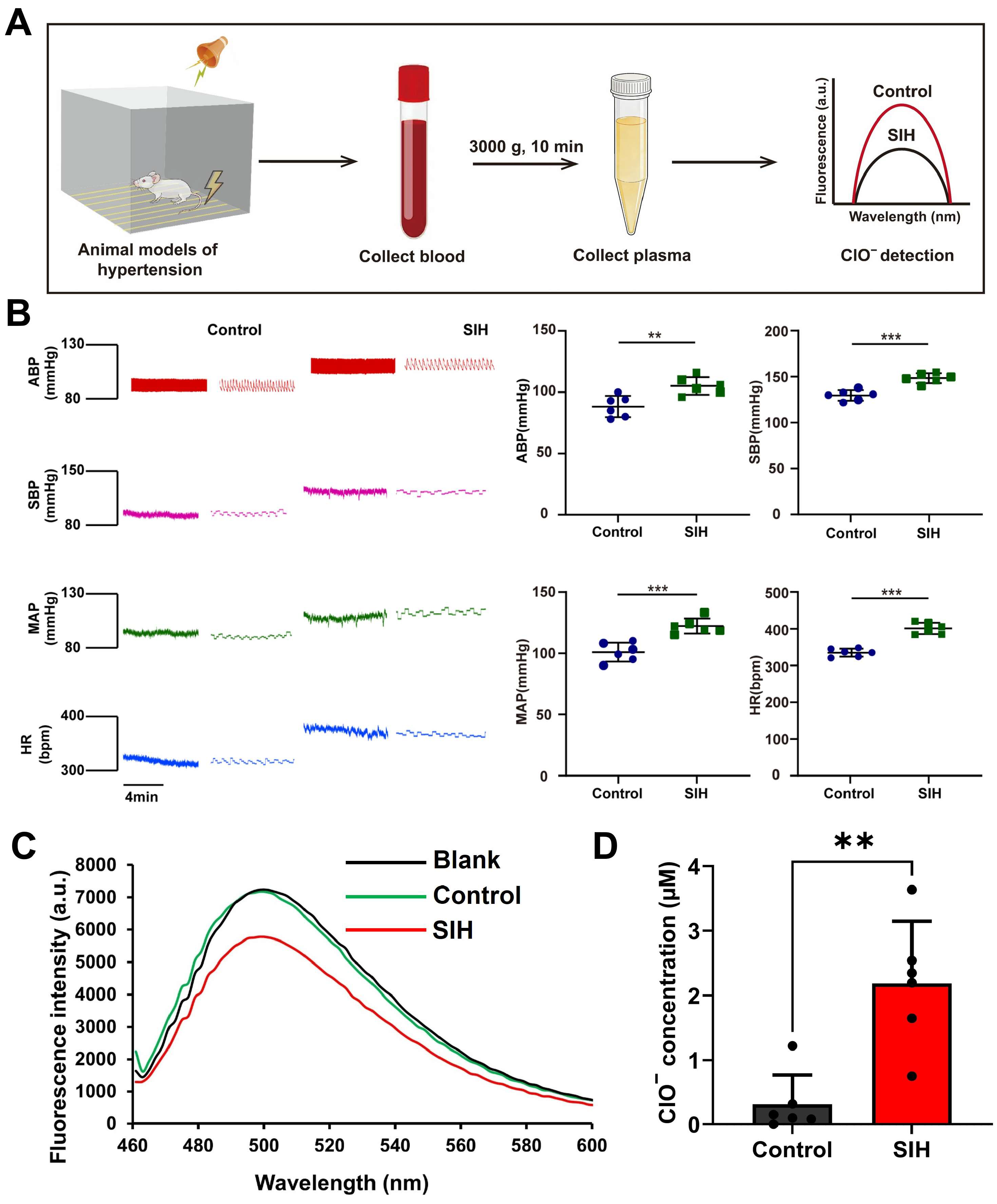
SIH is characterized by sustained elevations in blood pressure due to chronic stress, which can lead to severe health complications if left untreated [29]. While accumulating evidence suggests that reactive oxygen species (ROS) in plasma exacerbate SIH, the specific role of ClO in this context remains largely unexplored. Therefore, this study aimed to quantify ClO levels in the plasma of SIH rats using our established methodology. Before analyzing the plasma samples, the matrix effect was systematically evaluated to ensure the accuracy of quantification. Specifically, known quantities of ClO were added to the plasma samples from healthy rats. As shown in Table 2, no significant matrix interference was observed for the detection of ClO in rat plasma. The recovery values and relative standard deviations (RSDs) further confirmed that the proposed method is sufficiently robust and reliable for the direct quantification of ClO in this complex biological matrix. Figure 7A illustrates the animal study design, which included six control rats and six rats with SIH as the experimental group, with a total of 12 animals used in this study. As illustrated in Figure 7B, SIH rats exhibited significantly elevated arterial blood pressure (ABP), systolic blood pressure (SBP), mean arterial pressure (MAP), and heart rate (HR) compared with control animals. Consistent with these physiological changes, SIH rats displayed notably lower fluorescence intensity than controls (Figure 7C). The authors analyzed a total of 12 real samples, including 6 blank plasma samples and 6 plasma samples from SIH model rats. The calibration curve was constructed using ClO at concentrations of 0, 0.05, 0.1, 0.25, and 0.5 μM under optimized conditions, and all experiments were performed under identical conditions. The ClO concentration in plasma samples was quantified by substituting the measured Q% value into the corresponding linear regression equation. Furthermore, as highlighted in Figure 7D, plasma ClO levels were substantially increased in the SIH group relative to controls, with statistical significance (p < 0.01). These findings suggest that ClO may serve as a diagnostic biomarker for SIH, highlighting the platform’s value in translating ROS biomarkers from preclinical research to clinical applications.

4. Conclusions

In summary, we have developed a highly sensitive method for ClO detection with a limit of detection (LOD) of 41.2 nM. The S-DNA requires no fluorophore labeling, offering a convenient and low-cost approach. Owing to the high specificity and rapidity of the hydrolysis reaction between PS and ClO, the established method exhibits superior selectivity for ClO detection compared to other reported assays. Having been successfully applied to the quantitative determination of endogenous ClO in human cells and the plasma of SIH rats, this method holds substantial potential as a simple, low-cost tool for ClO analysis in clinical and physiological research, particularly for SIH-related diagnostic screening and pathogenesis studies. However, this study has notable limitations. This study exclusively used male Sprague-Dawley rats, with no exploration of gender differences in ClO metabolism or hypertension susceptibility, which limits the generalizability of the findings to female populations or other species. The sensor’s performance in more complex biological matrices (e.g., tissues) and in vivo scenarios remains untested, and the small sample size (n = 6 per group) may reduce statistical power for detecting subtle differences. Nevertheless, the sensor’s simplicity, low cost, and biological applicability still render it valuable for future ClO research, with room for optimization to address these constraints.

Author Contributions

Conceptualization, H.L. and G.Z.; methodology, J.L., Y.Z. and L.Z.; software, J.L.; validation, J.L. and Y.Z.; formal analysis, J.L. and L.Z.; investigation, J.L. and H.L.; resources, H.L. and G.Z.; data curation, J.L.; writing—original draft preparation, H.L. and J.L.; writing—review and editing, G.Z.; visualization, J.L. and L.Z.; supervision, G.Z.; project administration, G.Z.; funding acquisition, H.L. All authors have read and agreed to the published version of the manuscript.

Funding

This research was supported by the Doctoral Foundation of Heze University, China (XY22BS21).

Institutional Review Board Statement

The study was conducted in accordance with the National Institutes of Health’s Guidelines (Publication no. 85-23, 1996 revision), and the protocol was approved by the Ethics Committee of Heze University (Project identification code: ECHZU 2024-010) on 4 June 2024.

Informed Consent Statement

Not applicable, as this study does not involve human participants.

Data Availability Statement

Data presented in this study is contained within the article. Further inquiries can be directed to the corresponding authors.

Conflicts of Interest

The authors declare no conflicts of interest.

References

  1. Jeitner, T.M.; Kalogiannis, M.; Krasnikov, B.F.; Gomolin, I.; Peltier, M.R.; Moran, G.R. Linking Inflammation and Parkinson Disease: Hypochlorous Acid Generates Parkinsonian Poisons. Toxicol. Sci. 2016, 151, 388–402. [Google Scholar] [CrossRef]
  2. Fan, G.; Wang, N.; Zhang, J.; Ji, X.; Qin, S.; Tao, Y.; Zhao, W. BODIPY-based near-infrared fluorescent probe for diagnosis drug-induced liver injury via imaging of HClO in cells and in vivo. Dye. Pigment. 2022, 199, 110073. [Google Scholar] [CrossRef]
  3. Griendling, K.K.; Camargo, L.L.; Rios, F.J.; Alves-Lopes, R.; Montezano, A.C.; Touyz, R.M. Oxidative Stress and Hypertension. Circ. Res. 2021, 128, 993–1020. [Google Scholar] [CrossRef]
  4. Gil, D.; Choi, B.; Lee, J.J.; Lee, H.; Kim, K.-T.; Kim, C. A colorimetric/ratiometric chemosensor based on an aggregation-induced emission strategy for tracing hypochlorite in vitro and in vivo. Ecotox. Environ. Saf. 2023, 257, 114954. [Google Scholar]
  5. Chen, X.; Zou, Z.; Cang, Z.; Wang, M.; Teng, J.; Yang, H.B.; Guo, C.; Hu, F. Single-atom iron fabricated electrochemical flexible sensor for detection of hypochlorite ions in water samples. Microchem. J. 2025, 211, 113145. [Google Scholar] [CrossRef]
  6. Ma, C.; Zhong, G.; Zhao, Y.; Zhang, P.; Fu, Y.; Shen, B. Recent development of synthetic probes for detection of hypochlorous acid/hypochlorite. Spectrochim. Acta A Mol. Biomol. Spectrosc. 2020, 240, 118545. [Google Scholar] [CrossRef]
  7. Zareen, W.; Ahmed, N.; Raza, S.; Khan, M.A.; Shafiq, Z. Recent development in dual function fluorescence probes for HOCl and interaction with different bioactive molecules. Talanta 2024, 277, 126374. [Google Scholar] [CrossRef]
  8. Yang, B.; Qu, W.; Lu, J.; Wu, Z.; Li, Y.; Yao, R.; Wang, J.; Li, Y.; Lu, Z.; Geng, Z.; et al. Red-emitting aggregation-induced emission fluorescent probe for monitoring fluctuation of HClO in mitochondria during ferroptosis. Anal. Chim. Acta 2025, 1360, 344140. [Google Scholar] [CrossRef] [PubMed]
  9. Yang, D.; Wu, X.-T.; Ning, J.-Y.; Wei, B.-Y.; Miao, J.-Y.; Zhao, B.-X.; Lin, Z.-M. Novel fluorescence probe for ClO− in living cells: Based on FRET mechanism. Spectrochim. Acta A Mol. Biomol. Spectrosc. 2024, 321, 124754. [Google Scholar] [CrossRef] [PubMed]
  10. Xu, Q.; Jiao, C.; Liu, X.; Yang, Y.; Ren, J.; Wang, P.; Pan, X.; Wu, Y.; Yan, Z.; Zeng, J. A highly sensitive and fast-response fluorescence nanoprobe for in vivo imaging of hypochlorous acid. J. Hazard. Mater. 2025, 487, 137282. [Google Scholar] [CrossRef] [PubMed]
  11. Zhang, W.; Wang, H.; Li, F.; Chen, Y.; Kwok, R.T.K.; Huang, Y.; Zhang, J.; Hou, J.; Tang, B.Z. A ratiometric fluorescent probe based on AIEgen for detecting HClO in living cells. Chem. Commun. 2020, 56, 14613–14616. [Google Scholar] [CrossRef]
  12. Yudhistira, T.; Mulay, S.V.; Kim, Y.; Halle, M.B.; Churchill, D.G. Imaging of Hypochlorous Acid by Fluorescence and Applications in Biological Systems. Chem. Asian J. 2019, 14, 3048–3084. [Google Scholar] [PubMed]
  13. Xu, J.; Tian, Q.; Chu, Q.; Zhang, Y.; Zou, M.; Zhao, H.; Liu, Y.; Chu, W. Design and synthesis of phenothiazine-based D–A molecules with ICT characteristics as efficient fluorescent probes for detecting hypochlorite in water. Spectrochim. Acta A Mol. Biomol. Spectrosc. 2025, 328, 125491. [Google Scholar]
  14. Qi, H.; Zhai, Z.; Dong, X.; Zhang, P. Nitrogen doped carbon quantum dots (N-CQDs) with high luminescence for sensitive and selective detection of hypochlorite ions by fluorescence quenching. Spectrochim. Acta A Mol. Biomol. Spectrosc. 2022, 279, 121456. [Google Scholar] [CrossRef]
  15. Kellner, S.; DeMott, M.S.; Cheng, C.P.; Russell, B.S.; Cao, B.; You, D.; Dedon, P.C. Oxidation of phosphorothioate DNA modifications leads to lethal genomic instability. Nat. Chem. Biol. 2017, 13, 888–894. [Google Scholar] [CrossRef]
  16. Xiao, L.; Gu, C.; Xiang, Y. Orthogonal Activation of RNA-Cleaving DNAzymes in Live Cells by Reactive Oxygen Species. Angew. Chem. Int. Ed. Engl. 2019, 58, 14167–14172. [Google Scholar]
  17. Wu, K.; Yao, C.; Yang, D.; Liu, D. A functional DNA nanosensor for highly sensitive and selective imaging of ClO in atherosclerotic plaques. Biosens. Bioelectron. 2022, 209, 114273. [Google Scholar] [CrossRef]
  18. Xu, J.; Zhou, X.; He, H.; Li, S.; Ma, C. A turn-on fluorescence strategy for hypochlorous acid detection based on DNAzyme-assisted cyclic signal amplification. Spectrochim. Acta A 2023, 303, 123243. [Google Scholar]
  19. Khusbu, F.Y.; Xi, Z.; Chen, H.; Changbei, M.; Kemin, W. Thioflavin T as a fluorescence probe for biosensing applications. TrAC-Trend. Anal. Chem. 2018, 109, 1–18. [Google Scholar] [CrossRef]
  20. Liu, H.; Ma, C.; Ning, F.; Chen, H.; He, H.; Wang, K.; Wang, J. A facile label-free G-quadruplex based fluorescent aptasensor method for rapid detection of ATP. Spectrochim. Acta A Mol. Biomol. Spectrosc. 2017, 175, 164–167. [Google Scholar]
  21. Liu, H.; Zhang, X.; Li, X.; Wu, H.; Shi, Y.; Lu, W. A G-quadruplex/thioflavin T-based label-free biosensor to detect ClO in stress-induced hypertension. Spectrochim. Acta Part A 2024, 314, 124231. [Google Scholar] [CrossRef]
  22. Tong, L.; Chen, G.; Liu, T.; Wang, L.; Zhang, H.; Chen, F.; Zhang, S.; Du, D. IFN-g deficiency in the rostral ventrolateral medulla contributes to stress-induced hypertension by impairing microglial synaptic engulfment. J. Hypertens. 2023, 41, 1323–1332. [Google Scholar] [CrossRef]
  23. Liu, Q.; Li, X.; Xiao, M.; Ai, Y.; Liu, G.; Ding, H.; Pu, S. A “Turn-on” Fluorescent Probe Based on Phenothiazine for Selectively Recognizing ClO and its Practical Applications. J. Fluoresc. 2023, 33, 2451–2459. [Google Scholar] [CrossRef] [PubMed]
  24. Tan, H.; Song, Z.; Wang, Z.; Yang, X.; Rao, X.; Zhao, P.; Jiang, Q. A cinnamic acid-based ratiometric fluorescence probe for detection of hypochlorite and its biological applications. J. Mol. Struct. 2025, 1335, 141940. [Google Scholar] [CrossRef]
  25. Suna, G. A Commercially Available 2–aminoanthracene Fluorescent Probe for Rapid and Sensitive Detection of Hypochlorite in 100% Buffer Solution and its Application in Complex Water Samples. J. Fluoresc. 2025, 35, 139–144. [Google Scholar] [PubMed]
  26. Xu, L.; Yu, J.; Wang, Y.; Chen, Y.; Zhang, X.; Han, R.; Jing, J.; Zhang, R.; Zhang, X. A mitochondria-targeted fluorescent probe with large Stokes shift for rapid detection of hypochlorite and its application in living cells. Dye. Pigment. 2022, 207, 110622. [Google Scholar] [CrossRef]
  27. Chao, M.; Zhang, H.; Hu, Q.; Ma, S.; Cui, X.; Yu, X. AIE-based fluorescent probe designed with xanthone as a π-bridge for detecting of ClO? in pericarp and living cells. Spectrochim. Acta Part A 2025, 324, 124984. [Google Scholar]
  28. Suna, G.; Erdemir, E.; Gunduz, S.; Ozturk, T.; Karakus, E. Monitoring of Hypochlorite Level in Fruits, Vegetables, and Dairy Products: A BODIPY-Based Fluorescent Probe for the Rapid and Highly Selective Detection of Hypochlorite. ACS Omega 2023, 8, 22984–22991. [Google Scholar] [CrossRef]
  29. Tianfeng, L.; Linping, W.; Lei, T.; Zhangyan, R.; Bingjie, Z.; Haisheng, L.; Wen, L.; Haili, Z.; Shuai, Z.; Dongshu, D. PDZD8 Dysregulation Mediates RVLM Neuronal Hyperexcitation Via Activation of Ca2+-Calpain-2 Signaling in Stress-Induced Hypertension. Mol. Neurobiol. 2025, 62, 12539–12558. [Google Scholar]
Figure 1. Schematic illustration of ClO detection. The reaction takes only 5 minutes.
Biosensors 16 00169 g001
Figure 2. Fluorescence emission spectra in the absence (A) and the presence (B) of 50 μM ClO.
Biosensors 16 00169 g002
Figure 3. Optimization of the ClO detection conditions: (A) The concentration of S-DNA; (B) The concentration of ThT. Data represent the mean ± SD for three replicates.
Biosensors 16 00169 g003
Figure 4. (A) Fluorescence emission spectra of sensing system in the presence of increasing amounts of ClO (0, 0.05, 0.1, 0.25, 0.5, 1, 2.5, 5, 10 and 25 μM). (B) The linear relationship between Q% and the concentration of ClO. Inset: the linear relationship at low ClO concentration. Error bars show the standard deviation of three experiments.
Biosensors 16 00169 g004
Figure 5. The fluorescence intensity of S-DNA (500 nM) after reacting with 25 μM ClO or 25 μM other ROS and metal ions.
Biosensors 16 00169 g005
Figure 6. HCT-15 cell lysate analysis utilizing the procedures of the proposed method. The error bar reflects three separate measurements (mean ± SD).
Biosensors 16 00169 g006
Figure 7. Evaluation of plasma ClO levels in a rat model of SIH. (A) Summary of experimental protocols in animals. (B) Analysis of cardiovascular parameters (ABP, SBP, MAP, HR). (C,D) FL imaging in the plasma illustrating differences between control and SIH rats. All statistical analyses were performed using GraphPad Prism 9.0. Quantitative data are presented as mean ± standard deviation (SD), with n = 6 independent biological replicates per group. Unpaired two-tailed Student’s t-test was used for comparisons between the control group and SIH group. (** p < 0.01, *** p < 0.001 vs. control).
Biosensors 16 00169 g007
Table 1. Comparison of different methods for hypochlorous acid detection.
MethodsYearLOD (µM)Linear Range
(µM)
Signal ModeRef.
Phenothiazine probe20230.4720–30Turn on[23]
Cinnamic acid probe20250.0990–70Turn on[24]
2–aminoanthracene probe20250.140.5–2.5Turn off[25]
PCH probe20222.1020–100Turn on[26]
HON1-CN20250.480–50Turn on[27]
BOD−CN probe20230.083/Turn on[28]
Block DNA–G-Quadruplex/Thioflavin T20240.010–1Turn on[21]
This work20260.04120–0.5Turn off/
Table 2. Results for the detection of ClO in plasma.
ClO Spiked (µM)ClO Found (µM)Recovery (%)RSD (%)
0.2500.257 ± 0.015102.67%5.95
0.5000.497 ± 0.02199.33%4.19
Disclaimer/Publisher’s Note: The statements, opinions and data contained in all publications are solely those of the individual author(s) and contributor(s) and not of MDPI and/or the editor(s). MDPI and/or the editor(s) disclaim responsibility for any injury to people or property resulting from any ideas, methods, instructions or products referred to in the content.