A Minimally Invasive LC–MS/MS Approach for Assessing Endocannabinoids in Saliva and Capillary Blood Microsamples



Abstract
1. Introduction
2. Materials and Methods
2.1. Chemicals and Reagents
2.2. Saliva Sample Preparation
2.3. Blood Microsample Preparation
2.4. Plasma Sample Preparation
2.5. Liquid-Liquid Extraction
2.6. Protein Precipitation
2.7. Liquid Chromatography Tandem Mass Spectrometry
2.8. Method Validation Procedures
2.8.1. Determination of LOD, LLOQ, and Linearity
2.8.2. Precision, Recovery, and Matrix Effects
2.9. Venipuncture Responses
2.10. Association Between Plasma and Blood Microsamples
3. Results and Conclusions
3.1. Extraction from Saliva
3.2. Extraction from Blood Microsamples
3.3. Chromatography
3.4. Method Validation
3.4.1. Linearity, LOD, and LLOQ
3.4.2. Precision, Recovery, and Matrix Effects
3.5. Plasma and Blood Microsample Comparison
3.6. Endocannabinoid Response to Venipuncture
3.7. Limitations
3.8. Conclusions
Supplementary Materials
Author Contributions
Funding
Institutional Review Board Statement
Informed Consent Statement
Data Availability Statement
Acknowledgments
Conflicts of Interest
Abbreviations
| CB1 | cannabinoid receptor 1 |
| CB2 | cannabinoid receptor 2 |
| OEA | oleoylethanolamide |
| PEA | palmitoylethanolamide |
| LC–MS/MS | liquid chromatography–tandem mass spectrometry |
| VAMS | volumetric absorptive microsampling |
| AA | arachidonic acid |
| LLE | liquid–liquid extraction |
| PP | protein precipitation |
| LOD | limits of detection |
| LLOQ | lower limit of quantification |
| RSD | relative standard deviation |
References
- Devane, W.A.; Hanus, L.; Breuer, A.; Pertwee, R.G.; Stevenson, L.A.; Griffin, G.; Gibson, D.; Mandelbaum, A.; Etinger, A.; Mechoulam, R. Isolation and structure of a brain constituent that binds to the cannabinoid receptor. Science 1992, 258, 1946–1949. (In English) [Google Scholar] [CrossRef]
- Sugiura, T.; Kondo, S.; Sukagawa, A.; Nakane, S.; Shinoda, A.; Itoh, K.; Yamashita, A.; Waku, K. 2-Arachidonoylglycerol: A possible endogenous cannabinoid receptor ligand in brain. Biochem. Biophys. Res. Commun. 1995, 215, 89–97. (In English) [Google Scholar] [CrossRef]
- Schmid, P.C.; Reddy, P.V.; Natarajan, V.; Schmid, H.H. Metabolism of N-acylethanolamine phospholipids by a mammalian phosphodiesterase of the phospholipase D type. J. Biol. Chem. 1983, 258, 9302–9306. (In English) [Google Scholar] [CrossRef]
- Cravatt, B.F.; Lichtman, A.H. Fatty acid amide hydrolase: An emerging therapeutic target in the endocannabinoid system. Curr. Opin. Chem. Biol. 2003, 7, 469–475. [Google Scholar] [CrossRef]
- Bisogno, T.; Howell, F.; Williams, G.; Minassi, A.; Cascio, M.G.; Ligresti, A.; Matias, I.; Schiano-Moriello, A.; Paul, P.; Williams, E.J.; et al. Cloning of the first sn1-DAG lipases points to the spatial and temporal regulation of endocannabinoid signaling in the brain. J. Cell Biol. 2003, 163, 463–468. (In English) [Google Scholar] [CrossRef] [PubMed]
- Matsuda, L.A.; Lolait, S.J.; Brownstein, M.J.; Young, A.C.; Bonner, T.I. Structure of a cannabinoid receptor and functional expression of the cloned cDNA. Nature 1990, 346, 561–564. (In English) [Google Scholar] [CrossRef] [PubMed]
- Munro, S.; Thomas, K.L.; Abu-Shaar, M. Molecular characterization of a peripheral receptor for cannabinoids. Nature 1993, 365, 61–65. (In English) [Google Scholar] [CrossRef]
- Wilson, R.I.; Nicoll, R.A. Endogenous cannabinoids mediate retrograde signalling at hippocampal synapses. Nature 2001, 410, 588–592. [Google Scholar] [CrossRef] [PubMed]
- Puhl, S.-L. Cannabinoid-sensitive receptors in cardiac physiology and ischaemia. Biochim. Biophys. Acta (BBA)—Mol. Cell Res. 2020, 1867, 118462. [Google Scholar] [CrossRef]
- Han, K.H.; Lim, S.; Ryu, J.; Lee, C.-W.; Kim, Y.; Kang, J.-H.; Kang, S.-S.; Ahn, Y.K.; Park, C.-S.; Kim, J.J. CB1 and CB2 cannabinoid receptors differentially regulate the production of reactive oxygen species by macrophages. Cardiovasc. Res. 2009, 84, 378–386. [Google Scholar] [CrossRef]
- Di Marzo, V.; Petrosino, S. Endocannabinoids and the regulation of their levels in health and disease. Curr. Opin. Lipidol. 2007, 18, 129–140. (In English) [Google Scholar] [CrossRef] [PubMed]
- Navarrete, F.; García-Gutiérrez, M.S.; Jurado-Barba, R.; Rubio, G.; Gasparyan, A.; Austrich-Olivares, A.; Manzanares, J. Endocannabinoid System Components as Potential Biomarkers in Psychiatry. Front. Psychiatry 2020, 11, 315. (In English) [Google Scholar] [CrossRef] [PubMed]
- Ho, W.S.; Barrett, D.A.; Randall, M.D. ‘Entourage’ effects of N-palmitoylethanolamide and N-oleoylethanolamide on vasorelaxation to anandamide occur through TRPV1 receptors. Br. J. Pharmacol. 2008, 155, 837–846. (In English) [Google Scholar] [CrossRef]
- Amir Hamzah, K.; Toms, L.M.; Kucharski, N.; Orr, J.; Turner, N.P.; Hobson, P.; Nichols, D.S.; Ney, L.J. Sex-dimorphism in human serum endocannabinoid and n-acyl ethanolamine concentrations across the lifespan. Sci. Rep. 2023, 13, 23059. (In English) [Google Scholar] [CrossRef]
- Craft, R.M.; Marusich, J.A.; Wiley, J.L. Sex differences in cannabinoid pharmacology: A reflection of differences in the endocannabinoid system? Life Sci. 2013, 92, 476–481. (In English) [Google Scholar] [CrossRef]
- Balsevich, G.; Petrie, G.N.; Hill, M.N. Endocannabinoids: Effectors of glucocorticoid signaling. Front. Neuroendocrinol. 2017, 47, 86–108. (In English) [Google Scholar] [CrossRef] [PubMed]
- Zoerner, A.A.; Gutzki, F.M.; Suchy, M.T.; Beckmann, B.; Engeli, S.; Jordan, J.; Tsikas, D. Targeted stable-isotope dilution GC-MS/MS analysis of the endocannabinoid anandamide and other fatty acid ethanol amides in human plasma. J. Chromatogr. B 2009, 877, 2909–2923. (In English) [Google Scholar] [CrossRef]
- Jarvis, M.; Hamzah, K.A.; Nichols, D.; Ney, L.J. Hair and Saliva Endocannabinoid and Steroid Hormone Analysis by Liquid Chromatography Paired with Tandem Mass Spectrometry. Methods Mol. Biol. 2025, 2868, 135–147. (In English) [Google Scholar] [CrossRef]
- Gatta-Cherifi, B.; Matias, I.; Vallée, M.; Tabarin, A.; Marsicano, G.; Piazza, P.V.; Cota, D. Simultaneous postprandial deregulation of the orexigenic endocannabinoid anandamide and the anorexigenic peptide YY in obesity. Int. J. Obes. 2012, 36, 880–885. (In English) [Google Scholar] [CrossRef]
- Centonze, D.; Bari, M.; Rossi, S.; Prosperetti, C.; Furlan, R.; Fezza, F.; De Chiara, V.; Battistini, L.; Bernardi, G.; Bernardini, S.; et al. The endocannabinoid system is dysregulated in multiple sclerosis and in experimental autoimmune encephalomyelitis. Brain 2007, 130, 2543–2553. (In English) [Google Scholar] [CrossRef]
- Tagliamonte, S.; Gill, C.I.R.; Pourshahidi, L.K.; Slevin, M.M.; Price, R.K.; Ferracane, R.; Lawther, R.; O’Connor, G.; Vitaglione, P. Endocannabinoids, endocannabinoid-like molecules and their precursors in human small intestinal lumen and plasma: Does diet affect them? Eur. J. Nutr. 2021, 60, 2203–2215. (In English) [Google Scholar] [CrossRef] [PubMed]
- Ney, L.J.; Cooper, J.; Lam, G.N.; Moffitt, K.; Nichols, D.S.; Mayo, L.M.; Lipp, O.V. Hair endocannabinoids predict physiological fear conditioning and salivary endocannabinoids predict subjective stress reactivity in humans. Psychoneuroendocrinology 2023, 154, 106296. (In English) [Google Scholar] [CrossRef]
- Krumbholz, A.; Anielski, P.; Reisch, N.; Schelling, G.; Thieme, D. Diagnostic value of concentration profiles of glucocorticosteroids and endocannabinoids in hair. Ther. Drug Monit. 2013, 35, 600–607. (In English) [Google Scholar] [CrossRef] [PubMed]
- Amir Hamzah, K.; Turner, N.; Nichols, D.; Ney, L.J. Advances in targeted liquid chromatography-tandem mass spectrometry methods for endocannabinoid and N-acylethanolamine quantification in biological matrices: A systematic review. Mass. Spectrom. Rev. 2024, 44, 513–538. (In English) [Google Scholar] [CrossRef]
- Hillard, C.J. Circulating Endocannabinoids: From Whence Do They Come and Where are They Going? Neuropsychopharmacology 2018, 43, 155–172. (In English) [Google Scholar] [CrossRef]
- Dubois, S.; Marchese, F.; Pigliasco, F.; Barco, S.; Tripodi, G.; Lomonaco, T.; Lattanzi, S.; Russo, E.; Cangemi, G.; Striano, P. A Volumetric Absorptive Microsampling Technique to Monitor Cannabidiol Levels in Epilepsy Patients. Front. Pharmacol. 2020, 11, 582286. (In English) [Google Scholar] [CrossRef]
- Pigliasco, F.; Barco, S.; Dubois, S.; Marchese, F.; Striano, P.; Lomonaco, T.; Mattioli, F.; Tripodi, G.; Cangemi, G. Cannabidiol Determination on Peripheral Capillary Blood Using a Microsampling Method and Ultra-High-Performance Liquid Chromatography Tandem Mass Spectrometry with On-Line Sample Preparation. Molecules 2020, 25, 3608. (In English) [Google Scholar] [CrossRef]
- Yoshizawa, J.M.; Schafer, C.A.; Schafer, J.J.; Farrell, J.J.; Paster, B.J.; Wong, D.T. Salivary biomarkers: Toward future clinical and diagnostic utilities. Clin. Microbiol. Rev. 2013, 26, 781–791. (In English) [Google Scholar] [CrossRef]
- Hargreaves, J.; Jarvis, M.; Amir Hamzah, K.; Turner, N.; Ney, L.J. Stress Responsivity of Endocannabinoids and Related Biomolecules in Plasma and Saliva. Cannabis Cannabinoid Res. 2025, in press. (In English) [Google Scholar] [CrossRef] [PubMed]
- Ney, L.J.; Felmingham, K.L.; Bruno, R.; Matthews, A.; Nichols, D.S. Simultaneous quantification of endocannabinoids, oleoylethanolamide and steroid hormones in human plasma and saliva. J. Chromatogr. B 2020, 1152, 122252. (In English) [Google Scholar] [CrossRef]
- Ney, L.J.; Stone, C.; Nichols, D.; Felmingham, K.; Bruno, R.; Matthews, A. Endocannabinoid reactivity to acute stress: Investigation of the relationship between salivary and plasma levels. Biol. Psychol. 2021, 159, 108022. (In English) [Google Scholar] [CrossRef] [PubMed]
- Matias, I.; Gatta-Cherifi, B.; Tabarin, A.; Clark, S.; Leste-Lasserre, T.; Marsicano, G.; Piazza, P.V.; Cota, D. Endocannabinoids measurement in human saliva as potential biomarker of obesity. PLoS ONE 2012, 7, e42399. (In English) [Google Scholar] [CrossRef] [PubMed]
- Heiliczer, S.; Wilensky, A.; Gaver, T.; Georgiev, O.; Hamad, S.; Nemirovski, A.; Hadar, R.; Sharav, Y.; Aframian, D.J.; Tam, J.; et al. Salivary Endocannabinoid Profiles in Chronic Orofacial Pain and Headache Disorders: An Observational Study Using a Novel Tool for Diagnosis and Management. Int. J. Mol. Sci. 2022, 23, 13017. (In English) [Google Scholar] [CrossRef]
- O’Donohue, M.P.; Amir Hamzah, K.; Nichols, D.; Ney, L.J. Trauma film viewing and intrusive memories: Relationship between salivary alpha amylase, endocannabinoids, and cortisol. Psychoneuroendocrinology 2024, 164, 107007. (In English) [Google Scholar] [CrossRef]
- Woodhams, S.G.; Sagar, D.R.; Burston, J.J.; Chapman, V. The Role of the Endocannabinoid System in Pain. In Pain Control; Schaible, H.-G., Ed.; Springer: Berlin/Heidelberg, Germany, 2015; pp. 119–143. [Google Scholar]
- deRoon-Cassini, T.A.; Stollenwerk, T.M.; Beatka, M.; Hillard, C.J. Meet Your Stress Management Professionals: The Endocannabinoids. Trends Mol. Med. 2020, 26, 953–968. (In English) [Google Scholar] [CrossRef]
- Viswanathan, C.T.; Bansal, S.; Booth, B.; DeStefano, A.J.; Rose, M.J.; Sailstad, J.; Shah, V.P.; Skelly, J.P.; Swann, P.G.; Weiner, R. Quantitative bioanalytical methods validation and implementation: Best practices for chromatographic and ligand binding assays. Pharm. Res. 2007, 24, 1962–1973. (In English) [Google Scholar] [CrossRef]
- Thompson, M.; Ellison, S.L.R.; Wood, R. Harmonized guidelines for single-laboratory validation of methods of analysis (IUPAC Technical Report). Pure Appl. Chem. 2002, 74, 835–855. [Google Scholar] [CrossRef]
- Mortazavi, H.; Yousefi-Koma, A.A.; Yousefi-Koma, H. Extensive comparison of salivary collection, transportation, preparation, and storage methods: A systematic review. BMC Oral Health 2024, 24, 168. (In English) [Google Scholar] [CrossRef]
- Giavarina, D. Understanding Bland Altman analysis. Biochem. Med. 2015, 25, 141–151. (In English) [Google Scholar] [CrossRef]
- Marczylo, T.H.; Lam, P.M.; Nallendran, V.; Taylor, A.H.; Konje, J.C. A solid-phase method for the extraction and measurement of anandamide from multiple human biomatrices. Anal. Biochem. 2009, 384, 106–113. (In English) [Google Scholar] [CrossRef] [PubMed]
- Balvers, M.G.; Verhoeckx, K.C.; Witkamp, R.F. Development and validation of a quantitative method for the determination of 12 endocannabinoids and related compounds in human plasma using liquid chromatography-tandem mass spectrometry. J. Chromatogr. B 2009, 877, 1583–1590. (In English) [Google Scholar] [CrossRef] [PubMed]
- Zoerner, A.A.; Batkai, S.; Suchy, M.T.; Gutzki, F.M.; Engeli, S.; Jordan, J.; Tsikas, D. Simultaneous UPLC-MS/MS quantification of the endocannabinoids 2-arachidonoyl glycerol (2AG), 1-arachidonoyl glycerol (1AG), and anandamide in human plasma: Minimization of matrix-effects, 2AG/1AG isomerization and degradation by toluene solvent extraction. J. Chromatogr. B 2012, 883–884, 161–171. (In English) [Google Scholar] [CrossRef]
- Kratz, D.; Thomas, D.; Gurke, R. Endocannabinoids as potential biomarkers: It’s all about pre-analytics. J. Mass Spectrom. Adv. Clin. Lab 2021, 22, 56–63. (In English) [Google Scholar] [CrossRef]
- Hargreaves, J.; Ney, L.J. Experimental and Pre-Analytical Considerations of Endocannabinoid Quantification in Human Biofluids Prior to Mass Spectrometric Analysis. Targets 2025, 3, 11. [Google Scholar] [CrossRef]
- Weiermair, T.; Svehlikova, E.; Magnes, C.; Boulgaropoulos, B.; Altendorfer-Kroath, T.; Hummer, J.; Eberl, A. Implementation and validation of a UHPLC-MS/MS method for quantification of the endocannabinoids AEA and 2-AG in cerebral interstitial fluid and plasma. J. Pharm. Biomed. Anal. 2024, 238, 115844. (In English) [Google Scholar] [CrossRef]
- Aydin, E.; Cebo, M.; Mielnik, J.; Richter, H.; Schüle, R.; Sievers-Engler, A.; Młynarz, P.; Lämmerhofer, M. UHPLC-ESI-MS/MS assay for quantification of endocannabinoids in cerebrospinal fluid using surrogate calibrant and surrogate matrix approaches. J. Pharm. Biomed. Anal. 2023, 222, 115090. (In English) [Google Scholar] [CrossRef]
- Ismaiel, O.A.; Zhang, T.; Jenkins, R.G.; Karnes, H.T. Investigation of endogenous blood plasma phospholipids, cholesterol and glycerides that contribute to matrix effects in bioanalysis by liquid chromatography/mass spectrometry. J. Chromatogr. B 2010, 878, 3303–3316. (In English) [Google Scholar] [CrossRef]
- Nasiri, A.; Jahani, R.; Mokhtari, S.; Yazdanpanah, H.; Daraei, B.; Faizi, M.; Kobarfard, F. Overview, consequences, and strategies for overcoming matrix effects in LC-MS analysis: A critical review. Analyst 2021, 146, 6049–6063. (In English) [Google Scholar] [CrossRef]
- Vogeser, M.; Hauer, D.; Christina Azad, S.; Huber, E.; Storr, M.; Schelling, G. Release of anandamide from blood cells. Clin. Chem. Lab. Med. 2006, 44, 488–491. (In English) [Google Scholar] [CrossRef] [PubMed]
- Wood, J.T.; Williams, J.S.; Pandarinathan, L.; Courville, A.; Keplinger, M.R.; Janero, D.R.; Vouros, P.; Makriyannis, A.; Lammi-Keefe, C.J. Comprehensive profiling of the human circulating endocannabinoid metabolome: Clinical sampling and sample storage parameters. Clin. Chem. Lab. Med. 2008, 46, 1289–1295. (In English) [Google Scholar] [CrossRef] [PubMed]
- Castellini, M.A.; Castellini, J.M. Influence of hematocrit on whole blood glucose levels: New evidence from marine mammals. Am. J. Physiol. 1989, 256, R1220–R1224. (In English) [Google Scholar] [CrossRef]
- Pastor, A.; Farré, M.; Fitó, M.; Fernandez-Aranda, F.; de la Torre, R. Analysis of ECs and related compounds in plasma: Artifactual isomerization and ex vivo enzymatic generation of 2-MGs. J. Lipid Res. 2014, 55, 966–977. (In English) [Google Scholar] [CrossRef]
- de Sá, E.S.D.M.; Thaitumu, M.; Theodoridis, G.; Witting, M.; Gika, H. Volumetric Absorptive Microsampling in the Analysis of Endogenous Metabolites. Metabolites 2023, 13, 1038. (In English) [Google Scholar] [CrossRef]
- Tobin, N.H.; Murphy, A.; Li, F.; Brummel, S.S.; Taha, T.E.; Saidi, F.; Owor, M.; Violari, A.; Moodley, D.; Chi, B.; et al. Comparison of dried blood spot and plasma sampling for untargeted metabolomics. Metabolomics 2021, 17, 62. (In English) [Google Scholar] [CrossRef]
- Ackermans, M.T.; de Kleijne, V.; Martens, F.; Heijboer, A.C. Hematocrit and standardization in DBS analysis: A practical approach for hormones mainly present in the plasma fraction. Clin. Chim. Acta 2021, 520, 179–185. (In English) [Google Scholar] [CrossRef]
- Dalile, B.; Verbeke, K.; Van Oudenhove, L. Vasovagal reactions following venepuncture result in aberrant stress-induced cortisol levels. Psychoneuroendocrinology 2021, 128, 105220. (In English) [Google Scholar] [CrossRef] [PubMed]
- McManus, J.M.; Sharifi, N. Structure-dependent retention of steroid hormones by common laboratory materials. J. Steroid Biochem. Mol. Biol. 2020, 198, 105572. (In English) [Google Scholar] [CrossRef] [PubMed]
- Pippa, L.F.; Marques, M.P.; da Silva, A.C.T.; Vilar, F.C.; de Haes, T.M.; da Fonseca, B.A.L.; Martinez, R.; Coelho, E.B.; Wichert-Ana, L.; Lanchote, V.L. Sensitive LC-MS/MS Methods for Amphotericin B Analysis in Cerebrospinal Fluid, Plasma, Plasma Ultrafiltrate, and Urine: Application to Clinical Pharmacokinetics. Front. Chem. 2021, 9, 782131. (In English) [Google Scholar] [CrossRef]
- Jones, B.R.; Schultz, G.A.; Eckstein, J.A.; Ackermann, B.L. Surrogate matrix and surrogate analyte approaches for definitive quantitation of endogenous biomolecules. Bioanalysis 2012, 4, 2343–2356. (In English) [Google Scholar] [CrossRef]
- Kupke, I.R.; Kather, B.; Zeugner, S. On the composition of capillary and venous blood serum. Clin. Chim. Acta 1981, 112, 177–185. (In English) [Google Scholar] [CrossRef] [PubMed]



| Analyte | Ionisation Mode | Precursor Ion (m/z) | Product Ion (m/z) | DP (V) | CE (V) | CXP (V) |
|---|---|---|---|---|---|---|
| AEA | Positive | 348 | 62 | 56 | 42 | 9 |
| 348 | 287 | 56 | 42 | 9 | ||
| AEA-d4 | Positive | 352 | 66 | 56 | 42 | 9 |
| 352 | 287 | 56 | 42 | 9 | ||
| 2-AG | Positive | 379 | 287 | 80 | 19 | 18 |
| 379 | 269 | 80 | 19 | 19 | ||
| 2-AG-d5 | Positive | 384 | 287 | 80 | 19 | 18 |
| 384 | 91 | 80 | 19 | 18 | ||
| OEA | Positive | 326 | 62 | 108 | 20 | 9 |
| 326 | 55 | 108 | 70 | 14 | ||
| OEA-d4 | Positive | 330 | 66 | 108 | 20 | 9 |
| 330 | 55 | 108 | 70 | 14 | ||
| PEA | Positive | 300 | 62 | 108 | 20 | 9 |
| 300 | 283 | 108 | 20 | 9 | ||
| PEA-d4 | Positive | 304 | 66 | 108 | 20 | 9 |
| 304 | 55 | 108 | 20 | 9 | ||
| AA | Negative | 303 | 205 | 80 | 18 | −10 |
| 303 | 259 | 10 | 10 | −12 | ||
| AA-d8 | Negative | 311 | 267 | 10 | 10 | −12 |
| 311 | 212 | 80 | 18 | −10 | ||
| Cortisol | Positive | 363 | 121 | 50 | 32 | 10 |
| 363 | 97 | 50 | 30 | 6 | ||
| Cortisol-d4 | Positive | 367 | 121 | 50 | 32 | 10 |
| 367 | 331 | 50 | 30 | 6 | ||
| Cortisone | Positive | 361 | 121 | 50 | 32 | 10 |
| 361 | 163 | 50 | 30 | 6 | ||
| Cortisone-d8 | Positive | 369 | 125 | 50 | 32 | 10 |
| 369 | 169 | 50 | 30 | 6 | ||
| Progesterone | Positive | 315 | 97 | 50 | 28 | 12 |
| 315 | 109 | 50 | 32 | 12 | ||
| Progesterone-d9 | Positive | 324 | 113 | 50 | 32 | 12 |
| 324 | 100 | 50 | 28 | 12 | ||
| Testosterone | Positive | 289 | 97 | 60 | 30 | 12 |
| 289 | 109 | 60 | 32 | 12 | ||
| Testosterone-d3 | Positive | 292 | 97 | 60 | 30 | 12 |
| 292 | 109 | 60 | 32 | 12 |
| Extraction Technique | Analyte | Recovery (%) | Matrix Effects (%) |
|---|---|---|---|
| Protein Precipitation | AEA | 115 | 18 |
| 2-AG | 111 | 10 | |
| Liquid–Liquid Extraction | AEA | 75 | 4 |
| 2-AG | 79 | 3 |
| Extraction Solvent | Analyte | Recovery % | Matrix Effects % |
|---|---|---|---|
| Water | AEA | 57 | −27 |
| 2-AG | 7 | −8 | |
| Methanol | AEA | 63 | −21 |
| 2-AG | 6 | −17 |
| Matrix | Analyte | Calibration Curve | R2 | Retention Time (min) | Linear Range (ng/mL) | LOD (ng/mL) | LLOQ (ng/mL) |
|---|---|---|---|---|---|---|---|
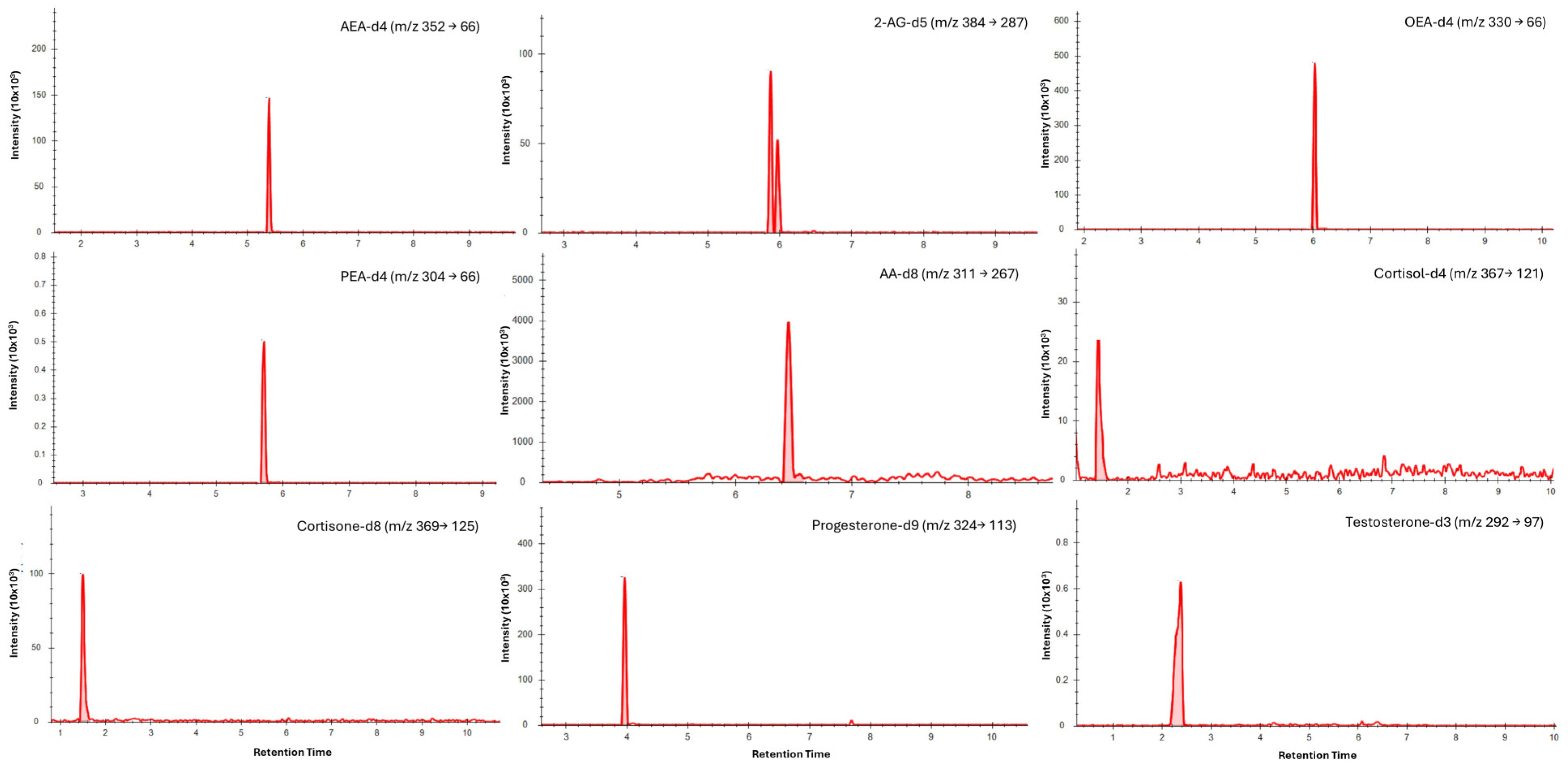
| Saliva | AEA | y = 184.3x + 84,248 | 0.989 | 5.39 | 0.80–0.05 | 0.001 | 0.003 |
| 2-AG | y = 197.48x + 61,432 | 0.989 | 5.90 | 1.00–0.07 | 0.01 | 0.01 | |
| OEA | y = 2912.5x + 189,710 | 0.994 | 6.02 | 0.80–0.05 | 0.02 | 0.05 | |
| PEA | y = 2194.1x + 161,756 | 0.989 | 5.71 | 0.80–0.05 | 0.01 | 0.03 | |
| AA | y = 48.32x + 1344.6 | 0.990 | 6.45 | 4.00–0.27 | 0.08 | 0.16 | |
| Cortisol | y = 349.14x + 131,895 | 0.992 | 1.54 | 4.00–0.27 | 0.05 | 0.09 | |
| Cortisone | y = 21.357x + 16,328 | 0.985 | 1.50 | 4.00–0.27 | 0.13 | 0.26 | |
| Progesterone | y = 778.08x + 50,352 | 0.977 | 3.96 | 0.40–0.03 | 0.01 | 0.01 | |
| Testosterone | y = 10,628x + 208,045 | 0.989 | 2.90 | 0.80–0.05 | 0.01 | 0.03 | |
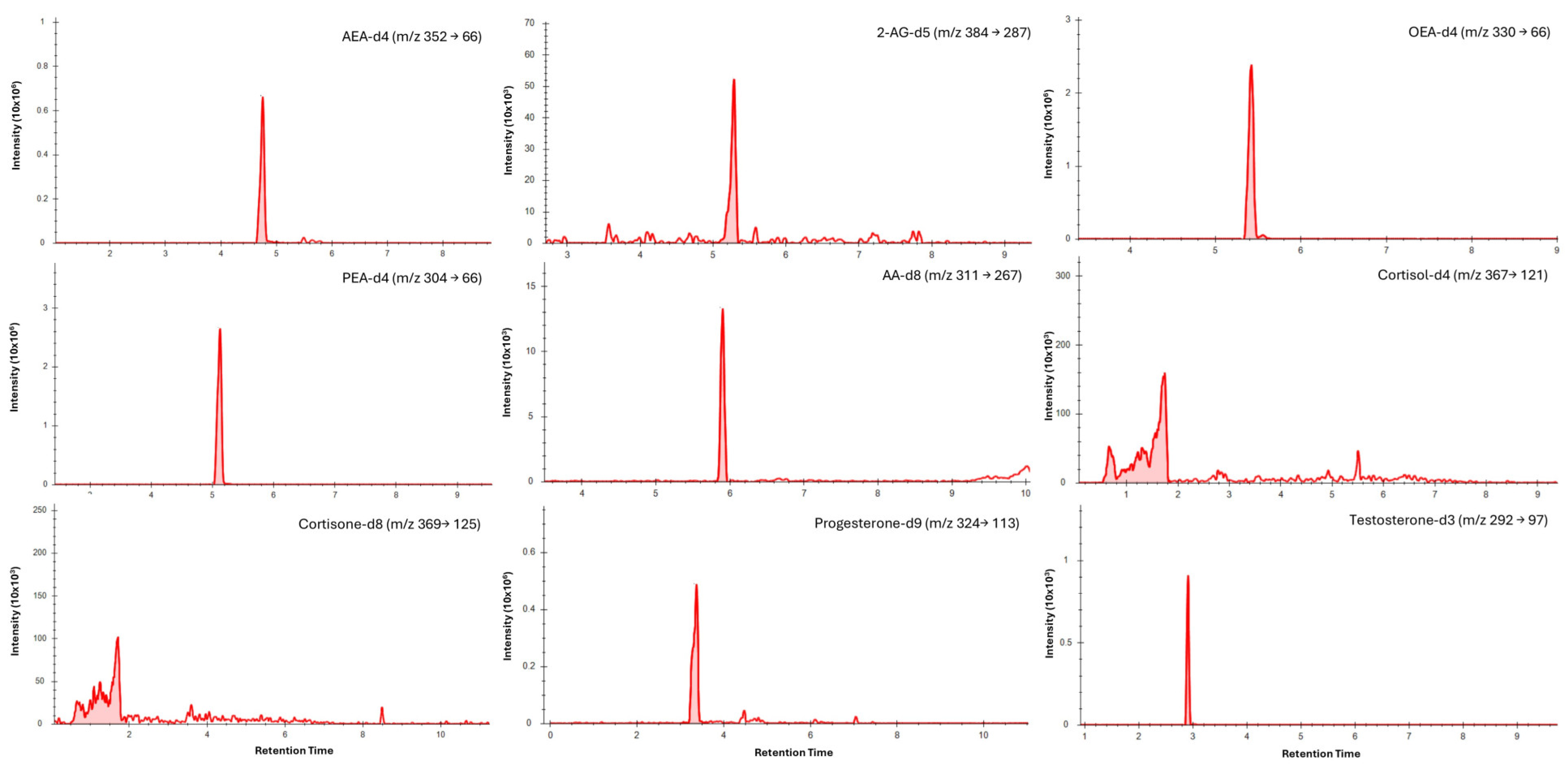
| Blood Microsamples | AEA | y = 190.54x − 66,610 | 0.994 | 4.75 | 20.00–0.97 | 0.05 | 0.09 |
| 2-AG | y = 137.95x − 56,950 | 0.989 | 5.30 | 25.00–1.21 | 0.59 | 1.19 | |
| OEA | y = 2752.1x − 115,436 | 0.991 | 5.42 | 20.00–0.97 | 0.53 | 1.06 | |
| PEA | y = 2886x − 6375 | 0.994 | 5.12 | 20.00–0.97 | 0.81 | 1.62 | |
| AA | y = 53.999x − 619.42 | 0.986 | 5.89 | 100.00–4.84 | 10.77 | 21.54 | |
| Cortisol | y = 433.54x − 35,524 | 0.996 | 1.72 | 100.00–4.84 | 2.51 | 5.01 | |
| Cortisone | y = 44.295x + 18,162 | 0.991 | 1.74 | 100.00–4.84 | 3.00 | 6.01 | |
| Progesterone | y = 1877.3x − 28,821 | 0.991 | 3.39 | 10.00–0.48 | 0.11 | 0.22 | |
| Testosterone | y = 15,926x + 64,210 | 0.989 | 2.39 | 20.00–0.97 | 0.55 | 1.09 |
| Matrix | Analyte | Concentration (ng/mL) | Precision (RSD %) | Recovery (%) | Matrix Effect (%) |
|---|---|---|---|---|---|
| Saliva | AEA | 0.4 | 8 | 75 | 4 |
| 0.04 | 12 | 85 | 6 | ||
| 0.001 | 15 | 66 | −13 | ||
| 2-AG | 1 | 6 | 77 | −19 | |
| 0.5 | 8 | 79 | 3 | ||
| 0.1 | 13 | 100 | 9 | ||
| OEA | 0.8 | 5 | 84 | −18 | |
| 0.4 | 10 | 94 | 31 | ||
| 0.08 | 9 | 96 | 1 | ||
| PEA | 0.8 | 5 | 87 | −17 | |
| 0.4 | 9 | 89 | 28 | ||
| 0.04 | 11 | 81 | −28 | ||
| AA | 4 | 11 | 79 | −53 | |
| 2 | 20 | 93 | 24 | ||
| 0.2 | 13 | 74 | −89 | ||
| Cortisol | 4 | 6 | 82 | −10 | |
| 2 | 17 | 71 | −2 | ||
| 0.2 | 8 | 87 | −4 | ||
| Cortisone | 4 | 7 | 80 | −8 | |
| 2 | 22 | 72 | −11 | ||
| 0.2 | 22 | 83 | 16 | ||
| Progesterone | 0.4 | 9 | 90 | −11 | |
| 0.2 | 11 | 86 | 8 | ||
| 0.02 | 11 | 89 | 15 | ||
| Testosterone | 0.8 | 12 | 90 | 6 | |
| 0.4 | 10 | 89 | 3 | ||
| 0.04 | 12 | 91 | 29 | ||
| Blood Microsamples | AEA | 10 | 8 | 63 | −21 |
| 1 | 8 | 63 | 11 | ||
| 0.1 | 15 | 72 | 21 | ||
| 2-AG | 25 | 34 | 5 | 11 | |
| 12.5 | 17 | 6 | −17 | ||
| 1.25 | 16 | 6 | 6 | ||
| OEA | 20 | 21 | 77 | 21 | |
| 10 | 6 | 68 | −40 | ||
| 1 | 18 | 76 | 21 | ||
| PEA | 20 | 15 | 70 | 22 | |
| 10 | 9 | 75 | −78 | ||
| 1 | 27 | 71 | 9 | ||
| AA | 100 | 85 | 110 | 39 | |
| 50 | 20 | 73 | −1 | ||
| 5 | 72 | 126 | 20 | ||
| Cortisol | 100 | 8 | 68 | −4 | |
| 50 | 22 | 74 | 0 | ||
| 5 | 17 | 90 | −18 | ||
| Cortisone | 100 | 6 | 70 | −5 | |
| 50 | 27 | 69 | −6 | ||
| 5 | 20 | 104 | 3 | ||
| Progesterone | 10 | 5 | 76 | 26 | |
| 5 | 17 | 81 | −24 | ||
| 0.5 | 7 | 74 | 20 | ||
| Testosterone | 20 | 5 | 77 | 9 | |
| 10 | 25 | 84 | −43 | ||
| 1 | 18 | 85 | −11 |
| Analyte | Linear Regression (Log Blood Microsample vs. Log Plasma) | Bland–Altman Analysis | ||||||||
|---|---|---|---|---|---|---|---|---|---|---|
| R2 | Slope | Intercept | p Value | Mean Ratio (Blood Microsample: Plasma) | Lower LoA | Upper LoA | Proportional Bias Slope (Log Diff vs. Log Mean) | 95% CI for Slope | p Value for Slope (Proportional Bias) | |
| AEA | 0.075 | −0.8215 | −3.108 | 0.387 | 2.11 | 0.25 | 17.47 | 1.91 | 0.94, 2.89 | 0.001 * |
| 2-AG | 0.395 | 0.4690 | 2.118 | 0.029 * | 18.00 | 7.08 | 45.79 | −0.36 | −1.01, 0.30 | 0.256 |
| OEA | 0.005 | 0.1289 | 0.6290 | 0.830 | 3.12 | 1.20 | 8.08 | 1.04 | −0.08, 2.15 | 0.065 |
| PEA | 0.257 | 1.034 | 1.562 | 0.093 | 4.67 | 2.49 | 8.77 | 0.88 | 0.19, 1.56 | 0.017 * |
| AA | 0.003 | 0.04687 | 5.294 | 0.863 | 1.84 | 0.02 | 142.81 | −0.34 | −1.65, 0.98 | 0.580 |
| Cortisol | 0.005 | −0.1654 | 3.199 | 0.821 | 0.56 | 0.23 | 1.41 | 1.42 | 0.32, 2.52 | 0.017 * |
| Cortisone | 0.000 | −0.01076 | 2.660 | 0.985 | 1.11 | 0.37 | 3.39 | 1.00 | −0.23, 2.23 | 0.101 |
| Progesterone | 0.523 | 0.7201 | −0.1186 | 0.008 * | 2.28 | 0.23 | 22.72 | −0.01 | −0.57, 0.56 | 0.984 |
| Testosterone | 0.610 | 0.7555 | −0.1755 | 0.005 * | 1.02 | 0.15 | 6.82 | −0.04 | −0.57, 0.49 | 0.003 * |
Disclaimer/Publisher’s Note: The statements, opinions and data contained in all publications are solely those of the individual author(s) and contributor(s) and not of MDPI and/or the editor(s). MDPI and/or the editor(s) disclaim responsibility for any injury to people or property resulting from any ideas, methods, instructions or products referred to in the content. |
© 2026 by the authors. Licensee MDPI, Basel, Switzerland. This article is an open access article distributed under the terms and conditions of the Creative Commons Attribution (CC BY) license.
Share and Cite
Hargreaves, J.; Eddes, G.; Nichols, D.S.; Ney, L.J. A Minimally Invasive LC–MS/MS Approach for Assessing Endocannabinoids in Saliva and Capillary Blood Microsamples. Biosensors 2026, 16, 147. https://doi.org/10.3390/bios16030147
Hargreaves J, Eddes G, Nichols DS, Ney LJ. A Minimally Invasive LC–MS/MS Approach for Assessing Endocannabinoids in Saliva and Capillary Blood Microsamples. Biosensors. 2026; 16(3):147. https://doi.org/10.3390/bios16030147
Chicago/Turabian StyleHargreaves, Jessica, Gabrielle Eddes, David S. Nichols, and Luke J. Ney. 2026. "A Minimally Invasive LC–MS/MS Approach for Assessing Endocannabinoids in Saliva and Capillary Blood Microsamples" Biosensors 16, no. 3: 147. https://doi.org/10.3390/bios16030147
APA StyleHargreaves, J., Eddes, G., Nichols, D. S., & Ney, L. J. (2026). A Minimally Invasive LC–MS/MS Approach for Assessing Endocannabinoids in Saliva and Capillary Blood Microsamples. Biosensors, 16(3), 147. https://doi.org/10.3390/bios16030147