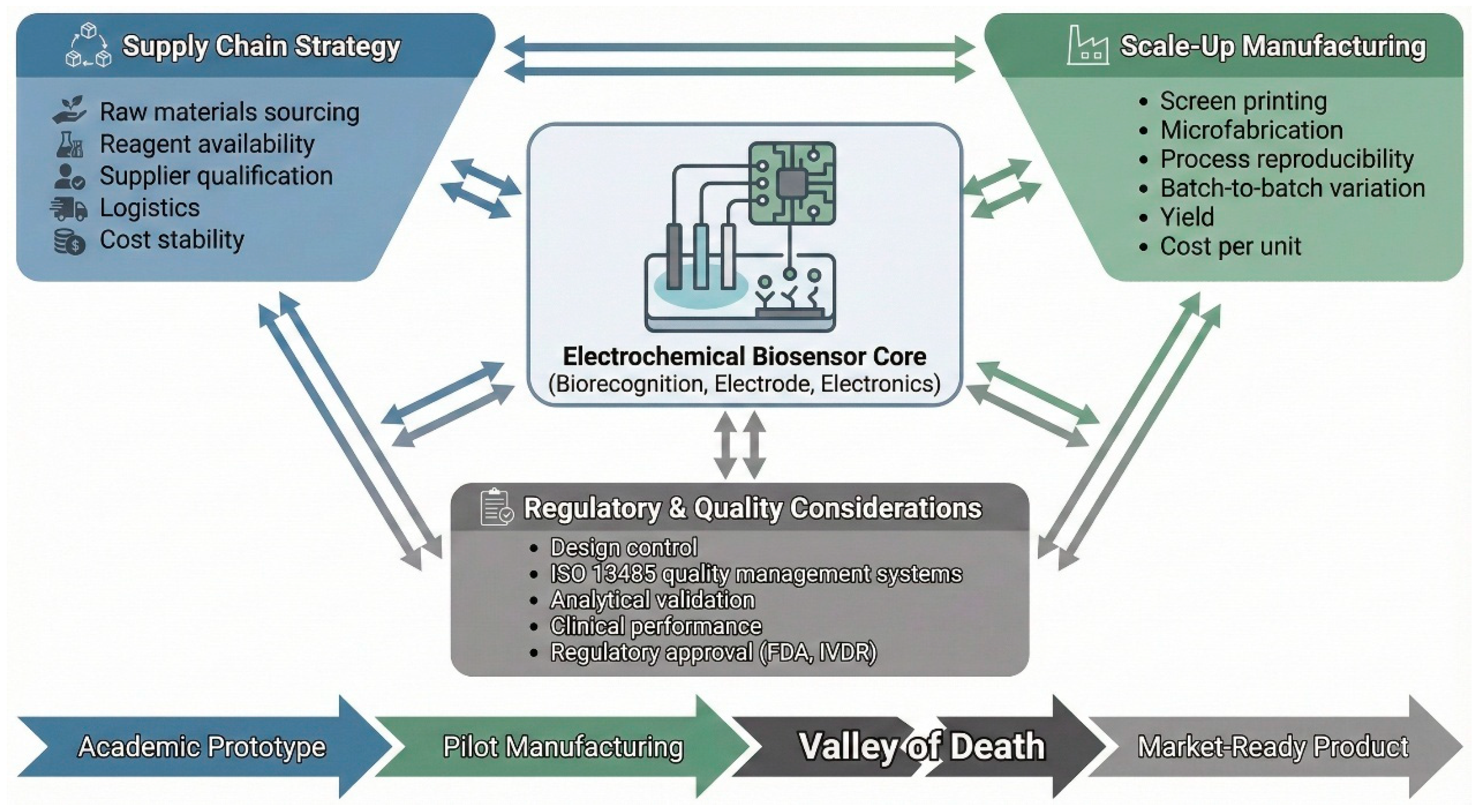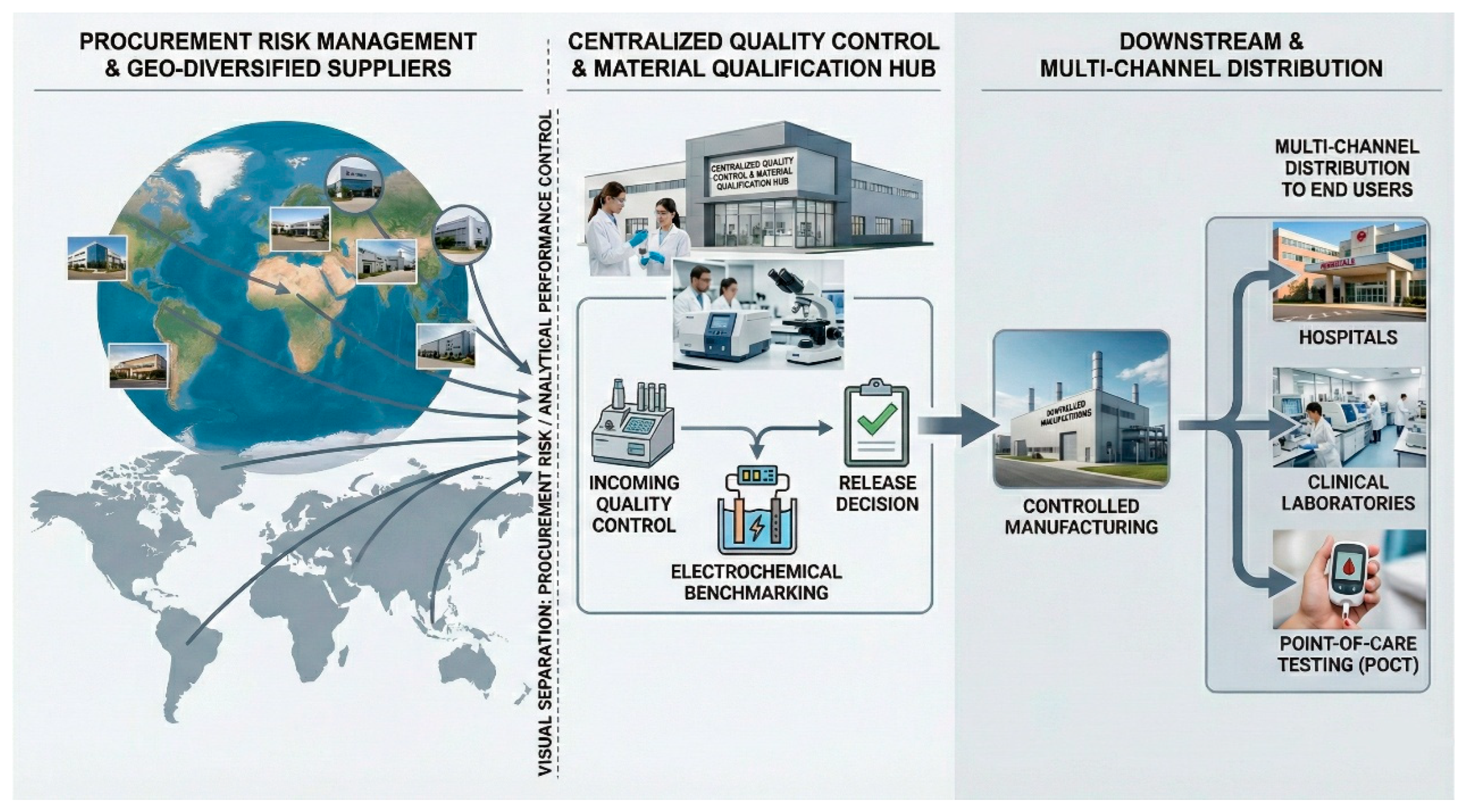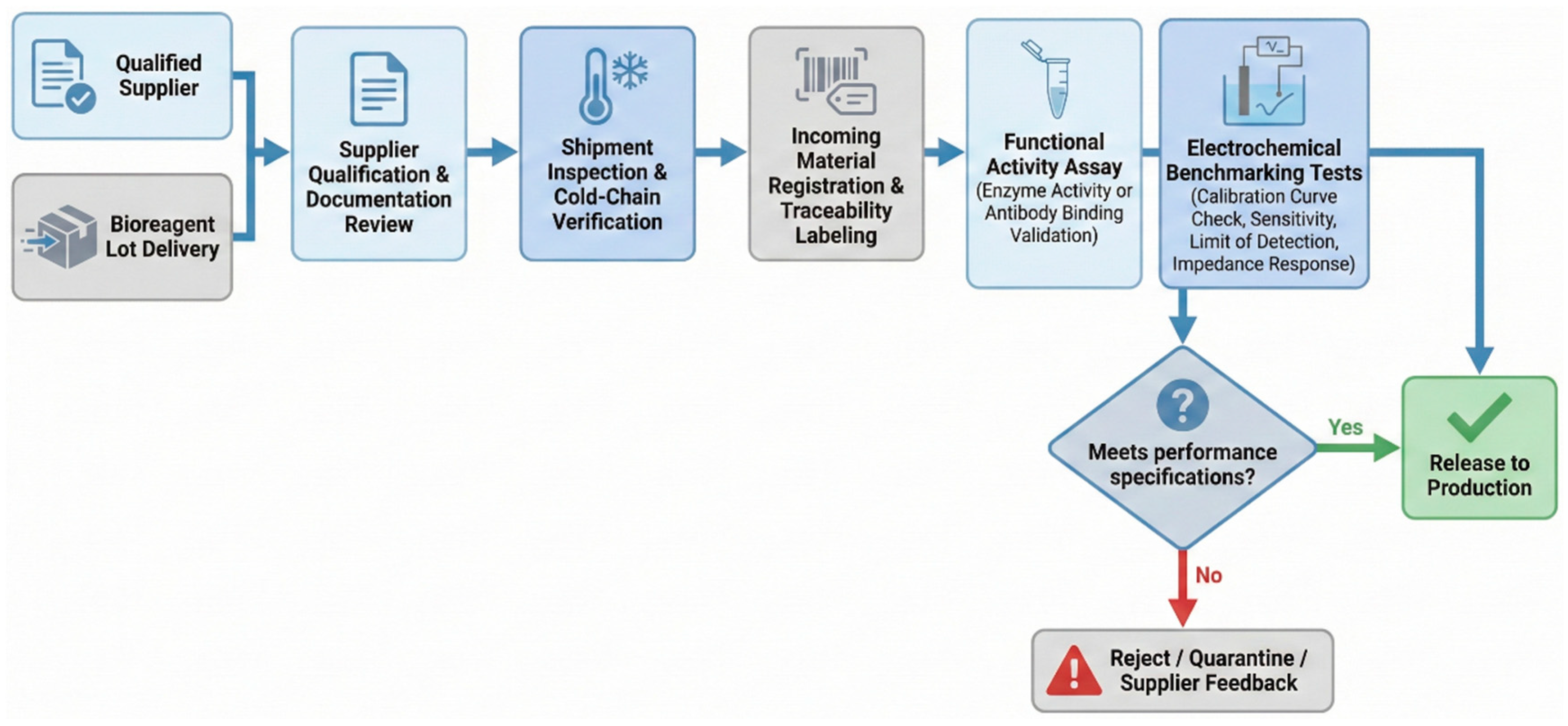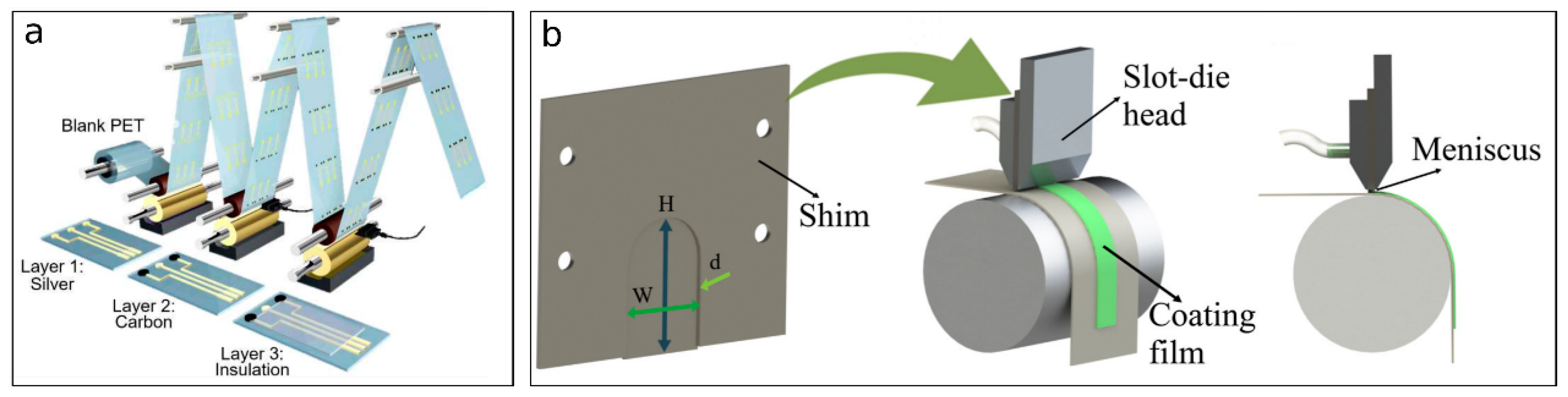
Commercial Translation of Electrochemical Biosensors: Supply Chain Strategy, Scale-Up Manufacturing, and Regulatory–Quality Considerations



Abstract
1. Introduction
2. Supply Chain Strategy for Electrochemical Biosensor Production

| Material Category | Representative Examples | Primary Supply-Chain Risks | TRL Stage | Mitigation Strategies and Best Practices | References |
|---|---|---|---|---|---|
| Biorecognition Elements | Enzymes (GOx, LOx), antibodies, aptamers, peptides | Batch-to-batch activity variability; cold-chain disruption; limited GMP suppliers; shelf-life uncertainty | TRL 1–4 | At early research and proof-of-concept stages, biorecognition elements should be screened from multiple suppliers and lots to establish baseline activity ranges and degradation pathways. Activity normalization (e.g., units per mg protein) and stress testing under temperature and humidity excursions help identify sensitivity to transport and storage conditions before scale-up. | [22,23] |
| TRL 5–7 | During pilot manufacturing, lot-to-lot qualification protocols should be introduced, including acceptance criteria based on electrochemical response (sensitivity, baseline current, and signal drift). Supplier change notification and retain-sample programs become critical to avoid untracked performance shifts. | ||||
| TRL 8–9 | At commercial scale, sourcing should be restricted to GMP-capable or ISO-certified suppliers with formal quality agreements. Bridging studies are required for any lot or supplier change, and long-term stability data must support labeled shelf life under defined storage conditions. | ||||
| Electrode Materials and Functional Inks | Carbon, graphene, CNT inks; Au/Pt inks; conductive polymers | Noble-metal price volatility; nanomaterial aggregation; formulation drift; printing reproducibility | TRL 1–4 | Critical-to-quality attributes such as solids content, viscosity, particle size distribution, and post-cure sheet resistance should be defined early. Incoming lots should be benchmarked against a reference electrode using standardized redox probes to detect electrochemical variability arising from formulation differences. | [24,25,26] |
| TRL 5–7 | Supplier quality agreements should explicitly cover formulation changes, precursor substitutions, and dispersion protocols. Second-source qualification and standardized ink preparation (mixing energy, dispersion time, and aging window) reduce dependence on single vendors and minimize batch-induced variability. | ||||
| TRL 8–9 | At commercialization, statistical incoming inspection and retain-sample programs are recommended. For noble-metal inks, price-risk planning and dual sourcing mitigate cost shocks that could otherwise force unvalidated redesigns. | ||||
| Substrates and Structural Materials | PET, PEN, PI, paper, elastomers | Surface-energy variability; dimensional instability; humidity sensitivity; supplier consolidation | TRL 1–4 | Substrates should be treated as functional components rather than passive supports. Early testing should define acceptable ranges for surface energy, roughness, thickness, and dimensional tolerance that directly affect printing yield and electrode adhesion. | [27] |
| TRL 5–7 | Multiple medical-grade or electronics-grade suppliers should be qualified, with controlled surface treatment (e.g., corona or plasma) locked to specific process parameters. Incoming substrate lots should be verified using rapid QC tests such as contact angle or dyne level. | ||||
| TRL 8–9 | Change-control procedures must cover resin formulation, additive packages, and finishing steps. For cellulose-based substrates, moisture conditioning and barrier packaging become essential to maintain shelf life and electrochemical consistency. | ||||
| Reagents, Mediators, and Chemicals | Buffers, redox mediators, crosslinkers, preservatives | Purity variability; oxidation or degradation; regulatory restrictions; hazardous handling | TRL 1–4 | Fit-for-use grades and impurity tolerances should be established, especially for redox mediators and chemicals influencing background current. Lot changes should be screened electrochemically to detect subtle shifts in baseline or sensitivity. | [28,29,30] |
| TRL 5–7 | Formal lot-to-lot verification and acceptance criteria should be implemented, reflecting practices used in regulated analytical laboratories where reagent lot changes are recognized sources of measurement bias. Supplier change notification and retain-sample programs support traceability and root-cause analysis. | ||||
| TRL 8–9 | Long-term contracts with qualified suppliers, controlled storage conditions, and full documentation of hazardous reagent handling are required to prevent supply interruptions or compliance-driven production halts. | ||||
| Electronic Components and Modules | ASICs, BLE chips, batteries, connectors | End-of-life (EOL) risk; counterfeit parts; silent BOM changes; geopolitical supply shocks | TRL 1–4 | Early designs should avoid single-source components by using pin-compatible alternatives and derating strategies. Component criticality should be documented to prioritize risk mitigation for safety- or performance-relevant parts. | [28,31] |
| TRL 5–7 | Authorized-channel procurement and counterfeit-avoidance practices (traceability, and incoming inspection where risk is-justified) should be adopted. EOL monitoring and last-time-buy planning reduce forced redesign during pilot deployment. | ||||
| TRL 8–9 | At commercial scale, supplier quality agreements must include hardware and firmware revision control with mandatory change notification. Component substitutions should trigger formal impact assessments and, where required, partial revalidation to ensure field reliability. |
3. Scale-Up Manufacturing: From Lab Bench to Mass Production
| Parameter | Roll-to-Roll Printing (Screen/ Gravure/Inkjet) | Wafer Microfabrication (Photolithography/Thin Films) | Additive Manufacturing (3D Printing/Direct-Write) | How to Interpret for Scale-up and Regulation | Key Literature Anchors |
|---|---|---|---|---|---|
| Typical manufacturing intent | Mass disposable, continuous web | High-precision arrays, integration, multiplexing | Rapid iteration; complex 3D features; niche manufacturing | Matching “manufacturing intent” to TPP reduces rework and late-stage quality surprises | Screen-printing vs. additive manufacturing overview [15] |
| Throughput | ~1–50 m/min web speed | Wafer-batch (100–1000s dies/wafer; batch tools) | Minutes per part (printer- and geometry-dependent) | Throughput determines feasible QC strategy (100% in-line vs. sampling) | Lithographic scalability and throughput framing [57] |
| Feature size/resolution | Typically ~50–200 µm, finer for some inkjet/direct-write | Sub-µm to few µm routinely | ~50–500 µm typical for many low-cost printers; finer with specialized direct-write | Resolution matters when sensing depends on diffusion length scales, field confinement, or dense arrays | Microfabrication reproducibility/fidelity emphasized in wafer approaches [58] |
| Per-unit cost (materials + fabrication, indicative) | Low: often < $0.20/unit at very high volume; glucose strips reported 5–15 cents/strip in mature production [40] | Moderate–high: strongly volume- and die-size-dependent; often > $1/unit at low–mid volume, potentially < $1/unit only when yields and volume are high and design is wafer-efficient | Currently moderate: often > $0.10–$1+/unit depending on print time/material; one report estimated ~$0.11 per electrode for a 3D-printed transducer [26] | We now define “low cost” as <$0.20/unit for disposables, “moderate” as $0.20–$2, and “high” as >$2, to help readers map techniques to business models | Glucose strip cost/yield anchor [40]; 3D-printed cost estimate [26] |
| Batch-to-batch reproducibility (quantified metric) | Often ~2–5% RSD for redox-probe response in well-controlled batches (example reported < 4.5% RSD for a batch against a standard redox probe) [59]; mature strip manufacturing can reach very low defect rates (<0.1%) [40] | Frequently ≤ 2% RSD reported for device consistency in microfabricated sensors (example: 1.3% RSD in a microfabricated electrode-based sensor consistency test) [60] | Can be excellent in controlled studies (example: ~0.2% RSD for sensitivity reported for a 3D-printed transducer), but may degrade with printer/material variability and post-processing if not controlled [26] | We now define reproducibility bands as excellent ≤ 2% RSD, good 2–5%, moderate 5–10%, and challenging > 10%, because regulatory robustness depends on predictable drift and tight lot release criteria | SPE batch RSD example [59]; microfabricated consistency example [60]; 3D printed RSD example |
| Quality control maturity for regulated production | Strong for web processes (in-line vision/metrology common); bioreagent deposition can dominate variability | Strong for geometry/films (semiconductor inspection toolchain); biofunctionalization still critical | Emerging; QC and materials qualification often less standardized | Regulatory risk is increasingly a function of QC observability, not only geometry | Additive vs. screen printing manufacturing perspective [15]; 3D-printed sensor review [55] |
4. Regulatory and Quality Considerations: Navigating the Global Landscape
5. Case Studies and Future Perspectives
6. Conclusions
Author Contributions
Funding
Institutional Review Board Statement
Informed Consent Statement
Data Availability Statement
Conflicts of Interest
Abbreviations
| ADC | analog-to-digital converter |
| Ag/AgCl | silver/silver chloride |
| AOI | automated optical inspection |
| APC | article processing charge |
| ASIC | application-specific integrated circuit |
| BEOL | back-end-of-line |
| BLE | Bluetooth Low Energy |
| CAPA | corrective and preventive action |
| CD-SEM | critical dimension scanning electron microscopy |
| CE | Conformité Européenne (CE marking) |
| CGM | continuous glucose monitoring |
| CLSI | clinical and laboratory standards institute |
| CNT(s) | carbon nanotube(s) |
| CV | cyclic voltammetry |
| EIS | electrochemical impedance spectroscopy |
| EOL | end-of-life |
| EU | European Union |
| FDA | U.S. Food and Drug Administration |
| GMP | good manufacturing practice |
| IQC | incoming quality control |
| ISO | international organization for standardization |
| IVD | in vitro diagnostic |
| IVDD | in vitro diagnostic directive |
| IVDR | in vitro diagnostic regulation (Regulation (EU) 2017/746) |
| JIC | just in case (inventory strategy) |
| JIT | just in time (inventory strategy) |
| LOD | limit of detection |
| LOQ | limit of quantification |
| LOB | limit of blank |
| MARD | mean absolute relative difference |
| NMPA | National Medical Products Administration (China) |
| PC | polycarbonate |
| PCCP | predetermined change control plan |
| PER | performance evaluation report |
| PET | polyethylene terephthalate |
| PMA | premarket approval |
| PMPF | post-market performance follow-up |
| POC | point of care |
| QMS | quality management system |
| QSR | quality system regulation |
| RoHS | restriction of hazardous substances |
| RSD | relative standard deviation |
| R2 | coefficient of determination |
| R2R | roll-to-roll |
| SD | standard deviation |
| SMBG | self-monitoring of blood glucose |
| SPE | screen-printed electrode |
| TPP | target product profile |
| TRL | technology readiness level |
| UV | ultraviolet |
| 510(k) | 510(k) Premarket Notification (U.S. FDA pathway) |
References
- Mishra, G.K.; Barfidokht, A.; Tehrani, F.; Mishra, R.K. Food Safety Analysis Using Electrochemical Biosensors. Foods 2018, 7, 141. [Google Scholar] [CrossRef]
- Turner, A.P. Biosensors: Sense and Sensibility. Chem. Soc. Rev. 2013, 42, 3184–3196. [Google Scholar] [CrossRef]
- Gao, F.; Liu, C.; Zhang, L.; Liu, T.; Wang, Z.; Song, Z.; Cai, H.; Fang, Z.; Chen, J.; Wang, J.; et al. Wearable and Flexible Electrochemical Sensors for Sweat Analysis: A Review. Microsyst. Nanoeng. 2023, 9, 1. [Google Scholar] [CrossRef]
- Zhang, W.; Wang, R.; Luo, F.; Wang, P.; Lin, Z. Miniaturized Electrochemical Sensors and Their Point-of-Care Applications. Chin. Chem. Lett. 2020, 31, 589–600. [Google Scholar] [CrossRef]
- García-Miranda Ferrari, A.; Rowley-Neale, S.J.; Banks, C.E. Screen-Printed Electrodes: Transitioning the Laboratory in-to-the Field. Talanta Open 2021, 3, 100032. [Google Scholar] [CrossRef]
- Yoo, E.-H.; Lee, S.-Y. Glucose Biosensors: An Overview of Use in Clinical Practice. Sensors 2010, 10, 4558–4576. [Google Scholar] [CrossRef]
- Gao, Y.; Xie, J.; AlMasoud, N.; Alomar, T.; El-Bahy, Z.; Algadi, H.; Ren, J.; Guo, Z.; Yao, C.; Gui, H. Wasted Poly(ethylene terephthalate)-Derived Composite Xerogel with Enhanced Electromagnetic Interference Shielding and Photothermal Conversion. J. Nanostruct. Chem. 2025, 15, 152505. [Google Scholar] [CrossRef]
- Sharma, R.A.; Fumi, L.; Audisio, R.A.; Denys, A.; Wood, B.J.; Pignatti, F. Commentary: How Will Interventional Oncology Navigate the “Valleys of Death” for New Medical Devices? Br. J. Radiol. 2018, 91, 20170643. [Google Scholar] [CrossRef]
- Amen, M.T.; Pham, T.T.T.; Cheah, E.; Tran, D.P.; Thierry, B. Metal-Oxide FET Biosensor for Point-of-Care Testing: Overview and Perspective. Molecules 2022, 27, 7952. [Google Scholar] [CrossRef]
- D’Alton, L.; Souto, D.E.P.; Punyadeera, C.; Abbey, B.; Voelcker, N.H.; Hogan, C.; Silva, S.M. A Holistic Pathway to Biosensor Translation. Sens. Diagn. 2024, 3, 1234–1246. [Google Scholar] [CrossRef]
- Docherty, N.; Macdonald, D.; Gordon, A.; Dobrea, A.; Mani, V.; Fu, Y.; Pang, S.; Jimenez, M.; Corrigan, D.K. Maximising the Translation Potential of Electrochemical Biosensors. Chem. Commun. 2025, 61, 13359–13377. [Google Scholar] [CrossRef]
- Kahles, A.; Volckmar, A.-L.; Goldschmid, H.; Salto-Tellez, M.; Vogeser, M.; Stone, J.; Brüggemann, M.; Budczies, J.; Kazdal, D.; Salgado, R.; et al. Regulation of Laboratory-Developed Tests and In-House In Vitro Diagnostic Medical Devices in the United States and the European Union—A Comparative Overview. ESMO Open 2025, 10, 105909. [Google Scholar] [CrossRef]
- Spieske, A.; Gebhardt, M.; Kopyto, M.; Birkel, H. Improving Resilience of the Healthcare Supply Chain in a Pandemic: Evidence from Europe during the COVID-19 Crisis. J. Purch. Supply Manag. 2022, 28, 100748. [Google Scholar] [CrossRef]
- Gereffi, G. What Does the COVID-19 Pandemic Teach Us about Global Value Chains? The Case of Medical Supplies. J. Int. Bus. Policy 2020, 3, 287–301. [Google Scholar] [CrossRef]
- Orzari, L.O.; Kalinke, C.; Silva-Neto, H.A.; Rocha, D.S.; Camargo, J.R.; Coltro, W.K.T.; Janegitz, B.C. Screen-Printing vs Additive Manufacturing Approaches: Recent Aspects and Trends Involving the Fabrication of Electrochemical Sensors. Anal. Chem. 2025, 97, 1482–1494. [Google Scholar] [CrossRef]
- Lin, Y.; Fan, D.; Shi, X.; Fu, M. The Effects of Supply Chain Diversification during the COVID-19 Crisis: Evidence from Chinese Manufacturers. Transp. Res. E Logist. Transp. Rev. 2021, 155, 102493. [Google Scholar] [CrossRef]
- Luo, Y.; Pehrsson, M.; Langholm, L.; Karsdal, M.; Bay-Jensen, A.-C.; Sun, S. Lot-to-Lot Variance in Immunoassays—Causes, Consequences, and Solutions. Diagnostics 2023, 13, 1835. [Google Scholar] [CrossRef]
- Kerr, E.; Alexander, R.; Francis, P.S.; Guijt, R.M.; Barbante, G.J.; Doeven, E.H. A Comparison of Commercially Available Screen-Printed Electrodes for Electrogenerated Chemiluminescence Applications. Front. Chem. 2021, 8, 628483. [Google Scholar] [CrossRef]
- Sheraz, M.; Sun, X.-F.; Siddiqui, A.; Wang, Y.; Hu, S.; Sun, R. Cellulose-Based Electrochemical Sensors. Sensors 2025, 25, 645. [Google Scholar] [CrossRef]
- George, E.; Pecht, M. RoHS Compliance in Safety and Reliability Critical Electronics. Microelectron. Reliab. 2016, 65, 1–7. [Google Scholar] [CrossRef]
- Baskaran, G. Firms’ Approach to Mitigating Risks in the Platinum Group Metals Sector. Miner. Econ. 2021, 34, 385–398. [Google Scholar] [CrossRef]
- Sun, Y.; Jiang, Q.-Y.; Chen, F.; Cao, Y. Paper-Based Electrochemical Sensor. Electrochem. Sci. Adv. 2022, 2, e2100057. [Google Scholar] [CrossRef]
- Brown, E.W.; Glasscott, M.W.; Conley, K.; Barr, J.; Ray, J.D.; Moores, L.C.; Netchaev, A. ACEstat: A DIY Guide to Unlocking the Potential of Integrated Circuit Potentiostats for Open-Source Electrochemical Analysis. Anal. Chem. 2022, 94, 4906–4912. [Google Scholar] [CrossRef]
- Sun, G.; Wei, X.; Zhang, D.; Huang, L.; Liu, H.; Fang, H. Immobilization of Enzyme Electrochemical Biosensors and Their Application to Food Bioprocess Monitoring. Biosensors 2023, 13, 886. [Google Scholar] [CrossRef]
- Zikulnig, J.; Carrara, S.; Kosel, J. A Life Cycle Assessment Approach to Minimize Environmental Impact for Sustainable Printed Sensors. Sci. Rep. 2025, 15, 10866. [Google Scholar] [CrossRef]
- Yu, Y.B.; Briggs, K.T.; Taraban, M.B.; Brinson, R.G.; Marino, J.P. Grand Challenges in Pharmaceutical Research Series: Ridding the Cold Chain for Biologics. Pharm. Res. 2021, 38, 3–7. [Google Scholar] [CrossRef]
- Zamani, M.; Klapperich, C.M.; Furst, A.L. Recent Advances in Gold Electrode Fabrication for Low-Resource Setting Biosensing. Lab Chip 2023, 23, 1410–1419. [Google Scholar] [CrossRef]
- Soon, G.H.; Deasy, M.; Dempsey, E. An Electrochemical Evaluation of Novel Ferrocene Derivatives for Glutamate and Liver Biomarker Biosensing. Biosensors 2021, 11, 254. [Google Scholar] [CrossRef]
- Saleem, M.; Yu, H.; Wang, L.; Zain-ul-Abdin; Khalid, H.; Akram, M.; Abbasi, N.M.; Huang, J. Review on Synthesis of Ferrocene-Based Redox Polymers and Derivatives and Their Application in Glucose Sensing. Anal. Chim. Acta 2015, 876, 9–25. [Google Scholar] [CrossRef]
- Estrada-Osorio, D.V.; Escalona-Villalpando, R.A.; Gutiérrez, A.; Arriaga, L.G.; Ledesma-García, J. Poly-L-lysine-Modified with Ferrocene to Obtain a Redox Polymer for Mediated Glucose Biosensor Application. Bioelectrochemistry 2022, 146, 108147. [Google Scholar] [CrossRef]
- Mura, G.; Murru, R.; Martines, G. Analysis of Counterfeit Electronics. Microelectron. Reliab. 2020, 114, 113793. [Google Scholar] [CrossRef]
- Balkhi, B.; Alshahrani, A.; Khan, A. Just-in-Time Approach in Healthcare Inventory Management: Does It Really Work? Saudi Pharm. J. 2022, 30, 1830–1835. [Google Scholar] [CrossRef]
- Yu, W.; Wong, C.Y.; Jacobs, M.A.; Chavez, R. What Are the Right Configurations of Just-in-Time and Just-in-Case When Supply Chain Shocks Increase? Int. J. Prod. Econ. 2024, 276, 109352. [Google Scholar] [CrossRef]
- Kalita, N.; Gogoi, S.; Minteer, S.D.; Goswami, P. Advances in Bioelectrode Design for Developing Electrochemical Biosensors. ACS Meas. Sci. Au 2023, 3, 404–433. [Google Scholar] [CrossRef]
- Bariya, M.; Shahpar, Z.; Park, H.; Sun, J.; Jung, Y.; Gao, W.; Nyein, H.Y.Y.; Liaw, T.S.; Tai, L.-C.; Ngo, Q.P.; et al. Roll-to-Roll Gravure Printed Electrochemical Sensors for Wearable and Medical Devices. ACS Nano 2018, 12, 6978–6987. [Google Scholar] [CrossRef]
- Phung, T.H.; Gafurov, A.N.; Kim, I.; Kim, S.Y.; Kim, K.M.; Lee, T.-M. Hybrid Device Fabrication Using Roll-to-Roll Printing for Personal Environmental Monitoring. Polymers 2023, 15, 2687. [Google Scholar] [CrossRef]
- Sardini, E.; Serpelloni, M.; Tonello, S. Printed Electrochemical Biosensors: Opportunities and Metrological Challenges. Biosensors 2020, 10, 166. [Google Scholar] [CrossRef]
- Heller, A.; Feldman, B. Electrochemical Glucose Sensors and Their Applications in Diabetes Management. Chem. Rev. 2008, 108, 2482–2505. [Google Scholar] [CrossRef]
- Maize, K.; Mi, Y.; Cakmak, M.; Shakouri, A. Real-Time Metrology for Roll-To-Roll and Advanced Inline Manufacturing: A Review. Adv. Mater. Technol. 2023, 8, 2200173. [Google Scholar] [CrossRef]
- Wiklund, J.; Karakoç, A.; Palko, T.; Yiğitler, H.; Ruttik, K.; Jäntti, R.; Paltakari, J. A Review on Printed Electronics: Fabrication Methods, Inks, Substrates, Applications and Environmental Impacts. J. Manuf. Mater. Process. 2021, 5, 89. [Google Scholar] [CrossRef]
- Välimäki, M.K.; Jansson, E.; Von Morgen, V.J.J.; Ylikunnari, M.; Väisänen, K.-L.; Ontero, P.; Kehusmaa, M.; Korhonen, P.; Kraft, T.M. Accuracy Control for Roll and Sheet Processed Printed Electronics on Flexible Plastic Substrates. Int. J. Adv. Manuf. Technol. 2022, 119, 6255–6273. [Google Scholar] [CrossRef]
- Liu, B.; Chen, Y.; Xie, J.; Chen, B. Industrial Roll-to-Roll Printing Register Control Using a Pulse-Width Subdivision Detection Algorithm. Appl. Sci. 2023, 13, 5307. [Google Scholar] [CrossRef]
- Cagnani, G.R.; Ibáñez-Redín, G.; Tirich, B.; Gonçalves, D.; Balogh, D.T.; Oliveira, O.N. Fully-Printed Electrochemical Sensors Made with Flexible Screen-Printed Electrodes Modified by Roll-to-Roll Slot-Die Coating. Biosens. Bioelectron. 2020, 165, 112428. [Google Scholar] [CrossRef] [PubMed]
- Batine, A.; Boumegnane, A.; Nadi, A.; Cochrane, C.; Cherkaoui, O.; Tahiri, M. Advances in Screen-Printed Conductive Inks for Sustainable and High-Performance E-Textiles: Innovations, Challenges, and Future Prospects. Adv. Eng. Mater. 2025, 27, 2501322. [Google Scholar] [CrossRef]
- Cao, T.; Yang, Z.; Zhang, H.; Wang, Y. Inkjet Printing Quality Improvement Research Progress: A Review. Heliyon 2024, 10, e30163. [Google Scholar] [CrossRef] [PubMed]
- Reddy Gajjala, R.K.; Muñana-González, S.; Núñez-Marinero, P.; Totoricaguena-Gorriño, J.; Ruiz-Rubio, L.; del Campo, F.J. Design and Fabrication of Wearable Biosensors: Materials, Methods, and Prospects. In Wearable Biosensing in Medicine and Healthcare; Springer: Singapore, 2024; pp. 317–378. [Google Scholar] [CrossRef]
- Kosri, E.; Ibrahim, F.; Thiha, A.; Madou, M. Micro and Nano Interdigitated Electrode Array (IDEA)-Based MEMS/NEMS as Electrochemical Transducers: A Review. Nanomaterials 2022, 12, 4171. [Google Scholar] [CrossRef]
- Støvring, N.; Rezaei, B.; Heiskanen, A.; Emnéus, J.; Keller, S.S. Fabrication of Pyrolytic Carbon Interdigitated Microelectrodes by Maskless UV Photolithography with Epoxy-Based Photoresists SU-8 and mr-DWL. Micro Nano Eng. 2024, 23, 100257. [Google Scholar] [CrossRef]
- Blair, E.O.; Corrigan, D.K. A Review of Microfabricated Electrochemical Biosensors for DNA Detection. Biosens. Bioelectron. 2019, 134, 57–67. [Google Scholar] [CrossRef]
- Mohd Asri, M.A.; Nordin, A.N.; Ramli, N. Low-Cost and Cleanroom-Free Prototyping of Microfluidic and Electrochemical Biosensors: Techniques in Fabrication and Bioconjugation. Biomicrofluidics 2021, 15, 061502. [Google Scholar] [CrossRef]
- Juska, V.B.; Maxwell, G.; Estrela, P.; Pemble, M.E.; O’Riordan, A. Silicon Microfabrication Technologies for Biology Integrated Advance Devices and Interfaces. Biosens. Bioelectron. 2023, 237, 115503. [Google Scholar] [CrossRef]
- Charmet, J.; Rodrigues, R.; Yildirim, E.; Challa, P.K.; Roberts, B.; Dallmann, R.; Whulanza, Y. Low-Cost Microfabrication Tool Box. Micromachines 2020, 11, 135. [Google Scholar] [CrossRef]
- Dincer, C.; Bruch, R.; Costa-Rama, E.; Fernández-Abedul, M.T.; Merkoçi, A.; Manz, A.; Urban, G.A.; Güder, F. Disposable Sensors in Diagnostics, Food, and Environmental Monitoring. Adv. Mater. 2019, 31, e1806739. [Google Scholar] [CrossRef]
- Kang, H.; Cho, A.; Park, S.; Cho, S.-Y.; Jung, H.-T. Top-Down Fabrication of Chemical and Biological Sensors. Acc. Mater. Res. 2024, 5, 1484–1495. [Google Scholar] [CrossRef]
- Liedert, C.; Rannaste, L.; Kokkonen, A.; Huttunen, O.-H.; Liedert, R.; Hiltunen, J.; Hakalathi, L. Roll-to-Roll Manufacturing of Integrated Immunodetection Sensors. ACS Sens. 2020, 5, 2010–2017. [Google Scholar] [CrossRef] [PubMed]
- Partel, S.; Kasemann, S.; Choleva, P.; Dincer, C.; Kieninger, J.; Urban, G.A. Novel Fabrication Process for Sub-Micron Interdigitated Electrode Arrays for Highly Sensitive Electrochemical Detection. Sens. Actuators B Chem. 2014, 205, 193–198. [Google Scholar] [CrossRef]
- Buist, M.; Ortiz-Catalan, M. Engineering a Quality Management System for Academic Research: Navigating Challenges to Comply with the New Medical Device Regulations in Europe. Med. Devices 2025, 18, 137–147. [Google Scholar] [CrossRef]
- Mariani, F.; Gualandi, I.; Schuhmann, W.; Scavetta, E. Micro- and Nano-Devices for Electrochemical Sensing. Microchim. Acta 2022, 189, 459. [Google Scholar] [CrossRef]
- Nag, A.; Mukhopadhyay, S.C.; Kosel, J. Printed Flexible Sensors; Springer: Cham, Switzerland, 2019. [Google Scholar]
- Zavanelli, N.; Kim, J.; Yeo, W.-H. Recent Advances in High-Throughput Nanomaterial Manufacturing for Hybrid Flexible Bioelectronics. Materials 2021, 14, 2973. [Google Scholar] [CrossRef] [PubMed]
- Shinwari, M.W.; Zhitomirsky, D.; Deen, I.A.; Selvaganapathy, P.R.; Deen, M.J.; Landheer, D. Microfabricated Reference Electrodes and Their Biosensing Applications. Sensors 2010, 10, 1679–1715. [Google Scholar] [CrossRef]
- Babamiri, B.; Farrokhnia, M.; Mohammadi, M.; Nezhad, A.S. A Novel Strategy for Controllable Electrofabrication of Molecularly Imprinted Polymer Biosensors Utilizing Embedded Prussian Blue Nanoparticles. Sci. Rep. 2025, 15, 8859. [Google Scholar] [CrossRef]
- Wang, S.; Liu, Y.; Zhu, A.; Tian, Y. In Vivo Electrochemical Biosensors: Recent Advances in Molecular Design, Electrode Materials, and Electrochemical Devices. Anal. Chem. 2023, 95, 388–406. [Google Scholar] [CrossRef] [PubMed]
- Zhou, J.; Zhou, S.; Fan, P.; Li, X.; Ying, Y.; Ping, J.; Pan, Y. Implantable Electrochemical Microsensors for In Vivo Monitoring of Animal Physiological Information. Nanomicro Lett. 2023, 16, 49. [Google Scholar] [CrossRef] [PubMed]
- Moya, A.; Gabriel, G.; Villa, R.; del Campo, F.J. Inkjet-Printed Electrochemical Sensors. Curr. Opin. Electrochem. 2017, 3, 29–39. [Google Scholar] [CrossRef]
- Sharma, A.; Luthra, G. Implementing a Risk-Based Approach to Quality Management System ISO-13485 Processes in Compliance with EUMDR 2017/745 for Medical Device Industry. J. Pharm. Res. Int. 2023, 35, 8–19. [Google Scholar] [CrossRef]
- Hussain, A.; Abbas, N.; Ali, A. Inkjet Printing: A Viable Technology for Biosensor Fabrication. Chemosensors 2022, 10, 103. [Google Scholar] [CrossRef]
- Paimard, G.; Ghasali, E.; Baeza, M. Screen-Printed Electrodes: Fabrication, Modification, and Biosensing Applications. Chemosensors 2023, 11, 113. [Google Scholar] [CrossRef]
- Ganguly, P.; Neethipathi, D.K.; Beniwal, A.; Dahiya, R. Influence of Thickness of Screen Printed Carbon Electrodes on Electrochemical Sensing. In 2022 IEEE International Conference on Flexible and Printable Sensors and Systems (FLEPS), Vienna, Austria, 10–13 July 2022; IEEE: Piscataway, NJ, USA, 2022; pp. 1–4. [Google Scholar] [CrossRef]
- Zhang, Y.; Hu, G.; Liu, Y.; Wang, J.; Yang, G.; Li, D. Suppression and Utilization of Satellite Droplets for Inkjet Printing: A Review. Processes 2022, 10, 932. [Google Scholar] [CrossRef]
- Bunday, B.; Allgair, J.; Adan, O.; Tam, A.; Latinski, S.; Eytan, G. Small Feature Accuracy Challenge for CD-SEM Metrology: Physical Model Solution. In Metrology, Inspection, and Process Control for Microlithography XX; SPIE: Bellingham, WA, USA, 2006; pp. 263–278. [Google Scholar]
- Hendrickx, E.; Colina, A.; van der Hoff, A.; Finders, J.M.; Vandenberghe, G. Image Placement Error: Closing the Gap between Overlay and Imaging. J. Micro/Nanopatterning Mater. Metrol. 2005, 4, 033006. [Google Scholar] [CrossRef]
- Sassolas, A.; Blum, L.J.; Leca-Bouvier, B.D. Immobilization Strategies to Develop Enzymatic Biosensors. Biotechnol. Adv. 2012, 30, 489–511. [Google Scholar] [CrossRef]
- Nguyen, H.H.; Lee, S.H.; Lee, U.J.; Fermin, C.D.; Kim, M. Immobilized Enzymes in Biosensor Applications. Materials 2019, 12, 121. [Google Scholar] [CrossRef]
- Mazzocchi, R.A. Medical Sensors—Defining a Pathway to Commercialization. ACS Sens. 2016, 1, 1167–1170. [Google Scholar] [CrossRef]
- Pannonhalmi, Á.; Sipos, B.; Kurucz, R.I.; Katona, G.; Kemény, L.; Csóka, I. Advancing Regulatory Oversight of Medical Device Trials to Align with Clinical Drug Standards in the European Union. Pharmaceuticals 2025, 18, 876. [Google Scholar] [CrossRef] [PubMed]
- Lottes, A.E.; Cavanaugh, K.J.; Chan, Y.Y.-F.; Devlin, V.J.; Goergen, C.J.; Jean, R.; Linnes, J.C.; Malone, M.; Peat, R.; Reuter, D.G.; et al. Navigating the Regulatory Pathway for Medical Devices—A Conversation with the FDA, Clinicians, Researchers, and Industry Experts. J. Cardiovasc. Transl. Res. 2022, 15, 927–943. [Google Scholar] [CrossRef] [PubMed]
- Kruachottikul, P.; Tea-makorn, P.; Dumrongvute, P.; Hemrungrojn, S.; Nupairoj, N.; Junchaya, O.; Vinayavekhin, S. MediGate: A MedTech Product Innovation Development Process from University Research to Successful Commercialization within Emerging Markets. J. Innov. Entrep. 2024, 13, 71. [Google Scholar] [CrossRef]
- Miller, B.J.; Blanks, W.; Yagi, B. The 510(k) Third Party Review Program: Promise and Potential. J. Med. Syst. 2023, 47, 93. [Google Scholar] [CrossRef]
- Kadakia, K.T.; Rathi, V.K.; Dhruva, S.S.; Ross, J.S.; Krumholz, H.M. Modernizing Medical Device Regulation: Challenges and Opportunities for the 510(k) Clearance Process. Ann. Intern. Med. 2024, 177, 1558–1565. [Google Scholar] [CrossRef]
- Stern, A.D. Innovation under Regulatory Uncertainty: Evidence from Medical Technology. J. Public Econ. 2017, 145, 181–200. [Google Scholar] [CrossRef]
- Lewin, A. Medical Device Innovation in America: Tensions Between Food and Drug Law and Patent. Available online: https://jolt.law.harvard.edu/articles/pdf/v26/26HarvJLTech403.pdf (accessed on 1 December 2025).
- Pietzsch, J.B.; Zanchi, M.G.; Linehan, J.H. Medical Device Innovators and the 510(k) Regulatory Pathway: Implications of a Survey-Based Assessment of Industry Experience. J. Med. Devices 2012, 6, 021015. [Google Scholar] [CrossRef]
- Burd, E.M. Validation of Laboratory-Developed Molecular Assays for Infectious Diseases. Clin. Microbiol. Rev. 2010, 23, 550–576. [Google Scholar] [CrossRef] [PubMed]
- Senseonics. Senseonics Announces CE Mark Approval of the Eversense® CGM System. Available online: https://www.senseonics.com/investor-relations/news-releases/2016/05-10-2016-224122137 (accessed on 6 January 2026).
- U.S. Food and Drug Administration. Premarket Approval (PMA). Available online: https://www.accessdata.fda.gov/scripts/cdrh/cfdocs/cfpma/pma.cfm?id=P160048S021&utm_source=chatgpt.com (accessed on 6 January 2026).
- Simova, I.; Petkova, V.; Ognyanov, S.; Dimitrov, M. Transformation of European Medical Device Regulation: The Role of Expert Panels. Pharmacia 2025, 72, 1–9. [Google Scholar] [CrossRef]
- Charrière, K.; Pazart, L. Clinical Evidence Requirements According to the IVDR 2017/746: Practical Tools and References for Underpinning Clinical Evidence of IVD-MDs. Clin. Chem. Lab. Med. 2023, 61, 1150–1157. [Google Scholar] [CrossRef]
- Song, X.; Hu, M.; Li, B.; Zhang, K.; Zhang, X.; Wang, L. Advancing Medical Device Regulatory Reforms for Innovation, Translation and Industry Development in China. J. Orthop. Transl. 2022, 37, 89–93. [Google Scholar] [CrossRef]
- Lu, Q.; Hsueh, Y.-S.; Tong, W.; Zhang, Y.; Xu, J.; Qin, L. Importance to Understand Medical Device Regulations for Accelerating Clinical Translation. J. Orthop. Transl. 2025, 51, 290–297. [Google Scholar] [CrossRef] [PubMed]
- Di Novo, N.G.; Cantù, E.; Tonello, S.; Sardini, E.; Serpelloni, M. Support-Material-Free Microfluidics on an Electrochemical Sensors Platform by Aerosol Jet Printing. Sensors 2019, 19, 1842. [Google Scholar] [CrossRef] [PubMed]
- Laschi, S.; Palchetti, I.; Marrazza, G.; Mascini, M. Disposable Electrochemical Sensors and Biosensors for Environmental and Food Analysis. Indian J. Chem. A 2003, 42, 2968–2973. [Google Scholar]
- Jia, L.; Lei, Z.; Zare, N.; Wu, T.; Ghalkhani, M.; Wan, L.; Xu, Y. Ti3C2 MXene-Enhanced Electrochemical Biosensors for Prostate-Specific Antigen (PSA) Detection in Prostate Cancer. J. Nanostruct. Chem. 2025, 15, 152502. [Google Scholar] [CrossRef]
- Guo, L.; Zhao, Y.; Huang, Q.; Huang, J.; Tao, Y.; Chen, J.; Li, H.-Y.; Liu, H. Electrochemical Protein Biosensors for Disease Marker Detection: Progress and Opportunities. Microsyst. Nanoeng. 2024, 10, 65. [Google Scholar] [CrossRef]
- Khan, A.; DeVoe, E.; Andreescu, S. Carbon-Based Electrochemical Biosensors as Diagnostic Platforms for Connected Decentralized Healthcare. Sens. Diagn. 2023, 2, 529–558. [Google Scholar] [CrossRef]
- ISO 14971:2019; Medical Devices—Application of Risk Management to Medical Devices. International Organization for Standardization: Geneva, Switzerland, 2019.
- Goode, J.A. Development of Biosensors Using Novel Bioreceptors; Investigation and Optimisation of Fundamental Parameters at the Nanoscale. Ph.D. Thesis, University of Leeds, Leeds, UK, 2015. [Google Scholar]
- Singh, R.; Gupta, R.; Bansal, D.; Bhateria, R.; Sharma, M. A Review on Recent Trends and Future Developments in Electrochemical Sensing. ACS Omega 2024, 9, 7336–7356. [Google Scholar] [CrossRef] [PubMed]
- Das, A.; Borthakur, P.P.; Das, D.; Sahariah, J.J.; Kalita, P.; Pathak, K. Emerging Trends in Paper-Based Electrochemical Biosensors for Healthcare Applications. Eng. Proc. 2025, 106, 8. [Google Scholar] [CrossRef]
- Ji, L.-N.; Guo, L.-X.; Liu, L.-B. Accuracy and Precision Assessment of a New Blood Glucose Monitoring System. Clin. Chem. Lab. Med. 2016, 54, 181–188. [Google Scholar] [CrossRef]
- Pleus, S.; Jendrike, N.; Baumstark, A.; Mende, J.; Haug, C.; Freckmann, G. Evaluation of Analytical Performance of Three Blood Glucose Monitoring Systems: System Accuracy, Measurement Repeatability, and Intermediate Measurement Precision. J. Diabetes Sci. Technol. 2019, 13, 111–117. [Google Scholar] [CrossRef] [PubMed]
- Cesana, B.M.; Antonelli, P.; Ferraro, S. Critical Appraisal of the CLSI Guideline EP09c “Measurement Procedure Comparison and Bias Estimation Using Patient Samples”. Clin. Chem. Lab. Med. 2025, 63, 507–514. [Google Scholar] [CrossRef] [PubMed]
- Angelides, K.; Matsunami, R.K.; Engler, D.A. Performance and System Validation of a New Cellular-Enabled Blood Glucose Monitoring System Using a New Standard Reference Measurement Procedure of Isotope Dilution UPLC-MRM Mass Spectrometry. J. Diabetes Sci. Technol. 2015, 9, 1061–1070. [Google Scholar] [CrossRef]
- Vaks, J.E.; Hemyari, P.; Rullkoetter, M.; Santulli, M.J.; Schoenbrunner, N. Verification of Claimed Limit of Detection in Molecular Diagnostics. J. Appl. Lab. Med. 2016, 1, 260–270. [Google Scholar] [CrossRef]
- Park, H.-I.; Lee, S.-S.; Son, J.-W.; Kwon, H.-S.; Kim, S.R.; Chae, H.; Kim, M.; Kim, Y.; Yoo, S. Analytical Performance Evaluation of Infopia ElementTM Auto-coding Blood Glucose Monitoring System for Self-Monitoring of Blood Glucose. J. Clin. Lab. Anal. 2016, 30, 849–858. [Google Scholar] [CrossRef]
- Sai, S.; Urata, M.; Ogawa, I. Evaluation of Linearity and Interference Effect on SMBG and POCT Devices, Showing Drastic High Values, Low Values, or Error Messages. J. Diabetes Sci. Technol. 2019, 13, 734–743. [Google Scholar] [CrossRef]
- Baumstark, A.; Pleus, S.; Mende, J.; Jendrike, N.; Tesar, M.; Schauer, S.; Sugiyama, T.; Aoki, T.; Sugiura, M.; Freckmann, G.; et al. Investigation of the Effect of 70 Potential Interferents on Measurement Results of Two Blood Glucose Monitoring Systems. J. Diabetes Sci. Technol. 2024, 19, 971–981. [Google Scholar] [CrossRef]
- Khosravi, S.; Soltanian, S.; Servati, A.; Khademhosseini, A.; Zhu, Y.; Servati, P. Screen-Printed Textile-Based Electrochemical Biosensor for Noninvasive Monitoring of Glucose in Sweat. Biosensors 2023, 13, 684. [Google Scholar] [CrossRef]
- Panjan, P.; Virtanen, V.; Sesay, A.M. Determination of Stability Characteristics for Electrochemical Biosensors via Thermally Accelerated Ageing. Talanta 2017, 170, 331–336. [Google Scholar] [CrossRef] [PubMed]
- McDermott, O.; Conroy, N.; Thenarasu, M.; Duarte, S. Digitalised Validation Systems as an Enabler for Quality 4.0 within a Medical Device Manufacturer. Sustain. Futures 2024, 8, 100383. [Google Scholar] [CrossRef]
- Center for Devices and Radiological Health. The 510(k) Program: Evaluating Substantial Equivalence in Premarket Notifications [510(k)]. U.S. Food and Drug Administration. 2019. Available online: https://www.fda.gov/regulatory-information/search-fda-guidance-documents/510k-program-evaluating-substantial-equivalence-premarket-notifications-510k (accessed on 6 January 2026).
- Bereznicki, L.R.; Jackson, S.L.; Peterson, G.M.; Jeffrey, E.C.; Marsden, K.A.; Jupe, D.M. Accuracy and Clinical Utility of the CoaguChek XS Portable International Normalised Ratio Monitor in a Pilot Study of Warfarin Home-Monitoring. J. Clin. Pathol. 2007, 60, 311–314. [Google Scholar] [CrossRef]
- Abbott. i-STAT 1. Available online: https://www.globalpointofcare.abbott/us/en/product-details/apoc/i-stat-system-us.html (accessed on 6 January 2026).
- U.S. Food and Drug Administration. 510(k) Premarket Notification (K191360). Available online: https://www.accessdata.fda.gov/scripts/cdrh/cfdocs/cfpmn/pmn.cfm?ID=k191360 (accessed on 6 January 2026).
- U.S. Food and Drug Administration. 510(k) Premarket Notification (K200107). Available online: https://www.accessdata.fda.gov/scripts/cdrh/cfdocs/cfpmn/pmn.cfm?ID=K200107 (accessed on 6 January 2026).
- Gideon, O.; Samuel, H.S.; Okino, I.A. Biocompatible Materials for Next-Generation Biosensors. Discov. Chem. 2024, 1, 34. [Google Scholar] [CrossRef]
- Ou, Y.; Han, Z.; Cai, S.; Heck, J.R.; Toprakcioglu, Z.; Yu, Z.; Weitz, D.A.; Knowles, T.P.J. Biomaterials with Droplet Microfluidics. Nat. Rev. Bioeng. 2026, 1–18. [Google Scholar] [CrossRef]
- Office of the Commissioner. FDA Roundup: April 21, 2023. U.S. Food and Drug Administration. 2024. Available online: https://www.fda.gov/news-events/press-announcements/fda-roundup-april-21-2023 (accessed on 6 January 2026).
- Barone, A.S.; Maragoni-Santos, C.; de Farias, P.M.; Cortat, C.M.G.; Maniglia, B.C.; Ongaratto, R.S.; Ferreira, S.; Fai, A.E.C. Rethinking Single-Use Plastics: Innovations, Polices, Consumer Awareness and Market Shaping Biodegradable Solutions in the Packaging Industry. Trends Food Sci. Technol. 2025, 158, 104906. [Google Scholar] [CrossRef]
- Federal Register. Medical Devices; Clinical Chemistry and Clinical Toxicology Devices; Classification of the Integrated Continuous Glucose Monitoring System. 2022. Available online: https://www.federalregister.gov/documents/2022/02/18/2022-03504/medical-devices-clinical-chemistry-and-clinical-toxicology-devices-classification-of-the-integrated?utm_source=chatgpt.com (accessed on 6 January 2026).
- Psavko, S.; Katz, N.; Mirchi, T.; Green, C.R. Usability and Teachability of Continuous Glucose Monitoring Devices in Older Adults and Diabetes Educators: Task Analysis and Ease-of-Use Survey. JMIR Hum. Factors 2022, 9, e42057. [Google Scholar] [CrossRef] [PubMed]
- Shakeel, A.; Maskey, B.B.; Shrestha, S.; Parajuli, S.; Jung, Y.; Cho, G. Towards Digital Twin Implementation in Roll-to-Roll Gravure Printed Electronics: Overlay Printing Registration Error Prediction Based on Printing Process Parameters. Nanomaterials 2023, 13, 1008. [Google Scholar] [CrossRef]


| Manufacturing Method | Common Defect | Potential Impact on Performance | In-Line QC Method | End-of-Line QC Method | References |
|---|---|---|---|---|---|
| Screen Printing | Inconsistent layer thickness, pinholes, smearing | Altered electrode area, variable resistance, short circuits | AOI, laser profilometry | Electrochemical testing (e.g., CV), impedance spectroscopy | [66,67] |
| Inkjet Printing | Satellite droplets, clogged nozzles (“missing jettle”), “coffee ring” effect | Inconsistent electrode morphology, open circuits, non-uniform bioreagent distribution | Stroboscopic imaging of droplet formation, real-time vision systems | Microscopic inspection, functional testing with analyte | [68,69] |
| Photolithography | Under- or over-etching, resist adhesion failure, misalignment | Incorrect feature dimensions, delamination, device failure | Critical Dimension Scanning Electron Microscopy (CD-SEM), overlay measurement tools | Wafer-level electrical probing, release testing | [70,71] |
| Bioreagent Immobilization | Inconsistent dispensing volume, enzyme denaturation, poor adhesion | Variable sensitivity, reduced shelf life, poor reproducibility | Gravimetric analysis (for dispensing), fluorescence-based activity assays | Accelerated aging studies, batch release testing with controls | [72,73] |
| Feature | U.S. Food and Drug Administration (FDA) | European Union (CE Mark Under IVDR) | China National Medical Products Administration (NMPA) |
|---|---|---|---|
| Governing Regulation | 21 CFR Part 820 (QSR), Part 809 (IVDs) | Regulation (EU) 2017/746 (IVDR) | Decree No. 739 (Regulations for the Supervision and Administration of Medical Devices) |
| Risk Classification | Class I (Low), II (Moderate), III (High) | Class A (Low), B, C, D (High) | Class I (Low), II (Moderate), III (High) |
| Primary Review Pathway | 510(k) Premarket Notification (Class II), Premarket Approval (PMA) (Class III) | Notified Body Conformity Assessment (Class B, C, D), Self-declaration (Class A) | Registration (Class II & III), Filing (Class I) |
| Key Submission Dossier | 510(k) or PMA submission with analytical and clinical data | Technical Documentation, including Performance Evaluation Report (PER) | Registration Dossier with local type-testing and clinical trial data |
| Clinical Evidence Requirement | Clinical trials often required for PMA; may be required for 510(k) if predicates differ | Mandatory for most classes; continuous lifecycle approach to data collection (PMPF) | Local clinical trials are mandatory for Class II and III devices not on exemption list |
| Quality System Standard | Quality System Regulation (QSR) | ISO 13485:2016 (harmonized standard) | Good Manufacturing Practice (GMP) guidelines |
| Key Challenge/ Debate | Perceived as slow and unpredictable, potentially stifling innovation | Shortage of Notified Bodies, increased data burden under IVDR | Requirement for local clinical trials, rapidly evolving regulations |
| References | [90,91,92] | [92,93,94] | [10,92,95] |
| Performance Metric | Definition (IUPAC/CLSI Based) | Importance for Clinical Use | Typical Validation Method | References |
|---|---|---|---|---|
| Precision (Repeatability and Reproducibility) | The closeness of agreement between replicate measurements under stipulated conditions (e.g., same run, different days, different operators/instruments). | Ensures consistent results for patient monitoring and treatment decisions. | CLSI EP05-A3 single-site precision design (commonly 20 days × 2 runs/day × 2 replicates/run; variants allowed when justified) with variance component estimation for repeatability and within-laboratory precision; report SD/CV by level and across factors such as day/run/operator as applicable. | [98,99] |
| Accuracy (Trueness) | The closeness of agreement between the average value obtained from a large series of test results and an accepted reference value. | Ensures the result reflects the patient’s true physiological state. | CLSI EP09 method-comparison using split patient samples spanning the shared measuring interval, with visual plots plus regression/bias estimation; EP09-A3 recommends at least 100 patient samples over multiple days for validation/claim verification, with acceptance criteria defined a priori. | [100,101] |
| LOD | The lowest amount of analyte in a sample which can be detected but not necessarily quantitated as an exact value. | Crucial for early disease diagnosis or detecting low-level biomarkers. | CLSI EP17-A2 detection capability evaluation: estimate LOB from blank results, then estimate LOD from low-level samples using the EP17 parametric framework (LOB = MB + cp·SDB; LOD = LOB + cp·SDL, with cp reflecting the 95th percentile multiplier corrected for finite degrees of freedom); establish LOQ against a predefined accuracy goal (often via precision-profile or CV-based criteria) and report the decision rule. | [102] |
| Linearity/Measuring Interval | The range of analyte concentrations over which the method gives test results proportional to the concentration of the analyte. | Defines the clinically reportable range of the device. | CLSI EP06 linearity evaluation across the intended measuring interval using multiple concentration levels (historically five to nine levels with multiple measurements per level) and an allowable nonlinearity criterion; report deviation from linear fit by level and define the reportable range supported by the criterion. | [103] |
| Analytical Specificity (Interference) | The ability of a method to measure only the analyte of interest in the presence of other substances in the sample matrix. | Prevents false positive or negative results from common interferents (e.g., acetaminophen, ascorbic acid, hematocrit effect). | CLSI EP07 interference testing with defined interferent panels and medically relevant challenge concentrations: screen and quantify interferent effects, define a medically significant bias threshold, and verify claims in relevant matrices; report interferent identity, concentration, direction/magnitude of bias, and the decision threshold used. | [104,105] |
| Stability (Shelf-life and In-use) | The ability of the biosensor to maintain its performance characteristics over a stated period under specified storage and use conditions. | Ensures reliability of the device until its expiration date and during patient use. | CLSI EP25 stability-claim evaluation for IVD reagents/products: real-time (and, when appropriate, accelerated) studies with predefined acceptance criteria tied to the analytical claims (e.g., drift in bias/precision, control recovery), supporting both shelf-life and in-use stability statements. | [106,107] |
Disclaimer/Publisher’s Note: The statements, opinions and data contained in all publications are solely those of the individual author(s) and contributor(s) and not of MDPI and/or the editor(s). MDPI and/or the editor(s) disclaim responsibility for any injury to people or property resulting from any ideas, methods, instructions or products referred to in the content. |
© 2026 by the authors. Licensee MDPI, Basel, Switzerland. This article is an open access article distributed under the terms and conditions of the Creative Commons Attribution (CC BY) license.
Share and Cite
Zhou, G.; Liu, H. Commercial Translation of Electrochemical Biosensors: Supply Chain Strategy, Scale-Up Manufacturing, and Regulatory–Quality Considerations. Biosensors 2026, 16, 112. https://doi.org/10.3390/bios16020112
Zhou G, Liu H. Commercial Translation of Electrochemical Biosensors: Supply Chain Strategy, Scale-Up Manufacturing, and Regulatory–Quality Considerations. Biosensors. 2026; 16(2):112. https://doi.org/10.3390/bios16020112
Chicago/Turabian StyleZhou, Gao, and Haibin Liu. 2026. "Commercial Translation of Electrochemical Biosensors: Supply Chain Strategy, Scale-Up Manufacturing, and Regulatory–Quality Considerations" Biosensors 16, no. 2: 112. https://doi.org/10.3390/bios16020112
APA StyleZhou, G., & Liu, H. (2026). Commercial Translation of Electrochemical Biosensors: Supply Chain Strategy, Scale-Up Manufacturing, and Regulatory–Quality Considerations. Biosensors, 16(2), 112. https://doi.org/10.3390/bios16020112