Review

Advancements in Testing Strategies for COVID-19


1
Beijing Key Laboratory for Separation and Analysis in Biomedicine and Pharmaceuticals, School of Life Sciences, Beijing Institute of Technology, Beijing 100081, China
2
Department of Wildlife and Ecology, Faculty of Fisheries and Wildlife, University of Veterinary and Animal Sciences-UVAS, Lahore 54000, Pakistan
3
Beijing Academy of Quantum Information Sciences, Beijing 100193, China
4
Shandong Analysis and Test Center, Qilu University of Technology (Shandong Academy of Sciences), Jinan 250014, China
*
Authors to whom correspondence should be addressed.
Biosensors 2022, 12(6), 410; https://doi.org/10.3390/bios12060410
Submission received: 8 May 2022 / Revised: 6 June 2022 / Accepted: 7 June 2022 / Published: 13 June 2022
(This article belongs to the Section Biosensors and Healthcare)

Abstract

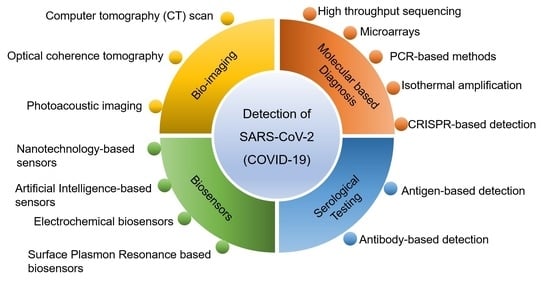
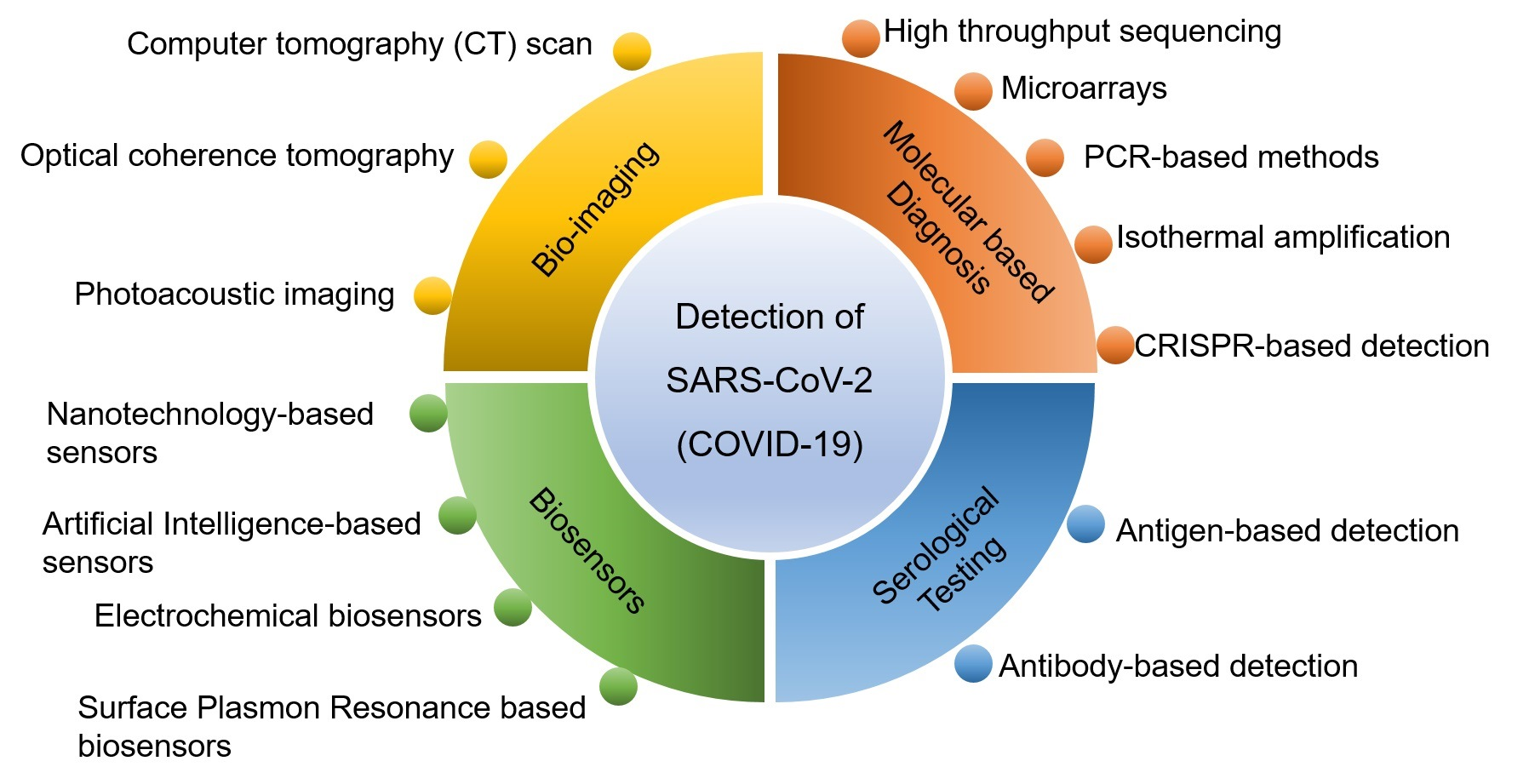
The SARS-CoV-2 coronavirus, also known as the disease-causing agent for COVID-19, is a virulent pathogen that may infect people and certain animals. The global spread of COVID-19 and its emerging variation necessitates the development of rapid, reliable, simple, and low-cost diagnostic tools. Many methodologies and devices have been developed for the highly sensitive, selective, cost-effective, and rapid diagnosis of COVID-19. This review organizes the diagnosis platforms into four groups: imaging, molecular-based detection, serological testing, and biosensors. Each platform’s principle, advancement, utilization, and challenges for monitoring SARS-CoV-2 are discussed in detail. In addition, an overview of the impact of variants on detection, commercially available kits, and readout signal analysis has been presented. This review will expand our understanding of developing advanced diagnostic approaches to evolve into susceptible, precise, and reproducible technologies to combat any future outbreak.
Keywords: SARS-CoV-2; coronavirus; variants; immunoassays; diagnosis SARS-CoV-2; coronavirus; variants; immunoassays; diagnosis
Graphical Abstract