Article

Large-Area Biomolecule Nanopatterns on Diblock Copolymer Surfaces for Cell Adhesion Studies


by
Verónica Hortigüela
1,
Enara Larrañaga
1,
Anna Lagunas
2,1,
Gerardo A. Acosta
3,2,
Fernando Albericio
3,2,
Jordi Andilla
4,
Pablo Loza-Alvarez
4 and
Elena Martínez
1,2,5,*
1
Institute for Bioengineering of Catalonia (IBEC), The Barcelona Institute of Science and Technology (BIST), 08028 Barcelona, Spain
2
Centro de Investigación Biomédica en Red (CIBER), 28029 Madrid, Spain
3
Department of Organic Chemistry, University of Barcelona, 08028 Barcelona, Spain
4
ICFO-Institut de Ciències Fotòniques, The Barcelona Institute of Science and Technology (BIST), Castelldefels, 08860 Barcelona, Spain
5
Department of Electronics and Biomedical Engineering, University of Barcelona, 08028 Barcelona, Spain
*
Author to whom correspondence should be addressed.
Nanomaterials 2019, 9(4), 579; https://doi.org/10.3390/nano9040579
Submission received: 1 March 2019 / Revised: 2 April 2019 / Accepted: 3 April 2019 / Published: 9 April 2019
(This article belongs to the Special Issue Nanoscale Surface Engineering)

Abstract

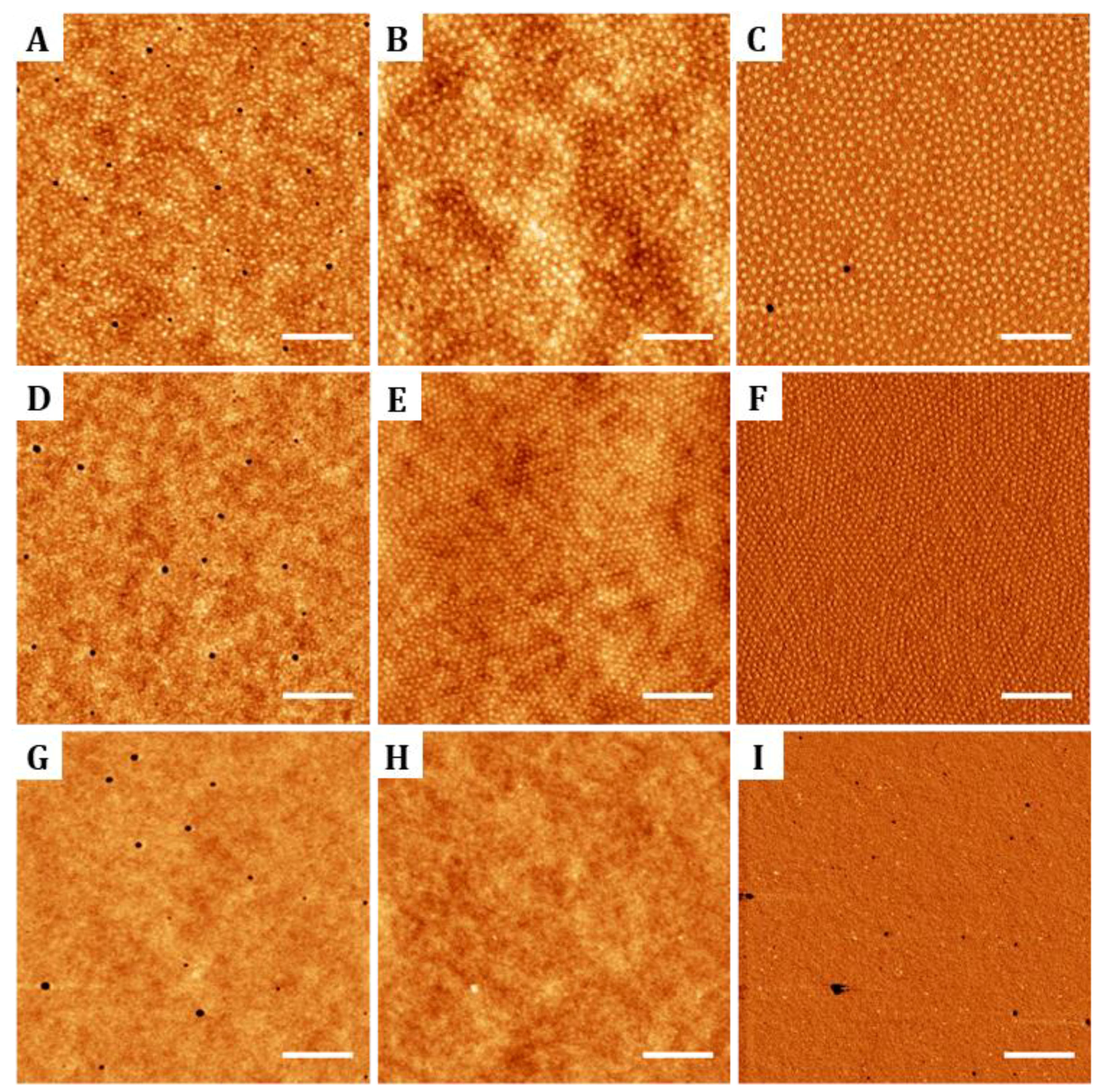
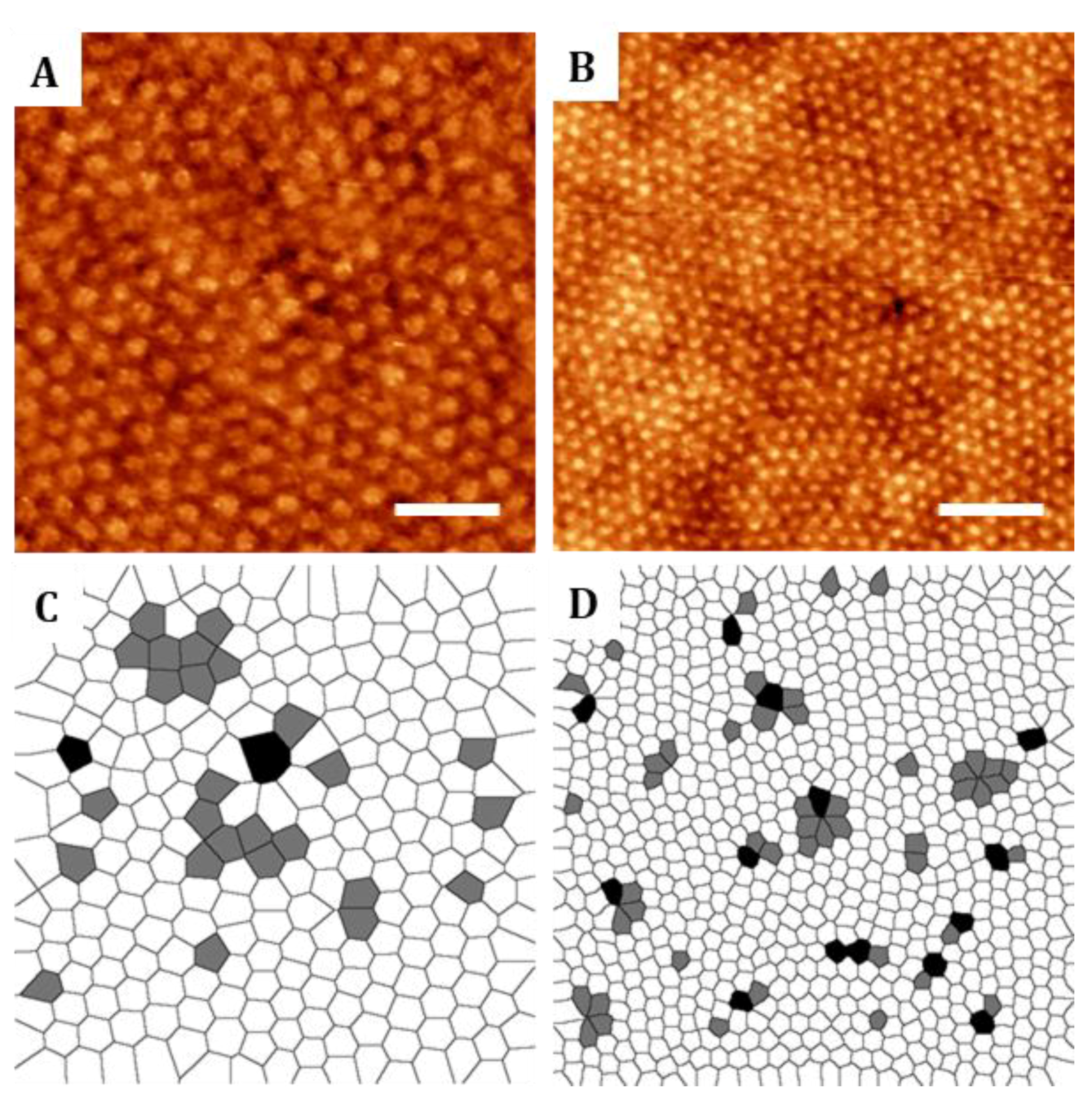
Cell membrane receptors bind to extracellular ligands, triggering intracellular signal transduction pathways that result in specific cell function. Some receptors require to be associated forming clusters for effective signaling. Increasing evidences suggest that receptor clustering is subjected to spatially controlled ligand distribution at the nanoscale. Herein we present a method to produce in an easy, straightforward process, nanopatterns of biomolecular ligands to study ligand–receptor processes involving multivalent interactions. We based our platform in self-assembled diblock copolymers composed of poly(styrene) (PS) and poly(methyl methacrylate) (PMMA) that form PMMA nanodomains in a closed-packed hexagonal arrangement. Upon PMMA selective functionalization, biomolecular nanopatterns over large areas are produced. Nanopattern size and spacing can be controlled by the composition of the block-copolymer selected. Nanopatterns of cell adhesive peptides of different size and spacing were produced, and their impact in integrin receptor clustering and the formation of cell focal adhesions was studied. Cells on ligand nanopatterns showed an increased number of focal contacts, which were, in turn, more matured than those found in cells cultured on randomly presenting ligands. These findings suggest that our methodology is a suitable, versatile tool to study and control receptor clustering signaling and downstream cell behavior through a surface-based ligand patterning technique.
Keywords: nanopattern; ligand–receptor interaction; clustering; diblock copolymer; cell adhesion; focal adhesion nanopattern; ligand–receptor interaction; clustering; diblock copolymer; cell adhesion; focal adhesion