Fully Thermally Decomposable CO2-Based Thermoplastic Polyurethane Encapsulation Films for Photovoltaic Cells: Mechanical, Barrier and Recycling Aspects

 , , and
Abstract
1. Introduction
2. Materials and Methods
2.1. Materials
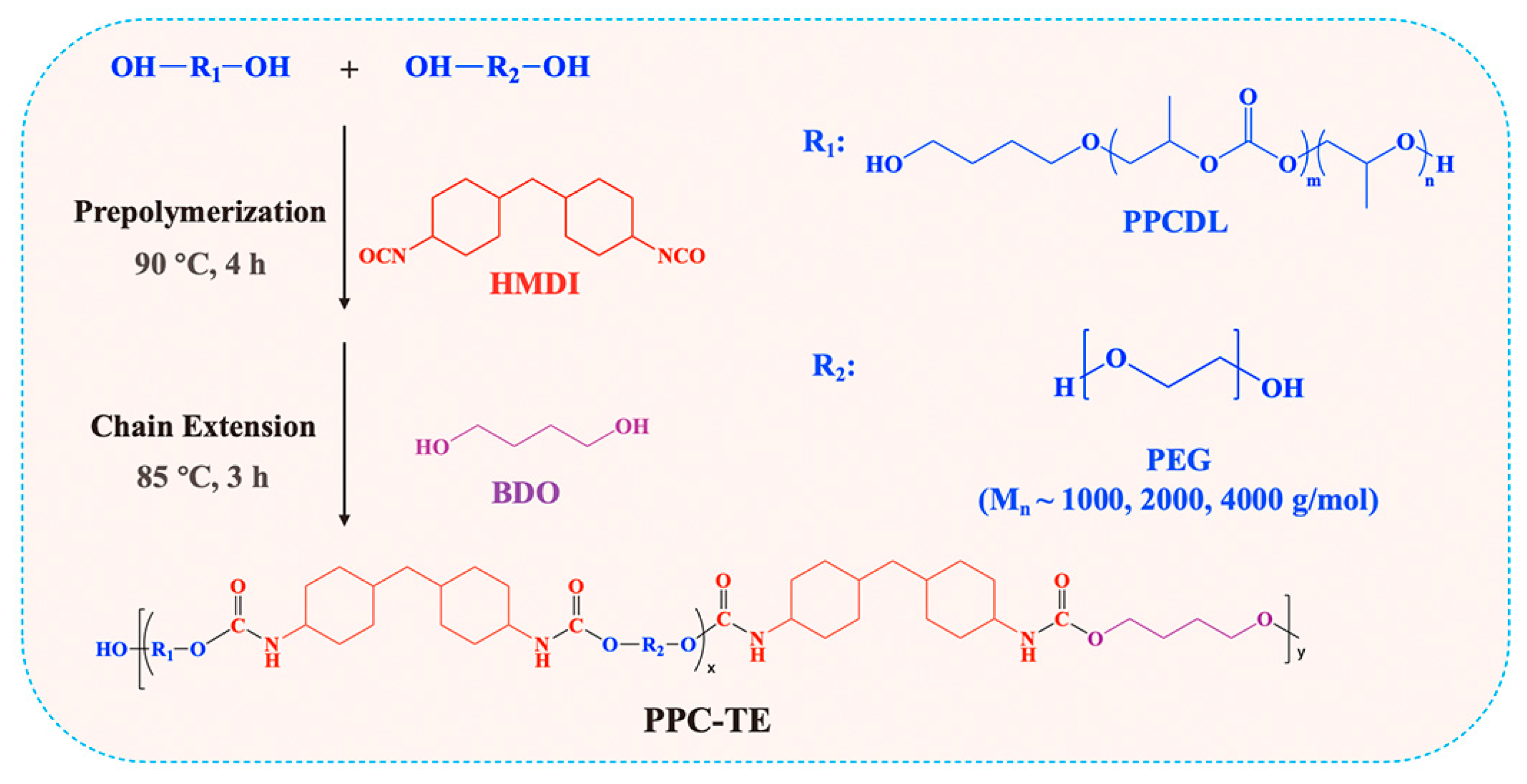
2.2. Synthesis of CO2-Based Thermoplastic Polyurethane (PPC-T and PPC-TE)
2.3. Characterization Methods
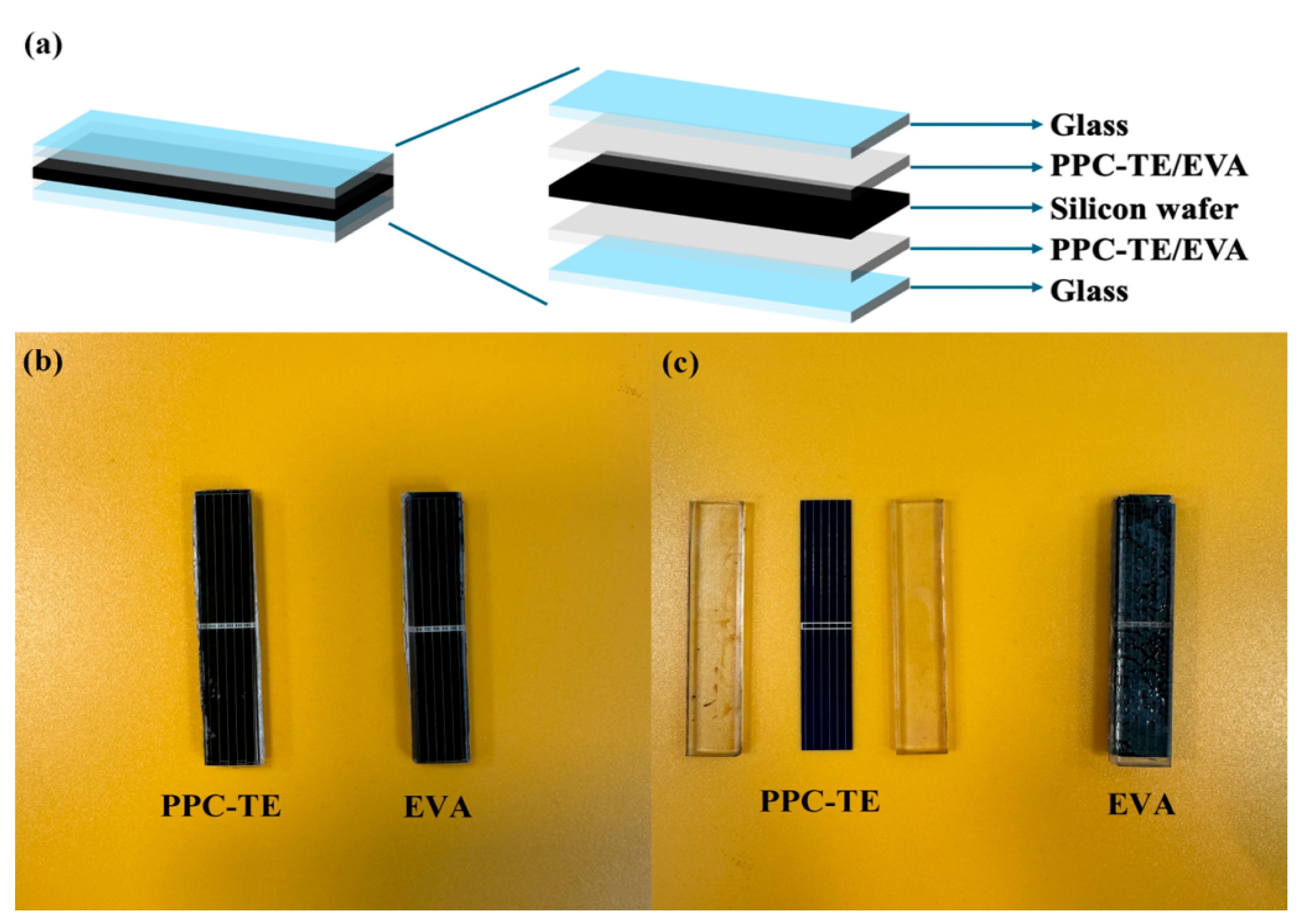
2.4. Methods for Encapsulating Solar Cells Using PPC-TE Films
2.5. Recyclability and Long-Term Stability of Encapsulated Cell
3. Results and Discussion
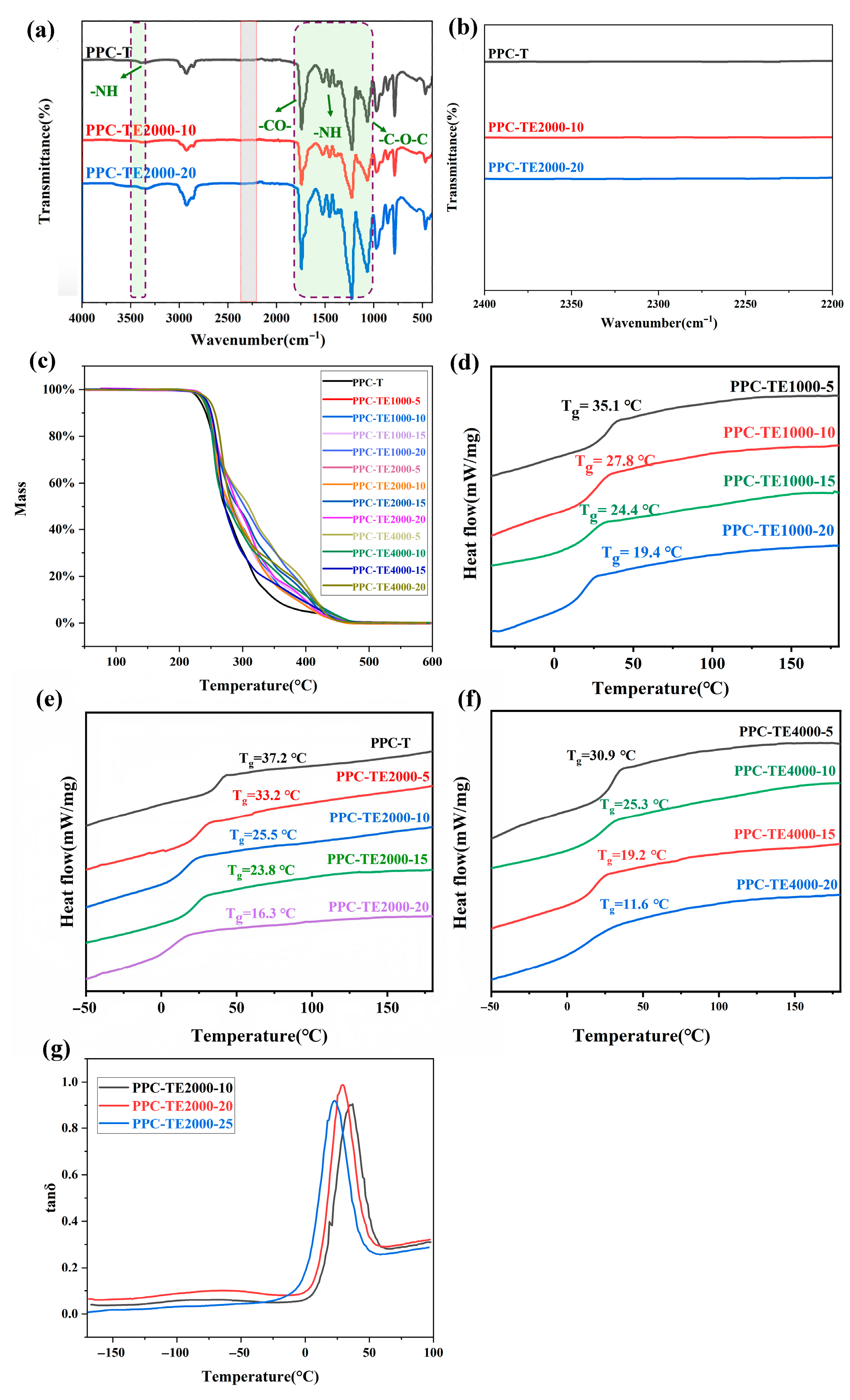
3.1. Chemical Structure (FT-IR)
3.2. Thermal Properties
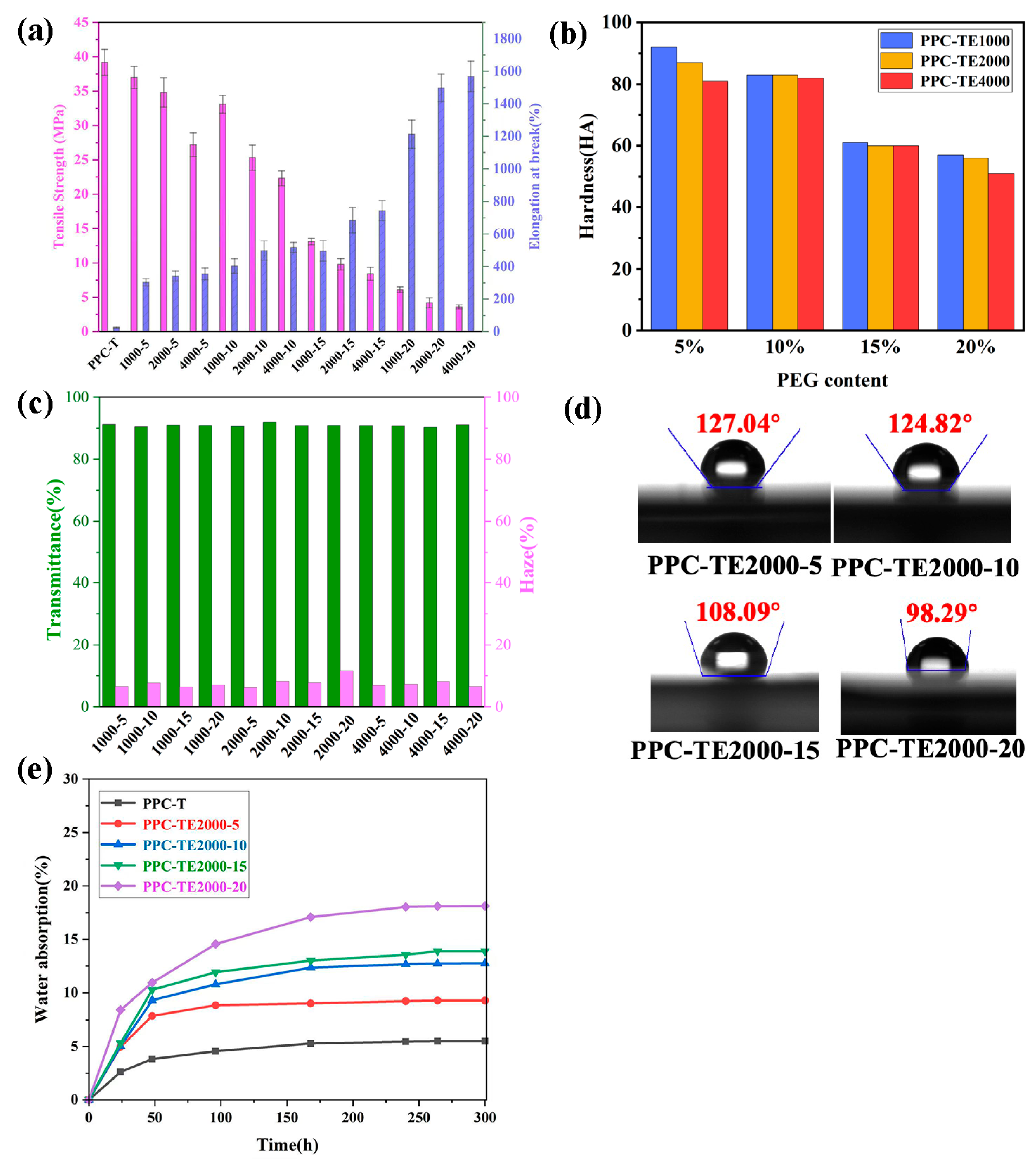
3.3. Mechanical and Optical Properties
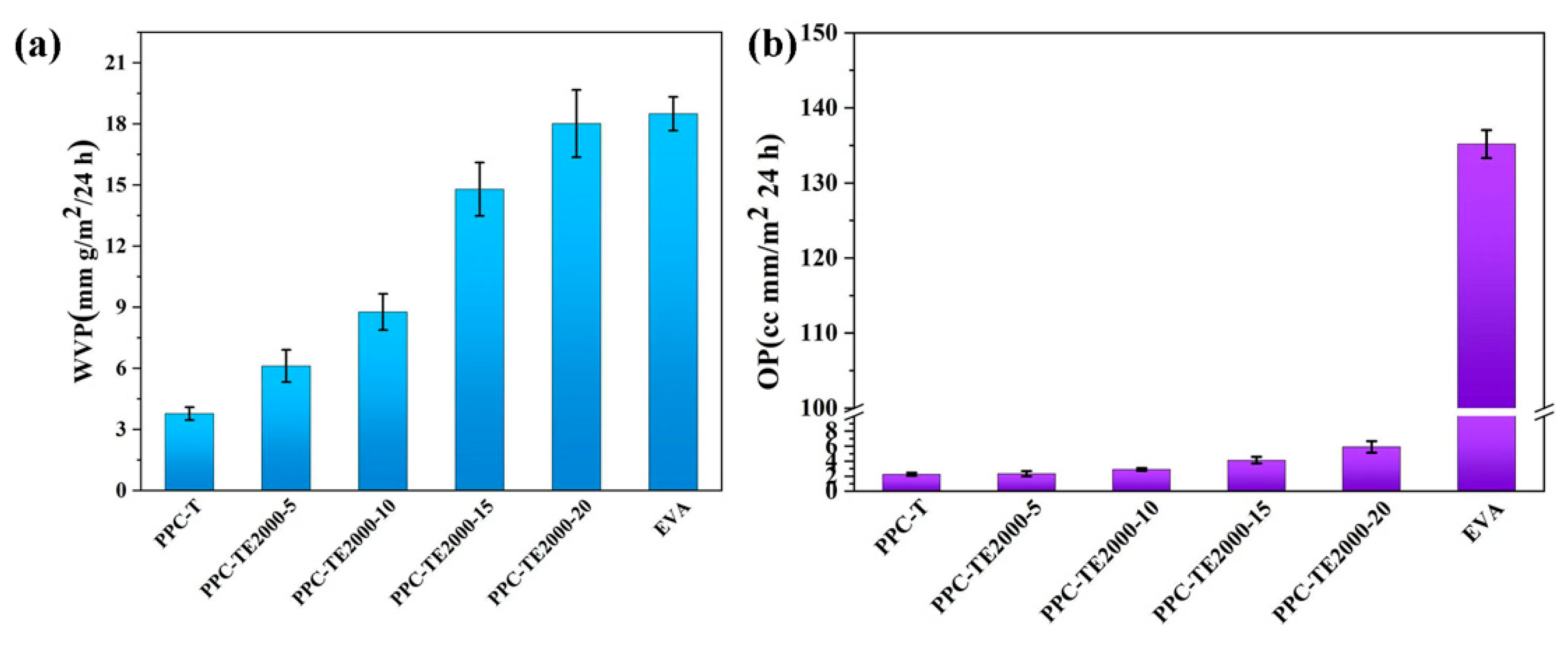
3.4. Surface and Barrier Properties
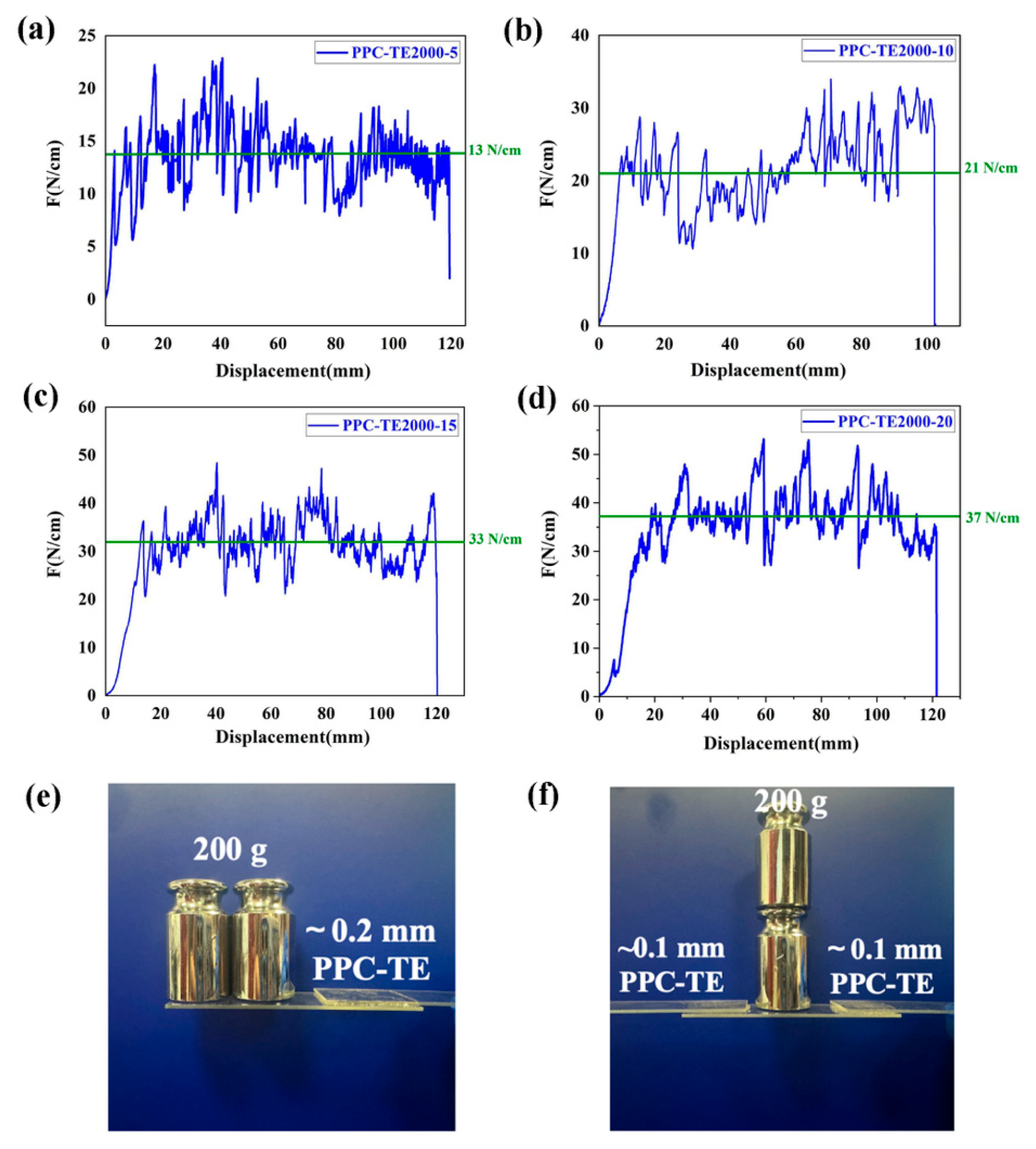
3.5. Shrinkage Behaviors and Adhesive Properties
3.6. Thermal Recyclability of Encapsulated Solar Cells
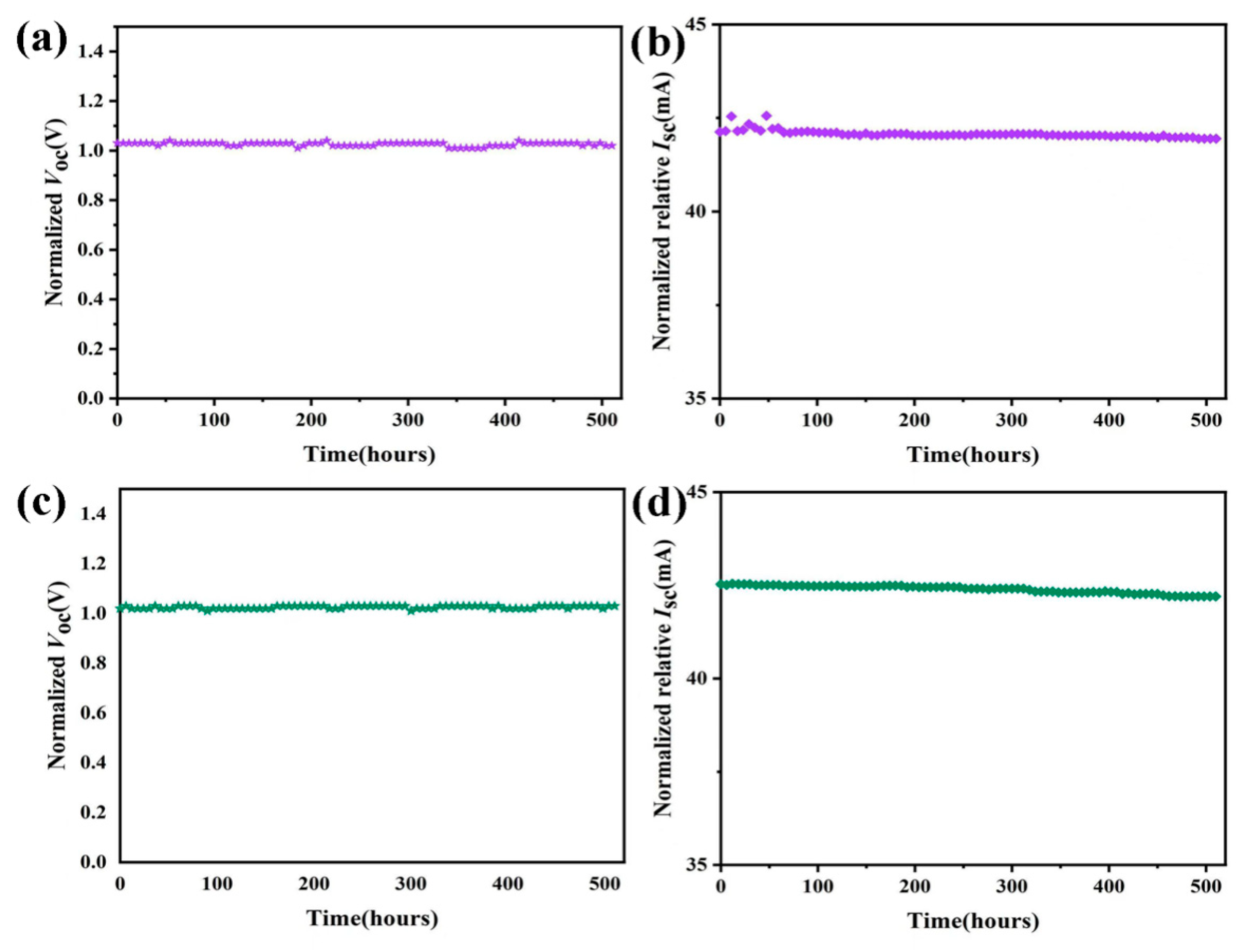
3.7. Long-Term Operation Stability of Encapsulated Solar Cells
4. Conclusions
Supplementary Materials
Author Contributions
Funding
Data Availability Statement
Acknowledgments
Conflicts of Interest
Abbreviations
| BDO | 1,4-Butanediol |
| DMF | N, N-dimethylformamide |
| EVA | Ethylene-vinyl acetate |
| EtOH | Ethanol |
| HMDI | Dicyclohexylmethane 4,4′-diisocyanate |
| OP | Oxygen permeability |
| PEG | Polyether glycol |
| PPCDL | Polycarbonate diol |
| PSC | Perovskite solar cells |
| PVB | Polyvinyl butyral |
| POE | Polyolefin elastomer |
| TPU | Thermoplastic polyurethane |
| Tg | Glass transition temperature |
| UV | Ultraviolet |
| WCA | Water contact angle |
| WVP | Water vapor permeability |
References
- Ismail, Y.A.M.; Abolibda, T.Z.; Almohammedi, A.; Aly, K.A.; Gomha, S.M.; Ahmed, H.A.; Ibrahim, M.S. Castor oil-based polyurethane for affordable solar cell encapsulation. Surf. Coat. Technol. 2024, 478, 130424. [Google Scholar] [CrossRef]
- The Pew Charitable Trusts. Who’s Winning the Clean Energy Race? 2025. Available online: https://www.pew.org/en/research-and-analysis/reports/2010/03/25/whos-winning-the-clean-energy-race (accessed on 24 September 2025).
- Ismail, Y.A.M.; Abolibda, T.Z.; Almohammedi, A.; Aly, K.A.; Gomha, S.M.; Ahmed, H.A.; Ibrahim, M.S. Inherent UV-blocking capability of polyurethane prepared from vegetable oil for solar cell encapsulation. J. Mater. Sci. 2024, 59, 6446–6458. [Google Scholar] [CrossRef]
- Wang, Q.; Fu, R.; Sun, T.; Liu, M.; Sun, S.; Jiang, H.; Li, Z.; Zhang, Y.; Liu, D.; Chen, Y.; et al. Continuously in-situ manufacture of perovskite quantum dots/POE encapsulation adhesive film for silicon solar cell enhancement application. Sol. Energy Mater. Sol. Cells 2023, 259, 112450. [Google Scholar] [CrossRef]
- Tanaka, M. Recent progress in crystalline silicon solar cells. IEICE Electron. Express 2013, 10, 20132006. [Google Scholar] [CrossRef]
- Lin, H.; Yang, M.; Ru, X.; Wang, G.; Yin, S.; Peng, F.; Hong, C.; Qu, M.; Lu, J.; Fang, L.; et al. Silicon heterojunction solar cells with up to 26.81% efficiency achieved by electrically optimized nanocrystalline-silicon hole contact layers. Nat. Energy 2023, 8, 789–799. [Google Scholar] [CrossRef]
- Lin, Y. Research status and application progress of thin film solar cells. New Chem. Mater. 2018, 46, 57–60. [Google Scholar]
- Md Yunus, N.A.; Nik Aman, N.H.; Khoshsirat, N. Comparison between thin-film solar cells and copper–indium–gallium–diselenide in Southeast Asia. IET Renew. Power Gener. 2015, 9, 1079–1086. [Google Scholar] [CrossRef]
- Feng, Z.; Zhou, Y. Research on thin film solar cell: Principal and parameters. In Proceedings of the 2022 IEEE 2nd International Conference on Data Science and Computer Application (ICDSCA), Dalian, China, 28–30 October 2022; pp. 500–503. [Google Scholar]
- Burst, J.M.; Duenow, J.N.; Albin, D.S.; Colegrove, E.; Reese, M.O.; Aguiar, J.A.; Jiang, C.S.; Patel, M.K.; Al-Jassim, M.M.; Kuciauskas, D.; et al. CdTe solar cells with open-circuit voltage breaking the 1 V barrier. Nat. Energy 2016, 1, 16015. [Google Scholar] [CrossRef]
- Rühle, S. Tabulated values of the Shockley–Queisser limit for single junction solar cells. Sol. Energy 2016, 130, 139–147. [Google Scholar] [CrossRef]
- Han, Q.; Hsieh, Y.-T.; Meng, L.; Wu, J.-L.; Sun, P.; Yao, E.-P.; Chang, S.-Y.; Bae, S.-H.; Kato, T.; Bermudez, V.; et al. High-performance perovskite/Cu(In,Ga)Se2 monolithic tandem solar cells. Science 2018, 361, 904–908. [Google Scholar] [CrossRef]
- Jošt, M.; Köhnen, E.; Al-Ashouri, A.; Bertram, T.; Tomšič, Š.; Magomedov, A.; Kasparavicius, E.; Kodalle, T.; Lipovšek, B.; Getautis, V.; et al. Perovskite/CIGS Tandem Solar Cells: From Certified 24.2% toward 30% and Beyond. ACS Energy Lett. 2022, 7, 1298–1307. [Google Scholar] [CrossRef]
- Ramanujam, J.; Bishop, D.M.; Todorov, T.K.; Gunawan, O.; Rath, J.; Nekovei, R.; Artegiani, E.; Romeo, A. Flexible CIGS, CdTe and a-Si:H based thin film solar cells: A review. Prog. Mater. Sci. 2020, 110, 100619. [Google Scholar] [CrossRef]
- Jackson, P.; Hariskos, D.; Lotter, E.; Paetel, S.; Wuerz, R.; Menner, R.; Wischmann, W.; Powalla, M. New world record efficiency for Cu(In,Ga)Se2 thin-film solar cells beyond 20%. Prog. Photovolt. Res. Appl. 2011, 19, 894–897. [Google Scholar] [CrossRef]
- Hädrich, M.; Kraft, C.; Löffler, C.; Metzner, H.; Reislöhner, U.; Witthuhn, W. Pathways to thin absorbers in CdTe solar cells. Thin Solid Films 2009, 517, 2282–2285. [Google Scholar] [CrossRef]
- Kuhn, T.E.; Erban, C.; Heinrich, M.; Eisenlohr, J.; Ensslen, F.; Neuhaus, D.H. Review of technological design options for building integrated photovoltaics (BIPV). Energy Build. 2021, 231, 110381. [Google Scholar] [CrossRef]
- Shukla, A.K.; Sudhakar, K.; Baredar, P. Recent advancement in BIPV product technologies: A review. Energy Build. 2017, 140, 188–195. [Google Scholar] [CrossRef]
- Ghosh, A. Potential of building integrated and attached/applied photovoltaic (BIPV/BAPV) for adaptive less energy-hungry building’s skin: A comprehensive review. J. Clean. Prod. 2020, 276, 123343. [Google Scholar] [CrossRef]
- Martín-Chivelet, N.; Kapsis, K.; Wilson, H.R.; Delisle, V.; Yang, R.; Olivieri, L.; Polo, J.; Eisenlohr, J.; Roy, B.; Maturi, L.; et al. Building-Integrated Photovoltaic (BIPV) products and systems: A review of energy-related behavior. Energy Build. 2022, 262, 111998. [Google Scholar] [CrossRef]
- Chae, Y.T.; Kim, J.; Park, H.; Shin, B. Building energy performance evaluation of building integrated photovoltaic (BIPV) window with semi-transparent solar cells. Appl. Energy 2014, 129, 217–227. [Google Scholar] [CrossRef]
- Agroui, K.; Collins, G. Characterisation of EVA encapsulant material by thermally stimulated current technique. Sol. Energy Mater. Sol. Cells 2003, 80, 33–45. [Google Scholar] [CrossRef]
- Shen, M.; He, J.; Cui, Y.; Zhang, Y. Preparation of an Al2O3—EVA Co-film and its Thermal Conductivity. J. Elastomers Plast. 2010, 42, 499–516. [Google Scholar] [CrossRef]
- Fraisse, G.; Ménézo, C.; Johannes, K. Energy performance of water hybrid PV/T collectors applied to combisystems of Direct Solar Floor type. Sol. Energy 2007, 81, 1426–1438. [Google Scholar] [CrossRef]
- Ma, S.; Yuan, G.; Zhang, Y.; Yang, N.; Li, Y.; Chen, Q. Development of encapsulation strategies towards the commercialization of perovskite solar cells. Energy Environ. Sci. 2022, 15, 13–55. [Google Scholar] [CrossRef]
- Oliveira, M.C.C.d.; Diniz Cardoso, A.S.A.; Viana, M.M.; Lins, V.d.F.C. The causes and effects of degradation of encapsulant ethylene vinyl acetate copolymer (EVA) in crystalline silicon photovoltaic modules: A review. Renew. Sustain. Energy Rev. 2018, 81, 2299–2317. [Google Scholar] [CrossRef]
- Pern, F.J.; Czanderna, A.W. EVA degradation mechanisms simulating those in PV modules. AIP Conf. Proc. 1992, 268, 445–452. [Google Scholar] [CrossRef]
- Parretta, A.; Bombace, M.; Graditi, G.; Schioppo, R. Optical degradation of long-term, field-aged c-Si photovoltaic modules. Sol. Energy Mater. Sol. Cells 2005, 86, 349–364. [Google Scholar] [CrossRef]
- Ayutthaya, S.I.N.; Wootthikanokkhan, J. Investigation of the photodegradation behaviors of an ethylene/vinyl acetate copolymer solar cell encapsulant and effects of antioxidants on the photostability of the material. J. Appl. Polym. Sci. 2008, 107, 3853–3863. [Google Scholar] [CrossRef]
- Bonucci, A.; Rondena, S.; Gallitognotta, A.; Gallina, P.; Salomon, O.; Wischmann, W.; Hiss, S. Thin-film CIGS PV modules with more than 3000h damp heat stability: Breakthrough time property of the B-Dry® edge sealant and its characterization. Sol. Energy Mater. Sol. Cells 2012, 98, 398–403. [Google Scholar] [CrossRef]
- David, C.M.; Xiaohong, G.; Liang, J.; George, K.; Nichole, N.; Paul, N.; Tsuyoshi, S.; Govindasamy, T.; John, H.W. Examination of a size-change test for photovoltaic encapsulation materials. In Proceedings of the SPIE, San Diego, CA, USA, 12–16 August 2012; p. 84720T. [Google Scholar]
- Søndergaard, R.R.; Makris, T.; Lianos, P.; Manor, A.; Katz, E.A.; Gong, W.; Tuladhar, S.M.; Nelson, J.; Tuomi, R.; Sommeling, P.; et al. The use of polyurethane as encapsulating method for polymer solar cells—An inter laboratory study on outdoor stability in 8 countries. Sol. Energy Mater. Sol. Cells 2012, 99, 292–300. [Google Scholar] [CrossRef]
- Huang, X.; Zhao, T.; Wang, S.; Han, D.; Huang, S.; Guo, H.; Xiao, M.; Meng, Y. Self-Healable, Transparent, Biodegradable, and Shape Memorable Polyurethanes Derived from Carbon Dioxide-Based Diols. Molecules 2024, 29, 4364. [Google Scholar] [CrossRef]
- Huang, X.; Alferov, K.; Zhao, T.; Yin, J.; Wang, S.; Han, D.; Huang, S.; Huang, Z.; Xiao, M.; Meng, Y. Facile and direct synthesis of oligocarbonate diols from carbon dioxide and their application as sustainable feedstock for polyurethane. J. CO2 Util. 2023, 75, 102571. [Google Scholar] [CrossRef]
- Lyu, S.; Wang, S.; Huang, S.; Han, D.; Liu, W.; Guo, H.; Xiao, M.; Meng, Y. Super Anti-Water Permeability and High Toughness of CO2-Derived Polycarbonate Polyurethane via Copolymerization with Polydimethylsiloxane. Macromol. Chem. Phys. 2025, 226, 2500139. [Google Scholar] [CrossRef]
- Miller, D.C.; Kempe, M.D.; Muller, M.T.; Gray, M.H.; Araki, K.; Kurtz, S.R. Durability of polymeric encapsulation materials in a PMMA/glass concentrator photovoltaic system. Prog. Photovolt. Res. Appl. 2016, 24, 1385–1409. [Google Scholar] [CrossRef]
- Yang, L.; Wang, Y.; Peng, X. Synthesis and characterization of novel fluorinated thermoplastic polyurethane with high transmittance and superior physical properties. J. Macromol. Sci. Part A 2017, 54, 516–523. [Google Scholar] [CrossRef]
- Wang, Y.; Yi, J.; Peng, X.; Ma, X.; Peng, S. Structure–property relationships of novel fluorinated polycarbonate polyurethane films with high transparency and thermal stability. Res. Chem. Intermed. 2019, 45, 845–862. [Google Scholar] [CrossRef]
- Gong, Y.; Wang, B.; Ren, H.; Li, D.; Wang, D.; Liu, H.; Dou, S. Recent Advances in Structural Optimization and Surface Modification on Current Collectors for High-Performance Zinc Anode: Principles, Strategies, and Challenges. Nano-Micro Lett. 2023, 15, 208. [Google Scholar] [CrossRef]
- Raman, R.K.; Ganesan, S.; Alagumalai, A.; Sudhakaran Menon, V.; Gurusamy Thangavelu, S.A.; Krishnamoorthy, A. Rational Design, Synthesis, and Structure–Property Relationship Studies of a Library of Thermoplastic Polyurethane Films as an Effective and Scalable Encapsulation Material for Perovskite Solar Cells. ACS Appl. Mater. Interfaces 2023, 15, 53935–53950. [Google Scholar] [CrossRef] [PubMed]
- Huang, Z.; He, Z.; Wang, C.; Ding, Z.; Ai, J.; Song, L.; Liu, B. Waterborne Polyurethane Dispersion Synthesized from CO2 Based Poly (Ethylene Carbonate) Diol with High Performance. Sustain. Polym. Energy 2023, 1, 10005. [Google Scholar] [CrossRef]
- Zhao, T.; Chen, S.; Huang, X.; Yin, J.; Wang, S.; Han, D.; Huang, S.; Huang, Z.; Xiao, M.; Meng, Y. Metal-Free Synthesis of Biodegradable CO2-Based Oligo(carbonate-ester) Diols as Building Blocks for Thermoplastic Polyurethanes. ACS Appl. Polym. Mater. 2024, 6, 1813–1822. [Google Scholar] [CrossRef]
- Yue, Y.; Zhang, Y.; Zheng, Y.; Shao, Y.; Wei, B.; Shi, W. Moisture-Resistant Thermoplastic Polyurethane Encapsulation for Flexible Perovskite Solar Cells. Energy Technol. 2025, 13, 2402310. [Google Scholar] [CrossRef]





| Sample | PEG Mn a (g/mol) | PEG Content (wt%) | Mn b (kDa) | PDI |
|---|---|---|---|---|
| PPC-T | - | 0 | 51.5 | 1.87 |
| PPC-TE1000-5 | 1000 | 5 | 68.2 | 1.88 |
| PPC-TE1000-10 | 1000 | 10 | 56.3 | 1.82 |
| PPC-TE1000-15 | 1000 | 15 | 54.2 | 1.85 |
| PPC-TE1000-20 | 1000 | 20 | 49.3 | 1.73 |
| PPC-TE2000-5 | 2000 | 5 | 78.5 | 1.84 |
| PPC-TE2000-10 | 2000 | 10 | 89.7 | 1.85 |
| PPC-TE2000-15 | 2000 | 15 | 82.7 | 1.74 |
| PPC-TE2000-20 | 2000 | 20 | 80.5 | 1.66 |
| PPC-TE4000-5 | 4000 | 5 | 89.5 | 2.01 |
| PPC-TE4000-10 | 4000 | 10 | 78.2 | 1.96 |
| PPC-TE4000-15 | 4000 | 15 | 83.5 | 2.03 |
| PPC-TE4000-20 | 4000 | 20 | 87.6 | 1.96 |
| Sample | PEG Content | Td5% (°C) | Tmax (°C) | Char Yield (%) |
|---|---|---|---|---|
| PPC-T | 0 wt% | 233.1 | 465.9 | 0 |
| PPC-TE1000 | 5 wt% | 233.6 | 452.4 | 0 |
| 10 wt% | 235.7 | 463.5 | 0 | |
| 15 wt% | 239.2 | 465.1 | 0 | |
| 20 wt% | 241.4 | 467.0 | 0 | |
| PPC-TE2000 | 5 wt% | 236.8 | 452.4 | 0 |
| 10 wt% | 240.8 | 449.1 | 0 | |
| 15 wt% | 241.1 | 459.8 | 0 | |
| 20 wt% | 242.9 | 456.8 | 0 | |
| PPC-TE4000 | 5 wt% | 237.9 | 466.1 | 0 |
| 10 wt% | 240.6 | 468.8 | 0 | |
| 15 wt% | 243.5 | 451.8 | 0 | |
| 20 wt% | 247.9 | 449.8 | 0 |
| Sample | Tensile Strength (MPa) | Elongation at Break (%) |
|---|---|---|
| PPC-T | 39.2 ± 1.87 | 24.0 ± 3 |
| PPC-TE1000-5 | 37.0 ± 1.59 | 302 ± 22 |
| PPC-TE1000-10 | 34.8 ± 2.14 | 341 ± 31 |
| PPC-TE1000-15 | 27.2 ± 1.72 | 354 ± 36 |
| PPC-TE1000-20 | 33.1 ± 1.30 | 403 ± 45 |
| PPC-TE2000-5 | 25.3 ± 1.83 | 498 ± 59 |
| PPC-TE2000-10 | 22.3 ± 1.07 | 517 ± 31 |
| PPC-TE2000-15 | 13.1 ± 0.47 | 495 ± 63 |
| PPC-TE2000-20 | 9.80 ± 0.82 | 684 ± 78 |
| PPC-TE4000-5 | 8.40 ± 0.95 | 743 ± 61 |
| PPC-TE4000-10 | 6.10 ± 0.39 | 1213 ± 87 |
| PPC-TE4000-15 | 4.20 ± 0.71 | 1498 ± 84 |
| PPC-TE4000-20 | 3.60 ± 0.28 | 1568 ± 94 |
| Sample | PEG Content | MD (%) | TD (%) |
|---|---|---|---|
| PPC-T | 0 wt% | 1.90 ± 0.23 | 0.79 ± 0.21 |
| PPC-TE1000 | 5 wt% | 1.65 ± 0.16 | 0.88 ± 0.12 |
| 10 wt% | 1.49 ± 0.15 | 0.72 ± 0.08 | |
| 15 wt% | 1.85 ± 0.21 | 1.31 ± 0.19 | |
| 20 wt% | 2.27 ± 0.25 | 1.33 ± 0.21 | |
| PPC-TE2000 | 5 wt% | 1.77 ± 0.25 | 1.42 ± 0.23 |
| 10 wt% | 1.61 ± 0.19 | 1.24 ± 0.21 | |
| 15 wt% | 2.01 ± 0.23 | 1.31 ± 0.15 | |
| 20 wt% | 2.82 ± 0.33 | 1.18 ± 0.19 | |
| PPC-TE4000 | 5 wt% | 1.34 ± 0.14 | 0.65 ± 0.07 |
| 10 wt% | 1.73 ± 0.28 | 0.73 ± 0.13 | |
| 15 wt% | 2.07 ± 0.31 | 1.21 ± 0.21 | |
| 20 wt% | 2.00 ± 0.29 | 1.17 ± 0.18 |
Disclaimer/Publisher’s Note: The statements, opinions and data contained in all publications are solely those of the individual author(s) and contributor(s) and not of MDPI and/or the editor(s). MDPI and/or the editor(s) disclaim responsibility for any injury to people or property resulting from any ideas, methods, instructions or products referred to in the content. |
© 2026 by the authors. Licensee MDPI, Basel, Switzerland. This article is an open access article distributed under the terms and conditions of the Creative Commons Attribution (CC BY) license.
Share and Cite
Ouyang, Y.; Ai, J.; Xiao, M.; Han, D.; Huang, S.; Wang, S.; Meng, Y. Fully Thermally Decomposable CO2-Based Thermoplastic Polyurethane Encapsulation Films for Photovoltaic Cells: Mechanical, Barrier and Recycling Aspects. Nanomaterials 2026, 16, 503. https://doi.org/10.3390/nano16090503
Ouyang Y, Ai J, Xiao M, Han D, Huang S, Wang S, Meng Y. Fully Thermally Decomposable CO2-Based Thermoplastic Polyurethane Encapsulation Films for Photovoltaic Cells: Mechanical, Barrier and Recycling Aspects. Nanomaterials. 2026; 16(9):503. https://doi.org/10.3390/nano16090503
Chicago/Turabian StyleOuyang, Yuting, Jizhi Ai, Min Xiao, Dongmei Han, Sheng Huang, Shuanjin Wang, and Yuezhong Meng. 2026. "Fully Thermally Decomposable CO2-Based Thermoplastic Polyurethane Encapsulation Films for Photovoltaic Cells: Mechanical, Barrier and Recycling Aspects" Nanomaterials 16, no. 9: 503. https://doi.org/10.3390/nano16090503
APA StyleOuyang, Y., Ai, J., Xiao, M., Han, D., Huang, S., Wang, S., & Meng, Y. (2026). Fully Thermally Decomposable CO2-Based Thermoplastic Polyurethane Encapsulation Films for Photovoltaic Cells: Mechanical, Barrier and Recycling Aspects. Nanomaterials, 16(9), 503. https://doi.org/10.3390/nano16090503