Article

Micromagnetic Investigation on Microstructure Modulation and Magnetic Properties of Nd-Fe-B Permanent Magnets

1
College of Artificial Intelligence, Inner Mongolia Normal University, 81 Zhaowuda Rd., Hohhot 010022, China
2
College of Physics and Electronic Information, Inner Mongolia Key Laboratory of Applied Condensed Matter Physics, Inner Mongolia Normal University, 81 Zhaowuda Rd., Hohhot 010022, China
*
Author to whom correspondence should be addressed.
Nanomaterials 2026, 16(8), 460; https://doi.org/10.3390/nano16080460
Submission received: 7 March 2026 / Revised: 30 March 2026 / Accepted: 7 April 2026 / Published: 14 April 2026
(This article belongs to the Special Issue Theoretical Calculations and Simulations of Low-Dimensional Materials)

Abstract

The magnetic properties of materials similar to Nd-Fe-B permanent magnets are highly sensitive to microstructure. Using Hybrid Monte Carlo micromagnetics simulations, we systematically investigate how grain boundary (GB) and grain crystallographic orientation affect coercivity (Hc) and remanence (Mr). A polycrystalline model with independently adjustable microstructural parameters is constructed via Voronoi tessellation. Our results show that increasing GB width from 2 nm to 10 nm reduces Hc by 32% and Mr by 16%. Grain boundary acts as both a nucleation site and pinning center: a wider GB facilitates reverse domain nucleation, especially at the triple junctions. However, domain wall propagation is underpinned by GB during the propagation process. For a thick GB, Hc decreases with increasing GB saturation magnetization (Ms′), because the thick weakly magnetic layer weakens exchange coupling between adjacent grains, shifting the reversal behavior from collective switching to more localized nucleation. Increasing the average easy-axis tilt angle reduces Hc, as the misalignment lowers the effective anisotropy component along the applied field direction, facilitating magnetization reversal. These findings confirm the importance of GB and texture control in optimizing the magnetic performance of Nd-Fe-B permanent magnets, offering references for experimental investigations.

1. Introduction

Nd-Fe-B permanent magnets have become indispensable in modern technologies, from electric vehicles to wind turbines, due to their exceptional magnetic properties [1,2]. Since their discovery nearly four decades ago, significant efforts have been devoted to understanding and improving their performance. The high coercivity of these magnets originates from the large magnetocrystalline anisotropy of the Nd2Fe14B phase, with K1 ≈ 4.5 × 10⁷ erg/cm3 at room temperature [3]. However, the magnetic properties of Nd-Fe-B magnets are remarkably sensitive to their microstructure [4,5]. Experimental work has shown that the grain boundary (GB) phase plays a crucial role. Its width, composition, and magnetic properties directly influence both coercivity and remanence [6,7,8,9,10,11]. For example, the GB diffusion of heavy rare earth elements such as Dy can substantially enhance coercivity by creating high-anisotropy shells around the Nd2Fe14B grains [12,13]. Grain size or composition [14,15,16], crystallographic alignment [17], and grain shape [16,18] also affect magnetization reversal, but their effects are often intertwined in experiments.
Micromagnetics simulations offer a way to disentangle these factors by independently controlling each microstructural parameter [19,20,21]. The Hybrid Monte Carlo (HMC) method is particularly well-suited for studying temperature-dependent micromagnetic problems as it samples magnetic configurations according to the Boltzmann distribution [22,23].
In this work, we use HMC simulations to systematically investigate how GB properties and crystallographic orientation affect the magnetic behavior of Nd-Fe-B magnets. We construct a polycrystalline model with adjustable microstructural features and examine their effects on coercivity, remanence, and magnetization reversal. Our aim is to provide clear, quantitative guidelines for microstructure optimization.

2. Model and Methods

2.1. Hybrid Monte Carlo Micromagnetics

We employed the HMC method, which was originally developed for finite-temperature micromagnetics simulations. This method is a numerical simulation approach widely used in lattice field theory, which transforms deterministic problems into stochastic ones, and its primary purpose is to generate a Boltzmann-like distribution [22]. The detailed implementation and validation of the HMC method for magnetic materials have been reported in our previous work [24,25].
For HMC micromagnetics, a momentum Πi is introduced for the magnetization Mi in the ith cell, as a pair of conjugate variables as the position and momentum in mechanics. The momentum Πi is generated following a Gaussian distribution exp( − V c ∑ i Π ⃑ i 2 / 2 k B T ). The correct Boltzmann distribution with respect to the free energy exp(−F{Mi}/kBT) is obtained by simulations divided into successive trajectories. Within each trajectory, the {Mi, Πi} pairs are iterated following the Hamilton equations; then, the Monte Carlo judgment is used to accept or reject the new distribution of {Mi} at the end of each trajectory. The magnetic free energy density F/Vc has the following terms [22]:
F V C = E e x t + E e x + E m + E a n i
The total free energy of the system consists of four contributions: the Zeeman energy, Eext; exchange energy, Eex; magnetostatic energy, Em; and magnetocrystalline anisotropy energy, Eani.
E e x t = − ∑ i H e x t ⋅ M i
E e x = A * i j 2 M s 2 D 2 ∑ i ∑ j M i − M j 2
E m = 2 π ∑ i ∑ j M i N i j ~ M j .
E a n i = − ∑ i K ( M i ⋅ k c ) 2 + b K 4 ( M i 2 − M s 2 ) 2
Vc is the cell volume. N ~ i j is the demagnetizing matrix; M s is the saturation magnetization; K is the anisotropy constant (uniaxial anisotropy is assumed at 300 K); and A* is the exchange constant. The term b K 4 ( M i 2 − M s 2 ) 2 i n E a n i is the constraint potential used in HMC simulation. b is a dimensionless parameter of double-well constraint potential, which in this paper is b = 10.

2.2. Polycrystalline Model Construction

As shown in Figure 1, we constructed polycrystalline models using Voronoi tessellation [26]. The simulation volume is 128 × 128 × 128 nm3, discretized into 64 × 64 × 64 cubic cells of 2 nm each (The Néel exchange length δ e x = A * / 2 π M s 2 1 / 2 is about 2.758 nm). Periodic boundary conditions were applied.
Once the model construction method is established, an arbitrary number of “seeds” can be distributed in the volume to obtain polycrystalline models with any desired number of grains, as shown in Figure 1a. Under the same dimensions, a larger number of seeds results in a smaller average grain size, which can be used to simulate the effect of grain size on the magnetic properties of the material. Using the same approach, polycrystalline models with different grain shapes can also be constructed to study the effect of grain shape on the magnetic properties of the material.
The GB is defined as shown in Figure 1b. For two adjacent grain centers, CA and CB, the cell P1 is assigned to the GB if its distance to the perpendicular bisector of the line CACB is less than half the desired GB width w. Otherwise, it remains part of the grain, as in point P2. By iterating over every cell, we can label all GB, as shown in Figure 1c.

2.3. Material Parameters

Table 1 lists the magnetic parameters for Nd2Fe14B at temperature T = 300 K used in our simulations, where αθ is a dimensionless constant for tuning the anisotropic texture. The crystallographic orientation of each grain is described by a tilt angle θ relative to the global z-axis. The distribution of θ follows the von Mises distribution [17], which is then normalized by adjusting the coefficient c1. The azimuthal angle is random within the range of 0 to 2π.
f θ = c 1 exp − α θ sin θ 2
1 = c 1 ∫ d θ f θ               θ ∈ 0 , π
After applying the half-angle formula, by setting θ ’ = 2 θ , c 2 = c 1 e ( − α θ / 2 ) , Equation (6) can be transformed into
f θ ′ = c 2 exp α θ 2 cos θ ′
1 = c 2 ∫ d θ ′ f θ ′                 θ ∈ 0 , π / 2
Table 2 presents the average angles θ ¯ of the easy-axes of each grain corresponding to different c1 when the number of grains (N) is 24. During the calculation, to eliminate the influence of orientation, a relatively large value is adopted so the material is oriented along the z-axis, and then the influence of other parameters is qualitatively analyzed.
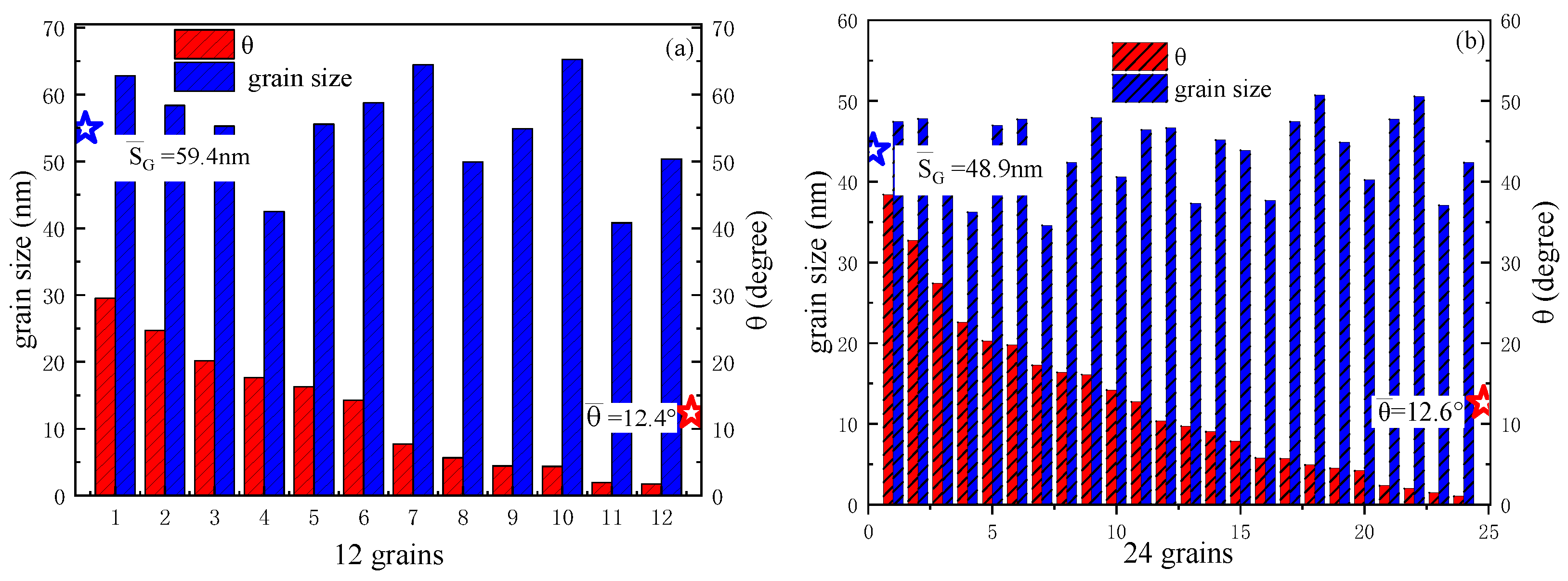
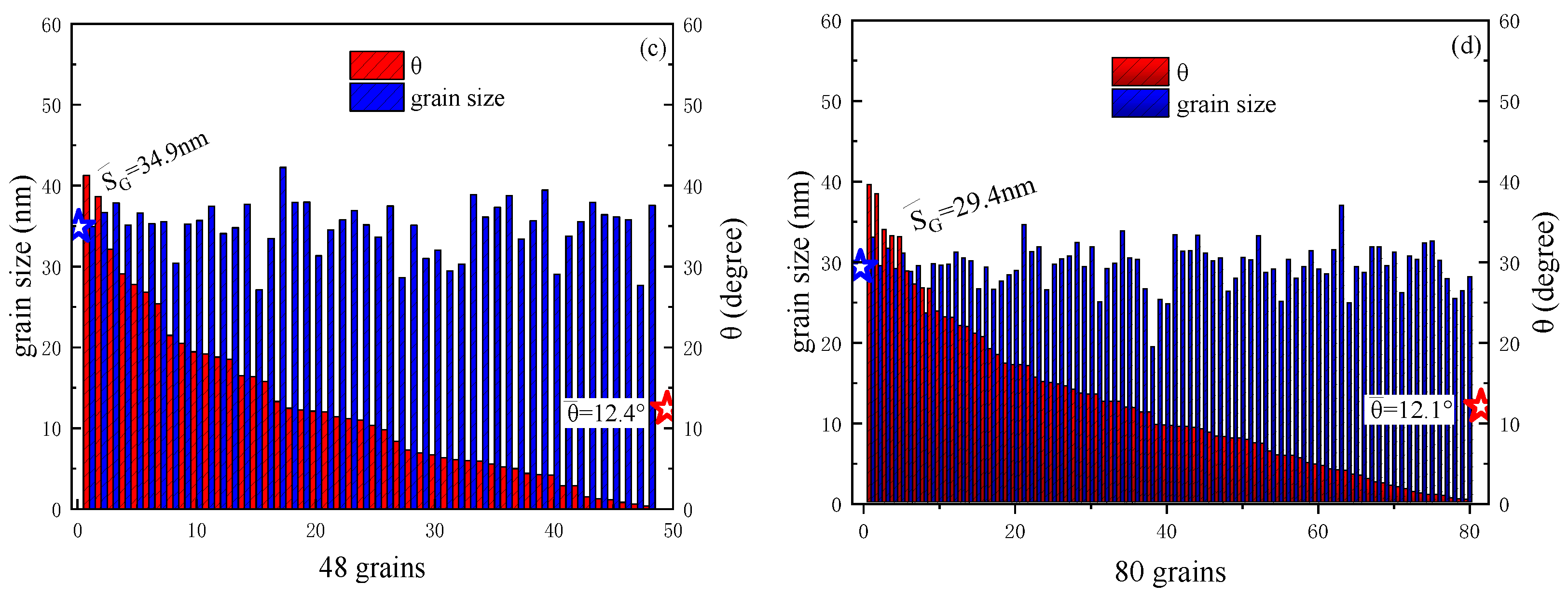
The grain size obtained by Voronoi partitioning is relatively uniform. Figure 2 shows statistics for the θ ¯ and average grain size ( S G ¯ ) for different numbers of grains. The blue-colored sections in the histogram of Figure 2 show that when the number of grains is 12, the S G ¯ is 59.4 nm; when the number of grains is 80, the S G ¯ is 29.4 nm. For the distribution of tilt angles, however, increasing the number of grains does not significantly change the θ ¯ (red star points).
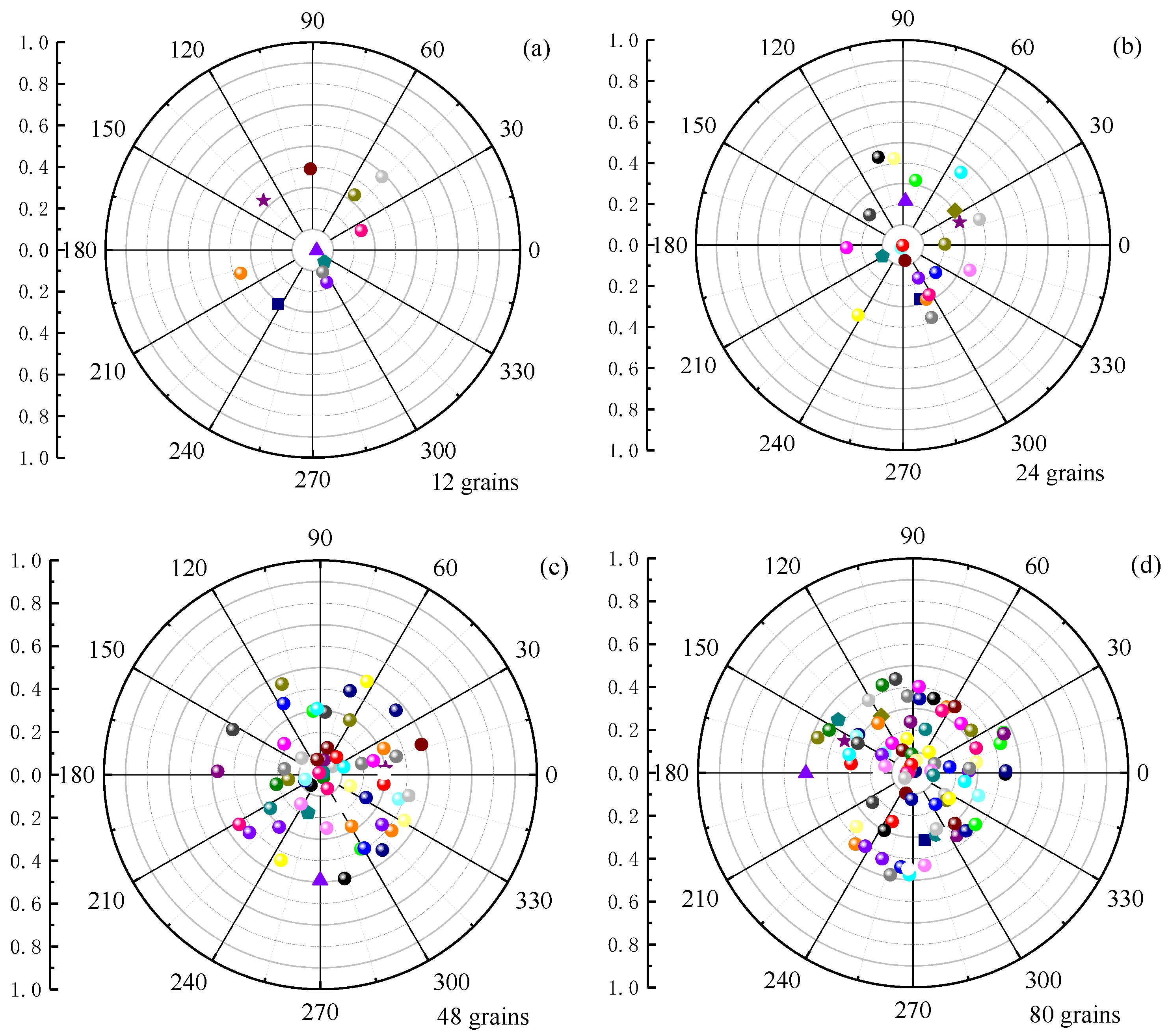
To visually observe the orientation of the grain easy axes, we plotted the distribution of each grain’s easy-axis direction relative to the z-axis (pointing out of the page) in polar coordinates for different numbers of grains. As can be seen from Figure 3, θ is confined to within 40° according to the distribution, while the azimuthal angle is completely random. As the number of grains increases, the number of data points within 40° increases, and the tilt angles between adjacent grains become increasingly closer. For example, for 80 grains, the θ ¯ between adjacent grains is within 1°, whereas for 12 grains, the θ ¯ between adjacent grains is about 4°. This indicates that we can arbitrarily regulate the grain size and anisotropic orientation.

3. Results and Discussion

3.1. Effect of Grain Boundary Width

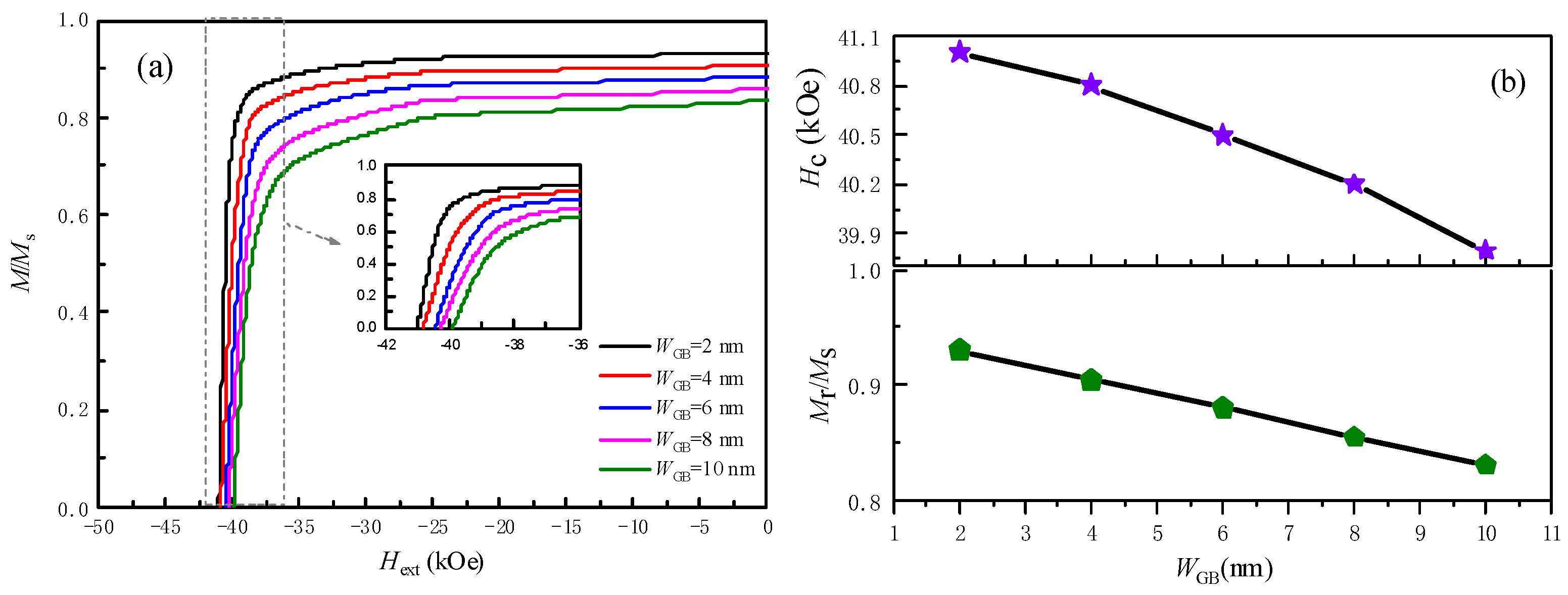
Figure 4 shows demagnetization curves for models with grain boundary width (WGB) ranging from 2 nm to 10 nm, referring to the parameters in Table 1. Both coercivity and remanence decrease monotonically as the WGB increases.
For a WGB of 2 nm, the coercivity is 42.3 kOe and Mr/Ms = 0.96. When the WGB increases to 10 nm, Hc drops to 28.7 kOe (a 32% decrease) and Mr/Ms falls to 0.81 (a 16% decrease). As the WGB increases, the volume fraction of this magnetically dilute phase rises, thereby reducing the overall magnetization of the composite magnet. This effect directly accounts for the observed decline in remanence, since the contribution of the GB phase to the net magnetic moment is limited. Simultaneously, a wider GB introduces more magnetically weaker phases, where reverse domains can preferentially nucleate under an external field. These nucleation sites become more numerous and more effective as the WGB expands. Once a reverse domain is nucleated, it can easily propagate into adjacent grains due to the reduced energy barrier for domain wall motion, leading to a lower coercive field.
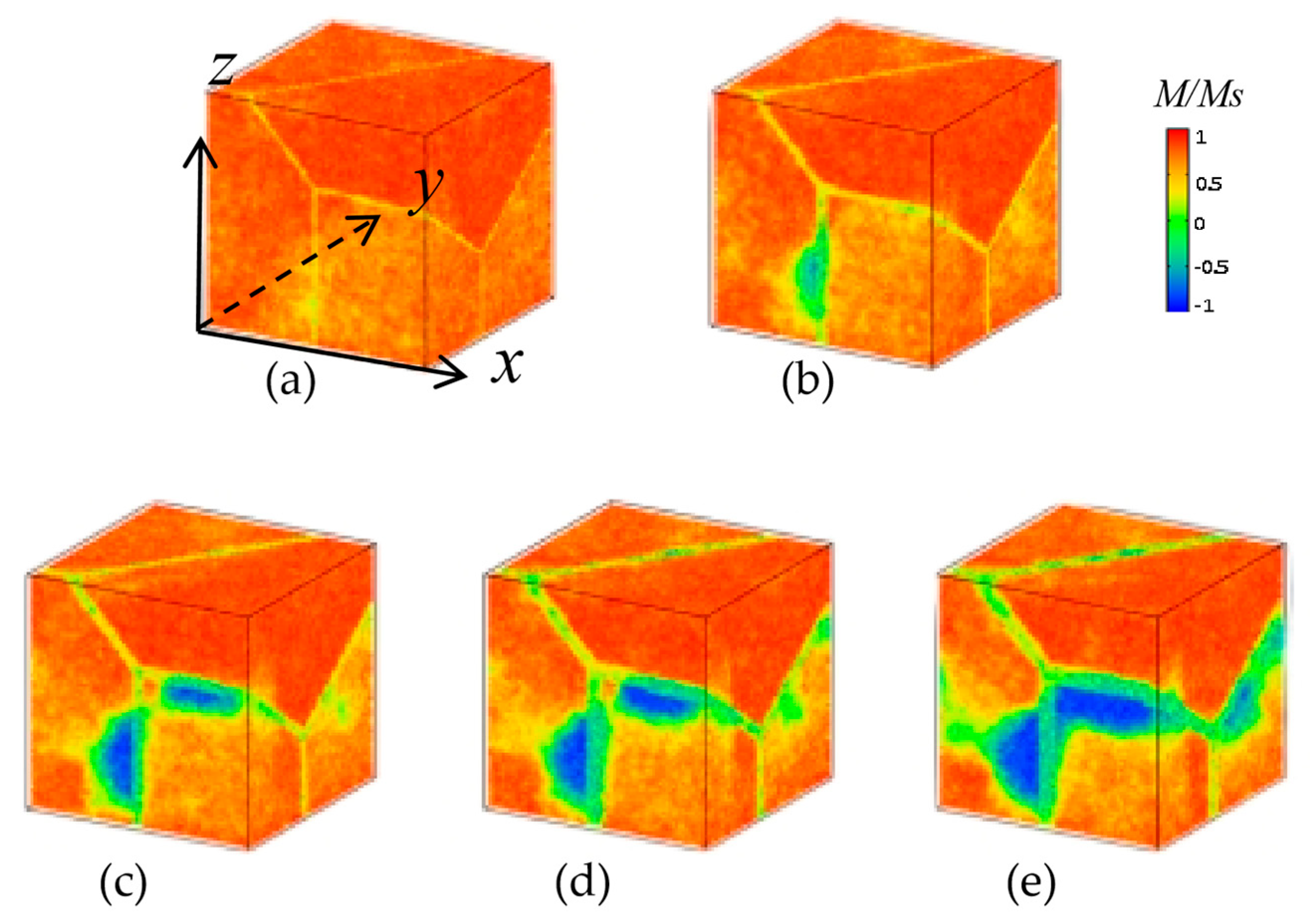
Figure 5 presents the magnetization reversal process at an external field of Hext = 36 kOe. At WGB = 2 nm, the sample remains mostly magnetized, with only minor local disturbances near GB regions. A narrow GB is insufficient to nucleate stable reverse domains, and the strong exchange coupling between grains helps maintain a uniform magnetization state. When WGB increases to 4 nm, nucleation begins to occur preferentially at GB regions. The slightly wider GB provides a sufficient local reduction in magnetocrystalline anisotropy and exchange stiffness, allowing reverse magnetic moments to emerge under the applied field. However, at this stage, reverse domains remain confined near GB and do not yet propagate into grain interiors. For WGB > 4 nm (i.e., 6 nm, 8 nm, and 10 nm), reverse domains have already formed and expanded into grain interiors. The wider GB acts as an effective nucleation site, and once a reverse domain is nucleated, the reduced energy barrier for domain wall motion allows it to grow rapidly into adjacent grains, leading to significant demagnetization.
A key observation is that nucleation consistently occurs at the GB edges, not at grain centers. Furthermore, domain walls are pinned at GBs during the reversal process. This dual behavior confirms that GBs serve simultaneously as both nucleation sites and pinning centers.
As nucleation sites, a wider GB facilitates the formation of reverse domains at lower external fields.
As pinning centers, GBs impede the motion of domain walls, which can temporarily delay full reversal, but in the presence of a wide GB, the pinning effect is insufficient to compensate for the enhanced nucleation.

3.2. Effect of Grain Boundary Magnetic Parameters

We discussed the influence of different GB magnetic parameters (i.e., Ms′, K′, A2*) on coercivity and remanence under the same WGB = 2 nm. Since the WGB is relatively narrow and the proportion of the weakly magnetic phase is small, the variation ranges of both coercivity and remanence are weak, although the change trend can still be observed.
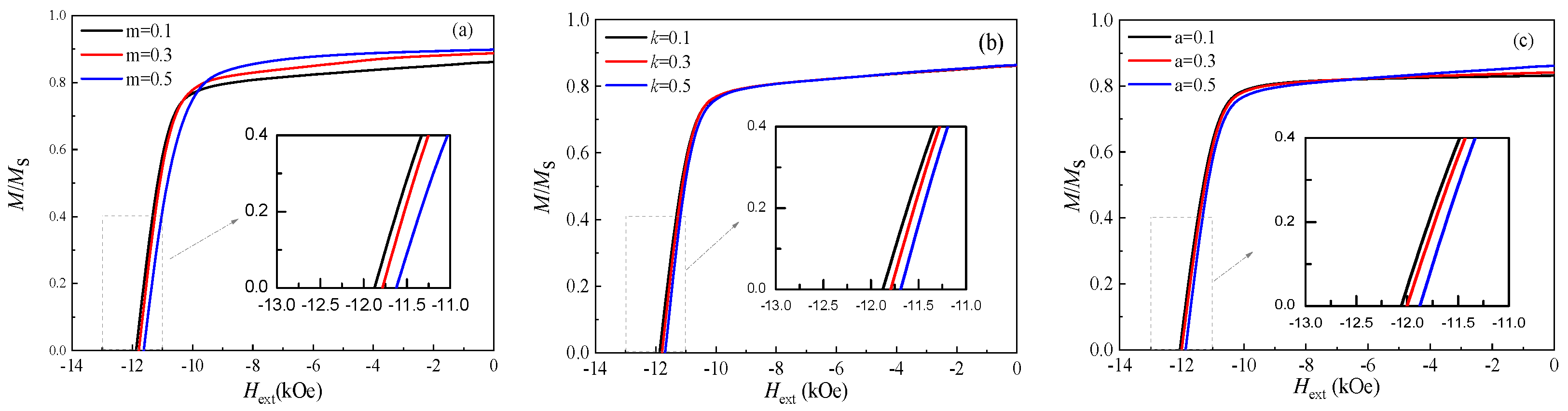
Figure 6a shows how the GB saturation magnetization (Ms′) affects magnetic properties. As Ms′ increases from 0.1 Ms to 0.5 Ms (m = Ms′/Ms in Figure 6a), the remanence increases from 0.88 to 0.96, while coercivity was slightly reduced. This trade-off reflects two competing effects. Higher GB magnetization increases the overall Ms, boosting remanence. But it also strengthens the exchange coupling between grains, making collective reversal easier and reducing coercivity. This explains the experimental observations that a non-magnetic GB—achieved by adding elements like Cu or Ga—yields higher coercivity [27,28].
Figure 6b shows that increasing the GB anisotropy K′ increases from 0.1 K to 0.5 K (k = K′/K in Figure 6b) raises coercivity from 11.7 kOe to 11.9 kOe, while remanence stays nearly constant. This result directly supports the GB diffusion strategy, where heavy rare earth elements like Dy form high-anisotropy shells around Nd2Fe14B grains. The enhanced anisotropy at the GB strengthens domain wall pinning and increases the nucleation field [12,29].
Increasing the GB exchange A2* from 0.1 A* to 0.5 A* (a = A2*/A* in Figure 6c) slightly reduces coercivity (from 12.1 kOe to 11.9 kOe) and slightly increases remanence (Figure 6c). Stronger exchange coupling across grains and the GB promotes magnetization reversal. Weakening this intergranular exchange coupling can enhance coercivity. Experimentally, it has been shown that adding elements with low solubility at sintering temperatures, such as Nb, Mo, or Zr, leads to the formation of precipitates within the Nd2Fe14B grains and modifies the GB chemistry. These microstructural changes are believed to reduce the intergranular exchange coupling, thereby contributing to an increase in coercivity [30].

3.3. Effect of Grain Crystallographic Orientation

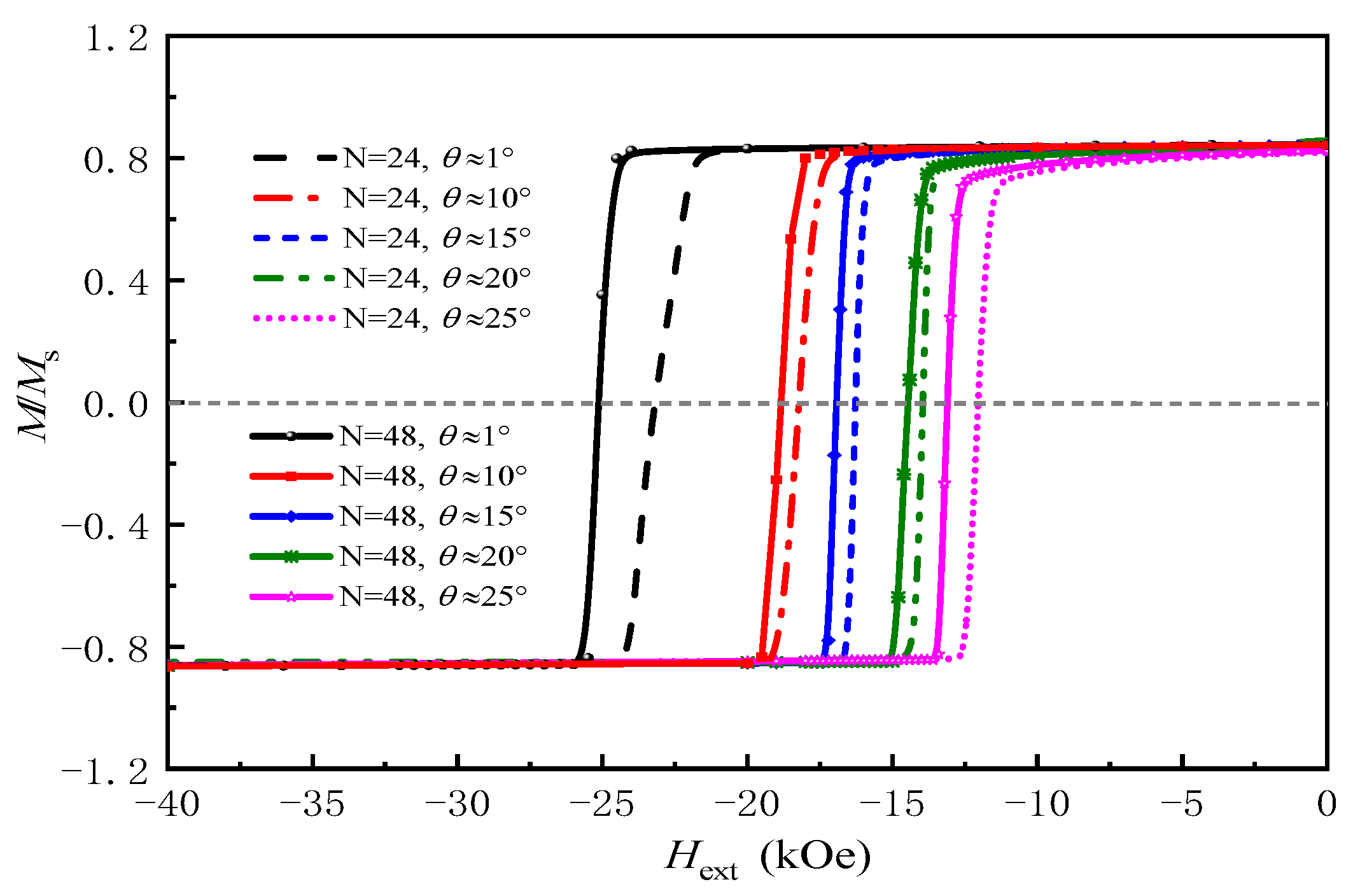
With fixed grain boundary parameters, we also investigated the effects of grain anisotropy orientation on coercivity and remanence. Figure 7 shows how the average easy-axis tilt angle affects demagnetization curves for models with 24 and 48 grains. As θ ¯ increases from 2.6° to 11.6°, coercivity drops from 41.2 kOe to 31.5 kOe for N = 24, and from 44.8 kOe to 34.2 kOe for N = 48. In contrast, the remanence remains nearly constant across the entire range of tilt angles, indicating that the easy-axis misalignment primarily affects the coercive field rather than the saturation magnetization.
This behavior is consistent with previous experimental and theoretical work [31]. When the easy axes of the grains are well-aligned, their magnetocrystalline anisotropy fields act cooperatively, leading to a higher energy barrier for the nucleation of reverse domains and thus a larger Hc. Conversely, an increase in misalignment disrupts this cooperative effect, reducing the effective anisotropy field and facilitating the nucleation of reverse domains, which results in a significant decrease in Hc.

4. Conclusions

This work employed Hybrid Monte Carlo micromagnetic simulations and a Voronoi-tessellated polycrystalline model to systematically study the effects of grain boundary features and grain crystallographic orientation on the coercivity and remanence of Nd-Fe-B permanent magnets at 300 K. Our main findings are as follows:
Grain boundary width significantly impacts both coercivity and remanence. Increasing the WGB from 2 nm to 10 nm reduces Hc by 32% and Mr/Ms by 16%. The GB serves as both a nucleation site (wider GBs promote nucleation) and a pinning center (domain walls stop at the GB). The enhanced nucleation effect from a wider GB outweighs the pinning effect, leading to reduced coercivity.
GB magnetic parameters regulate coercivity and Mr with distinct trends: higher GB saturation magnetization improves remanence but slightly reduces coercivity by strengthening intergranular exchange coupling. Higher GB anisotropy increases coercivity, as it strengthens domain wall pinning, supporting the Dy-diffusion strategy. A stronger GB exchange coupling slightly reduces coercivity due to promoted cooperative magnetization reversal.
Grain crystallographic orientation impacts coercivity: increasing the average easy-axis tilt angle from 2.6° to 11.6° reduces coercivity by about 24% for both 24 and 48-grain models. as misalignment weakens the cooperative anisotropy field and lowers the reverse domain nucleation energy barrier.
For high-coercivity Nd-Fe-B magnet design, a thin GB with low magnetization, high anisotropy and weak exchange coupling, combined with high-precision easy-axis alignment, are optimal. These findings provide quantitative theoretical guidance for the experimental preparation and microstructure modification of high-performance Nd-Fe-B permanent magnets.

Author Contributions

Conceptualization, L.B., G.Y. and Y.C.; Methodology, L.B., G.Y., B.N. and Y.C.; Software, L.B., H.Y. (Hargen Yibole) and B.N.; Validation, L.B. and H.Y. (Hui Yang); Formal analysis, L.B., B.N., Y.C. and J.F.; Investigation, L.B., H.Y. (Hui Yang) and R.Z.; Resources, L.B., J.F. and R.Z.; Data curation, L.B., H.Y. (Hargen Yibole), Y.C. and J.F.; Writing—original draft, L.B.; Writing—review & editing, L.B.; Visualization, H.Y. (Hargen Yibole) and J.F.; Supervision, G.Y.; Funding acquisition, L.B., H.Y. (Hargen Yibole), B.N., Y.C., H.Y. (Hui Yang) and R.Z. All authors have read and agreed to the published version of the manuscript.

Funding

This research was funded by the Natural Science Foundation of Inner Mongolia Autonomous Region of China under Grant Nos. 2024QN05064, 2025MS01002, 2024QN01019. The National Natural Science Foundation of China Grant No. 52461036. The Science and Technology Plan of the Inner Mongolia under Grant No. 2025KYPT0173. Fundamental Research Funds for the Inner Mongolia Normal University under Grant No. 2022JBYJ027.

Data Availability Statement

The original contributions presented in this study are included in the article. Further inquiries can be directed to the corresponding author.

Conflicts of Interest

The authors declare no conflict of interest.

References

  1. Sagawa, M.; Fujimura, S.; Yamamoto, H.; Matsuura, Y.; Hiraga, K. Permanent magnet materials based on the rare earth-iron-boron tetragonal compounds. IEEE Trans. Magn. 1984, 20, 1584–1589. [Google Scholar] [CrossRef] [Scilit]
  2. Croat, J.J.; Herbst, J.F.; Lee, R.W.; Pinkerton, F.E. Pr-Fe and Nd-Fe-based materials: A new class of high performance permanent magnets. J. Appl. Phys. 1984, 55, 2078–2081. [Google Scholar] [CrossRef] [Scilit]
  3. Hono, K.; Sepehri-Amin, H. Strategy for high-coercivity Nd-Fe-B magnets. Scr. Mater. 2012, 67, 530–535. [Google Scholar] [CrossRef] [Scilit]
  4. He, J.; Zhou, B.; Liao, X.; Liu, Z. Nanocrystalline alternative rare earth-iron-boron permanent magnets without Nd, Pr, Tb and Dy: A review. J. Mater. Res. Technol. 2024, 28, 1844–1856. [Google Scholar] [CrossRef] [Scilit]
  5. Xu, X.D.; Sasaki, T.T.; Li, J.N.; Dong, Z.J.; Sepehri-Amin, H.; Kim, T.H.; Ohkubo, T.; Schrefl, T.; Hono, K. Microstructure of a Dy-free Nd-Fe-B sintered magnet with 2 T coercivity. Acta Mater. 2018, 156, 146–157. [Google Scholar] [CrossRef] [Scilit]
  6. Sasaki, T.T.; Ohkubo, T.; Hono, K. Structure and chemical compositions of the grain boundary phase in Nd-Fe-B sintered magnets. Acta Mater. 2016, 115, 269–277. [Google Scholar] [CrossRef] [Scilit]
  7. Su, W.; Wang, J.; Lu, J.; Fu, G.; Shi, D.; Wang, C.; Yu, Z.; Wu, P. Effects of annealing processes on properties and microstructure of sintered Nd-Fe-B magnet with gallium and copper additions. J. Rare Earths 2024, 43, 2433–2441. [Google Scholar] [CrossRef] [Scilit]
  8. Lee, S.; Kim, G.; Lee, K.; Kim, S.; Kim, T.; Lee, S.; Kim, D.; Lee, W.; Lee, J. A novel two-step grain boundary diffusion process using TaF5 and Pr70Cu15Al10Ga5 for realizing high-coercivity in Nd-Fe-B-sintered magnets without use of heavy rare-earth. Acta Mater. 2025, 285, 120660. [Google Scholar] [CrossRef] [Scilit]
  9. Qu, N.; Lamarre, J.-M.; Bernier, F.; Song, S.; Dash, S.S.; Lang, L.; He, Y.; Zou, Y. Microstructure and magnetic properties of additively manufactured NdFeB magnets by cold spray. J. Alloys Compd. 2025, 1042, 183992. [Google Scholar] [CrossRef] [Scilit]
  10. Dong, H.; He, K.; Du, Y.; Ming, G.; Xu, H.; Meng, X.; Dong, C.; Ji, T.; Dai, K. Defect-structure-property relationships in laser powder bed fusion processed NdFeB magnets: The dominant role of laser energy density. J. Manuf. Process. 2025, 134, 158–170. [Google Scholar] [CrossRef] [Scilit]
  11. Dong, H.; He, K.; Meng, X.; Xu, H.; Ming, G.; Du, Y.; Dai, K.; Dong, C. Influence of laser powder bed fusion scanning strategies on the magnetic and mechanical properties of NdFeB. J. Alloys Compd. 2025, 1020, 179384. [Google Scholar] [CrossRef] [Scilit]
  12. Li, W.F.; Ohkubo, T.; Hono, K.; Nishiuchi, T.; Hirosawa, S. Coercivity mechanism of hydrogenation disproportionation desorption recombination processed Nd–Fe–B based magnets. Appl. Phys. Lett. 2008, 93, 052505. [Google Scholar] [CrossRef] [Scilit]
  13. Suzuki, H.; Satsu, Y.; Komuro, M. Magnetic properties of a Nd-Fe-B sintered magnet with Dy segregation. J. Appl. Phys. 2009, 105, 07A734. [Google Scholar] [CrossRef] [Scilit]
  14. Zhao, Y.; Han, R.; Duan, X.; Li, A.; Chen, H.; Dong, S.; Feng, H.; Zhu, M.; Hadjipanayis, G.C.; Li, W. Significant process of dual main phase method for sintered Nd-Fe-B magnets with enhanced coercivity: A review. J. Alloys Compd. 2024, 997, 174588. [Google Scholar] [CrossRef] [Scilit]
  15. Zhang, L.; Li, Y.; Bian, M.; Zhang, H.; Chen, H.; Qin, Y.; Li, Q.; Liu, W.; Zhu, M.; Yue, M. Phase composition tailoring and coercivity mechanism of high-performance high-abundance rare-earth sintered magnets. Acta Mater. 2024, 284, 120625. [Google Scholar] [CrossRef] [Scilit]
  16. Wu, Z.; Lian, J.; Zhao, D.; Cui, B. Microstructure refinement of hot deformed Dy-free NdFeB magnets through a novel cold sintering approach by pressure-assisted spark plasma sintering. J. Alloys Compd. 2025, 1048, 179138. [Google Scholar] [CrossRef] [Scilit]
  17. Li, J.; Sepehri-Amin, H.; Ohkubo, T.; Hono, K. Identifying the mechanism of hard magnet coercivity by its angular dependence. Phys. Rev. B 2022, 105, 174432. [Google Scholar] [CrossRef] [Scilit]
  18. Liu, J.; Sepehri-Amin, H.; Ohkubo, T.; Hioki, K.; Hattori, A.; Schrefl, T.; Hono, K. Grain size dependence of coercivity of hot-deformed Nd-Fe-B anisotropic magnets. Acta Mater. 2015, 82, 336–343. [Google Scholar] [CrossRef] [Scilit]
  19. Ohkubo, T.; Sepehri-Amin, H.; Hono, K. Micromagnetic simulations of magnetization reversals in Nd-Fe-B based permanent magnets. J. Jpn. Inst. Met. 2017, 81, 11–18. [Google Scholar] [CrossRef] [Scilit]
  20. Liu, D.; Zhao, T.Y.; Li, R.; Zhang, M.; Shang, R.X.; Sun, J.R.; Shen, B.G. Micromagnetic simulation of the influence of grain boundary on cerium substituted Nd-Fe-B magnets. AIP Adv. 2017, 7, 056201. [Google Scholar] [CrossRef] [Scilit]
  21. Yi, M.; Gutfleisch, O.; Xu, B.X. Micromagnetic simulations on the grain shape effect in Nd-Fe-B magnets. J. Appl. Phys. 2016, 120, 033903. [Google Scholar] [CrossRef] [Scilit]
  22. Wei, D.; Song, J.; Liu, C. Micromagnetics at finite temperature. IEEE Trans. Magn. 2016, 52, 7100808. [Google Scholar] [CrossRef] [Scilit]
  23. Wei, D.; Song, J.; Liu, C. Hybrid Monte Carlo micromagnetics. IEEE Trans. Magn. 2018, 54, 7100206. [Google Scholar] [CrossRef] [Scilit]
  24. Bao, L.B.; Yun, G.H.; Narsu, B.; Cao, Y.J. Grain-size effect on coercivity of Nd-Fe-B nanomagnets: Micromagnetics simulation based on a multi-grain model. Appl. Phys. Express 2021, 14, 085505. [Google Scholar] [CrossRef] [Scilit]
  25. Bao, L.B.; Wei, D.; Yun, G.H.; Cao, Y.J.; Narsu, B. Micromagnetics of Nd–Fe–B magnets at finite temperature. Jpn. J. Appl. Phys. 2021, 60, 030909. [Google Scholar] [CrossRef] [Scilit]
  26. Chantrell, R.W.; Tako, K.M.; Wongsam, M.; Walmsley, N. Magnetic properties and microstructure of thin-film media. J. Magn. Magn. Mater. 1997, 175, 137–147. [Google Scholar] [CrossRef] [Scilit]
  27. Cui, Y.; Du, Y.; Chen, R.; Tang, X.; Yin, W.; Dai, G.; Ouyang, Y.; Ju, J.; Yan, A. Thermal stability improvement of hot-deformed PrNd-Fe-B magnets by diffusion of Nd-Gd-Ga alloy. J. Alloys Compd. 2025, 1019, 179342. [Google Scholar] [CrossRef] [Scilit]
  28. Li, J.; Jiang, Q.; Wei, W.; Fu, S.; Kan, M.; Mo, Z. Optimized microstructure and improved magnetic properties of B-lean hot deformed Nd-Fe-B magnets by Ga doping. Intermetallics 2025, 179, 108676. [Google Scholar] [CrossRef] [Scilit]
  29. Sun, C.; Ming, X.; Fu, P.; Lin, J.; Wang, F.; Meng, F.; Zhang, J.; Shen, B. The high entropy multi-component diffusion of Tb60Dy10Cu10Al10Zn10 effectively enhances the diffusion depth of heavy rare earths and coercivity in NdFeB magnets. J. Magn. Magn. Mater. 2025, 618, 172876. [Google Scholar] [CrossRef] [Scilit]
  30. Kumar, M.B.S.; Prabhu, D.; Sadhasivam, M.; Manjusha, B.; Chandrasekaran, N.; Pradeep, K.G.; Sundararajan, G.; Gopalan, R. Enhancing the coercivity of Nd-Cu-diffused Nd-Fe-B permanent magnets by Nb-assisted grain boundary pinning. Mater. Res. Lett. 2022, 10, 780–787. [Google Scholar] [CrossRef] [Scilit]
  31. Zhao, Y.; Han, R.; Zheng, M.; Duan, X.; Shi, X.; Hu, X.; Chen, H.; Zhou, D.; Dong, S.; Li, W. Optimization of microstructure for HRE-free Nd-Fe-B magnets with improved properties. J. Mater. Res. Technol. 2025, 35, 1901–1912. [Google Scholar] [CrossRef] [Scilit]
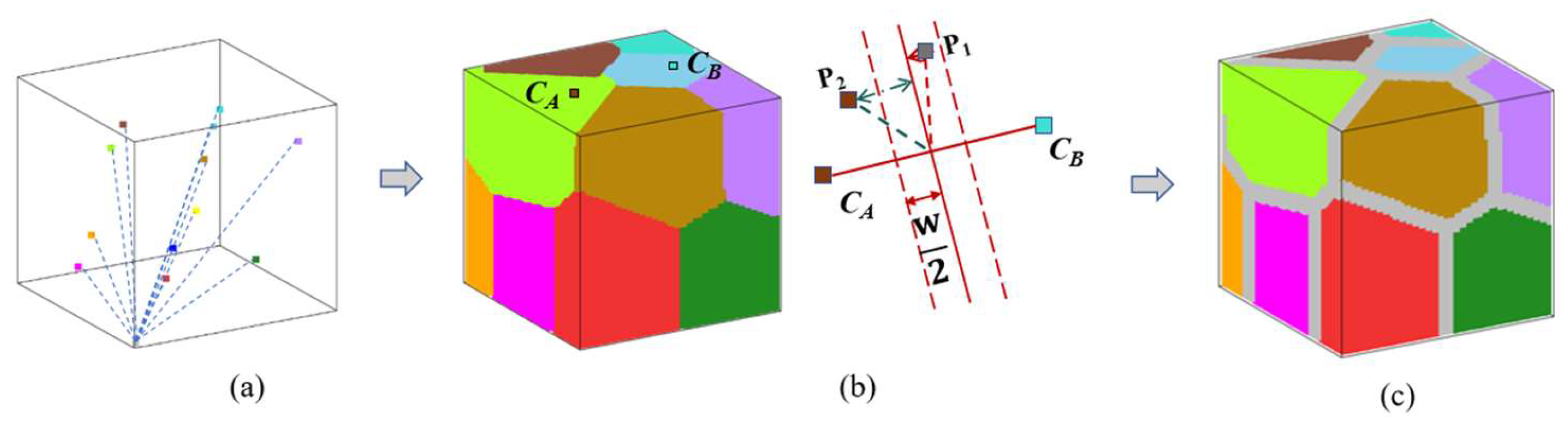
Figure 1. (a) Randomly distributed grain centers (each color corresponds to one grain) and Voronoi tessellation assigning cells to grains. (b) Diagram of method for dividing the grain boundary. (c) A complete polycrystal model with the grain boundary and grains.
Nanomaterials 16 00460 g001
Figure 2. Histogram distributions of the easy-axis tilt angles (red columnar) and the grain size (blue columnar) of each grain with different grain numbers: (a) N = 12; (b) N = 24; (c) N = 48; (d) N = 80. The blue stars represent the average grain size, and the red stars represent the average tilt angles.
Nanomaterials 16 00460 g002aNanomaterials 16 00460 g002b
Figure 3. Distributions of the easy-axis tilt angles in polar coordinates with (a) N = 12, (b) N = 24, (c) N = 48, and (d) N = 80. Different colors represent the tilt angles of grains.
Nanomaterials 16 00460 g003
Figure 4. (a) Simulated demagnetization curves of nanoscale muti-grain Nd2Fe14B with different grain boundary widths, WGB, at 300K, with K = 4.5 × 10⁶ J/m3 and external field (Hext) ranging from −80 kOe to +80 kOe. (b) Coercivity (Hc) and normalized remanence (Mr/Ms) versus WGB of nanoscale muti-grain Nd2Fe14B magnet.
Nanomaterials 16 00460 g004
Figure 5. Magnetization reversal processes of muti-grain Nd2Fe14B magnets at Hext = 36 kOe along the z-axis for GB widths of (a) 2 nm, (b) 4 nm, (c) 6 nm, (d) 8 nm, and (e) 10 nm.
Nanomaterials 16 00460 g005
Figure 6. Effect of (a) Ms′; (b) K′; and (c) A2* on the Hc and Mr/Ms, referring to the parameters in Table 1, with N = 6, K = 1 × 10⁶ J/m3, and WGB = 2 nm.
Nanomaterials 16 00460 g006
Figure 7. Demagnetization curves of Nd-Fe-B magnets with different easy-axis tilt angles for N = 24 and N = 48 with the parameters in Table 1: K = 2.1 × 10⁶ J/m3 and WGB = 4 nm.
Nanomaterials 16 00460 g007
Table 1. Magnetic parameters of Nd2Fe14B at 300 K.
Inside grains M s  (A/m)K   (J/m3)A* (J/m)
1.281 × 1061~4.5 × 1061.25 × 10−11
At grain boundaryM′s / M s K′/KA*2/A*
0.1~0.50.1~0.50.1~0.5
Other parametersWGB (nm)αθT (K)
2~1032300
Table 2. Average inclination angles θ ¯ for different α θ and c 1 with number of grains is 24.
θ ¯ α θ c 1
10°11.60.057
15°5.800.040
20°3.800.031
25°2.600.025
Disclaimer/Publisher’s Note: The statements, opinions and data contained in all publications are solely those of the individual author(s) and contributor(s) and not of MDPI and/or the editor(s). MDPI and/or the editor(s) disclaim responsibility for any injury to people or property resulting from any ideas, methods, instructions or products referred to in the content.