Article

Preparation of Fe3O4@ACF Composite Catalytic Electrode and Study of Its Degradation of Antibiotics


State Key Laboratory of Heavy Oil Processing, China University of Petroleum (Beijing) at Karamay, Karamay 834000, China
*
Author to whom correspondence should be addressed.
Nanomaterials 2026, 16(7), 431; https://doi.org/10.3390/nano16070431
Submission received: 11 March 2026 / Revised: 30 March 2026 / Accepted: 30 March 2026 / Published: 31 March 2026
(This article belongs to the Section Energy and Catalysis)

Abstract

Antibiotics are extensively used in intensive livestock farming for disease prevention, resulting in the discharge of antibiotic-contaminated wastewater into aquatic environments. Addressing this issue, electrocatalytic oxidation has emerged as a promising alternative to conventional chemical oxidation due to its cost-effectiveness and minimal secondary pollution. Central to this technology is the development of catalytic electrodes with high specific surface area and superior electrocatalytic activity. In this work, an Fe3O4-modified activated carbon fiber electrode (Fe3O4@ACF) was fabricated via a co-precipitation method. The Fe3O4@ACF electrode exhibited a hierarchical porous structure with a specific surface area of 940.2 m2/g, and demonstrated significantly enhanced oxygen reduction reaction activity with a current density of 21.8 mA·cm−2 at –3.25 V vs. Ag/AgCl, which is 2.3 times higher than that of pristine ACF. EIS analysis revealed a low charge transfer resistance of 7.18 Ω, indicating improved electron transfer kinetics. In electro-Fenton degradation of tetracycline, the electrode achieved 82% removal within 120 min with a first-order rate constant of 0.01335 min−1, and maintained over 94% of its initial activity after ten cycles. This study offers a viable and sustainable strategy for the efficient treatment of antibiotic-containing medical wastewater.

1. Introduction

Antibiotics inhibit the growth and survival of microorganisms and are therefore widely used in healthcare, animal husbandry, and aquaculture [1,2]. Their increasing consumption in recent years has raised concerns about antibiotic residues in aquatic environments and the associated risks to ecosystem sustainability [3]. Tetracycline (TC), a widely used broad-spectrum antibiotic, is often regarded as an emerging contaminant due to its frequent detection and persistence in water bodies [4]. After entering aquatic and soil environments, TC can exert toxic effects on aquatic organisms and microbial communities, disrupt ecological balance, and pose potential risks to human health [5]. Moreover, continuous exposure to TC may promote the emergence and dissemination of antibiotic-resistant bacteria and resistance genes, further aggravating antibiotic resistance and threatening public health [6]. Therefore, developing efficient and sustainable water-treatment technologies to mitigate antibiotic contamination is urgently needed.
Current treatments for emerging organic pollutants include adsorption [7], membrane separation [8], advanced oxidation [9], and biodegradation [10]. Among these, adsorption and advanced oxidation are extensively applied. Adsorption is attractive because of its low cost, simple operation, and rapid pollutant removal [11,12,13]. However, its practical application is limited by poor adsorbent regenerability, high regeneration energy consumption, finite adsorption capacity, and the inherently discontinuous nature of batch replacement/regeneration processes [14,15]. In contrast, advanced oxidation processes (AOPs) are a promising class of technologies capable of mineralizing non-biodegradable organic compounds or converting them into more biodegradable by-products [16,17]. While conventional advanced oxidation processes (AOPs) rely on the external addition of chemical oxidants such as ozone or hydrogen peroxide, electrochemical advanced oxidation processes (EAOPs) generate reactive species in situ via electrode reactions. This enables better process control, reduces chemical transport and storage risks, and enhances environmental compatibility [18]. Electrochemical advanced oxidation processes (EAOPs) have gained increasing attention due to their stable performance, facile controllability, low chemical demand, and environmental compatibility [19,20].
Among EAOPs, electro-Fenton (EF) technology produces H2O2 in situ at the cathode via electrochemical reduction of dissolved O2, while simultaneously enabling continuous regeneration of the Fe2+/Fe3+ redox catalyst to sustain Fenton reactions [21]. The resulting hydroxyl radicals (∙OH) are highly oxidative and can rapidly and non-selectively degrade refractory organic pollutants into intermediates, which can be further mineralized to CO2 and H2O [22,23]. In situ H2O2 generation eliminates the costs and safety concerns associated with transportation and storage [24]. In addition, cyclic Fe2+ regeneration can reduce iron-sludge formation and enhance pollutant degradation efficiency [25,26]. For instance, studies have shown that heterogeneous electro-Fenton systems can reduce iron sludge production by over 90% compared to homogeneous Fenton processes, while maintaining degradation efficiencies above 95% [27]. Owing to its robustness against matrix interference, operational simplicity, and high degradation/mineralization capability [28], EF has been widely investigated for the treatment of various refractory organic wastewaters [29,30,31].
To further improve EF performance, extensive efforts have been devoted to developing heterogeneous EF cathodes/catalysts with enhanced electron transfer and H2O2 utilization. As shown in the Table 1, Cheng et al. [32] fabricated a Fe–Ni LDH@ZIF-67 catalyst-modified carbon-cloth (CC) cathode, achieving 95.6% TC removal within 60 min, compared with 75.7% for Fe–Ni LDH/CC. Under the synergistic action of heterogeneous EF and anodic oxidation, the maximum H2O2 concentration reached 264 mg∙L−1, indicating improved H2O2 utilization. Cao et al. [33] prepared a Fe3O4/FeO/Fe3C-2-600 catalytic electrode by in situ growth of MIL-88B(Fe) on stainless-steel mesh followed by calcination; the resulting dual-cathode EF system achieved 97.7% TC degradation within 12 min. Cui et al. [34] synthesized Cu/CuFe2O4 (CCFO) with different CuO ratios using a one-step solvothermal method and obtained 96.3% TC degradation at the optimal composition. Zhang et al. [35] reported CO2-activated CuFeC and CuMnC aerogel cathodes that enabled effective treatment of real printing and dyeing wastewater without external addition of Fe2+ or H2O2, with removal efficiencies of 90.5% and 80.3%, respectively, within 60 min. In another study, Fe–Cu/kaolin electrodes were developed for rhodamine B (RhB) degradation in a three-dimensional EF (3D/EF) system, showing RhB removals of 91.6% and 81.1% at initial pH values of 6.71 and 9.0, respectively [36]. Luo et al. [37] investigated TC degradation using Cu-doped Fe@Fe2O3 core–shell nanoparticles as catalysts and nickel foam as the cathode, achieving 98.1% TC degradation within 2 h and 89.8% mineralization after 6 h. Gao et al. [38] constructed a 3D/EF system using CuFe2O4 as a heterogeneous catalyst and activated carbon as a granular electrode for semicoke wastewater treatment, achieving 80.9% COD removal under optimal conditions. The synthesis method and resulting morphology of electro-Fenton cathodes play critical roles in determining their catalytic performance. Different synthesis approaches yield distinct morphological features that directly impact key aspects of the electro-Fenton process. Active Site Exposure: Synthesis methods that promote uniform dispersion of catalytically active components maximize the exposure of active sites. Electron Transfer Efficiency: Morphologies that ensure intimate contact between the catalyst and conductive substrate facilitate efficient electron transfer. Mass Transport: Hierarchical pore structures facilitate rapid diffusion of reactants (O2, H2O2) and pollutants to active sites. H2O2 Generation and Utilization: Morphologies that provide abundant three-phase interfaces (solid catalyst–liquid electrolyte–dissolved O2) promote efficient electrochemical reduction of oxygen to H2O2.
Carbon-based materials can act as a good electron acceptor and transfer channel to improve the conductivity and optimize the adsorption of H- or O-relevant intermediates of g-C3N4-based catalysts [40,41,42]. Emerging carbon architectures offer additional advantages. For instance, graphdiyne, with its unique sp-/sp2-hybridized carbon network and intrinsic bandgap, can modulate interfacial charge transfer more effectively than conventional carbons. Carbon nanocages provide continuous conductive pathways and geometric confinement effects that facilitate both electron transport and mass diffusion, which are critical for gas-involving reactions such as the oxygen evolution reaction (OER) and hydrogen evolution reaction (HER). Ordered mesoporous carbon frameworks, with their well-defined periodic porosity, enable uniform dispersion of g-C3N4 and maximize accessible active sites while ensuring efficient charge transport [43].
The Fenton reaction is a contact reaction, and the poor electrical conductivity and small specific surface area of FeO or Fe2O3, which are used as Fenton materials, lead to low Fenton efficiency. Therefore, in this paper, high-performance electro-Fenton catalytic electrodes were prepared by loading Fe3O4 nanoparticles onto the surface of activated carbon fibers (Fe3O4@ACF) by chemical precipitation method using carbon nanofibers as substrate.

2. Experimental Materials and Methods

2.1. Experimental Materials and Reagents

All chemical reagents were analytically pure. Deionized (DI) water was used throughout the experiment. All the reagents used during the experiments, such as hydrochloric acid (HCl, 1 M), activated carbon fiber (ACF, 99.0%), iron sulfate heptahydrate (FeSO4·7H2O, 99.0%), potassium nitrate (KNO3, 99.8%), sodium sulfate (Na2SO4, 99.0%), sodium hydroxide (NaOH, 98%), and other major analytical reagents, were purchased from the Shanghai Titan Scientific Co., Ltd. (Shanghai, China)

2.2. Subsubsection Pre-Processing of ACF

ACF (2 cm × 2 cm, 99.8% purity) was placed in a beaker and ultrasonically cleaned 2–3 times with deionized water to remove residual impurities. Subsequently, a certain amount of 0.1 M HCl solution was added and soaked for 6–8 h to enhance its ability to adsorb ferric ions from solution [44], and finally, filtration was carried out for deionized water washing to remove residual acid and dried at 80 °C to obtain unmodified ACF.

2.3. Preparation of ACF-Loaded Fe3O4 Catalyst Electrode

2.78 g of iron sulfate heptahydrate (FeSO4·7H2O) and 1.01 g of potassium nitrate (KNO3) were dissolved in 60 mL of distilled water, and the reaction was carried out for 20 min with a magnetic stirrer. Subsequently, after vigorous stirring at 60 °C for 20 min, activated carbon fibers were added to the solution, while 6mL of ammonium hydroxide (NH3·H2O, 28%) was poured into the stirred solution, and the temperature was maintained at 60 °C (1 h). After the reaction, it was taken out and left to stand for 24 h, then washed with deionized water and dried at 80 °C in a preheated vacuum drying oven to obtain modified activated carbon fiber (Fe3O4@ACF).
The pretreated pure ACF and optimized Fe3O4@ACF prepared by the co-precipitation method were stored in a sealed bag for subsequent experiments.

2.4. Analytical Instrument

The surface morphology and elemental composition of the samples were characterized using a Hitachi SU4800 scanning electron microscope (SEM) (manufacturer: Hitachi High-Tech Corporation, Minato-ku, Tokyo, Japan) equipped with an energy dispersive X-ray spectrometer (HORIBA, 7593-H) (manufacturer: HORIBA, Ltd., Kyoto, Japan). Energy-dispersive X-ray spectroscopy (EDS) was used in conjunction with SEM to obtain characteristic spectra for qualitative and quantitative elemental analysis. The structure and crystal phase composition of the samples were investigated using an Ultimo IV X-ray diffractometer (CuKα radiation) (manufacturer: Thermo Fisher Scientific, Madison, Wisconsin, United States of America). The samples were analyzed by X-ray photoelectron spectroscopy (XPS) for surface composition and chemical valence states using a Kratos AXIS SUPRA XPS (manufacturer: Kratos Analytical Ltd., Manchester, United Kingdom). The samples were analyzed using a Micromeritics ASAP 2460 fully automated specific surface area and porosity analyzer (N2 desorption) (manufacturer: Micromeritics Instrument Corporation, Norcross, Georgia, United States of America). The elemental distribution on the sample surface was characterized by transmission electron microscopy (TEM) mapping analysis using a JEOL JEM 2100F system (200 kV voltage) (manufacturer: JEOL Ltd., Akishima, Tokyo, Japan).

2.5. Electrochemical Performance Study

Electrochemical tests, including linear scanning voltammetry (LSV) and electrochemical impedance spectroscopy (EIS) were carried out using Shanghai Chenhua CHI660E electrochemical workstation. These tests were carried out in 0.1 M Na2SO4 aqueous solution using a three-electrode system, in which the cathode material prepared in this study was used as the working electrode, a platinum sheet was used as the counter electrode, and an Ag/AgCl electrode was used as the reference electrode.
Linear Scanning Voltammetry (LSV): LSV has a test voltage range of –4.0 V to 2.0 V and a scan rate of 50 mV/S. Electrochemical Impedance Spectroscopy (EIS): EIS measurements are performed with an amplitude of 5 mV and a frequency range of 1 × 10⁶ to 1 × 10⁻² Hz.

2.6. Study of Oxidative Degradation Properties of Electrofenton

The experiments were carried out in a 250 mL vessel. A platinum sheet electrode was used as the anode for the reaction, while the Fe3O4@ACF material was used as the functionalized cathode (both measuring 2 cm × 2 cm). Subsequently, 100 mL of 20 mg/L TC solution was added to the vessel with 0.05 M Na2SO4 as the supporting electrolyte. Throughout the Electro-Fenton reaction, the solution was stirred and homogenized using a magnetic stirrer, and the current was supplied by an adjustable constant voltage DC power supply. Then air was passed into the solution at a flow rate of 200 mL/min to establish a non-homogeneous Electro-Fenton oxidation system. Ten minutes before the start of the experiment, a mechanical stirrer was activated for rapid mixing and air was introduced to form an air-saturated Electro-Fenton system. The constant voltage DC power supply was then started by connecting the positive and negative terminals to the poles of the power supply.
The tetracycline solution was scanned at full wavelength with a UV-visible spectrophotometer to determine its maximum absorption wavelength. Subsequently, the absorbance at the maximum wavelength was detected and monitored using a UV-visible spectrophotometer. The UV-visible degradation efficiency was calculated as:
Removal rate (%) = (C0 − Ct)/C0 × 100%
where C0 is the initial concentration of tetracycline (mg/L); Ct is the concentration of tetracycline at t min (mg/L); K is the quasi-primary rate constant for tetracycline degradation; and T is the reaction time (min).

2.7. Mechanistic Analysis of the Electro-Fenton System

First, 3 mM TBHP, IPA and MeOH were used as the bursting agents, which were added to the Electro-Fenton oxidation system, and the concentration of tetracycline was monitored by UV-Vis spectrophotometer. Subsequently, free radicals that play an important role in tetracycline degradation were investigated using electron paramagnetic resonance spectroscopy (EPR) on a Bruker EMX PLUS instrument in Germany in the range of 3460–3560 G. The results of this study are summarized in the following table.

3. Results and Discussion

3.1. Microstructure and Composition

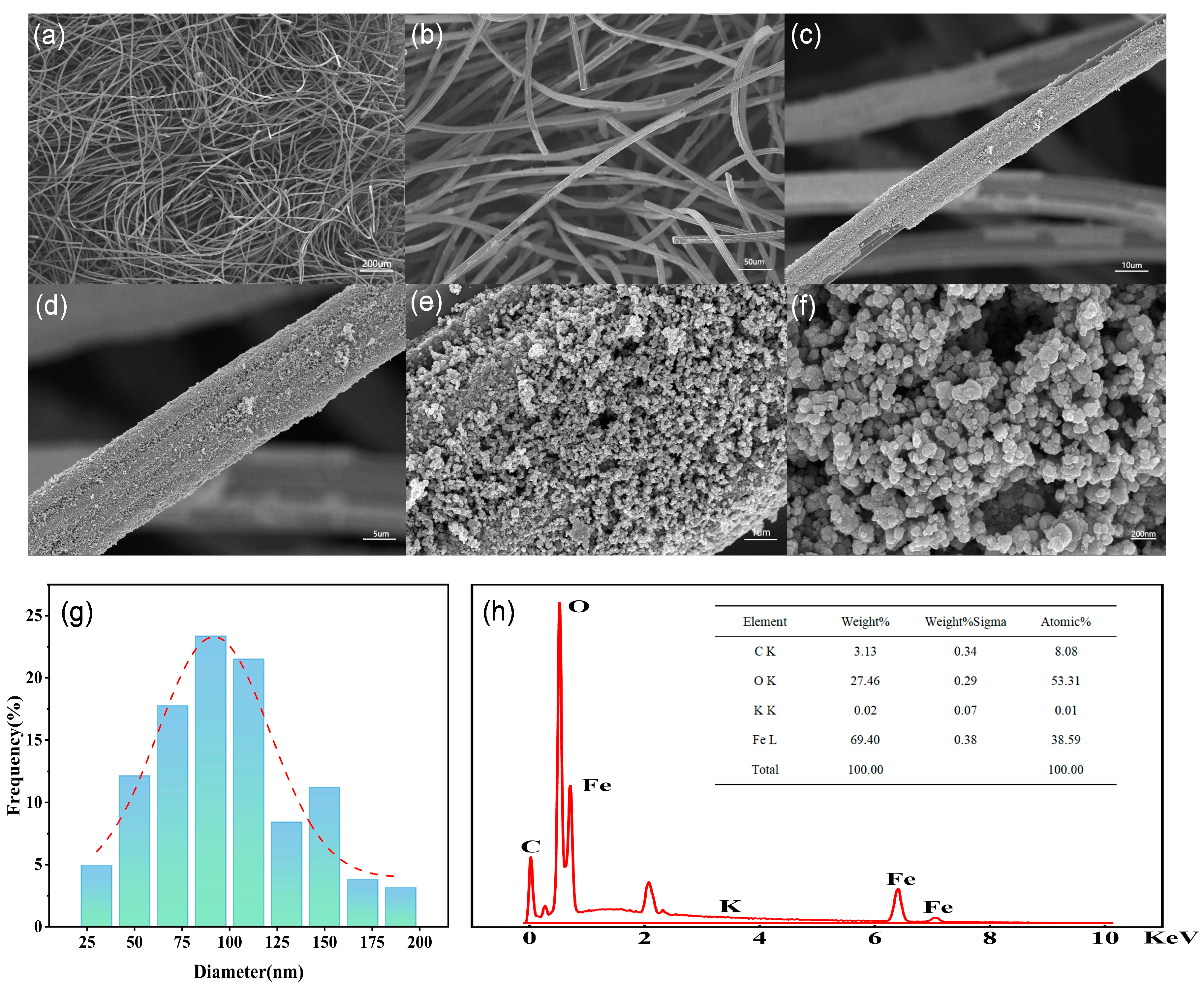
Figure 1 shows SEM images and EDS energy spectra of the prepared Fe3O4@ACF, as well as quantitative data on the distribution of each element. In Figure 1a–c, the samples show a large number of dense ACF filaments with a diameter of 11 μm. The ACF exhibits a unique, interlaced rod-like fibrous structure with many grooves on the surface. This unique morphology contributes to the large specific surface area and abundant active sites of the material. Figure 1d–f shows increased surface roughness after Fe3O4 loading. In addition, the aggregation of smaller Fe3O4@ACF particles to form larger-sized clusters of particles stacked in a disordered manner, as well as a layer of Fe3O4 flocs loading, resulted in the roughness and inhomogeneity of the microstructure of the sample surface. The EDS spectrum (Figure 1h) shows uniform distribution of Fe, O, C, and K elements in the composite, with weight percentages of 69.40% (C), 27.46% (O), 3.13% (Fe), and 0.02% (K). From the above results, it is shown that Fe3O4 particles have been successfully loaded onto the ACF surface.
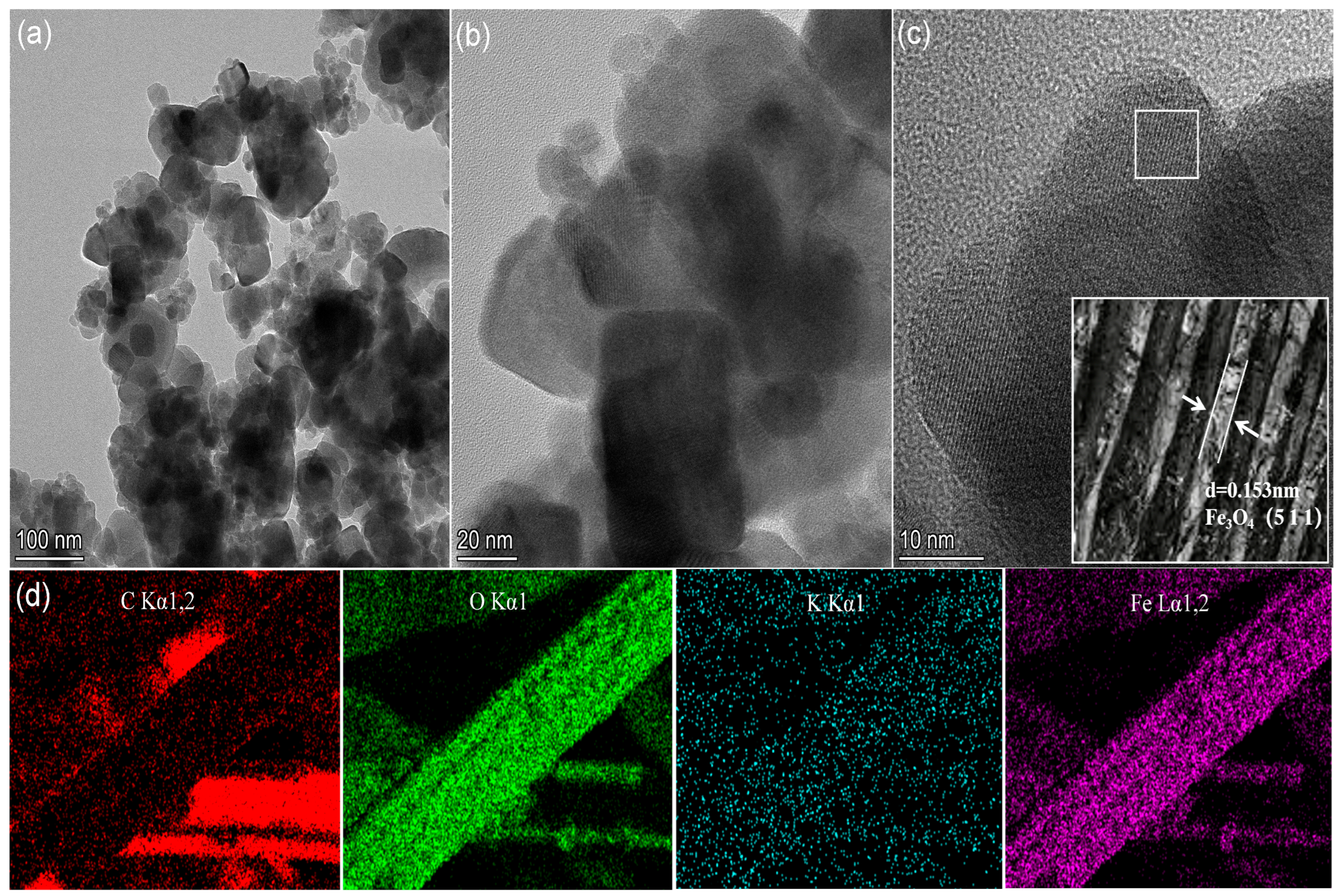
The microscopic morphology of Fe3O4@ACF was observed by transmission electron microscopy, as shown in Figure 2a,b. The composite particles are close to spherical and loaded on the ACF in a cluster shape, and it can be observed that a clear boundary appears between the Fe3O4 crystals and the ACF material, indicating that Fe3O4 is tightly adhered to the ACF surface. The high-resolution transmission electron microscopy (HRTEM) image (Figure 2c) shows that the lattice spacing of the as-prepared Fe3O4 lattice is 0.153 nm and corresponds to the iron tetraoxide (511) crystal plane. In addition, the EDS elemental mapping in Figure 2d confirms the presence of C, O, Fe and K elements in Fe3O4@ACF, where C, O and Fe are very uniformly distributed and K is sporadically dispersed. It further indicates that the Fe3O4@ACF non-homogeneous phase-like Fenton catalyst has been successfully constructed.
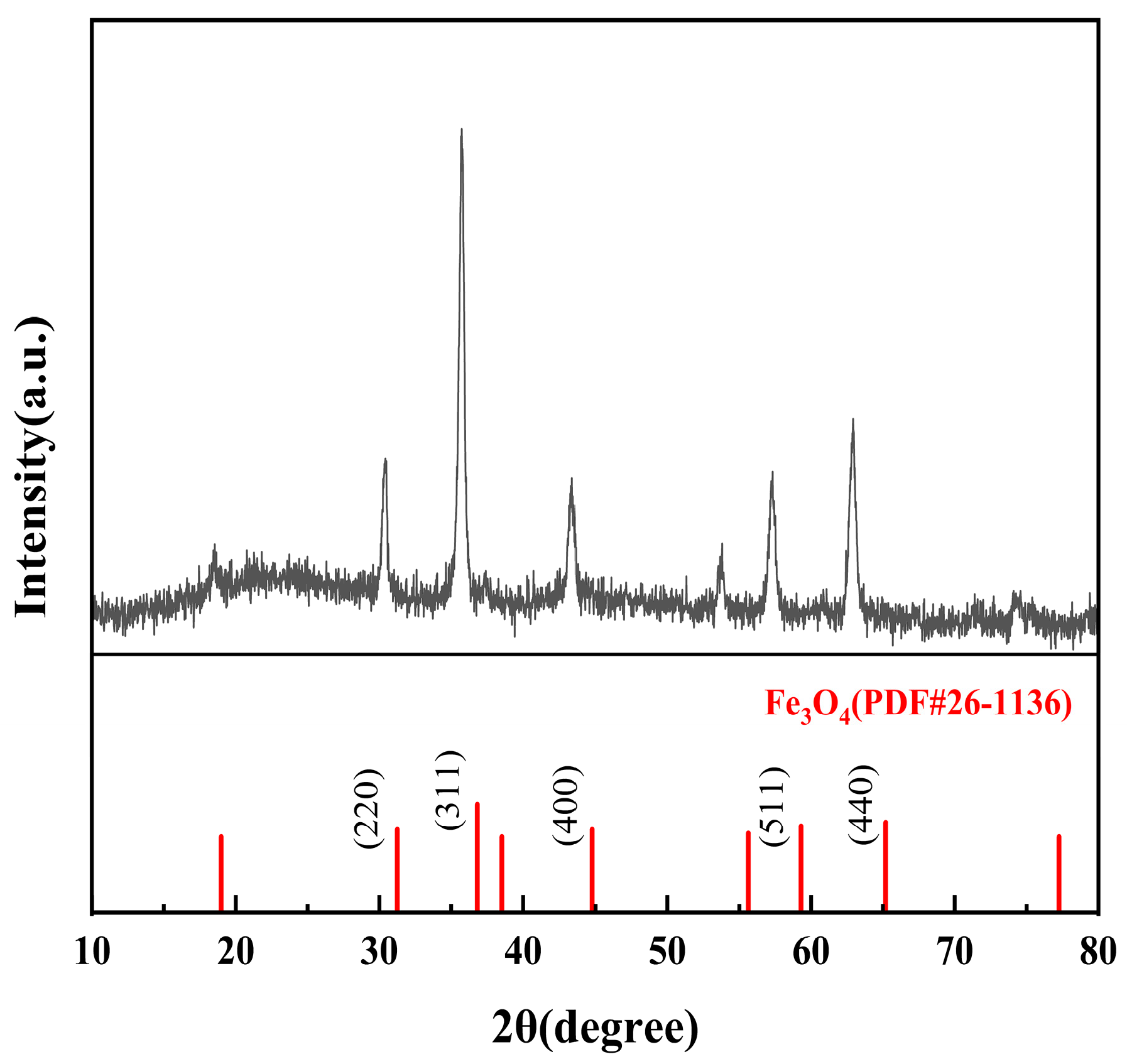
The XRD pattern of the Fe3O4@ACF composite (Figure 3) exhibits diffraction peaks that can be indexed to the spinel structure of magnetite (Fe3O4, JCPDS No. 26-1136). Slight shifts to lower 2θ values are attributed to nanoscale particle size (~100 nm) and partial surface oxidation to maghemite (γ-Fe2O3), as confirmed by XPS (Figure 4d). No detectable impurity phases such as α-Fe2O3 or FeO are observed. The coexistence of Fe3O4 and surface γ-Fe2O3 is consistent with the literature on air-exposed magnetite nanoparticles and does not compromise the catalytic activity, as both phases are active in Fenton-like reactions. This result provides direct evidence for the successful crystallization of Fe3O4 on the ACF substrate. Concurrently, the absence of any sharp diffraction features attributable to activated carbon indicates that the ACF matrix retains its amorphous structure within the composite. The HRTEM image in Figure 2c reveals clear lattice fringes with an interplanar spacing of 0.153 nm, which corresponds to the (511) plane of Fe3O4. This assignment is consistent with the distinct XRD peak observed at 59.303° (2θ) indexed to the (511) reflection (JCPDS No. 26-1136). Furthermore, the XRD pattern in Figure 3 exhibits additional peaks corresponding to the (220), (311), (400), and (440) planes, confirming the phase purity of the Fe3O4 nanoparticles.
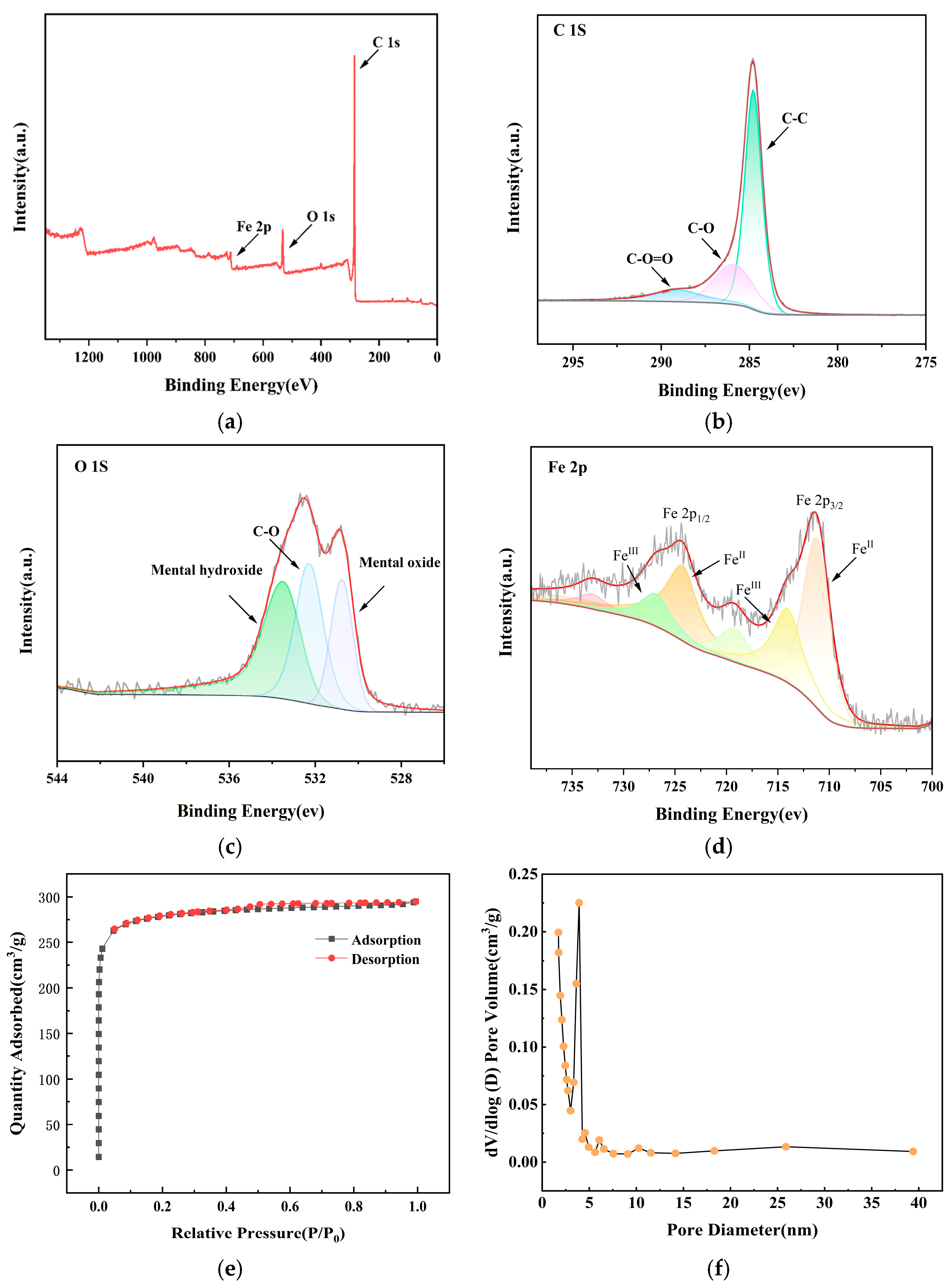
The chemical states and surface composition of the Fe3O4@ACF composite were further elucidated by XPS. As presented in Figure 4a,d, the high-resolution C 1s spectrum (Figure 4b) was deconvoluted into three peaks at 284.1 eV (C=C/C–C), 285.0 eV (C–O), and 290.9 eV (O=C–O). The presence of C–O species is corroborated by the O 1s spectrum (Figure 4c), which exhibits three components at 531.61 eV (C–O), 529.70 eV (metal oxides), and 532.83 eV (metal hydroxides). The metal hydroxide is Fe(OH)3 and it is possible that some Fe(OH)3 did not undergo dehydration to form Fe3O4 due to incomplete drying at the sampling location. The metal oxides signal originates from a mixed phase of Fe3O4 and γ-Fe2O3. This is confirmed by the Fe 2p spectrum (Figure 4d), where the Fe 2p3/2 and Fe 2p1/2 core-level peaks are centered at 711.2 eV and 724.9 eV, respectively, matching the standard values for Fe3O4 [45]. The detailed fitting reveals contributions from both Fe2+ (peaks at ~710.8 eV and ~724.3 eV) and Fe3+ (peaks at ~712.9 eV and ~726.27 eV) oxidation states. Moreover, the distinct satellite peak near 718.7 eV is characteristic of Fe3+ in γ-Fe2O3 [46], indicating partial surface oxidation of the Fe3O4 nanoparticles. Collectively, the XRD and XPS analyses provide consistent and conclusive evidence for the successful loading of Fe3O4 onto the ACF surface.
The specific surface area and pore architecture of the samples were characterized through N2 adsorption–desorption measurements, with the corresponding isotherms and pore size distribution profiles presented in Figure 4e–f [47]. The obtained isotherms exhibit a pronounced hysteresis loop within the relative pressure (P/P0) range of 0.4 to 1.0. This feature is diagnostic of mesoporous materials, arising from the capillary condensation and evaporation of nitrogen within pores of specific geometry. According to the IUPAC classification, the observed pattern aligns with a Type II isotherm displaying an H3-type hysteresis loop. This classification is characteristic of aggregated plate-like particles, which generate slit-shaped or wedge-shaped pores. The complexity of the pore network, particularly the presence of such non-uniform slit pores, accounts for the noted divergence between the adsorption and desorption branches and the hysteresis loop morphology. Quantitative analysis of the desorption branch via the BJH method revealed a bimodal pore size distribution, confirming the coexistence of micropores (centered around 1.7–2.0 nm) and mesopores (in the range of 2.0–5.0 nm), indicative of a hierarchical pore structure within the Fe3O4@ACF composite. The morphological characteristics of the Fe3O4@ACF composite are intrinsically linked to its electrochemical degradation performance. The interlaced fibrous ACF network provides a high surface area that enables uniform dispersion of Fe3O4 nanoparticles (~100 nm), preventing aggregation and maximizing exposure of active Fe sites. The tight adhesion between Fe3O4 and the conductive ACF substrate facilitates efficient electron transfer, as evidenced by the reduced charge transfer resistance (7.18 Ω) and enhanced ORR activity. Furthermore, the hierarchical pore structure (micropores of 1.7–2.0 nm and mesopores of 2.0–5.0 nm) synergistically promotes pollutant adsorption and rapid mass transport of reactants, ensuring efficient utilization of electrogenerated reactive oxygen species.

3.2. Electrochemical Performance Analysis

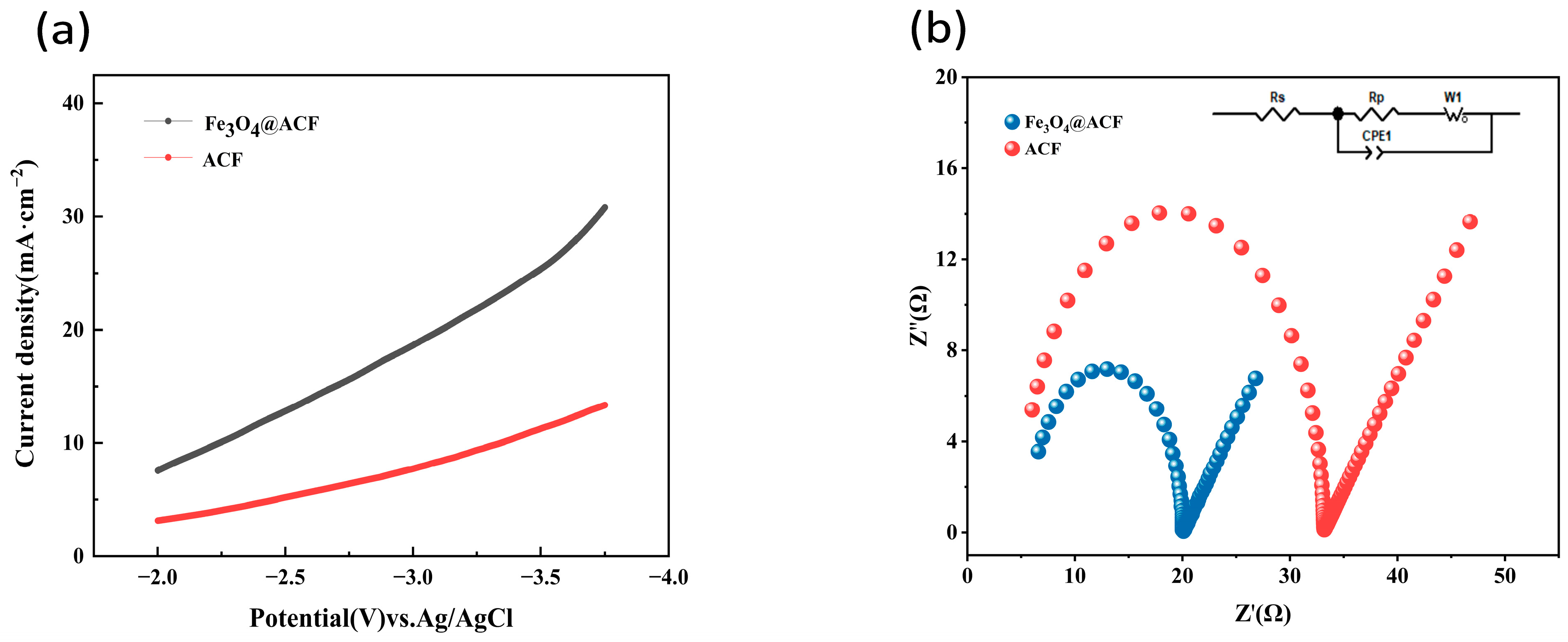
The electrocatalytic performance of the materials was first assessed through linear sweep voltammetry (LSV). As depicted in Figure 5a, the Fe3O4@ACF composite exhibits significantly enhanced oxygen reduction reaction (ORR) activity compared to pristine ACF. At −3.25 V vs. Ag/AgCl, the current density reaches 21.8 mA·cm−2 for Fe3O4@ACF, which is 2.3 times higher than that of pure ACF (9.4 mA·cm−2). This improvement indicates that Fe3O4 nanoparticles effectively promote the electrocatalytic process.
To elucidate the origin of this enhanced activity, electrochemical impedance spectroscopy (EIS) was employed to probe the charge transfer kinetics [48] at the electrode-electrolyte interface (Figure 5b). Nyquist plots show distinct semicircles in the high-frequency region, corresponding to charge transfer resistance (Rct). Quantitative fitting shows that Fe3O4@ACF possesses a substantially lower Rct value (7.18 Ω) compared to pure ACF, indicating significantly facilitated electron transfer. In the low-frequency region, the linear Warburg component reflects mass transport limitations, with Fe3O4@ACF exhibiting a shallower slope, suggesting improved diffusion kinetics. The EIS fitting results demonstrate that the charge transfer resistance (Rct = 13.02 Ω) of Fe3O4@ACF is significantly lower than that of pure ACF (Rct = 27.35 Ω), indicating a marked reduction in electronic transfer impedance (Table S1). This facilitates electron transfer during reactions and lowers electrochemical resistance, thereby enhancing power density and electron flux between acceptors and donors. These findings confirm that Fe3O4 loading effectively improves the material’s electron transport efficiency. The similarity in CPE1 parameters suggests negligible differences in interfacial capacitance characteristics, indicating that the loading process did not compromise the material’s interfacial structural stability.
The synergistic combination of LSV and EIS analyses provides compelling evidence for the superior electrocatalytic performance of Fe3O4@ACF. The substantially increased ORR current density directly demonstrates enhanced catalytic activity, while the reduced charge transfer resistance reveals more efficient interfacial electron transfer processes. These complementary findings collectively confirm that Fe3O4 modification effectively optimizes both the catalytic sites and charge transport pathways in the ACF-based electrode.

3.3. Catalytic Degradation Properties of Tetracycline by Fe3O4@ACF

To evaluate the versatility of the composite electrode, degradation experiments were conducted on tetracycline (TC) solutions. The effects of several parameters on degradation efficiency were systematically investigated, including the degradation method, electrode material, current density, pH value, electrode spacing, solution temperature, TC concentration, and electrode area.
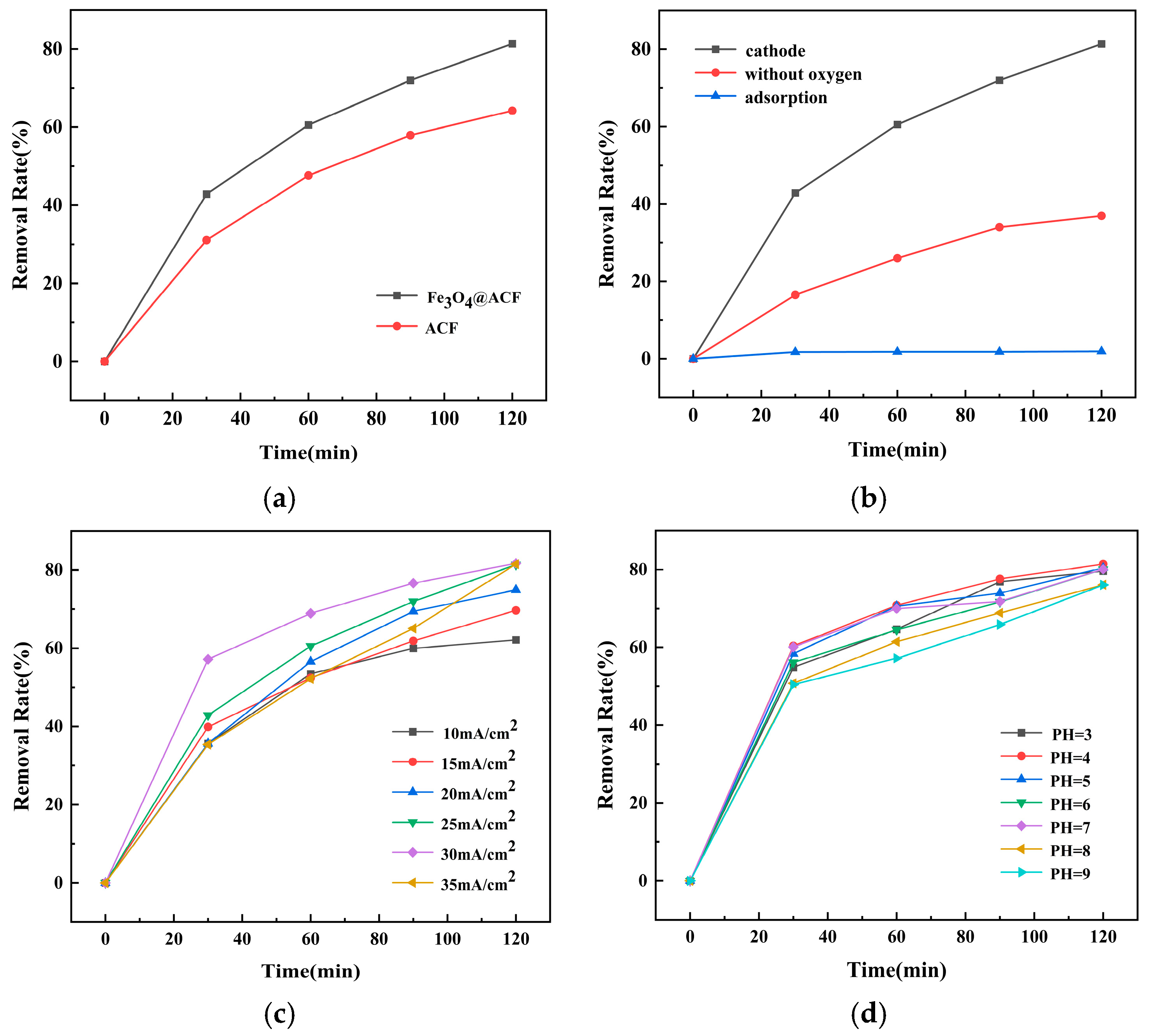
To elucidate the mechanism by which the Fe3O4@ACF composite electrode degrades tetracycline via the electro-Fenton process, a series of control experiments were performed (Figure 6b). The results demonstrate that the degradation efficiency was substantially suppressed under both adsorption-only and anaerobic conditions. In the adsorption-only test, the adsorption of tetracycline on ACF was below 2%, indicating a negligible contribution of physical adsorption to the overall removal. This minimal adsorption is likely attributable to the near-saturation of the ACF support during the material-preparation stage. Under oxygen-deficient operation, the interruption of continuous oxygen supply to the cathode severely hindered the oxygen-reduction reaction and the consequent electrogeneration of H2O2, leading to a pronounced decline in degradation. Nevertheless, a measurable residual degradation activity persisted, which can be explained by two concurrent pathways: oxygen produced at the anode via the oxygen-evolution reaction may diffuse to the cathode and be reduced to H2O2, while a small fraction of water molecules at the anode may be directly oxidized to yield ·OH radicals, both contributing to limited pollutant degradation in the absence of external aeration. Taken together, these findings confirm that the efficient degradation of tetracycline by Fe3O4@ACF is predominantly governed by the electro-Fenton catalytic oxidation when the composite acts as the cathode, rather than by physical adsorption or direct anodic oxidation pathways.
The comparison of Electro-Fenton oxidation performance of ACF and Fe3O4@ACF under the same conditions is shown in Figure 6a. The removal rate of ACF at 120 min was only 64.21%, while Fe3O4@ACF exhibited a removal rate of 82% at 120 min. This phenomenon may be attributed to the fact that the iron particles in Fe3O4@ACF act as a bridge for electron transfer, which polarizes the cathode and improves electron transfer efficiency [49]. This observation is consistent with the electrochemical properties of the material. Therefore, in the Electro-Fenton reaction, the Fe3O4@ACF composite electrode, exhibiting superior oxygen reduction reaction (ORR) electrocatalytic activity, was able to produce more H2O2. This, in turn, reacted with the iron active sites on the catalyst surface to generate more reactive species, ultimately enhancing the TC removal rate.
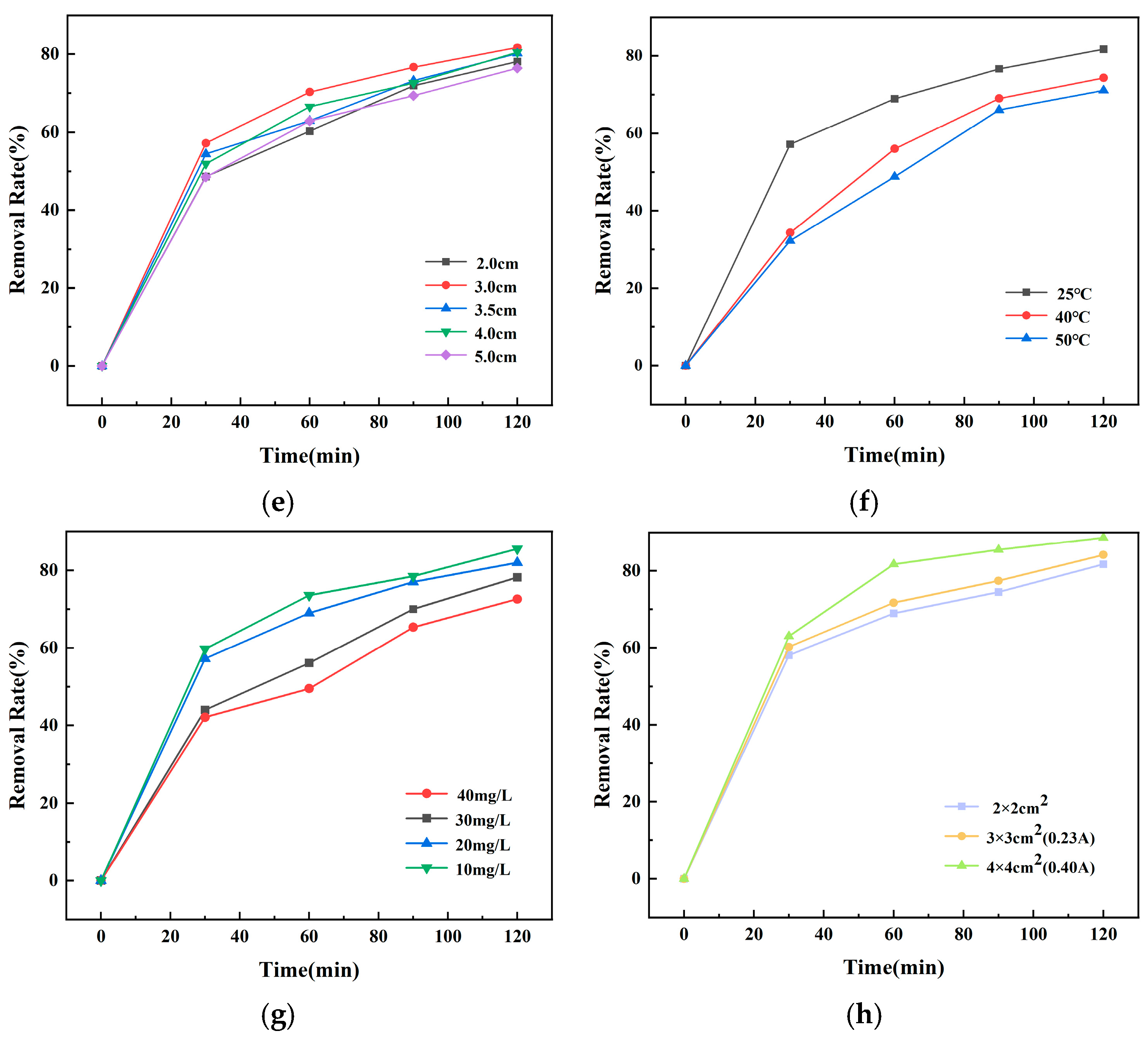
Figure 6c shows the effect of different current densities (10, 15, 20, 25, 30, and 35 mA·cm−2) on TC degradation. It can be seen that the highest removal rate (82%) was achieved at a current density of 30 mA·cm−2. This enhancement is attributed to iron particles acting as electron transfer bridges, polarizing the cathode and improving electron transfer efficiency, consistent with electrochemical properties. However, excessive current densities can promote side reactions [24], such as water electrolysis, which reduces the removal efficiency.
The effect of the initial solution pH on TC removal was investigated. Initial pH values in the range of 3–7 resulted in over 80% removal at 120 min. TC removal slightly decreased with increasing initial pH, consistent with the optimal pH for ·OH generation in the Fenton system of approximately 4.0 [50]. At low pH, the scavenging effect of H+ is enhanced, leading to a decrease in the oxidizing capacity of the Fenton process [51]. The formation of HO2 at higher pH may lead to a decrease in H2O2 yield [52]. In fact, the removal of TC by Fe3O4@ACF at pH 9 still reached more than 75% at 120 min. Therefore, Fe3O4@ACF shows superior activity in Electro-Fenton systems under acidic, neutral, and even weakly alkaline conditions, expanding the pH applicability in practical applications.
Figure 6e shows the effect of electrode spacing on the oxidation performance of the Electro-Fenton process [53]. It can be seen that when the electrode spacing is 3 cm, the removal rate reaches 81.72% at 120 min. Deviations above or below this value result in a decrease in removal efficiency. Excessive spacing reduces the rates of electromigration and diffusive mass transfer during electrochemical reactions [54]. When the spacing is too small, concentration polarization occurs, resulting in fewer organic molecules being free to migrate, which decreases mass transfer efficiency and thus affects the treatment efficiency of the Electro-Fenton system [26].
Figure 6f shows the effect of temperature on the performance of the Electro-Fenton process. It can be seen that the degradation efficiency decreases with increasing temperature, but the final degradation rate remains above 70%. At higher temperatures, the solubility of oxygen in water decreases, leading to reduced H2O2 production via electrocatalysis. In addition, at elevated temperatures, some H2O2 may decompose directly into H2O, significantly reducing the amount of ·OH available to degrade the contaminant and thus lowering the removal rate. Therefore, the Electro-Fenton system is not suitable for the direct treatment of high-temperature wastewater, and cooling the wastewater prior to the Electro-Fenton reaction is necessary to achieve better removal efficiency.
To investigate the effect of initial TC concentration on the catalytic performance of Fe3O4@ACF, TC concentrations of 10, 20, 30, and 40 mg/L were tested, as shown in Figure 6g. The catalytic degradation efficiency of the Fe3O4@ACF Electro-Fenton system decreased with increasing TC concentration. This inhibition can be attributed to the heterogeneous catalytic process at the interface of the liquid phase (TC solution) and solid phase (Fe3O4@ACF) [55]. The presence of a high TC concentration leads to competitive adsorption of TC and H2O2 on the Fe3O4@ACF catalyst surface. As a result, it becomes difficult for H2O2 to compete with TC molecules because the higher TC concentration limits the adsorption and subsequent degradation of H2O2. In addition, the decomposed TC intermediates occupy the active sites of the catalyst, which further inhibits the adsorption of H2O2 and leads to a decrease in degradation efficiency.
Figure 6h shows the effect of different electrode areas on the electrocatalytic performance. It can be seen that the degradation efficiency gradually increases with increasing electrode area, providing preliminary evidence of the potential of the composite electrodes for future industrial-scale applications.

3.4. Reusability and Practicality of Fe3O4@ACF

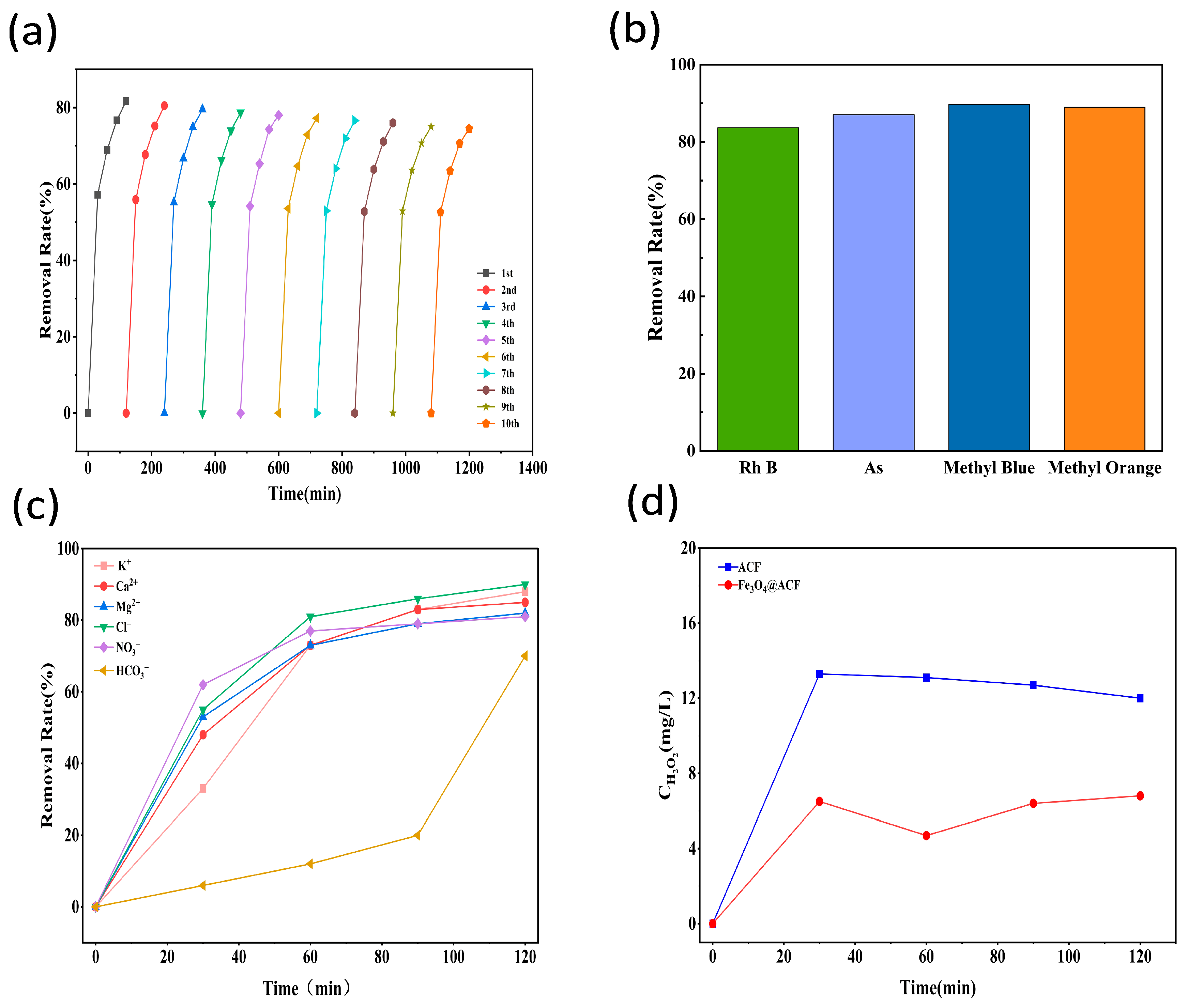
In addition to degradation efficiency, electrode stability is also important from a practical application perspective. Therefore, five consecutive degradation cycles were performed to evaluate the reusability of the Fe3O4@ACF electrode. As shown in Figure 7a, the TC degradation rate was maintained at around 75% and did not decrease significantly over ten cycles. This indicates that the Fe3O4@ACF electrode is stable and reusable, and this nanomaterial shows great promise for sustainable use and recycling in Electro-Fenton systems.
In addition, the performance of the Fe3O4@ACF composite electrode was evaluated by degrading other difficult-to-degrade pollutants, including Rhodamine B (RhB), arsenic-containing solutions (As), Methyl Blue, and Methyl Orange. As shown in Figure 7b, the removal efficiencies of these pollutants reached 83.64%, 87.06%, 89.72%, and 88.95%, respectively, within 120 min. The results indicate that the Fe3O4@ACF composite electrode has broad applicability for the degradation of various pollutants, highlighting its potential for treating a wide range of organic contaminants. we have further supplemented the anti-interference experiments against common coexisting ions in actual industrial wastewater, and the results show that our system maintains stable degradation performance in the presence of 100 mg/L of common cations (K+, Ca2+, Mg2+) and anions (Cl, NO3, HCO3), with only the bicarbonate ion showing a significant inhibitory effect, which provides solid data support for the practical application potential of the system in complex water matrices. The results of Figure 7d reveal that the pristine ACF electrode achieves a peak H2O2 concentration of 13.3 mg/L at 30 min, which gradually decreases to 12.0 mg/L by 120 min. In contrast, the Fe3O4@ACF electrode exhibits a lower peak H2O2 concentration (6.5 mg/L at 30 min), followed by a slight recovery to 6.8 mg/L at 120 min. This observation aligns with the enhanced electro-Fenton catalytic activity of Fe3O4@ACF: the Fe3O4 nanoparticles act as efficient Fenton catalysts, promoting the rapid decomposition of generated H2O2 into highly reactive ·OH radicals, which accelerates pollutant degradation and results in a lower steady-state H2O2 concentration compared to ACF. This provides direct experimental evidence linking Fe3O4 modification to improved utilization of H2O2 for pollutant mineralization, supporting our mechanistic hypothesis of enhanced ORR-derived electro-Fenton activity.

3.5. Analysis of the Main Controlling Factors of the Fenton Reaction

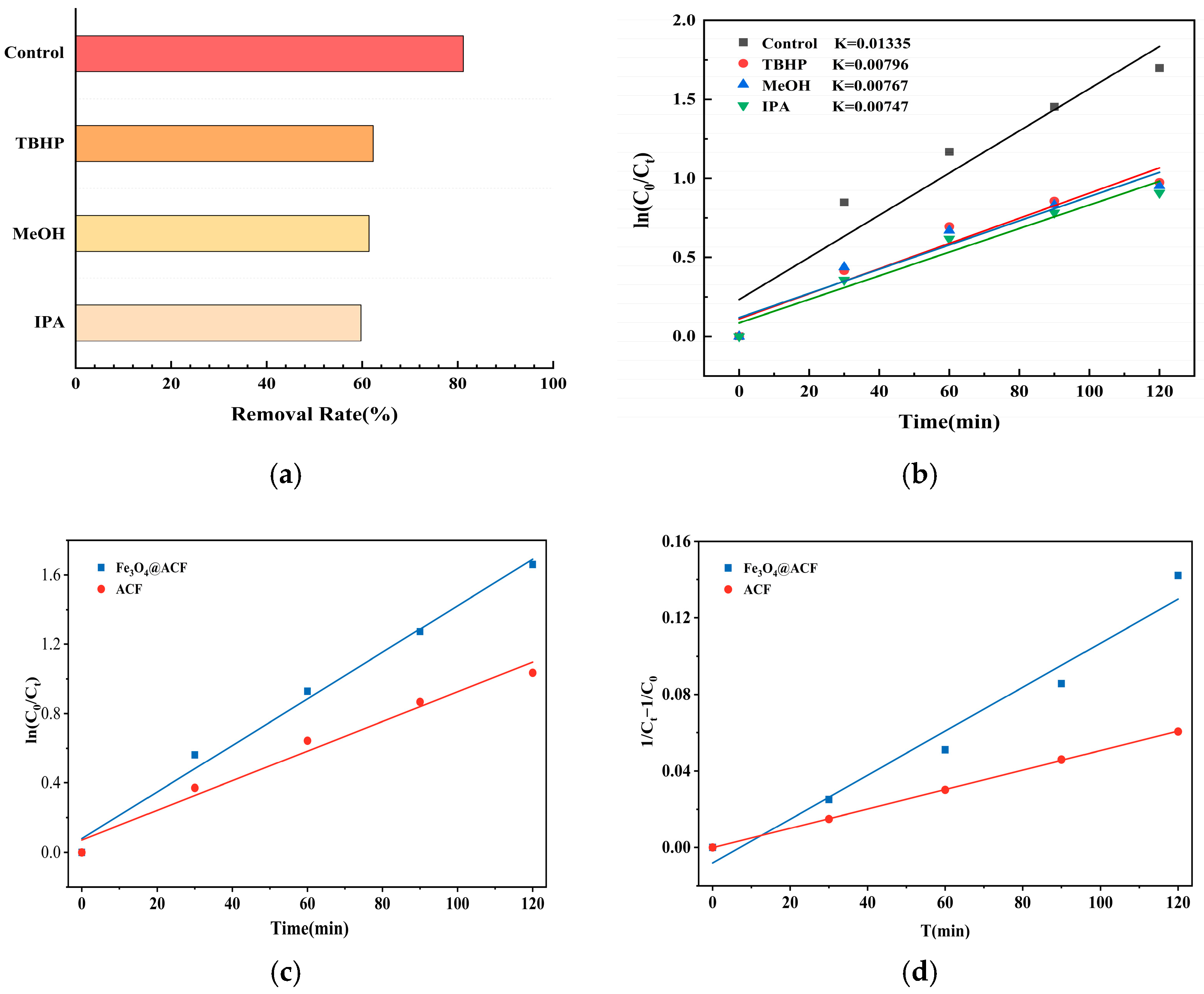
The mechanism of TC degradation was investigated by quencher and EPR experiments. The reactive species ∙OH and ∙O2 produced during degradation were quenched by 3 mM MeOH (or TBHP) and IPA. In Figure 8a, the removal efficiency of TC decreased from 82% to 61.44% and 62.3% when MeOH and TBHP were added, respectively. When IPA was added, the removal efficiency was 59.75% after 120 min. The contributions of ·OH and ·O2 to the removal process were calculated as 20.56% (or 19.7%) and 22.25%, respectively. To better study the kinetics of the TC degradation process, a first-order kinetic model was proposed as follows:
ln(C0/Ct) = kt
where C0 is the initial concentration of tetracycline (mg/L); Ct is the concentration of tetracycline at t min (mg/L); k is the quasi-primary rate constant for tetracycline degradation; and t is the reaction time (min).
As shown in Figure 8b, the first-order pseudo-kinetic constants k for each reaction after addition of quencher were calculated kinetically as 0.01335 (min−1), 0.00796 (min−1), 0.00767 (min−1), and 0.00747 (min−1), respectively. In summary, the addition of MeOH, TBHP and IPA significantly reduced the reaction rate, which corresponded to the decrease in the removal efficiency. This confirms that ∙OH and ∙O2 play a major role in the degradation of TC.
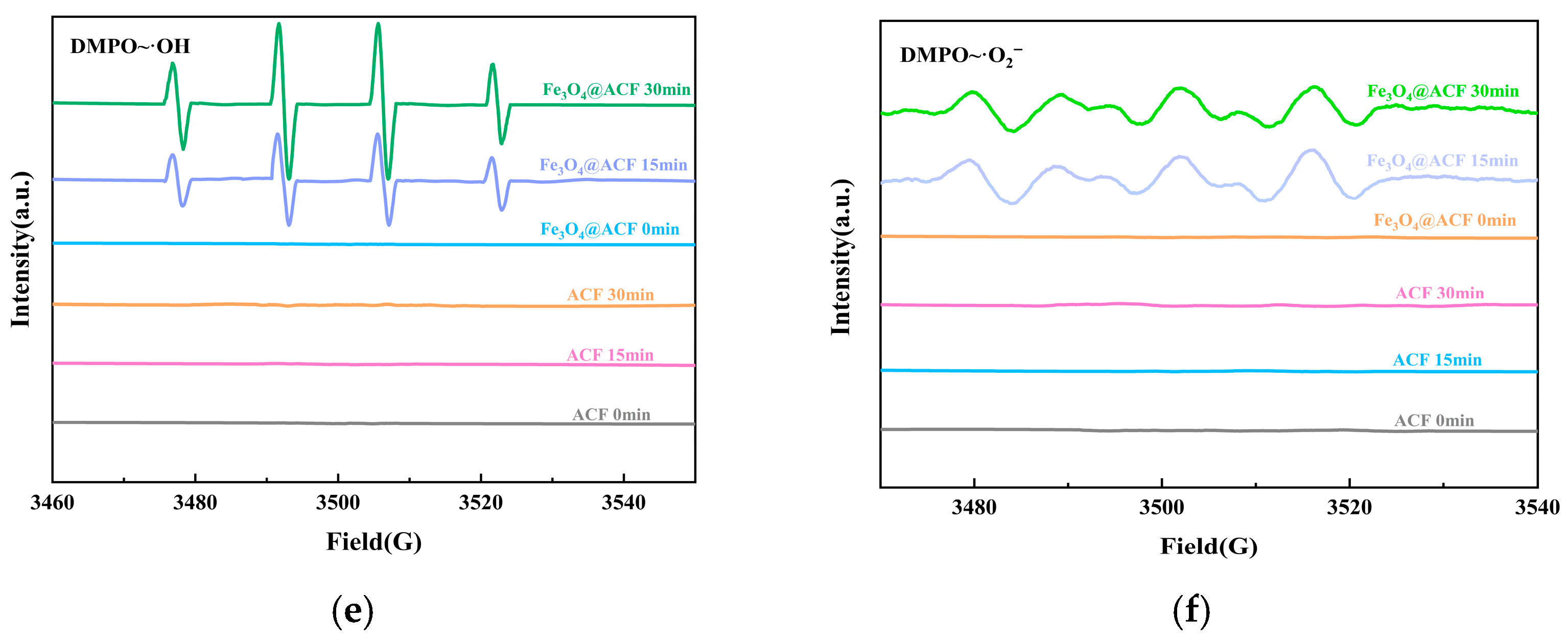
This conclusion was further verified by EPR experiments. Samples were taken at 0 min, 15 min and 30 min of the energization reaction using pure-ACF and Fe3O4@ACF electrodes to detect the signal intensity of DMPO~∙OH and DMPO~∙O2. As shown in Figure 8c,d, at 0 min, no ∙OH and ∙O2 were produced by the catalytic reaction of both electrodes, and the quantitatively determined concentrations of ∙OH and ∙O2 signals were 0. After 15 min of the reaction, DMPO~∙OH and DMPO~∙O2 signals were detected for the Fe3O4@ACF electrode. Figure 8c shows the characteristic peaks of DMPO~∙OH with intensity ratio of 1:2:2:1. Figure 8d shows the signals with intensity ratio of 1:1:1:1, which is in agreement with the peaks of DMPO~∙O2. This finding suggests that the presence of Fe3O4 significantly enhances the catalytic ability of pure ACF in the Fenton reaction. Thus, the Fe3O4@ACF composite electrode produced ∙OH and ∙O2 in the catalytic reaction, confirming that the loading of Fe3O4 promoted the production of ∙OH and ∙O2. The results showed that the doping of Fe3O4 effectively improved the efficiency of the Electro-Fenton reaction. The quenching and EPR experiments fully demonstrated that ∙OH and ∙O2 are the main radicals in the reaction process.
Cathode:
O2 +2H+ + 2e → H2O2
Fe2+ + H2O2 → Fe3+ + ·OH + OH
Fe3+ + H2O2 → Fe2+ + ·O2 + 2H+
·OH/·O2 + organic pollutants → intermediate → CO2 + H2O
In the Electro-Fenton reaction, the supplied oxygen is converted into H2O2, (Equation (3)) following the classical two-electron oxygen reduction reaction (ORR) pathway [56]. This process involves the redox cycling between Fe2+ and Fe3+, which leads to the generation of ∙OH and ∙O2 (Equations (4) and (5)). Subsequently, the generated ∙OH or ∙O2 attack the organic pollutants, producing intermediates that are eventually mineralized into CO2 and H2O (Equation (6)). Loaded Fe3O4 particles act as electron transfer bridges, enhancing electron transport, reactive oxygen species generation, and degradation efficiency.

4. Conclusions

In this study, a Fe3O4@ACF composite cathode was successfully fabricated via an optimized co-precipitation method. The Fe3O4 nanoparticles (~100 nm) were uniformly loaded onto the ACF support, as confirmed by SEM, TEM, XRD, and XPS analyses. The Fe3O4@ACF electrode exhibited superior electrochemical performance, achieving a 2.3-fold higher ORR current density than pristine ACF and a low charge transfer resistance of 7.18 Ω. When employed as a cathode in an electro-Fenton system, it achieved 82% tetracycline degradation within 120 min under optimal conditions (30 mA·cm−2, 3 cm electrode spacing, room temperature), following first-order kinetics with a rate constant of 0.01335 min−1. The electrode demonstrated excellent stability, with less than 3% performance decay over five cycles, and broad applicability, achieving >80% removal for various organic pollutants. Mechanistic studies confirmed that ·OH and ·O2 are the dominant reactive species, with Fe3O4 nanoparticles serving as electron-transfer mediators to enhance ROS generation. Overall, the Fe3O4@ACF composite offers a facile, stable, and efficient cathode material with broad pH applicability, presenting a promising solution for the treatment of antibiotic-contaminated wastewater.

Supplementary Materials

The following supporting information can be downloaded at: https://www.mdpi.com/article/10.3390/nano16070431/s1, Figure S1: Schematic diagram of electrode preparation; Figure S2: Pseudo-first-order (a) and pseudo-second-order (b) kinetic fitting plots for tetracycline hydrochloride degradation over Fe3O4@ACF and pristine ACF electrodes; Figure S3: TOC removal rates of tetracycline hydrochloride over pristine ACF and Fe3O4@ACF electrodes as a function of reaction time; Figure S4: Catalytic tetracycline degradation mechanism diagram using ACF-loaded Fe3O4; Figure S5: Current-time curve of Fe3O4@ACF at 8 V constant voltage; Table S1: Parameters fitted to the EIS test; Table S2: Previously reported materials for Electro-Fenton degradation of TC [57,58,59,60,61]; Table S3: Specific surface area, pore volume and average pore diameter parameters of pristine ACF and Fe3O4@ACF samples.

Author Contributions

Conceptualization, X.L.; formal analysis, resources, Y.P.; Data curation, investigation, and methodology, X.L.; writing—original draft preparation, X.L. and Y.P.; Writing—review and editing, H.Z. and Y.L.; Visualization, H.Z. and H.Y.; project administration, funding acquisition, J.H. All authors have read and agreed to the published version of the manuscript.

Funding

This work was financially supported by the National Natural Science Foundation of China (No. 52360003), and the Tianshan Talent Fund of Xinjiang Province (No. 2023TSYCJC0065).

Data Availability Statement

The original contributions presented in the study are included in the article, further inquiries can be directed to the corresponding authors.

Acknowledgments

The authors gratefully acknowledge the support of experimental facilities provided by China University of Petroleum (Beijing) at Karamay. Furthermore, we extend our thanks to the AI tools employed for language polishing and optimization throughout the manuscript preparation process.

Conflicts of Interest

The authors declare that they have no known competing financial interests or personal relationships that could have appeared to influence the work reported in this paper.

References

  1. Demain, A.L.; Sanchez, S. Microbial drug discovery: 80 years of progress. J. Antibiot. 2009, 62, 5–16. [Google Scholar] [CrossRef] [PubMed]
  2. Nisha, A.R. Antibiotic residues—A global health hazard. Vet. World 2008, 1, 375. [Google Scholar] [CrossRef]
  3. Mangla, D.; Sharma, A.; Ikram, S. Critical review on adsorptive removal of antibiotics: Present situation, challenges and future perspective. J. Hazard. Mater. 2022, 425, 127946. [Google Scholar] [CrossRef]
  4. Xie, Y.; Zhang, S.; Liang, W.; Long, J.; Cui, L. Synthesis of La2(WO4)3/g-C3N4 and Photocatalytic Degradation of Tetracycline. J. Phys. Conf. Ser. 2025, 2941, 012071. [Google Scholar] [CrossRef]
  5. Jung, K.W.; Kim, J.H.; Choi, J.W. Synthesis of magnetic porous carbon composite derived from metal-organic framework using recovered terephthalic acid from polyethylene terephthalate (PET) waste bottles as organic ligand and its potential as adsorbent for antibiotic tetracycline hydrochloride. Compos. Part B Eng. 2020, 187, 107867. [Google Scholar]
  6. Chen, Z.; Zhang, W.; Wang, G.; Zhang, Y.; Gao, Y.; Boyd, S.A.; Teppen, B.J.; Tiedje, J.M.; Zhu, D.; Li, H. Bioavailability of soil-sorbed tetracycline to Escherichia coli under unsaturated conditions. Environ. Sci. Technol. 2017, 51, 6165–6173. [Google Scholar] [CrossRef]
  7. Zhu, C.; Yao, Y.; Fang, Q.; Song, S.; Chen, B.; Shen, Y. Unveiling the Dynamic Evolution of Single-Atom Co Sites in Covalent Triazine Frameworks for Enhanced H2O2 Photosynthesis. ACS Catal. 2024, 14, 12. [Google Scholar] [CrossRef]
  8. Priac, A.; Morin-Crini, N.; Druart, C.; Gavoille, S.; Bradu, C.; Lagarrigue, C.; Torri, G.; Winterton, P.; Grégorio, C. Alkylphenol and alkylphenol polyethoxylates in water and wastewater: A review of options for their elimination. Arab. J. Chem. 2017, 10, 4511–4523. [Google Scholar] [CrossRef]
  9. Ghazal, H.; Koumaki, E.; Hoslett, D.J.H. Insights into current physical, chemical and hybrid technologies used for the treatment of wastewater contaminated with pharmaceuticals. J. Clean. Prod. 2022, 361, 132079.1–132079.22. [Google Scholar] [CrossRef]
  10. Li, X.; Liu, F.; Xi, S.; Xie, H.; Li, J.; Liu, G. Removal of antibiotics and antibiotic resistance genes in the synthetic oxytetracycline wastewater by UASB-A/O(MBR) process. J. Environ. Chem. Eng. 2023, 11, 109699. [Google Scholar] [CrossRef]
  11. Verma, M.; Borah, R.; Kumar, A.; Chae, S.-H.; Pan, S.-Y.; Kumar, V.; Vlaskin, M.S.; Kim, H. Capturing of inorganic and organic pollutants simultaneously from complex wastewater using recyclable magnetically chitosan functionalized with EDTA adsorbent. Process Saf. Environ. Prot. 2022, 167, 56–66. [Google Scholar] [CrossRef]
  12. Verma, M.; Lee, I.; Hong, Y.; Kumar, V.; Kim, H. Multifunctional β-Cyclodextrin-EDTA-Chitosan polymer adsorbent synthesis for simultaneous removal of heavy metals and organic dyes from wastewater. Environ. Pollut. 2022, 292, 118447. [Google Scholar] [CrossRef]
  13. Verma, M.; Kumar, A.; Lee, I.; Kumar, V.; Park, J.; Kim, H. Simultaneous capturing of mixed contaminants from wastewater using novel one-pot chitosan functionalized with EDTA and graphene oxide adsorbent. Environ. Pollut. 2022, 304, 119130. [Google Scholar] [CrossRef] [PubMed]
  14. Verma, M.; Borah, R.; Kumar, A.; Chae, S.-H.; Pan, S.-Y.; Kumar, V.; Vlaskin, M.S.; Kim, H. One-step functionalization of chitosan using EDTA: Kinetics and isotherms modeling for multiple heavy metals adsorption and their mechanism. J. Water Process Eng. 2022, 49, 102989. [Google Scholar] [CrossRef]
  15. Verma, M.; Lee, I.; Oh, J.; Kumar, V.; Kim, H. Synthesis of EDTA-functionalized graphene oxide-chitosan nanocomposite for simultaneous removal of inorganic and organic pollutants from complex wastewater. Chemosphere 2022, 287, 132385. [Google Scholar] [CrossRef]
  16. Ganiyu, S.O.; Martínez-Huitle, C.A.; Oturan, M.A. Electrochemical advanced oxidation processes for wastewater treatment: Advances in formation and detection of reactive species and mechanisms. Curr. Opin. Electrochem. 2021, 27, 100678. [Google Scholar] [CrossRef]
  17. Paździor, K.; Bilińska, L.; Ledakowicz, S. A review of the existing and emerging technologies in the combination of AOPs and biological processes in industrial textile wastewater treatment. Chem. Eng. J. 2019, 376, 120597. [Google Scholar] [CrossRef]
  18. Bashir, Y.; Raj, R.; Ghangrekar, M.M.; Nema, A.K.; Das, S. Critical assessment of advanced oxidation processes and bio-electrochemical integrated systems for removing emerging contaminants from wastewater. RSC Sustain. 2023, 1, 1912–1931. [Google Scholar] [CrossRef]
  19. Solano, A.M.S.; Garcia-Segura, S.; Martinez-Huitle, C.A.; Brillas, E. Degradation of acidic aqueous solutions of the diazo dye Congo Red by photo-assisted electrochemical processes based on Fenton’s reaction chemistry. Appl. Catal. B Environ. 2015, 168, 559–571. [Google Scholar] [CrossRef]
  20. Pan, Z.; Song, C.; Li, L.; Wang, H.; Pan, Y.; Wang, C.; Li, J.; Wang, T.; Feng, X. Membrane technology coupled with electrochemical advanced oxidation processes for organic wastewater treatment: Recent advances and future prospects. Chem. Eng. J. 2019, 376, 120909. [Google Scholar] [CrossRef]
  21. Dong, P.; Liu, W.; Wang, S.; Wang, H.; Wang, Y.; Zhao, C. In suit synthesis of Fe3O4 on carbon fiber paper@ polyaniline substrate as novel self-supported electrode for heterogeneous electro-Fenton oxidation. Electrochim. Acta 2019, 308, 54–63. [Google Scholar] [CrossRef]
  22. Sun, Z.; Xia, T.; Wang, H.; Yang, W.; Gao, S.; Li, Q. Direct-writing of three-dimensional porous Fe3N/FeS electrode for efficient degradation of organic pollutants in water through Electro-Fenton process. Ceram. Int. 2023, 49, 36405–36415. [Google Scholar] [CrossRef]
  23. Zhang, M.-H.; Dong, H.; Zhao, L.; Wang, D.-X.; Meng, D. A review on Fenton process for organic wastewater treatment based on optimization perspective. Sci. Total Environ. 2019, 670, 110–121. [Google Scholar]
  24. Tu, S.; Ning, Z.; Duan, X.; Zhao, X.; Chang, L. Efficient electrochemical hydrogen peroxide generation using TiO2/rGO catalyst and its application in electro-Fenton degradation of methyl orange. Colloids Surf. A Physicochem. Eng. 2022, 651, 129657. [Google Scholar] [CrossRef]
  25. Yang, X.; Zhao, H.Q.; Qu, Z.B.; He, M.Q.; Tang, Z.Y.; Lai, S.W.; Wang, Z.H. The effect of oxy gen-containing functional groups on formaldehyde adsorption in solution on carbon surface: A density functional the ory study. J. Environ. Chem. Eng. 2021, 9, 105987. [Google Scholar] [CrossRef]
  26. Sun, Y.; Tu, S.; Li, Y.; Sui, X.; Geng, S.; Wang, H.; Duan, X.; Chang, L. Degradation mechanism of methylene blue by heterogenous electro-Fenton with CeO2/rGO composite cathode. Colloids Surf. A Physicochem. Eng. 2024, 690, 133861. [Google Scholar] [CrossRef]
  27. Li, C.F.; Peng, S.Q.; Li, H.Q.; Zhang, M.Y.; Yang, P. Methylisothiazolinone (MIT) degradation performance of an air-lift moving bed electro-Fenton reactor: Homogeneous and heterogeneous phases. Sep. Purif. Technol. 2025, 378, 134768. [Google Scholar] [CrossRef]
  28. Lanzalaco, S.; Sirés, I.; Sabatino, M.A.; Dispenza, C.; Scialdone, O.; Galia, A. Synthesis of polymer nanogels by electro-Fenton process: Investigation of the effect of main operation parameters. Electrochim. Acta 2017, 246, 812–822. [Google Scholar] [CrossRef]
  29. Chen, C.; Zhu, Y.; Tian, M.; Chen, Y.; Yang, Y.; Jiang, K.; Gao, S. Sustainable self- powered electro-Fenton degradation using N, S co-doped porous carbon catalyst fabricated with adsorption-pyrolysis-doping strategy. Nano Energy 2021, 81, 105623. [Google Scholar] [CrossRef]
  30. Jia, J.; Yang, J.; Liao, J.; Wang, W.; Wang, Z. Treatment of dyeing wastewater with ACF electrodes. Financially supported by The State Key Laboratory of Environmental Aquatic Chemistry, Chinese Academic of Sciences. Water Res 1999, 33, 881–884. [Google Scholar] [CrossRef]
  31. Brillas, E.; Boye, B.; Sirés, I.; Garrido, J.A.; Marı, R.; Arias, C.; Cabot, P.-L.; Comninellis, C. Electrochemical destruction of chlorophenoxy herbicides by anodic oxidation and electro-Fenton using a boron-doped diamond electrode. Electrochim. Acta 2004, 49, 4487–4496. [Google Scholar] [CrossRef]
  32. Cheng, S.; Wu, B.; Pang, Y.; Shen, X. Highly efficient heterogeneous electro-Fenton reaction for tetracycline degradation by Fe–Ni LDH@ZIF-67 modified carbon cloth cathode: Mechanism and toxicity assessment. J. Environ. Manag. 2024, 354, 120336. [Google Scholar] [CrossRef]
  33. Cao, C.; Guo, Y.; Chen, D.; Cui, J.; Hu, X. A MOF-derived Fe3O4/FeO/Fe3C-2-600 dual-cathode electro-Fenton system construction: Revealing the mechanism for active centers linked by Fe0 as an electronic transfer station for enhancing Fenton reaction. Chem. Eng. J. 2025, 507, 160710. [Google Scholar] [CrossRef]
  34. Cui, L.; Li, Z.; Li, Q.; Chen, M.; Jing, W.; Gu, X. Cu/CuFe2O4 integrated graphite felt as a stable bifunctional cathode for high-performance heterogeneous electro-Fenton oxidation. Chem. Eng. J. 2021, 420, 127666. [Google Scholar] [CrossRef]
  35. Zhang, L.; Huang, J.; Yu, X.; Liu, G.; Liu, W.; Huang, C. Electro-Fenton oxidation of printing and dyeing wastewater with CO2 activated CuFeC and CuMnC aerogel cathode. J. Water Process Eng. 2023, 54, 104003. [Google Scholar] [CrossRef]
  36. Zhang, B.; Hou, Y.; Yu, Z.; Liu, Y.; Huang, J.; Qian, L.; Xiong, J. Three-dimensional electro-Fenton degradation of Rhodamine B with efficient Fe-Cu/kaolin particle electrodes: Electrodes optimization, kinetics, influencing factors and mechanism. Sep. Purif. Technol. 2019, 210, 60–68. [Google Scholar] [CrossRef]
  37. Luo, T.; Feng, H.; Tang, L.; Lu, Y.; Tang, W.; Chen, S.; Yu, J.; Xie, Q.; Ouyang, X.; Chen, Z. Efficient degradation of tetracycline by heterogeneous electro-Fenton process using Cu-doped Fe@Fe2O3: Mechanism and degradation pathway. Chem. Eng. J. 2020, 382, 122970. [Google Scholar] [CrossRef]
  38. Gao, W.-W.; Su, T.; Zhao, W.; Zhang, Z.-F.; Mu, M.; Song, Y.-H.; Zhang, X.-X.; Liu, X.-Y. Efficient degradation of semi-coking wastewater in three-dimensional electro-Fenton by CuFe2O4 heterocatalyst. Environ. Sci. Pollut. Res. 2022, 29, 74163–74172. [Google Scholar] [CrossRef]
  39. Zhao, H.; Qian, L.; Guan, X.; Wu, D.; Zhao, G. Continuous bulk FeCuC aerogel with ultradispersed metal nanoparticles: An efficient 3D heterogeneous electro-fenton cathode over a wide range of pH 3–9. Environ. Sci. Technol. 2016, 50, 5225–5233. [Google Scholar] [CrossRef] [PubMed]
  40. Zheng, Y.; Jiao, Y.; Zhu, Y.; Li, L.; Han, Y.; Chen, Y.; Du, A.; Jaroniec, M.; Qiao, S. Hydrogen evolution by a metal-free electrocatalyst. Nat. Commun. 2014, 5, 3783. [Google Scholar] [CrossRef]
  41. Zhao, Y.; Zhao, F.; Wang, X.; Xu, Z.; Zhang, Z.; Shi, G.; Qu, L. Graphitic Carbon Nitride Nanoribbons: Graphene-Assisted Formation and Synergic Function for Highly Efficient Hydrogen Evolution. Angew. Chem. Int. Ed. Engl. 2014, 53, 13934–13939. [Google Scholar] [CrossRef] [PubMed]
  42. Tian, J.; Ning, R.; Liu, Q.; Asiri, A.M.; Al-Youbi, A.O.; Sun, X. Three-dimensional porous supramolecular architecture from ultrathin g-C(3)N(4) nanosheets and reduced graphene oxide: Solution self-assembly construction and application as a highly efficient metal-free electrocatalyst for oxygen reduction reaction. Acs Appl. Mater. Interfaces 2014, 6, 1011–1017. [Google Scholar] [CrossRef]
  43. Chen, Y.; Zhang, B.; Liu, Y.; Chen, J.; Pan, H.; Sun, W. Graphitic carbon nitride-based electrocatalysts for energy applications. Mater. Today Catal. 2023, 1, 100003. [Google Scholar] [CrossRef]
  44. Marković, D.; Deeks, C.; Nunney, T.; Radovanović, Ž.; Radoičić, M.; Šaponjić, Z.; Radetić, M. Antibacterial activity of Cu-based nanoparticles synthesized on the cotton fabrics modified with polycarboxylic acids. Carbohydr. Polym. 2018, 200, 173–182. [Google Scholar] [CrossRef]
  45. Yamashita, T.; Hayes, P. Analysis of XPS spectra of Fe2+ and Fe3+ ions in oxide materials. Appl. Surf. Sci. 2008, 254, 2441–2449. [Google Scholar] [CrossRef]
  46. Shan, Y.; Yang, Y.; Cao, Y.; Huang, Z. Facile solvothermal synthesis of Ag/Fe3O4 nanocomposites and their SERS applications in on-line monitoring of pesticide contaminated water. RSC Adv. 2015, 5, 102610–102618. [Google Scholar] [CrossRef]
  47. Le, T.T.N.; Truong, H.B.; Hoa, L.T.; Le, H.S.; Tran, T.T.T.; Manh, T.D.; Le, V.T.; Dinh, Q.K.; Nguyen, X.C. Cu2O/Fe3O4/UiO-66 nanocomposite as an efficient fenton-like catalyst: Performance in organic pollutant degradation and influencing factors based machine learning. Heliyon 2023, 9, e20466. [Google Scholar] [CrossRef] [PubMed]
  48. Lin, L.; Zhang, F.; Hou, X.; Wang, L.; Wu, W.; Wang, L.; Li, Y.; Xie, H. Fe@Fe2O3/etched carbon felt as a cathode for efficient bisphenol a removal in a flow-through electro-Fenton system: Electron transfer pathway and underlying mechanism. Sep. Purif. Technol. 2024, 334, 125982. [Google Scholar] [CrossRef]
  49. Berhe, R.N.; Kassahun, S.K.; Kang, J.W.; Lee, Z.; Verma, M.; Kim, H. Performance evaluation of Fe3O4@ACF-supported bio-electro Fenton system for simultaneous sewage treatment and methyl orange degradation. Mater. Today Commun. 2023, 35, 106331. [Google Scholar] [CrossRef]
  50. Zhang, G.; Wang, S.; Zhao, S.; Fu, L.; Chen, G.; Yang, F. Oxidative degradation of azo dye by hydrogen peroxide electrogenerated in situ on anthraquinonemonosulphonate/polypyrrole composite cathode with heterogeneous CuO/γ-Al2O3 catalyst. Appl. Catal. B Environ. 2011, 106, 370–378. [Google Scholar] [CrossRef]
  51. Hodaifa, G.; Ochando-Pulido, J.M.; Rodriguez-Vives, S.; Martinez-Ferez, A. Optimization of continuous reactor at pilot scale for olive-oil mill wastewater treatment by Fenton-like process. Chem. Eng. J. 2013, 220, 117–124. [Google Scholar] [CrossRef]
  52. Park, J.-H.; Wang, J.J.; Park, K.H.; Seo, D.-C. Heterogeneous fenton oxidation of methylene blue with Fe-impregnated biochar catalyst. Biochar 2020, 2, 165–176. [Google Scholar] [CrossRef]
  53. Chai, Y.; Qin, P.; Zhang, J.; Li, T.; Dai, Z.; Wu, Z. Simultaneous removal of Fe(II) and Mn(II) from acid mine wastewater by electro-Fenton process. Process Saf. Environ. Prot. 2020, 143, 76–90. [Google Scholar] [CrossRef]
  54. Gao, X.; Zhang, C.; Wang, Y.; Zhang, H.; Zhao, M.; Wang, Y.; Guo, Y. Treatment of membrane concentrated landfill leachate by a heterogeneous electro-Fenton process with an iron-loaded needle coke cathode. J. Environ. Chem. Eng. 2022, 10, 108287. [Google Scholar] [CrossRef]
  55. Huang, S.; Zhang, Q.; Liu, P.; Ma, S.; Xie, B.; Yang, K.; Zhao, Y. Novel up-conversion carbon quantum dots/α-FeOOH nanohybrids eliminate tetracycline and its related drug resistance in visible-light responsive Fenton system. Appl. Catal. B: Environ. 2020, 263, 118336. [Google Scholar] [CrossRef]
  56. Nørskov, J.K.; Rossmeisl, J.; Logadottir, A.; Lindqvist, L.; Kitchin, J.R.; Bligaard, T.; J’onsson, H. Origin of the overpotential for oxygen reduction at a fuel-cell cathode. J. Phys. Chem. B 2004, 108, 17886–17892. [Google Scholar] [CrossRef]
  57. Chen, T.S.; Tsai, R.W.; Chen, Y.S.; Huang, K.L. Electrochemical Degradation of Tetracycline on BDD in Aqueous Solutions. Int. J. Electrochem. Sci. 2014, 9, 8422–8434. [Google Scholar] [CrossRef]
  58. Qi, J.; Li, M.; Yin, E.; Zhang, H.; Wang, H.; Li, X. Degradation of tetracycline under a wide pH range in a heterogeneous photo bio-electro-fenton system using FeMn-LDH/g-C3N4 cathode: Performance and mechanism. J. Environ. Manag. 2024, 360, 121111. [Google Scholar] [CrossRef]
  59. Zhi, D.; Qin, J.; Zhou, H.; Wang, J.; Yang, S. Removal of tetracycline by electrochemical oxidation using a Ti/SnO2–Sb anode: Characterization, kinetics, and degradation pathway. J. Appl. Electrochem. 2017, 47, 1313–1322. [Google Scholar] [CrossRef]
  60. Li, H.; Zhang, J.; Du, Y.; Shi, M.; Kuang, X.; Shen, X.; Si, W. Electrochemical activation of peroxydisulfate using an IrO2 electrode for the efficient degradation of acid orange 74: Mechanisms of different activation methods. J. Water Process Eng. 2023, 55, 104208. [Google Scholar] [CrossRef]
  61. Dong, H.; Chi, W.; Gao, A.; Xie, T.; Gao, B. Electrochemical Degradation of Tetracycline Using a Ti/Ta2O5-IrO2 Anode: Performance, Kinetics, and Degradation Mechanism. Materials 2021, 14, 4325. [Google Scholar] [PubMed]
Figure 1. SEM images of Fe3O4@ACF at different magnifications (af) and Particle size distribution histogram of Fe3O4@ACF (g); EDS of Fe3O4@ACF (h).
Nanomaterials 16 00431 g001
Figure 2. TEM (a,b) and HRTEM (c) images of Fe3O4@ACF, and elemental mapping image of Fe3O4@ACF (d).
Nanomaterials 16 00431 g002
Figure 3. X-ray powder diffraction pattern of Fe3O4@ACF.
Nanomaterials 16 00431 g003
Figure 4. Total XPS spectrum of Fe3O4@ACF (a); C 1s peak (b); O 1s peak (c); Fe 2p peak (d); Nitrogen adsorption–desorption isotherm of Fe3O4@ACF (e) and corresponding pore size distribution curve (f).
Nanomaterials 16 00431 g004
Figure 5. Linear sweep voltammetry curves (a) and electrochemical impedance spectra (b) of pure ACF and Fe3O4@ACF.
Nanomaterials 16 00431 g005
Figure 6. Comparison of Electro-Fenton oxidation on the degradation of pure ACF and Fe3O4@ACF (a); Comparison of different degradation methods (adsorption, anaerobic, cathodic) (b); Effect of current density on Electro-Fenton oxidation degradation (c); Effect of initial pH on Electro-Fenton oxidation degradation (d); Effect of electrode plate spacing on Electro-Fenton oxidation degradation (e); Effect of solution temperature on Electro-Fenton oxidation degradation (f);Effect of TC concentration on Electro-Fenton oxidation and degradation (g); Effect of electrode area on Electro-Fenton oxidation and degradation (h).
Nanomaterials 16 00431 g006aNanomaterials 16 00431 g006b
Figure 7. Stability of Fe3O4@ACF electrodes (a) and degradation experiments of different organic compounds (b); Degradation experiments for interfering ions (K+, Ca2+, Mg2+, Cl, NO3−, and HCO3−) experiments (c); Time-dependent H2O2 concentration curves generated by pristine ACF and Fe3O4@ACF electrodes in the electro-Fenton system (d).
Nanomaterials 16 00431 g007
Figure 8. Effect of quenching agent on TC removal rate at 120 min (a); Kinetic analysis of the quenching group (b); pseudo-first-order (c) and pseudo-second-order (d) kinetic fitting plots for tetracycline hydrochloride degradation over Fe3O4@ACF and pristine ACF electrodes; Spin-capture EPR spectra of DMPO~∙OH in a methanol dispersion system for Fe3O4@ACF and ACF (e); Spin-capture EPR spectra of DMPO~∙O2 in a methanol dispersion system for Fe3O4@ACF and ACF (f).
Nanomaterials 16 00431 g008aNanomaterials 16 00431 g008b
Table 1. Previously reported iron-based cathode materials for Electro-Fenton degradation of organic pollutants in wastewater.
Electrode MaterialOrganic DyeSynthesis MethodMorphologyConcentration (mg/L)Removal Efficiency
(Time)
Current
Density/
Voltage
Ref.
Fe-Ni LDH@ZIF-67Tetracycline (TC)In situ growthNanosheet array1095.6% (60 min)100 mA∙cm−2[32]
Fe3O4/Fe0/Fe3C-2-600Tetracycline (TC)MOF-derived calcinationNanoparticles1097.7% (12 min)3.5 mA∙cm−2[33]
3,6-Cu/CuFe2O4/CB@GFTetracycline (TC)SolvothermalNanoclusters5096.3 ± 1.8%
(3120 min)
30 mA∙cm−2[34]
CuFeC2,4,6-trichlorophenol (2,4,6-TCP)PyrolysisPorous4090.5% (60 min)7 mA∙cm−2[35]
Fe-Cu/kaolinRhodamineB (Rh B)Impregnation-calcinationParticle electrodes2097.2% (60 min)10 V[36]
Cu-doped Fe@Fe2O3
(CFF)
Tetracycline
(TC)
SolvothermalCore–shell nanoparticles2098.1% (3120 min)
90.0% (5120 min)
72.2% (7120 min)
40 mA∙cm−2[37]
CuFe2O4200 mL semi-coking waterSolvothermalNanoparticles\COD:80.9%, 120 min4 V[38]
FeCuCMethylene
(MB)
Sol–gelPorous5098% (30 min)
99% (60 min)
10 mA (4.1 V)[39]
FeCuCReal dyeing waste waterSol–gelPorous\TOC:64% (30 min)
83% (60 min)
10 mA (4.1 V)[39]
Disclaimer/Publisher’s Note: The statements, opinions and data contained in all publications are solely those of the individual author(s) and contributor(s) and not of MDPI and/or the editor(s). MDPI and/or the editor(s) disclaim responsibility for any injury to people or property resulting from any ideas, methods, instructions or products referred to in the content.