The Formation of Surface Nanoparticles Enhances the Vacuum Carburizing Efficiency of 20CrMnTi Steel

Abstract
1. Introduction
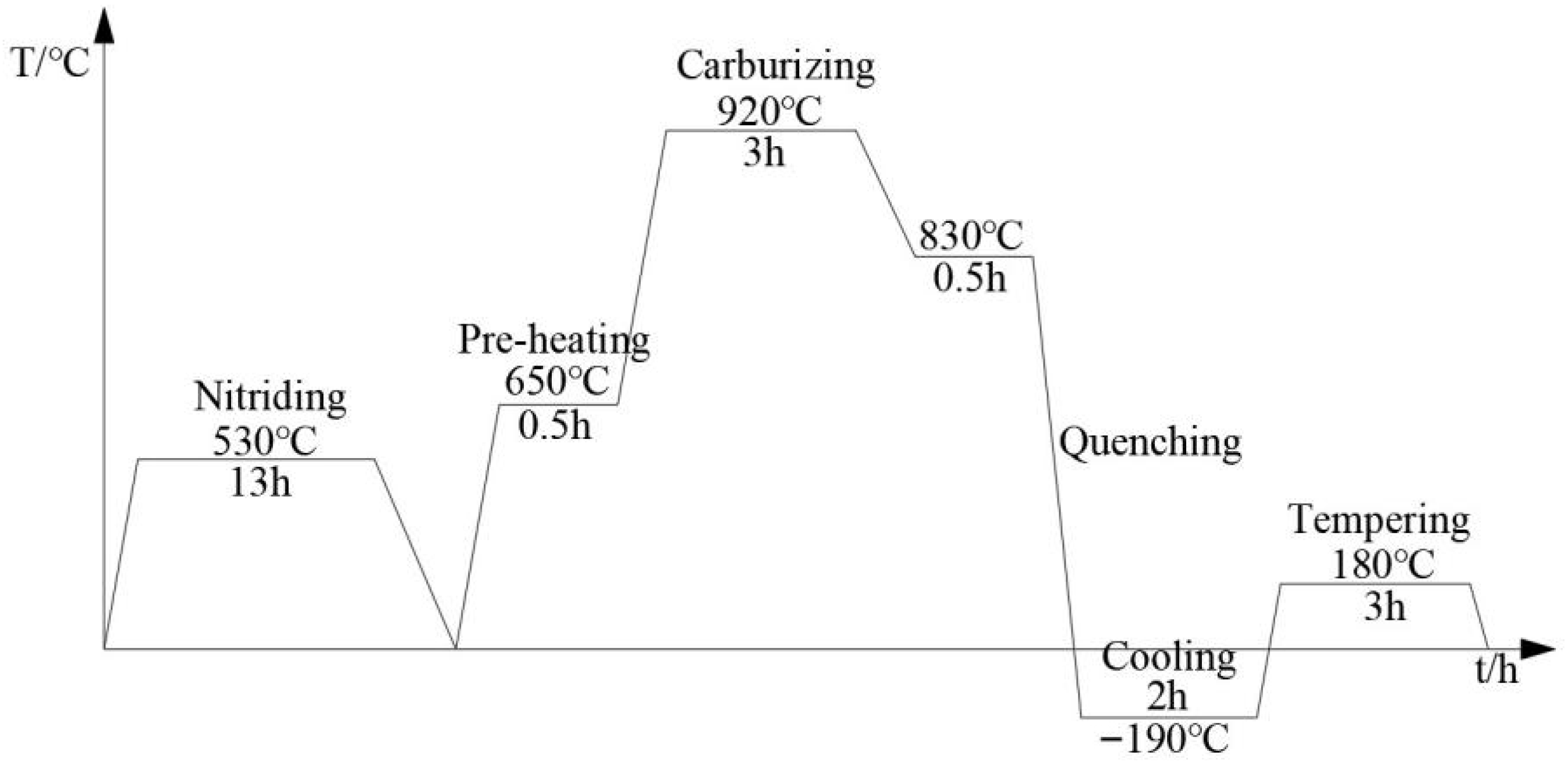
2. Experiment
3. Results and Discussion
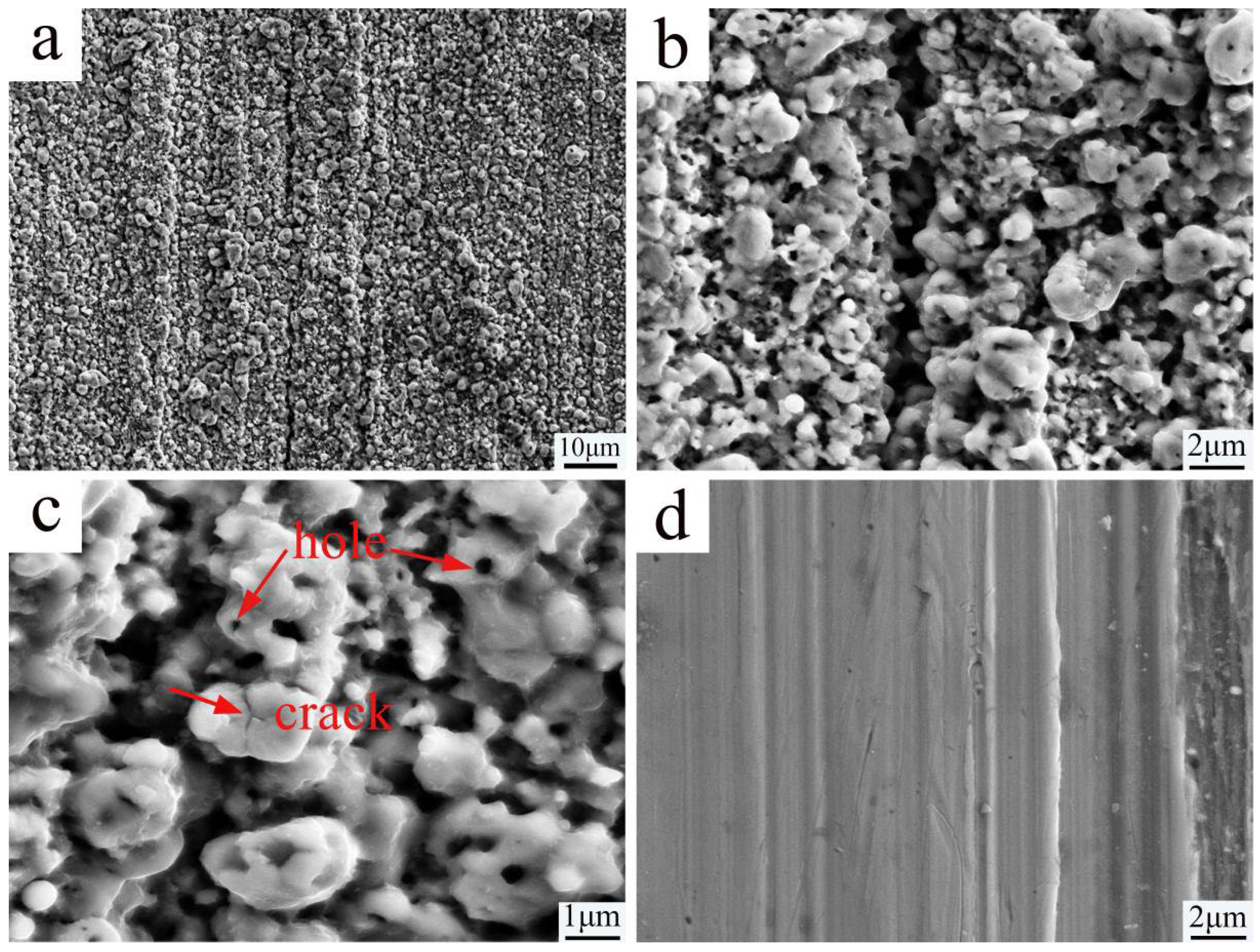
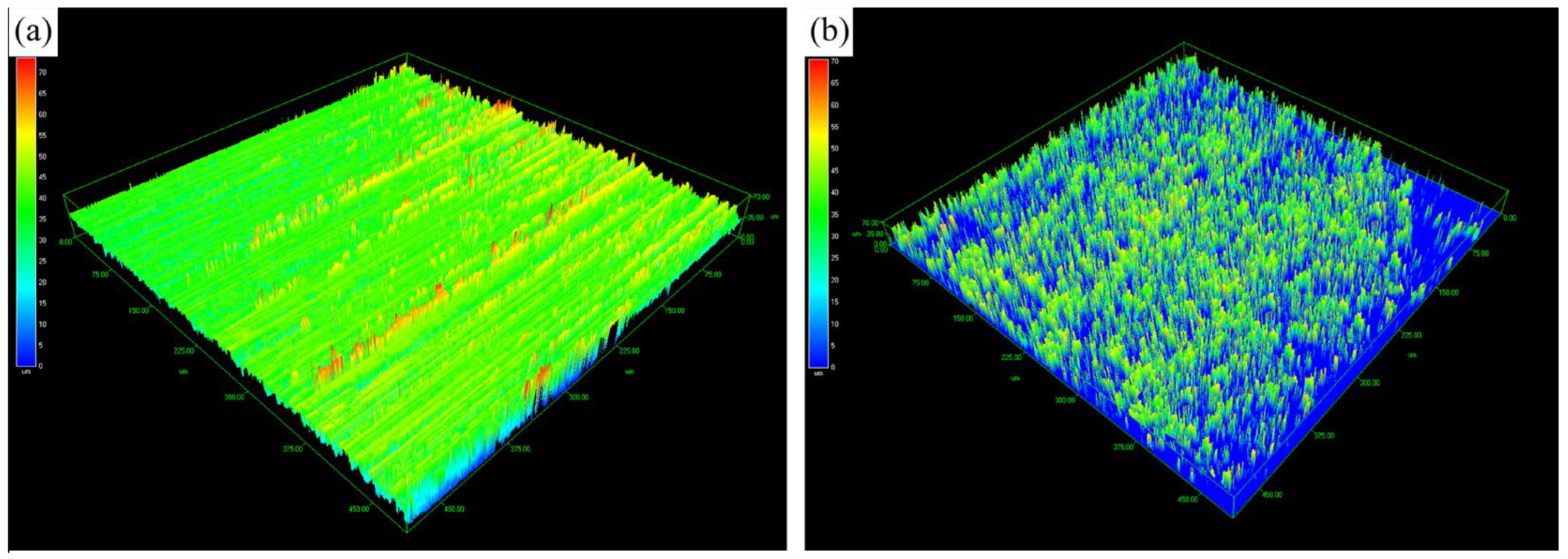
3.1. Microstructure of Nitriding Layer Analysis
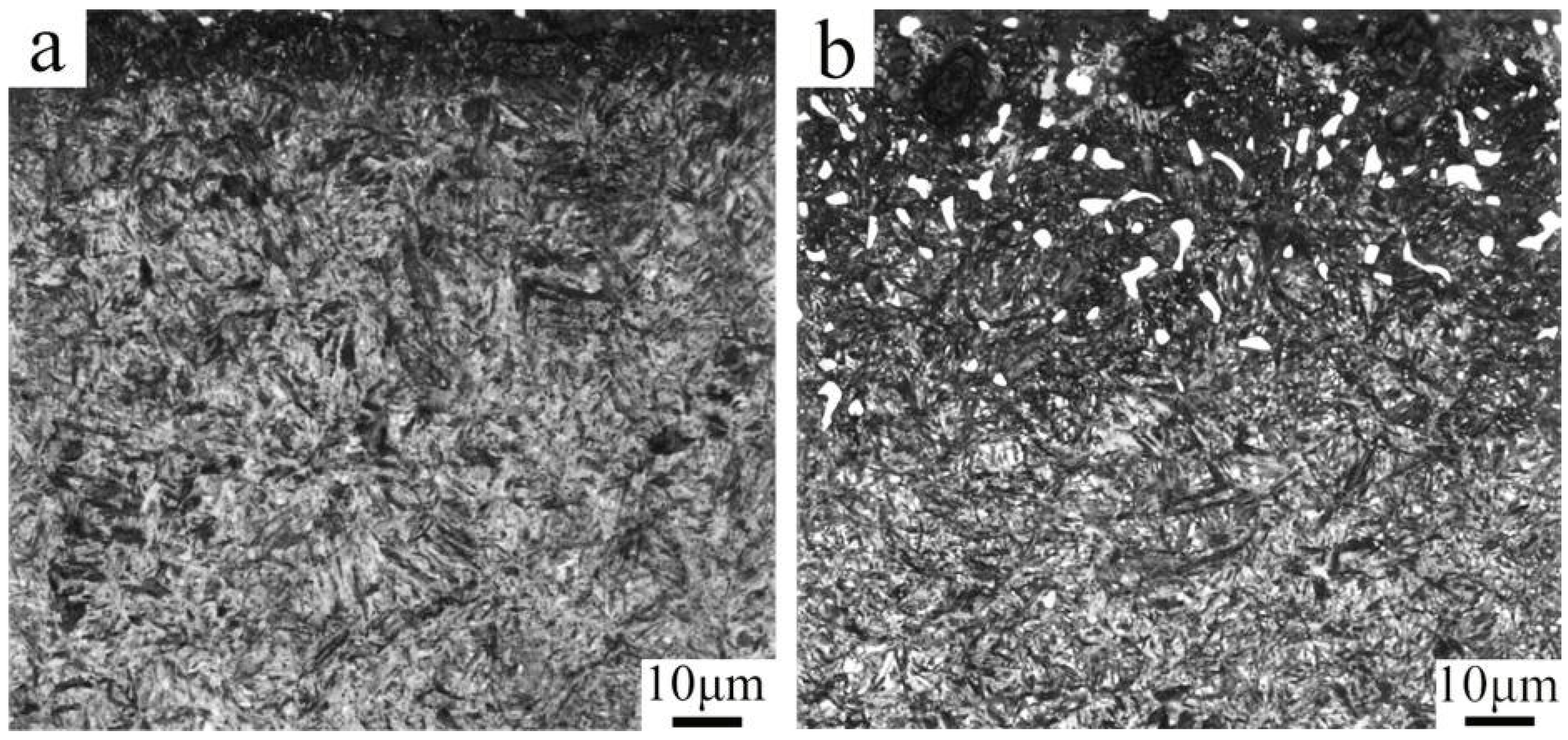
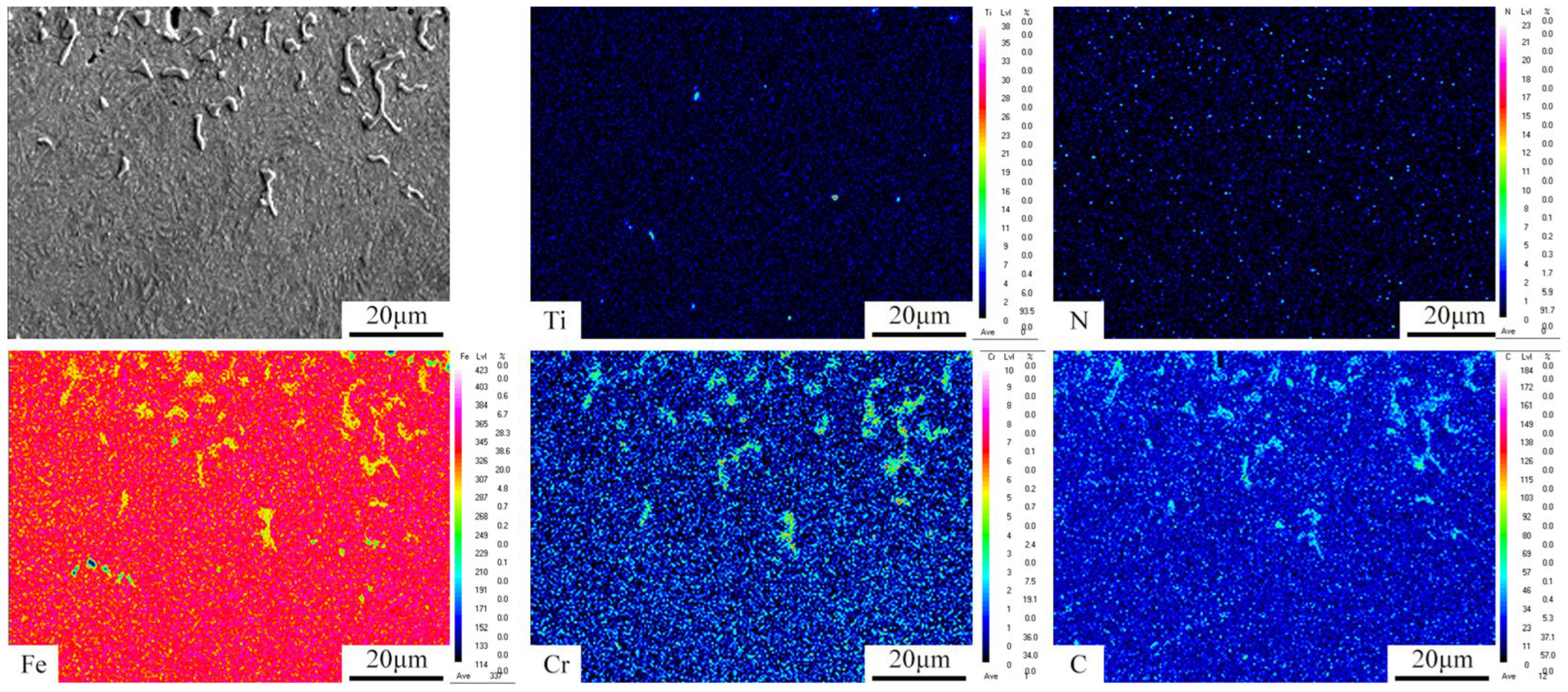
3.2. Microstructure of Carburized Layer Analysis
3.3. Hardness and Carbon Concentration Analysis
3.4. Diffusion of Nitrogen Atoms During Carburizing
4. Conclusions
- (1)
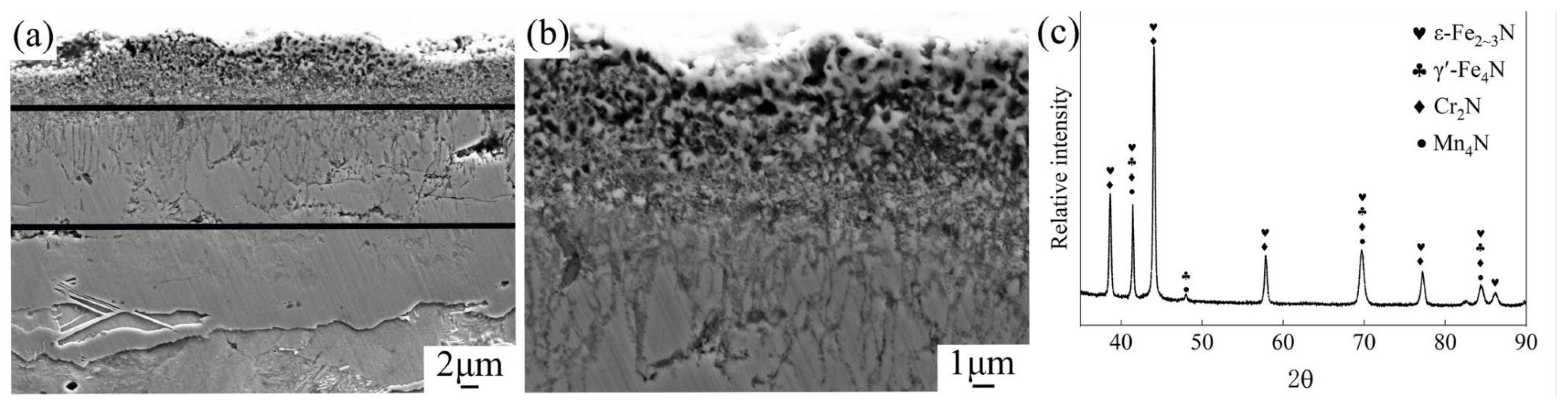
- Pre-nitriding treatment results in the formation of a nanoscale honeycomb-like nitride layer on the surface, significantly increasing both surface roughness and actual surface area.
- (2)
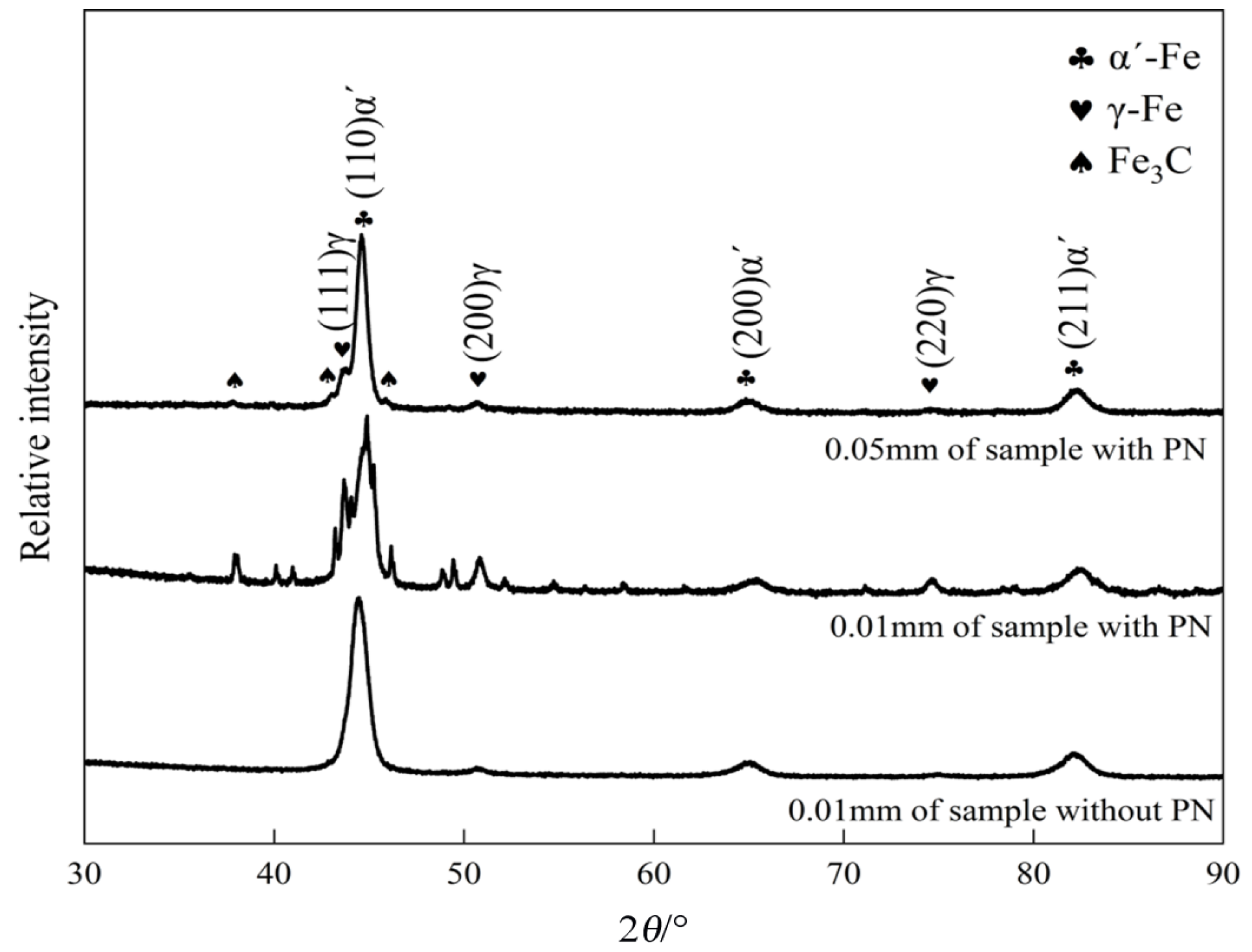
- Pre-nitriding refines the martensitic microstructure of the carburized layer, promotes the precipitation of carbides, and leads to a high fraction of carbides within the carburized layer.
- (3)
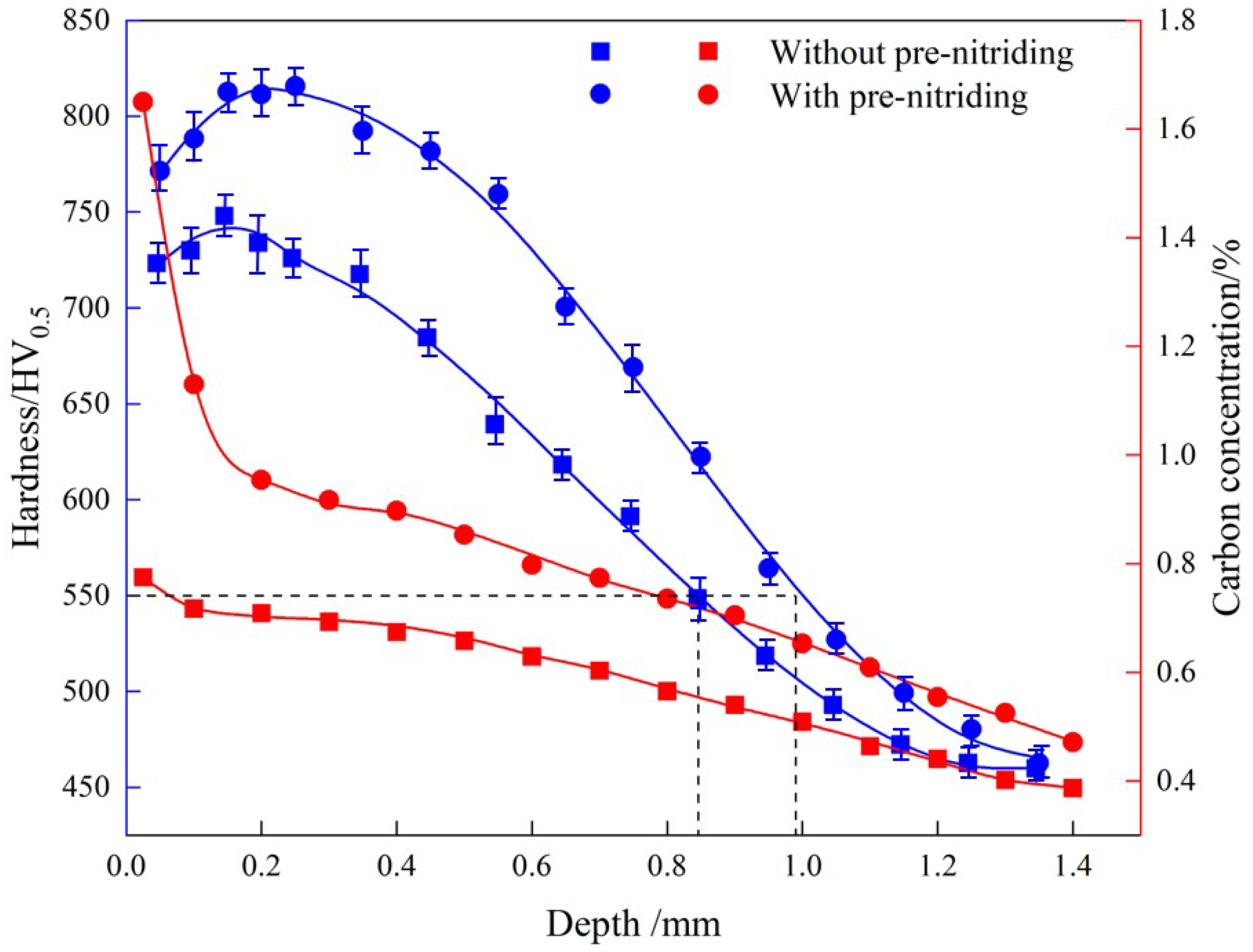
- Pre-nitriding significantly increases the carbon content in the carburized layer, extends the effective hardened depth of the case, raises the hardness at equivalent depths, and improves the hardness distribution in the carburized layer.
Author Contributions
Funding
Data Availability Statement
Conflicts of Interest
References
- Yang, Q.X.; Ren, X.J.; Gao, Y.K.; Li, Y.L.; Zhao, Y.H.; Yao, M. Effect of carburization on residual stress field of 20CrMnTi specimen and its numerical simulation. Mater. Sci. Eng. A 2005, 392, 240–247. [Google Scholar] [CrossRef]
- Balusamy, T.; Narayanan, T.S.N.; Ravichandran, K. Pack boronizing of AISI H11 tool steel: Role of surface mechanical attrition treatment. Vacuum 2013, 97, 36–43. [Google Scholar] [CrossRef]
- An, X.; Tian, Y.; Wang, H.; Wang, Z. Effect of preheat treatment on microstructure and properties of a gear steel for high-temperature carburizing. Steel Res. Int. 2020, 91, 2000180. [Google Scholar] [CrossRef]
- Song, L.; Gu, X.; Sun, F.; Hu, J. Reduced internal oxidation by a rapid carburizing technology enhanced by pre-oxidation for 18CrNiMo7-6 gear steel. Vacuum 2019, 160, 210–212. [Google Scholar] [CrossRef]
- Shen, J.; Liu, S.; Guo, X.H.; Niu, Y. Simultaneous oxidation and carburization of a Fe-9Cr alloy under different oxygen pressures at 800 °C. Corros. Sci. 2017, 129, 1–15. [Google Scholar] [CrossRef]
- Song, G.J.; Cui, X.F.; Lu, B.W.; Feng, X.R.; Song, S.Q.; Jin, G.; Wang, H.D. Influence of surface nanocrystallization pretreatment on high-temperature vacuum carburizing behavior. J. Mater. Process. Technol. 2020, 278, 116519. [Google Scholar] [CrossRef]
- Song, C.W.; Tian, Y.; Wang, H.J.; Wang, Z.D. Effect of preliminary nitriding treatment on microstructure and mechanical properties of carburized layer of Cr-Co-Mo-Ni bearing steel. China Metall. 2020, 30, 86–93. [Google Scholar]
- Mouri, L.; Mabille, I.; Fiaud, C.; Amouroux, J. Improvement of the corrosion resistance of a low carbon steel using a two step plasma treatment. Corros. Sci. 2002, 44, 2089–2099. [Google Scholar] [CrossRef]
- Kula, P.; Pietrasik, R.; Dybowski, K.; Paweta, S.; Wolowiec, E. Properties of surface layers processed by a new, high-temperature vacuum carburizing technology with prenitriding—PreNitLPC®. Adv. Mater. Res. 2012, 452–453, 401–406. [Google Scholar] [CrossRef]
- Sirin, S.Y.; Kaluc, E. Structural surface characterization of ion nitrided AISI 4340 steel. Mater. Des. 2012, 36, 741–747. [Google Scholar] [CrossRef]
- Li, J.; Yang, X.; Wang, S.; Wei, K.; Hu, J. A rapid D.C. Plasma nitriding technology catalyzed by pre-oxidation for AISI4140 steel. Mater. Lett. 2014, 116, 199–202. [Google Scholar] [CrossRef]
- Ahangarani, S.; Sabour, A.R.; Mahboubi, F. Surface modification of 30CrNiMo8 low-alloy steel by active screen setup and conventional plasma nitriding methods. Appl. Surf. Sci. 2007, 254, 1427–1435. [Google Scholar] [CrossRef]
- Tang, L.N.; Yan, M.F. Effects of rare earths addition on the microstructure, wear and corrosion resistances of plasma nitrided 30CrMnSiA steel. Surf. Coatings Technol. 2012, 206, 2363–2370. [Google Scholar] [CrossRef]
- Mahboubi, F.; Abdolvahabi, K. The effect of temperature on plasma nitriding behaviour of DIN 1.6959 low alloy steel. Vacuum 2006, 81, 239–243. [Google Scholar] [CrossRef]
- Cai, W.; Meng, F.; Gao, X.; Hu, J. Effect of QPQ nitriding time on wear and corrosion behavior of 45 carbon steel. Appl. Surf. Sci. 2012, 261, 411–414. [Google Scholar] [CrossRef]
- El-Hossary, F.M. The influence of surface microcracks and temperature gradients on the rf plasma nitriding rate. Surf. Coatings Technol. 2002, 150, 277–281. [Google Scholar] [CrossRef]
- Young, T. An essay on the cohesion of fluids. Philos. Trans. R. Soc. London. B Biol. Sci. 1983, 303, 1–62. [Google Scholar] [CrossRef]
- Wenzel, R.N. Resistance of solid surfaces to wetting by water. Ind. Eng. Chem. 1936, 28, 988–994. [Google Scholar] [CrossRef]
- Wang, X.A. Carburizing-nitriding dual modification process and properties of M50NiL steel with high hardness and deep diffusion layer. Ph.D. Thesis, Harbin Institute of Technology, Harbin, China, January 2017. (In Chinese) [Google Scholar]
- Yang, J.; Wu, X.; Gao, J.; Li, G. Surface characteristics and wetting mechanism of respirable coal dust. Min. Sci. Technol. 2010, 20, 365–371. [Google Scholar] [CrossRef]
- Li, Q.; Lin, B.; Zhao, S.; Dai, H. Surface physical properties and its effects on the wetting behaviors of respirable coal mine dust. Powder Technol. 2013, 233, 137–145. [Google Scholar] [CrossRef]
- ISO 2639:2021; Metallic Materials—Determination of Case-Hardening Depth after Carburizing. International Organization for Standardization: Geneva, Switzerland, 2021.
- Yang, Z.N.; Ji, Y.L.; Zhang, F.C.; Zhang, M.; Nawaz, B.; Zheng, C.L. Microstructural evolution and performance change of a carburized nanostructured bainitic bearing steel during rolling contact fatigue process. Mater. Sci. Eng. A 2018, 725, 98–107. [Google Scholar] [CrossRef]
- Bansal, G.K.; Rajinikanth, V.; Ghosh, C.; Srivastava, V.C.; Kundu, S.; Ghosh Chowdhury, S. Microstructure–Property Correlation in Low-Si Steel Processed Through Quenching and Nonisothermal Partitioning. Metall. Mater. Trans. A Phys. Metall. Mater. Sci. 2018, 49, 3501–3514. [Google Scholar] [CrossRef]
- Jeddi, D.; Lieurade, H.P. Effect of retained austenite on high cycle fatigue behavior of carburized 14NiCr11 steel. Procedia Eng. 2010, 2, 1927–1936. [Google Scholar] [CrossRef]
- Xie, L.; Palmer, D.; Otto, F.; Wang, Z.; Jane Wang, Q. Effect of Surface Hardening Technique and Case Depth on Rolling Contact Fatigue Behavior of Alloy Steels. Tribol. Trans. 2015, 58, 215–224. [Google Scholar] [CrossRef]
- Tong, W.P.; Tao, N.R.; Wang, Z.B.; Lu, J.; Lu, K. Nitriding iron at lower temperatures. Science 2003, 299, 686–688. [Google Scholar] [CrossRef]
- Wang, H.; Wang, B.; Wang, Z.; Tian, Y.; Misra, R.D.K. Optimizing the low-pressure carburizing process of 16Cr3NiWMoVNbE gear steel. J. Mater. Sci. Technol. 2019, 35, 1218–1227. [Google Scholar] [CrossRef]
- Kula, P.; Dybowski, K.; Wolowiec, E.; Pietrasik, R. ‘Boost-diffusion’ vacuum carburising—Process optimization. Vacuum 2014, 99, 175–179. [Google Scholar] [CrossRef]
- Cui, Z.Q.; Qin, Y.C. Metallography and Heat Treatment, 3rd ed.; China Machine Press: Beijing, China, 2020. [Google Scholar]
- You, Y. First-Principles Calculations of Interatomic Interactions and Molecular Dynamics Simulation of N Diffusion in Rare-Earth Nitrocarburized Layers. Ph.D. Thesis, Harbin Institute of Technology, Harbin, China, June 2013. (In Chinese) [Google Scholar]






| C | Si | Mn | Cr | Ti | S | P | N | Fe |
|---|---|---|---|---|---|---|---|---|
| 0.21 | 0.227 | 1.04 | 1.18 | 0.056 | 0.022 | 0.020 | 0.004 | Bal. |
| Samples | Area/μm2 | Surface Area/μm2 | Surface Area Ratio |
|---|---|---|---|
| Without PN | 202,539 | 211,451 | 1.044 |
| With PN | 202,495 | 344,443 | 1.701 |
| Surface | Contact Angles (°) | |
|---|---|---|
| θw | θp | |
| Without PN | 107 | 99 |
| With PN | 142 | 147 |
Disclaimer/Publisher’s Note: The statements, opinions and data contained in all publications are solely those of the individual author(s) and contributor(s) and not of MDPI and/or the editor(s). MDPI and/or the editor(s) disclaim responsibility for any injury to people or property resulting from any ideas, methods, instructions or products referred to in the content. |
© 2026 by the authors. Licensee MDPI, Basel, Switzerland. This article is an open access article distributed under the terms and conditions of the Creative Commons Attribution (CC BY) license.
Share and Cite
Li, F.; Wang, J.; Han, L.; Lu, C.; Li, Z. The Formation of Surface Nanoparticles Enhances the Vacuum Carburizing Efficiency of 20CrMnTi Steel. Nanomaterials 2026, 16, 305. https://doi.org/10.3390/nano16050305
Li F, Wang J, Han L, Lu C, Li Z. The Formation of Surface Nanoparticles Enhances the Vacuum Carburizing Efficiency of 20CrMnTi Steel. Nanomaterials. 2026; 16(5):305. https://doi.org/10.3390/nano16050305
Chicago/Turabian StyleLi, Fangpo, Jianjun Wang, Lihong Han, Caihong Lu, and Zhuocheng Li. 2026. "The Formation of Surface Nanoparticles Enhances the Vacuum Carburizing Efficiency of 20CrMnTi Steel" Nanomaterials 16, no. 5: 305. https://doi.org/10.3390/nano16050305
APA StyleLi, F., Wang, J., Han, L., Lu, C., & Li, Z. (2026). The Formation of Surface Nanoparticles Enhances the Vacuum Carburizing Efficiency of 20CrMnTi Steel. Nanomaterials, 16(5), 305. https://doi.org/10.3390/nano16050305