Article

Defect Passivation and Enhanced Hole Extraction in Inverted Perovskite Solar Cells via CeO2@MoS2 Interfacial Engineering

1
Department of Materials Engineering, Ming Chi University of Technology, New Taipei City 243303, Taiwan
2
Department of Materials Science and Engineering, National Taiwan University, Taipei 106319, Taiwan
3
College of Engineering, Ming Chi University of Technology, New Taipei City 24301, Taiwan
4
Organic Electronics Research Center, Ming Chi University of Technology, New Taipei City 243303, Taiwan
5
Department of Physics, National Atomic Research Institute, Taoyuan City 325207, Taiwan
6
Center for Plasma and Thin Film Technologies, Ming Chi University of Technology, New Taipei City 243303, Taiwan
7
Department of Physics, National Chung Hsing University, Taichung 402, Taiwan
*
Authors to whom correspondence should be addressed.
Nanomaterials 2026, 16(3), 188; https://doi.org/10.3390/nano16030188
Submission received: 29 December 2025 / Revised: 23 January 2026 / Accepted: 28 January 2026 / Published: 30 January 2026
(This article belongs to the Section Solar Energy and Solar Cells)

Abstract

Nanomaterial-based hole transport layers (HTLs) play a vital role in regulating interfacial charge extraction and recombination in perovskite solar cells (PSCs). To improve PSC efficiency, hydrothermally synthesized CeO2@MoS2 nanocomposites (CM NCs) were incorporated as an interfacial buffer layer into a NiOX/MeO-2PACz HTL. The introduction of CM NCs induces strong interfacial interactions, where Mo sites in MoS2 interact with NiOX, modulating the Ni2+/Ni3+ ratio and reducing the interfacial trap density. Moreover, CeO2 promotes the formation of oxygen vacancies, collectively improving the conductivity and hole transport capability of the NiOX HTL. The MoS2-grafted CeO2 interlayer effectively tailors the interfacial energetics and creates an effective channel for hole transfer, thereby reducing open-circuit voltage (VOC) loss and enhancing device performance. This interface modification efficiently enhances hole extraction, and non-radiative recombination is effectively suppressed at the NiOX/MeO-2PACz/perovskite interface. Thereby, incorporating 2 vol% CM NCs into PSCs achieved a power conversion efficiency (PCE) of 17.93%, compared to 17.50% for a 1 vol% CM NCs-based device and 17.01% for the unmodified control device. The enhanced performance at the optimized CM NCs concentration is attributed to effective defect passivation, reduced VOC loss, and improved interfacial band alignment, which together facilitate hole extraction and suppress non-radiative recombination. However, excessive CM NCs incorporation (4 vol%) leads to increased interfacial resistance, partial hole blocking effects associated with the n-type nature of CeO2, and aggravated recombination, resulting in degraded device performance. These results demonstrate that precise control over CM NCs interlayer thickness and concentration is critical for maximizing device performance, providing a robust strategy for designing high-efficiency and stable NiOX-based PSCs and advancing nanocomposite-enabled interfacial engineering for photovoltaic applications.

1. Introduction

Nanotechnology advancements have opened new avenues to improve the performance of solar energy utilization. The use of nanomaterials in the energy sector has attracted significant attention due to their exceptional optical, electrical, and catalytic properties, offering promising pathways for advancing energy conversion and storage technologies [1]. Nanomaterials can significantly enhance the absorbance of solar light; therefore, their use in solar cells has become prevalent to improve power conversion efficiency (PCE) [2]. Organic solar cells (OSCs) have recently demonstrated PCE exceeding 20% [3]. A typical single-junction OSC comprises a photoactive layer sandwiched between an electron transport layer (ETL) and a hole transport layer (HTL). Nevertheless, poor operational stability continues to impede commercialization, largely due to the limited insight into the fundamental degradation phenomena in OSCs. Therefore, perovskite solar cells (PSCs) have largely overcome these limitations and have achieved PCE exceeding 25% [4,5]. To fabricate a PSC, several layers are assembled in sequence, including a transparent conductive substrate (TCS), an ETL, a perovskite light-absorbing layer, an HTL, and finally a metal contact electrode. Furthermore, optimizing each functional layer, while keeping charge mobility, electron-hole balance, and optical transmittance, is essential for the fabrication of high-performance n–i–p (regular planar) and p–i–n (inverted planar) hybrid perovskite solar cell architectures. The inverted (p–i–n) architecture has attracted considerable interest due to its reduced hysteresis, compatibility with low-temperature processing, and suitability for monolithic tandem integration with silicon, Cu(In, Ga)Se2 (CIGS), and Sn–Pb perovskite subcells. Recently, p–i–n perovskite solar cells have achieved certified power conversion efficiencies exceeding 27%, demonstrating their strong technological potential [6].
The efficiency and operational stability of PSCs are significantly influenced by the engineering and selection of ETL and HTL materials. Accordingly, numerous studies have focused on ETL modification and its influence on PSC performance [7]. Nevertheless, the HTL plays an essential role in selectively extracting photogenerated holes from the perovskite absorber and efficiently transports them to the metal contact electrode [8]. In PSCs, the open-circuit voltage (VOC) originates from the splitting of the electron and hole quasi-Fermi levels; however, non-radiative recombination of excess free charge carriers leads to a reduction in this splitting [9]. Numerous non-radiative recombination processes in PSCs have been reported, including trap-assisted recombination, carrier-carrier scattering, and Auger recombination [10,11]. Nonradiative recombination at the interfaces of adjacent functional layers plays a crucial role in determining charge extraction and transport, which is a major factor limiting VOC and overall device efficiency [12]. Consequently, the HTL in PSCs has been widely investigated to improve the interfacial properties, prevent non-radiative recombination, and facilitate efficient charge-carrier transport. To this end, various nanomaterials have been employed as HTLs in PSCs, such as NiOX, CuOX, CuS, MoS2, VOX, WO3, and CuSCN [13]. Recently, NiOX has been extensively employed as an HTL material in PSCs due to its multiple benefits, such as low cost, ease of fabrication, good stability, and favourable band level structure [14]. However, multiple approaches have been employed to enhance the performance of NiOX, including the incorporation of metal ions and small molecules as dopants. To increase the ratio of Ni3+/Ni2+, various metals are doped in NiOX, including alkali metal and alkaline earth metal ions (Li+, K+, Rb+, Mg2+) [15,16], transition metal ions (Cu2+, Fe2+) [16,17], and rare earth metal ions (Ce4+, Yb3+) [18]. However, this approach introduces new challenges, such as lattice distortion [19] and reduced transmittance of NiOX HTL. Therefore, alternative modification strategies have been explored, such as incorporating carbon quantum dots [20], 3,6-difluoro-2,5,7,7,8,8-hexacyanoquinodimethane (F2HCNQ) [21], 2,2′-(perfluoronaphthalene-2,6-diylidene) dimalononitrile (F6TCNNQ) [22], which possess high electron affinity. These additives effectively suppress charge-carrier recombination and ultimately improve hole-transport performance. In 2014, K.-C. Wang et al. reported NiOx nanocrystals as p-type electrodes for PSCs, achieving a PCE of 9.51% using NiOx/perovskite/PCBM device configuration [23].
More recently, p-type NiOx layer modified with self-assembled monolayer (SAM), such as 2PACz, MeO-2PACz, Me-4PACz, or their mixtures, has emerged as an ideal hole-transport structure in PSCs [24,25,26], as it reduces interface trap density and enhances hole-selectivity by increasing the work function [27]. The work-function enhancement through SAM modification is ascribed to a vacuum-level shift, originating from the intrinsic dipole moment of the SAM molecule, and establishment of a space-charge region at the NiOx/SAM interface [27]. Therefore, upward band bending near the interface facilitates hole extraction and charge transport. To date, PSCs employing inorganic HTL generally exhibit lower PCEs due to detrimental interfacial reaction, which impedes the hole transport and increases carrier recombination rate at the interface [28]. Basically, the Ni3+ cations in NiOx HTL can interact with SAM molecules or perovskite materials, which reduces the amount of Ni3+ cations in NiOx. This reduction leads to a decreased electrical conductivity of the NiOx HTL and, consequently, a lower PCE in PSCs [29]. Introducing nanomaterial interlayers between the HTL and SAM has emerged as an efficient approach, leading to significant improvement in the fill factor (FF) and enhanced hole mobility. The FF value can be boosted from 0.22 to 0.80, accompanied by an increase in hole mobility from 10−6 to 10−4 cm2V−1s−1 [30].
CeO2 has abundant oxygen vacancies and demonstrates significant oxygen storage and release capability through the Ce4+/Ce3+ redox cycle [31]. The interfacial interaction between NiOx and CeO2 can generally increase oxygen-vacancy concentration and encourage oxygen diffusion, which contributes to superior performance in a solar cell [32,33]. Solar cell efficiency has been improved by creating an interface using MoS2 with TiO2, WS2, graphene, etc. [34]. Shanmugan et al. demonstrated a solar cell efficiency of 1.8% by creating a Schottky junction at the MoS2@Au interface [35]. In 2022, Yaohui Li et al. [36] enhanced the PCE of PSCs by modifying the HTL with MoS2-doped poly(3,4-ethylenedioxythiophene) (PEDOT). Hui Huang et al. [37] achieved 7.24% PCE using MoS2-doped PEDOT:PSS.
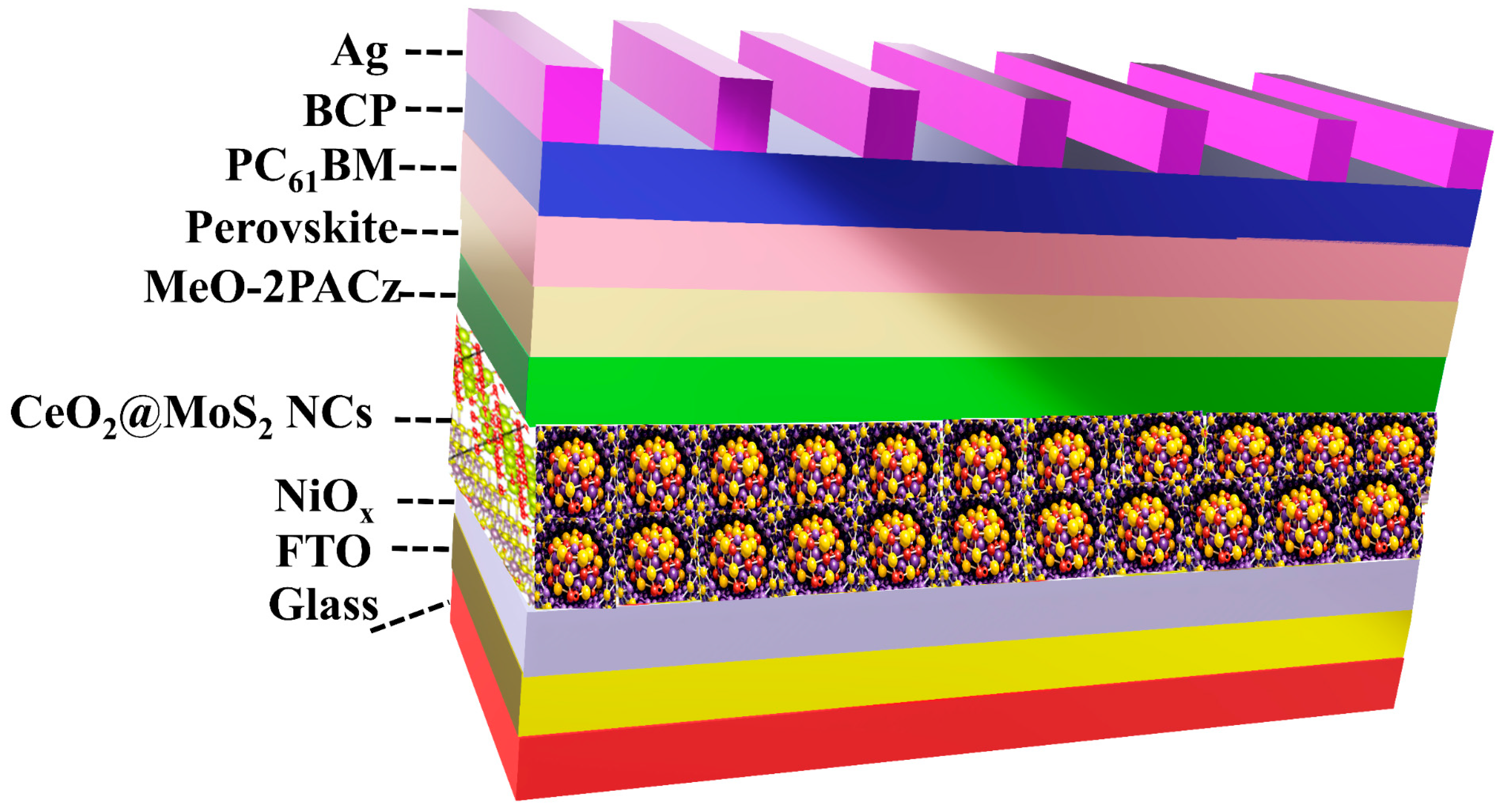
In this work, hydrothermally synthesized CeO2@MoS2 nanocomposites (CM NCs) were introduced as an interfacial modifier to augment the PCE of p–i–n PSCs with a glass/FTO/NiOx/MeO-2PACz/perovskite/PC61BM/BCP/Ag device architecture. An ultrathin CeO2@MoS2 nanocomposite layer was inserted between NiOx and MeO-2PACz. The oxygen vacancies and defect sites in CeO2@MoS2 promote hole extraction and suppress interfacial non-radiative recombination, thereby prolonging carrier lifetime and enhancing PCE.

2. Experimental Method

2.1. Reagents and Materials

Cerium (III) nitrate hexahydrate (Ce(NO3)3·6H2O), L-cysteine, and sodium molybdate (Na2MoO4) were obtained from Sigma-Aldrich (St. Louis, MO, USA). Nickel oxide nanoparticles (NPs) and PC61BM (99.0%) were obtained from Lumtec (New Taipei City, Taiwan). Ethanol (EtOH, >99%) was purchased from Fisher Chemical (Waltham, MA, USA). Dimethyl sulfoxide (DMSO, >99.9%), chlorobenzene (CB, >99.0%), and isopropyl alcohol (IPA, 99.8%) were obtained from Acros Organics (Geel, Belgium). Rubidium iodide (RbI), 2,2,2-Trifluoroethanol (TFE), Cesium iodide (CsI), and Dimethylformamide (DMF, 99.8%) were purchased from Sigma-Aldrich. FTO glasses, Formamidinium Iodide (FAI), 2-Thiopheneethylammonium chloride (TEACl), and Formamidinium Bromide (FABr) were purchased from FrontMaterials (New Taipei City, Taiwan). Bathocuproine (BCP) and lead iodide (PbI2, 99.9985%) were obtained from TCI (Tokyo, Japan).

2.2. Synthesis of CeO2 Nanoparticles

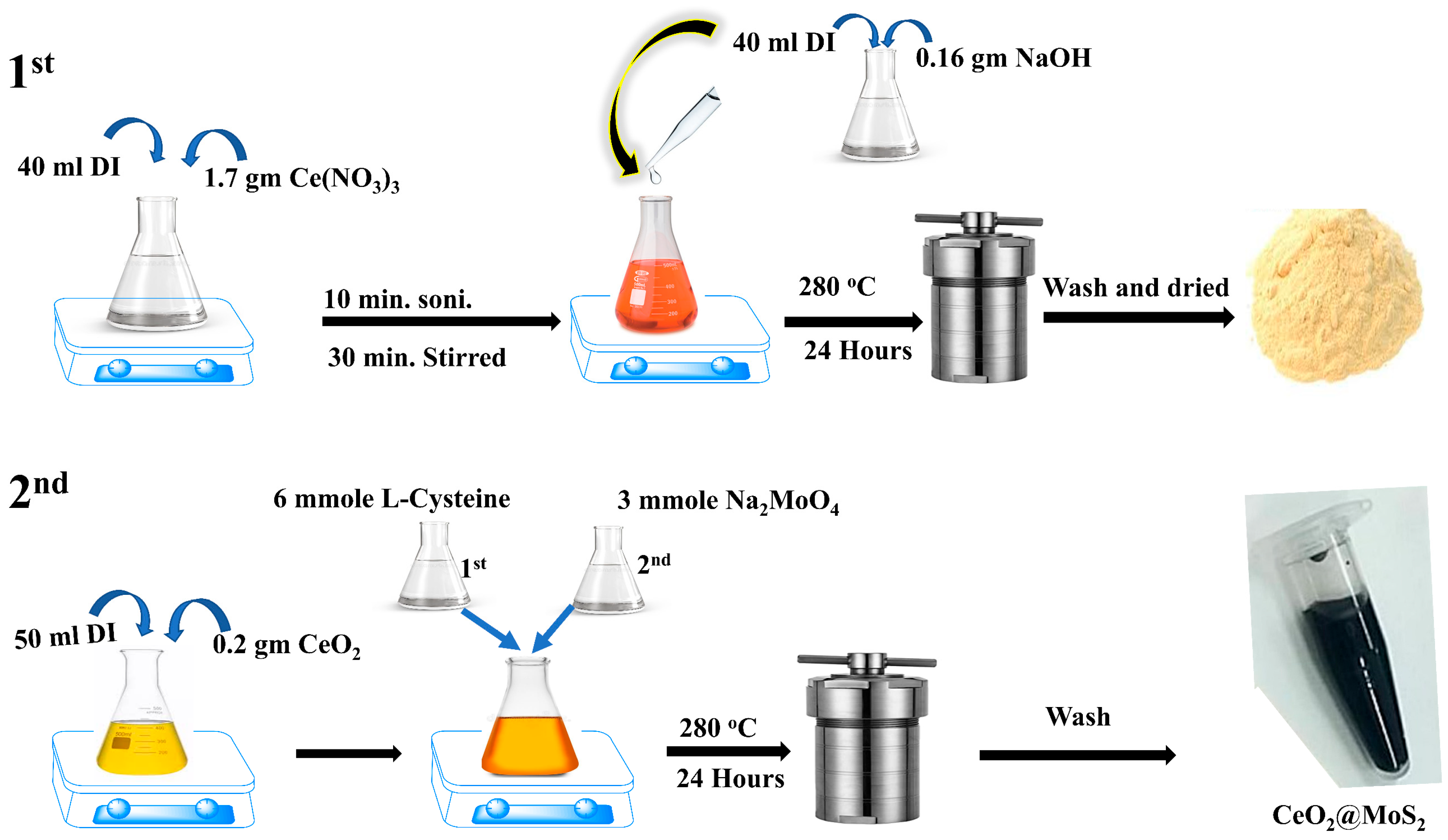
CeO2 nanoparticles were synthesized via a hydrothermal method, as described in reference [38], with slight modifications. Briefly, 1.736 g of Ce(NO3)3·6H2O was dissolved in 40 mL of deionized (DI) water and stirred for 30 min, followed by 30 min of ultrasonication. The mixture was continuously stirred for a further 10 min. Separately, 0.16 g NaOH was dissolved in 40 mL of DI water to prepare a NaOH solution, and was subsequently added dropwise to the Ce precursor solution under continuous stirring (Figure 1), resulting in a final pH of 7.2. After stirring for 1 h, the mixture reached a pH of 4, was transferred into a 100 mL Teflon-lined stainless-steel autoclave, and heated at 180 °C for 24 h. The obtained white precipitate was separated by centrifugation, washed three times with DI water, and then dried for six hours at 60 °C in an oven to produce yellow CeO2 powder.

2.3. Synthesis of CeO2@MoS2 Nanocomposite

First, 0.2 g of CeO2 was immersed in 1 mL of DI water, stirred till a homogenous suspension was achieved, and then diluted with 35 mL of DI water. After 30 min of stirring, the liquid was ultrasonically stirred for a further 30 min. Subsequently, a solution of L-cysteine (6 mmol, 30 mL) was added, and the mixture was stirred for 30 min, after which a solution of Na2MoO4 (3 mmol, 15 mL) was added. The resulting solution was further stirred for 1 h, transferred into a 100 mL Teflon-lined stainless-steel autoclave, and heated at 280 °C for 24 h. After naturally cooling to room temperature, the obtained precipitate was collected by centrifugation and washed several times with DI water and ethanol. A schematic flowchart of the CM NC synthesis process is shown in Figure 1.

2.4. Device Fabrication

PSCs were fabricated in a p–i–n configuration consisting of glass/FTO/NiOx/CM NCs/MeO-2PACz/perovskite/PC61BM/BCP/Ag, as schematically depicted in Figure 2. Before layer deposition, the FTO glass was cleaned using O2 plasma for 20 min. The NiOx NPs HTL solution (5 mg/mL in DI water) was deposited by spin-coating at 5000 rpm for 20 s, followed by annealing at 150 °C for 20 min. The MeO-2PACz layer (3 mM in EtOH) was realized by spin-coating onto the prepared NiOx/FTO substrate at 3000 rpm for 20 s, and subsequently annealed at 100 °C for 5 min. The perovskite precursor solution was obtained by mixing CsI (0.42 M), FAI (0.35 M), and PbI2 (1.47 M) in a DMF:DMSO (4:1, v/v) solvent mixture, followed by stirring at room temperature for 8 h. The perovskite layer was deposited by spin coating the precursor solution onto the FTO/HTL substrate according to a previously reported procedure [39]. The TEACl solution (4 mM in IPA) was dropped onto the perovskite film, then spin-coated at 3000 rpm for 20 s and annealed at 150 °C for 40 s. The PC61BM electron transport layer (ETL) layer (20 mg/mL in CB) was spin-coated at 1000 rpm for 20 s. The BCP work function layer (0.5 mg/mL in TFE) was then deposited by spin-coating at 3000 rpm for 20 s. At last, the Ag electrode was deposited by thermal evaporation at 2 × 10⁻⁶ torr to complete device fabrication, yielding PCSs with an active area of 0.09 cm2. To enhance device performance, CM NCs were incorporated as an interfacial layer between the NiOx and MeO-2PACz. A schematic representation of the glass/FTO/NiOX:CM NCs (25 nm)/MeO-2ACz/perovskite (550 nm)/PC61BM (50 nm)/BCP (5 nm)/Ag (120 nm) device with CM NCs is illustrated in Figure 2.

2.5. Characterization of Perovskite Film and Devices

The 1-Sun PCE of the PSCs was evaluated under AM1.5G solar simulator (Enlitech, SS-X100R AAA, Kaohsiung City, Taiwan). Transient photovoltage (TPV) and transient photocurrent (TPC) measurements were carried out using an all-in-one characterization platform (Paios, Fluxim AG, Winterthur, Switzerland) to examine charge-carrier recombination and extraction dynamics. The microstructure and lattice features of the CM NCs were investigated by high-resolution transmission electron microscopy (HRTEM, JEOL, Akishima, Japan, JEM-2100, LaB6 electron gun).

3. Results and Discussion

3.1. Characterization of CeO2@MoS2 Nanocomposites

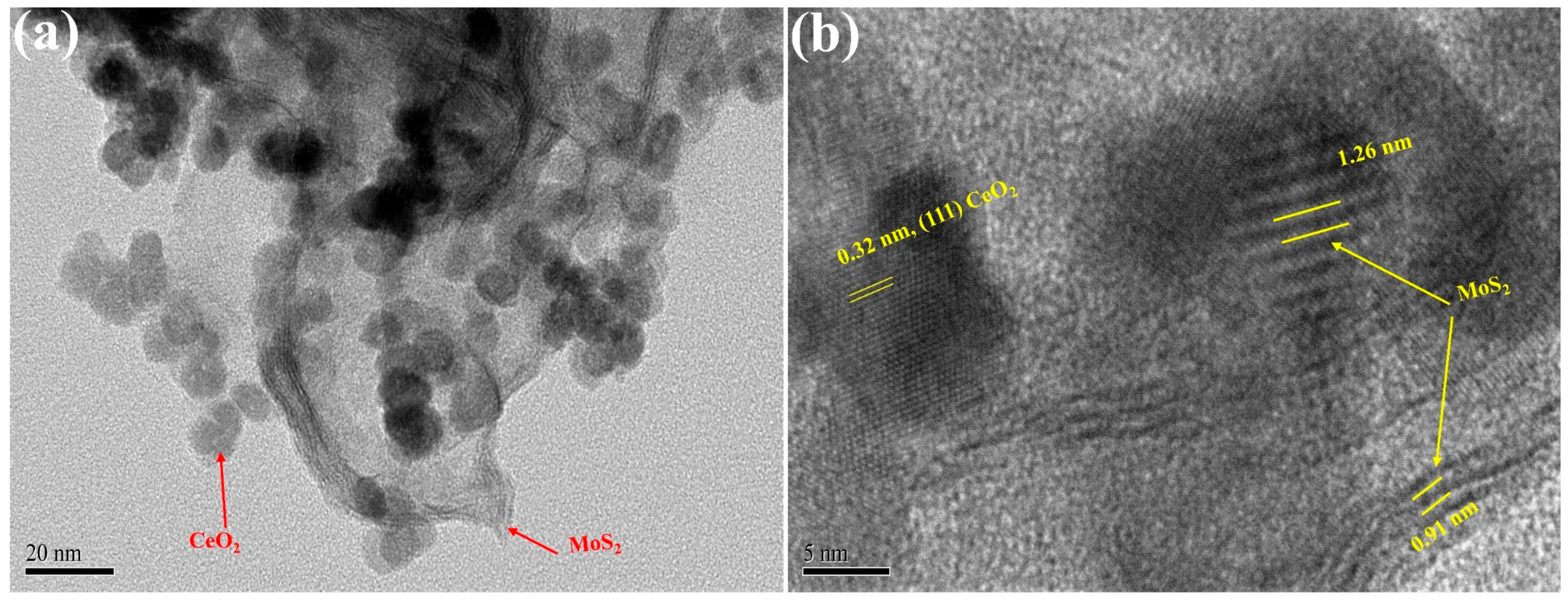
To confirm the internal structure, crystallinity, and defect characteristics of the nanomaterial, HRTEM analysis was performed. The results demonstrated that CeO2 nanoparticles are integrated with few-layer MoS2 nanosheets, forming a well-defined CeO2@MoS2 nanocomposite. As shown in Figure 3a,b, the CeO2 nanoparticles exhibit a roughly spherical morphology with a lattice spacing of 0.32 nm, corresponding to the (111) plane of cubic CeO2 [40]. Additionally, an ultrathin silk-like layered structure was observed on the surface of the CeO2 nanoparticles, attributed to few-layer MoS2 nanosheets, confirming the layered structure of MoS2. Expanded interlayer-like spacings of approximately 0.91 nm and 1.26 nm were observed at the CeO2–MoS2 interface, which are significantly larger than the typical (002) interlayer spacing (~0.62 nm) of pure MoS2 [41,42]. This expansion can be ascribed to lattice strain caused by lattice mismatch, strong interfacial interactions between CeO2 and MoS2, and the presence of sulfur vacancies and structural defects [43]. Furthermore, the oxygen-vacancy-rich CeO2 promotes interlayer expansion in MoS2, as indicated by the greater spacing of 1.26 nm in Figure 3b. These characteristics verify the production of few-layer, defect-rich MoS2 with increased interlayer spacing in the CM NCs. The multilayer MoS2 structure wrapping around CeO2 nanoparticles is expected to improve the structural stability and functional performance of CM NCs. Additionally, the TEM analysis revealed no secondary phases, demonstrating the excellent purity of the synthesized CM NCs.
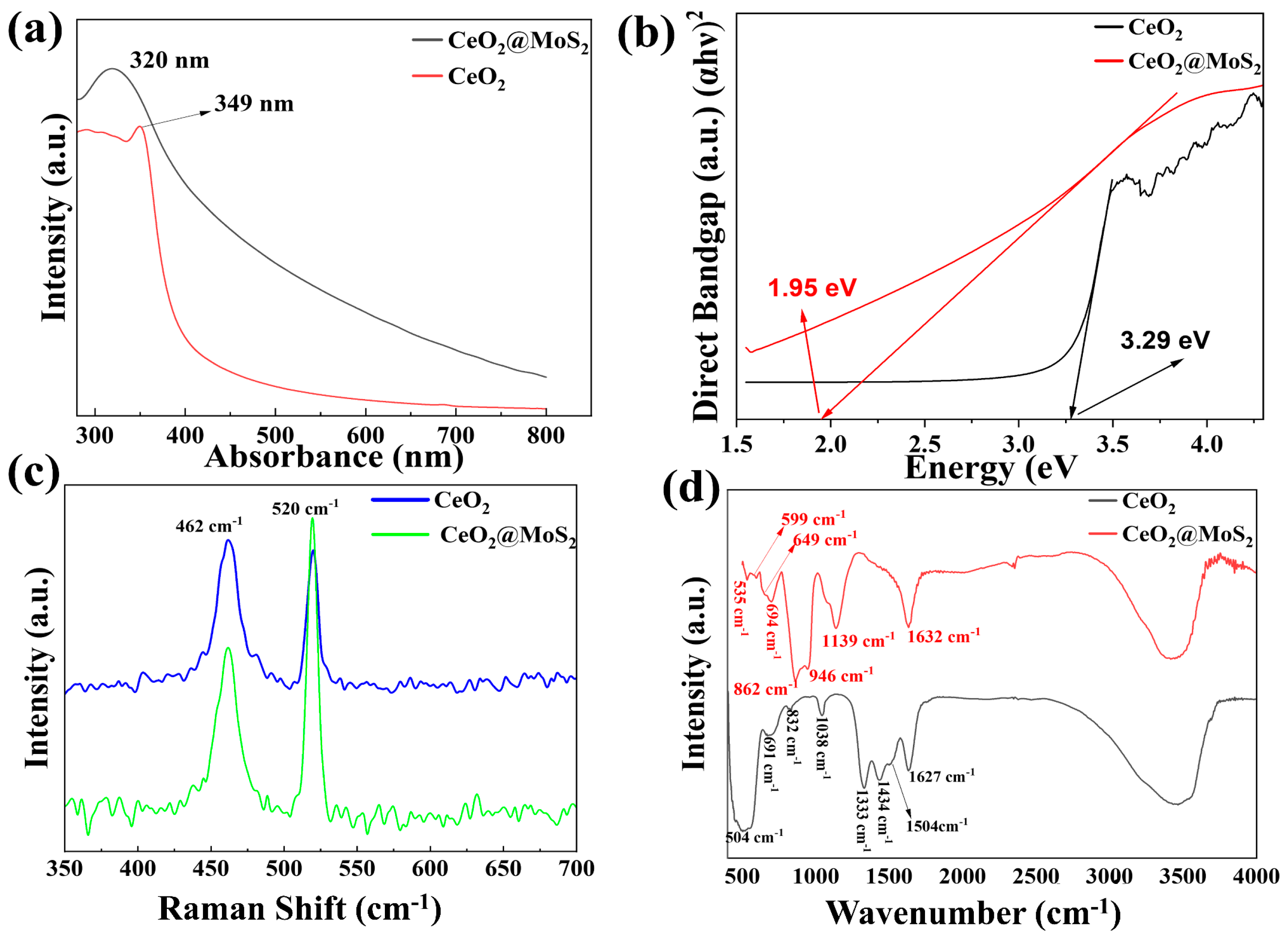
The optical absorption properties of the synthesized materials were characterized using the UV-Vis spectrometer (JASCO U-550, Tokyo, Japan). As shown in Figure 4a, pure CeO2 exhibits a sharp absorbance peak at 349 nm [44,45]. Moreover, CM NCs possess a broad absorption spectrum, with a specific absorption peak at 320 nm, indicating a blue shift induced by coupling with MoS2. This behavior is attributed to strong interfacial interactions between CeO2 and MoS2, as well as quantum confinement effects and lattice distortion. The UV-Vis absorption spectra were used to draw Tauc plots as illustrated in Figure 4b, and the direct bandgap of CeO2 was determined to be 3.29 eV [46]. However, an effective bandgap of CM NCs was estimated to be 1.97 eV, which is significantly smaller than the direct bandgap of CeO2. The observed bandgap narrowing arises from electronic coupling between CeO2 and MoS2, as well as the formation of interfacial states and defect levels associated with oxygen vacancies and lattice distortions. Such bandgap narrowing is beneficial for enhanced visible-light harvesting and interfacial charge transfer between the HTL and the perovskite layer. The atomic vibrations and structural characteristics of the synthesized materials were investigated using Raman spectroscopy (NANOSCOPE/NS220-RM0121010, South Korea). In the Raman spectra, as shown in Figure 4c, two strong and sharp peaks appeared for both CeO2 and CeO2@MoS2. The Raman vibration at 462 cm−1 corresponds to the F2g symmetric breathing mode of the Ce-O vibrational unit [47,48]. Additionally, the Raman band at 520 cm−1 is commonly attributed to the defect-induced vibrational bands in CeO2, associated with oxygen vacancies, lattice distortions, or surface defects [49]. Such defect-related vibrations are frequently enhanced in nanostructured materials due to their high surface-to-volume ratio. Moreover, the intensity of the 520 cm−1 peak is significantly enhanced in CeO2@MoS2, which can be attributed to an increased concentration of oxygen vacancies, interfacial charge transfer, and strain-induced symmetry breaking arising from strong CeO2–MoS2 interactions. These features indicate the presence of defect-rich CeO2 within the heterostructure. The Fourier transform infrared (FTIR) spectra were measured using a JASCO-FT-IR 4600 spectrometer, Tokyo, Japan. Figure 4d illustrates the FTIR spectra of CeO2 and CM NCs. Eight characteristic molecular vibrations were observed for CeO2 at 504, 691, 832, 1038, 1333, 1434, 1504, and 1627 cm−1. The bands at 504 and 691 cm−1 were attributed to the Ce-O stretching vibrations, confirming the formation of the CeO2 structure [50,51]. The bands at 832 cm−1 and 1038 cm−1 were observed due to the metal-oxygen bonding [52] and Ce–O–Ce bridging vibrations [53], respectively. Most published studies reported that CeO2 NPs readily react with CO2 in air, resulting in the formation of carbonate species absorbed on the CeO2 surface [54,55]. However, R. Bakkiyaraj et al. [53] and Bhawana Jain et al. [56] reported that molecular vibration in the range 1500–1380 cm−1 and 1396–1541 cm−1, respectively, corresponded to physically absorbed water molecules. Accordingly, the peaks at 1333, 1434, and 1504 cm−1 are attributed to physically adsorbed water and/or overlapping carbonate-related vibrational modes on the CeO2 surface. In addition, the broad bands in the 3750–3000 cm−1 region and the band at 1627 cm−1 are attributed to physically bonded water and various surface hydroxyl groups, corresponding to O–H stretching and bending vibrations, respectively [57]. On the other hand, CM NCs exhibited pronounced spectral changes, confirming successful bonding and strong interfacial interactions. The Ce-O stretching vibrations evolve into several peaks at 535, 599, 694, and 862 cm−1, indicating lattice deformation, increased oxygen vacancy concentration, and significant CeO2-MoS2 interaction. The vibration bands at 649 cm−1 [58,59] and 946 cm−1 [60] are attributed to Mo–S and Mo–O–Ce interfacial vibrations, respectively, indicating chemical bonding rather than physical mixing. Additionally, the band at 1139 cm−1 corresponds to sulfur vacancy-related states in MoS2 and defect-induced vibrational modes. Compared with pure CeO2, the enhanced intensity of the band 1632 cm−1, corresponding to adsorbed water bending vibrations, indicates higher surface activity and defect density in the CM NCs. Overall, the observed peak shifts, splitting, and emergence of new vibrational modes in the CM NCs collectively demonstrate strong interfacial interactions, defect enrichment, and the formation of oxygen and sulfur vacancies, consistent with the Raman and TEM results. These structural features are expected to facilitate improved charge transfer and enhanced optical and catalytic performance.

3.2. Interfacial Morphology Optimization of NiOX via CM NC Incorporation

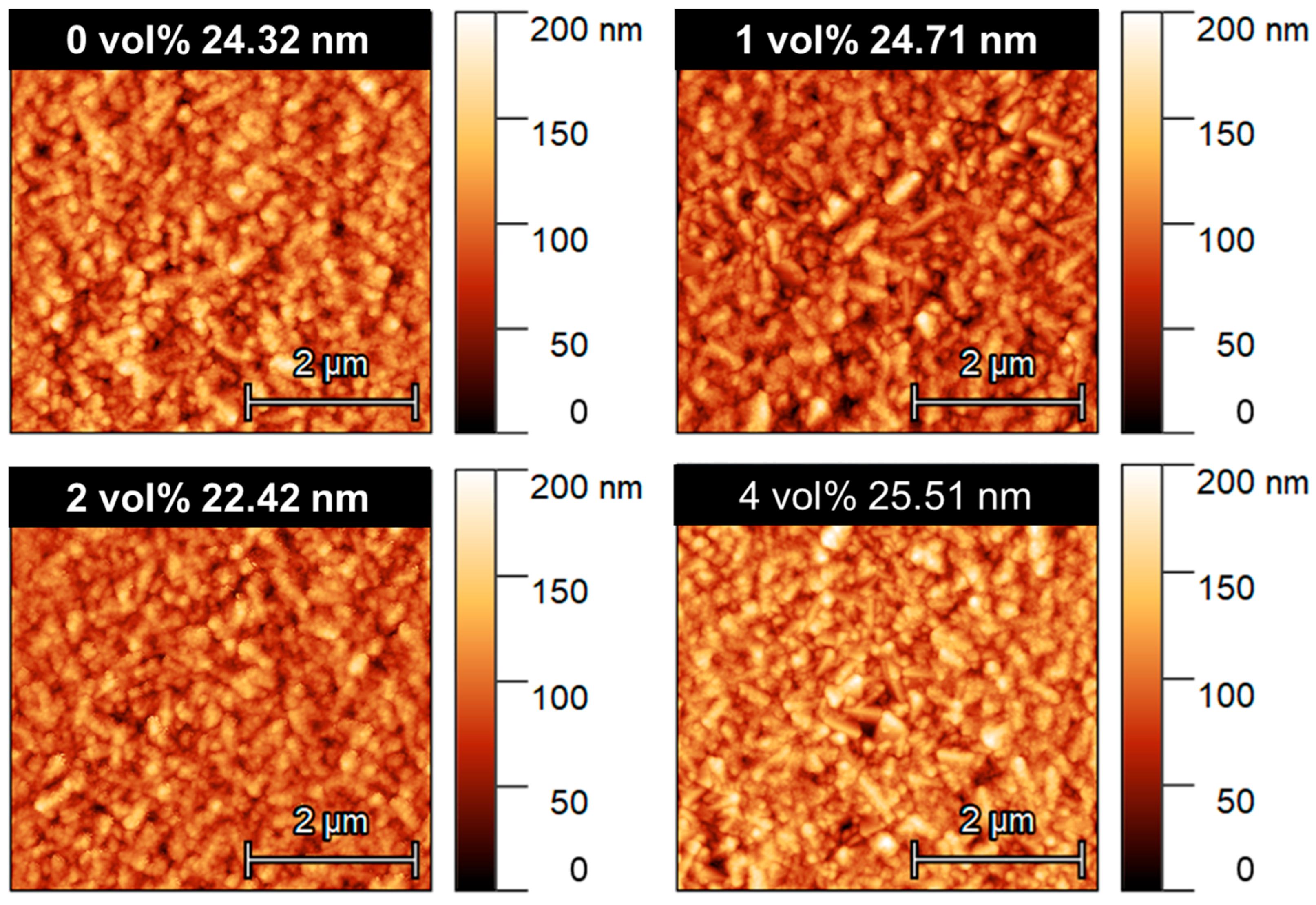
In addition, the morphology and surface roughness of the NiOX layer are critical factors influencing the PCE of PSCs. Atomic force microscope (AFM) analysis was employed to investigate the surface characteristics of NiOX films with varying CM NCs concentrations (Figure 5). As shown in the images, the pristine NiOX film (0 vol%) exhibited a root-mean-square (RMS) roughness of 24.32 nm. With the incorporation of 2 vol% CM NCs, the film achieved the most uniform surface with a minimum RMS value of 22.42 nm, indicating that an optimal concentration of CM NCs can effectively smooth the NiOX surface. However, increasing the concentration further to 4 vol% led to a higher RMS value of 25.51 nm, potentially due to the slight aggregation of nanocrystals at higher loading levels. The reduced surface roughness at 2 vol% was beneficial for ensuring intimate physical contact and carrier extraction at the interface between the NiOX and the subsequent perovskite active layer, which is essential for maximizing device performance.

3.3. Device Performance of Perovskite Solar Cells

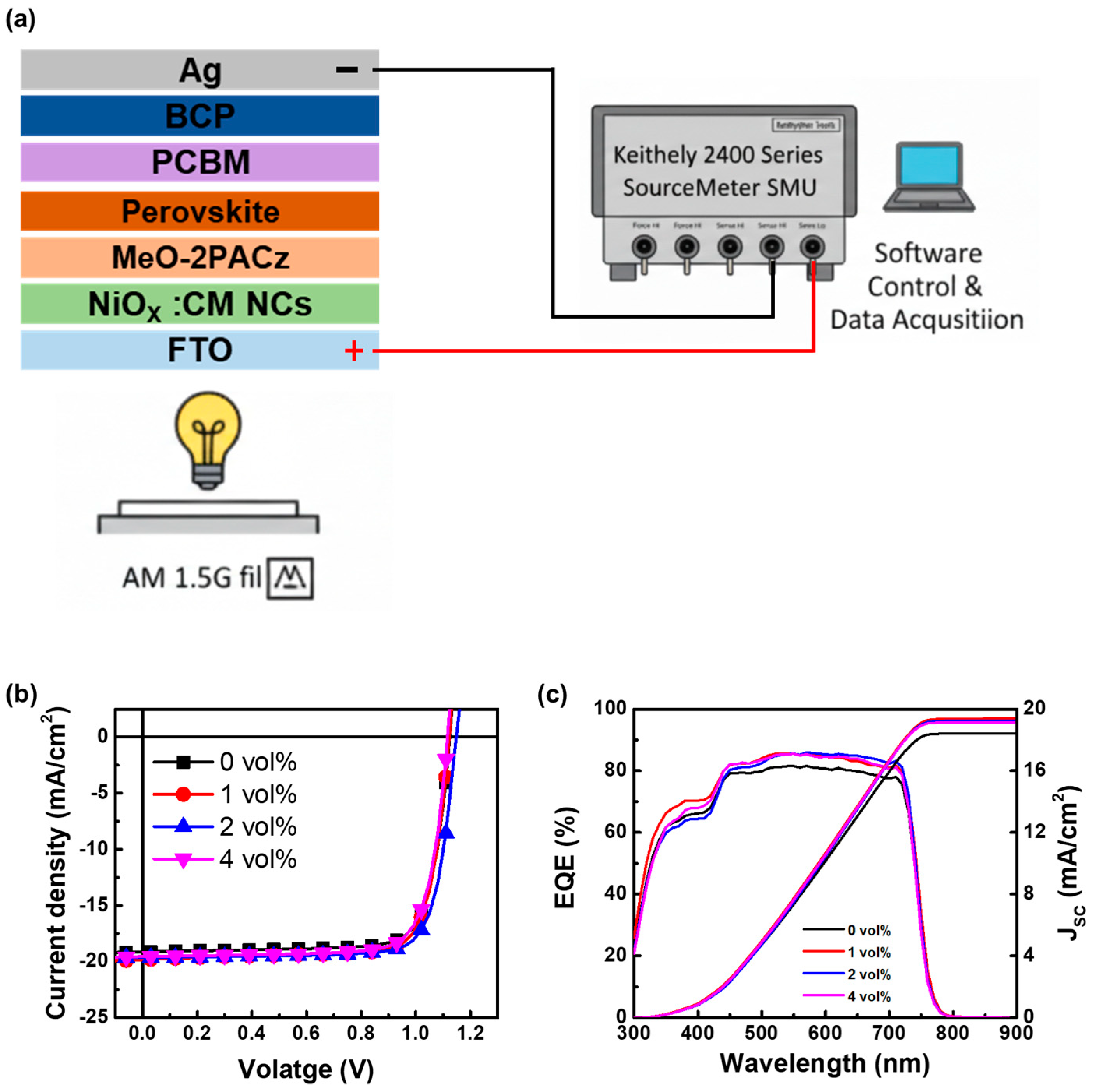
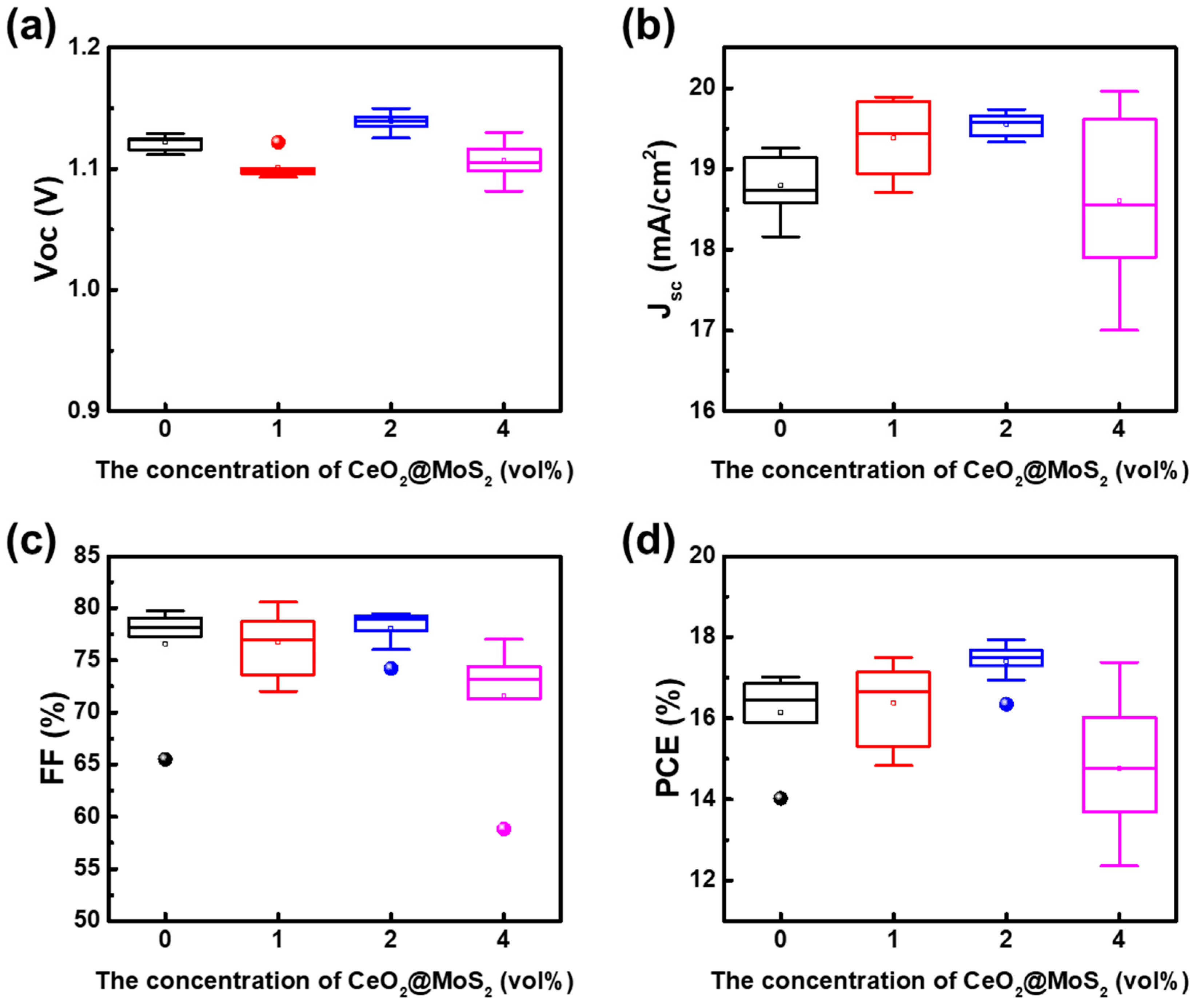
In this study, PSCs with a p–i–n device structure of glass/FTO/NiOx NPs/MeO-2PACz/perovskite/PC61BM/BCP/Ag were fabricated to investigate the effect of incorporating CM NCs into the NiOx HTL. CeO2 is well known for its high oxygen storage and release capacity through the reversible Ce4+/Ce3+ redox cycle, which produces a high density of oxygen vacancies [31]. Here, the interfacial interaction between NiOx and CeO2 further increased the concentration of oxygen vacancies and enhanced oxygen diffusion, thereby improving the electrical properties of the HTL. To evaluate the influence of the CM NCs layer on device performance, PSCs incorporating different concentrations of CM NCs were systematically investigated. Figure 6a shows the schematic diagram of the PSCs device structure and the electrical measurement layout. The J-V curves and EQE spectra with integrated JSC of PSCs incorporating different concentrations of CM NCs are presented in Figure 6b,c, respectively. The device characterizations and J-V curves with different concentrations of CM NCs are listed in Table 1. The photovoltaic characteristics of these devices as a function of CM NCs concentration under 1-sun illumination are shown in Figure 7. The control device without CM NCs exhibited an average VOC of 1.12 V, an average JSC of 18.79 mA/cm2, and an average FF of 76.59%, resulting in an average PCE of 16.14%. The perovskite solar cells performed better after adding 2 vol% CM NCs, with an average PCE of 17.40%, a VOC of 1.14 V, a JSC of 19.56 mA cm−2, and an FF of 78.07%. However, further increasing the CM NCs concentration to 4 vol% led to a deterioration in device performance. The performance decline suggested that excessive CM NCs may have disrupted the dispersion of the NiOx NPs solution, inducing NiOx NPs aggregation and increasing charge-transport resistance. To corroborate the JSC enhancement, EQE measurements were conducted on perovskite solar cells fabricated with NiOX films containing different CM NCs concentrations. As shown in Figure 6c, an increase in CM NCs concentration yields a progressive enlargement of the integrated EQE area, leading to higher simulated current densities that closely match the measured JSC values. Based on these results, 2 vol% of CM NCs was identified as the optimal concentration for enhancing charge extraction and improving PSC efficiency.
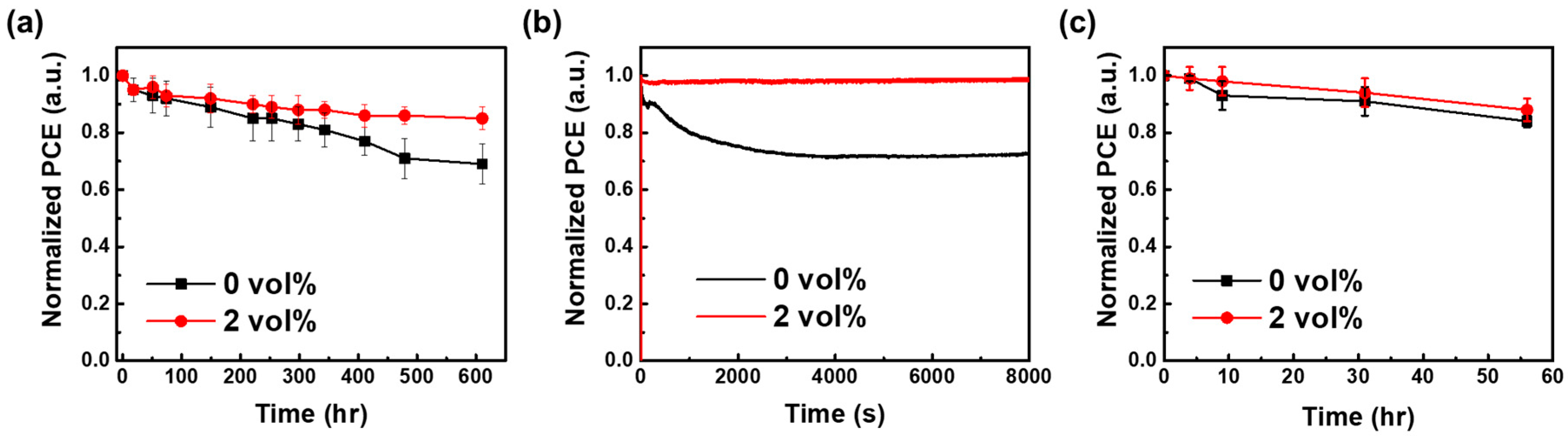
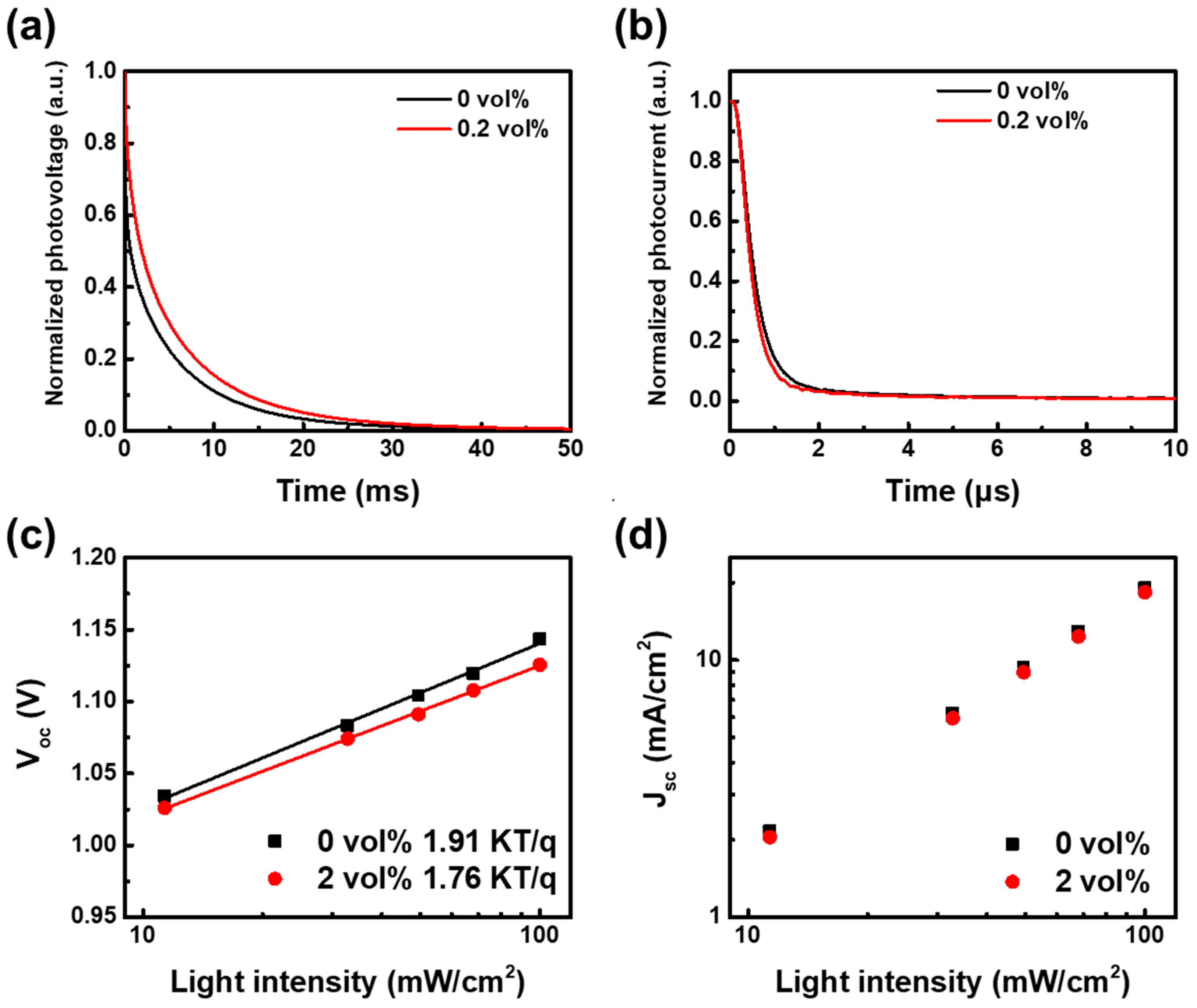
To elucidate the charge-carrier dynamics of NiOx NPs incorporating CM NCs, TPV and TPC measurements were conducted to evaluate the carrier recombination and extraction processes. Figure 8a,b present the TPV and TPC of devices containing 0 vol% and 2 vol% CM NCs, while the corresponding carrier lifetimes and extraction times are summarized in Table 2. The recombination lifetime increased from 4.18 ms to 5.06 ms upon introducing 2 vol% CM NCs into the NiOx NPs layer, consistent with the previously observed enhancements in JSC and FF. In addition, the radiative and non-radiative recombination behaviors were further analyzed by examining the dependence of VOC and JSC on light intensity [61,62]. An ideality factor (n) approaching 1 indicates that radiative recombination becomes the dominant recombination pathway, suggesting reduced trap-assisted non-radiative recombination and improved interfacial quality. Similarly, an α value close to 1 suggests minimal non-radiative recombination losses. The extracted ideality factors and α values are listed in Table 2. As shown in Figure 8c,d, the ideality factor decreases from 1.91 to 1.76 upon incorporation of 2 vol% CM NCs, indicating reduced radiative recombination and consequently lower efficiency losses compared with the control device. Moreover, the shelf stability of the device was evaluated by storing it in the dark under an N2 atmosphere. After 600 h, the device retained, on average, ~85% of its initial PCE (Figure 9a). The operational stability was further evaluated by maximum power point (MPP) tracking under continuous illumination using an LED solar simulator (LSH-7320, Taichung City, Taiwan) in a nitrogen atmosphere, with the PCE periodically recorded, as shown in Figure 9b. Compared with the control device, the modified device exhibits markedly enhanced operational stability. In addition, the shelf stability of the unencapsulated devices was investigated by storing them in the dark under ambient air conditions (30 °C, RH 40%), as presented in Figure 9c. After 56 h of storage, the devices retained approximately 90% of their initial PCE, indicating good environmental stability. This improved stability is attributed to defect-state reduction and suppression of deep trap densities from CM NCs incorporation within the NiOx nanoparticle layer.

4. Conclusions

In summary, we demonstrated an effective interfacial engineering strategy that simultaneously achieved defect passivation and efficient hole extraction in PSCs by incorporating CM NCs at the NiOx/MeO-2APCz interface. The initial PCE of 17.01%. was measured for the reference device. The device performance was substantially enhanced upon incorporation of CM NCs interlayer between NiOx and MeO-2PACz. The PCE was strongly dependent on the concentration of CM NCs, and an optimal loading condition was systematically identified. At CM NCs concentrations of 1 vol% and 2 vol%, the PSCs exhibited boosted PCEs of 17.50% and 17.93%, respectively, whereas excessive loading (4 vol%) led to performance degradation (17.07%) due to increased charge-transport resistance and excessive interfacial thickness. The enhanced device performance at the optimal CM NCs concentration is attributed to the synergistic effects of defect-rich MoS2 and oxygen vacancies induced by CeO2, which suppress the carrier recombination lifetime and reduce hole extraction time. Furthermore, the reduced ideality factor observed for devices incorporating 2 vol% CM NCs confirms the effective suppression of trap-assisted non-radiative recombination and improved interfacial charge transport. These findings show the potential of CM NCs as an effective interfacial modifier for improving PSC performance by simultaneously regulating defect states and charge-carrier dynamics, thereby offering a promising pathway towards low-cost, efficient, and stable perovskite solar cells for future solar energy harvesting applications.

Author Contributions

Conceptualization, K.-L.C. and Y.-C.H.; Methodology, P.K. and C.-F.L.; Validation, P.K. and C.-F.L.; Formal analysis, P.K., C.-F.L., Y.-M.S. and H.-C.C.; Investigation, P.K., C.-F.L., Y.-M.S. and H.-C.C.; Resources, K.-L.C. and Y.-C.H.; Writing—original draft, P.K. and H.-C.C.; Writing—review & editing, P.K., H.-C.C., K.-L.C. and Y.-C.H.; Visualization, P.K. and H.-C.C.; Supervision, K.-L.C. and Y.-C.H.; Project administration, K.-L.C. and Y.-C.H.; Funding acquisition, K.-L.C. and Y.-C.H. All authors have read and agreed to the published version of the manuscript.

Funding

The authors gratefully acknowledge the financial support of the Ministry of Science and Technology of Taiwan under grants NSTC 114-2221-E-005-033-MY3, NSTC 114-2321-B-002-007, NSTC 112-2628-E-131-001-MY4, NSTC 113-2221-E-131-021-MY3, NSTC 114-2622-E-131-007, NSTC114-2222-E-131-002, and NSTC 114-2622-E-131-015.

Data Availability Statement

Data are contained within the article.

Conflicts of Interest

The authors declare no conflict of interest.

References

  1. Aftab, S.; Goud, B.S.; Ali, Z.; Assiri, M.A.; Kim, J.H.; Rubab, N.; Akman, E. Advancements in nanomaterials for solar energy harvesting: Challenges, innovations, and future prospects. Chem. Eng. J. 2025, 516, 164224. [Google Scholar] [CrossRef]
  2. Barichello, J.; Amiri, P.; Bellani, S.; Anichini, C.; Zappia, M.I.; Gabatel, L.; Mariani, P.; Jafarzadeh, F.; Bonaccorso, F.; Brunetti, F.; et al. Beneath the Surface: Investigating Perovskite Solar Cells Under Water. Energy Env. Mater. 2025, 8, e70069. [Google Scholar] [CrossRef]
  3. Ahmad, N.; Yuan, J.; Zou, Y. One more step towards better stability of non-fullerene organic solar cells: Advances, challenges, future perspectives, and the Era of artificial intelligence. Energy Environ. Sci. 2025, 18, 5093–5158. [Google Scholar] [CrossRef]
  4. Yang, C.; Hu, W.; Liu, J.; Han, C.; Gao, Q.; Mei, A.; Zhou, Y.; Guo, F.; Han, H. Achievements, challenges, and future prospects for industrialization of perovskite solar cells. Light. Sci. Appl. 2024, 13, 227. [Google Scholar] [CrossRef] [PubMed]
  5. Nur-E-Alam, M.; Islam, M.S.; Abedin, T.; Islam, M.A.; Yap, B.K.; Kiong, T.S.; Das, N.; Rahman, M.R.; Khandaker, M.U. Current scenario and future trends on stability issues of perovskite solar cells: A mini review. Curr. Opin. Colloid Interface Sci. 2025, 76, 101895. [Google Scholar] [CrossRef]
  6. Liu, X.; Gong, J.; Xue, B.; Bu, T.; Cheng, Y.; Huang, F. Inorganic Charge Transport Layers for High-Performance p-i-n Perovskite Solar Cells. ChemSusChem 2026, 19, e202501739. [Google Scholar] [CrossRef]
  7. Kumar, P.; Huang, S.-H.; Hsu, C.-Y.; Chung, S.-Y.; Cha, H.-C.; Chuang, C.-M.; Chen, K.-L.; Huang, Y.-C. Enhancing Power Conversion Efficiency of Organic Solar Cells with Magnetoplasmonic Fe3O4@Au@m-ABS Nanoparticles. Nanomaterials 2024, 14, 1175. [Google Scholar] [CrossRef]
  8. Zhao, Z.; Yuan, L.; Huang, J.; Shi, J.; Cao, Y.; Zi, W.; Zhang, W. Modified HTL-induced efficiency enhancement for inverted perovskite solar cells. Org. Electron. 2020, 78, 105557. [Google Scholar] [CrossRef]
  9. Heo, J.; Lee, S.W.; Yong, J.; Park, H.; Lee, Y.K.; Shin, J.; Whang, D.R.; Chang, D.W.; Park, H.J. Interfacial modification of wide-bandgap perovskite solar cell approaching 20% with organic hole transport material. Chem. Eng. J. 2023, 474, 145632. [Google Scholar] [CrossRef]
  10. Chen, J.; Park, N. Causes and Solutions of Recombination in Perovskite Solar Cells. Adv. Mater. 2019, 31, 1803019. [Google Scholar] [CrossRef]
  11. Pazos-Outón, L.M.; Xiao, T.P.; Yablonovitch, E. Fundamental Efficiency Limit of Lead Iodide Perovskite Solar Cells. J. Phys. Chem. Lett. 2018, 9, 1703–1711. [Google Scholar] [CrossRef]
  12. Zhu, R.; Guan, N.; Wang, D.; Bao, Y.; Wu, Z.; Song, L. Review of Defect Passivation for NiOx-Based Inverted Perovskite Solar Cells. ACS Appl. Energy Mater. 2023, 6, 2098–2121. [Google Scholar] [CrossRef]
  13. Kumar, R.; Sangani, K.; Pandya, A.; Chourasia, N.K.; Chourasia, R.K. Density functional theory-based design of low-lattice mismatch MoS2/ZnSe and Zn3P2/MoS2 interfaces for enhanced photovoltaic efficiency via SCAPS-1D optimization. Inorg. Chem. Commun. 2025, 179, 114677. [Google Scholar] [CrossRef]
  14. Zhao, Z.; Liu, W.; Kong, T.; Liu, Y.; Chen, W.; Gao, P.; Bi, D. Phosphates Modulated NiOx HTL toward a Lower Voc Loss in Wide Bandgap Perovskite Solar Cells. Adv. Funct. Mater. 2025, 35, 2419393. [Google Scholar] [CrossRef]
  15. Chen, W.; Liu, F.-Z.; Feng, X.-Y.; Djurišić, A.B.; Chan, W.K.; He, Z.-B. Cesium Doped NiOx as an Efficient Hole Extraction Layer for Inverted Planar Perovskite Solar Cells. Adv. Energy Mater. 2017, 7, 1700722. [Google Scholar] [CrossRef]
  16. Chen, W.; Wu, Y.; Fan, J.; Djurišić, A.B.; Liu, F.; Tam, H.W.; Ng, A.; Surya, C.; Chan, W.K.; Wang, D.; et al. Understanding the Doping Effect on NiO: Toward High-Performance Inverted Perovskite Solar Cells. Adv. Energy Mater. 2018, 8, 1703519. [Google Scholar] [CrossRef]
  17. Yao, K.; Li, F.; He, Q.; Wang, X.; Jiang, Y.; Huang, H.; Jen, A.K.-Y. A copper-doped nickel oxide bilayer for enhancing efficiency and stability of hysteresis-free inverted mesoporous perovskite solar cells. Nano Energy 2017, 40, 155–162. [Google Scholar] [CrossRef]
  18. Bao, H.; Du, M.; Wang, H.; Wang, K.; Zuo, X.; Liu, F.; Liu, L.; Eder, D.; Cherevan, A.; Wang, S.; et al. Samarium-Doped Nickel Oxide for Superior Inverted Perovskite Solar Cells: Insight into Doping Effect for Electronic Applications. Adv. Funct. Mater. 2021, 31, 2102452. [Google Scholar] [CrossRef]
  19. Ge, B.; Lin, Z.Q.; Zhou, Z.R.; Qiao, H.W.; Chen, A.P.; Hou, Y.; Yang, S.; Yang, H.G. Boric Acid Mediated Formation and Doping of NiOx Layers for Perovskite Solar Cells with Efficiency over 21%. Sol. RRL 2021, 5, 2000810. [Google Scholar] [CrossRef]
  20. Xia, X.; Zhang, D.; Wang, X.; Xiao, Z.; Li, F. A carbon-quantum-dot-hybridized NiOx hole-transport layer enables efficient and stable planar p–i–n perovskite solar cells with high open-circuit voltage. J. Mater. Chem. C 2021, 9, 12213–12223. [Google Scholar] [CrossRef]
  21. Ru, P.; Bi, E.; Zhang, Y.; Wang, Y.; Kong, W.; Sha, Y.; Tang, W.; Zhang, P.; Wu, Y.; Chen, W.; et al. High Electron Affinity Enables Fast Hole Extraction for Efficient Flexible Inverted Perovskite Solar Cells. Adv. Energy Mater. 2020, 10, 1903487. [Google Scholar] [CrossRef]
  22. Chen, W.; Zhou, Y.; Wang, L.; Wu, Y.; Tu, B.; Yu, B.; Liu, F.; Tam, H.; Wang, G.; Djurišić, A.B.; et al. Molecule-Doped Nickel Oxide: Verified Charge Transfer and Planar Inverted Mixed Cation Perovskite Solar Cell. Adv. Mater. 2018, 30, 1800515. [Google Scholar] [CrossRef]
  23. Wang, K.-C.; Jeng, J.-Y.; Shen, P.-S.; Chang, Y.-C.; Diau, E.W.-G.; Tsai, C.-H.; Chao, T.-Y.; Hsu, H.-C.; Lin, P.-Y.; Chen, P.; et al. p-type Mesoscopic Nickel Oxide/Organometallic Perovskite Heterojunction Solar Cells. Sci. Rep. 2014, 4, 4756. [Google Scholar] [CrossRef]
  24. Al-Ashouri, A.; Köhnen, E.; Li, B.; Magomedov, A.; Hempel, H.; Caprioglio, P.; Márquez, J.A.; Morales Vilches, A.B.; Kasparavicius, E.; Smith, J.A.; et al. Monolithic perovskite/silicon tandem solar cell with >29% efficiency by enhanced hole extraction. Science 2020, 370, 1300–1309. [Google Scholar] [CrossRef]
  25. Zhang, S.; Ye, F.; Wang, X.; Chen, R.; Zhang, H.; Zhan, L.; Jiang, X.; Li, Y.; Ji, X.; Liu, S.; et al. Minimizing buried interfacial defects for efficient inverted perovskite solar cells. Science 2023, 380, 404–409. [Google Scholar] [CrossRef] [PubMed]
  26. Liu, L.; Yang, Y.; Du, M.; Cao, Y.; Ren, X.; Zhang, L.; Wang, H.; Zhao, S.; Wang, K.; Liu, S. Self-Assembled Amphiphilic Monolayer for Efficient and Stable Wide-Bandgap Perovskite Solar Cells. Adv. Energy Mater. 2023, 13, 2202802. [Google Scholar] [CrossRef]
  27. Yamaguchi, S.; Sato, A.; Ajiro, K.; Shiokawa, M.; Hashimoto, Y.; Maeda, T.; Sugiyama, M.; Gotanda, T.; Marumoto, K. Performance improvement mechanisms of perovskite solar cells by modification of NiOx hole-selective contacts with self-assembled-monolayers. Sol. Energy Mater. Sol. Cells 2023, 258, 112428. [Google Scholar] [CrossRef]
  28. Zhang, L.; Zhou, X.; Xie, J.; Hu, B.; Liu, P.; Chen, S.; Bae, S.-H.; Kim, J.; Dai, S.; Xu, B. Learning from hole-transporting polymers in regular perovskite solar cells to construct efficient conjugated polyelectrolytes for inverted devices. Chem. Eng. J. 2021, 420, 129735. [Google Scholar] [CrossRef]
  29. Boyd, C.C.; Shallcross, R.C.; Moot, T.; Kerner, R.; Bertoluzzi, L.; Onno, A.; Kavadiya, S.; Chosy, C.; Wolf, E.J.; Werner, J.; et al. Overcoming Redox Reactions at Perovskite-Nickel Oxide Interfaces to Boost Voltages in Perovskite Solar Cells. Joule 2020, 4, 1759–1775. [Google Scholar] [CrossRef]
  30. Huang, D.; Xiang, H.; Ran, R.; Wang, W.; Zhou, W.; Shao, Z. Recent Advances in Nanostructured Inorganic Hole-Transporting Materials for Perovskite Solar Cells. Nanomaterials 2022, 12, 2592. [Google Scholar] [CrossRef]
  31. Zou, W.; Ge, C.; Lu, M.; Wu, S.; Wang, Y.; Sun, J.; Pu, Y.; Tang, C.; Gao, F.; Dong, L. Engineering the NiO/CeO2 interface to enhance the catalytic performance for CO oxidation. RSC Adv. 2015, 5, 98335–98343. [Google Scholar] [CrossRef]
  32. Saw, E.T.; Oemar, U.; Tan, X.R.; Du, Y.; Borgna, A.; Hidajat, K.; Kawi, S. Bimetallic Ni–Cu catalyst supported on CeO2 for high-temperature water–gas shift reaction: Methane suppression via enhanced CO adsorption. J. Catal. 2014, 314, 32–46. [Google Scholar] [CrossRef]
  33. Elias, J.S.; Risch, M.; Giordano, L.; Mansour, A.N.; Shao-Horn, Y. Structure, Bonding, and Catalytic Activity of Monodisperse, Transition-Metal-Substituted CeO2 Nanoparticles. J. Am. Chem. Soc. 2014, 136, 17193–17200. [Google Scholar] [CrossRef]
  34. Tsai, M.-L.; Su, S.-H.; Chang, J.-K.; Tsai, D.-S.; Chen, C.-H.; Wu, C.-I.; Li, L.-J.; Chen, L.-J.; He, J.-H. Monolayer MoS2 Heterojunction Solar Cells. ACS Nano 2014, 8, 8317–8322. [Google Scholar] [CrossRef]
  35. Shanmugam, M.; Durcan, C.A.; Yu, B. Layered semiconductor molybdenum disulfide nanomembrane based Schottky-barrier solar cells. Nanoscale 2012, 4, 7399–7405. [Google Scholar] [CrossRef]
  36. Li, Y.; Wang, Y.; Zuo, Q.; Li, B.; Li, Y.; Cai, W.; Qing, J.; Li, Y.; Liu, X.; Shi, J.; et al. Improved efficiency of organic solar cell using MoS2 doped poly(3,4-ethylenedioxythiophene)(PEDOT) as hole transport layer. Appl. Surf. Sci. 2022, 590, 153042. [Google Scholar] [CrossRef]
  37. Xing, W.; Chen, Y.; Wu, X.; Xu, X.; Ye, P.; Zhu, T.; Guo, Q.; Yang, L.; Li, W.; Huang, H. PEDOT: PSS-Assisted Exfoliation and Functionalization of 2D Nanosheets for High-Performance Organic Solar Cells. Adv. Funct. Mater. 2017, 27, 1701622. [Google Scholar] [CrossRef]
  38. Yang, Y.; Mao, Z.; Huang, W.; Liu, L.; Li, J.; Li, J.; Wu, Q. Redox enzyme-mimicking activities of CeO2 nanostructures: Intrinsic influence of exposed facets. Sci. Rep. 2016, 6, 35344. [Google Scholar] [CrossRef]
  39. Huang, Y.-C.; Huang, S.-W.; Li, C.-F.; Huang, S.-H.; Tsai, F.-Y.; Su, W.-F. A comprehensive optimization of highly efficient MA-Free wide-bandgap perovskites for 4-T Perovskite/Silicon tandem solar cells. Chem. Eng. J. 2025, 503, 158272. [Google Scholar] [CrossRef]
  40. Phokha, S.; Pinitsoontorn, S.; Chirawatkul, P.; Poo-arporn, Y.; Maensiri, S. Synthesis, characterization, and magnetic properties of monodisperse CeO2 nanospheres prepared by PVP-assisted hydrothermal method. Nanoscale Res. Lett. 2012, 7, 425. [Google Scholar] [CrossRef]
  41. Liu, J.; Hu, Z.; Zhang, Y.; Li, H.-Y.; Gao, N.; Tian, Z.; Zhou, L.; Zhang, B.; Tang, J.; Zhang, J.; et al. MoS2 Nanosheets Sensitized with Quantum Dots for Room-Temperature Gas Sensors. Nano-Micro Lett. 2020, 12, 59. [Google Scholar] [CrossRef] [PubMed]
  42. Kumar, P.; Deng, Z.-Y.; Tsai, P.-Y.; Chiu, C.-Y.; Lin, C.-W.; Chaudhary, P.; Huang, Y.-C.; Chen, K.-L. Enhanced visible-light photocatalytic activity of Fe3O4@MoS2@Au nanocomposites for methylene blue degradation through Plasmon-Induced charge transfer. Sep. Purif. Technol. 2024, 342, 126988. [Google Scholar] [CrossRef]
  43. Wang, Y.; Zheng, D.; Wang, K.; Yang, Q.; Qian, J.; Zhou, J.; Liu, S.; Yang, D. Lattice Mismatch at the Heterojunction of Perovskite Solar Cells. Angew. Chem. Int. Ed. 2024, 63, e202405878. [Google Scholar] [CrossRef]
  44. Elaziouti, A.; Laouedj, N.; Bekka, A.; Vannier, R.-N. Preparation and characterization of p–n heterojunction CuBi2O4/CeO2 and its photocatalytic activities under UVA light irradiation. J. King Saud. Univ. Sci. 2015, 27, 120–135. [Google Scholar] [CrossRef]
  45. Pop, O.L.; Mesaros, A.; Vodnar, D.C.; Suharoschi, R.; Tăbăran, F.; Magerușan, L.; Tódor, I.S.; Diaconeasa, Z.; Balint, A.; Ciontea, L.; et al. Cerium Oxide Nanoparticles and Their Efficient Antibacterial Application In Vitro against Gram-Positive and Gram-Negative Pathogens. Nanomaterials 2020, 10, 1614. [Google Scholar] [CrossRef] [PubMed]
  46. Bharathi, R.N.; Sankar, S. Structural, optical and magnetic properties of Pr doped CeO2 nanoparticles synthesized by citrate–nitrate auto combustion method. J. Mater. Sci. Mater. Electron. 2018, 29, 6679–6691. [Google Scholar] [CrossRef]
  47. Fauzia; Khan, M.A.; Chaman, M.; Azam, A. Antibacterial and sunlight-driven photocatalytic activity of graphene oxide conjugated CeO2 nanoparticles. Sci. Rep. 2024, 14, 6606. [Google Scholar] [CrossRef]
  48. Pushkarev, V.V.; Kovalchuk, V.I.; d’Itri, J.L. Probing Defect Sites on the CeO2 Surface with Dioxygen. J. Phys. Chem. B 2004, 108, 5341–5348. [Google Scholar] [CrossRef]
  49. Schilling, C.; Hofmann, A.; Hess, C.; Ganduglia-Pirovano, M.V. Raman Spectra of Polycrystalline CeO2: A Density Functional Theory Study. J. Phys. Chem. C 2017, 121, 20834–20849. [Google Scholar] [CrossRef]
  50. Khan, A.L.; Dhanjai; Jain, R. Fabrication and optimization of polypyrrole/cerium oxide/glassy carbon sensing platform for the electrochemical detection of flupirtine. J. Appl. Electrochem. 2020, 50, 655–672. [Google Scholar] [CrossRef]
  51. Javed, K.; Ren, Y.; Cao, Z.; Begum, B.; Liu, Y.; Zafar, A.U.; Li, X. Surfactant-Free Synthesis of Melon Seed–Like CeO2 and Ho@CeO2 Nanostructures with Enriched Oxygen Vacancies: Characterization and Their Enhanced Antibacterial Properties. ACS Omega 2024, 9, 33528–33541. [Google Scholar] [CrossRef]
  52. Saranya, J.; Sreeja, B.S.; Padmalaya, G.; Radha, S.; Manikandan, T. Ultrasonic Assisted Cerium Oxide/Graphene Oxide Hybrid: Preparation, Anti-proliferative, Apoptotic Induction and G2/M Cell Cycle Arrest in HeLa Cell Lines. J. Inorg. Organomet. Polym. 2020, 30, 2666–2676. [Google Scholar] [CrossRef]
  53. Bakkiyaraj, R.; Balakrishnan, M.; Subramanian, R. Synthesis, structural characterisation, optical studies of CeO2 nanoparticles and its cytotoxic activity. Mater. Res. Innov. 2017, 21, 351–357. [Google Scholar] [CrossRef]
  54. Vayssilov, G.N.; Mihaylov, M.; Petkov, P.S.; Hadjiivanov, K.I.; Neyman, K.M. Reassignment of the Vibrational Spectra of Carbonates, Formates, and Related Surface Species on Ceria: A Combined Density Functional and Infrared Spectroscopy Investigation. J. Phys. Chem. C 2011, 115, 23435–23454. [Google Scholar] [CrossRef]
  55. Finos, G.; Collins, S.; Blanco, G.; del Rio, E.; Cíes, J.M.; Bernal, S.; Bonivardi, A. Infrared spectroscopic study of carbon dioxide adsorption on the surface of cerium–gallium mixed oxides. Catal. Today 2012, 180, 9–18. [Google Scholar] [CrossRef]
  56. Jain, B.; Singh, A.K.; Hashmi, A.; Susan, M.A.B.H.; Lellouche, J.-P. Surfactant-assisted cerium oxide and its catalytic activity towards Fenton process for non-degradable dye. Adv. Compos. Hybrid. Mater. 2020, 3, 430–441. [Google Scholar] [CrossRef]
  57. Ederer, J.; Janoš, P.; Šťastný, M.; Henych, J.; Ederer, K.; Slušná, M.Š.; Tolasz, J. Nanocrystalline cerium oxide for catalytic degradation of paraoxon methyl: Influence of CeO2 surface properties. J. Environ. Chem. Eng. 2021, 9, 106229. [Google Scholar] [CrossRef]
  58. Silambarasan, J.A.K. One-step fabrication of ultrathin layered 1T@2H phase MoS2 with high catalytic activity based counter electrode for photovoltaic devices. J. Mater. Sci. Technol. 2020, 51, 94–101. [Google Scholar] [CrossRef]
  59. Kumar, P.; Deng, Z.-Y.; Huang, Y.-C.; Chang, J.-Y.; Chiou, C.-Y.; Yadav, B.C.; Siju, H.K.; Wu, C.-H.; Chen, K.-L. Synergistic Effects of Au/Ag-Modified Fe3O4@MoS2 Nanocomposites in Photocatalytic Methylene Blue Degradation Under Green Light. Surf. Interfaces 2025, 72, 107059. [Google Scholar] [CrossRef]
  60. Tawade, A.K.; Khairnar, A.P.; Kamble, J.V.; Kadam, A.R.; Sharma, K.K.K.; Powar, A.A.; Patil, V.S.; Patil, M.R.; Mali, S.S.; Hong, C.K.; et al. Designing a TiO2-MoO3-BMIMBr nanocomposite by a solvohydrothermal method using an ionic liquid aqueous mixture: An ultra high sensitive acetaminophen sensor. RSC Adv. 2023, 13, 21283–21295. [Google Scholar] [CrossRef]
  61. Cao, Q.; Li, Y.; Zhang, H.; Yang, J.; Han, J.; Xu, T.; Wang, S.; Wang, Z.; Gao, B.; Zhao, J.; et al. Efficient and stable inverted perovskite solar cells with very high fill factors via incorporation of star-shaped polymer. Sci. Adv. 2021, 7, eabg0633. [Google Scholar] [CrossRef] [PubMed]
  62. Mundhaas, N.; Yu, Z.J.; Bush, K.A.; Wang, H.; Häusele, J.; Kavadiya, S.; McGehee, M.D.; Holman, Z.C. Series Resistance Measurements of Perovskite Solar Cells Using Jsc–Voc Measurements. Sol. RRL 2019, 3, 1800378. [Google Scholar] [CrossRef]
Figure 1. Schematic illustration of the synthesis process of the CM NCs.
Nanomaterials 16 00188 g001
Figure 2. Schematic representation of the PSC device architecture.
Nanomaterials 16 00188 g002
Figure 3. (a,b) High-magnification cross-section TEM images showing the morphology of CM NCs.
Nanomaterials 16 00188 g003
Figure 4. Optical properties of CeO2 and CM NCs at room temperature. (a) UV light absorbance spectra, (b) Direct bandgap calculated using Tauc plot, (c) Raman spectra, (d) FT−IR spectra.
Nanomaterials 16 00188 g004
Figure 5. AFM image of NiOX film incorporating different concentrations of CM NCs.
Nanomaterials 16 00188 g005
Figure 6. (a) Schematic illustrations of the PSCs device architecture and the electrical measurement setup. (b) J–V curves and (c) EQE spectra with integrated JSC of PSCs incorporating different concentrations of CM NCs.
Nanomaterials 16 00188 g006
Figure 7. Device characteristics of PSCs as a function of CM NCs concentrations in the NiOx NPs solution. (a) VOC, (b) JSC, (c) FF, and (d) PCE.
Nanomaterials 16 00188 g007
Figure 8. Charge-carrier dynamics of PSCs with 0 vol% and 2 vol% CM NCs. (a) normalized TPV. (b) normalized TPC, and light-intensity dependence of (c) VOC and (d) JSC.
Nanomaterials 16 00188 g008
Figure 9. (a) Long-term stability of PSCs with and without CeO2@MoS2 interlayer under N2 atmosphere. (b) MPP tracking of PSCs with and without CeO2@MoS2 under N2 atmosphere. (c) Long-term stability of PSCs with and without CeO2@MoS2 interlayer under ambient conditions.
Nanomaterials 16 00188 g009
Table 1. Photovoltaic parameters of PSCs incorporating different CM NCs concentrations.
CM NCs Amount
(vol%)
TypeVOC (V)JSC (mA/cm2)FF (%)PCE (%)
0Champion1.1219.1479.0917.01
Average ± SD1.12 ± 0.0118.79 ± 0.3976.59 ± 4.9616.14 ± 1.02
1Champion1.1219.8478.6317.50
Average ± SD1.10 ± 0.0119.38 ± 0.4576.71 ± 3.0116.38 ± 0.97
2Champion1.1519.6579.4817.93
Average ± SD1.14 ± 0.0119.56 ± 0.1478.07 ± 1.8117.40 ± 0.49
4Champion1.1219.5578.2417.07
Average ± SD1.10 ± 0.0118.54 ± 0.9271.80 ± 6.1014.71 ± 1.55
Table 2. Charge-transport and recombination parameters of PSCs incorporating CM NCs.
CM NCs Amount
(vol%)
Recombination
Time
(ms)
Extraction Time
(μs)
Ideality Factor
n
α
04.180.611.910.99
25.060.541.760.99
Disclaimer/Publisher’s Note: The statements, opinions and data contained in all publications are solely those of the individual author(s) and contributor(s) and not of MDPI and/or the editor(s). MDPI and/or the editor(s) disclaim responsibility for any injury to people or property resulting from any ideas, methods, instructions or products referred to in the content.