Next Article in Journal
Compact, Energy-Efficient, High-Speed Electro-Optic Microring Modulator Based on Graphene-TMD 2D Materials
Previous Article in Journal
Aniline Electropolymerization on Indium–Tin Oxide Nanofilms with Different Surface Resistivity: A Comprehensive Study
Previous Article in Special Issue
Comparative Efficiencies of TiO2 Photocatalysts on β-Blocker Metoprolol Degradation by Solar Heterogeneous Photocatalysis
 
 
Due to scheduled maintenance work on our servers, there may be short service disruptions on this website between 11:00 and 12:00 CEST on March 28th.
Article

pH-Self-Buffering and Flocculation-Enabled Nonradical Oxidation via Magnesium Hydroxide-Activated Peroxymonosulfate for Selective Organic Pollutant Degradation

1
Shandong Provincial Geo-Mineral Engineering Exploration Institute, Shandong Provincial Bureau of Geology & Mineral Resources, Jinan 250014, China
2
Shandong Engineering Research Center for Environmental Protection and Remediation on Groundwater, Jinan 250014, China
3
Key Laboratory of Geological Disaster Risk Prevention and Control, Emergency Management Department of Shandong Province, Jinan 250014, China
4
Institute of Eco-Environmental Forensics, School of Environmental Science and Engineering, Shandong University, Qingdao 266237, China
*
Author to whom correspondence should be addressed.
Nanomaterials 2026, 16(3), 166; https://doi.org/10.3390/nano16030166
Submission received: 29 December 2025 / Revised: 19 January 2026 / Accepted: 23 January 2026 / Published: 26 January 2026

Abstract

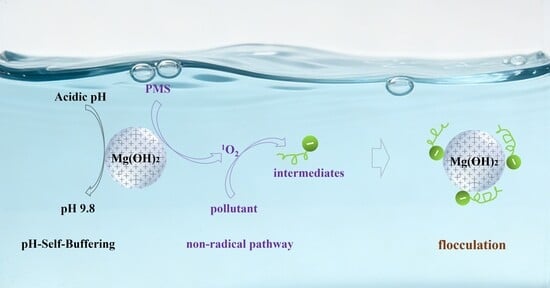
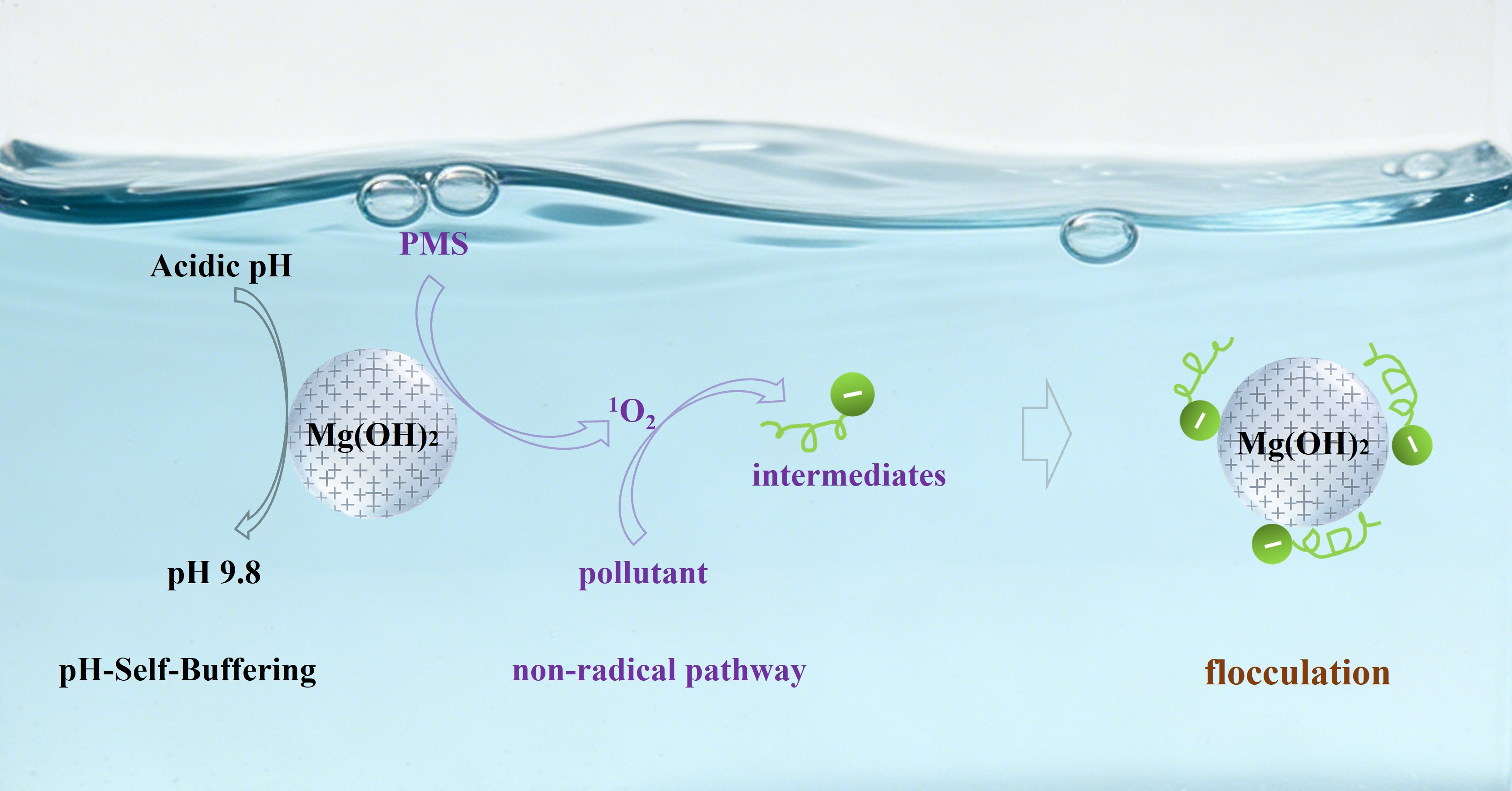
Peroxymonosulfate (PMS)-based advanced oxidation is often hindered by pH instability and the lack of post-reaction separation. Herein, commercial magnesium hydroxide (Mg(OH)2) is introduced as a multifunctional catalyst to address these limitations. Mg(OH)2 effectively catalyzed PMS decomposition via a nonradical pathway dominated by singlet oxygen (1O2) generation, achieving rapid and complete degradation of electron-rich pollutants like bisphenol A (BPA) within 40 min. The system exhibits exceptional pH self-regulation, stabilizing the solution at ~9.8 and maintaining high efficiency across an initial pH range of 3–11. Mechanistic studies confirm 1O2 as the primary reactive species with a steady-state concentration of 1.67 × 10⁻¹² M. The catalyst demonstrates strong resistance to common anions and humic acid, along with excellent stability over four cycles. Furthermore, Mg(OH)2 enables in situ flocculation and removal of degradation products. This work highlights Mg(OH)2 as an efficient, stable, and multifunctional activator, offering a integrated strategy for practical wastewater treatment.

Graphical Abstract

1. Introduction

Clean water is essential for human health and development, often requiring the removal of contaminants from surface water or wastewater [1]. Refractory, low-concentration, and non-biodegradable organic compounds represent a significant class of environmental pollutants [2]. In recent years, peroxymonosulfate (PMS, HSO5)-based advanced oxidation processes (AOPs) have garnered considerable attention for wastewater treatment due to their strong oxidative capacity [3,4]. These systems effectively degrade diverse organic pollutants, including emerging contaminants and recalcitrant waste streams [5]. The oxidation power primarily stems from reactive species generated upon PMS activation, such as sulfate radicals (SO4•−), hydroxyl radicals (•OH), singlet oxygen (1O2), and/or high-valent metals [6,7]. Catalysts, particularly transition metals or carbon-based materials, are typically employed to cleave the peroxide bond in PMS, initiating these reactions [8,9]. The activation mechanism, which proceeds via radical or non-radical pathways (e.g., involving 1O2, high-valent metal-oxo species, or direct electron transfer), critically determines the selectivity and efficiency of the degradation process [10,11,12,13].
To achieve selective pollutant degradation and enhance practical applicability, recent studies have focused on designing heterogeneous catalysts that direct PMS activation toward specific non-radical pathways. For example, Co3O4/carbon nanotubes, biochar-supported vanadiferous magnetite composites, and nitrogen-doped carbon materials have demonstrated the ability to selectively degrade electron-rich organic pollutants via a 1O2-dominated pathway, which offers improved resistance to background matrix interference [14,15,16]. Furthermore, catalysts engineered with distinct surface properties, such as beneficial metal cations, heteroatom doping, oxygen vacancies, or basic sites, have been shown to promote direct electron transfer or the formation of high-valent metal-oxo species, thereby also contributing to selective oxidation processes [17,18,19,20,21]. Despite these advances, many such sophisticated catalyst systems still face challenges including potential metal leaching, a limited operational pH range, and the lack of inherent functionality for separating reaction intermediates or the spent catalyst after use. Therefore, developing robust and multifunctional heterogeneous catalysts that integrate efficient and selective PMS activation with broad pH adaptability and facile separation remains a significant challenge.
A key operational constraint is the inherent acidification of the solution due to H+ release from PMS decomposition, which can impair oxidative efficiency and system stability [22,23]. While various catalysts have been explored to enhance PMS activity across different pH ranges [24,25,26], most systems lack integrated functionality for post-treatment separation. Unlike conventional Fenton processes where Fe3+ hydrolysis facilitates flocculation of degradation products [27], PMS-based AOPs often operate under mildly acidic conditions (around pH 5), hindering the in situ formation of effective flocculants and complicating the removal of reaction intermediates.
Magnesium hydroxide (Mg(OH)2), a naturally occurring alkaline mineral (brucite), features a layered crystal structure composed of Mg2+ ions coordinated with hydroxyl groups [28]. As an engineered nanomaterial, it is widely used in flame retardancy, pharmaceuticals, and materials science owing to its moderate alkalinity, low solubility, stability, and cost-effectiveness [29]. In environmental applications, Mg(OH)2 is commonly employed for pH adjustment, neutralization, and contaminant removal via precipitation and flocculation, leveraging its surface adsorption and charge-neutralization capabilities [30,31,32,33]. Preliminary evidence suggests that surface hydroxyl groups on MgO can activate PMS to generate 1O2, enabling selective degradation of electron-rich organics [34]. We therefore hypothesize that Mg(OH)2 can serve as a multifunctional persulfate activator, capable of simultaneously catalyzing PMS decomposition, buffering the reaction pH, and enhancing the flocculation and removal of degradation products—thus addressing critical gaps in conventional PMS-AOPs.
Herein, we develop and evaluate a novel Mg(OH)2-activated PMS system. This work aims to utilize the inherent alkalinity of Mg(OH)2 to neutralize reaction-induced acidity, thereby stabilizing pH and maintaining high oxidation efficiency. Concurrently, we exploit its flocculation properties to enable the efficient separation and removal of degraded organic products. This innovative catalyst not only improves the oxidation efficiency of PMS but also enables more efficient and environmentally friendly pollutant removal, making it a promising solution for advanced wastewater treatment.

2. Materials and Methods

2.1. Chemicals

Magnesium hydroxide (Mg(OH)2, ~100 nm), peroxymonosulfate (PMS, 2KHSO5·KHSO4·K2SO4, ≥47.0% KHSO5 basis), 5,5-dimethyl-1-pyrroline N-oxide (DMPO), 4-amino-2,2,6,6-tetramethylpiperidine (TEMP), bisphenol A (C15H16O2, BPA), humic acid (HA), p-benzoquinone (BQ), and furfuryl alcohol (FFA) were purchased from Aladdin Chemical Co., Ltd. (Shanghai, China). 4-chlorophenol (4-CP), phenol (BP), rhodamine 6G (Rh6G), tert-butyl alcohol (TBA), and nitrobenzene (NB) were obtained from Sinopharm Chemical Reagent Co., Ltd. (Shanghai, China). Methanol and ethanol were obtained from Tianjin Fu Yu Fine Chemicals Co., Ltd. (Tianjin, China). All chemicals were of analytical grade and used as received. All solutions were prepared using deionized water (18.25 MΩ·cm).

2.2. Catalytic Degradation Experiments

All batch experiments were conducted in the dark at 25 ± 2 °C with magnetic stirring (EMS-40, Shanghai Joyn Electronic Co., Ltd. Shanghai, China). In a typical procedure, 25 mg of Mg(OH)2 catalyst was dispersed into 35 mL of deionized water in a 100 mL conical flask and sonicated for 1 min. Subsequently, 10 mL of a BPA stock solution (25 mg L−1) was added to achieve a final concentration of 22 µM (50 mL total volume). The initial pH was adjusted using 0.1 M NaOH or H2SO4. The suspension was stirred in the dark for 20 min to establish adsorption–desorption equilibrium before initiating the reaction by adding 5 mL of a PMS solution (final concentration: 0.6 mM). At predetermined time intervals, 2 mL aliquots were withdrawn and immediately quenched with 0.5 mL of furfuryl alcohol, then filtered through a 0.22 µm membrane for analysis. Experiments for other pollutants (NB, 4-CP, BP, Rh6G, each at 22 µM) and comparative catalysts (NaOH, Al(OH)3, and Ca(OH)2) followed the same protocol. All experiments were performed in triplicate. The degradation efficiency (DE, %) of pollutants were calculated using Equation (1):
D E   % = C 0 C t C 0 × 100 %
where C0 represents the initial concentration of pollutant (mg/L) and Ct represents its concentration at reaction time t. The value of Ct/C0 represents the ratio of pollutant concentration at time t to its initial concentration (0 min). For reusability tests, the spent catalyst was recovered after each cycle via centrifugation, washed thoroughly with ethanol and deionized water, dried at 60 °C under vacuum, and then reused under identical conditions.

2.3. Analytical Methods and Characterization

The concentration of BPA was quantified by high-performance liquid chromatography (HPLC, ELITE P2201) equipped with a C18 column, using a methanol/water (70:30, v/v) mobile phase at a flow rate of 1.0 mL min−1 and a detection wavelength of 278 nm. The method detection limit for BPA was 0.05 mg L−1. Total organic carbon was measured using a Shimadzu TOC-V CPN analyzer. Residual PMS concentration was determined by a spectrophotometric method at the maximum absorbance peak of 350 nm [35]. Reactive oxygen species were identified by electron paramagnetic resonance (EPR) spectroscopy (JES–X320) using DMPO and TEMP as spin-trapping agents. The crystal structure of the catalyst was characterized by powder X-ray diffraction (XRD, Bruker D8) with Cu Kα radiation (λ = 0.1542 nm). The sizes and morphologies of the samples were characterized by field-emission scanning electron microscopy (FE-SEM, Zeiss Gemini 300, Oberkochen, Germany). Surface elemental composition and chemical states were analyzed by X-ray photoelectron spectroscopy (XPS, Thermo ESCALAB 250XI, Waltham, MA, USA), with binding energies calibrated against the C 1s peak at 284.8 eV. Fourier transform infrared (FT-IR) spectra of the catalysts were obtained using a Bruker VERTEX-70 spectrometer (Billerica, MA, USA). The measurements were performed in the range of 4000 to 400 cm−1 with samples prepared as potassium bromide (KBr) pellets.

3. Results and Discussion

3.1. Characterization of Mg(OH)2

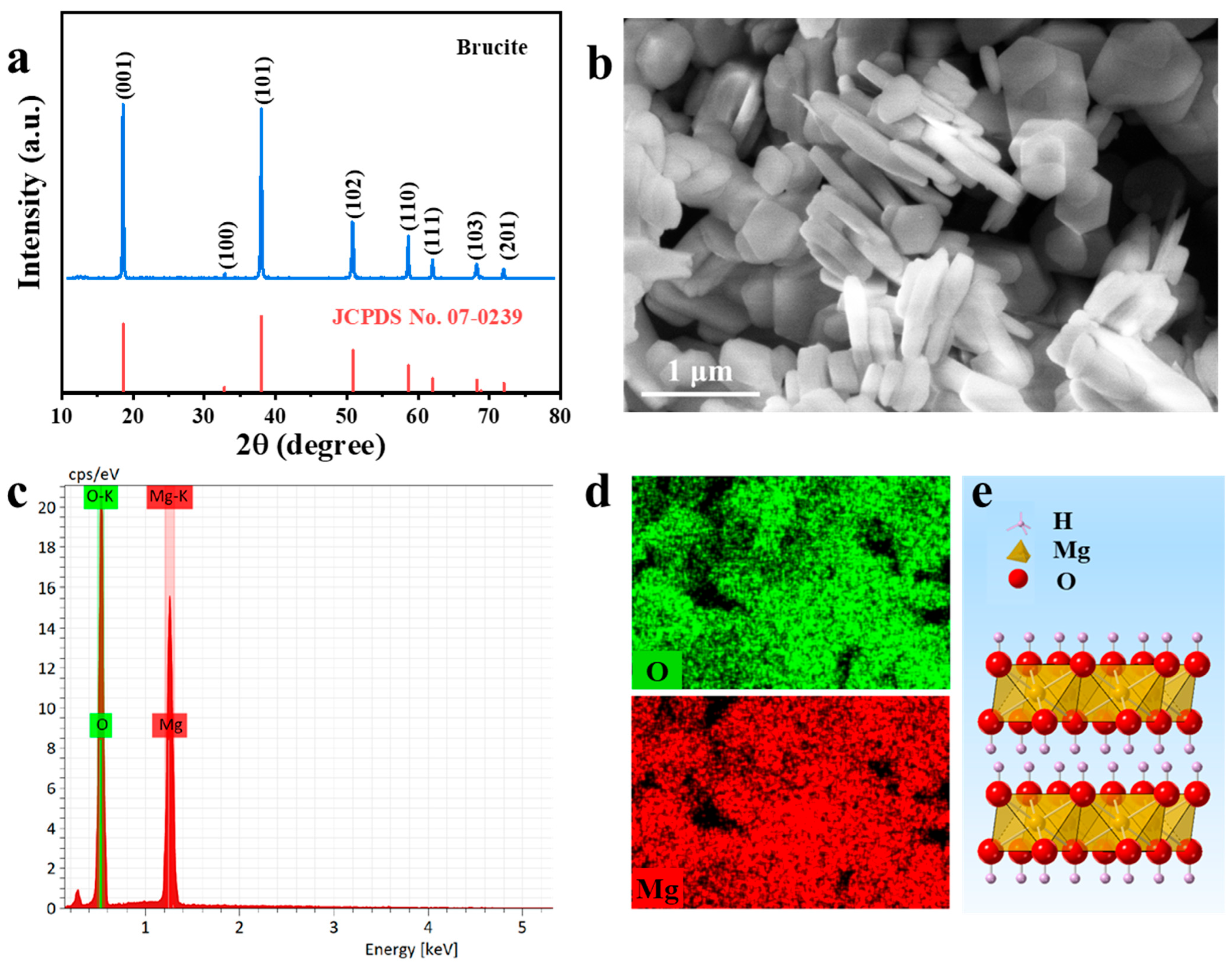
The X-ray diffraction (XRD) pattern of the commercial Mg(OH)2 is presented in Figure 1a. All diffraction peaks can be indexed to the hexagonal brucite structure (space group P-3 m1 (164), JCPDS No. 07-0239), with characteristic reflections at 18.6°, 32.8°, 38.0°, 50.8°, 58.6°, 62.1°, 68.2°, and 72.0°. The calculated lattice parameters were a = b = 3.147 Å and c = 4.769 Å. The sharp diffraction peaks indicate high crystallinity, which was quantitatively estimated to be ~98.74%. No impurity phases were detected, confirming the high phase purity of the Mg(OH)2 sample. The morphology of the Mg(OH)2, characterized by FE-SEM (Figure 1b), shows nanosheets approximately 90 nm thick and 0.6 µm in lateral size. Its elemental composition was determined by EDS, yielding an atomic ratio of 58.18% O and 41.82% Mg (Figure 1c). This composition is corroborated by the corresponding elemental mapping, which confirms the homogeneous distribution of O and Mg across the nanosheets (Figure 1d). Schematic diagram of Mg(OH)2 crystal structure was show in Figure 1e.
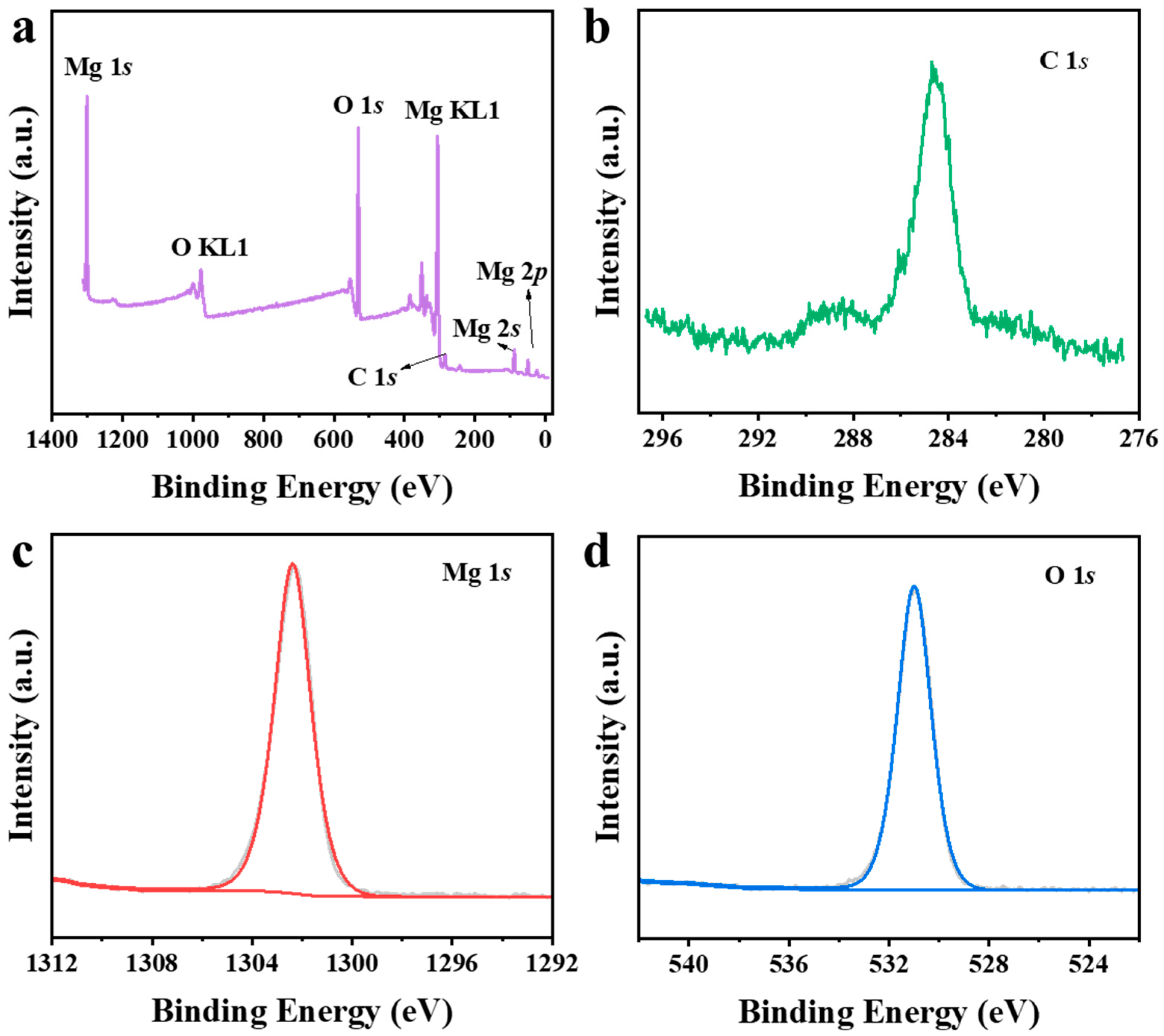
The surface chemical composition was analyzed by X-ray photoelectron spectroscopy (XPS) (Figure 2). The survey spectrum (Figure 2a) shows predominant signals of Mg, O, and C. The C 1s peak at 284.8 eV was used as a charge reference (Figure 2b) [36,37]. The high-resolution Mg 1s spectrum (Figure 2c) exhibits a peak at 1302.4 eV, corresponding to Mg2+ in Mg(OH)2 [38,39]. The O 1s spectrum (Figure 2d) shows a main component at 531.0 eV, attributable to oxygen in hydroxyl groups (–OH) [40]. These results collectively indicate that the surface of the material is predominantly composed of Mg(OH)2.

3.2. Catalytic Performance Evaluation

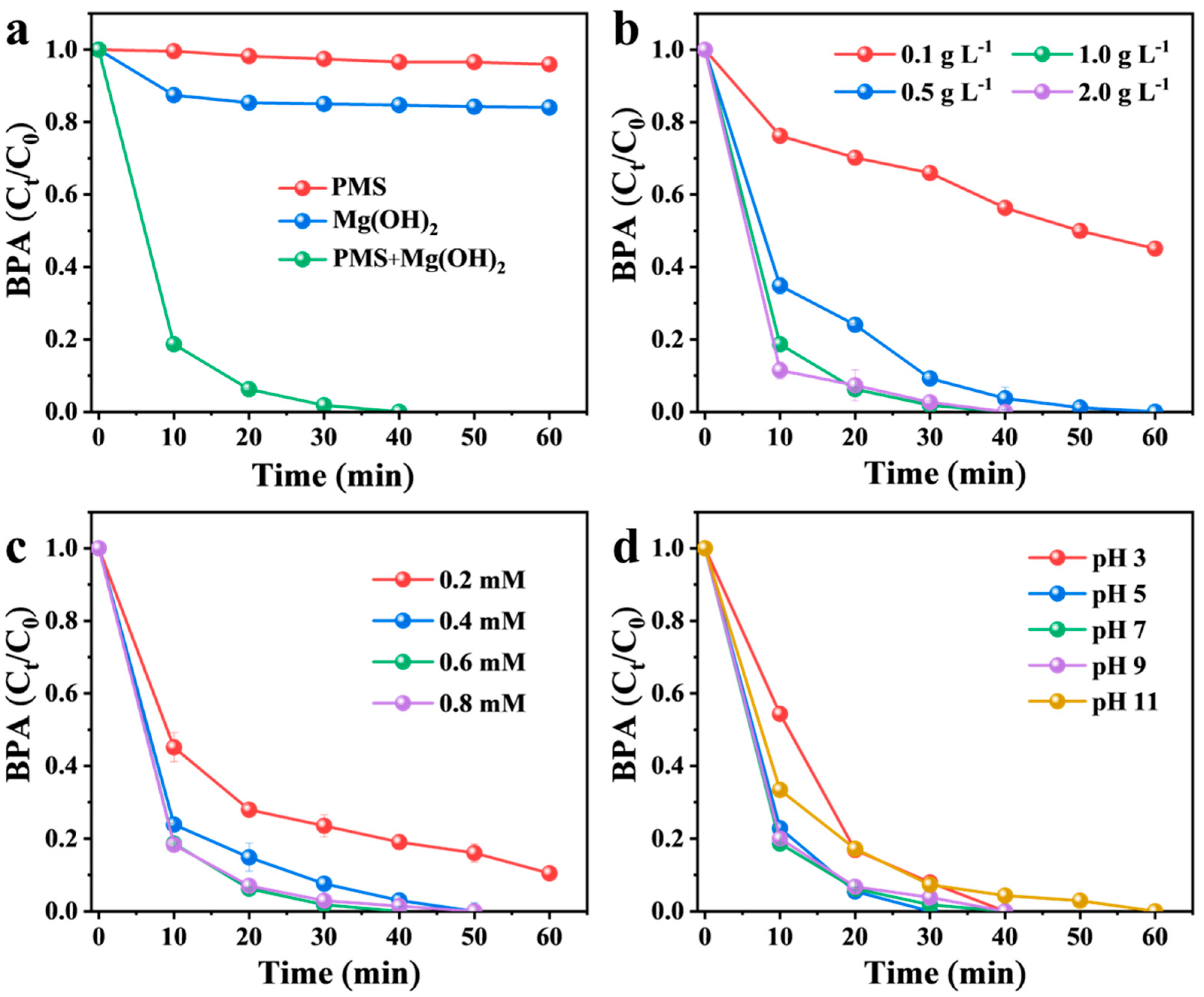
Figure 3a shows that approximately 16% of BPA was adsorbed onto the Mg(OH)2 surface, which may be attributed to the adsorption and flocculation capabilities of Mg(OH)2. In contrast, PMS alone (without catalyst) degraded only about 4% of BPA over 60 min, suggesting its intrinsic oxidizing capacity was negligible. However, in the Mg(OH)2/PMS system, BPA was rapidly degraded, with 82% removal within 10 min and complete elimination achieved within 40 min. Furthermore, a comparative analysis of catalytic performance for PMS activation (Table S1) demonstrates that Mg(OH)2 exhibits competitive, and in some cases enhanced, performance relative to other high-performance catalysts documented for 1O2-mediated BPA degradation.
The effect of catalyst loading is presented in Figure 3b. The dosage of Mg(OH)2 significantly influenced the degradation efficiency of BPA. The degradation performance improved markedly with increasing catalyst loading. Specifically, a low loading of 0.1 g/L achieved only 55% BPA removal after 60 min, while 0.5 g/L enabled complete (100%) degradation within the same timeframe. Further increasing the loading to 1.0 and 2.0 g/L accelerated the process, achieving complete degradation within 50 and 40 min, respectively. This clear positive correlation between the Mg(OH)2 amount and the degradation efficiency indicates that the reaction kinetics were primarily governed by the availability of surface active sites. A higher catalyst dosage provides a greater number of active sites (e.g., surface hydroxyl groups) for activating PMS, thereby enhancing the generation of reactive species and leading to faster and more complete pollutant removal.
As depicted in Figure 3c, PMS concentration also significantly influenced degradation performance. At PMS concentrations below 0.2 mM, complete BPA degradation required more than 60 min. Increasing PMS concentration to 0.4 mM reduced the time required for 100% BPA removal to 50 min, which can be attributed to enhanced generation of reactive species, thereby increasing the probability of attack on BPA molecules and accelerating degradation kinetics [41]. Further increasing PMS concentration to 0.6 mM and 0.8 mM continued to improve degradation rates; however, no further kinetic enhancement was observed at 0.8 mM compared to 0.6 mM, likely due to saturation of reactive species or scavenging effects at elevated oxidant levels [42].
Solution pH is a critical parameter affecting both catalyst speciation and PMS activation. Figure 3d presents the BPA degradation profiles in the Mg(OH)2/PMS under different initial pH conditions. Notably, complete BPA removal was achieved within 60 min across a broad initial pH range of 3–11. Although solution pH typically governs PMS activation, the degradation efficiency of the Mg(OH)2/PMS system remained largely unaffected by varying the initial pH from 3 to 11. This pH-independent performance is attributed to the buffering effect of Mg(OH)2, which stabilized the solution pH at approximately 9.8 upon its addition regardless of the initial acid value [43]. It is noteworthy that complete BPA degradation was sustained even under alkaline conditions, demonstrating remarkable insensitivity to pH variation. Such pH-independent behavior, commonly associated with nonradical oxidation pathways, represents a distinct advantage of the Mg(OH)2/PMS system over many conventional catalysts that exhibit strong pH-dependent activity. Based on these results, a catalyst dosage of 1 g/L and a PMS concentration of 0.6 mM were selected for all subsequent experiments.

3.3. Possible Activation Mechanism

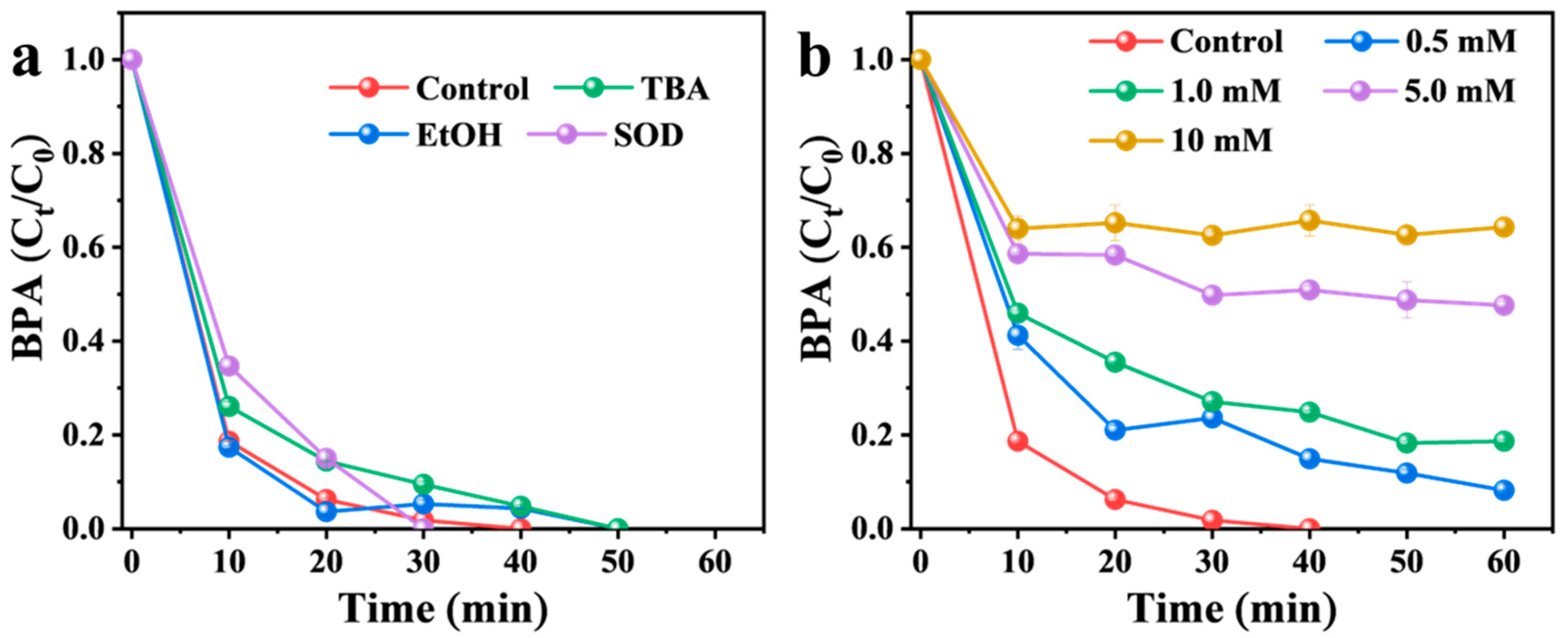
Quenching experiments were conducted to identify the reactive species generated in the Mg(OH)2/PMS system. Ethanol (EtOH) and tert-butyl alcohol (TBA) were employed as scavengers to probe the potential roles of •OH and SO4•−, respectively [44,45]. As shown in Figure 4a, the degradation of BPA was not significantly suppressed upon the addition of excess EtOH or TBA, suggesting limited contributions from these radical species. To examine the involvement of superoxide radical (O2•−), superoxide dismutase (SOD, 500 U mL−1) was introduced as a selective quencher [46]. The degradation efficiency of BPA remained nearly unchanged, indicating that O2•− did not play a major role in the reaction. Furthermore, furfuryl alcohol (FFA, 0.5–10 mM) was used as a selective scavenger to evaluate the non-radical pathway involving singlet oxygen (1O2), based on its high and specific reaction rate with 1O2 (k = 1.2 × 10⁸ M−1 s−1) as reported in the literature [12,47]. As depicted in Figure 4b, the addition of FFA markedly inhibited BPA degradation in a concentration-dependent manner. When the FFA concentration increased from 0.5 to 10 mM, the degradation efficiency was progressively suppressed, with 10 mM FFA reducing it from 100% to 35% within 40 min. This result confirms that 1O2 serves as a crucial non-radical reactive species responsible for BPA degradation in the Mg(OH)2/PMS system.
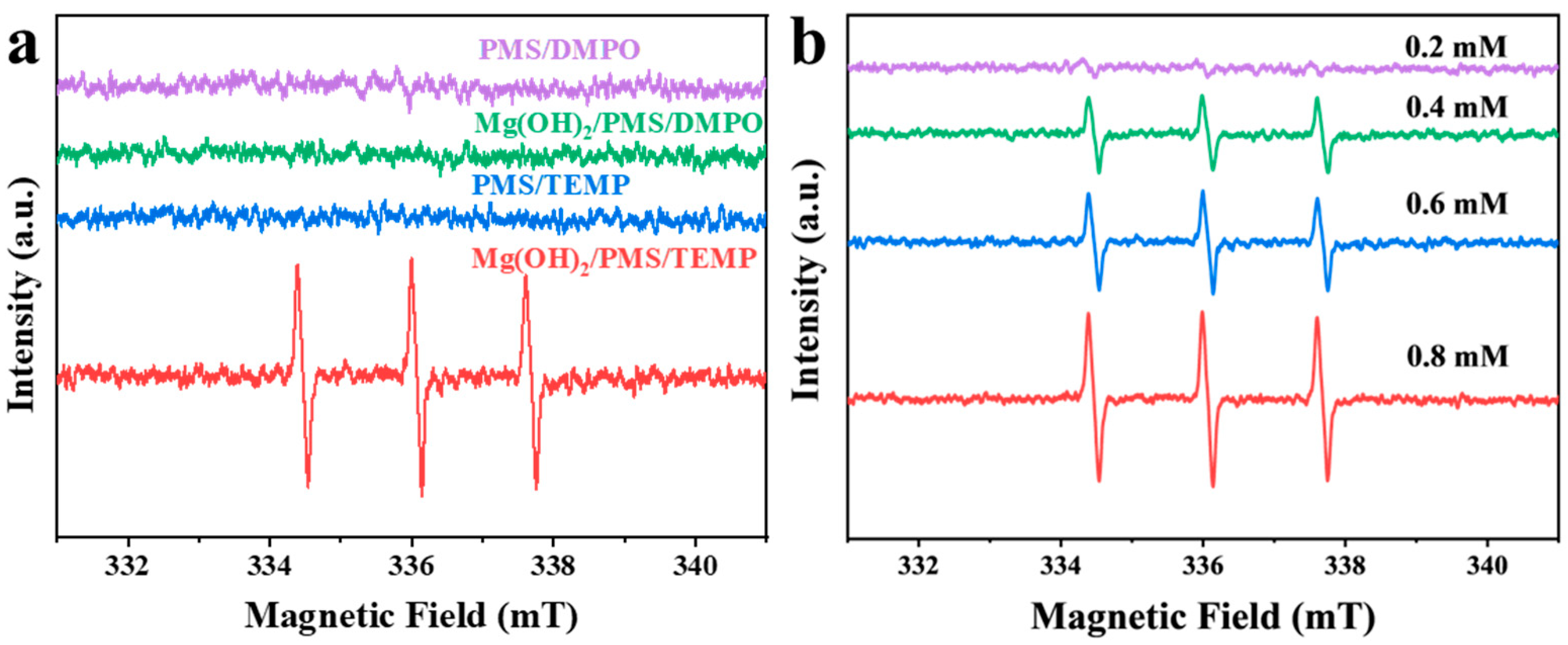
To elucidate the active species involved in the Mg(OH)2/PMS system, electron paramagnetic resonance (EPR) spectroscopy was carried out using 5,5-dimethyl-1-pyrroline N-oxide (DMPO) and 2,2,6,6-tetramethylpiperidine (TEMP) as spin-trapping agents [48]. DMPO was first employed to probe the generation of radical species, including •OH, SO4•−, and O2•−. As shown in Figure 5a, no characteristic signals were detected in the Mg(OH)2/PMS/DMPO system, indicating that these radicals were not produced—a finding consistent with the results of the quenching experiments. When TEMP was used as the trapping reagent for 1O2, a distinct triplet signal with intensity corresponding to that of TEMP–1O2 adduct was observed (Figure 5b). The signal intensity increased with higher PMS dosage, suggesting that more PMS participated in the catalytic reaction to generate 1O2, thereby enhancing pollutant degradation. This trend aligns well with the degradation performance shown in Figure 3c.
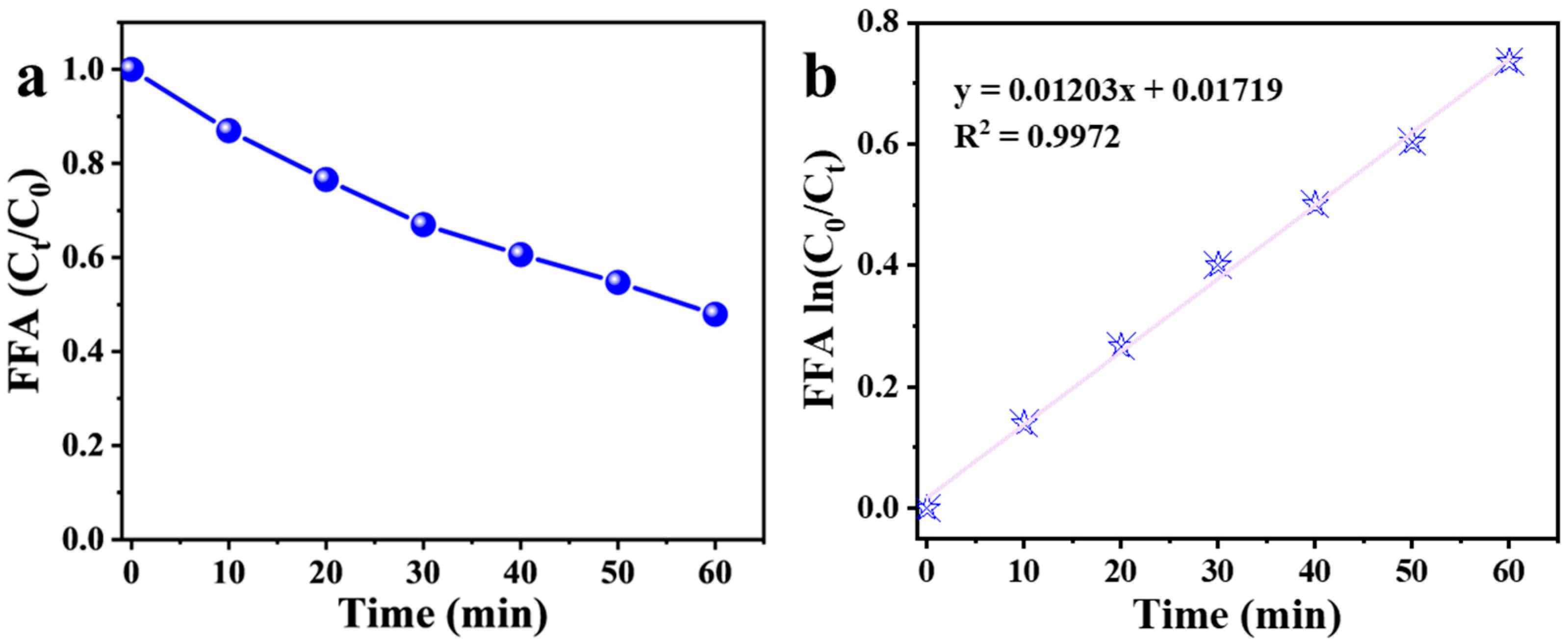
To further quantify the steady-state concentration of 1O2 ([1O2]SS), FFA was employed as a selective probe following established methods (Figure 6a) [49,50]. The decay of FFA followed pseudo-first-order kinetics, as evidenced by the linear relationship between ln[C0]/[Ct] and reaction time under steady-state 1O2 conditions (Figure 6b). The slope of this linear plot was divided by the second-order rate constant for the reaction between 1O2 and FFA (1.2 × 10⁸ M−1 s−1) to determine [1O2]SS. Based on the kinetic data obtained in the absence of FFA, the calculated steady-state concentration of 1O2 was 1.67 × 10⁻¹² M.
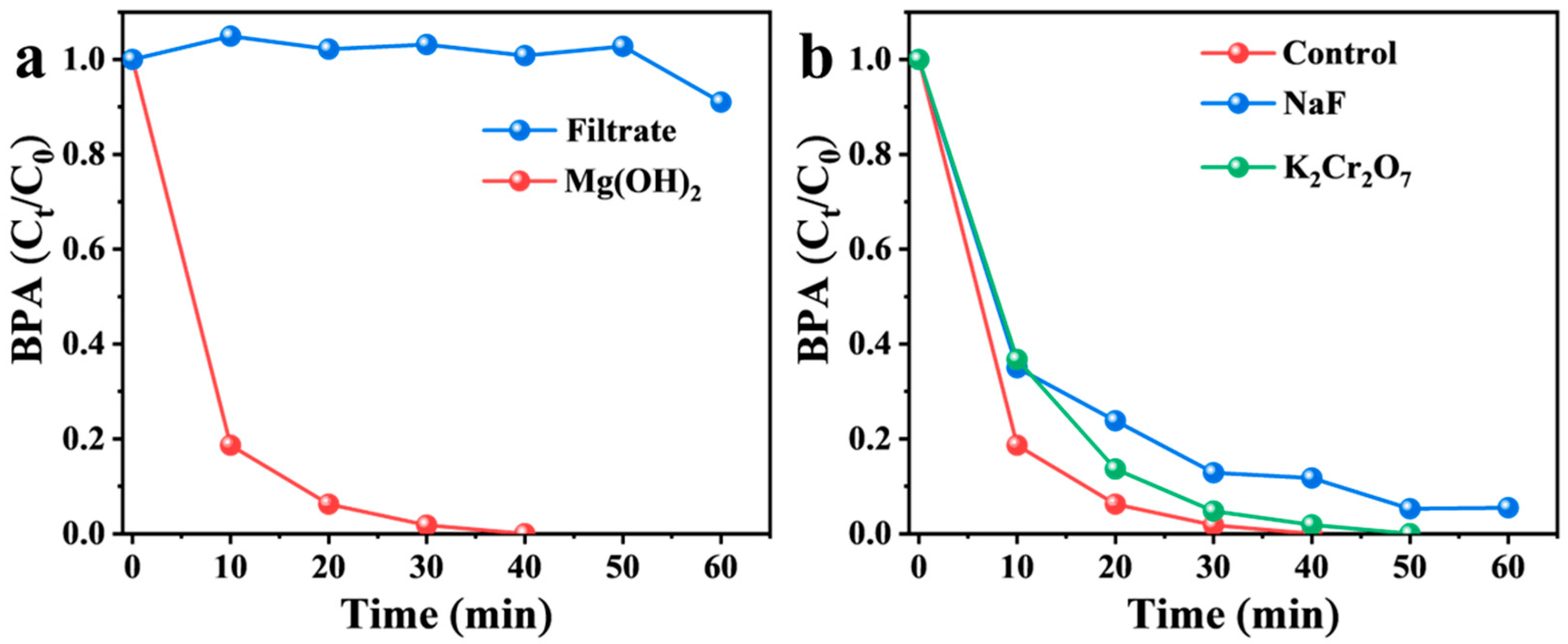
As shown in Figure 7a, negligible BPA degradation was observed in the filtrate of the Mg(OH)2 suspension, indicating that the solid Mg(OH)2 phase, rather than leached magnesium ions or homogeneous OH, played the dominant catalytic role. In PMS activation systems, direct electron transfer and 1O2 oxidation are two predominant non-radical pathways for pollutant degradation. To probe the potential contribution of electron transfer, potassium dichromate (K2Cr2O7) was employed as an effective quencher [51]. The degradation efficiency of BPA showed no significant decrease upon the addition of K2Cr2O7 (Figure 7b), suggesting that an electron-transfer process did not govern the reaction in the Mg(OH)2/PMS system. Collectively, these results demonstrate that 1O2 acts as the primary reactive species responsible for BPA degradation.
To elucidate the formation mechanism of 1O2, the influence of sodium fluoride (NaF) on the degradation process was evaluated. Based on previous reports, 1O2 generation in such systems is often attributed to surface hydroxyl groups ( OH), which can form hydrogen bonds with the –OH moiety of HSO5 [52,53]. The interaction between two adjacent HSO5 molecules leads to the formation of a peroxydisulfate-like intermediate, (SO4O)22−, which subsequently decomposes rapidly into 1O2 and sulfate ions (Equations (2) and (3)) [34]. To verify whether this pathway operates in the present system, NaF was introduced. Fluoride ions (F) are known to strongly interact with surface −OH groups via hydrogen bonding (e.g., −OHads⋯F), thereby displacing or passivating these active sites [54,55]. As shown in Figure 7b, the addition of F significantly suppressed BPA degradation. This result strongly supports the conclusion that surface hydroxyl groups on Mg(OH)2 are essential for activating PMS to generate 1O2, confirming the proposed mechanism.
2 H S O 5 + 2 O H S O 4 O 2 2 + 2 H 2 O
S O 4 O 2 2 2 S O 4 2 + O 2 1
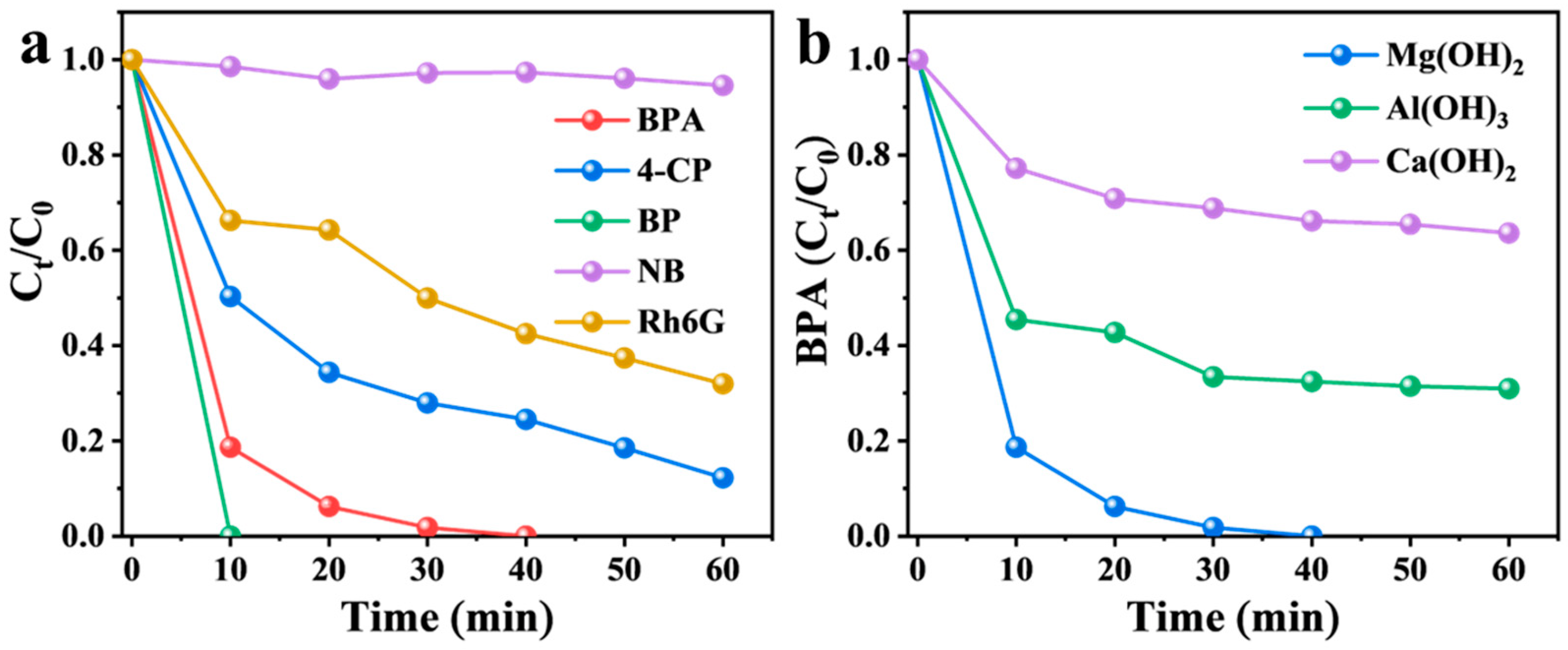
As shown in Figure 8a, phenol (BP) was completely degraded within 10 min in the Mg(OH)2/PMS system, whereas the degradation efficiencies for 4-chlorophenol (4-CP) and rhodamine 6G (Rh6G) reached 88% and 68%, respectively, after 60 min. In contrast, nitrobenzene (NB) was barely degraded under the same conditions. These results indicate that the Mg(OH)2/PMS system is effective for degrading various electron-rich phenolic contaminants, while exhibiting limited activity toward electron-deficient compounds. Furthermore, Al(OH)3 and Ca(OH)2, which share a similar crystalline structure with Mg(OH)2, were evaluated as catalysts under identical conditions. As shown in Figure 8b, the BPA degradation efficiencies obtained with Al(OH)3 and Ca(OH)2 were 69% and 36%, respectively, demonstrating that the catalytic performance is strongly dependent on the metal center, likely due to differences in surface hydroxyl density.

3.4. Evaluation of Flocculation Performance

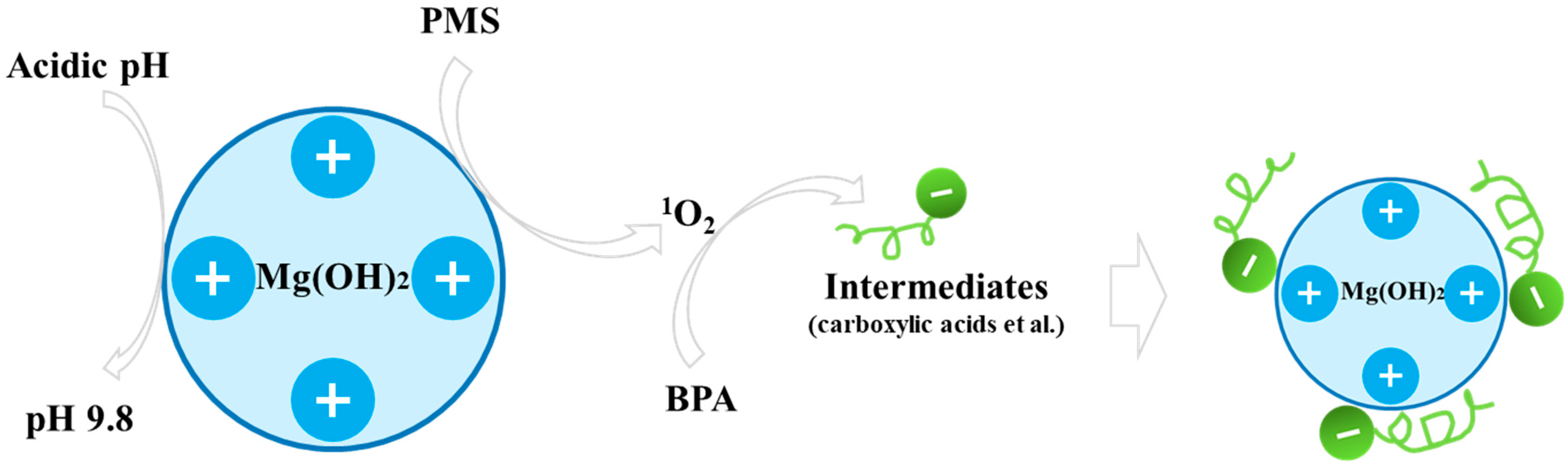
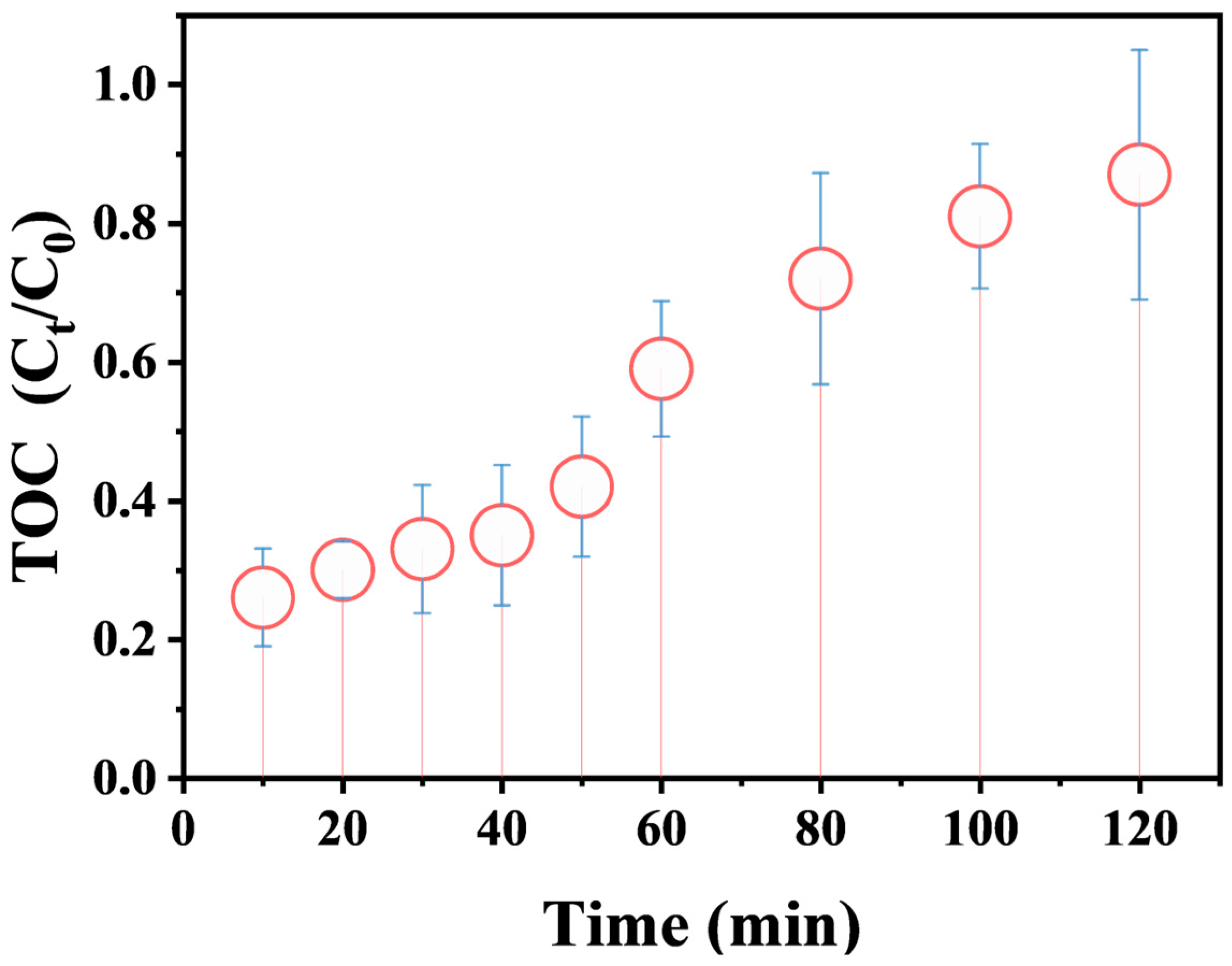
To quantitatively assess the flocculation performance, the variation in total organic carbon (TOC) of the supernatant was monitored during the reaction process (Figure 9). Although BPA was completely degraded within 40 min, the TOC removal at this point was only ~35%. As the reaction time was extended to 120 min, the TOC removal rate steadily increased to ~87%. This confirms that the flocculation primarily targets the generated intermediates rather than the parent BPA. The proposed flocculation mechanism involves the oxidation of BPA to hydrophilic acidic intermediates (e.g., acetic, oxalic, formic, propanedioic, or succinic acids) [56,57,58] by Mg(OH)2-activated PMS (primarily via 1O2), their subsequent dissociation into anions (e.g., R-COO) under the buffered alkaline conditions, adsorption onto positively charged Mg(OH)2 colloids and Mg2+ via electrostatic/coordinative interactions, and final removal through sweep flocculation and sedimentation (Figure 10) [32]. Thus, Mg(OH)2 acts as a dual-functional catalyst-flocculant, enabling an integrated oxidation-flocculation strategy that enhances overall decontamination and simplifies solid–liquid separation.

3.5. Effect of Common Matrix Species

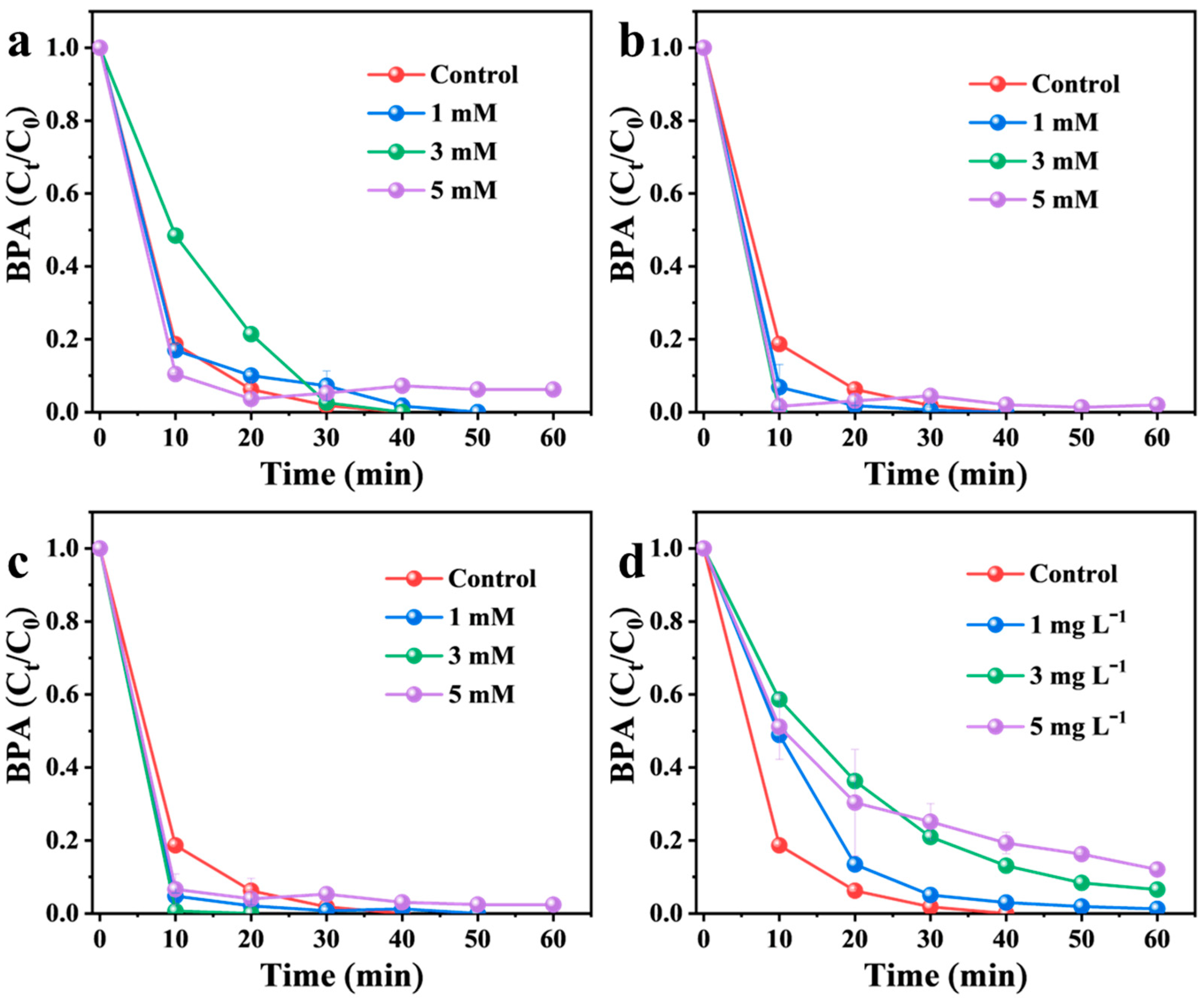
To evaluate the practical applicability of the present catalyst, the effects of common water matrix components, humic acid (HA) and inorganic anions (such as Cl, CO32−, and HCO3) on BPA degradation were investigated under the standard reaction conditions (pH ~9.8, after added Mg(OH)2) (Figure 11). Inorganic anions, which are ubiquitous in natural waters, often significantly influence reactive oxygen species and thus pollutant removal. As shown in Figure 11a, increasing the Cl concentration from 1 to 5 mM had almost no effect on BPA degradation in the Mg(OH)2/PMS system. Similarly, the presence of 1–5 mM CO32− or HCO3 did not cause significant inhibition of BPA removal (Figure 11b,c). It should be noted that at the system pH of ~9.8, the dominant inorganic carbon species is bicarbonate (HCO3), with a minor fraction as carbonate (CO32−). The added salts equilibrate accordingly within the buffered medium. These results highlight a distinct advantage of the 1O2-dominated non-radical pathway: its strong resistance to interference from common inorganic anions in real water matrices.
Humic acid (HA), containing abundant carboxyl and hydroxyl groups, can typically inhibit degradation processes by occupying metal active sites or scavenging radicals [59]. However, as shown in Figure 11d, BPA degradation efficiency remained largely unaffected even in the presence of 1–5 mg L−1 HA. This contrasts with the pronounced inhibition often reported for transition-metal-based catalysts [54,60,61]. The observed inertness likely stems from the abundant surface −OH groups on Mg(OH)2, which prevent direct binding between highly deprotonated HA and Mg(II) sites, thereby preserving the catalytic activity [34]. Furthermore, the catalytic action proceeds via surface hydroxyl groups activating PMS to generate 1O2, a pathway for which HA presents minimal competition or scavenging. Collectively, these findings demonstrate that PMS activation via surface hydroxyl groups to generate 1O2 offers superior robustness against both organic and inorganic interferences compared to conventional transition-metal-driven radical pathways.

3.6. Reusability and Stability of Mg(OH)2

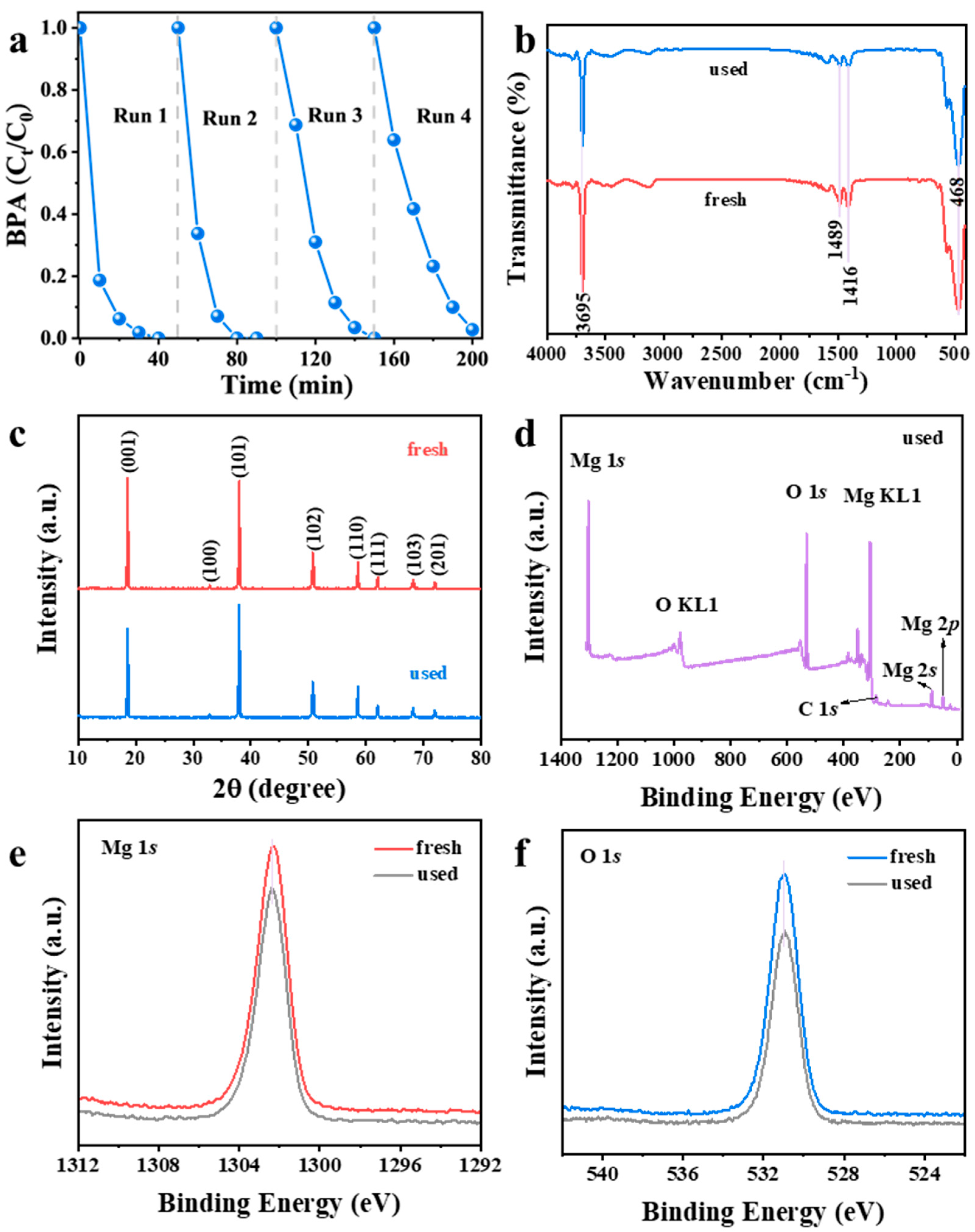
The reusability of Mg(OH)2 was evaluated over four consecutive catalytic cycles. After each run, the spent catalyst was recovered via centrifugation, thoroughly washed with ethanol and deionized water, and dried under vacuum before reuse under identical conditions. As shown in Figure 12a, the catalyst maintained excellent performance, achieving a BPA degradation efficiency of 98% even in the fourth run. FTIR analysis (Figure 12b) confirmed the integrity of the catalyst’s chemical structure after reuse, with all characteristic peaks—including the O–H stretching vibration (~3698 cm–1), the bands in the 1400–1500 cm–1 region, and the broad Mg–O/O–H bending band (400–600 cm–1)—remaining unchanged. Notably, the absence of new absorption peaks indicates no formation of additional functional groups and, importantly, no persistent adsorption of reaction intermediates or products on the catalyst surface after washing. The structural and chemical stability was further confirmed by material characterization. The XRD pattern of the used catalyst (Figure 12c) remained identical to that of the fresh Mg(OH)2, confirming the preservation of its hexagonal brucite structure. XPS analysis provided additional evidence of stability. The XPS survey scan of the used Mg(OH)2 (Figure 12d) displayed predominant peaks for Mg, O, and C, with the latter assigned to adventitious carbon used for binding energy calibration. The high-resolution Mg 1s spectrum (Figure 12e) displayed a peak at 1302.4 eV, corresponding to Mg2+ in Mg(OH)2, while the O 1s spectrum (Figure 12f) showed a dominant peak at 531.0 eV, attributable to oxygen in hydroxyl groups (–OH). Both spectral features were unchanged compared to the pristine catalyst. These results collectively demonstrate the outstanding reusability and structural integrity of Mg(OH)2 in the PMS activation process.

4. Conclusions

In summary, this study demonstrates that Mg(OH)2 serves as an effective catalyst for PMS activation through a nonradical pathway predominantly involving 1O2 generation. The system achieves rapid and complete degradation of electron-rich pollutants such as BPA within 40 min while exhibiting exceptional pH self-regulation, stabilizing the solution at ~9.8 and maintaining high catalytic efficiency across a broad initial pH range (3–11). The Mg(OH)2 catalyst exhibits outstanding performance in PMS activation, primarily driven by its surface hydroxyl groups. The system presents several notable practical advantages: (1) inherent pH-buffering capacity that ensures robust catalytic activity over a wide pH range, overcoming a key limitation in conventional PMS-based processes; (2) substrate-selective oxidation, enabling rapid degradation of electron-rich contaminants while demonstrating resilience toward electron-poor compounds and common matrix interferents (e.g., inorganic anions and natural organic matter); (3) integrated flocculation functionality, facilitating the aggregation and removal of oxidation intermediates; and (4) excellent structural and chemical stability over repeated cycles, highlighting its reusability. Beyond elucidating a surface hydroxyl-mediated nonradical activation mechanism, this work establishes Mg(OH)2 as a low-cost, stable, and multifunctional material. The findings provide a novel strategy for designing advanced oxidation systems that simultaneously enhance catalytic efficiency, operational stability, and post-treatment management, offering significant potential for sustainable wastewater treatment applications.

Supplementary Materials

The following supporting information can be downloaded at: https://www.mdpi.com/article/10.3390/nano16030166/s1, Table S1: Comparison of catalytic performance of Mg(OH)2 with other catalysts on PMS activation for BPA degradation by 1O2 process. References [62,63,64,65,66,67,68,69,70,71,72] are cited in the supplementary materials.

Author Contributions

Y.Z., writing—original draft, methodology, visualization, and investigation; C.Z., methodology and validation; Z.L., methodology and investigation; D.K., visualization and formal analysis; L.K., supervision, formal analysis, investigation, writing—review and editing, and funding acquisition. All authors have read and agreed to the published version of the manuscript.

Funding

This research was funded by the Open Project of Shandong Engineering Research Center for Environmental Protection and Remediation on Groundwater (grant number: 801KF2023-10) and the Youth Innovation Team Development Project of Shandong universities (No. 2023KJ297).

Data Availability Statement

The original contributions presented in this study are included in the article/Supplementary Material. Further inquiries can be directed to the corresponding author.

Conflicts of Interest

The authors declare no conflicts of interest.

References

  1. Catalyst for clean drinking water. Nature 2016, 531, 11. [CrossRef]
  2. Li, Y.; Dong, H.; Li, L.; Tang, L.; Tian, R.; Li, R.; Chen, J.; Xie, Q.; Jin, Z.; Xiao, J.; et al. Recent advances in waste water treatment through transition metal sulfides-based advanced oxidation processes. Water Res. 2021, 192, 116850. [Google Scholar] [CrossRef]
  3. Chen, F.; Huang, X.-T.; Bai, C.-W.; Zhang, Z.-Q.; Duan, P.-J.; Sun, Y.-J.; Chen, X.-J.; Zhang, B.-B.; Zhang, Y.-S. Advancements in heterogeneous activation of persulfates: Exploring mechanisms, challenges in organic wastewater treatment, and innovative solutions. Chem. Eng. J. 2024, 481, 148789. [Google Scholar] [CrossRef]
  4. Nidheesh, P.V.; Divyapriya, G.; Ezzahra Titchou, F.; Hamdani, M. Treatment of textile wastewater by sulfate radical based advanced oxidation processes. Sep. Purif. Technol. 2022, 293, 121115. [Google Scholar] [CrossRef]
  5. Liang, C.; Yin, S.; Huang, P.; Yang, S.; Wang, Z.; Zheng, S.; Li, C.; Sun, Z. The critical role of minerals in persulfate-based advanced oxidation process: Catalytic properties, mechanism, and prospects. Chem. Eng. J. 2024, 482, 148969. [Google Scholar] [CrossRef]
  6. Wang, Z.; Qiu, W.; Pang, S.-y.; Guo, Q.; Guan, C.; Jiang, J. Aqueous Iron(IV)–Oxo Complex: An Emerging Powerful Reactive Oxidant Formed by Iron(II)-Based Advanced Oxidation Processes for Oxidative Water Treatment. Environ. Sci. Technol. 2022, 56, 1492–1509. [Google Scholar] [CrossRef]
  7. Kong, L.; Liu, G.; Liu, Y.; Cai, B.; Zhan, S.; Zhan, J. A bioinspired iron-peroxy species of feroxyhyte for micropollutants oxidation with ultrahigh peroxymonosulfate utilization efficiency. Chem. Eng. J. 2024, 480, 148084. [Google Scholar] [CrossRef]
  8. Kong, L.; Zhu, M.; Zhan, J. Nitrogen-Doped Biochar Aerogel as Efficient Peroxymonosulfate Activator for Organic Pollutant Removal. Nanomaterials 2025, 15, 865. [Google Scholar] [CrossRef]
  9. Oyekunle, D.T.; Gendy, E.A.; Ifthikar, J.; Chen, Z. Heterogeneous activation of persulfate by metal and non-metal catalyst for the degradation of sulfamethoxazole: A review. Chem. Eng. J. 2022, 437, 135277. [Google Scholar] [CrossRef]
  10. Fang, Q.; Yang, H.; Ye, S.; Zhang, P.; Dai, M.; Hu, X.; Gu, Y.; Tan, X. Generation and identification of 1O2 in catalysts/peroxymonosulfate systems for water purification. Water Res. 2023, 245, 120614. [Google Scholar] [CrossRef] [PubMed]
  11. Anipsitakis, G.P.; Dionysiou, D.D. Degradation of Organic Contaminants in Water with Sulfate Radicals Generated by the Conjunction of Peroxymonosulfate with Cobalt. Environ. Sci. Technol. 2003, 37, 4790–4797. [Google Scholar] [CrossRef]
  12. Yun, E.-T.; Lee, J.H.; Kim, J.; Park, H.-D.; Lee, J. Identifying the Nonradical Mechanism in the Peroxymonosulfate Activation Process: Singlet Oxygenation Versus Mediated Electron Transfer. Environ. Sci. Technol. 2018, 52, 7032–7042. [Google Scholar] [CrossRef]
  13. Cao, Y.; Wang, Z.; He, S.; Shi, L.; Guo, K.; Fang, J. Reinvestigation on High-Valent Cobalt for the Degradation of Micropollutants in the Co(II)/Peroxymonosulfate System: Roles of Co(III). Environ. Sci. Technol. 2024, 58, 3564–3575. [Google Scholar] [CrossRef]
  14. Zhang, C.; Chen, L.; Luo, H.; Weng, H.; Qin, F.; Qin, D.; Huang, D. Selective micropollutants removal in wastewaters by non-radical activation of peroxymonosulfate: Multiparameter analysis of electron-donating capacity. Appl. Catal. B Environ. Energy 2025, 362, 124695. [Google Scholar] [CrossRef]
  15. Zhu, G.; Tan, W.; Gu, T.; Ji, Y.; Xu, Q.; Yang, J.; Zhu, M. Mechanism of peroxymonosulfate activation by vanadiferous magnetite-biochar composite catalyst: An investigation into the pathway of singlet oxygen generation. Chem. Eng. J. 2025, 514, 163239. [Google Scholar] [CrossRef]
  16. Xie, H.; Zhang, X.; Jia, X.; Xu, D.; Wu, Z.; Li, F.; Yao, W.; Zhang, Y. Synthesis of nitrogen-rich porous carbon via a molecular confinement strategy for activating peroxymonosulfate in bisphenol A degradation: Role of singlet oxygen and electron transfer process. Sep. Purif. Technol. 2025, 354, 129237. [Google Scholar] [CrossRef]
  17. Tan, J.; Chang, L.; Zhang, X.; Chai, H.; Huang, Y. Radical to non-radical conversion during PMS activation triggered by optimized electronic structure: Orientational regulation of oxidation pathway for water remediation. Sep. Purif. Technol. 2025, 357, 130034. [Google Scholar] [CrossRef]
  18. Zhou, Q.; Lu, D.; Zhang, H.; Lu, J.; He, M.; Sun, Y.; Wang, W.; Chen, X.; Zhang, Y.; Ma, J. Positive effect of metal cations on direct electron transfer-based CoAl-NC activated peroxymonosulfate oxidation: Key role of hydration layer. Appl. Catal. B Environ. Energy 2025, 378, 125621. [Google Scholar] [CrossRef]
  19. Su, R.; Ma, Y.; Liu, L.; Wu, Q.; Fu, D.; Li, Y.; Lin, H.; Wei, X.; Siddique, M.S.; Chen, J.; et al. Strengthening peroxymonosulfate activation via cotton-derived carbon: Pathway transformation from radical to non-radical. J. Clean. Prod. 2025, 486, 144548. [Google Scholar] [CrossRef]
  20. Ma, J.; Zhang, S.; Shi, X.; Dai, L.; Liu, Z.; Liu, X.; Lu, X.; Jiang, Z. Highly Efficient Degradation of Bisphenol A by Peroxymonosulfate Activation Using Bamboo Kraft Lignin Single-Atom Catalyst. Small 2025, 21, 2409803. [Google Scholar] [CrossRef] [PubMed]
  21. Zhang, Z.; Xiong, T.; Peng, H.; Zhang, H.; He, S.; Liu, X.; Liu, Y.; Feng, W.; Yang, Z.; Xiong, W. Optimization of Fenton-like reaction pathways using Ov-containing ZnO@nitrogen-rich porous carbon: The electron transfer and 1O2 triggered non-radical process. Environ. Sci. Nano 2025, 12, 936–947. [Google Scholar] [CrossRef]
  22. Ricardo, I.A.; Marson, E.O.; Paniagua, C.E.S.; Macuvele, D.L.P.; Starling, M.C.V.M.; Pérez, J.A.S.; Trovó, A.G. Microcontaminants degradation in tertiary effluent by modified solar photo-Fenton process at neutral pH using organic iron complexes: Influence of the peroxide source and matrix composition. Chem. Eng. J. 2024, 487, 150505. [Google Scholar] [CrossRef]
  23. Fan, J.; Lei, J.; Sun, S.-P. Efficacy, mechanism and stability of Fe/Cu bimetallic oxide anchoring on Al2O3 ceramic membrane in activating peroxymonosulfate for carbamazepine degradation at neutral pH. J. Membr. Sci. 2025, 736, 124664. [Google Scholar] [CrossRef]
  24. Chen, H.; Li, L.; Zhang, Y. Novel construction of the catalyst from red mud by the pyrolysis reduction of glucose for the peroxymonosulfate-induced degradation of m-cresol. Water Sci. Technol. 2022, 86, 2106–2123. [Google Scholar] [CrossRef] [PubMed]
  25. Chen, S.; Sun, Y.; Xu, T.; Ding, Q.; Jia, Y.; Li, H.; Li, X. Construction of LaFeO3 loaded nitrogen-doped biochar for enhanced removal of tetracycline via ultrasonication-induced peroxymonosulfate activation process. Colloids Surf. A Physicochem. Eng. Asp. 2025, 723, 137315. [Google Scholar] [CrossRef]
  26. Ma, M.; Chen, L.; Zhao, J.; Liu, W.; Ji, H. Efficient activation of peroxymonosulfate by hollow cobalt hydroxide for degradation of ibuprofen and theoretical study. Chin. Chem. Lett. 2019, 30, 2191–2195. [Google Scholar] [CrossRef]
  27. Han, X.; Lu, H.; Gao, Y.; Chen, X.; Yang, M. The role of in situ Fenton coagulation on the removal of benzoic acid. Chemosphere 2020, 238, 124632. [Google Scholar] [CrossRef]
  28. Balducci, G.; Bravo Diaz, L.; Gregory, D.H. Recent progress in the synthesis of nanostructured magnesium hydroxide. CrystEngComm 2017, 19, 6067–6084. [Google Scholar] [CrossRef]
  29. Pilarska, A.A.; Klapiszewski, Ł.; Jesionowski, T. Recent development in the synthesis, modification and application of Mg(OH)2 and MgO: A review. Powder Technol. 2017, 319, 373–407. [Google Scholar] [CrossRef]
  30. Liu, X.; Song, K.; Liu, W.; Xiong, Y.; Xu, Y.; Shi, Z.; Zhao, D.; Lin, Z. Removal and recovery of Pb from wastewater through a reversible phase transformation process between nano-flower-like Mg(OH)2 and soluble Mg(HCO3)2. Environ. Sci. Nano 2019, 6, 467–477. [Google Scholar] [CrossRef]
  31. Liu, W.; Huang, F.; Wang, Y.; Zou, T.; Zheng, J.; Lin, Z. Recycling Mg(OH)2 Nanoadsorbent during Treating the Low Concentration of CrVI. Environ. Sci. Technol. 2011, 45, 1955–1961. [Google Scholar] [CrossRef]
  32. Li, H.; Liu, S.; Zhao, J.; Feng, N. Removal of reactive dyes from wastewater assisted with kaolin clay by magnesium hydroxide coagulation process. Colloids Surf. A Physicochem. Eng. Asp. 2016, 494, 222–227. [Google Scholar] [CrossRef]
  33. Wang, K.; Zhao, J.; Li, H.; Zhang, X.; Shi, H. Removal of cadmium (II) from aqueous solution by granular activated carbon supported magnesium hydroxide. J. Taiwan Inst. Chem. Eng. 2016, 61, 287–291. [Google Scholar] [CrossRef]
  34. Kong, L.; Fang, G.; Xi, X.; Wen, Y.; Chen, Y.; Xie, M.; Zhu, F.; Zhou, D.; Zhan, J. A novel peroxymonosulfate activation process by periclase for efficient singlet oxygen-mediated degradation of organic pollutants. Chem. Eng. J. 2021, 403, 126445. [Google Scholar] [CrossRef]
  35. Wacławek, S.; Grübel, K.; Černík, M. Simple spectrophotometric determination of monopersulfate. Spectrochim. Acta Part A Mol. Biomol. Spectrosc. 2015, 149, 928–933. [Google Scholar] [CrossRef]
  36. Greczynski, G.; Hultman, L. Referencing to adventitious carbon in X-ray photoelectron spectroscopy: Can differential charging explain C 1s peak shifts? Appl. Surf. Sci. 2022, 606, 154855. [Google Scholar] [CrossRef]
  37. Gross, T.; Lippitz, A.; Unger, W.E.S.; Lehnert, A.; Schmid, G. Static charge correction in XPS on Cu-Zn-Al oxide catalyst precursors with the help of deposited Pd particles as a reference material. Appl. Surf. Sci. 1994, 78, 345–355. [Google Scholar] [CrossRef]
  38. Fathabadi, M.; Vafadar, M.F.; Lamanque, J.-C.; Zhao, S. Electrical Doping in Sc-III-Nitrides: Toward Multifunctional Devices at the Single Device Level. Small 2024, 20, 2407277. [Google Scholar] [CrossRef] [PubMed]
  39. Hou, Z.; Liu, Y.; Yao, S.; Wang, S.; Ji, Y.; Fu, W.; Xie, J.; Yan, Y.-M.; Yang, Z. Inducing weak and negative Jahn–Teller distortions to alleviate structural deformations for stable sodium storage. Mater. Horiz. 2024, 11, 5674–5683. [Google Scholar] [CrossRef]
  40. Wu, Z.; Jiang, Z.; Jin, Y.; Xiong, F.; Huang, W. Identification of Hydroxyl Groups on Au Surfaces Formed by H2O(a) + O(a) Reaction. J. Phys. Chem. C 2014, 118, 26258–26263. [Google Scholar] [CrossRef]
  41. Chen, F.; Liu, L.-L.; Chen, J.-J.; Li, W.-W.; Chen, Y.-P.; Zhang, Y.-J.; Wu, J.-H.; Mei, S.-C.; Yang, Q.; Yu, H.-Q. Efficient decontamination of organic pollutants under high salinity conditions by a nonradical peroxymonosulfate activation system. Water Res. 2021, 191, 116799. [Google Scholar] [CrossRef] [PubMed]
  42. Zhu, M.; Kong, L.; Xie, M.; Lu, W.; Liu, H.; Li, N.; Feng, Z.; Zhan, J. Carbon aerogel from forestry biomass as a peroxymonosulfate activator for organic contaminants degradation. J. Hazard. Mater. 2021, 413, 125438. [Google Scholar] [CrossRef]
  43. Dong, C.; Cairney, J.; Sun, Q.; Maddan, O.L.; He, G.; Deng, Y. Investigation of Mg(OH)2 nanoparticles as an antibacterial agent. J. Nanopart. Res. 2010, 12, 2101–2109. [Google Scholar] [CrossRef]
  44. Kong, L.; Fang, G.; Fang, Z.; Zou, Y.; Zhu, F.; Zhou, D.; Zhan, J. Peroxymonosulfate activation by localized electrons of ZnO oxygen vacancies for contaminant degradation. Chem. Eng. J. 2021, 416, 128996. [Google Scholar] [CrossRef]
  45. Luo, R.; Liu, C.; Li, J.; Wang, J.; Hu, X.; Sun, X.; Shen, J.; Han, W.; Wang, L. Nanostructured CoP: An efficient catalyst for degradation of organic pollutants by activating peroxymonosulfate. J. Hazard. Mater. 2017, 329, 92–101. [Google Scholar] [CrossRef] [PubMed]
  46. Mian, M.M.; Liu, G.; Fu, B.; Song, Y. Facile synthesis of sludge-derived MnOx-N-biochar as an efficient catalyst for peroxymonosulfate activation. Appl. Catal. B Environ. 2019, 255, 117765. [Google Scholar] [CrossRef]
  47. Liu, Y.; Guo, H.; Zhang, Y.; Tang, W.; Cheng, X.; Li, W. Heterogeneous activation of peroxymonosulfate by sillenite Bi25FeO40: Singlet oxygen generation and degradation for aquatic levofloxacin. Chem. Eng. J. 2018, 343, 128–137. [Google Scholar] [CrossRef]
  48. Fanaei, F.; Moussavi, G.; Srivastava, V.; Sillanpää, M. The enhanced catalytic potential of sulfur-doped MgO (S-MgO) nanoparticles in activation of peroxysulfates for advanced oxidation of acetaminophen. Chem. Eng. J. 2019, 371, 404–413. [Google Scholar] [CrossRef]
  49. Mostafa, S.; Rosario-Ortiz, F.L. Singlet Oxygen Formation from Wastewater Organic Matter. Environ. Sci. Technol. 2013, 47, 8179–8186. [Google Scholar] [CrossRef]
  50. Haag, W.R.; Hoigné, J.; Gassman, E.; Braun, A.M. Singlet oxygen in surface waters—Part I: Furfuryl alcohol as a trapping agent. Chemosphere 1984, 13, 631–640. [Google Scholar] [CrossRef]
  51. Fang, H.; Gao, Y.; Li, G.; An, J.; Wong, P.-K.; Fu, H.; Yao, S.; Nie, X.; An, T. Advanced Oxidation Kinetics and Mechanism of Preservative Propylparaben Degradation in Aqueous Suspension of TiO2 and Risk Assessment of Its Degradation Products. Environ. Sci. Technol. 2013, 47, 2704–2712. [Google Scholar] [CrossRef]
  52. Sun, Z.; Li, J.; Wang, X.; Zhang, Y.; Xia, S. MgFe2O4/MgO modified biochar with oxygen vacancy and surface hydroxyl groups for enhanced peroxymonosulfate activation to remove sulfamethoxazole through singlet oxygen-dominated nonradical oxidation process. Chem. Eng. J. 2023, 477, 146960. [Google Scholar] [CrossRef]
  53. Zhang, H.; Wang, X.; Lin, Y.; Lv, Y.; Chen, L.; Wang, L. Highly-efficient peroxymonosulfate activation by porous nano-MgO for tetracycline degradation: Surface hydroxyl groups and oxygen vacancies synergetic mediated nonradical process. Process Saf. Environ. Prot. 2024, 190, 560–573. [Google Scholar] [CrossRef]
  54. Kong, L.; Fang, G.; Chen, Y.; Xie, M.; Zhu, F.; Ma, L.; Zhou, D.; Zhan, J. Efficient activation of persulfate decomposition by Cu2FeSnS4 nanomaterial for bisphenol A degradation: Kinetics, performance and mechanism studies. Appl. Catal. B Environ. 2019, 253, 278–285. [Google Scholar] [CrossRef]
  55. Jańczyk, A.; Krakowska, E.; Stochel, G.; Macyk, W. Singlet Oxygen Photogeneration at Surface Modified Titanium Dioxide. J. Am. Chem. Soc. 2006, 128, 15574–15575. [Google Scholar] [CrossRef]
  56. Pahontu, A.M.; Stefan, D.S.; Chiriac, F.L.; Calinescu, I.; Dancila, A.M.; Stefan, M. Enhanced Degradation of Bisphenol A via Ultrasound, Assisted by Chemical Treatment. Sustainability 2023, 15, 14058. [Google Scholar] [CrossRef]
  57. Oh, W.-D.; Lua, S.-K.; Dong, Z.; Lim, T.-T. High surface area DPA-hematite for efficient detoxification of bisphenol A via peroxymonosulfate activation. J. Mater. Chem. A 2014, 2, 15836–15845. [Google Scholar] [CrossRef]
  58. Han, Y.; Dai, H.; Rong, X.; Jiang, H.; Xue, Y. Research Progress of Methods for Degradation of Bisphenol A. Molecules 2023, 28, 8028. [Google Scholar] [CrossRef]
  59. Fukushima, M.; Tatsumi, K.; Morimoto, K. The Fate of Aniline after a Photo-Fenton Reaction in an Aqueous System Containing Iron(III), Humic Acid, and Hydrogen Peroxide. Environ. Sci. Technol. 2000, 34, 2006–2013. [Google Scholar] [CrossRef]
  60. Latif, A.; Kai, S.; Si, Y. Catalytic degradation of organic pollutants in Fe(III)/peroxymonosulfate (PMS) system: Performance, influencing factors, and pathway. Environ. Sci. Pollut. Res. 2019, 26, 36410–36422. [Google Scholar] [CrossRef]
  61. Huang, Y.; Li, X.; Zhang, C.; Dai, M.; Zhang, Z.; Xi, Y.; Quan, B.; Lu, S.; Liu, Y. Degrading arsanilic acid and adsorbing the released inorganic arsenic simultaneously in aqueous media with CuFe2O4 activating peroxymonosulfate system: Factors, performance, and mechanism. Chem. Eng. J. 2021, 424, 128537. [Google Scholar] [CrossRef]
  62. Zhao, L.; Jin, C.; Liu, H.; Yang, Z.; Liu, Y. Natural bamboo-derived porous carbon activates PMS for BPA degradation: A singlet oxygen-dominated nonradical pathway. J. Environ. Sci. 2026. [Google Scholar] [CrossRef]
  63. Yang, S.; Wu, P.; Liu, J.; Chen, M.; Ahmed, Z.; Zhu, N. Efficient removal of bisphenol A by superoxide radical and singlet oxygen generated from peroxymonosulfate activated with Fe0-montmorillonite. Chem. Eng. J. 2018, 350, 484–495. [Google Scholar] [CrossRef]
  64. Jia, Y.; Chen, Y.; Xue, Y.; Fan, J. Efficient activation of peroxymonosulfate by Mn single-atom: Critical role of Mn-N4 coordination for generating singlet oxygen. Sep. Purif. Technol. 2023, 335, 126129. [Google Scholar] [CrossRef]
  65. Bu, Y.; Li, H.; Yu, W.; Pan, Y.; Li, L.; Wang, Y.; Pu, L.; Ding, J.; Gao, G.; Pan, B. Peroxydisulfate Activation and Singlet Oxygen Generation by Oxygen Vacancy for Degradation of Contaminants. Environ. Sci. Technol. 2021, 55, 2110–2120. [Google Scholar] [CrossRef] [PubMed]
  66. Lyu, Z.; Xu, M.; Wang, J.; Li, A.; Corvini, P.F.-X. Hierarchical nano-vesicles with bimetal-encapsulated for peroxymonosulfate activation: Singlet oxygen-dominated oxidation process. Chem. Eng. J. 2022, 433, 133581. [Google Scholar] [CrossRef]
  67. Xie, C.; Ren, Y.; Liu, Y. Singlet Oxygen-Mediated Micropollutant Degradation Using an FePc-Modified CNT Filter via Peroxymonosulfate Activation. Catalysts 2025, 15, 747. [Google Scholar] [CrossRef]
  68. Zeng, H.; Yang, B.; Zhang, J.; Zhu, H.; Deng, J.; Shi, Z.; Zhou, S.; Zhang, H.; Cai, A.; Deng, L. MnFe layered double hydroxides confined MnOx for peroxymonosulfate activation: A novel manner for the selective production of singlet oxygen. Environ. Pollut. 2024, 348, 123865. [Google Scholar] [CrossRef]
  69. Sui, C.; Nie, Z.; Liu, H.; Boczkaj, G.; Liu, W.; Kong, L.; Zhan, J. Singlet oxygen-dominated peroxymonosulfate activation by layered crednerite for organic pollutants degradation in high salinity wastewater. J. Environ. Sci. 2023, 135, 86–96. [Google Scholar] [CrossRef]
  70. Chen, Y.; Chen, P.; Qin, Z.; Jing, C.; Zhu, Y.; Liu, R. 2D Cobalt-carbon–nitrogen loaded 3D Prussian blue analogues enhances peroxymonosulfate activation for bisphenol A Degradation: Singlet oxygen dominated nonradical pathway. Sep. Purif. Technol. 2024, 347, 127636. [Google Scholar] [CrossRef]
  71. Zhang, X.; Zhan, J.; Ma, J.; Wang, Z.; Han, B.; Li, F.; Zhang, Y.; Yang, Z. Metal-free catalysts with local fluorination regulation for peroxymonosulfate activation: Nearly 100% singlet oxygen production for selective degradation of aqueous organic pollutants. Chem. Eng. J. 2023, 480, 148026. [Google Scholar] [CrossRef]
  72. Wang, H.; Guo, W.; Si, Q.; Liu, B.; Zhao, Q.; Luo, H.; Ren, N. Non-covalent doping of carbon nitride with biochar: Boosted peroxymonosulfate activation performance and unexpected singlet oxygen evolution mechanism. Chem. Eng. J. 2021, 418, 148026. [Google Scholar] [CrossRef]
Figure 1. Characterizations of Mg(OH)2: (a) XRD pattern, (b) FE-SEM image, (c) EDS spectra, (d) EDS mapping images. (e) Schematic diagram of Mg(OH)2 crystal structure.
Nanomaterials 16 00166 g001
Figure 2. High-resolution XPS spectra of (a) survey, (b) C 1s, (c) Mg 1s, and (d) O 1s.
Nanomaterials 16 00166 g002
Figure 3. (a) Catalytic performance of Mg(OH)2 in activating PMS for BPA degradation. Effects of (b) Mg(OH)2 loading, (c) PMS concentration, and (d) initial pH on BPA degradation. Reaction conditions: (a) [Mg(OH)2]0 = 1 g L − 1; [PMS]0 = 0.6 mM; [BPA]0 = 22 µM; initial pH 7. (b) [Mg(OH)2]0 = 0.1–2.0 g L−1; [PMS]0 = 0.6 mM; [BPA]0 = 22 µM; initial pH 7. (c) [Mg(OH)2]0 = 1 g L−1; [PMS]0 = 0.2–0.8 mM; [BPA]0 = 22 µM; initial pH 7. (d) [Mg(OH)2]0 = 1 g L−1; [PMS]0 = 0.6 mM; [BPA]0 = 22 µM; initial pH 3–11.
Nanomaterials 16 00166 g003
Figure 4. Effects of different quenchers on BPA degradation in the Mg(OH)2/PMS system: (a) EtOH, TBA, SOD, and (b) FFA.
Nanomaterials 16 00166 g004
Figure 5. (a) EPR spectra recorded in the presence of DMPO or TEMP under different conditions: Mg(OH)2/PMS system and PMS alone. (b) EPR spectra for the detection of 1O2 (using TEMP as the spin-trapping agent) in the Mg(OH)2/PMS system at varying PMS concentrations.
Nanomaterials 16 00166 g005
Figure 6. (a) Determination of [1O2]SS from the kinetic of furfuryl alcohol (FFA) degradation in Mg(OH)2/PMS system. (b) pseudo-first-order fitting of FFA concentration decay in Mg(OH)2/PMS system.
Nanomaterials 16 00166 g006
Figure 7. (a) Catalytic performance of Mg(OH)2 filtrate in activating PMS for BPA degradation. (b) Effects of NaF and K2Cr2O7 on BPA degradation in Mg(OH)2/PMS system. Reaction conditions: [Mg(OH)2]0 = 1 g L−1; [PMS]0 = 0.6 mM; [BPA]0 = 22 µM; [NaF]0 = 5 mM; [K2Cr2O7]0 = 1 mM; “Control” refers specifically to the Mg(OH)2/PMS/BPA system without the addition of any scavengers (i.e., neither NaF nor K2Cr2O7).
Nanomaterials 16 00166 g007
Figure 8. (a) Catalytic performance of Mg(OH)2 in the degradation of various pollutants. (b) kinetics of BPA degradation by PMS activated with other metal hydroxide activators. Reaction conditions: (a) [Mg(OH)2]0 = 1 g L−1; [PMS]0 = 0.6 mM; [pollutants]0 = 22 µM. (b) [catalyst]0 = 1 g L−1; [PMS]0 = 0.6 mM; [BPA]0 = 22 µM.
Nanomaterials 16 00166 g008
Figure 9. TOC removal efficiency of Mg(OH)2/PMS system in BPA degradation.
Nanomaterials 16 00166 g009
Figure 10. Reaction scheme for BPA degradation and flocculation in the Mg(OH)2/PMS system [56,57,58].
Nanomaterials 16 00166 g010
Figure 11. Effect of (a) Cl, (b) HCO3, (c) CO32−, and (d) HA on the BPA degradation. Reaction conditions: [Mg(OH)2]0 = 1 g L−1; [PMS]0 = 0.6 mM; [BPA]0 = 22 µM; initial pH 7.
Nanomaterials 16 00166 g011
Figure 12. (a) Reuse stability of Mg(OH)2 for PMS activation in BPA degradation. (b) FT−IR spectra, (c) XRD patterns, and (d) XPS survey spectra of fresh and used Mg(OH)2. High-resolution XPS spectra of (e) Mg 1s and (f) O 1s for fresh and used Mg(OH)2.
Nanomaterials 16 00166 g012
Disclaimer/Publisher’s Note: The statements, opinions and data contained in all publications are solely those of the individual author(s) and contributor(s) and not of MDPI and/or the editor(s). MDPI and/or the editor(s) disclaim responsibility for any injury to people or property resulting from any ideas, methods, instructions or products referred to in the content.