Nanoscale Failure Mechanism and Nanoengineering Modification Strategies of Layered NCM Cathodes



Abstract
1. Introduction
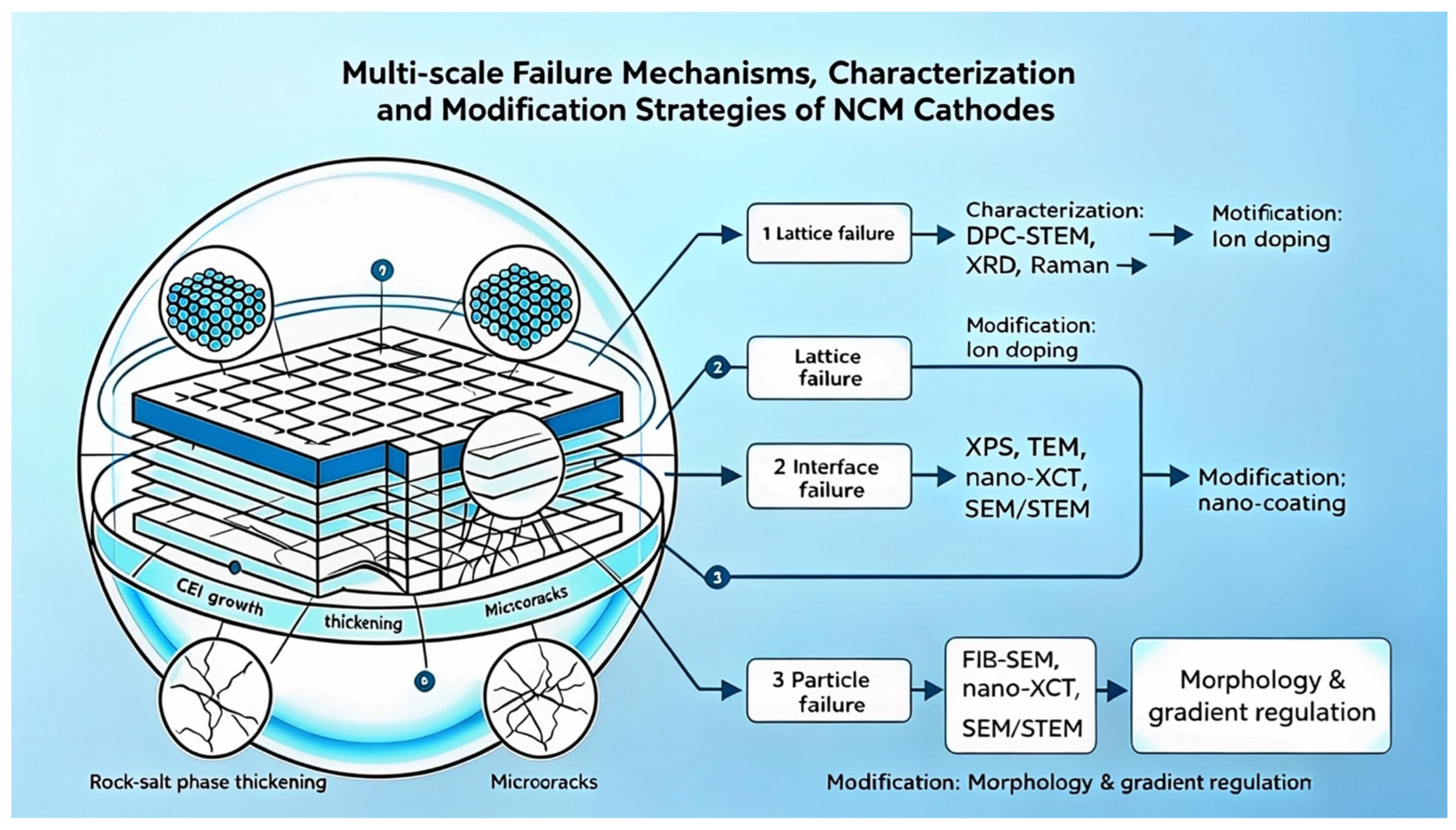
2. Nanoscale Failure Mechanisms of Layered NCM Cathodes
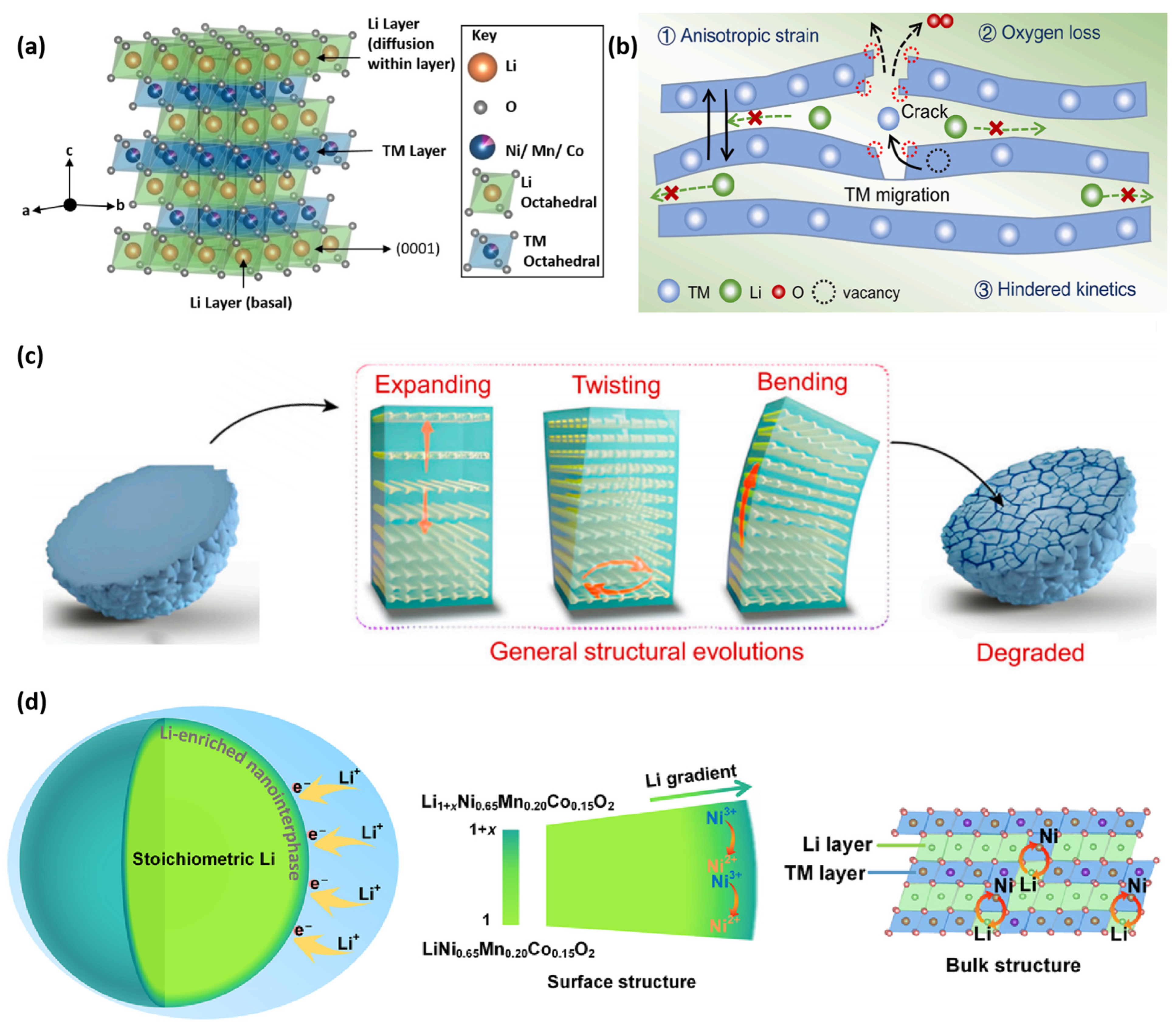
2.1. Lattice Distortion and Layered Structural Instability at Lattice Scale

2.2. Nanoscale Mass Transfer and Degradation Induced by Side Reactions at Interfacial Scale
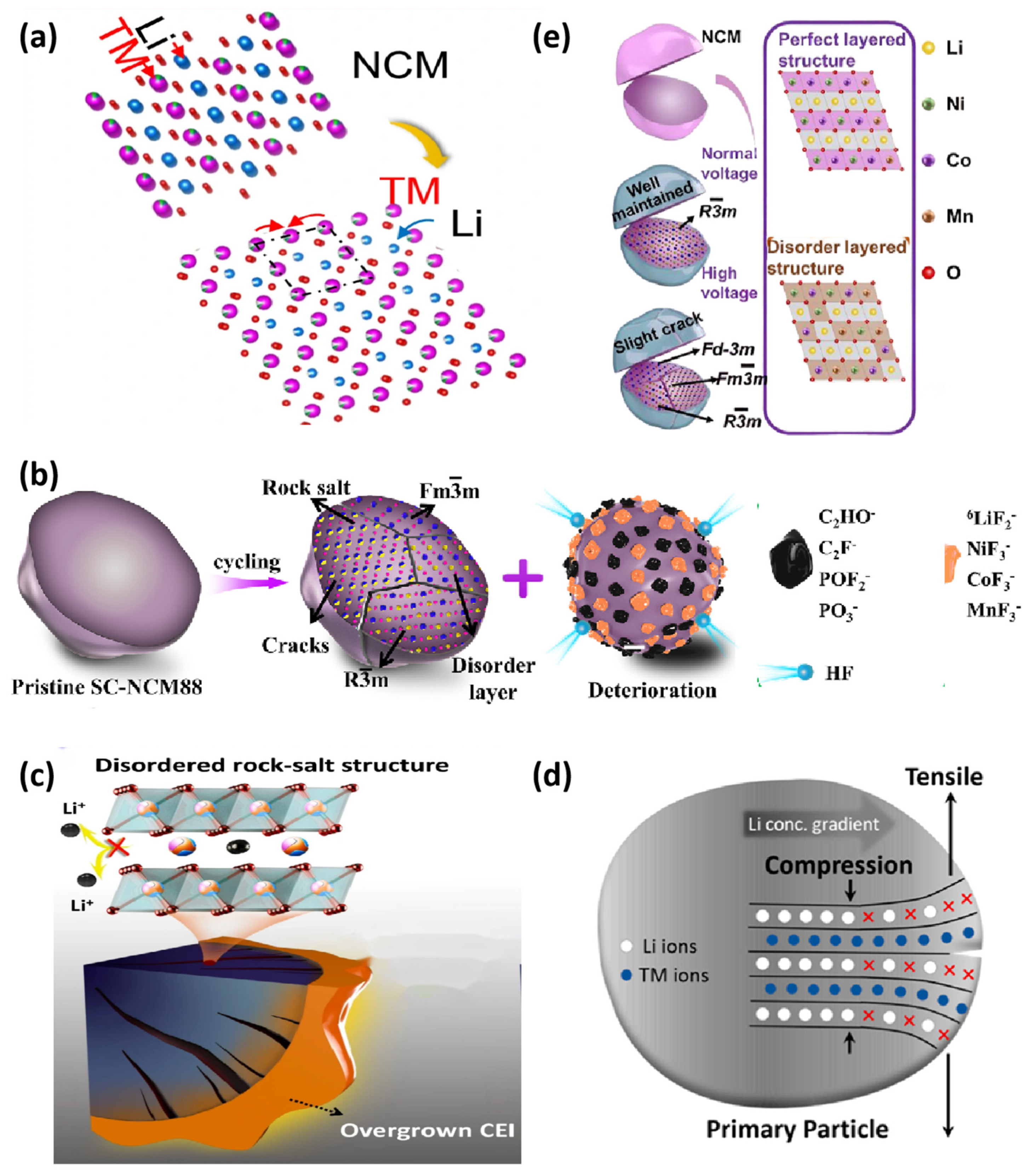
2.2.1. Formation Mechanism of Interfacial Rock-Salt Phase
2.2.2. Degradation Induced by CEI Film Growth
2.3. Generation of Nanocracks at Particle Scale

3. Nanoscale Characterization Techniques for Failure Analysis and Modification of NCM Cathodes
3.1. Nanoscale Characterization Techniques for Microstructure and Composition
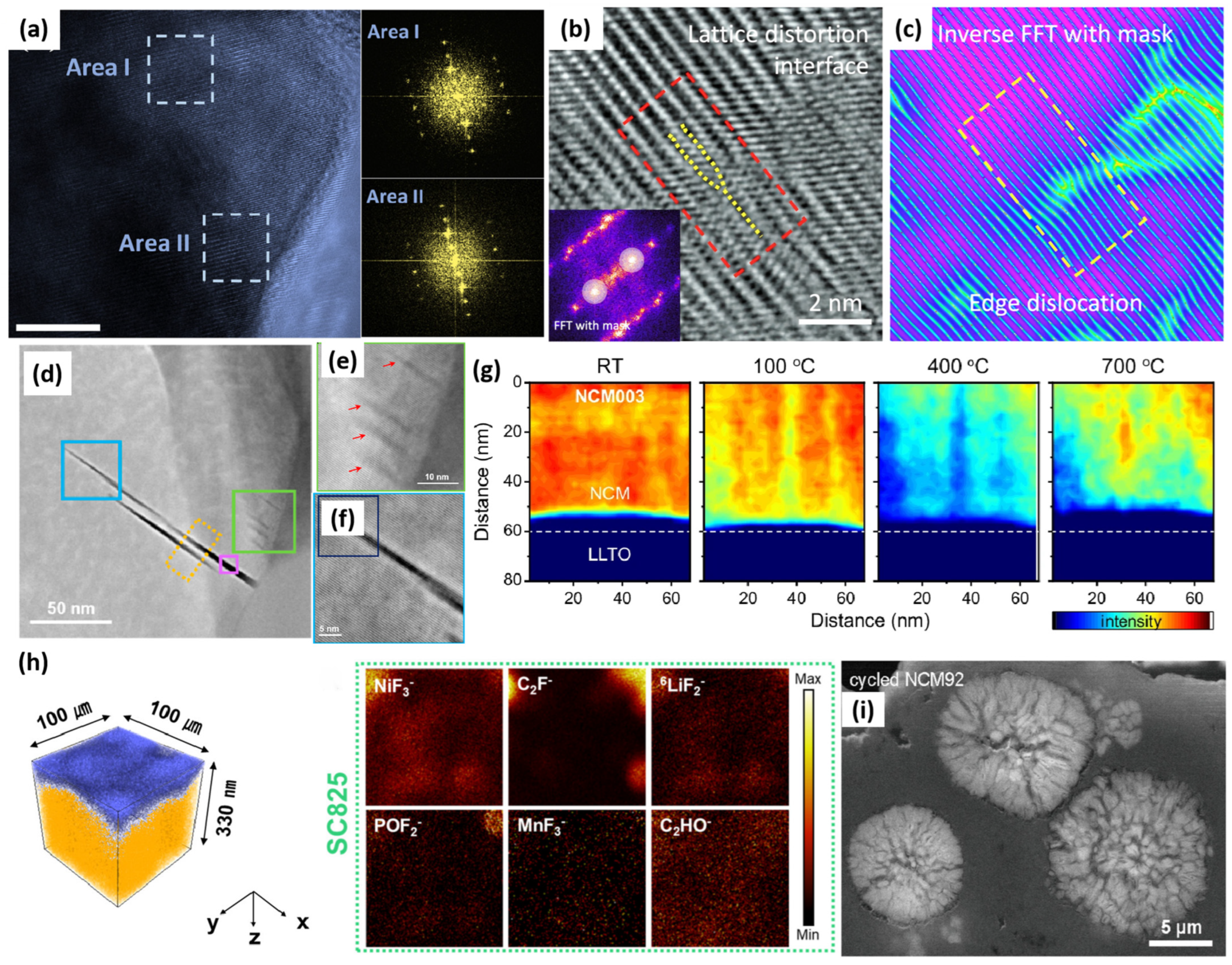
3.1.1. High-Resolution Electron Microscopy for Morphology and Atomic Structure Characterization
3.1.2. Micro-Region Characterization of Elemental Composition and Valence State Structure
3.1.3. Characterization of Three-Dimensional Microstructure and Cross-Section
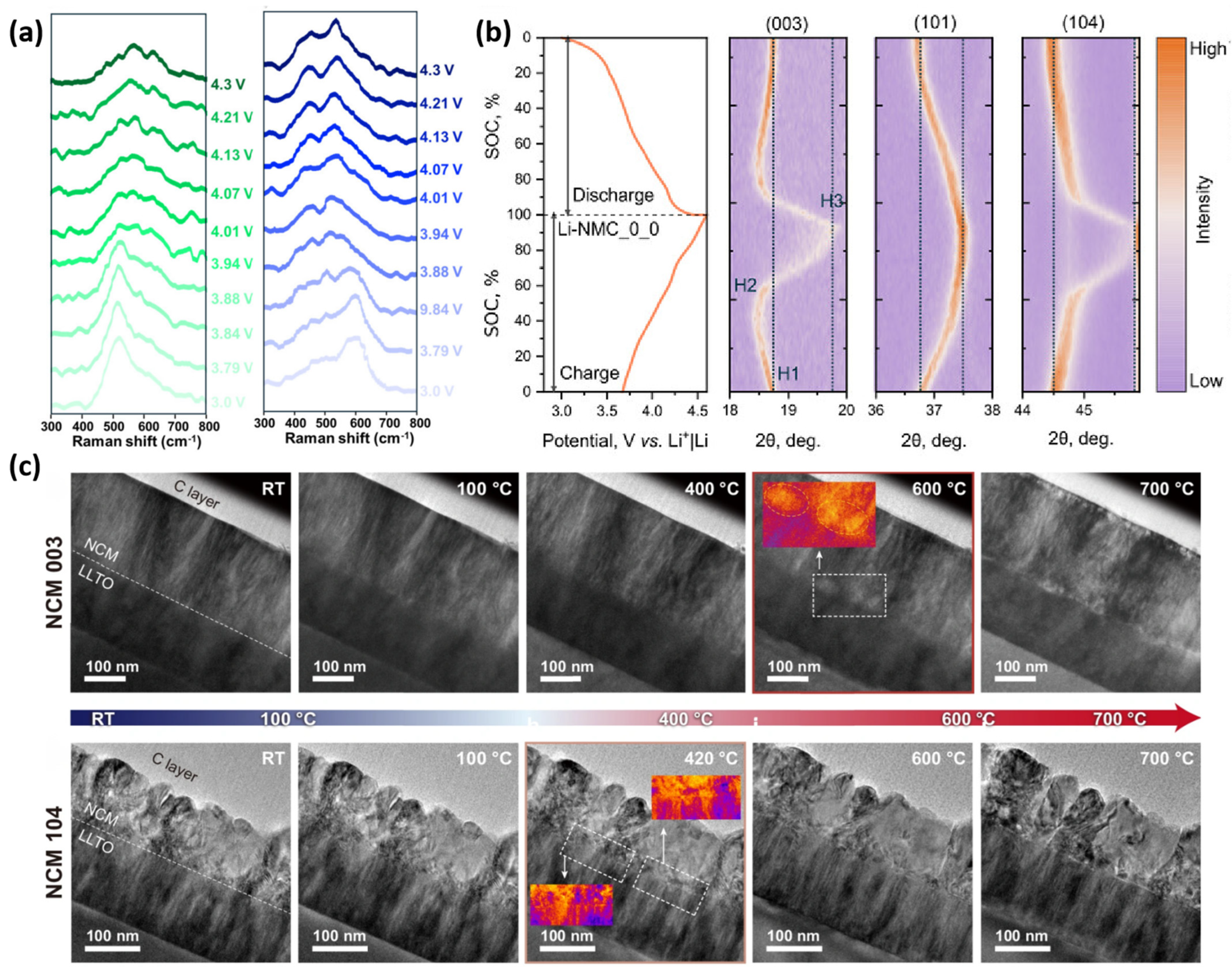
3.2. In Situ Dynamic Evolution Characterization Techniques

4. Optimization of Structural Stability of NCM Layered Cathodes via Nanoscale Modification Strategies
4.1. Nanocoating Modification
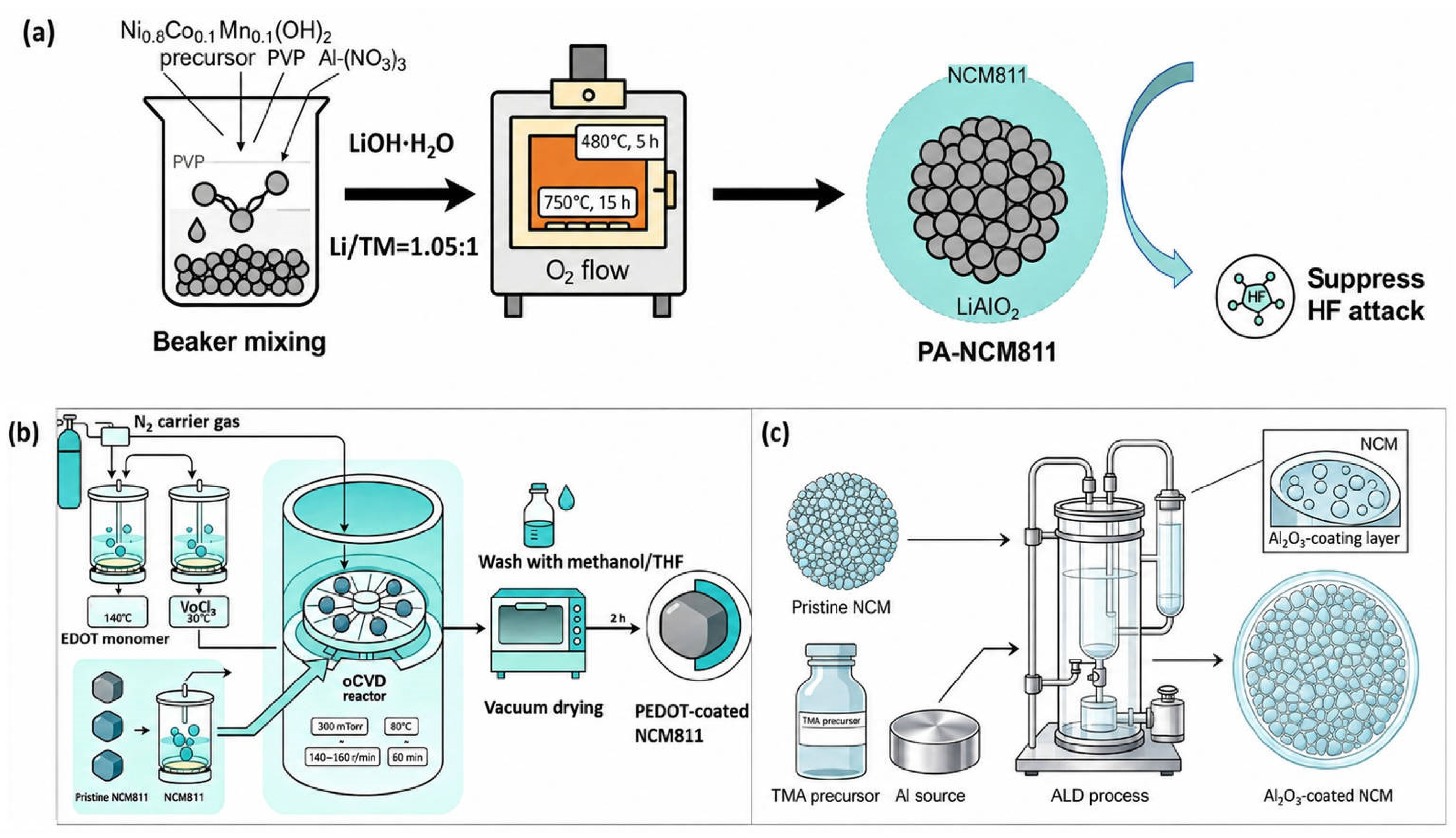
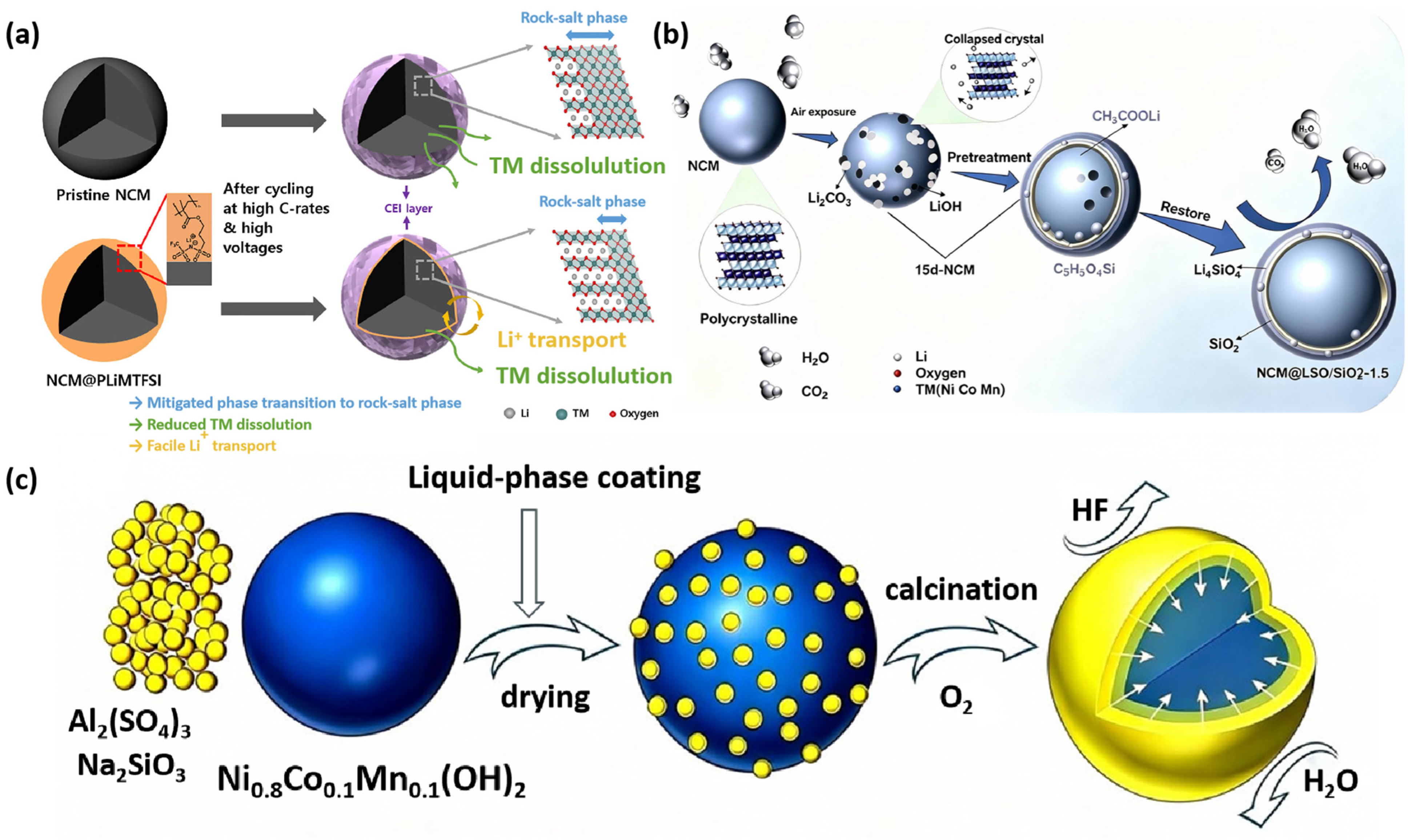
4.1.1. Coating Modification Methods
4.1.2. Elements for Coating Modification
4.2. Doping Modification at Nanoscale
4.2.1. Anion Doping
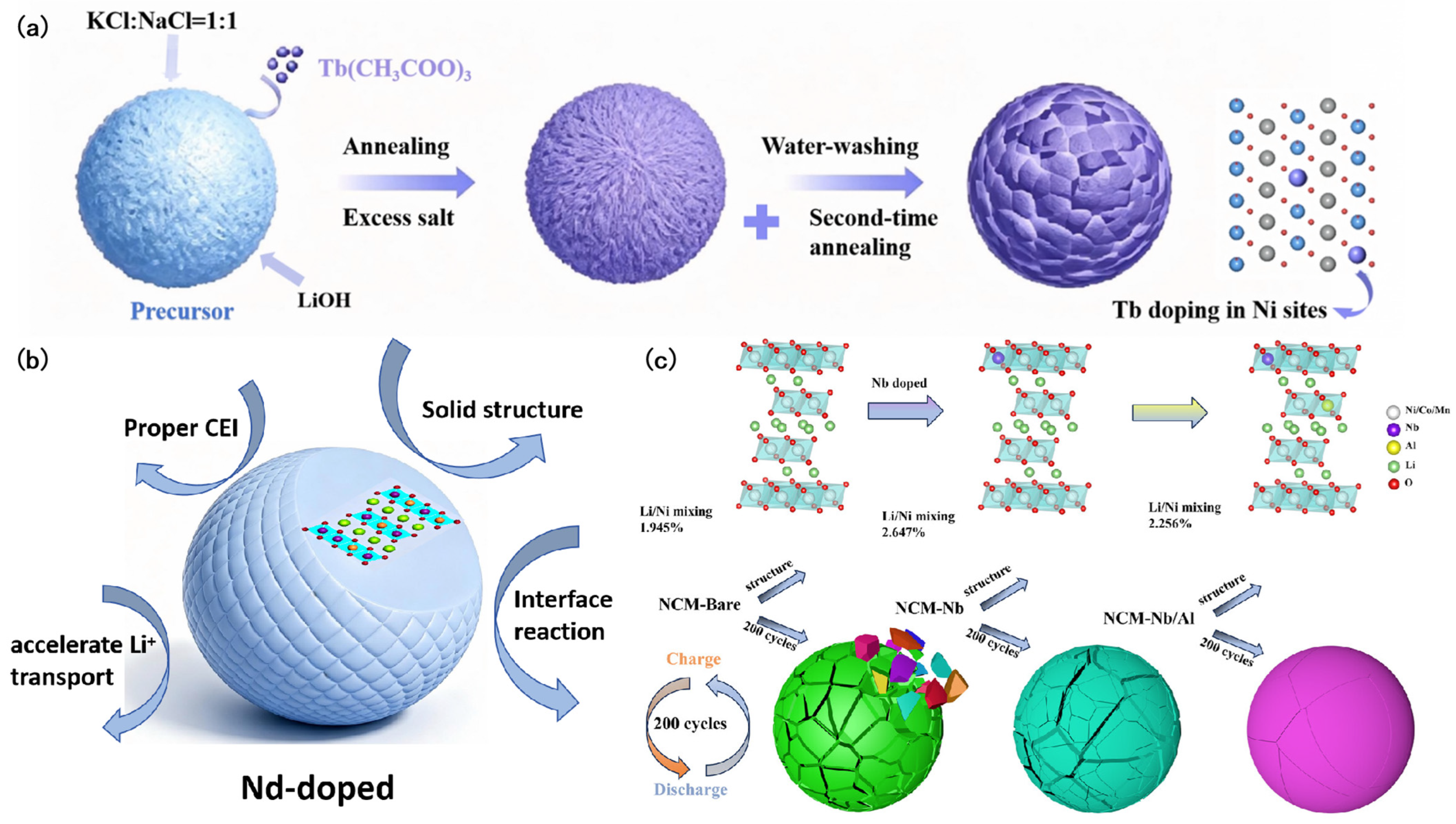
4.2.2. Cation Doping
4.2.3. Co-Doping

5. Conclusions and Outlook
- (1)
- Scale-up modification toward industrialization. Modification and future upcycling processes are of great significance for the industrial preparation of NCM materials. However, this technology still faces numerous substantial challenges at the present stage. Most existing studies are restricted to lab-scale preparation with a batch output of only tens of grams. Meanwhile, multiple factors remain bottlenecks for the large-scale upcycling of NCM materials. On one hand, several feasible laboratory-scale upcycling protocols are difficult to implement in industrial production lines. On the other hand, integrated continuous mass production processes have not yet been fully developed, resulting in low efficiency for batch fabrication.
- (2)
- Coupled research system of in situ multi-field nanocharacterization and molecular dynamics simulation. Current laboratory investigations into the mechanisms of NCM materials mostly rely on ex situ characterizations, which makes it difficult to clarify the underlying kinetic laws. Subsequent research shall deeply integrate in situ multi-field nanocharacterization and molecular dynamics simulation to realize bidirectional coupling. On the one hand, dynamic evolution data can be acquired in real time to supply actual working-condition boundary conditions and experimental calibration references for simulation models. On the other hand, molecular dynamics simulations can compensate for the limitations of characterizing ultramicroscopic transient reactions, quantitatively revealing the intrinsic correlation between microstructural defects and electrochemical performance.
- (3)
- Coupling system of coating-doping knowledge graph and machine learning. Existing laboratory research still suffers from blindness in the design of modification strategies, which leads to low experimental efficiency. In the future, precise nano-modification systems can be developed based on the evolution laws of atomic-scale defects, accompanied by the construction of knowledge graphs and the introduction of machine learning algorithms. This strategy can effectively eliminate blind trial and error during the selection of modification elements, rapidly screen optimal modification routes, and thus improve experimental efficiency.
Funding
Data Availability Statement
Conflicts of Interest
Abbreviations
| NCM | LiNixCoyMnzO2 |
| Li+ | Lithium ions |
| TM | Transition metal |
| MCRC | Multicrystal Rocking Curve |
| DCR | Defect chain reactions |
| SRL | Surface reconstruction layer |
| CEI | Cathode–electrolyte interphase |
| 2D | Two-dimensional |
| 3D | Three-dimensional |
| TEM | Transmission electron microscopy |
| HRTEM | High-resolution transmission electron microscopy |
| FFT | Fast Fourier transform |
| EDS | Energy-Dispersive X-ray Spectroscopy |
| EELS | Electron Energy-Loss Spectroscopy |
| TOF-SIMS | Time-of-Flight Secondary Ion Mass Spectrometry |
| EXAFS | Extended X-ray Absorption Fine Structure |
| FIB | Focused Ion Beam |
| Nano-XCT | X-ray nano-computed tomography |
| RT | Room temperature |
| LLTeO | Li1.5La1.5TeO6 |
| oCVD | Oxidative chemical vapor deposition |
| CG | Concentration-gradient |
| MOFs | Metal–organic frameworks |
| TOCs | Titanium oxo clusters |
| SC-NCM88 | Single-crystal LiNi0.88Co0.09Mn0.03O2 |
| ADF-STEM | Annular Dark-Field Scanning Transmission Electron Microscopy |
| HAADF-STEM | High-Angle Annular Dark-Field Scanning Transmission Electron Microscopy |
| DPC-STEM | Differential Phase-Contrast Scanning Transmission Electron Microscopy |
| NCM83 | LiNi0.83Co0.12Mn0.05O2 |
| NCM9005 | LiNi0.9Co0.05Mn0.05O2 |
| NCM811 | LiNi0.8Co0.1Mn0.1O2 |
| ALD | Atomic Layer Deposition |
| NCM523 | LiNi0.5Co0.2Mn0.3O2 |
| CG-NMC9 | LiNi0.9Mn0.067Co0.033O2 featuring concentration gradients |
| NCM622 | LiNi0.6Co0.2Mn0.2O2 |
| AS-NCM811 | LiAlO2 and Li2SiO3 serve as dual-coating agents for NCM811 |
References
- Wan, K.; Zheng, Y.; Xiong, X. A closed-loop recycling strategy for the selective Li extraction from spent LiNixCoyMn1-x-yO2 batteries utilizing waste silicon. J. Power Sources 2026, 679, 240138. [Google Scholar] [CrossRef] [Scilit]
- He, Y.; Dong, Y.; Qiao, L.; Costa, C.M.; Lanceros-Méndez, S.; Han, J.; He, W. Recent progress in ultra-thin solid polymeric electrolytes for next-generation lithium batteries. Energy Storage Mater. 2024, 67, 103329. [Google Scholar] [CrossRef] [Scilit]
- Zhang, H.; Dong, S.; Chen, W.; Shi, X.; Li, H.; Jin, X.; Guo, H.; Long, H. A sustainable hydrometallurgy protocol of ultrasonic-assisted leaching and multi-stage separation for recovery of critical metals from spent NCM lithium-ion batteries. Process Saf. Environ. Prot. 2025, 202, 107716. [Google Scholar] [CrossRef] [Scilit]
- Fu, W.; Kim, D.; Wang, F.; Yushin, G. Stabilizing cathodes and interphases for next-generation Li-ion batteries. J. Power Sources 2023, 561, 232738. [Google Scholar] [CrossRef] [Scilit]
- Liu, T.; Liu, J.; Li, L.; Yu, L.; Diao, J.; Zhou, T.; Li, S.; Dai, A.; Zhao, W.; Xu, S.; et al. Origin of structural degradation in Li-rich layered oxide cathode. Nature 2022, 606, 305–312. [Google Scholar] [CrossRef] [Scilit] [PubMed]
- Liu, X.; Xu, G.-L.; Kolluru, V.S.C.; Zhao, C.; Li, Q.; Zhou, X.; Liu, Y.; Yin, L.; Zhuo, Z.; Daali, A.; et al. Origin and regulation of oxygen redox instability in high-voltage battery cathodes. Nat. Energy 2022, 7, 808–817. [Google Scholar] [CrossRef] [Scilit]
- Lee, S.; Song, G.; Yun, B.; Kim, T.; Choi, S.H.; Kim, H.; Doo, S.W.; Lee, K.T. Revealing the Nanoscopic Corrosive Degradation Mechanism of Nickel-Rich Layered Oxide Cathodes at Low State-of-Charge Levels: Corrosion Cracking and Pitting. ACS Nano 2024, 18, 10566–10581. [Google Scholar] [CrossRef] [Scilit] [PubMed]
- Ryu, H.-H.; Lim, H.-W.; Kang, G.-C.; Park, N.-Y.; Sun, Y.-K. Long-Lasting Ni-Rich NCMA Cathodes via Simultaneous Microstructural Refinement and Surface Modification. ACS Energy Lett. 2023, 8, 1354–1361. [Google Scholar] [CrossRef] [Scilit]
- Reddy, M.V.; Julien, C.M.; Mauger, A.; Zaghib, K. Sulfide and Oxide Inorganic Solid Electrolytes for All-Solid-State Li Batteries: A Review. Nanomaterials 2020, 10, 1606. [Google Scholar] [CrossRef] [Scilit] [PubMed]
- Shen, W.; Huang, J.; Qu, X.; Li, K.; Fu, G.; Chen, X.; Lin, Y. Cracking Mechanism and Inhibition Strategies of Polycrystalline NCM Electrode Particles. ACS Appl. Mater. Interfaces 2024, 16, 57074–57090. [Google Scholar] [CrossRef] [Scilit] [PubMed]
- Li, S.; Liu, Z.; Yang, L.; Shen, X.; Liu, Q.; Hu, Z.; Kong, Q.; Ma, J.; Li, J.; Lin, H.-J.; et al. Anionic redox reaction and structural evolution of Ni-rich layered oxide cathode material. Nano Energy 2022, 98, 107335. [Google Scholar] [CrossRef] [Scilit]
- Zou, Y.; Mao, H.; Meng, X.; Du, Y.; Sheng, H.; Yu, X.; Shi, J.; Guo, Y. Mitigating the Kinetic Hindrance of Single-Crystalline Ni-Rich Cathode via Surface Gradient Penetration of Tantalum. Angew. Chem. Int. Ed. Engl. 2021, 60, 26535–26539. [Google Scholar] [CrossRef] [Scilit] [PubMed]
- Liu, X.; Gu, L. Advanced Transmission Electron Microscopy for Electrode and Solid-Electrolyte Materials in Lithium-Ion Batteries. Small Methods 2018, 2, 1800006. [Google Scholar] [CrossRef] [Scilit]
- Zheng, A.; Yin, K.; Pan, R.; Zhu, M.; Xiong, Y.; Sun, L. Research Progress on Metal–Organic Frameworks by Advanced Transmission Electron Microscopy. Nanomaterials 2023, 13, 1742. [Google Scholar] [CrossRef] [Scilit] [PubMed]
- Song, Y.; Cui, Y.; Geng, L.; Li, B.; Ge, L.; Zhou, L.; Qiu, Z.; Nan, J.; Wu, W.; Xu, H.; et al. Li/Ni Intermixing: The Real Origin of Lattice Oxygen Stability in Co-Free Ni-Rich Cathode Materials. Adv. Energy Mater. 2023, 14, 2303207. [Google Scholar] [CrossRef] [Scilit]
- Wu, K.; Li, Z.; Chen, X. Designing a Corrosion Inhibiting Layer to Enhance Cycling Stability of 4.7 V Ni-Rich Cathode. Adv. Funct. Mater. 2024, 34, 2315327. [Google Scholar] [CrossRef] [Scilit]
- Liu, Y.; Wang, Q.; Chen, L.; Xiao, Z.; Fan, X.; Ma, S.; Ming, L.; Tayal, A.; Zhang, B.; Wu, F.; et al. Diffusion-induced stress optimization by boosted surface Li-concentration for single-crystal Ni-rich layered cathodes. Mater. Today 2022, 61, 40–53. [Google Scholar] [CrossRef] [Scilit]
- Xie, Q.; Li, W.; Manthiram, A. A Mg-Doped High-Nickel Layered Oxide Cathode Enabling Safer, High-Energy-Density Li-Ion Batteries. Chem. Mater. 2019, 31, 938–946. [Google Scholar] [CrossRef] [Scilit]
- Liu, C.; Miao, C.; He, M.; Wang, J.; Chen, Q.; Nie, S.; Xiao, W. Optimized layered ternary LiNi0.5Co0.2Mn0.3O2 cathode materials modified with ultrathin Li3InCl6 fast ion conductor layer for lithium-ion batteries. J. Power Sources 2023, 566, 232961. [Google Scholar] [CrossRef] [Scilit]
- Zhou, X.; Chen, A.; Lu, C.; Ma, R.; Fang, R.; Gan, Y.; Wang, G.; Xu, J.; Mao, Q.; Lu, X.; et al. Ultra-low-dose Nb2O5 coating promotes electrochemical kinetics and rate capability of Ni-rich oxide cathode. J. Solid State Electrochem. 2024, 29, 4199–4208. [Google Scholar] [CrossRef] [Scilit]
- Jeyakumar, J.; Seenivasan, M.; Wu, Y.-S.; Kuo, L.-Y.; Wu, S.-H.; Chang, J.-K.; Jose, R.; Yang, C.-C. Sn-Doped/Coated Ni-Rich LiNi0.90Co0.04Mn0.03Al0.03O2 Cathode Materials for Improved Electrochemical Performance of Li-Ion Batteries. ACS Appl. Energy Mater. 2024, 7, 4919–4934. [Google Scholar] [CrossRef] [Scilit]
- Sun, H.H.; Kim, U.-H.; Park, J.-H.; Park, S.-W.; Seo, D.-H.; Heller, A.; Mullins, C.B.; Yoon, C.S.; Sun, Y.-K. Transition metal-doped Ni-rich layered cathode materials for durable Li-ion batteries. Nat. Commun. 2021, 12, 6552. [Google Scholar] [CrossRef] [Scilit] [PubMed]
- Yu, H.; Zhu, H.; Yang, Z.; Liu, M.; Jiang, H.; Li, C. Bulk Mg-doping and surface polypyrrole-coating enable high-rate and long-life for Ni-rich layered cathodes. Chem. Eng. J. 2021, 412, 128625. [Google Scholar] [CrossRef] [Scilit]
- Tang, Z.; Wang, S.; Liao, J.; Wang, S.; He, X.; Pan, B.; He, H.; Chen, C. Facilitating Lithium-Ion Diffusion in Layered Cathode Materials by Introducing Li+/Ni2+ Antisite Defects for High-Rate Li-Ion Batteries. Research 2019, 2019, 2198906. [Google Scholar] [CrossRef] [Scilit] [PubMed]
- Xing, C.; Da, H.; Yang, P.; Huang, J.; Gan, M.; Zhou, J.; Li, Y.; Zhang, H.; Ge, B.; Fei, L. Aluminum Impurity from Current Collectors Reactivates Degraded NCM Cathode Materials toward Superior Electrochemical Performance. ACS Nano 2023, 17, 3194–3203. [Google Scholar] [CrossRef] [Scilit] [PubMed]
- Fan, X.; Hu, G.; Zhang, B.; Ou, X.; Zhang, J.; Zhao, W.; Jia, H.; Zou, L.; Li, P.; Yang, Y. Crack-free single-crystalline Ni-rich layered NCM cathode enable superior cycling performance of lithium-ion batteries. Nano Energy 2020, 70, 104450. [Google Scholar] [CrossRef] [Scilit]
- Zhang, F.; Lou, S.; Li, S.; Yu, Z.; Liu, Q.; Dai, A.; Cao, C.; Toney, M.F.; Ge, M.; Xiao, X.; et al. Surface regulation enables high stability of single-crystal lithium-ion cathodes at high voltage. Nat. Commun. 2020, 11, 3050. [Google Scholar] [CrossRef] [Scilit] [PubMed]
- Huang, Z.; Liu, X.; Zheng, Y.; Wang, Q.; Liu, J.; Xu, S. Boosting efficient and low-energy solid phase regeneration for single crystal LiNi0.6Co0.2Mn0.2O2 via highly selective leaching and its industrial application. Chem. Eng. J. 2022, 451, 139039. [Google Scholar] [CrossRef] [Scilit]
- Lin, Q.; Guan, W.; Zhou, J.; Meng, J.; Huang, W.; Chen, T.; Gao, Q.; Wei, X.; Zeng, Y.; Li, J.; et al. Ni–Li anti-site defect induced intragranular cracking in Ni-rich layer-structured cathode. Nano Energy 2020, 76, 105021. [Google Scholar] [CrossRef] [Scilit]
- Li, H.; Wang, L.; Song, Y.; Zhang, Z.; Du, A.; Tang, Y.; Wang, J.; He, X. Why the Synthesis Affects Performance of Layered Transition Metal Oxide Cathode Materials for Li-Ion Batteries. Adv. Mater. 2024, 36, 2312292. [Google Scholar] [CrossRef] [Scilit] [PubMed]
- Wheatcroft, L.; Bird, A.; Gollapally, N.; Booth, S.G.; Cussen, S.A.; Inkson, B.J. In Situ Fracture Behavior of Single Crystal LiNi0.8Mn0.1Co0.1O2 (NMC811). Batter. Supercaps 2024, 7, e202400077. [Google Scholar] [CrossRef] [Scilit]
- Singer, A.; Zhang, M.; Hy, S.; Cela, D.; Fang, C.; Wynn, T.A.; Qiu, B.; Xia, Y.; Liu, Z.; Ulvestad, A.; et al. Nucleation of dislocations and their dynamics in layered oxide cathode materials during battery charging. Nat. Energy 2018, 3, 641–647. [Google Scholar] [CrossRef] [Scilit]
- Miller, D.J.; Proff, C.; Wen, J.G.; Abraham, D.P.; Bareño, J. Observation of Microstructural Evolution in Li Battery Cathode Oxide Particles by In Situ Electron Microscopy. Adv. Energy Mater. 2013, 3, 1098–1103. [Google Scholar] [CrossRef] [Scilit]
- Ulvestad, A.; Singer, A.; Clark, J.N.; Cho, H.M.; Kim, J.W.; Harder, R.; Maser, J.; Meng, Y.S.; Shpyrko, O.G. Topological defect dynamics in operando battery nanoparticles. Science 2015, 348, 1344–1347. [Google Scholar] [CrossRef] [Scilit] [PubMed]
- Nadimpalli, S.P.; Sethuraman, V.A.; Abraham, D.P.; Bower, A.F.; Guduru, P.R. Stress Evolution in Lithium-Ion Composite Electrodes during Electrochemical Cycling and Resulting Internal Pressures on the Cell Casing. J. Electrochem. Soc. 2015, 162, A2656–A2663. [Google Scholar] [CrossRef] [Scilit]
- Lee, E.-J.; Chen, Z.; Noh, H.-J.; Nam, S.C.; Kang, S.; Kim, D.H.; Amine, K.; Sun, Y.-K. Development of Microstrain in Aged Lithium Transition Metal Oxides. Nano Lett. 2014, 14, 4873–4880. [Google Scholar] [CrossRef] [Scilit] [PubMed]
- Cho, H.; Cho, J. Control of Crystallite Size of Cathode Material Via Artificial Organic Template. ECS Meet. Abstr. 2016, MA2016-03, 174. [Google Scholar] [CrossRef] [Scilit]
- Kong, X.; Yang, H.; Zhang, Y.; Dai, P.; Tang, Y.; Zeng, J.; Zhao, J. Design and mechanism exploration of single-crystalline NCM811 materials with superior comprehensive performance for Li-ion batteries. Chem. Eng. J. 2022, 452, 139431. [Google Scholar] [CrossRef] [Scilit]
- Xie, X.; Zhang, X.; Ding, X.; Wang, Y.; Yan, M.; Luo, D.; Li, G.; Li, L. Recent progress on Co-free and Ni-rich layered cathode materials: Challenges, improvements and prospect. Mater. Today Energy 2025, 54, 102111. [Google Scholar] [CrossRef] [Scilit]
- Wu, G.; Zhao, C.; You, Y.; Wu, F.; Lü, T.; Cao, X.; Zhu, Z.-Z.; Wu, S. Exploring Structural Evolution and Lattice Oxygen Bonding Variation in Li-Rich NCM Cathode Materials. J. Electrochem. Soc. 2025, 172, 030501. [Google Scholar] [CrossRef] [Scilit]
- Yin, J.; Wu, Z.; Fang, K.; Zhu, Y.; Zhang, K.; Zhang, H.; Chen, Y.; Li, L.; Fan, L.; Dong, K.; et al. Reassessing anionic redox in conventional layered oxide cathodes for Li-ion batteries: Ionic and covalent mechanisms. Chem. Sci. 2025, 16, 8268–8281. [Google Scholar] [CrossRef] [Scilit]
- Song, Y.; Wang, B.; Cui, Y.; Liu, P.; Gao, X.; Li, X.; Zhu, L.; Xue, Q.; Tang, Y.; Xing, W. Mechanically and chemically robust ultrahigh-Ni cathodes enabled by localized cation disorder design. eScience 2026, 6, 100435. [Google Scholar] [CrossRef] [Scilit]
- Meng, X.-H.; Lin, T.; Mao, H.; Shi, J.-L.; Sheng, H.; Zou, Y.-G.; Fan, M.; Jiang, K.; Xiao, R.-J.; Xiao, D.; et al. Kinetic Origin of Planar Gliding in Single-Crystalline Ni-Rich Cathodes. J. Am. Chem. Soc. 2022, 144, 11338–11347. [Google Scholar] [CrossRef] [Scilit] [PubMed]
- Dolabella, S.; Borzì, A.; Dommann, A.; Neels, A. Lattice Strain and Defects Analysis in Nanostructured Semiconductor Materi-als and Devices by High-Resolution X-Ray Diffraction: Theoretical and Practical Aspects. Small Methods 2022, 6, 2100932. [Google Scholar] [CrossRef] [Scilit]
- Bi, Y.; Tao, J.; Wu, Y.; Li, L.; Xu, Y.; Hu, E.; Wu, B.; Hu, J.; Wang, C.; Zhang, J.-G.; et al. Reversible planar gliding and microcracking in a single-crystalline Ni-rich cathode. Science 2020, 370, 1313–1317. [Google Scholar] [CrossRef] [Scilit]
- Xu, J.; Wang, Z.; Zheng, R.; Sun, H.; Liu, Y.; You, J. Building a robust surface structure toward stable ultrahigh-nickel cathodes. Chem. Eng. J. 2024, 485, 149878. [Google Scholar] [CrossRef] [Scilit]
- Su, Y.; Zhang, Q.; Chen, L.; Bao, L.; Lu, Y.; Chen, S.; Wu, F. Stress accumulation in Ni-rich layered oxide cathodes: Origin, impact, and resolution. J. Energy Chem. 2022, 65, 236–253. [Google Scholar] [CrossRef] [Scilit]
- Hofmann, F.; Abbey, B.; Liu, W.; Xu, R.; Usher, B.F.; Balaur, E.; Liu, Y. X-ray micro-beam characterization of lattice rotations and distortions due to an individual dislocation. Nat. Commun. 2013, 4, 2774. [Google Scholar] [CrossRef] [Scilit] [PubMed]
- Huang, W.; Liu, T.; Yu, L.; Wang, J.; Zhou, T.; Liu, J.; Li, T.; Amine, R.; Xiao, X.; Ge, M.; et al. Unrecoverable lattice rotation governs structural degradation of single-crystalline cathodes. Science 2024, 384, 912–919. [Google Scholar] [CrossRef] [Scilit]
- Qiao, X.; Wang, L.; Lu, J. The Tuning of Strain in Layered Structure Oxide Cathodes for Lithium-Ion Batteries. Research 2024, 7, 0489. [Google Scholar] [CrossRef] [Scilit] [PubMed]
- Xue, Z.; Wu, F.; Ge, M.; Huang, X.; Chu, Y.S.; Pianetta, P.; Liu, Y. Mesoscale interplay among composition heterogeneity, lattice deformation, and redox stratification in single-crystalline layered oxide cathode. eScience 2024, 4, 100251. [Google Scholar] [CrossRef] [Scilit]
- Jiang, M.; Danilov, D.L.; Eichel, R.; Notten, P.H.L. A Review of Degradation Mechanisms and Recent Achievements for Ni-Rich Cathode-Based Li-Ion Batteries. Adv. Energy Mater. 2021, 11, 2103005. [Google Scholar] [CrossRef] [Scilit]
- Li, P.-Y.; Huang, Y.-D.; Luo, Y.-H.; Wei, H.-X.; Tang, L.-B.; Chen, H.-Z.; Zhang, X.-H.; Zheng, J.-C. Low-temperature stepwise lithiation method toward layered oxide cathodes with low Li+/Ni2+ antisite defects. Ceram. Int. 2024, 50, 18689–18696. [Google Scholar] [CrossRef] [Scilit]
- Yang, C.; Shao, R.; Wang, Q.; Zhou, T.; Lu, J.; Jiang, N.; Gao, P.; Liu, W.; Yu, Y.; Zhou, H. Bulk and surface degradation in layered Ni-rich cathode for Li ions batteries: Defect proliferation via chain reaction mechanism. Energy Storage Mater. 2021, 35, 62–69. [Google Scholar] [CrossRef] [Scilit]
- Zhu, C.; Gan, Z.; Guo, Z.; Li, T.; Lei, H.; Zeng, Z.; Yang, Y.; Wang, H.; Sun, W.; Ge, P. Upcycling NCM cathodes by tailoring superexchange interaction for ultrastable energy storage properties. Energy Storage Mater. 2026, 89, 105267. [Google Scholar] [CrossRef] [Scilit]
- Liu, X.; Liu, T.; Wang, R.; Cai, Z.; Wang, W.; Yuan, Y.; Shahbazian-Yassar, R.; Li, X.; Wang, S.; Hu, E.; et al. Prelithiated Li-Enriched Gradient Interphase toward Practical High-Energy NMC–Silicon Full Cell. ACS Energy Lett. 2020, 6, 320–328. [Google Scholar] [CrossRef] [Scilit]
- Kim, Y. First-principles investigation of the structural characteristics of LiMO2 cathode materials for lithium secondary batteries. J. Mol. Struct. 2015, 1099, 317–322. [Google Scholar] [CrossRef] [Scilit]
- Yan, P.; Zheng, J.; Liu, J.; Wang, B.; Cheng, X.; Zhang, Y.; Sun, X.; Wang, C.; Zhang, J.-G. Tailoring grain boundary structures and chemistry of Ni-rich layered cathodes for enhanced cycle stability of lithium-ion batteries. Nat. Energy 2018, 3, 600–605. [Google Scholar] [CrossRef] [Scilit]
- Cai, J.; Zhou, X.; Li, L.; Yang, Z.; Huang, X.; Li, J.; Wang, G.; Zhu, Q.; Li, T.; Sun, C.; et al. Kinetically Dormant Ni-Rich Layered Cathode During High-Voltage Operation. Adv. Mater. 2025, 37, e2419253. [Google Scholar] [CrossRef] [Scilit] [PubMed]
- Noh, H.-J.; Youn, S.; Yoon, C.S.; Sun, Y.-K. Comparison of the structural and electrochemical properties of layered Li[NixCoyMnz]O2 (x = 1/3, 0.5, 0.6, 0.7, 0.8 and 0.85) cathode material for lithium-ion batteries. J. Power Sources 2013, 233, 121–130. [Google Scholar] [CrossRef] [Scilit]
- Jung, S.; Gwon, H.; Hong, J.; Park, K.; Seo, D.; Kim, H.; Hyun, J.; Yang, W.; Kang, K. Understanding the Degradation Mechanisms of LiNi0.5Co0.2Mn0.3O2 Cathode Material in Lithium Ion Batteries. Adv. Energy Mater. 2013, 4, 1300787. [Google Scholar] [CrossRef] [Scilit]
- Schweidler, S.; de Biasi, L.; Garcia, G.; Mazilkin, A.; Hartmann, P.; Brezesinski, T.; Janek, J. Investigation into Mechanical Degradation and Fatigue of High-Ni NCM Cathode Material: A Long-Term Cycling Study of Full Cells. ACS Appl. Energy Mater. 2019, 2, 7375–7384. [Google Scholar] [CrossRef] [Scilit]
- Liang, J.; Zhu, Y.; Li, X.; Luo, J.; Deng, S.; Zhao, Y.; Sun, Y.; Wu, D.; Hu, Y.; Li, W.; et al. A gradient oxy-thiophosphate-coated Ni-rich layered oxide cathode for stable all-solid-state Li-ion batteries. Nat. Commun. 2023, 14, 146. [Google Scholar] [CrossRef] [Scilit] [PubMed]
- Hartmann, L.; Reuter, L.; Wallisch, L.; Beiersdorfer, A.; Adam, A.; Goldbach, D.; Teufl, T.; Lamp, P.; Gasteiger, H.A.; Wandt, J. Depletion of Electrolyte Salt Upon Calendaric Aging of Lithium-Ion Batteries and its Effect on Cell Performance. J. Electrochem. Soc. 2024, 171, 060506. [Google Scholar] [CrossRef] [Scilit]
- Rinkel, B.L.D.; Vivek, J.P.; Garcia-Araez, N.; Grey, C.P. Two electrolyte decomposition pathways at nickel-rich cathode surfaces in lithium-ion batteries. Energy Environ. Sci. 2022, 15, 3416–3438. [Google Scholar] [CrossRef] [Scilit] [PubMed]
- Kühn, S.P.; Edström, K.; Winter, M.; Cekic-Laskovic, I. Face to Face at the Cathode Electrolyte Interphase: From Interface Features to Interphase Formation and Dynamics. Adv. Mater. Interfaces 2022, 9, 2102078. [Google Scholar] [CrossRef] [Scilit]
- Dose, W.M.; Li, W.; Temprano, I.; O’keefe, C.A.; Mehdi, B.L.; De Volder, M.F.L.; Grey, C.P. Onset Potential for Electrolyte Oxidation and Ni-Rich Cathode Degradation in Lithium-Ion Batteries. ACS Energy Lett. 2022, 7, 3524–3530. [Google Scholar] [CrossRef] [Scilit] [PubMed]
- Li, W.; Dolocan, A.; Oh, P.; Celio, H.; Park, S.; Cho, J.; Manthiram, A. Dynamic behaviour of interphases and its implication on high-energy-density cathode materials in lithium-ion batteries. Nat. Commun. 2017, 8, 14589. [Google Scholar] [CrossRef] [Scilit] [PubMed]
- Ivanishchev, A.V.; Ivanishcheva, I.A.; Lee, S.; Kim, J.-J.; Kim, Y.-J.; Bae, C.; Nam, S.-C.; Song, J.-H. Revealing the surface modification effect on Li-ion insertion into Ni-rich NCM cathode material by cyclic voltammetry. J. Electroanal. Chem. 2023, 950, 117864. [Google Scholar] [CrossRef] [Scilit]
- Qin, Z.; Zhang, T.; Gao, X.; Luo, W.; Han, J.; Lu, B.; Zhou, J.; Chen, G. Self-Reconstruction of Highly Degraded LiNi0.8Co0.1Mn0.1O2 toward Stable Single-Crystalline Cathode. Adv. Mater. 2023, 36, e2307091. [Google Scholar] [CrossRef] [Scilit] [PubMed]
- Ogley, M.J.W.; Johnston, B.I.J.; Hall, D.S.; Piper, L.F.J. Understanding Degradation in Single-Crystalline Ni-Rich Li-Ion Battery Cathodes. Chem. Rev. 2025, 125, 9774–9806. [Google Scholar] [CrossRef] [Scilit] [PubMed]
- Fan, X.; Ou, X.; Zhao, W.; Liu, Y.; Zhang, B.; Zhang, J.; Zou, L.; Seidl, L.; Li, Y.; Hu, G.; et al. In situ inorganic conductive network formation in high-voltage single-crystal Ni-rich cathodes. Nat. Commun. 2021, 12, 5320. [Google Scholar] [CrossRef] [Scilit] [PubMed]
- Jung, R.; Metzger, M.; Maglia, F.; Stinner, C.; Gasteiger, H.A. Oxygen Release and Its Effect on the Cycling Stability of LiNixMnyCozO2(NMC) Cathode Materials for Li-Ion Batteries. J. Electrochem. Soc. 2017, 164, A1361–A1377. [Google Scholar] [CrossRef] [Scilit]
- Lin, F.; Markus, I.M.; Nordlund, D.; Weng, T.-C.; Asta, M.D.; Xin, H.L.; Doeff, M.M. Surface reconstruction and chemical evolution of stoichiometric layered cathode materials for lithium-ion batteries. Nat. Commun. 2014, 5, 3529. [Google Scholar] [CrossRef] [Scilit] [PubMed]
- Li, J.; Sharma, N.; Jiang, Z.; Yang, Y.; Monaco, F.; Xu, Z.; Hou, D.; Ratner, D.; Pianetta, P.; Cloetens, P.; et al. Dynamics of particle network in composite battery cathodes. Science 2022, 376, 517–521. [Google Scholar] [CrossRef] [Scilit] [PubMed]
- Lin, F.; Nordlund, D.; Li, Y.; Quan, M.K.; Cheng, L.; Weng, T.-C.; Liu, Y.; Xin, H.L.; Doeff, M.M. Metal segregation in hierarchically structured cathode materials for high-energy lithium batteries. Nat. Energy 2016, 1, 15004. [Google Scholar] [CrossRef] [Scilit]
- Yin, S.; Deng, W.; Chen, J.; Gao, X.; Zou, G.; Hou, H.; Ji, X. Fundamental and solutions of microcrack in Ni-rich layered oxide cathode materials of lithium-ion batteries. Nano Energy 2021, 83, 105854. [Google Scholar] [CrossRef] [Scilit]
- Yang, S.; Fan, Q.; Shi, Z.; Liu, L.; Liu, J.; Ke, X.; Liu, J.; Hong, C.; Yang, Y.; Guo, Z. Superior Stability Secured by a Four-Phase Cathode Electrolyte Interface on a Ni-Rich Cathode for Lithium Ion Batteries. ACS Appl. Mater. Interfaces 2019, 11, 36742–36750. [Google Scholar] [CrossRef] [Scilit] [PubMed]
- Wu, F.; Liu, N.; Chen, L.; Li, N.; Dong, J.; Lu, Y.; Tan, G.; Xu, M.; Cao, D.; Liu, Y.; et al. The nature of irreversible phase transformation propagation in nickel-rich layered cathode for lithium-ion batteries. J. Energy Chem. 2021, 62, 351–358. [Google Scholar] [CrossRef] [Scilit]
- Wang, X.; Ding, Y.; Deng, Y.; Chen, Z. Ni-Rich/Co-Poor Layered Cathode for Automotive Li-Ion Batteries: Promises and Challenges. Adv. Energy Mater. 2020, 10, 1903864. [Google Scholar] [CrossRef] [Scilit]
- Huang, Y.; Fan, F.; Zeng, C.; Zhang, Y.; Xiao, H.; Shu, C. Synergistic surface-bulk modification enhances structural stability of ultrahigh nickel layered oxide cathode for high-energy lithium-ion batteries. Chem. Eng. J. 2026, 533, 174864. [Google Scholar] [CrossRef] [Scilit]
- Ryu, H.-H.; Namkoong, B.; Kim, J.-H.; Belharouak, I.; Yoon, C.S.; Sun, Y.-K. Capacity Fading Mechanisms in Ni-Rich Single-Crystal NCM Cathodes. ACS Energy Lett. 2021, 6, 2726–2734. [Google Scholar] [CrossRef] [Scilit]
- Li, J.; Wang, X.; Kong, X.; Yang, H.; Zeng, J.; Zhao, J. Insight into the Kinetic Degradation of Stored Nickel-Rich Layered Cathode Materials for Lithium-Ion Batteries. ACS Sustain. Chem. Eng. 2021, 9, 10547–10556. [Google Scholar] [CrossRef] [Scilit]
- Abraham, D.; Twesten, R.; Balasubramanian, M.; Petrov, I.; McBreen, J.; Amine, K. Surface changes on LiNi0.8Co0.2O2 particles during testing of high-power lithium-ion cells. Electrochem. Commun. 2002, 4, 620–625. [Google Scholar] [CrossRef] [Scilit]
- Jung, S.; Kim, H.; Song, S.H.; Lee, S.; Kim, J.; Kang, K. Unveiling the Role of Transition-Metal Ions in the Thermal Degradation of Layered Ni–Co–Mn Cathodes for Lithium Rechargeable Batteries. Adv. Funct. Mater. 2021, 32, 2108790. [Google Scholar] [CrossRef] [Scilit]
- Chen, X.; Tang, Y.; Fan, C.; Han, S. A highly stabilized single crystalline nickel-rich LiNi0.8Co0.1Mn0.1O2 cathode through a novel surface spinel-phase modification. Electrochim. Acta 2020, 341, 136075. [Google Scholar] [CrossRef] [Scilit]
- Lebens-Higgins, Z.W.; Sallis, S.; Faenza, N.V.; Badway, F.; Pereira, N.; Halat, D.M.; Wahila, M.; Schlueter, C.; Lee, T.-L.; Yang, W.; et al. Evolution of the Electrode–Electrolyte Interface of LiNi0.8Co0.15Al0.05O2 Electrodes Due to Electrochemical and Thermal Stress. Chem. Mater. 2018, 30, 958–969. [Google Scholar] [CrossRef] [Scilit]
- Dose, W.M.; Temprano, I.; Allen, J.P.; Björklund, E.; O’kEefe, C.A.; Li, W.; Mehdi, B.L.; Weatherup, R.S.; De Volder, M.F.L.; Grey, C.P. Electrolyte Reactivity at the Charged Ni-Rich Cathode Interface and Degradation in Li-Ion Batteries. ACS Appl. Mater. Interfaces 2022, 14, 13206–13222. [Google Scholar] [CrossRef] [Scilit] [PubMed]
- Luo, H.; Zhang, B.; Zhang, H.; Zheng, Q.; Wu, X.; Yan, Y.; Li, Z.; Tang, Y.; Hao, W.; Liu, G.; et al. Full-Dimensional Analysis of Electrolyte Decomposition on Cathode–Electrolyte Interface: Establishing Characterization Paradigm on LiNi0.6Co0.2Mn0.2O2 Cathode with Potential Dependence. J. Phys. Chem. Lett. 2023, 14, 4565–4574. [Google Scholar] [CrossRef] [Scilit] [PubMed]
- Liu, C.; Dolocan, A.; Cui, Z.; Manthiram, A. Multi-dimensional, Multi-scale Analysis of Interphase Chemistry for Enhanced Fast-Charging of Lithium-Ion Batteries with Ion Mass Spectrometry. J. Am. Chem. Soc. 2025, 147, 6023–6036. [Google Scholar] [CrossRef] [Scilit] [PubMed]
- Li, D.; Li, H.; Danilov, D.; Gao, L.; Zhou, J.; Eichel, R.-A.; Yang, Y.; Notten, P.H. Temperature-dependent cycling performance and ageing mechanisms of C6/LiNi1/3Mn1/3Co1/3O2 batteries. J. Power Sources 2018, 396, 444–452. [Google Scholar] [CrossRef] [Scilit]
- Rinkel, B.L.D.; Hall, D.S.; Temprano, I.; Grey, C.P. Electrolyte Oxidation Pathways in Lithium-Ion Batteries. J. Am. Chem. Soc. 2020, 142, 15058–15074. [Google Scholar] [CrossRef] [Scilit] [PubMed]
- Chen, X.; Yao, Y.; Yan, C.; Zhang, R.; Cheng, X.; Zhang, Q. A Diffusion--Reaction Competition Mechanism to Tailor Lithium Deposition for Lithium-Metal Batteries. Angew. Chem. Int. Ed. Engl. 2020, 59, 7743–7747. [Google Scholar] [CrossRef] [Scilit] [PubMed]
- Scipioni, R.; Isheim, D.; Barnett, S.A. Revealing the complex layered-mosaic structure of the cathode electrolyte interphase in Li-ion batteries. Appl. Mater. Today 2020, 20, 100748. [Google Scholar] [CrossRef] [Scilit]
- Liang, J.; Yan, D.; Zhang, X.; Jiang, A.; Yi, S.; Zeng, Y.; Liu, Q.; Yang, T.; Luo, K.; Li, L.; et al. Wadsley–Roth Phase Armored Ultra-Stable Ni-Rich Cathodes via Synergistic Interfacial Engineering. Adv. Funct. Mater. 2026, 36, e75050. [Google Scholar] [CrossRef] [Scilit]
- She, S.; Zhou, Y.; Hong, Z.; Huang, Y.; Wu, Y. Effect of Fluoroethylene Carbonate Electrolyte Additives on the Electrochemical Performance of Nickel-Rich NCM Ternary Cathodes. ACS Appl. Energy Mater. 2023, 6, 7289–7297. [Google Scholar] [CrossRef] [Scilit]
- Ou, X.; Liu, T.; Zhong, W.; Fan, X.; Guo, X.; Huang, X.; Cao, L.; Hu, J.; Zhang, B.; Chu, Y.S.; et al. Enabling high energy lithium metal batteries via single-crystal Ni-rich cathode material co-doping strategy. Nat. Commun. 2022, 13, 2319. [Google Scholar] [CrossRef] [Scilit] [PubMed]
- Li, Y.; Yang, S.; Li, C.; Chen, W.; Zhang, W.; Lin, Z.; Xia, Y. Constructing an interface layer with external resistance internal conduction on NCM cathode for improved stability and ion kinetics in lithium-ion batteries. Chem. Eng. J. 2025, 523, 168522. [Google Scholar] [CrossRef] [Scilit]
- Fan, X.; Chen, P.; Yin, X.; Qi, R.-X.; Yang, C.; Cheng, Y.-J.; Guo, K.; Liu, C.; Xia, Y. One Stone for Multiple Birds: A Versatile Cross-Linked Poly(dimethyl siloxane) Binder Boosts Cycling Life and Rate Capability of an NCM 523 Cathode at 4.6 V. ACS Appl. Mater. Interfaces 2022, 14, 16245–16257. [Google Scholar] [CrossRef] [Scilit] [PubMed]
- Kondrakov, A.O.; Schmidt, A.; Xu, J.; Geßwein, H.; Mönig, R.; Hartmann, P.; Sommer, H.; Brezesinski, T.; Janek, J. Anisotropic Lattice Strain and Mechanical Degradation of High- and Low-Nickel NCM Cathode Materials for Li-Ion Batteries. J. Phys. Chem. C 2017, 121, 3286–3294. [Google Scholar] [CrossRef] [Scilit]
- Ulvestad, A.; Singer, A.; Cho, H.-M.; Clark, J.N.; Harder, R.; Maser, J.; Meng, Y.S.; Shpyrko, O.G. Single Particle Nanomechanics in Operando Batteries via Lensless Strain Mapping. Nano Lett. 2014, 14, 5123–5127. [Google Scholar] [CrossRef] [Scilit] [PubMed]
- Lim, J.-M.; Hwang, T.; Kim, D.; Park, M.-S.; Cho, K.; Cho, M. Intrinsic Origins of Crack Generation in Ni-rich LiNi0.8Co0.1Mn0.1O2 Layered Oxide Cathode Material. Sci. Rep. 2017, 7, 39669. [Google Scholar] [CrossRef] [Scilit] [PubMed]
- Yan, Y.; Xu, Z.; Luo, G.; Deng, D.; Peng, W.; Wang, Z.; Kan, W.H.; Abdurakhmonov, O.; Sharopov, U.; Feng, Y.; et al. Tailoring cobalt gradient distribution toward practical Ni95 cathode for high-energy-density lithium-ion battery. Joule 2025, 10, 102229. [Google Scholar] [CrossRef] [Scilit]
- Qu, J.; Xie, Z.; Bicket, I.C.; Yuan, H.; Zuin, L.; Andelic, M.; Qu, W.; Botton, G.A.; Liu, H. Insights into Fast-Charge-Induced Cracking and Bulk Structural Deterioration of Ni-Rich Layered Cathodes for Lithium-Ion Batteries. ACS Nano 2025, 19, 33202–33211. [Google Scholar] [CrossRef] [Scilit] [PubMed]
- Parks, H.C.W.; Boyce, A.M.; Wade, A.; Heenan, T.M.M.; Tan, C.; Martínez-Pañeda, E.; Shearing, P.R.; Brett, D.J.L.; Jervis, R. Direct observations of electrochemically induced intergranular cracking in polycrystalline NMC811 particles. J. Mater. Chem. A 2023, 11, 21322–21332. [Google Scholar] [CrossRef] [Scilit]
- Ni, L.; Zhang, S.; Di, A.; Deng, W.; Zou, G.; Hou, H.; Ji, X. Challenges and Strategies towards Single-Crystalline Ni-Rich Layered Cathodes. Adv. Energy Mater. 2022, 12, 2201510. [Google Scholar] [CrossRef] [Scilit]
- Liu, K.; Xu, Z.; Wang, M.; Alessi, D.S.; Tang, Y.; Tsang, D.C.W. Mechanisms of Thermal Decomposition in Spent NCM Lithium-Ion Battery Cathode Materials with Carbon Defects and Oxygen Vacancies. Environ. Sci. Technol. 2024, 58, 21362–21373. [Google Scholar] [CrossRef] [Scilit] [PubMed]
- Ryu, H.-H.; Park, K.-J.; Yoon, C.S.; Sun, Y.-K. Capacity Fading of Ni-Rich Li[NixCoyMn1–x–y]O2 (0.6 ≤ x ≤ 0.95) Cathodes for High-Energy-Density Lithium-Ion Batteries: Bulk or Surface Degradation? Chem. Mater. 2018, 30, 1155–1163. [Google Scholar] [CrossRef] [Scilit]
- Hua, W.; Zhang, J.; Wang, S.; Cheng, Y.; Li, H.; Tseng, J.; Wu, Z.; Shen, C.; Dolotko, O.; Liu, H.; et al. Longrange Cationic Dis-ordering Induces Two Distinct Degradation Pathways in Co-Free Ni-Rich Layered Cathodes. Angew. Chem. Int. Ed. 2023, 62, e202214880. [Google Scholar] [CrossRef] [Scilit] [PubMed]
- Wang, L.; Lei, X.; Liu, T.; Dai, A.; Su, D.; Amine, K.; Lu, J.; Wu, T. Regulation of Surface Defect Chemistry toward Stable Ni-Rich Cathodes. Adv. Mater. 2022, 34, e2200744. [Google Scholar] [CrossRef] [Scilit] [PubMed]
- Yu, R.; Zeng, W.; Zhou, L.; Van Tendeloo, G.; Mai, L.; Yao, Z.; Wu, J. Layer-by-layer delithiation during lattice collapse as the origin of planar gliding and microcracking in Ni-rich cathodes. Cell Rep. Phys. Sci. 2023, 4, 101480. [Google Scholar] [CrossRef] [Scilit]
- Wu, F.; Fang, S.; Kuenzel, M.; Mullaliu, A.; Kim, J.-K.; Gao, X.; Diemant, T.; Kim, G.-T.; Passerini, S. Dual-Anion Ionic Liq-uid Electrolyte Enables Stable Ni-Rich Cathodes in Lithium-Metal Batteries. Joule 2021, 5, 2177–2194. [Google Scholar] [CrossRef] [Scilit]
- Su, L.; Jarvis, K.; Charalambous, H.; Dolocan, A.; Manthiram, A. Stabilizing High-Nickel Cathodes with High-Voltage Electrolytes. Adv. Funct. Mater. 2023, 33, 2213675. [Google Scholar] [CrossRef] [Scilit]
- Lee, S.; Su, L.; Mesnier, A.; Cui, Z.; Manthiram, A. Cracking vs. surface reactivity in high-nickel cathodes for lithium-ion batteries. Joule 2023, 7, 2430–2444. [Google Scholar] [CrossRef] [Scilit]
- Na, S.; Oh, R.; Song, J.; Lee, M.-J.; Park, K.; Park, G.-S. Formation Cycle Control for Enhanced Structural Stability of Ni-Rich LiNixCoyMn1-x-yO2 Cathodes. ACS Nano 2025, 19, 2136–2147. [Google Scholar] [CrossRef] [Scilit] [PubMed]
- Tang, Y.; Wang, X.; Ren, J.; Chen, B.; Huang, Z.; Wang, W.; Huang, Y.; Zhang, B.; Lan, S.; He, Z.; et al. Insight into structural degradation of NCMs under extreme fast charging process. Rare Met. 2023, 43, 41–50. [Google Scholar] [CrossRef] [Scilit]
- Shen, J.; Zhang, B.; Hao, C.; Li, X.; Xiao, Z.; He, X.; Ou, X. Understanding the failure mechanism towards developing high-voltage single-crystal Ni-rich Co-free cathodes. Green Energy Environ. 2024, 9, 1045–1057. [Google Scholar] [CrossRef] [Scilit]
- Mu, L.; Lin, R.; Xu, R.; Han, L.; Xia, S.; Sokaras, D.; Steiner, J.D.; Weng, T.-C.; Nordlund, D.; Doeff, M.M.; et al. Oxygen Release Induced Chemomechanical Breakdown of Layered Cathode Materials. Nano Lett. 2018, 18, 3241–3249. [Google Scholar] [CrossRef] [Scilit] [PubMed]
- Yan, P.; Zheng, J.; Chen, T.; Luo, L.; Jiang, Y.; Wang, K.; Sui, M.; Zhang, J.-G.; Zhang, S.; Wang, C. Coupling of electrochemically triggered thermal and mechanical effects to aggravate failure in a layered cathode. Nat. Commun. 2018, 9, 2437. [Google Scholar] [CrossRef] [Scilit] [PubMed]
- Hu, E.; Yu, X.; Lin, R.; Bi, X.; Lu, J.; Bak, S.; Nam, K.-W.; Xin, H.L.; Jaye, C.; Fischer, D.A.; et al. Evolution of redox couples in Li- and Mn-rich cathode materials and mitigation of voltage fade by reducing oxygen release. Nat. Energy 2018, 3, 690–698. [Google Scholar] [CrossRef] [Scilit]
- Xu, C.; Märker, K.; Lee, J.; Mahadevegowda, A.; Reeves, P.J.; Day, S.J.; Groh, M.F.; Emge, S.P.; Ducati, C.; Mehdi, B.L.; et al. Bulk fatigue induced by surface reconstruction in layered Ni-rich cathodes for Li-ion batteries. Nat. Mater. 2020, 20, 84–92. [Google Scholar] [CrossRef] [Scilit] [PubMed]
- Wang, C.; Zhang, R.; Kisslinger, K.; Xin, H.L. Atomic-Scale Observation of O1 Faulted Phase-Induced Deactivation of LiNiO2 at High Voltage. Nano Lett. 2021, 21, 3657–3663. [Google Scholar] [CrossRef] [Scilit] [PubMed]
- Wang, C.; Wang, X.; Zhang, R.; Lei, T.; Kisslinger, K.; Xin, H.L. Resolving complex intralayer transition motifs in high-Ni-content layered cathode materials for lithium-ion batteries. Nat. Mater. 2023, 22, 235–241. [Google Scholar] [CrossRef] [Scilit] [PubMed]
- Lv, H.; Zhu, X.; Mei, J.; Xia, Y.; Wang, B. Recent progress of in-situ characterization of LiNi1−x−yCoxMnyO2 cathodes for lithium metal batteries: A mini review. Nano Res. 2023, 17, 1384–1401. [Google Scholar] [CrossRef] [Scilit]
- Wu, Y.; Hu, S.; Xu, R.; Wang, J.; Peng, Z.; Zhang, Q.; Yu, Y. Boosting Potassium-Ion Battery Performance by Encapsulating Red Phosphorus in Free-Standing Nitrogen-Doped Porous Hollow Carbon Nanofibers. Nano Lett. 2019, 19, 1351–1358. [Google Scholar] [CrossRef] [Scilit] [PubMed]
- Zhang, X.; Zhou, Q.; Lv, Z.; Zhai, F.; Li, Z.; Li, S.; Zhang, B.; Cui, G. Multi-Scale Characterization Techniques for Poly-mer-Based Solid-State Lithium Batteries. Macromol. Chem. Phys. 2023, 224, 2200351. [Google Scholar] [CrossRef] [Scilit]
- Lee, S.; Li, W.; Dolocan, A.; Celio, H.; Park, H.; Warner, J.H.; Manthiram, A. In-Depth Analysis of the Degradation Mechanisms of High-Nickel, Low/No-Cobalt Layered Oxide Cathodes for Lithium-Ion Batteries. Adv. Energy Mater. 2021, 11, 2100858. [Google Scholar] [CrossRef] [Scilit]
- Chae, B.-G.; Park, S.Y.; Song, J.H.; Lee, E.; Jeon, W.S. Evolution and expansion of Li concentration gradient during charge–discharge cycling. Nat. Commun. 2021, 12, 3814. [Google Scholar] [CrossRef] [Scilit] [PubMed]
- Zhang, B.; Zhang, H.; Su, Y.; Dong, J.; Yan, K.; Liu, J.; Lu, Y.; Wang, H.; Wang, C.; Wu, F.; et al. Rare-Earth Doping Induced Pinning Effect with Enhanced Chemo-Mechanical Stability in Ni-Rich Cathodes for Lithium-Ion Batteries. Chin. J. Chem. 2025, 43, 889–896. [Google Scholar] [CrossRef] [Scilit]
- Lin, F.; Markus, I.M.; Doeff, M.M.; Xin, H.L. Chemical and Structural Stability of Lithium-Ion Battery Electrode Materials under Electron Beam. Sci. Rep. 2014, 4, 5694. [Google Scholar] [CrossRef] [Scilit] [PubMed]
- Kim, S.; Kim, M.; Lee, J.; Ku, M.; Song, I.; Prinz, F.B.; Kim, Y. Enhanced Cycling Stability of High-Voltage Ni-Rich Cathodes With Autogenous Robust Surfaces for All-Solid-State Batteries. Adv. Funct. Mater. 2026, 36, e31810. [Google Scholar] [CrossRef] [Scilit]
- Liu, Z.; Zhang, J.; Luo, J.; Guo, Z.; Jiang, H.; Li, Z.; Liu, Y.; Song, Z.; Liu, R.; Liu, W.-D.; et al. Approaching Ultimate Synthesis Reaction Rate of Ni-Rich Layered Cathodes for Lithium-Ion Batteries. Nano-Micro Lett. 2024, 16, 210. [Google Scholar] [CrossRef] [Scilit] [PubMed]
- Feng, L.; Liu, Y.; Wu, L.; Qin, W.; Yang, Z.; Liu, J. Surface modification with oxygen vacancy in LiNi0.5Co0.2Mn0.3O2 for lithium-ion batteries. J. Alloy. Compd. 2021, 881, 160626. [Google Scholar] [CrossRef] [Scilit]
- Li, Q.; Li, Z.; Li, K.; Tian, R.; Liu, X.; Zou, Y.; Zhao, P.; Lu, Y. Multiscale Structural Recovery of Spent NCM Cathodes through W-Doping-Assisted Regeneration. Energy Fuels 2026, 40, 15968–15978. [Google Scholar] [CrossRef] [Scilit]
- Yoon, Y.; Shin, S.; Shin, M.W. Study on the Structural Degradation of the Polyaniline(PANi) Coated LiNi0.90Co0.85Mn0.15o Particles. ECS Meet. Abstr. 2022, MA2022-02, 303. [Google Scholar] [CrossRef] [Scilit]
- Yu, L.; Wang, J.; Zhou, T.; Huang, W.; Li, T.; Ma, L.; Xiao, X.; Son, S.-B.; Ehrlich, S.N.; Wen, J.; et al. Unraveling the origin of air-stability in single-crystalline layered oxide positive electrode materials. Nat. Commun. 2025, 16, 6519. [Google Scholar] [CrossRef] [Scilit] [PubMed]
- Li, Q.; Xu, S.; Guo, S.; Jiang, K.; Li, X.; Jia, M.; Wang, P.; Zhou, H. A Superlattice-Stabilized Layered Oxide Cathode for Sodi-um-Ion Batteries. Adv. Mater. 2020, 32, 1907936. [Google Scholar] [CrossRef] [Scilit] [PubMed]
- Huang, R.; Ikuhara, Y. STEM characterization for lithium-ion battery cathode materials. Curr. Opin. Solid State Mater. Sci. 2012, 16, 31–38. [Google Scholar] [CrossRef] [Scilit]
- Wang, L.; Xie, R.; Chen, B.; Yu, X.; Ma, J.; Li, C.; Hu, Z.; Sun, X.; Xu, C.; Dong, S.; et al. In-situ visualization of the space-charge-layer effect on interfacial lithium-ion transport in all-solid-state batteries. Nat. Commun. 2020, 11, 5889. [Google Scholar] [CrossRef] [Scilit] [PubMed]
- Seo, J.H.; Na, S.; Ahn, S.J.; Park, K.; Lee, S.; Lee, J.; Kwon, J.-H. Electron Beam-Induced Effects on a Ni-Rich Layered Cathode Material: A Comprehensive Investigation Using STEM and EELS. J. Phys. Chem. C 2024, 128, 9099–9104. [Google Scholar] [CrossRef] [Scilit]
- Urban, K.W. Studying Atomic Structures by Aberration-Corrected Transmission Electron Microscopy. Science 2008, 321, 506–510. [Google Scholar] [CrossRef] [Scilit] [PubMed]
- Chung, H.; Grenier, A.; Huang, R.; Wang, X.; Lebens-Higgins, Z.; Doux, J.-M.; Sallis, S.; Song, C.; Ercius, P.; Chapman, K.; et al. Comprehensive study of a versatile polyol synthesis approach for cathode materials for Li-ion batteries. Nano Res. 2019, 12, 2238–2249. [Google Scholar] [CrossRef] [Scilit]
- Kang, Y.-S.; Park, S.Y.; Ito, K.; Kubo, Y.; Shin, Y.; Kim, D.Y.; Seo, D.-H.; Kim, S.; Park, J.-H.; Doo, S.-G.; et al. Revealing the structural degradation mechanism of the Ni-rich cathode surface: How thick is the surface? J. Power Sources 2021, 490, 229542. [Google Scholar] [CrossRef] [Scilit]
- Liu, B.; Hu, N.; Li, C.; Ma, J.; Zhang, J.; Yang, Y.; Sun, D.; Yin, B.; Cui, G. Direct Observation of Li-Ion Transport Heterogeneity Induced by Nanoscale Phase Separation in Li-rich Cathodes of Solid-State Batteries. Angew. Chem. Int. Ed. Engl. 2022, 61, e202209626. [Google Scholar] [CrossRef] [Scilit] [PubMed]
- Tian, Y.; Xu, Y.; Guo, S.; Xu, B.; Zhao, Z.; Yuan, X.; Wang, Y.; Li, J.; Wang, X.; Wang, P.; et al. Upcycling Spent Lithium-Ion Batteries: Constructing Bifunctional Catalysts Featuring Long-Range Order and Short-Range Disorder for Lithium-Oxygen Batteries. Adv. Mater. 2025, 37, e2418963. [Google Scholar] [CrossRef] [Scilit] [PubMed]
- Jeon, H.-J.; Rajagopal, R.; Park, J.; Kang, S.; Ryu, K.-S. Surface modification of Li(Ni0.8Co0.1Mn0.1)O2 with Li2ZrCl6 halide solid electrolyte for all-solid-state batteries. J. Ind. Eng. Chem. 2025, 149, 461–468. [Google Scholar] [CrossRef] [Scilit]
- Malaki, M.; Pokle, A.; Otto, S.-K.; Henss, A.; Beaupain, J.P.; Beyer, A.; Müller, J.; Butz, B.; Wätzig, K.; Kusnezoff, M.; et al. Advanced Analytical Characterization of Interface Degradation in Ni-Rich NCM Cathode Co-Sintered with LATP Solid Electrolyte. ACS Appl. Energy Mater. 2022, 5, 4651–4663. [Google Scholar] [CrossRef] [Scilit]
- Klein, S.; van Wickeren, S.; Röser, S.; Bärmann, P.; Borzutzki, K.; Heidrich, B.; Börner, M.; Winter, M.; Placke, T.; Kasnatscheew, J. Understanding the Outstanding High-Voltage Performance of NCM523||Graphite Lithium Ion Cells after Elimination of Ethylene Carbonate Solvent from Conventional Electrolyte. Adv. Energy Mater. 2021, 11, 2003738. [Google Scholar] [CrossRef] [Scilit]
- Yu, Z.; Huang, H.; Liu, Y.; Qu, X.; Zhou, Y.; Dou, A.; Su, M.; Wu, H.-H.; Zhang, L.; Dai, K.; et al. Design and tailoring of carbon-Al2O3 double coated nickel-based cation-disordered cathodes towards high-performance Li-ion batteries. Nano Energy 2022, 96, 107071. [Google Scholar] [CrossRef] [Scilit]
- Chen, Z.; Gong, X.; Zhu, H.; Cao, K.; Liu, Q.; Liu, J.; Li, L.; Duan, J. High Performance and Structural Stability of K and Cl Co-Doped LiNi0.5Co0.2Mn0.3O2 Cathode Materials in 4.6 Voltage. Front. Chem. 2019, 6, 643. [Google Scholar] [CrossRef] [Scilit] [PubMed]
- Zhou, T.; Chang, L.; Li, W.; Li, C.; Yuan, W.; An, C.; Luo, J. Visualization of crystal plane selectivity for irreversible phase transition in MnO@C anode. Chem. Commun. 2020, 56, 3753–3756. [Google Scholar] [CrossRef] [Scilit] [PubMed]
- Yamamoto, K.; Iriyama, Y.; Hirayama, T. Operandoobservations of solid-state electrochemical reactions in Li-ion batteries by spatially resolved TEM EELS and electron holography. Microscopy 2016, 66, 50–61. [Google Scholar] [CrossRef] [PubMed]
- Lee, S.; Park, H.; Kim, J.Y.; Kim, J.; Choi, M.-J.; Han, S.; Kim, S.; Kim, W.; Jang, H.W.; Park, J.; et al. Unveiling crystal orientation-dependent interface property in composite cathodes for solid-state batteries by in situ microscopic probe. Nat. Commun. 2024, 15, 7947. [Google Scholar] [CrossRef] [Scilit] [PubMed]
- Lv, Q.; Li, C.; Liu, Y.; Jing, Y.; Sun, J.; Wang, H.; Wang, L.; Ren, H.; Wu, B.; Cheng, T.; et al. In-Situ Polymerized High-Voltage Solid-State Lithium Metal Batteries with Dual-Reinforced Stable Interfaces. ACS Nano 2024, 18, 23253–23264. [Google Scholar] [CrossRef] [Scilit] [PubMed]
- Yoo, Y.; Kang, C.; Kim, H.; Lee, J.; Kumar, R.V.; Kim, K.; Yoon, J.; Lee, S. Enhanced Structure/Interfacial Properties of Single-Crystal Ni-Rich LiNi0.92Co0.04Mn0.04O2 Cathodes Synthesized Via LiCl-NaCl Molten-Salt Method. Energy Environ. Mater. 2024, 8, e12778. [Google Scholar] [CrossRef] [Scilit]
- Ravel, B.; Newville, M.; Kas, J.J.; Rehr, J.J. The effect of self-consistent potentials on EXAFS analysis. J. Synchrotron Radiat. 2017, 24, 1173–1179. [Google Scholar] [CrossRef] [Scilit] [PubMed]
- Sun, H.-H.; Manthiram, A. Impact of Microcrack Generation and Surface Degradation on a Nickel-Rich Layered Li[Ni0.9Co0.05Mn0.05]O2 Cathode for Lithium-Ion Batteries. Chem. Mater. 2017, 29, 8486–8493. [Google Scholar] [CrossRef] [Scilit]
- Xu, X.; Tang, S.; Han, X.; Wu, Y.; Lu, L.; Liu, X.; Yu, C.; Sun, X.; Feng, X.; Ouyang, M. Anomalous calendar aging of Ni-rich cathode batteries: Focusing on structural degradation. Energy Storage Mater. 2024, 66, 103198. [Google Scholar] [CrossRef] [Scilit]
- Xue, W.; Huang, M.; Li, Y.; Zhu, Y.G.; Gao, R.; Xiao, X.; Zhang, W.; Li, S.; Xu, G.; Yu, Y.; et al. Ultra-high-voltage Ni-rich layered cathodes in practical Li metal batteries enabled by a sulfonamide-based electrolyte. Nat. Energy 2021, 6, 495–505. [Google Scholar] [CrossRef] [Scilit]
- Wu, H.; Qin, C.; Wang, K.; Han, X.; Sui, M.; Yan, P. Revealing two distinctive intergranular cracking mechanisms of Ni-rich layered cathode by cross-sectional scanning electron microscopy. J. Power Sources 2021, 503, 230066. [Google Scholar] [CrossRef] [Scilit]
- Levartovsky, Y.; Chakraborty, A.; Kunnikuruvan, S.; Maiti, S.; Grinblat, J.; Talianker, M.; Aurbach, D.; Major, D.T. High-Energy Ni-Rich LiNi0.85Co0.1Mn0.05O2 Cathode Material for Li-Ion Batteries Enhanced by Nd- and Y-Doping. A Structural, Electrochemical, and Thermal Investigation. ACS Appl. Energy Mater. 2022, 5, 11142–11151. [Google Scholar] [CrossRef] [Scilit]
- Chen, C.; Wei, Y.; Zhao, Z.; Zou, Y.; Luo, D. Investigation of the swelling failure of lithium-ion battery packs at low temperatures using 2D/3D X-ray computed tomography. Electrochimica Acta 2019, 305, 65–71. [Google Scholar] [CrossRef] [Scilit]
- Jiang, R.; Cai, Y.; Dong, N. Combined X-ray computed tomography (X-CT) and electrochemical analysis of electrolyte-regulated stability of Li-metal anodes. Int. J. Electrochem. Sci. 2025, 20, 101224. [Google Scholar] [CrossRef] [Scilit]
- Shen, J.; Zhou, M.; Tang, W.; Huang, Q.; Pi, H.; Liu, W.; Liu, R.; Li, L. Surface reconstruction strategy enables rapid upcycling highly degraded layered cathode. Nano Energy 2025, 136, 110741. [Google Scholar] [CrossRef] [Scilit]
- Liu, Z.; Bai, S.; Burke, S.; Burrow, J.N.; Geurts, R.; Huang, C.-J.; Jiao, C.; Lee, H.-B.; Meng, Y.S.; Novák, L.; et al. FIB-SEM: Emerging Multimodal/Multiscale Characterization Techniques for Advanced Battery Development. Chem. Rev. 2025, 125, 5228–5281. [Google Scholar] [CrossRef] [Scilit] [PubMed]
- Su, W.; Wang, C.; Zeng, H.; Wang, J.; Gu, L.; Li, M.; Deng, L.; Li, C.V.; Yang, C. Recycling Ni-Rich NCM Cathode Materials From Spent Li-Ion Batteries as Efficient Electrocatalyst for Urea Oxidation. Energy Environ. Mater. 2026, e70314. [Google Scholar] [CrossRef] [Scilit]
- Li, Y.; Wang, Q.; Lian, X.-X.; Zhou, Q.-J. X-ray computed tomography and simultaneous multi-signal detection for evaluation of thermal runaway of lithium-ion battery. Mater. Technol. 2022, 37, 3041–3050. [Google Scholar] [CrossRef] [Scilit]
- Chen, W.; Chen, X.; Chen, W.; Jiang, Z. In Situ Atomic Force Microscopy and X-ray Computed Tomography Characterization of All-Solid-State Lithium Batteries: Both Local and Overall. Energy Technol. 2023, 11, 2201372. [Google Scholar] [CrossRef] [Scilit]
- Ko, G.; Jeong, S.; Park, S.; Lee, J.; Kim, S.; Shin, Y.; Kim, W.; Kwon, K. Doping strategies for enhancing the performance of lithium nickel manganese cobalt oxide cathode materials in lithium-ion batteries. Energy Storage Mater. 2023, 60, 102840. [Google Scholar] [CrossRef] [Scilit]
- Mansoor, A.; Jabar, B.; Li, F.; Jamil, S.; Fasehullah, M.; Chen, Y.; Liang, G.; Fan, P.; Zheng, Z. Strain-Mediated Lattice Rotation Design for Enhancing Thermoelectric Performance in Bi2S2Se. Adv. Funct. Mater. 2023, 33, 2302770. [Google Scholar] [CrossRef] [Scilit]
- Lee, E.; Muhammad, S.; Kim, T.; Kim, H.; Lee, W.; Yoon, W. Tracking the Influence of Thermal Expansion and Oxygen Vacancies on the Thermal Stability of Ni-Rich Layered Cathode Materials. Adv. Sci. 2020, 7, 1902413. [Google Scholar] [CrossRef] [Scilit] [PubMed]
- Shen, Y.; Zhang, J.; Chen, S.; Qu, K.; Yang, Z.; Peng, Y. Advances of transmission electron microscopy research for lithium-ion batteries. Nano Energy 2025, 140, 111065. [Google Scholar] [CrossRef] [Scilit]
- Gao, C.; Zhang, H.; Hu, X.; Ma, X. In situ generating poly ionic liquid composite electrolytes supported by mesoporous silica–modified PP separator enabling stable lithium-ion batteries. Ionics 2025, 31, 7773–7783. [Google Scholar] [CrossRef] [Scilit]
- Shen, T.; Xie, D.; Tang, W.; Wang, D.; Zhang, X.; Xia, X.; Wang, X.; Tu, J. Biomass-derived carbon/silicon three-dimensional hierarchical nanostructure as anode material for lithium ion batteries. Mater. Res. Bull. 2017, 96, 340–346. [Google Scholar] [CrossRef] [Scilit]
- Chen, H.; Liu, S.; Zhang, G.; Zhou, J.; Wang, S.; Gu, L.; Yan, R.; Wang, Z.; Zhang, Y. The second-level modification technology to commercial copper metal for stable lithium-metal batteries. J. Energy Storage 2025, 132, 117684. [Google Scholar] [CrossRef] [Scilit]
- Zhang, Q.; Ma, J.; Mei, L.; Liu, J.; Li, Z.; Li, J.; Zeng, Z. In situ TEM visualization of LiF nanosheet formation on the cathode-electrolyte interphase (CEI) in liquid-electrolyte lithium-ion batteries. Matter 2022, 5, 1235–1250. [Google Scholar] [CrossRef] [Scilit]
- Lin, F.; Liu, Y.; Yu, X.; Cheng, L.; Singer, A.; Shpyrko, O.G.; Xin, H.L.; Tamura, N.; Tian, C.; Weng, T.-C.; et al. Synchrotron X-ray Analytical Techniques for Studying Materials Electrochemistry in Rechargeable Batteries. Chem. Rev. 2017, 117, 13123–13186. [Google Scholar] [CrossRef] [Scilit] [PubMed]
- Zheng, N.; Ji, H.; Wang, J.; Zhang, M.; Wei, L.; Shi, R.; Jia, K.; Wu, X.; Xiao, X.; Zhuang, Z.; et al. Surface Catalytic Repair for the Efficient Regeneration of Spent Layered Oxide Cathodes. J. Am. Chem. Soc. 2024, 146, 27819–27829. [Google Scholar] [CrossRef] [Scilit] [PubMed]
- Wang, J.; Ji, H.; Li, J.; Liang, Z.; Chen, W.; Zhu, Y.; Ji, G.; Shi, R.; Zhou, G.; Cheng, H.-M. Direct recycling of spent cathode material at ambient conditions via spontaneous lithiation. Nat. Sustain. 2024, 7, 1283–1293. [Google Scholar] [CrossRef] [Scilit]
- Li, W.; Deng, K.; Yuan, Y.; Liu, G.G.; Zhuang, W. Improved high-voltage structural stability and rate capability of LiNi0.91Co0.045Mn0.045O2 cathode through structure and grain crystallographic orientations design induced by molybdenum modification. Rare Met. 2025, 44, 8376–8387. [Google Scholar] [CrossRef] [Scilit]
- Nam, S.; Lim, J.; Kang, D.C.; Heo, J.; Kim, Y.-S.; Shin, D.; Cho, J.; Yoon, S. Particle structure optimization of LiNi0.8Mn0.1Co0.1O2 cathodes for enhanced high-voltage operation up to 4.5 V. Chem. Eng. J. 2025, 526, 171383. [Google Scholar] [CrossRef] [Scilit]
- Kobets, A.; Obrezkov, F.; Kong, X.; Lahtinen, J.; Hu, T.; Mousavihashemi, S.; Ali, B.; Lassi, U.; Kallio, T. Comparative Investigation of Three Mg Doping Strategies in NMC811 Cathodes for High-Energy Density Lithium-Ion Batteries. Batter. Supercaps 2025, 9, e202500662. [Google Scholar] [CrossRef] [Scilit]
- Xing, C.; Gan, M.; Ying, Y.; Zhang, B.; Liu, L.; Ye, J.; Liu, Y.; Zhang, Y.; Huang, H.; Fei, L. Multiscale observations on mechanisms for direct regeneration of degraded NCM cathode materials. Energy Storage Mater. 2024, 65, 103182. [Google Scholar] [CrossRef] [Scilit]
- Cui, J.; Zheng, H.; He, K. In Situ TEM Study on Conversion-Type Electrodes for Rechargeable Ion Batteries. Adv. Mater. 2020, 33, 2000699. [Google Scholar] [CrossRef] [Scilit] [PubMed]
- Lu, P.; Yan, P.; Romero, E.; Spoerke, E.D.; Zhang, J.-G.; Wang, C.-M. Observation of Electron-Beam-Induced Phase Evolution Mimicking the Effect of the Charge–Discharge Cycle in Li-Rich Layered Cathode Materials Used for Li Ion Batteries. Chem. Mater. 2015, 27, 1375–1380. [Google Scholar] [CrossRef] [Scilit]
- Yuan, Y.; Amine, K.; Lu, J.; Shahbazian-Yassar, R. Understanding materials challenges for rechargeable ion batteries with in situ transmission electron microscopy. Nat. Commun. 2017, 8, 15806. [Google Scholar] [CrossRef] [Scilit]
- Cui, C.; Yang, H.; Zeng, C.; Gui, S.; Liang, J.; Xiao, P.; Wang, S.; Huang, G.; Hu, M.; Zhai, T.; et al. Unlocking the in situ Li plating dynamics and evolution mediated by diverse metallic substrates in all-solid-state batteries. Sci. Adv. 2022, 8, eadd2000. [Google Scholar] [CrossRef] [Scilit] [PubMed]
- Li, W.; Asl, H.Y.; Xie, Q.; Manthiram, A. Collapse of LiNi1–x–yCoxMnyO2 Lattice at Deep Charge Irrespective of Nickel Content in Lithium-Ion Batteries. J. Am. Chem. Soc. 2019, 141, 5097–5101. [Google Scholar] [CrossRef] [Scilit] [PubMed]
- Schweidler, S.; de Biasi, L.; Hartmann, P.; Brezesinski, T.; Janek, J. Kinetic Limitations in Cycled Nickel-Rich NCM Cathodes and Their Effect on the Phase Transformation Behavior. ACS Appl. Energy Mater. 2020, 3, 2821–2827. [Google Scholar] [CrossRef] [Scilit]
- Zhang, Y.; Katayama, Y.; Tatara, R.; Giordano, L.; Yu, Y.; Fraggedakis, D.; Sun, J.G.; Maglia, F.; Jung, R.; Bazant, M.Z.; et al. Revealing electrolyte oxidation via carbonate dehydrogenation on Ni-based oxides in Li-ion batteries by in situ Fourier transform infrared spectroscopy. Energy Environ. Sci. 2019, 13, 183–199. [Google Scholar] [CrossRef] [Scilit]
- Ji, H.; Wang, J.; Qu, H.; Li, J.; Ji, W.; Qiu, X.; Zhu, Y.; Ren, H.; Shi, R.; Ji, G.; et al. Closed-Loop Direct Upcycling of Spent Ni-Rich Layered Cathodes into High-Voltage Cathode Materials. Adv. Mater. 2024, 36, e2407029. [Google Scholar] [CrossRef] [Scilit] [PubMed]
- Chen, Y.; He, Q.; Mo, Y.; Zhou, W.; Zhao, Y.; Piao, N.; Liu, C.; Xiao, P.; Liu, H.; Li, B.; et al. Engineering an Insoluble Cathode Electrolyte Interphase Enabling High Performance NCM811//Graphite Pouch Cell at 60 °C. Adv. Energy Mater. 2022, 12, 2201631. [Google Scholar] [CrossRef] [Scilit]
- Shu, X.; Tan, L.; Yang, W.; Punyawudho, K.; Bai, Q.; Wang, Q. Research on the Evolution Law of Electrochemical Impedance Spectral Characteristics of Lithium-Ion Batteries in Different States. Molecules 2026, 31, 1048. [Google Scholar] [CrossRef] [Scilit] [PubMed]
- He, R.; He, Y.; Xie, W.; Guo, B.; Yang, S. Comparative analysis for commercial li-ion batteries degradation using the distribution of relaxation time method based on electrochemical impedance spectroscopy. Energy 2022, 263, 125972. [Google Scholar] [CrossRef] [Scilit]
- Fang, S.; Yan, M.; Hamers, R.J. Cell design and image analysis for in situ Raman mapping of inhomogeneous state-of-charge profiles in lithium-ion batteries. J. Power Sources 2017, 352, 18–25. [Google Scholar] [CrossRef] [Scilit]
- Flores, E.; Novák, P.; Aschauer, U.; Berg, E.J. Cation Ordering and Redox Chemistry of Layered Ni-Rich LixNi1–2yCoyMnyO2: An Operando Raman Spectroscopy Study. Chem. Mater. 2019, 32, 186–194. [Google Scholar] [CrossRef] [Scilit]
- Julien, M.C.; Mauger, A. In Situ Raman Analyses of Electrode Materials for Li-Ion Batteries. AIMS Mater. Sci. 2018, 5, 650−698. [Google Scholar] [CrossRef] [Scilit]
- Nayak, C.; Abharana, N.; Modak, B.; Halankar, K.; Jha, S.N.; Bhattacharyya, D. Insight into the charging–discharging of magnetite electrodes:in situXAS and DFT study. Phys. Chem. Chem. Phys. 2021, 23, 6051–6061. [Google Scholar] [CrossRef] [Scilit] [PubMed]
- Gao, R.; Zhang, L.; Tao, F.; Wang, J.; Du, G.; Xiao, T.; Deng, B. Transmission X-ray microscopy-based three-dimensional XANES imaging. Anal. 2024, 149, 4506–4513. [Google Scholar] [CrossRef] [Scilit] [PubMed]
- Tan, C.; Leach, A.S.; Heenan, T.M.; Parks, H.; Jervis, R.; Weker, J.N.; Brett, D.J.; Shearing, P.R. Nanoscale state-of-charge heterogeneities within polycrystalline nickel-rich layered oxide cathode materials. Cell Rep. Phys. Sci. 2021, 2, 100647. [Google Scholar] [CrossRef] [Scilit]
- Tian, C.; Xu, Y.; Nordlund, D.; Lin, F.; Liu, J.; Sun, Z.; Liu, Y.; Doeff, M. Charge Heterogeneity and Surface Chemistry in Polycrystalline Cathode Materials. Joule 2018, 2, 464–477. [Google Scholar] [CrossRef] [Scilit]
- Spence, S.; Lee, W.-K.; Lin, F.; Xiao, X. Transmission x-ray microscopy and its applications in battery material research—A short review. Nanotechnology 2021, 32, 442003. [Google Scholar] [CrossRef] [Scilit] [PubMed]
- Otoyama, M.; Suyama, M.; Hotehama, C.; Kowada, H.; Takeda, Y.; Ito, K.; Sakuda, A.; Tatsumisago, M.; Hayashi, A. Visualization and Control of Chemically Induced Crack Formation in All-Solid-State Lithium-Metal Batteries with Sulfide Electrolyte. ACS Appl. Mater. Interfaces 2021, 13, 5000–5007. [Google Scholar] [CrossRef] [Scilit] [PubMed]
- Jiang, Y.; Tian, A.; Yan, L.; Du, X.; Yang, L.; Li, L.; Zhou, J.; Wang, Q.; Ruan, S.; He, X.; et al. X-Ray Computed Tomography (CT) Technology for Detecting Battery Defects and Revealing Failure Mechanisms. J. Electron. Mater. 2024, 53, 5776–5787. [Google Scholar] [CrossRef] [Scilit]
- Gauthier, M.; Nguyen, M.H.; Blondeau, L.; Foy, E.; Wong, A. Operando NMR characterization of a metal-air battery using a double-compartment cell design. Solid State Nucl. Magn. Reson. 2021, 113, 101731. [Google Scholar] [CrossRef] [Scilit] [PubMed]
- Markevich, E.; Salitra, G.; Vestfrid, Y.; Afri, M.; Sriramulu, S.; Sharratt, A.; Venkataraman, K.; Aurbach, D. CF3-Substituted Ethylene Carbonates for High-Voltage/High-Energy Rechargeable Lithium Metal–LiNi0.8Co0.1Mn0.1O2 Batteries. ACS Appl. Mater. Interfaces 2024, 16, 43602–43616. [Google Scholar] [CrossRef] [Scilit] [PubMed]
- Trevisanello, E.; Ruess, R.; Conforto, G.; Richter, F.H.; Janek, J. Polycrystalline and Single Crystalline NCM Cathode Materials—Quantifying Particle Cracking, Active Surface Area, and Lithium Diffusion. Adv. Energy Mater. 2021, 11, 2003400. [Google Scholar] [CrossRef] [Scilit]
- Meng, J.; Qu, G.; Huang, Y. Stabilization strategies for high-capacity NCM materials targeting for safety and durability improvements. eTransportation 2023, 16, 100233. [Google Scholar] [CrossRef] [Scilit]
- Negi, R.S.; Elm, M.T. Reproducible long-term cycling data of Al2O3 coated LiNi0.70Co0.15Mn0.15O2 cathodes for lithium-ion batteries. Sci. Data 2022, 9, 127. [Google Scholar] [CrossRef] [Scilit] [PubMed]
- Yan, J.; Huang, H.; Tong, J.; Li, W.; Liu, X.; Zhang, H.; Huang, H.; Zhou, W. Recent progress on the modification of high nickel content NCM: Coating, doping, and single crystallization. Interdiscip. Mater. 2022, 1, 330–353. [Google Scholar] [CrossRef] [Scilit]
- Zhou, J.; Chu, Y.; Liu, W.; Chu, F.; Guan, Z.; He, Z.; Li, J.; Wu, F. Mg/Al Double-Pillared LiNiO2 as a Co-Free Ternary Cathode Material Ensuring Stable Cycling at 4.6 V. ACS Appl. Mater. Interfaces 2024, 16, 13948–13960. [Google Scholar] [CrossRef] [Scilit] [PubMed]
- Cui, S.-L.; Feng, D.; Xiao, Z.-X.; Liu, S.; Gao, X.-P.; Li, G.-R. Eu2O3-doped Li4SiO4 coating layer with a high ionic conductivity improving performance of LiNi0.8Co0.1Mn0.1O2 cathode materials. Electrochimica Acta 2022, 420, 140436. [Google Scholar] [CrossRef] [Scilit]
- You, M.J.; Jung, J.; Byeon, Y.S.; Jung, J.Y.; Hong, Y.; Park, M.-S. Controlled crystallinity of LiTaO3 surface layer for single-crystalline Ni-rich cathodes for lithium-ion batteries and all-solid-state batteries. Chem. Eng. J. 2024, 483, 149199. [Google Scholar] [CrossRef] [Scilit]
- Ding, G.; Yan, F.; Zhu, Z.; Chen, J.; Hu, Z.; Li, G.; Liu, J.; Gao, L.; Jiang, W.; Sun, F. Mussel-inspired polydopamine-assisted uniform coating of Li+ conductive LiAlO2 on nickel-rich LiNi0.8Co0.1Mn0.1O2 for high-performance Li-ion batteries. Ceram. Int. 2022, 48, 5714–5723. [Google Scholar] [CrossRef] [Scilit]
- Wang, L.; Liu, G.; Xu, R.; Wang, X.; Wang, L.; Yao, Z.; Zhan, C.; Lu, J. Enabling an Intrinsically Safe and High-Energy-Density 4.5 V-Class Lithium-Ion Battery with Synergistically Incorporated Fast Ion Conductors. Adv. Energy Mater. 2023, 13, 2203999. [Google Scholar] [CrossRef] [Scilit]
- Huang, Y.; Jin, F.-M.; Chen, F.-J.; Chen, L. Improved cycle stability and high-rate capability of Li3VO4-coated Li[Ni0.5Co0.2Mn0.3]O2 cathode material under different voltages. J. Power Sources 2014, 256, 1–7. [Google Scholar] [CrossRef] [Scilit]
- Negi, R.S.; Culver, S.P.; Wiche, M.; Ahmed, S.; Volz, K.; Elm, M.T. Optimized atomic layer deposition of homogeneous, conductive Al2O3 coatings for high-nickel NCM containing ready-to-use electrodes. Phys. Chem. Chem. Phys. 2021, 23, 6725–6737. [Google Scholar] [CrossRef] [Scilit] [PubMed]
- Li, K.; Cui, H.; Wu, Y.; Wang, C.; Li, Z.; Dmytro, S. Enhancing the rate performance by in situ surface engineering to form amorphous fast ion conductor Li1.5La1.5TeO6 on Ni-rich cathodes. J. Non-Cryst. Solids 2024, 643, 123164. [Google Scholar] [CrossRef] [Scilit]
- Zhang, X.; Hu, G.; Du, K.; Peng, Z.; Wang, W.; Tan, C.; Wang, Y.; Cao, Y. Enhanced electrochemical performance of Ni-rich layered LiNi0.9Co0.05Mn0.05O2 cathode material via synergistic modification of cerium doping and ceria coating. Ionics 2022, 29, 549–561. [Google Scholar] [CrossRef] [Scilit]
- Wang, L.; Ding, G.; Yang, Z.; Chen, J.; Liu, K.; Huang, X.; Lan, P.; Peng, Y.; Wang, S.; Zhao, Q.; et al. Synergistic construction of uniform LiAlO2 coating on LiNi0.8Co0.1Mn0.1O2 cathode materials by acid etching and polyvinylpyrrolidone cross-linking approaches for high-performance Li-ion batteries. J. Alloy. Compd. 2024, 990, 174411. [Google Scholar] [CrossRef] [Scilit]
- Xiang, H.; Ren, H.; Liu, Y.; Yang, D.; Feng, X. High loading electrode with superior electron/ion transport network for high performance lithium-ion batteries. J. Power Sources 2024, 609, 234672. [Google Scholar] [CrossRef] [Scilit]
- Liu, X.; Zhou, X.; Liu, Q.; Diao, J.; Zhao, C.; Li, L.; Liu, Y.; Xu, W.; Daali, A.; Harder, R.; et al. Multiscale Understanding of Surface Structural Effects on High-Temperature Operational Resiliency of Layered Oxide Cathodes. Adv. Mater. 2021, 34, 2107326. [Google Scholar] [CrossRef] [Scilit] [PubMed]
- Tsai, P.-C.; Wen, B.; Wolfman, M.; Choe, M.-J.; Pan, M.S.; Su, L.; Thornton, K.; Cabana, J.; Chiang, Y.-M. Single-particle measurements of electrochemical kinetics in NMC and NCA cathodes for Li-ion batteries. Energy Environ. Sci. 2018, 11, 860–871. [Google Scholar] [CrossRef] [Scilit]
- Zhao, L.; Chen, G.; Weng, Y.; Yan, T.; Shi, L.; An, Z.; Zhang, D. Precise Al2O3 Coating on LiNi0.5Co0.2Mn0.3O2 by Atomic Layer Deposition Restrains the Shuttle Effect of Transition Metals in Li-Ion Capacitors. Chem. Eng. J. 2020, 401, 126138. [Google Scholar] [CrossRef] [Scilit]
- Wang, L.; Su, Q.; Shi, W.; Wang, C.; Li, H.; Wang, Y.; Du, G.; Zhang, M.; Zhao, W.; Ding, S.; et al. Optimized structure stability and cycling performance of LiNi0.8Co0.1Mn0.1O2 through homogeneous nano-thickness Al2O3 coating. Electrochimica Acta 2022, 435, 141411. [Google Scholar] [CrossRef] [Scilit]
- Li, Y.; Yan, G.; Luo, L.; Wang, L.; Dai, S.; Yang, Y.; Liu, H.; Liu, Y.; Yuan, M. Enhanced electrochemical performance of LiNi0.4Co0.2Mn0.4O2 cathode materials via Y2O3 coating. Mater. Res. Express 2019, 6, 105533. [Google Scholar] [CrossRef] [Scilit]
- Park, G.; Kim, M.; Kim, M.; Noh, T.; Ryu, J.; Park, N.; Sun, Y. Structural Unpredictability of a Cobalt-Free Layered Cathode and Its Mitigation for Producing Reliable, Sustainable Batteries. Adv. Energy Mater. 2024, 15, 2404593. [Google Scholar] [CrossRef] [Scilit]
- Lv, Y.; Huang, S.; Zhang, J.; Kang, G.; Liu, Y.; Li, N.; Liang, Y.; Zhong, X.; Jia, T.; Ouyang, Y.; et al. Antimony Doping Enabled Radially Aligned Microstructure in LiNi0.91Co0.06Al0.03O2 Cathode for High-Voltage and Low-Temperature Lithium Battery. Adv. Funct. Mater. 2024, 34, 2312284. [Google Scholar] [CrossRef] [Scilit]
- Savina, A.A.; Sitnikova, L.A.; Morozov, A.V.; Nasser, S.; Boev, A.O.; Davydov, N.D.; Pankin, I.A.; Komayko, A.I.; Pazhetnov, E.M.; Aksyonov, D.A.; et al. Ta-Driven Suppression of Transition Metal Interdiffusion and Particle Coarsening in Concentration Gradient Ni-Rich Cathodes for Li-Ion Batteries. Adv. Funct. Mater. 2025, 36, e23170. [Google Scholar] [CrossRef] [Scilit]
- A Han, S.; Qutaish, H.; Lee, J.; Park, M.; Kim, J.H. Metal-organic framework derived porous structures towards lithium rechargeable batteries. EcoMat 2022, 5, e12283. [Google Scholar] [CrossRef] [Scilit]
- Kaur, R.; Chhabra, V.A.; Chaudhary, V.; Vikrant, K.; Tripathi, S.K.; Su, Y.; Kumar, P.; Kim, K.; Deep, A. Metal-organic frameworks and their derivatives as anode material in lithium-ion batteries: Recent advances towards novel configurations. Int. J. Energy Res. 2022, 46, 13178–13204. [Google Scholar] [CrossRef] [Scilit]
- Li, S.; Zhao, L.; Zhang, Y.; Wan, Y.; Wang, H.; Zhang, Q.; Tang, Y. A robust ZrO2 rectifier layer derived from UiO-66 enable ultra-high nickel cathodes with high stability and ion transport kinetics for lithium-ion batteries. J. Power Sources 2024, 608, 234533. [Google Scholar] [CrossRef] [Scilit]
- Feng, Z.; Zhang, S.; Huang, X.; Ren, Y.; Sun, D.; Tang, Y.; Yan, Q.; Wang, H. Interfacial Reviving of the Degraded LiNi0.8Co0.1Mn0.1O2 Cathode by LiPO3 Repair Strategy. Small 2022, 18, e2107346. [Google Scholar] [CrossRef] [Scilit] [PubMed]
- Amin, R.; Nisar, U.; Rahman, M.M.; Dixit, M.; Abouimrane, A.; Belharouak, I. Prospects of polymer coatings for all solid-state and emerging Li-ion batteries. J. Mater. Chem. A 2024, 12, 14186–14205. [Google Scholar] [CrossRef] [Scilit]
- Embleton, T.J.; Yun, J.; Choi, J.; Kim, J.; Choi, S.; Lee, C.; Son, Y.; Oh, P. Air- and Moisture Robust Surface Modification for Ni-Rich Layered Cathode Materials for Li-Ion Batteries. Small 2023, 19, e2206576. [Google Scholar] [CrossRef] [Scilit] [PubMed]
- Kim, H.; Jeong, M.; Kim, H.; Kim, Y.; Kang, K.; Oh, J.H. Enhanced Cycling Stability of NCM811 Cathodes at High C-Rates and Voltages via LiMTFSI-Based Polymer Coating. Small 2025, 21, e2502816. [Google Scholar] [CrossRef] [Scilit] [PubMed]
- Liu, S.; Zeng, Y.; Wang, H.; Wang, C.; Zhang, R.; Wang, C.; Cui, J.; Fang, X. Stabilizing High-Capacity Layered Cathode Materials via Nanocluster Cross-Linked Polymer. Adv. Energy Mater. 2026, 16, e06402. [Google Scholar] [CrossRef] [Scilit]
- Luo, S.; Yang, F.; Xiong, Z.; Wu, Y.; Ao, X.; Li, C.; Chen, Q.; Wang, K. Improvement in interfacial stability of high-rate Ni-rich oxide cathode by multifunctional LiTi0.5Zr1.5(PO4)3 conductive buffer layer. Chem. Eng. J. 2022, 448, 137663. [Google Scholar] [CrossRef] [Scilit]
- Nagasubramanian, A.; Yu, D.Y.W.; Hoster, H.; Srinivasan, M. Enhanced cycling stability of o-LiMnO2 cathode modified by lithium boron oxide coating for lithium-ion batteries. J. Solid State Electrochem. 2014, 18, 1915–1922. [Google Scholar] [CrossRef] [Scilit]
- He, J.; Wang, S.; Wei, P.; Liu, J.; Ren, Y. A regeneration strategy based on synchronous utilization in surface impurities of degradation nickel-rich material. Prog. Nat. Sci. Mater. Int. 2024, 34, 710–719. [Google Scholar] [CrossRef] [Scilit]
- Gupta, H.; Singh, S.K.; Srivastava, N.; Meghnani, D.; Tiwari, R.K.; Mishra, R.; Patel, A.; Tiwari, A.; Saroj, A.L.; Singh, R.K. Improved High Voltage Performance of Li-ion Conducting Coated Ni-rich NMC Cathode Materials for Rechargeable Li Battery. ACS Appl. Energy Mater. 2021, 4, 13878–13889. [Google Scholar] [CrossRef] [Scilit]
- Ahmed, S.A.; Agnihotri, T.; Ranjan, A.; Chang, C.; Hasan, R.; Tamilarasan, E.B.; Nikodimos, Y.; Shitaw, K.N.; Yeh, T.; Taklu, B.W.; et al. Dual-Functional Surface Engineering of Single-Crystal NMC Cathodes via Residue-to-Coating Conversion for Enhanced Interface Stability. Small 2025, 22, e06613. [Google Scholar] [CrossRef] [Scilit] [PubMed]
- Li, J.; Liu, Y.; Yao, W.; Rao, X.; Zhong, S.; Qian, L. Li2TiO3 and Li2ZrO3 co-modification LiNi0.8Co0.1Mn0.1O2 cathode material with improved high-voltage cycling performance for lithium-ion batteries. Solid State Ionics 2020, 349, 115292. [Google Scholar] [CrossRef] [Scilit]
- Yang, X.; Huang, Y.; Li, J.; Huang, W.; Yang, W.; Wu, C.; Tang, S.; Ren, F.; Gong, Z.; Zhou, N.; et al. Understanding of working mechanism of lithium difluoro(oxalato) borate in Li||NCM85 battery with enhanced cyclic stability. Energy Mater. 2023, 3, 300029. [Google Scholar] [CrossRef] [Scilit]
- Xiong, W.; Liu, Y.; Zhu, G.; Wang, Y.; Zheng, H. Multifunctional composite interfacial layer based on aluminum and boron for single crystal LiNi0.8Co0.1Mn0.1O2 with enhanced electrochemical performance at high voltage and temperature. J. Energy Storage 2023, 73, 109086. [Google Scholar] [CrossRef] [Scilit]
- He, X.; Luo, H.; Yong, K.; Yao, M.; Zhang, Y. A stable dual LiAlO2/Li2SiO3 coating LiNi0.8Co0.1Mn0.1O2 cathode towards ultra-long-life and wide-temperature lithium-ion battery. J. Energy Storage 2023, 70, 107872. [Google Scholar] [CrossRef] [Scilit]
- Hendri, Y.B.; Kuo, L.-Y.; Seenivasan, M.; Wu, Y.-S.; Wu, S.-H.; Chang, J.-K.; Jose, R.; Ihrig, M.; Kaghazchi, P.; Yang, C.-C. Two birds with one stone: One-pot concurrent Ta-doping and -coating on Ni-rich LiNi0.92Co0.04Mn0.04O2 cathode materials with fiber-type microstructure and Li+-conducting layer formation. J. Colloid Interface Sci. 2024, 661, 289–306. [Google Scholar] [CrossRef] [Scilit] [PubMed]
- Sun, H.; Ni, Y.; Wu, X.; Shi, D.; Yan, Z.; Zhang, K.; Cheng, F.; Xie, W.; Zhang, W.; Chen, J. Single-dopant long-range stabilization in long-cycled Li-rich layered cathodes via trace tetrahedral-site doping. eScience 2025, 5, 100406. [Google Scholar] [CrossRef] [Scilit]
- Chen, H.; Yuan, H.; Dai, Z.; Feng, S.; Zheng, M.; Zheng, C.; Jin, J.; Wu, M.; Wu, X.; Lu, J.; et al. Surface Gradient Ni-Rich Cathode for Li-Ion Batteries. Adv. Mater. 2024, 36, e2401052. [Google Scholar] [CrossRef] [Scilit] [PubMed]
- Qiu, Q.; Yuan, S.; Bao, J.; Wang, Q.; Yue, X.; Li, X.; Wu, X.; Zhou, Y. Suppressing Irreversible Phase Transition and Enhancing Electrochemical Performance of Ni-Rich Layered Cathode LiNi0.9Co0.05Mn0.05O2 by Fluorine Substitution. J. Energy Chem. 2021, 61, 574–581. [Google Scholar] [CrossRef] [Scilit]
- Hong, S.; Jang, Y.; Kim, H.; Jung, Y.; Shin, G.; Hah, H.J.; Cho, W.; Sun, Y.; Kim, D. Wet-Processable Binder in Composite Cathode for High Energy Density All-Solid-State Lithium Batteries. Adv. Energy Mater. 2024, 14, 2400802. [Google Scholar] [CrossRef] [Scilit]
- Li, F.; Liu, Z.; Liao, C.; Xu, X.; Zhu, M.; Liu, J. Gradient Boracic Polyanion Doping-Derived Surface Lattice Modulation of High-Voltage Ni-Rich Layered Cathodes for High-Energy-Density Li-Ion Batteries. ACS Energy Lett. 2023, 8, 4903–4914. [Google Scholar] [CrossRef] [Scilit]
- Jian, J.; Lin, S.; Han, G.; Zhan, X.; Shan, Y.; Xiao, R.; Liu, Z.; Sun, D.; Zhang, X.; Zhou, Q.; et al. Mitigating kinetic hindrance of single-crystal Ni-rich cathodes through morphology modulation, nickel reduction, and lithium vacancy generation achieved by terbium doping. J. Energy Chem. 2024, 97, 566–574. [Google Scholar] [CrossRef] [Scilit]
- Jiang, A.; Xie, H.; Lin, Q.; Xiao, Z.; Wang, F.; Zhang, X.; Zhang, W.; He, W.; Qian, Z.; Dai, X.; et al. Nd Doping Inhibits Lattice Oxygen Loss to Enhance High-Voltage Durability of Ni-Rich Cathodes. Adv. Funct. Mater. 2025, 36, e19006. [Google Scholar] [CrossRef] [Scilit]
- Luo, Z.; Li, J.; Mu, Y.; Zhang, S.; Chen, X.; Wang, J.; Zhu, X.; Meng, W.; Qiu, J.; Ming, H. Niobium Gradient Doping-Driven Microstructural Engineering for High-Performance Nickel-Rich Cathode Materials in Lithium-Ion Batteries. ACS Appl. Mater. Interfaces 2026, 18, 3809–3819. [Google Scholar] [CrossRef] [Scilit] [PubMed]
- Wu, F.; Liu, N.; Chen, L.; Li, N.; Lu, Y.; Cao, D.; Xu, M.; Wang, Z.; Su, Y. A Universal Method for Enhancing the Structural Stability of Ni-Rich Cathodes Via the Synergistic Effect of Dual-Element Cosubstitution. ACS Appl. Mater. Interfaces 2021, 13, 24925–24936. [Google Scholar] [CrossRef] [Scilit] [PubMed]
- Jamil, S.; Bin Yousaf, A.; Yoon, S.H.; Han, D.S.; Yang, L.; Kasak, P.; Wang, X. Dual cationic modified high Ni-low co layered oxide cathode with a heteroepitaxial interface for high energy-density lithium-ion batteries. Chem. Eng. J. 2021, 416, 129118. [Google Scholar] [CrossRef] [Scilit]
- Shen, Y.; Yin, D.; Xue, H.; Sun, W.; Wang, L.; Cheng, Y. A multifunctional dual cation doping strategy to stabilize high-voltage medium-nickel low-cobalt lithium layered oxide cathode. J. Colloid Interface Sci. 2024, 663, 961–970. [Google Scholar] [CrossRef] [Scilit] [PubMed]
- Ma, Z.; Yuan, J. Modification Mechanisms and Synergistic Effects of Nb/Al Codoping in High-Nickel Cathode Materials for Lithium-Ion Batteries. ChemElectroChem 2025, 12, e202500125. [Google Scholar] [CrossRef] [Scilit]




| In situ Characterization Techniques | Fields of Characterization on NCM Cathodes | Ref. |
|---|---|---|
| In situ TEM | Irreversible phase transition; generation of microcracks; growth of CEI film; interlayer sliding and gliding | [185,186] |
| In situ SEM | Morphology and volume evolution of NCM particles; crack propagation; growth of cathode–electrolyte interphase (CEI) film | [179,187] |
| In situ XRD | Variation in lattice parameters of NCM; irreversible phase transition; degree of cation mixing | [188,189] |
| In situ FT-IR | Evolution of chemical compositions of cathode–electrolyte interphase (CEI) film; lattice oxygen release; interfacial side reactions | [190,191] |
| In situ EIS | Impedance evolution during charge–discharge processes; diffusion kinetics of lithium ions; characterization of CEI film growth | [192,193,194] |
| In situ Raman | Dynamic lattice evolution of NCM; irreversible phase transition; dynamic evolution of cation mixing | [195,196,197] |
| In situ XANES | Valence state evolution of TM elements; dissolution of TM species and their interfacial deposition behavior | [198,199] |
| In situ TXM | Local microscopic phenomena at electrode interfaces | [200,201,202] |
| In situ CT | Initiation and three-dimensional propagation of cracks; structural evolution of three-dimensional pores | [203,204] |
| In situ NMR | Quantify the irreversible lithium loss; reflect lattice distortion | [205,206] |
Disclaimer/Publisher’s Note: The statements, opinions and data contained in all publications are solely those of the individual author(s) and contributor(s) and not of MDPI and/or the editor(s). MDPI and/or the editor(s) disclaim responsibility for any injury to people or property resulting from any ideas, methods, instructions or products referred to in the content. |
© 2026 by the authors. Licensee MDPI, Basel, Switzerland. This article is an open access article distributed under the terms and conditions of the Creative Commons Attribution (CC BY) license.
Share and Cite
Xu, R.; Liu, X.; Wang, Y.; Gaumet, J.-J.; Niu, C.; Luo, W. Nanoscale Failure Mechanism and Nanoengineering Modification Strategies of Layered NCM Cathodes. Nanomaterials 2026, 16, 1102. https://doi.org/10.3390/nano16171102
Xu R, Liu X, Wang Y, Gaumet J-J, Niu C, Luo W. Nanoscale Failure Mechanism and Nanoengineering Modification Strategies of Layered NCM Cathodes. Nanomaterials. 2026; 16(17):1102. https://doi.org/10.3390/nano16171102
Chicago/Turabian StyleXu, Rui, Xue Liu, Yi Wang, Jean-Jacques Gaumet, Chaojiang Niu, and Wen Luo. 2026. "Nanoscale Failure Mechanism and Nanoengineering Modification Strategies of Layered NCM Cathodes" Nanomaterials 16, no. 17: 1102. https://doi.org/10.3390/nano16171102
APA StyleXu, R., Liu, X., Wang, Y., Gaumet, J.-J., Niu, C., & Luo, W. (2026). Nanoscale Failure Mechanism and Nanoengineering Modification Strategies of Layered NCM Cathodes. Nanomaterials, 16(17), 1102. https://doi.org/10.3390/nano16171102