Comparison Between Ultrasonic and Thermal Exfoliation for Molybdenum Disulfide Nanoparticles—A Multifunctional Study

 ,
, 
 ,
,
Abstract
1. Introduction
2. Materials and Methods
2.1. Synthesis
2.2. Transmission Electron Microscopy (TEM)
2.3. X-Ray Diffraction (XRD)
2.4. Zeta Potential
2.5. X-Ray Photoelectron Spectroscopy (XPS)
2.6. UV–Visible–NIR Spectroscopy
2.7. Photoluminescence (PL)
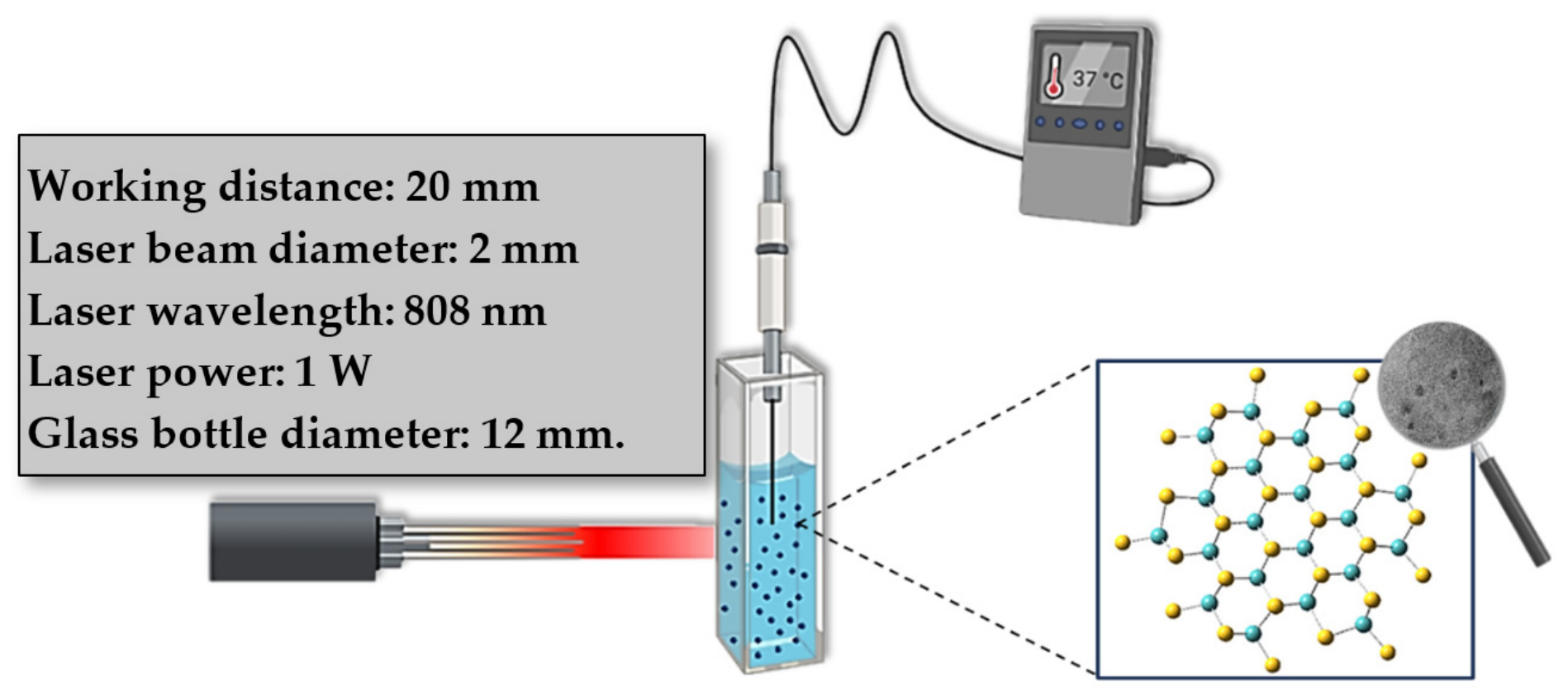
2.8. Photothermal Test
2.9. In Vitro Biocompatibility
2.10. Antibacterial Test
2.11. Numerical Simulation
3. Results
3.1. Yield of Synthesis
3.2. Characterization
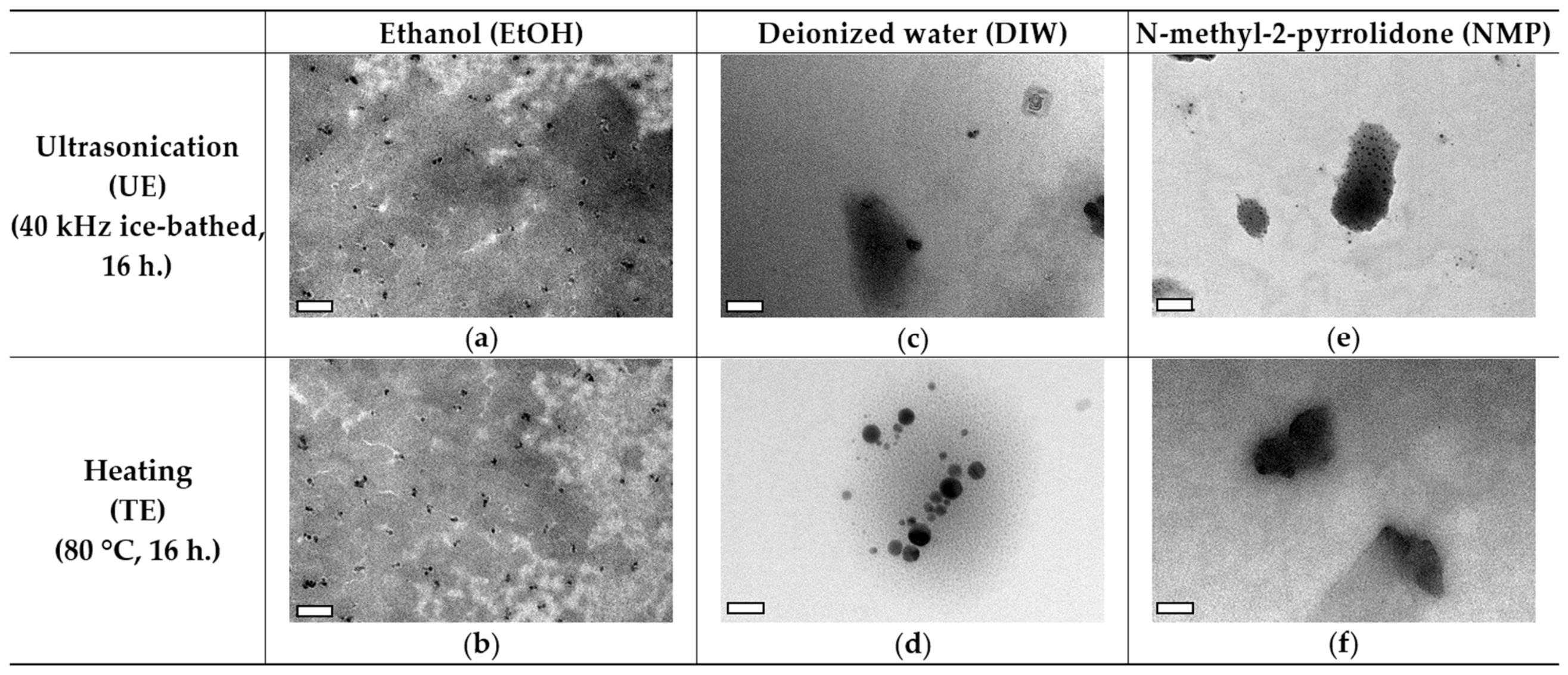
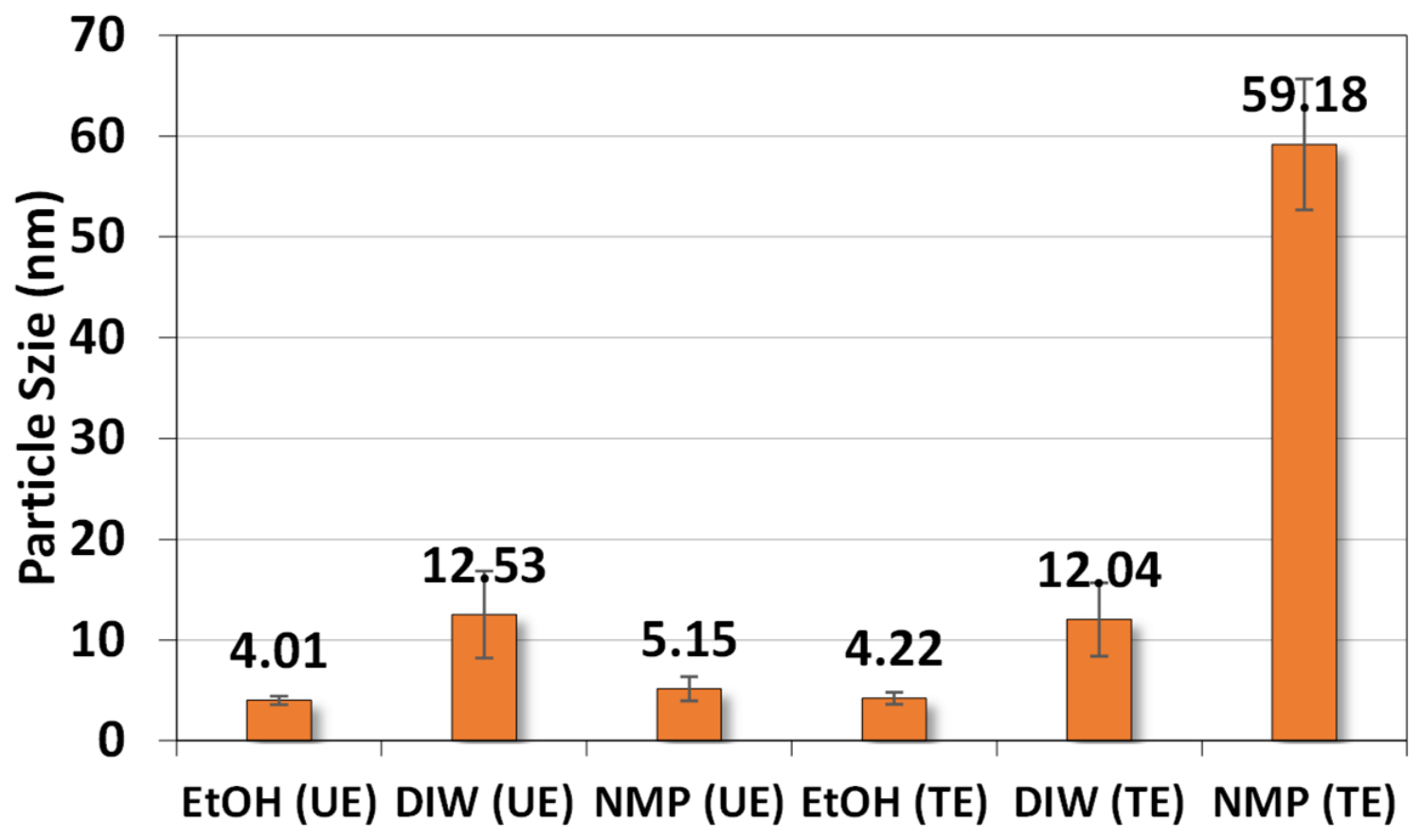
3.2.1. Morphology and Particle Size
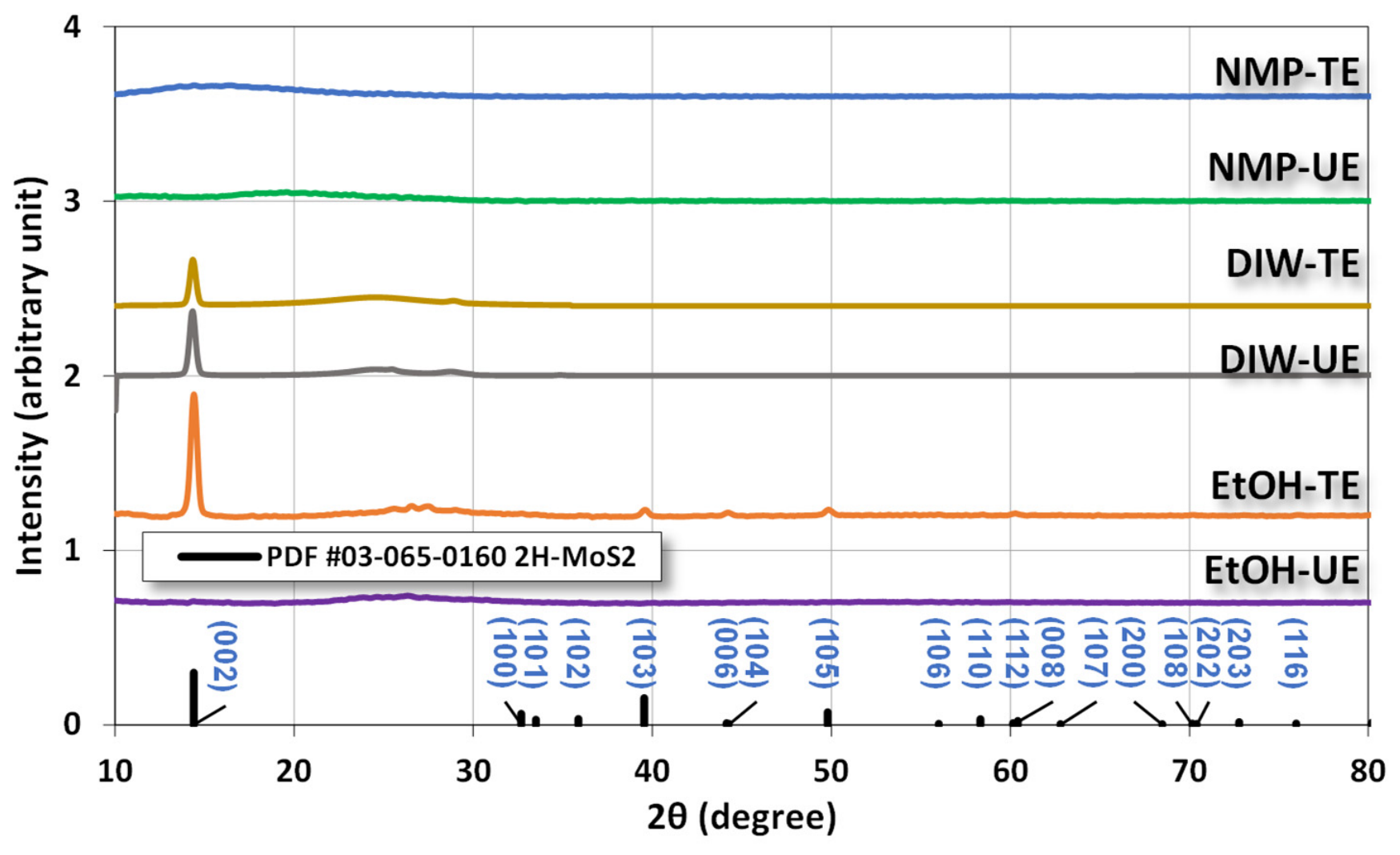
3.2.2. XRD
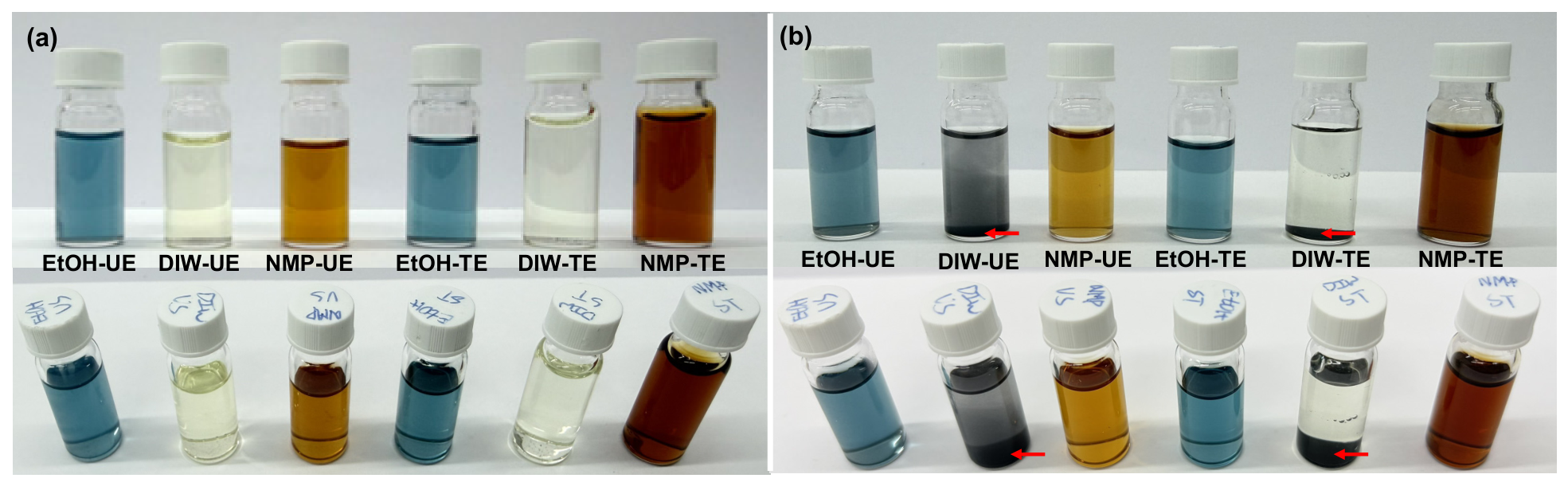
3.2.3. Zeta Potential
3.2.4. XPS
3.2.5. UV–Visible–NIR Spectrum
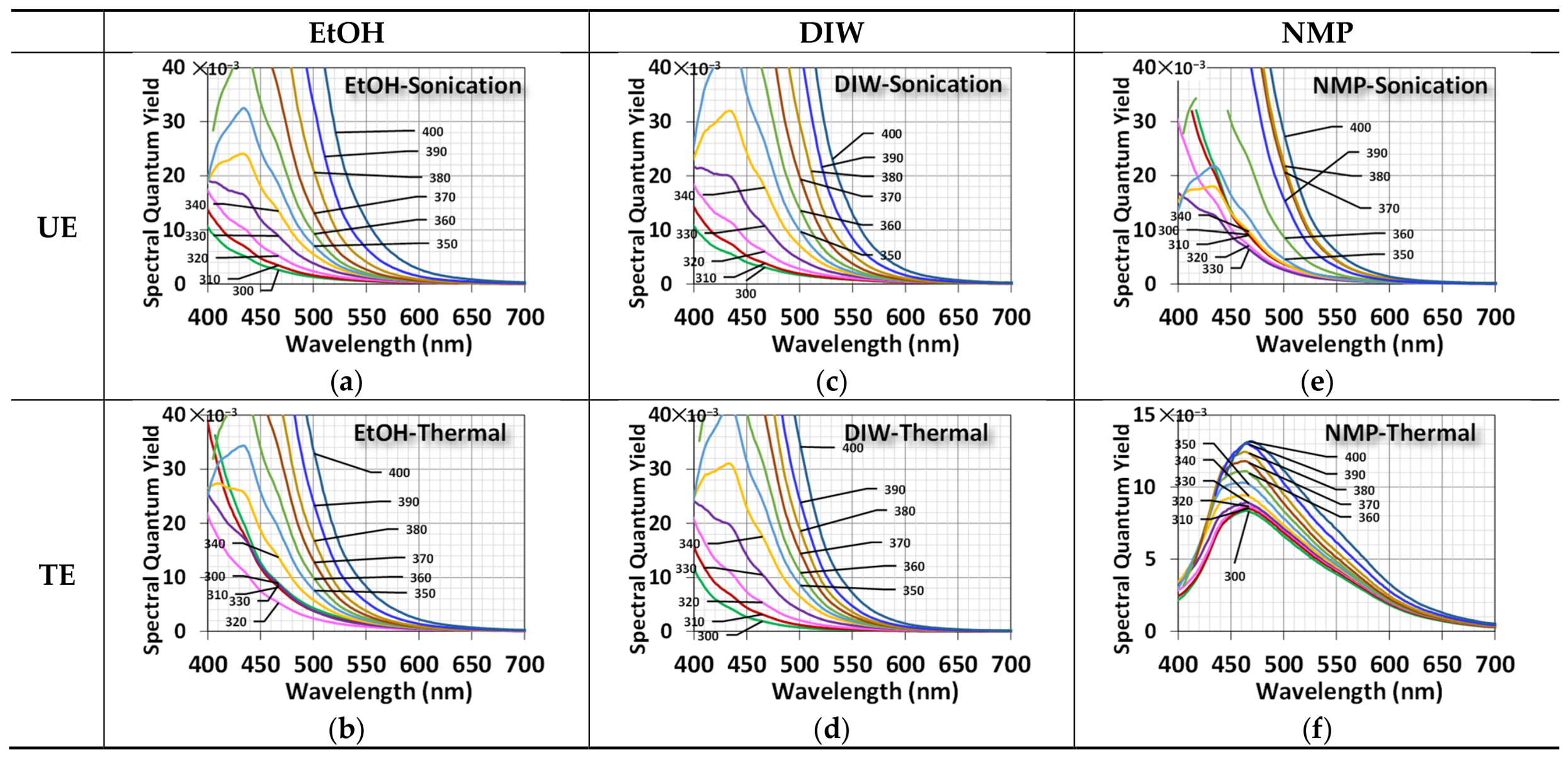
3.2.6. Photoluminescence
3.3. Photothermal Test
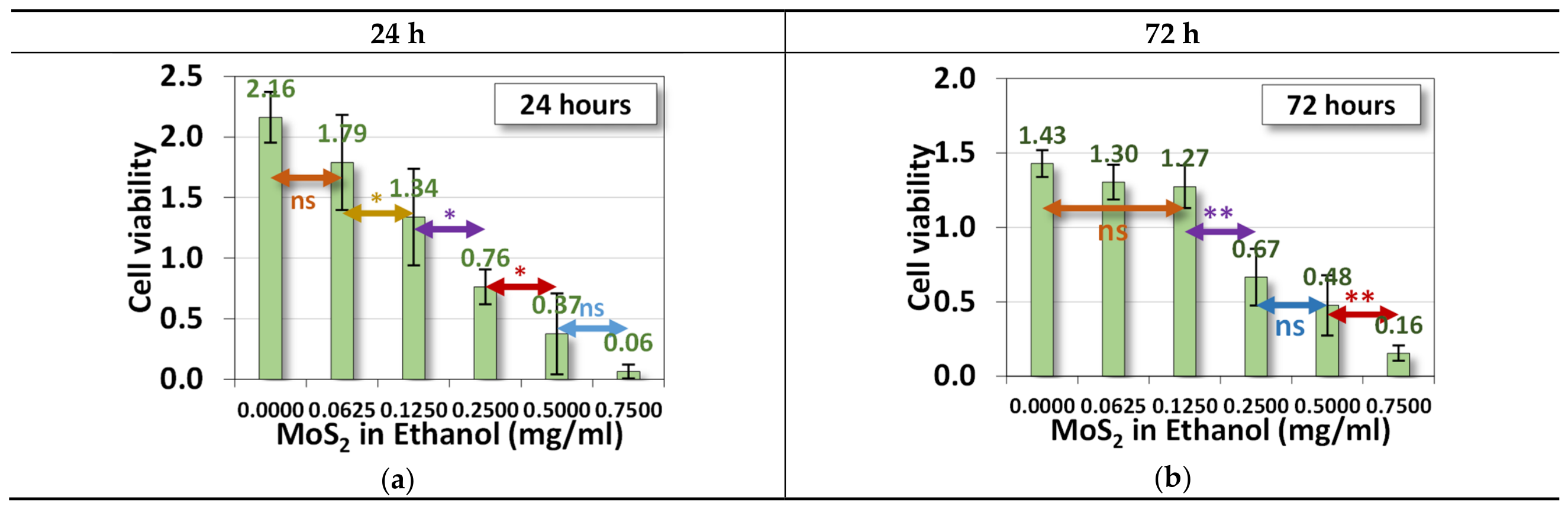
3.4. In Vitro Cell Viability
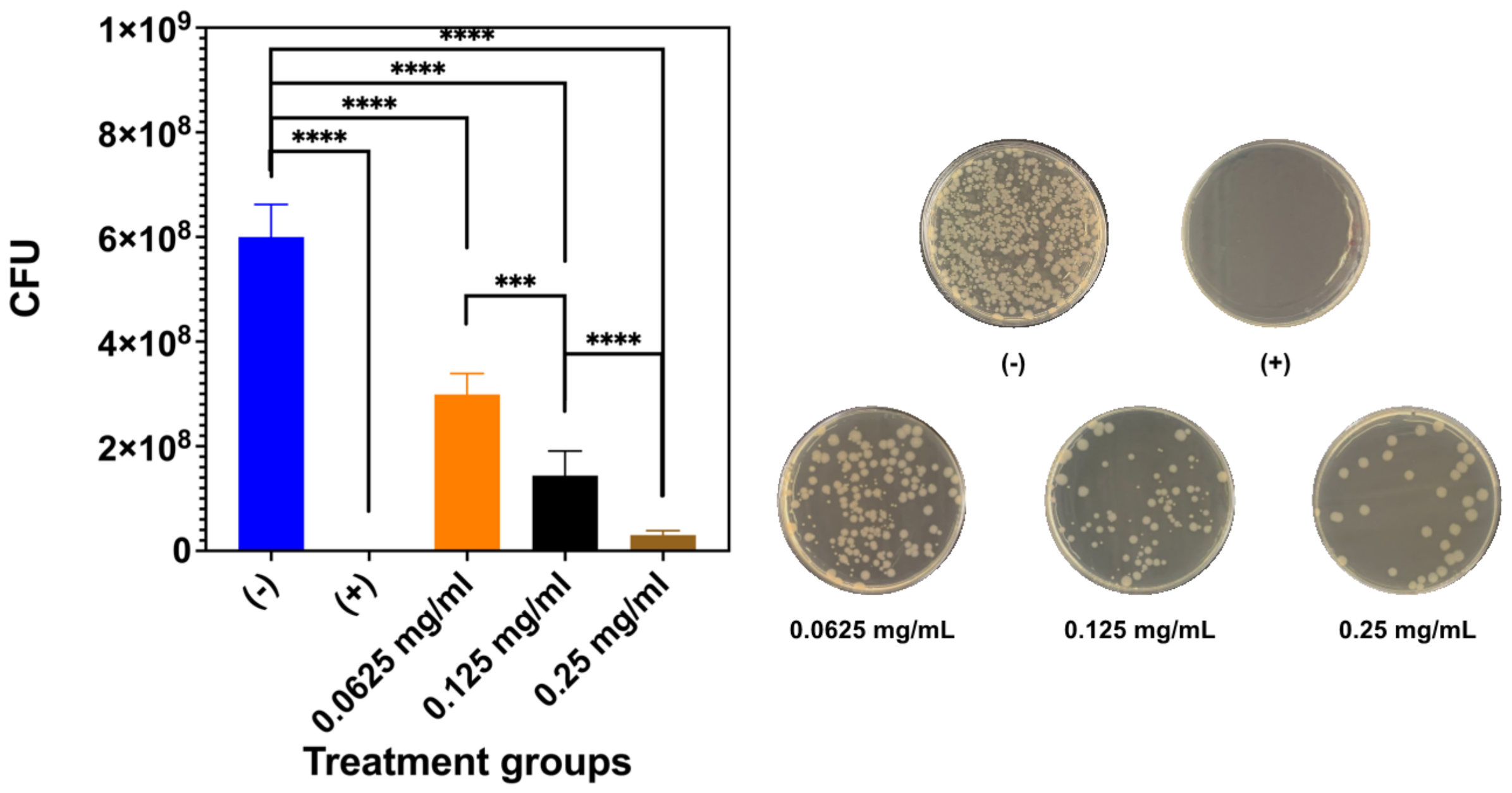
3.5. Antibacterial Test
4. Discussion
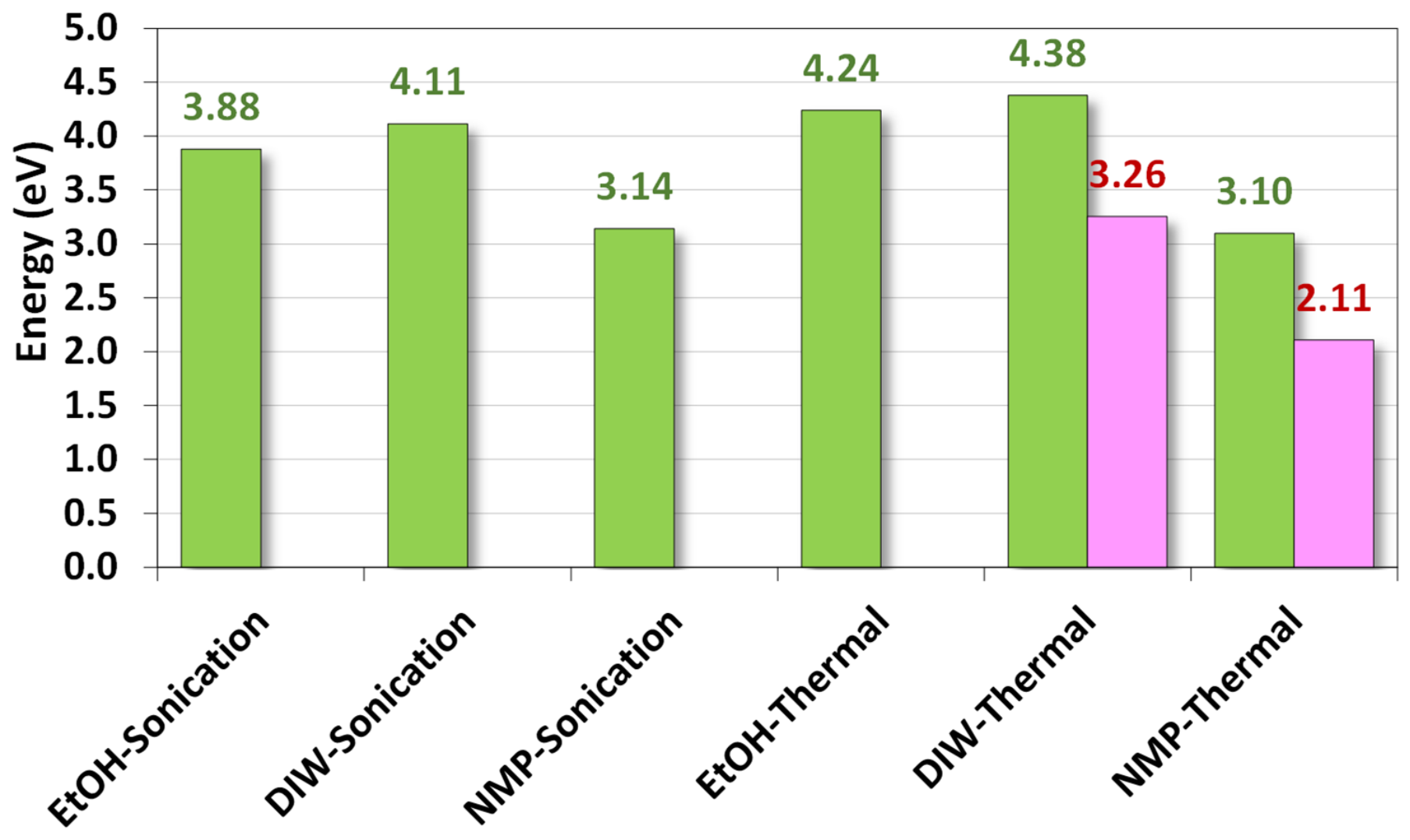
4.1. The Estimated Bandgap Energy
4.2. Correspondence Between XPS and XRD for the Microstructure
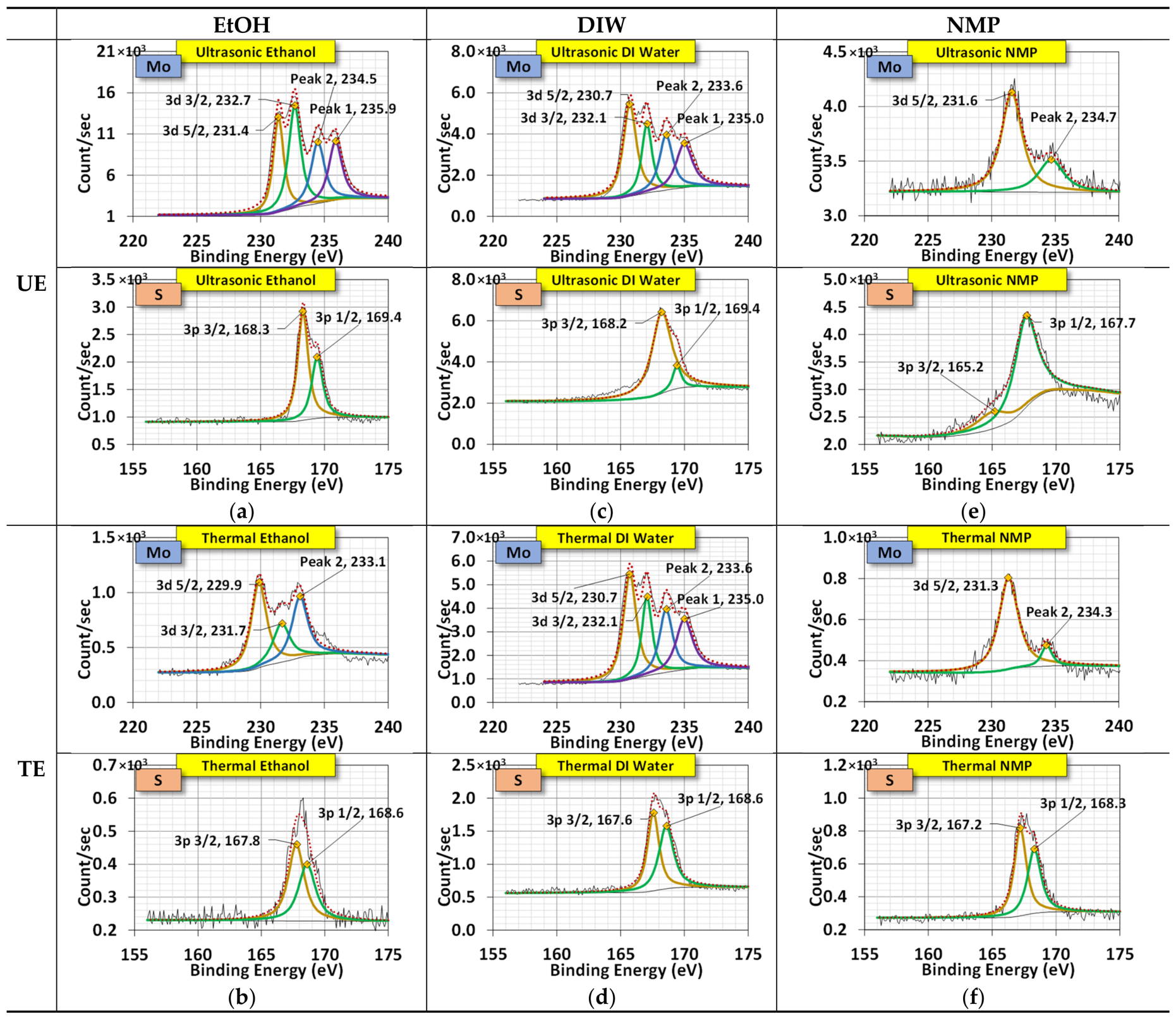
- Mo 3d peaks: Pristine semiconducting 2H-MoS2 exhibits a Mo 3d5/2 peak at ~229.3 eV and Mo 3d3/2 at ~232.5 eV, denoting a stable Mo4+ oxidation state. The binding energies of Mo in XPS (Figure 6a,b,d,e) for samples exfoliated in ethanol and DI water almost match these two energy levels, confirming the presence of Mo4+.
- S 2p peaks: The corresponding S 2p3/2 and S 2p1/2 spin-orbit components for pristine 2H-MoS2 appear at ~161.6 to −162.2 eV and ~162.8 to 163.4 eV, respectively, representing covalent metal–sulfur hybridization within the trigonal prismatic coordinate layers. The S bonding energies in XPS (Figure 6) for samples exfoliated in three solvents all shift higher, indicating defects in S, besides its regular bonding to Mo.
- Impurities or defects in S also affect the Mo bonding energy, and the satellite states reflect this fact.
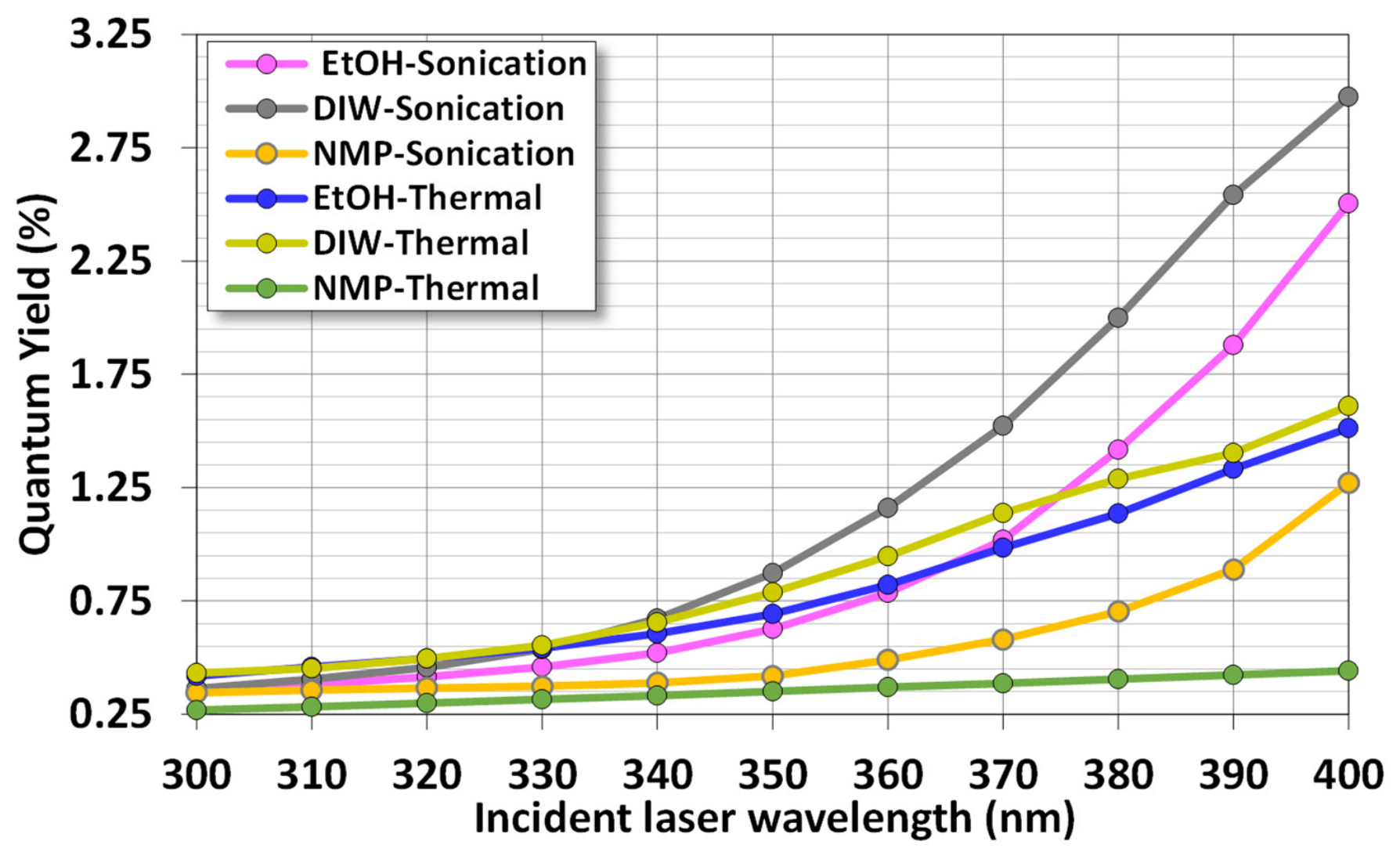
4.3. Estimate of Quantum Yield from Photoluminescence
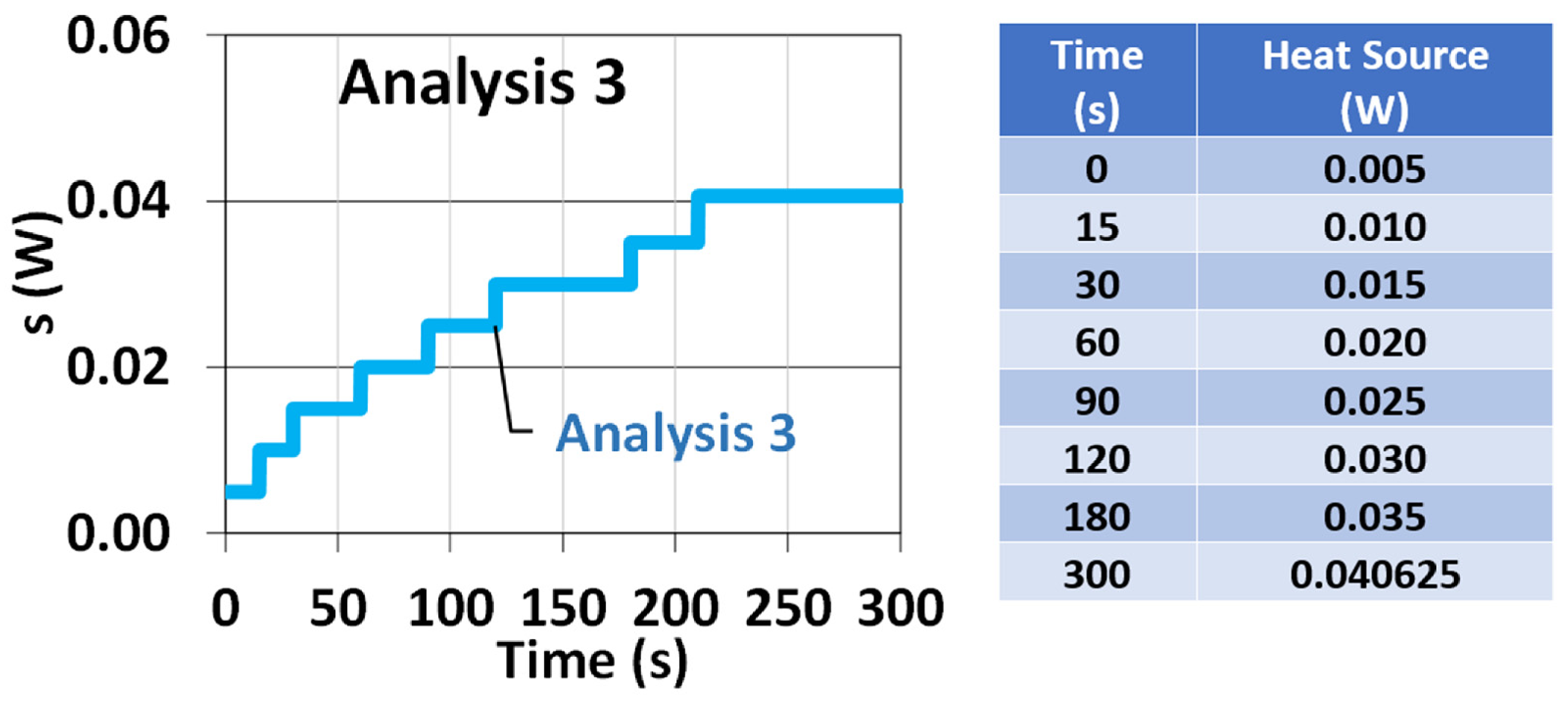
4.4. Evaluation of Heat Generation in Photothermal Test from Finite Element Analysis
4.5. Evaluation of Fabricated MoS2 Nanoparticles
5. Conclusions
Supplementary Materials
Author Contributions
Funding
Data Availability Statement
Acknowledgments
Conflicts of Interest
References
- Mitchell, P.C.H.; Outteridge, T.; Kloska, K.; McMahon, S.; Epshteyn, Y.; Sebenik, R.F.; Burkin, A.R.; Dorfler, R.R.; Laferty, J.M.; Leichtfried, G.; et al. Molybdenum and Molybdenum Compounds. In Ullmann’s Encyclopedia of Industrial Chemistry; Wiley-VCH: Weinheim, Germany, 2020; pp. 1–63. [Google Scholar]
- Srivastava, M.; Banerjee, S.; Bairagi, S.; Singh, P.; Kumar, B.; Singh, P.; Kale, R.D.; Mulvihill, D.M.; Ali, S.W. Recent Progress in Molybdenum Disulfide (MoS2) Based Flexible Nanogenerators: An Inclusive Review. Chem. Eng. J. 2024, 480, 147963. [Google Scholar] [CrossRef] [Scilit]
- Splendiani, A.; Sun, L.; Zhang, Y.; Li, T.; Kim, J.; Chim, C.Y.; Galli, G.; Wang, F. Emerging Photoluminescence in Monolayer MoS2. Nano Lett. 2010, 10, 1271–1275. [Google Scholar] [CrossRef] [Scilit]
- Wu, F.Y.; Cheng, Y.S.; Wang, D.M.; Li, M.L.; Lu, W.S.; Xu, X.Y.; Zhou, X.H.; Wei, X.W. Nitrogen-Doped MoS2 Quantum Dots: Facile Synthesis and Application for the Assay of Hematin in Human Blood. Mater. Sci. Eng. C 2020, 112, 110898. [Google Scholar] [CrossRef] [Scilit]
- Thomas, N.; Mathew, S.; Nair, K.M.; O’Dowd, K.; Forouzandeh, P.; Goswami, A.; McGranaghan, G.; Pillai, S.C. 2D MoS2: Structure, Mechanisms, and Photocatalytic Applications. Mater. Today Sustain. 2021, 13, 100073. [Google Scholar] [CrossRef] [Scilit]
- Obodo, P.C.; Obodo, K.O.; Aigbe, U.O.; Aigbodion, V. Recent Advances in Molybdenum Disulfide (MoS2) and MXene-based Heterostructures for Photovoltaic and Water Splitting Applications: A Review. ChemistrySelect 2025, 10, e202404995. [Google Scholar] [CrossRef] [Scilit]
- Zhang, L.; Wang, N.; Li, Y. Design, Synthesis, and Application of Some Two-Dimensional Materials. Chem. Sci. 2023, 14, 5266–5290. [Google Scholar] [CrossRef] [Scilit]
- Fang, C.; Wu, X.; Yang, F.; Qiao, R. Flow of Quasi-Two Dimensional Water in Graphene Channels. J. Chem. Phys. 2018, 148, 064702. [Google Scholar] [CrossRef] [Scilit]
- Komsa, H.-P.; Krasheninnikov, A.V. Effects of Confinement and Environment on the Electronic Structure and Exciton Binding Energy of MoS2 from First Principles. Phys. Rev. B 2012, 86, 241201. [Google Scholar] [CrossRef] [Scilit]
- Gan, Z.X.; Liu, L.Z.; Wu, H.Y.; Hao, Y.L.; Shan, Y.; Wu, X.L.; Chu, P.K. Quantum Confinement Effects across Two-Dimensional Planes in MoS2 Quantum Dots. Appl. Phys. Lett. 2015, 106, 233113. [Google Scholar] [CrossRef] [Scilit]
- Kuc, A.; Zibouche, N.; Heine, T. Influence of Quantum Confinement on the Electronic Structure of the Transition Metal Sulfide TS2. Phys. Rev. B 2011, 83, 245213. [Google Scholar] [CrossRef] [Scilit]
- Jiang, J.; Chen, Z.; Hu, Y.; Xiang, Y.; Zhang, L.; Wang, Y.; Wang, G.C.; Shi, J. Flexo-Photovoltaic Effect in MoS2. Nat. Nanotechnol. 2021, 16, 894–901. [Google Scholar] [CrossRef] [Scilit]
- Guo, Y.; Li, J. MoS2 Quantum Dots: Synthesis, Properties and Biological Applications. Mater. Sci. Eng. C 2020, 109, 110511. [Google Scholar] [CrossRef] [Scilit]
- Sinha, S.S.; Yadgarov, L.; Aliev, S.B.; Feldman, Y.; Pinkas, I.; Chithaiah, P.; Ghosh, S.; Idelevich, A.; Zak, A.; Tenne, R. MoS2 and WS2 Nanotubes: Synthesis, Structural Elucidation, and Optical Characterization. J. Phys. Chem. C 2021, 125, 6324–6340. [Google Scholar] [CrossRef] [Scilit]
- García de Arquer, F.P.; Talapin, D.V.; Klimov, V.I.; Arakawa, Y.; Bayer, M.; Sargent, E.H. Semiconductor Quantum Dots: Technological Progress and Future Challenges. Science 2021, 373, eaaz8541. [Google Scholar] [CrossRef] [Scilit]
- Lims, S.C.; Tran, N.A.; Dao, V.-D.; Pham, P.V. The World of Quantum Dot-Shaped Nanoparticles: Nobel Prize in Chemistry 2023: Advancements and Prospectives. Coord. Chem. Rev. 2025, 528, 216423. [Google Scholar] [CrossRef] [Scilit]
- Chen, L.; Chuang, Y.; Chen, C.-W.; Dong, C.-D. Facile Synthesis of MoS2/ZnO Quantum Dots for Enhanced Visible-Light Photocatalytic Performance and Antibacterial Applications. Nano-Struct. Nano-Objects 2022, 30, 100873. [Google Scholar] [CrossRef] [Scilit]
- Chen, X.; Park, Y.J.; Kang, M.; Kang, S.K.; Koo, J.; Shinde, S.M.; Shin, J.; Jeon, S.; Park, G.; Yan, Y.; et al. CVD-Grown Monolayer MoS2 in Bioabsorbable Electronics and Biosensors. Nat. Commun. 2018, 9, 1690. [Google Scholar] [CrossRef] [Scilit]
- Neacșa, A.; Ramadan, I.N.; Diniță, A.; Iacob, Ș.V.; Ilincă, C.N.; Laudacescu, E.V. Can Non-Phase-Transformation Heat Treatments Improve the Strength Properties of Materials? Materials 2025, 18, 1599. [Google Scholar] [CrossRef] [Scilit]
- Said, Z.; Pandey, A.K.; Tiwari, A.K.; Kalidasan, B.; Jamil, F.; Thakur, A.K.; Tyagi, V.V.; Sarı, A.; Ali, H.M. Nano-Enhanced Phase Change Materials: Fundamentals and Applications. Prog. Energy Combust. Sci. 2024, 104, 101162. [Google Scholar] [CrossRef] [Scilit]
- Hu, L.; Zhao, Q.; Huang, S.; Zheng, J.; Guan, X.; Patterson, R.; Kim, J.; Shi, L.; Lin, C.-H.; Lei, Q.; et al. Flexible and Efficient Perovskite Quantum Dot Solar Cells via Hybrid Interfacial Architecture. Nat. Commun. 2021, 12, 466. [Google Scholar] [CrossRef] [Scilit]
- Shilpa, G.; Kumar, P.M.; Kumar, D.K.; Deepthi, P.R.; Sadhu, V.; Sukhdev, A.; Kakarla, R.R. Recent Advances in the Development of High Efficiency Quantum Dot Sensitized Solar Cells (QDSSCs): A Review. Mater. Sci. Energy Technol. 2023, 6, 533–546. [Google Scholar] [CrossRef] [Scilit]
- Murphy, C.J. Peer Reviewed: Optical Sensing with Quantum Dots. Anal. Chem. 2002, 74, 520A–526A. [Google Scholar] [CrossRef] [Scilit]
- Lesiak, A.; Drzozga, K.; Cabaj, J.; Bański, M.; Malecha, K.; Podhorodecki, A. Optical Sensors Based on II-VI Quantum Dots. Nanomaterials 2019, 9, 192. [Google Scholar] [CrossRef] [Scilit]
- Engström, O.; Kaniewska, M. Deep Level Transient Spectroscopy in Quantum Dot Characterization. Nanoscale Res. Lett. 2008, 3, 179. [Google Scholar] [CrossRef] [Scilit]
- Oksanen, J.; Prunnila, M. Thermal Management in Quantum-Dot LEDs through Optical Thermodynamics. Joule 2023, 7, 2206–2208. [Google Scholar] [CrossRef] [Scilit]
- Yan, Y.; Gong, J.; Chen, J.; Zeng, Z.; Huang, W.; Pu, K.; Liu, J.; Chen, P. Recent Advances on Graphene Quantum Dots: From Chemistry and Physics to Applications. Adv. Mater. 2019, 31, e1808283. [Google Scholar] [CrossRef] [Scilit]
- Zare, I.; Zahed Nasab, S.; Rahi, A.; Ghaee, A.; Koohkhezri, M.; Ramezani Farani, M.; Madadi Gholipour, H.; Atabaki, A.H.; Hamblin, M.R.; Mostafavi, E.; et al. Antibacterial Carbon Materials-Based Quantum Dots: From Synthesis Strategies to Antibacterial Properties for Diagnostic and Therapeutic Applications in Wound Healing. Coord. Chem. Rev. 2025, 522, 216211. [Google Scholar] [CrossRef] [Scilit]
- Dong, X.; Liang, W.; Meziani, M.J.; Sun, Y.-P.; Yang, L. Carbon Dots as Potent Antibacterial Agents. Theranostics 2020, 10, 671–686. [Google Scholar] [CrossRef] [Scilit]
- Seth, S.; Karthikeyan; Rathinasabapathi, P.; Selvarajan, E.; Samuel, M.S.; Chandrasekar, N.; Balaji, R. Quantum Dots as Antibacterial Agents. In Carbon and Graphene Quantum Dots for Biomedical Applications; Woodhead Publishing: Cambridge, UK, 2023; pp. 119–128. [Google Scholar] [CrossRef] [Scilit]
- Montazer, L.; Mahani, M.; Khakbaz, F.; Divsar, F.; Yoosefian, M. Carbon Quantum Dots and Gold Nanostructures on Photothermal Therapy for Cancer Treatment. J. Photochem. Photobiol. A Chem. 2024, 450, 115443. [Google Scholar] [CrossRef] [Scilit]
- Dar, M.S.; Tabish, T.A.; Thorat, N.D.; Swati, G.; Sahu, N.K. Photothermal Therapy Using Graphene Quantum Dots. APL Bioeng. 2023, 7, 031502. [Google Scholar] [CrossRef] [Scilit]
- Pareek, A.; Kumar, D.; Pareek, A.; Gupta, M.M. Advancing Cancer Therapy with Quantum Dots and Other Nanostructures: A Review of Drug Delivery Innovations, Applications, and Challenges. Cancers 2025, 17, 878. [Google Scholar] [CrossRef] [Scilit]
- Li, B.; Jiang, L.; Li, X.; Ran, P.; Zuo, P.; Wang, A.; Qu, L.; Zhao, Y.; Cheng, Z.; Lu, Y. Preparation of Monolayer MoS2 Quantum Dots Using Temporally Shaped Femtosecond Laser Ablation of Bulk MoS2 Targets in Water. Sci. Rep. 2017, 7, 11182. [Google Scholar] [CrossRef] [Scilit]
- Liu, Q.; Hu, C.; Wang, X. A Facile One-Step Method to Produce MoS2 Quantum Dots as Promising Bio-Imaging Materials. RSC Adv. 2016, 6, 25605–25610. [Google Scholar] [CrossRef] [Scilit]
- Wu, J.-Y.; Zhang, X.-Y.; Ma, X.-D.; Qiu, Y.-P.; Zhang, T. High Quantum-Yield Luminescent MoS2 Quantum Dots with Variable Light Emission Created via Direct Ultrasonic Exfoliation of MoS2 Nanosheets. RSC Adv. 2015, 5, 95178–95182. [Google Scholar] [CrossRef] [Scilit]
- Agarwal, K.; Rai, H.; Mondal, S. Quantum Dots: An Overview of Synthesis, Properties, and Applications. Mater. Res. Express 2023, 10, 062001. [Google Scholar] [CrossRef] [Scilit]
- Jalali, H.B.; Sadeghi, S.; Dogru Yuksel, I.B.; Onal, A.; Nizamoglu, S. Past, Present and Future of Indium Phosphide Quantum Dots. Nano Res. 2022, 15, 4468–4489. [Google Scholar] [CrossRef] [Scilit]
- Chen, Z.; Zhao, C.; Zhou, X.; Xiao, L.; Li, Z.; Zhang, Y. A Review of Top-Down Strategies for the Production of Quantum-Sized Materials. Small Sci. 2023, 3, 2300086. [Google Scholar] [CrossRef] [Scilit]
- Chatterjee, S.; Maitra, U. In Situ Formation of Luminescent CdSe QDs in a Metallohydrogel: A Strategy towards Synthesis, Isolation, Storage and Re-Dispersion of the QDs. Nanoscale 2017, 9, 13820–13827. [Google Scholar] [CrossRef] [Scilit]
- Guo, Y.; Zhang, L.; Zhang, S.; Yang, Y.; Chen, X.; Zhang, M. Fluorescent Carbon Nanoparticles for the Fluorescent Detection of Metal Ions. Biosens. Bioelectron. 2015, 63, 61–71. [Google Scholar] [CrossRef] [Scilit]
- Häckl, K.; Kunz, W. Some Aspects of Green Solvents. C. R. Chim. 2018, 21, 572–580. [Google Scholar] [CrossRef] [Scilit]
- Winterton, N. The Green Solvent: A Critical Perspective. Clean Technol. Environ. Policy 2021, 23, 2499–2522. [Google Scholar] [CrossRef] [Scilit]
- Cvjetko Bubalo, M.; Vidović, S.; Radojčić Redovniković, I.; Jokić, S. Green Solvents for Green Technologies. Clean Technol. Environ. Policy 2015, 90, 1631–1639. [Google Scholar] [CrossRef] [Scilit]
- Sim, D.M.; Han, H.J.; Yim, S.; Choi, M.-J.; Jeon, J.; Jung, Y.S. Long-Term Stable 2H-MoS2 Dispersion: Critical Role of Solvent for Simultaneous Phase Restoration and Surface Functionalization of Liquid-Exfoliated MoS2. ACS Omega 2017, 2, 4678–4687. [Google Scholar] [CrossRef] [Scilit]
- Kaushik, S.; Nemala, S.S.; Kumar, M.; Negi, D.; Dhal, B.; Saini, L.; Banavath, R.; Saha, S.; Sharma, S.; Kalon, G. High-Yield Exfoliation of MoS2 Nanosheets by a Novel Spray Technique and the Importance of Soaking and Surfactants. Nano-Struct. Nano-Objects 2022, 32, 100922. [Google Scholar] [CrossRef] [Scilit]
- O’Neill, A.; Khan, U.; Coleman, J.N. Preparation of High Concentration Dispersions of Exfoliated MoS2 with Increased Flake Size. Chem. Mater. 2012, 24, 2414–2421. [Google Scholar] [CrossRef] [Scilit]
- Wang, H.; Chen, B.; Zhang, X.; Liu, S.; Zhu, B.; Wang, J.; Wu, K.; Chen, J. Ethanol Catalytic Deposition of MoS2 on Tapered Fiber. Photonics Res. 2015, 3, A102. [Google Scholar] [CrossRef] [Scilit]
- Huang, H.; Liu, N.; Wang, X.; Zhong, M.; Huang, X. Application of Hydrothermal and Solvothermal Method in Synthesis of MoS2. Rev. Chim. 2022, 73, 26–35. [Google Scholar] [CrossRef] [Scilit]
- Li, Z.; Fan, R.; Hu, Z.; Li, W.; Zhou, H.; Kang, S.; Zhang, Y.; Zhang, H.; Wang, G. Ethanol Introduced Synthesis of Ultrastable 1T-MoS2 for Removal of Cr(VI). J. Hazard. Mater. 2020, 394, 122525. [Google Scholar] [CrossRef] [Scilit]
- Varrla, E.; Backes, C.; Paton, K.R.; Harvey, A.; Gholamvand, Z.; McCauley, J.; Coleman, J.N. Large-Scale Production of Size-Controlled MoS2 Nanosheets by Shear Exfoliation. Chem. Mater. 2015, 27, 1129–1139. [Google Scholar] [CrossRef] [Scilit]
- Smith, R.J.; King, P.J.; Lotya, M.; Wirtz, C.; Khan, U.; De, S.; O’Neill, A.; Duesberg, G.S.; Grunlan, J.C.; Moriarty, G.; et al. Large-Scale Exfoliation of Inorganic Layered Compounds in Aqueous Surfactant Solutions. Adv. Mater. 2011, 23, 3944–3948. [Google Scholar] [CrossRef] [Scilit]
- Yao, Y.; Lin, Z.; Li, Z.; Song, X.; Moon, K.-S.; Wong, C. Large-Scale Production of Two-Dimensional Nanosheets. J. Mater. Chem. 2012, 22, 13494. [Google Scholar] [CrossRef] [Scilit]
- Museux, N.; Perez, L.; Autrique, L.; Agay, D. Skin Burns after Laser Exposure: Histological Analysis and Predictive Simulation. Burns 2012, 38, 658–667. [Google Scholar] [CrossRef] [Scilit]
- Svobodova, B.; Kloudova, A.; Ruzicka, J.; Kajtmanova, L.; Navratil, L.; Sedlacek, R.; Suchy, T.; Jhanwar-Uniyal, M.; Jendelova, P.; Machova Urdzikova, L. The Effect of 808 Nm and 905 Nm Wavelength Light on Recovery after Spinal Cord Injury. Sci. Rep. 2019, 9, 7660. [Google Scholar] [CrossRef] [Scilit]
- Mitchell, U.H.; Myrer, J.W.; Johnson, A.W.; Hilton, S.C. Restless Legs Syndrome and Near-Infrared Light: An Alternative Treatment Option. Physiother. Theory Pract. 2011, 27, 345–351. [Google Scholar] [CrossRef] [Scilit]
- Rojas, J.C.; Gonzalez-Lima, F. Low-Level Light Therapy of the Eye and Brain. Eye Brain 2011, 3, 49. [Google Scholar] [CrossRef] [Scilit]
- Zhang, R.; Qu, J. The Mechanisms and Efficacy of Photobiomodulation Therapy for Arthritis: A Comprehensive Review. Int. J. Mol. Sci. 2023, 24, 14293. [Google Scholar] [CrossRef] [Scilit]
- Dompe, C.; Moncrieff, L.; Matys, J.; Grzech-Leśniak, K.; Kocherova, I.; Bryja, A.; Bruska, M.; Dominiak, M.; Mozdziak, P.; Skiba, T.; et al. Photobiomodulation—Underlying Mechanism and Clinical Applications. J. Clin. Med. 2020, 9, 1724. [Google Scholar] [CrossRef] [Scilit]
- Ruokolainen, J.; Malinen, M.; Råback, P.; Zwinger, T.; Takala, E.; Kataja, J.; Gillet-Chaulet, F.; Ilvonen, S.; Gladstone, R.; Byckling, M.; et al. ElmerCSC/Elmerfem: Elmer 9.0; Zenodo: Genève, Switzerland, 2023. [Google Scholar]
- Liu, Y.; Zhong, Q.; Chen, K.; Zhou, J.; Yang, X.; Chen, W. Morphologies Controllable Synthesis of MoS2 by Hot-Injection Method: From Quantum Dots to Nanosheets. J. Mater. Sci. Mater. Electron. 2017, 28, 13633–13637. [Google Scholar] [CrossRef] [Scilit]
- Kariachan, S.; Shibu, J.; Velayudhan, P.; Sidharthan, S.K.; Velayudhan, P.; Simon, S.M.; Kasai, H.; Okubo, K.; Thomas, S.; Oka, K.; et al. Exploring the Advances in 2D Materials as a Quest for Energy Storage Electrode Materials. RSC Adv. 2026, 16, 10847–10886. [Google Scholar] [CrossRef] [Scilit]
- Yi, S.; Babadagli, T.; Li, H. Stabilization of Nickel Nanoparticle Suspensions with the Aid of Polymer and Surfactant: Static Bottle Tests and Dynamic Micromodel Flow Tests. Pet. Sci. 2020, 17, 1014–1024. [Google Scholar] [CrossRef] [Scilit]
- Chikan, V.; Kelley, D.F. Size-Dependent Spectroscopy of MoS2 Nanoclusters. J. Phys. Chem. B 2002, 106, 3794–3804. [Google Scholar] [CrossRef] [Scilit]
- Song, C.; Wang, Z.; Yin, Z.; Xiao, D.; Ma, D. Principles and Applications of Photothermal Catalysis. Chem Catal. 2022, 2, 52–83. [Google Scholar] [CrossRef] [Scilit]
- Fu, Y.; Liang, F.; He, C.; Yu, H.; Zhang, H.; Chen, Y.-F. Photon-Phonon Collaboratively Pumped Laser. Nat. Commun. 2023, 14, 8110. [Google Scholar] [CrossRef] [Scilit]
- Cao, H.; Wang, H.; Huang, Y.; Sun, Y.; Shi, S.; Tang, M. Quantification of Gold(III) in Solution and with a Test Stripe via the Quenching of the Fluorescence of Molybdenum Disulfide Quantum Dots. Microchim. Acta 2017, 184, 91–100. [Google Scholar] [CrossRef] [Scilit]
- Ryou, J.; Kim, Y.-S.; KC, S.; Cho, K. Monolayer MoS2 Bandgap Modulation by Dielectric Environments and Tunable Bandgap Transistors. Sci. Rep. 2016, 6, 29184. [Google Scholar] [CrossRef] [Scilit]
- Kobayashi, K.; Yamauchi, J. Electronic Structure and Scanning-Tunneling-Microscopy Image of Molybdenum Dichalcogenide Surfaces. Phys. Rev. B 1995, 51, 17085–17095. [Google Scholar] [CrossRef] [Scilit]
- Yun, W.S.; Han, S.W.; Hong, S.C.; Kim, I.G.; Lee, J.D. Thickness and Strain Effects on Electronic Structures of Transition Metal Dichalcogenides: 2H-MX2 Semiconductors (M = Mo, W; X = S, Se, Te). Phys. Rev. B 2012, 85, 033305. [Google Scholar] [CrossRef] [Scilit]
- Cheiwchanchamnangij, T.; Lambrecht, W.R.L. Quasiparticle Band Structure Calculation of Monolayer, Bilayer, and Bulk MoS2. Phys. Rev. B 2012, 85, 205302. [Google Scholar] [CrossRef] [Scilit]
- Qiu, D.Y.; da Jornada, F.H.; Louie, S.G. Optical Spectrum of MoS2: Many-Body Effects and Diversity of Exciton States. Phys. Rev. Lett. 2013, 111, 216805. [Google Scholar] [CrossRef] [Scilit]
- Gupta, A.; Arunachalam, V.; Vasudevan, S. Liquid-Phase Exfoliation of MoS2 Nanosheets: The Critical Role of Trace Water. J. Phys. Chem. Lett. 2016, 7, 4884–4890. [Google Scholar] [CrossRef] [Scilit]
- Chen, P.-C.; Lin, C.-P.; Hong, C.-J.; Yang, C.-H.; Lin, Y.-Y.; Li, M.-Y.; Li, L.-J.; Yu, T.-Y.; Su, C.-J.; Li, K.-S.; et al. Effective N-Methyl-2-Pyrrolidone Wet Cleaning for Fabricating High-Performance Monolayer MoS2 Transistors. Nano Res. 2019, 12, 303–308. [Google Scholar] [CrossRef] [Scilit]
- Kira, M.; Jahnke, F.; Koch, S.W. Quantum Theory of Secondary Emission in Optically Excited Semiconductor Quantum Wells. Phys. Rev. Lett. 1999, 82, 3544–3547. [Google Scholar] [CrossRef] [Scilit]
- Faraji, M.; Yamini, Y.; Salehi, N. Characterization of Magnetic Nanomaterials. In Magnetic Nanomaterials in Analytical Chemistry; Elsevier: Amsterdam, The Netherlands, 2021; pp. 39–60. [Google Scholar]
- Wang, Y.; Dou, W. Interband and Intraband Transitions, as Well as Charge Mobility in Driven Two-Band Model with Electron Phonon Coupling. J. Chem. Phys. 2024, 116, 204104. [Google Scholar] [CrossRef] [Scilit]
- Vlasenko, N.A. Momentum Relaxation of Hot Electrons during Radiative Intraband Indirect Transitions in ZnS:Cr. Semicond. Phys. Quantum Electron. Optoelectron. 2005, 8, 25–29. [Google Scholar] [CrossRef] [Scilit]
- Hari Krishna, P.; Ramrakhiani, M. Nano Particle Size Effect on Photo-Luminescence. Int. J. Nanotechnol. Appl. 2010, 4, 13–19. [Google Scholar] [CrossRef] [Scilit]
- Wu, X.; Suo, Y.; Shi, H.; Liu, R.; Wu, F.; Wang, T.; Ma, L.; Liu, H.; Cheng, Z. Deep-Tissue Photothermal Therapy Using Laser Illumination at NIR-IIa Window. Nano-Micro Lett. 2020, 12, 38. [Google Scholar] [CrossRef] [Scilit]
- Jiang, Q.; Zeng, W.; Zhang, C.; Meng, Z.; Wu, J.; Zhu, Q.; Wu, D.; Zhu, H. Broadband Absorption and Enhanced Photothermal Conversion Property of Octopod-like Ag@Ag2S Core@shell Structures with Gradually Varying Shell Thickness. Sci. Rep. 2017, 7, 17782. [Google Scholar] [CrossRef] [Scilit]
- Marinov, A.D.; Clancy, A.J.; Howard, C.A.; Cullen, P.L. XPS Peak-Fitting of 2H MoS2, 1T MoS2, and MoS2-X Nanosheets in MoS2 Powders and Battery Electrodes After Ar+ Ion Depth-Profiling. ACS Appl. Nano Mater. 2026, 9, 1183–1194. [Google Scholar] [CrossRef] [Scilit]
- Munusami, V.; Arutselvan, K.; Vadivel, S.; Govindasamy, S. High Sensitivity LPG and H2 Gas Sensing Behavior of MoS2/Graphene Hybrid Sensors Prepared by Facile Hydrothermal Method. Ceram. Int. 2022, 48, 29322–29331. [Google Scholar] [CrossRef] [Scilit]
- Bao, Y.; Yang, M.; Tan, S.J.R.; Liu, Y.P.; Xu, H.; Liu, W.; Nai, C.T.; Feng, Y.P.; Lu, J.; Loh, K.P. Substoichiometric Molybdenum Sulfide Phases with Catalytically Active Basal Planes. J. Am. Chem. Soc. 2016, 138, 14121–14128. [Google Scholar] [CrossRef] [Scilit]
- Menzel, J.P.; Noble, B.B.; Blinco, J.P.; Barner-Kowollik, C. Predicting Wavelength-Dependent Photochemical Reactivity and Selectivity. Nat. Commun. 2021, 12, 1691. [Google Scholar] [CrossRef] [Scilit]
- Drozd, G.T.; Weltzin, T.; Skiffington, S.; Lee, D.; Valiev, R.; Kurtén, T.; Madison, L.R.; He, Y.; Gargano, L. Wavelength-Resolved Quantum Yields for Vanillin Photochemistry: Self-Reaction and Ionic-Strength Implications for Wildfire Brown Carbon Lifetime. Environ. Sci. Atmos. 2024, 4, 509–518. [Google Scholar] [CrossRef] [Scilit]
- Maafi, M. On Photokinetics under Polychromatic Light. Front. Chem. 2024, 12, 1367276. [Google Scholar] [CrossRef] [Scilit]
- Porrès, L.; Holland, A.; Pålsson, L.O.; Monkman, A.P.; Kemp, C.; Beeby, A. Absolute Measurements of Photoluminescence Quantum Yields of Solutions Using an Integrating Sphere. J. Fluoresc. 2006, 16, 267–273. [Google Scholar] [CrossRef] [Scilit]
- Greenham, N.C.; Samuel, I.D.W.; Hayes, G.R.; Phillips, R.T.; Kessener, Y.A.R.R.; Moratti, S.C.; Holmes, A.B.; Friend, R.H. Measurement of Absolute Photoluminescence Quantum Efficiencies in Conjugated Polymers. Chem. Phys. Lett. 1995, 241, 89–96. [Google Scholar] [CrossRef] [Scilit]
- De Mello, J.C.; Wittmann, H.F.; Friend, R.H. An Improved Experimental Determination of External Photoluminescence Quantum Efficiency. Adv. Mater. 1997, 9, 230–232. [Google Scholar] [CrossRef] [Scilit]
- Xie, L.; Yang, Y.; Gong, G.; Feng, S.; Liu, D. One-Step Hydrothermal Synthesis of Highly Fluorescent MoS2 Quantum Dots for Lead Ion Detection in Aqueous Solutions. Nanomaterials 2022, 12, 3329. [Google Scholar] [CrossRef] [Scilit]
- Zhou, K.; Zhang, Y.; Xia, Z.; Wei, W. As-Prepared MoS2 Quantum Dot as a Facile Fluorescent Probe for Long-Term Tracing of Live Cells. Nanotechnology 2016, 27, 275101. [Google Scholar] [CrossRef] [Scilit]
- Wang, Y.; Liu, Y.; Zhang, J.; Wu, J.; Xu, H.; Wen, X.; Zhang, X.; Tiwary, C.S.; Yang, W.; Vajtai, R.; et al. Cryo-Mediated Exfoliation and Fracturing of Layered Materials into 2D Quantum Dots. Sci. Adv. 2017, 3, e1701500. [Google Scholar] [CrossRef] [Scilit]
- Marqus, S.; Ahmed, H.; Ahmed, M.; Xu, C.; Rezk, A.R.; Yeo, L.Y. Increasing Exfoliation Yield in the Synthesis of MoS2 Quantum Dots for Optoelectronic and Other Applications through a Continuous Multicycle Acoustomicrofluidic Approach. ACS Appl. Nano Mater. 2018, 1, 2503–2508. [Google Scholar] [CrossRef] [Scilit]
- Liu, J.; Cui, E.; Zhang, Q.; Xie, D. MoS2-Based Nanocomposites with High Photothermal Conversion Efficiency for Combinational Photothermal/Photodynamic Tumor Therapy. J. Alloys Compd. 2024, 970, 172489. [Google Scholar] [CrossRef] [Scilit]
- Wang, J.; Tan, X.; Pang, X.; Liu, L.; Tan, F.; Li, N. MoS2 Quantum Dot@Polyaniline Inorganic–Organic Nanohybrids for In Vivo Dual-Modal Imaging Guided Synergistic Photothermal/Radiation Therapy. ACS Appl. Mater. Interfaces 2016, 8, 24331–24338. [Google Scholar] [CrossRef] [Scilit]
- Ghasemipour, P.; Fattahi, M.; Rasekh, B.; Yazdian, F. Developing the Ternary ZnO Doped MoS2 Nanostructures Grafted on CNT and Reduced Graphene Oxide (RGO) for Photocatalytic Degradation of Aniline. Sci. Rep. 2020, 10, 4414. [Google Scholar] [CrossRef] [Scilit]
- Yang, Y.; Yu, Y.; Cui, C.; Liu, X.; Li, Y.; Liu, P.; Hui, F. Interfacial Engineering of MoS2 Thin Films for Wettability-Dependent Resistive Switching and Neuromorphic Behaviors. Nanomaterials 2026, 16, 959. [Google Scholar] [CrossRef] [Scilit]
- Shaltout, A.A.; Mostafa, N.Y.; Mahani, R.M.; Ahmed, S.I.; Allam, M.A.; Alzahrani, E.; Wahba, H.H. Investigation of structural and optical properties of molybdenum disulfide flakes/polyvinylidene fluoride nanocomposites. J. Mater. Res. Technol. 2020, 9(6), 14350–14359. [Google Scholar] [CrossRef] [Scilit]
- Nadeem, M.T.; Aqeel, R.; Zafar, A.; Nisar, A.; Khan, M.I.; Ahmad, M. Synergic effect of a MoS2–V2O5 heterostructure as an advanced catalyst for photocatalytic degradation of methylene blue. New J. Chem. 2025, 49, 1171–1181. [Google Scholar] [CrossRef] [Scilit]
- Rodríguez-Ocanto, N.; González-Gómez, W.S.; Rodríguez-Gattorno, G.; Padron-Hernandez, W.; Ruiz-Gómez, M.A. Sustainable colloidal ink for inkjet printing of 1T/2H-MoS2 based photodetectors on flexible substrate. Mater. Sci. Semicond. Process. 2025, 200, 110019. [Google Scholar] [CrossRef] [Scilit]
- Zhao, J.; Zhang, Z.; Yang, S.; Zheng, H.; Li, Y. Facile synthesis of MoS2 nanosheet-silver nanoparticles composite for surface enhanced Raman scattering and electrochemical activity. J. Alloys Compd. 2013, 559, 87–91. [Google Scholar] [CrossRef] [Scilit]
- Liu, B.; Ma, Y.; Zhang, A.; Chen, L.; Abbas, A.N.; Liu, Y.; Shen, C.; Wan, H.; Zhou, C. High-Performance WSe2 Field-Effect Transistors via Controlled Formation of In-Plane Heterojunctions. ACS Nano 2016, 10, 5153–5160. [Google Scholar] [CrossRef] [Scilit]
- Lalithambika, K.C.; Shanmugapriya, K.; Sriram, S. Photocatalytic activity of MoS2 nanoparticles: An experimental and DFT analysis. Appl. Phys. A 2019, 125, 817. [Google Scholar] [CrossRef] [Scilit]
- Yi, M.; Zhang, C. The synthesis of two-dimensional MoS2 nanosheets with enhanced tribological properties as oil additives. RSC Adv. 2018, 8, 9564–9573. [Google Scholar] [CrossRef] [Scilit]







| Ethanol (EtOH) | Deionized Water (DIW) | N-Methyl-2-Pyrrolidone (NMP) | |
|---|---|---|---|
| Ultrasonication (UE) (40 kHz ice-bathed, 16 h.) | 20 mL | 20 mL | 20 mL |
| Heating (TE) (80 °C, 16 h.) | 20 mL | 20 mL | 20 mL |
| Synthesis | MoS2 + Solvent | Product Weight (MoS2 Nanoparticles, mg) | Yield Ratio |
|---|---|---|---|
| Ultrasonication (UE) (40 kHz ice-bathed, 16 h.) | 200 mg + EtOH, 20 mL | 14 mg | 7.0% |
| 200 mg + DIW, 20 mL | 9 mg | 4.5% | |
| 200 mg + NMP, 20 mL | 6 mg | 3.0% | |
| Heating (TE) (80 °C, 16 h.) | 200 mg + EtOH, 20 mL | 30 mg | 15.0% |
| 200 mg + DIW, 20 mL | 4 mg | 2.0% | |
| 200 mg + NMP, 20 mL | 3 mg | 1.5% |
| Ethanol (EtOH) | Deionized Water (DIW) | N-Methyl-2-Pyrrolidone (NMP) | |
|---|---|---|---|
| Ultrasonication (UE) (40 kHz ice-bathed, 16 h.) | −28.43 ± 4.15 mV | −8.58 ± 2.92 mV | 26.13 ± 3.21 mV |
| Heating (TE) (80 °C, 16 h.) | −24.27 ± 5.26 mV | −4.88 ± 0.06 mV | 41.57 ± 4.61 mV |
| Synthesis Method | Solvent/Precursors | Yield (%) | Average Particle Size (nm) | PL Quantum Yield (%) | Photothermal Performance (Power Conversion Efficiency (PCE) or ΔT) | Reference |
|---|---|---|---|---|---|---|
| Thermal Exfoliation (TE) | Ethanol/MoS2 Powder | 15% | ~4.1 | 1.55% | ΔT ≈ 28.4 °C at 300 s, 1.0 W/cm2; PCE = 25.86% | This Work |
| Ultrasonic Exfoliation (UE) | Ethanol/MoS2 Powder | 7% | ~4.0 | 2.55% | ΔT ≈ 28.1 °C at 300 s, 1.0 W/cm2 | This Work |
| Chemical–Ultrasonic Exfoliation (40 kHz) | NaCl, Na2CO3, LiOH/MoS2 Powder | 1.5–7 | 4.84% | [36] | ||
| Hydrothermal Synthesis | Water + HCl/(NH4)2MoS4 + GSH | 4.4 | 20.4% | [91] | ||
| Chemical–Hydrothermal Exfoliation (Na intercalation) | Water/MoS2 Powder + Na sand | 11% | 3.5 | 11% | [92] | |
| Cryo-mediated exfoliation | Liquid Nitrogen/MoS2 Powder | 1% | 2.5 | 10% | [93] | |
| Nebulization–Condensation Method | Lithium Niobate/MoS2 Powder | 9.65% | 8.25 | 10.7% | [94] | |
| Solvent–Thermal Method | 1-Octadecene/(NH4)2MoS4, Oleic Acid, Oleylamine | 4.5 nm | ΔT ≈ 10.4 °C at 300 s, 1 W/cm2; PCE = 13.18% | [95] | ||
| Ultrasonic–Thermal Exfoliation (UE) | NMP/MoS2 Powder | 5.3 nm | ΔT ≈ 25 °C at 300 s, 1.5 W/cm2 | [96] |
Disclaimer/Publisher’s Note: The statements, opinions and data contained in all publications are solely those of the individual author(s) and contributor(s) and not of MDPI and/or the editor(s). MDPI and/or the editor(s) disclaim responsibility for any injury to people or property resulting from any ideas, methods, instructions or products referred to in the content. |
© 2026 by the authors. Licensee MDPI, Basel, Switzerland. This article is an open access article distributed under the terms and conditions of the Creative Commons Attribution (CC BY) license.
Share and Cite
Yiu, H.P.; Li, W.; Hsieh, J.-H.; Li, C.; Lee, C.Y.; Sankar, R. Comparison Between Ultrasonic and Thermal Exfoliation for Molybdenum Disulfide Nanoparticles—A Multifunctional Study. Nanomaterials 2026, 16, 1058. https://doi.org/10.3390/nano16171058
Yiu HP, Li W, Hsieh J-H, Li C, Lee CY, Sankar R. Comparison Between Ultrasonic and Thermal Exfoliation for Molybdenum Disulfide Nanoparticles—A Multifunctional Study. Nanomaterials. 2026; 16(17):1058. https://doi.org/10.3390/nano16171058
Chicago/Turabian StyleYiu, Hon Pan, William Li, Jang-Hsing Hsieh, Chuan Li, Cho Yin Lee, and Raman Sankar. 2026. "Comparison Between Ultrasonic and Thermal Exfoliation for Molybdenum Disulfide Nanoparticles—A Multifunctional Study" Nanomaterials 16, no. 17: 1058. https://doi.org/10.3390/nano16171058
APA StyleYiu, H. P., Li, W., Hsieh, J.-H., Li, C., Lee, C. Y., & Sankar, R. (2026). Comparison Between Ultrasonic and Thermal Exfoliation for Molybdenum Disulfide Nanoparticles—A Multifunctional Study. Nanomaterials, 16(17), 1058. https://doi.org/10.3390/nano16171058