


Abstract
This systematic review evaluates the application of green-synthesized nanoparticles for the removal of uranium (U) and thorium (Th) from contaminated water sources. The study focuses on the synthesis methods, adsorption performance, operational parameters, and environmental implications associated with these nanomaterials. Following PRISMA guidelines, studies published between 2015 and 2025 were identified through searches conducted in the Scopus and Web of Science databases. The review highlights the predominance of iron-based nanoparticles, biochar-derived materials, and biopolymer-based composites, many of which demonstrated removal efficiencies exceeding 90% and high adsorption capacities for U (VI) and Th (IV). Key factors influencing performance include solution pH, adsorbent dosage, contaminant concentration, and contact time. The review also examines adsorption mechanisms, regeneration potential, scalability challenges, and concerns related to environmental safety and nanoparticle recovery. Although the reported results demonstrate significant potential for radionuclide remediation, most studies remain limited to laboratory-scale experiments using synthetic water. This review synthesizes current knowledge, identifies existing research gaps, and discusses future directions required to support the practical implementation of green nanotechnologies for sustainable water treatment.
1. Introduction
The contamination of water resources by heavy metals and radionuclides presents a significant threat to the environment and public health, prompting an increasing demand for effective and sustainable treatment methods [1,2]. Among the most hazardous pollutants found in water are naturally occurring radioactive materials (NORM), with uranium (U) and thorium (Th) being particularly concerning [3,4]. Uranium, aside from its radioactive properties, is chemically toxic, possesses an extremely long half-life, and causes irreversible biotoxicity in various organisms [5,6]. Recognizing these risks, the World Health Organization (WHO) has set the maximum allowable concentration of U in drinking water at 30 µg/L [7]. Human activities such as uranium mining, phosphate processing, and oil and gas drilling are known to increase radionuclide levels in soil and water, thereby compounding the risk of contamination [8,9].
Rare earth elements (REEs) frequently coexist with naturally occurring radionuclides in REE-bearing minerals such as monazite, xenotime, and apatite [4]. As a result, U and Th can concentrate on tailings and wastewater generated during the mineral processing of REE ores. This accumulation represents a considerable contamination risk if not managed appropriately, as both elements are persistent contaminants that may pose radiological and toxicological risks depending on their concentration, speciation, and exposure pathway [3]. In particular, uranium is of high concern due to its greater mobility under oxidizing aqueous conditions, which increases the risk of transport to groundwater and surrounding water bodies [10], while Th tends to remain in solid residues and process streams associated with REE beneficiation [11]. Several incidents have been documented in regions impacted by REE mining and processing, where elevated U concentrations have been identified in groundwater [12,13]. These occurrences highlight the environmental and radiological hazards associated with poor residue management and the weathering of REE-containing materials [11]. Therefore, the development of effective and sustainable treatment strategies for the specific removal of uranium and thorium from contaminated waters is essential to reduce long-term environmental risks and support safer mineral resource production.
Traditionally, the treatment of contaminated water—including wastewater containing heavy metals and radionuclides—has relied on established techniques such as ion exchange, membrane processes, precipitation, solvent extraction, filtration, and conventional adsorption [10,14]. While these approaches have demonstrated effectiveness, they are often constrained by practical and economic limitations, particularly when implemented on a large scale [15,16].
A significant drawback of many traditional synthesis and treatment methods is their requirement for high energy, which increases operational costs. This issue is evident, for instance, in the production of carbon-based adsorbents, where the preparation process is notably expensive [15]. Furthermore, conventional chemical processes often rely on toxic and hazardous chemicals, volatile organic solvents, and sophisticated synthesis equipment, adding complexity and environmental risks to the treatment process [17,18].
To address the challenges posed by traditional treatment methods, nanomaterial-based strategies have gained prominence, particularly through the utilization of particles with dimensions ranging from 1 to 100 nm. These nanoparticles offer unique advantages, most notably a high surface area-to-volume ratio, which enhances their effectiveness and sustainability as treatment options for contaminated water sources [2,19].
A key advancement in this field is the concept of green synthesis, which represents a central component of green nanotechnology applied to water treatment. Green nanotechnology is understood as the development of nanoscale materials produced through environmentally oriented synthesis routes, including the use of plant extracts, microorganisms, biopolymers, biomass-derived precursors, and waste-based resources as reducing, stabilizing, capping or supporting agents [17]. Unlike conventional chemical synthesis routes, green synthesis presents numerous benefits. It is non-toxic, pollution-free, environmentally friendly, and more cost-effective [20]. This green synthesis leverages raw materials from plants—such as leaves, fruits, and peels—or from microorganisms, including fungi, algae, and bacteria. Additionally, waste biomass and industrial byproducts are utilized, further contributing to sustainability. The process itself eliminates the need for complex, expensive equipment, high energy consumption, and hazardous chemicals [18].
As a result, green synthesis plays a crucial role in developing advanced adsorbents with high performance, capable of efficiently removing radionuclides, such as uranium, from contaminated water [21].
Despite the well-established initial effectiveness of green-synthesized nanoparticles for heavy metal removal, several significant challenges impede their large-scale practical application. Most current research remains focused on laboratory or bench-level studies, leaving critical gaps in understanding how these materials can be produced and utilized at an industrial or field scale. Key issues include the scalability of nanoparticle production processes and the long-term stability of these materials under complex environmental conditions. Additionally, questions persist regarding the cost-effectiveness of deploying green-synthesized nanoparticles in mass treatment scenarios, which is essential for their adoption in real-world settings [2,22].
Another major concern is insufficient knowledge of the behaviour and potential toxicity of green-synthesized nanoparticles, particularly when they are not properly disposed of after use. This lack of understanding could have implications for environmental safety and public health, emphasizing the need for a thorough investigation into the fate and impact of these materials beyond their initial application [4]. Given these challenges, this systematic review aims to identify and synthesize available studies on green nanoparticles for U and Th removal from water, integrating information on their synthesis methods, green agents, material properties, adsorption performance, operational conditions, environmental safety, and implementation challenges. By doing so, it provides a focused overview of the current state of this emerging field and identifies the main gaps that need to be addressed before these materials can be considered for real-world radionuclide water treatment.
2. Materials and Methods
2.1. Protocol and Registration
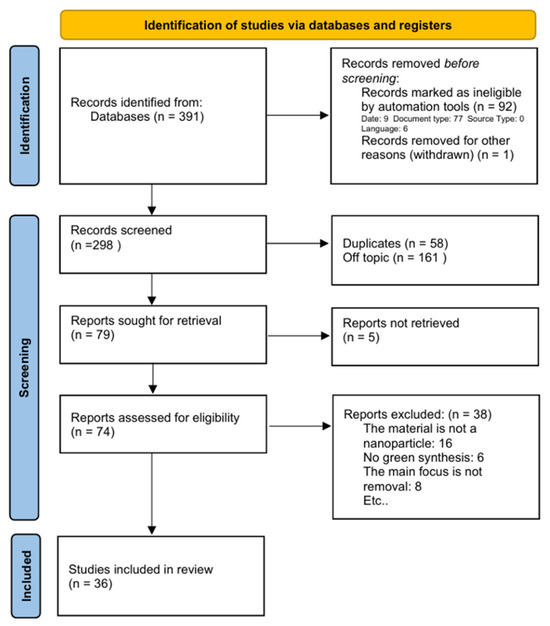
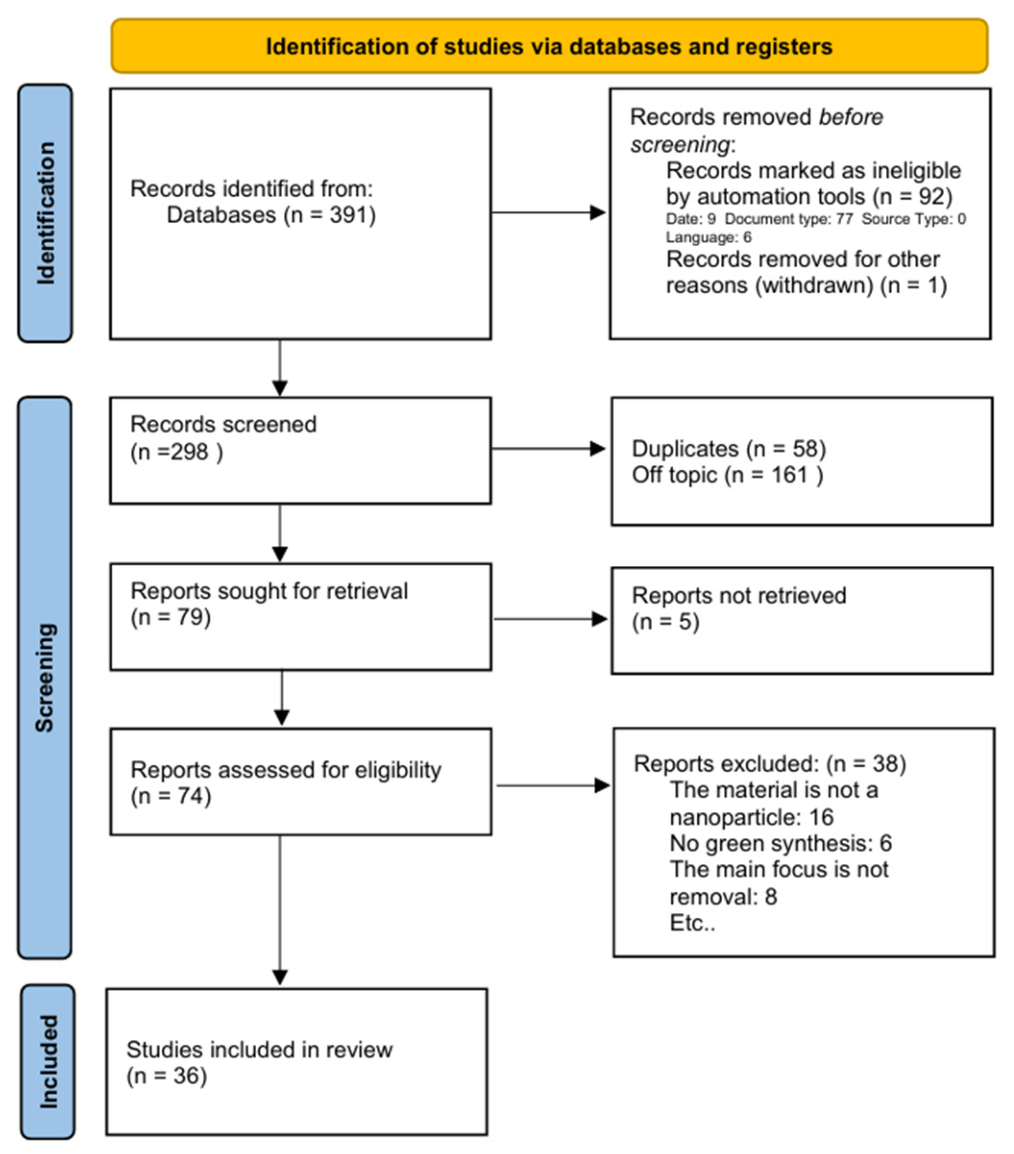
This systematic review was conducted in accordance with the Preferred Reporting Items for Systematic Reviews and Meta-Analyses (PRISMA) guidelines (Supplementary Material), which provide a structured framework for conducting and reporting systematic reviews to ensure transparency, reproducibility, and methodological rigor throughout the review process [23]. Reporting followed the PRISMA 2020 guidance, and the study selection process is presented using a PRISMA flow diagram (Figure 1). A protocol was developed a priori; however, it was not registered in an external registry.
Figure 1.
Prisma flow diagram illustrates the identification, screening, eligibility assessment, and final inclusion of studies in the systematic review.
2.2. Search Strategy
This research was conducted in August 2025. Two databases were used to conduct this study: Scopus and Web of Science. Keywords related to the research topic were identified and structured into four main conceptual groups. Group 1 included terms describing the synthesis’s sustainable or biological nature, such as “green”, “biosynthesis”, “biogenic synthesis”, “waste-based”, “biogenic”, and “sustainable”. Group 2 contained terms identifying the material type, including “nanoparticles”, “nanomaterials”, and “nanosorbent”. Group 3 focused on the target contaminants, specifically “uranium”, “thorium”, and “radionuclides”. Finally, Group 4 included terms related to the application and process, such as “removal”, “adsorption”, “water”, and “water treatment”. Within each group, keywords were combined using the Boolean operator OR, and the four groups were then connected using the Boolean operator AND.
For the Scopus database, the search was conducted through the following query, inserted in Title/Abstract/Keywords:
TITLE-ABS-KEY ((“green” OR “biosynthesis” OR “biogenic synthesis” OR “waste based” OR “biogenic” OR “sustainable”) AND (“nanoparticles” OR “nanomaterials” OR “nanosorbent”) AND (“uranium” OR “thorium” OR “radionuclides”) AND (“removal” OR “adsorption” OR “water” OR “mine water treatment” OR “water treatment”)).
The Web of Science database was searched through the “Topic” field, which includes the title, abstract, and keywords.
In the records identification phase, both automatic and manual methods were used to filter the information, helping identify ineligible records before proceeding to the subsequent screening stages.
2.3. Eligibility Criteria
To ensure the relevance and quality of the selected literature, a rigorous set of eligibility criteria was developed and applied during the screening process. For a study to be considered, it was required to investigate the removal or adsorption of uranium (U) and/or thorium (Th) from an aqueous medium. Furthermore, the research had to describe the synthesis and application of a nanomaterial produced via a demonstrably green method. In this review, “green synthesis” was defined as the use of plant extracts, microorganisms, biopolymers, biomass-derived precursors, waste-derived materials, or other low-toxicity natural agents as reducing, stabilizing, capping, templating, or supporting components during nanomaterial production. Studies were also considered when the authors explicitly described the synthesis route as “green synthesis”, “biosynthesis”, “biogenic synthesis” or a waste-derived sustainable process. However, because the literature does not apply a uniform quantitative standard for greenness, this classification was based on the synthesis route reported by the studies rather than on a formal “greenness score”. The possible use of auxiliary chemical reagents, energy-intensive steps, or post-synthesis functionalization was therefore considered when interpreting the environmental relevance of each material, rather than being used as an automatic exclusion criterion. Finally, the application context was strictly limited to water treatment.
Conversely, several criteria were established for exclusion. The search was limited to peer-reviewed journal articles published in English between 2015 and 2025. Studies were also excluded if the full text could not be retrieved or if the publication was not an original research article (e.g., reviews or conference proceedings). Thematically, publications were also excluded if their primary focus was on contaminant detection, analysis, or remobilization rather than removal.
2.4. Study Selection and Data Extraction
The study selection process was conducted independently by two researchers. Initially, the titles and abstracts of all records identified through the database search were reviewed to determine if they met the established inclusion criteria. Zotero, a reference management software, was used to identify and remove duplicate studies. Articles that passed the initial screening were subjected to a full-text review for final eligibility assessment. Any discrepancies between the reviewers regarding the inclusion of a study were resolved through discussion until a consensus was reached.
Following the final selection, the two researchers independently extracted data from the included studies and tabulated them in a Microsoft Excel spreadsheet. The following information was extracted from each study: title; author; publication year; country; synthesis method; green agent used; material name; material size; specific surface area; target contaminant; water source; maximum adsorption capacity; removal efficiency (%); equilibrium time; and the key factors tested.
2.5. Quality Assessment
The quality and risk of bias (ROB) of each included study were independently assessed by two reviewers. Any disagreements that arose during this process were resolved through discussion to reach a consensus, with a third reviewer mediating if necessary.
Acknowledging the absence of a universally standardized ROB tool for in vitro experimental studies, a custom assessment tool was developed a priori based on the domain-based principles outlined in the Cochrane Handbook [24]. This evaluation focused on five key domains designed to capture the most relevant sources of bias in this research field: (1) Control Group, (2) Methodological Design, (3) Material Characterization, (4) Evaluation Methodology, and (5) Clarity of Results & Conclusions.
For each domain, a judgment was assigned as “Low,” “Some concerns,” or “High” risk of bias. The overall ROB for each study was then determined based on these domain-level assessments: a study was rated as “High risk” if it had a high risk in at least one critical domain; “Unclear risk” if it raised some concerns in at least one domain but had no high risks; and “Low risk” only if all domains were rated as low risk.
The ROB assessment was used as a structured appraisal framework to support the interpretation of study quality and evidence robustness; no study was excluded solely based on the ROB classification.
3. Results
3.1. Study Selection
The study selection process, guided by the PRISMA methodology, is illustrated in Figure 1. The initial database search identified 391 records. Prior to the main screening, 93 records were removed either by automated tools (period, document type, source, and language). The remaining 298 records were then screened, leading to the exclusion of 58 duplicates and 161 articles based on title and abstract.
Subsequently, 79 reports were sought for full-text retrieval, of which 5 were unavailable. This left 74 reports for eligibility assessment. After a full-text analysis, 38 of these reports were excluded for not meeting the inclusion criteria (e.g., the material was not a nanoparticle, the focus was not removal). Ultimately, 36 studies were included in the review.
3.2. Study Charachteristics
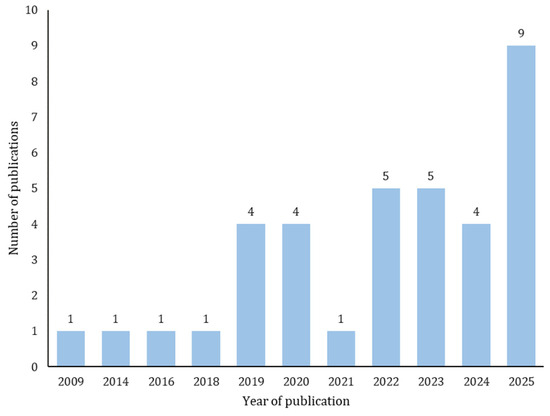
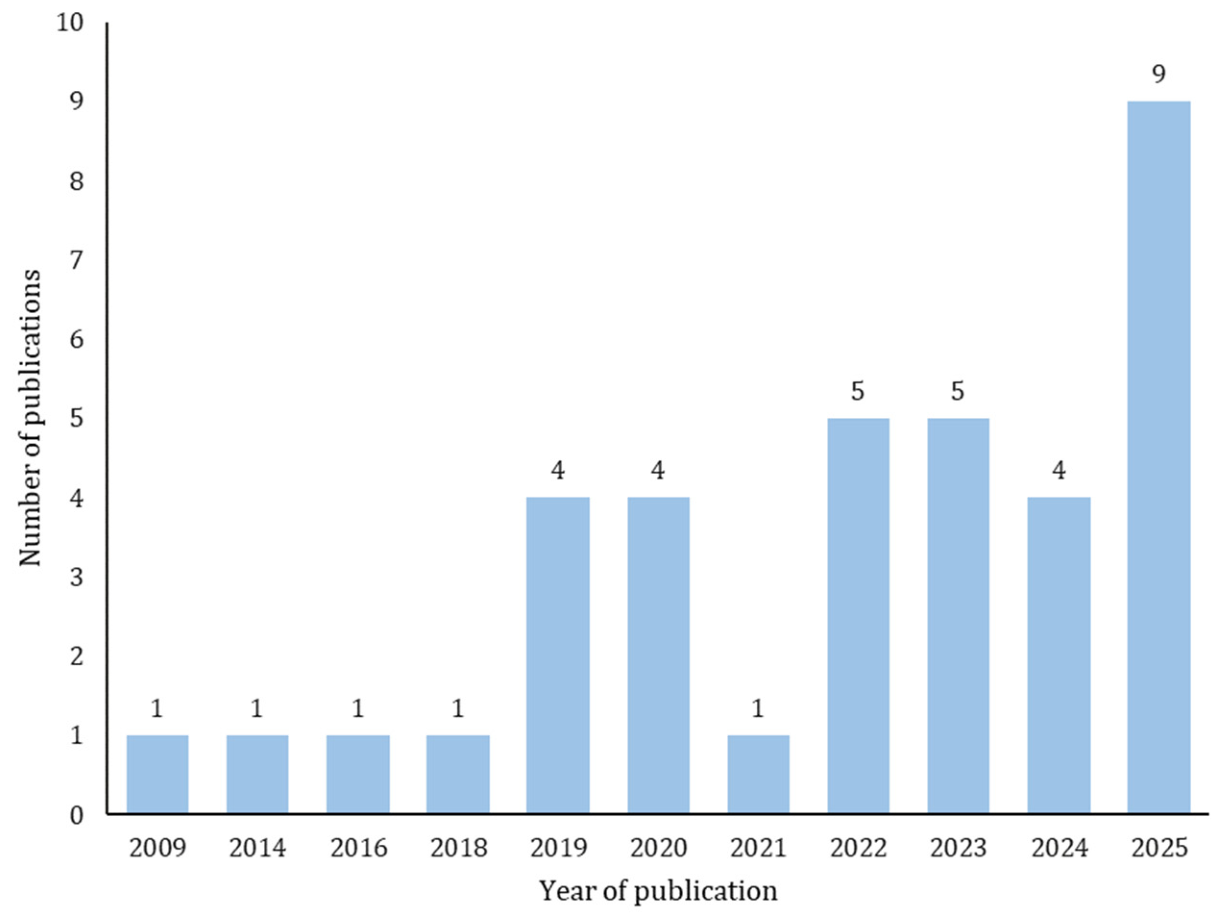
The distribution of publications by year is illustrated in Figure 2. The selected articles were published between 2009 and 2025, with a notable increase in research output since 2019.
Figure 2.
Distribution of included studies by publication year.
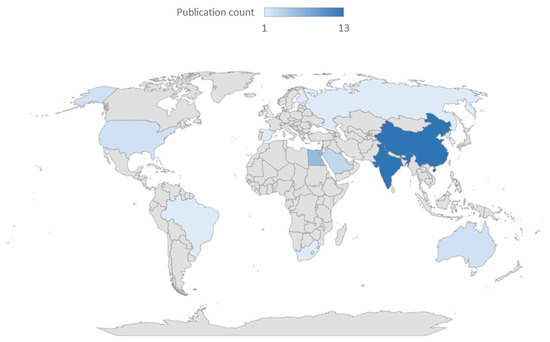
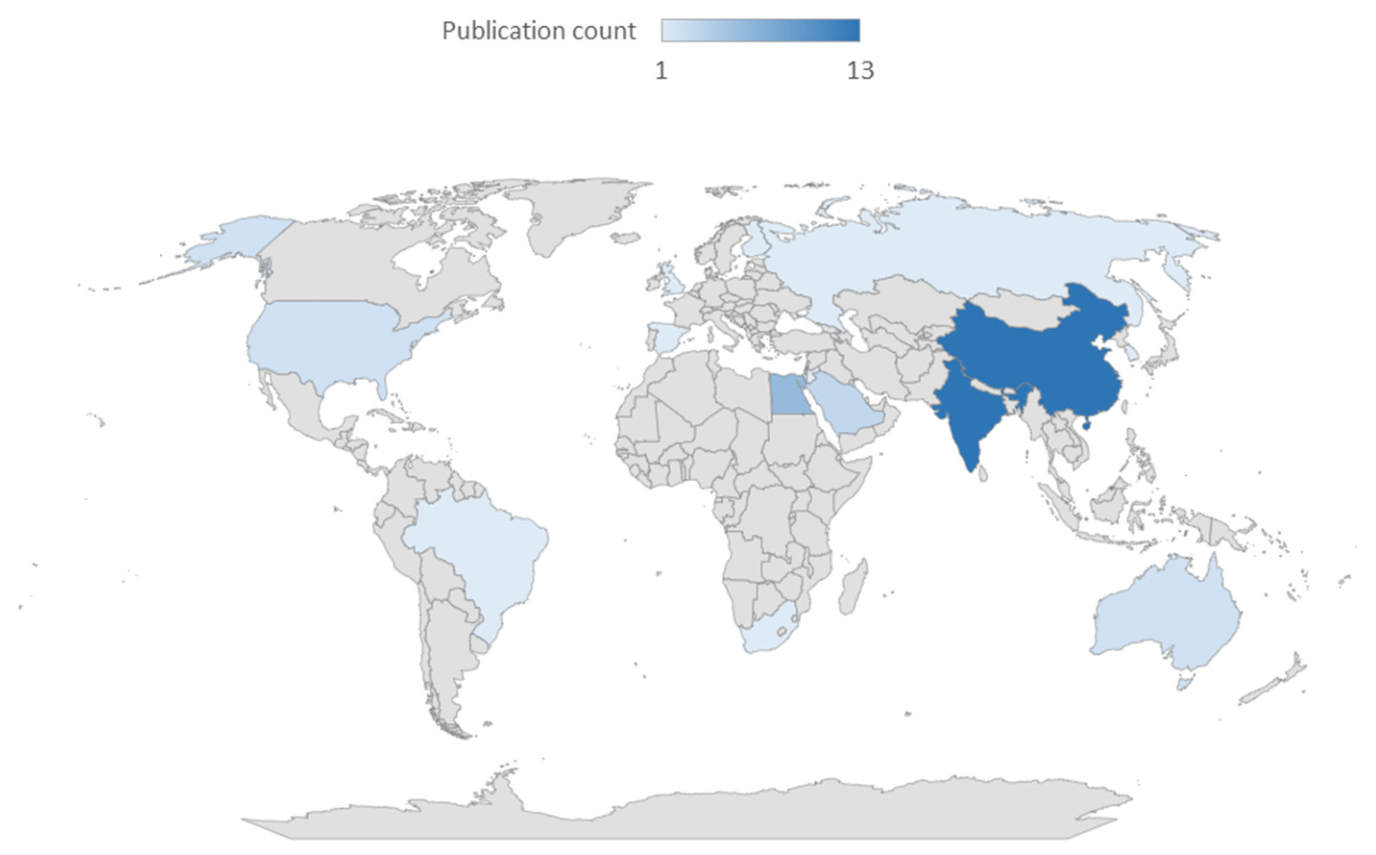
The geographical distribution of the included studies is presented in Figure 3. The analysis shows that research in this field, while globally distributed, is predominantly led by institutions in Asia. Specifically, China (n = 13) and India (n = 13) are the most prolific countries, accounting for most publications. Other active countries include Egypt, Saudi Arabia, and Brazil.
Figure 3.
Geographical distribution of the included studies.
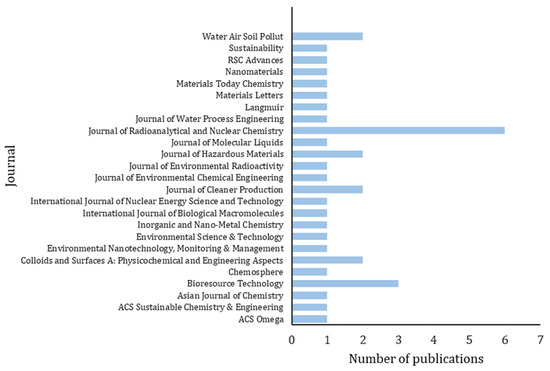
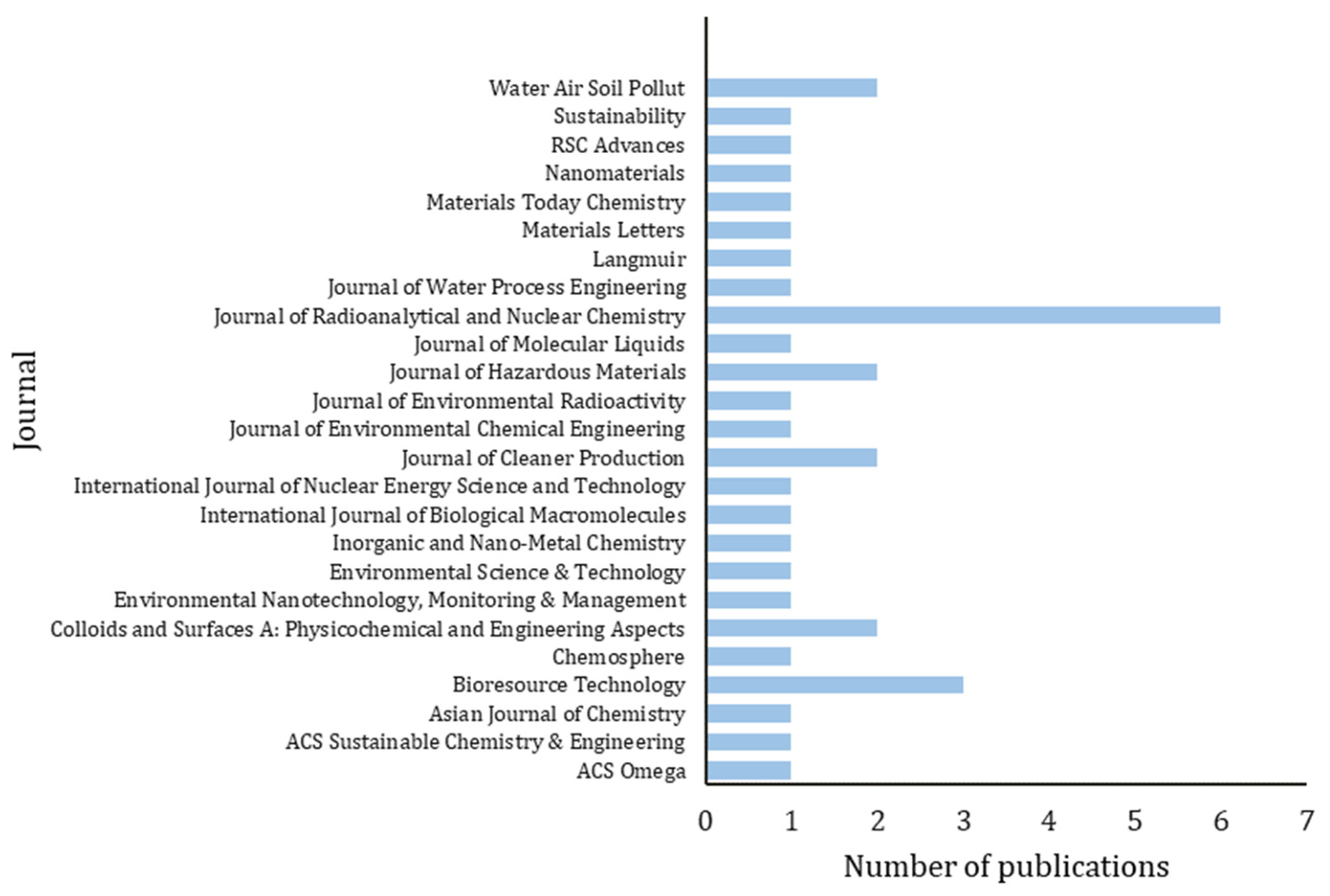
Figure 4 illustrates the sources of the included articles detailing the specific journals from which they are derived.
Figure 4.
Main publication sources for the included studies.
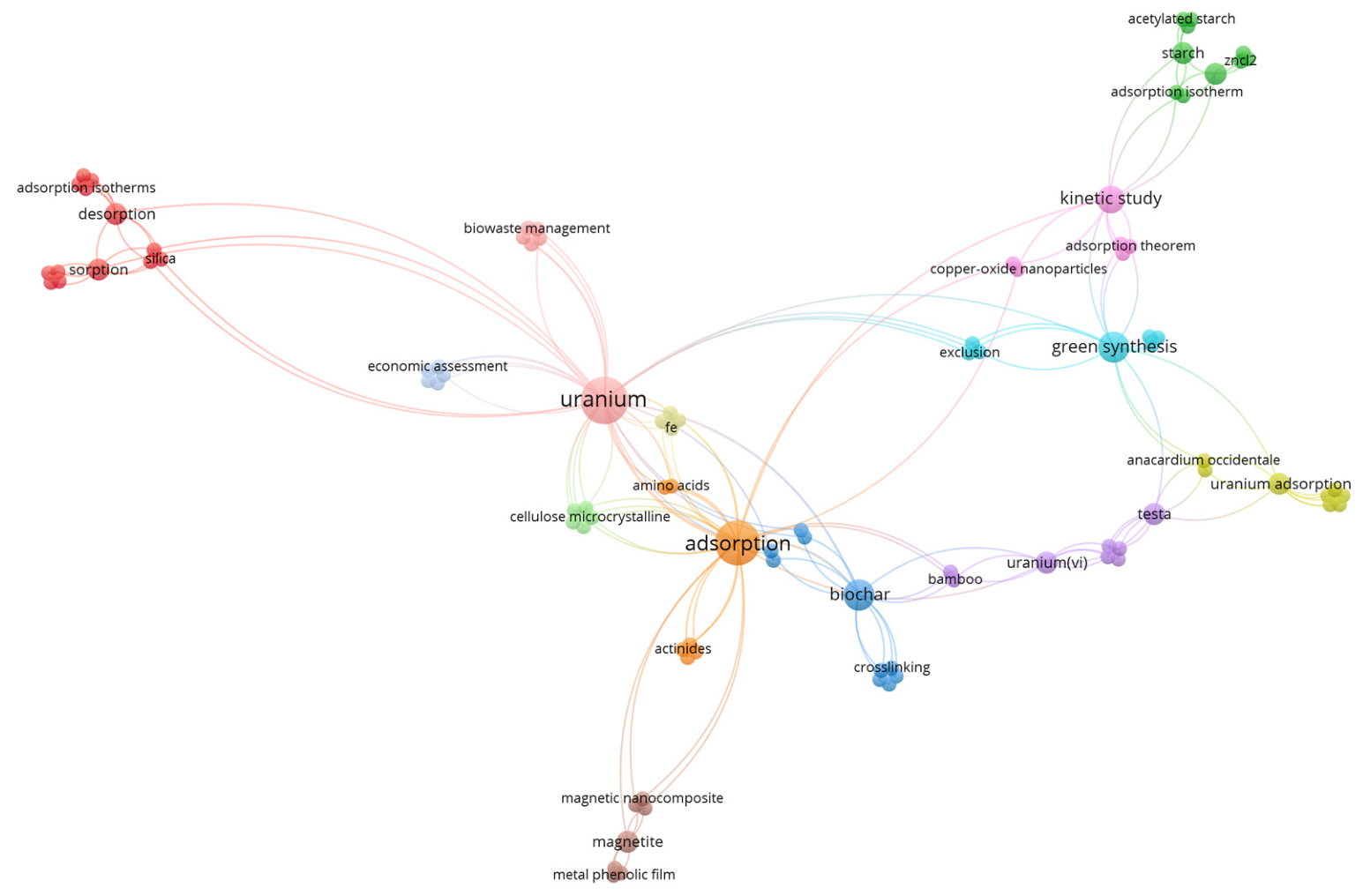
Furthermore, a keyword co-occurrence analysis was generated using VOSviewer software, version 1.6.20, as shown in Figure 5, to identify the main research themes. The analysis reveals that “adsorption” and “uranium” are the central concepts connecting the main research themes. A significant research stream, highlighted by the green cluster, focuses on the application of “green synthesis” to develop novel adsorbent materials, a topic closely linked to “kinetic studies”. Furthermore, the red cluster indicates a distinct research area centered on the fundamental mechanisms of the process, grouping key terms such as “adsorption isotherms” and “desorption”.
Figure 5.
Co-occurrence network of keywords from the included studies.
3.3. Data Synthesis Strategy
Due to heterogeneity in study designs, a narrative synthesis was conducted, with descriptive statistics used where appropriate. This approach was chosen because the significant methodological differences among the studies made it unfeasible to pool the results for a meta-analysis. To ensure clarity, the findings were organized into the following categories: nanomaterial type, green synthesis agent, synthesis method, material size, surface area, target contaminants, maximum adsorption capacity, removal efficiency, equilibrium time, and key experimental factors tested.
3.4. Types of Green Nanoparticles and Synthesis Methods
The analysis of the 36 included articles reveals a primary focus on U removal. A smaller subset of six studies addresses the adsorption of Th, either individually or in combination with uranium. The green synthesis of nanomaterials for this purpose is characterized by a notable prevalence of iron-based materials, particularly iron oxide (Fe3O4) nanoparticles and nano zerovalent iron (nZVI). These materials were explored in various configurations, including Fe3O4 NPs modified with tannic acid [25] and phytate, as well as magnetic composites functionalized with chitosan [26], glutathione [27], and β-cyclodextrin [28]. The development of biocomposites using plant extracts, such as those from papaya bark [29] and amla bark [30], was also a common approach. Further studies focused on the immobilization of Fe3O4 NPs onto biochar derived from algae [31] and bamboo [32], or their conjugation with recombinant cyanobacterial metallothioneins [33]. The synthesis of iron NPs was mediated by extracts from Terminalia bellirica [34], Tinospora cordifolia [35], and Anacardium occidentale testa [36], in addition to microorganisms like the fungus Penicillium commune [37]. Beyond oxides, nZVI was prepared via carbothermal reduction using starch and immobilized on biochar [38], or supported on activated carbon derived from peanut shells [39].
Another significant class of nanomaterials comprises carbon-based adsorbents derived from biochar produced from waste biomass, such as rice husks [40,41] or Liquidambar styraciflua fruits [42]. In addition to biochar, other carbon nanomaterials were investigated, including carbon quantum dots derived from starch [43] and graphene oxide composites functionalized with silica extracted from waste materials [40].
A prominent trend identified is the use of biopolymers and waste biomass as direct adsorbents or as scaffolds. Materials such as banana peels were directly processed into nanosorbents [44], while biopolymers, including cellulose [45], lignin [46], oat starch [47], and sodium alginate [48] were employed to create advanced composites and hydrogels. The use of microorganisms, such as sulfate-reducing bacteria, was also harnessed to produce stable biohybrids for uranium treatment [49]. The synthesis was frequently mediated by green reagents, such as oleic acid [50] or plant extracts derived from pomegranate [51], lemon [52], and eucalyptus [53].
In addition to the materials mentioned above, other oxides and minerals were also explored. Zeolite–hydroxyapatite composites derived from fly ash waste [54] and bacterially mediated hydroxyapatite [55] demonstrated a high affinity for radionuclides. Nanoparticles of various metal oxides, including copper oxide (CuO) [51,56], cerium oxide (CeO2) [52], Zn-Al layered double oxides [53], and strontium cobaltite (SrCoOx) [50], were successfully synthesized using plant extracts. Lastly, the green synthesis of nano zerovalent copper (nZVCu) mediated by Anacardium occidentale extract also proved effective for uranium removal [57]. More complex approaches included the use of bioelectrochemical systems with cobalt nanoparticles [58] and the fabrication of metal–organic frameworks (MOFs) [48] and zeolitic imidazolate frameworks (ZIFs) [59].
3.5. Removal Efficiency and Performance Metrics
Across the reviewed studies, green-synthesized nanomaterials demonstrated remarkable performance in removing uranium and thorium. The maximum adsorption capacities (q_max) varied significantly depending on the material’s composition and experimental conditions, ranging from modest values to exceptionally high capacities, such as those reported for Zn-Al layered double oxides (1153.71 mg/g for Th(IV)) [53], phytate-coated Fe3O4 NPs (948 mg/g for U(VI)) [60], and zeolite–hydroxyapatite composites (872 mg/g for U(VI)) [54]. The majority of the articles reported high removal efficiencies, consistently exceeding 90% and often approaching 99% under optimal conditions [34,39,47,48]. Adsorption kinetics also showed considerable variation. While many systems required several hours to reach equilibrium [32,49,55], a notable number of adsorbents exhibited ultra-fast performance, achieving equilibrium in minutes or even seconds [35,42,43,45,53]. Furthermore, the potential for practical application was underscored in multiple studies that successfully demonstrated the materials’ stability and high removal efficiency over several adsorption–desorption cycles, confirming their potential for regeneration and reuse [27,41,49,54].
The performance of the green-synthesized nanomaterials was evaluated across a range of physicochemical parameters to determine optimal adsorption conditions and elucidate the underlying removal mechanisms. A near-universal factor across studies was solution pH, consistently identified as the most critical parameter governing adsorption. Other key operational parameters extensively studied include adsorbent dosage, initial contaminant concentration, and contact time, which are fundamental for defining the system’s capacity and kinetics. The influence of temperature was also frequently assessed to determine the thermodynamic nature of adsorption, often revealing spontaneous, endothermic processes. Finally, to evaluate the robustness and selectivity of the nanomaterials for real-world applications, the effect of coexisting ions was a common focus. Many adsorbents demonstrated high performance even in complex water matrices, such as phosphorylated-cellulose nanocrystal ferrihydrite, which maintained over 88% removal efficiency for U(VI) in the presence of a wide array of competing cations and anions [45].
3.6. Risk of Bias Within Studies
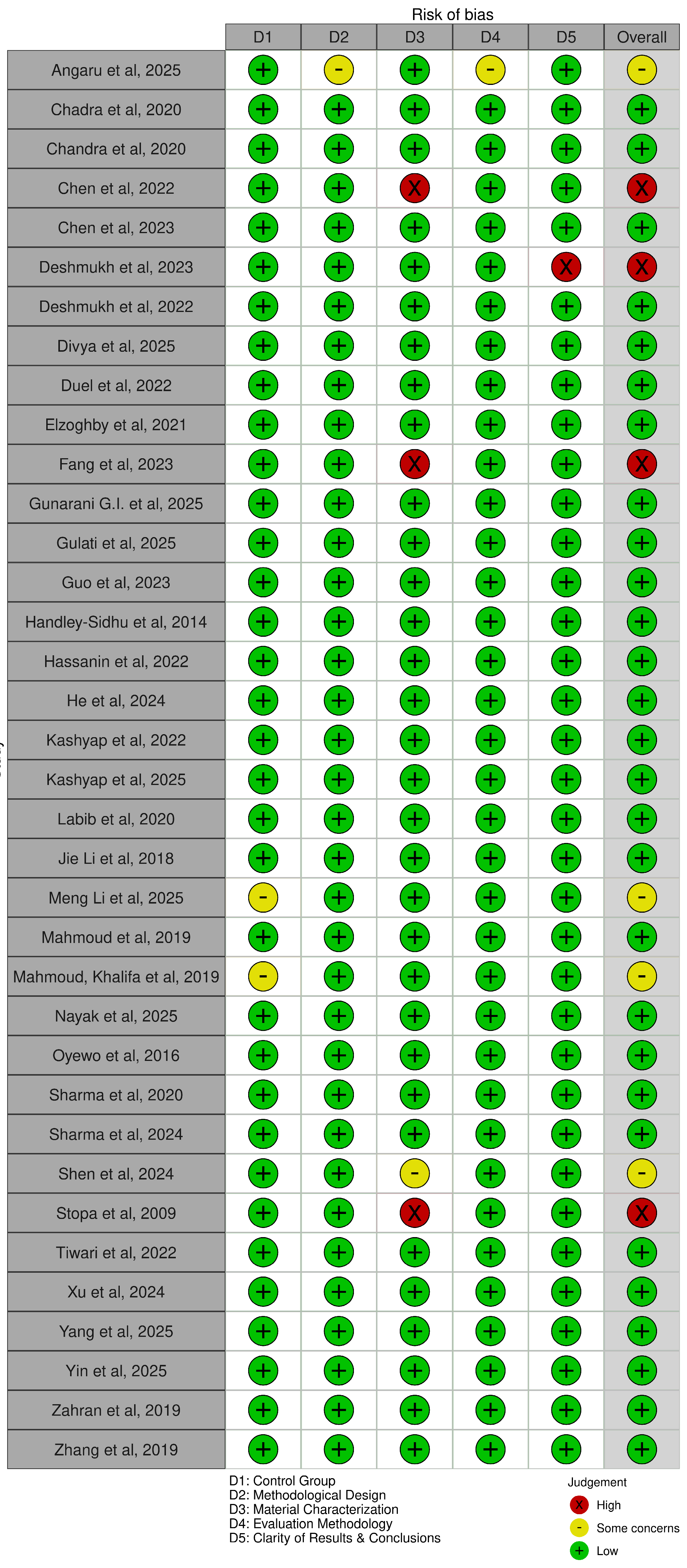
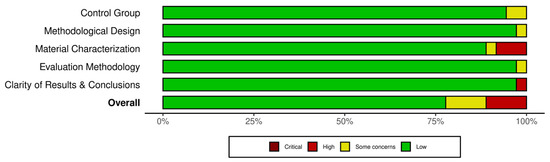
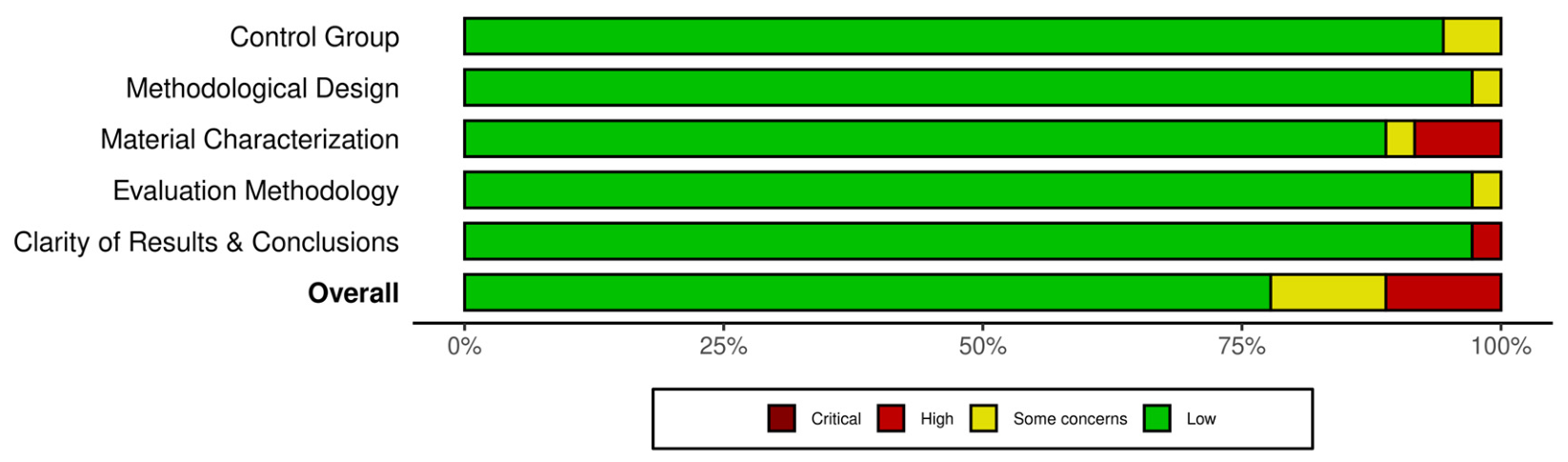
The risk of bias (ROB) for each study was assessed by evaluating the clarity and methodological soundness of the following domains: control group, study design, material characterization, evaluation method, results, and conclusions. Summary figures for this assessment were then generated using the robvis visualization tool [61]. The overall analysis indicated that most studies had a low risk of bias (Figure 6 and Figure 7). However, the “Material Characterization” domain was the one that presented the highest proportion of studies rated as “high risk” or having “some concerns”. This was mainly associated with incomplete reporting of specific characterization parameters in some studies, particularly nanoparticle size and, in some cases, surface area. Although all included studies described the materials as nanomaterials or nanoparticles and therefore met the inclusion criteria, missing characterization data may limit direct comparison among materials and reduce the certainty with which adsorption performance and mechanisms can be linked to specific physicochemical properties.
Figure 6.
Risk of Bias summary for the studies included in the systematic review [25,26,27,28,29,30,31,32,33,34,35,36,37,38,39,40,41,42,43,44,45,46,47,48,49,50,51,52,53,54,55,56,57,58,59,60].
Figure 7.
Risk of Bias graph.
Table 1.
Characteristics of Green-Synthesized Nanomaterials for Uranium and Thorium Removal.
Table 2.
Adsorption Performance and Experimental Conditions of Green Nanomaterials for Uranium and Thorium Removal.
4. Discussion
4.1. Principal Findings
Green-synthesized nanoparticles have emerged as promising candidates for radionuclide remediation, although their large-scale viability has yet to be fully demonstrated offering a sustainable alternative to conventional methods. The principal finding across the 36 analyzed studies is that these approaches are not only environmentally conscious but also demonstrate exceptional performance, with many of the reviewed materials showing efficiencies exceeding 90% and, in several cases, reporting extraordinarily high maximum adsorption capacities.
A second key finding is that this “green” approach is increasingly synonymous with a circular economy. The synthesis of high-performance adsorbents was frequently achieved by leveraging “waste-to-resource” pathways, such as utilizing agricultural residues like rice husks [40,41] or plant-based extracts [51,53] as precursors, rather than relying on costly or toxic chemical reagents.
The analysis also revealed a clear trend in material choice, with a significant predominance of iron-based nanomaterials, particularly magnetic Fe3O4 and nZVI and operationally, solution pH is consistently identified as the most critical parameter governing the success of the adsorption process.
Despite these promising outcomes, there is a notable imbalance in research focus, with uranium removal being extensively investigated while significantly fewer studies address thorium. This disparity underscores a critical research gap and indicates that the current evidence for thorium remediation using green-synthesized nanoparticles remains comparatively limited.
4.2. Comparison with Conventional Methods
The remediation of heavy metal and radionuclide contamination demands efficient, selective, and environmentally friendly technologies. Conventional wastewater treatment methods, including chemical precipitation, solvent extraction, ion exchange, and the use of traditional adsorbents like activated carbon, are often constrained by inherent limitations, such as high implementation cost [62], the reliance on toxic reagents [17], the subsequent use of harmful solvents [62], and the resulting creation of polluting waste.
In contrast, the advent of green-synthesized NPs provides a compelling, sustainable alternative that successfully addresses these deficiencies while demonstrating superior performance. Green synthesis is recognized as an eco-friendly, simple, and cost-effective process by most studies [29,37,51]. This approach prioritizes sustainable development by utilizing readily available biological resources and waste materials, resulting in bio-adsorbents that are non-hazardous to human health and the environment and that effectively prevent the formation of secondary pollutants [30]. Furthermore, the phytochemical components in these extracts serve a dual function as reducing and capping agents, eliminating the need for the additional chemical modifications often required in conventional nanoparticle synthesis to ensure stability [29,35].
Several green-synthesized nanoparticles showed promising adsorption performance compared with selected conventional adsorbents:
Efficiency and Capacity: Novel green materials exhibit ultra-high uptake capacities and rapid kinetics. For instance, the maximum adsorption capacity of 792.82 mg/g and 333.33 mg/g for U(VI) achieved by HApZ composites [54] and glutathione-decorated magnetite [27], respectively, were higher than conventional adsorbents like certain commercial activated carbons, such as the one reported with an adsorption capacity of 28.49 mg/g [63] or commercial alumina with 78 mg/g [64]. In terms of removal percentages, materials such as biogenic Fe/Ni nanoparticles and MNPs-SA@Cu MOF composite beads achieved near-complete removal efficiencies (99.7% to 99.9%) within short contact times [34,48].
Selectivity: Critically, these materials maintain high performance even in complex water environments. High removal efficiencies for U(VI) and Th(IV) were demonstrated in complex multi-ion systems using MNPs-SA@Cu MOF composite beads [48], reinforcing their practical applicability. Specific bio-composites, such as Phytate-coated Fe3O4 NPs, demonstrated the ability to eliminate uranyl ions [60], and similarly, phosphorylated cellulose-ferrihydrite (PCNCFH) showed effective performance and selectivity despite the presence of typical competing ions in water [45].
4.3. Mechanistic Insights
Adsorption and surface complexation are key mechanisms, enhanced by biomolecular functional groups.
The removal of U(VI) and Th(IV) from water is not a single process but rather a combination of chemical and electrostatic interactions.
The primary mechanism, and what often dictates the speed of the entire process, is chemisorption through surface complexation, evidenced by favourable fits to the pseudo-second-order kinetic model [32,41,46,48,54]. This process frequently involves inner-sphere complexation, in which metal ions form stable chemical bonds with specific, electron-rich functional groups on the adsorbent surface [45,54].
Critical to establishing this strong chemical affinity are phosphate (-PO43−), hydroxyl (-OH), amine/amidoxime (-NH2/C(=NOH)NH2), and carboxyl (-COOH) groups [35,41,45,46,48,54]. These groups actively participate in complexation and chelation reactions [30,41,45], which is often confirmed by spectroscopic shifts observed in FTIR spectra post-adsorption [41,48,54].
Parallel to complexation, electrostatic attraction plays a significant role, but its contribution is strongly dependent on solution pH and radionuclide speciation, particularly at optimal acidic to neutral pH levels where the radionuclides exist predominantly as cationic species (UO22+ and Th4+), which are drawn to negatively charged surface sites [30,48,54]. However, this behavior can be altered in the presence of coexisting anions, such as carbonate, phosphate, sulfate, nitrate, or chloride, which may influence radionuclide speciation, compete for active adsorption sites, modify ionic strength, or promote the formation of aqueous complexes and/or insoluble precipitates. Therefore, adsorption performance observed under synthetic conditions should be interpreted cautiously when considering real water matrices. Furthermore, several successful systems incorporate ion-exchange mechanisms, notably in materials containing zeolite or hydroxyapatite, often enabling a dual-mode removal pathway [48,54,59].
Finally, redox reactivity is particularly relevant for uranium (VI) removal. A crucial mechanism involves reductive immobilization, often facilitated by redox-active iron-based nanoparticles (e.g., nZVI or Fe3O4), which can promote electron transfer and chemically convert soluble U(VI) to the highly stable and immobile U(IV) oxidation state [25,38,39,60]. It should also be noted that, under higher pH conditions, the spontaneous formation of insoluble precipitates (such as hydroxides or phosphates) also contributes to the overall radionuclide removal [44,54].
When considering these mechanisms by material family, the reviewed studies indicate that different green nanomaterials do not depend on a single removal pathway. In plant-mediated systems, such as tannic acid-modified Fe3O4 [25], pomegranate peel-derived oxide nanocomposites [51], eucalyptus-assisted Zn-Al layered double oxides [53], and plant-extract-mediated Fe or Cu nanoparticles [34,35,36,57], the organic compounds in the extracts contribute to both nanoparticle formation and the introduction of surface functional groups that help bind radionuclides. These groups can favor complexation, chelation, electrostatic interactions, and adsorption selectivity, since different groups containing oxygen and nitrogen can show different affinities toward U(VI), Th(IV), and competing ions. However, their effect varies based on the plant source, synthesis conditions, and the final surface chemistry reported in each study. In iron-based materials, the main mechanism depends strongly on the iron phase: nZVI-supported systems [38,39] are more directly related to the reductive immobilization of U(VI), while Fe3O4-based composites [25,27,29,30,31,32,60] mainly combine magnetic recovery with adsorption and surface complexation, with possible redox contribution under favorable conditions. In biopolymer-, biomass-, and biochar-based composites, including chitosan, cellulose, lignin, starch, sodium alginate, banana peel, and modified biochars [26,41,44,45,46,47,48], functional groups containing oxygen, nitrogen, sulfur, or phosphate provide active sites for radionuclide binding through complexation, chelation, ion exchange, or precipitation-related pathways. In composites that include magnetic or mineral phases, the organic matrix acts together with the inorganic component: the biomass fraction provides functional binding sites, while the magnetic phase contributes to separation, additional adsorption sites, reduce particle aggregation, or redox-mediated immobilization in selected iron-based systems. Mineral and porous systems, including zeolite–hydroxyapatite composites, bacterially produced hydroxyapatite, MOF-based beads, and ZIF-containing composites [48,54,55,59], further demonstrate the role of ion exchange, phosphate-related immobilization, surface complexation, and high surface area/porosity in improving radionuclide uptake. Therefore, the mechanisms reported in the reviewed studies should be seen as specific combinations of surface functionality, ion exchange, complexation, precipitation, magnetic separation, and, in certain iron-based systems, redox-mediated immobilization, rather than one universal adsorption pathway.
4.4. Environmental and Toxicological Insights
An essential aspect of green nanotechnology is ensuring that the synthesized materials pose minimal environmental risk throughout their life cycle. In the reviewed studies, however, only a limited number of articles provided a direct assessment of the environmental impact or toxicological profile of the developed nanosorbents. In most cases, environmental safety was inferred mainly from the synthesis route itself, with materials frequently described as “green”, “eco-friendly”, or “sustainable” due to the use of plant extracts, biopolymers, microorganisms, or waste-derived precursors. Although green synthesis can reduce the use of hazardous reagents, toxic solvents, and energy-intensive processes, it does not automatically guarantee that the resulting nanomaterials are non-toxic after application.
This distinction is particularly important because nanoparticles may present environmental risks that are not solely determined by their synthesis route. Their behaviour and toxicity depend on physicochemical properties such as particle size, morphology, surface charge, coating, aggregation state, dissolution, and chemical transformation in environmental media [65]. The role of green capping and stabilizing agents is particularly relevant in this context. Javed et al. [66] emphasized that capping agents stabilize the nanoparticle–medium interface and can inhibit particle aggregation or coagulation, thereby influencing physicochemical behaviour and environmental interactions. In green synthesis, plant-derived extracts contain phytochemicals, polysaccharides, proteins, and other biomolecules that may act simultaneously as reducing, capping, and stabilizing agents [67]. These organic compounds may improve colloidal stability and provide functional groups involved in radionuclide binding; however, their behaviour after environmental release remains uncertain. Once released into water, soil, or sediments, nanoparticles may undergo ageing, aggregation, surface modification, or interaction with natural organic matter and coexisting ions, which can alter their mobility, bioavailability, and toxicity [65]. Therefore, although green caping agents may reduce the use of hazardous reagents during synthesis, nanomaterials used for radionuclide removal should be evaluated not only in terms of adsorption performance, but also in long-term stability, degradation, desorption, and transformation under realistic water chemistry, before assuming that green-synthesized nanoparticles are environmentally safe after application.
Within the reviewed literature, some studies explicitly reported favourable safety-related characteristics. For example, iron oxide nanoparticles synthesized by Penicillium commune were described as biocompatible [37], carbon quantum dots derived from starch were associated with low toxicity [43], and glutathione-decorated magnetic nanoparticles [27] were reported as non-toxic, accessible, and retrievable. A more rigorous assessment was observed in the study on cellulose-derived nanomaterials, where the toxicity characteristic leaching procedure was used to evaluate the stability of adsorbed uranium [45]. However, these examples remain limited, and most studies did not include standardized ecotoxicity assays, long-term leaching tests, or evaluations of nanoparticle release after treatment.
Another critical issue concerns the recovery and management of spent nanosorbents. If nanoparticles are not efficiently separated from treated water, their release may introduce a secondary contamination pathway. Magnetic nanomaterials, such as Fe3O4-based composites and nZVI-supported systems, offer an important practical advantage because they can potentially be recovered using external magnetic fields, facilitating reuse and reducing the probability of uncontrolled nanoparticle dispersion [22]. Nevertheless, recovery efficiency, regeneration stability, and the fate of radionuclide-loaded materials are not systematically evaluated across the reviewed studies. There are some adsorption–desorption tests but are often limited to a small number of cycles and rarely address the long-term structural stability of the material or the safe disposal of the radionuclide-bearing adsorbent.
Scale-up also remains a major challenge. Although many studies report high removal efficiencies under controlled laboratory conditions, most experiments were performed in batch systems using synthetic waters and optimized operating conditions. Practical implementation would require validation in complex matrices, such as mine water, groundwater, or industrial effluents, where competing ions, organic matter, pH variability, and suspended solids may influence performance. Moreover, large-scale production of green nanoparticles must consider reproducibility, precursor variability, energy consumption, and the costs associated with recovery, regeneration, and final disposal.
Overall, while the “green” label is generally justified by the synthesis methods reported in the literature, the actual environmental and toxicological footprint of these nanomaterials remains largely unquantified. Future studies should therefore combine removal performance with standardized ecotoxicological testing, life-cycle assessment, nanoparticle release monitoring, regeneration studies, and end-of-life management strategies. This is essential to determine whether green-synthesized nanoparticles can move beyond promising laboratory-scale adsorbents and become environmentally safe and practically viable technologies for U and Th remediation.
4.5. Limitations of Included Studies
In general, most studies were lab-based, lacked long-term assessments, and used non-standardized protocols.
The most significant limitation is the substantial heterogeneity across studies, reflected in the diverse nanomaterials and agents used in green synthesis methods. However, more importantly, it is due to the lack of standardized evaluation methods. The studies were carried out over different pH ranges, contaminant concentrations, and adsorbent amounts. Thus, a comparison of the different materials in terms of performance is not feasible.
Moreover, it can be observed that most of the articles included were lab-based, in vitro investigations. Although many studies demonstrated high removal efficiency, these were often achieved using synthetic “clean” water. Only a minority of studies have validated their materials in real-world samples, such as mine water, groundwater, or industrial effluent, leaving a significant gap in understanding how these adsorbents perform in complex environmental matrices containing organic matter and multiple competing ions.
Furthermore, a lack of long-term evaluation is identified. Reusability tests were sometimes confined to a few cycles (i.e., 3–5) of adsorption and subsequent desorption. However, this may not be a good measure of how long these materials can last. Ultimately, as discussed previously, there is a lack of ecotoxicological information and life cycle assessments. Therefore, how safe and sustainable these “green” nanomaterials are in the long term is still unknown.
4.6. Implications for Future Research
The findings and limitations delineated in this review indicate several imperative avenues for future research. First, it is essential to close the gap between lab success and real-world performance. Future research should transition from small-scale batch experiments to upscaled processes, including tests in complex water matrices such as real mine water, groundwater or industrial effluents, preferably under continuous-flow conditions. Particular attention should be given to mixed-ion systems, since coexisting species may compete with U(VI) and Th(IV) for active adsorption sites or alter radionuclide speciation. Therefore, future studies should systematically evaluate the influence of competing ions and natural organic matter under environmentally relevant conditions. In addition, more standardized testing and reporting protocols are needed to improve comparability among studies. At minimum, future adsorption studies should clearly report the initial radionuclide concentration, adsorbent dosage, solution pH, ionic strength, temperature, contact time, water matrix composition, equilibrium concentration, regeneration conditions, and number of reuse cycles. Besides removal efficiency and maximum adsorption capacity, quantitative indicators such as the distribution coefficient (Kd) should also be reported, as they provide a normalized measure of adsorbent affinity and may allow more reliable comparisons between materials tested under different experimental conditions.
Additionally, a major gap in the current literature is that the “green” label is mainly based on the synthesis method and needs to be thoroughly verified. Comprehensive life cycle assessments (LCAs) are very important; therefore, future research should focus on measuring the long-term environmental impacts, potential ecotoxicity, and biodegradability of these nanomaterials after use.
Finally, the creation of hybrid systems is a promising new way to innovate. Instead of just using adsorption, the focus should be on combining these green nanoparticle adsorbents with other treatment methods, such as membrane filtration or photocatalysis. These multifunctional systems could adsorb radionuclides and degrade other organic pollutants simultaneously, making water treatment more effective and complete.
Beyond scientific and technical challenges, the transition of green nanotechnologies from laboratory studies to real-world applications also depends on regulatory frameworks, interdisciplinary collaboration, and solid evidence of its cost-effectiveness under operational conditions. Current research is still largely focused on material development and small-scale batch experiments, while fewer studies address process design, site-specific implementation, and end-of-life management of spent adsorbents. Future progress will require closer integration between materials scientists, process engineers, environmental specialists, and economists.
Regulatory support is the tightest bottleneck. These materials face a double hurdle: they are nanomaterials and treat radionuclides, both under strict oversight, and a “green” label does not replace safety data, so clear rules are needed for classification, handling, transport, and disposal of spent nanosorbents.
Finally, alongside regulatory approval, the most significant barrier to adoption is the need for clear cost-effectiveness evidence. While the high performance identified in this review is encouraging, these green technologies must ultimately compete with conventional options (such as ion exchange or precipitation) that have well-established operational costs. The primary economic advantage of the approaches reviewed is their use of low-cost precursors, such as waste biomass and agricultural byproducts. However, this initial advantage must be weighed against the total life-cycle cost, which includes reagents for functionalization, energy for regeneration, and, critically, the logistics and costs associated with solids handling and final disposal. Therefore, ideally, future studies must move beyond performance metrics to provide comprehensive techno-economic analyses and life-cycle costing.
5. Conclusions and Future Perspectives
The contamination of water sources with radionuclides such as uranium and thorium may pose a significant risk to the environment and human health. Conventional remediation methods, such as chemical precipitation or ion exchange, are notably limited by high implementation costs, reliance on toxic reagents, and the creation of secondary, polluting waste streams. Continuing to rely solely on traditional remediation techniques fails to account for solutions that are sustainable, cost-effective, and acceptable to those affected by contaminated environments (whether water or soil). Green synthesis of nanoparticles emerges as a potential alternative, offering a straightforward, eco-friendly approach to synthesize adsorbents with promising adsorption performance. It is well acknowledged that the transition to a circular economy needs to be accelerated. The research reviewed in this work demonstrates that “waste-to-resource” pathways are not just theory but a practical reality for creating high-performance materials. This paper shows that green-synthesized nanoparticles exhibit promising performance under laboratory-scale conditions for the remediation of radionuclide contamination. It was found that materials synthesized from agricultural residues, such as rice husks, or common plant extracts can achieve removal efficiencies consistently exceeding 90% and, in several cases, high maximum adsorption capacities under specific experimental conditions.
However, this pivotal research currently stands at a critical juncture. The “green” label, at present, is justified almost entirely by the synthesis method alone; most studies are confined to controlled laboratory settings using “clean” synthetic water, and there is a severe lack of life cycle assessments and ecotoxicological data to accurately verify the long-term environmental safety and footprint of these materials post-application. For this technology to fulfil its potential and move from lab experiments to global application, these gaps must be addressed. Future research must shift from batch experiments to scaling, from synthetic water to industrial effluents, and from assumed safety to verified, long-term environmental compatibility.
Supplementary Materials
The following supporting information can be downloaded at: https://www.mdpi.com/article/10.3390/nano16130807/s1. PRISMA checklist.
Author Contributions
Conceptualization, S.M. and M.d.L.D.; methodology: S.M. and M.d.L.D.; formal analysis, B.B., M.C.V., E.A.L., A.I.T., D.A., M.K.P., N.G. and L.F.-C.; writing—original draft preparation, S.M.; writing—review, M.d.L.D., B.B., M.C.V., E.A.L., A.I.T., D.A., M.K.P., N.G. and L.F.-C.; writing—editing, S.M. and M.d.L.D.; supervision, M.d.L.D. and M.C.V.; project administration, M.d.L.D.; funding acquisition, M.d.L.D. and M.C.V. All authors have read and agreed to the published version of the manuscript.
Funding
This work is part of the REESOURCE project and has received funding from the European Union’s Horizon Europe framework programme under grant agreement N.º 101138460. This work was developed at R&D Unit CERENA, supported through FCT Project UID/04028/2025 (https://doi.org/10.54499/UID/04028/2025).
Data Availability Statement
This study is a literature review and does not involve generating or analysing new primary data. All data and references used in this review are available in the cited publications in the References section. No additional datasets were created or analysed in this work.
Conflicts of Interest
The authors declare no conflicts of interest.
Abbreviations
The following abbreviations are used in this manuscript:
| BET | Brunauer–Emmett–Teller |
| FTIR | Fourier-Transform Infrared Spectroscopy |
| LCA | Life Cycle Assessment |
| MOFs | Metal–Organic Frameworks |
| NORM | Naturally Occurring Radioactive Materials |
| NPs | Nanoparticles |
| NR | Not Reported |
| nZVCu | Nano Zerovalent Copper |
| nZVI | Nano Zerovalent Iron |
| PRISMA | Preferred Reporting Items for Systematic Reviews and Meta-Analyses |
| REEs | Rare Earth Elements |
| RoB | Risk of Bias |
| TEM | Transmission Electron Microscopy |
| Th | Thorium |
| U | Uranium |
| WHO | World Health Organization |
| ZIFs | Zeolitic Imidazolate Frameworks |
References
- Janet Joshiba, G.; Senthil Kumar, P.; Christopher, F.C.; Govindaraj, B.B. Insights of CMNPs in Water Pollution Control. IET Nanobiotechnol. 2019, 13, 553–559. [Google Scholar] [CrossRef] [Scilit] [PubMed]
- Olawade, D.B.; Wada, O.Z.; Egbewole, B.I.; Fapohunda, O.; Ige, A.O.; Usman, S.O.; Ajisafe, O. Metal and Metal Oxide Nanomaterials for Heavy Metal Remediation: Novel Approaches for Selective, Regenerative, and Scalable Water Treatment. Front. Nanotechnol. 2024, 6, 1466721. [Google Scholar] [CrossRef] [Scilit]
- Bjørklund, G.; Semenova, Y.; Pivina, L.; Dadar, M.; Rahman, M.M.; Aaseth, J.; Chirumbolo, S. Uranium in Drinking Water: A Public Health Threat. Arch. Toxicol. 2020, 94, 1551–1560. [Google Scholar] [CrossRef] [Scilit] [PubMed]
- Patel, K.S.; Sharma, S.; Maity, J.P.; Martín-Ramos, P.; Fiket, Ž.; Bhattacharya, P.; Zhu, Y. Occurrence of Uranium, Thorium and Rare Earth Elements in the Environment: A Review. Front. Environ. Sci. 2023, 10, 1058053. [Google Scholar] [CrossRef] [Scilit]
- Yu, S.; Dai, Y.; Cao, X.; Zhang, Z.; Liu, Y.; Ma, H.; Xiao, S.; Lai, Z.; Chen, H.; Zheng, Z.; et al. Adsorption of Uranium(VI) from Aqueous Solution Using a Novel Magnetic Hydrothermal Cross-Linking Chitosan. J. Radioanal. Nucl. Chem. 2016, 310, 651–660. [Google Scholar] [CrossRef] [Scilit]
- Yuvaraja, G.; Su, M.; Chen, D.-Y.; Pang, Y.; Kong, L.-J.; Subbaiah, M.V.; Wen, J.-C.; Reddy, G.M. Impregnation of Magnetic–Momordica Charantia Leaf Powder into Chitosan for the Removal of U(VI) from Aqueous and Polluted Wastewater. Int. J. Biol. Macromol. 2020, 149, 127–139. [Google Scholar] [CrossRef] [Scilit] [PubMed]
- World Health Organization (Ed.) Guidelines for Drinking-Water Quality; Fourth Edition Incorporating the First and Second Addenda; World Health Organization: Geneva, Switzerland, 2022. [Google Scholar]
- ICRP. Radiological Protection from Naturally Occurring Radioactive Material (NORM) in Industrial Processes; SAGE Publications Ltd.: London, UK, 2019. [Google Scholar]
- Popic, J.M.; Urso, L.; Michalik, B. Assessing the Exposure Situations with Naturally Occurring Radioactive Materials across European Countries by Means of the E-NORM Survey. Sci. Total Environ. 2023, 905, 167065. [Google Scholar] [CrossRef] [Scilit] [PubMed]
- Xie, Y.; Chen, C.; Ren, X.; Wang, X.; Wang, H.; Wang, X. Emerging Natural and Tailored Materials for Uranium-Contaminated Water Treatment and Environmental Remediation. Prog. Mater. Sci. 2019, 103, 180–234. [Google Scholar] [CrossRef] [Scilit]
- Gajendra, N.; Yilmaz, D.; Vila, M.C.; De Lurdes Dinis, M.; Levei, E.A.; Török, A.I.; Avsar, D.; Kladis, A.; Preveniou, A.; Hansen, A.M.; et al. Towards a European Sustainable Beneficiation of Rare Earth Elements Bearing Minerals: A Review. Sci. Total Environ. 2025, 980, 179386. [Google Scholar] [CrossRef] [Scilit] [PubMed]
- Fernandes, H.M.; Veiga, L.H.S.; Franklin, M.R.; Prado, V.C.S. Environmental Impact Assessment of Uranium Mining and Milling Facilities: A Study Case at the Pocos de Caldas Uranium Mining and Milling Site, Brazil; Instituto de Radioproteção e Dosimetria (IRD), Comissão Nacional de Energia Nuclear (CNEN): Rio de Janeiro, Brazil, 1994.
- Ma, W.; Gao, B.; Guo, Y.; Sun, Z.; Zhang, Y.; Chen, G.; Zhu, X.; Zhang, C. Occurrence and Distribution of Uranium in a Hydrological Cycle around a Uranium Mill Tailings Pond, Southern China. Int. J. Environ. Res. Public Health 2020, 17, 773. [Google Scholar] [CrossRef] [Scilit] [PubMed]
- Crini, G.; Lichtfouse, E. Advantages and Disadvantages of Techniques Used for Wastewater Treatment. Environ. Chem. Lett. 2019, 17, 145–155. [Google Scholar] [CrossRef] [Scilit]
- Qasem, N.A.A.; Mohammed, R.H.; Lawal, D.U. Removal of Heavy Metal Ions from Wastewater: A Comprehensive and Critical Review. npj Clean Water 2021, 4, 36. [Google Scholar] [CrossRef] [Scilit]
- Zamora-Ledezma, C.; Negrete-Bolagay, D.; Figueroa, F.; Zamora-Ledezma, E.; Ni, M.; Alexis, F.; Guerrero, V.H. Heavy Metal Water Pollution: A Fresh Look about Hazards, Novel and Conventional Remediation Methods. Environ. Technol. Innov. 2021, 22, 101504. [Google Scholar] [CrossRef] [Scilit]
- Huston, M.; DeBella, M.; DiBella, M.; Gupta, A. Green Synthesis of Nanomaterials. Nanomaterials 2021, 11, 2130. [Google Scholar] [CrossRef] [Scilit] [PubMed]
- Ying, S.; Guan, Z.; Ofoegbu, P.C.; Clubb, P.; Rico, C.; He, F.; Hong, J. Green Synthesis of Nanoparticles: Current Developments and Limitations. Environ. Technol. Innov. 2022, 26, 102336. [Google Scholar] [CrossRef] [Scilit]
- Lu, F.; Astruc, D. Nanomaterials for Removal of Toxic Elements from Water. Coord. Chem. Rev. 2018, 356, 147–164. [Google Scholar] [CrossRef] [Scilit]
- Devi, H.S.; Boda, M.A.; Shah, M.A.; Parveen, S.; Wani, A.H. Green Synthesis of Iron Oxide Nanoparticles Using Platanus orientalis Leaf Extract for Antifungal Activity. Green Process. Synth. 2019, 8, 38–45. [Google Scholar] [CrossRef] [Scilit]
- Michailidou, G.; Koumentakou, I.; Liakos, E.V.; Lazaridou, M.; Lambropoulou, D.A.; Bikiaris, D.N.; Kyzas, G.Z. Adsorption of Uranium, Mercury, and Rare Earth Elements from Aqueous Solutions onto Magnetic Chitosan Adsorbents: A Review. Polymers 2021, 13, 3137. [Google Scholar] [CrossRef] [Scilit] [PubMed]
- Pervaiz, S.; Javed, M.; Shah, A.; Latif, A.; Nasir, S.; Shah, I. Environmental Applications of Magnetic Nanohybrid Materials. RSC Adv. 2025, 15, 19899–19936. [Google Scholar] [CrossRef] [Scilit] [PubMed]
- Page, M.J.; McKenzie, J.E.; Bossuyt, P.M.; Boutron, I.; Hoffmann, T.C.; Mulrow, C.D.; Shamseer, L.; Tetzlaff, J.M.; Akl, E.A.; Brennan, S.E.; et al. The PRISMA 2020 Statement: An Updated Guideline for Reporting Systematic Reviews. BMJ 2021, 372, n71. [Google Scholar] [CrossRef] [Scilit] [PubMed]
- Higgins, J.P.T.; Thomas, J.; Chandler, J.; Cumpston, M.; Li, T.; Page, M.J.; Welch, V.A. Cochrane Handbook for Systematic Reviews of Interventions; Wiley-Blackwell: Hoboken, NJ, USA, 2020. [Google Scholar]
- Yang, J.; Li, W.; Zhao, G.; Hua, Y.; Liu, Q. Tannic Acid and Trivalent Iron Modified Fe3O4 Nanoparticles as a New Adsorbent to Remove Uranium from Wastewater. Mater. Lett. 2025, 380, 137708. [Google Scholar] [CrossRef] [Scilit]
- Stopa, L.C.B.; Yamaura, M. Uranium Removal by Chitosan Impregnated with Magnetite Nanoparticles: Adsorption and Desorption. Int. J. Nucl. Energy Sci. Technol. 2010, 5, 283–289. [Google Scholar] [CrossRef] [Scilit]
- Sharma, M.; Chaudhary, K.; Kumari, M.; Yadav, P.; Sachdev, K.; Chandra Janu, V.; Gupta, R. Highly Efficient, Economic, and Recyclable Glutathione Decorated Magnetically Separable Nanocomposite for Uranium(VI) Adsorption from Aqueous Solution. Mater. Today Chem. 2020, 18, 100379. [Google Scholar] [CrossRef] [Scilit]
- Zahran, F.; El-Maghrabi, H.H.; Hussein, G.; Abdelmaged, S.M. Fabrication of Bentonite Based Nanocomposite as a Novel Low Cost Adsorbent for Uranium Ion Removal. Environ. Nanotechnol. Monit. Manag. 2019, 11, 100205. [Google Scholar] [CrossRef] [Scilit]
- Deshmukh, P.; Sar, S.; Jindal, M.; Ray, T. Magnetite Based Green Bio Composite for Uranium Exclusion from Aqueous Solution. J. Radioanal. Nucl. Chem. 2023, 332, 297–310. [Google Scholar] [CrossRef] [Scilit]
- Deshmukh, P.; Sar, S.; Jindal, M. Plant Mediated Magnetic Nano Composite as Promising Scavenger’s Radionuclides for the Efficient Remediation in Aqueous Medium. Chemosphere 2023, 312, 137246. [Google Scholar] [CrossRef] [Scilit] [PubMed]
- Shen, M.; Dai, W.; Qiu, M.; Hu, B. Performance and Mechanism of U(VI) Removal from Solution by Humic Acid-Coated Fe3O4 Nanoparticle-Modified Biochar from Filamentous Green Algae. RSC Adv. 2024, 14, 20646–20655. [Google Scholar] [CrossRef] [Scilit] [PubMed]
- Chen, X.; Xia, H.; Lv, J.; Liu, Y.; Li, Y.; Xu, L.; Xie, C.; Wang, Y. Magnetic Hydrothermal Biochar for Efficient Enrichment of Uranium(VI) by Embedding Fe3O4 Nanoparticles on Bamboo Materials from “One-Can” Strategy. Colloids Surf. A Physicochem. Eng. Asp. 2023, 658, 130748. [Google Scholar] [CrossRef] [Scilit]
- Divya, T.; Dutta, B.; Bhattacharyya, K.; Barick, K.; Acharya, C. Bio-Nano Interactions of Recombinant Cyanobacterial Metallothionein with Magnetic Nanoparticles for the Removal of Cadmium and Uranium. ACS Omega 2025, 10, 26743–26755. [Google Scholar] [CrossRef] [Scilit] [PubMed]
- Gunarani, G.I.; Ramanan, K.K.; Srinivas, N.S. Terminalia bellirica Extract Mediated Synthesis of Fe and Fe/Ni Metal Oxide Nanoparticles for Chromium and Uranium Adsorption. Water Air Soil Pollut. 2025, 236, 744. [Google Scholar] [CrossRef] [Scilit]
- Tiwari, A.; Tapadia, K.; Thakur, C.; Sharma, A. A Sustainable Approach to Gilloy-Shoot Extract-Mediated Synthesis of Magnetite Nanoparticles: Isotherm and Kinetic Study of U(VI) Removal. J. Radioanal. Nucl. Chem. 2022, 331, 3819–3833. [Google Scholar] [CrossRef] [Scilit]
- Chandra, C.; Khan, F.; Agrawal, S.; Soni, V.K. Removal of Uranium(VI) from Aqueous Solution by Iron Nanoparticles Synthesized from Testa Extract of Annacardium occidentale: A Fluorimetric Study. Asian J. Chem. 2020, 32, 271–275. [Google Scholar] [CrossRef] [Scilit]
- Yin, X.; Eid, A.; Wei, Y.; Hamza, M.; Abdel-Rahman, M.; Zheng, N.; Fouda, A. Biogenic Iron Oxide Nanoparticles with Enhanced Photocatalytic Activity for Effective Removal of Uranium and Microbial Decontamination. J. Water Process Eng. 2025, 70, 107093. [Google Scholar] [CrossRef] [Scilit]
- Zhang, H.; Ruan, Y.; Liang, A.; Shih, K.; Diao, Z.; Su, M.; Hou, L.; Chen, D.; Lu, H.; Kong, L. Carbothermal Reduction for Preparing nZVI/BC to Extract Uranium: Insight into the Iron Species Dependent Uranium Adsorption Behavior. J. Clean. Prod. 2019, 239, 117873. [Google Scholar] [CrossRef] [Scilit]
- Fang, Q.; Wang, J.; Liu, Q.; Tan, Y.; Chen, Z.; Lv, J.; Zhang, D.; Peng, G. High-Efficiency Removal of U(VI) from Low-Concentration Uranium-Bearing Wastewater Using ZnCl2-Modified Activated Carbon Loading nZVI. J. Radioanal. Nucl. Chem. 2023, 332, 3977–3990. [Google Scholar] [CrossRef] [Scilit]
- Hassanin, M.; Negm, S.; Youssef, M.; Sakr, A.; Mira, H.; Mohammaden, T.; Al-Otaibi, J.; Hanfi, M.; Sayyed, M.; Cheira, M. Sustainable Remedy Waste to Generate SiO2 Functionalized on Graphene Oxide for Removal of U(VI) Ions. Sustainability 2022, 14, 2699. [Google Scholar] [CrossRef] [Scilit]
- Xu, Z.; Li, H.; Zhang, Y.; Zu, B. Enhanced Adsorption of Uranium (VI) from Aqueous Solutions by Hydrogen Peroxide-Modified Magnetic Biochar: Performance Evaluation and Mechanistic Study. Water Air Soil Pollut. 2024, 235, 708. [Google Scholar] [CrossRef] [Scilit]
- Mahmoud, M.E.; Khalifa, M.A.; El Wakeel, Y.M.; Header, M.S.; El-Sharkawy, R.M.; Kumar, S.; Abdel-Fattah, T.M. A Novel Nanocomposite of Liquidambar styraciflua Fruit Biochar-Crosslinked-Nanosilica for Uranyl Removal from Water. Bioresour. Technol. 2019, 278, 124–129. [Google Scholar] [CrossRef] [Scilit] [PubMed]
- Mahmoud, M.; Fekry, N.; Abdelfattah, A. Removal of Uranium (VI) from Water by the Action of Microwave-Rapid Green Synthesized Carbon Quantum Dots from Starch-Water System and Supported onto Polymeric Matrix. J. Hazard. Mater. 2020, 397, 122770. [Google Scholar] [CrossRef] [Scilit] [PubMed]
- Oyewo, O.; Onyango, M.; Wolkersdorfer, C. Application of Banana Peels Nanosorbent for the Removal of Radioactive Minerals from Real Mine Water. J. Environ. Radioact. 2016, 164, 369–376. [Google Scholar] [CrossRef] [Scilit] [PubMed]
- Nayak, T.; Mukherjee, S.; Kini, A.; Islam, M.; Nagar, A.; Seth, S.; Pradeep, T. Cellulose-Derived Nanomaterials for Affordable and Rapid Remediation of Uranium in Water. ACS Sustain. Chem. Eng. 2025, 13, 1838–1850. [Google Scholar] [CrossRef] [Scilit]
- Guo, L.; Peng, L.; Li, J.; Zhang, W.; Shi, B. Simultaneously Efficient Adsorption and Highly Selective Separation of U(VI) and Th(IV) by Surface-Functionalized Lignin Nanoparticles: A Novel pH-Dependent Process. J. Hazard. Mater. 2023, 443, 130123. [Google Scholar] [CrossRef] [Scilit] [PubMed]
- Gulati, M.; Sharma, H.; Kaith, B.S.; Mehra, R. Sustainable Water Treatment Using Oats-Based Nano-Starch and Acetylated Nano-Starch for Uranium Removal. Int. J. Biol. Macromol. 2025, 306, 141444. [Google Scholar] [CrossRef] [Scilit] [PubMed]
- Sharma, M.; Sharma, P.; Janu, V.C.; Gupta, R. Evaluation of Adsorptive Capture and Release Efficiency of MNPs-SA@Cu MOF Composite Beads Toward U(VI) and Th(IV) Ions from an Aqueous Media. Langmuir 2024, 40, 541–553. [Google Scholar] [CrossRef] [Scilit] [PubMed]
- He, S.; Chen, J.; Wang, X.; Wang, X.; Li, P.; Zhang, Y. Green Preparation of Regenerable Biohybrids with Xanthan Gum-Stabilized Biogenic Mackinawite Nanoparticles for Efficient Treatment from High-Concentration Uranium Wastewater. Bioresour. Technol. 2024, 408, 131104. [Google Scholar] [CrossRef] [Scilit] [PubMed]
- Labib, S.; El-Din, A.; Allan, K.; Attallah, M. Synthesis of Highly Deficient Nano SrCoOx for the Purification of Lanthanides from Monazite Concentrate. J. Radioanal. Nucl. Chem. 2020, 323, 1179–1188. [Google Scholar] [CrossRef] [Scilit]
- Elzoghby, A.; Bakry, A.; Masoud, A.; Mohamed, W.; Taha, M.; Hassanein, T. Synthesis of Polyamide-Based Nanocomposites Using Green-Synthesized Chromium and Copper Oxides Nanoparticles for the Sorption of Uranium from Aqueous Solution. J. Environ. Chem. Eng. 2021, 9, 106755. [Google Scholar] [CrossRef] [Scilit]
- Kashyap, K.; Khan, F.; Verma, D.; Agrawal, S. Effective Removal of Uranium from Aqueous Solution by Using Cerium Oxide Nanoparticles Derived from Citrus limon Peel Extract. J. Radioanal. Nucl. Chem. 2023, 332, 2435–2445. [Google Scholar] [CrossRef] [Scilit]
- Chen, C.; Xie, Y.; Jia, L.; Zhang, Y. Synthesis of Zn-Al Layered Double Oxides Using Eucalyptus Leaf Extract as Template for Efficient and Ultrafast Thorium(IV) Removal. J. Mol. Liq. 2023, 369, 120973. [Google Scholar] [CrossRef] [Scilit]
- Angaru, G.; Lingamdinne, L.; Kumar, N.; Asif, M.; Koduru, J.; Hu, Y. Unleashing the Synergistic Potential of Zeolite-Hydroxyapatite for Th(IV) and U(VI) Sequestration: Reusability and Industrial Effluent Applications. Colloids Surf. A-Physicochem. Eng. Asp. 2025, 719, 137052. [Google Scholar] [CrossRef] [Scilit]
- Handley-Sidhu, S.; Hriljac, J.A.; Cuthbert, M.O.; Renshaw, J.C.; Pattrick, R.A.D.; Charnock, J.M.; Stolpe, B.; Lead, J.R.; Baker, S.; Macaskie, L.E. Bacterially Produced Calcium Phosphate Nanobiominerals: Sorption Capacity, Site Preferences, and Stability of Captured Radionuclides. Environ. Sci. Technol. 2014, 48, 6891–6898. [Google Scholar] [CrossRef] [Scilit] [PubMed]
- Kashyap, K.; Moharana, M.; Pattanayak, S.; Khan, F. Adsorptive Removal of Heavy Metal Ions from Aqueous Solution by Using Green Synthesized Copper Oxide Nanoparticles. Inorg. Nano-Met. Chem. 2025, 55, 493–504. [Google Scholar] [CrossRef] [Scilit]
- Chandra, C.; Khan, F. Nano-Scale Zerovalent Copper: Green Synthesis, Characterization and Efficient Removal of Uranium. J. Radioanal. Nucl. Chem. 2020, 324, 589–597. [Google Scholar] [CrossRef] [Scilit]
- Li, M.; Chen, L.; Zhong, K.; He, H.; Chen, X.; Lu, X.; Guo, C.; Han, L.; Xia, Z.; Li, C.; et al. Harnessing Nanomaterial-Driven Electron Transfer for Enhanced Uranium Recovery and Toxicity Mitigation in Bioelectrochemical Systems. Bioresour. Technol. 2025, 433, 132757. [Google Scholar] [CrossRef] [Scilit] [PubMed]
- Li, J.; Wu, Z.; Duan, Q.; Alsaedi, A.; Hayat, T.; Chen, C. Decoration of ZIF-8 on Polypyrrole Nanotubes for Highly Efficient and Selective Capture of U(VI). J. Clean. Prod. 2018, 204, 896–905. [Google Scholar] [CrossRef] [Scilit]
- Duel, P.; Piña, M.; Morey, J. One-Pot Environmentally Friendly Synthesis of Nanomaterials Based on Phytate-Coated Fe3O4 Nanoparticles for Efficient Removal of the Radioactive Metal Ions 90Sr, 90Y and (UO2)2+ from Water. Nanomaterials 2022, 12, 4383. [Google Scholar] [CrossRef] [Scilit] [PubMed]
- McGuinness, L.A.; Higgins, J.P.T. Risk-of-Bias VISualization (Robvis): An R Package and Shiny Web App for Visualizing Risk-of-Bias Assessments. Res. Synth. Methods 2021, 12, 55–61. [Google Scholar] [CrossRef] [Scilit] [PubMed]
- Li, X.; Xu, H.; Chen, Z.-S.; Chen, G. Biosynthesis of Nanoparticles by Microorganisms and Their Applications. J. Nanomater. 2011, 2011, 270974. [Google Scholar] [CrossRef] [Scilit]
- Kütahyalı, C.; Eral, M. Selective Adsorption of Uranium from Aqueous Solutions Using Activated Carbon Prepared from Charcoal by Chemical Activation. Sep. Purif. Technol. 2004, 40, 109–114. [Google Scholar] [CrossRef] [Scilit]
- Sylwester, E.R.; Hudson, E.A.; Allen, P.G. The Structure of Uranium (VI) Sorption Complexes on Silica, Alumina, and Montmorillonite. Geochim. Cosmochim. Acta 2000, 64, 2431–2438. [Google Scholar] [CrossRef] [Scilit]
- Abbas, Q.; Yousaf, B.; Amina; Ali, M.U.; Munir, M.A.M.; El-Naggar, A.; Rinklebe, J.; Naushad, M. Transformation Pathways and Fate of Engineered Nanoparticles (ENPs) in Distinct Interactive Environmental Compartments: A Review. Environ. Int. 2020, 138, 105646. [Google Scholar] [CrossRef] [Scilit] [PubMed]
- Javed, R.; Zia, M.; Naz, S.; Aisida, S.O.; ul Ain, N.; Ao, Q. Role of Capping Agents in the Application of Nanoparticles in Biomedicine and Environmental Remediation: Recent Trends and Future Prospects. J. Nanobiotechnol. 2020, 18, 172. [Google Scholar] [CrossRef] [Scilit] [PubMed]
- Villagrán, Z.; Anaya-Esparza, L.M.; Velázquez-Carriles, C.A.; Silva-Jara, J.M.; Ruvalcaba-Gómez, J.M.; Aurora-Vigo, E.F.; Rodríguez-Lafitte, E.; Rodríguez-Barajas, N.; Balderas-León, I.; Martínez-Esquivias, F. Plant-Based Extracts as Reducing, Capping, and Stabilizing Agents for the Green Synthesis of Inorganic Nanoparticles. Resources 2024, 13, 70. [Google Scholar] [CrossRef] [Scilit]
Disclaimer/Publisher’s Note: The statements, opinions and data contained in all publications are solely those of the individual author(s) and contributor(s) and not of MDPI and/or the editor(s). MDPI and/or the editor(s) disclaim responsibility for any injury to people or property resulting from any ideas, methods, instructions or products referred to in the content. |
© 2026 by the authors. Licensee MDPI, Basel, Switzerland. This article is an open access article distributed under the terms and conditions of the Creative Commons Attribution (CC BY) license.