Article

Thermal Stability and Electrical Properties of High-Pressure-Molded Nanocomposites Containing Fast Ion-Conductive δ-Bi2O3 Phase


by
Aleksander Szpakiewicz-Szatan
1,*,
Jerzy E. Garbarczyk
2,
Sylwester J. Rzoska
1,*,
Tomasz K. Pietrzak
2 and
Jan Mizeracki
1
1
Institute of High Pressure Physics Polish Academy of Sciences (Unipress), Sokołowska 29/37, 01-142 Warsaw, Poland
2
Faculty of Physics, Warsaw University of Technology, Koszykowa 75, 00-662 Warsaw, Poland
*
Authors to whom correspondence should be addressed.
Nanomaterials 2026, 16(12), 753; https://doi.org/10.3390/nano16120753 (registering DOI)
Submission received: 22 May 2026 / Revised: 5 June 2026 / Accepted: 9 June 2026 / Published: 16 June 2026

Abstract

The report presents the electrical, structural, and microstructural properties of high-pressure–high-temperature-treated (HPHT) composites composed of δ-like Bi2O3 nanograins embedded in an aluminosilicate glassy matrix. Nanocomposites were obtained by heat treatment of the Bi2O3-Al2O3-SiO2 ternary glass system, followed by high-pressure molding (above 750 MPa). The total oxygen conductivity σt of the studied nanocomposites was high and approached a value of 4.5 × 10⁻⁴ S/cm at 600 °C. Due to HPHT treatment, we could also determine the intragrain conductivity of δ-Bi2O3 nanocrystallites. In this case, the value of σδ was even higher and was equal to 1.3 × 10⁻³ S/cm at 600 °C. It was also possible to study the temperature dependence of intragrain conductivity, showing two activation energies, which probably reflect the order–disorder transition within the sublattice of mobile O2− ions. The obtained nanocomposites exhibited promising properties for applications in electrochemical devices operating in the intermediate temperature range from 300 to 600 °C.

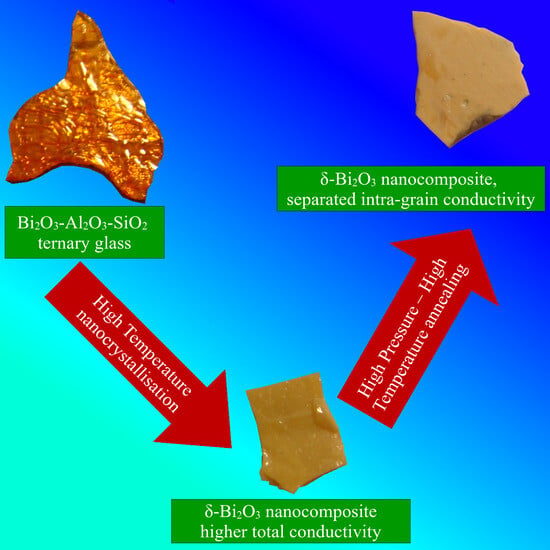
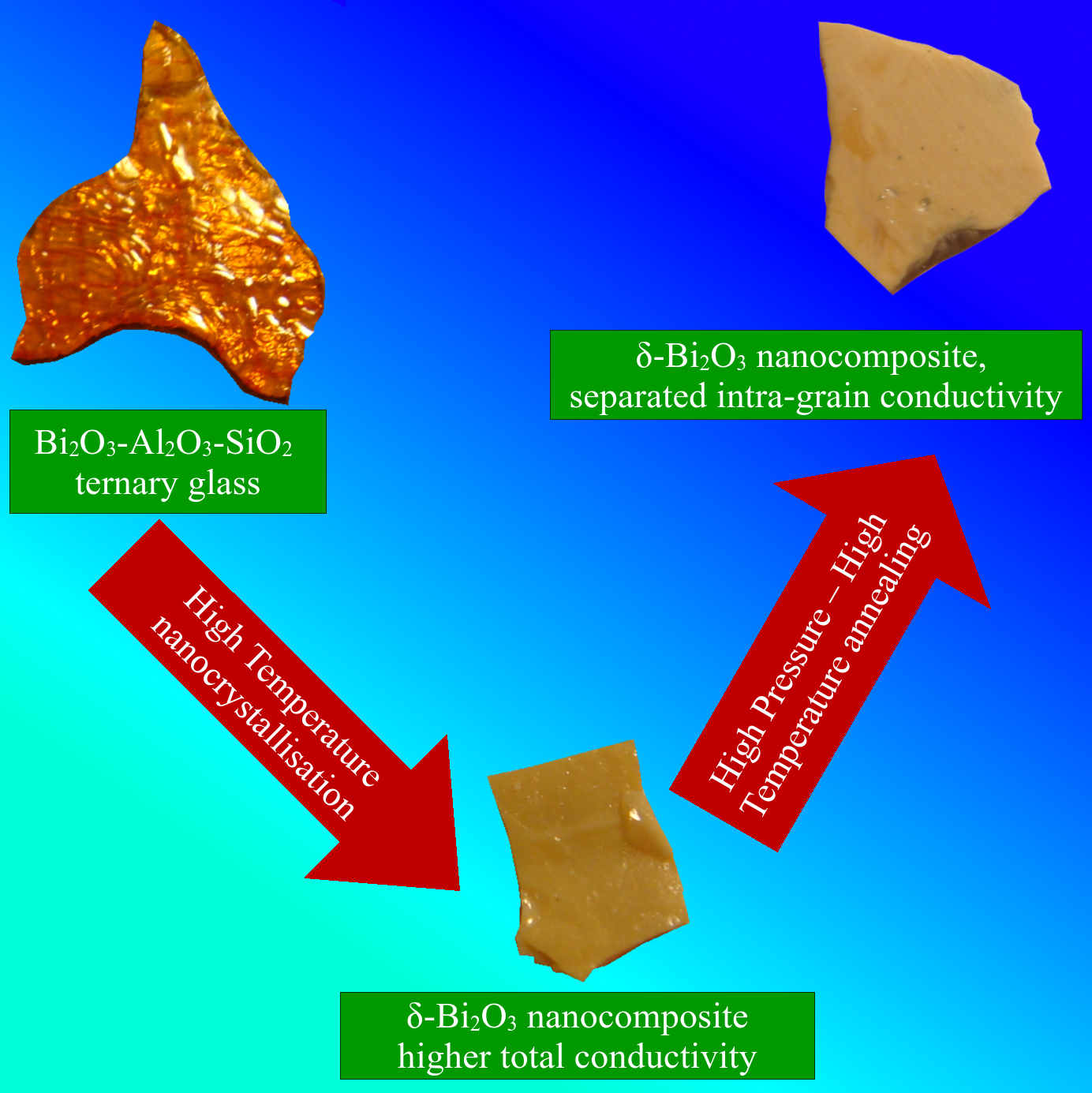
Graphical Abstract

1. Introduction

Bismuth sesquioxide, Bi2O3, is a compound of rich polymorphism [1,2,3,4,5] and can exhibit either semiconductor [6], ferroelectric [7,8], or fast oxygen-ion conductor properties [9], depending on the crystalline phase: α, β, γ, and δ.
This promising material is considered for use in a wide range of applications such as supercapacitors, photonic sensors, capsules in nuclear energetics, and solid oxide fuel cells [8,9,10,11,12,13,14]. Due to the extremely high conductivity of O2− ions, the face-centered cubic fluorite phase (δ-Bi2O3) is an attractive material for applications in electrochemical devices such as oxygen sensors or as an electrolyte in fuel cells [15,16,17,18,19,20,21,22]. A major disadvantage of the δ phase is that it is stable only over a narrow, high-temperature (1000–1100 K) range [1,23,24,25,26].
In our laboratory, we avoided this drawback by preparing Bi2O3-SiO2-Al2O3 glasses, which we then subjected to thermal nanocrystallization [27,28,29,30,31,32]. Such composites contain nanograins of δ-Bi2O3 confined in a glassy matrix, which are stable down to room temperature and even lower [15,28,29,30,31,32]. Preparation of pure Bi2O3 glass is practically impossible, and therefore, the addition of glass formers like SiO2 and Al2O3 is required. This can be achieved by intentional addition [32] or even more simply, by melting α-Bi2O3 in a ceramic crucible containing glass-forming silica and alumina [15,30,31]. Above the melting temperature of α-Bi2O3, both oxides diffuse from the crucible shell to the melt, making glass formation possible.
High-pressure high-temperature (HPHT) treatment of glasses may permanently alter their structural, thermal, and electrical properties [33,34,35,36,37,38]. In oxide glasses, densification exceeding 10%, an extraordinary Young’s modulus, and enhanced surface hardness were observed [36,37,38,39,40]. Those notable changes remain after decompression and are stable for years at ambient conditions [38,39,40,41,42,43]. However, one may suspect that the extraordinary properties of HPHT-treated materials could not remain stable at elevated temperatures under ambient pressure.
In our previous research, HPHT treatment of alkali metal phospho-olivines (such as LiFe0.75V0.10PO4 [41,42] and NaFePO4 [43,44]) has shown that HPHT treatment of relatively large (m = 5–10 g) samples at high (but still reasonably moderate) pressure of P~1 GPa allowed for the growth of nanocrystalline phases different from those obtained at ambient pressure. In the case of the mentioned phospho-olivines, this led to an increase in DC conductivity by over two orders of magnitude at room temperature and ambient pressure. The structure of those samples remained stable for at least a year [45].
Authors’ previous research [15] has shown that depending on the pressure applied during the HPHT treatment, Bi2O3-based glass can transform into other phases: body-centered cubic γ-Bi2O3 [29,30], face-centered cubic δ-Bi2O3 [46], or tetragonal β-Bi2O3 phase [47,48]. Depending on conditions (not fulfilled in this study), it could introduce some silicon oxide from the glassy matrix into crystallites and create potentially ferroelectric (either orthorhombic or close-to-90° monoclinic) bismuth silicate Bi2O5Si [7,32,49]. Results achieved in our studies described in [15] allowed us to propose a P-T map of phase transitions for the Bi2O3-Al2O3-SiO2 ternary system.
The aim of this work is to study the electrical properties of Bi2O3-Al2O3-SiO2 composites prepared by us that contain nanograins of superionic δ-Bi2O3 phase. This topic was also studied in our earlier papers [28,29,30,31,32], but the novelty of the present work is the use of high pressures in order to obtain samples with better properties. Our main focus was to study the impact of HPHT annealing on the ionic conductivity of this composite. While determining the total ionic conductivity of glass ceramics is quite standard, determining the intragrain conductivity of the δ-Bi2O3 phase is more challenging.

2. Materials and Methods

In order to prepare samples, monoclinic α-Bi2O3 [15,50,51] (Acros Organics, Geel, Belgium, Bismuth (III) oxide, 99.9% extra pure) was pulverized in a zirconia mortar and placed in a ceramic Al2O3 crucible. The crucible’s glaze contained SiO2 and Al2O3 oxides (VWR, Radnor, PA, USA, 459–0211 DIN). The powder was then heated to 1373 K and held at this temperature for 30 min, followed by melt quenching [15,28,29,30,31,32,52]. The quenching consisted of pouring the melt onto a steel plate (kept at RT) and covering the liquid sample with a second similar plate. This resulted in a glassy material, which was confirmed by XRD analysis. All structure studies (amorphous and nanocrystalline samples) were carried out at ambient conditions utilizing a PANalytical Empyrean X-ray diffractometer with CuKα λ = 1.54 Å (PANalytical B.V., Almelo, The Netherlands). The data were analyzed using PANalytical High Score Plus software (Ver. 4.7.0.24755, PANalytical B.V., Almelo, The Netherlands) with the JCPDS-ICDD (The International Centre for Diffraction Data, Newtown Square, PA, USA) database.
The differential thermal analysis (DTA) of the obtained glass is part of our previous publication on this topic [15].
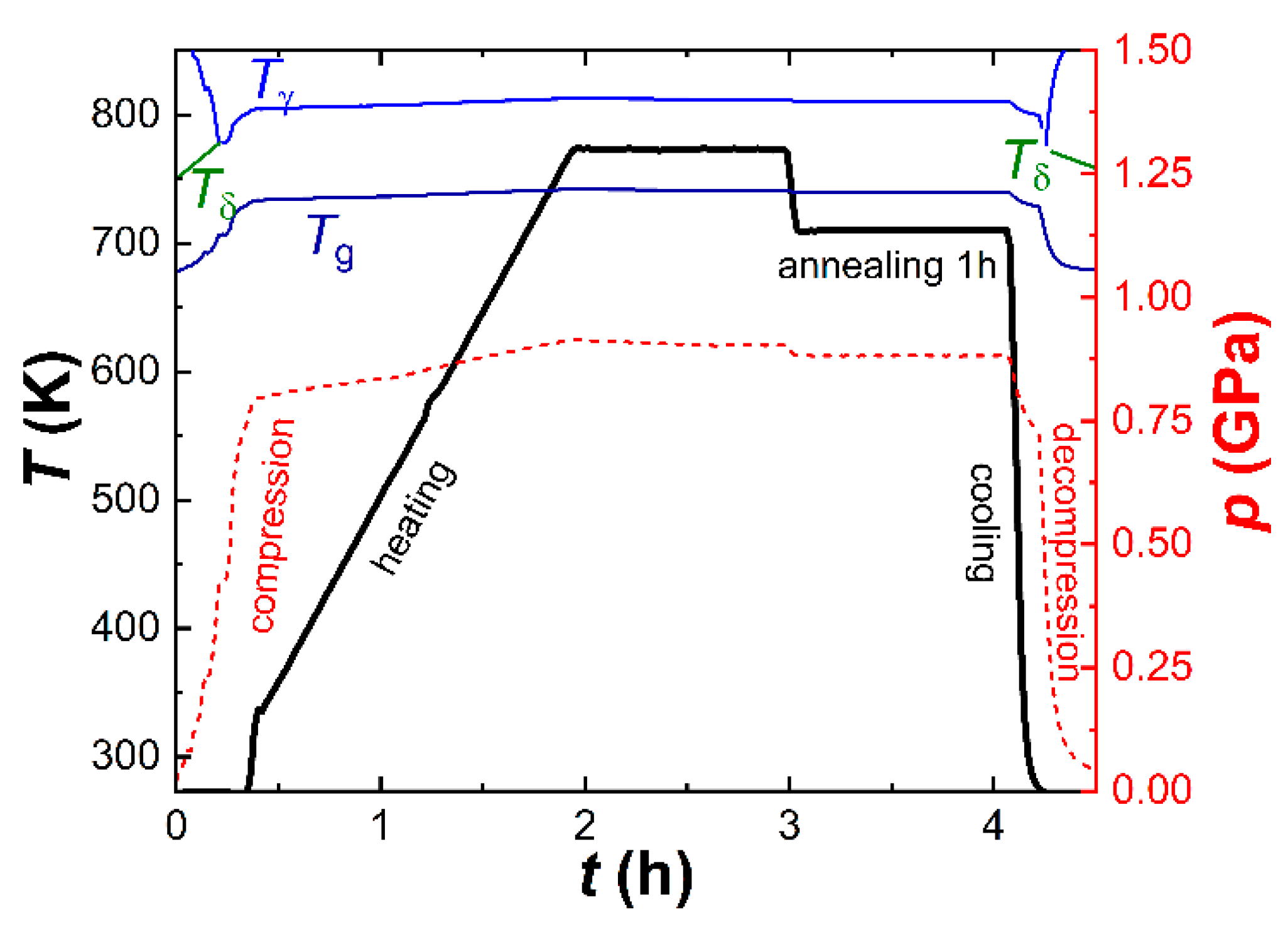
To prepare samples studied in this work, we subjected them to high-pressure high-temperature (HPHT) treatment, developed at our laboratory [15,42,43,44,45,46] and described in Figure 1. The scenario for this treatment was proposed based on our previously published P-T diagram of phase transitions [15]. In the HPHT experiment, Bi2O3-based glass (Bi2O3-Al2O3-SiO2 ternary system) was first thermally nanocrystallized into δ-Bi2O3 [15,29,30,31,32]. Next, the nanocrystalline material was placed in a pressure chamber, compressed to circa 770 MPa, heated above the glass transition temperature, and maintained under these conditions for 1 h. Next, the material was cooled down slightly to below the glass transition temperature and annealed for 1 h. Finally, the material was cooled down to room temperature and decompressed to atmospheric pressure. The HPHT procedure is illustrated in Figure 1.
The microstructure of the samples was examined using a Zeiss Ultra Plus SEM. Glasses (Carl Zeiss AG, Oberkochen, Germany) and nanomaterials of the Bi2O3-Al2O3-SiO2 system were measured using the EDS method with the use of the EDS Bruker Quantax 400 (Bruker Corporation, Billerica, MA, USA) extension of the SEM equipment. Our EDS results show that the weight percentage of the nanocomposite sample before HPHT annealing was as follows: Bi (84.57 ± 5.95)%, O (9.81 ± 2.90)%, Si (3.42 ± 0.35)%, and Al (2.20 ± 0.27)%. The weight percentage in the HPHT-annealed sample remained very close at Bi (81.64 ± 5.74)%, O (10.72 ± 3.17)%, Si (4.63 ± 0.47)%, and Al (3.0 ± 0.36)%. Atomic compositions were: Bi (33.15 ± 2.33)%, O (50.21 ± 14.86)%, Si (9.97 ± 1.01)% and Al (6.68 ± 0.82)% and Bi (29.22 ± 2.06)%, O (50.11 ± 14.83)%, Si (12.34 ± 1.25)% and Al (8.33 ± 1.02)%, respectively.
Electrical properties were studied using impedance spectroscopy (IS) [29,30,52,53] on polished samples with sputtered Pt electrodes. Conductivity values were determined from the measured resistances of the samples and their geometric factors. Measurements were performed using a Novocontrol Alpha-A spectrometer (Novocontrol Technologies GmbH & Co. KG, Hundsangen, Germany) in a temperature range from RT to 900 K and at frequencies between 10 mHz and 10 MHz. Data acquisition was controlled by the KURA software (version 0.7) developed in our laboratory [53].

3. Results

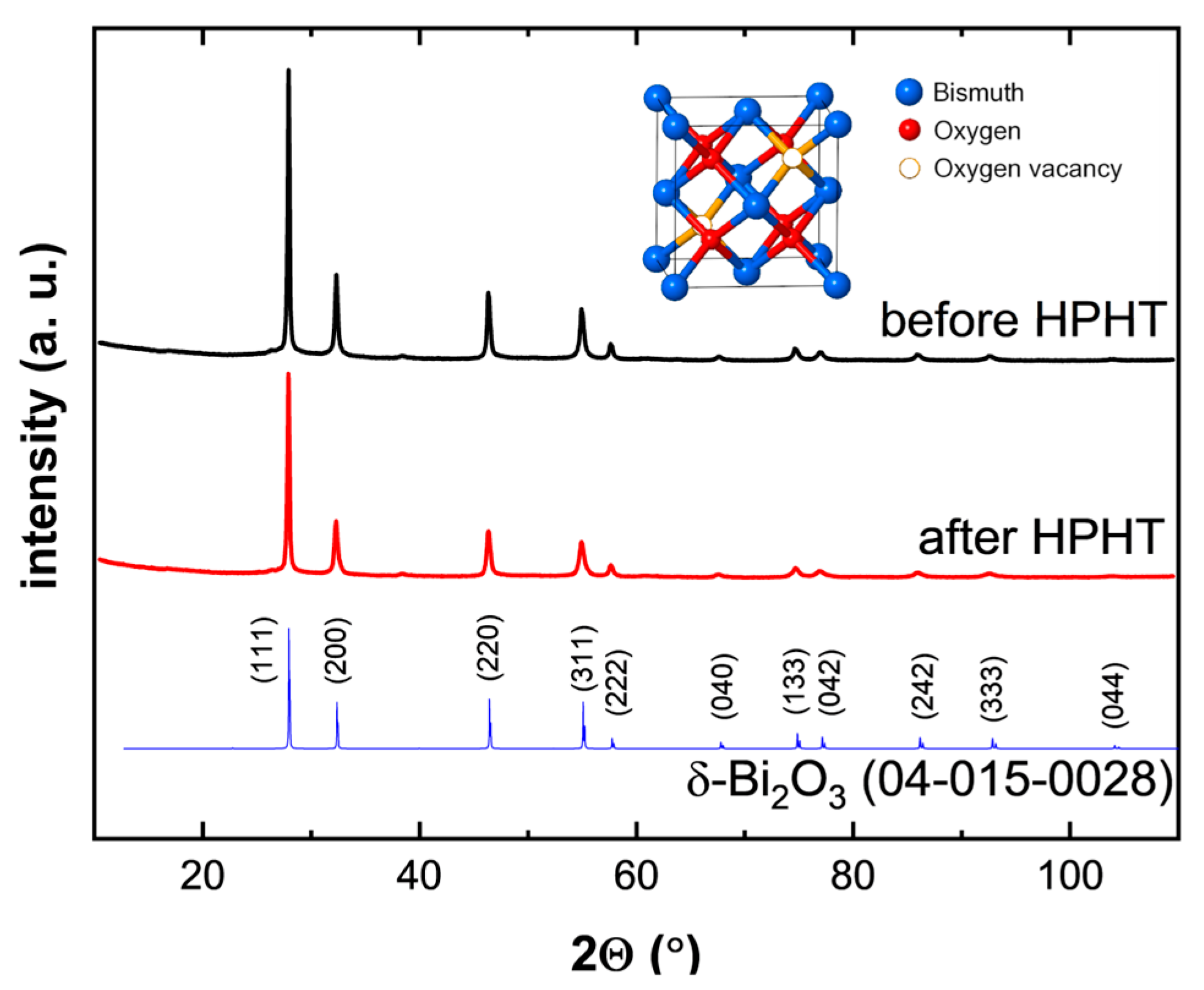
Figure 2 shows the fluorite-like unit cell of δ-Bi2O3 and X-Ray diffraction patterns of the studied composites before and after HPHT treatment. The HPHT treatment did not change the crystalline phase of δ-Bi2O3 nanograins, nor did it form any other crystalline phases in the Al2O3-SiO2 glassy matrix. The positions of the four most significant peaks and their relative proportions did not change (only a slight shift of 0.03–0.05° was observed). The crystallite sizes were determined by the Scherrer [54] formula on the basis of peak positions and their shapes. The crystallite sizes calculated for the four most significant peaks were 95 nm, 66 nm, 48 nm, and 36 nm before, and 100 nm, 66 nm, 48 nm, and 34 nm after HPHT. The average crystallite sizes were 61 (45) nm and 62 (50) nm, respectively; the difference between the pairs was within the limits of experimental error.
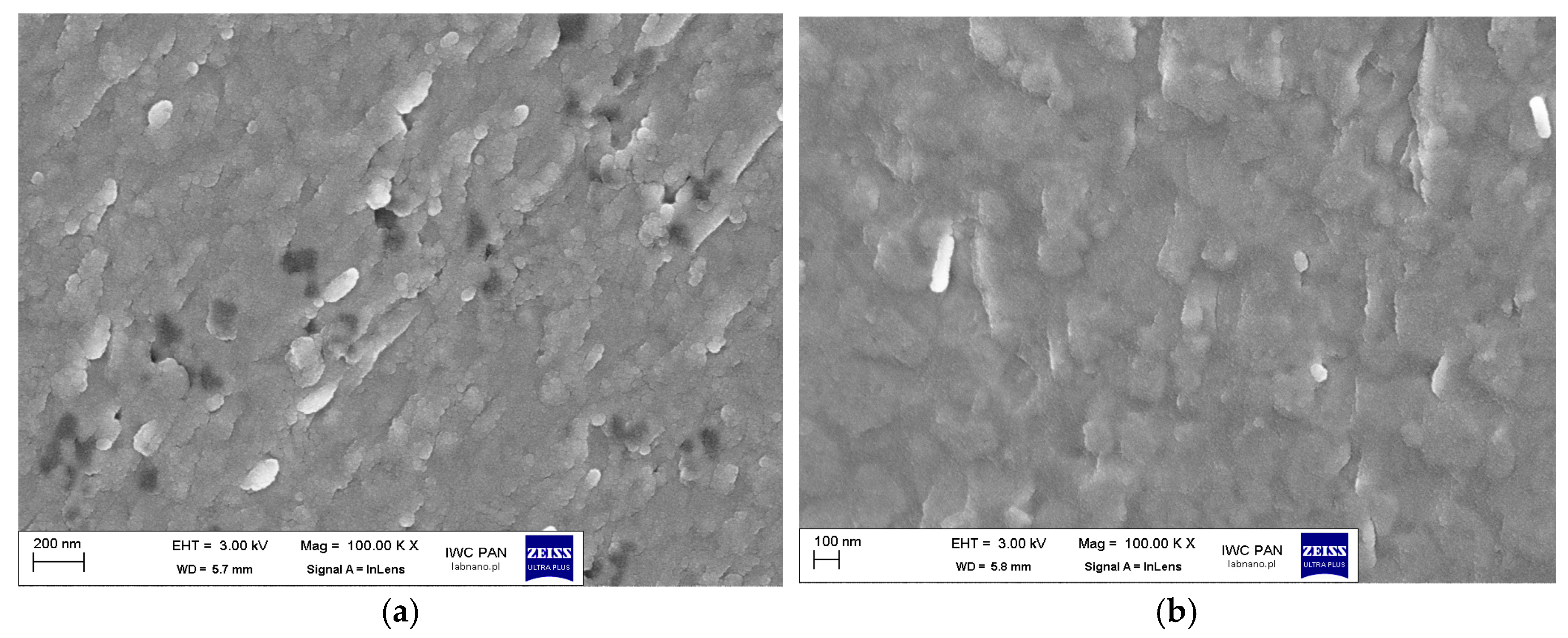
Figure 3a,b shows that HPHT treatment successfully altered the microstructure of the samples, making them more compact. The distance between larger nanograins of δ-Bi2O3 seems to be reduced. It is also worth noting that the average size of nanograins seen in Figure 3b (c.a. 100 nm) is slightly larger than the average size of nanocrystallites determined from XRD. This is understandable because a grain, visible in SEM, consists of a crystalline core and a disordered shell.
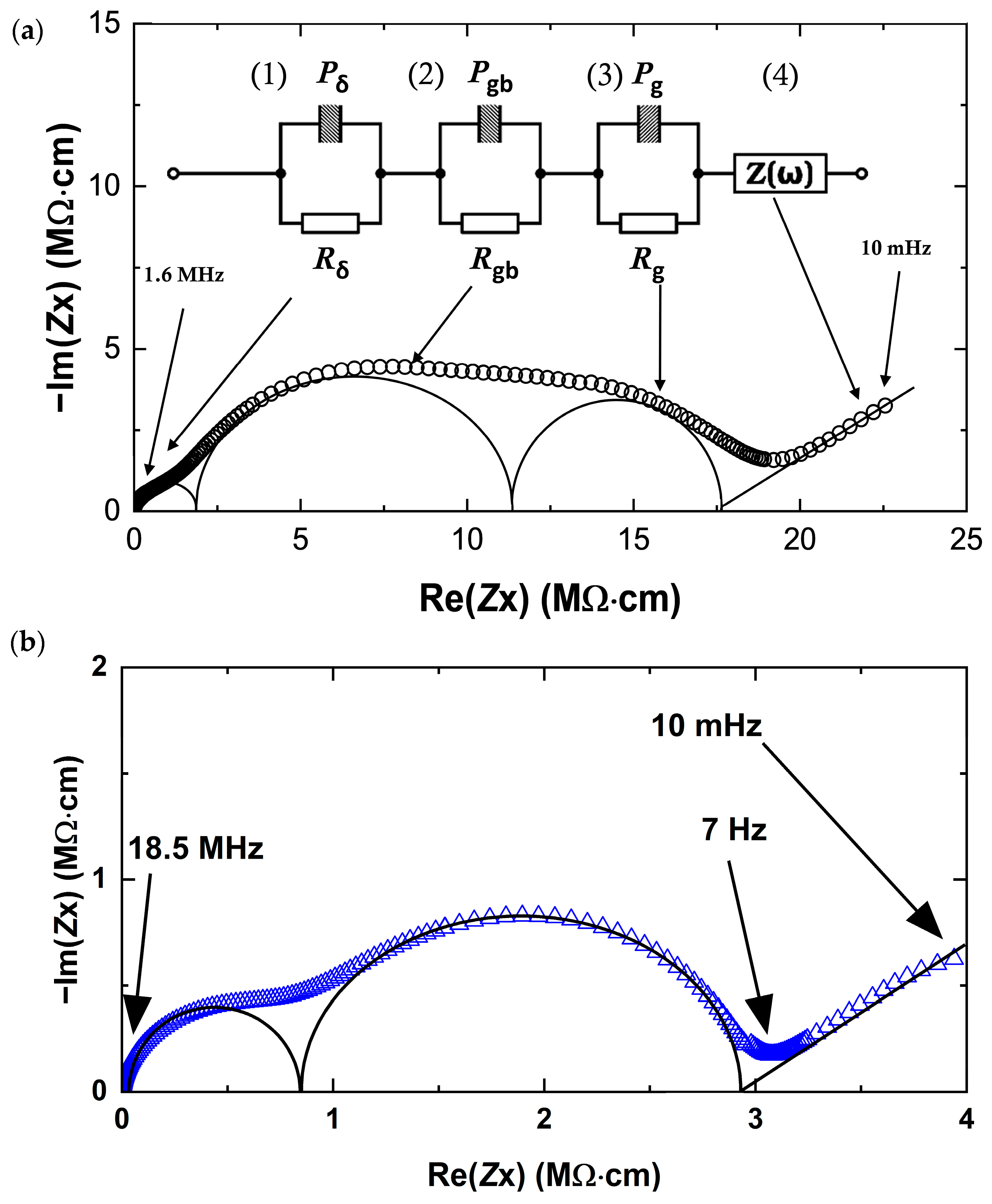
Electrical properties were studied using impedance spectroscopy across a wide range of frequencies. Considering the SEM images (Figure 3b), we proposed an equivalent electric circuit shown in Figure 4 together with a typical impedance diagram. The circuit consists of four elements corresponding to: (1) ionic polarization of δ-Bi2O3 nanograins, (2) ionic polarization of grain boundaries, (3) ionic polarization of thin glassy layers between grains, and (4) impedance Z(ω) related to diffusion of O2− ions in a porous Pt electrode [55,56].
Rδ, Rgb, and Rg denote the resistances of nanograins, grain boundaries, and glass areas, respectively. Capacitances corresponding to the polarization effects mentioned above are marked with Pδ, Pgb, and Pg (more precisely, these are constant phase elements commonly used in impedance spectroscopy [57,58,59]). Low-frequency impedance Z(ω) is not the focus of this study, because it concerns the diffusion of O2− ions in the porous electrode area. Most interesting for us, the electrical conductivity of oxygen ions in nanograins (intragrain conductivity) reveals itself at the highest frequencies (Figure 4). In the intermediate frequency range, transport phenomena occur at the grain boundaries [29,31,60,61] and in the glassy matrix area. The considerable sizes of the impedance arcs corresponding to those processes (Figure 4) indicate that the contribution of intergrain areas to the total resistance is also considerable. The total resistivity (conductivity σt) of the studied samples was determined from the ReZx—intercept. In Figure 4a, one can see experimental points and tentative fitted impedance arcs, corresponding to the polarization phenomena mentioned above. In our case, due to HPHT treatment, the separation of those processes and the determination of intragrain ionic conductivity σδ were possible without complex, time-consuming theoretical fitting [31]. On the other hand, the extraction of the intragrain contribution from the total impedance diagram is extremely difficult without HPHT treatment. In Figure 4b, related to thermally nanocrystallized glasses, the polarization of intragrains is not visible. In our earlier studies, we could detect this process using only ultra-high frequencies approaching 10 GHz [31]. However, applying such frequencies requires special instruments and a very careful electric shielding to avoid the influence of parasitic inductances.
If we compare the impedance diagrams in Figure 4a,b, we can see that the proportions between the impedances of residual glass and grain boundaries were reversed after HPHT treatment. The relative contribution of thin glassy layers to the total resistivity decreased, while the relative contribution of grain boundaries increased. Additionally, the contribution of intragrain resistivity was clearly visible. Total resistivity after HPHT treatment, quite unexpectedly, slightly increased (Figure 4a,b). This is probably due to closer contacts between grains and the build-up of a ramified network of grain boundaries. This minor disadvantage is, however, compensated by the remarkable possibility to study small grains of δ-Bi2O3.
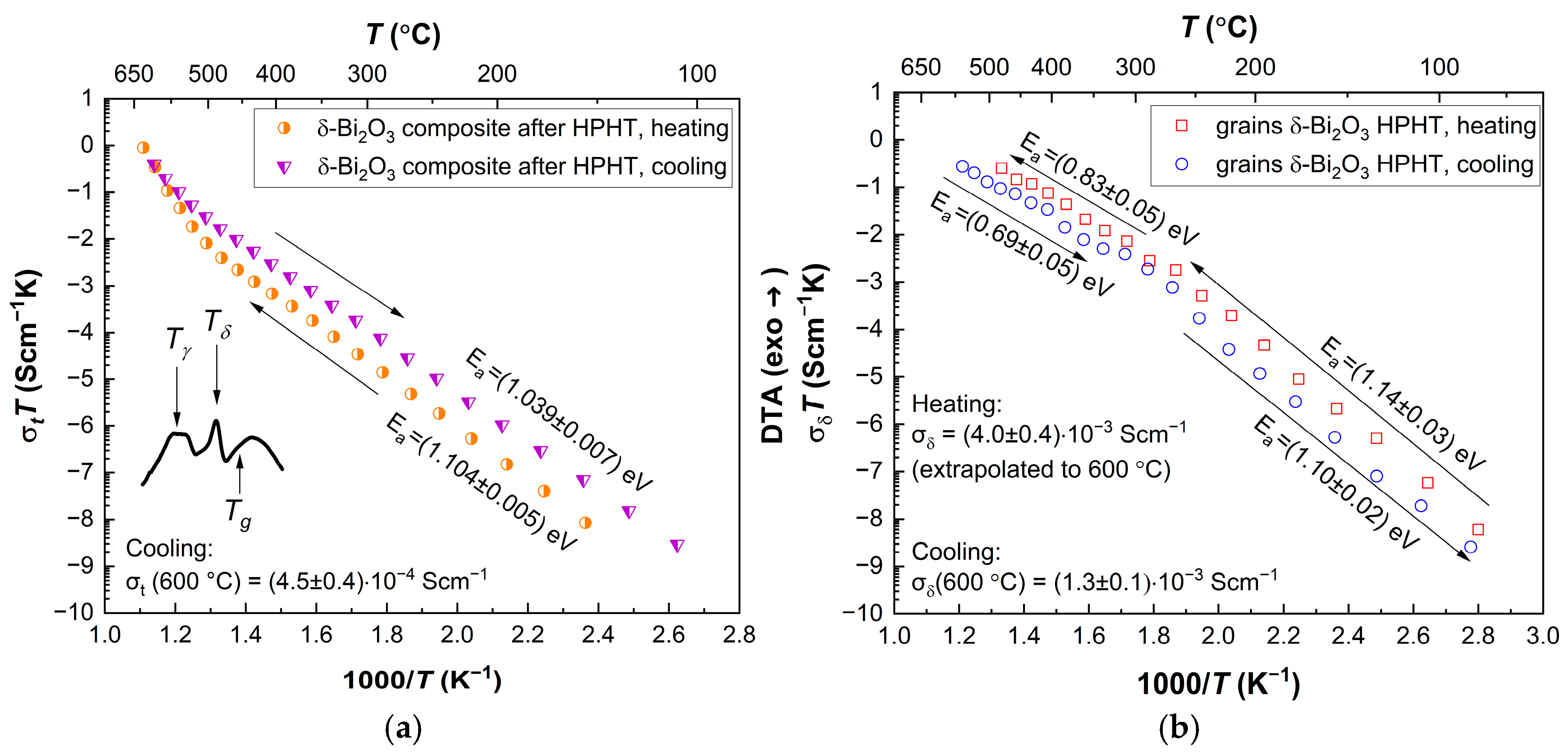
Based on impedance diagrams recorded at various temperatures, during heating and cooling, the total conductivity of the HPHT-treated nanocomposite was determined and presented in Arrhenius coordinates in Figure 5a. Since the composite still contains a residual glassy matrix, we inserted in this figure the DTA thermogram obtained for the initial glass [15]. Although the composition of the glassy matrix may differ from that of the initial glass, the attached thermogram may facilitate the analysis of the Arrhenius plots. It can be observed that at about 450 °C, the ionic conductivity sharply increases, apparently due to the glass transition and redundant crystallization of the δ phase. The upper limit of conductivity measurements was determined by the phase transition from δ to the less conductive and metastable γ phase.
The total oxygen conductivity was equal to (4.5 ± 0.4) × 10−4 S/cm at 600 °C, which is a promising value for applications in intermediate-temperature electrochemical devices based on solid oxide electrolytes. High activation energies (≈1 eV), describing effective ionic conduction, are typical for oxygen conductors [62] because the radius of the O2− anion is relatively large and equals 1.4 Å [62,63].
Figure 5b shows Arrhenius plots related to the intragrain conductivity of the δ-phase extracted from impedance diagrams like that in Figure 4a. In this case, we observe a change in activation energy from higher values (about 1 eV) below 300 °C to considerably lower ones (0.7–0.8 eV) above that temperature. Details concerning the conductivity runs are discussed below. It is worth noting that the intragrain conductivity of the δ phase reaches a high value of (1.3 ± 0.1) × 10−3 S/cm at 600 °C during cooling.

4. Discussion

Area-specific resistance required for practical fuel cell operation should not exceed 0.1 Ωcm−2 [64]. A 1-mm-thick layer requires a conductivity of at least 10−1 Scm−1; lower conductivity imposes a limit on layer thickness [64,65,66]. Materials such as (Y2O3)0.08(ZrO2)0.92, Ce0.9Gd0.1O1.95, La0.9Sr0.1Ga0.9Mg0.1O3, (BiO1.5)0.88(DyO1.5)0.08(WO3)0.04, and (Sc2O3)0.08(CeO2)0.01(ZrO2)0.91, could exhibit conductivities in the range of 10−3 to 10−2 S/cm at 500 °C [64,67,68,69,70,71]. Similarly, tungsten-stabilized Bi3Y0.90W0.1O6.15 could reach 3 × 10⁻² S/cm at 600 °C [19], while thermally nanocrystallized δ-Bi2O3 reaches a total conductivity of 5 × 10⁻⁵ S/cm at 500 °C [31]. Our sample reached a total conductivity of (4.5 ± 0.4) × 10−4 S/cm at 600 °C, which is a promising starting point for further refinement before practical application, especially considering the lowered activation energy (1.039 ± 0.007 eV), when compared with that reported in previous studies (1.30 eV) [31].
Superionic δ-Bi2O3 = δ-BiO1.5 exhibits a fluorite (CaF2) structure, whose oxygen sublattice contains 25% vacancies [72]. Such conditions strongly facilitate fast ionic transport by the vacancy mechanism [72,73,74,75]. On the other hand, a substantial disorder in the O2− sublattice cannot be stable at lower temperatures, where oxygen vacancies tend to form an ordered superstructure within the fluorite structure [76,77,78].
A change in the activation energy of ionic conductivity from a higher to a lower value is a characteristic feature of many superionic conductors, e.g., sodium β″-alumina or β-PbF2, which, like δ-Bi2O3, exhibits a fluorite structure [79,80,81,82,83,84,85,86,87,88]. In this class of fast ion conductors, a second-order phase transition occurring in the sublattice of mobile ions has been postulated. Fast ion conduction at high temperatures is the result of strong disorder of the “molten” sublattice of ions. In the lower-temperature range, a defective sublattice tends to order, which increases the activation energy. It is obvious that the degree of ordering depends on temperature and that this fundamental issue requires further studies. Transport of ions in an ordered sublattice is more difficult because the activation energy consists not only of migration energy but also of defect creation energy (creation of an oxygen vacancy in our case) [89].
In Figure 5b, one can see that the conductivity during cooling is unexpectedly slightly lower than during heating. We think that this may be caused by a stronger rate of vacancy ordering upon cooling. Impedance measurements, in situations where the sublattice of mobile ions evolves over time, are quite challenging. In our previous studies [29,31], we could not detect (in Arrhenius plot) the changing point of activation energy. This was caused by difficulties in determining intragrain conductivity. In this study, due to HPHT treatment of the composites, this determination was easier. The reduction in conductivity during cooling suggests that the HPHT-induced effect is further modified during thermal cycling. The intragrain activation energy (0.69 ± 0.05 eV), while higher than that reported by Takahashi (0.4–0.5 eV) at temperatures above 730 °C, is remarkably lower than that previously observed in thermally nanocrystallized δ-Bi2O3, which was not HPHT-annealed (0.96 eV) [31].

5. Conclusions

In this work, we applied high-pressure high-temperature treatment (HPHT) to obtain composites containing nanograins of the superionic δ-Bi2O3 phase. This treatment allowed us to determine the intragrain conductivity of O2− ions over a wide temperature range. The electrical properties of the composites are very promising from an application standpoint. It was also possible to detect changes in activation energy that may indicate an order–disorder transition in the sublattice of mobile oxygen ions. This hypothesis, however, requires further research, for example, using neutron diffractometry.

Author Contributions

Conceptualization, J.E.G., A.S.-S. and S.J.R.; formal analysis, A.S.-S., J.E.G. and S.J.R.; funding acquisition, S.J.R.; investigation, A.S.-S., T.K.P. and J.M.; project administration, S.J.R.; resources, J.E.G., T.K.P. and S.J.R.; supervision, J.E.G. and S.J.R.; visualization, A.S.-S.; writing—original draft, A.S.-S., J.E.G. and S.J.R.; writing—review and editing, A.S.-S., J.E.G. and S.J.R. All authors have read and agreed to the published version of the manuscript.

Funding

A.S.-S., T.K.P., S.J.R. and J.E.G. were supported by the National Science Centre (Narodowe Centrum Nauki) through the grant No. 2022/45/B/ST5/04005, supporting the cooperation of IHPP PAS and Warsaw University of Technology (Poland), guided by S.J. Rzoska.

Data Availability Statement

Data is available at public repository: 10.6084/m9.figshare.32358351.

Acknowledgments

Pressure treatment due to courtesy of Institute of High Pressure Physics of the Polish Academy of Sciences NL-3 Laboratory.

Conflicts of Interest

The authors declare no conflicts of interest.

Abbreviations

The following abbreviations are used in this manuscript:
HPHTHigh Pressure-High Temperature
XRDX-Ray Diffraction
SEMScanning Electron Microscope
ISImpedance Spectroscopy
EDSEnergy-Dispersive X-ray Spectroscopy

References

  1. Levin, E.M.; Roth, R.S. Polymorphism of bismuth sesquioxide. I. pure Bi2O3. J. Res. Natl. Bur. Stand. A Phys. Chem. 1964, 68A, 189–195. [Google Scholar] [CrossRef]
  2. Harwig, H.A.; Gerards, A.G. The polymorphism of bismuth sesquioxide. Thermochim. Acta 1979, 28, 121–131. [Google Scholar] [CrossRef]
  3. Drache, M.; Roussel, P.; Wignacourt, J.P. Structures and oxide mobility in Bi-Ln-O materials: Heritage of Bi2O3. Chem. Rev. 2007, 107, 80–96. [Google Scholar] [CrossRef] [PubMed]
  4. Cornei, N.; Tancret, N.; Abraham, F.; Mentré, O. New ε-Bi2O3 metastable polymorph. Inorg. Chem. 2006, 45, 4886–4888. [Google Scholar] [CrossRef]
  5. Gualtieri, A.F.; Immovilli, S.; Prudenziati, M. Powder X-ray diffraction data for the new polymorphic compound ω-Bi2O3. Powder Diffr. 1997, 12, 90–92. [Google Scholar] [CrossRef]
  6. Utami, B.A.; Sutanto, H.; Hidayanto, E. Recent advances in doped Bi2O3 and its photocatalytic activity: A review. Int. J. Res. Rev. 2022, 9, 216–230. [Google Scholar] [CrossRef]
  7. Taniguchi, H.; Kuwabara, A.; Kim, J.; Kim, Y.; Moriwake, H.; Kim, S.; Hoshiyama, T.; Koyama, T.; Mori, S.; Takata, M.; et al. Ferroelectricity driven by twisting of silicate tetrahedral chains. Angew. Chem. Int. Ed. Engl. 2013, 52, 8088–8092. [Google Scholar] [CrossRef]
  8. Yang, Q.; Hu, J.; Fang, Y.W.; Jia, Y.; Yang, R.; Deng, S.; Lu, Y.; Dieguez, O.; Fan, L.; Zheng, D.; et al. Ferroelectricity in layered bismuth oxide down to 1 nanometer. Science 2023, 379, 1218–1224. [Google Scholar] [CrossRef]
  9. Maeder, T. Review of Bi2O3 based glasses for electronics and related applications. Int. Mater. Rev. 2013, 58, 3–40. [Google Scholar] [CrossRef]
  10. Astuti, Y.; Mei, R.; Darmawan, A.; Arnelli, J.; Widiyandari, H. Enhancement of electrical conductivity of bismuth oxide/activated carbon composite. Sci. Iran. 2022, C29, 3119–3131. [Google Scholar] [CrossRef]
  11. Jeong, I.; Jeong, S.J.; Yun, B.H.; Lee, J.W.; Lee, C.W.; Jung, W.; Lee, K.T. Physically driven enhancement of the stability of Bi2O3-based ionic conductors via grain boundary engineering. NPG Asia Mater. 2022, 14, 53. [Google Scholar] [CrossRef]
  12. Singh, S.; Sahoo, R.K.; Shinde, N.M.; Yun, J.M.; Mane, R.S.; Chung, W.; Kim, K.H. A symmetric faradaic assembly of Bi2O3 and MnO2 for a high-performance hybrid electrochemical energy storage device. RSC Adv. 2019, 9, 32154–32164. [Google Scholar] [CrossRef] [PubMed]
  13. Luo, W.; Li, F.; Li, Q.; Wang, X.; Yang, W.; Zhou, L.; Mai, L. Hetero-structured Bi2S3−Bi2O3 nanosheets with a built-in electric field for improved sodium storage. ACS Appl. Mater. Interfaces 2018, 10, 7201–7207. [Google Scholar] [CrossRef]
  14. Kilner, J.A.; Burriel, M. Materials for intermediate-temperature solid-oxide fuel cells. Annu. Rev. Mater. Res. 2014, 44, 365–393. [Google Scholar] [CrossRef]
  15. Szpakiewicz-Szatan, A.; Pietrzak, T.K.; Sierakowski, K.; Boćkowski, M.; Rzoska, S.J.; Garbarczyk, J.E.; Starzonek, S. Nanocrystallization of Bi2O3 based system from the glassy state under high compression. Materialia 2024, 33, 10197. [Google Scholar] [CrossRef]
  16. Wachsman, E.D.; Lee, K.T. Lowering the temperature of solid oxide fuel cells. Science 2011, 334, 935–939. [Google Scholar] [CrossRef] [PubMed]
  17. Wachsman, E.D.; Marlowe, C.A.; Lee, K.T. Role of solid oxide fuel cells in a balanced energy strategy. Energy Environ. Sci. 2012, 5, 5498–5509. [Google Scholar] [CrossRef]
  18. Borowska-Centkowska, A.; Leszczynska, M.; Wrobel, W.; Malys, M.; Hull, S.; Krok, F.; Abrahams, I. Stability of tungsten-doped δ-Bi3YO6. Solid State Ion. 2020, 345, 115173. [Google Scholar] [CrossRef]
  19. Borowska-Centkowska, A.; Leszczynska, M.; Wrobel, W.; Malys, M.; Krynski, M.; Hull, S.; Krok, F.; Abrahams, I. Structure and conductivity in tungsten doped δ-Bi3YO6. Solid State Ion. 2017, 308, 61–67. [Google Scholar] [CrossRef]
  20. Shao, Z.; Haile, S.M. A high-performance cathode for the next generation of solid-oxide fuel cells. Nature 2004, 431, 170–173. [Google Scholar] [CrossRef]
  21. Harwig, H.A.; Gerards, A.G. Electrical properties of the α, β, γ, and δ phases of bismuth sesquioxide. J. Solid State Chem. 1978, 26, 65–274. [Google Scholar] [CrossRef]
  22. Basu, S. Future directions of fuel cell science and technology. In Recent Trends in Fuel Cell Science and Technology; Basu, S., Ed.; Springer: New York, NY, USA, 2007; pp. 356–365. [Google Scholar] [CrossRef]
  23. Schröder, F.; Bagdassarov, N.; Ritter, F.; Bayarjargal, L. Temperature dependence of Bi2O3 structural parameters close to the α–δ phase transition. Phase Transit. 2010, 83, 311–325. [Google Scholar] [CrossRef]
  24. Risold, D.; Hallstedt, B.; Gauckler, L.J.; Lukas, H.L.; Fries, S.G. The bismuth-oxygen system. J. Phase Equilibria 1995, 16, 223–234. [Google Scholar] [CrossRef]
  25. Matsumoto, A.; Koyama, Y.; Tanaka, I. Structures and energetics of Bi2O3 polymorphs in a defective fluorite family derived by systematic first-principles lattice dynamics calculations. Phys. Rev. B Condens. Matter Mater. Phys. 2010, 81, 094117. [Google Scholar] [CrossRef]
  26. Kilner, J.; Brook, R. A study of oxygen ion conductivity in doped non-stoichiometric oxides. Solid State Ion. 1982, 6, 237–252. [Google Scholar] [CrossRef]
  27. Garbarczyk, J.E.; Wasiucionek, M.; Jozwiak, P.; Nowinski, J.L.; Julien, C.M. Novel nanomaterials based on electronic and mixed conductive glasses. Solid State Ion. 2009, 180, 531–536. [Google Scholar] [CrossRef]
  28. Kruk-Fura, P.; Garbarczyk, J.E. Studies on δ-Bi2O3 Based Stabilized at Room Temperature by Novel Methods. Appl. Sci. 2022, 12, 7885. [Google Scholar] [CrossRef]
  29. Pietrzak, T.K.; Wasiucionek, M.; Garbarczyk, J.E. Towards higher electric conductivity and wider phase stability range via nanostructured glass-ceramics processing. Nanomaterials 2021, 11, 1321. [Google Scholar] [CrossRef]
  30. Pietrzak, T.K.; Jarocka, A.; Jastrzebski, C.; Plocinski, T.; Wasiucionek, M.; Garbarczyk, J.E. Facile and reproducible method of stabilizing δ-Bi2O3 phases confined in nanocrystallites embedded in amorphous matrix. Sci. Rep. 2021, 11, 19145. [Google Scholar] [CrossRef]
  31. Pietrzak, T.K.; Garbarczyk, J.E.; Wasiucionek, M. Stabilization of the δ-Bi2O3-like structure down to room temperature by thermal nanocrystallization of bismuth oxide-based glasses. Solid State Ion. 2018, 323, 78–84. [Google Scholar] [CrossRef]
  32. Nowagiel, M.; Lafon, O.; Płociński, T.; Trébosc, J.; Turczyński, J.; Zajkowska-Pietrzak, W.; Garbarczyk, J.E.; Wasiucionek, M.; Pietrzak, T.K. Towards a deeper insight into the stabilisation mechanism of δ-Bi2O3-like phase to low temperature by confinement of nanograins in glassy matrix. Ceram. Int. 2026, 52, 10077–10086. [Google Scholar] [CrossRef]
  33. Drozd-Rzoska, A. Pressure dependence of the glass temperature in supercooled liquids. Phys. Rev. E 2005, 72, 041505. [Google Scholar] [CrossRef]
  34. Mierzwa, M.; Paluch, M.; Rzoska, S.J.; Zioło, J. The liquid−glass and liquid−liquid Transitions of TPP at elevated pressure. J. Phys. Chem. B 2008, 112, 10383–10385. [Google Scholar] [CrossRef]
  35. Drozd-Rzoska, A.; Rzoska, S.J.; Starzonek, S. New scaling paradigm for dynamics in glass-forming systems. Prog. Mater. Sci. 2023, 134, 101074. [Google Scholar] [CrossRef]
  36. Smedskjaer, M.M.; Bauchy, M.; Mauro, J.C.; Rzoska, S.J.; Boćkowski, M. Unique effects of thermal and pressure histories on glass hardness: Structural and topological origin. J. Chem. Phys. 2015, 143, 164505. [Google Scholar] [CrossRef]
  37. Svenson, M.N.; Guerette, M.; Huang, L.; Loennroth, N.; Mauro, J.C.; Rzoska, S.J.; Bockowski, M.; Smedskjaer, M. Universal behavior of changes in elastic moduli of hot compressed oxide glass. Chem. Phys. Lett. 2016, 651, 88–91. [Google Scholar] [CrossRef]
  38. Mascaraque, M.; Bauchy, M.; Fierro, J.L.G.; Rzoska, S.J.; Boćkowski, M.; Smedskjaer, M.M. Dissolution kinetics of hot compressed oxide glasses. J. Phys. Chem. B 2017, 121, 9063–9072. [Google Scholar] [CrossRef]
  39. Kapoor, S.; Guo, X.; Youngman, R.E.; Hogue, C.L.; Mauro, J.C.; Rzoska, S.J.; Bockowski, M.; Jensen, L.R.; Smedskjaer, M.M. Network glasses under pressure: Permanent densification in modifier-free Al2O3-B2O3-P2O5-SiO2 systems. Phys. Rev. Appl. 2017, 7, 054011. [Google Scholar] [CrossRef]
  40. Januchta, K.; Youngman, R.E.; Goel, A.; Bauchy, M.; Logunov, S.L.; Rzoska, S.J.; Bockowski, M.; Jensen, L.R.; Smedskjaer, M.M. Discovery of ultra-crack-resistant oxide glasses with adaptive networks. ACS Chem. Mater. 2017, 29, 5865–5876. [Google Scholar] [CrossRef]
  41. Baranowski, P.; Starzonek, S.; Drozd-Rzoska, A.; Rzoska, S.J.; Bockowski, M.; Keblinski, P.; Pietrzak, T.K.; Garbarczyk, J.E. Multifold pressure-induced increase of electric conductivity in LiFe0.75V0.10PO4 glass. Sci. Rep. 2019, 9, 16607. [Google Scholar] [CrossRef]
  42. Starzonek, S.; Szpakiewicz-Szatan, A.; Rzoska, S.J.; Drozd-Rzoska, A.; Boćkowski, M.; Pietrzak, T.K.; Garbarczyk, J.E. Pressure-driven relaxation processes in nanocomposite ionic glass LiFe0.75V0.10PO4. J. Non-Cryst. Solids 2023, 605, 122163. [Google Scholar] [CrossRef]
  43. Szpakiewicz-Szatan, A.; Starzonek, S.; Pietrzak, T.K.; Garbarczyk, J.E.; Rzoska, S.J.; Boćkowski, M. Novel high-pressure nanocomposites for cathode materials in sodium batteries. Nanomaterials 2022, 13, 164. [Google Scholar] [CrossRef]
  44. Szpakiewicz-Szatan, A.; Starzonek, S.; Garbarczyk, J.E.; Pietrzak, T.K.; Boćkowski, M.; Rzoska, S.J. AC Electric Conductivity of High Pressure and High Temperature Formed NaFePO4 Glassy Nanocomposite. Nanomaterials 2024, 14, 1492. [Google Scholar] [CrossRef]
  45. Szpakiewicz-Szatan, A.; Pietrzak, T.K.; Boćkowski, M.; Rzoska, S.J.; Garbarczyk, J.E.; Starzonek, S. Title of High pressure treatment of sodium olivine-like glass: Possible future cathode material. In Proceedings of the the 3rd Polish-Slovenian International Seminar on Soft Matter, Celestynów, Poland, 28 September 2024. [Google Scholar]
  46. Yashima, M.; Ishimura, D. Crystal structure and disorder of the fast oxide-ion conductor cubic Bi2O3. Chem. Phys. Lett. 2003, 378, 395–399. [Google Scholar] [CrossRef]
  47. Blower, S.K.; Greaves, C. The structure of β-Bi2O3 from powder neutron diffraction data. Acta Cryst. 1988, 44, 587–589. [Google Scholar] [CrossRef]
  48. Aurivillius, B. Mixed Bismuth Oxides with Layer lattices I. The structure type of CaNb2Bi2O9. Ark. Kemi 1949, 1, 463–480. [Google Scholar]
  49. Fei, Y.T.; Fan, S.J.; Sun, R.Y.; Xu, J.Y.; Ishii, M. Crystallizing behavior of Bi2O3-SiO2 system. J. Mater. Sci. Lett. 2000, 19, 893–895. [Google Scholar] [CrossRef]
  50. Ivanov, S.A.; Tellgren, R.; Rundlof, H.; Orlov, V.G. Structural Studies of α-Bi2O3 by Neutron Powder Diffraction. Powder Diffr. 2001, 16, 227–230. [Google Scholar] [CrossRef]
  51. Gunnar, M.; Liv, F.; Ballhausen, C.J.; Ragnarsson, U.; Rasmussen, S.E.; Sunde, E.; Sørensen, N.A. The Crystal Structure of alpha-Bi2O3. Acta Chem. Scand. 1970, 24, 384–396. [Google Scholar]
  52. Kalbarczyk, A.S.; Kalabinski, J.; Nowinski, J.L.; Ślubowska, W.; Wasiucionek, M.; Garbarczyk, J.E. Properties of 15Ag2O·70V2O5·15P2O5 glass prepared by melt quenching, twin rollers and mechanosynthesis method. Solid State Ion. 2015, 271, 10–14. [Google Scholar] [CrossRef]
  53. Pietrzak, T.K. Multi-device software for impedance spectroscopy measurements with stabilization in low and high temperature ranges working under Linux environment. Ionics 2019, 25, 2445–2452. [Google Scholar] [CrossRef]
  54. Miranda, M.A.R.; Sasaki, J.M. The limit of application of the Scherrer equation. Acta Cryst. 2018, 74, 54–65. [Google Scholar] [CrossRef]
  55. Honders, A.; Broers, G.H.J. Bounded diffusion in solid solution electrode powder compacts. Part I. The interfacial impedance of a solid solution electrode (MxSSE) in contact with a m+-ion conducting electrolyte. Solid State Ion. 1985, 15, 173–183. [Google Scholar] [CrossRef]
  56. Zurhelle, A.F.; Stehling, W.; Waser, R.; De Souza, R.A.; Menzel, S. Oxygen diffusion in platinum electrodes: A molecular dynamics study of the role of extended defects. Adv. Mater. Interfaces 2022, 9, 2101257. [Google Scholar] [CrossRef]
  57. Gateman, S.M.; Gharbi, O.; Gomes de Melo, H.; Ngo, K.; Turmine, M.; Vivier, V. On the use of a constant phase element (CPE) in electrochemistry. Curr. Opin. Electrochem. 2022, 36, 101133. [Google Scholar] [CrossRef]
  58. Opitz, A.K.; Fleig, J. Investigation of O2 reduction on Pt/YSZ by means of thin film microelectrodes: The geometry dependence of the electrode impedance. Solid State Ion. 2010, 181, 684–693. [Google Scholar] [CrossRef]
  59. Wallauer, J.; Balabajew, M.; Roling, B. Impedance spectroscopy on electrode|ionic liquid interfaces. In Electrodeposition from Ionic Liquids; Endres, F., Abbott, A., MacFarlane, D., Eds.; Wiley-VCH Verlag GmbH & Co. KGaA: Weinheim, Germany, 2017; pp. 373–399. [Google Scholar] [CrossRef]
  60. Wang, Y.; Nowick, A.S. The “grain-boundary effect” in doped ceria solid electrolytes. J. Solid State Chem. 1980, 35, 325–333. [Google Scholar] [CrossRef]
  61. Wang, D.; Park, D.; Griffith, J.; Nowick, A. Oxygen-ion conductivity and defect interactions in yttria-doped ceria. Solid State Ion. 1981, 2, 95–105. [Google Scholar] [CrossRef]
  62. Etsell, T.H.; Flengas, S.N. Electrical properties of solid oxide electrolytes. Chem. Rev. 1970, 70, 339–376. [Google Scholar] [CrossRef]
  63. Shannon, R.D.; Prewitt, C.T. Effective ionic radii in oxides and fluorides. Acta Cryst. 1969, 25, 925–946. [Google Scholar] [CrossRef]
  64. Zhang, J.; Lenser, C.; Menzler, N.H.; Guillon, O. Comparison of solid oxide fuel cell (SOFC) electrolyte materials for operation at 500 °C. Solid State Ion. 2020, 344, 115138. [Google Scholar] [CrossRef]
  65. Steele, B.C. Oxygen ion conductors and their technological applications. Mater. Sci. Eng. B 1992, 13, 79–87. [Google Scholar] [CrossRef]
  66. Zhu, B. Solid oxide fuel cell (SOFC) technical challenges and solutions from nano-aspects. Int. J. Energy Res. 2009, 33, 1126–1137. [Google Scholar] [CrossRef]
  67. Yeh, T.H.; Hsu, W.C.; Chou, C.C. Mechanical and electrical properties of ZrO2 (3Y) doped with RENbO4 (RE = Yb, Er, Y, Dy, YNd, Sm, Nd). J. Phys. IV 2005, 128, 213–219. [Google Scholar] [CrossRef]
  68. Jung, D.W.; Duncan, K.L.; Wachsman, E.D. Effect of total dopant concentration and dopant ratio on conductivity of (DyO1.5)x − (WO3)y − (BiO1.5)1−x−y. Acta Mater. 2010, 58, 355–363. [Google Scholar] [CrossRef]
  69. Xia, C. Microstructures, conductivities, and electrochemical properties of Ce0.9Gd0.1O2 and GDC–Ni anodes for low-temperature SOFCs. Solid State Ion. 2002, 152–153, 423–430. [Google Scholar] [CrossRef]
  70. Kumar, A.; Jaiswal, A.; Sanbui, M.; Omar, S. Oxygen-ion conduction in scandia-stabilized zirconia-ceria solid electrolyte (xSc2O3 − 1CeO2 − (99 − x)ZrO2, 5 ≤ x ≤ 11). J. Am. Ceram. Soc. 2017, 100, 659–668. [Google Scholar] [CrossRef]
  71. Ishihara, T.; Matsuda, H.; Takita, Y. Doped LaGaO3 perovskite type oxide as a new oxide ionic conductor. J. Am. Chem. Soc. 1994, 116, 3801–3803. [Google Scholar] [CrossRef]
  72. Gattow, G.; Schröder, H. Über Wismutoxide. III. Die Kristallstruktur der Hochtemperaturmodifikation von Wismut(III)-oxid (δ-Bi2O3). Z. Anorg. Allg. Chem. 1962, 318, 176–189. [Google Scholar] [CrossRef]
  73. Takahashi, T.; Iwahara, H.; Nagai, Y. High oxide ion conduction in sintered Bi2O3 containing SrO, CaO or La2O3. J. Appl. Electrochem. 1972, 2, 97–104. [Google Scholar] [CrossRef]
  74. Takahashi, T.; Iwahara, H.; Arao, T. High oxide ion conduction in sintered oxides of the system Bi2O3-Y2O3. J. Appl. Electrochem. 1975, 5, 187–195. [Google Scholar] [CrossRef]
  75. Takahashi, T.; Iwahara, H. Oxide ion conductors based on bismuthsesquioxide. Mater. Res. Bull. 1978, 13, 1447–1453. [Google Scholar] [CrossRef]
  76. Hochrein, O.; Zahn, D. Atomic mechanisms of superionic conductivity in fluorite. Solid State Ion. 2009, 180, 116–119. [Google Scholar] [CrossRef]
  77. Kuang, X.; Payne, J.L.; Johnson, M.R.; Evans, R.I. Remarkably high oxide ion conductivity at low temperature in an ordered fluorite-type superstructure. Angew. Chem. Int. Ed. Engl. 2012, 51, 690–694. [Google Scholar] [CrossRef]
  78. Cazorla, C.; Errandonea, D. Giant mechanocaloric effects in fluorite-structured superionic materials. Nano Lett. 2016, 16, 3124–3129. [Google Scholar] [CrossRef] [PubMed]
  79. Mahan, G.D. Theoretical Issues in Superionic Conductors. In Superionic Conductors; Mahan, G.D., Roth, W.L., Eds.; Springer: Boston, MA, USA, 1976; pp. 115–134. [Google Scholar] [CrossRef]
  80. Derrington, C.E.; O’keeffe, M. Anion conductivity and disorder in lead fluoride. Nat. Phys. Sci. 1973, 246, 44–46. [Google Scholar] [CrossRef]
  81. Voronin, B.M.; Volkov, S.V. Ionic conductivity of fluorite type crystals CaF2, SrF2, BaF2, and SrCl2 at high temperatures. J. Phys. Chem. Solids 2001, 62, 1349–1358. [Google Scholar] [CrossRef]
  82. Ravi, B.G.; Baskaran, N.; Ramasamy, S. Effect of anion disorder on the ionic conductivity of CaF2 single crystals. Mater. Chem. Phys. 1997, 47, 57–61. [Google Scholar] [CrossRef]
  83. Funke, K.; Banhatti, R.D. Ionic transport and localized ionic motion in Na-β″-alumina, Na1.70Li0.32Al10.66O17. J. Mater. Sci. 2007, 42, 1942–1947. [Google Scholar] [CrossRef]
  84. Park, S.M.; Hellstrom, E.E. Ionic conductivity of Na, K and Ag β″-alumina-ZrO2 composites. J. Mater. Sci. 1994, 29, 2425–2430. [Google Scholar] [CrossRef]
  85. Farrington, G. Divalent beta″-aluminas: High conductivity solid electrolytes for divalent cations. Solid State Ion. 1982, 7, 267–281. [Google Scholar] [CrossRef]
  86. Carr, V.M.; Chadwick, A.V.; Saghafian, R. The electrical conductivity of PbF2 and SrCl2 crystals at high temperatures. J. Phys. 1978, 11, L637–L641. [Google Scholar] [CrossRef]
  87. Chadwick, A. High-temperature transport in fluorites. Solid State Ion. 1983, 8, 209–220. [Google Scholar] [CrossRef]
  88. Castiglione, M.J.; Wilson, M.; Madden, P.A.; Grey, C.P. Ion mobility in α-PbF2: A computer simulation study. J. Phys. Condens. Matter 2001, 13, 51–66. [Google Scholar] [CrossRef]
  89. Balluffi, R.W. Vacancy defect mobilities and binding energies obtained from annealing studies. J. Nucl. Mater. 1978, 69–70, 240–263. [Google Scholar] [CrossRef]
Figure 1. The HPHT treatment of the studied samples. Solid black line—temperature, dashed red line—pressure. Tg—glass transition temperature, Tδ—crystallization temperature of δ-Bi2O3, Tγ—crystallization temperature of γ-Bi2O3. The pressure-dependent glass-transition and crystallization temperatures are based on the authors’ previous P-T diagram of phase transitions [15].
Nanomaterials 16 00753 g001
Figure 2. XRD patterns of the studied composites before and after HPHT treatment. The only crystalline phase is δ-Bi2O3 (JCPDS ICDD 04-15-0028). Silica and alumina form a glass matrix of the composites.
Nanomaterials 16 00753 g002
Figure 3. SEM images of studied composites: (a) before and (b) after HPHT treatment.
Nanomaterials 16 00753 g003
Figure 4. (a) Impedance diagram of HPHT-treated composite containing nanograins of δ-Bi2O3 (T = 537 K, during cooling). The electric equivalent circuit consists of four elements described in the text related to ionic polarization of (1) grains, (2) grain boundaries and (3) glass with additional (4) impedance related to diffusion through porous Pt electrode. Black circles are measurement data, lines are responses of parts of equivalent circuit. (b) Impedance diagram of thermally nanocrystallized glass containing nanograins of δ-Bi2O3, not detected by impedance spectroscopy (T = 539 K, during cooling). Blue triangles are measurement data, lines are responses of parts of equivalent circuit. Measurement frequencies were marked with arrows. Impedance data were normalized with the samples’ geometric parameters. Thickness and surface area of samples used in measurements before and after HPHT treatment (respectively): 0.89 mm, 11 mm2, and 0.56 mm, 54.94 mm2.
Nanomaterials 16 00753 g004
Figure 5. Temperature dependencies of ionic conductivity of HPHT-treated composite during heating and cooling: (a) total ionic conductivity, (b) intra-grain ionic conductivity. The inset in Figure 5a shows a DTA thermogram indicating characteristic temperatures of thermally crystallized glass [15].
Nanomaterials 16 00753 g005
Disclaimer/Publisher’s Note: The statements, opinions and data contained in all publications are solely those of the individual author(s) and contributor(s) and not of MDPI and/or the editor(s). MDPI and/or the editor(s) disclaim responsibility for any injury to people or property resulting from any ideas, methods, instructions or products referred to in the content.