Morphology-Dependent Antibacterial Activity of Cu2-xS Nanostructures: Nanoplates Versus Superparticles


Abstract
1. Introduction
2. Materials and Methods
2.1. Chemicals and Materials
2.2. Characterizations
2.3. Fabrication of the Cu2-xS NPs
2.4. Fabrication of the Cu2-xS SPs
2.5. Preparation of Cu2-xS NPs and Cu2-xS SPs in PBS
2.6. Cytotoxicity Assays
2.7. Antibacterial Assays
2.8. POD-like Activity Assay
2.9. The Release of Copper Ions
3. Results
3.1. Structural and Morphological Characterization
3.2. Biocompatibility
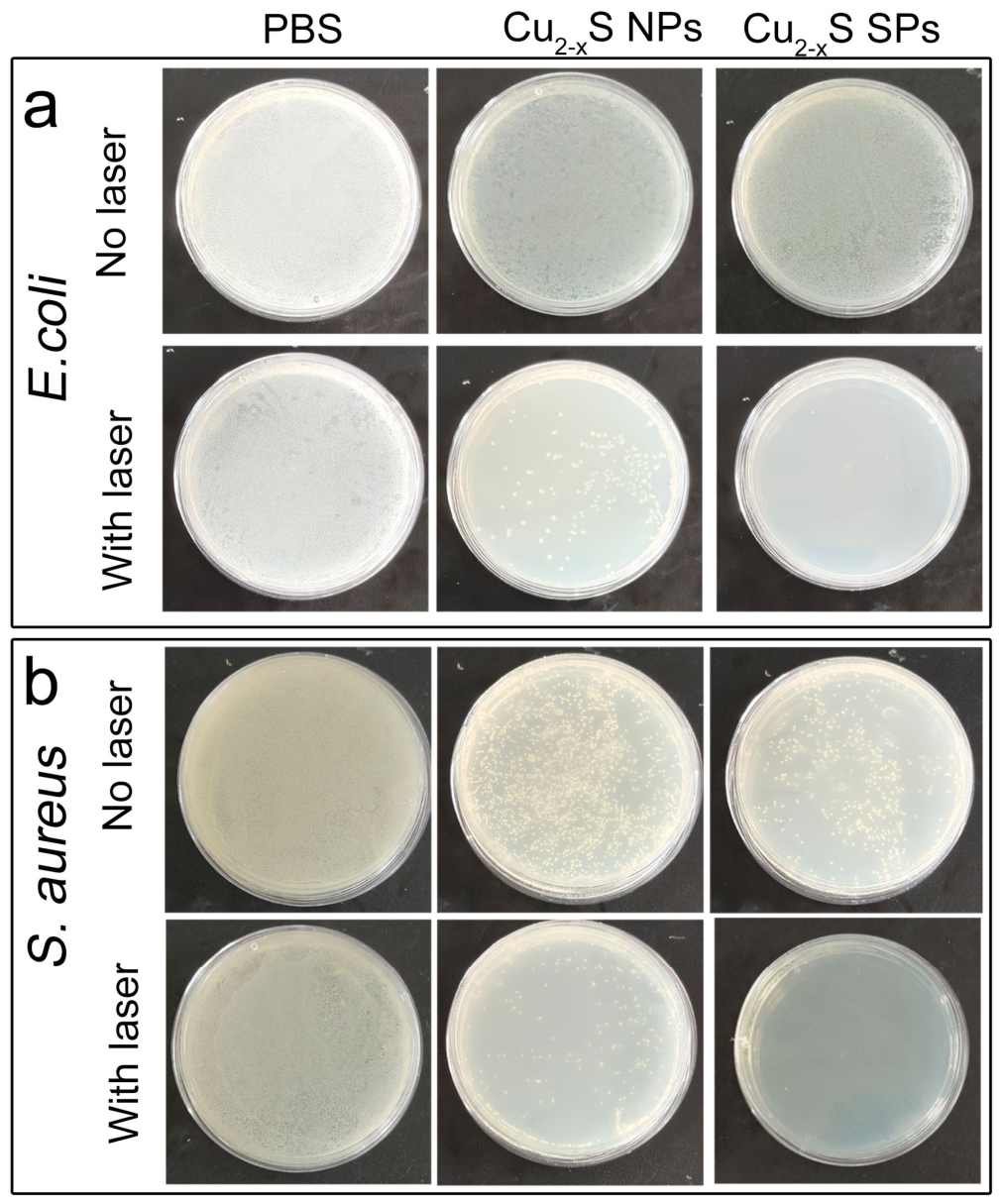
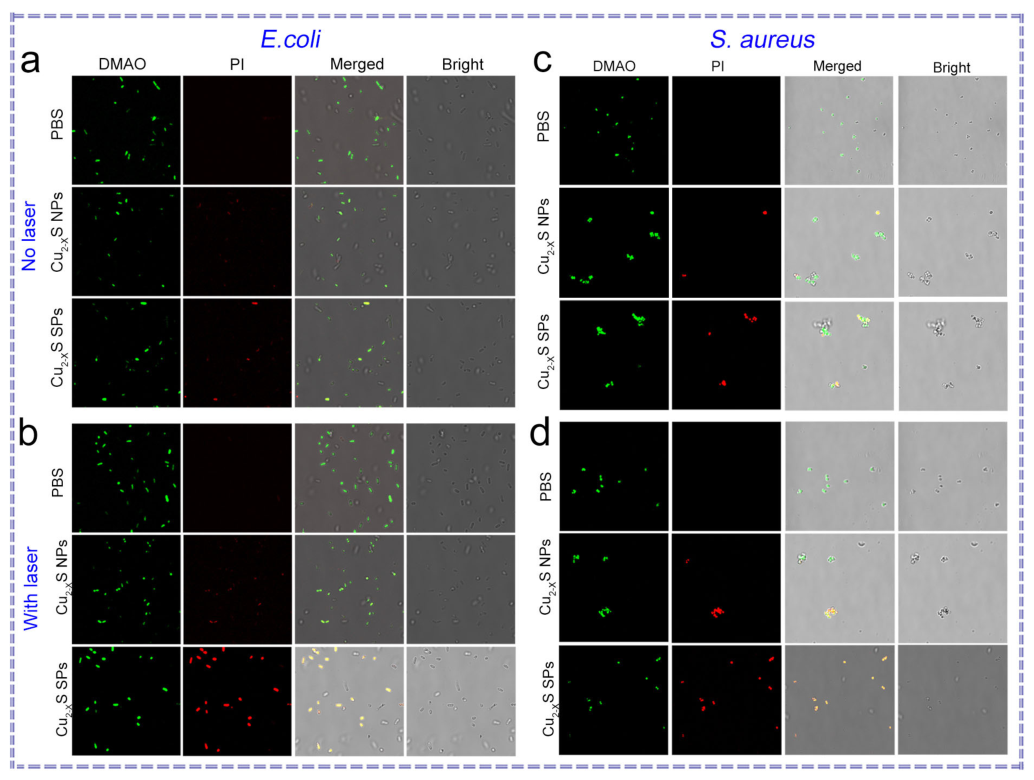
3.3. Antibacterial Performance
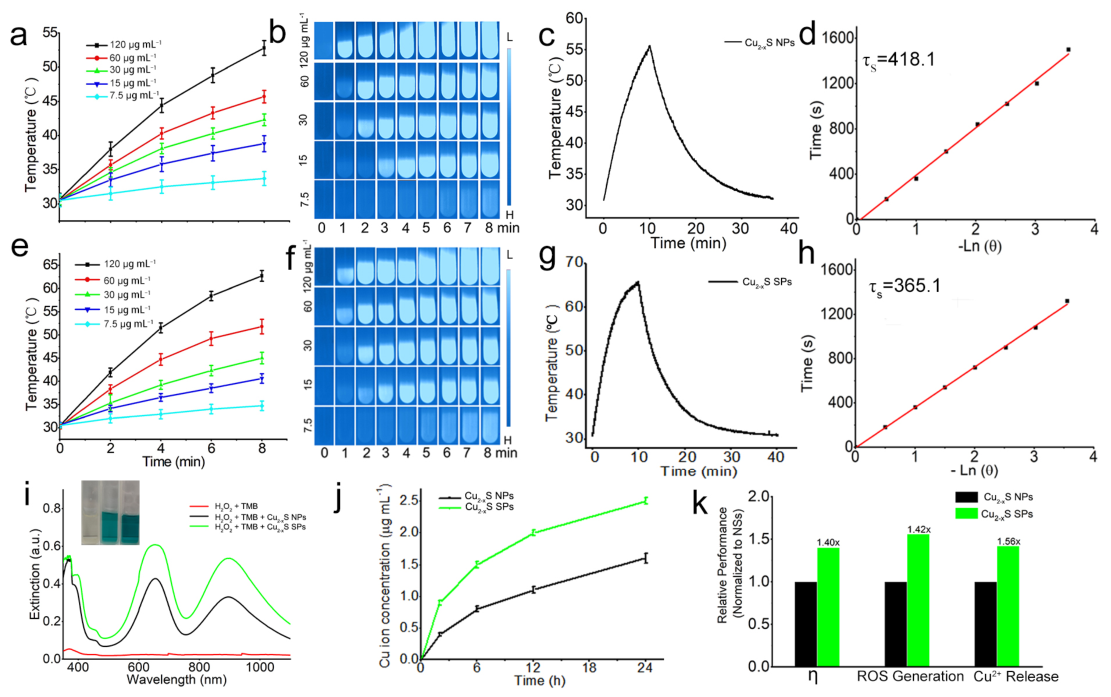
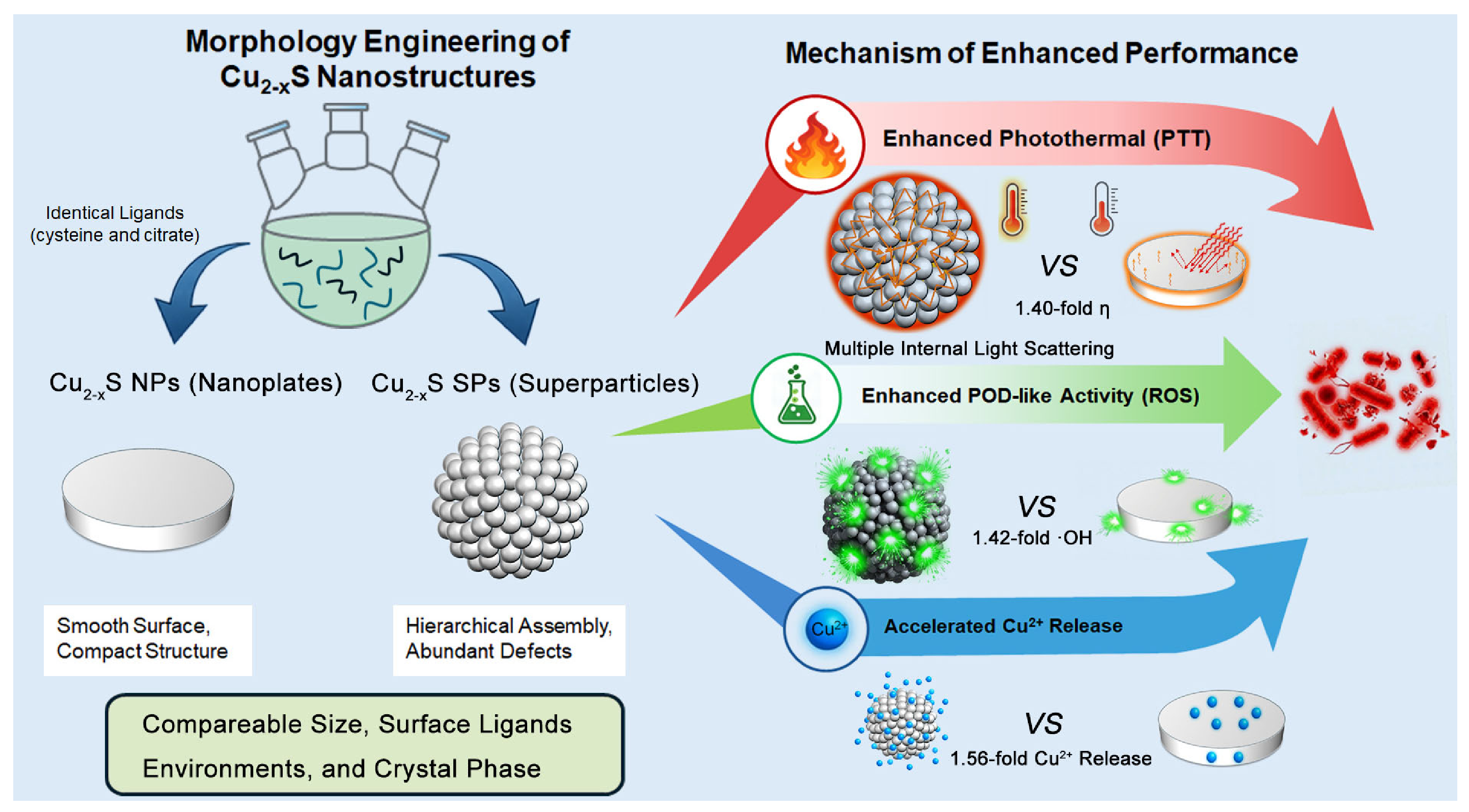
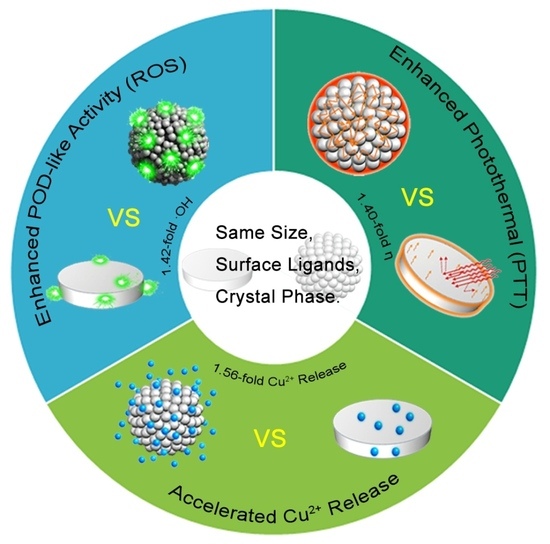
3.4. Antibacterial Mechanism Investigation
4. Conclusions
Supplementary Materials
Author Contributions
Funding
Data Availability Statement
Conflicts of Interest
References
- Murray, C.J.; Ikuta, K.S.; Sharara, F.; Swetschinski, L.; Aguilar, G.R.; Gray, A.; Han, C.; Bisignano, C.; Rao, P.; Wool, E.; et al. Global burden of bacterial antimicrobial resistance in 2019: A systematic analysis. Lancet 2022, 399, 629–655. [Google Scholar] [CrossRef]
- Salam, M.A.; Al-Amin, M.Y.; Salam, M.T.; Pawar, J.S.; Akhter, N.; Rabaan, A.A.; Alqumber, M.A. Antimicrobial resistance: A growing serious threat for global public health. Healthcare 2023, 11, 1946. [Google Scholar] [CrossRef] [PubMed]
- Makabenta, J.M.V.; Nabawy, A.; Li, C.H.; Schmidt-Malan, S.; Patel, R.; Rotello, V.M. Nanomaterial-based therapeutics for antibiotic-resistant bacterial infections. Nat. Rev. Microbiol. 2021, 19, 23–36. [Google Scholar] [CrossRef] [PubMed]
- Gupta, A.; Mumtaz, S.; Li, C.H.; Hussain, I.; Rotello, V.M. Combatting antibiotic-resistant bacteria using nanomaterials. Chem. Soc. Rev. 2019, 48, 415–427. [Google Scholar] [CrossRef]
- Wang, L.; Hu, C.; Shao, L. The antimicrobial activity of nanoparticles: Present situation and prospects for the future. Int. J. Nanomed. 2017, 12, 1227–1249. [Google Scholar] [CrossRef]
- Xie, M.; Gao, M.; Yun, Y.; Malmsten, M.; Rotello, V.M.; Zboril, R.; Akhavan, O.; Kraskouski, A.; Amalraj, J.; Cai, X.; et al. Antibacterial nanomaterials: Mechanisms, impacts on antimicrobial resistance and design principles. Angew. Chem. Int. Ed. 2023, 62, e202217345. [Google Scholar] [CrossRef]
- Liu, M.; Liu, Y.; Gu, B.; Wei, X.; Xu, G.; Wang, X.; Swihart, M.T.; Yong, K.T. Recent advances in copper sulphide-based nanoheterostructures. Chem. Soc. Rev. 2019, 48, 4950–4965. [Google Scholar] [CrossRef]
- Li, C.; Gao, F.; Tong, Y.; Chang, F.; Han, H.; Liu, C.; Xu, M.; Li, H.; Zhou, J.; Li, X.; et al. NIR-II window triple-mode antibacterial nanoplatform: Cationic copper sulfide nanoparticles combined vancomycin for synergistic bacteria eradication. J. Colloid Interface Sci. 2022, 628, 595–604. [Google Scholar] [CrossRef]
- Lesyuk, R.; Klein, E.; Yaremchuk, I.; Klinke, C. Copper sulfide nanosheets with shape-tunable plasmonic properties in the NIR region. Nanoscale 2018, 10, 20640–20651. [Google Scholar] [CrossRef] [PubMed]
- Ermini, M.L.; Voliani, V. Antimicrobial nano-agents: The copper age. ACS Nano 2021, 15, 6008–6029. [Google Scholar] [CrossRef] [PubMed]
- Goel, S.; Chen, F.; Cai, W. Synthesis and biomedical applications of copper sulfide nanoparticles: From sensors to theranostics. Small 2014, 10, 631–645. [Google Scholar] [CrossRef]
- Huo, J.; Jia, Q.; Huang, H.; Zhang, J.; Li, P.; Dong, X.; Huang, W. Emerging photothermal-derived multimodal synergistic therapy in combating bacterial infections. Chem. Soc. Rev. 2021, 50, 8762–8789. [Google Scholar] [CrossRef]
- Xie, Y.; Qian, Y.; Li, Z.; Liang, Z.; Liu, W.; Yang, D.; Qiu, X. Near-infrared-activated efficient bacteria-killing by lignin-based copper sulfide nanocomposites with an enhanced photothermal effect and peroxidase-like activity. ACS Sustain. Chem. Eng. 2021, 9, 6479–6488. [Google Scholar] [CrossRef]
- Qiao, Y.; Ping, Y.; Zhang, H.; Zhou, B.; Liu, F.; Yu, Y.; Xie, T.; Li, W.; Zhong, D.; Zhang, Y.; et al. Laser-activatable CuS nanodots to treat multidrug-resistant bacteria and release copper ion to accelerate healing of infected chronic nonhealing wounds. ACS Appl. Mater. Interfaces 2019, 11, 3809–3822. [Google Scholar] [CrossRef]
- Naskar, A.; Kim, K.-S. Photo-stimuli-responsive CuS nanomaterials as cutting-edge platform materials for antibacterial applications. Pharmaceutics 2022, 14, 2343. [Google Scholar] [CrossRef] [PubMed]
- Wang, L.; Ma, X.; Cai, K.; Li, X. Morphological effect of copper sulfide nanoparticles on their near infrared laser activated photothermal and photodynamic performance. Mater. Res. Express 2019, 6, 105406. [Google Scholar] [CrossRef]
- Li, Y.; Su, M.; Yan, T.; Wang, Z.; Zhang, J. Near-infrared copper sulfide hollow nanostructures with enhanced photothermal and photocatalytic performance for effective bacterial sterilization. ACS Appl. Bio Mater. 2023, 6, 2468–2476. [Google Scholar] [CrossRef] [PubMed]
- Mutalik, C.; Okoro, G.; Krisnawati, D.I.; Jazidie, A.; Rahmawati, E.Q.; Rahayu, D.; Hsu, W.; Kuo, T.R. Copper sulfide with morphology-dependent photodynamic and photothermal antibacterial activities. J. Colloid Interface Sci. 2022, 607, 1825–1835. [Google Scholar] [CrossRef]
- Cai, L.; Yang, J.; Shao, X.; Zhu, X.; Liu, Y.; Wan, C.; Wang, F.; Chen, J. Copper-doped nanostructured MoS2 with distinct nanoscale morphology for efficient bacteria inactivation and catalytic degradation of antibiotics. J. Environ. Chem. Eng. 2024, 12, 111537. [Google Scholar] [CrossRef]
- Su, M.; Wu, Z.; Yan, T.; Li, N.; Li, X.; Hou, T.; Liu, J.; Zhang, C.; Zhu, C.; Wang, Z.; et al. Atomic-thin 2D copper sulfide nanocrystals with over 94% photothermal conversion efficiency as superior NIR-II photoacoustic agents. Adv. Funct. Mater. 2024, 34, 2409580. [Google Scholar] [CrossRef]
- Wang, X.; Sun, X.; Liu, W.; Li, H.; Wang, J.; Wang, D. Amino acid-mediated amorphous copper sulphide with enhanced photothermal conversion efficiency for antibacterial application. J. Colloid Interface Sci. 2024, 657, 142–154. [Google Scholar] [CrossRef]
- Zou, Z.; Sun, J.; Li, Q.; Pu, Y.; Liu, J.; Sun, R.; Wang, L.; Jiang, T. Vancomycin modified copper sulfide nanoparticles for photokilling of vancomycin-resistant enterococci bacteria. Colloids Surf. B Biointerfaces 2020, 189, 110875. [Google Scholar] [CrossRef] [PubMed]
- Mo, S.; Song, Y.; Lin, M.; Wang, J.; Zhang, Z.; Sun, J.; Guo, D.; Liu, L. Near-infrared responsive sulfur vacancy-rich CuS nanosheets for efficient antibacterial activity via synergistic photothermal and photodynamic pathways. J. Colloid Interface Sci. 2022, 608, 2896–2906. [Google Scholar] [CrossRef] [PubMed]
- Tao, A.R.; Habas, S.; Yang, P. Shape control of colloidal metal nanocrystals. Small 2008, 4, 310–325. [Google Scholar] [CrossRef]
- Xia, Y.; Xiong, Y.; Lim, B.; Skrabalak, S.E. Shape-controlled synthesis of metal nanocrystals: Simple chemistry meets complex physics? Angew. Chem. Int. Ed. 2009, 48, 60–103. [Google Scholar] [CrossRef]
- Niu, W.; Xu, G. Crystallographic control of noble metal nanocrystals. Nano Today 2011, 6, 262–285. [Google Scholar] [CrossRef]
- Zhu, H.; Guo, G.; Xia, Y. Cross-scale modulation for aqueous fabrication of monodisperse Cu2−xE (E = S, Se, Te) nanocrystals and supraparticles. Nano Res. 2023, 16, 1448–1458. [Google Scholar] [CrossRef]
- Kundu, A.; Chakraborty, B. Surface structure to tailor the electrochemical behavior of mixed-valence copper sulfides during water electrolysis. JACS Au 2024, 4, 642–656. [Google Scholar] [CrossRef]
- Luther, J.M.; Jain, P.K.; Ewers, T.; Alivisatos, A.P. Localized surface plasmon resonances arising from free carriers in doped quantum dots. Nat. Mater. 2011, 10, 361–366. [Google Scholar] [CrossRef]
- Wang, X.; Zhang, Q.; Zou, L.; Hu, H.S.; Zhang, M.X.; Dai, J.W. Facile-synthesized ultrasmall CuS nanocrystals as drug nanocarriers for highly effective chemo-photothermal combination therapy of cancer. RSC Adv. 2016, 6, 20949–20960. [Google Scholar] [CrossRef]
- Liu, Y.; Liu, C.L.; Deng, Q.; Yu, Y.; Tang, X.; Li, L.; Grimes, C.; Yang, S.; Cai, Q.; Zhen, D. A β-keto-enamine covalent organic framework fluorescent switch for selective and sensitive UO22+ detection. Sens. Actuators B Chem. 2025, 433, 137564. [Google Scholar] [CrossRef]
- Ma, B.J.; Wang, S.; Liu, F.; Zhang, S.; Duan, J.Z.; Li, Z.; Kong, Y.; Sang, Y.H.; Liu, H.; Bu, W.B. Self-assembled copper-amino acid nanoparticles for in situ glutathione “AND” H2O2 sequentially triggered chemodynamic therapy. J. Am. Chem. Soc. 2018, 141, 849–857. [Google Scholar] [CrossRef] [PubMed]
- Huang, W.-C.; Tsai, P.-J.; Chen, Y.-C. Multifunctional Fe3O4@Au nanoeggs as photothermal agents for selective killing of nosocomial and antibiotic-resistant bacteria. Small 2009, 5, 51–56. [Google Scholar] [CrossRef] [PubMed]



Disclaimer/Publisher’s Note: The statements, opinions and data contained in all publications are solely those of the individual author(s) and contributor(s) and not of MDPI and/or the editor(s). MDPI and/or the editor(s) disclaim responsibility for any injury to people or property resulting from any ideas, methods, instructions or products referred to in the content. |
© 2026 by the authors. Licensee MDPI, Basel, Switzerland. This article is an open access article distributed under the terms and conditions of the Creative Commons Attribution (CC BY) license.
Share and Cite
Zhu, H.; Zhao, M.; Chao, Y.; Yao, J.; Yu, Q.; Sun, N. Morphology-Dependent Antibacterial Activity of Cu2-xS Nanostructures: Nanoplates Versus Superparticles. Nanomaterials 2026, 16, 636. https://doi.org/10.3390/nano16100636
Zhu H, Zhao M, Chao Y, Yao J, Yu Q, Sun N. Morphology-Dependent Antibacterial Activity of Cu2-xS Nanostructures: Nanoplates Versus Superparticles. Nanomaterials. 2026; 16(10):636. https://doi.org/10.3390/nano16100636
Chicago/Turabian StyleZhu, Hui, Mengzhe Zhao, Yang Chao, Jun Yao, Qin Yu, and Na Sun. 2026. "Morphology-Dependent Antibacterial Activity of Cu2-xS Nanostructures: Nanoplates Versus Superparticles" Nanomaterials 16, no. 10: 636. https://doi.org/10.3390/nano16100636
APA StyleZhu, H., Zhao, M., Chao, Y., Yao, J., Yu, Q., & Sun, N. (2026). Morphology-Dependent Antibacterial Activity of Cu2-xS Nanostructures: Nanoplates Versus Superparticles. Nanomaterials, 16(10), 636. https://doi.org/10.3390/nano16100636