Article

Enhanced Performance of an Au/MoS2/GaAs Photodetector by Room-Temperature Metal Electrode Transfer


1
School of Microelectronic, Shenzhen University of Information Technology, Shenzhen 518172, China
2
School of Integrated Circuits, Huazhong University of Science and Technology, Wuhan 430074, China
*
Author to whom correspondence should be addressed.
Nanomaterials 2026, 16(10), 624; https://doi.org/10.3390/nano16100624 (registering DOI)
Submission received: 26 March 2026 / Revised: 12 May 2026 / Accepted: 14 May 2026 / Published: 19 May 2026
(This article belongs to the Section Nanoelectronics, Nanosensors and Devices)

Abstract

Recently, self-powered MoS2/GaAs photodetectors have attracted intensive attention. However, thermal processing following metal–electrode deposition tends to damage the lattice structure of MoS2, leading to degraded device performance and poor consistency. In this work, Au/MoS2/GaAs photodetectors are fabricated using two different methods of transferring Au (Tr-Au) and thermal evaporation Au (TE-Au), and their photoelectric performances are compared. It is found that, compared to TE-Au devices, the Tr-Au devices exhibit higher responsivity (45.29 A/W) and detectivity (3.11 × 10¹³ Jones). The underlying mechanisms are attributed to a significant reduction in defect traps in MoS2 and a smooth MoS2/GaAs heterojunction interface, which collectively increase photocurrent and suppress dark current. Therefore, the room-temperature Au transfer method shows great promise for the fabrication of high-performance optoelectronic devices.

Graphical Abstract

1. Introduction

Since the discovery of two-dimensional (2D) materials such as graphene in 2004 [1], extensive research has been conducted in this field [2,3,4,5]. Compared to bulk materials, 2D materials possess a unique lattice structure that makes them more sensitive to electric fields, optical fields and strain effects, therefore they hold great promise for optoelectronic applications [6,7,8,9,10]. Among them, MoS2, a representative transition metal dichalcogenide, stands out due to its high photoelectric gain, excellent carrier mobility and tunable bandgap (1.2~1.8 eV) [6,7,8]. Moreover, large-scale CVD growth of MoS2 has already been achieved, positioning it as an ideal candidate for visible to near-infrared photodetection. However, the weak light absorption (~5% for monolayer MoS2) [5] and high dark current [9], which lead to low detectivity, have hindered the development of MoS2-based photodetectors. Considerable efforts have been devoted to improving the quality of MoS2-based photodetectors through various approaches, including MoS2/bulk-semiconductor heterojunctions [10,11], MoS2-based transistors [12,13], and novel 2D materials [14,15]. Among these, MoS2/GaAs heterojunctions have attracted particular attention due the superior properties of GaAs, such as its high electron mobility, suitable effective mass and wider bandgap, which makes it a highly favored second-generation semiconductor. Li et al. demonstrated that MoS2/GaAs heterojunctions an enhance light absorption and utilize the built-in electric fields to efficiently separate photogenerated electron–hole pairs, enabling self-powered, and high-performance photodetectors [10]. Lin et al. introduced hexagonal boron nitride (h-BN) into MoS2/GaAs heterojunctions to improve power conversion efficiency [11]. However, previous studies have often relied on high-work-function metals such as Au or Pt as contact electrodes, which require deposition processes involving high-temperature thermal evaporation or high-energy electron beam bombardment [15]. These methods typically damage the lattice structure of MoS2, resulting in degraded device performance and poor consistency.
In this work, to address this issue, a low-temperature metal–electrode transfer technique is adopted to replace conventional high-energy or high-temperature fabrication methods for preparing Au/MoS2/GaAs photodetectors. By preserving the lattice integrity of MoS2 and ensuring a smooth MoS2/GaAs interface, the resulting device achieves a responsivity of 45.29 A/W and a detectivity of 3.11 × 10¹³ Jones, nearly a 250% improvement over those with thermally evaporated electrodes. Statistical analyses further confirm excellent device uniformity. This work offers a straightforward and effective route toward high-performance 2D optoelectronic devices.

2. Materials and Methods

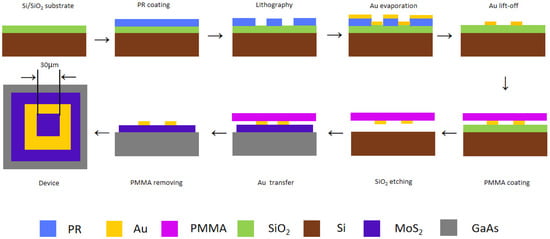
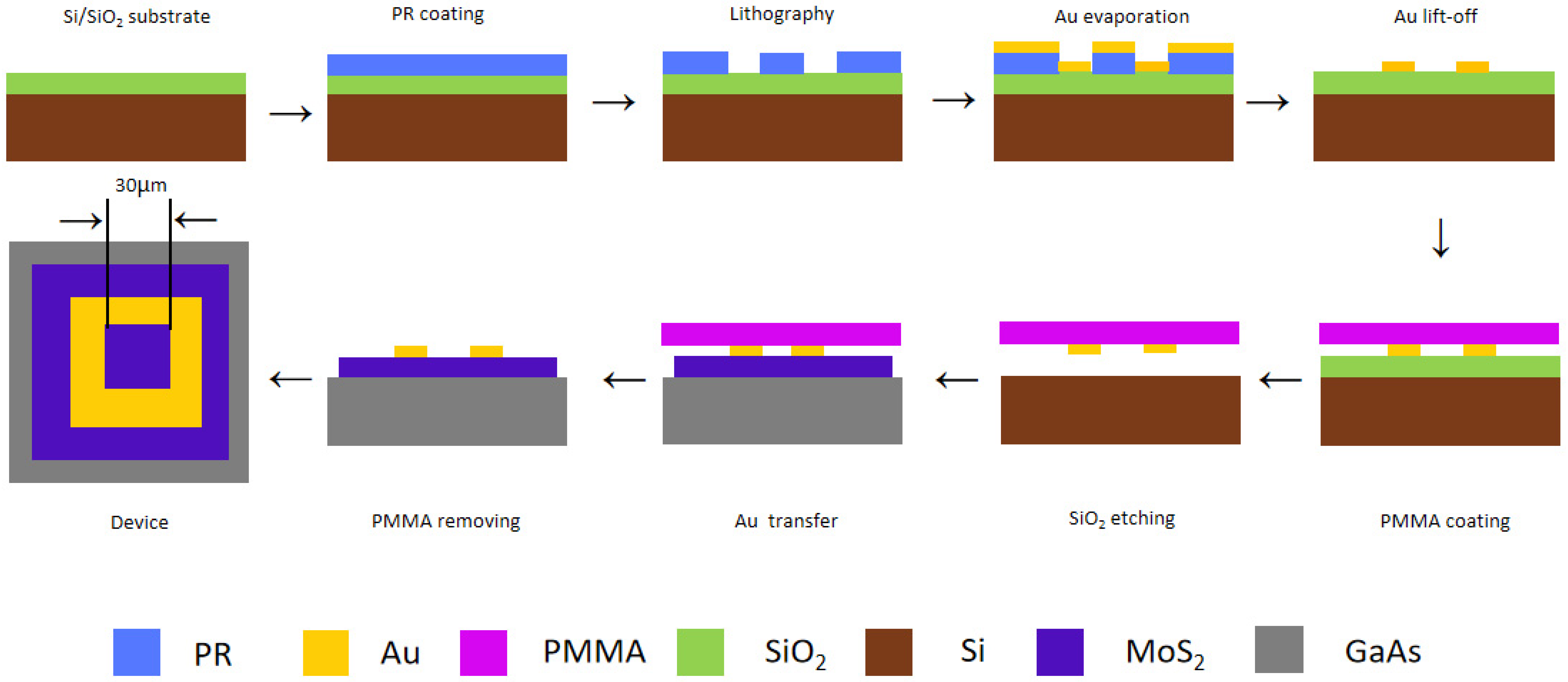
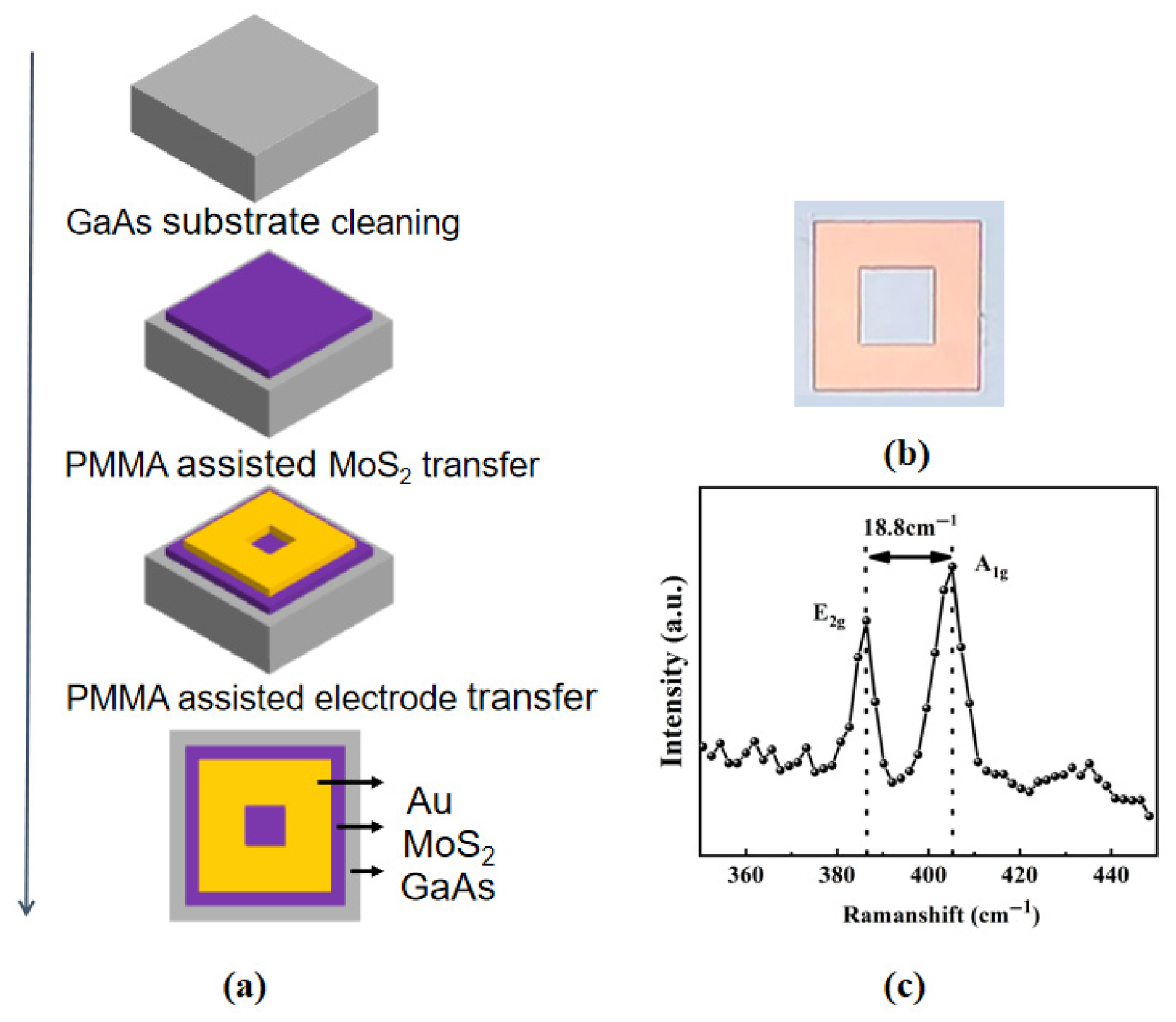
Figure 1a illustrates the fabrication process flow of the Au/MoS2/GaAs photodetector using low-temperature Au-electrode transfer. An n-type GaAs wafer with a doping concentration of 1018 cm−3 was used as the substrate. The wafer was first rinsed with deionized (DI) water, followed by sequential ultrasonic cleaning in acetone, ethanol and isopropanol for 5 min each to remove organic residues and surface impurity particles. It is important to note that the ultrasonic power should be kept as low as possible to avoid wafer fragmentation. The wafer was then dipped in a diluted HF solution (4~5%) for 5 min to remove the native oxides. Subsequently, it was soaked in an 8% ammonium sulfide (NH4)2S solution for 40 min at room temperature to eliminate surface oxides and prevent re-oxidation through sulfur passivation. After that, the GaAs wafer was rinsed with DI water 4~5 times to remove the residual ammonium sulfide solution and dried with N2 gas. Next, a monolayer CVD (chemical vapor deposition)-grown MoS2 thin film (purchased from Six Carbon Corporation, Shenzhen, China) was transferred onto the GaAs surface with the assistance of a PMMA supporting layer [16]. A similar method was used to transfer a pre-deposited Au electrode film (~40 nm thick, 30 × 30 µm2 in area) onto the MoS2 surface, and the resulting sample is denoted as the Tr-sample. The Au-electrode transfer process is detailed as follows: (1) first, Au was evaporated onto a SiO2/Si substrate and patterned into electrodes using a lift-off process; (2) the substrate was then spin-coated with PMMA at 3000 rpm for 60 s, followed by baking on a hot plate at 150 °C; (3) subsequently, the wafer was dipped in a 4.12 mol/L HF solution to etch away the SiO2 layer, causing the PMMA-supported Au electrode to detach from the Si substrate; (4) the PMMA/Au electrode film was then transferred to the DI water to remove the residual HF; (5) the MoS2/GaAs wafer was aligned with the PMMA/Au film by naked eye in DI water to form the PMMA/Au/MoS2/GaAs structure, then the assembly was dried with N2 gas, followed by sequential baking at 80 °C for 600 s and at 150 °C for another 600 s; and (6) finally, the PMMA sacrificing layer was removed by immersion in acetone for 20 min at room temperature. For comparison, a control sample (denoted as the TE-sample) was fabricated by directly thermally evaporating Au onto the MoS2 surface at room temperature under a high vacuum of ~10−5 Torr, with an evaporation rate of 0.01~0.03 nm/s. The Au film was then patterned into electrodes with an area of 30 × 30 µm2 via a lift-off process. Both the Tr- and TE-samples exhibit identical optical micrographs, as shown in Figure 1b.
Figure 1c presents the Raman spectrum of the MoS2 flake on the GaAs substrate. Two characteristic Raman peaks, corresponding to the A1g and E2g modes of MoS2, are observed at 405.2 cm−1 and 386.4 cm−1, respectively. The Raman shift between the A1g and E2g is 18.8 cm−1, confirming that the transferred MoS2 flake is monolayer, which is consistent with previous reports [8,17].

3. Results and Discussion

3.1. Operating Principle of the Au/MoS2/GaAs Photodetector

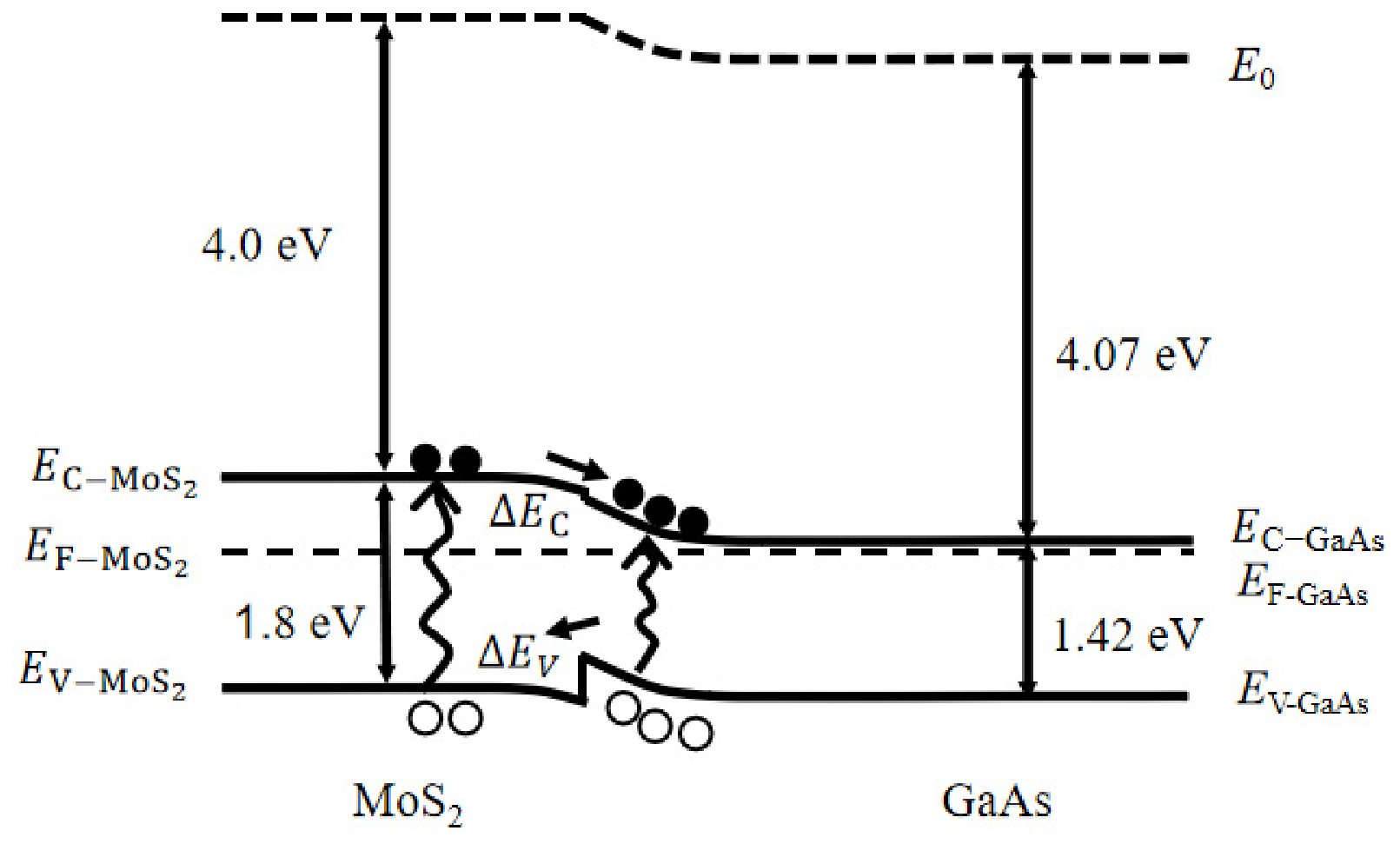
Figure 2 shows the energy-band diagram of the MoS2/n-GaAs heterojunction under light illumination. The electron affinities and bandgap of GaAs and MoS2 are 4.07 eV/1.42 eV and 4.0 eV/1.80 eV, respectively [18,19,20]. The Fermi level of MoS2 ( E F - M o S 2 ) lies slightly above the mid-gap, as monolayer MoS2 is typically n-type without intentional doping [21]. In contrast, the Fermi level of GaAs (EF-GaAs) is close to its conduction band (EC-GaAs) due to heavy doping. When the MoS2 flake is transferred onto the n+-GaAs substrate, the majority carriers (electrons) diffuse from n+-GaAs into MoS2, establishing a built-in electric field across the MoS2/GaAs interface. This results in upward band bending in GaAs and downward band bending in MoS2, as illustrated in Figure 2. The conduction-band offset (ΔEC) is 0.07 eV, while the valance-band offset (ΔEV) is 0.31 eV. Under equilibrium conditions, the barrier height is roughly estimated to be ~0.83 eV, based on the electron affinity difference (0.07 eV) and the Fermi level difference (~0.9 eV) between n+-GaAs and monolayer MoS2. Upon light illumination, both MoS2 and GaAs absorb photons to generate electron–hole pairs. Driven by the built-in field, the photogenerated electrons and holes flow from MoS2 to GaAs and from GaAs to MoS2, respectively, thereby producing a photocurrent.

3.2. Photoelectric Performance of TE-Sample

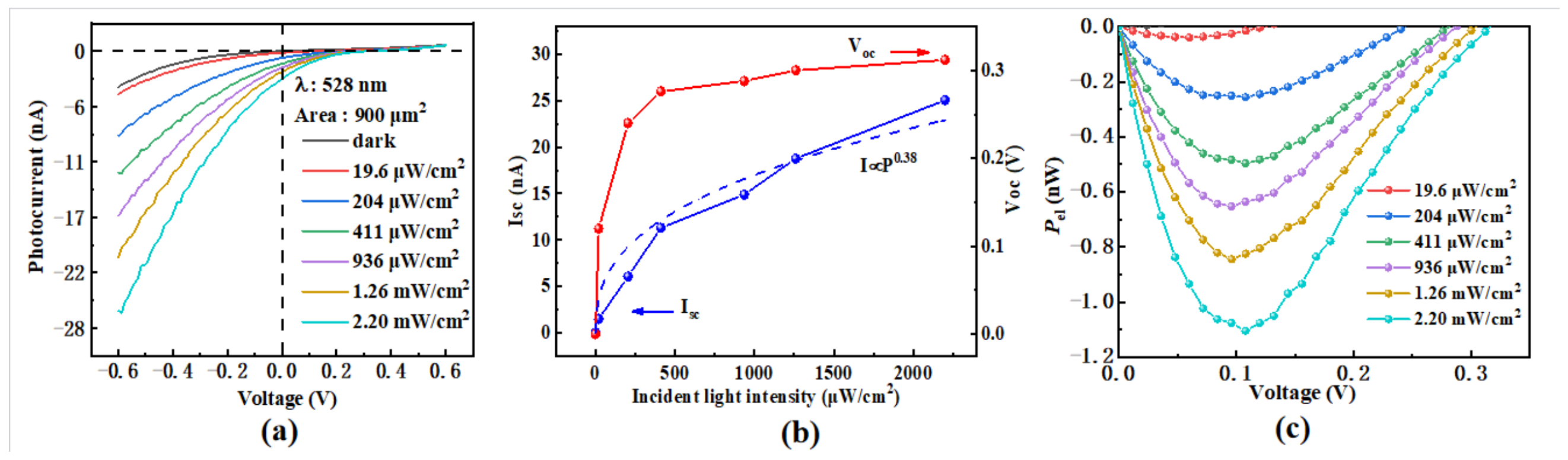
First, the photoelectric performance of the control sample (TE-sample) was investigated. To evaluate the influence of light intensity on device performance, the photocurrent–voltage (I-V) curves of the control sample were measured under 528 nm laser irradiation at various light intensities ranging from 0 (dark condition) to 2.2 mWcm−2, as shown in Figure 3a. The asymmetric I-V curves indicate a rectifying behavior characteristic of the MoS2/GaAs heterojunction photodetector, which exhibits a clear response to 528 nm illumination [17,22,23]. As clearly demonstrated in Figure 3a, the photocurrent increases with rising light intensity, which can be attributed to the increased number of photogenerated carriers under stronger illumination [24]. To further investigate the effect of the light intensity on the illumination characteristics of the TE-sample, the short-circuit current (Isc), open-circuit voltage (Voc), and the electrical power (Pel) were extracted and are plotted in Figure 3b and Figure 3c, respectively. Figure 3b shows that a notable Isc exists even at zero bias, which is attributed to the drift of photogenerated electrons and holes across the barrier region driven by the built-in field [22]. Moreover, Isc increases as a power law with the light intensity, due to the increased density of photogenerated carriers crossing the barrier region. The relationship between the photocurrent and incident light intensity can be expressed as I p h = c P α , where Iph is the photocurrent, P is the incident light intensity, c is a proportionality constant dependent on the wavelength, and α is the power-law fitting exponent [24,25]. As mentioned above, Isc corresponds to the photocurrent Iph at zero bias under 528 nm illumination. By fitting the Isc curves using the power-law function, the exponent α is determined to be approximately 0.38 (<1) for the TE-devices. This value, being significantly less than unity, indicates the presence of structural defects in MoS2 or interface states at the MoS2/GaAs heterojunction, which reduce the collection efficiency of photogenerated carriers during illumination [25]. In contrast, an α value equal to or very close to 1 would signify perfect collection of photogenerated carriers and an ideal, defect-free MoS2/GaAs heterojunction [22]. When the devices are illuminated, these defects or interface states tend to trap photogenerated carriers, thereby affecting the local electrostatic field at the MoS2/GaAs heterojunction and consequently influencing the Voc. This phenomenon is known as the photogating effect [26]. As shown in Figure 3b, the Voc of the TE device shifts positively and increases from 0 to 0.312 V as the light intensity increases from 0 to 2.2 mW/cm2. This increase occurs because a higher incident optical intensity leads to more photogenerated carriers being separated and transported by the built-in field, resulting in an elevated Voc. Nevertheless, a saturation tendency in Voc is observed in Figure 3b. A plausible explanation that the structural defects in MoS2 or the interface states at the heterojunction become gradually filled as the light intensity increases, which modulates the built-in field and causes Voc to approach a saturation value [24,27]. As shown in Figure 3c, the electrical power (Pel) is strongly dependent on both the applied voltage and the light intensity, suggesting that the optimal output performance of the device can be achieved by selecting appropriate values for these parameters. For example, an input voltage of 0.1 V and a light intensity of 2.2 mW/cm2 yield an electrical power of approximately 1.1 nW.
Responsivity (R) and detectivity (D) are two crucial parameters for evaluating photodetectors, defined by the following equations [28,29,30]:
R = I p h I D P A
D = A 1 / 2 × R ( 2 q I D ) 1 / 2
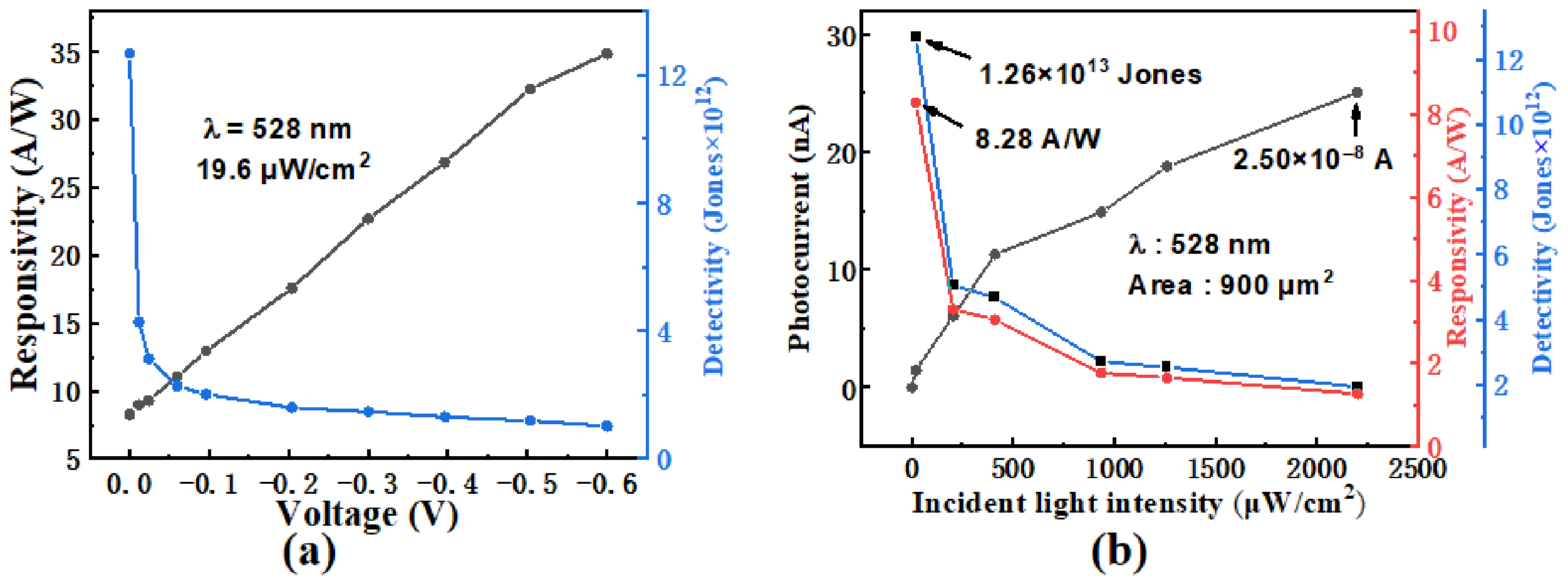
where ID, P, A, and q represent the dark current, incident light intensity, device area, and electron charge, respectively. Figure 4a represents the responsibility and detectivity of the control device under 528 nm laser illumination at various bias voltages. The responsivity increases with bias voltage, which is attributed to the corresponding increase in photocurrent. In contrast, the detectivity decreases sharply with bias voltage, as the dark current becomes large under higher bias voltage, as evident in Figure 4a. Figure 4b shows the photocurrent, responsivity, and detectivity of the control samples under different incident light intensities at zero bias. Under 528 nm laser illumination with a light intensity of 19.6 μW/cm2 at zero bias, the TE device exhibits self-powered behavior, achieving a maximum responsivity of 8.28 A/W and a maximum detectivity of 1.26 × 10¹³ Jones. This indicates an efficient generation and collection of electron–hole pairs under weak illumination. As the light intensity increases, both responsivity and detectivity decrease sharply and then gradually approach saturation. This behavior can be explained by the photogating effect: under high light intensity, the electric field in the space charge region is reduced due to carrier trapping at band tail states of MoS2 or at the MoS2/GaAs interface. These trap states become progressively saturated by photogenerated carriers [7,17], thereby limiting the collection of photogenerated carriers and reducing detectivity [26]. In addition, the photocurrent is observed to increase with increasing light intensity, which is attributed to the higher density of photogenerated carriers resulting from stronger illumination.

3.3. Photoelectric Performance of Tr-Sample

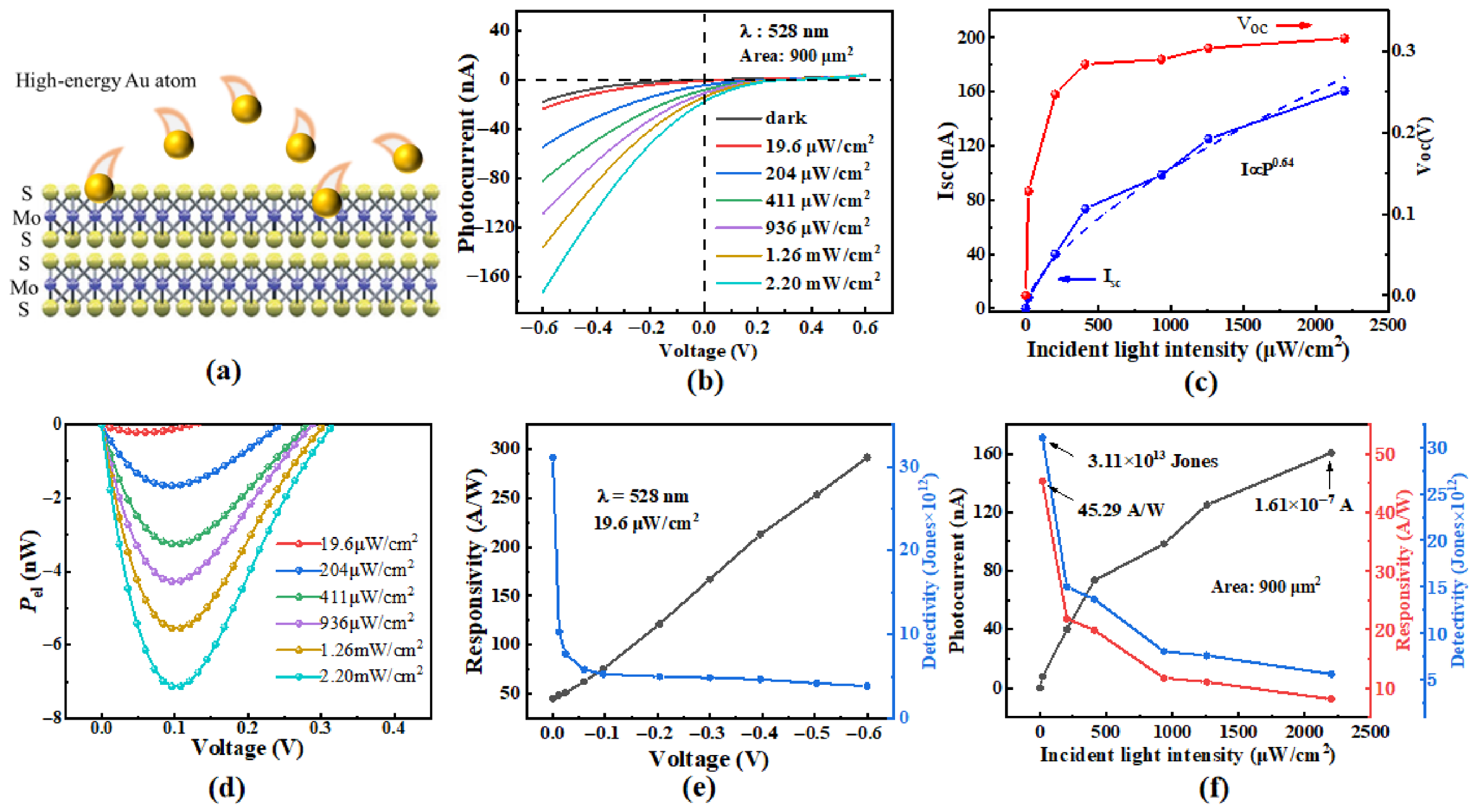
For the control sample, the high-energy Au atoms generated during thermal evaporation can damage the MoS2 lattice, as schematically illustrated in Figure 5a. This damage introduces traps that capture photogenerated carriers and degrades the quality of the MoS2/GaAs heterojunction, thereby deteriorating the device performance. To address this issue, an improved strategy involving the transfer of a pre-deposited Au film onto the MoS2 surface was adopted, and the corresponding performance of the transferred device (Tr-device) was characterized. Figure 5b shows is its I-V curves measured in the dark and under 528 nm laser irradiation. Compared with the results shown in Figure 3a, the photocurrent of the Tr-device is significantly enhanced, indicating improved photovoltaic performance [30]. Because the transfer process induces less lattice damage to MoS2, the density of trapping sites for photogenerated carriers is greatly reduced. Consequently, more carriers can be swept across the space-charge region and contribute to the photocurrent, leading to a substantial increase in photocurrent [22,24].
Figure 5c presents the extracted Isc and Voc of the Tr-devices. Compared with the TE-sample, the Tr-device exhibits a higher Isc and an enhanced self-powered photovoltaic performance, which can be attributed to the improved quality of the MoS2/GaAs heterojunction, as discussed above. Moreover, the fitted power-law exponent α for the Tr-device is 0.64, which is larger than that of the TE-sample, indicating fewer structural defects at the MoS2/GaAs interface and further supporting the improved heterojunction quality. Nevertheless, the α value remains below unity, suggesting that a substantial number of defects still exist within the MoS2 layer. These residual defects are likely due to intrinsic structural imperfections, such as sulfur vacancies, which are inevitably introduced during chemical vapor deposition [31]. As shown in Figure 5c, the Voc of the Tr-device increases from 0 V to 0.32 V as the light intensity rises from 0 to 2.2 mW/cm2, which is slightly higher than that of the TE-sample. Both the built-in voltage and the interfacial charges at the MoS2/GaAs interface are believed to contribute to the observed Voc [32]. As previously noted, high-temperature Au evaporation can induce lattice damage in MoS2, creating defects that may act as the minority carrier traps [24,33]. When the TE-sample is illuminated, minority traps capture photogenerated holes in the negative space-charge region (within MoS2), partially neutralizing the negative charges in that region and thereby reducing the build-in voltage and Voc. In contrast, the Tr-device exhibits a higher Pel than the TE-sample under various forward bias voltages, as shown in Figure 5d, indicating a stronger photovoltaic effect.
Figure 5e presents the R and D of the Tr-Au/MoS2/GaAs device under 528 nm laser illumination at different bias voltages. Comparing Figure 5e with Figure 3c, both R and D of the Tr-device are significantly higher than those of the TE-sample, primarily due to con the improved quality of the MoS2/GaAs heterojunction. According to Equation (1), the higher R of the Tr-device results from its increased photocurrent. The higher D indicates a superior ability to detect weak optical signals compared to the TE-sample, which is attributed to the reduced trap density and the enhanced R.
Figure 5f shows the photocurrent, responsivity and detectivity of the Tr-device under various incident light intensities at zero bias. For clarity, the extracted value of photocurrent, responsivity and detectivity for both samples are summarized in Table 1. Compared with the TE-sample, the Tr-device exhibits superior photoelectric performance, with a detectivity of 3.11 × 10¹³ Jones, a responsivity of 45.29 A/W, and a photocurrent of 1.61 × 10⁻⁷ A.
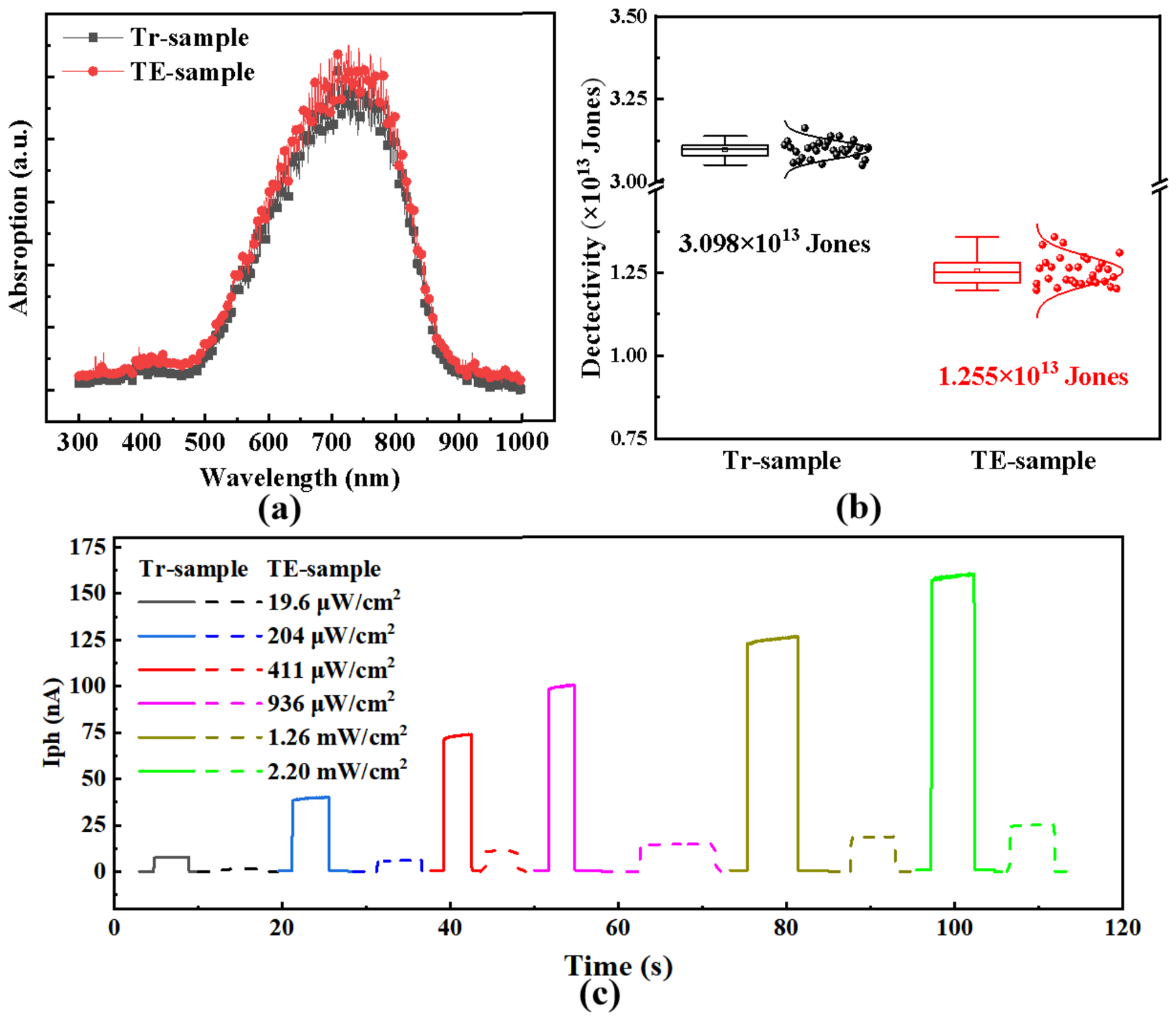
To investigate the influence of thermally evaporated (TE) and transferred (Tr) Au contacts on the photoelectric performance, the absorption spectra, statistical distribution of detectivity D, and time-resolved photocurrent response were further measured and are presented in Figure 6. Figure 6a shows the absorption spectra of the TE- and Tr-samples. Both samples exhibit a broad detection wavelength range from 500 to 850 nm and share the same absorption peak at 750 nm. Notably, the Tr-sample shows a slightly higher absorption rate than the TE-sample, suggesting its potential for wide-spectrum photodetection capability [24]. Although the absorption peak is located at 750 nm, electrical characterizations were carried out at 528 nm. This wavelength corresponds to a stable, well-calibrated light source, enabling reliable and repeatable evaluation of key device parameters such as responsivity, dark current, and switching behavior. Figure 6b presents the normal distributions and box plots of detectivity extracted from the photocurrents of 30 devices. The mean detectivity values are 3.098 × 10¹³ Jones for the Tr-sample and 1.255 × 10¹³ Jones for the TE-sample, indicating improved light detectivity for the Tr-device. The box plots further reveal that the Tr-sample exhibits narrower statistical dispersion and better consistency, suggesting superior and more reliable photoelectric performance.
Figure 6c presents the Iph under different incident light intensities over one on/off cycle. As expected, the photocurrent increases with rising light intensity. Compared with the TE-sample, the Tr-sample shows a substantially higher photocurrent, indicating a marked reduction in the trapping of the photogenerated carriers. This improvement is attributed to the absence of lattice damage in MoS2, thanks to the elimination of high-energy Au atom bombardment during the transfer process [33]. Notably, the Tr-sample exhibits a pronounced increase in photocurrent upon light illumination, which is likely associated with reduced carrier trapping at the MoS2/GaAs heterojunction. This enables a rapid response to light excitation and further confirms the enhanced photoelectric performance of the Tr-device.

4. Conclusions

In this work, by transferring a pre-deposited Au film onto the MoS2 surface, the integrity of the MoS2 lattice is preserved, and a smooth MoS2/GaAs interface is achieved. The resulting Tr-Au/MoS2/GaAs photodetector exhibits a responsivity of 45.29 A/W and a detectivity of 3.11 × 10¹³ Jones, demonstrating substantially improved photodetection performance compared to devices featuring thermally evaporated Au electrodes. This enhancement contributed to the reduced trap density within the MoS2 layer and the increased collection efficiency of photogenerated carriers, both of which are closely associated with the non-destructive integration of two-dimensional materials and metal electrodes. Moreover, statistical analyses confirm the excellent consistency of the photodetection performance, verifying the reproducibility of the proposed Au transfer method. These findings highlight that non-destructive metal integration is critical for precise interface control and defect reduction in the development of high-quality heterojunction devices combining two-dimensional and bulk semiconductors. Collectively, this work not only provides an effective route for fabricating high-performance MoS2/GaAs photodetectors but also offers valuable insights for optimizing future fabrication processes of high-performance two-dimensional optoelectronic devices, thereby holding significant potential for the eventual commercial application of 2D/bulk semiconductor heterojunction devices.

Author Contributions

Conceptualization, C.L. and J.X.; methodology, C.L. and W.J.; validation, C.L. and W.J.; formal analysis, C.L. and W.J.; writing—original draft preparation, C.L. and C.Q.; writing—review and editing, J.X.; supervision, J.X.; and project administration, J.X. All authors have read and agreed to the published version of the manuscript.

Funding

This work was funded by the Shenzhen University Stability Support Program, grant number 20231127160720001, SUIT-enterprise joint project, grant number HX-0367.

Data Availability Statement

The original contributions presented in this study are included in the article. Further inquiries can be directed to the corresponding author.

Conflicts of Interest

The authors declare no conflicts of interest.

References

  1. Novoselov, K.S.; Geim, A.K.; Morozov, S.V.; Jiang, D.; Zhang, Y.; Dubonos, S.V.; Grigorieva, I.V.; Firsov, A.A. Electric Field Effect in Atomically Thin Carbon Films. Science 2004, 306, 666–669. [Google Scholar] [CrossRef]
  2. Novoselov, K.S.; Mishchenko, A.; Carvalho, A.; Castro Neto, A.H. 2D materials and van der Waals heterostructures. Science 2016, 353, aac9439. [Google Scholar] [CrossRef]
  3. Zhang, Y.; Tan, Y.; Stormer, H.L.; Kim, P. Experimental observation of the quantum Hall effect and Berry’s phase in graphene. Nature 2005, 438, 201–204. [Google Scholar] [CrossRef]
  4. Schwierz, F.; Pezoldt, J.; Granzner, R. Two-dimensional materials and their prospects in transistor electronics. Nanoscale 2015, 7, 8261–8283. [Google Scholar] [CrossRef] [PubMed]
  5. Bernardi, M.; Palummo, M.; Grossman, J.C. Extraordinary Sunlight Absorption and One Nanometer Thick Photovoltaics Using Two-Dimensional Monolayer Materials. Nano Lett. 2013, 13, 3664–3670. [Google Scholar] [CrossRef]
  6. Xie, Y.; Liang, F.; Wang, D.; Chi, S.; Yu, H.; Lin, Z.; Zhang, H.; Chen, Y.; Wang, J.; Wu, Y. Room-Temperature Ultrabroadband Photodetection with MoS2 by Electronic-Structure Engineering Strategy. Adv. Mater. 2018, 30, 1804858. [Google Scholar] [CrossRef] [PubMed]
  7. Furchi, M.M.; Polyushkin, D.K.; Pospischil, A.; Mueller, T. Mechanisms of Photoconductivity in Atomically Thin MoS2. Nano Lett. 2014, 14, 6165–6170. [Google Scholar] [CrossRef] [PubMed]
  8. Rojas-Lopez, R.R.; Brant, J.C.; Ramos, M.S.O.; Castro, T.H.L.G.; Guimarães, M.H.D.; Neves, B.R.A.; Guimarães, P.S.S. Photoluminescence and charge transfer in the prototypical 2D/3D semiconductor heterostructure MoS2/GaAs. Appl. Phys. Lett. 2021, 119, 233101. [Google Scholar] [CrossRef]
  9. Lembke, D.; Bertolazzi, S.; Kis, A. Single-Layer MoS2 Electronics. Acc. Chem. Res. 2015, 48, 100–110. [Google Scholar] [CrossRef]
  10. Li, H.; Li, Y.; Jiang, H.; Mao, L.; Ni, Y. Characteristic analysis of the MoS2/SiO2 interface field-effect transistor with varying MoS2 layers. J. Mater. Sci.-Mater. Electron. 2023, 34, 427. [Google Scholar] [CrossRef]
  11. Lin, S.; Li, X.; Wang, P.; Xu, Z.; Zhang, S.; Zhong, H.; Wu, Z.; Xu, W.; Chen, H. Interface designed MoS2/GaAs heterostructure solar cell with sandwich stacked hexagonal boron nitride. Sci. Rep. 2015, 5, 15103. [Google Scholar] [CrossRef] [PubMed]
  12. Gong, T.; Yan, B.Y.; Zhang, T.P.; Huang, W.; He, Y.H.; Xu, X.Y.; Sun, S.; Zhang, X.S. Fano resonance-enhanced Si/MoS2 photodetector. Photonics Res. 2023, 11, 2159–2167. [Google Scholar] [CrossRef]
  13. Shin, D.H.; Jung, D.H.; Kim, Y.; Lee, C.; Wang, X.; Choi, S. High-speed heterojunction photodiodes made of single- or multiple-layer MoS2 directly-grown on Si quantum dots. J. Alloys Compd. 2020, 820, 153074. [Google Scholar] [CrossRef]
  14. Kufer, D.; Nikitskiy, I.; Lasanta, T.; Navickaite, G.; Koppens, F.H.; Konstantatos, G. Hybrid 2D-0D MoS2-PbS quantum dot photodetectors. Adv. Mater. 2015, 27, 176–180. [Google Scholar] [CrossRef]
  15. Balgarkashi, A.; Piazza, V.; Jasinski, J.; Frisenda, R.; Surrente, A.; Baranowski, M.; Dimitrievska, M.; Dede, D.; Kim, W.; Guniat, L.; et al. Spatial Modulation of Vibrational and Luminescence Properties of Monolayer MoS2 Using a GaAs Nanowire Array. IEEE J. Quantum Electron. 2022, 58, 1–8. [Google Scholar] [CrossRef]
  16. Padma, R.; Lee, G.; Kang, J.S.; Jun, S.C. Structural, chemical, and electrical parameters of Au/MoS2/n-GaAs metal/2D/3D hybrid heterojunction. J. Colloid Interf. Sci. 2019, 550, 48–56. [Google Scholar] [CrossRef]
  17. Jia, C.; Wu, D.; Wu, E.; Guo, J.; Zhao, Z.; Shi, Z.; Xu, T.; Huang, X.; Tian, Y.; Li, X. A self-powered high-performance photodetector based on a MoS2/GaAs heterojunction with high polarization sensitivity. J. Mater. Chem. C 2019, 7, 3817–3821. [Google Scholar] [CrossRef]
  18. Qu, J.; Chen, J. Near-infrared photodetector based on MoS2 QDs/GaAs heterojunction with an Al2O3 interface passivation layer. Micro Nanostruct. 2022, 166, 207231. [Google Scholar] [CrossRef]
  19. Lopez-Sanchez, O.; Alarcon Llado, E.; Koman, V.; Fontcuberta i Morral, A.; Radenovic, A.; Kis, A. Light Generation and Harvesting in a van der Waals Heterostructure. ACS Nano 2014, 8, 3042–3048. [Google Scholar] [CrossRef]
  20. Xu, Z.; Lin, S.; Li, X.; Zhang, S.; Wu, Z.; Xu, W.; Lu, Y.; Xu, S. Monolayer MoS2/GaAs heterostructure self-driven photodetector with extremely high detectivity. Nano Energy 2016, 23, 89–96. [Google Scholar] [CrossRef]
  21. Pető, J.; Dobrik, G.; Kukucska, G.; Vancsó, P.; Koós, A.A.; Koltai, J.; Nemes-Incze, P.; Hwang, C.; Tapasztó, L. Moderate strain induced indirect bandgap and conduction electrons in MoS2 single layers. npj 2D Mater. Appl. 2019, 3, 39. [Google Scholar] [CrossRef]
  22. Dam, S.; Hussain, S. Investigating the Enhanced Photoresponse in MoS2/GaAs Heterojunction. Phys. Status Solidi A 2023, 220, 2200378. [Google Scholar] [CrossRef]
  23. Zhang, Y.; Yu, Y.; Wang, X.; Tong, G.; Mi, L.; Zhu, Z.; Geng, X.; Jiang, Y. Solution assembly MoS2 nanopetals/GaAs n–n homotype heterojunction with ultrafast and low noise photoresponse using graphene as carrier collector. J. Phys. Chem. C 2017, 5, 140–148. [Google Scholar]
  24. Er-Xiong, D.; Karakassides, A.; Zhou, Y.; Fang, R.; Fida, A.; Kauppinen, E.I.; Sun, Z.; Lipsanen, H. High-performance, self-powered photodetectors based on vertically stacked van der Waals heterostructures toward bifacial photovoltaics. Nano Energy 2025, 140, 111062. [Google Scholar]
  25. Dai, W.; Liu, W.; Yang, J.; Xu, C.; Alabastri, A.; Liu, C.; Nordlander, P.; Guan, Z.; Xu, H. Giant photothermoelectric effect in silicon nanoribbon photodetectors. Light Sci. Appl. 2020, 9, 120. [Google Scholar] [CrossRef] [PubMed]
  26. Fang, H.; Hu, W. Photogating in Low Dimensional Photodetectors. Adv. Sci. 2017, 4, 1700323. [Google Scholar] [CrossRef]
  27. Hao, L.; Liu, Y.; Han, Z.; Xu, Z.; Zhu, J. Large Lateral Photovoltaic Effect in MoS2/GaAs Heterojunction. Nanoscale Res. Lett. 2017, 12, 562. [Google Scholar] [CrossRef]
  28. Bhatnagar, P.; Patel, M.; Lee, K.; Kim, J. Self-powered transparent photodetector for subretinal visual functions of wide-field-of-view and broadband perception. InfoMat 2023, 5, e12408. [Google Scholar] [CrossRef]
  29. Hu, L.; Dong, Y.; Deng, J.; Xie, Y.; Ma, X.; Qian, F.; Wang, Q.; Fu, P.; Xu, C. High responsivity graphene-InGaAs near-infrared photodetector realized by hole trapping and its response saturation mechanism. Opt. Express 2021, 29, 23234. [Google Scholar] [CrossRef]
  30. Ding, E.; Liu, P.; Yoon, H.H.; Ahmed, F.; Du, M.; Shafi, A.M.; Mehmood, N.; Kauppinen, E.I.; Sun, Z.; Lipsanen, H. Highly Sensitive MoS2 Photodetectors Enabled with a Dry-Transferred Transparent Carbon Nanotube Electrode. ACS Appl. Mater. Interfaces 2023, 15, 4216–4225. [Google Scholar] [CrossRef] [PubMed]
  31. Hong, J.; Hu, Z.; Probert, M.; Li, K.; Lv, D.; Yang, X.; Gu, L.; Mao, N.; Feng, Q.; Xie, L.; et al. Exploring atomic defects in molybdenum disulphide monolayers. Nat. Commun. 2015, 6, 6293. [Google Scholar] [CrossRef]
  32. Zhang, Y.; Ma, K.; Zhao, C.; Hong, W.; Nie, C.; Qiu, Z.; Wang, S. An Ultrafast WSe2 Photodiode Based on a Lateral p-i-n Homojunction. ACS Nano 2021, 15, 4405–4415. [Google Scholar] [CrossRef]
  33. Chen, S.; Fu, Y.; Ishaq, M.; Li, C.; Ren, D.; Su, Z.; Qiao, X.; Fan, P.; Liang, G.; Tang, J. Carrier recombination suppression and transport enhancement enable high-performance self-powered broadband Sb2Se3 photodetectors. InfoMat 2023, 5, e12400. [Google Scholar] [CrossRef]
Figure 1. (a) Fabrication process flow of the Au/MoS2/GaAs photodetector; (b) optical microscopy image of the fabricated devices; (c) Raman spectrum of the MoS2 layer on the GaAs substrate.
Nanomaterials 16 00624 g001
Figure 2. Energy band diagram of the MoS2/n-GaAs heterojunction under light illumination.
Nanomaterials 16 00624 g002
Figure 3. (a) I-V characteristics of the control sample in the dark and under 528 nm laser illumination at various light intensities; (b) extracted open-circuit voltage (Voc) and short-circuit current (Isc) as functions of light intensity at zero bias, where the blue dashed line represents the power-law fit; and (c) electrical power as a function of bias voltage.
Nanomaterials 16 00624 g003
Figure 4. (a) Responsivity and detectivity of the control samples measured under various bias voltages; (b) photocurrent, responsivity and detectivity of the control samples as functions of incident light intensity at zero bias voltage.
Nanomaterials 16 00624 g004
Figure 5. (a) Schematic diagram illustrating lattice damage in MoS2 induced during thermal evaporation; (b) I-V curves of the transferred-Au/MoS2/n-GaAs photodetector in the dark and under 528 nm laser irradiation; (c) the extracted open-circuit voltage and short-circuit current as functions of light intensities, where the blue dash line represents the power-law fit; (d) electrical power as a function of bias voltage; (e) responsivity and detectivity of the devices under various bias voltages; and (f) photocurrent, responsivity, and detectivity of the devices under different incident light intensities at zero bias.
Nanomaterials 16 00624 g005
Figure 6. (a) Absorption spectra of monolayer MoS2 for the thermally evaporated Au (TE) and transferred Au (Tr) samples; (b) normal distributions and box plots of the D extracted from the photocurrents of 30 devices for the Tr- and TE-samples; (c) time-resolved photoresponse of the Tr- and TE-samples under incident light intensities ranging from 19.6 µW/cm2 to 2.2 mW/cm2 at zero bias voltage, with an on/off period of 10 s.
Nanomaterials 16 00624 g006
Table 1. Extracted photoelectric parameters from Figure 5f for Tr- and TE-samples.
SamplesIph (A)R (A/W)D (Jones)
TE-Sample2.50 × 10−88.281.26 × 1013
Tr-Sample1.61 × 10−745.293.11 × 1013
Disclaimer/Publisher’s Note: The statements, opinions and data contained in all publications are solely those of the individual author(s) and contributor(s) and not of MDPI and/or the editor(s). MDPI and/or the editor(s) disclaim responsibility for any injury to people or property resulting from any ideas, methods, instructions or products referred to in the content.