
Article

Strain-Engineered Phase Diagrams in (SrTiO3)8/(BaTiO3)8 Superlattices: Toward Néel Skyrmions and Energy Storage


1
Department of Materials Science and Engineering, Xiamen Institute of Technology, Xiamen 361021, China
2
The Higher Educational Key Laboratory for Flexible Manufacturing Equipment Integration of Fujian Province, Xiamen Institute of Technology, Xiamen 361021, China
3
State Key Laboratory of Powder Metallurgy, Central South University, Changsha 410083, China
4
Key Laboratory of Information Functional Material for Fujian Higher Education, Quanzhou Normal University, Donghai District, Quanzhou 362000, China
5
Department of Physics, Quanzhou Normal University, Donghai District, Quanzhou 362000, China
*
Author to whom correspondence should be addressed.
Nanomaterials 2026, 16(10), 582; https://doi.org/10.3390/nano16100582 (registering DOI)
Submission received: 10 April 2026 / Revised: 3 May 2026 / Accepted: 7 May 2026 / Published: 10 May 2026
(This article belongs to the Special Issue Advances in Ferroelectric and Multiferroic Nanostructures)

Abstract

Misfit strain between the substrate and the superlattice plays a critical role in determining the domain configurations and ferroelectric properties of superlattice heterostructures. This implies that a proper substrate material can be selected to design and tailor the domain structure and the properties of the superlattice. However, the influence of the substrate-induced strain on domain structures and polarization switching processes under different substrates is difficult to observe experimentally. In this study, we employ the phase-field method to explore the effects of different substrates on the domain patterns and switching properties of superlattice heterostructures. A phase diagram mapping substrate lattice parameters against the electric field was constructed for ferroelectric (SrTiO3)8/(BaTiO3)8 superlattice thin films. Néel-type skyrmion structures were observed under an applied electric field and could be stabilized upon field removal. Two distinct switching modes were also identified, depending on the substrate. Additionally, we observed that misfit strain-induced hysteresis linearization enhances both recoverable energy density and energy storage efficiency, suggesting that superlattice heterostructures hold promise for energy storage applications. Our findings provide new insights into the switching mechanisms of superlattice structures and pave the way for designing next-generation functional nanoelectronic devices.

1. Introduction

The ferroelectric skyrmions in superlattice structures have garnered great attention due to their potential applications in next-generation nanoelectronic devices, particularly for high-density and high-speed data storage devices [1,2,3,4,5,6,7,8,9,10,11,12,13]. These skyrmions exhibit many exotic physical phenomena, like negative permittivity [5], chirality [6], and improper ferroelectricity [7]. The formation of skyrmion structures and their associated ferroelectric/dielectric properties in superlattice heterostructures are governed by various factors, including temperature, applied electric fields, stacking sequences, thin film thickness, and the substrate [12]. This dependence enables the tailoring and design of ferroelectric superlattice properties through tuning these factors. These extensive studies highlight the broad design space available for exploring behaviors beyond novel phases and for enhancing ferroelectric/dielectric properties in oxide superlattices.
Current research mainly focuses on PbTiO3 (PT)-based materials [2,3,4,5,6,7,12,13], which can be attributed to their tetragonal structure and high spontaneous polarization at room temperature, promoting the formation of stable skyrmion structures. However, due to the environmental concerns associated with lead-based PT-based superlattices, widely investigated BT-based superlattices have emerged as excellent lead-free alternatives. Recent studies have reported skyrmion structures within BaTiO3/SrTiO3 (BT/ST) superlattices, BaTiO3–SrTiO3 composites and rhombohedral BaTiO3 [14,15,16,17].
As a superlattice, (BaTiO3)n/(SrTiO3)n has been widely investigated and used for its exotic domain structures, relaxor-like behavior, and highly tunable ferroelectric properties [18,19,20,21,22,23,24,25,26,27,28]. Selecting a proper substrate is a key step in the experimental growth of superlattice heterostructures. Domain engineering via substrates is a powerful approach for tailoring functional ferroelectric materials. For example, Ishibe et al. intentionally controlled domain size and defect density using substrates with low symmetry [29]. Chen et al. introduced a dielectric layer to control the domain patterns of BiFeO3 [30]. Winchester et al. used miscut substrates to effectively generate striped or mosaic domain patterns [31]. Additionally, specific studies focus on the control of polar topological patterns [32] and domain orientations [33]. For ST/BT superlattice structures, the interfacial coherency between the superlattice and the substrate has a strong influence on the domain structure, hysteresis loops, and other ferroelectric properties [18,19,20].
Early studies of ST/BT superlattices grown on substrates focused on their basic physical properties, including Curie temperature, phase structures, ferroelectric domain patterns, lattice constants, dynamic properties, and strain relaxation [18,19,20,21,22]. Recently, the polarization evolution and topological structures of ST/BT superlattices have attracted significant interest due to their potential applications in memory devices. Experimentally, Bein et al. utilized rapid in situ synchrotron X-ray diffraction to monitor the evolution of ferroelectric domains during the growth of ST/BT superlattices [23]. Furthermore, rotational polarization nanotopological structures [24], three-dimensional polarization vortex structures [25], and skyrmion-like structures [14] have been observed in ST/BT superlattices. These works demonstrate the feasibility of controlling the different degrees of freedom associated with these topologies, which could lead to technological applications similar to (or distinct from) those of magnetic skyrmions. Studies on switching and dielectric properties have revealed that ST/BT superlattices exhibit relaxor-like behavior [26]. Very recently, negative capacitance properties have been reported in ST/BT superlattice structures, implying that these superlattices hold potential for low-power microelectronics applications [27,28].
The phase-field method has proven to be a powerful tool for predicting the domain structure, phase diagram, and domain evolution process of ferroelectric skyrmions [3,4,5,8,12,13,14,34,35,36,37,38]. In our previous work [14], we predicted domain structures under fully relaxed strain conditions and discovered skyrmion structures when the electric field is removed. However, the effects of the substrate on the domain patterns of superlattice heterostructures are rarely studied, and the intrinsic mechanism of the polarization switching process under substrate effects remains unclear for the design of superlattice systems.
In this work, we investigated the influence of substrates on the domain structures and field-driven evolution of ST8/BT8 superlattices at room temperature using phase field simulations. The superlattice was assumed to be grown on six substrates: SrTiO3, DyScO3, TbScO3, GdScO3, SmScO3, and BaTiO3. Several polarization topological configurations are observed in the superlattice structure. By constructing a substrate lattice constant-electric field phase diagram, we established the conditions for obtaining stable ferroelectric skyrmions. Furthermore, we visualized the polarization switching mechanisms in superlattices grown on different substrates under external fields. Notably, we present the unipolar P-E loops for the superlattice structures on different substrates. As the substrate lattice parameter increases, the hysteresis loop exhibits a linear characteristic, thereby identifying the ST8/BT8 superlattices on specific substrates as promising candidates for energy storage applications.

2. Simulation Method

The lattice phase field model is used to simulate a ST8/BT8 ferroelectric superlattice structure [39], and order parameter η is chosen to distinguish between the BT and ST phases. The value of η(r) is set to be
η ( r ) = 0 ,                 S T   p h a s e 0.5 ,           i n t e r f a c e 1 ,                   B T   p h a s e
For simplicity, η is considered static in this simulation.
To describe the domain structure of a ferroelectric superlattice, the spontaneous polarization Pi (r, t) (i = 1, 2, and 3) is chosen to be another order parameter. Therefore, the spatial evolution of the ferroelectric polarization distribution is governed by the time-dependent Ginzburg–Landau equation:
P i ( r , t ) t = L δ F δ P i ( r , t ) ,
where t is time, L is the dynamic coefficient, and F is the free energy of the superlattice system. According to the Landau–Ginzburg–Devonshire theory, the free energy F is expressed as
F = V ( f L a n d + f g r a d + f e l e c + f e l a s )   d V ,
where fLand, fgrad, felec, and felas represent the Landau potential, gradient, electrostatic, and elastic energy densities, respectively; V is the total volume.
The Landau potential energy density can be expressed as
f L a n d = α i r P i 2 + α i j r P i 2 P j 2 + α i j k r P i 2 P j 2 P k 2 + α i j k l r P i 2 P j 2 P k 2 P l 2 ,
where αi(r), αij(r), αijk(r), and αijkl(r) are the Landau expansion coefficients. Note that here Einstein’s summation rule and Voigt’s matrix notation are employed for the tensors. The value of the Landau coefficients is correlated with the order parameter η(r) and can be written as α(r) = αBT·η(r) + αST·(1 − η(r)), where αBT and αST represent the Landau coefficients of BaTiO3 and SrTiO3 phase in the superlattice.
The gradient energy density is related to the formation of ferroelectric domain wall and is given by
f g r a d = 1 2 G i j k l P i x j P k x l ,
where Gijkl is the gradient energy coefficient. The electrostatic energy density can be written as
f e l e c = 1 2 ε b ε 0 E i 2 E i P i ,
where εb is the background dielectric constant, and Ei is the external electric field.
The elastic energy density is calculated based on Khachaturyan’s micro-elastic theory [40]
f e l a s = 1 2 C i j k l ε i j Q i j k l P k P l ε k l Q k l i j P i P j ,
where Cijkl and Qijkl are elastic stiffness and electrostrictive coefficient tensors, and εij is the total strain, which can be decomposed into two parts: homogeneous strain and heterogenous strain, i.e.,
ε i j = ε ij ¯ + δ ε i j r ,
where ε ij ¯ is the homogenous strain, a uniform macroscopic strain that determines the macroscopic shape deformation of the materials. For the superlattice structure, the macroscopic in-plane mismatch strain is the homogeneous strain, which is determined by the lattice parameter mismatch between the substrate material and the superlattice material
ε 11 ¯ = ε 22 ¯ = a s u b a s u p a s u p ,
where asub and asup represent the lattice parameter of the substrate and superlattice material. For ST/BT superlattice structure, asup(r) = aBT·η(r) + aST·(1 − η(r)), and aBT and aST represent the lattice constant of BaTiO3 and SrTiO3, respectively. Six different substrates are employed in this work, including SrTiO3, DyScO3, TbScO3, GdScO3, SmScO3, and BaTiO3. The lattice parameters of these materials can be found in Refs. [41,42]. Table 1 lists the lattice parameters used in this simulation and the calculated mismatch strain in the ST and BT layers of the superlattice.
Noticing that the homogeneous strain along the out-of-plane direction is relaxed, the homogenous strain should therefore be calculated as
ε 33 ¯ = V Q i j k l P k P l d 3 x
The heterogeneous strain part is related to the local displacement u(r) and can be calculated using the usual elasticity relation:
δ ε i j r = 1 2 u i r j + u j r i
Substituting Equations (9)–(11) into Equation (8) can calculate the total strain of the superlattice system. Hence, the elastic energy can be obtained using Equation (7). Subsequently, the total free energy of the superlattice system is calculated using Equations (3)–(7). Finally, the domain structure and polarization distribution of the ferroelectric superlattice are obtained by solving Equation (2) via the semi-implicit Fourier spectral method [43]. The Landau energy coefficients, gradient energy coefficients, elastic energy coefficients and electrostrictive coefficients are listed in Table 2, consistent with our previous studies [14,44]. The periodic boundary conditions are employed along all the x, y and z directions.
All simulations were performed at 300 K (room temperature). The thermal expansion effect is not taken into consideration in this work, since the thermal expansion rates of these oxides do not differ significantly in the 200–400 K range, and the mismatch strain between the substrate and the superlattice undergoes only minor changes [45]. The ST8/BT8 superlattice is modeled as fully commensurate with the substrate and is assumed to be defect-free in this simulation, as the thickness of the BaTiO3 layer is approximately 3.2 nm, which is well below the critical thickness observed in experiments [46,47].

3. Results and Discussion

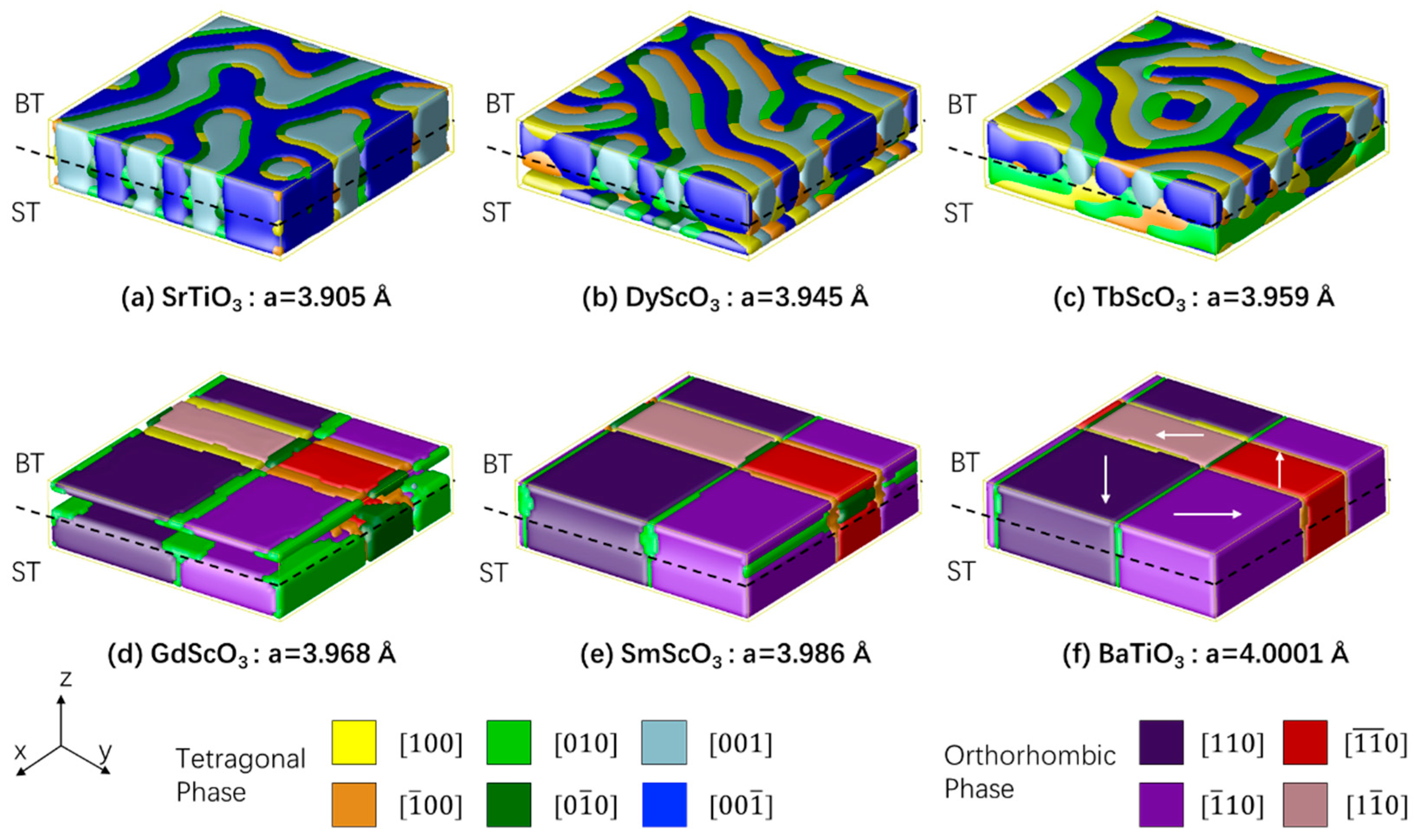
Figure 1a–f illustrates the simulated domain structures of the superlattice ST8/BT8 on six different substrates: SrTiO3, DyScO3, TbScO3, GdScO3, SmScO3, and BaTiO3, respectively. The simulation cell is discretized with 64Δx × 64Δy × 16Δz grids, where Δx = Δy = asub, Δz(r) = aBT·η(r) + aST·(1 − η(r)). At Ez = 0, the BT8/ST8 superlattice structure grown on SrTiO3 exhibits a labyrinth domain pattern, as shown in Figure 1a. The BT phase was constrained by the compressive stress induced by the SrTiO3 substrate and exhibited tetragonal c+/c− domains. In the absence of misfit strain, polarization in the ST phase was induced by the electrostatic effect. With increasing substrate lattice parameter, the domain wall width of the labyrinth structure expands, particularly at the interface between the BT and ST phases. On the TbScO3 substrate, the BT phase retains a tetragonal labyrinth structure, while the polarization in the ST phase begins to rotate toward the in-plane direction. On the GdScO3 substrate, which has a larger lattice parameter, the ST phase of the superlattice first transforms into an orthorhombic phase, accompanied by a significant decrease in the BT phase polarization. For substrates with even larger lattice parameters, such as SmScO3 and BaTiO3, an orthorhombic phase is also observed in the BT phase to minimize the depolarization field.
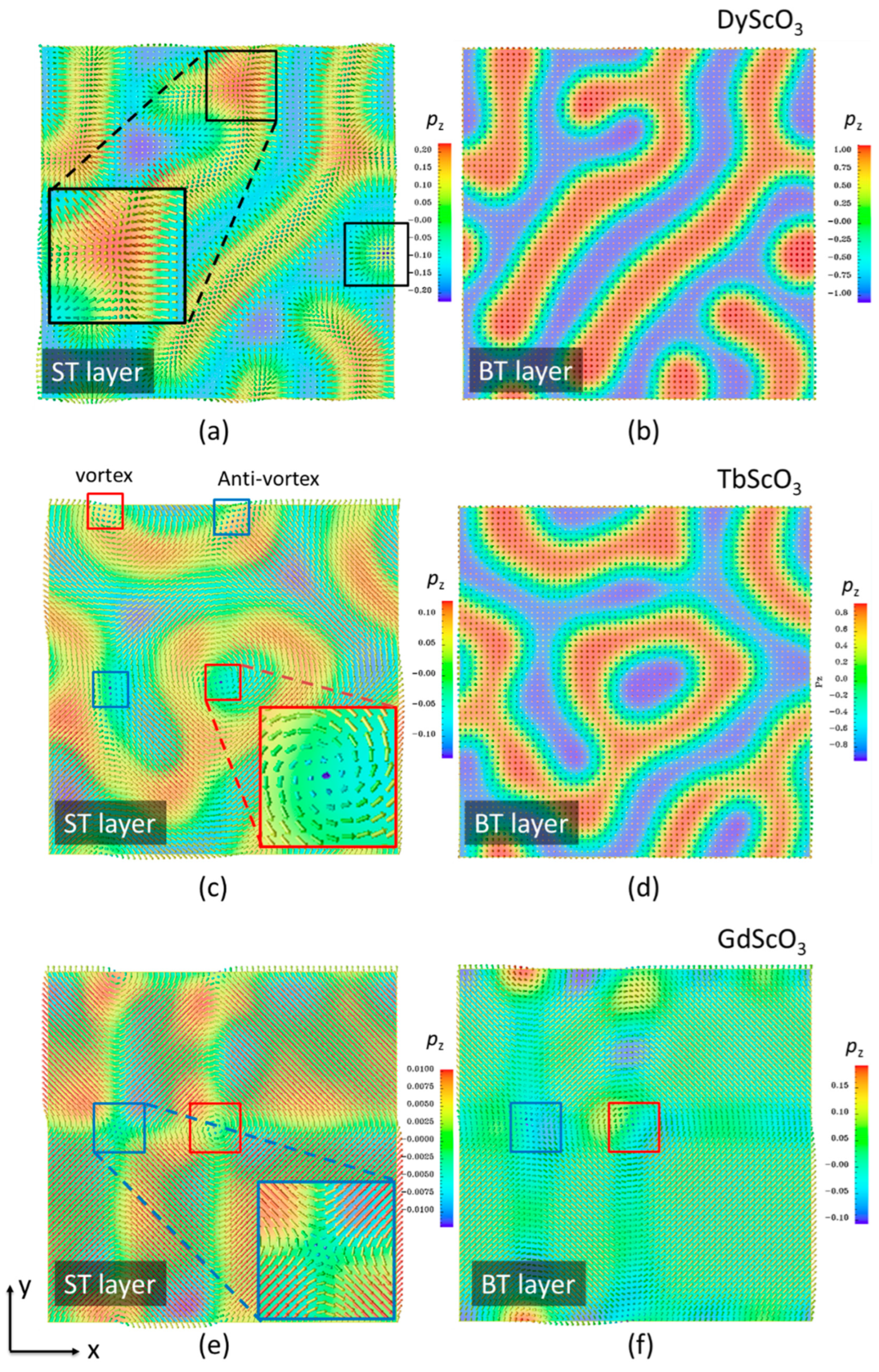
Several topological structures were observed in the superlattice structures. Figure 2a–f illustrates the vector plots at the center of the BT and ST layers of the superlattice grown on DyScO3, TbScO3, and GdScO3 substrates, respectively. For the superlattice grown on DyScO3, the polarization in the BT layer remains oriented along the +/−z direction. However, in the ST layer, the polarization lies in-plane owing to the tensile in-plane strain, exhibiting rosette-like structures, as highlighted in the black boxes (Figure 2a). In the ST layer of the superlattice grown on TbScO3, vortex (red box) and anti-vortex (blue box) pairs were observed (Figure 2c), implying that a phase transformation from the tetragonal phase to the orthorhombic phase occurs. For the superlattice grown on the GdScO3 substrate, vortex-antivortex pairs were simultaneously observed in both the ST and BT layers (Figure 2e,f), indicating that the entire structure has transformed to an orthorhombic phase.
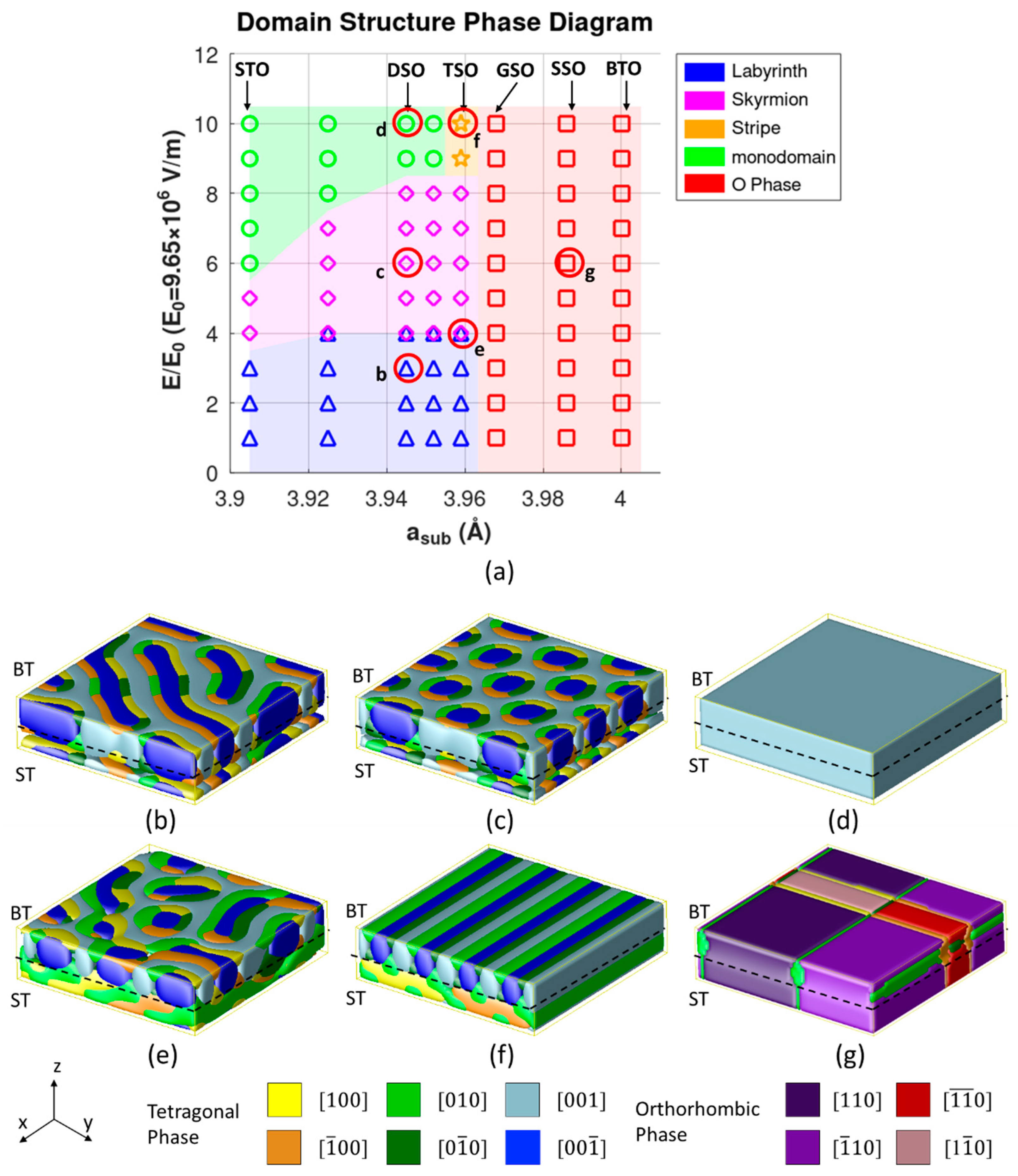
To achieve stable ferroelectric topological structures, the whole structure was initially polarized under an electric field of 10E0(~9.65 × 10⁷ V/m), then we gradually decreased the external field to zero and examined the resulting domain structures. Distinct domain structures were observed in the simulation. Figure 3a shows a phase diagram of the polar textures constructed by the phase field model. The horizontal axis of the phase diagram represents the substrate lattice constant a, while the vertical axis denotes the maximum applied electric field Ez. The six typical simulated domain patterns are illustrated in Figure 3b–g, including labyrinth, skyrmion, stripe, monodomain, mixed labyrinth-skyrmion, and orthorhombic structures. To better understand the formation mechanism of these polarization topological structures, the evolution of the domain structure and the polarization distribution was further examined. Based on the phase diagram, two distinct modes of ferroelectric domain structure evolution under an electric field were observed on different substrates. In Mode I, the domain structure evolution undergoes three distinct stages with increasing electric field: labyrinth, skyrmion, and monodomain. According to the phase diagram, when the substrate lattice constant is less than 3.9658 Å (as in SrTiO3, DyScO3, and TbScO3 substrates), the domain structure evolution consistently follows the characteristics of Mode I.
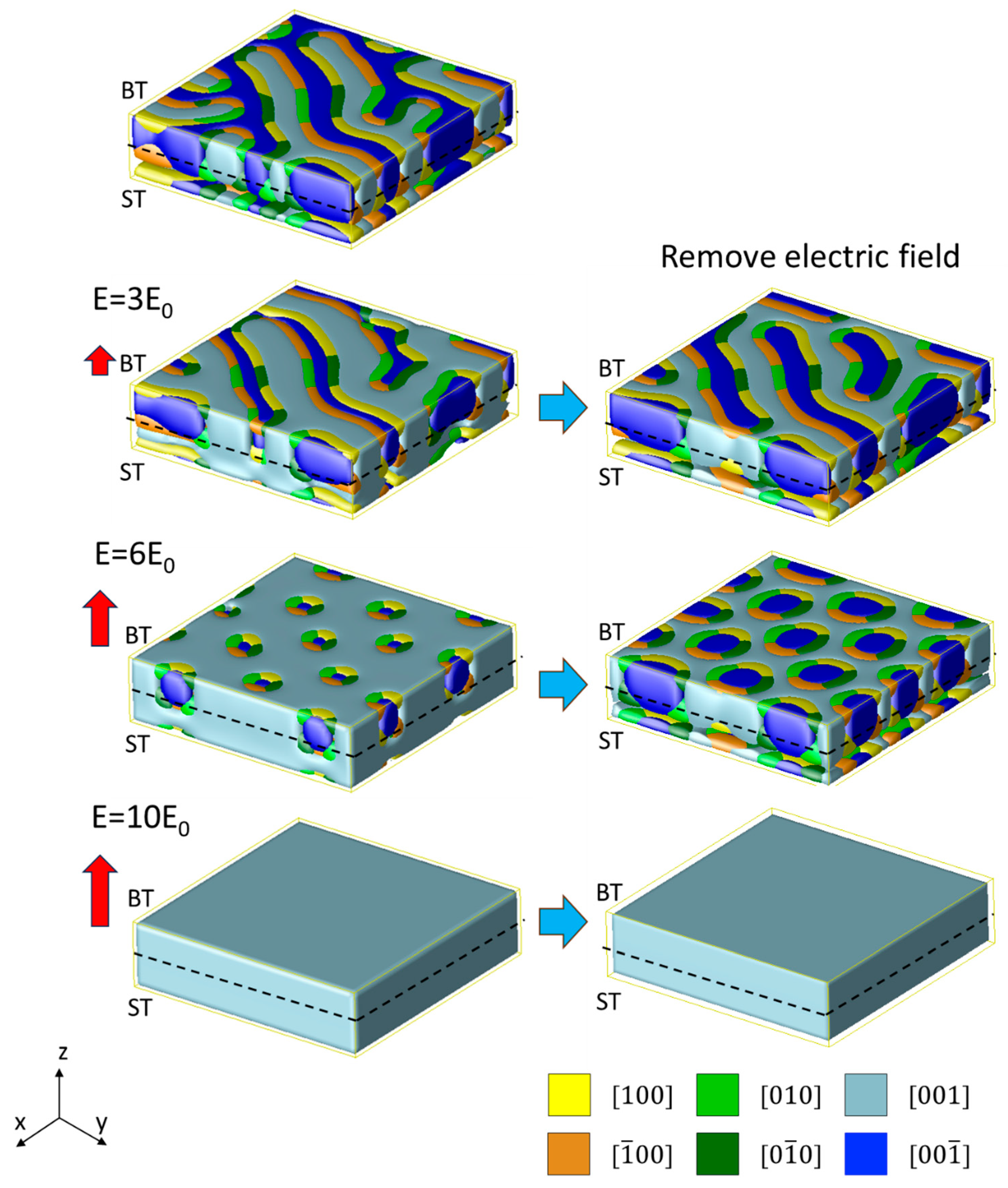
Figure 4 illustrates the typical domain structure evolution for Mode I, where the superlattice is grown on a DyScO3 substrate. The initial domain structure exhibits a typical labyrinth domain pattern; similar structures have been reported experimentally in PT/ST superlattices [3,4,13] and ultrathin PbTiO3 films [48,49]. As Ez increases, the −c domains begin to shrink while the +c domains expand, and the labyrinth pattern can be maintained. Upon removing the external field at this stage, the labyrinth pattern is preserved but exhibits slight variations compared to the initial structure. Further increasing Ez to 6E0, a bubble-like skyrmion structure emerges, exhibiting a well-ordered hexagonal close-packed pattern like our previously reported results [14]. When the external field is removed, these bubble-like skyrmion domains expand while maintaining their original structures because of topological protection. Finally, when the external field reaches 9E0, the skyrmion structures are destroyed, and the whole superlattice system transforms into a single +c domain structure. At this stage, removing the external field leaves the monodomain structure unchanged, while the Pz component decreases, exhibiting hysteresis behavior relative to the external field.
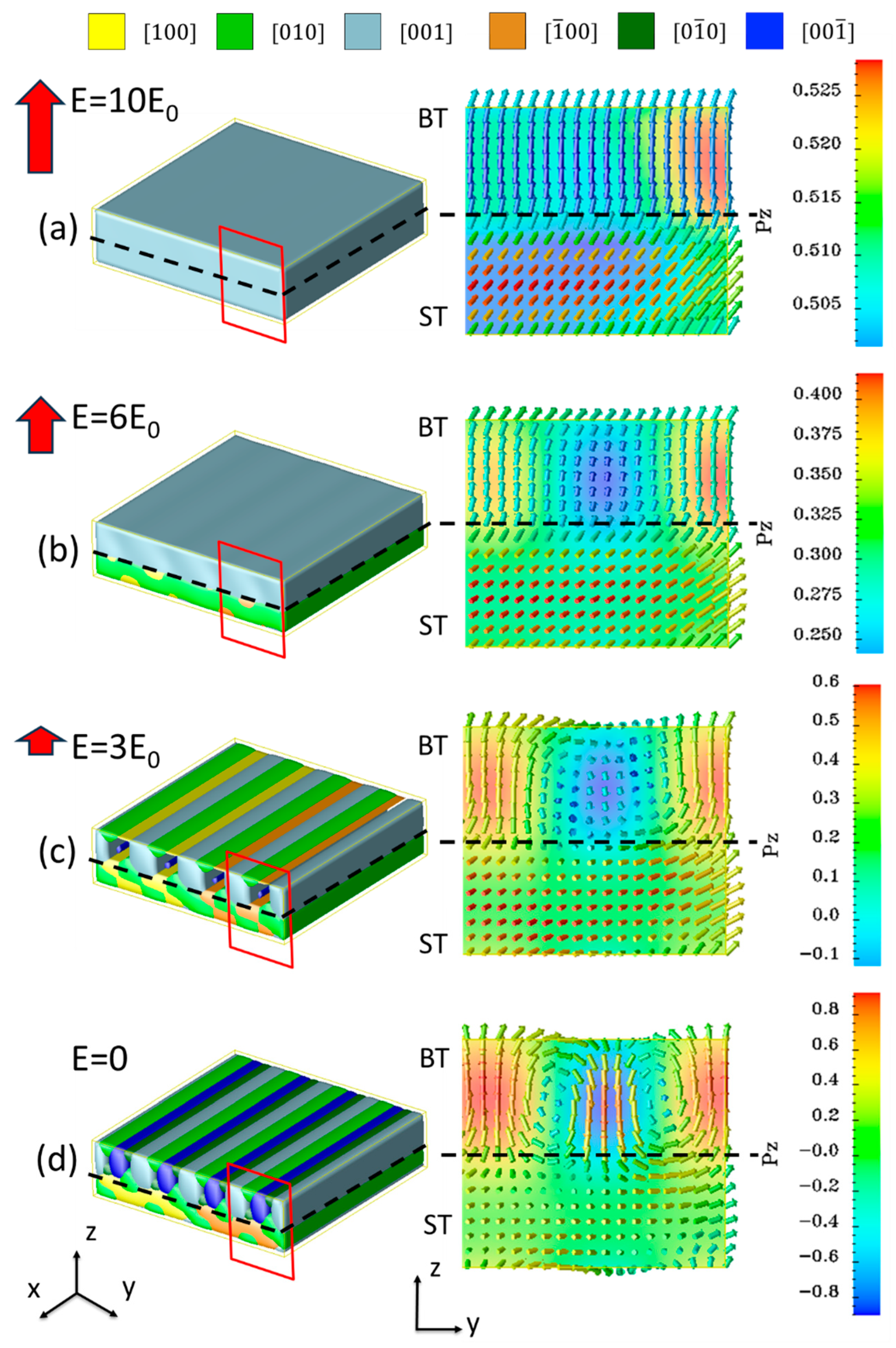
It is worth noting that a stripe domain structure was observed for the ST8/BT8 superlattice grown on the TbScO3 substrate. Increasing the field to Ez ≥ 9E0 results in a monodomain structure; however, a stripe domain structure formed spontaneously when the external electric field was removed. Figure 5a–d illustrates the domain structure evolution and the polarization vector distribution during this process. First, at the electric field Ez = 10E0, the polarization in the BT phase aligns fully along the +z axis, while that in the ST phase maintains an in-plane component (Figure 5a). Further reducing the external field, the depolarization field leads to polarization inhomogeneity in the BT phase (Figure 5b). On the other hand, the introduction of new domain walls can reduce the overall electrostatic energy of the system. The competition between the energies promotes the nucleation of −c domains in the BT phase (Figure 5c), which subsequently grow as the electric field is further reduced, eventually leading to the emergence of a stripe domain structure (Figure 5d).
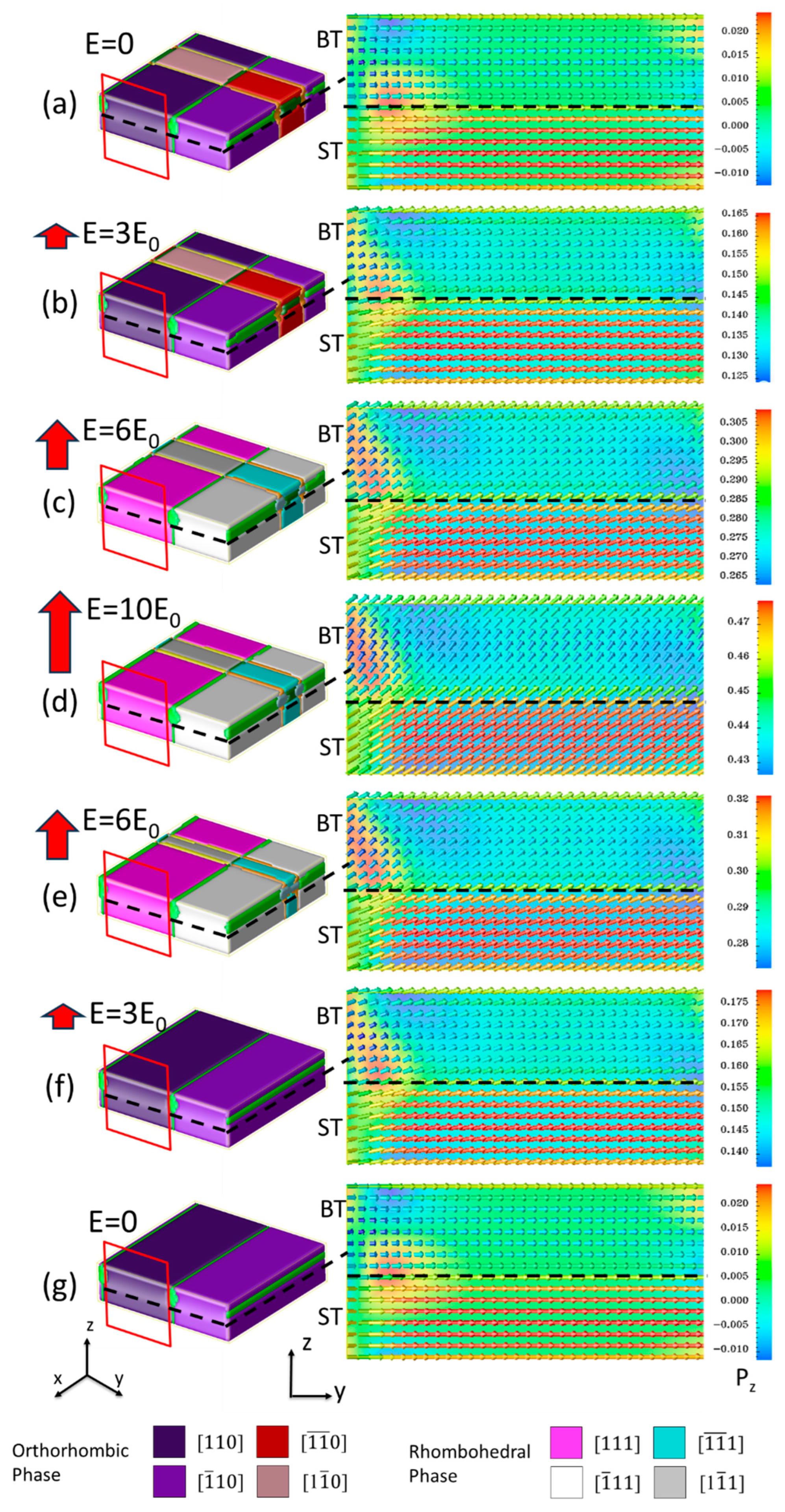
With the further increase of the substrate lattice constant, the elastic energy induced by the substrate drives a phase transition from the tetragonal to the orthorhombic phase in the superlattice. Specifically, our simulations indicate that once the substrate lattice constant is larger than 3.9658 Å, the switching mode of the superlattice structure exhibits a distinctly different mode, which we denote as Mode II. In Mode II, the variation of polarization is primarily caused by the rotation of the polarization vectors. Figure 6 illustrates the domain structure evolution and the corresponding polarization vector plots for the ST8/BT8 superlattice grown on the SmScO3 substrate under an external electric field. At Ez = 0, the polarization in both the BT and ST phases is oriented in the in-plane direction. As the external field increases, the rise in polarization stems mainly from polarization rotation rather than from the motion of 180° domain walls. When Ez ≥ 6E0, an orthorhombic to rhombohedral phase transition is observed as the polarization rotates from the in-plane <110> direction to the +z-oriented <111> direction. Notably, the polarization rotation process is fully reversible; when the external field is removed, the polarization rotates back to its original state, ultimately recovering an in-plane orthorhombic phase similar to the initial configuration.
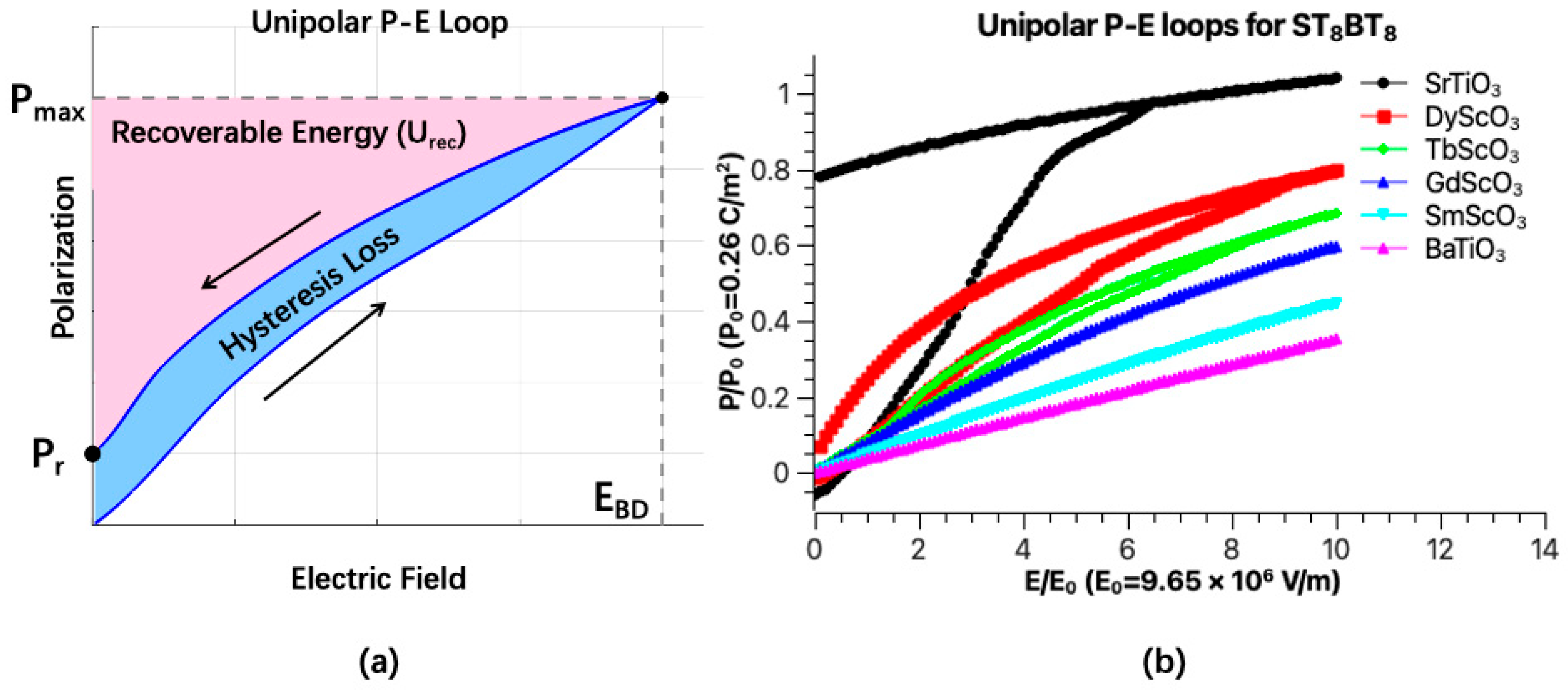
The reversible domain structure evolution depicted in Figure 6 corresponds to a slim hysteresis loop with low hysteresis loss, which suggests that the superlattice structure on some specific substrates has great potential for energy storage applications. Figure 7a shows a schematic figure of the ferroelectric hysteresis loop with corresponding key parameters for evaluating energy storage performance. The energy density of ferroelectric energy storage devices is strongly related to the breakdown electric field EBD. A higher EBD is necessary for device reliability and performance, as it allows the material to withstand stronger external electric fields and directly contributes to a higher recoverable energy density. The recovered energy density Urec quantifies the energy storage capability and is calculated as follows:
U rec = P r P m a x E d P ,
where Pmax and Pr represent the maximum polarization and the remanent polarization of the hysteresis loop, respectively. In Figure 7a, the pink area above the polarization hysteresis loop represents the recoverable energy density Urec and the light blue area inside the loop represents the energy loss Uloss of the material. Therefore, the energy storage efficiency can be expressed as
η = U r e c U r e c + U l o s s .
The unipolar P-E loops for the ST8/BT8 superlattice on different substrates are presented in Figure 7b. In this process, an external electric field was applied along the out-of-plane direction to polarize the system, and then gradually reduced to zero. For the superlattice structure grown on SrTiO3, a high hysteresis loss was observed in the P-E loop, which can be attributed to the strong compressive elastic strain in the BT layer. Please note that the polarization in the ST layer was totally induced by the depolarization field. As the substrate lattice parameter increases, both the remanent polarization and hysteresis loss dramatically decrease, accompanied by a reduction in Pmax. The shape of the P-E loops becomes slim and linear. This linear response is primarily driven by the polarization rotation mechanism in superlattices grown on substrates with larger lattice parameters.
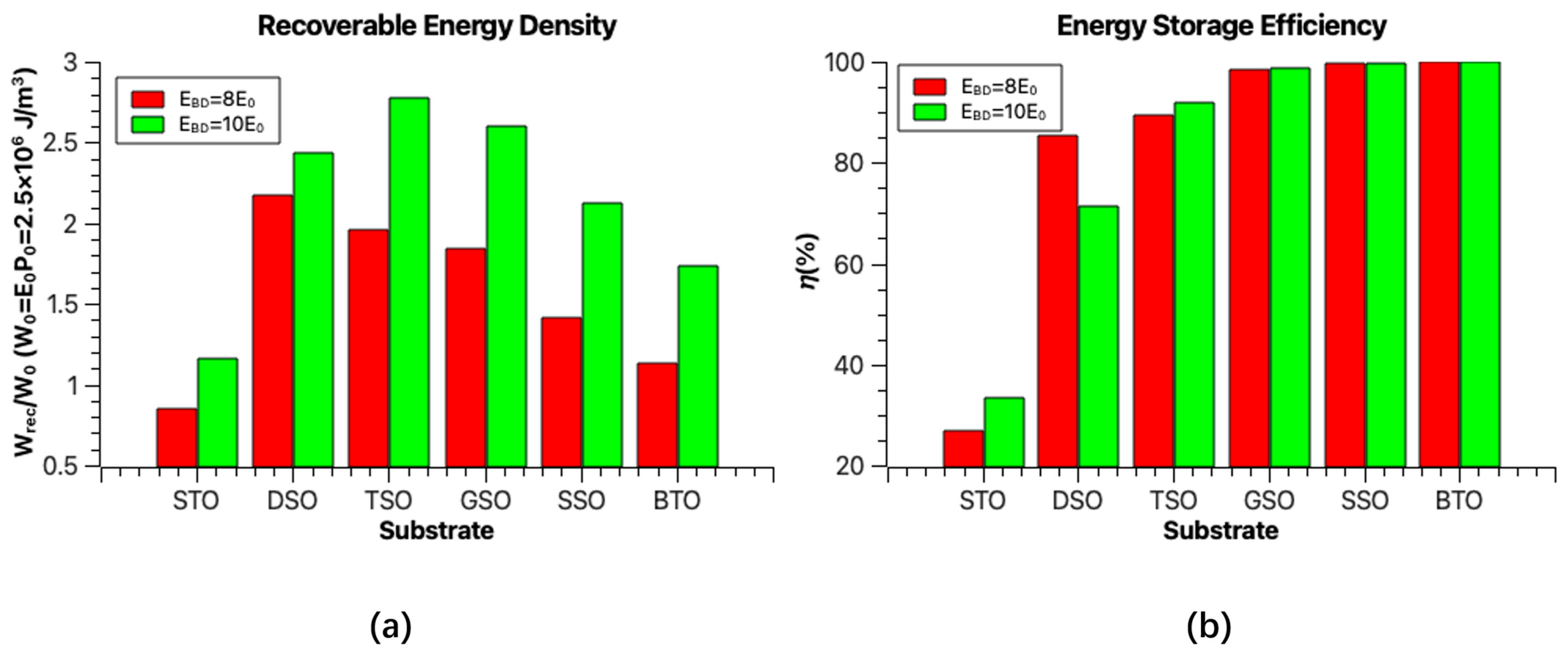
The recoverable energy density and the energy storage efficiency of the superlattice can be calculated through Equations (12) and (13), as shown in Figure 8a,b, respectively. For the ST8/BT8 superlattice grown on an SrTiO3 substrate, the large hysteresis loss resulting from the hysteresis loop leads to low recoverable energy (Urec) and energy efficiency (η). However, with the increased substrate lattice parameter, the hysteresis loop of the superlattice films becomes slim and shows a linear response with lower hysteresis loss, resulting in a significant enhancement in both the recoverable energy and efficiency.
According to Lupi et al.’s experimental work [26], a maximum electric field of 750 kV cm−1 was applied to investigate the switching properties of STn/BTn superlattice structures. In this work, we assume a similar electric breakdown field EBD = 8E0~770 kV cm−1. The ST8/BT8 superlattice grown on a DyScO3 substrate achieves a maximum Urec of 2.172 W0(~5.43 × 10⁶ J m−3), which is significantly higher than that of regular paraelectric SrTiO3 films (3.2 × 10⁶ J m−3). If EBD reaches 10E0, i.e., ~960 kV cm−1, the estimated Urec becomes significantly higher. The performance peak value observed in the superlattice structure grown on a TbScO3 substrate is a high Urec of 2.777 W0(~6.94 × 10⁶ J m−3).
For superlattices grown on substrates with even larger lattice constants, the saturation polarization (Pmax) decreases, leading to a reduction in Urec. However, the linear hysteresis loops induced by the polarization rotation mechanism have very low hysteresis loss, which gives rise to high energy storage efficiency. The theoretically predicted energy efficiency is remarkably high; for substrates with a lattice constant larger than that of TbScO3, the efficiency exceeds 80%. Considering the recoverable energy density and energy efficiency, the ST8/BT8 superlattices on DyScO3 and TbScO3 substrates emerge as promising candidates for energy storage applications.

4. Summary

In summary, using phase-field simulations, we systematically investigated the ferroelectric domain structures and polarization dynamics in (SrTiO3)8/(BaTiO3)8 superlattices under various substrate strains. The following are the most important findings:
(1)
A substrate-electric field phase diagram was established, and we identified six typical simulated domain patterns. This study shows that stable and topologically protected skyrmions can be achieved via substrate engineering and external field control.
(2)
Two distinct domain evolution modes under an electric field for different substrates were discovered. In Mode I, the domain structure evolution undergoes three distinct stages with an increasing electric field: labyrinth, skyrmion, and monodomain. In Mode II, the variation of polarization is primarily caused by the rotation of the polarization vectors.
(3)
We revealed that the substrate mismatch strain effectively modulates the hysteresis loops, thereby endowing the (SrTiO3)8/(BaTiO3)8 superlattices with relatively high recoverable energy density Urec and efficiency η. Our simulation results show that the (SrTiO3)8/(BaTiO3)8 superlattices on DyScO3 and TbScO3 substrates emerge as promising candidates for energy storage applications.
These results highlight the potential of strain engineering for designing next-generation nanoscale ferroelectric materials targeting both topological nanoelectronics and high-performance energy storage applications. Further experimental studies are needed to validate the theoretical predictions presented here and to facilitate the development of future nanoscale ferroelectric devices.

Author Contributions

Conceptualization, F.Y., J.W. and P.W.; methodology, P.W.; software, J.W. and P.W.; validation, T.D., F.Y. and P.W.; formal analysis, T.D., W.Z. and Y.H.; investigation, T.D. and Y.H.; resources, F.Y. and J.W.; data curation, F.Y., J.W. and P.W.; writing—original draft preparation, T.D.; writing—review and editing, W.Z., F.Y., Y.H. and P.W.; visualization, T.D., W.Z. and Y.H.; supervision, P.W.; project administration, F.Y., J.W., and P.W.; funding acquisition, F.Y., J.W. and P.W. All authors have read and agreed to the published version of the manuscript.

Funding

This research was funded by Natural Science Foundation of Xiamen under contract No. 3502Z202374087, the Science and Technology Program of the Fujian Educational Committee under Grant No. JAT241094, and the Cultivating Program of Quanzhou Normal University under contract No. 3001/H25012.

Data Availability Statement

The original contributions presented in this study are included in the article. Further inquiries can be directed to the corresponding authors.

Acknowledgments

The author J.W. would like to thank the State Key Laboratory of Powder Metallurgy, China, for its support.

Conflicts of Interest

The authors declare no conflicts of interest.

Abbreviations

The following abbreviations are used in this manuscript:
BTBarium Titanate (BaTiO3)
STStrontium Titanate (SrTiO3)
PTLead Titanate (PbTiO3)

References

  1. Nahas, Y.; Prokhorenko, S.; Louis, L.; Gui, Z.; Kornev, I.; Bellaiche, L. Discovery of Stable Skyrmionic State in Ferroelectric Nanocomposites. Nat. Commun. 2015, 6, 8542. [Google Scholar] [CrossRef]
  2. Pereira Gonçalves, M.A.; Escorihuela-Sayalero, C.; Garca-Fernández, P.; Junquera, J.; Íñiguez, J. Theoretical Guidelines to Create and Tune Electric Skyrmion Bubbles. Sci. Adv. 2019, 5, eaau7023. [Google Scholar] [CrossRef]
  3. Hong, Z.; Chen, L.-Q. Blowing Polar Skyrmion Bubbles in Oxide Superlattices. Acta Mater. 2018, 152, 155–161. [Google Scholar] [CrossRef]
  4. Das, S.; Tang, Y.L.; Hong, Z.; Gonçalves, M.A.P.; McCarter, M.R.; Klewe, C.; Nguyen, K.X.; Gómez-Ortiz, F.; Shafer, P.; Arenholz, E.; et al. Observation of Room-Temperature Polar Skyrmions. Nature 2019, 568, 368–372. [Google Scholar] [CrossRef] [PubMed]
  5. Das, S.; Hong, Z.; Stoica, V.A.; Gonçalves, M.A.P.; Shao, Y.T.; Parsonnet, E.; Marksz, E.J.; Saremi, S.; McCarter, M.R.; Reynoso, A.; et al. Local Negative Permittivity and Topological Phase Transition in Polar Skyrmions. Nat. Mater. 2020, 20, 194–201. [Google Scholar] [CrossRef]
  6. Han, L.; Addiego, C.; Prokhorenko, S.; Wang, M.; Fu, H.; Nahas, Y.; Yan, X.; Cai, S.; Wei, T.; Fang, Y.; et al. High-Density Switchable Skyrmion-like Polar Nanodomains Integrated on Silicon. Nature 2022, 603, 63–67. [Google Scholar] [CrossRef]
  7. Bousquet, E.; Dawber, M.; Stucki, N.; Lichtensteiger, C.; Hermet, P.; Gariglio, S.; Triscone, J.-M.; Ghosez, P. Improper Ferroelectricity in Perovskite Oxide Artificial Superlattices. Nature 2008, 452, 732–736. [Google Scholar] [CrossRef] [PubMed]
  8. Guo, X.; Zhou, L.; Roul, B.; Wu, Y.; Huang, Y.; Das, S.; Hong, Z. Theoretical Understanding of Polar Topological Phase Transitions in Functional Oxide Heterostructures: A Review. Small Methods 2022, 6, 2200486. [Google Scholar] [CrossRef]
  9. Junquera, J.; Nahas, Y.; Prokhorenko, S.; Bellaiche, L.; Íñiguez, J.; Schlom, D.G.; Chen, L.-Q.; Salahuddin, S.; Muller, D.A.; Martin, L.W.; et al. Topological Phases in Polar Oxide Nanostructures. Rev. Mod. Phys. 2023, 95, 025001. [Google Scholar] [CrossRef]
  10. Wang, Y.J.; Tang, Y.L.; Zhu, Y.L.; Ma, X.L. Entangled Polarizations in Ferroelectrics: A Focused Review of Polar Topologies. Acta Mater. 2023, 243, 118485. [Google Scholar] [CrossRef]
  11. Han, H.; Ma, J.; Wang, J.; Xu, E.; Xu, Z.; Huang, H.; Shen, Y.; Nan, C.-W.; Ma, J. Polar Topological Materials and Devices: Prospects and Challenges. Prog. Mater. Sci. 2025, 153, 101489. [Google Scholar] [CrossRef]
  12. Li, H.M.; Wang, Y.J.; Tang, Y.L.; Zhu, Y.L.; Ma, X.L. Evolution of Solitons in the PbTiO3/SrTiO3 Multilayer Film Driven by the Electric Field. Acta Mater. 2025, 289, 120882. [Google Scholar] [CrossRef]
  13. Hong, Z.; Damodaran, A.R.; Xue, F.; Hsu, S.L.; Britson, J.; Yadav, A.K.; Nelson, C.T.; Wang, J.J.; Scott, J.F.; Martin, L.W.; et al. Stability of Polar Vortex Lattice in Ferroelectric Superlattices. Nano Lett. 2017, 17, 2246–2252. [Google Scholar] [CrossRef]
  14. Yang, F.; Liang, Y.; Wu, P. Vortex Structure in Relaxed BaTiO3/SrTiO3 Superlattice. Appl. Phys. Express 2023, 16, 055002. [Google Scholar] [CrossRef]
  15. Prosandeev, S.; Prokhorenko, S.; Nahas, Y.; Bellaiche, L. Prediction of a Novel Topological Multidefect Ground State. Phys. Rev. B 2019, 100, 140104. [Google Scholar] [CrossRef]
  16. Teng, S.-H.; Anabaraonye, C.; Grünebohm, A. BaTiO3–SrTiO3 Composites: A Microscopic Study on Paraelectric Cubic Inclusions. Phase Transit. 2025, 98, 45–54. [Google Scholar] [CrossRef]
  17. Gómez-Ortiz, F.; Bastogne, L.; Anand, S.; Yu, M.; He, X.; Ghosez, P. Switchable Skyrmion–Antiskyrmion Tubes in Rhombohedral BaTiO3 and Related Materials. Phys. Rev. B 2025, 111, L180104. [Google Scholar] [CrossRef]
  18. Tenne, D.A.; Bruchhausen, A.; Lanzillotti-Kimura, N.D.; Fainstein, A.; Katiyar, R.S.; Cantarero, A.; Soukiassian, A.; Vaithyanathan, V.; Haeni, J.H.; Tian, W.; et al. Probing Nanoscale Ferroelectricity by Ultraviolet Raman Spectroscopy. Science 2006, 313, 1614–1616. [Google Scholar] [CrossRef] [PubMed]
  19. Schlom, D.G.; Chen, L.-Q.; Pan, X.; Schmehl, A.; Zurbuchen, M.A. A Thin Film Approach to Engineering Functionality into Oxides. J. Am. Ceram. Soc. 2008, 91, 2429–2454. [Google Scholar] [CrossRef]
  20. Schlom, D.G.; Chen, L.; Eom, C.-B.; Rabe, K.M.; Streiffer, S.K.; Triscone, J.-M. Strain Tuning of Ferroelectric Thin Films. Annu. Rev. Mater. Res. 2007, 37, 589–626. [Google Scholar] [CrossRef]
  21. Železný, V.; Soukiassian, A.; Schlom, D.G.; Xi, X.X. Infrared Spectroscopy of an Epitaxial BaTiO3/SrTiO3 Superlattice Grown on a (110) SmScO3 Substrate. J. Appl. Phys. 2014, 115, 184102. [Google Scholar] [CrossRef]
  22. Merckling, C.; Korytov, M.; Celano, U.; Hsu, M.-H.M.; Neumayer, S.M.; Jesse, S.; de Gendt, S. Epitaxial Growth and Strain Relaxation Studies of BaTiO3 and BaTiO3/SrTiO3 Superlattices Grown by MBE on SrTiO3-Buffered Si(001) Substrate. J. Vac. Sci. Technol. A Vac. Surf. Film. 2019, 37, 021510. [Google Scholar] [CrossRef]
  23. Bein, B.; Hsing, H.-C.; Callori, S.J.; Sinsheimer, J.; Chinta, P.V.; Headrick, R.L.; Dawber, M. In Situ X-Ray Diffraction and the Evolution of Polarization during the Growth of Ferroelectric Superlattices. Nat. Commun. 2015, 6, 10136. [Google Scholar] [CrossRef]
  24. Estandía, S.; Sánchez, F.; Chisholm, M.F.; Gázquez, J. Rotational Polarization Nanotopologies in BaTiO3/SrTiO3 Superlattices. Nanoscale 2019, 11, 21275–21283. [Google Scholar] [CrossRef]
  25. Peng, D.; Yang, X.; Jiang, W. Three-Dimensional Polarization Vortex Configuration Evolution in Compressed BaTiO3/SrTiO3 Superlattice. J. Appl. Phys. 2019, 126, 244101. [Google Scholar] [CrossRef]
  26. Lupi, E.; Wexler, R.B.; Meyers, D.; Zahradnik, A.; Jiang, Y.; Susarla, S.; Ramesh, R.; Martin, L.W.; Rappe, A.M. Engineering Relaxor Behavior in (BaTiO3)n/(SrTiO3)n Superlattices. Adv. Mater. 2023, 35, 2302012. [Google Scholar] [CrossRef]
  27. Pavlenko, M.A.; Tikhonov, Y.A.; Razumnaya, A.G.; Vinokur, V.M.; Lukyanchuk, I.A. Temperature Dependence of Dielectric Properties of Ferroelectric Heterostructures with Domain-Provided Negative Capacitance. Nanomaterials 2021, 12, 75. [Google Scholar] [CrossRef]
  28. Yuan, G.; Lei, Y.; Dong, Y.; Li, C.; Li, J. Steady-State Negative Capacitance in SrTiO3/BaTiO3 Trilayers and Superlattices. Appl. Phys. Lett. 2026, 128, 142903. [Google Scholar] [CrossRef]
  29. Ishibe, T.; Tomeda, A.; Komatsubara, Y.; Kitaura, R.; Uenuma, M.; Uraoka, Y.; Yamashita, Y.; Nakamura, Y. Carrier and Phonon Transport Control by Domain Engineering for High-Performance Transparent Thin Film Thermoelectric Generator. Appl. Phys. Lett. 2021, 118, 151601. [Google Scholar] [CrossRef]
  30. Chen, D.; Chen, Z.; He, Q.; Clarkson, J.D.; Serrao, C.R.; Yadav, A.K.; Nowakowski, M.E.; Fan, Z.; You, L.; Gao, X.; et al. Interface Engineering of Domain Structures in BiFeO3 Thin Films. Nano Lett. 2016, 17, 486–493. [Google Scholar] [CrossRef]
  31. Winchester, B.; Wu, P.; Chen, L.Q. Phase-Field Simulation of Domain Structures in Epitaxial BiFeO3 Films on Vicinal Substrates. Appl. Phys. Lett. 2011, 99, 052903. [Google Scholar] [CrossRef]
  32. Feng, Y.; Wang, Y.; Tang, Y.; Zhu, Y.; Ma, X. Interfacial Manipulation of Polar Topologies in Oxide Ferroelectric Films. Adv. Funct. Mater. 2025, 35, e10402. [Google Scholar] [CrossRef]
  33. Fan, Y.; Zhang, S.; Xue, Z.; Dong, Y.; Chen, D.; Zhang, J.; Liu, J.; Si, M.; Luo, C.; Li, W.; et al. Hidden Structural Phase Transition Assisted Ferroelectric Domain Orientation Engineering in Hf0.5Zr0.5O2 Films. Nat. Commun. 2025, 16, 4232. [Google Scholar] [CrossRef] [PubMed]
  34. Yuan, S.; Chen, Z.; Prokhorenko, S.; Nahas, Y.; Bellaiche, L.; Liu, C.; Xu, B.; Chen, L.; Das, S.; Martin, L.W. Hexagonal Close-Packed Polar-Skyrmion Lattice in Ultrathin Ferroelectric PbTiO3 Films. Phys. Rev. Lett. 2023, 130, 226801. [Google Scholar] [CrossRef]
  35. Ren, J.; Liu, L.; Sun, F.; He, Q.; Wu, M.; Chen, W.; Zheng, Y. Emergence and Transformation of Polar Skyrmion Lattices via Flexoelectricity. npj Comput. Mater. 2024, 10, 216. [Google Scholar] [CrossRef]
  36. Wang, Z.; Chen, L.-Q. Reversible Phase Transition between Vortex Lattice and Hexagonal Polar Skyrmion Crystals. Nano Lett. 2023, 23, 9907–9911. [Google Scholar] [CrossRef] [PubMed]
  37. Shi, X.; Liu, J.; Xu, K.; Wang, H.; Wang, Z.; Wang, N.; Huang, H.; Liu, Z. A Perturbation Model of Gradient Energy Anisotropy for Phase-Field Simulation of Ferroelectrics. Materials 2026, 19, 1445. [Google Scholar] [CrossRef]
  38. Zhang, Y.; Li, Q.; Huang, H.; Hong, J.; Wang, X. Strain Manipulation of Ferroelectric Skyrmion Bubbles in a Freestanding PbTiO3 Film: A Phase Field Simulation. Phys. Rev. B 2022, 105, 224101. [Google Scholar] [CrossRef]
  39. Wu, P.; Liang, Y. Lattice Phase Field Model for Nanomaterials. Materials 2021, 14, 7317. [Google Scholar] [CrossRef]
  40. Khachaturyan, A.G. Theory of Structural Transformations in Solids; Courier Corporation: Washington, DC, USA, 2013. [Google Scholar]
  41. Uecker, R.; Klimm, D.; Bertram, R.; Bernhagen, M.; Schulze-Jonack, I.; Brützam, M.; Kwasniewski, A.; Gesing, T.M.; Schlom, D.G. Growth and Investigation of Nd1−xSmXScO3 and Sm1−xGdXScO3 Solid-Solution Single Crystals. Acta Phys. Pol. A 2013, 124, 295–300. [Google Scholar] [CrossRef]
  42. Soukiassian, A.; Tian, W.; Vaithyanathan, V.; Haeni, J.H.; Chen, L.Q.; Xi, X.X.; Schlom, D.G.; Tenne, D.A.; Sun, H.P.; Pan, X.Q.; et al. Growth of Nanoscale BaTiO3/SrTiO3 Superlattices by Molecular-Beam Epitaxy. J. Mater. Res. 2008, 23, 1417–1432. [Google Scholar] [CrossRef]
  43. Chen, L.Q.; Shen, J. Applications of Semi-Implicit Fourier-Spectral Method to Phase Field Equations. Comput. Phys. Commun. 1998, 108, 147–158. [Google Scholar] [CrossRef]
  44. You, Y.; Yang, F.; Wu, P. Domain Wall State Diagram for SrTiO3/BaTiO3 Superlattice Structures. J. Adv. Dielectr. 2023, 13, 2243003. [Google Scholar] [CrossRef]
  45. Biegalski, M.D.; Haeni, J.H.; Trolier-McKinstry, S.; Schlom, D.G.; Brandle, C.D.; Graitis, A.J.V. Thermal expansion of the new perovskite substrates DyScO3 and GdScO3. J. Mater. Res. 2005, 20, 952–958. [Google Scholar] [CrossRef]
  46. Kim, Y.S.; Kim, D.H.; Kim, J.D.; Chang, Y.J.; Noh, T.W.; Kong, J.H.; Char, K.; Park, Y.D.; Bu, S.D.; Yoon, J.-G.; et al. Critical Thickness of Ultrathin Ferroelectric BaTiO3 Films. Appl. Phys. Lett. 2005, 86, 102907. [Google Scholar] [CrossRef]
  47. Kawai, M.; Kan, D.; Isojima, S.; Kurata, H.; Isoda, S.; Shimakawa, Y.; Kimura, S.; Sakata, O. Critical Thickness Control by Deposition Rate for Epitaxial BaTiO3 Thin Films Grown on SrTiO3(001). J. Appl. Phys. 2007, 102, 114311. [Google Scholar] [CrossRef]
  48. Streiffer, S.K.; Eastman, J.A.; Fong, D.D.; Thompson, C.B.; Munkholm, A.; Murty, R.; Auciello, O.; Bai, G.R.; Stephenson, G.B. Observation of Nanoscale 180° Stripe Domains in Ferroelectric PbTiO3 Thin Films. Phys. Rev. Lett. 2002, 89, 067601. [Google Scholar] [CrossRef]
  49. Nahas, Y.; Prokhorenko, S.; Fischer, J.; Xu, B.; Carrétéro, C.; Prosandeev, S.; Bibès, M.; Fusil, S.; Dkhil, B.; Garcia, V.; et al. Inverse Transition of Labyrinthine Domain Patterns in Ferroelectric Thin Films. Nature 2020, 577, 47–51. [Google Scholar] [CrossRef] [PubMed]
Figure 1. Simulated ferroelectric domain structures of superlattice ST8/BT8 on various substrates: (a) SrTiO3, (b) DyScO3, (c) TbScO3, (d) GdScO3, (e) SmScO3, and (f) BaTiO3. The lattice parameters are indicated in the figure.
Nanomaterials 16 00582 g001
Figure 2. Vector plot of the ST layer (left column) and the BT layer (right column) in ST8/BT8 grown on substrates of DyScO3 (a,b), TbScO3 (c,d), and GdScO3 (e,f). The black box shows the rosette structures. The red box and blue box show typical vortex and antivortex structures, respectively.
Nanomaterials 16 00582 g002
Figure 3. (a) Phase field-predicted domain structure phase diagram showing six types of structures in red circles. (bg) show labyrinth, skyrmion, stripe, monodomain, mixed labyrinth and skyrmion, and orthorhombic phase structures, respectively.
Nanomaterials 16 00582 g003
Figure 4. Domain evolution process of the ST8/BT8 superlattice grown on DyScO3 under an electric field applied along the +z direction (Mode I). Labyrinth, skyrmion, and monodomain structures are obtained after applying and subsequently removing electric fields of 3E0, 6E0 and 10E0, respectively.
Nanomaterials 16 00582 g004
Figure 5. The stripe domain generation process in the ST8/BT8 grown on the TbScO3 substrate. (ad) represent the domain structures (left) and corresponding polarization vector plots (right) during the electric field decreasing process at Ez = 10E0, 6E0, 3E0 and 0.
Nanomaterials 16 00582 g005
Figure 6. The domain structure evolution of the unipolar process of domain structure (left column) and vector plot (right column) of the ST8/BT8 grown on SmScO3 (Mode II). (ad) show the domain structures and polarization vectors at increasing electric field strengths of 0, 3E0, 6E0, and 10E0, respectively. (eg) show the corresponding distributions during the electric field decreasing process at 6E0, 3E0, and 0, respectively.
Nanomaterials 16 00582 g006
Figure 7. (a) A schematic diagram of the hysteresis loop with key parameters for evaluating energy storage performance and (b) phase field simulated unipolar P-E loops for ST8/BT8 superlattice thin films grown on various substrates.
Nanomaterials 16 00582 g007
Figure 8. Comparison of the (a) recoverable energy and (b) energy storage efficiency for ST8/BT8 superlattice grown on various substrates. The red bar and green bar represent the predicted values assuming EBD = 8E0 and 10E0, respectively. STO, DSO, TSO, GSO, SSO and BTO refer to the substrate materials SrTiO3, DyScO3, TbScO3, GdScO3, SmScO3, and BaTiO3, respectively.
Nanomaterials 16 00582 g008
Table 1. Lattice parameters of the substrate and the calculated misfit strain in the ST and BT layers.
SubstrateLattice Parameter (Å)Strain in BTStrain in ST
SrTiO33.905−2.38%0.00%
DyScO33.945−1.38%1.02%
TbScO33.959−1.03%1.38%
GdScO33.968−0.80%1.61%
SmScO33.986−0.35%2.07%
BaTiO34.00010.00%2.44%
Table 2. Landau energy coefficients, gradient energy coefficients, elastic energy coefficients and electrostrictive coefficients used in this work; T in Kelvin.
ParameterBaTiO3SrTiO3Unit
α14.124(T−388) × 1052.6353[coth(42/T) − 0.90476] × 107C−2·N·m2
α11−2.097 × 1081.696 × 109C−4·N·m6
α127.974 × 1081.373 × 109C−4·N·m6
α1111.294 × 1090C−6·N·m10
α112−1.950 × 1090C−6·N·m10
α123−2.500 × 1090C−6·N·m10
α11113.863 × 10100C−8·N·m14
α11122.529 × 10100C−8·N·m14
α11221.637 × 10100C−8·N·m14
α11231.367 × 10100C−8·N·m14
G113.46 × 10−103.46 × 10⁻¹⁰C−2·N·m4
G1200C−2·N·m4
G441.73 × 10−101.73 × 10⁻¹⁰C−2·N·m4
C111.78 × 10113.36 × 1011N·m−2
C120.964 × 10111.07 × 1011N·m−2
C441.22 × 10111.27 × 1011N·m−2
Q110.100.066C−2·m4
Q12−0.034−0.0135C−2·m4
Q440.0290.0096C−2·m4
Disclaimer/Publisher’s Note: The statements, opinions and data contained in all publications are solely those of the individual author(s) and contributor(s) and not of MDPI and/or the editor(s). MDPI and/or the editor(s) disclaim responsibility for any injury to people or property resulting from any ideas, methods, instructions or products referred to in the content.