Nanodevice Approaches for Detecting Micro- and Nanoplastics in Complex Matrices

 , ,
, ,  , , , and
Abstract
1. Introduction
2. Conventional Analytical Methods for MNP Detection
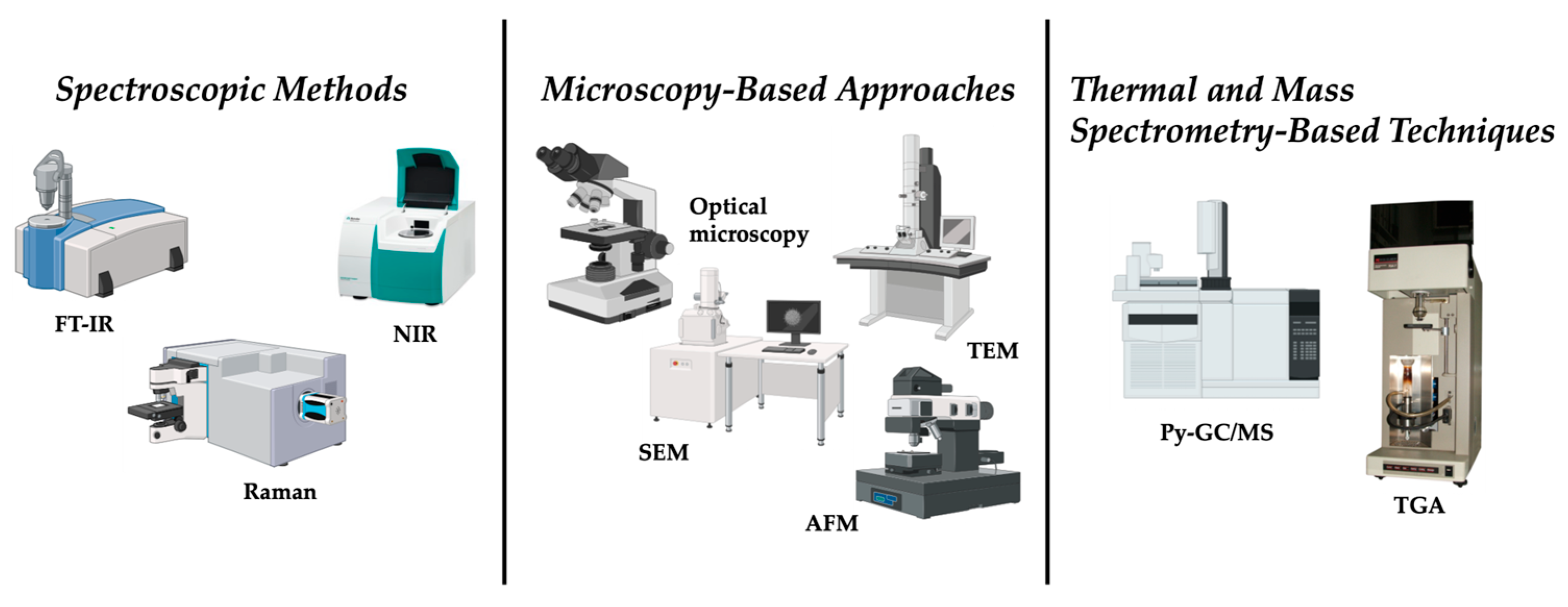
2.1. Spectroscopic Methods
2.2. Microscopy-Based Approaches
2.3. Thermal and Mass Spectrometry-Based Techniques
3. Nanodevices in MNP Monitoring
3.1. The Emergency of Nanodevices
3.2. Applications Across Complex Matrices
4. Nanotechnology-Based Strategies for MNP Detection
4.1. Nanosensors for MNP Detection
4.2. Lab-on-a-Chip and Microfluidic Platforms
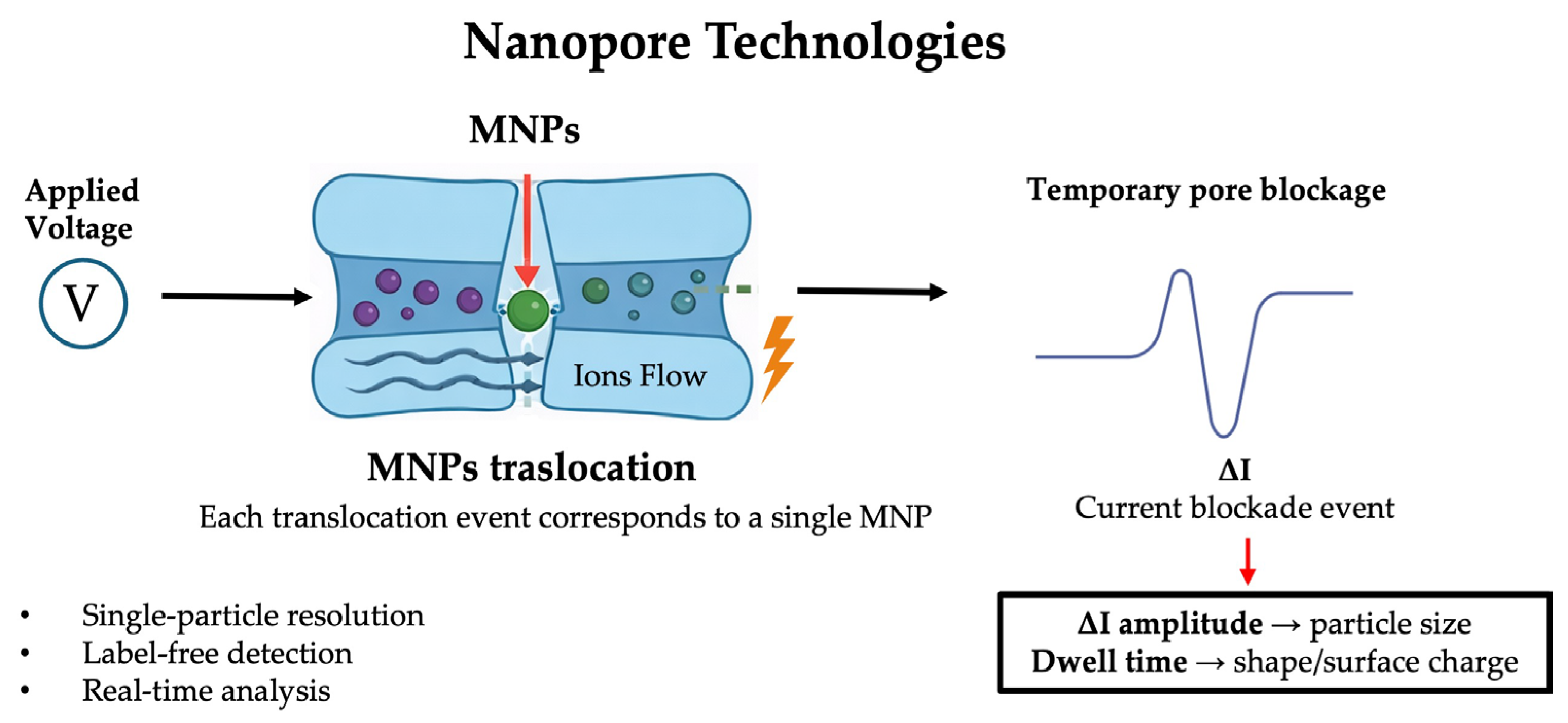
4.3. Nanopore Technologies
4.4. Nanostructured Capture and Enrichment Materials
5. Outlook and Conclusions
Author Contributions
Funding
Data Availability Statement
Conflicts of Interest
References
- Houssini, K.; Li, J.; Tan, Q. Complexities of the global plastics supply chain revealed in a trade-linked material flow analysis. Commun. Earth Environ. 2025, 6, 257. [Google Scholar] [CrossRef]
- Amobonye, A.; Bhagwat, P.; Raveendran, S.; Singh, S.; Pillai, S. Environmental Impacts of Microplastics and Nanoplastics: A Current Overview. Front. Microbiol. 2021, 12, 768297. [Google Scholar] [CrossRef] [PubMed]
- Daoutakou, M.; Kintzios, S. Biosensors for Micro- and Nanoplastics Detection: A Review. Chemosensors 2025, 13, 143. [Google Scholar] [CrossRef]
- Harun-Ur-Rashid, M.; Jahan, I.; Foyez, T.; Imran, A.B. Bio-Inspired Nanomaterials for Micro/Nanodevices: A New Era in Biomedical Applications. Micromachines 2023, 14, 1786. [Google Scholar] [CrossRef]
- Rivera-Rivera, D.M.; Quintanilla-Villanueva, G.E.; Luna-Moreno, D.; Sánchez-Álvarez, A.; Rodríguez-Delgado, J.M.; Cedillo-González, E.I.; Kaushik, G.; Villarreal-Chiu, J.F.; Rodríguez-Delgado, M.M. Exploring Innovative Approaches for the Analysis of Micro- and Nanoplastics: Breakthroughs in (Bio)Sensing Techniques. Biosensors 2025, 15, 44. [Google Scholar] [CrossRef] [PubMed]
- Berkel, C.; Özbek, O. Methods used in the identification and quantification of micro(nano)plastics from water environments. S. Afr. J. Chem. Eng. 2024, 50, 388–403. [Google Scholar] [CrossRef]
- Pasieczna-Patkowska, S.; Cichy, M.; Flieger, J. Application of Fourier Transform Infrared (FTIR) Spectroscopy in Characterization of Green Synthesized Nanoparticles. Molecules 2025, 30, 684. [Google Scholar] [CrossRef]
- Rathore, C.; Saha, M.; Gupta, P.; Kumar, M.; Naik, A.; Boer, J. Standardization of micro-FTIR methods and applicability for the detection and identification of microplastics in environmental matrices. Sci. Total Environ. 2023, 888, 164157. [Google Scholar] [CrossRef] [PubMed]
- Anger, P.; von der Esch, E.; Baumann, T.; Elsner, M.; Niessner, R.; Ivleva, N. Raman Microspectroscopy as a Tool for Microplastic Particle Analysis. TrAC Trends Anal. Chem. 2018, 109, 214–226. [Google Scholar] [CrossRef]
- Ou, L.; Honda, A.; Miyasaka, N.; Akaji, S.; Omori, I.; Ishikawa, R.; Li, Y.; Ueda, K.; Takano, H. Application of three-dimensional Raman imaging to determination of the relationship between cellular localization of diesel exhaust particles and the toxicity. Toxicol. Mech. Methods 2021, 32, 333–340. [Google Scholar] [CrossRef]
- Liu, Y.; Hu, J.; Lin, L.; Yang, B.; Huang, M.; Chang, M.; Huang, X.; Dai, Z.; Sun, S.; Ren, L.; et al. Overcoming the fluorescent interference during Raman spectroscopy detection of microplastics. Sci. Total Environ. 2023, 897, 165333. [Google Scholar] [CrossRef]
- Faltynkova, A.; Johnsen, G.; Wagner, M. Hyperspectral imaging as an emerging tool to analyze microplastics: A systematic review and recommendations for future development. Microplastics Nanoplastics 2021, 1, 13. [Google Scholar] [CrossRef]
- Silva, A.L.P.; Silva, S.A.M.; Duarte, A.; Barceló, D.; Rocha-Santos, T. Analytical methodologies used for screening micro(nano)plastics in (eco)toxicity tests. Green Anal. Chem. 2022, 3, 100037. [Google Scholar] [CrossRef]
- Ribeiro, F.; Duarte, A.C.; da Costa, J.P. Staining methodologies for microplastics screening. TrAC Trends Anal. Chem. 2024, 172, 117555. [Google Scholar] [CrossRef]
- Groß, M.; Mail, M.; Debastiani, R.; Scherer, T.; Braun, M. Weathering of plastics in terrestrial environments. TrAC Trends Anal. Chem. 2025, 190, 118281. [Google Scholar] [CrossRef]
- Nene, A.; Sadeghzade, S.; Viaroli, S.; Yang, W.; Uchenna, U.P.; Kandwal, A.; Liu, X.; Somani, P.; Galluzzi, M. Recent advances and future technologies in nano-microplastics detection. Environ. Sci. Eur. 2025, 37, 7. [Google Scholar] [CrossRef]
- Zhu, Y.; Li, Y.; Huang, J.; Zhang, Y.; Ho, Y.-W.; Fang, J.; Lam, E. Advanced Optical Imaging Technologies for Microplastics Identification: Progress and Challenges. Adv. Photonics Res. 2024, 5, 2400038. [Google Scholar] [CrossRef]
- Neugirg, B.; Koebley, S.; Schniepp, H.; Fery, A. AFM-based mechanical characterization of single nanofibres. Nanoscale 2016, 8, 8414–8426. [Google Scholar] [CrossRef]
- Picó, Y.; Barceló, D. Pyrolysis gas chromatography-mass spectrometry in environmental analysis: Focus on organic matter and microplastics. TrAC Trends Anal. Chem. 2020, 130, 115964. [Google Scholar] [CrossRef]
- La Nasa, J.; Biale, G.; Fabbri, D.; Modugno, F. A review on challenges and developments of analytical pyrolysis and other thermoanalytical techniques for the quali-quantitative determination of microplastics. J. Anal. Appl. Pyrolysis 2020, 149, 104841. [Google Scholar] [CrossRef]
- Ng, H.M.; Saidi, N.M.; Omar, F.S.; Kasi, R.; Subramaniam, T.R.; Bashir, S. Thermogravimetric Analysis of Polymers. Encycl. Polym. Sci. Technol. 2018, 1–29. [Google Scholar] [CrossRef]
- Conte, R.; Foggia, R.; Valentino, A.; Di Salle, A.; Kandsi, F.; Calarco, A. Nanotechnology advancements transforming molecular diagnostics: Applications in precision healthcare. Int. J. Nano Dimens. 2024, 15, 1–8. [Google Scholar] [CrossRef]
- Khani, S.; Rezaei, P. Optical sensors based on plasmonic nano-structures: A review. Heliyon 2024, 10, e40923. [Google Scholar] [CrossRef]
- Jalalvand, A.R.; Karami, M.M. Roles of nanotechnology in electrochemical sensors for medical diagnostic purposes: A review. Sens. Bio-Sens. Res. 2025, 47, 100733. [Google Scholar] [CrossRef]
- Surappa, S.; Multani, P.; Parlatan, U.; Sinawang, P.D.; Kaifi, J.; Akin, D.; Demirci, U. Integrated “lab-on-a-chip” microfluidic systems for isolation, enrichment, and analysis of cancer biomarkers. Lab A Chip 2023, 23, 2942–2958. [Google Scholar] [CrossRef] [PubMed]
- Cho, G.; Kim, K.; Chen, W.; Son, S.; Jeon, T.-J.; Kim, S.M. Nanopore detection of sub-nanosized plastics in PE-coated paper cups and analysis of their inflammatory responses. Chem. Eng. J. 2024, 495, 153407. [Google Scholar] [CrossRef]
- Pervaiz, S.; Javed, M.; Shah, A.; Latif, A.; Nasir, S.; Shah, I. Environmental applications of magnetic nanohybrid materials. RSC Adv. 2025, 15, 19899–19936. [Google Scholar] [CrossRef]
- Tao, S.; Lin, B. Water soluble organic carbon and its measurement in soil and sediment. Water Res. 2000, 34, 1751–1755. [Google Scholar] [CrossRef]
- Chiu, M.L.; Lawi, W.; Snyder, S.T.; Wong, P.K.; Liao, J.C.; Gau, V. Matrix Effects—A Challenge toward Automation of Molecular Analysis. SLAS Technol. 2010, 15, 233–242. [Google Scholar] [CrossRef]
- Al-Amiery, A.A.; Fayad, M.A.; Abdul Wahhab, H.A.; Al-Azzawi, W.K.; Mohammed, J.K.; Majdi, H.S. Interfacial Engineering for Advanced Functional Materials: Surfaces, Interfaces, and Applications. Results Eng. 2024, 22, 102125. [Google Scholar] [CrossRef]
- Koelmans, A.A.; Mohamed Nor, N.H.; Hermsen, E.; Kooi, M.; Mintenig, S.M.; De France, J. Microplastics in freshwaters and drinking water: Critical review and assessment of data quality. Water Res. 2019, 155, 410–422. [Google Scholar] [CrossRef]
- Gigault, J.; Halle, A.T.; Baudrimont, M.; Pascal, P.Y.; Gauffre, F.; Phi, T.L.; El Hadri, H.; Grassl, B.; Reynaud, S. Current opinion: What is a nanoplastic? Environ. Pollut. 2018, 235, 1030–1034. [Google Scholar] [CrossRef] [PubMed]
- Asamoah, B.O.; Uurasjärvi, E.; Räty, J.; Koistinen, A.; Roussey, M.; Peiponen, K.-E. Towards the Development of Portable and In Situ Optical Devices for Detection of Micro-and Nanoplastics in Water: A Review on the Current Status. Polymers 2021, 13, 730. [Google Scholar] [CrossRef]
- Rillig, M.C.; Ingraffia, R.; de Souza Machado, A.A. Microplastic Incorporation into Soil in Agroecosystems. Front. Plant Sci. 2017, 8, 2017. [Google Scholar] [CrossRef]
- Zhu, X.; Wang, K.; Yan, H.; Liu, C.; Zhu, X.; Chen, B. Microfluidics as an Emerging Platform for Exploring Soil Environmental Processes: A Critical Review. Environ. Sci. Technol. 2022, 56, 711–731. [Google Scholar] [CrossRef]
- Smith, M.; Love, D.C.; Rochman, C.M.; Neff, R.A. Microplastics in Seafood and the Implications for Human Health. Curr. Environ. Health Rep. 2018, 5, 375–386. [Google Scholar] [CrossRef] [PubMed]
- Kumar, V.; Sharma, N.; Umesh, M.; Gupta, P.; Sharma, P.; Basheer, T.; Huligowda, L.K.D.; Thomas, J.; Bhagat, S.K.; Pasrija, R. Microplastics in food: Occurrence, toxicity, green analytical detection methods and future challenges. Green Anal. Chem. 2024, 11, 100152. [Google Scholar] [CrossRef]
- Hassan, M.M.; Yi, X.; Zareef, M.; Li, H.; Chen, Q. Recent advancements of optical, electrochemical, and photoelectrochemical transducer-based microfluidic devices for pesticide and mycotoxins in food and water. Trends Food Sci. Technol. 2023, 142, 104230. [Google Scholar] [CrossRef]
- Singh, R.; Dutt, S.; Sharma, P.; Sundramoorthy, A.K.; Dubey, A.; Singh, A.; Arya, S. Future of Nanotechnology in Food Industry: Challenges in Processing, Packaging, and Food Safety. Challenges 2023, 7, 2200209. [Google Scholar] [CrossRef]
- Leslie, H.A.; van Velzen, M.J.M.; Brandsma, S.H.; Vethaak, A.D.; Garcia-Vallejo, J.J.; Lamoree, M.H. Discovery and quantification of plastic particle pollution in human blood. Environ. Int. 2022, 163, 107199. [Google Scholar] [CrossRef]
- Ragusa, A.; Svelato, A.; Santacroce, C.; Catalano, P.; Notarstefano, V.; Carnevali, O.; Papa, F.; Rongioletti, M.C.A.; Baiocco, F.; Draghi, S.; et al. Plasticenta: First evidence of microplastics in human placenta. Environ. Int. 2021, 146, 106274. [Google Scholar] [CrossRef]
- Banigo, A.T.; Azeez, T.O.; Ejeta, K.O.; Lateef, A.; Ajuogu, E. Nanobiosensors: Applications in biomedical technology. IOP Conf. Ser. Mater. Sci. Eng. 2020, 805, 012028. [Google Scholar] [CrossRef]
- Kumar, P.; Lata, K.; Gacem, A.; Tariq, M.; Singh, S.; Sharma, A.; Yadav, V.K.; Bhutto, J.K.; Kumar, M.; Alreshidi, M.A.; et al. A review on the environmental fate, toxicological risks, and cutting-edge degradation methods of microplastics contamination. Environ. Sci. Eur. 2025, 37, 114. [Google Scholar] [CrossRef]
- Boctor, J.; Hoyle, F.C.; Farag, M.A.; Ebaid, M.; Walsh, T.; Whiteley, A.S.; Murphy, D.V. Microplastics and nanoplastics: Fate, transport, and governance from agricultural soil to food webs and humans. Environ. Sci. Eur. 2025, 37, 68. [Google Scholar] [CrossRef]
- Darwish, M.A.; Abd-Elaziem, W.; Elsheikh, A.; Zayed, A.A. Advancements in nanomaterials for nanosensors: A comprehensive review. Nanoscale Adv. 2024, 6, 4015–4046. [Google Scholar] [CrossRef] [PubMed]
- Oh, S.; Hur, H.; Kim, Y.; Shin, S.; Woo, H.; Choi, J.; Lee, H.H. Peptide Specific Nanoplastic Detection Based on Sandwich Typed Localized Surface Plasmon Resonance. Nanomaterial 2021, 11, 2887. [Google Scholar] [CrossRef]
- Palani, S.; Kenison, J.P.; Sabuncu, S.; Huang, T.; Civitci, F.; Esener, S.; Nan, X. Multispectral Localized Surface Plasmon Resonance (msLSPR) Reveals and Overcomes Spectral and Sensing Heterogeneities of Single Gold Nanoparticles. ACS Nano 2023, 17, 2266–2278. [Google Scholar] [CrossRef]
- Huang, C.J.; Narasimha, G.V.; Chen, Y.C.; Chen, J.K.; Dong, G.C. Measurement of Low Concentration of Micro-Plastics by Detection of Bioaffinity-Induced Particle Retention Using Surface Plasmon Resonance Biosensors. Biosensors 2021, 11, 219. [Google Scholar] [CrossRef]
- Yin, S.; Duvigneau, J.; Vancso, G.J. Fluorescent Polyethylene by In Situ Facile Synthesis of Carbon Quantum Dots Facilitated by Silica Nanoparticle Agglomerates. ACS Appl. Polym. Mater. 2021, 3, 5517–5526. [Google Scholar] [CrossRef]
- Shabib, A.; Maraqa, M.A.; Mohammad, A.F.; Awwad, F. Design, fabrication, and application of electrochemical sensors for microplastic detection: A state-of-the-art review and future perspectives. Environ. Sci. Eur. 2025, 37, 94. [Google Scholar] [CrossRef]
- Lohith Kumar, D.H.; Bhardwaj, G.; Indhur, R.; Wankhede, L.; Brar, S.K.; Kumari, S. Electrochemical approaches for detecting micro and nano-plastics in different environmental matrices. Int. J. Electrochem. Sci. 2025, 20, 101182. [Google Scholar] [CrossRef]
- Elli, G.; Ciocca, M.; Shkodra, B.; Ibba, P.; Lugli, P.; Petti, L. Electrolyte-Gated Field-Effect Transistor-Based Sensor for Nanoplastic Detection: A Sensitivity Investigation of Two Nanoplastic Models. In Proceedings of the 2024 IEEE Sensors, Kobe, Japan, 20–23 October 2024; pp. 1–4. [Google Scholar]
- Setiono, A.; Bertke, M.; Nyang’au, W.O.; Xu, J.; Fahrbach, M.; Kirsch, I.; Uhde, E.; Deutschinger, A.; Fantner, E.J.; Schwalb, C.H.; et al. In-Plane and Out-of-Plane MEMS Piezoresistive Cantilever Sensors for Nanoparticle Mass Detection. Sensors 2020, 20, 618. [Google Scholar] [CrossRef] [PubMed]
- Liu, Y.; Tian, Y.; Lin, C.; Miao, J.; Yu, X. A monolithically integrated microcantilever biosensor based on partially depleted SOI CMOS technology. Microsyst. Nanoeng. 2023, 9, 60. [Google Scholar] [CrossRef]
- Kumari, M.; Gupta, V.; Kumar, N.; Arun, R.K. Microfluidics-Based Nanobiosensors for Healthcare Monitoring. Mol. Biotechnol. 2024, 66, 378–401. [Google Scholar] [CrossRef]
- Wang, W.; Xia, L.; Xiao, X.; Li, G. Recent Progress on Microfluidics Integrated with Fiber-Optic Sensors for On-Site Detection. Sensors 2024, 24, 2067. [Google Scholar] [CrossRef]
- Lan, Z.; Chen, R.; Zou, D.; Zhao, C.-X. Microfluidic Nanoparticle Separation for Precision Medicine. Adv. Sci. 2025, 12, 2411278. [Google Scholar] [CrossRef]
- Ardila, C.M.; Jiménez-Arbeláez, G.A.; Vivares-Builes, A.M. The Potential Clinical Applications of a Microfluidic Lab-on-a-Chip for the Identification and Antibiotic Susceptibility Testing of Enterococcus faecalis-Associated Endodontic Infections: A Systematic Review. Dent. J. 2023, 12, 5. [Google Scholar] [CrossRef]
- Wu, K.; He, X.; Wang, J.; Pan, T.; He, R.; Kong, F.; Cao, Z.; Ju, F.; Huang, Z.; Nie, L. Recent progress of microfluidic chips in immunoassay. Front. Bioeng. Biotechnol. 2022, 10, 1112327. [Google Scholar] [CrossRef]
- Venugopalan, P.; Samad, S.A.; Kumawat, N.; Kumar, S. Plasmonic sensing in microfluidic paper-based analytical devices integrated with metal nanoparticles: A review. RSC Adv. 2025, 15, 31723–31751. [Google Scholar] [CrossRef] [PubMed]
- Jiang, W.; Ma, Z.; Cao, F.; Hu, L.; Bao, L.; Chang, P.; Xu, C.; Lv, X.; Xie, Y. Label-free integrated microfluidic plasmonic biosensor from vertical-cavity surface-emitting lasers for SARS-CoV-2 receptor binding domain protein detection. Opt. Express 2023, 31, 12138–12149. [Google Scholar] [CrossRef] [PubMed]
- Zou, Z.; Lee, S.; Ahn, C. A Polymer Microfluidic Chip with Interdigitated Electrodes Arrays for Simultaneous Dielectrophoretic Manipulation and Impedimetric Detection of Microparticles. Sens. J. IEEE 2008, 8, 527–535. [Google Scholar] [CrossRef]
- Park, D.S.; Young, B.M.; You, B.H.; Singh, V.; Soper, S.A.; Murphy, M.C. An integrated, optofluidic system with aligned optical waveguides, microlenses, and coupling prisms for fluorescence sensing. J. Microelectromechanical Syst. 2020, 29, 600–609. [Google Scholar] [CrossRef]
- Rodríguez, C.F.; Guzmán-Sastoque, P.; Gantiva-Diaz, M.; Gómez, S.C.; Quezada, V.; Muñoz-Camargo, C.; Osma, J.F.; Reyes, L.H.; Cruz, J.C. Low-cost inertial microfluidic device for microparticle separation: A laser-Ablated PMMA lab-on-a-chip approach without a cleanroom. HardwareX 2023, 16, e00493. [Google Scholar] [CrossRef]
- Elsayed, A.A.; Erfan, M.; Sabry, Y.M.; Dris, R.; Gaspéri, J.; Barbier, J.-S.; Marty, F.; Bouanis, F.; Luo, S.; Nguyen, B.T.T.; et al. A microfluidic chip enables fast analysis of water microplastics by optical spectroscopy. Sci. Rep. 2021, 11, 10533. [Google Scholar] [CrossRef]
- He, H.; Scheicher, R.H.; Pandey, R.; Rocha, A.R.; Sanvito, S.; Grigoriev, A.; Ahuja, R.; Karna, S.P. Functionalized Nanopore-Embedded Electrodes for Rapid DNA Sequencing. J. Phys. Chem. C 2008, 112, 3456–3459. [Google Scholar] [CrossRef]
- Fried, J.P.; Swett, J.L.; Nadappuram, B.P.; Fedosyuk, A.; Sousa, P.M.; Briggs, D.P.; Ivanov, A.P.; Edel, J.B.; Mol, J.A.; Yates, J.R. Understanding Electrical Conduction and Nanopore Formation During Controlled Breakdown. Small 2021, 17, e2102543. [Google Scholar] [CrossRef] [PubMed]
- Leong, I.W.; Tsutsui, M.; Nakada, T.; Taniguchi, M.; Washio, T.; Kawai, T. Back-Side Polymer-Coated Solid-State Nanopore Sensors. ACS Omega 2019, 4, 12561–12566. [Google Scholar] [CrossRef] [PubMed]
- Srinivas, A.R.G.; Hilali, R.; Damavandi, M.; Malmstrom, J.; Barker, D.; Weatherall, E.; Willmott, G.; Travas-Sejdic, J. Polymer Brush Functionalization of Polyurethane Tunable Nanopores for Resistive Pulse Sensing. ACS Appl. Polym. Mater. 2021, 3, 279–289. [Google Scholar] [CrossRef]
- Zhou, X.-X.; Liu, R.; Hao, L.-T.; Liu, J.-F. Identification of polystyrene nanoplastics using surface enhanced Raman spectroscopy. Talanta 2021, 221, 121552. [Google Scholar] [CrossRef]
- Hu, R.; Zhang, K.; Wang, W.; Wei, L.; Lai, Y. Quantitative and sensitive analysis of polystyrene nanoplastics down to 50 nm by surface-enhanced Raman spectroscopy in water. J. Hazard. Mater. 2022, 429, 128388. [Google Scholar] [CrossRef]
- Roman, J.; Jarroux, N.; Patriarche, G.; Français, O.; Pelta, J.; Le Pioufle, B.; Bacri, L. Functionalized Solid-State Nanopore Integrated in a Reusable Microfluidic Device for a Better Stability and Nanoparticle Detection. ACS Appl. Mater. Interfaces 2017, 9, 41634–41640. [Google Scholar] [CrossRef]
- Li, Y.; Chen, H.; Li, S.; Feng, L.; Wang, Z.; Wang, D.; Wang, Q.; Wang, H. Corals-inspired magnetic absorbents for fast and efficient removal of microplastics in various water sources. RSC Adv. 2024, 14, 11908–11913. [Google Scholar] [CrossRef]
- Li, W.; Liu, S.; Huang, K.; Qin, S.; Liang, B.; Wang, J. Preparation of magnetic Janus microparticles for the rapid removal of microplastics from water. Sci. Total Environ. 2023, 903, 166627. [Google Scholar] [CrossRef]
- Khan, S.; Kalsoom, U.; Kashif, M.; Hussain, S.A.; Gul, M.; Azizi, S.; Maaza, M. Smart and Sustainable Microplastic Removal: Hybrid Systems, Bio-Inspired Technologies, Real-Time Sensing, and Policy Integration. Water Air Soil Pollut. 2025, 236, 900. [Google Scholar] [CrossRef]
- Zhang, W.; Xu, H.; Xie, F.; Ma, X.; Niu, B.; Chen, M.; Zhang, H.; Zhang, Y.; Long, D. General synthesis of ultrafine metal oxide/reduced graphene oxide nanocomposites for ultrahigh-flux nanofiltration membrane. Nat. Commun. 2022, 13, 471. [Google Scholar] [CrossRef] [PubMed]
- Sen Gupta, R.; Mandal, S.; Malakar, A.; Rege, S.; Islam, S.S.; Samanta, K.; Misra, A.; Bose, S. Graphene oxide offers precise molecular sieving, structural integrity, microplastic removal, and closed-loop circularity in water-remediating membranes through a covalent adaptable network. J. Mater. Chem. A 2024, 12, 321–334. [Google Scholar] [CrossRef]
- Enyoh, C.E.; Devi, A.; Maduka, T.O.; Tyagi, L.; Rana, S.; Akuwudike, I.S.; Wang, Q. A Review of Materials for the Removal of Micro- and Nanoplastics from Different Environments. Micro 2025, 5, 17. [Google Scholar] [CrossRef]
- Sacko, A.; Nure, J.F.; Nyoni, H.; Mamba, B.; Nkambule, T.; Msagati, T.A.M. The Application of Tannic Acid-Coated Magnetite Nanoparticles for Recovery of Microplastics from the Water System. Water Conserv. Sci. Eng. 2024, 9, 41. [Google Scholar] [CrossRef]
- Sujathan, S.; El-Zein, A. Performance of analytical techniques for microplastic and nanoplastic quantification in the presence of clay. Water Res. 2026, 288, 124716. [Google Scholar] [CrossRef] [PubMed]
- Magalhães, S.; Alves, L.; Medronho, B.; Svanedal, I.; Norgren, M.; Rasteiro, M. Innovative Approaches to Mitigating Microplastic Pollution in Effluents and Soils. Sustainability 2025, 17, 9014. [Google Scholar] [CrossRef]
- Choi, S.; Lee, S.; Kim, M.-K.; Yu, E.-S.; Ryu, Y.-S. Challenges and Recent Analytical Advances in Micro/Nanoplastic Detection. Anal. Chem. 2024, 96, 8846–8854. [Google Scholar] [CrossRef] [PubMed]
- Zhang, H.; Duan, Q.; Yan, P.; Lee, J.; Wu, W.; Zhou, C.; Zhai, B.; Yang, X. Advancements and challenges in microplastic detection and risk assessment: Integrating AI and standardized methods. Mar. Pollut. Bull. 2025, 212, 117529. [Google Scholar] [CrossRef] [PubMed]
- Kamel, A.H.; Hefnawy, A.; Hazeem, L.J.; Rashdan, S.A.; Abd-Rabboh, H.S.M. Current perspectives, challenges, and future directions in the electrochemical detection of microplastics. RSC Adv. 2024, 14, 2134–2158. [Google Scholar] [CrossRef] [PubMed]



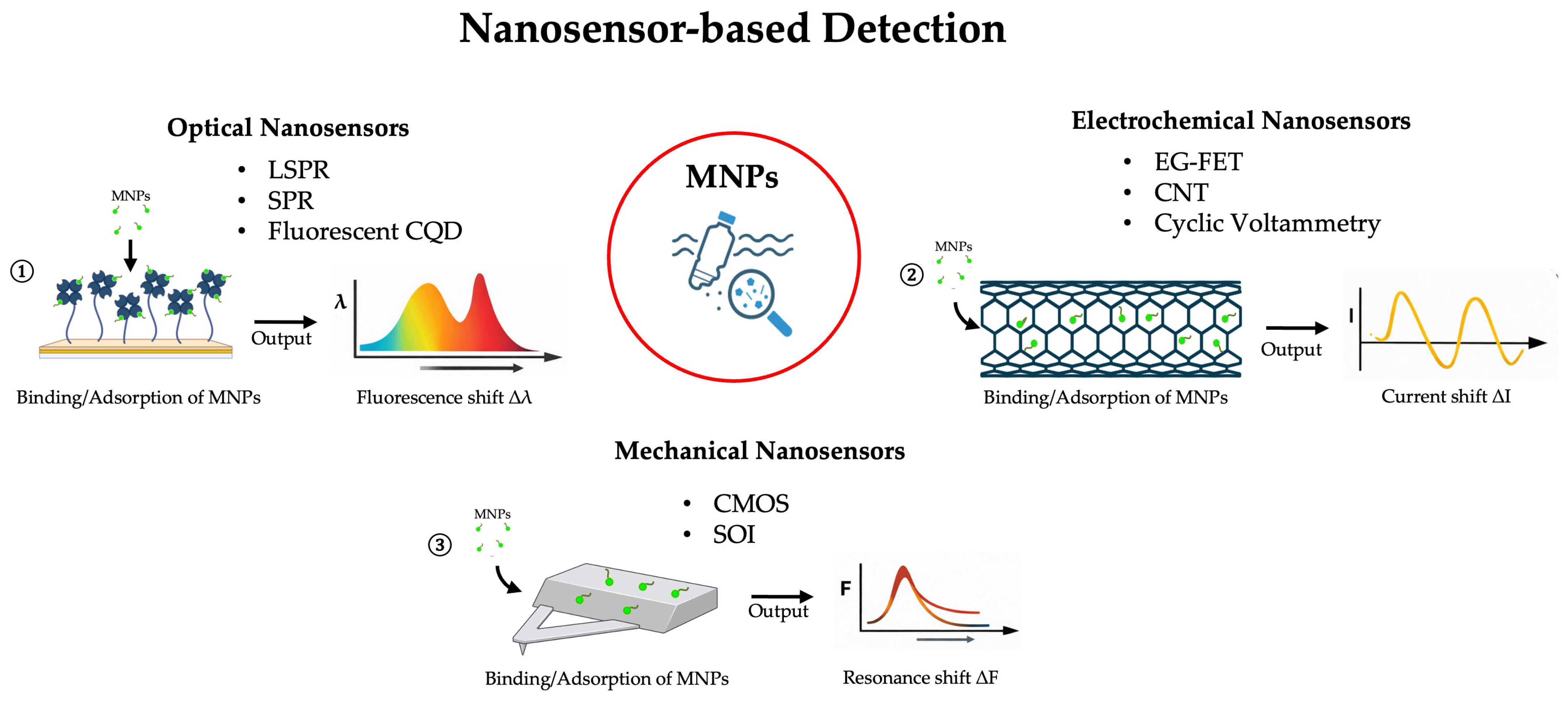
| Sensor Type | Nanomaterial Composition/Functionalization | Key Features and Detection Mechanism | Matrix/Application Domain | Challenges and Limitations | Ref. |
|---|---|---|---|---|---|
| Plasmonic (LSPR) biosensor | Gold nanoparticles (40–50 nm) functionalized with PS-specific oligopeptide probes; additional 5 nm AuNPs as sandwiching layer | Selective detection of fragmented PS nanoplastics; LSPR peak shift measured via UV–Vis; 60% enhanced sensitivity due to plasmonic coupling | Aquatic environments | Potential interference from coexisting colloids and natural organic matter; limited specificity toward other polymer types; requires precise nanoparticle size control | [46] |
| Multispectral LSPR (msLSPR) | Gold nanostructures (spheres, rods, bipyramids) | Real-time multispectral imaging; bipyramids showed superior uniformity and stronger responses; provides design guidelines for nanoplasmonic sensing | Biological matrices | Complex data analysis and instrumentation; sensitivity may vary with particle morphology and matrix refractive index fluctuations | [47] |
| Surface Plasmon Resonance (SPR) biosensor | Estrogen receptor (ER)-functionalized SPR chip | Monitored refractive index perturbations by PS, PVC, and PE; demonstrated bioselective binding and quantification; mimics receptor–plastic interactions | Biological matrices; Aquatics environment; Soil and sediments | Receptor stability and regeneration issues; possible non-specific adsorption; limited throughput for large-scale environmental monitoring | [48] |
| Fluorescent nanosensor/labeling system | Carbon quantum dots (CQDs) embedded in polyethylene (PE) using SiO2 supports | In situ synthesis under mild conditions; strong blue fluorescence (394–408 nm); applicable for polymer identification and traceability | Food products | Applicable mainly to pre-labeled or engineered plastics; limited use for native environmental MNPs; potential photobleaching and matrix fluorescence interference | [49] |
| Electrochemical nanosensor (MIP-based) | Graphene or carbon nanotube nanocomposites with metallic nanostructures and molecularly imprinted sites | Converts MNP binding into electrical signals; detection limits down to 10−11 M; label-free and high surface conductivity | Food products; Aquatic environments | Template removal and imprinting reproducibility challenges; potential fouling in complex matrices; selectivity limited to target imprint | [50] |
| Electrolyte-Gated FET (EG-CNTFET) | Carbon nanotube semiconducting channel | Sensitive to PS nanoparticles (functionalized and non-functionalized); 22.6 μA and 20.9 μA per mg/mL response; validated by AFM; hydrophobic interactions drive detection | Aquatic environments | Sensitivity strongly dependent on surface chemistry and ionic strength; device-to-device variability; limited polymer discrimination | [52] |
| Mechanical nanosensor (microcantilever) | CMOS-integrated piezoresistive microcantilever array (12 elements) | On-chip high-sensitivity detection (0.98 × 10⁻⁶ nm−1); <1 μV noise; detected IgG, abrin, SEB (LOD 48 pg/mL); suitable for high-performance biomolecule or MNP sensing | Biological matrices | High fabrication and calibration complexity; sensitivity to temperature and mechanical noise; indirect validation for MNP-specific detection | [54] |
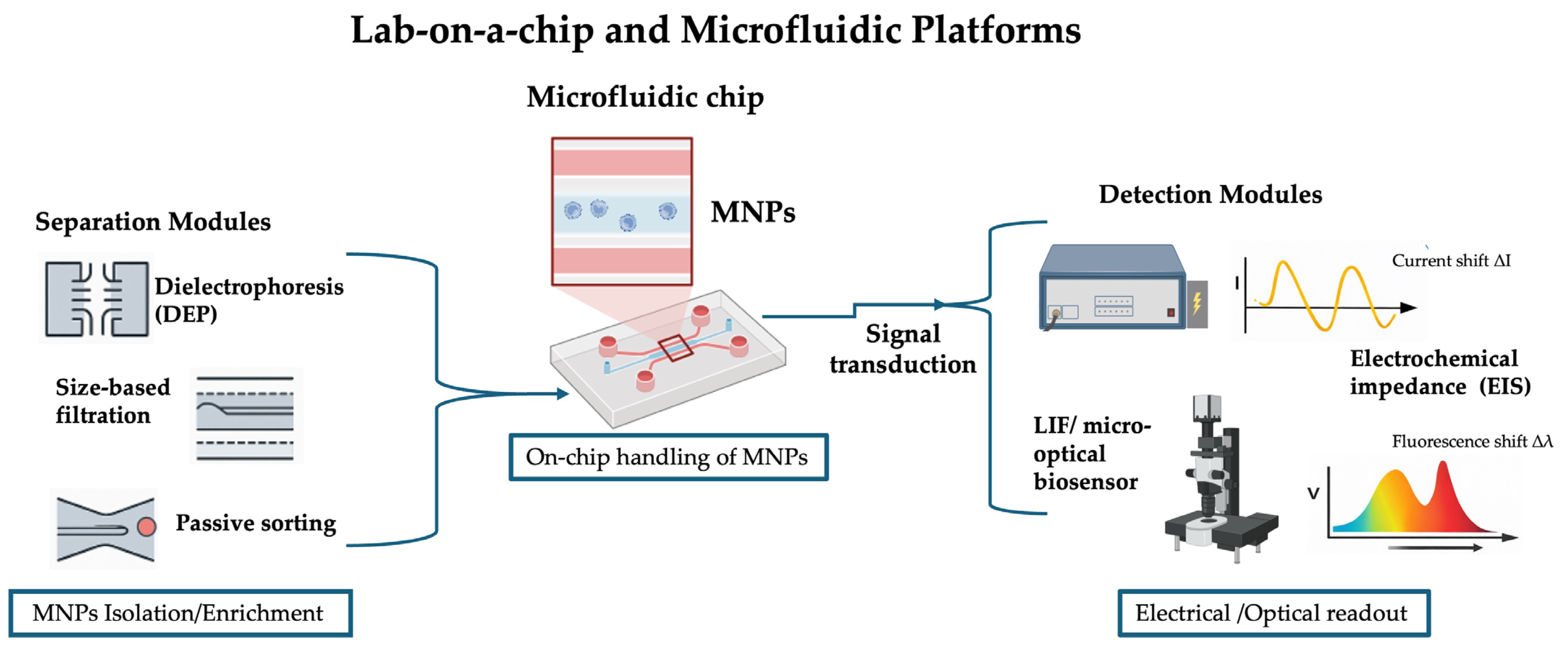
| Sensor Type | Nanomaterial Composition/Functionalization | Key Features and Detection Mechanism | Matrix/Application Domain | Challenges and Limitations | Ref. |
|---|---|---|---|---|---|
| Microfluidic biochip with interdigitated electrode arrays (IDAs) | Polymer-based microfluidic biochip integrating IDAs for DEP and EIS | Combines dielectrophoresis (DEP) for particle manipulation and electrochemical impedance spectroscopy (EIS) for detection; size-selective separation of 1.8 and 3.5 µm silica microspheres into distinct microchambers; quantitative impedance-based detection; scalable fabrication via micro-injection molding for disposable, low-cost devices | Aquatic environments | Limited discrimination for chemically similar polymers; performance influenced by conductivity and ionic strength of the medium; reduced sensitivity for nanoscale particles | [62] |
| Laser-induced fluorescence (LIF)-based micro-optical biosensor | Cyclic olefin copolymer (COC) optical waveguides integrated with poly(methyl methacrylate) (PMMA) microfluidic substrate containing microlens array and COC coupling prism | Highly sensitive fluorescence detection platform; hot-embossed PMMA channels and fly-cut COC waveguides (50 μm); SNR = 119, LOD = 7.34 × 10⁻²⁰ mol; microlens array enhances fluorescence collection efficiency; suitable for rapid detection of fluorescently labeled MNPs | Aquatic environments | Requires fluorescent labeling of MNPs; potential interference from background fluorescence; limited applicability to unlabeled or aged environmental plastics | [63] |
| Passive microfluidic particle separator | Polymethyl methacrylate (PMMA) microchannels fabricated by laser ablation | Passive, cost-effective device for size-based sorting of 15–40 µm particles; optimized by COMSOL Multiphysics; demonstrated 96.14% separation precision with chitosan microparticles; no cleanroom required; accessible and reproducible fabrication | Aquatic environments; Soil and sediments | Restricted to size-based separation; ineffective for sub-micron particles; lacks chemical or polymer-specific identification capability | [64] |
| Micro-optofluidic platform for microplastic quantification | Micro-reservoir and micro-filter system integrated on a microfluidic chip | Enables simultaneous quantification, size sorting, and spectroscopic identification (1–100 µm range); uses optical spectroscopy for polymer type determination; validated with mixed plastic standards; flow cytometry used as reference for size distribution | Aquatic environments; Soil and sediments | Limited sensitivity below 1 µm; optical signal attenuation in turbid matrices; relatively complex system integration and data processing | [65] |
| Sensor Type | Nanomaterial Composition/Functionalization | Key Features and Detection Mechanism | Matrix/Application Domain | Challenges and Limitations | Ref. |
|---|---|---|---|---|---|
| Solid-state nanopore sensor | Polyimide-coated silicon nitride (Si3N4) nanopores | Detects 200 nm carboxylated PS nanobeads via resistive pulse sensing; coating length influences signal amplitude and capture dynamics; high mechanical stability and reusability | Aquatic environments | Limited throughput due to single-pore operation; signal interpretation sensitive to pore geometry and surface charge; challenges in discriminating mixed polymer types | [68] |
| Tunable resistive pulse sensor (TRPS) | Thermoplastic polyurethane (TPU) nanopores functionalized with polymer brushes (poly(acrylic acid), neutral, or zwitterionic polymers) | Detects 500 nm PS beads; surface charge strongly affects pulse duration and ionic current rectification; tunable pore properties allow selectivity and control | Aquatic environments; Soil and sediments | Requires careful calibration and mechanical tuning; sensitivity decreases in highly polydisperse samples; fouling and clogging in complex environmental matrices | [69] |
| SERS-based nanoparticle aggregation platform | Silver nanoparticles (AgNPs, 56.7 ± 14.1 nm) aggregated with PS nanoplastics (1 µm and 50 nm) using MgSO4 as coagulant | SEM and SERS used to characterize aggregates; LOD ≈ 5 µg/mL for both PS sizes; clear PS spectral peaks even in spiked river water, confirming strong SERS sensitivity despite matrix interference | Aquatic environments; Soil and sediments | Aggregation-dependent reproducibility; quantitative accuracy affected by variable hotspot formation; limited specificity in mixed polymer systems | [70] |
| Quantitative AgNP–KI SERS system | Silver nanoparticles (50–60 nm) aggregated with PS nanoplastics via potassium iodide (KI) addition | KI acts as both aggregating and surface-cleaning agent; detects PS nanoplastics of 50–500 nm; LODs: 12.5 µg/mL (50 nm), 6.25 µg/mL (100 nm), 25 µg/mL (200–500 nm); enables size-resolved quantitative detection | Aquatic environments; Soil and sediments | Requires controlled aggregation conditions; sensitivity decreases for irregular or weathered plastics; potential spectral overlap in complex mixtures | [71] |
| Hybrid nanopore–microfluidic device | Decorated nanopore membrane integrated into reusable microfluidic chip | Detects proteins and gold nanorods; combines resistive and optical sensing; surface functionalization and flow control improve ionic conductance, signal stability, and sensor lifetime | Biological matrices; Food products | Not yet validated for environmental MNPs; fabrication and integration complexity; limited portability for field deployment | [72] |
| Sensor Type | Nanomaterial Composition/Functionalization | Key Features and Detection Mechanism | Matrix/Application Domain | Challenges and Limitations | Ref. |
|---|---|---|---|---|---|
| Magnetic nanoparticle adsorbent | Fe3O4@PDA (magnetite nanoparticles coated with polydopamine) | Achieved ~98.5% MP removal efficiency in river, lake, aquaculture, and urban waters; PDA shell enhances adhesion via hydrogen bonding, non covalent (π–π) stacking, and hydrophobic interactions | Aquatic environments | Limited selectivity among different polymer types; potential saturation and reduced efficiency after multiple reuse cycles; possible co-adsorption of natural organic matter | [73] |
| Janus magnetic microparticles (MJMs) | Aminated Fe3O4@SiO2 cores with asymmetric surface chemistry | Dual-surface functionality enables selective capture; achieved ~92% PS and ~60% PE removal within 20 min at 2 mg/mL; magnetically recoverable and reusable | Aquatic environments | Lower efficiency for non-aromatic polymers (e.g., PE); synthesis complexity; performance sensitive to particle orientation and surface stability | [74] |
| Graphene-based hybrid membrane | Reduced graphene oxide (rGO) nanosheets embedded with Co3O4 in a polymeric support (h-rGO) | High water flux, mechanical robustness, and environmental stability; removed PS microspheres efficiently from wastewater; reusable under multiple cycles | Aquatic environments; Soil and sediments | Membrane fouling by organic and inorganic species; limited removal efficiency for nanoplastics below pore-size threshold; fabrication cost and scalability challenges | [75,76] |
| Covalently adaptable GO membrane | Graphene oxide membrane modified with dynamic covalent adaptable networks | Efficient MP removal with structural integrity retention; reprocessable and recyclable, supporting circular use; suitable for continuous operation | Aquatic environments; Soil and sediments | Long-term chemical stability under harsh water conditions remains uncertain; limited data on polymer-specific selectivity; potential trade-off between adaptability and mechanical strength | [77] |
| Molecularly imprinted polymer (MIP) composite | Polymer matrix with imprinted cavities for polymer-like structures | High selectivity toward plastic fragments; adaptable for membrane integration or composite adsorbents; demonstrates feasibility for polymer-specific recognition | Aquatic environments; Soil and sediments | Template removal and imprint fidelity challenges; limited binding capacity; decreased performance in heterogeneous environmental samples | [78] |
| Tannic-acid-coated magnetic nanoparticles | Fe3O4 nanoparticles coated with tannic acid (polyphenolic surface) | Removed PS and PET MPs with 83–98% efficiency under optimal conditions; magnetic recovery; reduced performance in complex matrices due to fouling | Aquatic environments; Soil and sediments | Susceptibility to surface fouling and competitive adsorption; pH-dependent performance; gradual loss of activity after repeated regeneration cycles | [79] |
| Technology Class | Representative Platforms | Typical LOD | Analysis Time | Sensitivity | Cost | Throughput | Primary Application |
|---|---|---|---|---|---|---|---|
| Nanoplasmonic Sensors | LSPR, msLSPR, SPR biosensors | ng–µg/mL; RIU-based (10−6–10−8 RIU) | Minutes to <1 h | High (refractive index shifts, bioselective binding) | Moderate–high (optical instrumentation) | Medium (single-point or array-based) | Detection and identification |
| Electrochemical and FET-Based Sensors | MIP-electrochemical sensors, CNT-FET, EG-FET | 10−11–10−6 M; ng/mL | Minutes | Very high (current/impedance modulation) | Moderate | Medium | Detection and quantification |
| Mechanical Nanosensors | Microcantilever arrays | pg–ng/mL (mass-based) | Minutes | Very high (resonance/piezoresistive response) | High (fabrication and control) | Low–medium | High-precision sensing |
| Microfluidic and Optofluidic Platforms | DEP–EIS chips, LIF micro-optical sensors, optofluidic quantifiers | µg/mL to pg/mL (sub-fg for LIF with labeling) | Seconds to minutes | Moderate–high | Low–moderate (disposable chips) | High (continuous flow, parallelization) | Screening, sorting, quantification |
| Nanopore-Based Sensors | Solid-state nanopores, TRPS, hybrid nanopore–microfluidics | Single-particle sensitivity | Seconds to minutes | Very high (event-based detection) | Moderate–high | Low–medium | Size-resolved detection |
| SERS-Based Platforms | AgNP aggregation, KI-assisted SERS systems | ~1–25 µg/mL | Minutes | Very high (molecular fingerprinting) | Moderate–high | Low–medium | Polymer identification |
| Nanomaterial Capture and Removal Systems | Magnetic nanoparticles, Janus particles, GO/rGO membranes, MIP composites | Not applicable (removal-focused) | Minutes to hours | High capture efficiency (60–98%) | Low–moderate | High (bulk processing) | Separation and remediation |
Disclaimer/Publisher’s Note: The statements, opinions and data contained in all publications are solely those of the individual author(s) and contributor(s) and not of MDPI and/or the editor(s). MDPI and/or the editor(s) disclaim responsibility for any injury to people or property resulting from any ideas, methods, instructions or products referred to in the content. |
© 2025 by the authors. Licensee MDPI, Basel, Switzerland. This article is an open access article distributed under the terms and conditions of the Creative Commons Attribution (CC BY) license.
Share and Cite
Debri, R.P.; Sepe, F.; Romano, S.; D’Orazio, N.; De Lorenzo, A.; Calarco, A.; Conte, R.; Peluso, G. Nanodevice Approaches for Detecting Micro- and Nanoplastics in Complex Matrices. Nanomaterials 2026, 16, 55. https://doi.org/10.3390/nano16010055
Debri RP, Sepe F, Romano S, D’Orazio N, De Lorenzo A, Calarco A, Conte R, Peluso G. Nanodevice Approaches for Detecting Micro- and Nanoplastics in Complex Matrices. Nanomaterials. 2026; 16(1):55. https://doi.org/10.3390/nano16010055
Chicago/Turabian StyleDebri, Rita Paola, Fabrizia Sepe, Silvia Romano, Nicolantonio D’Orazio, Antonino De Lorenzo, Anna Calarco, Raffaele Conte, and Gianfranco Peluso. 2026. "Nanodevice Approaches for Detecting Micro- and Nanoplastics in Complex Matrices" Nanomaterials 16, no. 1: 55. https://doi.org/10.3390/nano16010055
APA StyleDebri, R. P., Sepe, F., Romano, S., D’Orazio, N., De Lorenzo, A., Calarco, A., Conte, R., & Peluso, G. (2026). Nanodevice Approaches for Detecting Micro- and Nanoplastics in Complex Matrices. Nanomaterials, 16(1), 55. https://doi.org/10.3390/nano16010055