Fiber Optic Micro-Hole Salinity Sensor Based on Femtosecond Laser Processing



Abstract
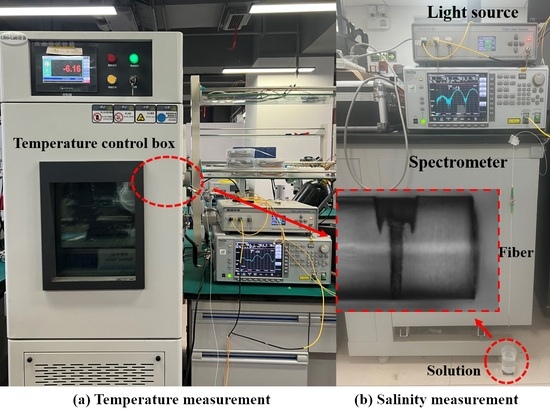
1. Introduction
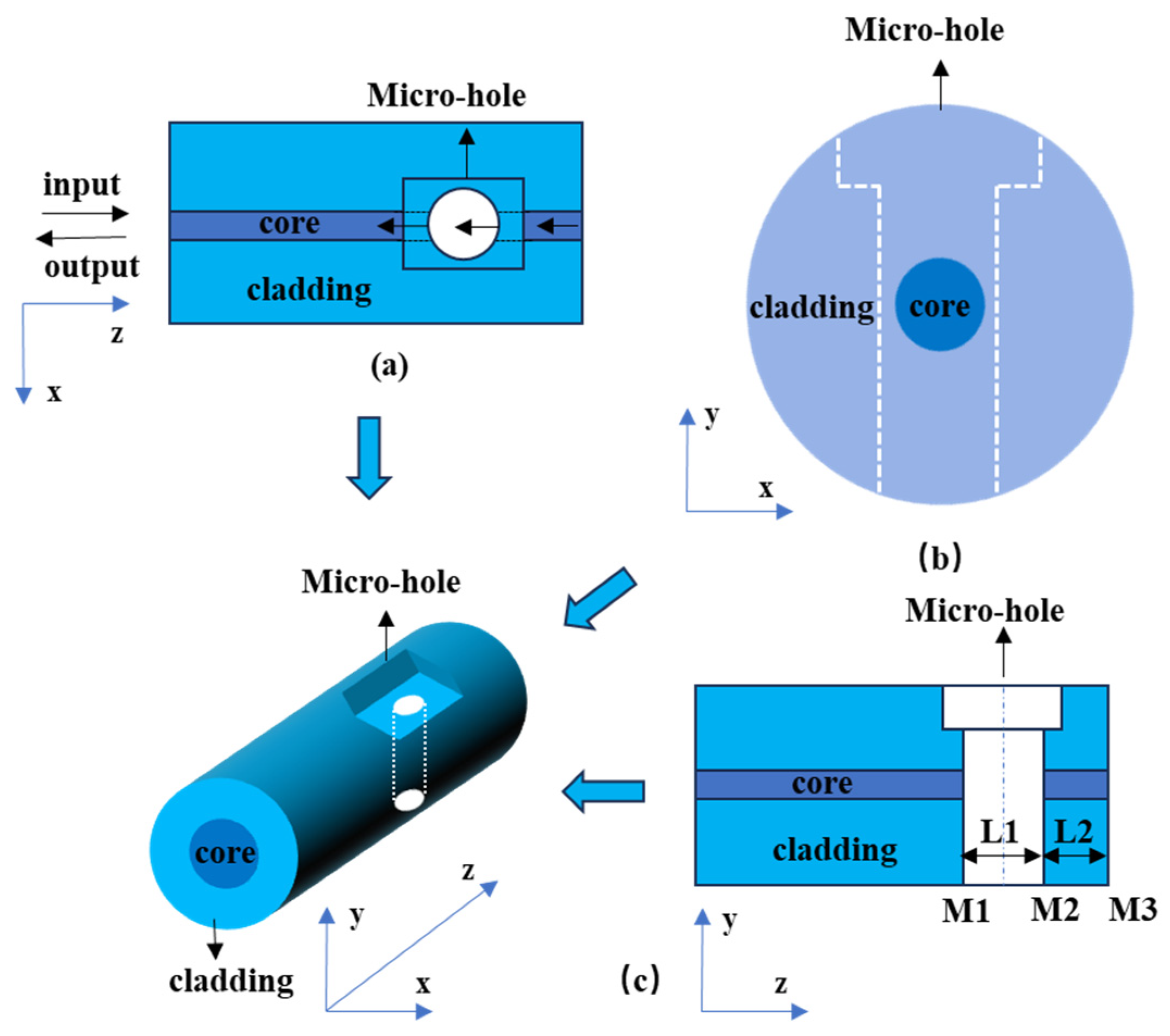
2. Sensor Structure Design and Working Principle
3. Simulation
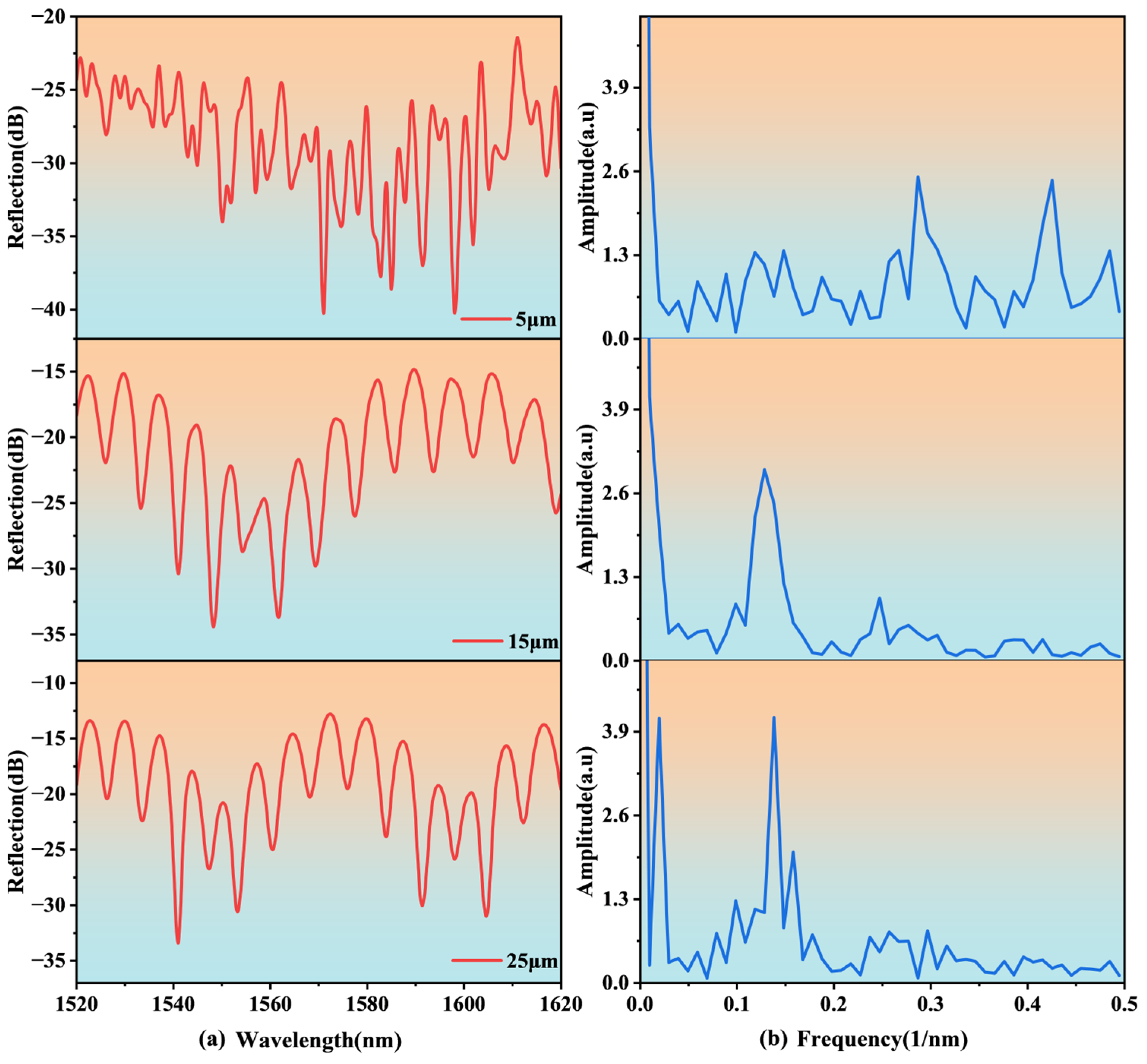
3.1. Reflection Spectrum Characteristics at Different Apertures
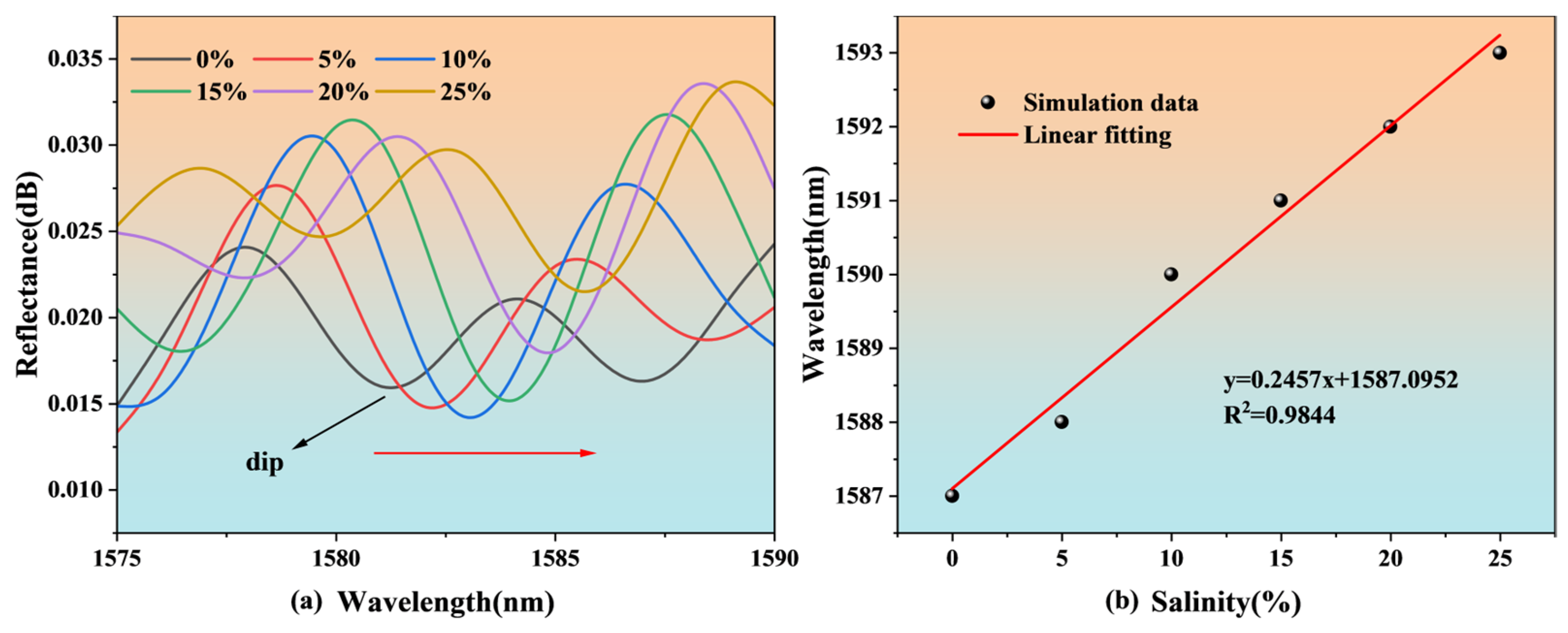
3.2. Reflection Spectrum Characteristics Under Different Salinities
4. Experiment
4.1. Processing
4.2. Test
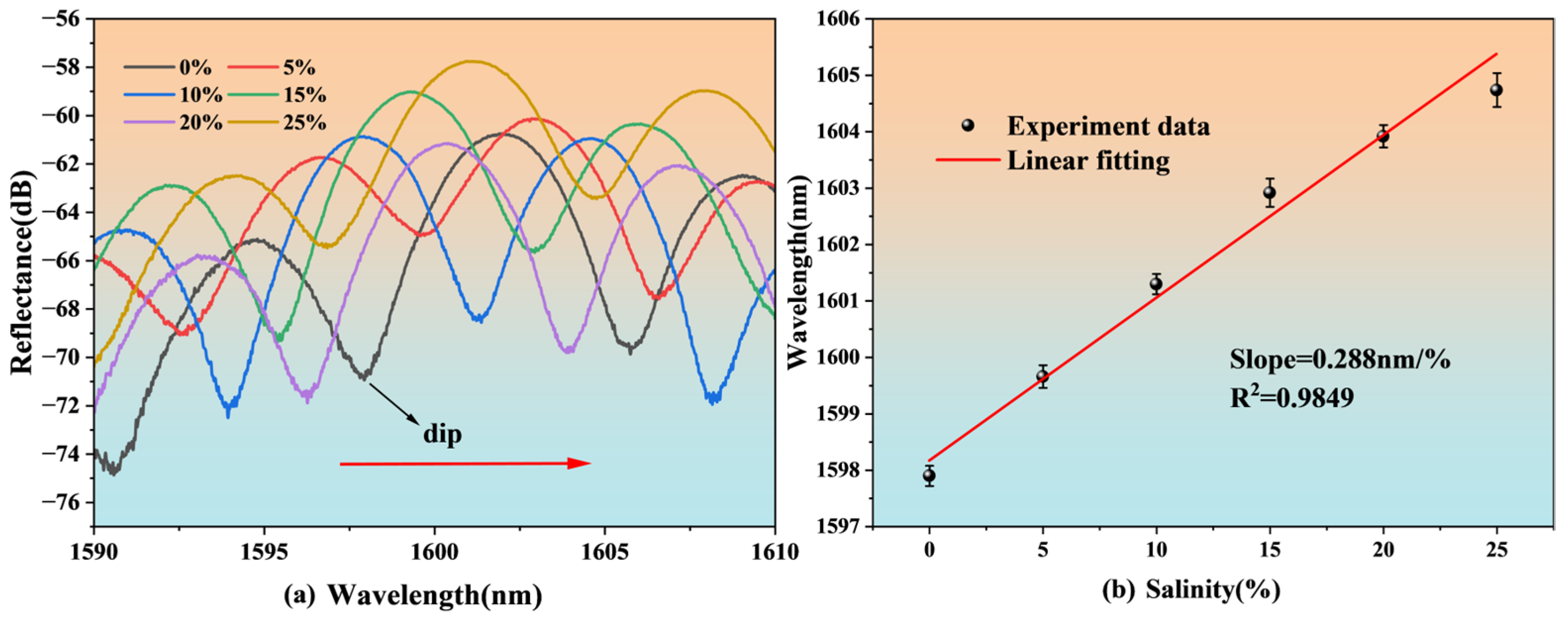
4.2.1. Salinity Experiment
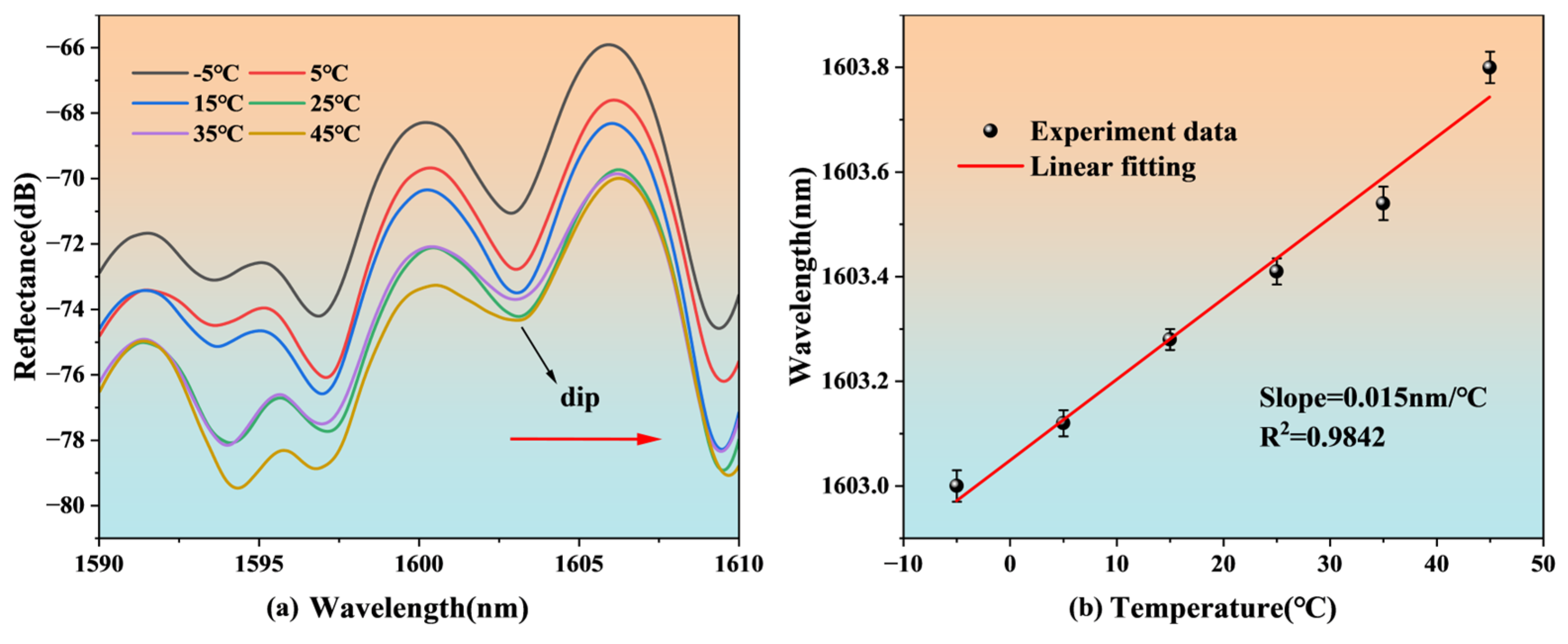
4.2.2. Temperature Experiment
5. Conclusions
Author Contributions
Funding
Data Availability Statement
Conflicts of Interest
References
- Li, G.; Wang, Y.; Shi, A.; Liu, Y.; Li, F. Review of Seawater Fiber Optic Salinity Sensors Based on the Refractive Index Detection Principle. Sensors 2023, 23, 2187. [Google Scholar] [CrossRef] [Scilit]
- Shi, Y.; Li, X.; Wang, P.; Zhang, Y.; Shi, B.; Li, Y. A review: Salinity and temperature measurement based on optical fiber sensors. Sens. Actuators A Phys. 2024, 380, 116040. [Google Scholar] [CrossRef] [Scilit]
- Wang, Y.; Tong, R.-j.; Zhao, K.-j.; Xing, B.; Li, X.; Hu, S.; Zhao, Y. Optical fiber sensor based on SPR and MZI for seawater salinity and temperature measurement. Opt. Laser Technol. 2023, 162, 109315. [Google Scholar] [CrossRef] [Scilit]
- Yuan, J.; Zhang, M.; Yu, G. Measurement of salinity in slurry based on modified electrical conductivity method. Meas. Sci. Technol. 2021, 32, 075801. [Google Scholar] [CrossRef] [Scilit]
- McDougall, T.J.; Jackett, D.R.; Millero, F.J. An algorithm for estimating Absolute Salinity in the global ocean. Ocean Sci. Discuss. 2009, 6, 215–242. [Google Scholar]
- Wang, L.; Wang, Y.j.; Song, S.; Li, F. Overview of fibre optic sensing technology in the field of physical ocean observation. Front. Phys. 2021, 9, 745487. [Google Scholar] [CrossRef] [Scilit]
- Zhao, S.; Du, C.; Wang, Q.; Jia, B.; Zhang, L.; Cui, L.; Deng, X.; Chen, S. A long period fiber grating seawater salinity sensor based on bend insensitive single mode fiber. Opt. Fiber Technol. 2023, 77, 103269. [Google Scholar] [CrossRef] [Scilit]
- Tong, R.-j.; Zhao, K.-j.; Xing, B.; Zheng, H.-n.; Wu, S.-c. An optical fiber sensor for salinity and temperature simultaneous detection based on dual SPR effect. Opt. Laser Technol. 2024, 175, 110760. [Google Scholar] [CrossRef] [Scilit]
- Zhang, S.-q.; Zhao, Y.; Peng, Y.; Zhao, J.-C. High-sensitivity optical fiber SPR sensor with cascaded biconical fiber and hetero-core structure for simultaneous measurement of seawater salinity and temperature. Opt. Laser Technol. 2024, 170, 110275. [Google Scholar] [CrossRef] [Scilit]
- Xue, D.; Zhang, H.; Wang, S.; Li, H.; Jiang, J.; Jia, D.; Liu, T. High sensitivity composite FP cavity fiber optic sensor based on MEMS for temperature and salinity measurement of seawater. Opt. Express 2023, 31, 33241–33252. [Google Scholar] [CrossRef] [Scilit] [PubMed]
- Lv, R.-Q.; Qu, J.-F.; Zhang, M.-X.; Li, S.-Q.; Liu, Y.-N. A simple combination method of MZI and MI for salinity measurement. IEEE Trans. Instrum. Meas. 2022, 71, 1–7. [Google Scholar] [CrossRef] [Scilit]
- Yi, D.; Huo, Z.; Tan, X.; Geng, Y.; Liu, F.; Li, X. Optimization analysis of lateral-offset Mach–Zehnder interferometer based on no-core fiber. IEEE Sens. J. 2021, 21, 14853–14859. [Google Scholar] [CrossRef] [Scilit]
- Guo, J.; Sun, M.; Fang, J.; Wei, G.; Shi, B.; Jiang, H. High-sensitivity seawater salinity sensing with cladding etched fiber Bragg grating technology. IEEE Sens. J. 2023, 23, 14182–14192. [Google Scholar] [CrossRef] [Scilit]
- Luo, D.; Ma, J.; Ibrahim, Z.; Ismail, Z. Etched FBG coated with polyimide for simultaneous detection the salinity and temperature. Opt. Commun. 2017, 392, 218–222. [Google Scholar] [CrossRef] [Scilit]
- Siyu, E.; Zhang, Y.-N.; Han, B.; Zheng, W.; Wu, Q.-L.; Zheng, H.-K. Two-channel surface plasmon resonance sensor for simultaneous measurement of seawater salinity and temperature. IEEE Trans. Instrum. Meas. 2020, 69, 7191–7199. [Google Scholar] [CrossRef] [Scilit]
- Wei, X.; Peng, Y.; Chen, X.; Zhang, S.; Zhao, Y. Optimization of tapered optical fiber sensor based on SPR for high sensitivity salinity measurement. Opt. Fiber Technol. 2023, 78, 103309. [Google Scholar] [CrossRef] [Scilit]
- Zhao, J.; Zhang, Y.-n.; Liu, Y.; Li, C.; Lian, Z.; Lv, R.; Zhao, Y. Lateral offset optical fiber modal interferometer sensor for simultaneous measurement of seawater temperature and salinity. Opt. Fiber Technol. 2021, 67, 102737. [Google Scholar] [CrossRef] [Scilit]
- Flores, R.; Janeiro, R.; Viegas, J. Optical fibre Fabry-Pérot interferometer based on inline microcavities for salinity and temperature sensing. Sci. Rep. 2019, 9, 9556. [Google Scholar] [CrossRef] [Scilit] [PubMed]
- Nguyen, L.V.; Vasiliev, M.; Alameh, K. Three-wave fiber Fabry–Pérot interferometer for simultaneous measurement of temperature and water salinity of seawater. IEEE Photonics Technol. Lett. 2011, 23, 450–452. [Google Scholar] [CrossRef] [Scilit]
- Rao, Y.-J.; Deng, M.; Duan, D.-W.; Yang, X.-C.; Zhu, T.; Cheng, G.-H. Micro Fabry-Perot interferometers in silica fibers machined by femtosecond laser. Opt. Express 2007, 15, 14123–14128. [Google Scholar] [CrossRef] [Scilit]
- Coelho, L.; Tafulo, P.A.; Jorge, P.A.; Santos, J.L.; Viegas, D.; Schuster, K.; Kobelke, J.; Frazão, O. Simultaneous measurement of partial pressure of O2 and CO2 with a hybrid interferometer. Opt. Lett. 2012, 37, 3063–3065. [Google Scholar] [CrossRef] [Scilit] [PubMed]
- Li, Y.; Zhang, J.; Sheng, Z.; Teng, H.; Liang, T.; Peng, X.; Lu, X.; Li, Y.; Tang, X. Spatial distribution of high-energy electron emission from water plasmas produced by femtosecond laser pulses. Phys. Rev. Lett. 2003, 90, 165002. [Google Scholar] [CrossRef] [Scilit] [PubMed]
- Liu, W.; Kosareva, O.; Golubtsov, I.; Iwasaki, A.; Becker, A.; Kandidov, V.; Chin, S. Femtosecond laser pulse filamentation versus optical breakdown in H2O. Appl. Phys. B 2003, 76, 215–229. [Google Scholar] [CrossRef] [Scilit]
- Lee, C.-L.; Lu, Y.; Chen, C.-H.; Ma, C.-T. Microhole-pair hollow core fiber Fabry–Perot interferometer micromachining by a femtosecond laser. Sens. Actuators A Phys. 2020, 302, 111798. [Google Scholar] [CrossRef] [Scilit]
- Liu, X.; Wang, Q.; Wang, D.N. Ultra compact and sensitive optical fiber interferometric refractive index sensor. Optik 2022, 254, 168642. [Google Scholar] [CrossRef] [Scilit]
- Jie, W.; Zongchen, Z.; Chao, J.; Changning, L.; Simei, S. Femtosecond Laser Precision Machining of Micropores in Single-Mode Fiber and Sensing Application. Laser Optoelectron. Prog. 2020, 57, 313–319. [Google Scholar]
- Nguyen, L.V.; Vasiliev, M.; Alameh, K. Water salinity fiber sensor with selectable sensitivity using a liquid-fillable composite in-fiber Fabry-Perot cavity. In Proceedings of the 7th International Symposium on High-Capacity Optical Networks and Enabling Technologies, Cairo, Egypt, 19–21 December 2010; pp. 161–165. [Google Scholar]
- Qiu, J.; Hong, W.; Wang, D.N.; Gao, D.; Wang, Y.; Li, Y. Transmission properties of the single mode fiber with a cross-sectional micro-channel investigated using time-domain finite difference (FDTD) method. Opt. Fiber Technol. 2011, 17, 580–585. [Google Scholar] [CrossRef] [Scilit]
- Liu, Y.; Qu, S.; Li, Y. Single microchannel high-temperature fiber sensor by femtosecond laser-induced water breakdown. Opt. Lett. 2013, 38, 335–337. [Google Scholar] [CrossRef] [Scilit] [PubMed]

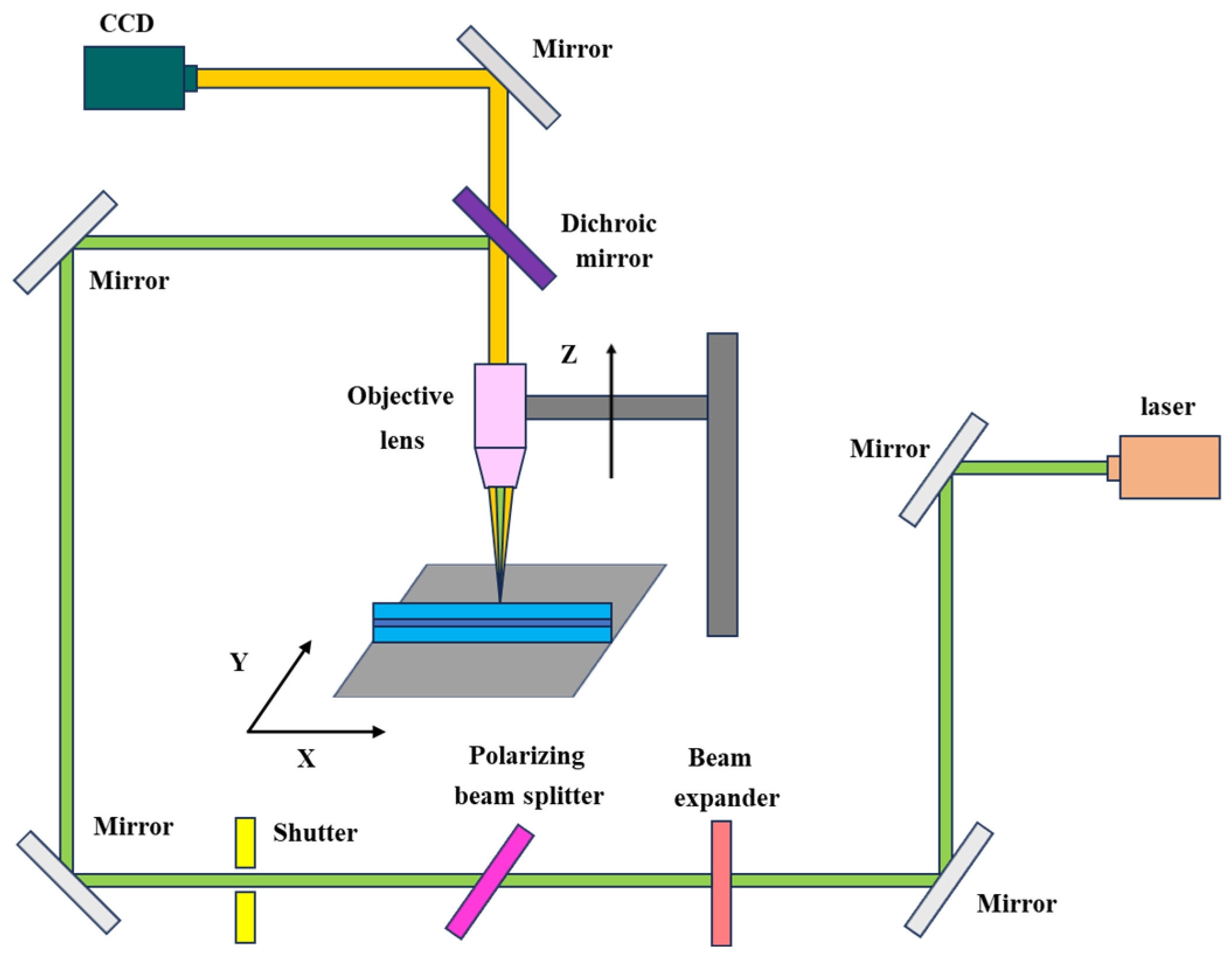
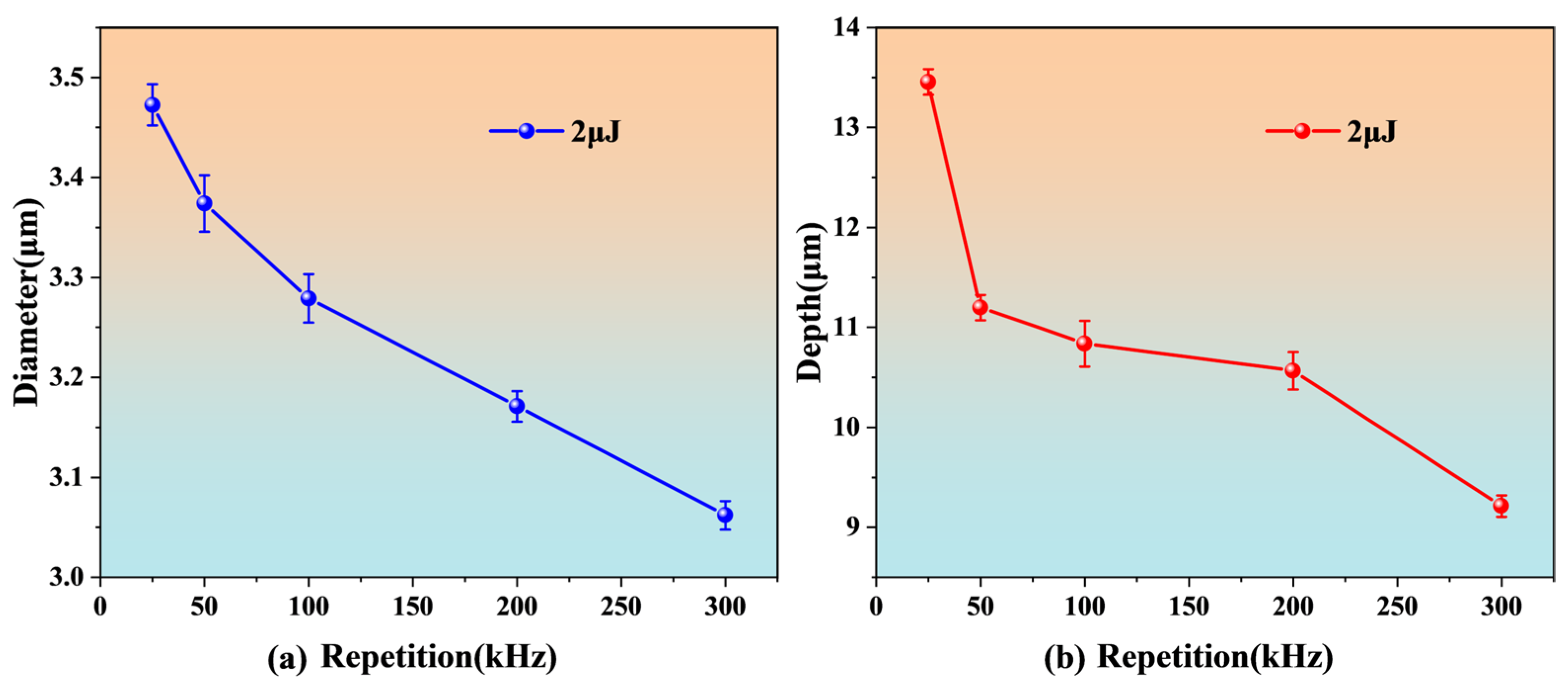
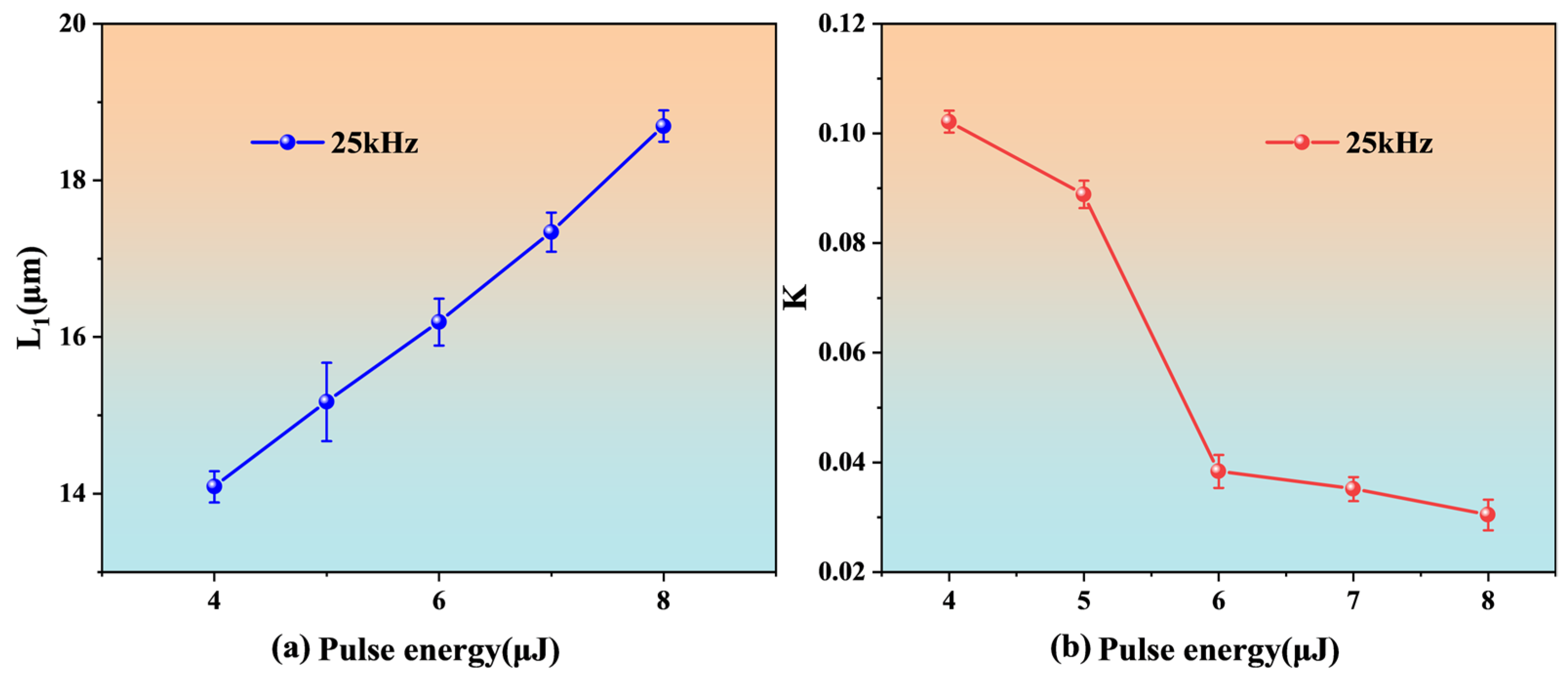
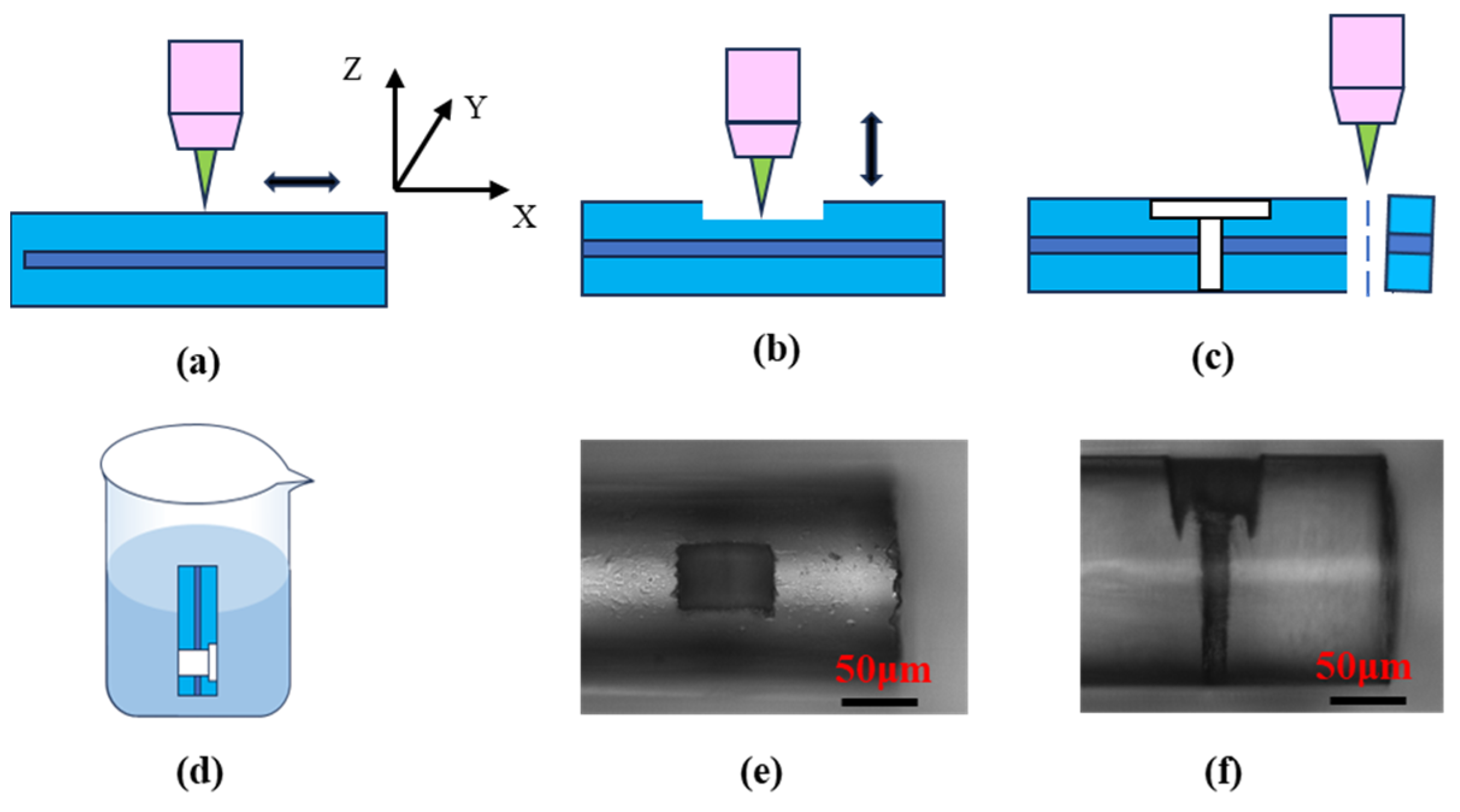



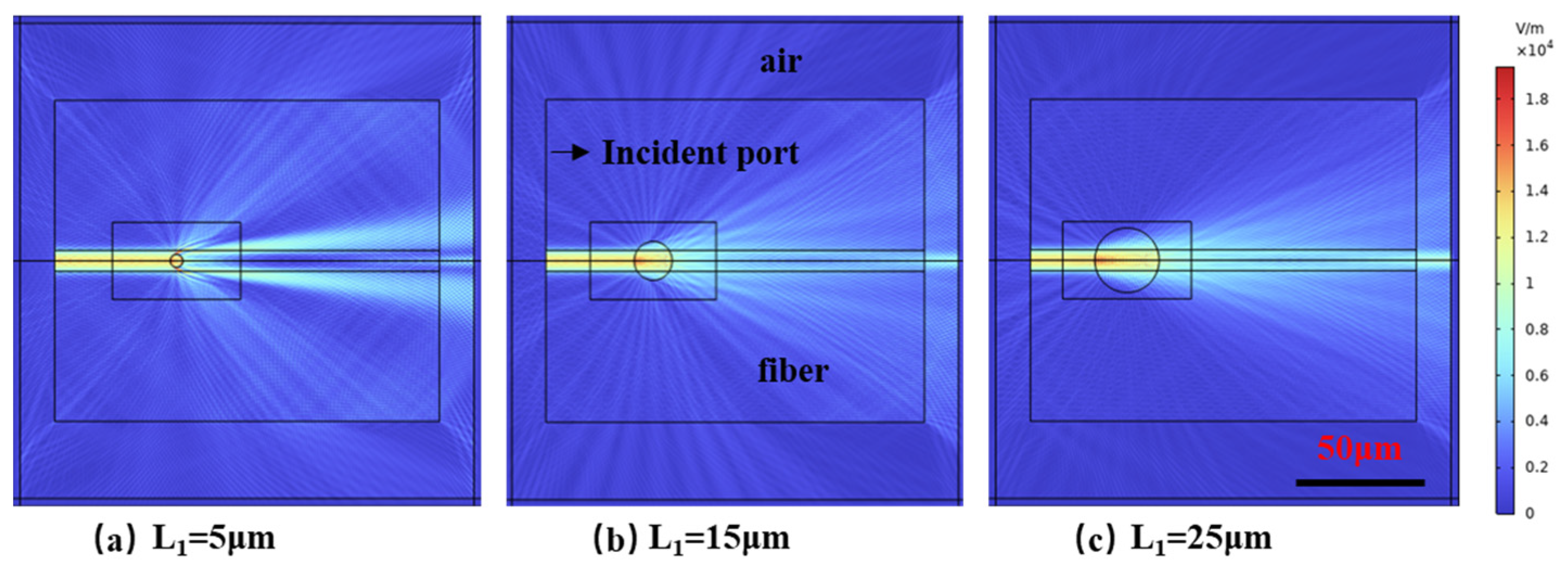
| Diameter | Scatter Loss | Transmittance |
|---|---|---|
| 5 μm | 0.9124 | 0.0874 |
| 15 μm | 0.7033 | 0.2938 |
| 25 μm | 0.5626 | 0.4286 |
Disclaimer/Publisher’s Note: The statements, opinions and data contained in all publications are solely those of the individual author(s) and contributor(s) and not of MDPI and/or the editor(s). MDPI and/or the editor(s) disclaim responsibility for any injury to people or property resulting from any ideas, methods, instructions or products referred to in the content. |
© 2025 by the authors. Licensee MDPI, Basel, Switzerland. This article is an open access article distributed under the terms and conditions of the Creative Commons Attribution (CC BY) license (https://creativecommons.org/licenses/by/4.0/).
Share and Cite
Li, C.; Fan, C.; Wu, H.; Sedao, X.; Wang, J. Fiber Optic Micro-Hole Salinity Sensor Based on Femtosecond Laser Processing. Nanomaterials 2025, 15, 60. https://doi.org/10.3390/nano15010060
Li C, Fan C, Wu H, Sedao X, Wang J. Fiber Optic Micro-Hole Salinity Sensor Based on Femtosecond Laser Processing. Nanomaterials. 2025; 15(1):60. https://doi.org/10.3390/nano15010060
Chicago/Turabian StyleLi, Chen, Chao Fan, Hao Wu, Xxx Sedao, and Jiang Wang. 2025. "Fiber Optic Micro-Hole Salinity Sensor Based on Femtosecond Laser Processing" Nanomaterials 15, no. 1: 60. https://doi.org/10.3390/nano15010060
APA StyleLi, C., Fan, C., Wu, H., Sedao, X., & Wang, J. (2025). Fiber Optic Micro-Hole Salinity Sensor Based on Femtosecond Laser Processing. Nanomaterials, 15(1), 60. https://doi.org/10.3390/nano15010060