Review

Advances in Nanodynamic Therapy for Cancer Treatment

by
Bingchang Zhang
,
Yan Huang
and
Yong Huang
*
State Key Laboratory of Targeting Oncology, National Center for International Research of Bio-Targeting Theranostics, Guangxi Key Laboratory of Bio-Targeting Theranostics, Collaborative Innovation Center for Targeting Tumor Diagnosis and Therapy, Guangxi Medical University, Nanning 530021, China
*
Author to whom correspondence should be addressed.
These authors contributed equally to this work.
Nanomaterials 2024, 14(7), 648; https://doi.org/10.3390/nano14070648
Submission received: 13 March 2024 / Revised: 4 April 2024 / Accepted: 7 April 2024 / Published: 8 April 2024

Abstract

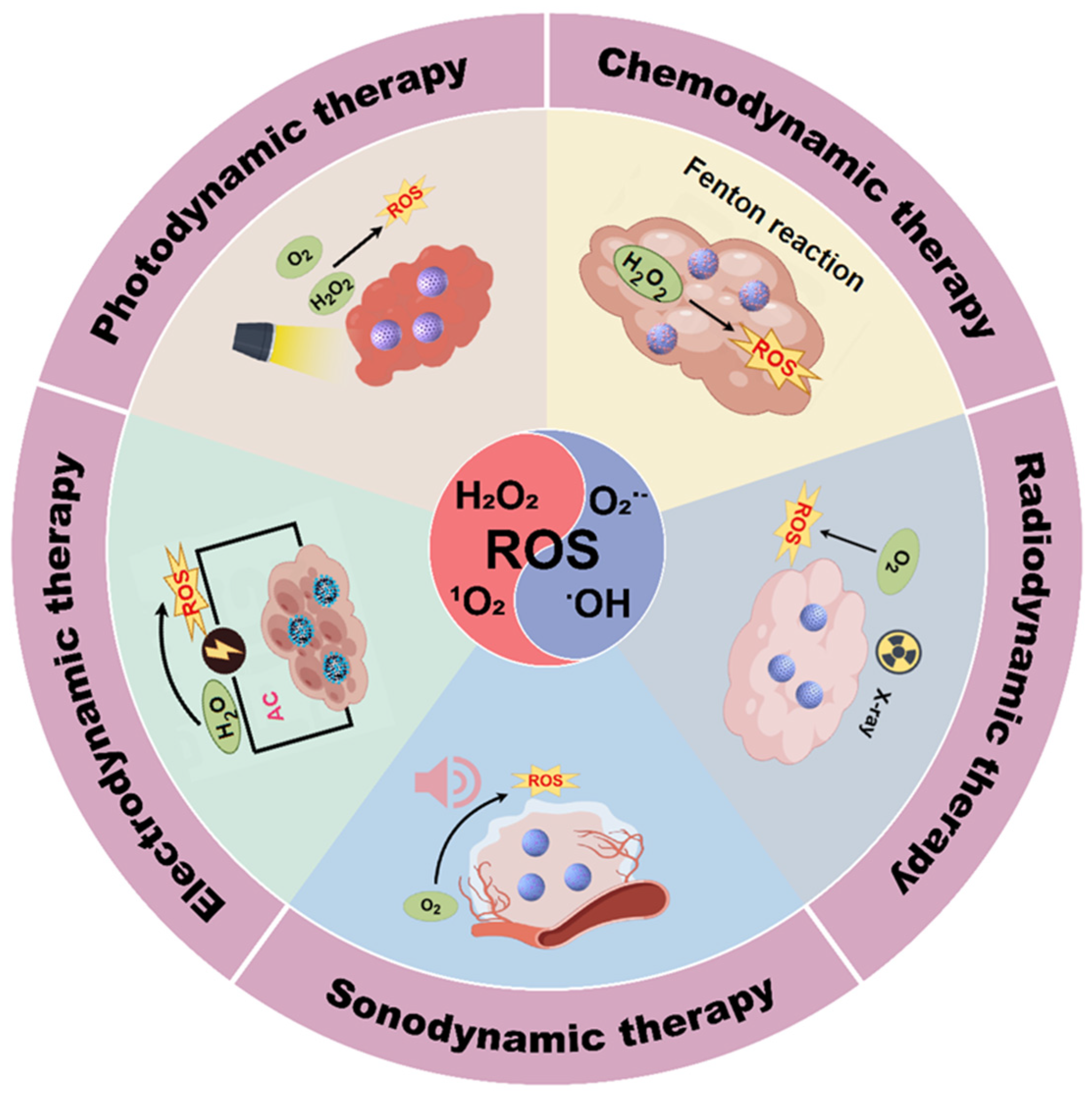
Nanodynamic therapy (NDT) exerts its anti-tumor effect by activating nanosensitizers to generate large amounts of reactive oxygen species (ROS) in tumor cells. NDT enhances tumor-specific targeting and selectivity by leveraging the tumor microenvironment (TME) and mechanisms that boost anti-tumor immune responses. It also minimizes damage to surrounding healthy tissues and enhances cytotoxicity in tumor cells, showing promise in cancer treatment, with significant potential. This review covers the research progress in five major nanodynamic therapies: photodynamic therapy (PDT), electrodynamic therapy (EDT), sonodynamic therapy (SDT), radiodynamic therapy (RDT), and chemodynamic therapy (CDT), emphasizing the significant role of advanced nanotechnology in the development of NDT for anti-tumor purposes. The mechanisms, effects, and challenges faced by these NDTs are discussed, along with their respective solutions for enhancing anti-tumor efficacy, such as pH response, oxygen delivery, and combined immunotherapy. Finally, this review briefly addresses challenges in the clinical translation of NDT.
Keywords: nanodynamic therapy; nanomaterials; tumor therapy; reactive oxygen species nanodynamic therapy; nanomaterials; tumor therapy; reactive oxygen species