


Nitrogen-Doped Carbon Dots Encapsulated a Polyoxomolybdate-Based Coordination Polymer as a Sensitive Platform for Trace Tetracycline Determination in Water

Abstract
1. Introduction
2. Experiment and Method
2.1. Materials
2.2. Instrumentation
2.3. Fabrication of NCDs@(4-Hap)4(Mo8O26)
2.4. Fluorescence Sensing of TC
2.5. Detection of TC in Environmental Samples
3. Results and Discussion
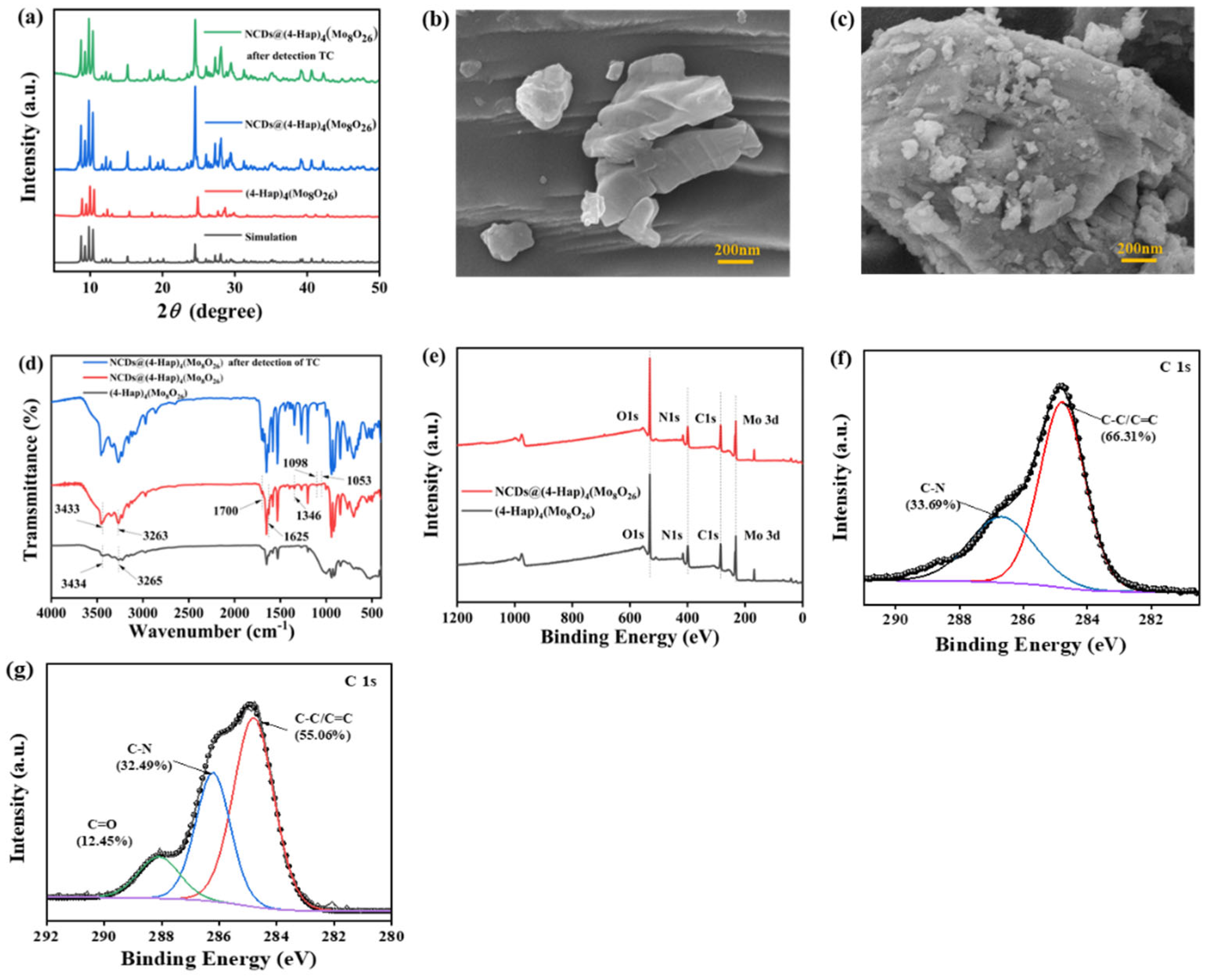
3.1. Characterization of Materials
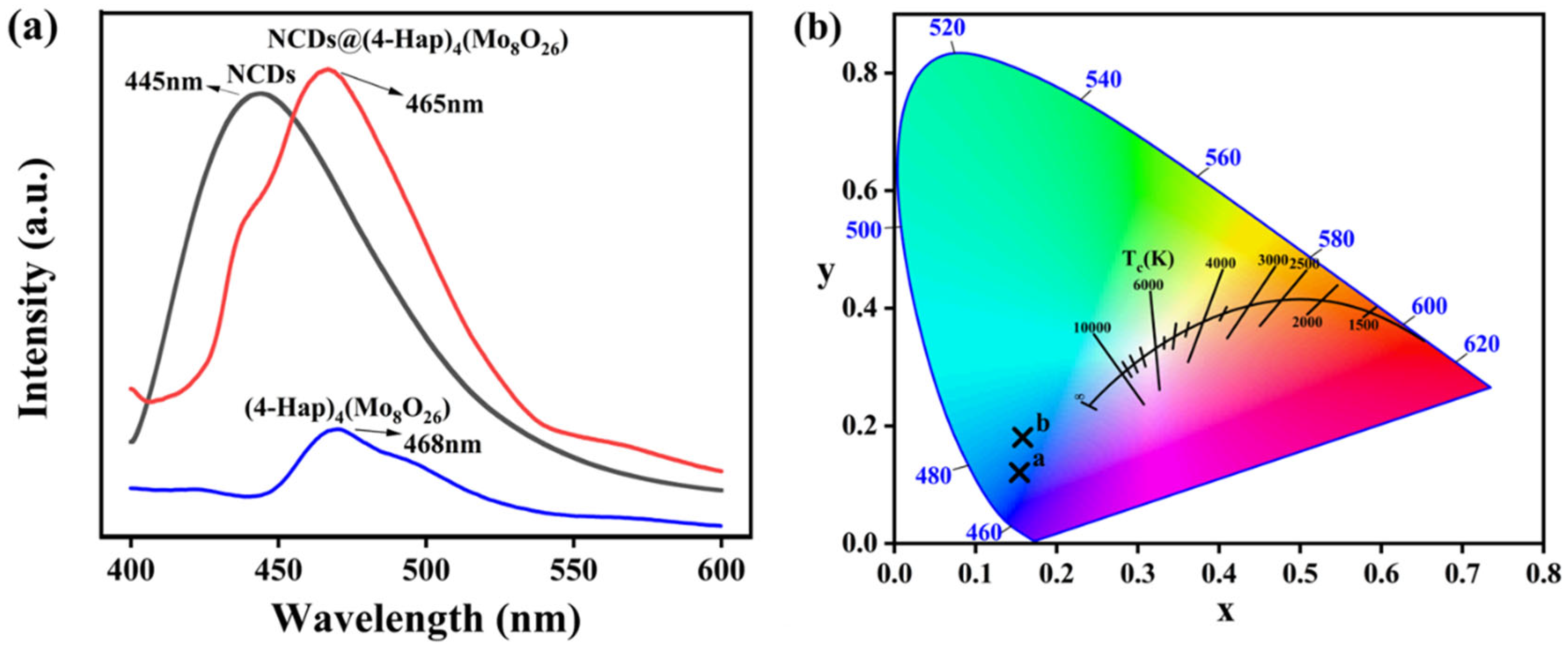
3.2. Luminescence of NCDs@(4-Hap)4(Mo8O26)
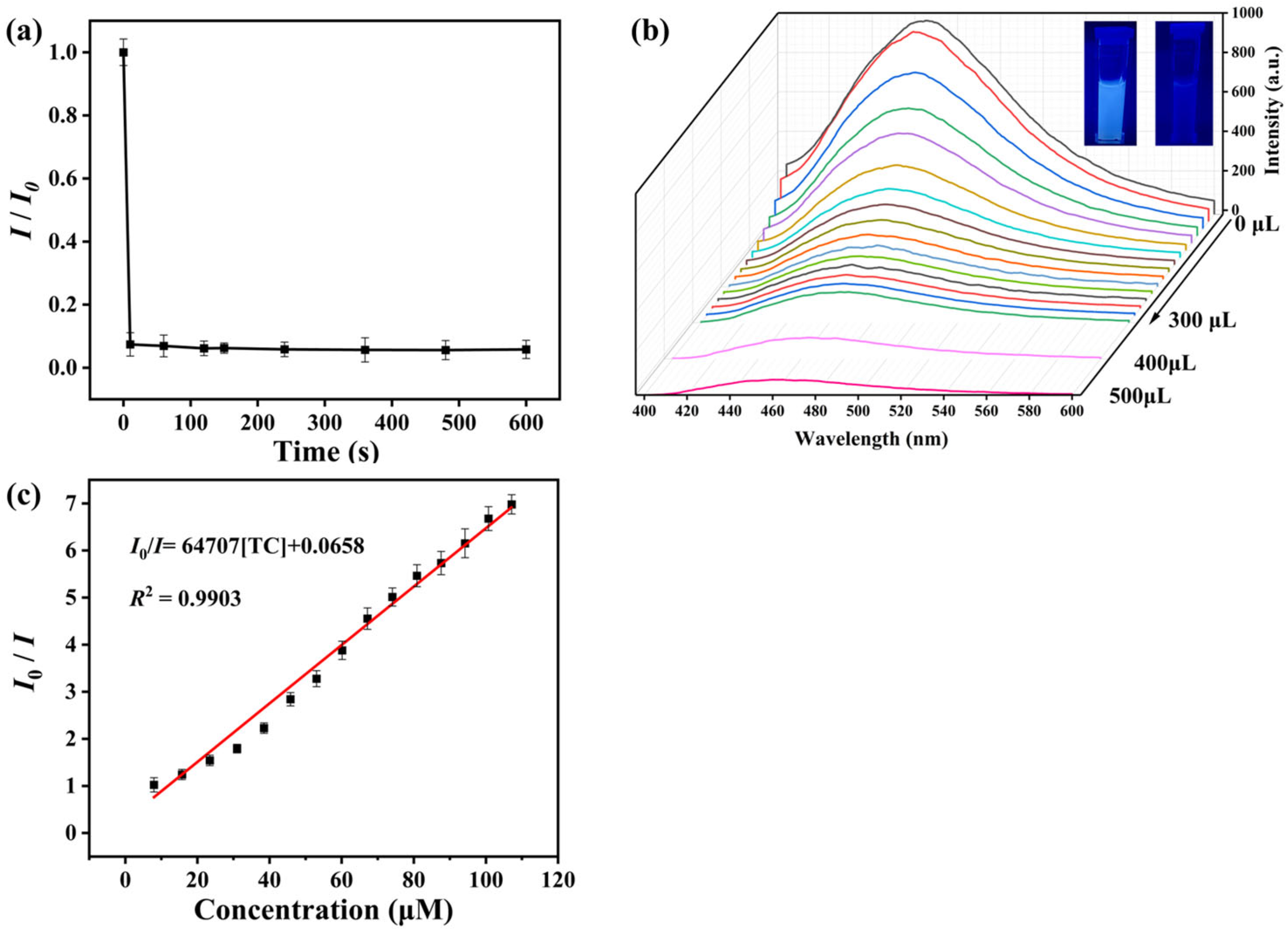
3.3. Sensing of TC
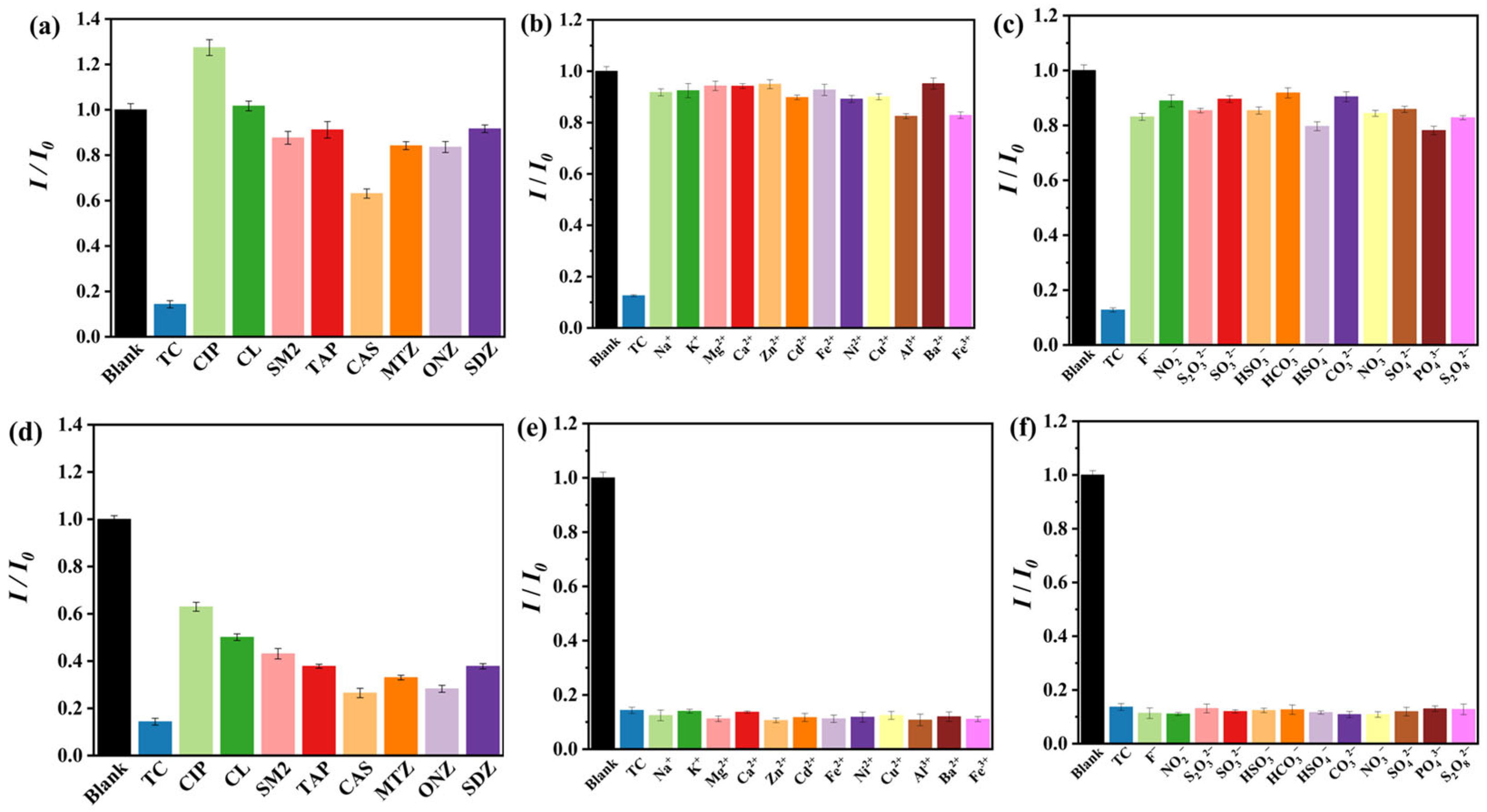
3.4. Selectivity and Anti-Interference
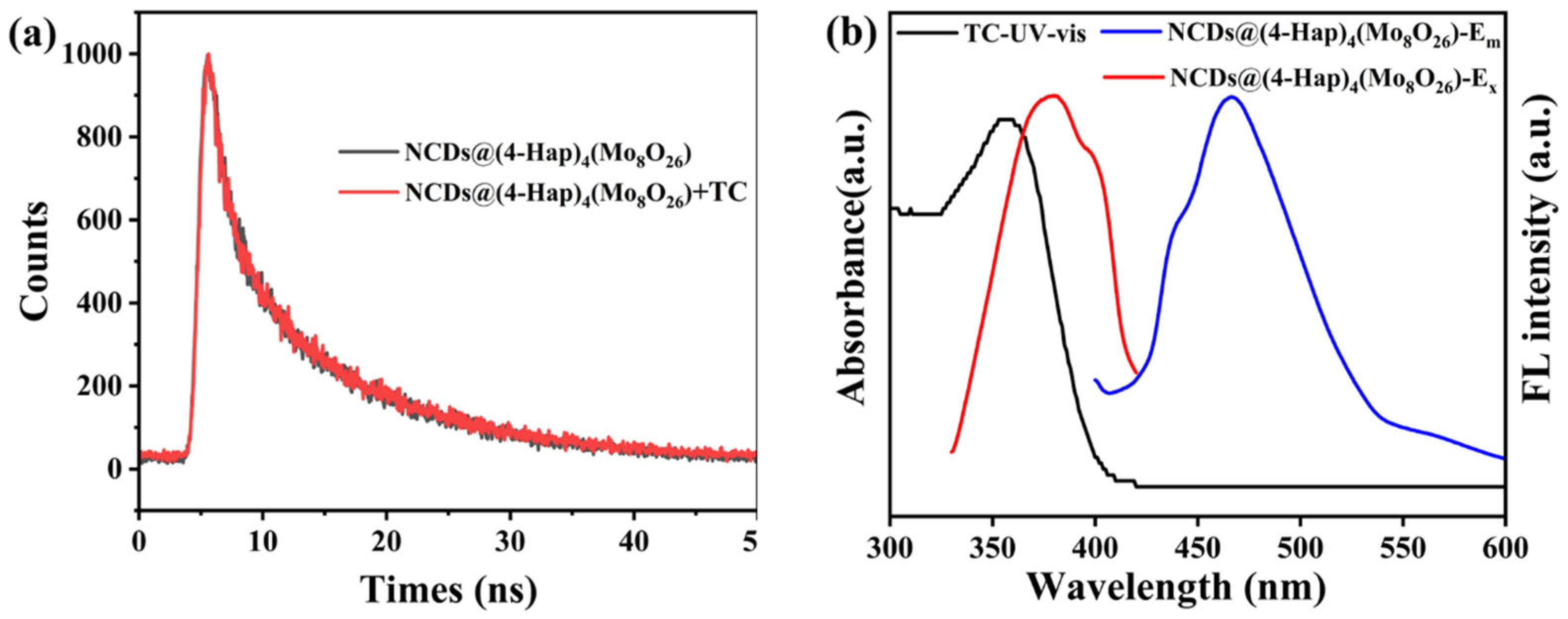
3.5. Mechanism of NCDs@(4-Hap)4(Mo8O26) for TC Detection
3.6. Sensing TC in Environmental Samples
4. Conclusions
Supplementary Materials
Author Contributions
Funding
Data Availability Statement
Acknowledgments
Conflicts of Interest
References
- Chen, Y.; Jiang, C.; Wang, Y.; Song, R.; Tan, Y.; Yang, Y.; Zhang, Z. Sources, Environmental Fate, and Ecological Risks of Antibiotics in Sediments of Asia’s Longest River: A Whole-Basin Investigation. Environ. Sci. Technol. 2022, 56, 14439–14451. [Google Scholar] [CrossRef] [Scilit] [PubMed]
- Center for Disease Dynamics, Economics & Policy. The State of the World’s Antibiotics. 2021. Available online: https://cddep.org/wp-content/uploads/2021/02/The-State-of-the-Worlds-Antibiotics-in-2021.pdf (accessed on 21 July 2022).
- Tiseo, K.; Huber, L.; Gilbert, M.; Robinson, T.P.; Van Boeckel, T.P. Global Trends in Antimicrobial Use in Food Animals from 2017 to 2030. Antibiotics 2020, 9, 918. [Google Scholar] [CrossRef] [Scilit] [PubMed]
- Danner, M.-C.; Robertson, A.; Behrends, V.; Reiss, J. Antibiotic pollution in surface fresh waters: Occurrence and effects. Sci. Total Environ. 2019, 664, 793–804. [Google Scholar] [CrossRef] [Scilit]
- Yang, Y.; Zhang, X.; Jiang, J.; Han, J.; Li, W.; Li, X.; Yee Leung, K.M.; Snyder, S.A.; Alvarez, P.J.J. Which Micropollutants in Water Environments Deserve More Attention Globally? Environ. Sci. Technol. 2022, 56, 13–29. [Google Scholar] [CrossRef] [Scilit]
- Peng, A.; Wang, C.; Zhang, Z.; Jin, X.; Gu, C.; Chen, Z. Tetracycline photolysis revisited: Overlooked day-night succession of the parent compound and metabolites in natural surface waters and associated ecotoxicity. Water Res. 2022, 225, 119197. [Google Scholar] [CrossRef] [Scilit] [PubMed]
- Leichtweis, J.; Vieira, Y.; Welter, N.; Silvestri, S.; Dotto, G.L.; Carissimi, E. A review of the occurrence, disposal, determination, toxicity and remediation technologies of the tetracycline antibiotic. Process Saf. Environ. 2022, 160, 25–40. [Google Scholar] [CrossRef] [Scilit]
- Lopes, C.E.C.; de Faria, L.V.; Araújo, D.A.G.; Richter, E.M.; Paixão, T.R.L.C.; Dantas, L.M.F.; Muñoz, R.A.A.; da Silva, I.S. Lab-made 3D-printed electrochemical sensors for tetracycline determination. Talanta 2023, 259, 124536. [Google Scholar] [CrossRef] [Scilit] [PubMed]
- Wang, B.; Gu, C.; Jiao, Y.; Gao, Y.; Liu, X.; Guo, J.; Qian, T. Novel preparation of red fluorescent carbon dots for tetracycline sensing and its application in trace determination. Talanta 2023, 253, 123975. [Google Scholar] [CrossRef] [Scilit] [PubMed]
- Sullam, E.M.; Adam, K.M.; Liu, J.; Chen, H.; Xiao, J. Silicon quantum dots-based fluorescent sensor for the detection of cobalt with high sensitivity and selectivity. Chin. Chem. Lett. 2023, 108476. [Google Scholar] [CrossRef] [Scilit]
- Bi, K.; Tan, R.; Hao, R.; Miao, L.; He, Y.; Xianghua, W.; Zhang, J.; Rui, X. A carbazole-hemicyanine dye based ratiometric fluorescent probe for selective detection of bisulfite (HSO3−) in cells and C. elegans. Chin. Chem. Lett. 2019, 30, 545–548. [Google Scholar] [CrossRef] [Scilit]
- Koshevoi, E.I.; Samsonenko, D.G.; Dorovatovskii, P.V.; Lazarenko, V.A.; Fedin, V.P. Crystal Structure of Metal-Organic Coordination Polymers Based on Potassium and Barium Cations with α-Cyclodextrin. J. Struct. Chem. 2020, 61, 431–438. [Google Scholar] [CrossRef] [Scilit]
- Wang, F.-X.; Zhang, Z.-C.; Wang, C.-C. Selective oxidation of aqueous organic pollutants over MOFs-based catalysts: A mini review. Chem. Eng. J. 2023, 459, 141538. [Google Scholar] [CrossRef] [Scilit]
- Wang, F.; Liu, S.-S.; Feng, Z.; Fu, H.; Wang, M.; Wang, P.; Liu, W.; Wang, C.-C. High-efficient peroxymonosulfate activation for rapid atrazine degradation by FeSx@MoS2 derived from MIL-88A(Fe). J. Hazard. Mater. 2022, 440, 129723. [Google Scholar] [CrossRef] [Scilit] [PubMed]
- Wang, C.-C.; Ren, X.; Wang, P.; Chang, C. The state of the art review on photocatalytic Cr(VI) reduction over MOFs-based photocatalysts: From batch experiment to continuous operation. Chemosphere 2022, 303, 134949. [Google Scholar] [CrossRef] [Scilit]
- Suresh, K.; Matzger, A.J. Enhanced Drug Delivery by Dissolution of Amorphous Drug Encapsulated in a Water Unstable Metal–Organic Framework (MOF). Angew. Chem. Int. Ed. 2019, 58, 16790–16794. [Google Scholar] [CrossRef] [Scilit]
- Wang, Y.; Yan, J.; Wen, N.; Xiong, H.; Cai, S.; He, Q.; Hu, Y.; Peng, D.; Liu, Z.; Liu, Y. Metal-organic frameworks for stimuli-responsive drug delivery. Biomaterials 2020, 230, 119619. [Google Scholar] [CrossRef] [Scilit]
- Li, Y.-H.; Wang, C.-C.; Zeng, X.; Sun, X.-Z.; Zhao, C.; Fu, H.; Wang, P. Seignette salt induced defects in Zr-MOFs for boosted Pb(Ⅱ) adsorption: Universal strategy and mechanism insight. Chem. Eng. J. 2022, 442, 136276. [Google Scholar] [CrossRef] [Scilit]
- Zhang, Y.-Q.; Wang, C.-C.; Zhu, T.; Wang, P.; Gao, S.-J. Ultra-high uptake and selective adsorption of organic dyes with a novel polyoxomolybdate-based organic–inorganic hybrid compound. RSC Adv. 2015, 5, 45688–45692. [Google Scholar] [CrossRef] [Scilit]
- Li, H.; Shi, L.; Li, C.; Fu, X.; Huang, Q.; Zhang, B. Metal–Organic Framework Based on α-Cyclodextrin Gives High Ethylene Gas Adsorption Capacity and Storage Stability. ACS Appl. Mater. Interfaces 2020, 12, 34095–34104. [Google Scholar] [CrossRef] [Scilit] [PubMed]
- Qasem, N.A.A.; Ben-Mansour, R.; Habib, M.A. An efficient CO2 adsorptive storage using MOF-5 and MOF-177. Appl. Energy 2018, 210, 317–326. [Google Scholar] [CrossRef] [Scilit]
- Wang, C.-Y.; Wang, C.-C.; Zhang, X.-W.; Ren, X.-Y.; Yu, B.; Wang, P.; Zhao, Z.-X.; Fu, H. A new Eu-MOF for ratiometrically fluorescent detection toward quinolone antibiotics and selective detection toward tetracycline antibiotics. Chin. Chem. Lett. 2022, 33, 1353–1357. [Google Scholar] [CrossRef] [Scilit]
- Zhang, Y.; Sun, M.; Peng, M.; Du, E.; Xu, X.; Wang, C.-C. The fabrication strategies and enhanced performances of metal-organic frameworks and carbon dots composites: State of the art review. Chin. Chem. Lett. 2023, 34, 107478. [Google Scholar] [CrossRef] [Scilit]
- Si, Y.; Li, Y.; Yang, G.; Zhang, S.; Yang, L.; Dai, W.; Wang, H. Zeolitic imidazolate framework-8 for ratiometric fluorescence sensing tetracyclines in environmental water based on AIE effects. Anal. Chim. Acta 2022, 1199, 339576. [Google Scholar] [CrossRef] [Scilit]
- Leng, F.; Zhao, X.J.; Wang, J.; Li, Y.F. Visual detection of tetracycline antibiotics with the turned on fluorescence induced by a metal–organic coordination polymer. Talanta 2013, 107, 396–401. [Google Scholar] [CrossRef] [Scilit]
- Zhao, J.; Gong, J.; Wei, J.; Yang, Q.; Li, G.; Tong, Y.; He, W. Metal organic framework loaded fluorescent nitrogen-doped carbon nanozyme with light regulating redox ability for detection of ferric ion and glutathione. J. Colloid Interface Sci. 2022, 618, 11–21. [Google Scholar] [CrossRef] [Scilit] [PubMed]
- Zhang, R.; Chen, W. Nitrogen-doped carbon quantum dots: Facile synthesis and application as a “turn-off” fluorescent probe for detection of Hg2+ ions. Biosens. Bioelectron. 2014, 55, 83–90. [Google Scholar] [CrossRef] [Scilit] [PubMed]
- Guo, X.; Wang, C.-F.; Yu, Z.-Y.; Chen, L.; Chen, S. Facile access to versatile fluorescent carbon dots toward light-emitting diodes. Chem. Commun. 2012, 48, 2692–2694. [Google Scholar] [CrossRef] [Scilit] [PubMed]
- Cao, L.; Wang, X.; Meziani, M.J.; Lu, F.; Wang, H.; Luo, P.G.; Lin, Y.; Harruff, B.A.; Veca, L.M.; Murray, D.; et al. Carbon Dots for Multiphoton Bioimaging. J. Am. Chem. Soc. 2007, 129, 11318–11319. [Google Scholar] [CrossRef] [Scilit]
- Feng, J.-F.; Gao, S.-Y.; Shi, J.; Liu, T.-F.; Cao, R. C-QDs@UiO-66-(COOH)2 Composite Film via Electrophoretic Deposition for Temperature Sensing. Inorg. Chem. 2018, 57, 2447–2454. [Google Scholar] [CrossRef] [Scilit]
- Wei, W.; Lu, R.; Tang, S.; Liu, X. Highly cross-linked fluorescent poly(cyclotriphosphazene-co-curcumin) microspheres for the selective detection of picric acid in solution phase. J. Mater. Chem. A 2015, 3, 4604–4611. [Google Scholar] [CrossRef] [Scilit]
- Wang, X.-S.; Li, L.; Yuan, D.-Q.; Huang, Y.-B.; Cao, R. Fast, highly selective and sensitive anionic metal-organic framework with nitrogen-rich sites fluorescent chemosensor for nitro explosives detection. J. Hazard. Mater. 2018, 344, 283–290. [Google Scholar] [CrossRef] [Scilit]
- Uriarte, D.; Domini, C.; Garrido, M. New carbon dots based on glycerol and urea and its application in the determination of tetracycline in urine samples. Talanta 2019, 201, 143–148. [Google Scholar] [CrossRef] [Scilit]
- Chen, J.; Xu, Y.; Li, S.; Xu, F.; Zhang, Q. Ratio fluorescence detection of tetracycline by a Eu3+/NH2-MIL-53(Al) composite. RSC Adv. 2021, 11, 2397–2404. [Google Scholar] [CrossRef] [Scilit]
- Zhou, Y.; Yang, Q.; Zhang, D.; Gan, N.; Li, Q.; Cuan, J. Detection and removal of antibiotic tetracycline in water with a highly stable luminescent MOF. Sens. Actuators B Chem. 2018, 262, 137–143. [Google Scholar] [CrossRef] [Scilit]
- Fan, Y.J.; Wang, Z.G.; Su, M.; Liu, X.T.; Shen, S.G.; Dong, J.X. A dual-signal fluorescent colorimetric tetracyclines sensor based on multicolor carbon dots as probes and smartphone-assisted visual assay. Anal. Chim. Acta 2023, 1247, 340843. [Google Scholar] [CrossRef] [Scilit]
- Meng, L.; Lan, C.; Liu, Z.; Xu, N.; Wu, Y. A novel ratiometric fluorescence probe for highly sensitive and specific detection of chlorotetracycline among tetracycline antibiotics. Anal. Chim. Acta 2019, 1089, 144–151. [Google Scholar] [CrossRef] [Scilit]
- Sianglam, P.; Ngamdee, K.; Ittisanronnachai, S.; Promarak, V.; Ren, X.-K.; Ngeontae, W. An effective strategy for the detection of tetracycline by N,S-doped carbon nanodots after preconcentration with a hybrid functional nanocomposite. Microchem. J. 2022, 183, 108025. [Google Scholar] [CrossRef] [Scilit]
- Jayaweera, S.; Yin, K.; Ng, W.J. Nitrogen-Doped Durian Shell Derived Carbon Dots for Inner Filter Effect Mediated Sensing of Tetracycline and Fluorescent Ink. J. Fluoresc. 2019, 29, 221–229. [Google Scholar] [CrossRef] [Scilit] [PubMed]
- Lian, X.; Yan, B. Novel core–shell structure microspheres based on lanthanide complexes for white-light emission and fluorescence sensing. Dalton Trans. 2016, 45, 2666–2673. [Google Scholar] [CrossRef] [Scilit] [PubMed]
- Hu, F.-l.; Shi, Y.-X.; Chen, H.-H.; Lang, J.-P. A Zn(ii) coordination polymer and its photocycloaddition product: Syntheses, structures, selective luminescence sensing of iron(iii) ions and selective absorption of dyes. Dalton Trans. 2015, 44, 18795–18803. [Google Scholar] [CrossRef] [Scilit] [PubMed]
- Li, C.; Zeng, C.; Chen, Z.; Jiang, Y.; Yao, H.; Yang, Y.; Wong, W.-T. Luminescent lanthanide metal-organic framework test strip for immediate detection of tetracycline antibiotics in water. J. Hazard. Mater. 2020, 384, 121498. [Google Scholar] [CrossRef] [Scilit] [PubMed]
- Wang, Y.; He, J.; Zheng, M.; Qin, M.; Wei, W. Dual-emission of Eu based metal-organic frameworks hybrids with carbon dots for ratiometric fluorescent detection of Cr(VI). Talanta 2019, 191, 519–525. [Google Scholar] [CrossRef] [Scilit] [PubMed]

| Material | LOD (nM) | Linear Range (µM) | Ref |
|---|---|---|---|
| GUCDs | 165 | 0.5–25 | [33] |
| NH2-MIL-53(Al) | 920 | 1.5–70 | [34] |
| PCN-128Y | 30 | 0–1 | [35] |
| Europium-doped carbon dots | 15.8 | 0–623.8 | [36] |
| BSA-AuNCs | 65 | 0.2–10 | [37] |
| N,S-doped carbon nanodots | 160 | 0.8–10 | [38] |
| Nitrogen-doped durian shell-derived carbon dots | 75 | 0–30 | [39] |
| NCDs@(4-Hap)4(Mo8O26) | 33.9 | 8–107 | This work |
| Samples | Spiked Concentration (µM) | Measured (µM) | Recovery (%) | RSD (%) |
|---|---|---|---|---|
| River water | 25 | 23.1 | 92.2 | 5.73 |
| 50 | 48.5 | 96.9 | 2.22 | |
| 100 | 98.3 | 98.3 | 1.24 | |
| Tap water | 25 | 23.0 | 92.0 | 5.93 |
| 50 | 47.5 | 94.9 | 3.69 | |
| 100 | 104 | 105 | 3.26 |
Disclaimer/Publisher’s Note: The statements, opinions and data contained in all publications are solely those of the individual author(s) and contributor(s) and not of MDPI and/or the editor(s). MDPI and/or the editor(s) disclaim responsibility for any injury to people or property resulting from any ideas, methods, instructions or products referred to in the content. |
© 2023 by the authors. Licensee MDPI, Basel, Switzerland. This article is an open access article distributed under the terms and conditions of the Creative Commons Attribution (CC BY) license (https://creativecommons.org/licenses/by/4.0/).
Share and Cite
Zhang, Y.; Sun, M.; Lu, Y.; Peng, M.; Du, E.; Xu, X. Nitrogen-Doped Carbon Dots Encapsulated a Polyoxomolybdate-Based Coordination Polymer as a Sensitive Platform for Trace Tetracycline Determination in Water. Nanomaterials 2023, 13, 2676. https://doi.org/10.3390/nano13192676
Zhang Y, Sun M, Lu Y, Peng M, Du E, Xu X. Nitrogen-Doped Carbon Dots Encapsulated a Polyoxomolybdate-Based Coordination Polymer as a Sensitive Platform for Trace Tetracycline Determination in Water. Nanomaterials. 2023; 13(19):2676. https://doi.org/10.3390/nano13192676
Chicago/Turabian StyleZhang, Yanqiu, Minrui Sun, Yang Lu, Mingguo Peng, Erdeng Du, and Xia Xu. 2023. "Nitrogen-Doped Carbon Dots Encapsulated a Polyoxomolybdate-Based Coordination Polymer as a Sensitive Platform for Trace Tetracycline Determination in Water" Nanomaterials 13, no. 19: 2676. https://doi.org/10.3390/nano13192676
APA StyleZhang, Y., Sun, M., Lu, Y., Peng, M., Du, E., & Xu, X. (2023). Nitrogen-Doped Carbon Dots Encapsulated a Polyoxomolybdate-Based Coordination Polymer as a Sensitive Platform for Trace Tetracycline Determination in Water. Nanomaterials, 13(19), 2676. https://doi.org/10.3390/nano13192676

