
Vascularized Flaps as Living Bioreactors in Bone Tissue Engineering: From Biological Principles to Translational Strategies—A Narrative Review

 , , and
Abstract
1. Introduction
2. Materials and Methods
3. Discussion
3.1. Biological Basis of Vascularized Flaps as Living Bioreactors
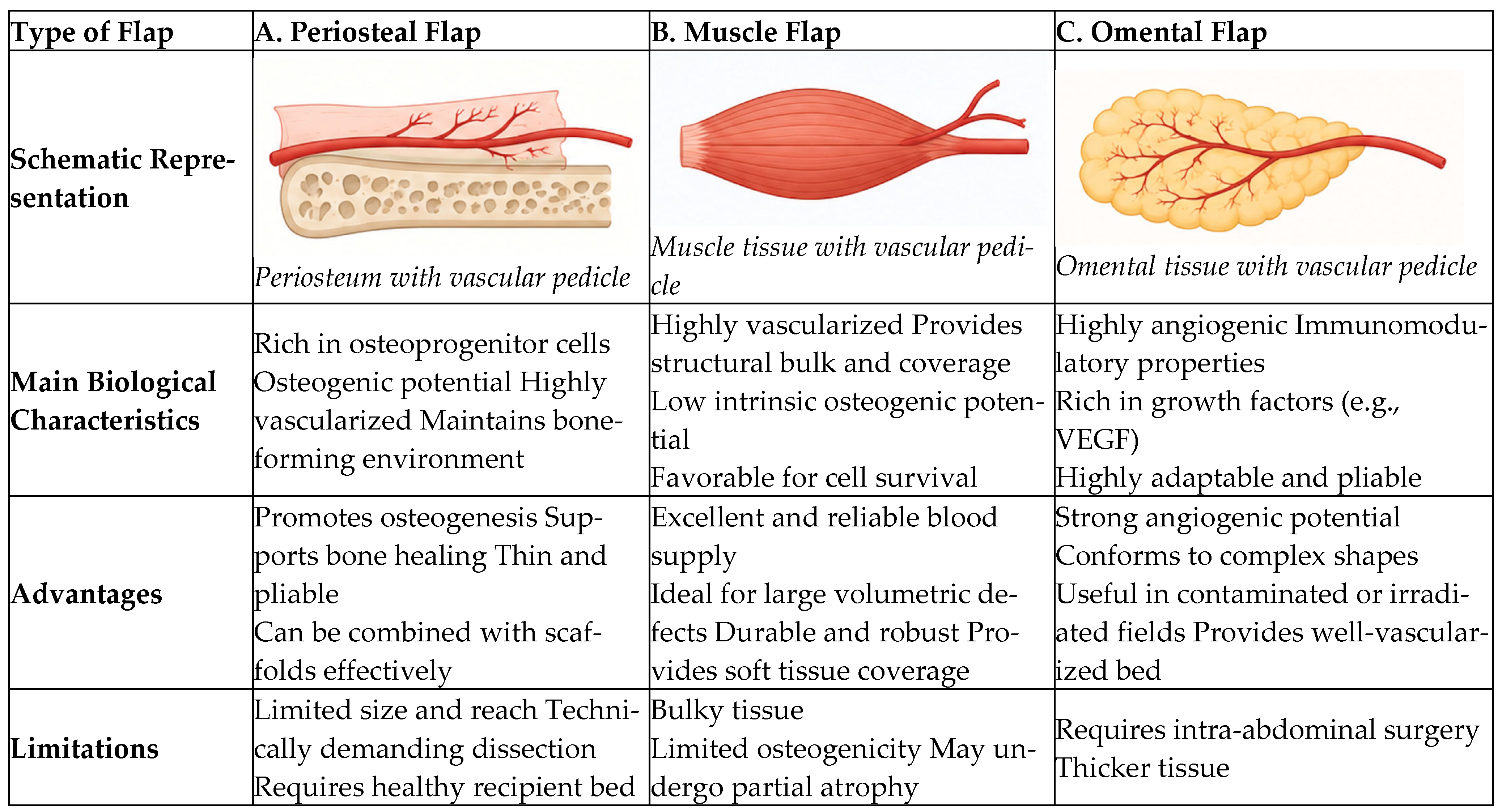
3.2. Biological Flaps as In Vivo Bioreactors: Periosteum, Muscle and Omentum
3.3. Periosteal Flaps: The Osteogenic Gold Standard
3.4. Muscle Flaps: Vascular Carriers and Inductive Environments
3.5. Omental Flaps: Highly Vascularized and Adaptable Bioreactors
3.6. Comparative Perspective and Biological Hierarchy
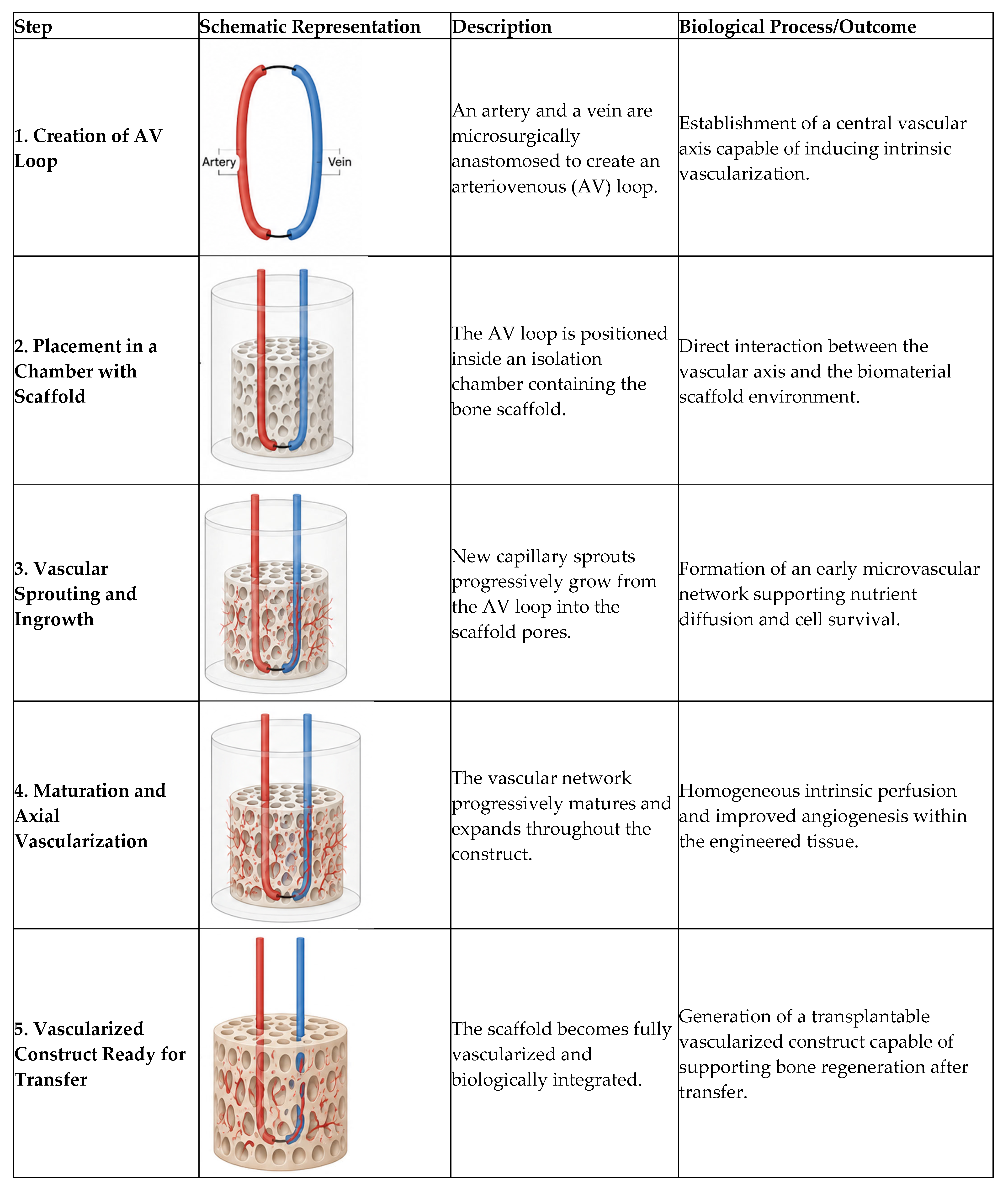
3.7. Arteriovenous Loop and Axial Vascularization Strategies
3.8. Hybrid and Translational Strategies
4. Clinical Implications and Decision-Making
- ‑
- Small defects with preserved vascularity → autologous bone grafting remains the standard approach
- ‑
- Large defects with adequate soft tissue coverage → scaffold-based reconstruction with or without biological augmentation
- ‑
- Large defects with poor vascularity or soft tissue loss → vascularized flap (preferably periosteal) combined with scaffold-based reconstruction
- ‑
- Complex or critical-size defects → hybrid strategies integrating vascularized flaps, scaffolds, and potentially AV loop-based vascularization
- ‑
- Extensive defects or prefabricated constructs → AV loop-based axial vascularization to ensure intrinsic and homogeneous perfusion.
5. Future Perspectives
6. Conclusions
Author Contributions
Funding
Institutional Review Board Statement
Informed Consent Statement
Data Availability Statement
Acknowledgments
Conflicts of Interest
Abbreviations
| AV | Arteriovenous |
| BMP | Bone Morphogenetic Protein |
| BMD | Bone Mineral Density |
| BMSCs | Bone Marrow Stromal Cells |
| CaP | Calcium Phosphate |
| CPF | Corticoperiosteal Flap |
| DBM | Decellularized Bone Matrix |
| EPCs | Endothelial Progenitor Cells |
| MeSH | Medical Subject Headings |
| MSCs | Mesenchymal Stem Cells |
| mPCL-TCP | Medical-grade Polycaprolactone–Tricalcium Phosphate |
| PBCB | Porous Cancellous Bone Matrix |
| PCL | Polycaprolactone |
| RMAV | Regenerative Matching Axial Vascularization |
| β-TCP | Beta-Tricalcium Phosphate |
References
- Dimitriou, R.; Jones, E.; McGonagle, D.; Giannoudis, P.V. Bone regeneration: Current concepts and future directions. BMC Med. 2011, 9, 66. [Google Scholar] [CrossRef]
- Giannoudis, P.V.; Dinopoulos, H.; Tsiridis, E. Bone substitutes: An update. Injury 2005, 36, S20–S27. [Google Scholar] [CrossRef]
- Wang, W.; Yeung, K.W.K. Bone grafts and biomaterials substitutes for bone defect repair: A review. Bioact. Mater. 2017, 2, 224–247. [Google Scholar] [CrossRef]
- Kurien, T.; Pearson, R.G.; Scammell, B.E. Bone graft substitutes currently available in orthopaedic practice. Bone Joint J. 2013, 95-B, 583–597. [Google Scholar] [CrossRef] [PubMed]
- Simunovic, F.; Finkenzeller, G. Vascularization Strategies in Bone Tissue Engineering. Cells 2021, 10, 1749. [Google Scholar] [CrossRef] [PubMed]
- Auger, F.A.; Gibot, L.; Lacroix, D. The Pivotal Role of Vascularization in Tissue Engineering. Annu. Rev. Biomed. Eng. 2013, 15, 177–200. [Google Scholar] [CrossRef]
- Laschke, M.W.; Menger, M.D. Prevascularization in tissue engineering: Current concepts and future directions. Biotechnol. Adv. 2016, 34, 112–121. [Google Scholar] [CrossRef] [PubMed]
- Lovett, M.; Lee, K.; Edwards, A.; Kaplan, D.L. Vascularization Strategies for Tissue Engineering. Tissue Eng. Part B Rev. 2009, 15, 353–370. [Google Scholar] [CrossRef]
- Arkudas, A.; Tjiawi, J.; Bleiziffer, O.; Grabinger, L.; Polykandriotis, E.; Beier, J.P.; Stürzl, M.; Horch, R.E. Fibrin Gel-Immobilized VEGF and bFGF Efficiently Stimulate Angiogenesis in the AV Loop Model. Mol. Med. 2007, 13, 480–487. [Google Scholar] [CrossRef]
- O’Brien, F.J. Biomaterials & scaffolds for tissue engineering. Mater. Today 2011, 14, 88–95. [Google Scholar] [CrossRef]
- Akar, B.; Tatara, A.M.; Sutradhar, A.; Hsiao, H.Y.; Miller, M.; Cheng, M.H.; Mikos, A.G.; Brey, E.M. Large Animal Models of an in Vivo Bioreactor for Engineering Vascularized Bone. Tissue Eng. Part B Rev. 2018, 24, 317–325. [Google Scholar] [CrossRef]
- Huang, R.L.; Tremp, M.; Ho, C.K.; Sun, Y.; Liu, K.; Li, Q. Prefabrication of a functional bone graft with a pedicled periosteal flap as an in vivo bioreactor. Sci. Rep. 2017, 7, 18038. [Google Scholar] [CrossRef]
- Nau, C.; Henrich, D.; Seebach, C.; Schröder, K.; Barker, J.H.; Marzi, I.; Frank, J. Tissue engineered vascularized periosteal flap enriched with MSC/EPCs for the treatment of large bone defects in rats. Int. J. Mol. Med. 2017, 39, 907–917. [Google Scholar] [CrossRef] [PubMed][Green Version]
- Grosso, A.; Burger, M.G.; Lunger, A.; Schaefer, D.J.; Banfi, A.; Di Maggio, N. It Takes Two to Tango: Coupling of Angiogenesis and Osteogenesis for Bone Regeneration. Front. Bioeng. Biotechnol. 2017, 5, 68. [Google Scholar] [CrossRef]
- Diomede, F.; Marconi, G.D.; Fonticoli, L.; Pizzicanella, J.; Merciaro, I.; Bramanti, P.; Mazzon, E.; Trubiani, O. Functional Relationship between Osteogenesis and Angiogenesis in Tissue Regeneration. Int. J. Mol. Sci. 2020, 21, 3242. [Google Scholar] [CrossRef] [PubMed]
- Warnke, P.H.; Wiltfang, J.; Acil, Y.; Eufinger, H.; Wehmöller, M.; Russo, P.A.; Bolte, H.; Sherry, E.; Behrens, E.; Terheyden, H. Growth and transplantation of a custom vascularised bone graft in a man. Lancet 2004, 364, 766–770. [Google Scholar] [CrossRef] [PubMed]
- Bhumiratana, S.; Bernhard, J.C.; Alfi, D.M.; Yeager, K.; Eton, R.E.; Bova, J.; Shah, F.; Gimble, J.M.; Lopez, M.J.; Vunjak-Novakovic, G. Tissue-engineered autologous grafts for facial bone reconstruction. Sci. Transl. Med. 2016, 8, 343ra83. [Google Scholar] [CrossRef]
- Kneser, U.; Polykandriotis, E.; Ohnolz, J.; Heidner, K.; Grabinger, L.; Euler, S.; Amann, K.U.; Hess, A.; Horch, R.E. Engineering of Vascularized Transplantable Bone Tissues: Induction of Axial Vascularization in an Osteoconductive Matrix Using an Arteriovenous Loop. Tissue Eng. 2006, 12, 1721–1731. [Google Scholar] [CrossRef]
- Arkudas, A.; Beier, J.P.; Heidner, K.; Tjiawi, J.; Polykandriotis, E.; Srour, S.; Rumpfl, M.; Horch, R.E.; Kneser, U. Axial Prevascularization of Porous Matrices Using an Arteriovenous Loop Promotes Survival and Differentiation of Transplanted Autologous Osteoblasts. Tissue Eng. 2007, 13, 1549–1560. [Google Scholar] [CrossRef]
- Paré, A.; Charbonnier, B.; Veziers, J.; Vignes, C.; Dutilleul, M.; De Pinieux, G.; Laure, B.; Bossard, A.; Saucet-Zerbib, A.; Touzot-Jourde, G.; et al. Standardized and axially vascularized calcium phosphate-based implants for segmental mandibular defects: A promising proof of concept. Acta Biomater. 2022, 154, 626–640. [Google Scholar] [CrossRef]
- Murphy, S.V.; Atala, A. 3D bioprinting of tissues and organs. Nat. Biotechnol. 2014, 32, 773–785. [Google Scholar] [CrossRef]
- Kang, H.W.; Lee, S.J.; Ko, I.K.; Kengla, C.; Yoo, J.J.; Atala, A. A 3D bioprinting system to produce human-scale tissue constructs with structural integrity. Nat. Biotechnol. 2016, 34, 312–319. [Google Scholar] [CrossRef] [PubMed]
- Byambaa, B.; Annabi, N.; Yue, K.; Santiago, G.T.-D.; Alvarez, M.M.; Jia, W.; Kazemzadeh-Narbat, M.; Shin, S.R.; Tamayol, A.; Khademhosseini, A. Bioprinted Osteogenic and Vasculogenic Patterns for Engineering 3D Bone Tissue. Adv. Healthc. Mater. 2017, 6, 1700015. [Google Scholar] [CrossRef]
- Sparks, D.S.; Savi, F.M.; Dlaska, C.E.; Saifzadeh, S.; Brierly, G.; Ren, E.; Cipitria, A.; Reichert, J.C.; Wille, M.-L.; Hutmacher, D.W. Convergence of scaffold-guided bone regeneration principles and microvascular tissue transfer surgery. Sci. Adv. 2023, 9, eadd6071. [Google Scholar] [CrossRef]
- Naujokat, H.; Spille, J.; Bergholz, R.; Wieker, H.; Weitkamp, J.; Wiltfang, J. Robot-assisted scaffold implantation and two-stage flap raising of the greater omentum for reconstruction of the facial skeleton: Description of a novel technique. Int. J. Med. Robot. Comput. Assist. Surg. 2022, 18, e2429. [Google Scholar] [CrossRef]
- Warnke, P.H.; Wiltfang, J.; Springer, I.; Acil, Y.; Bolte, H.; Kosmahl, M.; Russo, P.A.J.; Sherry, E.; Lützen, U.; Wolfart, S.; et al. Man as living bioreactor: Fate of an exogenously prepared customized tissue-engineered mandible. Biomaterials 2006, 27, 3163–3167. [Google Scholar] [CrossRef]
- Schott, N.G.; Friend, N.E.; Stegemann, J.P. Coupling Osteogenesis and Vasculogenesis in Engineered Orthopedic Tissues. Tissue Eng. Part B Rev. 2021, 27, 199–214. [Google Scholar] [CrossRef] [PubMed]
- Stegen, S.; van Gastel, N.; Carmeliet, G. Bringing new life to damaged bone: The importance of angiogenesis in bone repair and regeneration. Bone 2015, 70, 19–27. [Google Scholar] [CrossRef] [PubMed]
- Hu, K.; Olsen, B.R. Osteoblast-derived VEGF regulates osteoblast differentiation and bone formation during bone repair. J. Clin. Investig. 2016, 126, 509–526. [Google Scholar] [CrossRef]
- Carmeliet, P.; Jain, R.K. Angiogenesis in cancer and other diseases. Nature 2000, 407, 249–257. [Google Scholar] [CrossRef]
- Jain, R.K. Molecular regulation of vessel maturation. Nat. Med. 2003, 9, 685–693. [Google Scholar] [CrossRef]
- Später, T.; Ampofo, E.; Menger, M.D.; Laschke, M.W. Combining Vascularization Strategies in Tissue Engineering: The Faster Road to Success? Front. Bioeng. Biotechnol. 2020, 8, 592095. [Google Scholar] [CrossRef]
- Rouwkema, J.; Khademhosseini, A. Vascularization and Angiogenesis in Tissue Engineering: Beyond Creating Static Networks. Trends Biotechnol. 2016, 34, 733–745. [Google Scholar] [CrossRef] [PubMed]
- Novosel, E.C.; Kleinhans, C.; Kluger, P.J. Vascularization is the key challenge in tissue engineering. Adv. Drug Deliv. Rev. 2011, 63, 300–311. [Google Scholar] [CrossRef] [PubMed]
- Weigand, A.; Horch, R.E.; Boos, A.M.; Beier, J.P.; Arkudas, A. The Arteriovenous Loop: Engineering of Axially Vascularized Tissue. Eur. Surg. Res. 2018, 59, 286–299. [Google Scholar] [CrossRef] [PubMed]
- Roberts, S.J.; van Gastel, N.; Carmeliet, G.; Luyten, F.P. Uncovering the periosteum for skeletal regeneration: The stem cell that lies beneath. Bone 2015, 70, 10–18. [Google Scholar] [CrossRef]
- Dwek, J.R. The periosteum: What is it, where is it, and what mimics it in its absence? Skeletal Radiol. 2010, 39, 319–323. [Google Scholar] [CrossRef]
- Manasseri, B.; Cuccia, G.; Moimas, S.; D’Alcontres, F.S.; Polito, F.; Bitto, A.; Altavilla, D.; Squadrito, F.; Geuna, S.; Pattarini, L.; et al. Microsurgical arterovenous loops and biological templates: A novel in vivo chamber for tissue engineering. Microsurgery 2007, 27, 623–629. [Google Scholar] [CrossRef]
- Beier, J.P.; Horch, R.E.; Hess, A.; Arkudas, A.; Heinrich, J.; Loew, J.; Gulle, H.; Polykandriotis, E.; Bleiziffer, O.; Kneser, U. Axial vascularization of a large volume calcium phosphate ceramic bone substitute in the sheep AV loop model. J. Tissue Eng. Regen. Med. 2010, 4, 216–223. [Google Scholar] [CrossRef]
- Liu, Y.; Chan, J.K.Y.; Teoh, S.H. Review of vascularised bone tissue-engineering strategies with a focus on co-culture systems. J. Tissue Eng. Regen. Med. 2015, 9, 85–105. [Google Scholar] [CrossRef]
- Percival, C.J.; Richtsmeier, J.T. Angiogenesis and intramembranous osteogenesis. Dev. Dyn. 2013, 242, 909–922. [Google Scholar] [CrossRef]
- Colnot, C. Skeletal Cell Fate Decisions Within Periosteum and Bone Marrow During Bone Regeneration. J. Bone Miner. Res. 2009, 24, 274–282. [Google Scholar] [CrossRef]
- Matsuda, K.; Falkenberg, K.J.; Woods, A.A.; Choi, Y.S.; Morrison, W.A.; Dilley, R.J. Adipose-Derived Stem Cells Promote Angiogenesis and Tissue Formation for In Vivo Tissue Engineering. Tissue Eng. Part A 2013, 19, 1327–1335. [Google Scholar] [CrossRef]
- Peng, H.; Wright, V.; Usas, A.; Gearhart, B.; Shen, H.C.; Cummins, J.; Huard, J. Synergistic enhancement of bone formation and healing by stem cell–expressed VEGF and bone morphogenetic protein-4. J. Clin. Investig. 2002, 110, 751–759. [Google Scholar] [CrossRef] [PubMed][Green Version]
- Goldsmith, H.S.; Griffith, A.L.; Kupferman, A.; Catsimpoolas, N. Lipid angiogenic factor from omentum. JAMA 1984, 252, 2034–2036. [Google Scholar] [CrossRef] [PubMed]
- Litbarg, N.O.; Gudehithlu, K.P.; Sethupathi, P.; Arruda, J.A.L.; Dunea, G.; Singh, A.K. Activated omentum becomes rich in factors that promote healing and tissue regeneration. Cell Tissue Res. 2007, 328, 487–497. [Google Scholar] [CrossRef]
- Watson, E.; Tatara, A.M.; van den Beucken, J.J.J.P.; Jansen, J.A.; Wong, M.E.; Mikos, A.G. An Ovine Model of In Vivo Bioreactor-Based Bone Generation. Tissue Eng. Part C Methods 2020, 26, 384–396. [Google Scholar] [CrossRef] [PubMed]
- Almubarak, S.; Nethercott, H.; Freeberg, M.; Beaudon, C.; Jha, A.; Jackson, W.; Marcucio, R.; Miclau, T.; Healy, K.; Bahney, C. Tissue engineering strategies for promoting vascularized bone regeneration. Bone 2016, 83, 197–209. [Google Scholar] [CrossRef]
- Sparks, D.S.; Medeiros Savi, F.; Saifzadeh, S.; Wille, M.L.; Wagels, M.; Hutmacher, D.W. Bone Regeneration Exploiting Corticoperiosteal Tissue Transfer for Scaffold-Guided Bone Regeneration. Tissue Eng. Part C Methods 2022, 28, 202–213. [Google Scholar] [CrossRef]
- Heliotis, M.; Lavery, K.M.; Ripamonti, U.; Tsiridis, E.; di Silvio, L. Transformation of a prefabricated hydroxyapatite/osteogenic protein-1 implant into a vascularised pedicled bone flap in the human chest. Int. J. Oral Maxillofac. Surg. 2006, 35, 265–269. [Google Scholar] [CrossRef]
- Kokemueller, H.; Spalthoff, S.; Nolff, M.; Tavassol, F.; Essig, H.; Stuehmer, C.; Bormann, K.-H.; Rücker, M.; Gellrich, N.-C. Prefabrication of vascularized bioartificial bone grafts in vivo for segmental mandibular reconstruction: Experimental pilot study in sheep and first clinical application. Int. J. Oral Maxillofac. Surg. 2010, 39, 379–387. [Google Scholar] [CrossRef]
- Han, D.; Dai, K. Prefabrication of a Vascularized Bone Graft with Beta Tricalcium Phosphate Using an In Vivo Bioreactor. Artif. Organs 2013, 37, 884–893. [Google Scholar] [CrossRef]
- Horch, R.E.; Beier, J.P.; Kneser, U.; Arkudas, A. Successful human long-term application of in situ bone tissue engineering. J. Cell Mol. Med. 2014, 18, 1478–1485. [Google Scholar] [CrossRef]
- Weigand, A.; Beier, J.P.; Hess, A.; Gerber, T.; Arkudas, A.; Horch, R.E.; Boos, A.M. Acceleration of Vascularized Bone Tissue-Engineered Constructs in a Large Animal Model Combining Intrinsic and Extrinsic Vascularization. Tissue Eng. Part A. 2015, 21, 1680–1694. [Google Scholar] [CrossRef]
- Gonzalez Matheus, I.; Hutmacher, D.W.; Olson, S.; Redmond, M.; Sutherland, A.; Wagels, M. A Medical-Grade Polycaprolactone and Tricalcium Phosphate Scaffold System with Corticoperiosteal Tissue Transfer for the Reconstruction of Acquired Calvarial Defects in Adults: Protocol for a Single-Arm Feasibility Trial. JMIR Res. Protoc. 2022, 11, e36111. [Google Scholar] [CrossRef]
- Erol, Ö.O.; Spira, M. New Capillary Bed Formation with a Surgically Constructed Arteriovenous Fistula. Plast. Reconstr. Surg. 1980, 66, 109–115. [Google Scholar] [CrossRef]
- Matheus, I.G.; Hutmacher, D.W.; Olson, S.; Redmond, M.; Sutherland, A.; Wagels, M. Formation of New Tissue from an Arteriovenous Loop in the Absence of Added Extracellular Matrix. Tissue Eng. 2000, 6, 595–603. [Google Scholar] [CrossRef]
- Mayer, S.A.; Thomas, B.; Heuer, M.; Brune, J.C.; Eras, V.; Schuster, K.; Knoedler, L.; Schaefer, R.L.; Thiele, W.; Sleeman, J.P.; et al. In vivo Engineering and Transplantation of Axially Vascularized and Epithelialized Flaps in Rats. Tissue Eng. Part A 2025, 31, 234–243. [Google Scholar] [CrossRef]
- Falkner, F.; Mayer, S.A.; Thomas, B.; Dimmler, A.; Heimel, P.; Schneider, K.; Kengelbach-Weigand, A.; Kramer, A.-M.; Schaefer, R.L.; Panayi, A.C.; et al. Engineering Vascularized Transplantable Soft Tissue Free Flaps in Sheep Using the Arteriovenous Loop Technique. Tissue Eng. Part A 2025, Epub ahead of printing. [Google Scholar] [CrossRef]
- Morrison, W.A.; Marre, D.; Grinsell, D.; Batty, A.; Trost, N.; O’Connor, A.J. Creation of a Large Adipose Tissue Construct in Humans Using a Tissue-engineering Chamber: A Step Forward in the Clinical Application of Soft Tissue Engineering. eBioMedicine 2016, 6, 238–245. [Google Scholar] [CrossRef]
- Dvir, T.; Timko, B.P.; Kohane, D.S.; Langer, R. Nanotechnological strategies for engineering complex tissues. Nat. Nanotechnol. 2011, 6, 13–22. [Google Scholar] [CrossRef]
- Yap, K.K.; Yeoh, G.C.; Morrison, W.A.; Mitchell, G.M. The Vascularised Chamber as an In Vivo Bioreactor. Trends Biotechnol. 2018, 36, 1011–1024. [Google Scholar] [CrossRef]
- Qu, D.; Li, J.; Li, Y.; Gao, Y.; Zuo, Y.; Hsu, Y.; Hu, J. Angiogenesis and osteogenesis enhanced by bFGF ex vivo gene therapy for bone tissue engineering in reconstruction of calvarial defects. J. Biomed. Mater. Res. A 2011, 96A, 543–551. [Google Scholar] [CrossRef]
- Lee, E.; Ko, J.Y.; Kim, J.; Park, J.W.; Lee, S.; Im, G.I. Osteogenesis and angiogenesis are simultaneously enhanced in BMP2-/VEGF-transfected adipose stem cells through activation of the YAP/TAZ signaling pathway. Biomater. Sci. 2019, 7, 4588–4602. [Google Scholar] [CrossRef]
- Matai, I.; Kaur, G.; Seyedsalehi, A.; McClinton, A.; Laurencin, C.T. Progress in 3D bioprinting technology for tissue/organ regenerative engineering. Biomaterials 2020, 226, 119536. [Google Scholar] [CrossRef]
- Shah, N.J.; Hyder, M.N.; Quadir, M.A.; Courchesne, N.M.D.; Seeherman, H.J.; Nevin, M.; Spector, M.; Hammond, P.T. Adaptive growth factor delivery from a polyelectrolyte coating promotes synergistic bone tissue repair and reconstruction. Proc. Natl. Acad. Sci. USA 2014, 111, 12847–12852. [Google Scholar] [CrossRef]
- Bakshi, R.; Hokugo, A.; Khalil, D.; Wang, L.; Shibuya, Y.; Zhou, S.; Zhang, Z.; Rezzadeh, K.; McClendon, M.; Stupp, S.I.; et al. A Chemotactic Functional Scaffold with VEGF-Releasing Peptide Amphiphiles Facilitates Bone Regeneration by BMP-2 in a Large-Scale Rodent Cranial Defect Model. Plast. Reconstr. Surg. 2021, 147, 386–397. [Google Scholar] [CrossRef]
- Miri, A.K.; Khalilpour, A.; Cecen, B.; Maharjan, S.; Shin, S.R.; Khademhosseini, A. Multiscale bioprinting of vascularized models. Biomaterials 2019, 198, 204–216. [Google Scholar] [CrossRef]


| Strategy | Biological Characteristics | Advantages | Limitations | Ideal Indication |
|---|---|---|---|---|
| Periosteal flap | Osteogenic and highly vascularized | High osteogenicity | Limited tissue volume | Segmental bone defects |
| Muscle flap | Highly vascularized soft tissue | High vascularity | Low intrinsic osteogenesis | Prefabricated constructs |
| Omentum flap | Angiogenic and adaptable tissue | Adaptability | Requires abdominal surgery | Irregular or complex defects |
| AV loop | Intrinsic axial vascularization | Controlled vascular network | Microsurgical complexity | Large or prefabricated constructs |
| Author | Model | Approach | Scaffold | Biological Strategy | Vascularization Type | Key Findings |
|---|---|---|---|---|---|---|
| Biological flaps | ||||||
| Huang et al., 2017 [12] | Rabbit (in vivo) | In vivo bioreactor (periosteal flap) | DBM | Periosteum-derived osteogenic cells | Intrinsic (pedicled flap) | Increased bone mass, vascular density, and biomechanical strength compared to muscle pouch |
| Nau et al., 2017 [13] | Rat (critical femoral defect) | Axial vascularization + tissue engineering | β-TCP | MSCs + EPCs | Axial (periosteal flap) | Enhanced BMD, angiogenesis, and mechanical stability; vascular supply is essential |
| Naujokat et al., 2022 [25] | Pig (omentum model) | Ectopic in vivo bioreactor | Ceramic scaffold + BMP | Growth factors + omental environment | Intrinsic (omentum-based vascularization) | Successful bone formation; minimally invasive robotic technique feasible |
| Sparks et al., 2022 [49] | Sheep (preclinical proof of concept) | Scaffold + corticoperiosteal flap | mPCL-TCP | CPF (osteogenic progenitors + growth factors) | Axial | Effective regeneration even in large defects |
| Sparks et al., 2023 [24] | Sheep + clinical case | RMAV (advanced axial vascularization) | mPCL-TCP | Corticoperiosteal flap | Intrinsic axial | Bone regeneration comparable to autograft; successful clinical translation |
| Watson et al., 2020 [47] | Sheep (large animal) | In vivo bioreactor adjacent to rib periosteum | Autograft/Bio-Oss | Periosteal induction ± infection modulation | Intrinsic (periosteum driven) | Successful bone formation; infection influences regeneration |
| Warnke et al., 2004 [16] | Human (clinical case) | In vivo bioreactor (latissimus dorsi muscle flap prefabrication) | Titanium mesh + bone mineral blocks | rhBMP-7 + bone marrow | Intrinsic (muscle flap) | First successful prefabrication and transplantation of a vascularized mandibular bone graft in humans |
| Heliotis et al., 2006 [50] | Human (clinical case) | In vivo bioreactor (prefabricated pedicled bone flap) | Hydroxyapatite scaffold + OP-1 (BMP-7) | Osteoinductive stimulation within vascularized environment | Intrinsic (pedicled flap) | Successful transformation of scaffold into a vascularized bone flap demonstrating clinical feasibility of in vivo bone tissue engineering |
| Kokemüller et al., 2010 [51] | Sheep (preclinical) + clinical application | In vivo bioreactor (muscle-based prefabrication) | β-TCP scaffold + autologous bone marrow | Osteogenic cell loading + axial vascular bundle | Intrinsic axial (vascular bundle) | Axial perfusion significantly enhanced angiogenesis, bone formation, and scaffold integration; successful translation toward mandibular reconstruction |
| AV loop and axial vascularization | ||||||
| Kneser et al., 2006 [18] | Rat (in vivo) | AV loop + isolation chamber | Porous cancellous bone matrix (PBCB) | Intrinsic vascular induction | Intrinsic axial (AV loop) | Effective axial prevascularization of bone scaffold with organized microvascular network supporting subsequent bone tissue engineering |
| Arkudas et al., 2007 [9] | Rat | Scaffold + vascular pedicle | Fibrin glue-coated PCL scaffold | BMSCs | Intrinsic axial (vascular pedicle-AV loop-related) | Enhanced vascularization and bone formation within scaffold-based constructs |
| Arkudas et al., 2007 [19] | Rat | Axial prevascularization (AV loop) | Porous scaffold | Autologous osteoblasts | Intrinsic axial (AV loop) | Improved survival and differentiation of transplanted osteoblasts |
| Paré et al., 2022 [20] | Sheep | AV loop + mandibular defect | Biphasic CaP scaffold | Bone marrow loading | Intrinsic axial | Full osseointegration and lamellar bone formation |
| Han & Dai, 2013 [52] | Rabbit | Intrinsic vascularized in vivo bioreactor (vessel bundle) | β-TCP | BMP-2-transduced MSCs | Intrinsic axial (AV bundle) | Bone formation observed only in presence of osteoinductive stimulus (BMP-2) |
| Horch et al., 2014 [53] | Human (clinical cases) | In situ bone tissue engineering with AV loop | Cancellous bone + fibrin glue/β-TCP-HA + fibrin glue | Autologous bone graft or bone marrow aspirate | Intrinsic axial vascularization (AV loop) | Long-term healing of large radius and tibial defects with patent AV loops and stable bone regeneration at 36–72 months |
| Weigand et al., 2015 [54] | Sheep (large animal) | AV loop + perforated/isolation chamber | Nanostructured bone substitute | Scaffold remodeling with intrinsic/extrinsic vascular ingrowth | Intrinsic axial vascularization ± extrinsic vascularization | Combined intrinsic/extrinsic vascularization accelerated scaffold vascularization, tissue ingrowth, remodeling, and bone formation in clinically relevant constructs |
| Hybrid Strategies | ||||||
| Gonzalez Matheus et al., 2022 [55] | Clinical (feasibility trial) | Hybrid RMAV approach | mPCL-TCP (3D-printed scaffold) | Corticoperiosteal flap (osteogenic and vascular source) | Intrinsic axial | Proposed regenerative matching axial vascularization strategy for large calvarial defects; ongoing clinical translation |
| Reconstructive Setting | Preferred Strategy | Biological Rationale | Potential Application |
|---|---|---|---|
| Small bone defects with preserved vascularity | Autologous bone grafting or conventional scaffold-based reconstruction | Native vascular supply is generally sufficient to support graft integration and bone healing | Standard reconstructive approach for limited defects |
| Large defects with adequate soft tissue coverage | Scaffold-based reconstruction with biological augmentation | Osteoconductive scaffolds may support regeneration when surrounding vascularity is preserved | Suitable for selected large but biologically favorable defects |
| Large defects associated with poor vascularity or soft tissue loss | Vascularized flap, preferably periosteal, combined with scaffold-based reconstruction | Provides immediate perfusion together with osteogenic and angiogenic biological support | Particularly useful in compromised recipient beds |
| Complex or critical-size defects | Hybrid strategies integrating vascularized flaps, scaffolds, and osteoinductive stimuli | Combines structural stability, vascularization, and biological stimulation to enhance regeneration | Advanced reconstructive option for challenging defects |
| Extensive defects or prefabricated constructs | AV loop-based axial vascularization combined with scaffold-based engineering | Establishes intrinsic and homogeneous vascular perfusion throughout the construct | Promising strategy for large-scale tissue-engineered reconstruction |
| Irregular craniofacial or anatomically complex defects | Omental flap-based or adaptable vascularized bioreactor strategies | Highly vascularized and conformable tissues adapt to complex three-dimensional geometries | Potentially useful in personalized craniofacial reconstruction |
Disclaimer/Publisher’s Note: The statements, opinions and data contained in all publications are solely those of the individual author(s) and contributor(s) and not of MDPI and/or the editor(s). MDPI and/or the editor(s) disclaim responsibility for any injury to people or property resulting from any ideas, methods, instructions or products referred to in the content. |
© 2026 by the authors. Licensee MDPI, Basel, Switzerland. This article is an open access article distributed under the terms and conditions of the Creative Commons Attribution (CC BY) license.
Share and Cite
Battaglia, F.; Colonna, M.R.; Cigna, E.; Maruccia, M.; Delia, G. Vascularized Flaps as Living Bioreactors in Bone Tissue Engineering: From Biological Principles to Translational Strategies—A Narrative Review. J. Funct. Biomater. 2026, 17, 270. https://doi.org/10.3390/jfb17060270
Battaglia F, Colonna MR, Cigna E, Maruccia M, Delia G. Vascularized Flaps as Living Bioreactors in Bone Tissue Engineering: From Biological Principles to Translational Strategies—A Narrative Review. Journal of Functional Biomaterials. 2026; 17(6):270. https://doi.org/10.3390/jfb17060270
Chicago/Turabian StyleBattaglia, Fabiana, Michele Rosario Colonna, Emanuele Cigna, Michele Maruccia, and Gabriele Delia. 2026. "Vascularized Flaps as Living Bioreactors in Bone Tissue Engineering: From Biological Principles to Translational Strategies—A Narrative Review" Journal of Functional Biomaterials 17, no. 6: 270. https://doi.org/10.3390/jfb17060270
APA StyleBattaglia, F., Colonna, M. R., Cigna, E., Maruccia, M., & Delia, G. (2026). Vascularized Flaps as Living Bioreactors in Bone Tissue Engineering: From Biological Principles to Translational Strategies—A Narrative Review. Journal of Functional Biomaterials, 17(6), 270. https://doi.org/10.3390/jfb17060270