


Clinical Outcomes of Immediate and Delayed Composite Restorations After Pulp Capping with Biodentine: A Systematic Literature Review



Abstract
1. Introduction
2. Materials and Methods
2.1. Protocol and Registration
2.2. Focus Question
2.3. Eligibility Criteria and Search Strategy
2.4. Risk of Bias and Certainty of Evidence Assessment
2.5. Data Extraction
3. Results
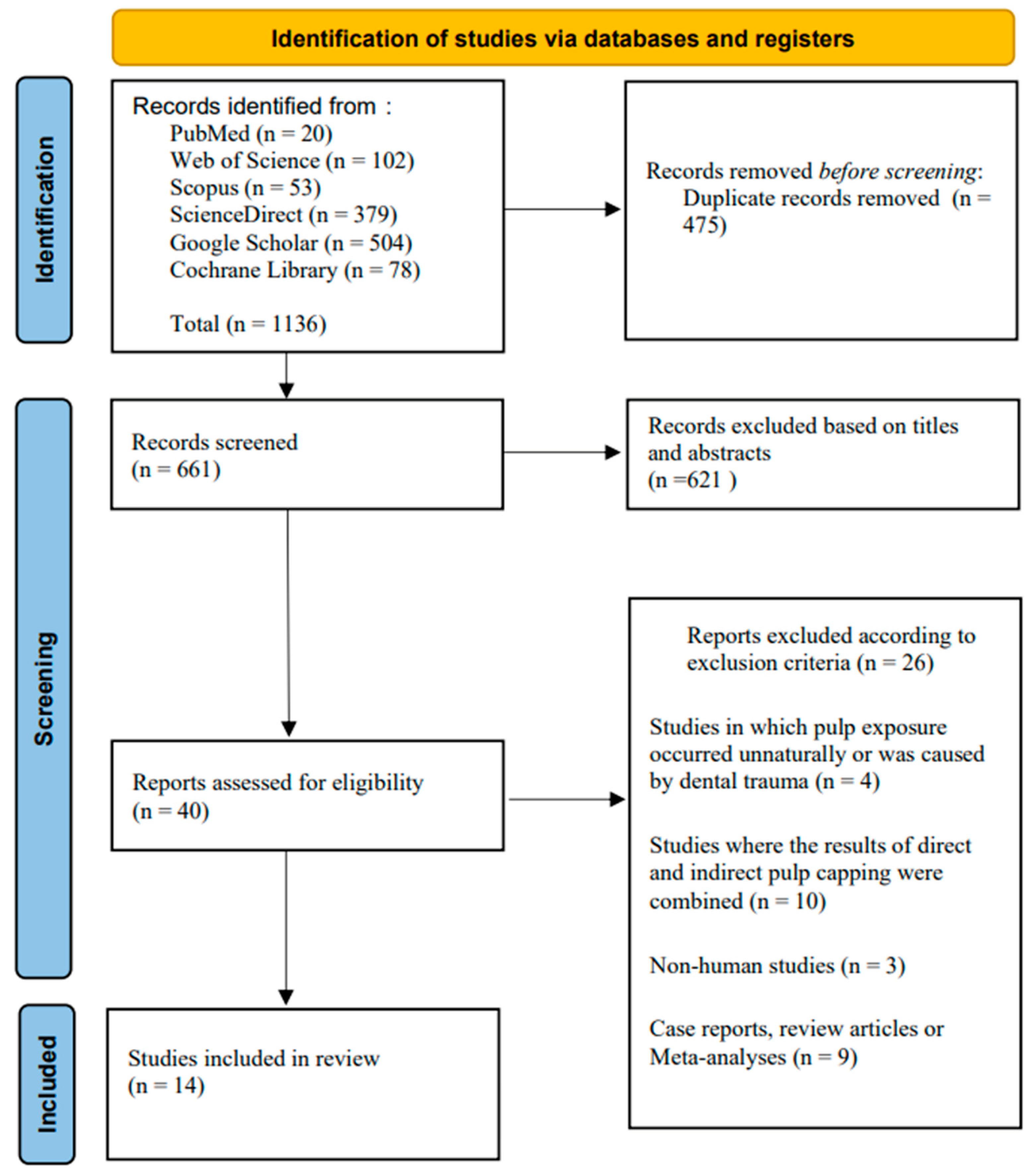
3.1. Selected Studies
3.2. Study Characteristics
3.3. Risk of Bias and Certainty of Evidence
3.4. DPC—Delayed Biodentine Approach
3.5. DPC—Immediate Composite Approach
3.6. IPC—Delayed Biodentine Approach
3.7. IPC—Immediate Composite Approach
4. Discussion
5. Conclusions
Supplementary Materials
Author Contributions
Funding
Institutional Review Board Statement
Informed Consent Statement
Data Availability Statement
Conflicts of Interest
References
- Drouri, S.; El Merini, H.; Sy, A.; Jabri, M. Evaluation of direct and indirect pulp capping with Biodentine in vital permanent teeth with deep caries lesions: A case series. Cureus 2023, 15, e39374. [Google Scholar] [CrossRef] [PubMed]
- Tan, S.Y.; Yu, V.S.H.; Lim, K.C.; Tan, B.C.K.; Neo, C.L.J.; Shen, L.; Messer, H.H. Long-term pulpal and restorative outcomes of pulpotomy in mature permanent teeth. J. Endod. 2020, 46, 383–390. [Google Scholar] [CrossRef]
- Ricucci, D.; Rôças, I.N.; Alves, F.R.F.; Cabello, P.H.; Siqueira, J.F. Outcome of direct pulp capping using calcium hydroxide: A long-term retrospective study. J. Endod. 2023, 49, 45–54. [Google Scholar] [CrossRef]
- Kahler, B.; Taha, N.; Lu, J.; Saoud, T. Vital pulp therapy for permanent teeth with diagnosis of irreversible pulpitis: Biological basis and outcome. Aust. Dent. J. 2023, 68, S1–S10. [Google Scholar] [CrossRef]
- Mustafa, R.M.; Al-Nasrawi, S.J.; Aljdaimi, A.I. The effect of Biodentine maturation time on resin bond strength when aged in artificial saliva. Int. J. Dent. 2020, 2020, 8831813. [Google Scholar] [CrossRef]
- Choudhury, W.R.; Nekkanti, S. Mechanical properties of SDR and Biodentine as dentin replacement materials: An in vitro study. J. Contemp. Dent. Pract. 2022, 23, 43–48. [Google Scholar] [CrossRef]
- Koliniotou-Koumpia, E.; Dionysopoulos, D.; Koumpia, E.; Giannelis, G. Pulp Chamber Temperature Rise during Resin Composite Polymerization. Balk. J. Stomatol. 2011, 15, 150–154. [Google Scholar]
- Page, M.J.; McKenzie, J.E.; Bossuyt, P.M.; Boutron, I.; Hoffmann, T.C.; Mulrow, C.D.; Shamseer, L.; Tetzlaff, J.M.; Akl, E.A.; Brennan, S.E.; et al. The PRISMA 2020 statement: An updated guideline for reporting systematic reviews. BMJ 2021, 372, n71. [Google Scholar] [CrossRef]
- Rios, L.P.; Ye, C.; Thabane, L. Association between framing of the research question using the PICOT format and reporting quality of randomized controlled trials. BMC Med. Res. Methodol. 2010, 10, 11. [Google Scholar] [CrossRef] [PubMed]
- Brozek, J.L.; Canelo-Aybar, C.; Akl, E.A.; Bowen, J.M.; Bucher, J.; Chiu, W.A.; Cronin, M.; Djulbegovic, B.; Falavigna, M.; Guyatt, G.H.; et al. GRADE guidelines 30: The GRADE approach to assessing the certainty of modeled evidence: An overview in the context of health decision-making. J. Clin. Epidemiol. 2021, 129, 138–150. [Google Scholar] [CrossRef]
- Hashem, D.; Mannocci, F.; Patel, S.; Manoharan, A.; Watson, T.F.; Banerjee, A. Evaluation of calcium silicate vs. glass ionomer cement indirect pulp capping. Clin. Oral Investig. 2019, 23, 1931–1939. [Google Scholar] [CrossRef]
- Hashem, D.; Mannocci, F.; Patel, S.; Manoharan, A.; Brown, J.E.; Watson, T.F.; Banerjee, A. Clinical and radiographic assessment of calcium silicate indirect pulp capping. J. Dent. Res. 2015, 94, 562–568. [Google Scholar] [CrossRef]
- Linu, S.; Lekshmi, M.S.; Varunkumar, V.S.; Sam Joseph, V.G. Treatment outcome following direct pulp capping using bioceramic materials. J. Endod. 2017, 43, 1635–1639. [Google Scholar] [CrossRef] [PubMed]
- Katge, F.A.; Patil, D.P. Comparative analysis of calcium silicate-based cements as pulp-capping agents. J. Endod. 2017, 43, 507–513. [Google Scholar] [CrossRef] [PubMed]
- Kusumvalli, S.; Diwan, A.; Pasha, S.; Devale, M.; Chowdhary, C.; Saikia, P. Clinical evaluation of Biodentine in deep dental caries. Indian J. Dent. Res. 2019, 30, 191–195. [Google Scholar] [CrossRef]
- Zanini, M.; Balice, G.; Kérourédan, O.; Lézé, C.; Gueyffier, F.; Maucort-Boulch, D.; Nony, P.; Grosgogeat, B.; Pradelle-Plasse, N. Outcomes of direct pulp capping after carious excavation of deep caries on permanent mature teeth: An ancillary study derived from a randomised clinical trial. Eur. Endod. J. 2025, 10, 514–524. [Google Scholar] [CrossRef]
- Hegde, S.; Sowmya, B.; Mathew, S.; Bhandi, S.H.; Nagaraja, S.; Dinesh, K. Clinical evaluation of mineral trioxide aggregate and Biodentine. J. Conserv. Dent. 2017, 20, 91–95. [Google Scholar] [CrossRef]
- Peskersoy, C.; Lukarcanin, J.; Turkun, M. Efficacy of calcium silicate materials as pulp-capping agents. J. Dent. Sci. 2021, 16, 723–731. [Google Scholar] [CrossRef]
- Parinyaprom, N.; Nirunsittirat, A.; Chuveera, P.; Na Lampang, S.; Srisuwan, T.; Sastraruji, T.; Bua-On, P.; Simprasert, S.; Khoipanich, I.; Sutharaphan, T.; et al. Outcomes of direct pulp capping using MTA or Biodentine. J. Endod. 2018, 44, 341–348. [Google Scholar] [CrossRef] [PubMed]
- Yavuz, Y.; Kotanli, S.; Dogan, M.S.; Almak, Z. Follow-up of calcium silicate materials in pulp capping. Adv. Clin. Exp. Med. 2025, 34, 1289–1298. [Google Scholar] [CrossRef]
- Lipski, M.; Nowicka, A.; Kot, K.; Postek-Stefańska, L.; Wysoczańska-Jankowicz, I.; Borkowski, L.; Andersz, P.; Jarząbek, A.; Grocholewicz, K.; Sobolewska, E.; et al. Factors affecting outcomes of direct pulp capping using Biodentine. Clin. Oral Investig. 2018, 22, 2021–2029. [Google Scholar] [CrossRef]
- Awawdeh, L.; Al-Qudah, A.; Hamouri, H.; Chakra, R.J. Outcomes of vital pulp therapy using MTA or Biodentine. J. Endod. 2018, 44, 1603–1609. [Google Scholar] [CrossRef] [PubMed]
- Brizuela, C.; Ormeño, A.; Cabrera, C.; Cabezas, R.; Silva, C.I.; Ramírez, V.; Mercade, M. Direct pulp capping with calcium hydroxide, MTA, and Biodentine. J. Endod. 2017, 43, 1776–1780. [Google Scholar] [CrossRef]
- Duncan, H.F.; Galler, K.M.; Tomson, P.L.; Simon, S.; El-Karim, I.; Kundzina, R.; Krastl, G.; Dammaschke, T.; Fransson, H.; Markvart, M. European Society of Endodontology position statement. Int. Endod. J. 2019, 52, 923–934. [Google Scholar] [CrossRef] [PubMed]
- Ricucci, D.; Loghin, S.; Siqueira, J.F. Correlation between clinical and histologic pulp diagnoses. J. Endod. 2014, 40, 1932–1939. [Google Scholar] [CrossRef]
- American Association of Endodontists. AAE position statement on vital pulp therapy. J. Endod. 2021, 47, 1340–1344. [Google Scholar] [CrossRef]
- Ricucci, D.; Siqueira, J.F.; Rôças, I.N.; Lipski, M.; Shiban, A.; Tay, F.R. Pulp and dentine responses to selective caries excavation. J. Dent. 2020, 100, 103430. [Google Scholar] [CrossRef]
- Alovisi, M.; Baldi, A.; Comba, A.; Gamerro, R.; Paolone, G.; Mandurino, M.; Dioguardi, M.; Roggia, A.; Scotti, N. Long-term evaluation of pulp vitality preservation in direct and indirect pulp capping: A retrospective clinical study. J. Clin. Med. 2024, 13, 3962. [Google Scholar] [CrossRef] [PubMed]
- Frankenberger, R.; Koch, A.; Plohmann, L.; Beck-Broichsitter, B.; Becker, S. The outcome of indirect pulp capping over 40 years: A practice-based retrospective evaluation. Dent. J. 2025, 13, 182. [Google Scholar] [CrossRef]
- Gomez-Sosa, J.F.; Granone-Ricella, M.; Rosciano-Alvarez, M.; Barrios-Rodriguez, V.D.; Goncalves-Pereira, J.; Caviedes-Bucheli, J. Determining factors in the success of direct pulp capping: A systematic review. J. Contemp. Dent. Pract. 2024, 25, 392–401. [Google Scholar] [CrossRef]
- Prasertsuksom, N.; Osiri, S.; Jaruchotiratanasakul, N.; Ongchavalit, L. Treatment outcomes and prognostic factors of direct pulp capping in permanent teeth: A systematic review and meta-analysis. Eur. Endod. J. 2024, 9, 295–307. [Google Scholar] [CrossRef] [PubMed]
- Cho, S.-Y.; Seo, D.-G.; Lee, S.-J.; Lee, J.; Lee, S.-J.; Jung, I.-Y. Prognostic factors for clinical outcomes according to time after direct pulp capping. J. Endod. 2013, 39, 327–331. [Google Scholar] [CrossRef] [PubMed]
- Savitri, D.; Suprastiwi, E.; Margono, A. Applying Glass Ionomer Cement to MTA Flow and Biodentine and Its Effects on the Interface Layer. J. Phys. Conf. Ser. 2017, 884, 012109. [Google Scholar] [CrossRef]
- Ertuğrul, C.Ç.; Ertuğrul, İ.F. Effect of pulp capping materials on intrapulpal temperature. J. Dent. Sci. 2021, 16, 85–90. [Google Scholar] [CrossRef] [PubMed]

| Data Base | Search Query | Result |
|---|---|---|
| PubMed | #1 (“pulp capping” OR “direct pulp capping” OR “indirect pulp capping” OR “vital pulp therapy” OR “reversible pulpitis treatment” OR “pulp exposure”) #2 (“Biodentine” OR “calcium silicate cement” OR “tricalcium silicate” OR “bioceramic cement”) #3 (“coronal restoration” OR “permanent restoration” OR “definitive restoration” OR “composite restoration” OR “composite” OR “temporary restoration” OR “temporary filling”) #4 (“success rate” OR “pulp sensibility” OR “clinical outcome” OR “radiographic outcome” OR “dentin bridge formation”) #5 #1 AND #2 AND #3 AND #4 | 20 |
| Web of Science | (“pulp exposure”) AND (“pulp capping” OR “vital pulp therapy”) AND (“Biodentine” OR “composite”) AND (“outcome”) | 102 |
| Scopus | (“pulp exposure”) AND (“pulp capping” OR “vital pulp therapy”) AND (“Biodentine” OR “composite”) AND (“outcome”) | 53 |
| ScienceDirect | (“pulp exposure” OR “pulp capping” OR “vital pulp therapy”) AND (“Biodentine” OR “tricalcium silicate cement”) AND (“composite” OR “composite restoration” OR “temporary restoration”) AND (“success rate” OR “pulp sensibility” OR “clinical outcome” OR “radiographic outcome”) | 379 |
| Google Scholar | (“pulp exposure” OR “pulp capping” OR “vital pulp therapy”) AND (“Biodentine” OR “tricalcium silicate cement”) AND (“composite” OR “composite restoration” OR “temporary restoration”) AND (“success rate” OR “pulp sensibility” OR “clinical outcome” OR “radiographic outcome”) | 504 |
| Cochrane Library | #1 (“pulp capping” OR “vital pulp therapy” OR “pulp exposure”) #2 (“Biodentine” OR “calcium silicate cement” OR “tricalcium silicate”) #3 (“composite restoration” OR composite OR “temporary restoration” OR restoration #4 (“success rate” OR “pulp vitality” OR “clinical outcome” OR “radiographic outcome” OR “dentin bridge formation”) #5 #1 AND #2 AND #3 AND #4 | 78 |
| Inclusion Criteria | Exclusion Criteria |
|---|---|
| Clinical studies evaluating indirect pulp capping (IPC) or direct pulp capping (DPC) using Biodentine * | Studies involving pulp exposure due to trauma or non-caries-related causes |
| Studies involving mature or immature permanent teeth | Non-human studies |
| Studies involving deep carious lesions in permanent teeth treated with indirect and/or direct pulp capping using Biodentine | Case reports, reviews, and meta-analyses |
| Studies evaluating clinical and/or radiographic outcomes | |
| Studies with a minimum follow-up period of 6 months | |
| Studies where permanent restoration was performed using composite resin or temporary Biodentine restoration |
| Study, Country | Study Design | Pulp Capping | Teeth Included | Caries Removal | Hemostasis (Solution; Duration) | Definitive Restoration Type and Timing | Follow-Up |
|---|---|---|---|---|---|---|---|
| Drouri et al. (2023, Morocco) [1] | Cohort | IPC DPC | 43 teeth; mature; anterior, premolar, and molar teeth | Not specified | 2.5% NaOCl + saline; Not specified | Biodentine bulk → composite (2 weeks) | 1, 3, 6 months |
| Zanini et al. (2025, France) [16] | Cohort | DPC | 36 teeth; mature; anterior and posterior teeth | Complete or partial | 2% CHX; ≤5 min | Immediate composite | 1, 2, 3 years |
| Hashem et al. (2015, UK) [12] | RCT | IPC | 36 teeth; mature; anterior and posterior teeth | Selective (slow-speed rose-head burs + Carisolv) | Not specified | Biodentine bulk → composite (1 month) | 1, 6, 12 months |
| Hashem et al. (2019, UK) [11] | RCT | IPC | 36 teeth; mature; anterior and posterior teeth | Selective (slow-speed rose-head burs + Carisolv) | Not specified | Biodentine bulk → composite (1 month) | 1, 6, 12, 24 months |
| Yavuz et al. (2025, Turkey) [20] | RCT | IPC DPC | 48 teeth; mature; posterior teeth | Not specified | Not specified; ~5 min | Immediate composite | 6 & 12 months |
| Parinyaprom et al. (2018, Thailand) [19] | RCT | DPC | 29 teeth; immature and mature; tooth type not specified | Not specified | 2.5% NaOCl; ≤10 min | Immediate composite | every 6 months Up to ~24 months |
| Awawdeh et al. (2018, Jordan) [22] | RCT | DPC/partial pulpotomy if bleeding persisted | 34 teeth; mature; anterior and posterior teeth | Not specified | 5% NaOCl; 3 min | Biodentine bulk → composite (1 week) | 6, 12, 24, 36 months |
| Brizuela et al. (2017, Chile) [23] | RCT | DPC | 60 teeth; immature and mature; permanent molars | Not specified | Saline; ≤10 min | Immediate composite (+GIC) | 1 week, 3, 6, 12 months |
| Katge et al. (2017, India) [14] | RCT | DPC | 29 teeth; immature; first permanent molars | Stepwise (rotary + spoon excavation) | Saline → 3% NaOCl; Not specified | Biodentine bulk → composite (3 months) | 6 & 12 months |
| Peskersoy et al. (2021, Turkey) [18] | RCT | DPC | 105 teeth; mature; permanent molars | Not specified | 2.5% NaOCl → saline; 5 min | Immediate composite | 1 month, 6 months, 1 & 3 years |
| Hegde et al. (2017, India) [17] | Cohort | DPC | 12 teeth; mature; permanent molars | Not specified | 3% NaOCl; Not specified | Biodentine bulk → composite (3 weeks) | 3, 6, 12 months |
| Kusumvalli et al. (2019, India) [15] | Cohort | IPC DPC | 12 teeth; mature; posterior teeth | Stepwise (rotary + spoon excavation) | Moist cotton pressure (unspecified) + 3% NaOCl; 1–2 min | Immediate composite | 1, 3, 6, 12 months |
| Linu et al. (2017, India) [13] | Cohort | DPC | 15 teeth; mature; mandibular permanent molars | Not specified | 5% NaOCl; 10 min | Biodentine bulk → composite (2 weeks) | 1, 3, 6, 12, 18 months |
| Lipski et al. (2018, Poland) [21] | Cohort | DPC | 112 teeth; immature and mature; anterior and posterior teeth | Not specified | Saline/2% NaOCl/2% CHX; Not specified | Immediate composite (+GIC) or delayed composite (2–3 months) | 2–3 months & 1–1.5 years |
| Study | Lipski, 2018 [21] | Linu, 2017 [13] | Kusumvalli, 2019 [15] | Hegde, 2017 [17] | Zanini, 2025 [16] | Drouri, 2023 [1] |
|---|---|---|---|---|---|---|
| 1. Were the two groups similar and recruited from the same population? | − | + | − | + | + | + |
| 2. Were the exposures measured similarly to assign people to both exposed and unexposed groups? | o | + | o | + | + | + |
| 3. Was the exposure measured in a valid and reliable way? | + | + | + | + | + | + |
| 4. Were confounding factors identified? | o | + | − | o | o | o |
| 5. Were strategies to deal with confounding factors stated? | − | − | − | − | − | − |
| 6. Were the groups/participants free of the outcome at the start of the study (or at the moment of exposure)? | + | + | + | + | + | + |
| 7. Were the outcomes measured in a valid and reliable way? | + | + | + | + | + | o |
| 8. Was the follow up time reported and sufficient to be long enough for outcomes to occur? | + | + | + | + | + | o |
| 9. Was follow up complete, and if not, were the reasons to loss to follow up described and explored? | + | o | o | + | − | + |
| 10. Were strategies to address incomplete follow up utilized? | o | − | − | o | + | − |
| 11. Was appropriate statistical analysis used? | + | + | + | + | + | o |
| Risk of bias | Moderate | Moderate | Moderate | Moderate | Moderate | Moderate |
| Study | Hashem, 2015 [12] | Hashem, 2019 [11] | Brizuela, 2017 [23] | Awawdeh, 2018 [22] | Katge, 2017 [14] | Parinyaprom, 2018 [19] | Yavuz, 2025 [20] | Peskersoy, 2021 [18] |
|---|---|---|---|---|---|---|---|---|
| 1. Was true randomization used for assignment of participants to treatment groups? | + | + | + | + | − | + | + | + |
| 2. Was allocation to treatment groups concealed? | + | + | o | − | − | o | o | o |
| 3. Were treatment groups similar at the baseline? | + | + | + | o | + | + | + | o |
| 4. Were participants blind to treatment assignment? | o | o | o | + | o | + | o | o |
| 5. Were those delivering treatment blind to treatment assignment? | − | − | − | − | − | − | − | − |
| 6. Were outcomes assessors blind to treatment assignment? | + | + | o | + | o | + | + | o |
| 7. Were treatment groups treated identically other than the intervention of interest? | + | + | + | + | o | + | + | + |
| 8. Was follow up complete and if not, were differences between groups in terms of their follow up adequately described and analyzed? | o | + | − | + | − | + | + | + |
| 9. Were participants analyzed in the groups to which they were randomized? | + | + | + | o | + | + | + | + |
| 10. Were outcomes measured in the same way for treatment groups? | + | + | + | + | + | + | + | + |
| 11. Were outcomes measured in a reliable way? | + | + | + | + | o | + | o | o |
| 12. Was appropriate statistical analysis used? | + | + | + | + | + | + | + | + |
| 13. Was the trial design appropriate, and any deviations from the standard RCT design (individual randomization, parallel groups) accounted for in the conduct and analysis of the trial? | + | + | + | + | o | + | + | + |
| Risk of bias | Low | Low | Moderate | Moderate | High | Low | Moderate | High |
| Restorative Strategy | Number of Studies | Number of Cohort Studies | Number of RCT Studies | Success Range (%) | Consistency of the Findings Across the Studies | Main Limitations | Overall Certainty of Evidence |
|---|---|---|---|---|---|---|---|
| IPC immediate | 2 | 1 | 1 | 80–95.2% | Consistent | Very small number of studies; small sample sizes; indirect comparison only; short follow-up; heterogeneity in clinical protocols | Low |
| IPC delayed | 3 | 1 | 2 | 77.8–88% | Consistent | Limited number of studies; some follow-up losses or incompletely separated data; indirect comparison only; variation in follow-up duration and outcome criteria | Low |
| DPC immediate | 7 | 3 | 4 | 79–100% | Consistent | Heterogeneity in patient age, tooth type, pulp exposure size, hemostasis protocol, follow-up duration, and outcome assessment; mostly indirect comparisons; some studies with moderate/high risk of bias | Low |
| DPC delayed | 6 | 4 | 2 | 74–100% | Consistent | Heterogeneity in clinical protocols and timing of final restoration; mostly indirect comparisons; variable follow-up; some incomplete or non-separately reported follow-up losses; some studies with moderate/high risk of bias | Low |
| Study | Sample Size | Follow-Up | Success (%) | Evaluation Criteria | Failures | Follow-Up Losses |
|---|---|---|---|---|---|---|
| Drouri et al. (2023) [1] | 23 teeth | 6 months | 74% | Asymptomatic; positive pulp sensibility test; no radiographic pathology | 6 teeth | Not separately reported |
| Lipski et al. (2018) [21] | 37 teeth | 1–1.5 years | 78.4% | Asymptomatic; positive pulp sensibility test; no radiographic pathology | 8 teeth | Not separately reported |
| Awawdeh et al. (2018) [22] | 34 teeth | 36 months | 91.7% | Asymptomatic; positive pulp sensibility test; no swelling/fistula; no radiographic pathology | 5 teeth | 8 teeth |
| Linu et al. (2017) [13] | 15 teeth | 18 months | 92.3% | Asymptomatic; positive pulp sensibility test; dentin bridge formation; no radiographic pathology | 1 tooth | 2 teeth |
| Katge et al. (2017) [14] | 29 teeth | 12 months | 100% | Asymptomatic; positive pulp sensibility test; dentin bridge; no periapical pathology | Not reported | 8 teeth |
| Hegde et al. (2017) [17] | 12 teeth | 12 months | 83.3% | Asymptomatic; no percussion sensitivity; no swelling/fistula; no radiographic pathology | 2 teeth | Not reported |
| Study | Sample Size | Follow-Up | Success (%) | Evaluation Criteria | Failures (n) | Follow-Up Losses |
|---|---|---|---|---|---|---|
| Zanini et al. 2025 [16] | 36 teeth | 3 years | 86.0% | Asymptomatic; positive pulp sensibility test; no periapical pathology; acceptable restoration margins. | 8 teeth | 10 teeth |
| Lipski et al. 2018 [21] | 49 teeth | 1–1.5 years | 85.7% | Asymptomatic; positive pulp sensibility test; no radiographic pathology | 7 teeth | Not reported |
| Parinyaprom et al. 2018 [19] | 29 teeth | 18.9 ± 12.9 months | 96.4% | Asymptomatic; positive pulp sensibility test; no periapical pathology | Not reported | 1 tooth |
| Brizuela et al. 2017 [23] | 60 teeth | 12 months | 100% | Asymptomatic; positive pulp sensibility test; no radiographic pathology | Not reported | 35 teeth |
| Yavuz et al. 2025 [20] | 26 teeth | 12 months | 96% | Asymptomatic; no percussion pain; no radiographic pathology | 2 teeth | 2 teeth |
| Kusumvalli et al. 2019 [15] | 7 teeth | 12 months | 85.7% | Asymptomatic; positive pulp sensibility test; no radiographic pathology | 1 tooth | Not reported |
| Peskersoy et al. 2021 [18] | 105 teeth | 3 years | 79% | Asymptomatic; positive pulp sensibility test; no radiographic pathology | 21 teeth | Not separately reported |
| Study | Sample Size | Follow-Up | Success (%) | Evaluation Criteria | Failures (n) | Follow-Up Losses |
|---|---|---|---|---|---|---|
| Drouri et al. 2023 [1] | 17 teeth | 6 months | 88% | Asymptomatic; positive pulp sensibility test; no radiographic pathology | 2 teeth | Not reported |
| Hashem et al. 2019 [11] | 36 teeth | 24 months | 77.8% | Asymptomatic; positive pulp sensibility test; no percussion sensitivity; no radiographic pathology | 6 teeth | 9 teeth |
| Hashem et al. 2015 [12] | 36 teeth | 12 months | 83.3% | Asymptomatic; positive pulp sensibility test; no swelling/fistula; no radiographic pathology | Not reported | Not reported |
| Study | Sample Size | Follow-Up | Success (%) | Evaluation Criteria | Failures (n) | Follow-Up Losses |
|---|---|---|---|---|---|---|
| Kusumvalli et al. 2019 [15] | 5 teeth | 12 months | 80% | Asymptomatic; positive pulp sensibility test; no radiographic pathology | 1 tooth | Not reported |
| Yavuz et al. 2025 [20] | 22 teeth | 12 months | 95.2% | Asymptomatic; no percussion pain; no radiographic pathology | 2 teeth | 2 teeth |
Disclaimer/Publisher’s Note: The statements, opinions and data contained in all publications are solely those of the individual author(s) and contributor(s) and not of MDPI and/or the editor(s). MDPI and/or the editor(s) disclaim responsibility for any injury to people or property resulting from any ideas, methods, instructions or products referred to in the content. |
© 2026 by the authors. Licensee MDPI, Basel, Switzerland. This article is an open access article distributed under the terms and conditions of the Creative Commons Attribution (CC BY) license.
Share and Cite
Aleksiuk, M.; Kostenkova, A.; Drukteinis, S. Clinical Outcomes of Immediate and Delayed Composite Restorations After Pulp Capping with Biodentine: A Systematic Literature Review. J. Funct. Biomater. 2026, 17, 241. https://doi.org/10.3390/jfb17050241
Aleksiuk M, Kostenkova A, Drukteinis S. Clinical Outcomes of Immediate and Delayed Composite Restorations After Pulp Capping with Biodentine: A Systematic Literature Review. Journal of Functional Biomaterials. 2026; 17(5):241. https://doi.org/10.3390/jfb17050241
Chicago/Turabian StyleAleksiuk, Margarita, Ana Kostenkova, and Saulius Drukteinis. 2026. "Clinical Outcomes of Immediate and Delayed Composite Restorations After Pulp Capping with Biodentine: A Systematic Literature Review" Journal of Functional Biomaterials 17, no. 5: 241. https://doi.org/10.3390/jfb17050241
APA StyleAleksiuk, M., Kostenkova, A., & Drukteinis, S. (2026). Clinical Outcomes of Immediate and Delayed Composite Restorations After Pulp Capping with Biodentine: A Systematic Literature Review. Journal of Functional Biomaterials, 17(5), 241. https://doi.org/10.3390/jfb17050241

