1. Introduction
Bone defects caused by trauma, tumor resection, congenital abnormalities, and age-related disorders such as osteoporosis continue to represent a substantial clinical burden worldwide, with millions of bone grafting procedures performed annually [
1]. When the defect size exceeds the intrinsic regenerative capacity of bone, biomaterial-based substitutes are required to provide structural support, facilitate cellular infiltration, and promote new tissue formation [
2]. Among the available candidates, bioactive glasses have emerged as one of the most versatile classes of bone-repair biomaterials because of their ability to bond directly to living bone through the formation of a hydroxycarbonate apatite layer, release biologically active ions that stimulate osteogenesis, and accommodate broad compositional modifications for enhanced therapeutic functionality [
3,
4]. Since the introduction of 45S5 Bioglass, the field has evolved from conventional silicate formulations toward increasingly complex multifunctional systems designed to meet the mechanical, biological, and antimicrobial requirements of clinically relevant bone regeneration [
2,
4].
Despite their outstanding bioactivity, conventional silicate-based bioactive glasses remain limited by relatively poor mechanical reliability, especially low fracture toughness and insufficient resistance under load-bearing conditions [
5,
6]. These shortcomings have prompted extensive efforts to identify alternative glass formers capable of improving structural performance without compromising biological activity. In this respect, tellurium dioxide (TeO
2) is a particularly interesting network former because of its high chemical durability, structural flexibility, and the coexistence of [TeO
4] [
7,
8] and [TeO
3] units arising from the lone-pair electrons of Te
4+ [
9,
10]. These features provide tellurite glasses with high polarizability and relatively strong network connectivity, which may enable more controlled degradation behavior than that of highly soluble phosphate-dominated systems [
11,
12]. The incorporation of boron trioxide (B
2O
3) as a co-network former may further strengthen this platform by enhancing thermal stability and network cross-linking through the formation of [BO
4] units. In addition, boron-containing dissolution products have been associated with beneficial effects on bone-related cellular functions, including mineralized nodule formation and the expression of osteogenic markers, when released within appropriate concentration windows [
11,
13]. However, despite these promising attributes, borotellurite glasses remain insufficiently explored for bone tissue engineering, particularly in terms of long-term dissolution behavior, cytocompatibility, and antibacterial performance [
14].
Rare-earth oxide incorporation has recently gained attention as a powerful strategy for tuning the structure and functional behavior of multicomponent glass systems [
15,
16]. Among these oxides, Y
2O
3 is especially attractive because Y
3+ ions can reinforce the glass network through strong Y–O interactions, increase cross-link density, and improve resistance to deformation and chemical degradation [
17,
18]. Previous computational and experimental studies have suggested that yttrium incorporation can influence local network connectivity, phosphate environments, and calcium distribution, thereby potentially affecting mineralization-related processes [
7,
19]. In addition, Y
2O
3-containing glass and ceramic materials have generally demonstrated acceptable biocompatibility at relevant concentrations, supporting their potential use in implantable biomedical systems [
20,
21,
22]. It should also be acknowledged that ion-mediated compositional modification is an established strategy in bioactive glass and glass–ceramic research. Various therapeutic or functional ions, including Sr, Zn, Ce, La, and Ag, have been incorporated into different glass matrices to improve bioactivity, osteogenic response, antibacterial performance, and physicochemical stability. Recent studies have further demonstrated that processing conditions and compositional design strongly influence the biological performance of phosphate-based mesoporous glass–ceramic nanoparticles for bone regeneration [
23], while Ag incorporation has been shown to enhance the osteogenic and antibacterial functionality of bioactive spherical glass–ceramic nanoparticles [
24]. However, most of these approaches have focused on silicate-, phosphate-, calcium phosphate-, or glass–ceramic nanoparticle-based systems. In comparison, TeO
2-rich borotellurite bioactive glasses remain much less explored, particularly in terms of how Y
2O
3 incorporation affects long-term tellurium release, cytocompatibility, mechanical reliability, bioactive surface reactions, and antibacterial behavior. Therefore, the novelty of the present study is not based solely on the general concept of oxide doping, but rather on clarifying the multifunctional role of Y
2O
3 within a TeO
2-rich borotellurite bioactive glass matrix and evaluating its combined effects on structural, mechanical, dissolution, biological, and antibacterial responses. Nevertheless, the structural and biological role of Y
2O
3 in TeO
2-rich glass matrices remains largely unexplored. This gap is important because, in tellurite-based systems, compositional stabilization may have consequences far beyond mechanical reinforcement and may directly influence the release of biologically critical ions during prolonged degradation.
In parallel with the need for mechanically and biologically optimized bone substitutes, implant-associated infection remains a major clinical challenge in orthopedic and reconstructive applications. Pathogens such as
Staphylococcus aureus and
Escherichia coli can rapidly adhere to implanted surfaces and form biofilms that are highly tolerant to conventional antibiotic therapy [
25,
26,
27]. For this reason, silver-based surface functionalization has become one of the most widely investigated strategies for imparting antibacterial activity to implant-related biomaterials. Ag
+ ions exhibit broad-spectrum antimicrobial effects through multiple mechanisms, including membrane disruption, oxidative stress induction, impairment of enzymatic respiration, and interactions with nucleic acids and proteins [
28,
29]. When introduced as a surface coating, silver can provide localized antibacterial protection while minimizing systemic exposure, and previous studies have shown that Ag-functionalized ceramic and glass-derived coatings can effectively reduce bacterial adhesion and biofilm formation [
30,
31]. Thus, integrating an optimized bioactive glass composition with silver surface functionalization offers a promising route toward multifunctional bone biomaterials capable of combining structural support, cytocompatibility, and infection resistance.
A further concern specific to tellurite-containing systems is the potential cytotoxicity associated with prolonged release of tellurite species. Although low concentrations of tellurite may contribute to antibacterial action, excessive or sustained ion release can adversely affect mammalian cells by inducing oxidative stress and mitochondrial dysfunction [
32]. This issue is particularly relevant in the context of long-term bone-contact applications, where maintaining osteoblast viability is essential. Therefore, a key unresolved question is whether Y
2O
3 incorporation can stabilize TeO
2-rich borotellurite glass networks sufficiently to suppress harmful long-term ion release while preserving the beneficial structural and biological features of the system. Clarifying this balance is essential for assessing the translational potential of tellurite-based bioactive glasses.
Based on this rationale, the present study developed a novel borotellurite bioactive glass system with the composition 45TeO2–20Na2O–10CaO–15P2O5–10B2O3, partially modified with 1–7 mol.% Y2O3 through substitution of TeO2. The effects of Y2O3 incorporation on glass structure, thermal behavior, physical characteristics, mechanical performance, ion release, in vitro bioactivity, cytocompatibility, osteoblast adhesion, and antibacterial behavior were systematically investigated. In addition, the most promising composition was further functionalized with a silver coating to enhance antibacterial efficacy. By integrating compositional optimization with surface modification, this work aims to establish clear composition–structure–property relationships in Y2O3-modified borotellurite bioactive glasses and to demonstrate that Y2O3 acts not only as a reinforcing additive, but also as a critical biocompatibility-enabling modifier for bone tissue engineering applications.
2. Materials and Methods
2.1. Synthesis and Production of Bioactive Glasses
High-purity H
3BO
3 (99.9%, Merck KGaA, Darmstadt, Germany), Na
2CO
3 (99.9%, Merck KGaA, Darmstadt, Germany), TeO
2 (99.9%, Nanografi Nano Technology, Ankara, Türkiye), P
2O
5 (>98%, Nanografi Nano Technology, Ankara, Türkiye), CaO (>99.95%, Nanografi Nano Technology, Ankara, Türkiye), and Y
2O
3 (99.99%, Nanografi Nano Technology, Ankara, Türkiye) were used as raw materials for the preparation of the glass specimens. The general properties of these starting materials are presented in
Table 1.
The nominal glass composition investigated in this study was (45 − x)TeO
2–20Na
2O–10CaO–15P
2O
5–10B
2O
3–xY
2O
3, which was introduced through equimolar substitution of TeO
2 to maintain total oxide content at 100 mol.%. The resulting five compositions are designated TB (x = 0), TBY1 (x = 1), TBY3 (x = 3), TBY5 (x = 5), and TBY7 (x = 7), and their compositions are presented in
Table 2. The powder mixtures (Batch masses of 10 g per composition) were weighed on an analytical balance with a readability of 0.00001 g (Radwag AS 220.R2).
Each powder mixture was homogenized by mechanical stirring at 600 rpm for 15 min. The mixtures were melted in a high-temperature furnace (MSE 1600, MSE Tecnology, Kocaeli, Türkiye) using alumina crucibles under ambient atmospheric conditions. Given the known volatility of P
2O
5 at elevated temperatures, covered crucibles were used throughout the melting stage to minimize evaporative loss; the actual oxide contents were assumed to correspond to the nominal batch compositions. The melting procedure was carried out in three stages: the furnace temperature was first raised to 200 °C within 40 min and held for 2 h to ensure complete dehydration of H
3BO
3; it was then raised to 600 °C within 80 min and held for 120 min to facilitate decarbonation of Na
2CO
3; finally, the temperature was raised to 1150 °C within 70 min to complete the melting process. The prepared melt was quickly poured into a graphite mold preheated to 280 °C to produce cylindrical glass samples, 5 mm in height and 2 mm in diameter, for compression testing, and disc-shaped specimens approximately 2 mm thick for all other characterization procedures. To relieve thermal residual stress, all samples were annealed at 300 °C for 3 h and subsequently cooled slowly to room temperature. The annealing temperature was selected based on the glass transition temperature of the base composition [
33].
2.2. Determination of Physical, Structural, Optical, and Thermal Properties
The amorphous nature and phase composition of the as-cast glasses and Simulated body fluid (SBF)-treated surfaces were analyzed by X-ray diffraction (XRD) using a Rigaku D/Max-2000 diffractometer (Rigaku Corporation, Tokyo, Japan) equipped with CuKα radiation (λ = 1.5405 Å). Diffraction patterns were recorded over a 2θ range of 5–70° with a step size of 0.02° and a counting time of 1 s per step. Phase identification was performed using the ICDD PDF-4+ database, 2023 release. In the SBF-treated samples, the formation of a hydroxyapatite layer was assessed by monitoring the characteristic reflections at 2θ ≈ 25.9° (002), 31.7° (211), and 32.9° (300).
Fourier-transform infrared (FTIR) spectra were recorded using a Bruker Hyperion 3000 FTIR spectrometer equipped with an attenuated total reflectance (ATR) accessory (Bruker Optics GmbH, Ettlingen, Germany) within the range of 500–4000 cm−1. Measurements were performed with a spectral resolution of 4 cm−1 and 64 scans per sample. The acquired spectra were baseline-corrected and normalized prior to analysis, and band assignments were interpreted based on reported vibrational modes of TeO2–B2O3–P2O5 glass systems.
The density (ρ) of the glass samples (Radwag AS 220.R2) was determined using Archimedes principle with a Radwag analytical balance equipped with a density measurement kit, employing distilled water (ρ = 0.9982 g/cm
3 at 20 °C) as the immersion medium. At least three independent measurements were conducted for each composition, and the average values were used for further calculations. Based on the experimental density values, key structural parameters including molar volume (
Vm), atomic packing density (
Vt), oxygen packing density (
OPD), molar oxygen volume (
MOV), average cross-linking density (
ñc), bond density (
nb), and dissociation energy (
Gt) were calculated using the equations provided in
Table 3. The dissociation energy values for the constituent oxides were taken from the literature of Inaba et al. [
34].
UV–Vis optical transmittance spectra were measured at room temperature using a PerkinElmer Lambda 25 UV–Vis spectrophotometer (PerkinElmer Inc., Waltham, MA, USA) over the wavelength range of 300–1000 nm. The optical bandgap energy (E
g) was determined using the Tauc method by extrapolating the linear region of the (αhν)
2 versus photon energy (hν) plot to the energy axis, where the absorption coefficient (α) was calculated based on the Beer–Lambert law. In addition to the bandgap energy, key optical parameters, including the refractive index (
n), extinction coefficient (
k), metallization criterion (
M), optical electronegativity, optical basicity (
Λ), dielectric constant (
ε), and linear dielectric susceptibility (
χ), were calculated from the absorption data using the relationships summarized in
Table 4.
Differential thermal analysis (DTA) was performed using a DTA/TG thermal analysis system (Shimadzu DTG-60H) from room temperature to 800 °C at a heating rate of 10 °C/min under a nitrogen atmosphere, using α-Al
2O
3 as the reference material. The glass transition temperature (T
g), crystallization onset temperature (T
c), and first and second melting temperatures (T
m1, T
m2) were determined from the inflection point of the endothermic baseline shift and the onset of exothermic and endothermic peaks, respectively. The Hrubrek glass stability parameter (ΔT = T
c − T
g) was calculated as a quantitative measure of resistance to devitrification during thermal processing [
35].
2.3. Determination of Elastic and Mechanical Properties
Prior to mechanical characterization, all samples were ground and polished to a mirror-like finish using progressively finer SiC abrasive papers, followed by final polishing with 3 μm and 1 μm diamond suspensions to ensure a smooth and defect-free surface for indentation measurements.
Vickers microhardness was measured at room temperature using an AOB Lab micro Vickers hardness tester (AOB Lab, Istanbul, Türkiye) under a 1000 g load applied for 5 s. At least five indentations were performed for each composition, and the average diagonal length was used to calculate the hardness (
Hv) according to Equation (1).
where H
v is the Vickers hardness (kg/mm
2), P is the applied load (kg), and d is the average indentation diagonal length (mm). The fracture toughness (K
IC) of the glass samples was estimated using the half-penny crack model, as given in Equation (2) [
36,
37,
38]:
where K
IC is the fracture toughness (MPa·m
1/2), E is the Young’s modulus (GPa),
Hv is the Vickers hardness (kg/mm
2),
P is the applied load (kg), and c is the crack length (m). The brittleness index (
B) was calculated using Equation (3):
where B represents brittleness (µm
−1/2). Uniaxial compression tests were performed using a universal testing machine (Shimadzu Corporation, Kyoto, Japan) on cylindrical samples (5 mm height × 2 mm diameter) to evaluate compressive strength and fracture behavior under axial loading conditions. Vickers microhardness, fracture toughness, and compressive strength measurements were performed on five independent specimens for each composition (
n = 5), and the results are reported as mean ± standard deviation.
The elastic properties of the glasses were theoretically estimated using the Makishima–Mackenzie model, which relates mechanical behavior to the packing density of the glass network and the dissociation energy per unit volume of the constituent oxides. Based on these parameters, the Young’s modulus (
Em), bulk modulus (
Km), shear modulus (
Gm), and Poisson’s ratio (
σm) were calculated. The equations used in these calculations are summarized in
Table 5 [
39,
40].
2.4. Silver Coating
Silver surface modification was applied to the undoped TB glass and the TBY3 composition, selected as the optimal Y2O3-doped sample based on its balanced mechanical performance, cytocompatibility, controlled ion-release behavior, and preliminary antibacterial response. TB was chosen as the unmodified reference composition to assess the direct effect of Ag-based surface functionalization on the base borotellurite glass. TBY3 was selected as the representative Y2O3-modified composition because it provided the most balanced combination of cytocompatibility, mechanical performance, controlled ion release, and antibacterial behavior among the doped glasses. Although TBY1 showed the highest long-term viability and TBY7 exhibited the highest hardness and cell adhesion, TBY3 demonstrated a more favorable overall compromise without the pronounced reduction in compressive strength observed at higher Y2O3 contents. Therefore, coating TB and TBY3 enabled a direct comparison between the base glass and an optimized Y2O3-containing composition while keeping the experimental design focused.
A silver-containing sol was prepared via an acid-catalyzed sol–gel route using tetraethyl orthosilicate (TEOS; Merck, Germany) as the silica precursor. TEOS (5 mL) was mixed with ethanol (11 mL) and stirred at 34 °C for 20 min. Separately, AgNO3 (Merck, Germany; 51 mg, 0.01 M equivalent) was dissolved in a mixture of ethanol (Merck, Germany; 11 mL), deionized water (3 mL), and HNO3 (Merck, Germany; catalyst). The silver precursor solution was added dropwise to the TEOS solution under continuous stirring. The resulting sol was aged at 34 °C for 2 h, then at room temperature for 48 h. Prior to coating, samples were ultrasonically cleaned in acetone, ethanol, and deionized water, and dried at 75 °C. Coatings were deposited by dip-coating, with immersion for 1 min followed by controlled withdrawal and drying at room temperature for 10 min. The process was repeated to obtain a double-layer coating. Thermal consolidation was performed by heating to 250 °C at 2 °C/min, holding for 30 min, and cooling to room temperature. The coated samples were designated as Ag-TB and Ag-TBY3. The presence and distribution of the coating were subsequently confirmed by surface characterization using scanning electron microscopy (SEM).
2.5. Ion Release Quantification by ICP-MS
The dissolution behavior of the glass samples and their ion release profiles under physiological-like conditions were evaluated by inductively coupled plasma mass spectrometry (ICP-MS) following immersion in simulated body fluid (SBF). The SBF solution was prepared according to the protocol of Kokubo and Takadama [
42]. The ionic composition of the SBF used in this study was as follows: Na
+, 142.0 mM; K
+, 5.0 mM; Mg
2+, 1.5 mM; Ca
2+, 2.5 mM; Cl
−, 103.0 mM; HCO
3−, 27.0 mM; HPO
42−, 1.0 mM; and SO
42−, 0.5 mM. This composition was selected to approximate the inorganic ionic concentrations of human blood plasma and to assess the in vitro bioactive response of the prepared glasses under physiological-like conditions. Each glass disc was immersed individually in 15 mL of SBF in sealed polypropylene tubes and incubated at 37 °C under static conditions.
Ion release was quantified at 1 and 30 days to assess short- and long-term dissolution behavior. At each time point, the entire immersion medium was collected, and the samples were gently rinsed with 1 mL of deionized water to ensure complete recovery of dissolved species. The rinse solution was combined with the collected SBF, and the final solution was acidified with HNO3 to 2% (v/v) prior to analysis. The concentrations of B, Na, P, Ca, Te, and Y ions released into the solution were determined using ICP-MS ( Agilent Technologies, Santa Clara, CA, USA) with external calibration and internal standard correction to minimize matrix effects. All measurements were performed in triplicate (n = 3), and the results are reported in ppb (µg/L).
2.6. In Vitro Biological Assessment of Bioactive Glasses
The biological performance of the prepared bioactive glass compositions was evaluated through a combination of in vitro bioactivity, cytocompatibility, surface cell response, degradation behavior, and antibacterial adhesion analyses. In vitro bioactivity was assessed by monitoring appetite-forming ability following immersion in simulated body fluid (SBF; Colin Chemistry, Türkiye). Cytocompatibility was assessed using the Alamar Blue assay, and cell adhesion and spreading behavior on glass surfaces were examined by scanning electron microscopy (SEM; EVO LS 10, Carl Zeiss Microscopy GmbH, Jena, Germany). The in vitro degradation behavior of the samples was determined by weight loss measurements in phosphate-buffered saline (PBS). In addition, antibacterial performance was evaluated by a quantitative viable counting method based on the number of bacteria remaining adhered to the sample surfaces after incubation.
2.6.1. Formation of Hydroxyapatite in SBF
The in vitro bioactivity of the glass compositions was evaluated by immersion in simulated body fluid (SBF) at 37 °C for 14 days, following the protocol described by Kokubo and Takadama [
42]. Disc-shaped samples were individually immersed in sealed polyethylene containers containing SBF at a controlled surface area-to-volume ratio. To maintain ion concentrations comparable to physiological conditions, the SBF solution was renewed every 7 days during the immersion period. After 14 days, the samples were removed, gently rinsed with deionized water to eliminate loosely attached residues, and air-dried at room temperature. The formation of apatite-like layers on the sample surfaces was characterized by X-ray diffraction (XRD), as described in
Section 2.2, and by field-emission scanning electron microscopy (FESEM). The elemental composition of the surface precipitates was analyzed to determine the Ca/P atomic ratio and to evaluate its proximity to stoichiometric hydroxyapatite. In addition, attenuated total reflectance Fourier-transform infrared (ATR-FTIR) spectroscopy was performed to identify phosphate- and carbonate-related vibrational bands associated with apatite formation.
2.6.2. Cell Viability Test
The cytocompatibility of the bioactive glass samples was evaluated using the MC3T3-E1 murine preosteoblast cell line (ATCC CRL-2593, ATCC, Manassas, VA, USA), which was kindly provided as a gift by Istinye University, Istanbul, Türkiye, and is a well-established in vitro model for bone-related biomaterials. Cells were cultured in α-minimum essential medium (α-MEM) supplemented with 10% fetal bovine serum (FBS; Gibco, Grand Island, NY, USA) and 1% penicillin–streptomycin, and maintained at 37 °C in a humidified incubator with 5% CO2.
Prior to cell seeding, glass disc samples were sterilized by immersion in 70% ethanol for 30 min, followed by 20 min of ultraviolet (UV) irradiation on each side. The sterilized samples were then placed individually into 24-well culture plates. Cells were seeded onto the samples at a density of 1 × 10
4 cells per well. Tissue culture polystyrene (TCPS) without samples was used as the negative control, while a 2 mM ZnSO
4 solution served as the positive cytotoxic control. Cell viability was assessed after 24 h and 30 days using the Alamar Blue assay. For each measurement, Alamar Blue reagent was added to the culture medium at a final concentration of 10% (
v/
v), followed by incubation for 4 h at 37 °C. Fluorescence intensity was measured using a microplate reader at excitation and emission wavelengths of 560 and 590 nm, respectively. Cell viability was expressed as a percentage relative to the negative control (100%). According to ISO 10993-5:2009, samples exhibiting cell viability above 70% were classified as non-cytotoxic [
43]. All experiments were performed in triplicate (n = 3), and the results are presented as mean ± standard deviation.
2.6.3. Cell Adhesion and Morphology Analysis
Cell adhesion and spreading morphology were examined using field-emission scanning electron microscopy (FESEM; ZEISS Gemini300, Carl Zeiss Microscopy GmbH, Jena, Germany). Glass discs were sterilized as described above and placed on 24-well plates. MC3T3-E1 cells were seeded at 2 × 10⁴ cells/well and incubated for 24 h to allow initial attachment. After incubation, wells were gently washed twice with PBS to remove non-adherent cells. Adherent cells were fixed in 2.5% glutaraldehyde in 0.1 M sodium cacodylate buffer (pH 7.4) for 1 h at 4 °C. Samples were subsequently dehydrated through a graded ethanol series (50%, 70%, 90%, 100% ×2), dried using the critical-point drying method or hexamethyldisilazane (HMDS) evaporation, sputter-coated with gold-palladium, and examined by FESEM. The percentage of cells adhering to the glass surface, relative to the total number of seeded cells, was quantified by counting cells in representative fields of view (at least 3 fields per sample at ×200 magnification). All experiments were performed in triplicate.
2.6.4. In Vitro Biodegradation
The in vitro degradation behavior of the bioactive glass samples was evaluated in phosphate-buffered saline (PBS) under physiological-like conditions over an immersion period of 1–30 days. Each specimen was immersed individually in PBS and maintained at 37 °C throughout the test period. At the end of each designated immersion interval, the samples were removed from the solution, gently rinsed with deionized water to eliminate loosely attached surface residues, and dried at 75 °C for 40 min. The dried samples were then weighed using an analytical balance with precision of five decimal places.
The degradation behavior was assessed in terms of weight loss (
WL), which was calculated according to Equation (4) [
5]:
where
Wi represents the weights of the samples before immersion in the phosphate-buffered solution;
Wd represents their weights after being stored in PBS on specific days and then dried.
2.6.5. Quantitative Analysis of Bacterial Adhesion (CFU Method)
The antibacterial performance of the bioactive glass samples was assessed by quantifying viable bacteria adhered to the sample surfaces using a colony-forming unit (CFU) assay. Gram-negative
Escherichia coli (ATCC 11775) and Gram-positive
Staphylococcus aureus (ATCC 25923) were selected as representative bacterial strains [
44,
45].
Prior to testing, disc-shaped samples were sterilized by ultraviolet (UV) irradiation and placed individually into 24-well plates. Bacterial suspensions were adjusted to 0.5 McFarland standard and diluted 1:10 in tryptic soy broth (TSB; Merck KGaA, Darmstadt, Germany). Each sample was incubated with the bacterial suspension at 35–37 °C for 24 h under static conditions.
Following incubation, samples were gently rinsed with phosphate-buffered saline (PBS) to remove non-adherent bacteria. The adherent bacteria were then detached from the sample surfaces using a combination of ultrasonication and vortexing. The resulting bacterial suspensions were serially diluted and plated onto tryptic soy agar (TSA; Merck KGaA, Darmstadt, Germany). After incubation for 24 h, colonies were counted on plates containing 30–300 CFU, and the results were expressed as CFU per disc. All experiments were performed in triplicate (n = 3), and the data are reported as mean ± standard deviation.
3. Results and Discussion
3.1. Structural, Optical, Thermal, and Physical Characterization of the Glasses
3.1.1. X-Ray Diffraction Analysis
The structural evolution of the Y
2O
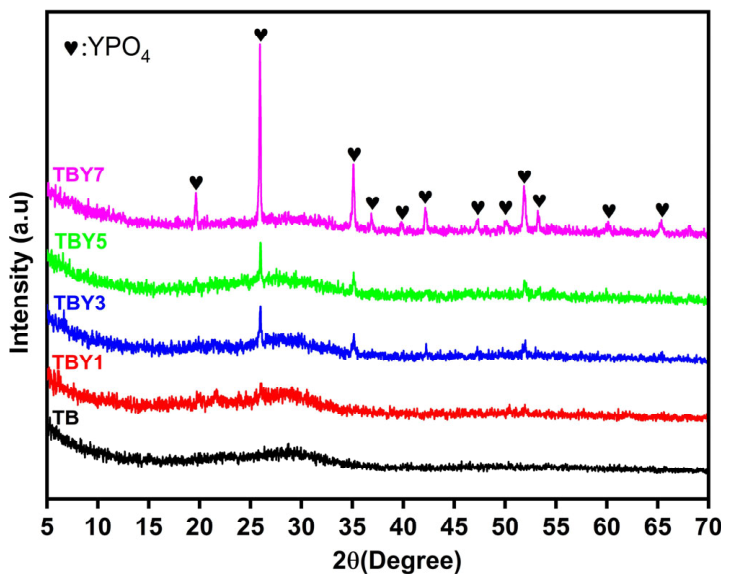
3-modified borotellurite glasses was investigated by X-ray diffraction (XRD) to confirm the amorphous nature of the prepared samples and to identify any crystalline phase formation induced by yttrium incorporation. The XRD patterns of the glass samples are presented in
Figure 1.
The undoped TB sample exhibited two broad diffuse halos, which are characteristic of an amorphous glass network and indicate the absence of long-range structural ordering [
46,
47]. This result confirms that the base TeO
2–B
2O
3–P
2O
5-containing composition was successfully obtained in a glassy state. With the incorporation of Y
2O
3, the glass-forming character of the system was largely preserved; however, weak diffraction peaks began to emerge, indicating the onset of partial crystallization. These peaks were consistent with the xenotime-type YPO
4 phase (ICDD 01-074-2429), suggesting that yttrium incorporation promoted the formation of phosphate-rich crystalline domains within the predominantly amorphous matrix.
The increasing intensity of these diffraction peaks with increasing Y
2O
3 content indicates that crystallization became more pronounced at higher dopant levels. This behavior suggests that Y
2O
3 not only modifies the local glass structure but also affects the balance between glass stability and nucleation tendency. The higher ionic field strength of Y
3+ ions enables them to act as strong coordination centers in the glass network, facilitating interactions with phosphate units and promoting local structural rearrangements favorable for YPO
4 formation [
48,
49]. At relatively low Y
2O
3 concentrations (1–3 mol.%), these crystalline regions appear to remain limited and dispersed within the amorphous matrix. In contrast, at higher concentrations (5–7 mol.%), the greater density of yttrium-rich centers likely enhances nucleation and crystal growth, leading to the clearer and sharper YPO
4 reflections observed in the XRD patterns [
15,
48]. Overall, the XRD results indicate that Y
2O
3 incorporation preserves the predominantly glassy nature of the system while progressively increasing its tendency toward partial crystallization at elevated dopant contents.
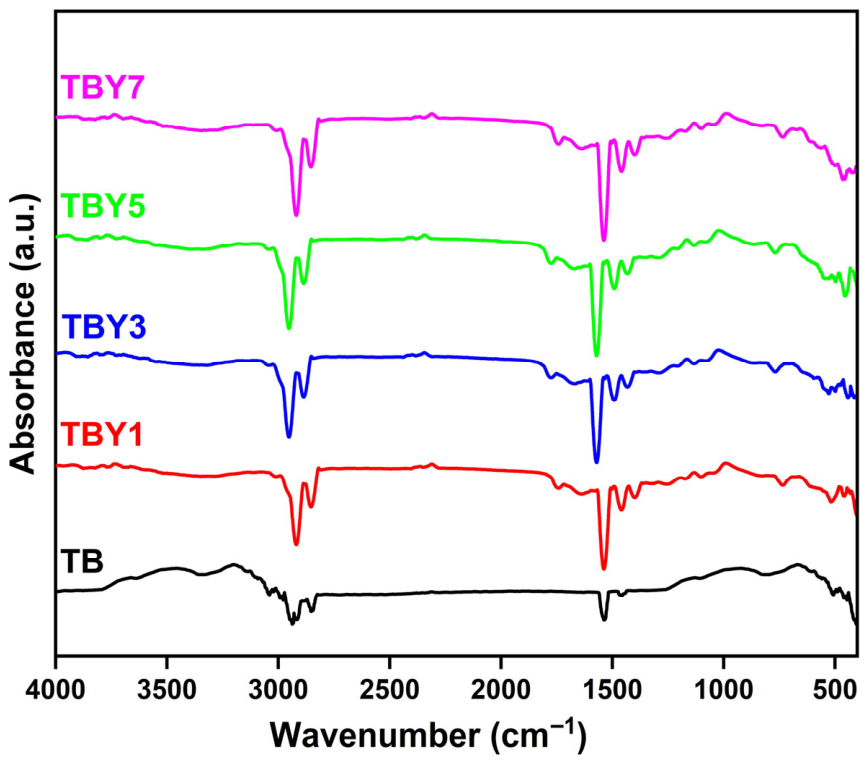
3.1.2. Fourier-Transform Infrared (FTIR) Analysis
FTIR spectroscopy was used to investigate the structural changes induced by Y
2O
3 incorporation in the borotellurite glass network. The spectra of the prepared samples are shown in
Figure 2. All compositions exhibited characteristic absorption bands associated with TeO
2-, B
2O
3-, and P
2O
5-based structural units, confirming the multicomponent nature of the glass system and indicating that the principal glass-forming units were retained after Y
2O
3 addition.
The spectra displayed several bands in the regions of approximately 2919, 2850, 1746, 1641, 1536, 1460, 1432, 1257, 1096, 1068, 734, 509, and 454 cm
−1. The weak bands observed near 2850–2920 cm
−1 are generally attributed to adsorbed water, hydroxyl-containing species, or residual surface contaminants. In contrast, the bands within the 1200–1600 cm
−1 region are more structurally significant and can be assigned mainly to B–O stretching vibrations of [BO
3] units, non-bridging B–O bonds, and borate-related ring structures. In particular, the band near 1257 cm
−1 is associated with boroxole ring vibrations, indicating the presence of borate structural motifs within the glass network [
50]. The emergence and increased definition of bands around 1432 and 1460 cm
−1 after Y
2O
3 addition suggest that yttrium modifies the local borate environment and may promote the formation of additional non-bridging oxygens or partial depolymerization within the borate sub-network.
The doublet-like features observed around 1096 and 1068 cm
−1 likely arise from overlapping vibrations of borate and phosphate units, reflecting the structural heterogeneity expected in a multicomponent glass system. The appearance of these split bands after Y
2O
3 incorporation suggests a redistribution of local bonding environments rather than complete network disruption. The band around 734 cm
−1, which becomes more evident in Y
2O
3-containing samples, is attributed to vibrations involving non-bridging oxygen atoms linked to [TeO
3] trigonal pyramidal units [
50,
51]. This finding suggests that yttrium affects the local tellurite coordination environment and may favor the formation or enhanced spectral detectability of TeO
3-related structural species. Finally, the low-wavenumber bands near 509 and 454 cm
−1 are assigned to Te–O–Te and O–Te–O bending vibrations, with possible contributions from phosphate-related bending modes [
51,
52,
53]. Overall, the FTIR results indicate that Y
2O
3 incorporation does not alter the fundamental multicomponent character of the glass network, but it does induce measurable local structural rearrangements in both the borate and tellurite environments.
3.1.3. UV–Vis Optical Analysis
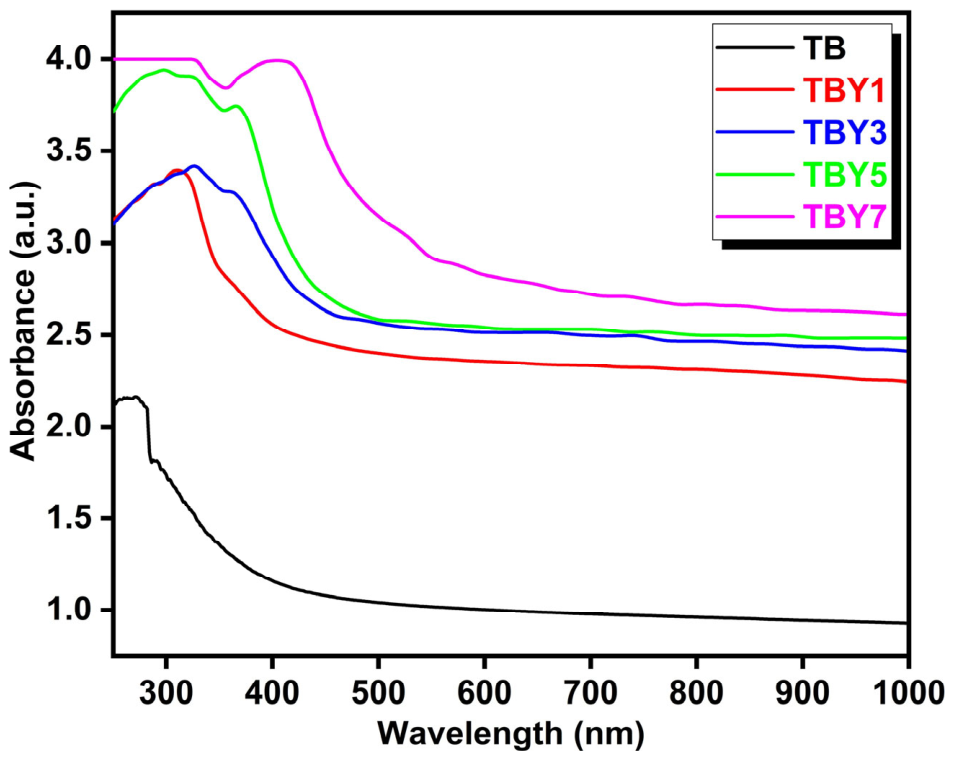
UV–Vis spectroscopy was employed to evaluate the optical response of the Y
2O
3-modified borotellurite glass system and to examine the effect of yttrium incorporation on the electronic structure of the glasses. The absorption spectra recorded for the prepared samples are presented in
Figure 3. All compositions except TBY7 exhibited broad absorption behavior without a sharp absorption edge, which is characteristic of amorphous materials and is consistent with the XRD results confirming the predominantly glassy nature of the system [
47].
A progressive shift of the absorption edge toward longer wavelengths was observed as the Y
2O
3 content increased. The absorption wavelength increased from 274 nm for the undoped TB sample to 408 nm for TBY7, indicating a clear red shift in the optical response. This trend suggests that Y
2O
3 incorporation alters the local bonding environment and affects the electronic transition behavior of the glass network. Similar red-shift behavior has been reported in rare-earth-modified borate- and phosphate-based glass systems [
54,
55,
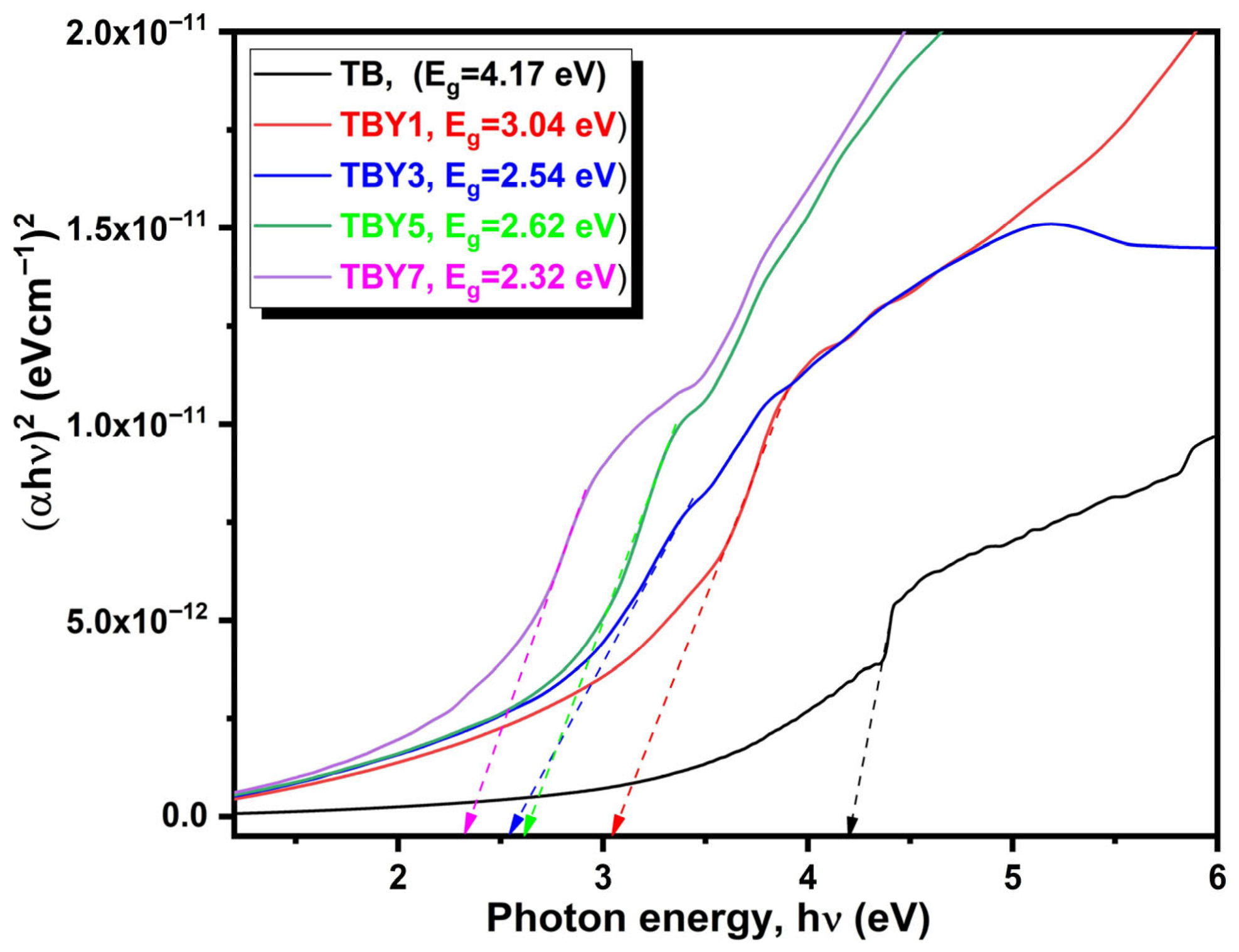
56]. The optical band gap values were estimated using the Tauc method, and the corresponding
versus
plots are shown in
Figure 4. The calculated band gap values decreased markedly from 4.17 eV for TB to 2.32 eV for TBY7, demonstrating that yttrium addition significantly narrows the optical band gap.
The reduction in band gap energy can be attributed to local structural rearrangements induced by Y
2O
3, which likely promote the formation of defect-related states and non-bridging oxygen-associated electronic levels within the glass network [
57,
58]. These additional localized states reduce the energy required for electronic excitation and thereby shift the absorption edge toward lower photon energies. In multicomponent amorphous systems, such behavior is also commonly associated with increased structural disorder and the development of band-tail states [
59,
60,
61]. Although surface roughness may contribute to light scattering and broaden the effective absorption edge, the overall trend observed here is consistent with intrinsic compositional modification of the glass structure rather than a purely surface-related effect.
The calculated optical constants are summarized in
Table 6. In parallel with the reduction in band gap, the refractive index increased from 2.13 in TB to 2.61 in TBY7. This inverse relationship between band gap and refractive index is well known in oxide glass systems and reflects increased electronic polarizability as the energy separation between valence and conduction bands decreases [
62]. The damping coefficient also increased with Y
2O
3 content, while the dielectric constant and linear dielectric susceptibility rose from 4.54 to 6.81 and from 0.28 to 0.46, respectively, indicating enhanced polarization capability in the modified glasses. In contrast, the metallization criterion decreased from 0.457 to 0.341, remaining within the range reported for oxide glasses with potential for nonlinear optical behavior [
63].
The optical basicity showed a slight decrease from 0.880 to 0.869 with increasing Y2O3 content. This trend can be explained by the relatively lower basicity contribution of Y2O3 compared with TeO2- and Na2O-rich structural environments. As Y2O3 progressively substitutes for TeO2, the average electron donor ability of oxygen ions in the glass decreases slightly, shifting the network toward a comparatively less basic and more electronically stabilized state. Overall, the UV–Vis results demonstrate that Y2O3 incorporation significantly modifies the optical behavior of borotellurite glasses by narrowing the band gap, increasing refractive index and dielectric response, and altering the electronic polarizability of the network. These findings further support the conclusion that yttrium acts as an effective compositional modifier capable of tuning not only the structural and mechanical properties, but also the optical characteristics of the developed bioactive glass system.
3.1.4. Thermal Properties
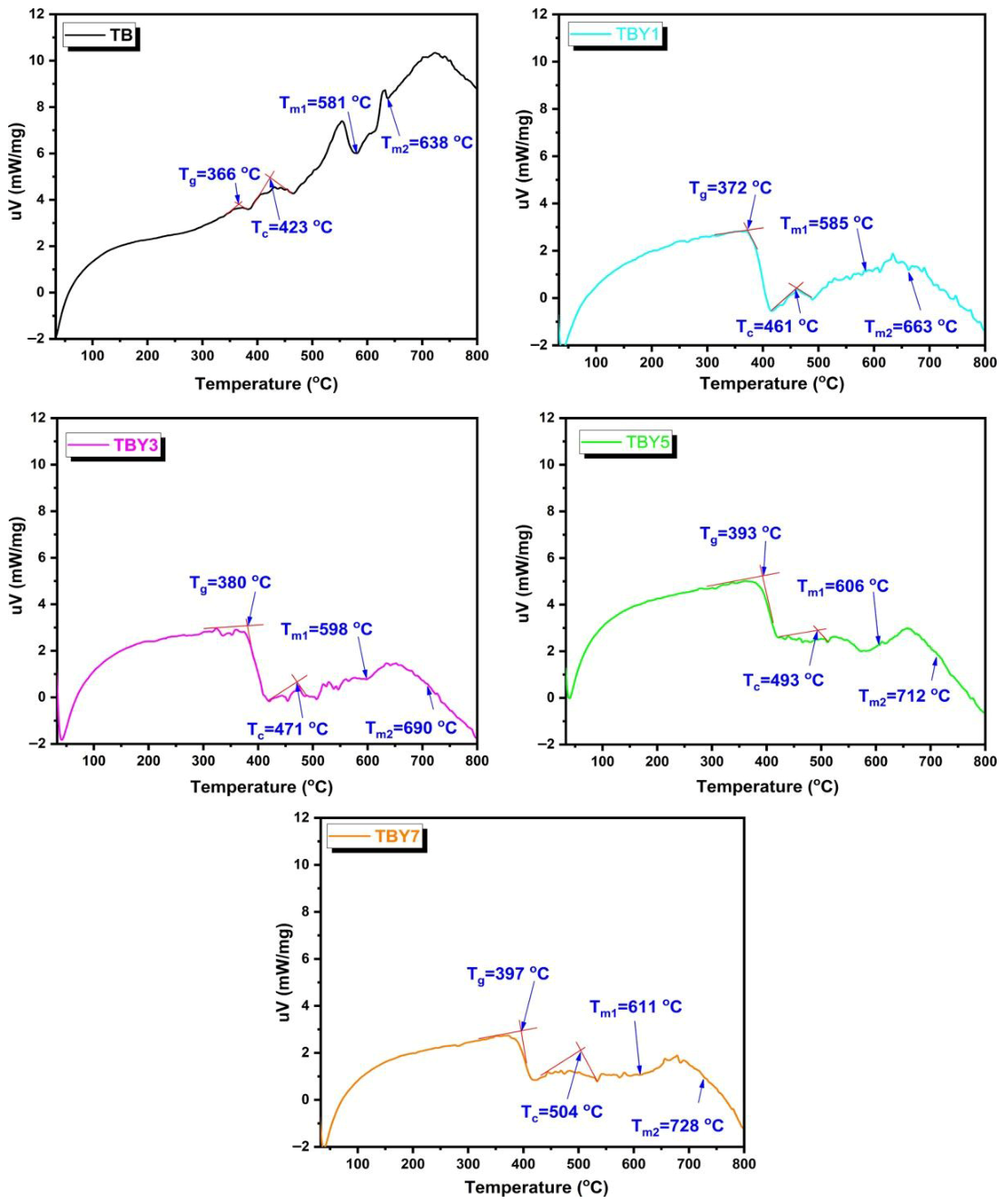
The thermal behavior of the Y
2O
3-modified borotellurite glasses was evaluated by differential thermal analysis (DTA), and the corresponding thermograms are presented in
Figure 5. The characteristic thermal parameters extracted from these curves, including the glass transition temperature (T
g), crystallization temperature (T
c), first melting temperature (T
m1), second melting temperature (T
m2), and thermal stability window (ΔT = T
c − T
g), are summarized in
Table 7.
A clear compositional dependence was observed for all thermal parameters. The glass transition temperature increased progressively from 366 °C in undoped TB glass to 397 °C in TBY7. A similar increasing trend was also recorded for the crystallization temperature, which rose from 423 °C to 504 °C, as well as for the first and second melting temperatures, which increased from 581 °C and 638 °C in TB to 611 °C and 728 °C in TBY7, respectively. Most importantly, the thermal stability window (ΔT) increased markedly from 57 °C in TB to 107 °C in TBY7, indicating that the addition of Y2O3 substantially improved the glass network’s resistance to devitrification during heating.
The progressive increase in T
g with increasing Y
2O
3 content indicates that yttrium incorporation enhances the rigidity of the glass network. This behavior can be attributed primarily to the stronger Y–O bond energy (E
Y–O = 715 kJ mol
−1) compared with the Te–O bond (E
Te–O = 391 ± 8 kJ mol
−1) [
64]. The substitution of TeO
2 by Y
2O
3 therefore introduces stronger local bonding interactions, which restrict segmental mobility within the glass structure and shift the glass transition to higher temperatures. The simultaneous increase in T
c and melting temperatures further supports the conclusion that Y
2O
3 acts as a network-stabilizing oxide, thereby improving the overall thermal robustness of the borotellurite system.
The marked widening of the ΔT parameter is particularly important from a processing perspective, as it reflects an increased working range between glass transition and crystallization onset. A larger ΔT value indicates better glass-forming ability and improved thermal processability, reducing the likelihood of uncontrolled crystallization during shaping or thermal treatment [
35]. In the present study, the monotonic increase in ΔT with Y
2O
3 addition suggests that yttrium not only stiffens the network but also enhances kinetic resistance to crystallization. Similar behavior has been reported in other rare-earth-containing oxide glasses. For example, in the 52B
2O
3–12SiO
2–26Bi
2O
3–(10 − x)TiO
2–xY
2O
3 system, increasing Y
2O
3 content also led to higher T
g, T
c, T
m, and ΔT values, which were attributed to the formation of stronger Y–O–B linkages and a more thermally stable glass network [
65]. The same mechanism is likely operative in the present borotellurite system, where Y
2O
3 contributes to increased bond strength and network stabilization.
3.1.5. Physical Properties
The calculated physical parameters of the Y
2O
3-modified borotellurite glasses, including density (
ρ), atomic packing density (
Vt), dissociation energy per unit volume (
Gt), molar volume (
VM, oxygen packing density (
OPD), molar oxygen volume (
MOV), average cross-link density (
), and bond density (
nb), are summarized in
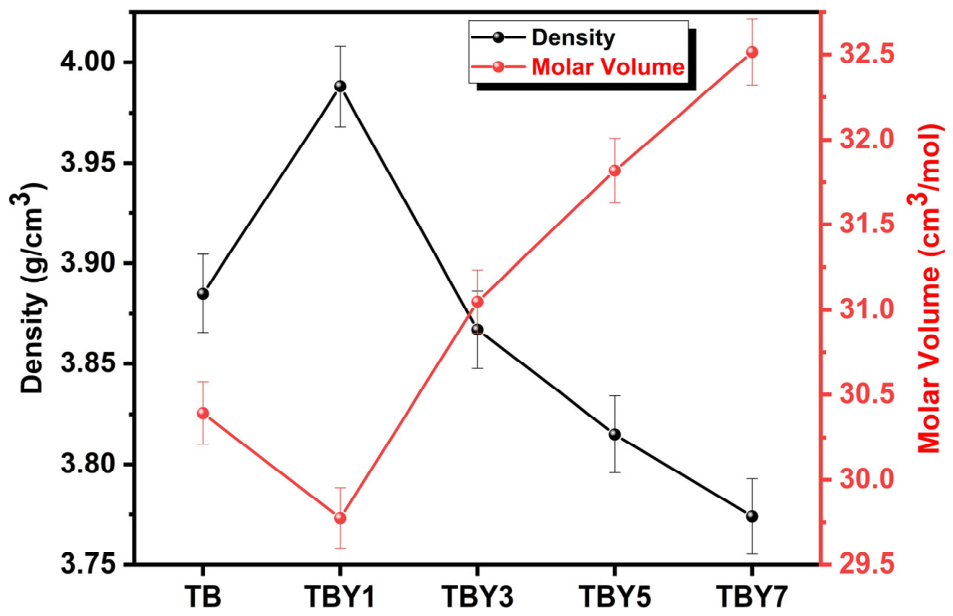
Table 8. The relationship between density and molar volume is additionally illustrated in
Figure 6.
The incorporation of Y
2O
3 produced a distinctly non-linear effect on the physical structure of the glasses. The density initially increased from 3.885 g/cm
3 for the undoped TB composition to 3.988 g/cm
3 for TBY1, and then gradually decreased to 3.774 g/cm
3 for TBY7. In contrast, the molar volume followed the opposite trend, decreasing from 30.393 cm
3/mol in TB to 29.774 cm
3/mol in TBY1, and then increasing progressively to 32.515 cm
3/mol in TBY7. This inverse relationship between density and molar volume is characteristic of variations in network packing efficiency and indicates that Y
2O
3 exerts a concentration-dependent effect on the structural compactness of the borotellurite glass system [
66].
At low Y
2O
3 concentration, particularly in TBY1, the simultaneous increase in density and decrease in molar volume suggest that limited yttrium incorporation promotes a more compact structural arrangement. This interpretation is supported by the fact that both
Vt and OPD reached their highest values in TBY1 (0.584 and 75.905 mol/L, respectively). These trends indicate more efficient atomic and oxygen packing within the glass network at low yttrium levels. Similar densification behavior has been reported in rare-earth-modified oxide glasses and is generally attributed to the relatively high field strength of Y
3+ ions, which promotes tighter coordination of surrounding oxygen atoms and improved local packing efficiency [
66,
67]. However, this compaction effect did not persist at higher Y
2O
3 contents. Beyond 1 mol.% Y
2O
3, density decreased continuously, while molar volume and molar oxygen volume increased. In the present system, this behavior can be explained by two concurrent effects. First, the progressive substitution of TeO
2 (
ρ = 5.67 g/cm
3) by Y
2O
3 (
ρ = 5.01 g/cm
3) lowers the overall mass contribution per unit volume. Second, the increase in MOV from 13.508 cm
3/mol in TB to 14.015 cm
3/mol in TBY7 indicates that the oxygen sub-network becomes progressively more open, suggesting volumetric expansion and reduced packing efficiency at higher yttrium levels [
68,
69,
70]. The accompanying decline in OPD and Vt further supports this interpretation, indicating that although yttrium strengthens local bonding, excessive addition leads to a structurally looser and less efficiently packed network.
Despite this structural opening at higher dopant contents, the dissociation energy per unit volume (G
t) increased monotonically from 49.600 to 50.909 kJ/cm
3, while the average cross-link density (
) rose from 2.000 to 2.092 across the series. These results demonstrate that Y
2O
3 simultaneously strengthens the average bond network, even as the overall packing efficiency decreases. This behavior is consistent with the high bond dissociation energy of Y–O bonds (715 kJ/mol), which increases the average bond strength of the glass structure. In contrast, the bond density (
nb) increased slightly at low yttrium content and then decreased from 8.658 × 10
22 ions/cm
3 in TBY1 to 8.262 × 10
22 ions/cm
3 in TBY7, which is consistent with the rise in molar volume and the reduced number of bonds per unit volume in a more open network. Similar dual behavior, namely reduced packing efficiency but increased bond strength, has been reported in tellurite- and borophosphate-based glasses containing rare-earth oxides [
70,
71].
3.1.6. Morphological Characterization of the Silver Coating
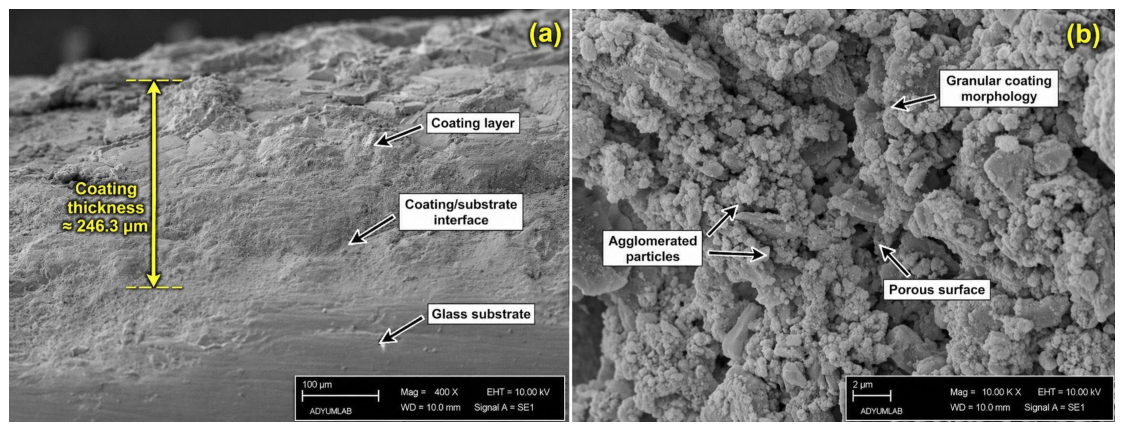
SEM images (
Figure 7a,b) confirmed the formation of a continuous silver-containing coating on the glass surface. Cross-sectional analysis showed an average coating thickness of approximately 246.28 µm, indicating that the deposited layer was sufficiently developed to act as a potential reservoir for sustained antibacterial ion release. The coating appeared generally compact and continuous, which is important because the antibacterial performance of Ag-containing coatings is strongly associated with coating continuity, surface coverage, and controlled Ag release [
28,
29,
30,
31]. However, its relatively high thickness may also influence interfacial stress, adhesion strength, and long-term mechanical stability. In the literature, silver-based surface coatings are widely recognized for their broad-spectrum antibacterial efficacy and their ability to reduce bacterial adhesion and biofilm formation on biomaterial surfaces [
29,
30,
72,
73,
74]. At the same time, excessively thick coatings may increase the risk of cracking, delamination, or residual stress accumulation, which can compromise structural reliability and coating adhesion [
30,
31]. Therefore, the present results suggest that the coating was successfully formed and is likely beneficial for antibacterial functionality, but further optimization of coating thickness and interfacial adhesion would be valuable for improving long-term stability and translational potential.
3.2. Elastic and Mechanical Properties
The elastic properties of the Y
2O
3-modified borotellurite glasses were theoretically estimated using the Makishima–Mackenzie model, and the calculated elastic modulus (
Em), bulk modulus (
Km), shear modulus (
Gm), longitudinal modulus (
Lm), and Poisson’s ratio (σ
m) are summarized in
Table 9. As shown, the elastic response of the glass system exhibited a composition-dependent trend rather than a monotonic increase with Y
2O
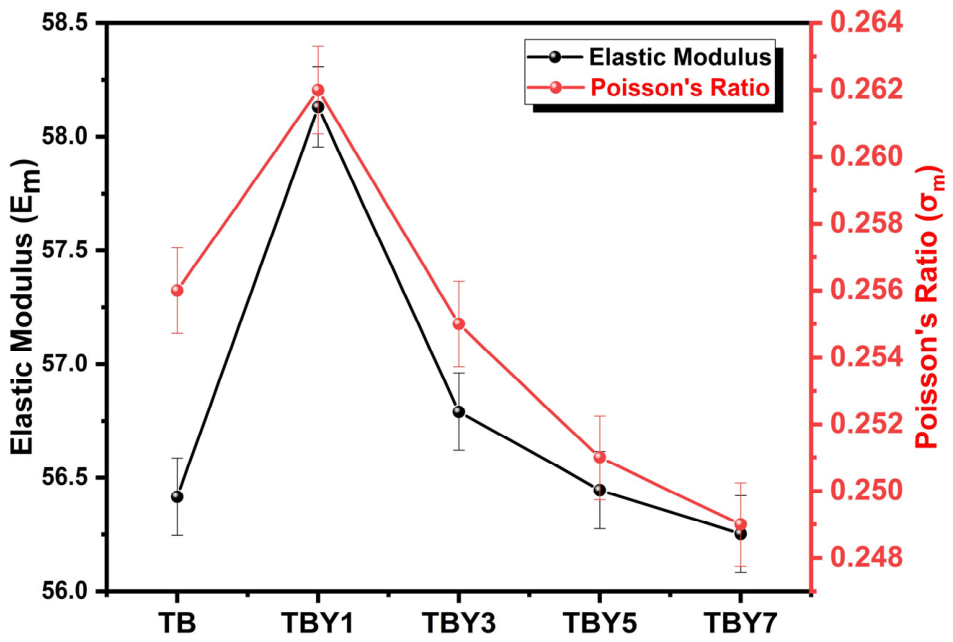
3 addition. The elastic modulus increased slightly from 56.416 GPa in the undoped TB glass to 58.131 GPa in TBY1, and then gradually decreased to 56.253 GPa in TBY7. A similar trend was observed for
Km,
Gm, and
Lm, all of which reached their maximum values at low yttrium content and showed a slight decline with further Y
2O
3 incorporation. These results indicate that limited Y
2O
3 addition improves the stiffness of the glass network, whereas higher dopant levels do not provide further enhancement in elastic response.
The observed elastic behavior can be explained by considering the dual effect of Y
2O
3 on glass structure. In oxide glasses, elastic properties are governed primarily by bond strength and packing efficiency; therefore, both the dissociation energy of the network and the density of atomic packing contribute to the final elastic response [
65,
66]. In the present study, the initial increase in
Em at TBY1 is consistent with the physical-property data discussed previously, where the highest atomic packing density (
Vt = 0.584) and oxygen packing density (
OPD = 75.905 mol/L) were also recorded for this composition. This suggests that a small amount of Y
2O
3 promotes a more compact and mechanically efficient glass network. However, as the Y
2O
3 content increased further, the gradual decline in
Em,
Km,
Gm, and
Lm indicates that the reduction in packing efficiency and the increase in molar volume begin to outweigh the strengthening contribution of Y–O-related bonding. In other words, higher Y
2O
3 levels strengthen local bonds but simultaneously generate a more open and less efficiently packed structure, resulting in only limited elastic benefit.
Poisson’s ratio also followed a composition-dependent trend, increasing slightly from 0.256 in TB to 0.262 in TBY1 and then decreasing progressively to 0.249 in TBY7. This behavior further supports the interpretation that low-level Y
2O
3 addition improves structural compactness and mechanical balance, whereas higher concentrations induce increasing heterogeneity and structural opening. The relationship between Y
2O
3 content, elastic modulus, and Poisson’s ratio is illustrated in
Figure 8.
The experimental mechanical properties of the glass series are presented in
Table 10. Vickers hardness increased continuously from 2.824 GPa in TB to 4.317 GPa in TBY7, demonstrating that Y
2O
3 incorporation markedly enhances resistance to localized deformation. Fracture toughness also improved significantly, increasing from 1.190 MPa·m
1/2 in TB to 2.289 MPa·m
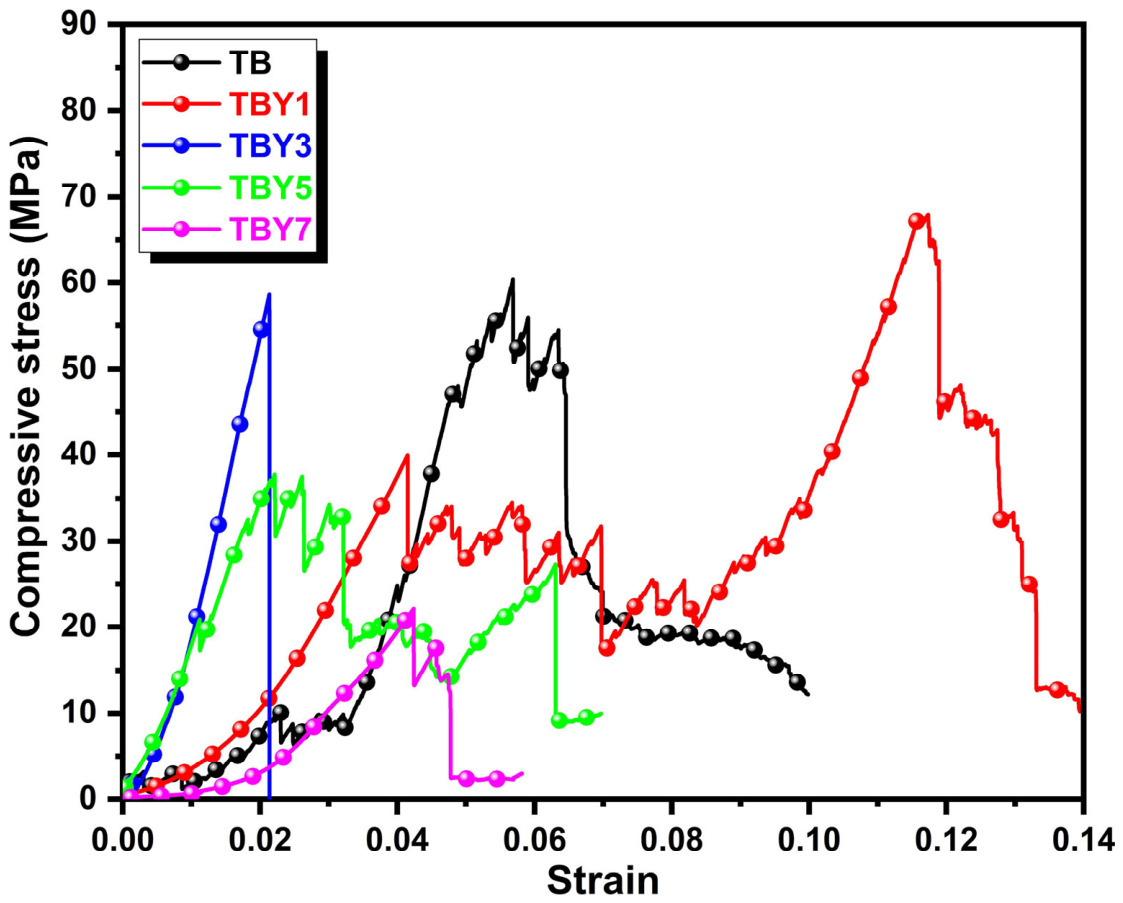
1/2 in TBY7. In contrast, the maximum compressive stress showed a non-monotonic trend, reaching its highest value at TBY1 (67.973 MPa) and then decreasing substantially with further Y
2O
3 addition, ultimately falling to 22.132 MPa in TBY7. These contrasting trends indicate that Y
2O
3 is highly effective in improving local indentation resistance and crack resistance, but does not continuously enhance the bulk load-bearing capacity of the glass under compression.
The progressive increase in hardness can be attributed to the strengthening effect of Y–O-related bonding, together with the monotonic increase in dissociation energy per unit volume (G
t) and average cross-link density (
). These parameters indicate that Y
2O
3 reinforces the local bond network and improves its resistance to indentation-induced deformation [
70]. The simultaneous increase in fracture toughness and the decrease in brittleness from 2.373 µm
−1/2 in TB to 1.625 µm
−1/2 in TBY5 suggest that moderate yttrium incorporation improves resistance to crack initiation and propagation more effectively than it increases brittleness. However, the slight increase in brittleness at TBY7 (1.886 µm
−1/2), despite the highest hardness in the series, suggests that the network at the highest Y
2O
3 content becomes locally harder but less able to dissipate crack-tip stresses, thereby producing a slightly more brittle response under indentation loading.
The compressive behavior followed a different structural logic. Unlike hardness, compressive strength depends not only on local bond strength, but also on volumetric packing efficiency, structural homogeneity, and the ability of the network to distribute stress uniformly under axial loading. The highest compressive strength observed in TBY1 is fully consistent with the highest density and packing density values recorded for this composition, indicating that optimum structural compactness was achieved at low Y
2O
3 content. With further Y
2O
3 addition, the decrease in density, Vt, and OPD, together with the increase in V
M and MOV, indicates the development of a more open and less efficiently packed glass structure. Such structural loosening likely reduces the material’s ability to distribute compressive stress homogeneously, making it more sensitive to local defects and promoting earlier catastrophic failure under bulk loading [
69]. This interpretation is also consistent with the stress–strain behavior shown in
Figure 9, where compositions containing higher Y
2O
3 contents exhibit weaker compressive response.
From a biomedical standpoint, the compressive strength values obtained in this study (22–68 MPa) remain below the typical range reported for cortical bone (100–200 MPa) [
75,
76]. However, they fall within or near the range often reported for trabecular bone and for bioactive glass materials intended for non-load-bearing or low-load bone defect filling applications [
5,
77]. Therefore, although the present compositions may not yet be suitable for high load-bearing orthopedic applications, they remain relevant for bone repair scenarios where bioactivity, cytocompatibility, and controlled dissolution are prioritized over high compressive strength.
3.3. Assessment of ICP Results
The ion-release behavior of the Y
2O
3-modified borotellurite bioactive glasses was evaluated after immersion in simulated body fluid (SBF) for 1 and 30 days, and the corresponding ICP-MS results are summarized in
Table 11. These measurements were used to assess both the early-stage dissolution behavior and the longer-term release profile of biologically relevant ions from the glass network.
After 1 day, the Y2O3-containing compositions released markedly higher amounts of Na, P, and Ca than the undoped TB glass, indicating enhanced early-stage ionic exchange. In contrast, Te release decreased substantially in all doped samples relative to TB, suggesting that Y2O3 suppresses the initial release of tellurium-containing species. After 30 days, ion concentrations increased in all groups, as expected from continued dissolution; however, the undoped TB sample still exhibited the highest B and Te release, whereas the Y2O3-containing glasses maintained considerably lower tellurium concentrations. Among the doped compositions, TBY3 showed the highest Y release (0.751 ppb), while Na and Ca release remained relatively high across all groups.
These findings indicate that Y2O3 exerts a dual effect on the dissolution behavior of the borotellurite glass system. It appears to facilitate the release of biologically relevant ions such as Na, Ca, and P during the early stage, while simultaneously stabilizing the network against excessive long-term tellurium release through stronger Y–O interactions. The overall release profile also suggests controlled degradation rather than rapid network breakdown, likely due to the gradual formation of a surface reaction layer during immersion. Therefore, Y2O3 modification improves the biological suitability of the glass not only by altering composition, but also by regulating ion release in a more favorable manner.
3.4. Biocompatibility and In Vitro Analyses
3.4.1. Assessment of Hydroxyapatite Formation
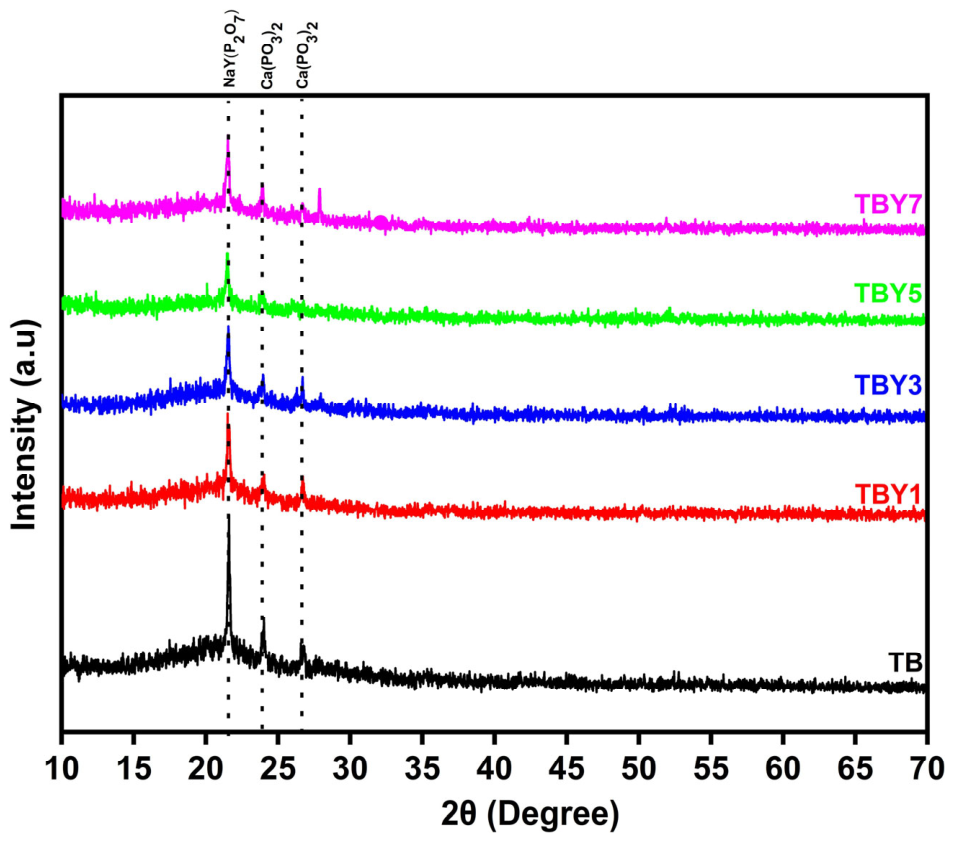
The in vitro bioactivity of the prepared glasses was evaluated by XRD after 14 days of immersion in simulated body fluid (SBF), and the corresponding diffraction patterns are shown in
Figure 10. Following SBF incubation, the glass surface exhibited diffraction features consistent with sodium yttrium diphosphate (NaY(P
2O
7), ICDD 01-087-1913) and calcium catenate phosphate (Ca(PO
3)
2, ICDD 01-079-0700), indicating the formation of phosphate-rich reaction products on the glass surface. These findings confirm that the Y
2O
3-modified borotellurite glasses retained their ability to undergo surface reactions under physiological-like conditions, which is a key indicator of in vitro bioactivity.
The formation of such calcium- and phosphate-containing surface phases suggests that dissolution of the glass network was followed by reprecipitation processes at the glass–solution interface. This behavior is consistent with the established bioactivity mechanism of bioactive glasses, in which ionic exchange and network dissolution promote the development of a surface reaction layer that subsequently acts as a precursor for apatite-like mineralization [
42,
78]. Although the detected phases were not identified directly as stoichiometric hydroxyapatite, their phosphate-rich nature indicates that the glass surfaces were actively participating in mineral deposition. Similar intermediate calcium phosphate or pyrophosphate-type phases have been reported in multicomponent bioactive glass systems during the early stages of SBF mineralization, prior to the maturation of a more apatite-like layer [
42,
78]. Therefore, the XRD results suggest that Y
2O
3 incorporation does not suppress the in vitro bioactive response of the borotellurite glass system and may still support the formation of biologically relevant mineralized surface products.
3.4.2. Assessment of Cell Viability (Alamar Blue) Results
The biological response of the prepared bioactive glass samples toward osteoblast-like MC3T3-E1 cells was evaluated in vitro using the Alamar Blue viability assay after 24 h and 30 days of incubation. The negative control group without any sample was taken as the 100% viability reference, whereas ZnSO
4 (2 mM) was used as the positive cytotoxic control. The Cell viability (%) of MC3T3-E1 cells cultured with Y
2O
3-doped bioactive glass samples for 1 and 30 days is shown in
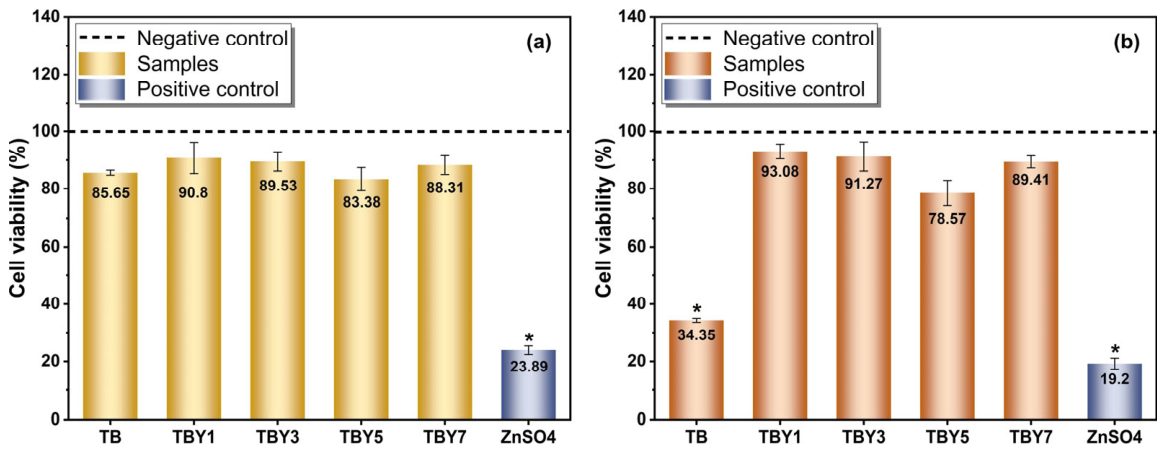
Figure 11.
At 24 h, all glass compositions maintained relatively high cell viability, ranging from 83.38 ± 4.05% to 90.80 ± 5.46%, indicating that none of the tested glasses induced acute cytotoxicity during the early exposure period. In contrast, the positive control showed markedly reduced viability (23.89 ± 1.47%), confirming the sensitivity of the assay. After 30 days, the differences among the compositions became much more pronounced. The undoped TB sample showed a substantial reduction in cell viability to 34.35 ± 0.71%, whereas all Y
2O
3-containing glasses remained above the 70% threshold defined by ISO 10993-5:2009 for non-cytotoxic materials [
43]. Among them, TBY1 exhibited the highest long-term viability (93.08 ± 2.58%), followed by TBY3 (91.27 ± 5.12%), TBY7 (89.41 ± 2.14%), and TBY5 (78.57 ± 4.39%). These results clearly show that Y
2O
3 incorporation markedly improved long-term cytocompatibility compared with the undoped borotellurite glass.
When evaluated collectively, the results suggest that yttrium addition exerts a composition-dependent effect on osteoblast viability. The superior long-term performance of the Y
2O
3-containing samples, particularly TBY1, may be explained by the stabilizing effect of Y
3+ on the glass network. As discussed in the structural and ICP-MS results, Y
2O
3 incorporation reduced excessive long-term tellurium release while maintaining controlled dissolution of biologically relevant ions. This is particularly important because prolonged release of tellurite species has been associated with oxidative stress and mitochondrial dysfunction in mammalian cells [
32]. In the present study, the severe long-term viability loss observed in the undoped TB sample is consistent with this mechanism, whereas the significantly improved viability of the Y
2O
3-modified glasses supports the idea that yttrium acts not only as a mechanical modifier but also as a biocompatibility-enabling network stabilizer.
The slight decline in viability observed at higher Y
2O
3 contents relative to TBY1 may reflect changes in dissolution kinetics, ionic concentration, or local pH conditions associated with increasing dopant levels. Such behavior is not unusual in multicomponent bioactive glasses, where cellular response depends strongly on achieving a balance between beneficial ion release and excessive local chemical perturbation. Previous studies have similarly reported that Y
2O
3-containing glass and ceramic systems can display acceptable cytocompatibility when the yttrium content remains within an appropriate compositional window [
20,
21,
22]. Therefore, the present results indicate that careful optimization of Y
2O
3 concentration is critical, with low-to-moderate yttrium incorporation providing the most favorable balance between structural stability and biological performance. Overall, the Alamar Blue results confirm that the Y
2O
3-modified borotellurite glasses are substantially more suitable for bone-related applications than the undoped composition, particularly under long-term exposure conditions relevant to implantable biomaterials.
3.4.3. Osteoblast Adhesion and Morphological Evaluation
The adhesion behavior of MC3T3-E1 osteoblast-like cells on the surfaces of the Y
2O
3-doped bioactive glass samples was evaluated, and the corresponding results are presented in
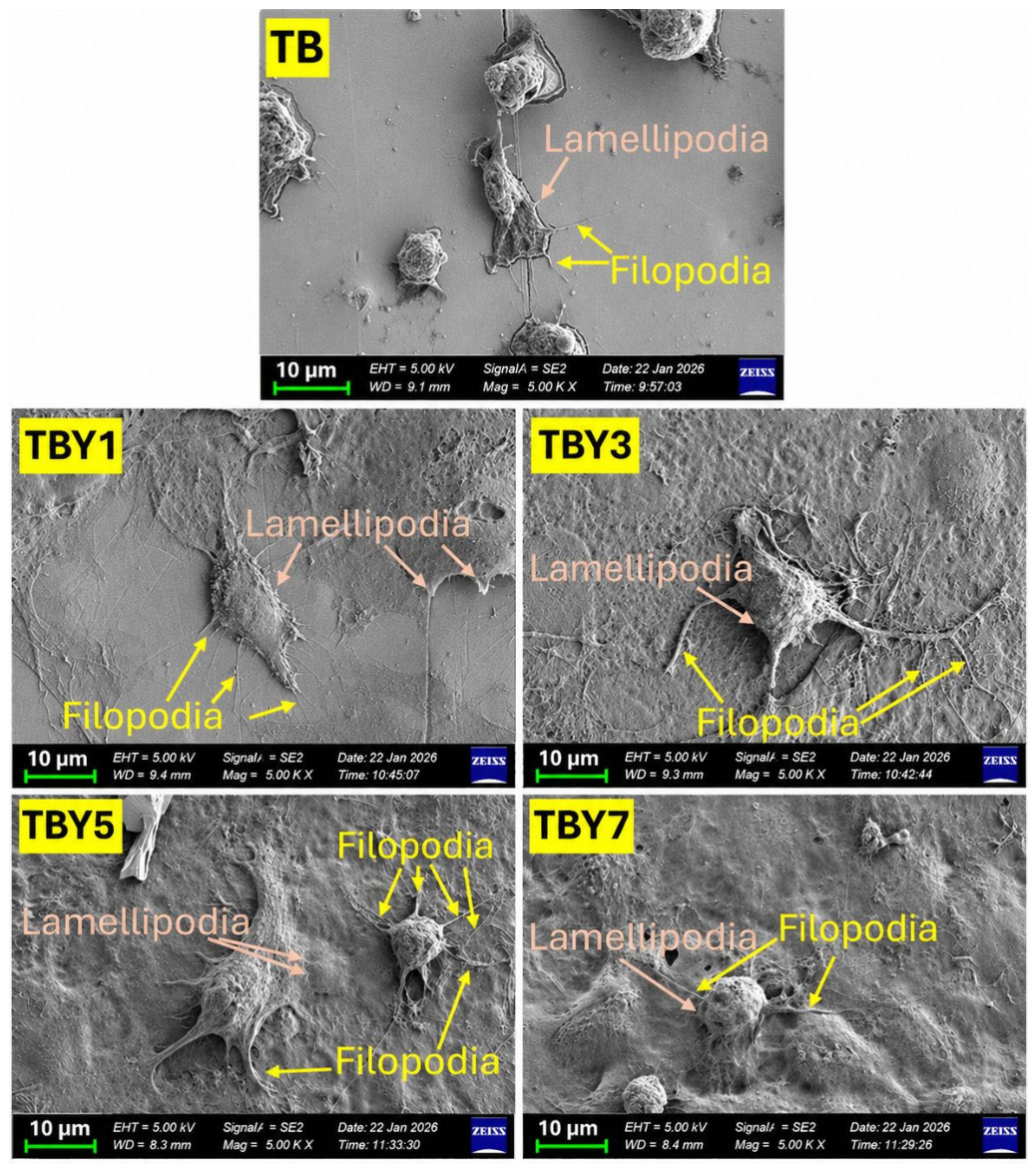
Figure 12. Representative FESEM images illustrating the morphology of cells attached to the sample surfaces are shown in
Figure 13.
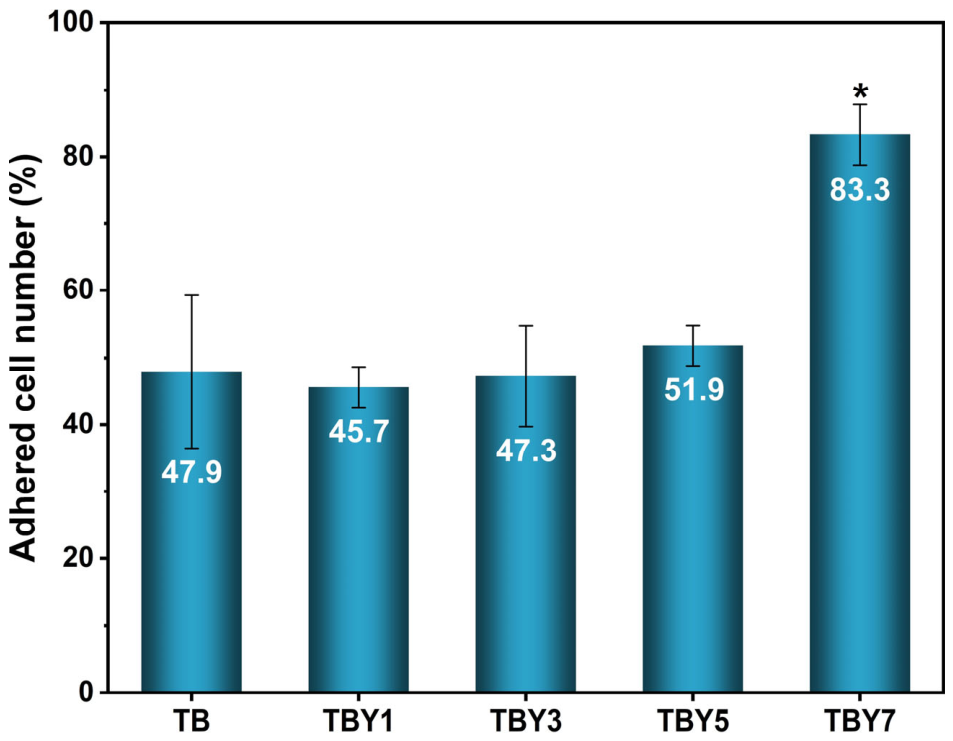
The results demonstrate that increasing Y
2O
3 content enhances cell–surface interactions and promotes more effective osteoblast attachment to the bioactive glass surfaces. As shown in
Figure 12, the adhesion levels of TB, TBY1, and TBY3 were comparable, while a moderate increase was observed for TBY5. A pronounced rise in cell adhesion was recorded for TBY7, which exhibited the highest adhesion value (83.33 ± 4.55%) and a statistically significant difference compared with the TB reference. These findings indicate that high yttrium incorporation positively influences the surface properties of the glass in a manner favorable for early osteoblast attachment.
Cell adhesion is one of the most critical parameters governing the early biological performance of biomaterials, as it directly affects subsequent cell spreading, proliferation, and differentiation [
2,
79,
80,
81]. In the present study, low yttrium contents did not substantially alter the adhesion response; however, increasing the Y
2O
3 concentration led to a marked enhancement in cell attachment. The strong adhesion observed for TBY7 suggests that yttrium incorporation may induce favorable chemical and physicochemical modifications at the glass surface, such as improved protein adsorption capacity or increased surface energy. It is well established that biomaterial–cell interactions are mediated by adsorbed proteins and surface chemistry, which regulate integrin-mediated attachment and focal adhesion formation [
82,
83].
The FESEM observations in
Figure 13 further support the quantitative adhesion data. On the TB surface, cells appeared relatively sparse and less spread, indicating weaker anchorage. In contrast, the Y
2O
3-containing samples, particularly TBY5 and TBY7, exhibited more extensive spreading and stronger attachment to the substrate. The FESEM images also reveal the presence of lamellipodia and filopodia, which are well-recognized indicators of active cytoskeletal organization and dynamic cell–surface interaction [
84,
85]. These protrusive structures are associated with actin remodeling and integrin engagement at the cell–material interface, and their presence reflects a biologically favorable surface for osteoblast adhesion [
81,
84].
The improved adhesion observed at higher Y
2O
3 contents is consistent with previous reports on bioactive glasses and rare-earth-modified biomaterials, in which enhanced surface reactivity and controlled ionic dissolution were shown to support osteoblast attachment and early cellular response [
2,
4,
14,
80]. In particular, ionic dissolution products released from bioactive glasses can modulate signaling pathways involved in osteogenic activity [
14], while surface topography and nanoscale features may further influence integrin binding and cytoskeletal organization [
86]. In the present system, the superior adhesion behavior of TBY7 likely reflects a synergistic effect of optimized surface chemistry, regulated ion release, and improved interfacial energy conditions induced by Y
2O
3 incorporation.
Overall, the combined quantitative adhesion data and FESEM-based morphological observations demonstrate that Y2O3 content significantly affects the early osteoblast response to borotellurite bioactive glasses. While low yttrium contents had only a limited influence on adhesion, higher concentrations particularly in the TBY7 composition substantially improved both the number of adhered cells and their spreading behavior.
3.4.4. In Vitro Degradation Behavior
The biodegradation behavior of the Y
2O
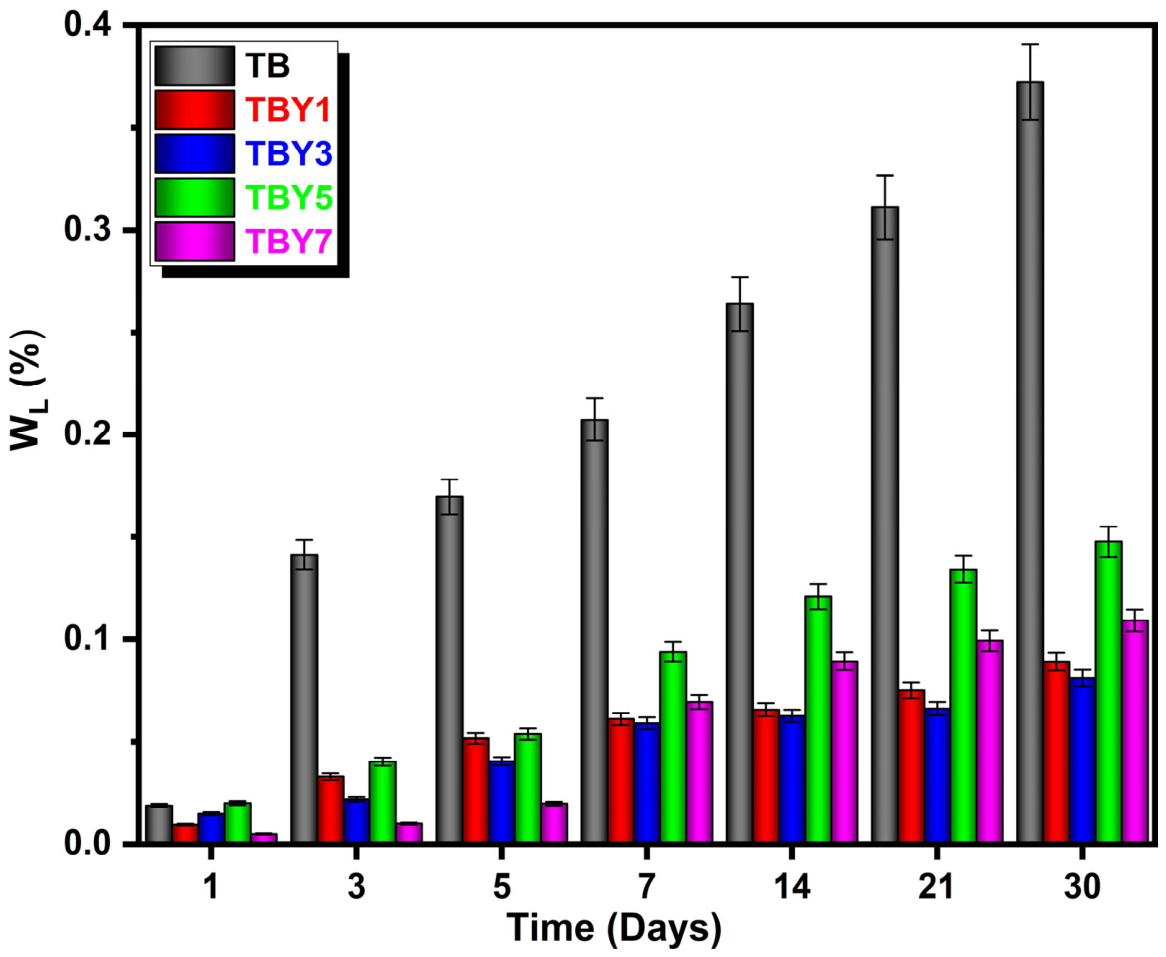
3-doped bioactive glasses was evaluated by immersing the samples in PBS for predetermined time intervals and calculating the corresponding percentage weight loss. The time-dependent weight loss profiles are presented in
Figure 14.
As shown in
Figure 14, the weight loss increased progressively with immersion time for all compositions, indicating continuous interaction between the glass surface and the surrounding solution. However, the undoped TB sample consistently exhibited the highest degradation level throughout the test period, demonstrating a faster dissolution rate than the Y
2O
3-containing glasses. Although weight loss also increased over time in the doped groups, their overall degradation remained lower than that of the unmodified composition.
These results suggest that Y
2O
3 incorporation improves the chemical durability of the borotellurite glass system. This effect can be attributed to the strengthening of cation–oxygen interactions and the resulting increase in network stability, which reduces the susceptibility of the glass to dissolution in aqueous media [
18,
87,
88,
89]. Similar findings have been reported for rare-earth-modified glass systems, where the introduction of rare-earth oxides enhanced chemical resistance by increasing network rigidity and cross-linking strength [
90]. Therefore, the present results indicate that Y
2O
3 acts as an effective stabilizing modifier that moderates biodegradation while preserving the reactive character of the bioactive glass.
3.4.5. Antibacterial Performance and Bacterial Adhesion
The antibacterial performance of the Y
2O
3-doped borotellurite bioactive glasses was evaluated by viable bacterial counting after adhesion of
Escherichia coli ATCC 11775 and
Staphylococcus aureus ATCC 25923 on the sample surfaces. The corresponding live-count results are summarized in
Table 12.
For
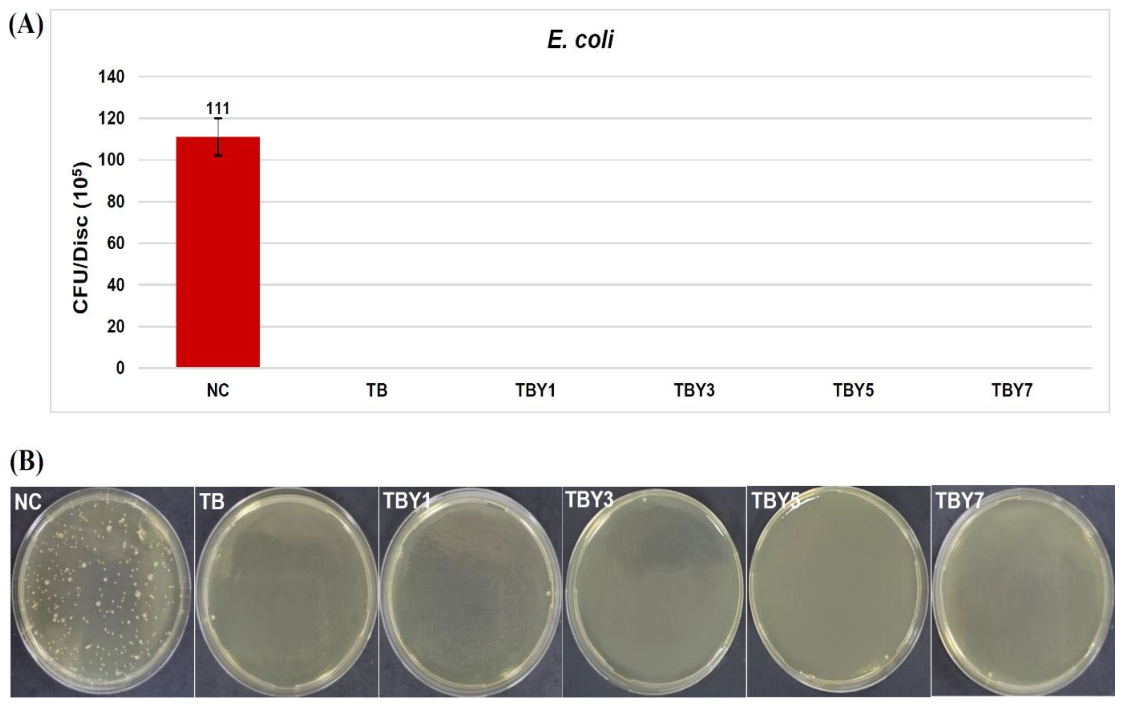
E. coli, no viable bacterial adhesion was detected on either the undoped TB glass or any of the Y
2O
3-containing bioactive glass samples, whereas the negative control glass of identical surface area exhibited a bacterial count of 111 × 10
5 CFU/disk, confirming that the assay conditions were valid and that the absence of detectable adhesion on the tested glasses reflected a genuine antibacterial response rather than experimental failure. These results are presented in
Figure 15.
For
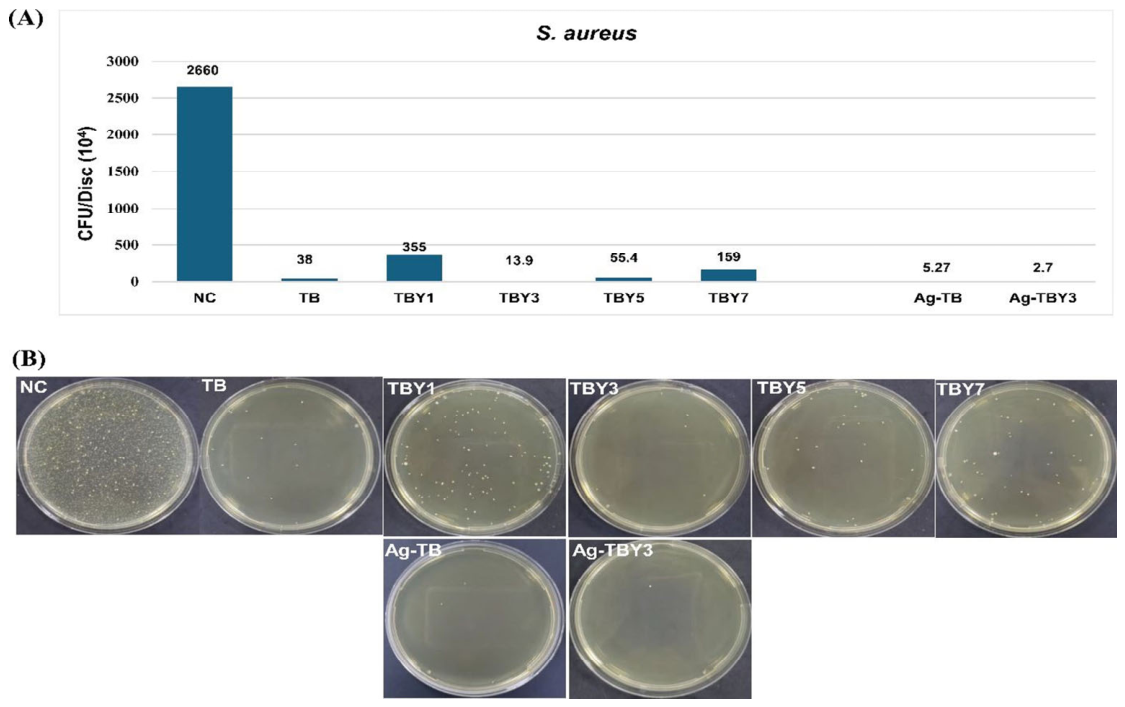
S. aureus, measurable bacterial adhesion was detected on all uncoated glass samples, although the extent of adhesion strongly depended on composition. Among the Y
2O
3-doped groups, TBY3 exhibited the lowest bacterial count (13.9 ± 2.4 × 10
4 CFU/disk), indicating the strongest anti-adhesive effect within the doped series. Relative to the undoped TB sample, this corresponded to an adhesion inhibition of 63.4%, while inhibition relative to the negative control reached approximately 99.5%. After silver coating of the TBY3 composition, the bacterial count decreased further to 2.7 ± 0.5 × 10
4 CFU/disk, corresponding to an additional 80.6% reduction compared with uncoated TBY3. In comparison with TB and the negative control, the adhesion inhibition achieved by Ag-TBY3 reached 92.9% and 99.9%, respectively. These results are shown in
Figure 16.
The antibacterial trends observed in this study can be interpreted in light of both the ion-release behavior and the surface chemistry of the glasses. ICP-MS analysis confirmed the release of tellurium-containing species from the borotellurite compositions, and the absence of detectable
E. coli adhesion may be associated with the known antimicrobial effect of tellurite species. Tellurite ions are highly toxic to many bacterial cells because they disrupt thiol metabolism, induce oxidative stress, and interfere with essential cellular redox processes. Gram-negative bacteria can be particularly sensitive to these effects, which may explain the complete suppression of detectable
E. coli adhesion on all tested glass surfaces [
32]. At the same time, the composition-dependent differences observed for
S. aureus suggest that Y
2O
3 incorporation influences antibacterial behavior not only through dissolution products, but also through its effect on surface structure and interfacial interactions. In this respect, the superior performance of TBY3 suggests that an intermediate Y
2O
3 level provides the most favorable balance between antibacterial ion release and surface characteristics that limit bacterial colonization.
The marked improvement after silver coating is fully consistent with the well-established broad-spectrum antimicrobial activity of silver and its derivatives. Silver ions are known to act through multiple simultaneous mechanisms, including membrane disruption, enzyme inactivation, reactive oxygen species generation, and binding to nucleic acids and proteins, which collectively reduce the likelihood of resistance development compared with conventional single-target antibiotics [
28,
29,
91,
92]. Recent studies have also shown that integrating silver into biomaterial surfaces effectively reduces bacterial adhesion and biofilm formation, thereby lowering the risk of implant-associated infection [
30,
31,
72,
73,
74]. In the present work, coating the most promising Y
2O
3-doped composition (TBY3) with silver further enhanced the anti-adhesive response against
S. aureus, confirming a clear synergistic benefit of combining compositional optimization with antibacterial surface functionalization. Overall, these findings demonstrate that Y
2O
3-doped borotellurite bioactive glasses possess intrinsic antibacterial potential, while silver coating provides an additional and highly effective strategy for strengthening infection-resistant functionality.
3.5. Limitations and Future Perspectives
The present study provides an initial in vitro evaluation of Y2O3-modified borotellurite bioactive glasses through cytocompatibility, osteoblast adhesion, SBF bioactivity, ion-release, degradation, and antibacterial analyses. However, osteogenic differentiation was not directly confirmed by ALP activity, matrix mineralization, or osteogenic gene-expression analysis. Therefore, future studies should include ALP activity, Alizarin Red S mineralization assays, and osteogenic markers such as RUNX2, ALP, COL1A1, OCN, and OPN to more clearly verify osteoinductive potential.
Further work should also assess long-term coating stability, degradation under dynamic conditions, and in vivo bone-defect performance to better establish practical applicability. In addition, XPS analysis should be performed to clarify surface chemical states and coating–glass interfacial chemistry. Post-melting XRF analysis was performed as a semi-quantitative screening method during the revision process; however, the data were not included in the manuscript because they do not represent absolute final stoichiometric compositions for this multicomponent borotellurite–phosphate glass system. Fully validated bulk compositional verification by ICP-OES or ICP-MS after complete glass digestion is also needed to confirm the final oxide composition more accurately.



 ,
,