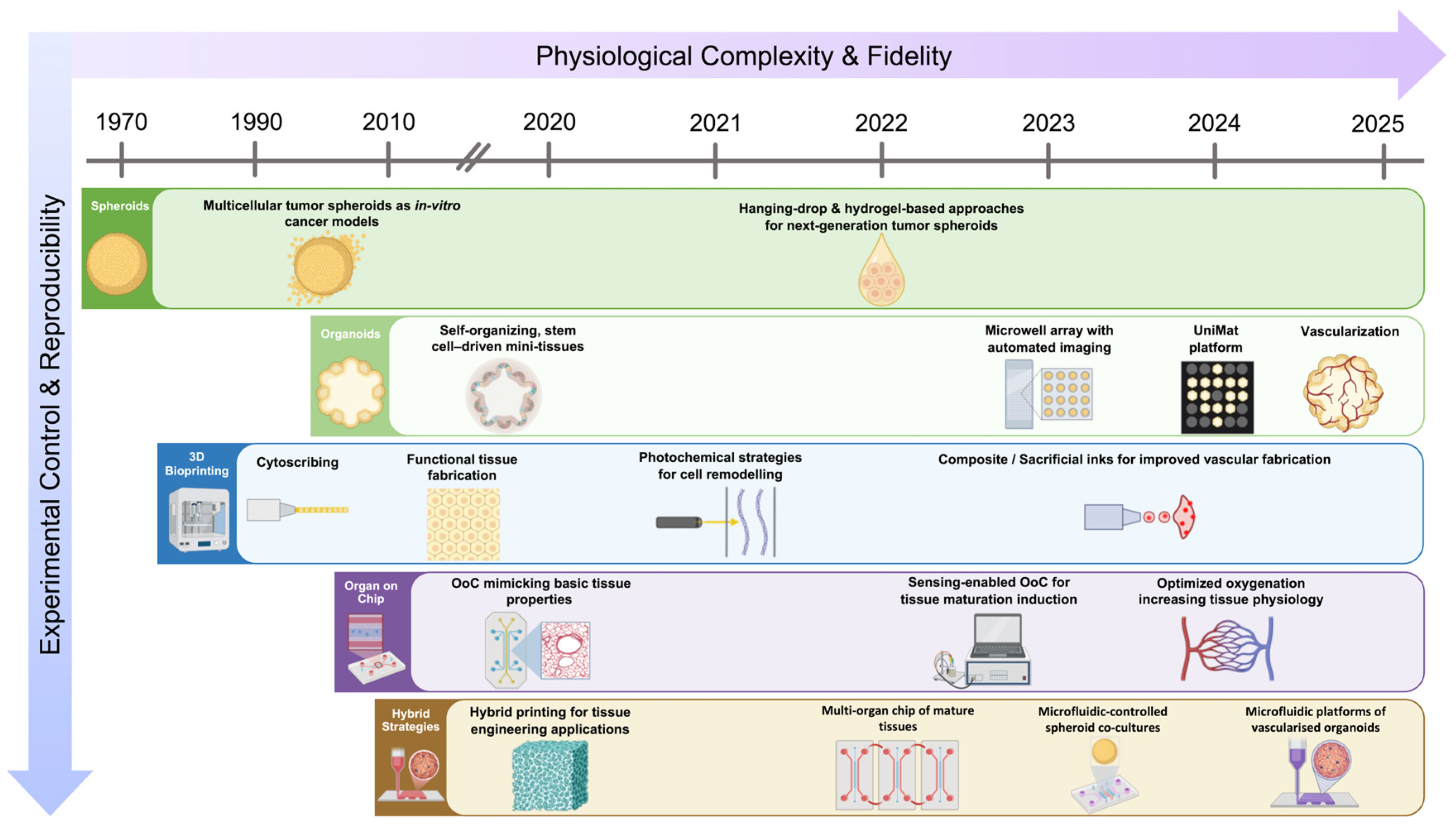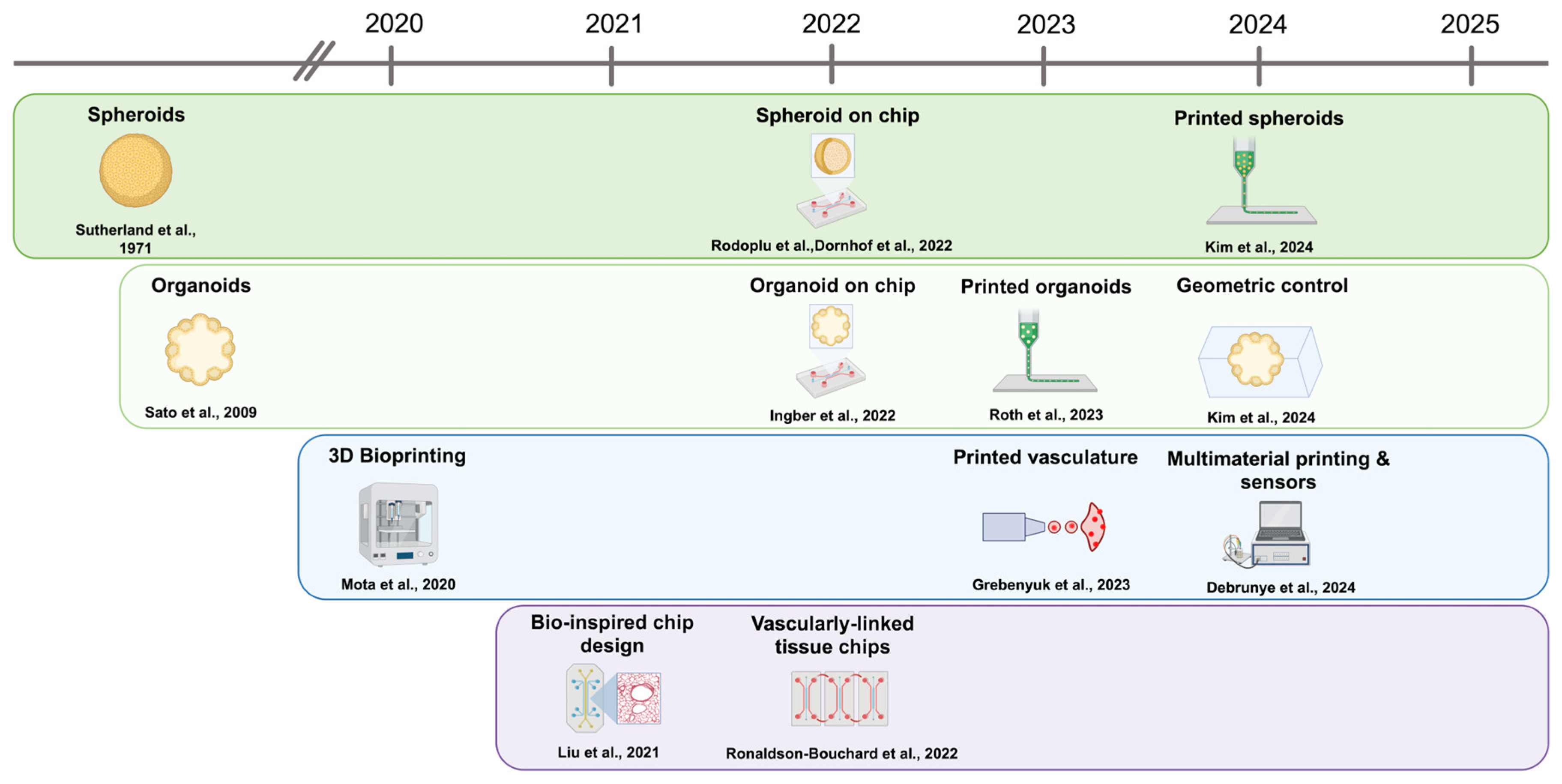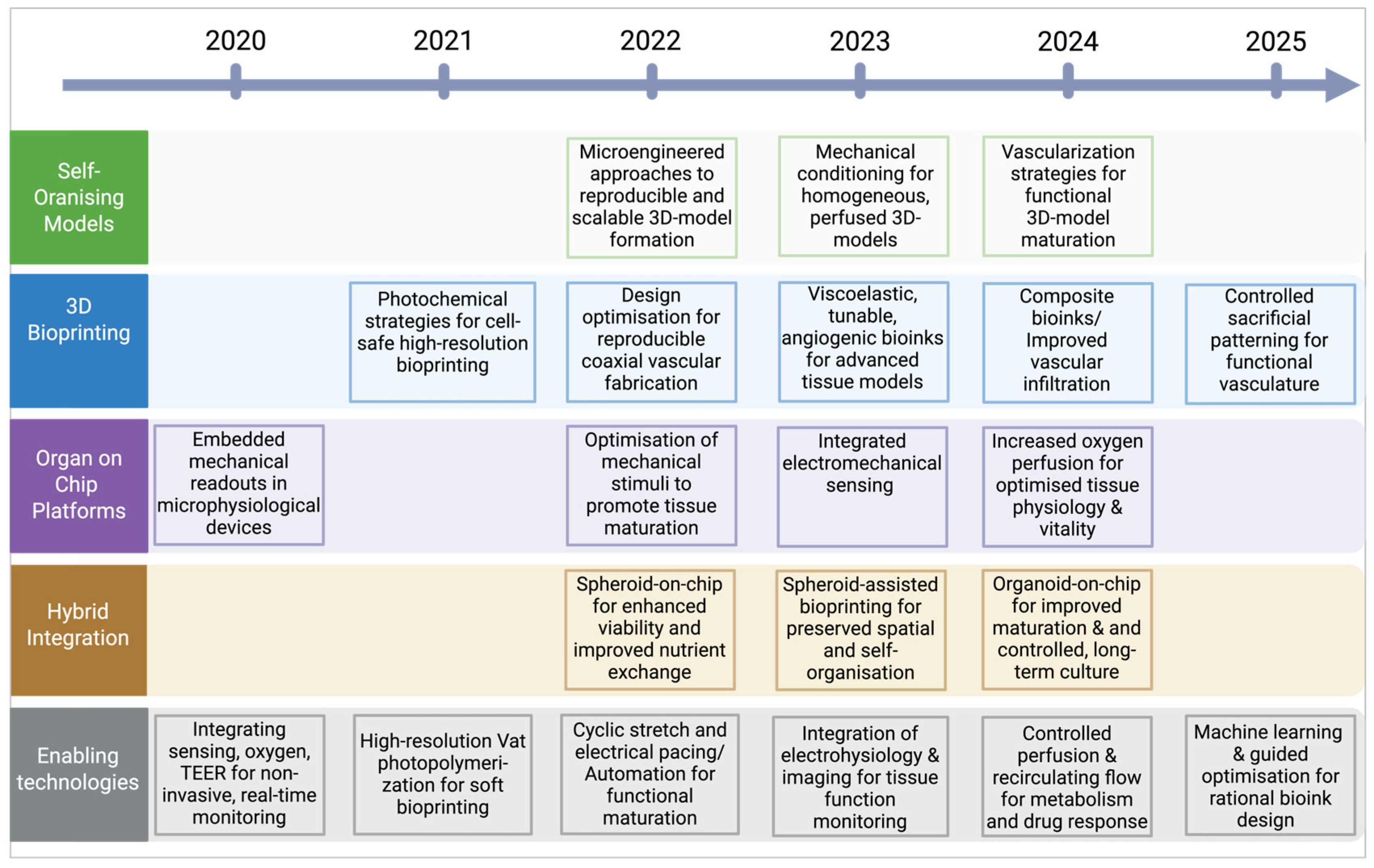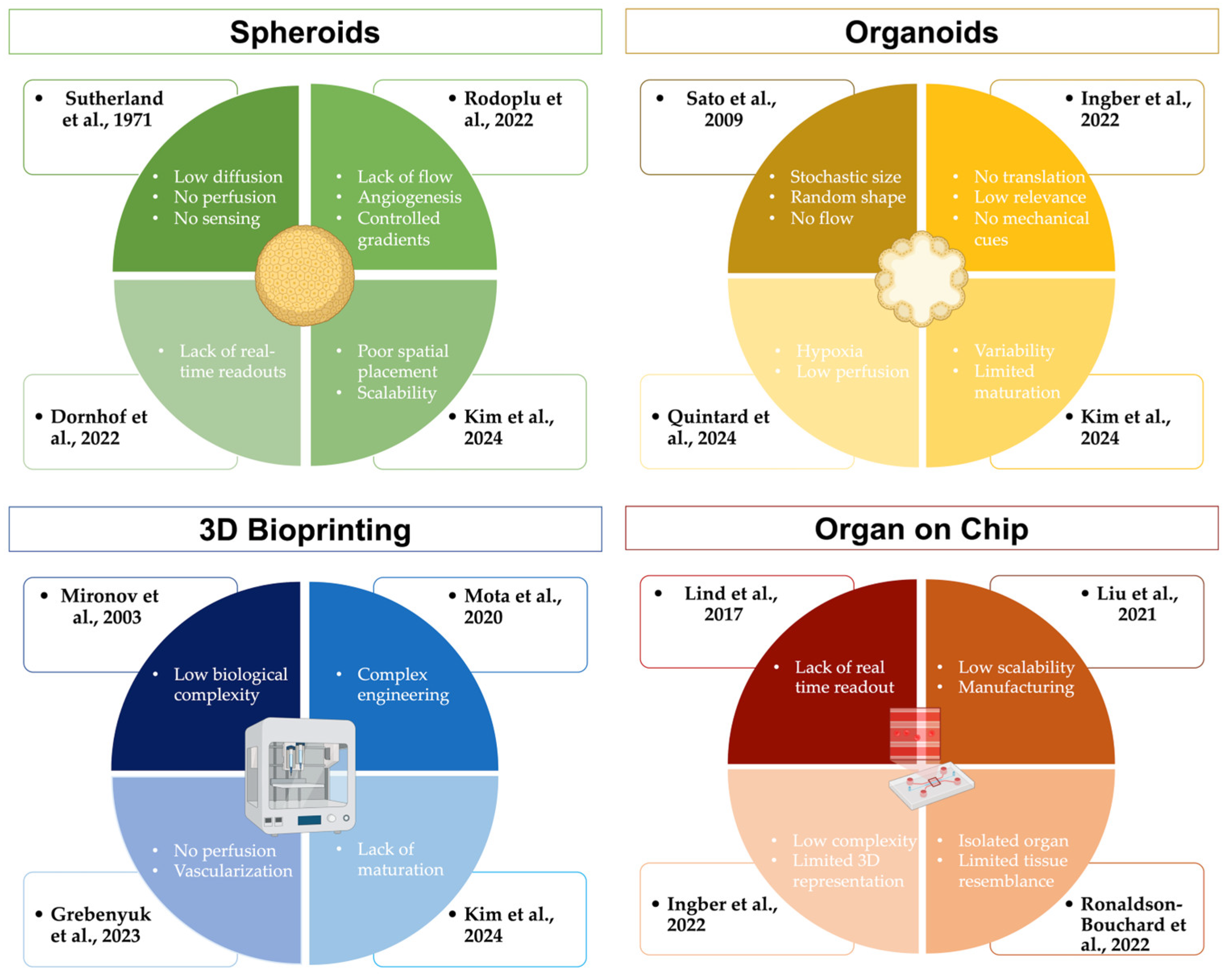

Living Tissues by Design: The Rise of Hybrid Models in Biofabrication



Abstract
1. Introduction
2. Traditional 3D Culture Models: From Spheroids to Organoids
2.1. Spheroids: Simplified, Scalable, but Limited in Architecture and Perfusion
2.1.1. Strategies Developed Between 2020 and 2025
2.1.2. Current Limitations
2.2. Organoids: Powerful Self-Organisation, Constrained by Scale, Reproducibility, and Microenvironmental Control
2.2.1. Strategies Developed Between 2020 and 2025
2.2.2. Current Limitations
2.3. Bridging the Gap: Toward Engineered Complexity
3. Biofabrication Approaches
3.1. 3D Bioprinting: Enabling Geometry, Perfusion, and Multi-Material Tissues
3.1.1. Evolution of 3D Bioprinting Methods
3.1.2. Strategies Developed Between 2020 and 2025 That Enable Hybrid Functionality
- (a)
- Sacrificial-ink vascularisation
- (b)
- Coaxial extrusion
- (c)
- Spheroid- or organoid-assisted bioprinting
- (d)
- Light-based printing
- (e)
- Mechanical and perfusion conditioning
3.1.3. Practical Outcomes and Remaining Challenges
3.2. Organ-on-Chip Technologies: Microengineered Platforms for Dynamic Physiology
3.2.1. Evolution
3.2.2. Strategies Developed Between 2020 and 2025 That Enable Hybrid Functionality
- (a)
- Perfusable vascular networks on chip
- (b)
- Mechanical sensing and readouts
- (c)
- Sensor integration for real-time readouts
- (d)
- Bioprinting and chip manufacturing
- (e)
- Multi-tissue coupling and recirculating vascular flow
3.2.3. Practical Impact and Unresolved Technological Gaps
4. Hybrid Strategies: Bridging Engineered Control and Biological Self-Organisation
4.1. Engineering Boundary Conditions That Shape Morphogenesis
4.2. Engineered Perfusion That Complements Biological Vascularisation
4.3. Mechanical and Biochemical Feedback Loops to Accelerate Maturation
4.4. Embedded Sensing and Instrumented Hybrids for Continuous Readouts
4.5. Computational and Closed-Loop Optimisation of Hybrid Systems
5. Key Gaps and Translational Hurdles
5.1. Standardisation and Reproducibility
5.2. Functional Maturation
5.3. Multi-Compartment Integration: Immune, Neural, and Endocrine Axes
5.4. Materials, Sensors, and Long-Term Device Stability
5.5. Pathways to Regulatory and Ethical Approval
6. Future Prospects and Outlook
7. Conclusions
Author Contributions
Funding
Institutional Review Board Statement
Informed Consent Statement
Data Availability Statement
Acknowledgments
Conflicts of Interest
References
- Duval, K.; Grover, H.; Han, L.H.; Mou, Y.; Pegoraro, A.F.; Fredberg, J.; Chen, Z. Modeling Physiological Events in 2D vs. 3D Cell Culture. Physiology 2017, 32, 266–277. [Google Scholar] [CrossRef] [Scilit]
- Suarez-Martinez, E.; Suazo-Sanchez, I.; Celis-Romero, M.; Carnero, A. 3D and organoid culture in research: Physiology, hereditary genetic diseases and cancer. Cell Biosci. 2022, 12, 39. [Google Scholar] [CrossRef] [Scilit]
- Pampaloni, F.; Reynaud, E.G.; Stelzer, E.H.K. The third dimension bridges the gap between cell culture and live tissue. Nature Rev. Mol. Cell Biol. 2007, 8, 839–845. [Google Scholar] [CrossRef] [Scilit]
- Sutherland, R.M.; McCredie, J.A.; Inch, W.R. Growth of Multicell Spheroids in Tissue Culture as a Model of Nodular Carcinomas2. JNCI J. Natl. Cancer Inst. 1971, 46, 113–120. [Google Scholar] [CrossRef] [Scilit] [PubMed]
- Steinberg, M.S. Reconstruction of tissues by dissociated cells. Some morphogenetic tissue movements and the sorting out of embryonic cells may have a common explanation. Science 1963, 141, 401–408. [Google Scholar] [CrossRef] [Scilit] [PubMed]
- Friedrich, J.; Seidel, C.; Ebner, R.; Kunz-Schughart, L.A. Spheroid-based drug screen: Considerations and practical approach. Nat. Protoc. 2009, 4, 309–324. [Google Scholar] [CrossRef] [Scilit] [PubMed]
- Sato, T.; Vries, R.G.; Snippert, H.J.; van de Wetering, M.; Barker, N.; Stange, D.E.; van Es, J.H.; Abo, A.; Kujala, P.; Peters, P.J.; et al. Single Lgr5 stem cells build crypt-villus structures in vitro without a mesenchymal niche. Nature 2009, 459, 262–265. [Google Scholar] [CrossRef] [Scilit]
- Clevers, H. Modeling Development and Disease with Organoids. Cell 2016, 165, 1586–1597. [Google Scholar] [CrossRef] [Scilit]
- Lancaster, M.A.; Renner, M.; Martin, C.-A.; Wenzel, D.; Bicknell, L.S.; Hurles, M.E.; Homfray, T.; Penninger, J.M.; Jackson, A.P.; Knoblich, J.A. Cerebral organoids model human brain development and microcephaly. Nature 2013, 501, 373–379. [Google Scholar] [CrossRef] [Scilit]
- Fatehullah, A.; Tan, S.H.; Barker, N. Organoids as an in vitro model of human development and disease. Nat. Cell Biol. 2016, 18, 246–254. [Google Scholar] [CrossRef] [Scilit]
- Zhao, Z.; Chen, X.; Dowbaj, A.M.; Sljukic, A.; Bratlie, K.; Lin, L.; Fong, E.L.S.; Balachander, G.M.; Chen, Z.; Soragni, A.; et al. Organoids. Nat. Rev. Methods Primers 2022, 2, 94. [Google Scholar] [CrossRef] [Scilit] [PubMed]
- Pastore, M.; Giachi, A.; Spínola-Lasso, E.; Marra, F.; Raggi, C. Organoids and spheroids: Advanced in vitro models for liver cancer research. Front. Cell Dev. Biol. 2025, 12, 1536854. [Google Scholar] [CrossRef] [Scilit]
- Kim, J.; Koo, B.-K.; Knoblich, J.A. Human organoids: Model systems for human biology and medicine. Nat. Rev. Mol. Cell Biol. 2020, 21, 571–584. [Google Scholar] [CrossRef] [Scilit]
- Zhao, X.; Xu, Z.; Xiao, L.; Shi, T.; Xiao, H.; Wang, Y.; Li, Y.; Xue, F.; Zeng, W. Review on the Vascularization of Organoids and Organoids-on-a-Chip. Front. Bioeng. Biotechnol. 2021, 9, 637048. [Google Scholar] [CrossRef] [Scilit]
- Leung, C.M.; de Haan, P.; Ronaldson-Bouchard, K.; Kim, G.-A.; Ko, J.; Rho, H.S.; Chen, Z.; Habibovic, P.; Jeon, N.L.; Takayama, S.; et al. A guide to the organ-on-a-chip. Nat. Rev. Methods Primers 2022, 2, 33. [Google Scholar] [CrossRef] [Scilit]
- Pushing the boundaries of biofabrication. Nat. Rev. Bioeng. 2025, 3, 103. [CrossRef] [Scilit]
- Bhatia, S.N.; Ingber, D.E. Microfluidic organs-on-chips. Nat. Biotechnol. 2014, 32, 760–772. [Google Scholar] [CrossRef] [Scilit]
- Ingber, D.E. Human organs-on-chips for disease modelling, drug development and personalized medicine. Nat. Rev. Genet. 2022, 23, 467–491. [Google Scholar] [CrossRef] [Scilit] [PubMed]
- Huh, D.; Matthews, B.D.; Mammoto, A.; Montoya-Zavala, M.; Hsin, H.Y.; Ingber, D.E. Reconstituting organ-level lung functions on a chip. Science 2010, 328, 1662–1668. [Google Scholar] [CrossRef] [Scilit]
- Murphy, S.V.; Atala, A. 3D bioprinting of tissues and organs. Nat. Biotechnol. 2014, 32, 773–785. [Google Scholar] [CrossRef] [Scilit] [PubMed]
- Mironov, V.; Boland, T.; Trusk, T.; Forgacs, G.; Markwald, R.R. Organ printing: Computer-aided jet-based 3D tissue engineering. Trends Biotechnol. 2003, 21, 157–161. [Google Scholar] [CrossRef] [Scilit] [PubMed]
- Zheng, K.; Chai, M.; Luo, B.; Cheng, K.; Wang, Z.; Li, N.; Shi, X. Recent progress of 3D printed vascularized tissues and organs. Smart Mater. Med. 2024, 5, 183–195. [Google Scholar] [CrossRef] [Scilit]
- Mota, C.; Camarero-Espinosa, S.; Baker, M.B.; Wieringa, P.; Moroni, L. Bioprinting: From Tissue and Organ Development to in Vitro Models. Chem. Rev. 2020, 120, 10547–10607. [Google Scholar] [CrossRef] [Scilit] [PubMed]
- Lind, J.U.; Busbee, T.A.; Valentine, A.D.; Pasqualini, F.S.; Yuan, H.; Yadid, M.; Park, S.-J.; Kotikian, A.; Nesmith, A.P.; Campbell, P.H.; et al. Instrumented cardiac microphysiological devices via multimaterial three-dimensional printing. Nat. Mater. 2017, 16, 303–308. [Google Scholar] [CrossRef] [Scilit]
- Huang, M.S.; Christakopoulos, F.; Roth, J.G.; Heilshorn, S.C. Organoid bioprinting: From cells to functional tissues. Nat. Rev. Bioeng. 2025, 3, 126–142. [Google Scholar] [CrossRef] [Scilit]
- Dornhof, J.; Zieger, V.; Kieninger, J.; Frejek, D.; Zengerle, R.; Urban, G.A.; Kartmann, S.; Weltin, A. Bioprinting-based automated deposition of single cancer cell spheroids into oxygen sensor microelectrode wells. Lab Chip 2022, 22, 4369–4381. [Google Scholar] [CrossRef] [Scilit]
- Wibe, E.; Berg, J.P.; Tveit, K.M.; Nesland, J.M.; Lunde, S. Multicellular spheroids grown directly from human tumour material. Int. J. Cancer 1984, 34, 21–26. [Google Scholar] [CrossRef] [Scilit]
- Vinci, M.; Gowan, S.; Boxall, F.; Patterson, L.; Zimmermann, M.; Court, W.; Lomas, C.; Mendiola, M.; Hardisson, D.; Eccles, S.A. Advances in establishment and analysis of three-dimensional tumor spheroid-based functional assays for target validation and drug evaluation. BMC Biol. 2012, 10, 29. [Google Scholar] [CrossRef] [Scilit]
- Rodoplu, D.; Matahum, J.S.; Hsu, C.-H. A microfluidic hanging drop-based spheroid co-culture platform for probing tumor angiogenesis. Lab Chip 2022, 22, 1275–1285. [Google Scholar] [CrossRef] [Scilit]
- Khan, A.H.; Zhou, S.P.; Moe, M.; Ortega Quesada, B.A.; Bajgiran, K.R.; Lassiter, H.R.; Dorman, J.A.; Martin, E.C.; Pojman, J.A.; Melvin, A.T. Generation of 3D Spheroids Using a Thiol–Acrylate Hydrogel Scaffold to Study Endocrine Response in ER+ Breast Cancer. ACS Biomater. Sci. Eng. 2022, 8, 3977–3985. [Google Scholar] [CrossRef] [Scilit]
- Wongpakham, T.; Chunfong, T.; Jeamsaksiri, W.; Chessadangkul, K.; Bhanpattanakul, S.; Kallayanathum, W.; Tharasanit, T.; Pimpin, A. Development of Pyramidal Microwells for Enhanced Cell Spheroid Formation in a Cell-on-Chip Microfluidic System for Cardiac Differentiation of Mouse Embryonic Stem Cells. Cells 2024, 13, 2132. [Google Scholar] [CrossRef] [Scilit]
- Fang, G.; Chen, Y.-C.; Lu, H.; Jin, D. Advances in Spheroids and Organoids on a Chip. Adv. Funct. Mater. 2023, 33, 2215043. [Google Scholar] [CrossRef] [Scilit]
- Quintard, C.; Tubbs, E.; Jonsson, G.; Jiao, J.; Wang, J.; Werschler, N.; Laporte, C.; Pitaval, A.; Bah, T.-S.; Pomeranz, G.; et al. A microfluidic platform integrating functional vascularized organoids-on-chip. Nat. Commun. 2024, 15, 1452. [Google Scholar] [CrossRef] [Scilit] [PubMed]
- Kim, M.H.; Singh, Y.P.; Celik, N.; Yeo, M.; Rizk, E.; Hayes, D.J.; Ozbolat, I.T. High-throughput bioprinting of spheroids for scalable tissue fabrication. Nat. Commun. 2024, 15, 10083. [Google Scholar] [CrossRef] [Scilit]
- Debruyne, A.C.; Okkelman, I.A.; Heymans, N.; Pinheiro, C.; Hendrix, A.; Nobis, M.; Borisov, S.M.; Dmitriev, R.I. Live Microscopy of Multicellular Spheroids with the Multimodal Near-Infrared Nanoparticles Reveals Differences in Oxygenation Gradients. ACS Nano 2024, 18, 12168–12186. [Google Scholar] [CrossRef] [Scilit]
- Nayak, P.; Bentivoglio, V.; Varani, M.; Signore, A. Three-Dimensional In Vitro Tumor Spheroid Models for Evaluation of Anticancer Therapy: Recent Updates. Cancers 2023, 15, 4846. [Google Scholar] [CrossRef] [Scilit]
- Liu, X.; Fang, J.; Huang, S.; Wu, X.; Xie, X.; Wang, J.; Liu, F.; Zhang, M.; Peng, Z.; Hu, N. Tumor-on-a-chip: From bioinspired design to biomedical application. Microsyst. Nanoeng. 2021, 7, 50. [Google Scholar] [CrossRef] [Scilit] [PubMed]
- Wang, L.; Chen, A.; Zhang, D.; He, Z. From Cells to Organoids: Approaches, Regulatory Mechanisms, Applications, and Challenges of Organoids. Cells 2025, 14, 1898. [Google Scholar] [CrossRef] [Scilit]
- Kim, D.; Lim, H.; Youn, J.; Park, T.-E.; Kim, D.S. Scalable production of uniform and mature organoids in a 3D geometrically-engineered permeable membrane. Nat. Commun. 2024, 15, 9420. [Google Scholar] [CrossRef] [Scilit]
- Jerbaka, F.; Gribova, V.; Rey, T.; Elfaloussi, S.; Kawczynski, M.; Kharouf, N.; Herault, Y.; Arntz, Y.; Bloch-Zupan, A.; Bugueno, I.M. Organotypic 3D Cellular Models Mimicking the Epithelio-Ectomesenchymal Bilayer During Odontogenesis. Tissue Eng. Part A 2024, 31, 471–488. [Google Scholar] [CrossRef] [Scilit]
- Sockell, A.; Wong, W.; Longwell, S.; Vu, T.; Karlsson, K.; Mokhtari, D.; Schaepe, J.; Lo, Y.-H.; Cornelius, V.; Kuo, C.; et al. A microwell platform for high-throughput longitudinal phenotyping and selective retrieval of organoids. Cell Syst. 2023, 14, 764–776.e766. [Google Scholar] [CrossRef] [Scilit]
- Li, Z.; Yu, D.; Zhou, C.; Wang, F.; Lu, K.; Liu, Y.; Xu, J.; Xuan, L.; Wang, X. Engineering vascularised organoid-on-a-chip: Strategies, advances and future perspectives. Biomater. Transl. 2024, 5, 21–32. [Google Scholar] [CrossRef] [Scilit]
- Grebenyuk, S.; Abdel Fattah, A.R.; Kumar, M.; Toprakhisar, B.; Rustandi, G.; Vananroye, A.; Salmon, I.; Verfaillie, C.; Grillo, M.; Ranga, A. Large-scale perfused tissues via synthetic 3D soft microfluidics. Nat. Commun. 2023, 14, 193. [Google Scholar] [CrossRef] [Scilit]
- Poerio, A.; Mano, J.F.; Cleymand, F. Advanced 3D Printing Strategies for the Controlled Delivery of Growth Factors. ACS Biomater. Sci. Eng. 2023, 9, 6531–6547. [Google Scholar] [CrossRef] [Scilit]
- Malkani, S.; Prado, O.; Stevens, K.R. Sacrificial Templating for Accelerating Clinical Translation of Engineered Organs. ACS Biomater. Sci. Eng. 2025, 11, 1–12. [Google Scholar] [CrossRef] [Scilit]
- Bosch-Rué, È.; Díez-Tercero, L.; Delgado, L.M.; Pérez, R.A. Biofabrication of Collagen Tissue-Engineered Blood Vessels with Direct Co-Axial Extrusion. Int. J. Mol. Sci. 2022, 23, 5618. [Google Scholar] [CrossRef] [Scilit]
- Duong, V.T.; Lin, C.C. Digital Light Processing 3D Bioprinting of Gelatin-Norbornene Hydrogel for Enhanced Vascularization. Macromol. Biosci. 2023, 23, e2300213. [Google Scholar] [CrossRef] [Scilit] [PubMed]
- Mitchell, T.C.; Feng, N.L.; Lam, Y.T.; Michael, P.L.; Santos, M.; Wise, S.G. Engineering Vascular Bioreactor Systems to Closely Mimic Physiological Forces In Vitro. Tissue Eng. Part B Rev. 2023, 29, 232–243. [Google Scholar] [CrossRef] [Scilit] [PubMed]
- Wang, H.; Ning, X.; Zhao, F.; Zhao, H.; Li, D. Human organoids-on-chips for biomedical research and applications. Theranostics 2024, 14, 788–818. [Google Scholar] [CrossRef] [Scilit] [PubMed]
- Huang, C.; Sanaei, F.; Verdurmen, W.P.R.; Yang, F.; Ji, W.; Walboomers, X.F. The Application of Organs-on-a-Chip in Dental, Oral, and Craniofacial Research. J. Dent. Res. 2023, 102, 364–375. [Google Scholar] [CrossRef] [Scilit]
- Morales, I.A.; Boghdady, C.M.; Campbell, B.E.; Moraes, C. Integrating mechanical sensor readouts into organ-on-a-chip platforms. Front. Bioeng. Biotechnol. 2022, 10, 1060895. [Google Scholar] [CrossRef] [Scilit] [PubMed]
- Ronaldson-Bouchard, K.; Teles, D.; Yeager, K.; Tavakol, D.N.; Zhao, Y.; Chramiec, A.; Tagore, S.; Summers, M.; Stylianos, S.; Tamargo, M.; et al. A multi-organ chip with matured tissue niches linked by vascular flow. Nat. Biomed. Eng. 2022, 6, 351–371. [Google Scholar] [CrossRef] [Scilit] [PubMed]
- Limon, S.; Habib, A.; Quigley, C.; Sarah, R. Advancing scaffold porosity through a machine learning framework in extrusion based 3D bioprinting. Front. Mater. 2024, 10, 1337485. [Google Scholar] [CrossRef] [Scilit]
- Wang, Y.; Qin, J. Advances in human organoids-on-chips in biomedical research. Life Med. 2023, 2, lnad007. [Google Scholar] [CrossRef] [Scilit]
- Nwokoye, P.N.; Abilez, O.J. Bioengineering methods for vascularizing organoids. Cell Rep. Methods 2024, 4, 100779. [Google Scholar] [CrossRef] [Scilit]
- Roth, J.G.; Brunel, L.G.; Huang, M.S.; Liu, Y.; Cai, B.; Sinha, S.; Yang, F.; Pașca, S.P.; Shin, S.; Heilshorn, S.C. Spatially controlled construction of assembloids using bioprinting. Nat. Commun. 2023, 14, 4346. [Google Scholar] [CrossRef] [Scilit]
- Maggiore, J.C.; LeGraw, R.; Przepiorski, A.; Velazquez, J.; Chaney, C.; Vanichapol, T.; Streeter, E.; Almuallim, Z.; Oda, A.; Chiba, T.; et al. A genetically inducible endothelial niche enables vascularization of human kidney organoids with multilineage maturation and emergence of renin expressing cells. Kidney Int. 2024, 106, 1086–1100. [Google Scholar] [CrossRef] [Scilit]
- Werschler, N.; Quintard, C.; Nguyen, S.; Penninger, J. Engineering next generation vascularized organoids. Atherosclerosis 2024, 398, 118529. [Google Scholar] [CrossRef] [Scilit]
- Klebe, R.J. Cytoscribing: A method for micropositioning cells and the construction of two- and three-dimensional synthetic tissues. Exp. Cell Res. 1988, 179, 362–373. [Google Scholar] [CrossRef] [Scilit]
- Boland, T.; Xu, T.; Damon, B.; Cui, X. Application of inkjet printing to tissue engineering. Biotechnol. J. 2006, 1, 910–917. [Google Scholar] [CrossRef] [Scilit] [PubMed]
- Budharaju, H.; Sundaramurthi, D.; Sethuraman, S. Embedded 3D bioprinting—An emerging strategy to fabricate biomimetic & large vascularized tissue constructs. Bioact. Mater. 2024, 32, 356–384. [Google Scholar] [CrossRef] [Scilit]
- Rahman, T.T.; Rahman, A.M.; Pei, Z.; Wood, N.; Qin, H. Effects of Coaxial Nozzle’s Inner Nozzle Diameter on Filament Strength and Gelation in Extrusion-Based 3D Printing with In Situ Ionic Crosslinking. Biomimetics 2024, 9, 589. [Google Scholar] [PubMed]
- Lee, Y.B.; Lim, S.; Lee, Y.; Park, C.H.; Lee, H.J. Green Chemistry for Crosslinking Biopolymers: Recent Advances in Riboflavin-Mediated Photochemistry. Materials 2023, 16, 1218. [Google Scholar] [CrossRef] [Scilit] [PubMed]
- Sharifi, S.; Sharifi, H.; Akbari, A.; Chodosh, J. Systematic optimization of visible light-induced crosslinking conditions of gelatin methacryloyl (GelMA). Sci. Rep. 2021, 11, 23276. [Google Scholar] [CrossRef] [Scilit]
- Putame, G.; Gabetti, S.; Carbonaro, D.; Meglio, F.D.; Romano, V.; Sacco, A.M.; Belviso, I.; Serino, G.; Bignardi, C.; Morbiducci, U.; et al. Compact and tunable stretch bioreactor advancing tissue engineering implementation. Application to engineered cardiac constructs. Med. Eng. Phys. 2020, 84, 1–9. [Google Scholar] [CrossRef] [Scilit]
- Komosa, E.; Lin, W.-H.; Mahadik, B.; Bazzi, M.; Townsend, D.; Fisher, J.; Ogle, B. A novel perfusion bioreactor promotes the expansion of pluripotent stem cells in a 3D-bioprinted tissue chamber. Biofabrication 2023, 16, 014101. [Google Scholar] [CrossRef] [Scilit] [PubMed]
- Kim, D.-S.; Choi, Y.W.; Shanmugasundaram, A.; Jeong, Y.-J.; Park, J.; Oyunbaatar, N.-E.; Kim, E.-S.; Choi, M.; Lee, D.-W. Highly durable crack sensor integrated with silicone rubber cantilever for measuring cardiac contractility. Nat. Commun. 2020, 11, 535. [Google Scholar] [CrossRef] [Scilit]
- Wu, Q.; Zhang, P.; O’Leary, G.; Zhao, Y.; Xu, Y.; Rafatian, N.; Okhovatian, S.; Landau, S.; Valiante, T.A.; Travas-Sejdic, J.; et al. Flexible 3D printed microwires and 3D microelectrodes for heart-on-a-chip engineering. Biofabrication 2023, 15, 035023. [Google Scholar] [CrossRef] [Scilit]
- Chen, H.; Luo, Z.; Lin, X.; Zhu, Y.; Zhao, Y. Sensors-integrated organ-on-a-chip for biomedical applications. Nano Res. 2023, 16, 10072–10099. [Google Scholar] [CrossRef] [Scilit]
- Lucchetti, M.; Werr, G.; Johansson, S.; Barbe, L.; Grandmougin, L.; Wilmes, P.; Tenje, M. Integration of multiple flexible electrodes for real-time detection of barrier formation with spatial resolution in a gut-on-chip system. Microsyst. Nanoeng. 2024, 10, 18. [Google Scholar] [CrossRef] [Scilit]
- Marrero, D.; Guimera, A.; Maes, L.; Villa, R.; Alvarez, M.; Illa, X. Organ-on-a-chip with integrated semitransparent organic electrodes for barrier function monitoring. Lab Chip 2023, 23, 1825–1834. [Google Scholar] [CrossRef] [Scilit]
- Chliara, M.A.; Elezoglou, S.; Zergioti, I. Bioprinting on Organ-on-Chip: Development and Applications. Biosensors 2022, 12, 1135. [Google Scholar] [CrossRef] [Scilit]
- Mierke, C.T. Bioprinting of Cells, Organoids and Organs-on-a-Chip Together with Hydrogels Improves Structural and Mechanical Cues. Cells 2024, 13, 1638. [Google Scholar] [CrossRef] [Scilit]
- Wu, X.; Shi, W.; Liu, X.; Gu, Z. Recent advances in 3D-printing-based organ-on-a-chip. EngMedicine 2024, 1, 100003. [Google Scholar] [CrossRef] [Scilit]
- Tabatabaei Rezaei, N.; Kumar, H.; Liu, H.; Lee, S.S.; Park, S.S.; Kim, K. Recent Advances in Organ-on-Chips Integrated with Bioprinting Technologies for Drug Screening. Adv. Healthc. Mater. 2023, 12, e2203172. [Google Scholar] [CrossRef] [Scilit] [PubMed]
- Mello, E.; Sorrentino, S.; Bucciarelli, A.; Cordelli, E.; De Luca, E.; Nygaard, H.; Wendt, S.; Rainer, A.; Gigli, G.; Moroni, L.; et al. Geometrical constraints dictate assembly and phenotype of human iPSC-derived motoneuronal spheroids. Stem Cell Res. Ther. 2025, 16, 417. [Google Scholar] [CrossRef] [Scilit] [PubMed]
- Choi, S.J.; Liu, Z.; Yang, F.; Wang, H.; George, D.; Gracias, D.H.; Kim, D.H. 3D Spatiotemporal Activation Mapping of Cardiac Organoids Using Conformal Shell Microelectrode Arrays (MEAs). Res. Sq. 2025. [Google Scholar] [CrossRef] [Scilit]
- Koveal, D.; Díaz-García, C.M.; Yellen, G. Fluorescent Biosensors for Neuronal Metabolism and the Challenges of Quantitation. Curr. Opin. Neurobiol. 2020, 63, 111–121. [Google Scholar] [CrossRef] [Scilit]
- Velasco, V.; Shariati, S.A.; Esfandyarpour, R. Microtechnology-based methods for organoid models. Microsyst. Nanoeng. 2020, 6, 76. [Google Scholar] [CrossRef] [Scilit]
- Kim, Y.; Chica-Carrillo, E.C.; Lee, H.J. Microfabricated sensors for non-invasive, real-time monitoring of organoids. Micro Nano Syst. Lett. 2024, 12, 26. [Google Scholar] [CrossRef] [Scilit]
- Spitz, S.; Schobesberger, S.; Brandauer, K.; Ertl, P. Sensor-integrated brain-on-a-chip platforms: Improving the predictive validity in neurodegenerative research. Bioeng. Transl. Med. 2024, 9, e10604. [Google Scholar] [CrossRef] [Scilit]
- Sarah, R.; Schimmelpfennig, K.; Rohauer, R.; Lewis, C.L.; Limon, S.M.; Habib, A. Characterization and Machine Learning-Driven Property Prediction of a Novel Hybrid Hydrogel Bioink Considering Extrusion-Based 3D Bioprinting. Gels 2025, 11, 45. [Google Scholar] [CrossRef] [Scilit] [PubMed]
- Chen, Y.; Liu, S.; Chen, Y.; Wang, M.; Liu, Y.; Qu, Z.; Du, L.; Wu, C. Sophisticated Interfaces Between Biosensors and Organoids: Advancing Towards Intelligent Multimodal Monitoring Physiological Parameters. Biosensors 2025, 15, 557. [Google Scholar] [CrossRef] [Scilit] [PubMed]
- Birey, F.; Pașca, S.P. Imaging neuronal migration and network activity in human forebrain assembloids. STAR Protoc. 2022, 3, 101478. [Google Scholar] [CrossRef] [Scilit]
- Urzi, A.; Lahmann, I.; Nguyen, L.V.N.; Rost, B.R.; García-Pérez, A.; Lelievre, N.; Merritt-Garza, M.E.; Phan, H.C.; Bassell, G.J.; Rossoll, W.; et al. Efficient generation of a self-organizing neuromuscular junction model from human pluripotent stem cells. Nat. Commun. 2023, 14, 8043. [Google Scholar] [CrossRef] [Scilit] [PubMed]
- Zhang, Y.; Wang, Y.; Yin, H.; Wang, J.; Liu, N.; Zhong, S.; Li, L.; Zhang, Q.; Yue, T. Strain sensor on a chip for quantifying the magnitudes of tensile stress on cells. Microsyst. Nanoeng. 2024, 10, 88. [Google Scholar] [CrossRef] [Scilit]
- de Barros, N.R.; Harb, S.V.; da Silva Horinouchi, C.D.; Tofani, L.B.; dos Santos, D.M.; Elias, G.B.; Velho, J.C.M.; de Aguiar, A.C.; Sant’Ana, M.; Figueira, A.C.M. Advances in 3D Bioprinting and Microfluidics for Organ-on-a-Chip Platforms. Polymers 2025, 17, 3078. [Google Scholar] [CrossRef] [Scilit]
- Wu, Z.; Liu, R.; Shao, N.; Zhao, Y. Developing 3D bioprinting for organs-on-chips. Lab Chip 2025, 25, 1081–1096. [Google Scholar] [CrossRef] [Scilit]



| System | Boundary/Limitation | Strategy/Hybridisation | Key High-Impact Studies |
|---|---|---|---|
| Spheroids |
| Self-assembled multicellular aggreggates | Sutherland et al., 1971 [4] |
| Spheroid-on-Chip |
| Microfluidic confinement Extended perfusion | Rodoplu et al., 2022 [29] |
| Spheroid-on-Chip (instrumented) |
| Integrated sensors (O2, electrodes) | Dornhof et al., 2022 [26] |
| Printed Spheroids |
| High-throughput bioprinting of spheroids | Kim et al., 2024 [34] |
| System | Boundary/Limitation | Strategy/Hybridisation | Key High-Impact Studies |
|---|---|---|---|
| Organoids | Stochastic size Random shape Limited flow | Self-organization from stem cells | Sato et al., 2009 [7] |
| Engineered Confinement | Variability Limited maturation | Geometric boundary control | Kim et al., 2024 [34] |
| Organoid-on-Chip | Hypoxia No perfusion | Microfluidic perfusion Vascular coupling | Quintard et al., 2024 [33] |
| Organoid-on-Chip (conceptual) | Limited translational potential Low physiological relevance | Organs-on-chip paradigm | Ingber et al., 2022 [18] |
| Printed Organoid Assemblies | Poor spatial organization | Bioprinted assembloids | Roth et al., 2023 [56] |
| System | Boundary/Limitation | Strategy/Hybridisation | Key High-Impact Studies |
|---|---|---|---|
| Bioprinting | Limited biological complexity | Layer-by-layer tissue printing | Mironov et al., 2003 [21] |
| Bioprinting (Review Baseline) | Engineering-heavy Biologically poor | Biofabrication principles | Mota et al., 2020 [23] |
| Perfused printed Tissues | No perfusion | Soft microfluidics Printed vasculature | Grebenyuk et al., 2023 [43] |
| Printed self-organized Tissues | Lack of maturation | Printing spheroids/organoids | Kim et al., 2024 [34] |
| Category | Biological Self-Organisation & Cellular Complexity | Architectural & Spatial Control | Perfusion & Vascular Integration | Mechanical & Electrical Conditioning | Physiological Monitoring & Readouts | Scalability & Reproducibility |
|---|---|---|---|---|---|---|
| System | ||||||
| Spheroids | ++ | + | + | + | + | + |
| Organoids | +++ | + | + | + | + | + |
| 3D Bioprinting | + | +++ | ++ | ++ | ++ | ++ |
| Organ-on-Chip Platforms | + | ++ | +++ | +++ | +++ | +++ |
| Hybrid Approaches | +++ | +++ | +++ | +++ | +++ | +++ |
| System | Boundary/Limitation | Strategy/Hybridisation | Key High-Impact Studies |
|---|---|---|---|
| Organ on Chip | Limited 3D tissue complexity | Microfluidic physiological control | Ingber et al., 2022 [18] |
| OoC Foundations | Scaling & manufacturability | Bioinspired chip design | Liu et al., 2021 [37] |
| Instrumented OoC | Lack of real-time readouts | Multimaterial printing Sensors | Lind et al., 2017 [24] |
| Multi-Organ Hybrid OoC | Organ-isolated physiology | Vascularly linked tissue chips | Ronaldson-Bouchard et al., 2022 [52] |
| Publication | Boundary/Limitation | Proposed Strategy |
|---|---|---|
| Bioprinting of Cells, Organoids and Organs-on-a-Chip Together with Hydrogels (2024) | Organoid cultures lack spatial control, mechanical cues and integrative architecture; static conditions limit mechanobiological insights. | 3D/4D bioprinting with organoids and organ-on-chip using engineered hydrogels; scaffolds for defined mechanical and structural cues and combinatorial control of physical and biochemical microenvironments. |
| Organoid bioprinting: from cells to functional tissues (2024) | Conventional organoid self-organization lacks predetermined 3D architecture and scalable patterning. | Use of continuous and pick-and-place bioprinting methods to position spheroids/organoid-forming cells precisely, enabling hierarchical and reproducible tissue assembly while preserving biological self-organization |
| A microfluidic platform integrating functional vascularized organoids-on-chip (2025) | Organoids on chips commonly lack functional vasculature and realistic perfusion. | Combined vascular network formation within microfluidic chips that connect endothelial networks to spheroids and organoids, enabling intravascular perfusion and sustained culture. |
| Advances in 3D Bioprinting and Microfluidics for Organ-on-Chip Platforms (2025) | Organ-on-chip platforms often miss dynamic physiological control and scalable fabrication. | Convergence of high-resolution 3D bioprinting with microfluidic design enables precise spatial control of tissues and fluids, embedded sensors, and multi-organ connectivity. |
| Converging bioprinting and organoids to better recapitulate the tumor microenvironment (2024) | Tumor organoid models fail to mimic complex microenvironments and lack vascular perfusion. | Hybrid fabrication combining 3D bioprinting of tumor organoids with organ-on-chip components to introduce perfusion and structural heterogeneity reflective of the tumor microenvironment. |
| Recent advances in biofabrication strategies based on bioprinting for vascularized tissue repair and regeneration (2023) | Bioprinted constructs lack mature, perfusable vasculature at multiple scales. | Use of multi-scale bioinks, growth factor patterning, and printing strategies that encourage vessel formation and tissue integration. |
| Bioengineering methods for vascularizing organoids (2024) | Organoids suffer from hypoxia, limited nutrient transport and lack of intrinsic vasculature. | Vascularization via co-culture of vascular cells/organoids, co-differentiation, organoid-on-a-chip integration, and 3D bioprinting for perfusable features. |
| System | Key Advances | Impact on Field | Representative Studies |
|---|---|---|---|
| Spheroids | Microengineered spheroid formation using hanging-drop microfluidics Droplet hydrogels Optimized microwells | Reproducible Homogeneous spheroids with enhanced viability Reduced batch variation | Rodoplu 2022 [29]; Khan 2022 [30]; Wongpakham 2024 [31] |
| Organoids | Geometric confinement High-throughput microwell platforms Controlled organoid size and maturation | Reduced variability Improved phenotypic consistency Disease modeling and screening | Kim 2024 (UniMat) [34]; Sockell 2023 [41] |
| 3D Bioprinting | Engineered vascular networks through coaxial extrusion Sacrificial templating Lumen-stabilizing bioinks | More perfusable Scalable printed tissues Improved nutrient delivery | Malkani 2025 [45]; Bosch-Rué 2022 [46] |
| Organ-on-Chip platforms | Integrated perfusion and multi-modal sensing Continuous real-time tissue monitoring | Stable long-term cultures Dynamic physiological readouts | Fang 2023 [32]; Kim 2020 [67]; Wu 2023 [68] |
| Hybrid Approaches | Convergent constructs Vascularization Fluid flow 3D printing | Enhanced maturation Sustained perfusion Systemic-level interactions | Quintard 2024 [33]; Roth 2023 [56] Huang 2025 [25]; Ronaldson-Bouchard 2022 [52] |
| System | Remaining Challenges | Underlying Causes | Promising Solutions | Representative Studies |
|---|---|---|---|---|
| Spheroids | Long-term maturation Diffusion limits Weak architectural control | No intrinsic vasculature Static culture Reliance on passive self-assembly | Microfluidic perfusion Vascularized encapsulation Spheroid-assisted biofabrication | Fang 2023 [32]; Quintard 2024 [33]; Roth 2023 [56] |
| Organoids | Persistent heterogeneity Restricted size Insufficient mechanical cues | Probabilistic self-organization Absence perfusion and dynamic strain | Constrained microenvironments Organoid-on-chip perfusion Pattern-guided fabrication | Huang 2025 [25]; Quintard 2024 [33]; Kim 2024 (UniMat) [34] |
| 3D Bioprinting | Immature vasculature Loss of function over time Thick-tissue hypoxia | Printed channels lack adaptive remodeling Mechanical mismatch Low oxygen tension | Hybrid vascularization Sacrificial/embedded printing Growth-factor patterning | Huang 2025 [25]; Malkani 2025 [45]; Bosch-Rué 2022 [46] |
| Organ-on-Chip platforms | Limited biological complexity Challenges scaling to multi-organ integration | Limited biological complexity Challenges scaling to multi-organ integration | Multi-tissue platforms Soft biomaterials Multimodal sensors | Ronaldson-Bouchard 2022 [52]; Wu 2023 [68] |
| Hybrid Approaches | Integration complexity Reproducibility High engineering overhead | Need to coordinate self-assembly with engineered constraint Complex multi-physics | Standardized vascular templates Guided self-organization Adaptive perfusion circuits | Huang 2025 [25]; Quintard 2024 [33]; Malkani 2025 [45] |
Disclaimer/Publisher’s Note: The statements, opinions and data contained in all publications are solely those of the individual author(s) and contributor(s) and not of MDPI and/or the editor(s). MDPI and/or the editor(s) disclaim responsibility for any injury to people or property resulting from any ideas, methods, instructions or products referred to in the content. |
© 2026 by the authors. Licensee MDPI, Basel, Switzerland. This article is an open access article distributed under the terms and conditions of the Creative Commons Attribution (CC BY) license.
Share and Cite
Platania, V.; Lamprou, A.; Bugueno, I.M. Living Tissues by Design: The Rise of Hybrid Models in Biofabrication. J. Funct. Biomater. 2026, 17, 135. https://doi.org/10.3390/jfb17030135
Platania V, Lamprou A, Bugueno IM. Living Tissues by Design: The Rise of Hybrid Models in Biofabrication. Journal of Functional Biomaterials. 2026; 17(3):135. https://doi.org/10.3390/jfb17030135
Chicago/Turabian StylePlatania, Varvara, Argyro Lamprou, and Isaac Maximiliano Bugueno. 2026. "Living Tissues by Design: The Rise of Hybrid Models in Biofabrication" Journal of Functional Biomaterials 17, no. 3: 135. https://doi.org/10.3390/jfb17030135
APA StylePlatania, V., Lamprou, A., & Bugueno, I. M. (2026). Living Tissues by Design: The Rise of Hybrid Models in Biofabrication. Journal of Functional Biomaterials, 17(3), 135. https://doi.org/10.3390/jfb17030135