


Antibacterial and Bioregenerative Nanomaterials in Oral Health: From Material Design to Clinical Translation and Technological Trends

 ,
,  , , ,
, , , 
Abstract
1. Introduction
2. Materials and Methods
- Identification: The initial search generated a total of 485 records.
- Deduplication: After removing duplicates, 312 unique studies remained for evaluation.
- Screening: Titles and abstracts were screened against the inclusion criteria, resulting in 145 articles eligible for full-text analysis.
- Inclusion: A final number of 105 studies were included in the narrative synthesis. These were selected based on mechanistic relevance, consistency of reported data, and direct applicability to dental restorative procedures.
3. Antibacterial and Bioactive Nanomaterials for Restorative Dentistry
3.1. Context
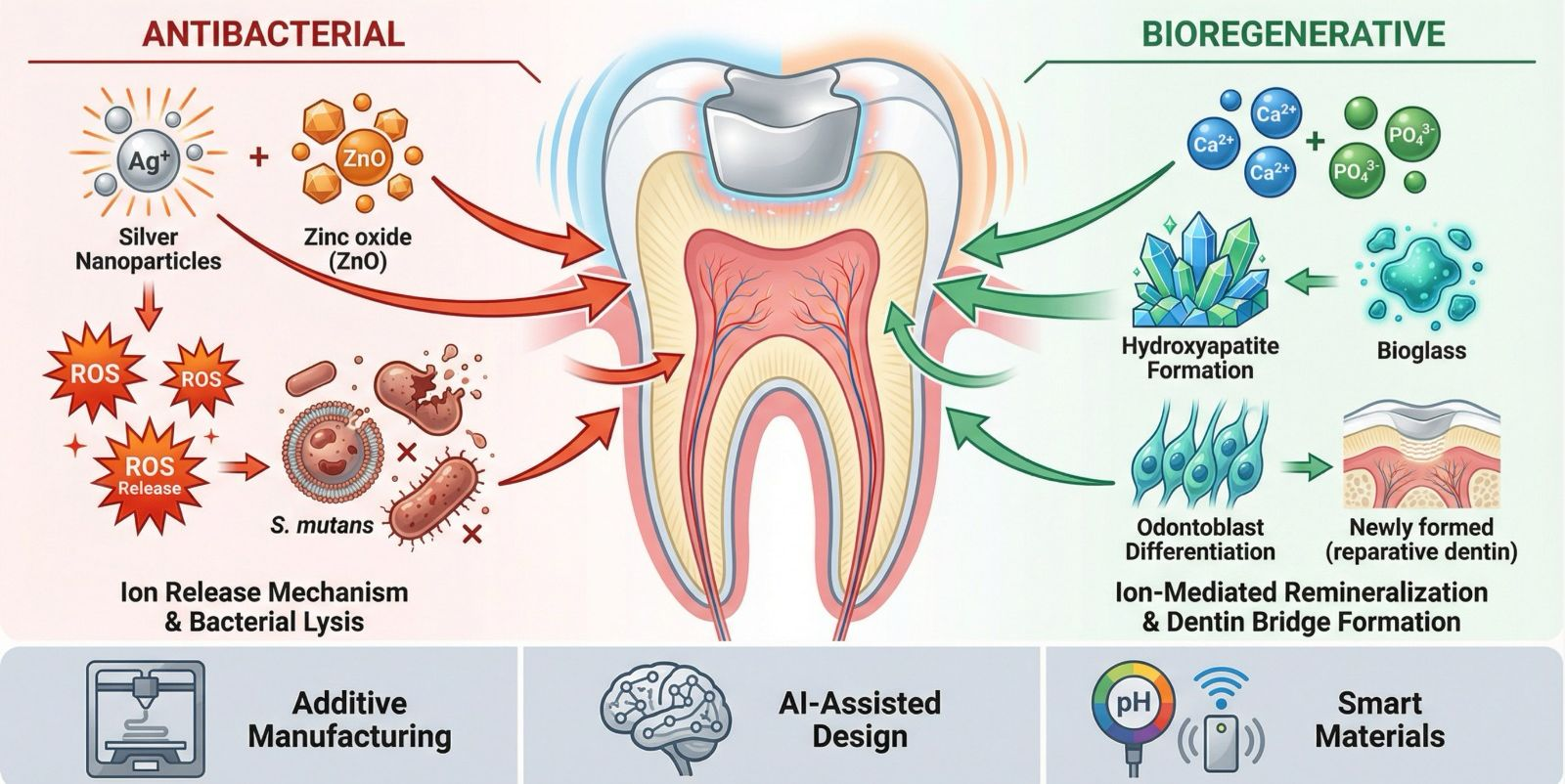
3.2. Mechanisms of Action
3.3. Metallic Nanoparticle
3.4. Cationic Monomers and Natural Nanopolymers
3.5. Carbon-Based Nanomaterials
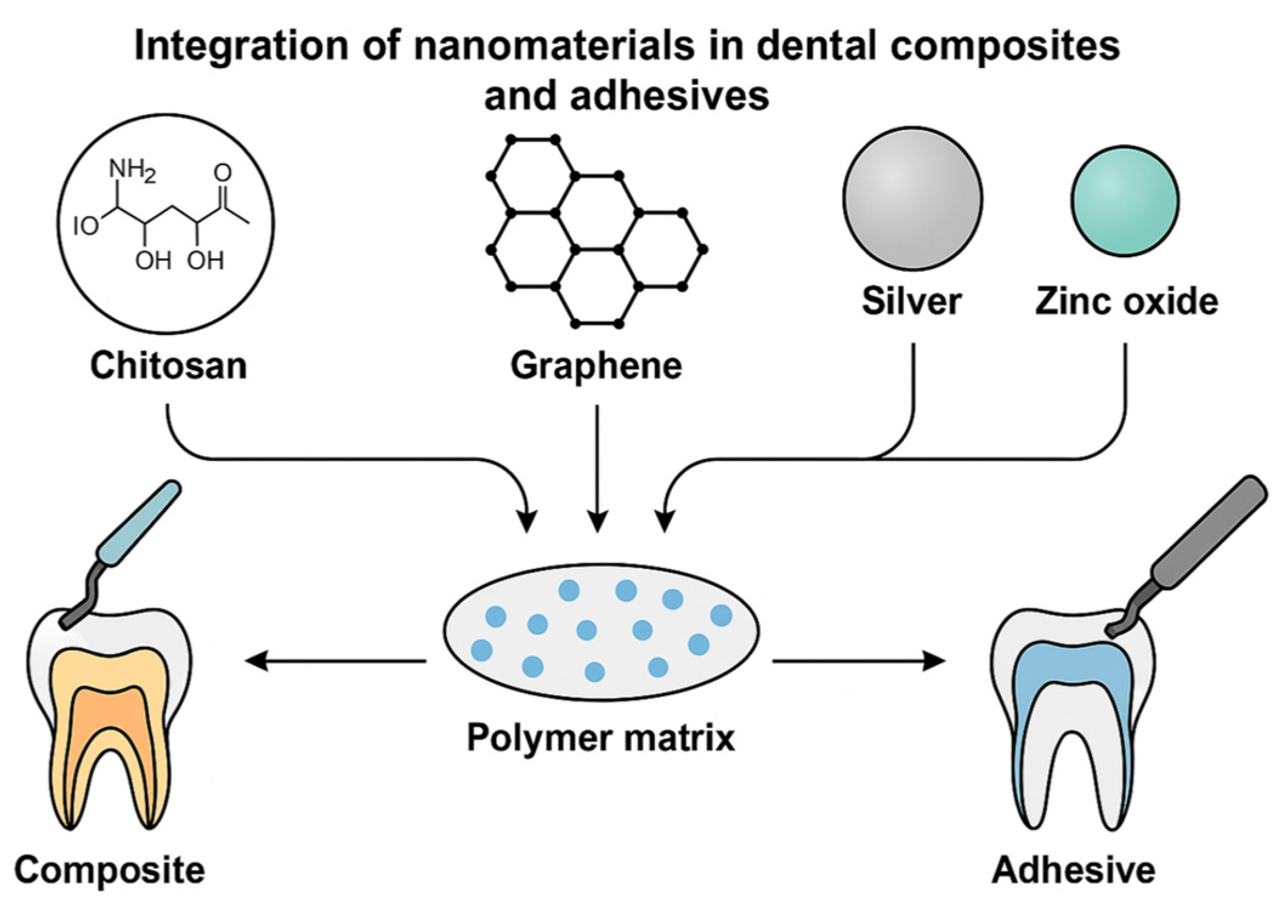
3.6. Integration into Composites and Adhesives
3.7. Limitations and Future Directions
4. Bioregenerative Nanomaterials in Restorative Dental Therapy
4.1. Concept and Biological Basis
4.2. Nanohydroxyapatite (nHAp)
4.3. Bioglass
4.4. Calcium Phosphates and Calcium Silicates
4.5. Hybrid Nanocomposites
4.6. Regenerative Mechanisms and Cellular Effects
4.7. Limitations and Future Directions
5. Dual-Function Nanomaterials with Antibacterial and Bioregenerative Activity
5.1. Concept and Rationale
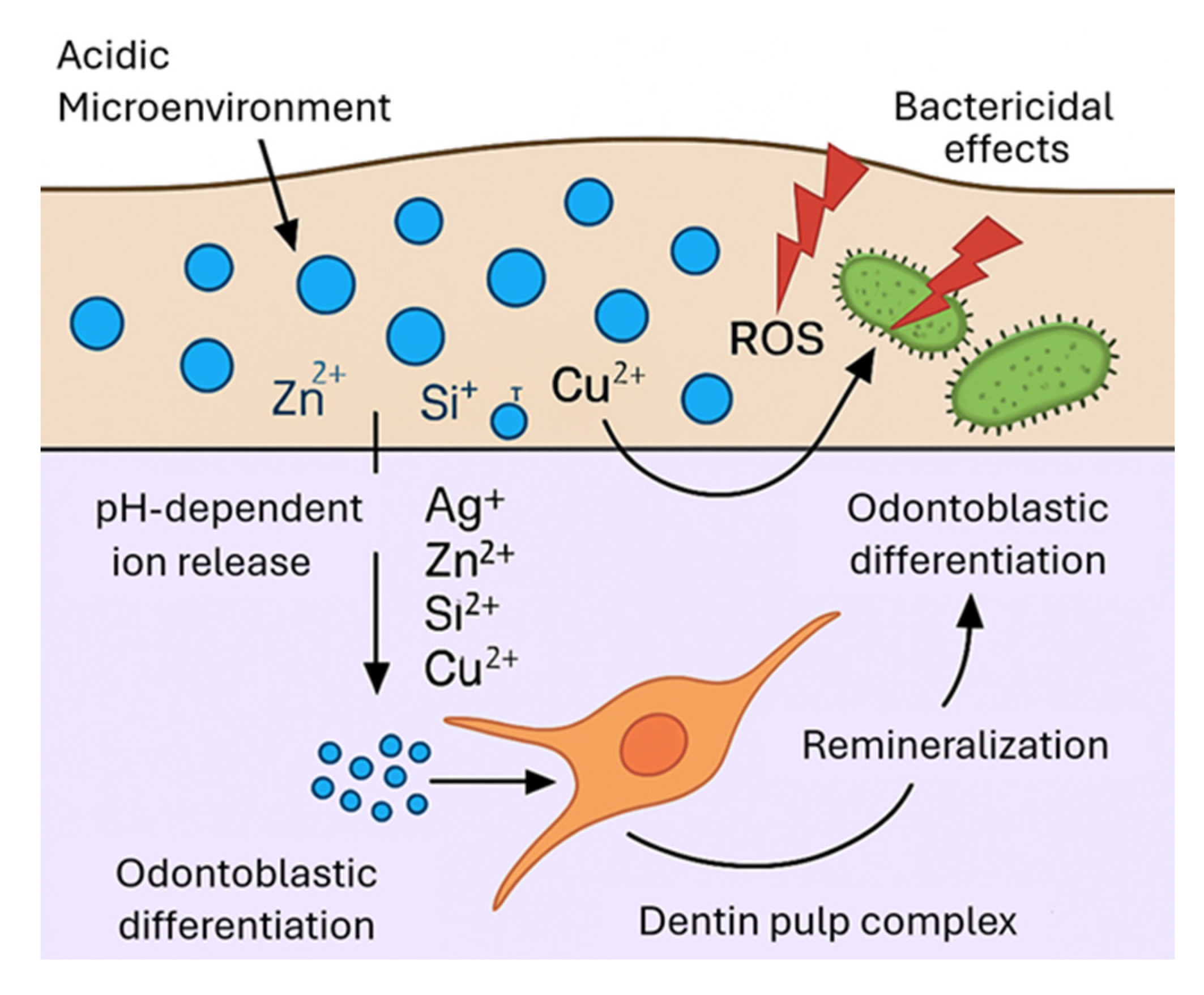
5.2. Synergistic Action Mechanisms
5.3. NACP–DMAHDM Composites
5.4. Hybrid Systems of Ag–nHAp and ZnO–Bioglass
5.5. Chitosan- and Graphene-Based Nanocomposites
5.6. Smart Nanomaterials with Controlled Release
5.7. Cellular Compatibility and Biointegration
5.8. Clinical and Technological Perspectives
6. Technological Advances and Future Directions
6.1. Smart and Responsive Materials
6.2. Bioactive and Regenerative Nanomaterials
6.3. Digital and Additive Manufacturing
6.4. AI Integration
6.5. Sustainability and Regulatory Considerations
6.6. Future Directions
- To ensure repeatability and cross-study comparability, standardized experimental methods were developed to assess antibacterial activity, bioactivity, and mechanical performance.
- To evaluate long-term material stability using therapeutically relevant aging methods, such as thermocycling, prolonged water storage, and pH cycling, to determine the durability of antibacterial and bioactive functions.
- To implement sophisticated biofilm models with salivary pellicle development to better imitate intraoral microbial habitats.
- To support the integration of clinically significant objectives, such as secondary caries prevention, marginal integrity, restorative longevity, and biological safety.
7. Conclusions
- -
- Standardization: Implementation of rigorous testing protocols (e.g., ISO 10993) that include thermal and pH cycling;
- -
- Technology: Use of AI for formulation optimization and 3D printing for personalized regenerative structures;
- -
- Sustainability: Development of bio-fabricated materials based on natural compounds (e.g., nano-curcumin, chitosan) to minimize cytotoxicity risks;
Author Contributions
Funding
Institutional Review Board Statement
Informed Consent Statement
Data Availability Statement
Acknowledgments
Conflicts of Interest
Abbreviations
| ACP | Amorphous Calcium Phosphate |
| AgNPs | Silver Nanoparticles |
| AI | Artificial Intelligence |
| BAG | Bioactive Glass |
| BG | Bioglass |
| CS | Calcium Silicates |
| CuNPs | Copper Nanoparticles |
| DMAHDM | Dimethylaminohexadecyl Methacrylate |
| DMP-1 | Dentin Matrix Protein 1 |
| DSPP | Dentin Sialophosphoprotein |
| FDA | Food and Drug Administration |
| FDI | World Dental Federation |
| GO | Graphene Oxide |
| ISO | International Organization for Standardization |
| LS | Lithium Silicates |
| ML | Machine Learning |
| MPC | 2-Methacryloyloxyethyl Phosphorylcholine |
| NACP | Nano-Calcium Phosphate |
| nBG | Nanoscale Bioglass |
| nHAp | Nanohydroxyapatite |
| NCD | Non-Communicable Disease |
| PLGA | Poly(lactic-co-glycolic acid) |
| PCL | Polycaprolactone |
| QAM | Quaternary Ammonium Monomers |
| ROS | Reactive Oxygen Species |
| UV | Ultraviolet |
| ZnO NPs | Zinc Oxide Nanoparticles |
References
- Pitts, N.B.; Zero, D.T.; Marsh, P.D.; Ekstrand, K.; Weintraub, J.A.; Ramos-Gomez, F.; Tagami, J.; Twetman, S.; Tsakos, G.; Ismail, A. Dental caries. Nat. Rev. Dis. Primers 2017, 3, 17030. [Google Scholar] [CrossRef] [PubMed]
- Selwitz, R.H.; Ismail, A.I.; Pitts, N.B. Dental caries. Lancet 2007, 369, 51–59. [Google Scholar] [CrossRef] [PubMed]
- Rathee, M.; Sapra, A. Dental Caries. In StatPearls; StatPearls Publishing: Treasure Island, FL, USA, 2023. Available online: https://www.ncbi.nlm.nih.gov/books/NBK551699/ (accessed on 30 November 2025).
- Pitts, N.B.; Twetman, S.; Fisher, J.; Marsh, P.D. Understanding dental caries as a non-communicable disease. Br. Dent. J. 2021, 231, 749–753. [Google Scholar] [CrossRef] [PubMed]
- Giacaman, R.A.; Fernández, C.E.; Muñoz-Sandoval, C.; León, S.; García-Manríquez, N.; Echeverría, C.; Valdés, S.; Castro, R.J.; Gambetta-Tessini, K. Understanding dental caries as a non-communicable and behavioral disease: Management implications. Front. Oral Health 2022, 3, 764479. [Google Scholar] [CrossRef]
- FDI World Dental Federation. White Paper on Dental Caries Prevention and Management; FDI: Geneva, Switzerland, 2016; Available online: https://www.fdiworlddental.org/resources/white-papers/white-paper-on-dental-caries-prevention-and-management (accessed on 30 November 2025).
- Ferracane, J.L. Resin composite—State of the art. Dent. Mater. 2011, 27, 29–38. [Google Scholar] [CrossRef]
- German, M.J. Developments in resin-based composites. Br. Dent. J. 2022, 233, 367–373. [Google Scholar] [CrossRef]
- Schmalz, G.; Hickel, R.; Price, R.B.; Platt, J.A. Bioactivity of Dental Restorative Materials: FDI Policy Statement. Int. Dent. J. 2023, 73, 21–27. [Google Scholar] [CrossRef]
- Ferracane, J.L.; Sidhu, S.K.; Melo, M.A.S.; Yeo, I.-S.L.; Diogenes, A.; Darvell, B.W. Bioactive dental materials Developing, promising, confusing. JADA Found. Sci. 2023, 2, 100022. [Google Scholar] [CrossRef]
- Polini, A.; Bai, H.; Tomsia, A.P. Dental applications of nanostructured bioactive glass and its composites. Wiley Interdiscip. Rev. Nanomed. Nanobiotechnol. 2013, 5, 399–410. [Google Scholar] [CrossRef]
- Zhang, Y.; Zhai, D.; Xu, M.; Yao, Q.; Zhu, H.; Chang, J.; Wu, C. 3D-printed bioceramic scaffolds with antibacterial and osteogenic activity. Biofabrication 2017, 9, 025037. [Google Scholar] [CrossRef]
- Ionescu, A.C.; Nicita, F.; Zambelli, V.; Bellani, G.; Degli Esposti, L.; Iafisco, M.; Brambilla, E. Ion-releasing resin composites prevent demineralization around restorations in an in-vitro biofilm model. J. Dent. 2025, 139, 105600. [Google Scholar] [CrossRef]
- Vilela, H.S.; Vela, B.F.; Campos, A.L.; Trinca, R.B.; Braga, R.R. Ion-releasing restorative materials and dentin remineralization: Current strategies and future perspectives. Dent. Mater. 2025, 41, 1251–1265. [Google Scholar] [CrossRef]
- Foong, L.K.; Foroughi, M.M.; Mirhosseini, A.F.; Safaei, M.; Jahani, S.; Mostafavi, M.; Ebrahimpoor, N.; Sharifi, M.; Varma, R.S.; Khatami, M. Applications of nano-materials in dentistry in diverse dentistry regimes. RSC Adv. 2020, 10, 4378–4392. [Google Scholar] [CrossRef] [PubMed]
- Sreenivasalu, P.K.P.; Dora, C.P.; Swami, R.; Jasthi, V.C.; Shiroorkar, P.N.; Nagaraja, S.; Asdaq, S.M.B.; Anwer, K. Nanomaterials in Dentistry: Current Applications and Future Scope. Nanomaterials 2022, 12, 1676. [Google Scholar] [CrossRef] [PubMed]
- Besinis, A.; De Peralta, T.; Handy, R.D. The antibacterial effects of silver, titanium dioxide and silica dioxide nanoparticles compared to the dental disinfectant chlorhexidine on Streptococcus mutans using a suite of bioassays. Nanotoxicology 2014, 8, 1–13. [Google Scholar] [CrossRef] [PubMed]
- Abozaid, D.; Azab, A.; Bahnsawy, M.A.; Eldebawy, M.; Ayad, A.; Soomro, R.; Elwakeel, E.; Mohamed, M.A. Bioactive restorative materials in dentistry: A comprehensive review of mechanisms, clinical applications, and future directions. Odontology 2025. [Google Scholar] [CrossRef]
- Makvandi, P.; Jamaledin, R.; Jabbari, M.; Nikfarjam, N.; Borzacchiello, A. Antibacterial quaternary ammonium compounds in dental materials: A systematic review. Dent. Mater. 2018, 34, 851–867. [Google Scholar] [CrossRef]
- Loguercio, A.D.; Ñaupari-Villasante, R.; Gutierrez, M.F.; Gonzalez, M.I.; Reis, A.; Heintze, S.D. 5-year clinical performance of posterior bulk-filled resin composite restorations: A double-blind randomized controlled trial. Dent. Mater. 2023, 39, 1159–1168. [Google Scholar] [CrossRef]
- Yu, K.; Zhang, Q.; Dai, Z.; Zhu, M.; Xiao, L.; Zhao, Z.; Bai, Y.; Zhang, K. Smart Dental Materials Intelligently Responding to Oral pH to Combat Caries: A Literature Review. Polymers 2023, 15, 2611. [Google Scholar] [CrossRef]
- Cicciù, M.; Fiorillo, L.; Cervino, G. Chitosan Use in Dentistry: A Systematic Review of Recent Clinical Studies. Mar. Drugs 2019, 17, 417. [Google Scholar] [CrossRef]
- Alhussein, A.; Alsahafi, R.; Alfaifi, A.; Alenizy, M.; Ba-Armah, I.; Schneider, A.; Jabra-Rizk, M.-A.; Masri, R.; Garcia Fay, G.; Oates, T.W.; et al. Novel remineralizing and antibiofilm low-shrinkage-stress nanocomposites to inhibit salivary biofilms and protect tooth structures. Materials 2023, 16, 6770. [Google Scholar] [CrossRef] [PubMed]
- Sun, Q.; Zhang, L.; Bai, R.; Zhuang, Z.; Zhang, Y.; Yu, T.; Peng, L.; Xin, T.; Chen, S.; Han, B. Recent progress in antimicrobial strategies for resin-based restoratives. Polymers 2021, 13, 1590. [Google Scholar] [CrossRef] [PubMed]
- Degli Esposti, L.; Ionescu, A.C.; Carella, F.; Adamiano, A.; Brambilla, E.; Iafisco, M. Antimicrobial activity of remineralizing ion-doped amorphous calcium phosphates for preventive dentistry. Front. Mater. 2022, 9, 846130. [Google Scholar] [CrossRef]
- Rodríguez-Gómez, F.D.; Monferrer, D.; Penon, O.; Rivera-Gil, P. Regulatory pathways and guidelines for nanotechnology-enabled health products: A comparative review of EU and US frameworks. Front. Med. 2025, 12, 1544393. [Google Scholar] [CrossRef]
- Rohmadi, A.; Ubaidillah; Diharjo, K.; Triyono, J.; Harwijayanti, W.; Kaleg, S.; Mazlan, S.A. Mechanical and antibacterial characteristics of a 3D-printed nano-titanium dioxide-hydroxyapatite dental resin-based composite. J. Mech. Behav. Mater. 2025, 34, 71–80. [Google Scholar] [CrossRef]
- Najeeb, M.; Islam, S. Artificial intelligence (AI) in restorative dentistry: Current trends and future prospects. BMC Oral Health 2025, 25, 592. [Google Scholar] [CrossRef]
- Liang, Z.; Liao, X.; Zong, H.; Zeng, X.; Liu, H.; Wu, C.; Keremane, K.; Poudel, B.; Yin, J.; Wang, K.; et al. Pioneering the future of dentistry: AI-driven 3D bioprinting for next-generation clinical applications. Transl. Dent. Res. 2025, 1, 100005. [Google Scholar] [CrossRef]
- Marta, M.-M.; Chivu, O.R.; Marian, D.; Enache, I.-C.; Veja, I.; Pitic, D.E.; Flueras, R.; Popovici, R.A.; Stana, A.H.; Cojocariu, C.; et al. Elemental composition and dentin bioactivity at the interface with AH Plus bioceramic sealer: An energy-dispersive X-ray spectroscopy study. Appl. Sci. 2024, 14, 11867. [Google Scholar] [CrossRef]
- Marian, D.; Popovici, R.A.; Olariu, I.; Pitic, D.E.; Marta, M.-M.; Veja, I. Patterns and Practices in the Use of Endodontic Materials: Insights from Romanian Dental Practices. Appl. Sci. 2025, 15, 1272. [Google Scholar] [CrossRef]
- Khvostenko, D.; Salehi, S.; Naleway, S.E.; Hilton, T.J.; Ferracane, J.L.; Mitchell, J.C.; Kruzic, J.J. Cyclic mechanical loading promotes bacterial penetration along composite restoration marginal gaps. Dent. Mater. 2015, 31, 702–710. [Google Scholar] [CrossRef]
- Ferracane, J.L. Models of caries formation around dental composite restorations. J. Dent. Res. 2016, 95, 364–371. Available online: https://www.ncbi.nlm.nih.gov/pmc/articles/PMC5384487/ (accessed on 30 November 2025). [CrossRef] [PubMed]
- Takahashi, N.; Nyvad, B. The role of bacteria in the caries process: Ecological perspectives. J. Dent. Res. 2011, 90, 294–303. [Google Scholar] [CrossRef] [PubMed]
- Mo, S.; Bao, W.; Lai, G.-Y.; Wang, J.; Li, M.-Y. The microfloral analysis of secondary caries biofilm around Class I and Class II composite and amalgam fillings. BMC Infect. Dis. 2010, 10, 241. [Google Scholar] [CrossRef] [PubMed]
- Li, X.; Liang, X.; Wang, Y.; Wang, D.; Teng, M.; Xu, H.; Zhao, B.; Han, L. Graphene-Based Nanomaterials for Dental Applications: Principles, Current Advances, and Future Outlook. Front. Bioeng. Biotechnol. 2022, 10, 804201. [Google Scholar] [CrossRef]
- Chen, Z.; Chu, Z.; Jiang, Y.; Xu, L.; Qian, H.; Wang, Y.; Wang, W. Recent advances on nanomaterials for antibacterial treatment of oral diseases. Mater. Today Bio 2023, 20, 100635. [Google Scholar] [CrossRef]
- Slomberg, D.L.; Lu, Y.; Broadnax, A.D.; Hunter, R.A.; Carpenter, A.W.; Schoenfisch, M.H. Role of size and shape on biofilm eradication for nitric oxide-releasing silica nanoparticles. ACS Appl. Mater. Interfaces 2013, 5, 9322–9329. [Google Scholar] [CrossRef]
- Liao, Y.; Wang, X.; Chen, P.; Zhong, Q.; Gong, J. Antimicrobial mechanisms of metal-based nanomaterials. Int. J. Nanomed. 2025, 20, 1123–1139. [Google Scholar] [CrossRef]
- Guo, Z.; Chen, Y.; Wang, Y.; Jiang, H.; Wang, X. Advances and challenges in metallic nanomaterial synthesis and antibacterial applications. J. Mater. Chem. B 2020, 8, 4764–4778. [Google Scholar] [CrossRef]
- Yin, I.X.; Zhang, J.; Zhao, I.S.; Mei, M.L.; Li, Q.; Chu, C.H. The antibacterial mechanism of silver nanoparticles and its application in dentistry. Int. J. Nanomed. 2020, 15, 2555–2562. [Google Scholar] [CrossRef]
- Mallineni, S.K.; Sakhamuri, S.; Kotha, S.L.; AlAsmari, A.R.G.M.; AlJefri, G.H.; Almotawah, F.N.; Mallineni, S.; Sajja, R. Silver Nanoparticles in Dental Applications: A Descriptive Review. Bioengineering 2023, 10, 327. [Google Scholar] [CrossRef]
- Corrêa, J.M.; Mori, M.; Sanches, H.L.; da Cruz, A.D.; Poiate, E., Jr.; Poiate, I.A.V.P. Silver nanoparticles in dental biomaterials. Int. J. Biomater. 2015, 2015, 485275. [Google Scholar] [CrossRef] [PubMed]
- Sycińska-Dziarnowska, M.; Szyszka-Sommerfeld, L.; Woźniak, K.; Spagnuolo, G. Silver nanoparticles in dentistry: Investigating research prospects for silver-based biomaterials. Eng. Proc. 2023, 56, 130. [Google Scholar] [CrossRef]
- Asadi, A.; Mohammadi, E.; Hosseinpour, S. Biohybrid nanomaterials in biomedicine: Current trends and future prospects. Adv. Appl. NanoBio Technol. 2025, 4, 18618. Available online: https://kneopen.com/AANBT/article/view/18618/ (accessed on 19 December 2025). [CrossRef]
- Mandhalkar, R.; Paul, P.; Reche, A. Application of nanomaterials in restorative dentistry. Cureus 2023, 15, e33779. [Google Scholar] [CrossRef]
- Bruna, T.; Maldonado-Bravo, F.; Jara, P.; Caro, N. Silver nanoparticles and their antibacterial applications. Int. J. Mol. Sci. 2021, 22, 7202. [Google Scholar] [CrossRef]
- Yadav, J.; Tare, H. Silver nanoparticles as antimicrobial agents: Mechanisms, challenges, and applications. Int. J. Pharm. Qual. Assur. 2024, 15, 546–553. [Google Scholar] [CrossRef]
- Moradaian, M.; Saadat, M.; Agharezaei, S.; Khorshidi Asl, Z. Effect of nanohydroxyapatite and silver nanoparticle incorporation on the flexural strength of resin composites. BioMed Res. Int. 2025, 2025, 9132555. [Google Scholar] [CrossRef]
- Lima, L.A.; Lima, F.R.L.; Silva, P.G.B.; Rodrigues, L.K.A. Enhancing antimicrobial, physical, and mechanical properties of restorative dental materials through metallic nanoparticle incorporation: A systematic review and meta-analysis. Discov. Mater. 2025, 5, 29. [Google Scholar] [CrossRef]
- Favaro, J.C.; Geha, O.; Canavarros, T.N.; Nascimento, A.; Lopes, M.B.; Guiraldo, R.D.; Berger, S.B. Addition of silver nanoparticles to universal adhesive: In vitro effect on biofilm and shear bond strength. Braz. Dent. J. 2025, 36, 255–263. [Google Scholar] [CrossRef]
- Campos-Ibarra, V.; Rodríguez-Moreno, A.; Zavala-Alonso, N.V.; Vargas-Sanchez, L.O.; Loredo-Tobias, M.; García-Arreola, M.E.; Aranda-Herrera, B.; Ruiz-Garcia, J.; Manisekaran, R. Silver nanoparticles incorporated dental restorative resin and its antibiofilm effect. R. Soc. Open Sci. 2024, 11, 240915. [Google Scholar] [CrossRef]
- Yin, I.X.; Zhao, I.S.; Mei, M.L.; Li, Q.; Yu, O.Y.; Chu, C.H. Use of silver nanomaterials for caries prevention: A concise review. Int. J. Nanomed. 2020, 15, 3181–3191. [Google Scholar] [CrossRef] [PubMed]
- Padmavathy, N.; Vijayaraghavan, R. Enhanced bioactivity of ZnO nanoparticles—An antimicrobial study. Sci. Technol. Adv. Mater. 2008, 9, 035004. [Google Scholar] [CrossRef] [PubMed]
- Vincent, M.; Hartemann, P.; Engels-Deutsch, M. Antimicrobial applications of copper. Int. J. Hyg. Environ. Health 2016, 219, 585–591. [Google Scholar] [CrossRef] [PubMed]
- Oetiker, N.; Salinas, D.; Lucero-Mora, J.; Orellana, R.; Quiroz-Muñoz, M.; Bravo, D.; Pérez-Donoso, J.M. Antimicrobial effect of copper nanoparticles on relevant supragingival oral bacteria. Microorganisms 2024, 12, 624. [Google Scholar] [CrossRef]
- Chambers, C.; Stewart, S.B.; Su, B.; Jenkinson, H.F.; Sandy, J.R.; Ireland, A.J. Silver-doped titanium dioxide nanoparticles as antimicrobial additives to dental polymers. Dent. Mater. 2017, 33, e115–e123. [Google Scholar] [CrossRef]
- Roguska, A.; Belcarz, A.; Zalewska, J.; Hołdyński, M.; Andrzejczuk, M.; Pisarek, M.; Ginalska, G. Metal TiO2 nanotube layers for the treatment of dental implant infections. ACS Appl. Mater. Interfaces 2018, 10, 17089–17101. [Google Scholar] [CrossRef]
- Song, X.; Segura-Egea, J.J.; Díaz-Cuenca, A. Sol–gel technologies to obtain advanced bioceramics for dental therapeutics. Molecules 2023, 28, 6967. [Google Scholar] [CrossRef]
- Preda, S.; Pandele-Cușu, J.; Petrescu, S.V.; Ciobanu, E.M.; Petcu, G.; Culiță, D.C.; Apostol, N.G.; Costescu, R.M.; Raut, I.; Constantin, M.; et al. Photocatalytic and antibacterial properties of doped TiO2 nanopowders synthesized by sol–gel method. Gels 2022, 8, 673. [Google Scholar] [CrossRef]
- Muzychka, L.; Hodyna, D.; Metelytsia, L.; Smolii, O. Nature-inspired novel quaternary ammonium compounds: Synthesis, antibacterial and antibiofilm activity. ChemMedChem 2025, 20, e202400807. [Google Scholar] [CrossRef]
- Liang, X.; Yu, B.; Ye, L.; Lin, D.; Zhang, W.; Zhong, H.-J.; He, J. Recent advances in quaternary ammonium monomers for dental applications. Materials 2024, 17, 345. [Google Scholar] [CrossRef]
- Zhang, N.; Zhang, K.; Xie, X.; Dai, Z.; Zhao, Z.; Imazato, S.; Al-Dulaijan, Y.A.; Al-Qarni, F.D.; Weir, M.D.; Reynolds, M.A.; et al. Nanostructured polymeric materials with protein-repellent and anti-caries properties for dental applications. Nanomaterials 2018, 8, 393. [Google Scholar] [CrossRef] [PubMed]
- Aliasghari, A.; Rabbani Khorasgani, M.; Vaezifar, S.; Rahimi, F.; Younesi, H.; Khoroushi, M. Evaluation of antibacterial efficiency of chitosan and chitosan nanoparticles on cariogenic Streptococci: In vitro study. Iran J. Microbiol. 2016, 8, 93–101. [Google Scholar] [PubMed]
- Dobrzyński, W.; Piszko, P.J.; Kiryk, J.; Kiryk, S.; Michalak, M.; Kotela, A.; Kensy, J.; Świenc, W.; Grychowska, N.; Matys, J.; et al. Dental resin composites modified with chitosan: A systematic review. Mar. Drugs 2025, 23, 199. [Google Scholar] [CrossRef] [PubMed]
- Rajasekar, N.; Mohanraj, K.G.; Mary Martin, T.; Meenakshi, S.K. Advanced dental care: β-Chitosan zinc oxide nanoparticles targeting cariogenic microorganisms. Cureus 2024, 16, e66296. [Google Scholar] [CrossRef]
- Javed, R.; Rais, F.; Fatima, H.; Haq, I.U.; Kaleem, M.; Naz, S.S.; Ao, Q. Chitosan encapsulated ZnO nanocomposites: Fabrication, characterization, and functionalization of bio-dental approaches. Mater. Sci. Eng. C Mater. Biol. Appl. 2020, 116, 111184. [Google Scholar] [CrossRef]
- Mousavi, S.A.; Ghotaslou, R.; Khorramdel, A.; Akbarzadeh, A.; Aeinfar, A. Antibacterial and antifungal impacts of combined silver, zinc oxide, and chitosan nanoparticles within tissue conditioners of complete dentures in vitro. Ir. J. Med. Sci. 2020, 189, 1183–1190. [Google Scholar] [CrossRef]
- Palmieri, V.; Lauriola, M.C.; Ciasca, G.; Conti, C.; De Spirito, M.; Papi, M. The graphene oxide contradictory effects against human pathogens. Nanotechnology 2017, 28, 152001. [Google Scholar] [CrossRef]
- Prodan, D.; Moldovan, M.; Cuc, S.; Sarosi, C.; Petean, I.; Filip, M.; Carpa, R.; Doukeh, R.; Mirica, I.C. Advanced dentistry biomaterials containing graphene oxide. Polymers 2024, 16, 1743. [Google Scholar] [CrossRef]
- Sindi, A.M. Applications of graphene oxide and reduced graphene oxide in advanced dental materials and therapies. J. Taibah Univ. Med. Sci. 2024, 19, 103–113. [Google Scholar] [CrossRef]
- Madhav, V.N.V.; Joshi, S.; Kulkarni, M. Graphene: A game changer in prosthodontics and implant dentistry. Int. J. Res. Med. Sci. 2022, 10, 1565–1567. [Google Scholar] [CrossRef]
- He, Y.; Vasilev, K.; Zilm, P. pH-responsive biomaterials for the treatment of dental caries—A focused and critical review. Pharmaceutics 2023, 15, 1837. [Google Scholar] [CrossRef] [PubMed]
- Par, M.; Cheng, L.; Camilleri, J.; Lingström, P. Applications of smart materials in minimally invasive dentistry—Some research and clinical perspectives. Dent. Mater. 2024, 40, 104–112. [Google Scholar] [CrossRef] [PubMed]
- ISO 10993-1:2025; Biological Evaluation of Medical Devices. Part 1: Requirements and General Principles for the Evaluation of Biological Safety Within a Risk Management Process. ISO: Geneva, Switzerland, 2025.
- Tian, J.; Wu, Z.; Wang, Y.; Han, C.; Zhou, Z.; Guo, D.; Lin, Y.; Ye, Z.; Fu, J. Multifunctional dental resin composite with antibacterial and remineralization properties containing nMgO-BAG. J. Mech. Behav. Biomed. Mater. 2023, 146, 105783. [Google Scholar] [CrossRef] [PubMed]
- Trifan, A.; Liciu, E.; Busuioc, C.; Stancu, I.-C.; Banciu, A.; Nicolae, C.; Dragomir, M.; Cristea, D.-D.; Sabău, R.-E.; Nițulescu, D.-A.; et al. Developing bioengineered 3D-printed composite scaffolds with antimicrobial potential for bone tissue regeneration. J. Funct. Biomater. 2025, 16, 227. [Google Scholar] [CrossRef]
- Talaat, S.; Hashem, A.A.; Abu-Seida, A.; Wahed, A.A.; Aziz, T.M.A. Regenerative potential of mesoporous silica nanoparticles scaffold on dental pulp and root maturation in immature dog’s teeth: A histologic and radiographic study. BMC Oral Health 2024, 24, 817. [Google Scholar] [CrossRef]
- Muresan, G.C.; Boca, S.; Lucaciu, O.; Hedesiu, M. The applicability of nanostructured materials in regenerating soft and bone tissue in the oral cavity—A review. Biomimetics 2024, 9, 348. [Google Scholar] [CrossRef]
- Pecci-Lloret, M.P.; Gea-Alcocer, S.; Murcia-Flores, L.; Rodríguez-Lozano, F.J.; Oñate-Sánchez, R.E. Use of nanoparticles in regenerative dentistry: A systematic review. Biomimetics 2024, 9, 243. [Google Scholar] [CrossRef]
- Juntavee, N.; Juntavee, A.; Plongniras, P. Remineralization potential of nano-hydroxyapatite on enamel and cementum surrounding margin of CAD/CAM ceramic restoration. Int. J. Nanomed. 2018, 13, 2755–2765. [Google Scholar] [CrossRef]
- Muntean, F.L.; Olariu, I.; Marian, D.; Olariu, T.; Petrescu, E.L.; Drăghici, G.A. Hydroxyapatite from mollusk shells: Characteristics, production, and potential applications in dentistry. Dent. J. 2024, 12, 409. [Google Scholar] [CrossRef]
- Hench, L.L. The story of Bioglass. J. Mater. Sci. Mater. Med. 2006, 17, 967–978. [Google Scholar] [CrossRef]
- Fernando, D.; Attik, N.; Pradelle-Plasse, N.; Jackson, P.; Grosgogeat, B.; Colon, P. Bioactive glass for dentin remineralization: A systematic review. Mater. Sci. Eng. C Mater. Biol. Appl. 2017, 76, 1369–1377. [Google Scholar] [CrossRef] [PubMed]
- Skallevold, H.E.; Rokaya, D.; Khurshid, Z.; Zafar, M.S. Bioactive glass applications in dentistry. Int. J. Mol. Sci. 2019, 20, 5960. [Google Scholar] [CrossRef] [PubMed]
- Simila, H.O.; Anselmi, C.; Cardoso, L.M.; Dal-Fabbro, R.; Beltrán, A.M.; Bottino, M.C.; Boccaccini, A.R. Sol–gel-derived calcium silicate cement incorporating collagen and mesoporous bioglass nanoparticles for dental pulp therapy. Dent. Mater. 2024, 40, 1412–1426. [Google Scholar] [CrossRef] [PubMed]
- Weir, M.D.; Ruan, J.; Zhang, N.; Chow, L.C.; Zhang, K.; Chang, X.; Bai, Y.; Xu, H.H.K. Effect of calcium phosphate nanocomposite on in vitro remineralization of human dentin lesions. Dent. Mater. 2017, 33, 1033–1044. [Google Scholar] [CrossRef]
- Parinyaprom, N.; Nirunsittirat, A.; Chuveera, P.; Na Lampang, S.; Srisuwan, T.; Sastraruji, T.; Bua-On, P.; Simprasert, S.; Khoipanich, I.; Sutharaphan, T.; et al. Outcomes of direct pulp capping by using either ProRoot MTA or Biodentine in permanent teeth with carious pulp exposure in 6–18-year-old patients: A randomized controlled trial. J. Endod. 2018, 44, 1036–1041. [Google Scholar] [CrossRef]
- Coll, J.A.; Dhar, V.; Chen, C.Y.; Crystal, Y.O.; Guelmann, M.; Marghalani, A.A.; AlShamali, S.; Xu, Z.; Glickman, G.N.; Wedeward, R. Use of vital pulp therapies in primary teeth 2024. Pediatr. Dent. 2024, 46, 13–26. Available online: https://pubmed.ncbi.nlm.nih.gov/38449041/ (accessed on 19 December 2025).
- Sari, M.; Hening, P.; Chotimah; Dewi Ana, I. Bioceramic hydroxyapatite-based scaffold with a porous structure using honeycomb as a natural polymeric porogen for bone tissue engineering. Biomater. Res. 2021, 25, 2. [Google Scholar] [CrossRef]
- Wu, L.; Cao, X.; Meng, Y.; Huang, T.; Zhu, C.; Pei, D.; Weir, M.D.; Oates, T.W.; Lu, Y.; Xu, H.H.K.; et al. Novel bioactive adhesive containing dimethylaminohexadecyl methacrylate and calcium phosphate nanoparticles to inhibit metalloproteinases and nanoleakage with three months of aging in artificial saliva. Dent. Mater. 2022, 38, 1198–1210. [Google Scholar] [CrossRef]
- Zhou, W.; Zhou, X.; Huang, X.; Zhu, C.; Weir, M.D.; Melo, M.A.S.; Bonavente, A.; Lynch, C.D.; Imazato, S.; Oates, T.W.; et al. Antibacterial and remineralizing nanocomposite inhibits root caries biofilms and protects root dentin hardness at the margins. J. Dent. 2020, 99, 103344. [Google Scholar] [CrossRef]
- Ali, H.; Mahran, A.; Yehia, T. Effect of bioactive glass nanoparticles and nano-hydroxyapatite coated by chitosan on odontogenic differentiation and proliferation of human dental pulp stem cells. Egypt. Dent. J. 2022, 68, 2985–2994. [Google Scholar] [CrossRef]
- Siew Ching, H.; Thirumulu Ponnuraj, K.; Luddin, N.; Ab Rahman, I.; Nik Abdul Ghani, N.R. Early odontogenic differentiation of dental pulp stem cells treated with nanohydroxyapatite–silica–glass ionomer cement. Polymers 2020, 12, 2125. [Google Scholar] [CrossRef] [PubMed]
- Manuja, A.; Kumar, B.; Kumar, R.; Chhabra, D.; Ghosh, M.; Manuja, M.; Brar, B.; Pal, Y.; Tripathi, B.N.; Prasad, M. Metal/metal oxide nanoparticles: Toxicity concerns associated with their physical state and remediation for biomedical applications. Toxicol. Rep. 2021, 8, 1043–1055. [Google Scholar] [CrossRef] [PubMed]
- Zhou, W.; Peng, X.; Zhou, X.; Bonavente, A.; Weir, M.D.; Melo, M.A.S.; Imazato, S.; Oates, T.W.; Cheng, L.; Xu, H.H.K. Novel nanocomposite inhibiting caries at the enamel restoration margins in an in vitro saliva-derived biofilm secondary caries model. Int. J. Mol. Sci. 2020, 21, 6369. [Google Scholar] [CrossRef] [PubMed]
- Garibay-Alvarado, J.A.; Garcia-Zamarron, D.J.; Silva-Holguín, P.N.; Donohue-Cornejo, A.; Cuevas-González, J.C.; Espinosa-Cristóbal, L.F.; Ruíz-Baltazar, Á.d.J.; Reyes-López, S.Y. Polymer-based hydroxyapatite–silver composite resin with enhanced antibacterial activity for dental applications. Polymers 2024, 16, 2017. [Google Scholar] [CrossRef]
- Torkian, P.; Mortazavi Najafabadi, S.; Ghashang, M.; Grzelczyk, D. Glass–ceramic fillers based on zinc oxide–silica systems for dental composite resins: Effect on mechanical properties. Materials 2023, 16, 6268. [Google Scholar] [CrossRef]
- Yuan, H.; Meng, L.Y.; Park, S.J. A review: Synthesis and applications of graphene/chitosan nanocomposites. Carbon Lett. 2016, 17, 11–17. [Google Scholar] [CrossRef]
- Vasiliu, S.; Racovita, S.; Gugoasa, I.A.; Lungan, M.A.; Popa, M.; Desbrieres, J. The benefits of smart nanoparticles in dental applications. Int. J. Mol. Sci. 2021, 22, 2585. [Google Scholar] [CrossRef]
- Wang, L.; Han, Y.; Yu, Y.; Huang, L. Ai-Optimized 3D-Printed Abutments In Prosthodontics. Int. Dent. J. 2025, 75, 105153. [Google Scholar] [CrossRef]
- Karunakaran, H.; Krithikadatta, J.; Doble, M. Local and systemic adverse effects of nanoparticles incorporated in dental materials: A critical review. Saudi Dent. J. 2024, 36, 198–210. [Google Scholar] [CrossRef]
- Zhang, J.; Peng, Y.; Hu, S.; Xu, J.; Yu, C.; Hua, L.; Zhou, S.; Liu, Q. Therapeutic application of curcumin and its nanoformulation in dentistry: Opportunities and challenges. AIMS Mol. Sci. 2025, 12, 10. [Google Scholar] [CrossRef]



| Main Category | Representative Examples | Primary Mechanism of Action | Clinical Applications and Relevant Effects | Key Limitations |
|---|---|---|---|---|
| Antibacterial Nanomaterials | AgNPs, ZnO, CuO, TiO2, Cationic monomers (DMAHDM), Chitosan, Graphene oxide | - Controlled release of metal ions (Ag+, Zn2+, Cu2+) - Generation of reactive oxygen species (ROS) - Contact-killing through electrostatic interactions - Inhibition of bacterial adhesion and biofilm formation | - Reduction in marginal secondary caries - Prevention of secondary inflammation - Incorporation into composites, cements, adhesives, and sealants | - Potential cytotoxicity at high concentrations - Discoloration (especially AgNPs) - Interference with polymerization - Long-term ion release stability |
| Bioregenerative Nanomaterials | Nanohydroxyapatite (nHAp), Bioglass (BG), Amorphous Calcium Phosphate (ACP, NACP), Calcium Silicates | - Release of Ca2+, PO43− and Si4+ ions - Promotion of secondary apatite nucleation - Stimulation of odontoblastic differentiation - Local pH buffering and rebalancing | - Remineralization of enamel and dentin - Support for dentin–pulp regeneration - Reduction in dentin hypersensitivity - Improved bonding at the dentin–adhesive interface | - Mechanical properties can be compromised at high filler loads - Release kinetics are difficult to control - Efficacy is highly dependent on the oral environment (pH, saliva) |
| Dual-Function Nanomaterials | NACP–DMAHDM, Ag–nHAp, ZnO–bioglass, Chitosan–GO, Zn- or F-doped bioglass | - Synergistic release of antibacterial and remineralizing ions- pH-responsive behavior (acid-triggered ion release) - Combined contact-killing effect and apatite formation | - “Smart” restorations with biologically adaptive behavior - Prevention of secondary caries and enhancement of tissue healing - Use in bioactive composites, cements, and base materials | - Complex formulation challenges - Balancing antimicrobial efficacy vs. cytotoxicity - Long-term durability and safety not yet established in clinical settings |
| Nanomaterial | Primary Antibacterial Mechanism | Major Advantages | Limitations/Challenges |
|---|---|---|---|
| Silver nanoparticles (AgNPs) | Release of Ag+ ions → denaturation of enzymatic proteins and disruption of the bacterial membrane; generation of reactive oxygen species (ROS) | Broad-spectrum antibacterial activity; rapid and persistent effect; good compatibility with resin composites | Potential cytotoxicity at higher concentrations; gray discoloration; incomplete understanding of biodistribution |
| Zinc oxide nanoparticles (ZnO NPs) | Release of Zn2+ and ROS generation → oxidative stress and inhibition of bacterial metabolism | Better biocompatibility than AgNPs; high chemical stability; synergistic effects with other agents | pH- and concentration-dependent antibacterial activity; potential interference with resin polymerization at higher loadings; variability in long-term ion release under oral conditions |
| Copper nanoparticles (CuNPs) | Release of Cu2+ → disruption of bacterial cell walls and inhibition of microbial DNA | Low cost; antibacterial and antifungal efficacy; good stability within composite matrices | Susceptible to oxidation and instability in moist environments; potential discoloration of the material |
| Titanium dioxide nanoparticles (TiO2 NPs) | Photocatalytic activation under UV or blue light → formation of bactericidal free radicals | Tunable photocatalytic properties; high stability; non-toxic in the absence of light | Require light activation; limited activity without irradiation; possible unwanted oxidative reactions |
| Cationic monomer DMAHDM | Contact killing—positively charged surfaces attract and disrupt bacterial membranes | Compatible with resin composites; long-lasting antibacterial effect; does not leach from the matrix | Active only upon direct contact; reduced efficiency in the presence of mature biofilm Contact-dependent antibacterial activity; reduced effectiveness against mature or thick biofilms; potential masking of cationic sites by salivary proteins and acquired pellicle formation |
| Chitosan (natural nanopolymer) | Electrostatic interaction with bacterial membranes → increased permeability and DNA inhibition | Excellent biocompatibility; biodegradable; additional anti-inflammatory properties | Low solubility at neutral pH; limited activity against Gram-negative bacteria |
| Graphene oxide (GO) | Mechanical membrane disruption (“cutting” effect) + ROS generation | Superior mechanical properties; synergistic effects with other agents; antibacterial activity without requiring metal ions | Potential pro-oxidative effects at high concentrations; biocompatibility still under investigation |
| Material | Composition | Mechanism of Action | Biological Effects | Primary Evidence Level |
|---|---|---|---|---|
| nHAp | Ca10(PO4)6(OH)2 | - Biomimetic nucleation - Ion release (Ca2+, PO43−) | - Enamel/dentin remineralization - Occlusion of dentinal tubules - Stimulation of odontogenic differentiation | In vitro, Animal model |
| Bioglass | SiO2–CaO–Na2O–P2O5 | - Apatite layer formation - Ion release (Ca2+, Si4+) - pH increase | - Dentin remineralization - Odontoblastic differentiation - Angiogenic potential | In vitro, Animal model |
| NACP | Amorphous Calcium Phosphate | - pH-responsive ion release - High surface reactivity | - Sustained remineralization - pH buffering capacity | In vitro |
| Calcium Silicates | CaSiO3, Ca3SiO5 | - Hydration reaction - Ca(OH)2 formation - Ion release | - Dentin bridge formation - Pulp capping applications - Antibacterial effect (high pH) | In vitro, Clinical trial (limited) |
Disclaimer/Publisher’s Note: The statements, opinions and data contained in all publications are solely those of the individual author(s) and contributor(s) and not of MDPI and/or the editor(s). MDPI and/or the editor(s) disclaim responsibility for any injury to people or property resulting from any ideas, methods, instructions or products referred to in the content. |
© 2026 by the authors. Licensee MDPI, Basel, Switzerland. This article is an open access article distributed under the terms and conditions of the Creative Commons Attribution (CC BY) license.
Share and Cite
Pitic, D.E.; Nodiți-Cuc, A.-R.; Talpos-Niculescu, C.I.; Marian, D.; Popovici, R.A.; Kis, A.M.; Trusculescu, L.-M.; Feher, A.; Lile, I.E. Antibacterial and Bioregenerative Nanomaterials in Oral Health: From Material Design to Clinical Translation and Technological Trends. J. Funct. Biomater. 2026, 17, 87. https://doi.org/10.3390/jfb17020087
Pitic DE, Nodiți-Cuc A-R, Talpos-Niculescu CI, Marian D, Popovici RA, Kis AM, Trusculescu L-M, Feher A, Lile IE. Antibacterial and Bioregenerative Nanomaterials in Oral Health: From Material Design to Clinical Translation and Technological Trends. Journal of Functional Biomaterials. 2026; 17(2):87. https://doi.org/10.3390/jfb17020087
Chicago/Turabian StylePitic (Cot), Dana Emanuela, Aniela-Roxana Nodiți-Cuc, Cristina Ioana Talpos-Niculescu, Diana Marian, Ramona Amina Popovici, Andreea Mihaela Kis, Laria-Maria Trusculescu, Adina Feher, and Ioana Elena Lile. 2026. "Antibacterial and Bioregenerative Nanomaterials in Oral Health: From Material Design to Clinical Translation and Technological Trends" Journal of Functional Biomaterials 17, no. 2: 87. https://doi.org/10.3390/jfb17020087
APA StylePitic, D. E., Nodiți-Cuc, A.-R., Talpos-Niculescu, C. I., Marian, D., Popovici, R. A., Kis, A. M., Trusculescu, L.-M., Feher, A., & Lile, I. E. (2026). Antibacterial and Bioregenerative Nanomaterials in Oral Health: From Material Design to Clinical Translation and Technological Trends. Journal of Functional Biomaterials, 17(2), 87. https://doi.org/10.3390/jfb17020087