1. Introduction
In recent years, the application of generative artificial intelligence (GenAI) in second language (L2) education has expanded rapidly. Large language models, represented by ChatGPT, have evolved beyond providing linguistic resources to facilitating learning interactions through their advanced natural language capabilities (
Lee et al., 2026). L2 learning is inherently an interactive process, through which learners develop their language abilities via communication, feedback, and negotiation of meaning (
Y. Wang & Guo, 2026). Traditionally, interactions in L2 learning have primarily occurred between learners and teachers or peers. However, the integration of GenAI has transformed both interaction partners and processes, enabling learners to engage in continuous, immediate, and personalized language communication with artificial intelligence systems (
H. Wu et al., 2026). Therefore, how L2 learners evaluate this emerging human–GenAI interaction process is of great importance.
However, reliable instruments specifically designed to assess L2 learners’ cognitive evaluation of their interactive learning experiences with GenAI remain scarce. Existing scales have mainly focused on learners’ L2 skills developed through GenAI feedback (
L. Xu et al., 2025;
Yao et al., 2026) or L2 teachers’ GenAI-related literacies (
Y. Wang et al., 2025), overlooking learners’ holistic evaluations developed through sustained GenAI interactions. Smart Service Interactive Experience (SSIE) from service psychology provides a relevant framework for understanding such evaluations (
Zhang et al., 2025). Although recent studies have extended SSIE to GenAI-assisted education (
P. Li, 2026), its original dimensions were developed for service experiences and user satisfaction rather than L2 learning contexts. Therefore, drawing on SSIE and adapting it to L2 learning characteristics, this study develops the GenAI L2 Interactive Learning Experience Scale (AI-L2-ILES) to assess L2 learners’ interactive learning experiences with GenAI.
This study further incorporates network analysis as a complementary approach. While factor analysis examines dimensional structures by identifying which dimensions constitute a construct, it mainly yields zero-order marginal correlations among latent factors. These bivariate associations cannot disentangle genuine direct links from indirect, spurious covariation driven by other dimensions within the construct system (
Borsboom et al., 2021); thus, factor-analytic outputs offer limited insights into how dimensions directly interconnect with one another. Conceptualizing constructs as networks of nodes and edges, network analysis estimates partial conditional associations: edge weights reflect pairwise relationships after statistically controlling for all remaining dimensions in the network. This method enables visualization of direct associations, identification of central hub or peripheral dimensions, and mapping of unique pathways among experiential facets that cannot be differentiated from conventional factor-correlation matrices (
Borsboom et al., 2021). Previous scale research has applied network analysis following factor validation and demonstrated its complementary value (
Niu et al., 2024). Together, factor and network analyses yield a more comprehensive understanding of construct structures. Moreover, although previous research has identified disciplinary differences in L2 learning and GenAI usage needs (
Xie, 2019;
Y. Xu & Wu, 2026), whether such differences extend to interactive-experience structures remains unclear. Therefore, this study conducts cross-disciplinary network comparisons to examine the stability of the AI-L2-ILES network structure.
Overall, this study aims to develop and validate the AI-L2-ILES while further exploring the structural relationships among its dimensions. Specifically, this study first employs exploratory factor analysis (EFA) and confirmatory factor analysis (CFA) to establish the scale’s factor structure, assess its reliability and validity, and examine measurement invariance across learners from different genders and academic disciplines. Building on these psychometric evaluations, this study further conducts dimension-level network analysis to identify patterns of interrelationships among dimensions and determine their relative importance within the construct. By integrating scale development with network analysis, this study aims to provide a reliable and valid instrument for assessing GenAI L2 interactive learning experience and offer insights into the internal structure of this construct.
2. Literature Review
2.1. GenAI Interactive Learning Experience as an Experiential Construct
The concept of SSIE is primarily grounded in theories in service-quality management and human–computer interaction. In the service management literature,
Parasuraman et al. (
1985) proposed the service-quality model, emphasizing that interactive experiences during service delivery constitute a critical factor influencing users’ evaluations of service quality. With the advancement of intelligent technologies, this perspective has been extended to smart-service contexts, where users’ evaluations of intelligent systems are shaped not only by functional performance but also by their overall perceptions of the interaction process (
Ashfaq et al., 2025). Meanwhile, the theories of human–computer interaction offer a valuable perspective for understanding user relationships with intelligent systems.
Reeves and Nass (
1996) demonstrated that individuals naturally apply social norms and expectations to technological systems when interacting with media such as computers. Building on this perspective,
Nass and Moon (
2000) proposed the Computers Are Social Actors paradigm, highlighting that human–computer interaction involves inherently social processes rather than merely functional exchanges.
The emergence of smart services has prompted researchers to integrate these two theoretical traditions and systematically investigate users’ holistic experiences during interactions with intelligent systems. Prior studies have demonstrated that SSIE is a multidimensional construct. For instance, based on the experiences of hotel guests,
Ali et al. (
2026) conceptualized SSIE as a five-dimensional construct comprising Seamlessness, Accuracy, Enjoyment, Security, and Empowerment. Similarly,
Zhang et al. (
2025) developed an SSIE scale for family travelers, identifying eight dimensions:
Efficiency,
Ease of Use,
Learning,
Socialization,
Novelty,
Safety, Flow, and
Seamlessness. Extending this line of research,
Ashfaq et al. (
2025) treated the eight-dimensional SSIE as a set of cognitive factors and examined its influence on users’ emotional experiences with hotel service robots.
Based on the aforementioned theoretical foundations, this study defines GenAI L2 interactive learning experience as a comprehensive cognitive evaluation developed by L2 learners through their perceptions of the interaction process, perceived relationship with GenAI, and learning value during sustained interactions with GenAI. This construct highlights that learners do not evaluate GenAI solely based on its functional capabilities or technological performance; rather, they form holistic judgments within specific L2 learning contexts regarding whether learner–GenAI interactions can support learning goals, facilitate meaningful communication, and promote positive interactive experiences. Thus, GenAI L2 interactive learning experience not only reflects the extension of intelligent system interaction characteristics into educational settings but also captures learners’ cognitive construction of GenAI as a meaningful interactive learning partner. This construct focuses on learners’ evaluative appraisals of the interaction process, rather than on the specific cognitive or affective mechanisms that occur within L2 interactions.
To clarify the conceptual boundaries of AI-L2-ILE, it is useful to recognize that the construct is not limited to purely cognitive evaluations, but represents learners’ multidimensional experiential appraisal of AI-mediated L2 interaction. The dimensions of effectiveness, sociability, novelty, flow, and seamlessness capture complementary aspects of how learners evaluate and experience the interaction process. Unlike perceived usefulness and technology acceptance (
Davis, 1989), which focus on instrumental evaluations of technology attributes and adoption intentions, AI-L2-ILE captures learners’ holistic perceptions of the interaction process rather than their likelihood of adoption. Unlike usability, which emphasizes ease, efficiency, and effort in system use, AI-L2-ILE encompasses broader experiential facets of interaction. Unlike flow (
Csikszentmihalyi, 1990), which primarily refers to an immersive psychological state, AI-L2-ILE encompasses multiple facets of interaction appraisal beyond absorption. Unlike engagement, which emphasizes behavioral or emotional involvement during a task (
Eerdemutu et al., 2024), AI-L2-ILE focuses on learners’ appraisal of the interaction experience. Unlike perceived interactivity (
F. Wang et al., 2025), which centers on perceived system responsiveness and user control, AI-L2-ILE has a broader scope, encompassing multiple facets of the interaction experience beyond responsiveness. Unlike satisfaction (
Deci & Ryan, 2000), which reflects a global evaluation of an experience or outcome, AI-L2-ILE represents a multidimensional appraisal of the interaction experience. In short, AI-L2-ILE is a multidimensional experiential appraisal construct that captures learners’ overall appraisal of the human–GenAI interaction experience.
This construct is not assumed to be entirely context-free. Recent research has highlighted that learners’ interaction experiences with GenAI may vary as a function of task structure.
Cosi Mireia and Poole (
2025) found that task type influenced learners’ language output more than ChatGPT’s prompted proficiency level.
Y. Wang (
2026) observed that learners’ engagement with GenAI ranged from deep evaluative use to surface-level dependence depending on task design.
Sim et al. (
2025) similarly found that ChatGPT’s effectiveness varied across different pragmatic tasks. These findings suggest that learners may experience GenAI differently depending on the task at hand. This clarifies that the scale captures experiential appraisals within specific task contexts.
2.2. GenAI-Assisted L2 Learning as the Target Context
The application of GenAI in L2 learning has expanded beyond the provision of linguistic resources to supporting interactive learning processes. Previous research has demonstrated that GenAI can not only provide language feedback and learning support but also function as an interactive partner in language learning.
Lee et al. (
2026) identified multiple roles of GenAI in language classrooms, including Feedback Provider, Learning Tutor, Cognitive Stimulator, Interaction Facilitator, and Conversation Partner. These roles suggest that GenAI is transitioning from a supplementary tool to an active participant in language practice and learning interactions, underscoring the importance of interactive learning experiences in GenAI-assisted L2 learning. L2 learning is inherently an interactive process, through which learners develop language abilities through communication, feedback, and negotiation of meaning (
H. Wu et al., 2026). Traditionally, such interactions have primarily occurred between learners and human interlocutors, such as teachers and peers. However, GenAI introduces a new form of interaction by enabling learners to engage in continuous, immediate, and personalized communication with AI systems. (
Pan et al., 2025;
C. Wang et al., 2024). Accordingly, how learners perceive and evaluate these emerging human–GenAI interaction experiences may shape their willingness to use GenAI and language learning behaviors. Despite growing research interest in GenAI-assisted L2 learning, existing quantitative studies have primarily focused on functional effectiveness or user attitudes (
Saarela et al., 2026), while learners’ holistic experiences during sustained GenAI-mediated interactions remain insufficiently explored. Therefore, developing a theoretically grounded and empirically validated measure of AI-L2-ILE is necessary.
Hitherto, the Perceived Learner–AI Interactivity Scale developed by
F. Wang et al. (
2025) is the only existing instrument that shows conceptual relevance to this study. However, this scale does not directly assess the construct of GenAI-assisted learning experience. Comprising four dimensions: Responsiveness, Personalization, Learner Control, and Learning Engagement, the scale primarily captures learners’ perceptions of GenAI systems’ interactive capabilities and interactional features. Specifically, it focuses on whether GenAI systems can facilitate effective interaction and emphasizes learners’ cognitive evaluation of interactional functions and quality. In contrast, drawing on the concept of interactive experience in service psychology, the AI-L2-ILE examined in this study represents a broader experiential construct. It focuses on learners’ holistic evaluations of the interaction process, their relationship with GenAI, and the learning value they derive from sustained human–GenAI interactions. Thus, perceived interactivity primarily reflects learners’ perceptions of GenAI’s interactional capabilities and system attributes, whereas interactive learning experience captures how learners interpret and evaluate the meaning and value of GenAI-mediated interactions within L2 learning contexts. Accordingly, the two constructs differ in their conceptual focus and analytical levels.
Recent research has begun to characterize GenAI-supported L2 learning along several pedagogical dimensions. First, GenAI can engage learners in task-based language practice, where learners complete meaningful communicative tasks (e.g., drafting emails, role-playing conversations, composing essays) with GenAI as a conversational partner or co-writer (
Y. Li et al., 2026). Second, GenAI facilitates real-time feedback and meaning negotiation, providing immediate corrective or reformulative responses that allow learners to notice gaps and modify their output (
Pan et al., 2025). Third, beyond classroom settings, GenAI enables self-directed and informal L2 practice, as learners independently use GenAI tools for language exploration, exposure, and production outside formal instruction (
G. L. Liu & Zhao, 2026). These pedagogical features, such as task engagement, feedback exchange, and autonomous practice, distinguish GenAI-mediated L2 interaction from general smart service encounters and underscore the need for a context-sensitive measure that captures learners’ experiential evaluations in this specific educational setting.
2.3. Rationales for Contextualizing SSIE in GenAI-Assisted L2 Learning
This study adopts a contextual adaptation approach (
DeVellis, 2016), drawing on the SSIE scale developed by
Zhang et al. (
2025). Specifically, the SSIE dimensional framework is adapted and refined to develop a measure of AI-L2-ILE. The selection of SSIE as the theoretical basis is motivated by its conceptual relevance and potential for contextual extension. As a relatively recent and well-established framework in the field of smart service research, SSIE comprises eight dimensions that capture key experiential characteristics underlying users’ interactions with intelligent systems (
Zhang et al., 2025). GenAI, as an emerging form of intelligent service technology, shares fundamental similarities with smart services, as both involve continuous, dynamic, and bidirectional interactions between users and intelligent systems.
F. Wang et al. (
2025) further suggested that learners’ perceptions developed through GenAI interactions share psychological continuity with experiences involving other intelligent systems. Therefore, SSIE offers a valuable theoretical lens for understanding learners’ interactive experiences with GenAI.
However, SSIE was not originally developed for educational contexts, and its initial application scenarios differ substantially from GenAI-assisted L2 learning. Smart service contexts primarily focus on user experience, service value, and satisfaction, whereas L2 learning contexts emphasize cognitive engagement, interaction quality, and learning support (
Pan et al., 2025;
C. Wang et al., 2024). Therefore, the meanings of SSIE dimensions require contextual reinterpretation to capture learners’ unique experiences in GenAI-assisted L2 environments. For instance,
Socialization in GenAI interactions does not necessarily refer to the social connections among users typically emphasized in service contexts; rather, it may reflect whether GenAI can provide partner-like communication, personalized feedback, and learning companionship. Similarly,
Flow in L2 learning involves not only enjoyment during interaction but also learners’ immersion and sustained engagement while completing learning tasks with GenAI support (
H. Wu & Wang, 2025).
Importantly, SSIE is not intended to capture the full range of L2 learning processes. L2 learning involves domain-specific processes such as feedback uptake, negotiation of meaning, self-regulation, and language practice, which are beyond the scope of the present construct (
S. Li et al., 2024;
Loewen & Sato, 2018;
Nassaji, 2016). Rather, SSIE provides an experiential lens for examining how learners holistically evaluate their sustained interactions with GenAI in an L2 learning context. In this sense, L2 learning defines the contextual and functional meaning of the interaction, while SSIE captures learners’ experiential evaluations of that interaction. The AI-L2-ILES therefore measures the experiential layer of GenAI-assisted L2 learning rather than L2 learning processes or outcomes themselves. This distinction also motivates the contextual adaptation of SSIE dimensions to reflect the specific goals and characteristics of L2 learning.
To summarize, SSIE provides a theoretically grounded framework for understanding interactions between users and intelligent systems; however, it was not specifically developed for educational contexts, particularly L2 learning environments. Although recent studies have begun to extend SSIE to GenAI-supported education (e.g.,
P. Li, 2026 applied the SSIE framework to a GenAI-assisted music education context), empirical research remains limited, and no instrument has been developed specifically to assess learners’ AI-L2-ILE. Therefore, this study builds on the SSIE framework while adapting and reconceptualizing its relevant dimensions in accordance with the characteristics of GenAI-assisted L2 learning. Beyond scale development, this study further employs network analysis as a complementary approach to examine the interrelationships and relative importance of different dimensions (
Borsboom et al., 2021), providing additional insights into the internal structure of AI-L2-ILES. Accordingly, this study addresses the following research questions:
RQ1: What are the psychometric properties of the AI-L2-ILES?
RQ1a: What is the underlying factor structure of the AI-L2-ILES?
RQ1b: Does the AI-L2-ILES demonstrate satisfactory reliability and validity?
RQ1c: Is the measurement invariance of the AI-L2-ILES supported across different groups?
RQ2: How are the dimensions of the AI-L2-ILES interconnected, and what are their relative roles within the construct?
3. Methodology
3.1. Participants
For sampling, convenience sampling was used. Recruitment announcements were posted on course-management platforms and student WeChat groups of five Chinese universities, inviting students who had used GenAI tools (e.g., ChatGPT, DeepSeek, Kimi) for L2 learning purposes. Inclusion criteria were: (a) current enrollment at one of the five participating universities, and (b) at least a month of experience using GenAI for L2 learning. Prior GenAI-assisted L2 learning experience was determined by two screening questions at the beginning of the questionnaire: one asking whether they had ever used GenAI tools for L2 learning (yes/no), and another asking about the frequency of such use (with options ranging from “rarely” to “daily”). Only those who answered “yes” and reported at least monthly use were included.
Data were collected between 16 and 24 December 2025, from five universities in Hunan, Henan, Jiangsu, and Zhejiang provinces, China. The participating institutions comprised two teacher-training universities, one university of science and technology, one comprehensive university, and one university of finance and economics. Participation was voluntary, and students reported using GenAI tools primarily for L2 learning purposes. No incentives were offered for participation.
Eligible students completed the questionnaire online through Wenjuanxing. Of the 1664 responses initially received, 534 were excluded: 467 failed at least one of the three attention-check items, and 67 contained incomplete data (i.e., missing responses to one or more items). This resulted in 1130 valid responses. The valid sample was then randomly divided into two equal subsamples (
n = 565 each) for EFA and CFA using SPSS’s random case-selection function. The demographic characteristics of the two subsamples were broadly comparable (see
Table 1).
Demographic information, including gender, age, major, and grade, is presented in
Table 1. As part of the demographic background, self-rated L2 proficiency was also collected using a single item: “
How would you rate your overall English proficiency?” with five response options: 1 = very poor, 2 = poor, 3 = average, 4 = good, 5 = very good. In the EFA subsample (
n = 565), the distribution was: 8 (1.4%) for “
very poor”, 56 (9.9%) for “
poor”, 379 (67.1%) for “
average”, 112 (19.8%) for “
good”, and 10 (1.8%) for “
very good”. In the CFA subsample (
n = 565), the distribution was: 30 (5.3%) for 1 (
very poor), 64 (11.3%) for 2 (
poor), 379 (67.1%) for 3 (
average), 76 (13.5%) for 4 (
good), and 16 (2.8%) for 5 (
very good). The majority of participants in both subsamples rated themselves at or above the midpoint, indicating that most participants perceived themselves as having at least average English proficiency. All of them had received formal English instruction throughout their schooling (from primary to tertiary level), as English is a compulsory subject in China.
3.2. Dimensions and Items for AI-L2-ILES
Following the scale-development procedures recommended by
DeVellis (
2016) and
Boateng et al. (
2018), the AI-L2-ILES was developed through a contextual adaptation approach. Specifically, the SSIE scale developed by
Zhang et al. (
2025) served as the theoretical foundation, and its dimensional structure was adapted to capture learners’ interaction experiences with GenAI in L2 learning contexts.
The applicability of the eight SSIE dimensions (i.e.,
Efficiency,
Ease of use,
Learning,
Socialization,
Novelty,
Safety,
Flow, and
Seamlessness) was examined through expert evaluation and learner discussions. Following
McKenzie et al.’s (
1999) recommendation, six specialists from semantics (
n = 2), psychometrics (
n = 2), and computer-assisted language learning (
n = 2) evaluated the conceptual relevance and clarity of the adapted dimensions and items. In addition, 27 university students from diverse disciplines (L2, humanities and social sciences, and STEM) and educational levels (undergraduate, master’s, and doctoral; three from each subgroup) assessed the contextual appropriateness of the SSIE dimensions based on their GenAI-assisted L2 learning experiences.
All items were drafted in Chinese and reviewed by six specialists, who provided written comments on item relevance, clarity, and contextual appropriateness. Based on their feedback, the wording was revised to improve clarity and conceptual alignment. The revised items were then discussed with 27 university students in focus-group sessions, where students identified ambiguous phrasing and assessed whether the items accurately reflected their GenAI-assisted L2 learning experiences. Their oral feedback was summarized and used to further refine the wording. Back-translation was not performed because the items were originally developed in Chinese for Chinese-speaking participants. Cognitive interviewing was also not conducted; however, the focus-group discussions served a similar function by identifying ambiguous phrasing and assessing item comprehension. No quantitative content-validity indices were calculated, as expert and learner evaluations were conducted as qualitative content-validation procedures rather than quantitative ratings. This approach was considered appropriate for the initial item-generation and refinement stage (
DeVellis, 2016).
Based on these evaluations, Ease to use and Safety were removed due to their limited relevance for the present sample (Chinese university students with prior GenAI experience). In this context, the GenAI platforms commonly used by the participants (e.g., ChatGPT, DeepSeek, Kimi) feature relatively intuitive interaction mechanisms, and usability was not a differentiating factor in their experience appraisals. In the 27 student discussions, participants reported that their GenAI use in L2 learning primarily involved routine activities such as essay writing, speaking practice, and grammar explanation. Although privacy, inaccurate information, bias, and academic-integrity concerns may arise in GenAI use, these were not identified as salient features of their routine L2 learning interactions. Safety was therefore excluded because it primarily concerns risk and responsible use rather than the experiential quality of interaction targeted by the present construct. Similarly, Ease to use concerns system usability, whereas “little effort” in the retained items refers to obtaining learning support efficiently. We acknowledge that these dimensions may remain relevant in other settings (e.g., assessment contexts).
Socialization was retained but conceptually revised. While the original SSIE dimension emphasizes interpersonal social connections, learners highlighted their perceptions of GenAI as a socially responsive interaction partner during L2 learning. Therefore, this dimension was redefined to capture the social characteristics of GenAI-based learning interactions. Consequently, the adapted initial AI-L2-ILES consisted of six dimensions: Efficiency, Learning, Sociability, Novelty, Flow, and Seamlessness.
The 18 initial items were developed through two approaches. For dimensions with direct conceptual counterparts in the SSIE framework (
Efficiency,
Socialization,
Novelty,
Flow, and
Seamlessness), items were adapted from the original SSIE scale (
Zhang et al., 2025) by replacing service-domain referents (e.g., “smart technologies”, “hotel stay”) with L2-learning referents (e.g., “GenAI”, “L2 learning”), while preserving the core semantic structure of each item. For the Learning dimension, which had no direct counterpart in SSIE, items were newly developed based on the conceptual definition of learning-related interaction experiences.
Table 2 illustrates representative adaptations.
Given the multidimensional nature of the construct, three items were initially developed for each dimension, resulting in an initial pool of 18 items. This item allocation was consistent with
Zhang et al.’s (
2025) SSIE scale, in which most dimensions were represented by approximately three items. Maintaining a concise scale was intended to balance construct coverage and parsimony, thereby reducing respondent burden and improving response quality. All items are rated on a 6-point Likert scale ranging from 1 (
strongly disagree) to 6 (
strongly agree).
3.3. GenAI-IDLE as the Criterion
The scale was developed and validated by
G. L. Liu et al. (
2025) and consists of eight items measuring the frequency and diversity of learners’ use of GenAI for informal English-learning purposes. All items are rated on a 6-point Likert scale ranging from 1 (
strongly disagree) to 6 (
strongly agree). In the original scale, “English” was used; for the present study, it was replaced with “L2,” and the items were presented with a parenthetical note specifying that L2 refers to the language being learned (e.g., English), so that the meaning was clear to all participants. The modification was limited to this terminological substitution; the substantive item content and response format remained unchanged. Formal measurement equivalence testing between the original and modified versions was not conducted because the modification was limited to terminology and did not alter the substantive content of the items. Thus, the present analysis provides evidence regarding the internal structure of the modified version, but does not constitute formal evidence of measurement equivalence with the original version. The modified scale demonstrated a unidimensional structure with good model fit: χ
2/
df = 2.880, CFI = 0.990, TLI = 0.985, RMSEA = 0.058, SRMR = 0.019. The internal consistency was also high (McDonald’s ω = 0.938).
GenAI-IDLE was selected as the criterion-related measure because it captures a behavioral dimension of learners’ engagement with GenAI that is conceptually related to, yet distinct from, the construct assessed by the AI-L2-ILES. Specifically, the AI-L2-ILES measures learners’ multidimensional appraisal of their interactive learning experiences with GenAI, whereas GenAI-IDLE assesses the frequency and diversity of learners’ autonomous GenAI use for informal L2 learning. Given that positive interactive experiences may foster continued behavioral engagement with technology-mediated systems (
Mpinganjira et al., 2025), a positive association between the two constructs is theoretically plausible. Accordingly, a positive correlation between the AI-L2-ILES and GenAI-IDLE was expected to provide preliminary evidence of criterion-related validity, rather than evidence of criterion validity in the strict sense.
More specifically, the characteristics of informal, autonomous, and task-oriented GenAI use provide a theoretical basis for this expected association. Sustained engagement with GenAI across self-selected L2 learning tasks gives learners repeated opportunities to experience and evaluate its affordances, such as responsiveness, continuity, and adaptability. Over time, these accumulated interactional experiences may strengthen perceptions of GenAI’s effectiveness for accomplishing learning goals, while also making interactions feel more seamless and facilitating a greater sense of flow (
H. Wu & Wang, 2025). In turn, positive experiences of effectiveness, flow, and seamlessness may encourage learners to continue returning to GenAI for self-directed L2 learning (
Y. Xu & Wu, 2026). Thus, the behavioral engagement captured by GenAI-IDLE is theoretically related to the interactional appraisal captured by the AI-L2-ILES, providing a rationale for examining their association. However, because both measures were self-reported and administered concurrently, the observed correlation may also reflect construct overlap and common-method variance. The resulting association should therefore be interpreted as preliminary evidence of criterion-related validity rather than definitive evidence of criterion validity.
3.4. Data Analysis
To address
RQ1, data from Sample 1 were analyzed using R 4.5.3 and the
psych package. Exploratory factor analysis (EFA) was conducted using maximum likelihood (ML) extraction and oblique Promax rotation, given the expected correlations among factors (
Fabrigar et al., 1999;
Osborne et al., 2008). Data suitability was assessed using the Kaiser–Meyer–Olkin (KMO) measure and Bartlett’s test of sphericity. Factor retention was informed by multiple criteria, including Kaiser’s criterion (eigenvalues > 1), scree plot inspection, parallel analysis based on 500 simulated datasets, and theoretical interpretability (
Hayton et al., 2004). Items were evaluated based on factor loadings and cross-loadings, with loadings above 0.40 considered acceptable. Items showing a difference in less than 0.15 between their two highest loadings were considered for removal. The EFA was rerun after item removal to obtain the final factor solution.
Data from Sample 2 were used for confirmatory factor analysis (CFA) and validation analyses. All CFA models were estimated using AMOS 24.0 with ML estimation. Although the items were measured on a six-point Likert scale, previous simulation research suggests that ML estimation can perform adequately with ordinal indicators having five or more response categories, particularly when category thresholds are approximately symmetric (
Rhemtulla et al., 2012). Normality was assessed by examining skewness and kurtosis for each item. Skewness values ranged from –0.517 to 0.382, and kurtosis values ranged from –0.955 to 0.660, both within the acceptable thresholds of |skewness| < 3 and |kurtosis| < 7 (
Kline, 2016), indicating no severe violation of normality.
No missing data were present in the final sample. Model fit was evaluated using the chi-square statistic divided by degrees of freedom (χ
2/
df), root mean square error of approximation (RMSEA), standardized root mean square residual (SRMR), comparative fit index (CFI), and Tucker–Lewis index (TLI) (
Hu & Bentler, 1999). Convergent validity was assessed using average variance extracted (AVE), whereas discriminant validity was assessed using the heterotrait–monotrait ratio (HTMT) and the Fornell–Larcker criterion (
Fornell & Larcker, 1981;
Henseler et al., 2015). Criterion validity was examined through associations with theoretically relevant external variables. Reliability was evaluated using McDonald’s ω, computed using the OMEGA macro (
Hayes & Coutts, 2020) in SPSS 26.0 (
Viladrich et al., 2017).
Gender and academic discipline were selected as grouping variables because prior L2 research has identified systematic differences in technology engagement and learning perceptions across these two dimensions. For gender, previous studies have reported gender differences in L2 learners’ perceptions of GenAI tools (
Al-atrash et al., 2026;
Dolenc & Brumen, 2024). For academic discipline, recent evidence suggests that disciplinary background is associated with differences in students’ use and perceptions of AI-assisted L2 learning (
C. Wang et al., 2026;
J. Wu et al., 2026). Measurement invariance across gender and academic disciplines was tested using successive model comparisons with ML estimation, where metric invariance constrained factor loadings and scalar invariance constrained both loadings and intercepts across groups. ΔCFI < 0.01 and ΔRMSEA < 0.015 indicated acceptable invariance (
Cheung & Rensvold, 2002).
Regarding
RQ2, network analysis was performed in R (version 4.5.3) using the full sample (
n = 1130). A Gaussian graphical model was estimated to examine the conditional associations among the five dimensions, with each dimension represented as a node in the network. Node scores were calculated as the mean of items within each dimension (
Epskamp et al., 2018). All variables were standardized prior to analysis. Dimension-level analysis was chosen because the five dimensions were empirically confirmed by EFA and CFA, making them appropriate units for examining dimensional interrelationships, and a five-node network provides a parsimonious and interpretable overview of the construct’s higher-order structure. This approach is exploratory and descriptive and does not claim to reveal item-level mechanisms.
The network was estimated using the R packages qgraph (version 1.9.8) and bootnet (version 1.5.7). To obtain a parsimonious network structure, the graphical LASSO with extended Bayesian information criterion (EBIC) tuning was applied, with the hyperparameter γ set to 0.5, the default and recommended value for exploratory network estimation (
Epskamp & Fried, 2018). No missing data were present in the full sample after data screening (see
Section 3.1), so no imputation was necessary. The accuracy of edge estimates was evaluated through 1000 non-parametric bootstrap iterations, generating 95% confidence intervals for edge weights.
To examine the structural importance of each dimension, centrality indices, including strength and expected influence, were calculated. These indices were used to identify dimensions that played more prominent roles within the network structure (
Borsboom et al., 2021). Given the small number of nodes (five dimensions), centrality indices, particularly betweenness and closeness, were not included as these indices are more informative in larger networks (
Borsboom et al., 2021).
To examine differences in the AI-L2-ILES network across academic disciplines, pairwise Network Comparison Tests (NCTs) were conducted using the full sample (
n = 1130) across L2, Humanities and Social Sciences, and STEM groups (
van Borkulo et al., 2023). The NCTs used 1000 permutations and examined global strength invariance and network structure invariance. Global strength assessed differences in overall network connectivity, whereas network structure assessed differences in the pattern and magnitude of edge weights. FDR correction was applied to account for pairwise comparisons. Nonsignificant results were interpreted as indicating no statistically detectable between-group differences, rather than identical networks.
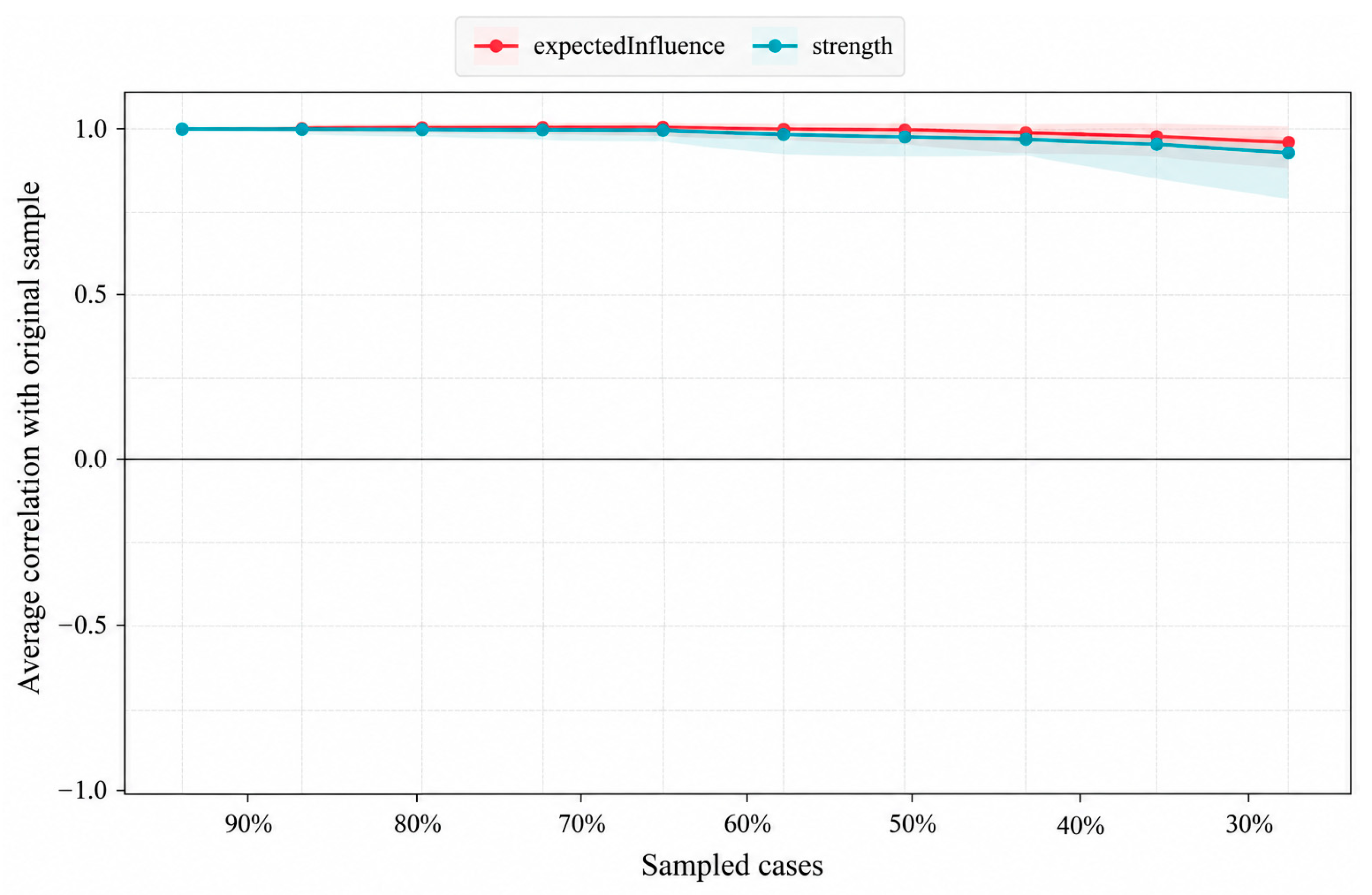
In addition, the robustness of the network was examined using case-dropping bootstrap procedures. The correlation stability coefficients (CS) for centrality indices and edge weights were evaluated, with values above 0.50 considered indicative of acceptable stability (
Epskamp et al., 2018).
4. Results
4.1. Scale-Development Findings
4.1.1. Exploratory Factor Analysis
To address RQ1a, EFA was conducted using data from Sample 1. The suitability of the data for factor analysis was initially assessed using KMO measure and Bartlett’s test of sphericity. For the original 18-item scale, the KMO value was 0.896, and Bartlett’s test of sphericity was significant, χ2(153) = 6376.488, p < 0.001, indicating that the data were suitable for factor analysis. The Likert-type items were treated as approximately continuous, and Pearson correlations were used in the analysis. ML was used as the extraction method, and Promax rotation was applied to allow the factors to correlate.
Initial EFA was conducted on the original 18 items to examine the factor structure and identify potentially problematic items. During the initial EFA, two items from the original Learning dimension, I4 and I5, exhibited substantial cross-loadings with Sociability. I4 loaded 0.430 on the Learning factor and 0.384 on Sociability, whereas I5 loaded 0.407 on Learning and 0.432 on Sociability. The differences between the two factor loadings were 0.046 and 0.025, respectively, both of which are below the predefined threshold of 0.15. These two items were therefore removed because they showed insufficient discrimination between the two dimensions. The EFA was subsequently rerun using the remaining 16 items.
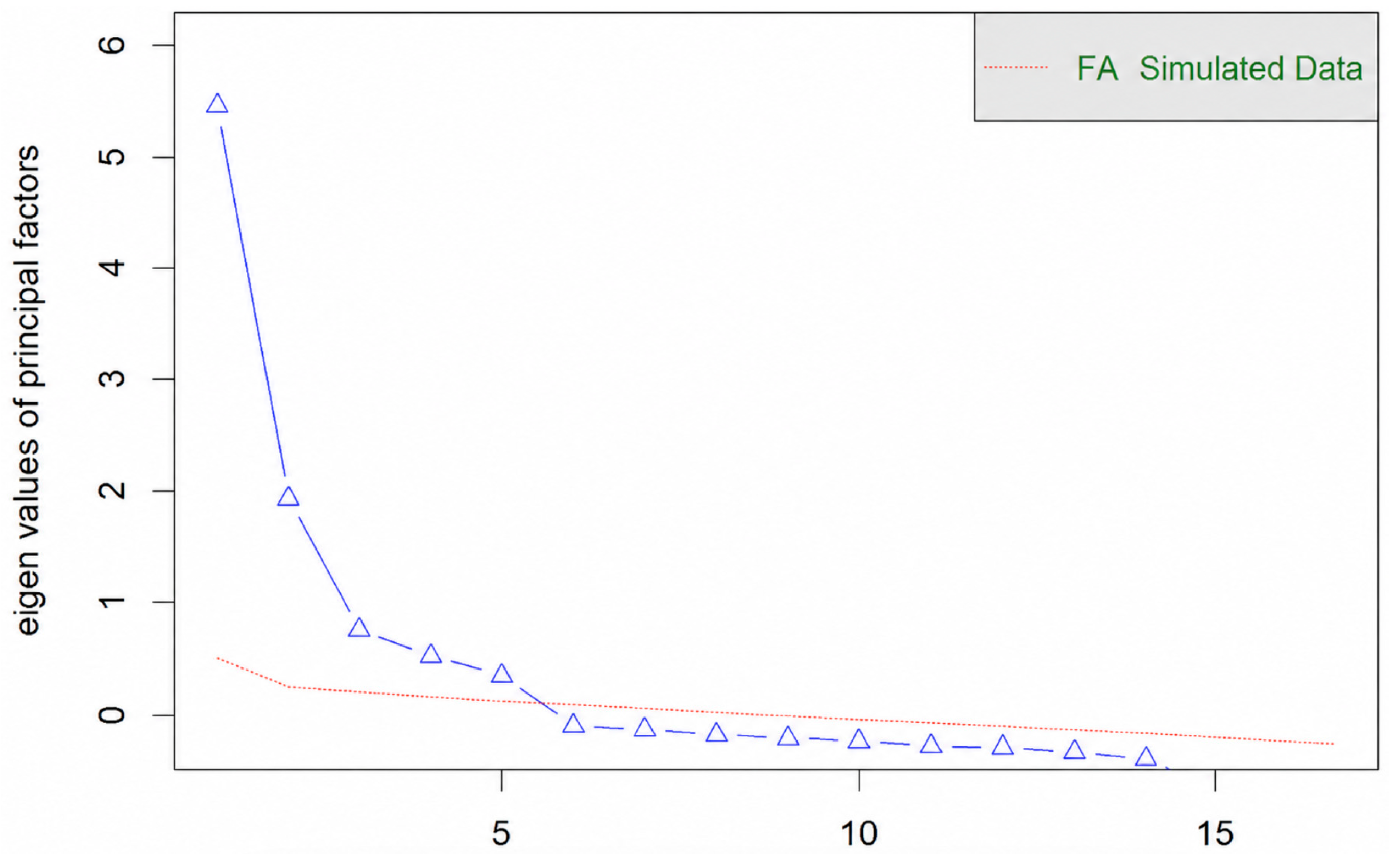
Factor retention was further evaluated using parallel analysis after the item refinement. Parallel analysis of the original 18-item scale suggested six factors; however, the sixth factor was defined primarily by I4 and I5, the two items that exhibited substantial cross-loadings in the initial five-factor solution. Given their insufficient discrimination and the resulting two-item factor, these items were removed before determining the final factor structure. Parallel analysis was then conducted on the remaining 16 items using 500 simulated datasets and maximum likelihood extraction. The results indicated that five factors should be retained (see
Figure 1). Accordingly, a five-factor solution was specified for the final EFA.
For the final 16-item solution, the KMO value was 0.873, and Bartlett’s test of sphericity was significant, χ2(120) = 5325.410, p < 0.001, further supporting the factorability of the data. The final EFA used ML extraction with Promax rotation, consistent with the correlated nature of the factors. The five-factor solution accounted for 67.5% of the total variance. Specifically, Effectiveness accounted for 15.6% of the variance, Sociability for 14.9%, Novelty for 13.0%, Flow for 12.0%, and Seamlessness for 11.9%.
Notably, the original Learning and Efficiency dimensions did not emerge as two distinct factors. Instead, one item originally assigned to Learning and three items originally assigned to Efficiency converged into a single factor. Because these items collectively reflect learners’ perceptions of the effectiveness of GenAI in supporting and facilitating their L2 learning processes, this factor was labeled Effectiveness. The label therefore reflects the common substantive meaning of the items while acknowledging the empirical integration of the original Learning and Efficiency dimensions.
The final EFA solution consisted of five factors:
Effectiveness, Sociability, Novelty, Flow, and
Seamlessness. The
Effectiveness factor comprised four items (I1, I2, I3, and I6), with primary factor loadings ranging from 0.540 to 0.951.
Sociability comprised three items (I10, I11, and I12), with loadings ranging from 0.776 to 0.991.
Novelty comprised three items (I7, I8, and I9), with loadings ranging from 0.736 to 0.854.
Flow comprised three items (I13, I14, and I15), with loadings ranging from 0.690 to 0.838. Finally,
Seamlessness comprised three items (I16, I17, and I18), with loadings ranging from 0.722 to 0.884. The complete rotated pattern matrix, including primary factor loadings, cross-loadings, and communalities, is presented in
Table 3. In addition, the detailed item contents are provided in the
Supplementary Materials. The factor correlation matrix is presented in
Table 4.
To further clarify the substantive meaning of each retained factor,
Table 5 provides a concise interpretation of the five subscales.
4.1.2. Confirmatory Factor Analysis
Using the five-factor structure identified in the EFA, the 16-item scale was further examined using data from Sample 2. For
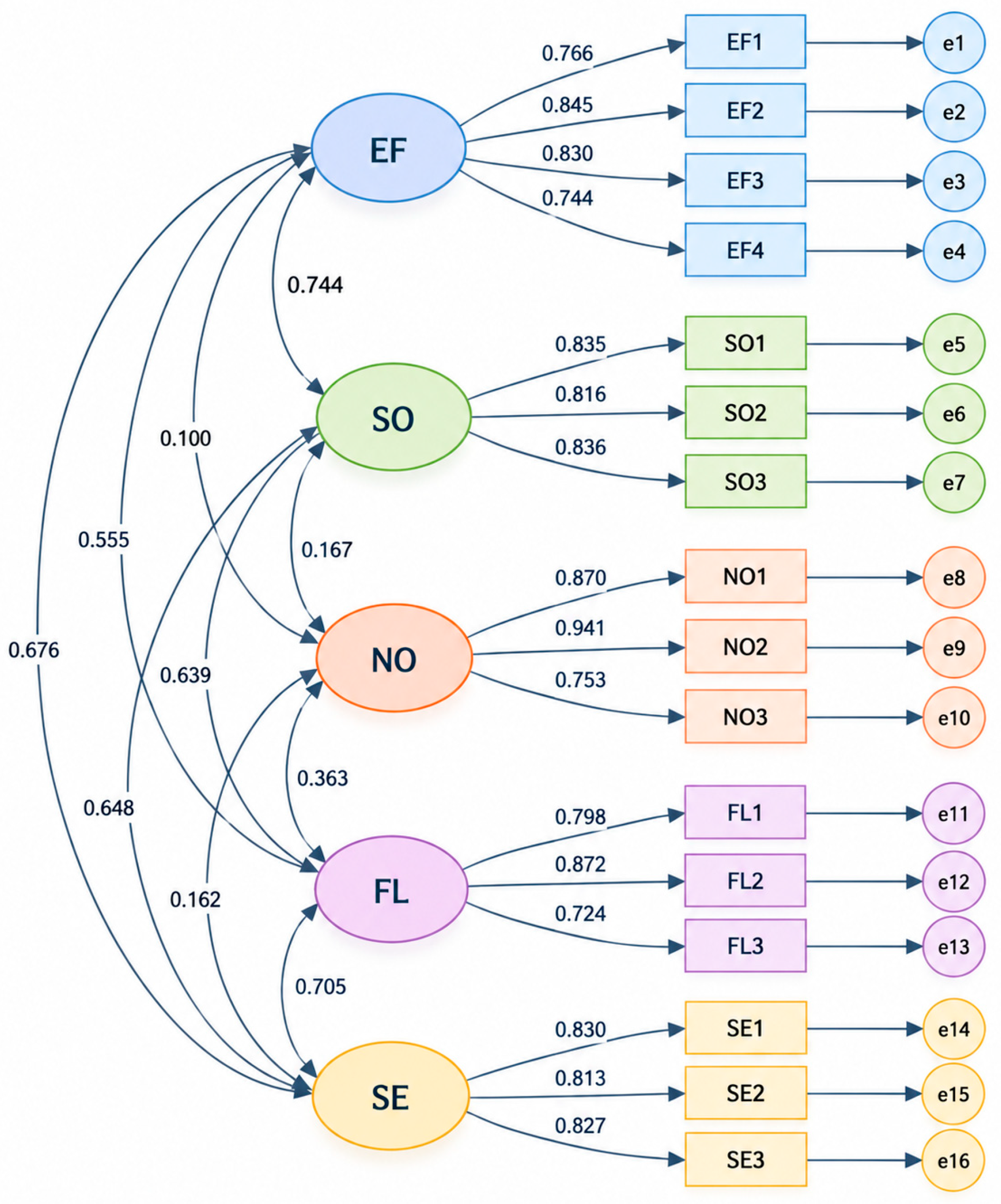
RQ1b, CFA was conducted to evaluate whether the proposed factor structure adequately represented the observed data. All items exhibited significant standardized factor loadings, with values exceeding the recommended threshold of 0.45 (see
Figure 2,
Table 6 and
Table 7) (
Kline, 2016). Therefore, all 16 items were retained for subsequent analyses.
The model fit indices indicated an acceptable fit without any modifications between the hypothesized five-factor model and the data. Specifically, χ
2/
df = 3.062 (<5). Other fit indices demonstrated satisfactory model fit, including TLI = 0.956 and CFI = 0.966 (both > 0.9). In addition, the RMSEA was 0.060 (<0.08), and the SRMR was 0.039 (<0.08) (
Hu & Bentler, 1999).
To further validate the five-factor structure, we tested a set of competing models: (a) a one-factor model with all 16 items loading on a single factor; (b) a four-factor model combining Effectiveness and Sociability into a single factor, given their high correlation (r = 0.744) in the five-factor solution; and (c) a higher-order model with all five first-order factors loading on a single second-order factor.
The original six-factor model separating
Efficiency and
Learning was not estimable because the
Learning dimension was reduced to a single item after EFA (the other two
Learning items were removed due to cross-loadings), and a single-item factor is not identified in CFA (
Kline, 2016).
As shown in
Table 8, the five-factor model demonstrated superior fit compared to the one-factor and four-factor alternatives. The higher-order model also showed acceptable fit, indicating that the five dimensions can be meaningfully summarized by a general construct. These results collectively support the adequacy of the proposed five-factor structure of the AI-L2-ILES.
4.1.3. Validity and Reliability Analysis
To address
RQ1b, reliability was assessed using McDonald’s ω, which is conceptually appropriate, as it does not require the tau-equivalence assumption underlying Cronbach’s α. The overall scale demonstrated strong internal consistency (ω = 0.885). For the five subscales, ω values were 0.872 (
Effectiveness), 0.868 (
Sociability), 0.889 (
Novelty), 0.836 (
Flow), and 0.864 (
Seamlessness). All values exceeded the recommended threshold of 0.70 (
Viladrich et al., 2017), confirming satisfactory reliability of the scale and its dimensions.
Convergent and discriminant validity were then assessed using average variance extracted (AVE) and the Fornell–Larcker criterion. As shown in
Table 9, AVE values ranged from 0.635 to 0.737, exceeding the recommended threshold of 0.50 (
Fornell & Larcker, 1981), indicating that the items within each factor adequately captured their corresponding constructs.
Discriminant validity was examined using both the Fornell–Larcker criterion and the HTMT ratio of correlations. The HTMT values (see
Table 10) for all factor pairs ranged from 0.103 to 0.765, all below the recommended threshold of 0.85 (
Henseler et al., 2015), supporting the distinctiveness of the five dimensions. The Fornell–Larcker criterion further supported discriminant validity: the square roots of AVE for all five dimensions (ranging from 0.797 to 0.858) were greater than their correlations with other dimensions (
r = 0.100–0.705). These results collectively confirm that each dimension is empirically distinct.
In addition, correlation analysis showed that all five AI-L2-ILES subscales were significantly and positively correlated with GenAI-IDLE (all ps < 0.001). Specifically, Effectiveness was positively correlated with GenAI-IDLE (r = 0.579), Sociability was positively correlated with GenAI-IDLE (r = 0.565), Novelty showed a relatively weak positive correlation with GenAI-IDLE (r = 0.268), Flow was positively correlated with GenAI-IDLE (r = 0.625), and Seamlessness showed a relatively strong positive correlation with GenAI-IDLE (r = 0.670).
These findings provide preliminary evidence for the criterion validity of the scale. However, given that both measures were self-reports collected concurrently from the same participants, the results should be interpreted with caution due to the possibility of common-method variance.
4.1.4. Cross-Group Invariance Analysis
Using data from Sample 2, measurement invariance across gender and academic disciplines was examined to address
RQ1c (see
Table 11). For gender, the configural, metric, and scalar invariance models all demonstrated acceptable fit. The changes in fit indices were minimal (ΔCFI < 0.01 and ΔRMSEA < 0.015), supporting scalar invariance across gender groups.
Measurement invariance across academic disciplines was also supported. Although the fit indices slightly decreased across increasingly constrained models, both metric and scalar invariance models met the recommended criteria (ΔCFI < 0.01 and ΔRMSEA < 0.015). These findings indicate that the AI-L2-ILES demonstrates measurement equivalence across genders and academic disciplinary groups.
4.2. Network Analysis Findings
4.2.1. Network Structure and Edge Weights
Using the EBICglasso estimation method (
Epskamp et al., 2018), the AI-L2-ILES network was estimated with five nodes, including
Effectiveness,
Sociability,
Novelty,
Flow, and
Seamlessness, with a theoretical maximum of 10 edges (see
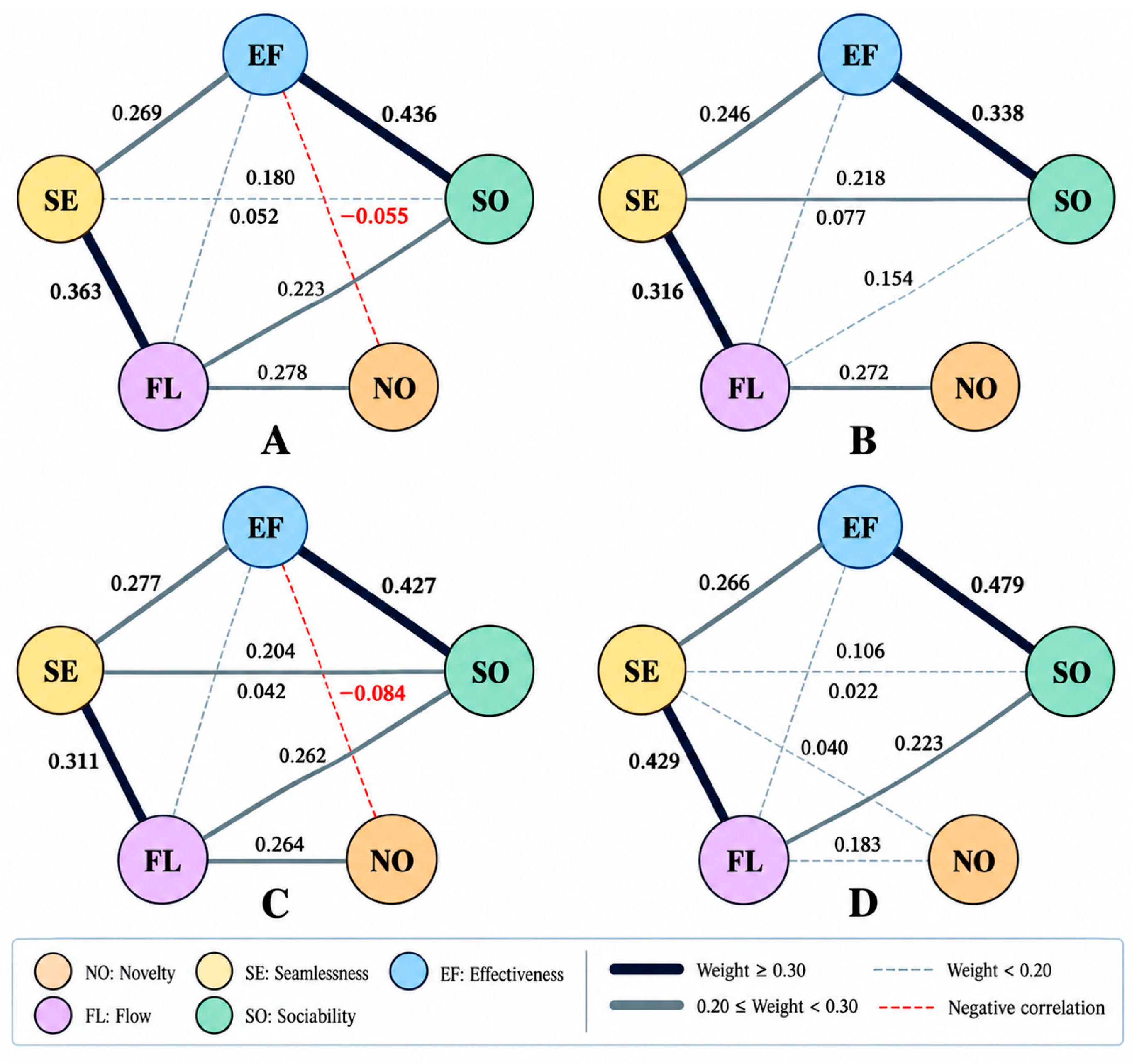
Figure 3). A total of eight non-zero edges were retained, resulting in a network density of 0.800, indicating a highly interconnected network structure.
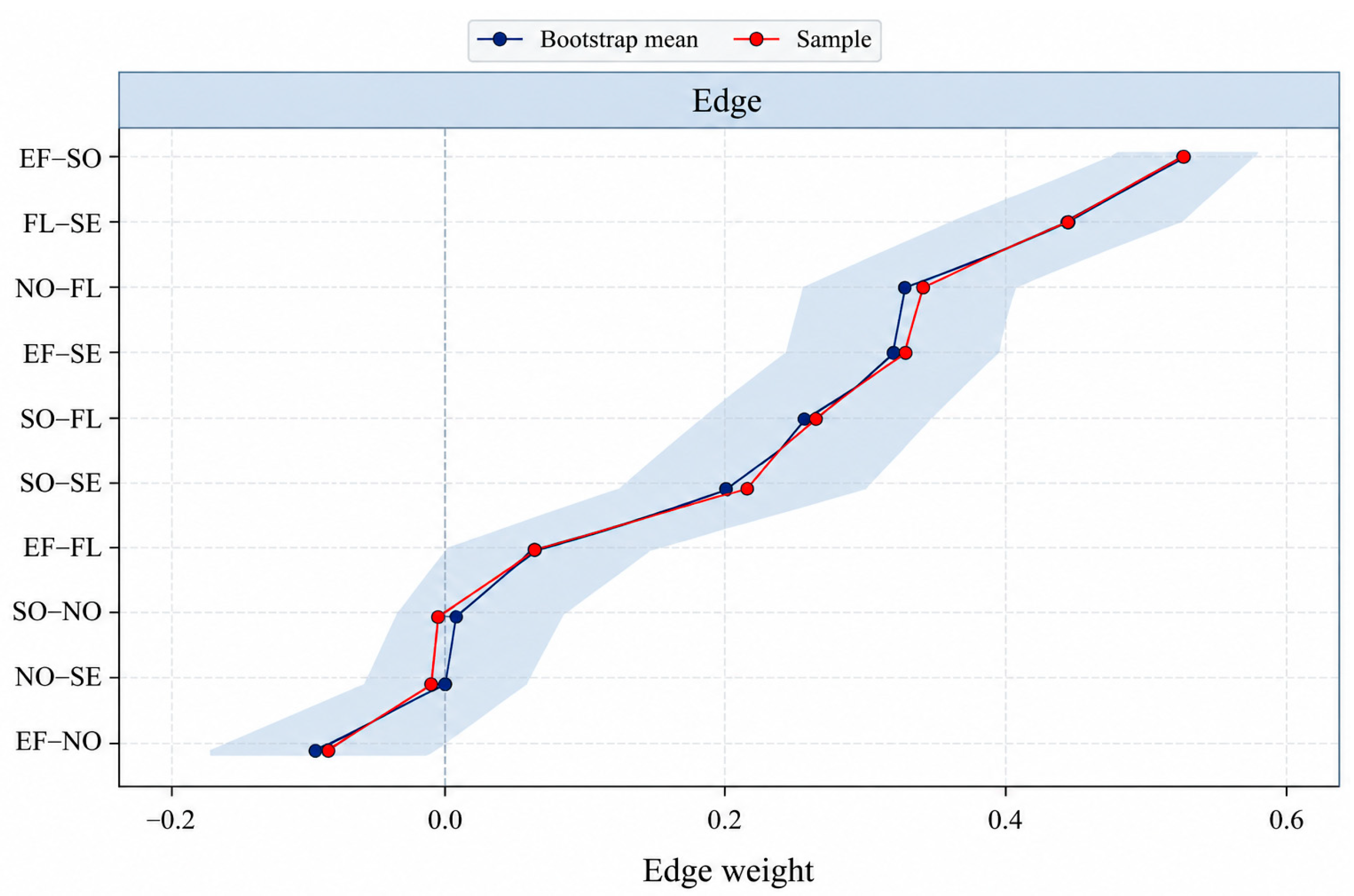
The strongest edge was observed between Sociability and Effectiveness (SO–EF, 0.436, 95% CI [0.380, 0.493]), followed by Seamlessness and Flow (SE–FL, 0.363, 95% CI [0.293, 0.433]), Novelty and Flow (NO–FL, 0.278, 95% CI [0.216, 0.339]), Seamlessness and Effectiveness (SE–EF, 0.269, 95% CI [0.207, 0.332]), Sociability and Flow (SO–FL, 0.223, 95% CI [0.158, 0.288]), and Sociability and Seamlessness (SO–SE, 0.180, 95% CI [0.105, 0.255]). These findings suggest that learners’ perceptions of social interaction, learning effectiveness, and interaction continuity are closely interconnected within the AI-L2-ILES network.
In contrast, the edges between Flow and Effectiveness (FL–EF, 0.052, 95% CI [−0.007, 0.111]) and Novelty and Effectiveness (NO–EF, −0.055, 95% CI [−0.125, 0.015]) had confidence intervals including zero, indicating that these associations were not statistically reliable. Moreover, Novelty showed no direct connections with Sociability (NO–SO) or Seamlessness (NO–SE) after regularization, suggesting that Novelty represents a relatively distinct experiential dimension within the AI-L2-ILES network.
4.2.2. Accuracy of Edge Weight Estimates
Figure 4 illustrates the bootstrapped accuracy of the estimated edge weights. Based on 1000 non-parametric bootstrap iterations, six edges showed relatively narrow confidence intervals that did not include zero (SO–EF: 95% CI [0.380, 0.493]; SE–FL: [0.293, 0.433]; NO–FL: [0.216, 0.339]; SE–EF: [0.207, 0.332]; SO–FL: [0.158, 0.288]; SO–SE: [0.105, 0.255]), indicating that these edges were estimated with greater precision. The remaining four edges had confidence intervals that included zero (FL–EF: [−0.007, 0.111]; NO–EF: [−0.125, 0.015]; SO–NO: [−0.044, 0.044]; NO–SE: [−0.037, 0.037]), indicating less precise estimates.
Three types of edges should be distinguished in interpreting the network: edges regularized to zero (NO–SO, NO–SE), edges with non-zero weights but wide confidence intervals (none in the present network), and edges with non-zero weights and relatively narrow confidence intervals (e.g., SO–EF, SE–FL). The bootstrap confidence intervals primarily reflect estimation accuracy rather than serving as conventional significance tests for individual edges (
Epskamp et al., 2018). The close correspondence between the original edge estimates and the bootstrap estimates (red and black lines, respectively) further supports the stability of the edge estimates.
4.2.3. Centrality Analysis
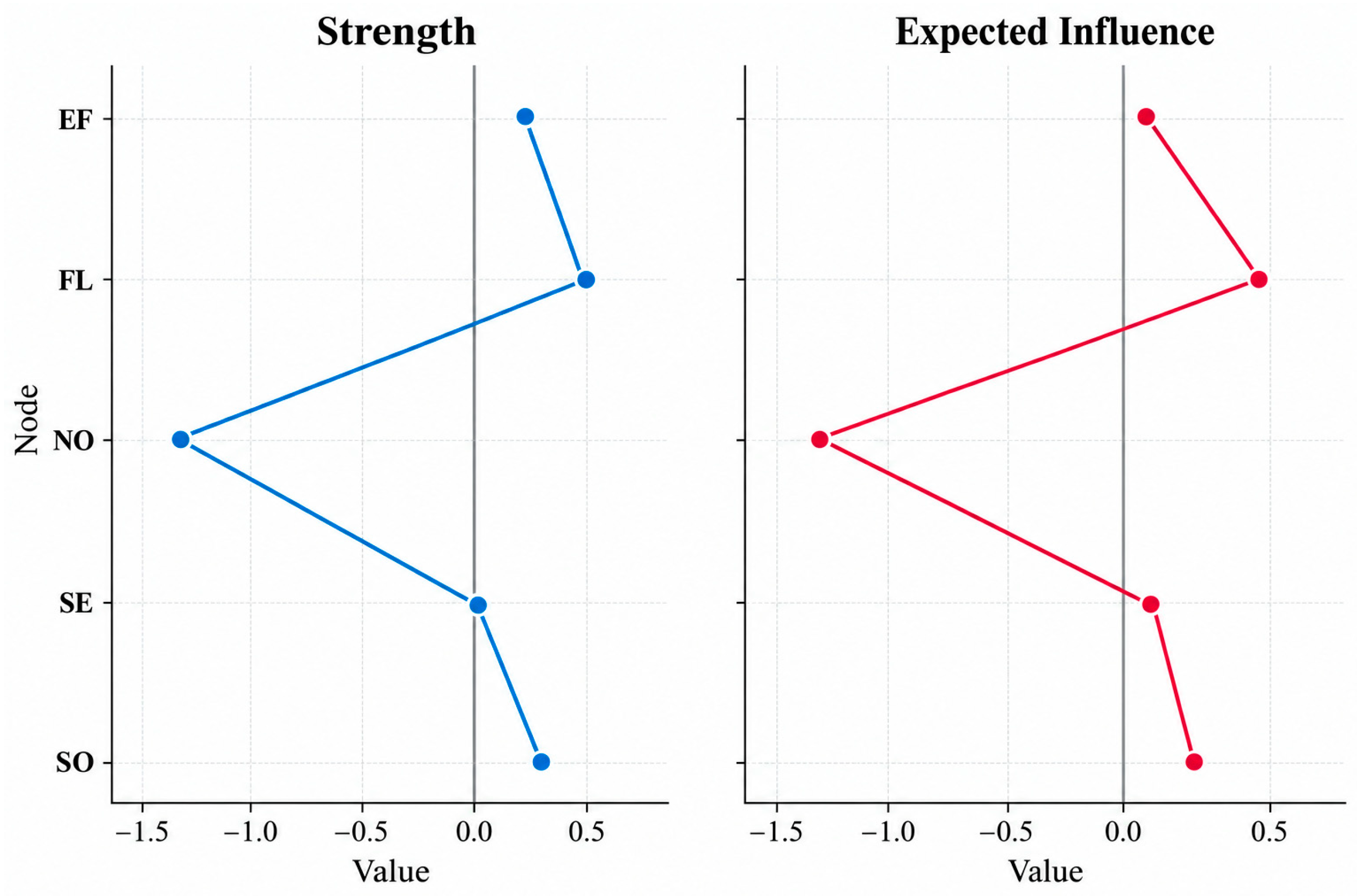
Centrality analysis was conducted to identify the relative importance of nodes within the AI-L2-ILES network (see
Figure 5). Among the five dimensions,
Flow demonstrated the highest strength centrality, indicating that it is the most strongly connected node within the network. In contrast,
Novelty exhibited the lowest strength centrality, suggesting its relatively peripheral position. These findings highlight the central role of flow experience in connecting different dimensions of GenAI-mediated learning experiences.
4.2.4. Centrality Stability
To assess the stability of the network estimates, we conducted a case-dropping bootstrap analysis with 1000 iterations (
Epskamp et al., 2018). The CS coefficients for node strength and expected influence were both 0.75, exceeding the recommended threshold of 0.50 (see
Figure 6), indicating good stability of the centrality estimates.
4.2.5. Cross-Disciplinary Network Comparison
Pairwise Network Comparison Tests were conducted to examine whether the AI-L2-ILES network differed across academic disciplines (L2, Humanities and Social Sciences, and STEM). No significant differences were observed in global network strength among the three groups (L2 = 1.620, Humanities and Social Sciences = 1.873, STEM = 1.748).
Pairwise comparisons further showed no significant differences: L2 vs. Humanities and Social Sciences (S = 0.252, p = 0.249, FDR-corrected p = 0.522), L2 vs. STEM (S = 0.128, p = 0.348, FDR-corrected p = 0.522), and Humanities and Social Sciences vs. STEM (S = 0.125, p = 0.522, FDR-corrected p = 0.522). Similarly, the M-tests revealed no significant differences in network structure across groups (all FDR-corrected p > 0.736). These findings suggest that the AI-L2-ILES network structure remained stable across academic disciplines.
5. Discussion
In recent years, the application of GenAI in L2 education has expanded rapidly, moving beyond the provision of linguistic resources to supporting interactive learning processes. Previous studies have documented a range of functions served by GenAI in language education, including feedback provision, cognitive stimulation, and interaction facilitation (
Lee et al., 2026). However, despite the increasingly prominent role of GenAI as an agent-like interactive partner rather than merely a learning tool, reliable instruments specifically designed to capture L2 learners’ cognitive evaluation of their interactive learning experiences with GenAI remain scarce. To address this research gap, the present study developed the AI-L2-ILES and evaluated its psychometric properties.
5.1. Psychometric Properties of the AI-L2-ILES
Regarding the factor structure examined in
RQ1a, the eight dimensions of the original SSIE framework (
Zhang et al., 2025) underwent a process of retention, deletion, reconceptualization, and restructuring during contextual adaptation, resulting in a five-dimensional model consisting of
Effectiveness,
Sociability,
Novelty,
Flow, and
Seamlessness. The removal of
Ease of Use and
Safety suggests that, in GenAI-assisted L2 learning contexts, learners’ evaluations are less focused on technical attributes such as system usability and privacy protection, but rather on whether GenAI-mediated interactions can effectively facilitate L2 learning. This finding aligns with
Lee et al. (
2026), who emphasized that the central value of GenAI in L2 education lies in its role as a cognitive stimulator and interaction facilitator. Although
Safety represents important concerns in traditional smart service contexts, such as payment security and personal information protection, these concerns may be less salient in learners’ routine use of GenAI for L2 learning, providing contextual justification for its exclusion. Notably,
P. Li (
2026), who applied the SSIE framework to a GenAI-assisted music education context, also found that
Safety negatively predicted learners’ behavioral intentions. This finding further supports our study’s decision to exclude
Safety and suggests that, in GenAI-supported educational contexts, safety may not function as a core experiential dimension and may, under certain conditions, even attenuate learners’ positive perceptions.
For the dimension restructuring examined in
RQ1a, the original SSIE dimensions of
Efficiency and
Learning (
Zhang et al., 2025) did not emerge as distinct factors. Instead, three
Efficiency items converged with one retained
Learning item to form a single factor, which was subsequently conceptualized as
Effectiveness. Although this factor was identified inductively, its emergence can be theoretically interpreted in light of the goal-oriented nature of GenAI-assisted L2 learning. In service contexts,
Efficiency primarily concerns convenience and reduced effort, whereas
Learning concerns knowledge acquisition. In educational contexts, however, the value of efficient interactions may depend partly on whether they contribute to meaningful learning outcomes. Consistent with this view,
Suzuki et al. (
2025) found that learning efficiency during computer-assisted L2 vocabulary learning strongly predicted subsequent vocabulary retention. This does not suggest that efficiency and learning are psychometrically identical; rather, it indicates a functional relationship between the resources required for learning and the outcomes achieved. Accordingly, the convergence observed here may reflect learners’ holistic evaluations of whether GenAI interactions enable meaningful L2 learning with a reasonable investment of time and effort. Nevertheless, the observed convergence may also have been influenced by the limited number of retained
Learning items, and should therefore be interpreted cautiously rather than as evidence that Efficiency and Learning are inherently identical constructs. Regarding
RQ1b and
RQ1c, the AI-L2-ILES demonstrated satisfactory reliability, validity, and measurement invariance, indicating sound psychometric properties (
Cheung & Rensvold, 2002;
Fornell & Larcker, 1981).
The retention and reconceptualization of
Sociability represent an important finding supporting the construct validity of the scale. In the original SSIE framework,
Socialization primarily refers to interpersonal emotional connections among users in service contexts (
Zhang et al., 2025). In this study, however, this dimension was reconceptualized as learners’ perceptions of social responsiveness and partner-like communication during interactions with GenAI. The CFA results further supported the validity of this reconceptualized dimension, as indicated by its satisfactory factor loadings. This finding aligns with the Computers Are Social Actors paradigm proposed by
Reeves and Nass (
1996) and
Nass and Moon (
2000), which suggests that individuals naturally apply social rules and expectations to technological systems during interactions. Such social responses may be particularly salient in L2 learning contexts, where language learning is inherently social. The immediate dialogue, personalized feedback, and natural language interaction enabled by GenAI may further enhance learners’ perceptions of GenAI as a social actor (
Luo & Gan, 2025). This finding is also consistent with the development of the Personal Attributes for Self-Directed AI Learning scale, which showed that learners tend to perceive GenAI as a responsive learning partner rather than merely a technological tool (
B. Li et al., 2025). Therefore,
Sociability not only maintains theoretical continuity with prior smart interaction research but also acquires new context-specific meanings within GenAI-assisted L2 learning.
5.2. Dimensional Interconnection of the AI-L2-ILES
Concerning the interrelationships among dimensions examined in
RQ2,
Sociability demonstrated the strongest association with
Effectiveness, suggesting that learners perceiving greater social responsiveness during GenAI interactions tended to evaluate these interactions as more effective for learning. L2 learning is inherently socially mediated, with learners developing language abilities through communication, feedback, and negotiation of meaning (
Lee et al., 2026). When GenAI provides partner-like responsiveness and conversational support, learners may be more likely to perceive such interactions as beneficial.
F. Wang et al. (
2025) suggested that perceived GenAI interactivity shares psychological continuity with traditional interpersonal interactions and may support GenAI-supported learning processes. Thus, enhanced social responsiveness may be associated with more positive evaluations of GenAI-mediated learning experiences. The strong association between
Sociability and
Effectiveness also supports the reconceptualization of
Sociability in the present scale, as excluding this dimension would overlook an important aspect of AI-L2-ILE. Moreover, the strong association between
Seamlessness and
Flow indicates that smooth and uninterrupted GenAI interactions may be linked to learners’ concentration and immersion. When interactions are not disrupted by technical delays, incomplete responses, or loss of conversational context, learners may be more likely to achieve a focused learning state.
Novelty demonstrated the most independent position within the network, showing relatively weak associations with the other dimensions. Its connections with Sociability and Seamlessness were further reduced to near zero after regularization. This finding suggests that learners’ perceptions of GenAI novelty are relatively distinct from their evaluations of social, fluent, and immersive interaction experiences. Novelty mainly reflects learners’ initial cognitive responses to GenAI as an innovative technology, whereas other dimensions capture deeper experiences developed through sustained interactions. Several alternative explanations for Novelty’s peripheral position should be considered. First, this pattern may reflect the sample’s relatively high GenAI familiarity, as participants were recruited based on prior GenAI use; for experienced users, novelty may be less salient. Second, novelty effects tend to diminish over time, and the cross-sectional design captures only a single time point, potentially obscuring novelty’s role during initial adoption. Third, the novelty items focused specifically on perceptions of newness, which may be closer to initial impressions than sustained experiential appraisals. These explanations are not mutually exclusive, and future longitudinal research could clarify whether Novelty’s peripheral position is a stable structural feature or reflects user experience and measurement timing. Overall, the findings suggest that although Novelty may encourage initial engagement, it is unlikely to be a core dimension of sustained GenAI-mediated learning experience.
In contrast,
Flow emerged as the most central dimension, ranking highest across multiple centrality indices, suggesting that it may function as a statistical bridge connecting other dimensions within the network. As an immersive state characterized by focused attention and sustained involvement,
Flow may relate to learners’ evaluations of
Effectiveness, Sociability, and
Seamlessness. Given the cross-sectional nature of the data, however, these findings reflect associations rather than causal priority. The centrality of
Flow carries both theoretical and measurement-related implications. Theoretically,
Flow’s hub-like position suggests that immersive engagement may function not merely as one of several parallel experiential facets, but as a state that connects with and potentially reinforces other dimensions of the interaction experience. This interpretation is consistent with prior research conceptualizing flow as a state of optimal engagement in L2 learning (
Csikszentmihalyi, 1990;
Jiang & Li, 2026), as well as evidence linking flow with satisfaction and perceived learning in technology-enhanced language learning (
H. Liu & Song, 2021). The present findings extend this literature by demonstrating
Flow’s network-level prominence in GenAI-assisted L2 interaction. From a measurement perspective,
Flow’s central role does not imply that other dimensions are less important or that the AI-L2-ILES should be reduced to a unidimensional measure. Rather, if researchers seek a brief screener of learners’ overall interaction experience,
Flow-related items may provide efficient indicators, whereas the full five-dimensional structure remains important for comprehensive diagnostic assessment.
Notably, the network comparison analysis did not detect significant structural differences across learners from different academic disciplines. This finding complements previous research documenting disciplinary variations in GenAI use and L2 learning (
Xie, 2019;
Y. Xu & Wu, 2026) by suggesting that, in terms of how learners evaluate their GenAI interaction experiences, network structures may be more similar than different across disciplines. However, the absence of detected differences should not be taken as strong evidence of full structural equivalence. It may reflect the broad discipline categories used in this study, limited sensitivity of the Network Comparison Tests, or relatively similar GenAI exposure across the sample. Moreover, because the findings are based on self-report scale data, they do not directly capture actual interaction processes, behavioral patterns, or language outcomes. Thus, the observed similarity should be interpreted primarily as a pattern in learners’ self-reported evaluations rather than evidence of the underlying cognitive architecture of human–GenAI interaction. One possibility is that disciplinary differences may relate to why learners use GenAI more than how they evaluate the interaction experience itself, but this interpretation remains tentative and requires further investigation.
6. Implications and Limitations
This study makes three theoretical contributions. First, it proposes and validates the construct of AI-L2-ILE, conceptualized as a comprehensive experiential evaluation formed by L2 learners through their perceptions of the interaction process, interactional relationship, and learning value during sustained interactions with GenAI. This construct expands the conceptual boundaries of GenAI-assisted language learning research by shifting the focus from the functional attributes of GenAI to the structure of learners’ experiential evaluations, offering a learner-centered perspective for understanding how GenAI is experienced as an interactive learning partner in L2 learning. Second, this study identifies and validates the five-factor structure of the AI-L2-ILES (Effectiveness, Sociability, Novelty, Flow, and Seamlessness). The emergence of Effectiveness demonstrates how the goal-oriented nature of educational contexts can shape experiential dimensions: when learners evaluate GenAI-mediated interaction in relation to their learning goals, experiential quality may become closely linked to perceived learning value. This structural insight informs both L2 research and AI-in-education studies by specifying how learners distinguish different aspects of their interactions with GenAI in L2 learning. Third, this study introduces dimension-level network analysis into research on AI-L2-ILE and reveals differentiated association patterns among dimensions, including the strong connection between Sociability and Effectiveness, the relative independence of Novelty, and the central role of Flow. These findings provide a complementary perspective beyond traditional dimensional approaches for understanding the internal structure of this construct, with implications for understanding how learners experience GenAI through its interactive qualities in L2 learning.
This study also offers several practical implications for GenAI-assisted L2 teaching. First, the AI-L2-ILES serves as a diagnostic instrument for educators to identify potential weaknesses in learners’ GenAI interaction experiences. By assessing learners’ experiences across dimensions such as Effectiveness and Flow, teachers can develop more targeted instructional strategies and optimize GenAI integration in language learning. Second, the strong association between Sociability and Effectiveness suggests that learners who perceive greater social responsiveness from GenAI also tend to report higher perceptions of its learning value. Therefore, teachers and GenAI developers should attend not only to information accuracy but also to interactional qualities, including responsive feedback, empathetic support, and coherent dialogue. Third, the central role of Flow highlights the importance of immersive experiences in connecting different aspects of GenAI interaction. Instructional designers should thus prioritize interaction fluency, task engagement, and conversational continuity while minimizing technical disruptions and cognitive distractions. Finally, the peripheral position of Novelty indicates that although Novelty may be associated with initial adoption, sustained engagement should be supported by meaningful learning experiences rather than temporary technological appeal. These implications also inform the use and design of GenAI for L2 learning by suggesting that social responsiveness and flow-sustaining features may deserve greater attention than novelty-driven functionalities.
Several limitations should be acknowledged. First, the sample was limited to Chinese university students recruited through convenience sampling, which restricts generalizability to other cultural, educational, or age groups. Learners from different contexts, such as secondary school students, adult learners, or non-academic populations, may develop different evaluations of GenAI-mediated learning experience. Second, the study relied entirely on self-report data collected from the same participants at a single time point. This raises concerns about common-method variance and social desirability biases, which may have inflated the observed correlations, including the criterion-related validity coefficient with GenAI-IDLE. Third, the cross-sectional design precludes causal inferences. Although network analysis revealed associations among dimensions, these reflect statistical relationships rather than causal priority. For example, Flow’s centrality does not establish that enhancing Flow would causally improve perceptions of Effectiveness or Sociability. Fourth, the study did not include objective behavioral data (e.g., actual GenAI usage logs, task completion records, or interaction frequency) to complement the self-report findings. Such data would help validate whether the AI-L2-ILES scores correspond to observable interaction patterns. Fifth, this study treated GenAI as a general category and did not differentiate among specific tools such as ChatGPT, DeepSeek, or Kimi, which may afford different interaction experiences due to variations in interface design, response style, and functional affordances. Future research could address these limitations through more diverse samples, longitudinal or experimental designs, objective usage data, and comparative studies across GenAI platforms.
7. Conclusions
This study developed and validated the AI-L2-ILES, a five-dimensional instrument comprising Effectiveness, Sociability, Novelty, Flow, and Seamlessness. The scale demonstrated strong psychometric properties, including satisfactory reliability, validity, and measurement invariance across genders and academic disciplines. Dimension-level network analysis further uncovered the structural relationships among these dimensions. The strong association between Sociability and Effectiveness underscores the critical role of social responsiveness in shaping L2 learners’ GenAI-mediated interactive learning experiences, whereas the highest centrality of Flow indicates that immersive experience functions as a central component linking multiple experiential dimensions. In contrast, the relative independence of Novelty highlights the distinction between initial perceptions of technological novelty and deeper, sustained experiential evaluations. Overall, the AI-L2-ILES appears to be a promising instrument for future research, though further validation is needed across diverse contexts, including different countries, L2s, learner proficiency levels, specific GenAI tools, and varied learning tasks, before its generalizability can be fully established.
Author Contributions
Conceptualization, H.W. and Y.W.; methodology, H.W.; software, H.W.; validation, H.W., G.S.L. and Y.W.; formal analysis, H.W.; investigation, H.W.; resources, Y.W.; data curation, H.W.; writing—original draft preparation, H.W.; writing—review and editing, Y.W. and G.S.L.; visualization, H.W.; supervision, Y.W. and G.S.L.; project administration, Y.W.; funding acquisition, Y.W. All authors have read and agreed to the published version of the manuscript.
Funding
The research was supported by National Education Science Planning Project (No. FRA250474).
Institutional Review Board Statement
As a component of a larger longitudinal project, this study followed the ethical guidelines of the Declaration of Helsinki and was approved by the Research Ethics Committee of North China University of Water Resources and Electric Power (Protocol No. 2025168, approved 3 August 2025).
Informed Consent Statement
Informed consent was obtained from all subjects involved in the study.
Data Availability Statement
The data supporting the findings of this study were collected as part of an ongoing nationally funded research project and constitute one of the project’s interim research outputs. Because the project is still in progress, the dataset is not currently available for unrestricted public access. However, the data can be obtained from the corresponding author upon reasonable request.
Conflicts of Interest
The authors declare no conflicts of interest.
Abbreviations
The following abbreviations are used in this manuscript:
| GenAI | Generative artificial intelligence |
| L2 | Second language |
| AI-L2-ILE | GenAI L2 Interactive Learning Experience |
| AI-L2-ILES | GenAI L2 Interactive Learning Experience Scale |
| SSIE | Smart Service Interactive Experience |
| EFA | Exploratory factor analysis |
| CFA | Confirmatory factor analysis |
| IDLE | Informal digital learning of English |
References
- Al-atrash, A., Hamdan, M., & Dweikat, K. (2026). Exploring EFL students’ perspectives on ChatGPT-assisted autonomous practices in enhancing self-directed learning at Palestinian universities. Cogent Education, 13(1), 2689737. [Google Scholar] [CrossRef] [Scilit]
- Ali, F., Sener, G., Petkovic, Z., Cavusoglu, M., & Alotaibi, S. (2026). Operationalizing smart service experience: Guest engagement, value, memories, and behavioral intentions in hotels. International Journal of Hospitality Management, 134, 104588. [Google Scholar] [CrossRef] [Scilit]
- Ashfaq, M., Ul Haq, I., Pham, H. C., Ullah Jan, I., & Shahzad, K. (2025). Critical determinants of intentions to revisit smart hotels: An examination of smart service interactional experience, emotions, and technophilia. Journal of Hospitality Marketing & Management, 34(5), 627–650. [Google Scholar] [CrossRef] [Scilit]
- Boateng, G. O., Neilands, T. B., Frongillo, E. A., Melgar-Quiñonez, H. R., & Young, S. L. (2018). Best practices for developing and validating scales for health, social, and behavioral research: A primer. Frontiers in Public Health, 6, 149. [Google Scholar] [CrossRef] [Scilit]
- Borsboom, D., Deserno, M. K., Rhemtulla, M., Epskamp, S., Fried, E. I., McNally, R. J., Robinaugh, D. J., Perugini, M., Dalege, J., Costantini, G., Isvoranu, A.-M., Wysocki, A. C., van Borkulo, C. D., van Bork, R., & Waldorp, L. J. (2021). Network analysis of multivariate data in psychological science. Nature Reviews Methods Primers, 1(1), 58. [Google Scholar] [CrossRef] [Scilit]
- Cheung, G., & Rensvold, R. (2002). Evaluating goodness-of-fit indexes for testing measurement invariance. Structural Equation Modeling, 9(2), 233–255. [Google Scholar] [CrossRef] [Scilit]
- Cosi Mireia, T., & Poole, F. (2025). Enhancing linguistic interaction with ChatGPT: An exploratory study of proficiency-matching and ecological validity in less commonly taught languages. CALICO Journal, 42(3), 527–550. Available online: https://utppublishing.com/doi/abs/10.3138/calico-2025-0023 (accessed on 15 September 2026).
- Csikszentmihalyi, M. (1990). Flow: The psychology of optimal experience. Harper and Row. [Google Scholar]
- Davis, F. D. (1989). Perceived usefulness, perceived ease of use, and user acceptance of information technology. MIS Quarterly, 13(3), 319–340. [Google Scholar] [CrossRef] [Scilit]
- Deci, E. L., & Ryan, R. M. (2000). The “what” and “why” of goal pursuits: Human needs and the self-determination of behavior. Psychological Inquiry, 11(4), 227–268. [Google Scholar] [CrossRef] [Scilit]
- DeVellis, R. F. (2016). Scale development: Theory and applications (Applied social research methods). SAGE Publications. [Google Scholar]
- Dolenc, K., & Brumen, M. (2024). Exploring social and computer science students’ perceptions of AI integration in (foreign) language instruction. Computers and Education: Artificial Intelligence, 7, 100285. [Google Scholar] [CrossRef] [Scilit]
- Eerdemutu, L., Dewaele, J.-M., & Wang, J. (2024). Developing a short language classroom engagement scale (LCES) and linking it with needs satisfaction and achievement. System, 120, 103189. [Google Scholar] [CrossRef] [Scilit]
- Epskamp, S., Borsboom, D., & Fried, E. I. (2018). Estimating psychological networks and their accuracy: A tutorial paper. Behavior Research Methods, 50(1), 195–212. [Google Scholar] [CrossRef] [Scilit]
- Epskamp, S., & Fried, E. I. (2018). A tutorial on regularized partial correlation networks. Psychological Methods, 23(4), 617–634. [Google Scholar] [CrossRef] [Scilit]
- Fabrigar, L. R., Wegener, D. T., MacCallum, R. C., & Strahan, E. J. (1999). Evaluating the use of exploratory factor analysis in psychological research. Psychological Methods, 4(3), 272–299. [Google Scholar] [CrossRef]
- Fornell, C., & Larcker, D. F. (1981). Evaluating structural equation models with unobservable variables and measurement error. Journal of Marketing Research, 18(1), 39–50. [Google Scholar] [CrossRef] [Scilit]
- Hayes, A. F., & Coutts, J. J. (2020). Use omega rather than Cronbach’s alpha for estimating reliability. But…. Communication Methods and Measures, 14(1), 1–24. [Google Scholar] [CrossRef] [Scilit]
- Hayton, J. C., Allen, D. G., & Scarpello, V. (2004). Factor retention decisions in exploratory factor analysis: A tutorial on parallel analysis. Organizational Research Methods, 7(2), 191–205. [Google Scholar] [CrossRef] [Scilit]
- Henseler, J., Ringle, C. M., & Sarstedt, M. (2015). A new criterion for assessing discriminant validity in variance-based structural equation modeling. Journal of the Academy of Marketing Science, 43(1), 115–135. [Google Scholar] [CrossRef] [Scilit]
- Hu, L.-t., & Bentler, P. M. (1999). Cutoff criteria for fit indexes in covariance structure analysis: Conventional criteria versus new alternatives. Structural Equation Modeling, 6(1), 1–55. [Google Scholar] [CrossRef] [Scilit]
- Jiang, Y., & Li, Q. (2026). A latent profile exploratory study on L2 dispositional flow among Chinese EFL undergraduates. Discover Psychology, 6(1), 184. [Google Scholar] [CrossRef] [Scilit]
- Kline, R. B. (2016). Principles and practice of structural equation modeling (4th ed.). The Guilford Press. [Google Scholar]
- Lee, S., Choe, H., Zou, D., & Jeon, J. (2026). Generative AI (GenAI) in the language classroom: A systematic review. Interactive Learning Environments, 34(1), 335–359. [Google Scholar] [CrossRef] [Scilit]
- Li, B., Zhang, Z., Lowell, V., Wang, C., & Bonk, C. J. (2025). Development and validation of the PA-SDA scale: Measuring personal attributes in AI-integrated self-directed language learning. System, 133, 103793. [Google Scholar] [CrossRef] [Scilit]
- Li, P. (2026). Music education with GenAI: Exploring the mediating roles of enjoyment between smart service interactional experience and behavioural intention. European Journal of Education, 61(1), e70423. [Google Scholar] [CrossRef] [Scilit]
- Li, S., Wu, H., & Wang, Y. (2024). Positive emotions, self-regulatory capacity, and EFL performance in the Chinese senior high school context. Acta Psychologica, 243, 104143. [Google Scholar] [CrossRef] [Scilit]
- Li, Y., Shadiev, R., & Chiu, T. K. F. (2026). Applying generative artificial intelligence to task-based language teaching and learning: A systematic review and meta-analysis. TechTrends, 70(1), 150–163. [Google Scholar] [CrossRef] [Scilit]
- Liu, G. L., & Zhao, X. (2026). A scoping review of AI-mediated informal language learning: Mapping out the terrain and identifying future directions. ReCALL, 38(1), 111–130. [Google Scholar] [CrossRef] [Scilit]
- Liu, G. L., Zou, M. M., Soyoof, A., & Chiu, M. M. (2025). Untangling the relationship between AI-mediated informal digital learning of English (AI-IDLE), foreign language enjoyment and the ideal L2 self: Evidence from Chinese university EFL students. European Journal of Education, 60(1), e12846. [Google Scholar] [CrossRef] [Scilit]
- Liu, H., & Song, X. (2021). Exploring “Flow” in young Chinese EFL learners’ online English learning activities. System, 96, 102425. [Google Scholar] [CrossRef] [Scilit]
- Loewen, S., & Sato, M. (2018). Interaction and instructed second language acquisition. Language Teaching, 51(3), 285–329. [Google Scholar] [CrossRef] [Scilit]
- Luo, S., & Gan, Z. (2025). How social support contributes to self-efficacy and learning achievement: A validation study of secondary EFL learners. System, 133, 103770. [Google Scholar] [CrossRef] [Scilit]
- McKenzie, J. F., Wood, M. L., Kotecki, J. E., Clark, J. K., & Brey, R. A. (1999). Establishing content validity: Using qualitative and quantitative steps. American Journal of Health Behavior, 23(4), 311–318. [Google Scholar] [CrossRef] [Scilit]
- Mpinganjira, M., Maduku, D. K., Rana, N. P., & Thusi, P. (2025). Drivers of intentions towards continued use of digital voice assistants: The moderating role of service experience. Journal of Global Information Management, 33(1), 1–32. [Google Scholar] [CrossRef] [Scilit]
- Nass, C., & Moon, Y. (2000). Machines and mindlessness: Social responses to computers. Blackwell Publishing. [Google Scholar] [CrossRef] [Scilit]
- Nassaji, H. (2016). Anniversary article interactional feedback in second language teaching and learning: A synthesis and analysis of current research. Language Teaching Research, 20(4), 535–562. [Google Scholar] [CrossRef] [Scilit]
- Niu, Z., Huang, L., He, H., Mei, S., Li, L., & Griffiths, M. D. (2024). The revised patient satisfaction questionnaire (PSQ-R): Validity, reliability, equivalence, and network analysis among hospitalized patients in the Chinese population. BMC Health Services Research, 24(1), 1289. [Google Scholar] [CrossRef] [Scilit]
- Osborne, J. W., Costello, A. B., & Kellow, J. T. (2008). Best practices in exploratory factor analysis. In J. W. Osborne (Ed.), Best practices in quantitative methods (pp. 86–99). SAGE Publications, Inc. [Google Scholar]
- Pan, M., Lai, C., & Guo, K. (2025). Effects of GenAI-empowered interactive support on university EFL students’ self-regulated strategy use and engagement in reading. The Internet and Higher Education, 65, 100991. [Google Scholar] [CrossRef] [Scilit]
- Parasuraman, A. P., Zeithaml, V., & Berry, L. (1985). A conceptual model of service quality and its implication for future research. The Journal of Marketing, 49, 41–50. [Google Scholar] [CrossRef] [Scilit]
- Reeves, B., & Nass, C. I. (1996). The media equation: How people treat computers, television, and new media like real people and places. In The media equation: How people treat computers, television, and new media like real people and places. Cambridge University Press. [Google Scholar]
- Rhemtulla, M., Brosseau-Liard, P., & Savalei, V. (2012). When can categorical variables be treated as continuous? A comparison of robust continuous and categorical SEM estimation methods under suboptimal conditions. Psychological Methods, 17(3), 354–373. [Google Scholar] [CrossRef] [Scilit]
- Saarela, M., Gunasekara, S., & Kumarage, P. (2026). A meta-analysis of generative AI effects on language proficiency and affective–cognitive outcomes in language learning. Discover Computing, 29(1), 116. [Google Scholar] [CrossRef] [Scilit]
- Sim, S., Kim, Y., & Ku, K. (2025). Exploring generative AI as a roleplay interlocutor in L2 task-based pragmatics learning: Comparing ChatGPT-learner and technology-mediated peer interactions. TESOL Quarterly, 59(S1), S86–S116. [Google Scholar] [CrossRef] [Scilit]
- Suzuki, Y., Nakata, T., & He, X. (2025). Efficiency trumps aptitude: Individualizing computer-assisted second language vocabulary learning. ReCALL, 37(1), 96–113. [Google Scholar] [CrossRef] [Scilit]
- van Borkulo, C. D., van Bork, R., Boschloo, L., Kossakowski, J. J., Tio, P., Schoevers, R. A., Borsboom, D., & Waldorp, L. J. (2023). Comparing network structures on three aspects: A permutation test. Psychological Methods, 28(6), 1273–1285. [Google Scholar] [CrossRef] [Scilit]
- Viladrich, C., Angulo-Brunet, A., & Doval, E. (2017). A journey around alpha and omega to estimate internal consistency reliability. Anales de Psicología, 33(3), 755–782. [Google Scholar] [CrossRef] [Scilit]
- Wang, C., Sun, L., Yan, J., & Zou, B. (2026). Disciplinary and educational level differences in AI-mediated informal digital learning of English (AI-IDLE): A qualitative epistemic network analysis. Journal of Computer Assisted Learning, 42. [Google Scholar] [CrossRef] [Scilit]
- Wang, C., Zou, B., Du, Y., & Wang, Z. (2024). The impact of different conversational generative AI chatbots on EFL learners: An analysis of willingness to communicate, foreign language speaking anxiety, and self-perceived communicative competence. System, 127, 103533. [Google Scholar] [CrossRef] [Scilit]
- Wang, F., Cheung, A. C. K., Chai, C. S., & Liu, J. (2025). Development and validation of the perceived interactivity of learner-AI interaction scale. Education and Information Technologies, 30(4), 4607–4638. [Google Scholar] [CrossRef] [Scilit]
- Wang, Y. (2026). Exploring student engagement with multimodal generative AI in task-based Chinese language learning. Computer Assisted Language Learning, 1–26. [Google Scholar] [CrossRef] [Scilit]
- Wang, Y., Derakhshan, A., & Ghiasvand, F. (2025). EFL teachers’ generative artificial intelligence (GenAI) literacy: A scale development and validation study. System, 133, 103791. [Google Scholar] [CrossRef] [Scilit]
- Wang, Y., & Guo, Y. (2026). Investigating the interplay of Chinese English as foreign language learners’ growth mindset, enjoyment, adaptability, and engagement in AI-mediated informal digital learning of English. Journal of Computer Assisted Learning, 42(1), e70189. [Google Scholar] [CrossRef] [Scilit]
- Wu, H., Lalli, G. S., & Xia, Y. (2026). Explaining second language learners’ willingness to communicate with GenAI voice chatbots via SEM and fsQCA: The role of dark personality and motivational dispositions. The Asia-Pacific Education Researcher, 1–12. [Google Scholar] [CrossRef] [Scilit]
- Wu, H., & Wang, Y. (2025). Disclosing Chinese college students’ flow experience in GenAI-assisted informal digital learning of english: A self-determination theory perspective. Learning and Motivation, 90, 102134. [Google Scholar] [CrossRef] [Scilit]
- Wu, J., Wang, Y., He, Y., Yin, X., Chen, F., & Wan, B. (2026). Acceptance of AI-assisted English language learning tools in higher education: Psychological correlates across disciplinary and proficiency groups [Original Research]. Frontiers in Psychology, 1806457. [Google Scholar] [CrossRef] [Scilit]
- Xie, Q. (2019). Analyzing professional English learning needs and situations of science and language majors in a Chinese university. Higher Education Studies, 9, 141. [Google Scholar] [CrossRef] [Scilit]
- Xu, L., Zhang, L., Ou, L., & Wang, D. (2025). The development and validation of a scale on student AI literacy in L2 writing: A domain-specific perspective. Journal of Second Language Writing, 69, 101227. [Google Scholar] [CrossRef] [Scilit]
- Xu, Y., & Wu, H. (2026). Chinese STEM college students’ AI-mediated informal digital learning of English: A hybrid SEM-PNA approach to the hedonic-motivation system adoption model. Journal of Intelligence, 14(7), 120. [Google Scholar] [CrossRef] [Scilit]
- Yao, Y., Rong, M., Chen, X., & Zhu, X. (2026). Measuring Chinese undergraduate students’ engagement with GenAI feedback in L2 writing: A large-scale study. Innovation in Language Learning and Teaching, 1–18. [Google Scholar] [CrossRef] [Scilit]
- Zhang, T., Lu, L., Chi, O. H., Lu, C., & Cobanoglu, C. (2025). Smart service interactional experience for family travelers: Scale development and validation. Journal of Hospitality & Tourism Research, 49(4), 667–687. [Google Scholar] [CrossRef] [Scilit]
| Disclaimer/Publisher’s Note: The statements, opinions and data contained in all publications are solely those of the individual author(s) and contributor(s) and not of MDPI and/or the editor(s). MDPI and/or the editor(s) disclaim responsibility for any injury to people or property resulting from any ideas, methods, instructions or products referred to in the content. |