1. Introduction
The rapid proliferation of artificial intelligence (AI) in education is fundamentally reshaping the landscape of second language (L2) learning. Intelligent tutoring systems, automated writing evaluation (AWE) tools, and generative AI platforms such as ChatGPT now offer unprecedented opportunities for personalized, adaptive, and scalable instruction (
Kohnke et al., 2023). These tools can provide instantaneous, individualized feedback to L2 writers, raising important questions about how such technologies can be optimally harnessed to support language development. However, the effectiveness of these technological interventions ultimately hinges on a deeper, more fundamental question: what cognitive architectures enable human learners to perceive, process, and internalize feedback effectively? Understanding these underlying cognitive mechanisms is a prerequisite for designing AI systems that do not merely deliver information but genuinely catalyze language development. As
Godwin-Jones (
2022) observed, the integration of intelligent writing assistance into L2 learning requires not only technological sophistication but also a robust theoretical understanding of how learners cognitively engage with feedback a gap that the present study seeks to address by empirically investigating the metacognitive processes that underpin successful feedback processing. To move beyond the prevailing technology-driven paradigm, we must first reverse-engineer the cognitive architecture that learners naturally engage when processing feedback effectively. Rather than testing an AI tool, the present study empirically investigates how beginner Chinese-as-a-second-language (CSL) writers process feedback through written languaging (WL), thereby identifying the cognitive-psychological mechanisms that could inform the design of intelligent, adaptive AI systems. Specifically, our findings highlight the learner’s capacity for noticing, hypothesis-testing, and metalinguistic reflection as key processes that such systems might aim to scaffold. These implications, however, remain theoretical and are not directly tested in this human-feedback study. This foundational inquiry is a prerequisite for designing systems that genuinely catalyze language development, rather than merely delivering corrected output. The design of current AI-powered writing assistants, while technologically sophisticated, has largely been technology-driven rather than theory-driven. Most AWE systems and generative AI feedback tools operate on a “detect-and-correct” paradigm: they excel at identifying errors and providing correct forms, but treat feedback as a product to be delivered rather than a process to be cognitively processed (
H. Chen & Pan, 2022;
H. Yang et al., 2024). This implicit assumption overlooks a fundamental cognitive reality: durable learning does not arise from the correction itself, but from the learner’s metacognitive engagement with that correction (
Ferris, 2004;
Swain, 2006). By empirically investigating how beginner CSL writers process feedback through WL, this study does not test an AI tool, but rather provides the cognitive-psychological “functional specification” for what an intelligent, adaptive AI system must scaffold: the learner’s capacity for noticing, hypothesis-testing, and metalinguistic reflection.
L2 writing represents a particularly rich context for investigating this question. It is a cognitively demanding task that requires the intricate coordination of multiple dimensions of intelligence, including linguistic aptitude, working memory, metacognitive regulation, motivation, and emotional control (
Skehan, 2015;
Oxford, 2017). Within this complex landscape, written corrective feedback (WCF) has remained one of the most extensively studied areas in applied linguistics. Direct WCF where errors are explicitly identified and correct forms are provided is a staple in beginner-level L2 writing classrooms due to its clarity and efficiency (
Ferris, 2010;
Ellis, 2009). For lower-proficiency learners, direct feedback reduces the cognitive load during revision, allowing them to make corrections without having to infer the correct form themselves (
Ferris, 2002). Meta-analyses have confirmed that WCF can significantly improve L2 written accuracy, with effects moderated by feedback type, learner proficiency, and instructional conditions.
Brown et al. (
2023), in a Bayesian meta-analysis, further underscored that the effectiveness of WCF is contingent upon how it is delivered and processed.
Yet a persistent pedagogical paradox remains: learners often correct errors locally based on direct feedback but fail to internalize the corrections, leading to recurrent errors in subsequent writing (
Truscott, 1996;
Ferris, 2004). This suggests that the cognitive architecture required for durable learning is not automatically activated by feedback provision alone. A crucial processing gap exists between “being told the correct form“ and “restructuring internal linguistic knowledge.”
Ferris (
2004) argued that the long-term effect of feedback depends not on what the teacher “provides,” but rather on how the learner “processes the received feedback.” However, what constitutes “effective processing” has not been fully defined at the operational level particularly in a logographic writing system like Chinese, where the cognitive load imposed by orthographic processing is fundamentally different from that in alphabetic L2 contexts (
J. Yang, 2018,
2022).
Truscott’s (
1996) seminal critique of grammar correction, while controversial, highlighted a valid concern: without deeper cognitive engagement, error correction may remain superficial and fail to promote durable acquisition.
It is precisely on this cognitive gap that
Swain’s (
2006) concept of “languaging” offers a crucial theoretical pathway. Languaging the process of using language to mediate and reflect on one’s own cognitive activities is hypothesized to be a core component of an intelligent learner’s cognitive architecture.
Swain (
2006, p. 98) defined languaging as “the process of making meaning and shaping knowledge and experience through language”. When learners articulate their reasoning about why an error occurred and how to correct it, they engage in deeper cognitive processing, activating the noticing, hypothesis-testing, and metalinguistic functions essential for acquisition (
Swain & Lapkin, 1995;
Qi & Lapkin, 2001). Within
Swain and Lapkin’s (
1995) Output Hypothesis framework, output serves three key functions, noticing, hypothesis-testing, and metalinguistic reflection, which collectively transform feedback reception into active cognitive processing. WL, in particular, provides learners with extended processing time and a tangible written record for later retrieval, making it an ideal medium for studying this metacognitive dimension of feedback processing (
Ishikawa, 2013;
Suzuki, 2012). Recent research has further illuminated the mediating roles of individual difference factors such as language aptitude in the effectiveness of WL.
Ishikawa and Suzuki (
2023) found that the benefits of WL are not uniform across learners but are moderated by their cognitive aptitudes, underscoring the need to examine WL within the broader framework of individual differences in cognitive architecture.
Despite its theoretical appeal, the empirical exploration of WL has been largely confined to adult learners of Indo-European languages in English-as-a-Foreign-Language (EFL) contexts. A scoping review of languaging research in L2 education (
C. Li et al., 2023) confirms that the majority of empirical studies have focused on university-level learners and alphabetic target languages. Two significant gaps exist in the literature, which this study addresses.
First, target language typology. Chinese, with its logographic writing system, imposes unique cognitive demands on orthographic processing. Unlike alphabetic scripts where errors predominantly occur at the morphosyntactic level (e.g., verb tense, subject-verb agreement), Chinese character writing requires fine visuospatial processing and radical-level analysis (
J. Yang, 2022). Beginner learners from non-character backgrounds often treat characters as unanalyzable pictures rather than combinable semantic components, leading to frequent errors such as radical misuse, stroke omission, and structural misconfiguration (
J. Yang, 2018;
X. Yan & Lin, 2023). Whether WL, as a metacognitive tool, can effectively scaffold this specific orthographic challenge remains empirically untested. Does this specificity of the writing system reshape the cognitive pathways of feedback processing? How applicable is WL in CSL writing? These questions lack empirical answers.
Second, learner population characteristics. Secondary school learners in the UK (aged 14–15) represent a distinct learner profile with different cognitive and motivational characteristics compared to university-aged adults. Adolescents are undergoing significant cognitive and metacognitive development but have limited processing capacity and attention spans (
Muñoz, 2014). Their learning is also constrained by institutional time limits—typically no more than 2.5 h of Chinese per week and minimal out-of-class input (
Tinsley & Board, 2017;
Collen, 2023). The feasibility, effectiveness, and learner acceptance of WL in this authentic classroom context remain to be empirically examined. Recent work by
Rahim and Yang (
2024) has begun to explore languaging with low-proficiency L2 learners, but their study focused on English as the target language and did not address the unique challenges of logographic writing systems.
Peng (
2024) further emphasized that individual and collaborative feedback processing can yield different developmental trajectories, suggesting that the social and cognitive contexts of feedback matter profoundly for adolescent learners.
From the perspective of the “Intelligent Language Learner,” this study is positioned not as an AI-intervention study, but as an essential foundational investigation into the cognitive and metacognitive mechanisms that constitute intelligent L2 learning. By examining how WL, a form of self-regulated, metacognitive activity, enhances feedback processing, we aim to delineate the cognitive architecture that underpins successful error correction and long-term linguistic development. In this study, the “intelligent language learner” refers to a learner who actively engages in self-regulated, metacognitive processing of linguistic input and feedback—specifically, the capacity to notice gaps in one’s own knowledge, test hypotheses about language forms, and engage in metalinguistic reflection. “Intelligent L2 learning,” accordingly, is understood not as a fixed aptitude or the mere application of learning strategies, but as a dynamic process in which learners monitor their own comprehension and production, allocate attentional resources to formal features of the target language, and strategically use language as a tool for thinking and reflection. WL externalises these internal cognitive processes through written articulation, making them available for conscious inspection and refinement, and thus serves as a key mechanism for fostering intelligent L2 learning. Understanding these mechanisms is paramount for the future development of AI tools. Current AWE systems excel at error detection and providing corrections, but they are often designed as “black boxes” that do not explicitly engage the user’s cognitive architecture (
H. Chen & Pan, 2022). Research on learner interaction with AI-generated feedback (
H. Yang et al., 2024) has shown that students’ responses to automated feedback often remain at the mechanical, surface level in initial stages, mirroring the very “shallow processing” problem that WL is designed to address.
D. Yan and Zhang (
2024) found that cognitive engagement with ChatGPT-generated feedback is elicited through “heightened attention to linguistic form, reflective problem-solving, and critical appraisal of AI-generated feedback” precisely the kinds of metacognitive processes that WL explicitly cultivates. By illuminating the hierarchical, attention-driven nature of WL and the individual differences that moderate its effects, this study identifies cognitive-psychological principles—specifically, a noticing → languaging → internalisation processing sequence operationalised through WL and measured via writing accuracy indicators—that could guide the future design of adaptive AI systems. Such systems might be engineered to prompt for, assess, and respond to learners’ metalinguistic reasoning, but these design proposals are theoretical extrapolations from our human-feedback data and require direct empirical testing in AI-mediated contexts. We interpret our accuracy and languaging data as behavioural proxies for this architecture, recognising that cognitive processes are inferred rather than directly observed.
To fill the identified gaps, this study conducted a within-subjects crossover experiment in a beginner CSL classroom in a UK secondary school, investigating the effects of WL with direct feedback on writing accuracy in an authentic teaching context. The study used the General Certificate of Secondary Education (GCSE) writing assessment criteria as a framework for overall performance, while simultaneously measuring writing accuracy from character-level, text-level, and clause-level dimensions to more comprehensively reflect the linguistic performance characteristics of beginner CSL learners. Specifically, the study addressed the following three research questions:
Does adding WL to direct feedback produce an immediate, measurable improvement in writing accuracy among beginner CSL learners? Is this effect consistent across orthographic (character accuracy rate), text-level (errors per 100 characters), and syntactic (proportion of error-free clauses) measures?
Does learners’ overall writing performance (as measured by GCSE writing scores) change significantly from pre-test to post-test?
How do learners perceive direct feedback and WL activities? What are their subjective evaluations of acceptance, understanding, and the role of these activities in writing development?
An intelligent system, whether a human teacher or an AI tool, must be able to adapt its scaffolding based on the learner’s current cognitive state. Our findings operationalize this cognitive state by illuminating the hierarchical nature of feedback processing and the critical role of metacognitive languaging, providing empirical evidence for a cognitive architecture—specifically, a noticing → languaging → internalisation sequence—that could inform the design of AI systems that might adaptively prompt for, assess, and respond to learners’ metalinguistic reasoning. However, as this study did not involve any AI system, these implications are theoretical and await empirical validation in AI-mediated learning environments. These principles, hierarchical targeting, contingent elaboration, adaptive load management, and metacognitive transparency collectively specify the functional requirements for an AI system that genuinely cultivates, rather than circumvents, the learner’s cognitive architecture. This study extends the applicability of the languaging construct to the CSL context and adolescent learner population, providing new evidence from a non-Indo-European language on the interaction between orthographic features and feedback processing. At the same time, the study aims to offer an operational, low-cost feedback-enhancing strategy for overseas secondary Chinese classrooms with limited instructional time.
3. Theoretical Framework
This study is underpinned by three interrelated theoretical perspectives—sociocultural theory (
Vygotsky, 1978), the output hypothesis (
Swain, 1985), and the noticing hypothesis (
R. W. Schmidt, 1990) which together form a progressive explanatory chain for understanding the cognitive architecture of intelligent L2 learning. Each theory addresses a different level of analysis: sociocultural theory explains
why language mediates cognition; the output hypothesis explains
what kinds of language activity promote acquisition; and the noticing hypothesis explains
how attention translates into internalization. Together, they provide a comprehensive framework for understanding how WL functions as a metacognitive tool that deepens feedback processing and fosters durable L2 writing development. This integrated framework not only guides the design of the present study but also offers theoretical grounding for the development of intelligent, AI-powered feedback systems that aim to scaffold metacognitive engagement.
3.1. Sociocultural Theory: Language as a Mediating Tool for Cognition
Sociocultural theory, rooted in the work of
Vygotsky (
1978), provides the most fundamental theoretical premise for this study. Its core tenet is that human cognitive development is mediated through social interaction and culturally constructed tools, among which language is the most important (
Lantolf & Thorne, 2006). From this perspective, language is not merely a vehicle for communication; it is a psychological tool that fundamentally shapes how we think, reason, and learn. When learners use language to organize their thinking whether through speaking or writing language ceases to be merely a tool for expression and becomes part of the thinking process itself.
This perspective has profound implications for understanding the cognitive architecture of intelligent L2 learners. In
Vygotsky’s (
1986) framework, higher psychological functions (such as voluntary attention, logical memory, and conceptual thinking) originate in social interaction and are gradually internalized through the mediation of language. This process of internalization is not a passive transfer of external knowledge to internal storage; it is an active, constructive process in which learners use language to transform external social activities into internal cognitive resources. In the context of feedback processing, when a learner writes down an explanation such as ‘I wrote 大 (big) instead of 太 (too) because I forgot the dot,’ they are engaging in a form of self-directed dialogue that externalizes internal cognitive processes, making them available for conscious inspection, revision, and consolidation.
In this study, the WL texts are precisely the material records of this “language-mediating-cognition” process. Learners organize, structure, and reconstruct their understanding of language rules through writing. This process transforms implicit, often vague intuitions about language into explicit, inspectable reasoning. Critically, the written artifact created through WL is not merely a record of what the learner already knows; it is itself a tool that reshapes cognition. By rendering thinking visible, the written text allows learners to examine their own reasoning, identify gaps or inconsistencies, and refine their understanding a form of self-scaffolding that is central to intelligent, autonomous learning (
Oxford, 2017).
From the perspective of AI-assisted learning, sociocultural theory also highlights the potential of intelligent systems to serve as mediating tools that interact with learners’ cognitive processes. An AI writing assistant, for example, is not merely a source of feedback but a sociocultural artifact that can mediate and potentially transform the learner’s cognitive activity. However, as
Godwin-Jones (
2022) cautions, the design of such tools must be guided by an understanding of how learners actually use language as a mediational tool, rather than by technological affordances alone. This study contributes to that understanding by illuminating how WL, as a form of language-mediated cognition, operates in a specific L2 learning context.
3.2. The Output Hypothesis: The Functions of Output in L2 Acquisition
The output hypothesis, proposed by
Swain (
1985) and elaborated in subsequent work (
Swain & Lapkin, 1995;
Swain, 2006), provides the functional mechanism that explains why languaging promotes acquisition. Swain developed the output hypothesis through long-term observation of Canadian French immersion programs, where she found that learners’ grammatical accuracy did not reach native-speaker levels despite abundant comprehensible input (
Krashen, 1985). This finding led her to propose that output the production of language plays an independent and critical role in acquisition that is not fulfilled by input alone.
Swain and Lapkin (
1995) identified three functions of output, noticing/triggering, hypothesis-testing, and metalinguistic reflection, each of which is directly activated by the WL task in this study (for a full theoretical discussion, see
Section 2.2). In essence, the WL task operationalises these functions by requiring learners to explicitly identify errors (noticing), propose and justify corrections (hypothesis-testing), and articulate underlying linguistic rules (metalinguistic reflection), thereby transforming output from a display of known forms into an exploration of unknown ones.
Building on this foundation,
Swain (
2006) introduced the concept of “languaging” to capture the cognitive processes through which learners use language to mediate their own learning. Languaging is the externalization of cognitive processes through language, making thinking, reasoning, and rule formation observable and amenable to repeated processing. Importantly, not all output is equally effective; only output that compels learners to notice gaps, test hypotheses, and engage in metalinguistic reflection truly promotes language development. WL, as operationalized in this study, satisfies all three conditions by requiring learners to explicitly identify errors, explain reasons for corrections, and reflect on language rules, thereby transforming output from “displaying what is known” to “exploring what is unknown.”
The output hypothesis illuminates how WL enhances the learner’s metacognitive capacity. By systematically externalizing internal reasoning, WL reduces cognitive load, making more cognitive resources available for analysis and consolidation. This is particularly important for beginner learners, whose working memory is heavily burdened by the demands of basic language production. For AI-assisted learning environments, the output hypothesis suggests that intelligent systems should be designed not merely to provide corrective input but to actively elicit output, and specifically, the kind of reflective, metalinguistic output that WL embodies (
D. Yan & Zhang, 2024).
3.3. The Noticing Hypothesis: Attention as a Necessary Condition for Acquisition
The noticing hypothesis, advanced by
R. W. Schmidt (
1990) and
R. Schmidt (
2001), further specifies how cognitive processing occurs at the level of attention, providing a more granular account of the micro-processes involved in languaging.
R. W. Schmidt (
1990) argued that only input that is noticed by the learner can be absorbed and enter the acquisition system; noticing is a necessary condition for language acquisition. This hypothesis is rooted in the observation that learning cannot occur without awareness of what is being learned a principle that has been supported by decades of research on attention and memory.
R. Schmidt (
2001, p. 4) subsequently refined the noticing hypothesis in several important ways. He distinguished between different levels of awareness, noting that noticing is not a binary phenomenon (noticed vs. unnoticed) but a continuum ranging from detection (the registration of stimuli) to awareness (conscious recognition) to understanding (the insight into underlying rules). He also emphasized that noticing is not automatic; its degree and duration significantly affect learning outcomes. The more fully and persistently learners attend to linguistic features, the higher the likelihood of internalization. Critically, Schmidt argued that the “depth” of processing matters: shallow attention to surface features leads to shallow learning, while deeper, more elaborate processing leads to more durable learning.
In writing instruction, learners often prioritize meaning expression over attention to linguistic form, so formal errors are easily overlooked or processed superficially. Direct feedback increases the salience of linguistic forms by juxtaposing correct forms with errors, thereby triggering initial noticing. However, as
Ferris (
2004) and others have noted, brief attention to form is not equivalent to understanding and internalization. Without further cognitive processing, learners may remain at the level of “seeing and copying a replacement” a surface-level strategy that does not lead to durable learning.
WL plays a critical role precisely at this point: it deepens and extends the initial noticing triggered by feedback, transforming brief attention into sustained, operational cognitive processing. When learners are required to articulate their revision reasoning in writing, they cannot simply copy the correct form; they must attend to the nature of the error, the structure of the correct form, and the relationship between the two. This process prolongs attention, deepens processing, and promotes the kind of elaborative rehearsal that strengthens memory representations (
Craik & Lockhart, 1972). The written record of this process also allows for subsequent review, providing additional opportunities for retrieval and consolidation.
The noticing hypothesis underscores the critical role of attentional control in intelligent L2 learning. The intelligent learner is not merely one who receives more input or feedback, but one who actively allocates attention to relevant features and sustains that attention long enough for learning to occur. WL can be understood as a metacognitive strategy that enhances attentional control by structuring and externalizing the learner’s focus of attention, thereby promoting deeper cognitive processing (
Oxford, 2017;
Ishikawa & Suzuki, 2023).
In the context of AI-assisted learning, the noticing hypothesis has direct implications for system design. Intelligent feedback systems should be designed not only to
present corrections but also to
guide attention and
sustain engagement. Research on human–AI interaction in L2 learning (
Klimova & Pikhart, 2023;
D. Yan & Zhang, 2024) suggests that learners often process AI-generated feedback superficially, replicating the very “shallow processing” problem observed with human feedback. To address this, intelligent systems could be designed to prompt learners to articulate their understanding of corrections, thereby deepening attention and promoting the elaborative processing that the noticing hypothesis identifies as critical for acquisition.
3.4. An Integrated Cognitive Architecture: From Theory to Operationalization
At the operational level, these three theories jointly determine the key design choices and analytical approaches of this study. They are not merely parallel perspectives but form an integrated, multilevel account of how WL contributes to intelligent L2 learning.
The WL task was guided by three questions (“What is wrong here?”, “How should it be corrected?”, and “Why should it be changed this way?”), which were explicitly designed to activate the three functions described by
Swain and Lapkin (
1995). The noticing hypothesis provided the rationale for using direct feedback rather than indirect feedback: direct feedback ensures that even learners with limited proficiency can identify the target errors, thereby initiating the noticing process that WL then elaborates. Sociocultural theory explains why the WL task is effective: it provides learners with a mediating tool (written language) that externalizes internal cognitive processes, making them available for conscious inspection and manipulation.
The choice of three layered indicators character accuracy rate, errors per 100 characters, and proportion of error-free clauses corresponds to the different linguistic levels at which learner attention may dwell (character forms, overall error density, and syntactic structure). Their combined use can sensitively capture differences in cognitive processing outcomes at different levels, reflecting the hierarchical nature of the cognitive architecture that WL engages. As argued earlier, WL’s effects are expected to manifest first at lower levels (character and word accuracy) before transferring to higher-level syntactic accuracy a prediction consistent with both cognitive load theory (
Sweller, 1988) and the hierarchical nature of language processing. Specifically, the hierarchy we hypothesise is grounded in the following theoretical rationale: character-level processing requires relatively discrete visuospatial operations and imposes the least cognitive load; vocabulary-level processing involves semantic selection and collocational constraints and imposes moderate cognitive load; clause-level processing requires the simultaneous integration of orthographic, lexical, syntactic, and discourse-level information and imposes the highest cognitive load. This progression from low to high cognitive load corresponds to a progression from local to global processing, a well-documented pattern in both L2 acquisition and cognitive skill acquisition (
Anderson, 1983;
DeKeyser, 2020;
Skehan, 2015). Accordingly, we predict that the facilitative effects of WL will be strongest at the lowest level (error density, which captures errors across all levels), weaker at the intermediate level (character accuracy), and weakest or absent at the highest level (proportion of error-free clauses) in the short term, with longer-term effects potentially cascading upward as lower-level processing becomes increasingly automatised.
This integrated framework thus serves a dual purpose. It not only guides the empirical design of this study but also provides a functional specification for intelligent feedback systems. A truly ‘intelligent’ tool should not merely present corrections but should be engineered to elicit and amplify the very cognitive processes noticing, hypothesis-testing, and metalinguistic analysis that our framework identifies as central to the learner’s cognitive architecture. The theoretical framework thus bridges the gap between cognitive architecture research and AI pedagogy, offering principles that can guide the development of more intelligent, human-centered learning technologies.
In summary, this study’s theoretical framework offers a coherent account of the cognitive architecture of intelligent L2 learning, integrating sociocultural, output-based, and attentional mechanisms to explain how WL functions as a metacognitive amplifier. By empirically testing the predictions of this framework in a novel context (adolescent CSL learners in an authentic classroom), the study contributes both to theoretical understanding and to the practical design of interventions human and AI-mediated that can foster intelligent language learning.
In this study, the term ‘cognitive architecture’ refers specifically to the functional organisation of metacognitive processes through which learners perceive, process, and internalise written corrective feedback. This architecture is not assumed to be a comprehensive model of all cognitive faculties involved in L2 writing, but rather a delineable set of processing stages, noticing, hypothesis-testing, and metalinguistic reflection, that mediate between feedback reception and durable learning. These stages are operationalised through observable indicators: noticing is triggered by the direct feedback itself; hypothesis-testing and metalinguistic reflection are evidenced by the content and quality of learners’ WL texts; and internalisation is inferred from improvements in writing accuracy (errors per 100 characters, character accuracy rate, proportion of error-free clauses) and transfer to subsequent performance (GCSE scores). Thus, our accuracy measures and languaging texts function as behavioural and textual proxies for the underlying cognitive processes, rather than direct measures of cognitive architecture per se. We acknowledge that these proxies are indirect, and we interpret our findings as providing empirical evidence for the operation of this architecture, not as a direct delineation of neurological or comprehensive cognitive structures.
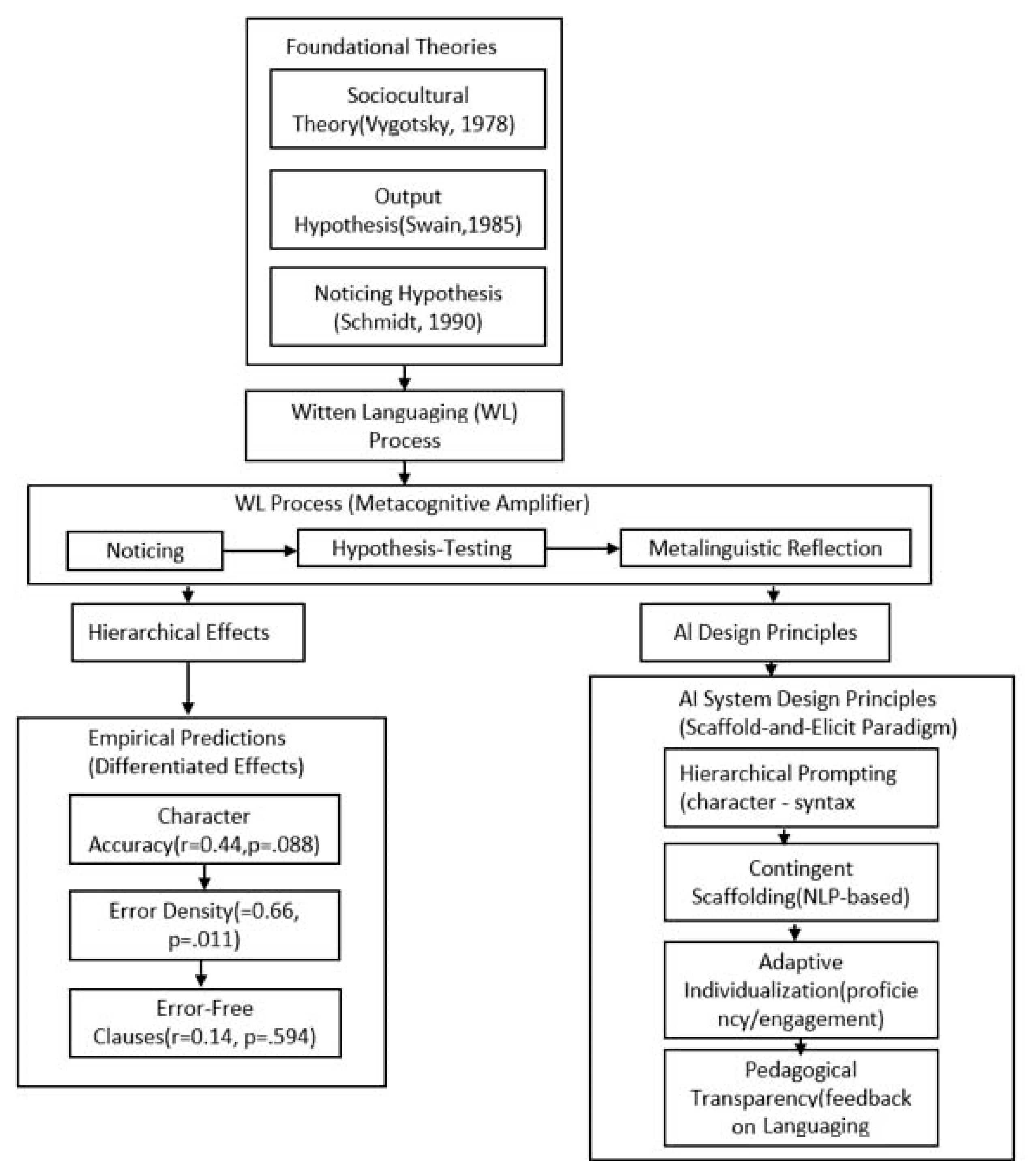
Figure 1 presents the integrated theoretical framework that guides this study. The framework illustrates how three foundational theories Sociocultural Theory, the Output Hypothesis, and the noticing hypothesis converge to specify the cognitive architecture of intelligent L2 feedback processing. At the core of this architecture is the WL process, which transforms initial noticing into sustained metacognitive engagement through hypothesis-testing and metalinguistic reflection. This processing is hypothesized to follow a hierarchical pattern, with benefits first manifesting at local linguistic levels before transferring to higher-level syntactic integration. The framework further specifies two key outputs: (1) empirical predictions regarding the differentiated effects of WL across three accuracy indicators, and (2) design principles for AI-powered feedback systems that aim to scaffold, rather than supplant, the learner’s metacognitive activity. This dual-purpose framework thus bridges cognitive architecture research and AI pedagogy.
4. Methodology
This study employed a within-subjects crossover design to examine the effects of WL with direct feedback on writing accuracy in an authentic beginner CSL classroom in a UK secondary school. The methodological choices were guided by the theoretical framework outlined above, which conceptualizes WL as a metacognitive tool that engages specific cognitive processes noticing, hypothesis-testing, and metalinguistic reflection within the learner’s cognitive architecture. The design was therefore structured to isolate the cognitive effect of WL from other confounding variables, to capture its effects at multiple linguistic levels, and to investigate individual differences in cognitive engagement.
4.1. Research Design
The study used a within-subjects crossover design, in which each participant experienced both experimental conditions in a balanced order: Condition A was “direct feedback + WL”, and Condition B was “direct feedback only” (NOWL). A within-subjects design was chosen over a between-subjects design for two primary reasons, both grounded in the study’s focus on cognitive architecture.
First, control of individual differences. Beginner learners show significant individual differences in language aptitude, orthographic processing ability, working memory capacity, and metacognitive awareness (
Muñoz, 2014;
Skehan, 2015;
Ishikawa & Suzuki, 2023). These cognitive and affective individual differences are central to understanding the architecture of intelligent L2 learning, but they also pose a significant threat to internal validity in small-sample research. Under small-sample conditions, a between-subjects design may confound these individual differences with treatment effects. By using each participant as their own control, the within-subjects design significantly reduces between-subject variability and increases statistical power and internal validity (
Sibbald & Roberts, 1998;
Wellek & Blettner, 2012). This design choice is therefore not merely a practical convenience but a theoretically motivated decision to isolate the cognitive effect of WL from stable learner characteristics.
Second, crossover control of order effects. The crossover arrangement each participant receiving both conditions in a balanced order controls for order effects such as practice effects, fatigue, or task-specific learning that might otherwise confound the results. By counterbalancing the sequence of conditions across two groups, the design ensures that any observed differences between conditions cannot be attributed to the order in which they were administered. This is particularly important in cognitive research, where practice effects can be substantial.
Participants were assigned to one of two sequence groups through stratified randomization based on pre-test writing scores. Students were ranked by their pre-test GCSE writing total score (out of 16) and paired, then randomly assigned within each pair to ensure high- and low-scoring students were evenly distributed across the two groups. Due to the odd sample size, the two sequence groups differed slightly in number: Sequence Group 1 (
n = 7) received A → B, and Sequence Group 2 (
n = 8) received B → A (see
Table 1). Under this crossover design, each participant provided one writing performance data point per condition, resulting in 15 × 2 = 30 observational data points for analysis.
To enhance the clarity of the experimental procedure, the following table provides a visual summary of the study timeline, tasks, and conditions (
Table 2).
4.2. Participants and Research Context
4.2.1. Participants
The initial sample consisted of 18 students enrolled in the GCSE Mandarin Foundation Tier course at a secondary school on the Isle of Wight, UK. All students came from the same intact class, taught by one teacher with five years of Chinese teaching experience. After data completeness screening, three participants were excluded from the final analysis: two produced fewer than 10 Chinese characters across multiple writing tasks (preventing meaningful accuracy analysis), and one had more than 40% missing data due to repeated absences. The final effective sample comprised 15 participants.
The participants’ background characteristics are summarized in
Table 3: 7 males (46.7%) and 8 females (53.3%), aged 14–15 years (M = 14.93, SD = 0.26). All participants were native English speakers, had no Chinese family background, had studied Chinese for 2 years, and were at the GCSE Mandarin Foundation Tier stage. According to the
Chinese Language Proficiency Standards for International Chinese Language Education, their comprehensive proficiency roughly corresponds to Level 1–2 of the elementary stage. In terms of writing ability, participants could complete simple sentences and short texts (approximately 75 characters), but their character writing accuracy, lexical choice appropriateness, and basic syntactic stability remained quite variable.
These participants are characterized by limited working memory capacity for L2 processing, emerging but not yet fully mature metacognitive skills, and a heavy reliance on external scaffolding for error detection and correction (
Muñoz, 2014;
Pfenninger & Singleton, 2017). Their status as “beginner” learners means that their cognitive resources are heavily taxed by basic language production, leaving limited attentional capacity for self-monitoring and error correction a key rationale for the use of direct feedback and the WL scaffold.
4.2.2. Teaching Context
The study was implemented in the participants’ regular classroom environment; all writing tasks and revision activities were embedded in their normal Chinese curriculum. The school’s GCSE Chinese course followed the AQA examination board syllabus, with three 50-min lessons per week, totalling 2.5 h of classroom contact time per week. The curriculum covered listening, speaking, reading, and writing skills, with writing instruction accounting for about 20% of class time. According to a background questionnaire, over 80% of students reported spending less than 30 min per day on Chinese outside class, and nearly half reported almost no exposure to Chinese beyond homework. This input profile reflects the typical characteristics of Chinese teaching in UK secondary schools: limited instructional time, insufficient out-of-class input, and learning heavily reliant on the classroom environment (
Tinsley & Board, 2017;
Collen, 2023).
This context is theoretically significant for studying cognitive architecture. The limited input and instructional time mean that learners have few opportunities for implicit, incidental learning; their development depends heavily on explicit instructional interventions that optimize cognitive processing efficiency. WL, as a metacognitive intervention that deepens processing of limited instructional input, is therefore particularly well-suited to this context. The findings of this study thus have direct relevance for resource-constrained teaching environments where maximizing the cognitive yield of limited instructional time is paramount.
During the study period (March to May 2025), all participants were preparing for the GCSE Mandarin Foundation Tier examination. The school used the textbook
GCSE Chinese (AQA), with teaching focused on examination topics (e.g., personal information, school life, holiday experiences, eating habits). The writing tasks used in this study were selected or adapted from GCSE Chinese writing authentic examination materials (
AQA, 2024), with task structures consistent with students’ regular classroom practice and exam preparation. Each writing task contained four content prompts and required students to write a short text of about 75 Chinese characters within 30 min.
Ethical approval was obtained from the Ethics Review Committee of Northeast Normal University and the school administration. Approval Number: 202602035. Before the study began, researchers provided all participants with detailed information about the research purpose, procedures, data use, and participant rights. All participants signed written informed consent forms, and were informed that participation was entirely voluntary and that they could withdraw at any time. All data were anonymized after collection, with participants identified by alphanumeric codes (S1–S15), and no personally identifiable information was recorded.
4.3. Experimental Conditions
This study compared two experimental conditions, both implemented in the same classroom setting, with feedback provided by the same teacher. The design of these conditions was informed by the theoretical framework: Condition A (WL) operationalizes the full cognitive architecture of noticing → languaging → internalization, while Condition B (NOWL) operationalizes noticing without the extended metacognitive processing.
Condition A: Direct Feedback + WL. Participants received direct feedback from the teacher on their first draft. Direct feedback was operationally defined as the teacher explicitly marking errors in the student’s text and providing the correct linguistic form, including corrections for character writing, word choice, and syntactic structure (
Ferris, 2010). The feedback itself contained no metalinguistic explanation or systematic grammar instruction; its main function was to enable learners to clearly identify language errors and make corrections—thereby triggering the initial
noticing that
R. W. Schmidt (
1990) identified as a prerequisite for acquisition. After receiving feedback, participants were required to complete a WL record sheet, providing written explanations for their revision actions. The record sheet contained three guiding questions: (1) “Why is this language form incorrect/problematic?” (2) “Why did the teacher provide feedback on this form?” (3) “If you cannot explain what the problem is, you may write ‘I don’t know’.” Participants were allowed to respond in their L1 (English) to ensure that Chinese writing ability did not constrain their ability to articulate metalinguistic reasoning. These guiding questions were explicitly designed to activate the three functions of output identified by
Swain and Lapkin (
1995): noticing (question 1), hypothesis-testing (question 2), and metalinguistic reflection (question 3).
Condition B: Direct Feedback Only (NOWL). Participants received the same direct feedback on their first draft from the teacher and were asked to revise the text based on the feedback, but they were not required to complete a WL record sheet or provide any written explanation. This condition serves as a control that isolates the cognitive effect of WL: any difference between conditions can be attributed to the additional metacognitive processing elicited by the WL task, rather than to the feedback itself.
Under both conditions, the scope and manner of teacher feedback were consistent: the teacher provided direct corrections for all identifiable errors (including character, vocabulary, grammar, and word order errors) without selective feedback. Feedback was marked in red ink directly on the students’ written texts, with correct forms written above or beside the errors. All feedback was provided by the same teacher to ensure consistency in feedback style and standards.
4.4. Writing Tasks and Experimental Procedure
The study lasted six weeks, with all activities embedded in the participants’ regular Chinese lessons. Four writing tasks were administered: pre-test, two experimental tasks, and post-test. All tasks were selected or adapted from GCSE Chinese Foundation Tier writing examination materials (
AQA, 2024). Each task required participants to write a short text of about 75 Chinese characters within 30 min, with four content prompts. The topics for each task were: pre-test and post-test “holiday experiences” (same topic); Experimental Task 1 “travel plans in China”; Experimental Task 2 “school life”.
The same-topic pre-test/post-test design was chosen to maximize control over task complexity, content familiarity, and information generation load, ensuring that observed differences reflected changes in linguistic forms rather than task difficulty (
Van Beuningen et al., 2008). This design choice is particularly important for cognitive research, as differences in task difficulty can affect cognitive load and thus confound measures of accuracy. The pre-test and post-test were separated by three weeks, during which students completed different-topic writing tasks and received feedback under different conditions, reducing the likelihood of direct memory of the original text.
The overall procedure was as follows:
Week 1: Researchers explained the research purpose and procedures to participants, obtained informed consent from participants and their guardians, and confirmed through classroom observation and teacher evaluation that participants’ language proficiency met the definition of beginner learners.
Week 2 (Pre-test): Participants completed the pre-test writing task (holiday topic) without any feedback or revision. No corrective feedback or revision requirement was provided at this stage, to avoid the pre-test itself becoming part of the intervention. The pre-test texts were used for: (1) obtaining overall writing scores according to GCSE criteria (for stratified randomization and pre-post comparison); (2) calculating baseline accuracy indicators.
Week 3 (Experimental Task 1): Participants completed the first experimental writing task (China travel topic). After submission, the teacher provided direct feedback on all identifiable errors in each participant’s text during breaks or after class, and returned the marked essays the next day. Sequence Group 1 then completed the WL record sheet and revised accordingly (Condition A), while Sequence Group 2 revised the text without WL (Condition B). The revision phase was limited to 15 min, completed independently in class.
Week 4 (Experimental Task 2): The second experimental writing task (school life topic) was administered, with treatment conditions crossed over. Sequence Group 1 received Condition B (direct feedback only), and Sequence Group 2 received Condition A (direct feedback + WL). All other procedures were the same as Week 3.
Week 5 (Post-test): Participants completed the post-test writing task, using the same topic as the pre-test (holiday experiences). No feedback was provided at this stage, to isolate the pure effect of the intervention.
Week 6 (Semi-structured interviews): Semi-structured interviews were conducted with 5 voluntarily participating participants to explore their perceptions and attitudes towards feedback and WL activities.
4.5. Measurement Indicators
Writing accuracy was operationalized through three complementary indicators. In second language writing research, accuracy is generally understood as the degree of control over target language formal rules and is an important component of the CAF (Complexity-Accuracy-Fluency) framework. However, existing research also points out that writing accuracy is not a unitary construct; different indicators capture different aspects of formal language control (
Liu & Shi, 2025). Given that the participants were beginner UK Chinese learners with relatively short writing texts, and considering the linguistic characteristic of Chinese using characters as the basic writing unit, this study selected the following three indicators from the character, text, and clause levels: character accuracy rate, errors per 100 characters, and proportion of error-free clauses.
These three indicators capture different levels of cognitive control in L2 writing:
Character accuracy rate reflects learners’ control over visuospatial orthographic processing the cognitive ability to retrieve and execute correct stroke sequences, radical configurations, and spatial arrangements. This is the most local level of cognitive control and is predicted to be most sensitive to WL, as character errors are discrete and readily identifiable.
Errors per 100 characters provides a standardized overall error density indicator, capturing the cumulative effect of errors across all linguistic levels. It reflects the learner’s general ability to monitor and regulate the accuracy of their output.
Proportion of error-free clauses is the most stringent indicator, reflecting learners’ ability to simultaneously coordinate multiple linguistic dimensions (orthographic, lexical, syntactic) within a single syntactic unit. This requires more integrated cognitive control and is predicted to be less sensitive to short-term WL interventions, consistent with the hierarchical nature of the cognitive architecture hypothesized above.
Character accuracy rate reflects learners’ orthographic accuracy control at the character level. Any character that deviates from the standard form due to missing strokes, extra strokes, radical errors, radical position reversal, or structural disorder was counted as an erroneous character. Characters that were formally standard, correctly structured, and semantically appropriate to the context were counted as correct characters. Each erroneous character was counted as one independent error instance; when the same error appeared multiple times in the same text, it was counted according to the actual number of occurrences. The formula was: Character accuracy rate = (number of correct characters ÷ total number of characters) × 100%.
Errors per 100 characters provides a standardized overall error density indicator, controlling for the influence of text length differences on error count comparisons (
Chandler, 2003). All identifiable errors including orthographic, lexical, syntactic, and word-order errors were counted across the entire text. The formula was: Errors per 100 characters = (total number of errors ÷ total number of characters) × 100. In second language writing research, the error rate per 100 words (or characters) is considered one of the most commonly used and reliable indicators of linguistic accuracy, particularly suitable for learners with short texts and unstable language structures.
Proportion of error-free clauses reflects learners’ ability to produce clauses that are both syntactically and orthographically correct. Following established procedures (
Wolfe-Quintero et al., 1998;
Polio & Shea, 2014), a clause was defined as a syntactic unit centred on a predicate (verbal or adjectival) expressing a relatively complete event or state (
Zhao, 1968). In clause counting, the principle of “one predicate corresponds to one clause” was followed. For beginner learners’ Chinese written texts, even if the sentence structure was incomplete or contained formal errors, as long as the predicate component could be identified, it was still counted as a valid clause; nominal phrases, temporal phrases, or locative phrases without predicates were not counted as clauses. In judging error-free clauses, a binary principle was adopted: if any identifiable language error appeared in a clause, that clause was judged as “erroneous”; only if the clause contained no identifiable errors was it counted as “error-free.” Very short expressions (e.g., “hello”), expressions lacking a complete syntactic structure or a predicate centre (e.g., “goodbye”), were not included in the total clause count. The formula was: Proportion of error-free clauses = (number of error-free clauses ÷ total number of clauses) × 100%.
Overall writing performance (GCSE score) was used as a supplementary dependent variable. Pre-test and post-test essays were scored according to the AQA GCSE Mandarin Foundation Tier writing assessment criteria (
AQA, 2024). The marking scheme has a total of 16 points, covering two dimensions: Content and Communication (10 points) and Quality of Language and Accuracy (6 points). This assessment tool was chosen because the participants were beginner Chinese learners at the UK secondary level, and their language proficiency, writing task formats, and learning objectives were closely aligned with the GCSE Foundation Tier. Pre-test and post-test essays were independently scored by two raters, with good inter-rater reliability (pre-test r = 0.975,
p < .001; post-test r = 0.962,
p < .001).
4.6. Qualitative Data Sources and Analysis
Qualitative data came from two sources: WL record sheets and semi-structured interviews. These data were essential for investigating the process of cognitive engagement during WL (RQ3) and for understanding how individual differences moderate the effects of WL.
WL record sheets. In Condition A, participants completed WL record sheets containing three guiding questions and blank response areas. Participants were encouraged to “write down your thoughts as detailed as possible, in English, Chinese, or a mix of both.” These records were collected by the researchers after class, transcribed into electronic documents, and analysed as qualitative data. A total of 275 meaning units were collected. From a cognitive research perspective, these texts provide a window into learners’ metacognitive processing their awareness of errors, their reasoning about corrections, and their ability (or inability) to articulate metalinguistic explanations.
Semi-structured interviews. After the intervention, semi-structured interviews were conducted with 5 participants (S1–S5) on a voluntary basis. Interviewees were selected voluntarily, covering different genders and writing proficiency levels. Each interview lasted about 10 min and was conducted face-to-face. The interview guide revolved around three themes: overall perceptions and acceptance of direct feedback and WL activities; self-assessment of the feedback understanding and processing process; subjective evaluation of the role of these activities in writing development. All interviews were audio-recorded with consent and transcribed verbatim, conducted in English. Basic information about the interviewees is shown in
Table 4.
Qualitative data analysis. Qualitative data were analysed using thematic content analysis (
Schreier, 2012;
Graneheim & Lundman, 2004). The analysis proceeded in three phases: first, each WL record was segmented into meaning units—discrete statements expressing a single idea or observation; second, each meaning unit was assigned an initial label using open coding, with coding schemes referencing established categories from error analysis and second language writing research (
Ferris, 2002), and refined iteratively during analysis; third, initial codes were grouped into broader core categories through the constant comparative method (
Glaser & Strauss, 1967). Interview transcripts were analysed using a combined deductive-inductive approach, with the deductive part guided by the theoretical framework (sociocultural theory, output hypothesis, noticing hypothesis) and inductive coding used to capture participants’ spontaneous expressions. This dual approach ensured that the analysis was both theory-informed and grounded in participant voices.
4.7. Data Analysis
Before data analysis, the original writing texts underwent the following pre-processing: text length standardisation for indicators involving error counts, values were converted to relative indicators based on actual text length; error counting using an error-instance counting method, each erroneous character or erroneous form appearing once in the text was counted as one independent error instance; if the same error appeared multiple times in the same text, it was counted according to the actual number of occurrences; error-free clause judgement using a binary principle, any clause containing any identifiable error was judged as “erroneous.”
Quantitative data were analysed using SPSS 26.0. Given the within-subjects design and small sample size (N = 15), the Wilcoxon signed-rank test was selected as the primary inferential statistical method for all paired comparisons. This test was chosen for three reasons: first, the Shapiro–Wilk normality test showed that errors per 100 characters under the NOWL condition significantly deviated from normality (W = 0.586,
p < .001); second, for a sample size of 15, non-parametric tests are more robust to violations of normality; third, using the same non-parametric test across all analyses maintains analytical consistency (
Larson-Hall, 2016;
Plonsky & Oswald, 2014). Effect sizes (r) for all significant comparisons were calculated using the formula r = |Z|/√N, where N is the number of valid paired observations. Following conventions in second language research, r values of 0.10, 0.30, and 0.50 were interpreted as small, medium, and large effects, respectively (
Plonsky & Oswald, 2014).
To ensure objectivity in scoring, pre-test and post-test writing texts were independently scored by two experienced Chinese teachers familiar with GCSE writing standards. Both raters had more than five years of GCSE Chinese teaching experience. All essays were anonymized and randomly mixed during scoring. Inter-rater reliability was assessed using Pearson correlation coefficients: r = 0.975 (
p < .001) for the pre-test and r = 0.962 (
p < .001) for the post-test, indicating good reliability. Based on this, the average of the two raters’ scores was used as the student’s final writing score, as shown in
Table 5.
6. Discussion
This study examined the effects of WL with direct feedback on writing accuracy among beginner CSL learners in a UK secondary school. The quantitative and qualitative findings jointly reveal a core finding: WL can effectively reduce writing error density, but its effect is clearly hierarchical, acting first on local linguistic features and not yet significantly improving overall syntactic error-freeness at the clause level. The following discussion addresses the three research questions in turn, integrating theoretical frameworks and existing literature to interpret this differentiated pattern, and concludes with implications for understanding the cognitive architecture of intelligent L2 learning and for the design of AI-assisted feedback systems.
6.1. Immediate Effects of Written Languaging on Writing Accuracy: A Hierarchical Cognitive Architecture
This finding provides empirical evidence for a core cognitive architecture: WL functions as a metacognitive amplifier that strengthens noticing and hypothesis-testing at local linguistic levels, producing measurable reductions in error density and transferable improvements in overall writing performance yet its effects are hierarchical and moderated by individual differences in cognitive and motivational resources. By ‘cognitive architecture,’ we refer specifically to the functional processing sequence—noticing → hypothesis-testing/metalinguistic reflection → consolidation that we operationalised through our WL task and measured through accuracy indicators. Our data are interpreted as behavioural manifestations of this architecture rather than direct observations of cognitive structures. The quantitative results showed that the errors per 100 characters under the WL condition were significantly lower than under the NOWL condition, with a large effect size (Z = −2.556,
p = .011, r = 0.66), and 86.7% of participants showed a consistent direction of change. This finding aligns with previous studies indicating that WL promotes more successful revision of language errors (
Suzuki, 2012;
Moradian et al., 2017;
Yılmaz, 2016).
First, activation of the output functions. From the perspective of the output hypothesis (
Swain, 1985), the WL task required learners to articulate their reasoning about language forms, thereby activating the noticing/triggering, hypothesis-testing, and metalinguistic functions. When learners explained “why this form is incorrect,” they were compelled to attend to the gap between their own production and the target form a process that
Swain and Lapkin (
1995) considered critical for language development. The significant reduction in errors per 100 characters suggests that this languaging process did facilitate deeper cognitive processing of feedback information. Crucially, the WL texts themselves provide evidence of this activation: learners explicitly identified error types (“I forgot the dot”), proposed corrections (“it should be the character for ‘rise’“), and in some cases articulated the underlying rule (“in this sentence, ‘is’ does not need to be used”). This progression from noticing to hypothesis-testing to metalinguistic reflection from less to more cognitively demanding is precisely the sequence that the output hypothesis predicts.
Second, extension to a typologically distinct target language. Most previous research was conducted with adult learners in EFL settings where target language errors are predominantly morphosyntactic (e.g., tense, agreement). This study provides evidence that WL is also effective for adolescent beginners learning a typologically different language Chinese, with its logographic writing system and associated orthographic processing demands. The qualitative finding that 48.4% of WL units focused on character-level features indicates that WL effectively scaffolds the visuospatial analysis required for Chinese character learning. This extends the languaging construct beyond alphabetic contexts and suggests that WL can serve as a cognitive tool for orthographic as well as grammatical processing. Learners who wrote explanations such as “the character for ‘sea’ should be written as ‘each’, and I forgot the little dot” were engaging in a form of visual analysis that is specific to logographic writing systems—a cognitive process not previously examined in WL research.
Third, evidence of cross-task transfer. Unlike studies that only examined immediate revision on the same text (e.g.,
Suzuki, 2012), the crossover design used in this study involved new writing tasks, demonstrating that the benefits of WL are not limited to immediate revision but transfer to subsequent writing production. This transfer effect is critical for establishing WL as a strategy that promotes durable learning rather than merely task-specific performance. The significant improvement in GCSE scores from pre-test to post-test (Z = −3.342,
p = .001, r = 0.89) provides particularly strong evidence for this transfer, as the post-test was administered two weeks after the last WL activity and with no feedback provided. This suggests that WL strengthened knowledge representations in a way that remained accessible and effective in a different performance context.
Fourth, the hierarchical pattern. The most theoretically significant finding is the differentiated pattern across the three accuracy indicators. The significant effect on errors per 100 characters (a global error density measure that captures errors at all levels) combined with the near-significant trend for character accuracy and the absence of effect for error-free clauses reveals a hierarchy in WL’s effects. This hierarchical pattern suggests that WL’s cognitive benefits first manifest at the level of reducing the frequency of local errors (character and word-level) before extending to the more demanding task of producing completely error-free syntactic units. This is consistent with the idea that L2 writing development proceeds from local to global control a process observed in other domains of skill acquisition (
Sweller, 1988;
DeKeyser, 2020). Character-level and word-level corrections are relatively discrete, self-contained cognitive operations that require attention to a single linguistic unit. In contrast, producing an error-free clause requires the simultaneous coordination of multiple linguistic dimensions orthography, lexis, syntax, and discourse within a single output unit. This is a higher-order integration task that may require more extensive practice and consolidation than a single WL session can provide.
Theoretical rationale for the hierarchical pattern. The hierarchical effect observed in this study significant reduction in errors per 100 characters, near-significant trend for character accuracy, and no effect on clause-level accuracy requires explicit theoretical grounding. We argue that this hierarchy reflects three distinct but interconnected dimensions of cognitive processing in L2 writing.
First, linguistic processing proceeds from local to global. Character-level processing is the most local: it involves the retrieval of orthographic forms and the execution of visuospatial configurations operations that are relatively discrete and self-contained (
J. Yang, 2018;
Chan et al., 2021). Vocabulary-level processing is intermediate: it involves semantic selection, collocational knowledge, and lexical constraints operations that require the integration of form and meaning but remain within the boundaries of individual lexical items (
Jiang, 2013). Clause-level processing is the most global: it requires the simultaneous integration of orthographic, lexical, syntactic, and discourse information into a coherent syntactic unit (
Polio & Shea, 2014). This progression from local to global processing is well-documented in both L2 acquisition research (
Skehan, 2015) and cognitive skill acquisition theory (
Anderson, 1983), which posits that skill development proceeds from declarative knowledge (knowing that) through proceduralisation to automaticity a process that typically begins with lower-level components before higher-level integration becomes fluent (
DeKeyser, 2020).
Second, cognitive load increases with linguistic level. In cognitive load theory, the mental effort required to perform a task depends on the number of interacting elements that must be simultaneously processed in working memory (
Sweller, 1988). Character-level processing involves a limited number of interacting features (radicals, strokes, spatial configuration); vocabulary-level processing involves a moderate number (semantic features, collocational constraints); but clause-level processing involves a large number of interacting elements (orthographic forms, lexical choices, word order, grammatical agreement, and discourse coherence). As a result, clause-level accuracy is the most cognitively demanding outcome to achieve, particularly for beginner learners whose working memory resources are already taxed by basic production demands (
Muñoz, 2014). WL, as implemented in this study, reduced cognitive load at the local level by directing learners’ attention to discrete errors, but it did not, and could not, within a single brief intervention, provide the extensive practice needed to automatise the higher-level integration processes required for error-free clause production.
Third, the observed hierarchy reflects a developmental ordering. The three accuracy indicators are not merely different measures of the same construct; they represent different stages in the developmental progression of L2 writing accuracy (
Jiang, 2013). Character-level accuracy is the foundational level: without reliable character recognition and production, higher-level syntactic processing is severely constrained. Vocabulary-level accuracy is the next layer: lexical choice and collocational knowledge mediate between orthographic forms and syntactic structures. Clause-level accuracy is the highest level: it presupposes reasonably stable control over the lower levels. This developmental ordering predicts that instructional interventions will first affect lower-level outcomes before higher-level outcomes show improvement, a prediction borne out by our data. The hierarchical pattern thus is not an arbitrary ordering but reflects a principled developmental sequence grounded in both linguistic theory and cognitive science.
Fourth, the qualitative data provide convergent evidence for this hierarchy. Learners’ WL texts showed that their spontaneous attentional focus followed the same hierarchy: character-level issues received the most attention (48.4%), vocabulary-level issues received moderate attention (29.8%), and syntactic issues received the least (15.6%). This attentional distribution is not merely a descriptive finding; it provides evidence that learners’ cognitive resources were allocated according to the same local-to-global hierarchy that we theorise. Learners attended most to the levels they could most readily identify and articulate, and least to the levels that required the most abstract metalinguistic knowledge.
In summary, the hierarchical effect is not an artefact or a premature interpretation. It is a theoretically grounded finding that reflects: the local-to-global organisation of linguistic processing, the differential cognitive load imposed by different linguistic levels, the developmental progression of L2 writing accuracy, and the attentional priorities evidenced in learners’ WL texts. The fact that WL’s effects were strongest at the text level (errors per 100 characters, which aggregates local errors), weaker at the character level, and absent at the clause level is precisely what a hierarchical cognitive architecture would predict.
This hierarchical interpretation is strongly supported by the qualitative data. Learners’ WL texts showed a clear attentional hierarchy: character-level issues (48.4%) received the most attention, followed by word-level issues (29.8%), with syntactic issues receiving substantially less (15.6%). This attentional distribution explains why error density which is heavily weighted toward character and word-level errors decreased significantly while clause-level accuracy which depends on syntactic integration did not improve correspondingly. The cognitive resources allocated by learners during WL were predominantly directed toward the local linguistic features that they could most readily identify and articulate. As learners gain more experience with WL, and as their proficiency develops, it is plausible that their attentional focus will gradually shift toward higher-level syntactic features a developmental trajectory that future longitudinal research should investigate. This finding carries a clear implication for AI design: an intelligent system should not be optimized solely for correction accuracy. Rather, it should be designed to elicit and capture such local-level cognitive engagement. For instance, by prompting learners to articulate why they made a specific character error, the system can move learners from passive receipt of correction to active orthographic analysis.
Hierarchical Effects and the Cognitive Architecture of L2 Feedback Processing
The hierarchical pattern observed in this study, local-level improvements (character accuracy, error density) without parallel gains in clause-level accuracy, raises a fundamental question: why does WL’s facilitative effect not transfer immediately to higher-level syntactic outcomes? We argue that the answer lies in the modular structure of the cognitive architecture that underlies L2 writing production.
L2 writing, viewed from a cognitive processing perspective, involves multiple processing modules that operate at different levels of linguistic representation (
Levelt, 1989;
DeKeyser, 2020). The orthographic module handles the retrieval and execution of character forms; the lexical module manages semantic selection and collocational constraints; and the syntactic module organises words into grammatically well-formed and discourse-appropriate structures. Crucially, these modules are hierarchically organised: lower-level modules must achieve a sufficient degree of automaticity before higher-level modules can function efficiently (
Anderson, 1983;
Segalowitz, 2010). This modular perspective predicts that instructional interventions that strengthen lower-level processing—such as WL’s facilitation of character-level noticing and correction, will improve lower-level outcomes relatively quickly, but higher-level syntactic integration will improve only after lower-level processing has become sufficiently automatised to free up working memory resources for syntactic planning and monitoring (
Sweller, 1988).
The hierarchical pattern thus reflects a fundamental property of the cognitive architecture: the processing bottleneck at higher levels. Lower-level operations are relatively independent and can be improved through focused attention on discrete errors; higher-level operations require the coordination of multiple lower-level outputs, making them more resistant to short-term intervention. The fact that WL reduced errors per 100 characters, a measure that aggregates errors across all levels, while not affecting clause-level accuracy suggests that WL successfully strengthened local processing but that the strengthening was not yet sufficient to support consistent error-free syntactic production. This is consistent with the broader literature on L2 development, which shows that grammatical accuracy typically lags behind lexical and orthographic accuracy in the early stages of L2 writing development (
Jiang, 2013).
Importantly, this hierarchical model has direct implications for the design of future interventions, including AI-mediated ones. If WL’s effects are inherently hierarchical, then instructional scaffolding should follow the same developmental sequence: first targeting character and word-level errors, then gradually shifting to syntactic structures as learners’ lower-level processing becomes more automatised. Adaptive AI systems could be designed to monitor learners’ performance across these different linguistic levels and to adjust the focus of languaging prompts accordingly.
6.2. Character Accuracy Rate: Interpreting the Positive Trend
The character accuracy rate approached but did not reach statistical significance (p = .088, r = 0.44). While 73.3% of participants showed improvement in character accuracy under the WL condition, the effect was not as robust as that for error density. Several theoretically relevant factors may explain this pattern.
First, the cumulative nature of character acquisition. Character acquisition is inherently cumulative, requiring repeated exposure and practice over time (
Shen, 2010;
Ke, 1998;
J. Yang, 2018,
2022). Unlike grammatical rules that can be explained and applied relatively quickly, orthographic representations the precise visuospatial configurations of characters require multiple encounters with correct forms in varied contexts to become stable. A single instance of WL per task may not be sufficient to establish robust orthographic representations. The medium effect size (r = 0.44) suggests that the intervention did have a meaningful impact, but statistical power was limited by the small sample (N = 15). With a larger sample, this trend might reach conventional significance levels. Future research with larger samples and extended WL interventions would be needed to determine whether character accuracy is indeed amenable to WL or whether it requires different types of instructional support (e.g., explicit stroke-order training, radical analysis exercises).
Second, the nature of orthographic processing. The WL task required learners to articulate their reasoning about errors in language essentially, a verbal-linguistic activity. However, character learning involves a significant visuospatial component that may not be fully captured by verbal explanation (
Chan et al., 2021). Learners might be able to identify errors and articulate what is wrong (e.g., “I wrote ‘big’ instead of ‘too’ because I forgot the dot”) but still lack the procedural, motor-based knowledge required to execute the correct character form consistently. This suggests that WL may be more effective for conscious, declarative aspects of orthographic knowledge (knowing
that a character is wrong) than for procedural aspects (knowing
how to produce it correctly). The qualitative data support this interpretation: several learners wrote statements such as “I don’t know what the Chinese characters for Beijing are” or “Although I know how to express it in a meaningful way, I haven’t learned how to write it,” revealing a gap between awareness and execution. For AI-assisted learning environments, this finding suggests that intelligent systems should not only prompt languaging about errors but also provide targeted practice on character formation through multimodal scaffolds (e.g., animated stroke-order demonstrations, radical decomposition exercises) that address the procedural dimension of orthographic learning.
Third, the role of practice and consolidation. The near-significant trend at the character level, combined with the significant effect at the error density level, suggests that WL may be more effective at
reducing the frequency of character errors by helping learners notice and correct them than at eliminating them altogether. This is an important distinction. Error density is a global measure that can be improved by correcting some errors while leaving others uncorrected. Character accuracy, by contrast, requires that each individual character be produced correctly a more stringent standard. This pattern is consistent with the broader literature on skill acquisition, which shows that performance improvements typically emerge first in the reduction of errors (accuracy) before reaching complete error-free performance (fluency) (
DeKeyser, 2020;
Anderson, 1983). The findings suggest that WL is a valuable tool for the early stage of error reduction but may need to be supplemented with other interventions (e.g., repeated practice, distributed retrieval, targeted feedback on specific character types) to achieve complete elimination of character errors. For AI designers, this highlights the need for multimodal scaffolding. A system that simply provides a correct character may be insufficient. An intelligent system could integrate WL prompts with animated stroke-order demonstrations or radical decomposition exercises, thereby addressing the procedural dimension of learning that verbal languaging alone may not fully capture.
6.3. Proportion of Error-Free Clauses: Understanding the Absence of Effect
No significant effect was found for the proportion of error-free clauses (p = .594, r = 0.14), contrasting with the significant effect on the lower-level indicators. This absence of effect, while perhaps initially disappointing, is theoretically illuminating. It suggests that the benefits of WL are primarily confined to lower-level linguistic units (characters and individual words) and have not yet transferred to higher-level syntactic units. Understanding why this is the case provides crucial insights into the cognitive architecture of L2 writing and the role of WL within it.
First, cognitive load and resource allocation. Producing an error-free clause requires simultaneous control over multiple linguistic dimensions: orthography, lexical choice, word order, and grammatical structure. For beginner learners, each of these dimensions imposes significant cognitive load. WL, as implemented in this study, directed learners’ attention to individual errors but did not provide systematic training in syntactic coordination. The qualitative data show that only 15.6% of WL units involved syntactic and structural attention, and even when learners perceived sentence-level problems, they often struggled to articulate the specific issue (“The sentence combination is wrong, the two sentences are mixed together”). This suggests that the cognitive demands of clause-level accuracy exceed the processing resources that learners can allocate during a brief WL task. Learners may be able to identify a syntactic problem, but they lack the metalinguistic resources the explicit knowledge of grammatical rules and their interrelationships to fully articulate and resolve it.
Second, the hierarchical nature of language development. This finding aligns with previous research showing that the proportion of error-free clauses is a more stringent indicator and less sensitive to short-term interventions (
Jiang, 2013).
Jiang (
2013) noted that judging error-free units in Chinese writing involves multiple dimensions syntax, vocabulary, and orthography making it a more demanding measure than simple error counts. The differentiated effect pattern in this study suggests that different accuracy indicators capture different aspects of language development at different stages. The benefits of WL may first manifest at lower levels (error reduction at the character and word levels) before gradually transferring to higher-level syntactic control—a process that may require more extended WL practice over multiple writing tasks and across different syntactic structures.
Third, implications for pedagogical sequencing. The hierarchical effect pattern has important pedagogical implications. It suggests that WL interventions should be sequenced developmentally: early WL tasks might focus on character and word-level errors—the types of errors that learners are most able to articulate and correct. As learners’ proficiency and metalinguistic awareness develop, WL tasks can gradually shift toward syntactic issues, prompting learners to explain not just individual corrections but the grammatical relationships among constituents. This developmental sequencing aligns with the broader principle of “scaffolding” (
Wood et al., 1976) providing support that is matched to learners’ current level of competence and gradually withdrawing it as learners become more capable. For AI-assisted learning systems, this implies that feedback prompts should be adaptive: for beginner learners, prompts might focus on character and word-level errors; for more advanced learners, prompts could increasingly target syntactic structures and discourse-level coherence. Such adaptive scaffolding requires intelligent systems that can assess the learner’s current proficiency and adjust the cognitive demand of the languaging task accordingly.
Fourth, reconciling theoretical debates. The hierarchical pattern helps reconcile the long-standing debate between
Truscott (
1996) and
Ferris (
2004,
2010) regarding the value of corrective feedback. Truscott argued that grammar correction is ineffective because learners do not deeply process the feedback; Ferris countered that feedback can be effective when implemented appropriately. The present findings suggest that both perspectives capture part of the truth. Feedback without WL (NOWL) may indeed lead to shallow processing and limited learning, as Truscott feared. However, WL can deepen feedback processing and produce measurable improvements though these improvements are initially confined to lower-level linguistic features. The effects of feedback are not uniformly simultaneous across all levels but proceed in a hierarchical, stepwise manner. This hierarchical model of feedback processing provides a more nuanced theoretical account than either side of the debate alone.
6.4. From Immediate Revision to Cross-Task Transfer: Evidence for Durable Learning
The significant improvement in GCSE writing total scores from pre-test (M = 6.07) to post-test (M = 6.97) (Z = −3.342, p = .001, r = 0.89) indicates that the instructional intervention had a positive impact on overall writing performance, and this impact extended beyond the immediate task context. This finding is particularly compelling for three reasons.
First, the scope of transfer. The post-test used the same topic as the pre-test (“holiday experiences”) but was administered two weeks after the last WL activity, with no feedback provided during the post-test itself. The significant improvement suggests that learners had internalized some of the language forms and strategies that had been processed through WL, enabling them to produce more accurate writing even without immediate feedback. This is evidence not just of task-specific learning but of durable changes in the underlying cognitive representations that support writing performance. This aligns with the finding that WL promotes durable learning rather than merely task-specific performance (
Suzuki, 2012;
Yılmaz, 2016). The consistency of improvement (93.3% of participants showed higher post-test scores) further strengthens this interpretation.
Second, the nature of the GCSE assessment. The GCSE writing assessment criteria are holistic, covering both content and language quality. The significant improvement in GCSE scores indicates that the benefits of WL were sufficiently robust to be detected by a high-stakes, external assessment. This has important implications for practice: it suggests that WL is not merely a laboratory technique but a strategy that can improve performance on the authentic assessments that matter for learners’ educational outcomes. This finding should be of considerable interest to secondary school Chinese teachers seeking evidence-based strategies for improving GCSE writing performance.
Third, theoretical implications for cognitive architecture. The transfer effect suggests that WL contributed to strengthening the neural pathways and knowledge representations that underlie L2 production. By consolidating correct forms and their associated rules through written explanation, WL may have helped learners move from declarative knowledge (knowing that) toward procedural knowledge (knowing how) a shift that is central to the development of automaticity in L2 performance (
Anderson, 1983;
DeKeyser, 2020). The written record created during WL may also have served as an external memory aid that facilitated subsequent retrieval—a function that aligns with sociocultural theory’s emphasis on external mediation of cognitive processes (
Lantolf & Thorne, 2006).
6.5. Learner Perceptions and Individual Differences: The Moderating Role of Cognitive and Affective Resources
The interview results revealed considerable individual variation in learners’ perceptions of WL, consistent with previous research on learner responses to feedback (
S. Chen et al., 2016;
Mahfoodh & Pandian, 2011). These variations provide important insights into the conditions under which WL is most effective and the mechanisms that mediate its effects.
Higher-proficiency learners appeared to benefit more from WL, whereas weaker learners struggled to engage meaningfully with the task. This pattern aligns with
Fukuta et al.’s (
2019) finding that the effects of WL may depend on learners’ proficiency. For learners who could understand the feedback and articulate their reasoning in writing (such as S5: “I write down what the teacher says, so I can be clearer about how to revise”), WL provided an opportunity for deep processing—a form of cognitive engagement that strengthened knowledge representations. In contrast, for learners who could not even understand the feedback itself (such as S2: “I couldn’t even understand the feedback, so I couldn’t do the WL either”), WL became an additional, unproductive burden rather than a supportive scaffold. This suggests that WL is most effective when learners possess the prerequisite linguistic and metalinguistic resources to benefit from it a finding consistent with the broader literature on aptitude-treatment interactions in L2 learning (
Skehan, 2015;
Ishikawa & Suzuki, 2023).
Motivation and engagement also moderated the effects of WL. Several participants expressed concerns about the time and effort required, with comments such as “It wasn’t helpful, it wasted time. I write slowly anyway” (S2). This highlights the importance of considering learners’ available cognitive and motivational resources when designing tasks. For learners with limited attention spans or low writing fluency, a full WL task may exceed their cognitive capacity, leading to superficial responses or disengagement. Conversely, learners who saw the value of WL (“Using both together helps the most”—S4) engaged more deeply and reaped greater benefits. This suggests that motivational interventions such as explaining the rationale for WL, reducing task demands for struggling learners, and providing positive feedback on languaging effort may be as important as the WL task itself.
This suggests that the effectiveness of WL is significantly moderated by learners’ cognitive and motivational resources. This finding is arguably the most critical for the development of personalized AI tutors. The ‘one-size-fits-all’ feedback approach, common in current AWE systems, is clearly suboptimal. An intelligent system must be adaptive. Based on the learner’s performance history and engagement patterns, it could: dynamically adjust the complexity of the languaging prompts; provide contingent feedback on the quality of the learner’s explanation; and offer differentiated support, such as sentence stems for struggling learners or more challenging metalinguistic questions for advanced learners.
6.6. Processing Mechanisms and the Nature of Intelligent L2 Learning
The integration of quantitative and qualitative findings provides a more complete picture of how WL affects writing accuracy and what it reveals about the cognitive architecture of intelligent L2 learning. Importantly, rather than re-stating the three theoretical functions of output, we ground our discussion in the empirical evidence from our qualitative data.
First, noticing amplification is evidenced by learners’ precise identification of orthographic features. Learners did not merely acknowledge errors but pinpointed specific visuospatial details, as exemplified by S8’s statement: “I wrote the character wrong, it should be the character for ‘rise’, not the one with only one mouth on the right”—and another learner’s observation: “the stroke should have been on the left, but it was on the right.” This level of fine-grained attention, extending beyond mere detection to explicit localization of missing radicals or misoriented strokes, demonstrates how WL amplifies and sustains the initial noticing triggered by direct feedback.
Second, hypothesis externalization and testing are observed when learners articulate structural rules and semantic distinctions. For instance, S3 wrote: “High school refers to a middle school, not going to school. Because the meaning of ‘going to school’ is to attend school.” Another learner noted: “It should be ‘I have many English classes’, rather than ‘I have a lot of English classes’.” These explanations go beyond simple replacement of erroneous forms; they reveal learners actively testing hypotheses about lexical collocations, semantic boundaries, and structural patterns, precisely the hypothesis-testing function that
Swain and Lapkin (
1995) theorized, now empirically traced in learners’ own words.
Third, metalinguistic reflection, though the least frequent category (6.2%), emerges when learners connect errors to their cognitive states or prior learning experiences. Examples include: “I wrote too fast, so I missed strokes,” and “I haven’t reviewed the food unit for a long time.” These statements indicate emerging self-regulatory behavior—the ability to monitor one’s own cognitive processes and identify the conditions under which errors occur. However, its low frequency suggests that such reflection does not occur automatically and may require additional scaffolding, particularly for adolescent learners whose metacognitive skills are still developing.
Fourth, the qualitative data also illuminate how individual differences moderate WL effects. Interview responses revealed that higher-proficiency learners found WL beneficial for understanding and remembering corrections (e.g., S5: “I write down what the teacher says, so I can be clearer about how to revise”), whereas lower-proficiency or less motivated learners perceived it as an additional burden (e.g., S2: “It wasn’t helpful, it wasted time”). This variation underscores that WL effectiveness is not uniform but depends on learners’ existing cognitive and motivational resources, a finding with direct implications for adaptive instructional design.
In summary, the evidence from this study indicates that WL, when combined with direct feedback, is an instructional strategy that can effectively promote deeper feedback processing among adolescent beginner CSL learners. Its effects are first evident in the reduction in identifiable local errors and gradually transfer to overall writing performance. However, the hierarchical nature of the effects also reminds us that the journey from “reducing errors” to “stable correctness” still requires longer practice and internalization processes. The cognitive architecture revealed by this study, a hierarchical system in which local error correction precedes higher-level syntactic integration, provides both empirical grounding and theoretical direction for future research and instructional design. Crucially, this cognitive architecture provides a blueprint for creating truly intelligent learning environments. The goal of AI, from this perspective, is not to replace the learner’s cognitive work, but to optimize its distribution—handling the “heavy lifting” of error detection while strategically offloading “meaning-making” back to the learner through adaptive WL prompts. The following section elaborates on the design principles that operationalize this vision.
6.7. Theoretical Implications for the Design of AI-Powered Feedback Systems
The hierarchical cognitive architecture revealed in this study carries potential implications for the design of intelligent writing systems. However, because our study did not implement or evaluate any AI tool, the following principles are theoretical extrapolations from our findings, not empirically validated design rules. They are offered to inform future research and development, not as tested prescriptions.
Current AWE and generative AI tools, while increasingly proficient at error detection, typically operate within a “detect-and-correct” paradigm. Our findings suggest that this paradigm may be cognitively suboptimal: it supplies the correct form but does not systematically engage the learner’s metacognitive architecture, thereby reinforcing the very “shallow processing” that WL is designed to mitigate (
Truscott, 1996;
Ferris, 2004). In contrast, the present findings support a “scaffold-and-elicit” paradigm, wherein AI systems could be engineered to optimize the distribution of cognitive labor between machine intelligence and human cognition. Specifically, the AI might handle the “heavy lifting” of pattern recognition and error detection, while strategically offloading the “meaning-making” work back to the learner through adaptive WL prompts. This paradigm translates into four empirically grounded design principles:
Hierarchical Prompting. The hierarchical pattern observed in our quantitative and qualitative findings, significant effects at the error density level, near-significant trends at the character level, and no effects at the clause level, provides empirical grounding for a developmental approach to WL prompting. This hierarchy reflects the differential cognitive demands of linguistic levels and the local-to-global organisation of L2 processing. The qualitative finding that 48.4% of learners’ attentional focus was on character-level features, and only 15.6% on syntax, indicates that WL prompts must be developmentally calibrated. For beginner learners, AI systems could initially target character and word-level errors (e.g., “What stroke or radical is missing?”), gradually escalating to syntactic prompts (e.g., “Can you explain the word order in this clause?”) as the learner’s proficiency and WL quality improve. One-size-fits-all prompts risk either overwhelming or under-challenging the learner.
Contingent Scaffolding via NLP. The near-significant trend for character accuracy (
p = .088, r = 0.44) and the significant effect on error density (
p = .011, r = 0.66) suggest that WL effectiveness depends on the
depth of the explanation. An intelligent system equipped with NLP capabilities could assess the linguistic complexity and accuracy of the learner’s WL in real time (
D. Yan & Zhang, 2024). If a learner produces a superficial explanation (e.g., “I got it wrong”), the system might issue a contingent follow-up prompt (e.g., “Can you identify
which part of the character is incorrect and
why?”). If the languaging is accurate and deep, the system could move to a more challenging syntactic prompt.
Adaptive Individualization. The interview data revealed that higher-proficiency learners found WL beneficial, while lower-proficiency learners perceived it as burdensome. This indicates that AI systems must be adaptive, differentiating prompt difficulty and task load based on the learner’s performance history and engagement patterns. For struggling learners, systems might provide sentence stems or reduced error foci (e.g., focusing only on two character errors), gradually increasing demands as self-efficacy and competence grow (
Deci & Ryan, 2000). This personalization is beyond the reach of fixed-prompt designs.
Pedagogical Transparency. Learners’ mixed perceptions of WL (S2: “wasted time”; S5: “helps me remember”) suggest that AI systems could not merely require languaging but also provide metacognitive feedback on the quality of the languaging itself (e.g., “Your explanation is clear, this will help you remember this character”). This pedagogical transparency transforms the AI from a black-box corrector into a transparent cognitive partner.
These four principles, derived directly from the hierarchical effects and individual-difference patterns observed in this study, offer a theoretically grounded alternative to the current generation of AI writing tools. Future AI research should move beyond evaluating systems solely on correction accuracy and begin evaluating them on their capacity to foster sustained metacognitive engagement, a metric that aligns with the long-term goals of intelligent L2 development. In essence, the intelligent language learner is not defined by passive reception of correct forms, but by the active, self-regulated engagement with feedback, a capacity that our findings operationalize through the hierarchical architecture of WL. This architecture reveals that intelligence in L2 learning is not a fixed trait but a dynamic process of metacognitive regulation, which can be effectively scaffolded. For AI design, this implies a fundamental paradigm shift: from systems that replace cognitive labor (by providing answers) to systems that redistribute cognitive labor (by eliciting and amplifying the learner’s own reasoning). The four principles derived from our data, Hierarchical Prompting, Contingent Scaffolding, Adaptive Individualization, and Pedagogical Transparency, provide empirically grounded heuristics for building AI writing assistants that serve as genuine cognitive partners, capable of fostering the very metacognitive skills that underpin long-term, durable language development. Future experimental studies are needed to test whether such adaptive prompting actually enhances learning in AI-mediated environments.
7. Conclusions
This study contributes to the conceptualisation of the intelligent language learner by empirically investigating a core cognitive architecture—specifically, the noticing → languaging → internalisation processing sequence—operationalised through a WL task and measured through writing accuracy and transfer outcomes. While our behavioural data provide evidence for the operation of this architecture, we recognise that cognitive processes are inferred from, rather than directly observable in, these measures. We demonstrate that intelligence in L2 learning is not merely a trait or a fixed aptitude, but a capacity for self-regulated engagement with feedback a capacity that can be effectively scaffolded through WL. The resulting hierarchical model of feedback processing provides a theoretical contribution to SLA and offers empirically grounded insights that can inform the future development of adaptive AI-powered writing assistants. However, these implications are derived from a human-feedback study and should be tested in AI-mediated learning contexts before being translated into practice. By moving beyond the paradigm of error correction and embracing the paradigm of cognitive scaffolding, intelligent systems can be designed to cultivate the very metacognitive skills that underpin long-term, durable language development. In an era where AI tools are increasingly capable of providing correct answers, the distinctive value of human and human-centered AI learning lies precisely in the cultivation of learners’ capacity to reason about, reflect on, and self-regulate their own learning processes.
First, the effect of WL on writing accuracy is clearly hierarchical. Adding WL to direct feedback significantly reduced errors per 100 characters (Z = −2.556, p = .011, r = 0.66), with 86.7% of participants showing consistent improvement. However, the character accuracy rate showed only a positive trend without reaching significance (p = .088), and the proportion of error-free clauses showed no significant change (p = 0.594). This pattern indicates that the effect of WL is first manifested in the reduction of error density per unit of text, without simultaneously improving higher-level overall syntactic error-freeness. The qualitative data explain this hierarchy: learners’ attention during WL was predominantly focused on character-level (48.4%) and word-level (29.8%) issues, with limited syntactic attention (15.6%). This attentional distribution mirrors the quantitative hierarchy and provides a cognitive explanation for the differentiated effects.
Second, the benefits of WL transferred to subsequent writing performance. GCSE writing total scores improved significantly from pre-test to post-test (Z = −3.342, p = .001, r = 0.89), with 93.3% of participants scoring higher on the post-test. This suggests that some of the language knowledge processed through WL had been partially transformed from immediate revision into retrievable language resources, which continued to exert an inhibitory effect on errors when learners faced new writing tasks. This transfer effect is evidence that WL promotes durable, generalizable learning rather than mere task-specific performance.
Third, individual differences moderate the effects of WL. The interview results revealed that higher-proficiency learners tended to benefit more from WL, finding it helpful for understanding and remembering corrections. In contrast, lower-proficiency or less motivated learners viewed WL as an additional burden, struggling to engage meaningfully with the task. This suggests that the effectiveness of WL is not automatic but is significantly moderated by learners’ cognitive resources, proficiency, and motivation—a finding with important implications for both classroom practice and the design of AI-mediated learning environments.
Finally, WL functions as a metacognitive amplifier within the learner’s cognitive architecture. By deepening attention to errors, externalizing hypothesis-testing, and prompting metalinguistic reflection, WL enhances the cognitive processing of feedback beyond what is achieved by direct feedback alone. The hierarchical pattern of effects reveals that WL’s cognitive benefits first strengthen local, lower-level linguistic control before extending to higher-level syntactic integration. This hierarchical model provides a more nuanced understanding of how feedback processing unfolds in L2 writing and offers theoretical grounding for the development of adaptive, intelligence-informed instructional interventions.
This study has clearly identified the key components within the cognitive framework of intelligent second language learning, namely, the ability to transform feedback into learning through metacognitive language use. The findings demonstrate that “intelligence” in L2 learning is not merely about having high aptitude or using sophisticated strategies; it is fundamentally about the capacity for self-regulated, metacognitive engagement with linguistic input and feedback the very capacity that WL operationalizes. This study provides empirical evidence that such metacognitive capacity can be scaffolded through a simple, low-cost instructional intervention, with measurable effects on writing accuracy that transfer to subsequent performance. The study also identifies the boundaries of this scaffolding: WL is most effective at local levels of control and is moderated by individual differences, suggesting that future interventions whether human or AI-mediated must be adaptive to learners’ current cognitive states and developmental trajectories. Critically, the hierarchical nature of WL effects and the moderating role of individual differences identified in this study offer specific design parameters for AI systems. An intelligent writing assistant should not treat all learners identically; rather, it should assess learners’ proficiency and motivational states to determine the appropriate level of scaffolding; adapt WL prompts to target the linguistic levels (character, word, or syntax) that are most developmentally appropriate for the learner; and provide real-time, contingent feedback on the quality of learners’ languaging to deepen their metacognitive processing. These design principles, grounded in empirical evidence of the cognitive architecture of intelligent L2 learning, chart a path toward AI systems that are not merely intelligent in their outputs but genuinely intelligent in their capacity to foster human intelligence.
8. Limitations and Future Directions
This study has several limitations that suggest avenues for future research, particularly in the context of understanding intelligent L2 learning and the design of AI-assisted instructional systems.
First, AI integration and intelligent languaging scaffolds. Most importantly, this study did not involve any AI system; all feedback was provided by a human teacher. Therefore, our discussion of AI implications is speculative and theory-driven, not empirically grounded in AI-mediated interactions. We explicitly frame these discussions as future directions rather than as empirical contributions of the present work. This study was not an AI-intervention but provides the cognitive-psychological foundation for designing intelligent feedback systems. Future experimental studies could employ a three-arm comparison to empirically validate these principles: traditional AWE (corrections only), AWE + fixed WL prompts (standardized prompts across all learners), and AWE + adaptive WL (where prompt complexity and focus are dynamically adjusted to the learner’s proficiency, prior performance, and real-time languaging quality analyzed via NLP). This design would not only test the “scaffold-and-elicit” paradigm against the “detect-and-correct” paradigm but also provide crucial insights into the added value of adaptivity over fixed scaffolds. Recent advances in large language models (LLMs) make it increasingly feasible to generate contingent, contextually appropriate follow-up prompts, and to assess the depth of learners’ metalinguistic reasoning in real time (
D. Yan & Zhang, 2024;
Kohnke et al., 2023), enabling dynamic, personalized scaffolding that moves beyond one-size-fits-all feedback. Such research would directly translate the cognitive architecture identified in this study into an operational AI system, providing both theoretical insights into human–AI interaction and practical tools for the classroom. Furthermore, the absence of a no-intervention control group limits our ability to attribute pre-to-post improvements solely to the instructional intervention, as we cannot completely rule out the influence of maturation or practice effects over the study period. While the crossover design controls for individual differences and the two experimental conditions are equated for time on task, future research should include a no-feedback control group to more rigorously isolate the effects of WL from other temporal factors.
Second, sample size and generalizability. The small sample (N = 15) from a single UK secondary school limits statistical power and generalizability. The near-significant trend for character accuracy (p = .088, r = 0.44) may have reached significance with a larger sample. Future research should recruit larger, more diverse samples from multiple schools and L1 backgrounds to test the cross-context stability of the hierarchical effect pattern. Larger samples would also enable more sophisticated analyses of how individual differences (aptitude, working memory, motivation) moderate WL effects a crucial direction for understanding the cognitive architecture of intelligent L2 learning. Cross-linguistic comparisons (e.g., alphabetic vs. logographic target languages) would further illuminate whether the hierarchical pattern is specific to CSL or generalizes across writing systems.
Third, intervention duration and long-term effects. The short intervention (two WL sessions over two weeks) could not capture the cumulative developmental trajectory of WL effects, particularly at the syntactic level. The hierarchical pattern suggests that syntactic improvements may require extended practice across multiple writing tasks. Future longitudinal studies spanning a semester or academic year, with delayed post-tests at multiple intervals, are needed to assess whether WL’s effects consolidate over time and whether the observed hierarchy (local errors → global accuracy → syntactic control) represents a genuine developmental progression. Such research would also reveal the optimal frequency and intensity of WL interventions for durable learning.
Fourth, task authenticity and modality. The writing tasks were examination-oriented (GCSE materials), limiting generalizability to more open, communicative writing contexts. Additionally, the pen-and-paper WL format, while effective, may not be the most efficient or scalable modality. Future research should examine WL across diverse writing genres (narrative, expository, collaborative) and explore digital formats typed responses, voice-to-text languaging, or multimodal annotations. Digital WL offers advantages for automated collection, analysis, and adaptive scaffolding, and comparative studies of languaging modalities would inform both classroom practice and AI system design.
Fifth, learner engagement and individual differences. The finding that proficiency and motivation moderate WL effects highlight the need for research on enhancing engagement. Could brief training on WL strategies, gamification, or reducing cognitive demands (e.g., sentence stems, limiting error focus) increase participation, particularly for struggling learners? Research in educational psychology suggests that engagement can be enhanced through instructional design (
Deci & Ryan, 2000) a principle applicable to WL. For AI systems, this implies adaptive prompting that matches task demands to learners’ current cognitive resources, ensuring that WL remains a scaffold rather than a burden.
Sixth, process-tracing and neurocognitive methods. The qualitative data (WL texts and interviews) provide indirect evidence of cognitive processes. Future research should employ think-aloud protocols, eye-tracking, or EEG to capture real-time cognitive activity during WL. Such process-tracing data would provide a more direct window into the cognitive architecture of WL how attention is allocated, how hypothesis-testing unfolds, and how metalinguistic reflection emerges over time. This would not only strengthen theoretical understanding but also inform the design of AI systems that can detect and respond to learners’ cognitive states in real time.
In summary, while this study provides robust evidence for WL as a metacognitive tool that enhances feedback processing in beginner CSL writing, these limitations point to clear directions for future research. Addressing them through larger samples, longitudinal designs, diverse tasks and modalities, AI integration, engagement interventions, and process-tracing methods will deepen our understanding of the cognitive architecture of intelligent L2 learning and enable the development of more effective, adaptive instructional systems.