Emotional Responses to AI-Powered Personalised Advertising: The Role of Perceived Empathy and Social Cognition in Consumer Decision-Making

 ,
,  and
and
Abstract
1. Introduction
2. Theoretical Background and Hypothesis Development
2.1. AI-Powered Personalised Advertising: Conceptual Definition and Theoretical Framework
2.2. Trust in AI: From Personalisation to Perceived Empathy
2.3. Perceived AI Empathy
2.4. Emotional Arousal
2.5. Cognitive Elaboration
2.6. Consumer Engagement
2.7. Consumer Engagement and Purchase Intention
2.8. Social Cognition as a Moderating Mechanism
2.9. Conceptual Model Summary
3. Research Methodology
3.1. Research Design and Philosophical Positioning
3.2. Sampling Strategy and Data Collection Procedure
3.3. Survey Instrument and Operationalization of Constructs
3.4. Analytical Strategy: Justification and Implementation of WarpPLS-SEM
4. Results
4.1. Common Method Bias Assessment
4.2. Measurement Model Assessment
4.3. Structural Model Results and Hypothesis Testing
4.4. Interpretation of Path Coefficients
4.5. Mediation Analysis
4.6. Explanatory Power and Predictive Relevance
5. Discussion
5.1. Theoretical Contributions
5.2. Practical Implications
5.3. Limitations
6. Conclusions
Author Contributions
Funding
Institutional Review Board Statement
Informed Consent Statement
Data Availability Statement
Conflicts of Interest
References
- Acatrinei, C., Apostol, I. G., Barbu, L. N., Chivu, R. G., & Orzan, M. C. (2025). Artificial intelligence in digital marketing: Enhancing consumer engagement and supporting sustainable behavior through social and mobile networks. Sustainability, 17, 6638. [Google Scholar] [CrossRef]
- Adolphs, R. (2009). The social brain: Neural basis of social knowledge. Annual Review of Psychology, 60, 693–716. [Google Scholar] [CrossRef] [PubMed]
- Aguirre, E., Mahr, D., Grewal, D., de Ruyter, K., & Wetzels, M. (2015). Unraveling the personalization paradox: The effect of information collection and trust-building strategies on online advertisement effectiveness. Journal of Retailing, 91, 34–49. [Google Scholar] [CrossRef]
- Aiken, L. S., & West, S. G. (1991). Multiple regression: Testing and interpreting interactions. Sage. [Google Scholar]
- Ajzen, I. (1991). The theory of planned behavior. Organizational Behavior and Human Decision Processes, 50, 179–211. [Google Scholar] [CrossRef]
- Anderson, J. C., & Gerbing, D. W. (1988). Structural equation modeling in practice: A review and recommended two-step approach. Psychological Bulletin, 103, 411–423. [Google Scholar] [CrossRef]
- Araujo, T., Helberger, N., Kruikemeier, S., & de Vreese, C. H. (2020). In AI we trust? Perceptions about automated decision-making by artificial intelligence. AI & Society, 35, 611–623. [Google Scholar]
- Barclay, D., Higgins, C., & Thompson, R. (1995). The partial least squares (PLS) approach to causal modeling: Personal computer adoption and use as an illustration. Technology Studies, 2, 285–309. [Google Scholar]
- Baron-Cohen, S., Wheelwright, S., Hill, J., Raste, Y., & Plumb, I. (2001). The ‘reading the mind in the eyes’ test revised version. Journal of Child Psychology and Psychiatry, 42, 241–251. [Google Scholar] [CrossRef]
- Bleier, A., & Eisenbeiss, M. (2015). The importance of trust for personalized online advertising. Journal of Retailing, 91, 390–409. [Google Scholar] [CrossRef]
- Bowden, J. L. H. (2009). The process of customer engagement: A conceptual framework. Journal of Marketing Theory and Practice, 17, 63–74. [Google Scholar] [CrossRef]
- Brodie, R. J., Hollebeek, L. D., Jurić, B., & Ilić, A. (2011). Customer engagement: Conceptual domain, fundamental propositions, and implications for research. Journal of Service Research, 14, 252–271. [Google Scholar] [CrossRef]
- Bryman, A. (2016). Social research methods (5th ed.). Oxford University Press. [Google Scholar]
- Bucea-Manea-Tonis, R., Martins, O. M., Orzan, M. C., Goldbach, D., & Popa, M. (2026). AI-enhanced neuromarketing and social media communication: Evidence from PLS-SEM analysis in an academic context. International Journal of Engineering Business Management, 18, 18479790261420680. [Google Scholar] [CrossRef]
- Cacioppo, J. T., & Petty, R. E. (1986). The elaboration likelihood model of persuasion. Advances in Experimental Social Psychology, 19, 123–205. [Google Scholar]
- Choi, H., Mela, C. F., Balseiro, S. R., & Leary, A. (2020). Online display advertising markets: A literature review and future directions. Information Systems Research, 31, 556–575. [Google Scholar] [CrossRef]
- Choudhury, A., & Shamszare, H. (2023). Investigating the impact of user trust on the adoption and use of ChatGPT. Journal of Medical Internet Research, 25, e47184. [Google Scholar] [CrossRef] [PubMed]
- Cohen, J. (1988). Statistical power analysis for the behavioral sciences (2nd ed.). Lawrence Erlbaum. [Google Scholar]
- Crolic, C., Thomaz, F., Hadi, R., & Stephen, A. T. (2022). Blame the bot: Anthropomorphism and anger in customer-chatbot interactions. Journal of Marketing, 86, 132–148. [Google Scholar] [CrossRef]
- Davenport, T., Guha, A., Grewal, D., & Bressgott, T. (2020). How artificial intelligence will change the future of marketing. Journal of the Academy of Marketing Science, 48, 24–42. [Google Scholar] [CrossRef]
- Davis, F. D. (1989). Perceived usefulness, perceived ease of use, and user acceptance of information technology. MIS Quarterly, 13, 319–340. [Google Scholar] [CrossRef]
- Davis, M. H. (1983). Measuring individual differences in empathy: Evidence for a multidimensional approach. Journal of Personality and Social Psychology, 44, 113–126. [Google Scholar] [CrossRef]
- Dawes, J. (2008). Do data characteristics change according to the number of scale points used? International Journal of Market Research, 50, 61–77. [Google Scholar] [CrossRef]
- Decety, J., & Jackson, P. L. (2004). The functional architecture of human empathy. Behavioral and Cognitive Neuroscience Reviews, 3, 71–100. [Google Scholar] [CrossRef] [PubMed]
- Dens, N., & De Pelsmacker, P. (2010). Advertising for extensions. Marketing Letters, 21, 187–199. [Google Scholar] [CrossRef]
- Dodds, W. B., Monroe, K. B., & Grewal, D. (1991). Effects of price, brand, and store information on buyers’ product evaluations. Journal of Marketing Research, 28, 307–319. [Google Scholar]
- Epley, N., Waytz, A., & Cacioppo, J. T. (2007). On seeing the human: A three-factor theory of anthropomorphism. Psychological Review, 114, 864–886. [Google Scholar] [CrossRef]
- Eurostat. (2023). Digital economy and society statistics—Households and individuals. Eurostat. Available online: https://ec.europa.eu/eurostat/statistics-explained/index.php/Digital_economy_and_society_statistics_-_households_and_individuals (accessed on 21 May 2025).
- Fishbein, M., & Ajzen, I. (1975). Belief, attitude, intention and behavior. Addison-Wesley. [Google Scholar]
- Fiske, S. T., & Taylor, S. E. (2017). Social cognition: From brains to culture (3rd ed.). Sage. [Google Scholar]
- Flavián, C., Csaló, L. V., & Guinalíu, M. (2021). Understanding consumer interaction on a social product-sharing website. Journal of Business Research, 132, 590–600. [Google Scholar]
- Flavián, C., Pérez-Rueda, A., Belanche, D., & Csaló, L. V. (2022). Intention to use analytical artificial intelligence (AI) in services. Journal of Service Management, 33, 293–320. [Google Scholar] [CrossRef]
- Fogg, B. J. (2003). Persuasive technology: Using computers to change what we think and do. Morgan Kaufmann. [Google Scholar]
- Fornell, C., & Larcker, D. F. (1981). Evaluating structural equation models with unobservable variables and measurement error. Journal of Marketing Research, 18, 39–50. [Google Scholar] [CrossRef]
- Frith, U., & Frith, C. D. (2003). Development and neurophysiology of mentalizing. Philosophical Transactions of the Royal Society of London B: Biological Sciences, 358, 459–473. [Google Scholar] [CrossRef]
- Gambino, A., Fox, J., & Ratan, R. A. (2020). Building a stronger CASA: Extending the computers are social actors paradigm. Human-Machine Communication, 1, 71–86. [Google Scholar] [CrossRef]
- Glikson, E., & Woolley, A. W. (2020). Human trust in artificial intelligence: Review of empirical research. Academy of Management Annals, 14, 627–660. [Google Scholar] [CrossRef]
- Go, E., & Sundar, S. S. (2019). Humanizing chatbots: The effects of visual, identity and conversational cues on humanness perceptions. Computers in Human Behavior, 97, 304–316. [Google Scholar] [CrossRef]
- Haenlein, M., & Kaplan, A. (2019). A brief history of artificial intelligence: On the past, present, and future of artificial intelligence. California Management Review, 61, 5–14. [Google Scholar] [CrossRef]
- Hair, J. F., Henseler, J., Dijkstra, T. K., & Sarstedt, M. (2014a). Common beliefs and reality about partial least squares: Comments on Rönkkö and Evermann. Organizational Research Methods, 17, 182–209. [Google Scholar]
- Hair, J. F., Risher, J. J., Sarstedt, M., & Ringle, C. M. (2019). When to use and how to report the results of PLS-SEM. European Business Review, 31, 2–24. [Google Scholar] [CrossRef]
- Hair, J. F., Sarstedt, M., Hopkins, L., & Kuppelwieser, V. G. (2014b). Partial least squares structural equation modeling (PLS-SEM): An emerging tool in business research. European Business Review, 26, 106–121. [Google Scholar] [CrossRef]
- Harman, H. H. (1976). Modern factor analysis (3rd ed.). University of Chicago Press. [Google Scholar]
- Hatfield, E., Cacioppo, J. T., & Rapson, R. L. (1993). Emotional contagion. Current Directions in Psychological Science, 2, 96–99. [Google Scholar] [CrossRef]
- Heerink, M., Kröse, B., Evers, V., & Wielinga, B. (2010). Assessing acceptance of assistive social agent technology by older adults. Journal of Physical Therapy Science, 22, 225–232. [Google Scholar]
- Henseler, J., Ringle, C. M., & Sarstedt, M. (2015). A new criterion for assessing discriminant validity in variance-based structural equation modeling. Journal of the Academy of Marketing Science, 43, 115–135. [Google Scholar] [CrossRef]
- Hernandez-Ortega, B. (2018). Don’t believe strangers: Online consumer reviews and the role of social presence. Journal of Retailing and Consumer Services, 45, 191–200. [Google Scholar]
- Holbrook, M. B., & Batra, R. (1987). Assessing the role of emotions as mediators of consumer responses to advertising. Journal of Consumer Research, 14, 404–420. [Google Scholar] [CrossRef] [PubMed]
- Hollebeek, L. D., Glynn, M. S., & Brodie, R. J. (2014). Consumer brand engagement in social media. Journal of Interactive Marketing, 28, 149–165. [Google Scholar] [CrossRef]
- Huang, M. H. (2004). Romantic love and sex: Their relationship and impacts on ad attitudes. Psychology & Marketing, 21, 53–73. [Google Scholar]
- Jacoby, J. (2002). Stimulus-organism-response reconsidered: An evolutionary step in modeling (consumer) behavior. Journal of Consumer Psychology, 12, 51–57. [Google Scholar] [CrossRef]
- Jiang, Y., Zhu, Z., Chan, K. W., & Zhao, X. (2019). Challenge or support? How team empowerment affects creativity and OCB. Asia Pacific Journal of Management, 36, 1115–1139. [Google Scholar]
- Johanson, C., Wang, Y., & Zhu, R. (2023). Can algorithms feel your pain? Journal of Computer-Mediated Communication, 28, zmad006. [Google Scholar]
- Katz, E., Blumler, J. G., & Gurevitch, M. (1973). Uses and gratifications research. Public Opinion Quarterly, 37, 509–523. [Google Scholar] [CrossRef]
- Kim, D. J., Ferrin, D. L., & Rao, H. R. (2008). A trust-based consumer decision-making model in electronic commerce. Decision Support Systems, 44, 544–564. [Google Scholar] [CrossRef]
- Kim, J., & Forsythe, S. (2008). Adoption of virtual try-on technology for online apparel shopping. Journal of Interactive Marketing, 22, 45–59. [Google Scholar] [CrossRef]
- Kock, N. (2022). WarpPLS user manual: Version 8.0. ScriptWarp Systems. Available online: https://www.scriptwarp.com/warppls/ (accessed on 21 May 2025).
- Komiak, S. Y. X., & Benbasat, I. (2006). The effects of personalization and familiarity on trust and adoption of recommendation agents. MIS Quarterly, 30, 941–960. [Google Scholar] [CrossRef]
- Kumar, V., Aksoy, L., Donkers, B., Venkatesan, R., Wiesel, T., & Tillmanns, S. (2010). Undervalued or overvalued customers: Capturing total customer engagement value. Journal of Service Research, 13, 297–310. [Google Scholar] [CrossRef]
- Lazarus, R. S. (1991). Emotion and adaptation. Oxford University Press. [Google Scholar]
- Lee, J. D., & See, K. A. (2004). Trust in automation: Designing for appropriate reliance. Human Factors, 46, 50–80. [Google Scholar] [CrossRef]
- Letheren, K., Mulcahy, R., & Russell-Bennett, R. (2024). Feeling the love (or not): Consumer responses to AI-driven personalization. Journal of Marketing Management, 40, 112–138. [Google Scholar]
- Liang, H., Saraf, N., Hu, Q., & Xue, Y. (2007). Assimilation of enterprise systems: The effect of institutional pressures and the mediating role of top management. MIS Quarterly, 31, 59–87. [Google Scholar] [CrossRef]
- Luhmann, N. (1979). Trust and power. Wiley. [Google Scholar]
- MacInnis, D. J., & Jaworski, B. J. (1989). Information processing from advertisements: Toward an integrative framework. Journal of Marketing, 53, 1–23. [Google Scholar] [CrossRef]
- Mackenzie, S. B., Lutz, R. J., & Belch, G. E. (1986). The role of attitude toward the ad as a mediator of advertising effectiveness. Journal of Marketing Research, 23, 130–143. [Google Scholar] [CrossRef]
- Matz, S. C., Nave, G., Hillis, A., Bhattacharya, S., & Goldenberg, A. (2024). Psychological targeting in the digital age: From prediction to social influence. Current Opinion in Psychology, 55, 101726. [Google Scholar]
- McKnight, D. H., Choudhury, V., & Kacmar, C. (2002). The impact of initial consumer trust on intentions to transact with a web site: A trust building model. Journal of Strategic Information Systems, 11, 297–323. [Google Scholar] [CrossRef]
- Mehrabian, A. (1996). Pleasure-arousal-dominance: A general framework for describing and measuring individual differences in temperament. Current Psychology, 14, 261–292. [Google Scholar] [CrossRef]
- Mehrabian, A., & Russell, J. A. (1974). An approach to environmental psychology. MIT Press. [Google Scholar]
- Miller, G. A. (1956). The magical number seven, plus or minus two. Psychological Review, 63, 81–97. [Google Scholar] [CrossRef]
- Mitchell, A. A., & Olson, J. C. (1981). Are product attribute beliefs the only mediator of advertising effects on brand attitude? Journal of Marketing Research, 18, 318–332. [Google Scholar] [CrossRef]
- Nass, C., Steuer, J., & Tauber, E. R. (1994). Computers are social actors. In Proceedings of the SIGCHI Conference on Human Factors in Computing Systems (pp. 72–78). ACM. [Google Scholar]
- National Institute of Statistics Romania. (2022). Population census results. INS. Available online: https://insse.ro/cms/en/content/population-and-housing-census-2021-provisional-results (accessed on 21 May 2025).
- National Institute of Statistics Romania. (2023). Household ICT access and usage survey. INS. Available online: https://insse.ro/cms/en/content/quality-reports (accessed on 21 May 2025).
- Orzan, G., Iconaru, C., Popescu, I. C., Orzan, M., & Macovei, O. I. (2014). PLS-based SEM analysis of apparel online buying behavior: The importance of eWOM. Industria Textila, 64, 362–367. [Google Scholar]
- Pansari, A., & Kumar, V. (2017). Customer engagement: The construct, antecedents, and consequences. Journal of the Academy of Marketing Science, 45, 294–311. [Google Scholar] [CrossRef]
- Pavlou, P. A. (2003). Consumer acceptance of electronic commerce. International Journal of Electronic Commerce, 7, 101–134. [Google Scholar] [CrossRef]
- Pentina, I., Hancock, T., & Xie, T. (2023). Exploring relationship development with social chatbots. Computers in Human Behavior, 140, 107600. [Google Scholar] [CrossRef]
- Petty, R. E., & Cacioppo, J. T. (1986). Communication and persuasion: Central and peripheral routes to attitude change. Springer. [Google Scholar]
- Picard, R. W. (1997). Affective computing. MIT Press. [Google Scholar]
- Podsakoff, P. M., MacKenzie, S. B., Lee, J. Y., & Podsakoff, N. P. (2003). Common method biases in behavioral research: A critical review of the literature and recommended remedies. Journal of Applied Psychology, 88, 879–903. [Google Scholar] [CrossRef]
- Poels, K., & Dewitte, S. (2006). How to capture the heart? Reviewing 20 years of emotion measurement in advertising. Journal of Advertising Research, 46, 18–37. [Google Scholar] [CrossRef]
- Pop, R. A., Săplăcan, Z., Dabija, D. C., & Alt, M. A. (2022). The impact of social media influencers on travel decisions: The role of trust in consumer decision-making. Journal of Travel & Tourism Marketing, 39, 19–32. [Google Scholar]
- Preacher, K. J., & Hayes, A. F. (2008). Asymptotic and resampling strategies for assessing and comparing indirect effects in multiple mediator models. Behavior Research Methods, 40, 879–891. [Google Scholar] [CrossRef]
- Radu, A. C., Orzan, M. C., Ceptureanu, S., & Stoica, I. (2017). User satisfaction regarding healthcare education services financed through the European Social Fund. Economic Computation and Economic Cybernetics Studies and Research, 51(1), 89–102. [Google Scholar]
- Reeves, B., & Nass, C. (1996). The media equation. Cambridge University Press. [Google Scholar]
- Rindfleisch, A., Malter, A. J., Ganesan, S., & Moorman, C. (2008). Cross-sectional versus longitudinal survey research: Concepts, findings, and guidelines. Journal of Marketing Research, 45, 261–279. [Google Scholar] [CrossRef]
- Ringle, C. M., Sarstedt, M., Mitchell, R., & Gudergan, S. P. (2020). Partial least squares structural equation modeling in HRM research. International Journal of Human Resource Management, 31, 1617–1643. [Google Scholar] [CrossRef]
- Russell, J. A. (1980). A circumplex model of affect. Journal of Personality and Social Psychology, 39, 1161–1178. [Google Scholar] [CrossRef]
- Saunders, M., Lewis, P., & Thornhill, A. (2019). Research methods for business students (8th ed.). Pearson. [Google Scholar]
- Shank, D. B., Graves, C., Gott, A., Gamez, P., & Rodríguez, S. (2019). Feeling our way to machine minds: People attribute poor mind to artificial intelligence in proportion to perceived capacity for pain. Computers in Human Behavior, 98, 237–247. [Google Scholar] [CrossRef]
- Statista. (2024). Artificial intelligence in marketing—Statistics & facts. Statista. Available online: https://www.statista.com/topics/5017/ai-use-in-marketing/ (accessed on 21 May 2025).
- Sundar, S. S., Kim, J., & Rosson, M. B. (2023). Social cues in AI-mediated communication: Implications for trust and anthropomorphism. Journal of Computer-Mediated Communication, 28, zmad012. [Google Scholar]
- Tam, K. Y., & Ho, S. Y. (2005). Web personalization as a persuasion strategy: An elaboration likelihood model perspective. Information Systems Research, 16, 271–291. [Google Scholar] [CrossRef]
- Tran, T. P. (2017). Personalized ads on Facebook: An effective marketing tool for online marketers. Journal of Retailing and Consumer Services, 39, 230–242. [Google Scholar] [CrossRef]
- Urrutia, M., Salcedo, P., & Marrero, H. (2024). Social cognition and artificial intelligence: Challenges and opportunities for personalized affective computing. Journal of Intelligence, 12, 45. [Google Scholar]
- Van Doorn, J., Lemon, K. N., Mittal, V., Nass, S., Pick, D., Pirner, P., & Verhoef, P. C. (2010). Customer engagement behavior: Theoretical foundations and research directions. Journal of Service Research, 13, 253–266. [Google Scholar] [CrossRef]
- Vivek, S. D., Beatty, S. E., & Morgan, R. M. (2012). Customer engagement: Exploring customer relationships beyond purchase. Journal of Marketing Theory and Practice, 20, 122–146. [Google Scholar] [CrossRef]
- Waytz, A., Heafner, J., & Epley, N. (2014). The mind in the machine: Anthropomorphism increases trust in an autonomous vehicle. Journal of Experimental Social Psychology, 52, 113–117. [Google Scholar] [CrossRef]
- Xu, K., & Chan-Olmsted, S. M. (2022). Examining the effects of chatbot experience, perceived empathy, and brand image on consumer loyalty. Computers in Human Behavior, 137, 107434. [Google Scholar]
- Zeng, F., Dou, W., Li, Z., & Nan, W. (2021). Toward a two-dimensional model of employee social media use for work. Journal of Organizational Computing and Electronic Commerce, 31, 1–22. [Google Scholar]
- Zhou, L., Gao, J., Li, D., & Shum, H. Y. (2020). The design and implementation of XiaoIce, an empathetic social chatbot. Computational Linguistics, 46, 53–93. [Google Scholar] [CrossRef]
- Złotowski, J., Proudfoot, D., Yogeeswaran, K., & Bartneck, C. (2015). Anthropomorphism: Opportunities and challenges in human-robot interaction. International Journal of Social Robotics, 7, 347–360. [Google Scholar] [CrossRef]


| Variable/Category | n | % | Cumulative % |
|---|---|---|---|
| Gender | |||
| Male | 117 | 50.0% | 50.0% |
| Female | 117 | 50.0% | 100.0% |
| Age Group | |||
| 18–24 years | 37 | 15.8% | 15.8% |
| 25–34 years | 52 | 22.2% | 38.0% |
| 35–44 years | 51 | 21.8% | 59.8% |
| 45–54 years | 47 | 20.1% | 79.9% |
| 55–65 years | 47 | 20.1% | 100.0% |
| Education Level | |||
| Secondary school/High school | 70 | 29.9% | 29.9% |
| Vocational/Technical certificate | 35 | 15.0% | 44.9% |
| Bachelor’s degree | 82 | 35.0% | 79.9% |
| Master’s/Postgraduate degree | 42 | 17.9% | 97.9% |
| Doctoral degree (PhD) | 5 | 2.1% | 100.0% |
| Residential Area | |||
| Urban | 126 | 53.8% | 53.8% |
| Rural | 108 | 46.2% | 100.0% |
| Monthly Net Household Income (RON) | |||
| Below 2000 RON | 35 | 15.0% | 15.0% |
| 2001–3500 RON | 58 | 24.8% | 39.7% |
| 3501–5000 RON | 71 | 30.3% | 70.1% |
| 5001–7000 RON | 47 | 20.1% | 90.2% |
| Above 7000 RON | 23 | 9.8% | 100.0% |
| Frequency of Online Advertising Exposure | |||
| Several times a day | 89 | 38.0% | 38.0% |
| Once a day | 62 | 26.5% | 64.5% |
| Several times a week | 54 | 23.1% | 87.6% |
| Once a week or less | 29 | 12.4% | 100.0% |
| Code | Construct | Item | Item Wording | Source |
|---|---|---|---|---|
| AIPA | AI-Powered Ad Personalisation | AIPA1 | The online advertisements I see are customized to match my personal interests and needs. | (Aguirre et al., 2015; Tam & Ho, 2005) |
| AIPA2 | The ads I encounter online seem to be selected based on my recent browsing behavior. | |||
| AIPA3 | I notice that online ads are tailored specifically to my preferences and lifestyle. | |||
| AIPA4 | The digital advertisements I receive reflect an understanding of what I am likely to want or need. | |||
| TAI | Trust in AI | TAI1 | I trust that AI systems used in online advertising act in my best interest. | (Glikson & Woolley, 2020; Araujo et al., 2020) |
| TAI2 | I believe AI-powered advertising systems are reliable and competent. | |||
| TAI3 | I feel confident that AI systems in advertising will not misuse my personal data. | |||
| TAI4 | Overall, I trust AI-driven advertising platforms to deliver relevant and honest content. | |||
| PAE | Perceived AI Empathy | PAE1 | The AI-powered ads I encounter seem to understand what I am going through at this moment. | (Zhou et al., 2020; Xu & Chan-Olmsted, 2022) |
| PAE2 | I feel that AI-generated advertisements genuinely respond to my current emotional state. | |||
| PAE3 | The personalized ads I see online seem to be aware of my personal situation and needs. | |||
| PAE4 | AI advertising systems seem to understand and resonate with my feelings and experiences. | |||
| EA | Emotional Arousal | EA1 | When I see personalized AI-generated ads, I feel emotionally stimulated and activated. | (Mehrabian, 1996; Holbrook & Batra, 1987) |
| EA2 | Personalized AI ads evoke strong feelings in me. | |||
| EA3 | I experience an emotional reaction when I encounter AI-tailored advertisements. | |||
| EA4 | AI-personalized ads make me feel energized and engaged on an emotional level. | |||
| CE | Cognitive Elaboration | CE1 | When I see a personalized AI-generated ad, I tend to think carefully about the information it presents. | (Cacioppo & Petty, 1986; Tam & Ho, 2005) |
| CE2 | I find myself actively evaluating the arguments made in AI-personalized advertisements. | |||
| CE3 | Personalized AI ads prompt me to think deeply about the products or services they promote. | |||
| CE4 | I engage in systematic thinking when processing AI-tailored advertising messages. | |||
| SC | Social Cognition | SC1 | I can easily understand what other people are feeling, even without them saying it explicitly. | (Baron-Cohen et al., 2001; M. H. Davis, 1983) |
| SC2 | I am good at reading other people’s emotions from their facial expressions or tone of voice. | |||
| SC3 | I often find myself imagining how things look from another person’s perspective. | |||
| SC4 | I can usually tell when someone is upset or uncomfortable, even if they try to hide it. | |||
| SC5 | I naturally put myself in other people’s shoes when trying to understand their behavior. | |||
| CENG | Consumer Engagement | CENG1 | I find myself deeply immersed in the content of personalized AI-generated advertisements. | (Vivek et al., 2012; Hollebeek et al., 2014) |
| CENG2 | I actively interact with AI-personalized ads by clicking, sharing, or saving them. | |||
| CENG3 | I feel a strong connection to brands that use AI to personalize their advertising for me. | |||
| CENG4 | Personalized AI ads hold my attention more than generic advertisements. | |||
| CENG5 | I am emotionally and cognitively invested when engaging with AI-tailored advertising content. | |||
| PI | Purchase Intention | PI1 | I am likely to purchase products or services promoted through AI-personalized advertisements. | (Pavlou, 2003; Dodds et al., 1991) |
| PI2 | If an AI-personalized ad recommends a product, I would seriously consider buying it. | |||
| PI3 | AI-tailored advertisements increase my intention to purchase the promoted products. |
| Construct | Item | Loading (λ) | α | ρA | CR | AVE | VIF | |
|---|---|---|---|---|---|---|---|---|
| AI-Powered Ad Personalisation | AIPA1 | 0.814 | 0.851 | 0.856 | 0.899 | 0.692 | 1.87 | |
| AIPA2 | 0.829 | |||||||
| AIPA3 | 0.791 | |||||||
| AIPA4 | 0.806 | |||||||
| Trust in AI | TAI1 | 0.802 | 0.843 | 0.848 | 0.895 | 0.681 | 2.14 | |
| TAI2 | 0.838 | |||||||
| TAI3 | 0.811 | |||||||
| TAI4 | 0.793 | |||||||
| Perceived AI Empathy | PAE1 | 0.819 | 0.872 | 0.877 | 0.912 | 0.723 | 2.31 | |
| PAE2 | 0.843 | |||||||
| PAE3 | 0.857 | |||||||
| PAE4 | 0.824 | |||||||
| Emotional Arousal | EA1 | 0.793 | 0.845 | 0.850 | 0.896 | 0.683 | 1.96 | |
| EA2 | 0.817 | |||||||
| EA3 | 0.804 | |||||||
| EA4 | 0.831 | |||||||
| Cognitive Elaboration | CE1 | 0.811 | 0.849 | 0.854 | 0.898 | 0.688 | 2.03 | |
| CE2 | 0.798 | |||||||
| CE3 | 0.823 | |||||||
| CE4 | 0.839 | |||||||
| Social Cognition | SC1 | 0.786 | 0.877 | 0.882 | 0.910 | 0.671 | 1.74 | |
| SC2 | 0.812 | |||||||
| SC3 | 0.797 | |||||||
| SC4 | 0.821 | |||||||
| SC5 | 0.808 | |||||||
| Consumer Engagement | CENG1 | 0.823 | 0.893 | 0.897 | 0.921 | 0.701 | 2.28 | |
| CENG2 | 0.841 | |||||||
| CENG3 | 0.808 | |||||||
| CENG4 | 0.836 | |||||||
| CENG5 | 0.819 | |||||||
| Purchase Intention | PI1 | 0.851 | 0.843 | 0.847 | 0.905 | 0.761 | — | |
| PI2 | 0.867 | |||||||
| PI3 | 0.843 |
| Construct | AIPA | TAI | PAE | EA | CE | SC | CENG | PI |
|---|---|---|---|---|---|---|---|---|
| AIPA | 0.832 | — | — | — | — | — | — | — |
| TAI | 0.611 | 0.825 | — | — | — | — | — | — |
| PAE | 0.543 | 0.628 | 0.850 | — | — | — | — | — |
| EA | 0.487 | 0.512 | 0.634 | 0.827 | — | — | — | — |
| CE | 0.471 | 0.498 | 0.612 | 0.571 | 0.830 | — | — | — |
| SC | 0.392 | 0.447 | 0.521 | 0.438 | 0.456 | 0.819 | — | — |
| CENG | 0.524 | 0.561 | 0.648 | 0.673 | 0.659 | 0.412 | 0.837 | — |
| PI | 0.441 | 0.503 | 0.573 | 0.617 | 0.601 | 0.381 | 0.712 | 0.873 |
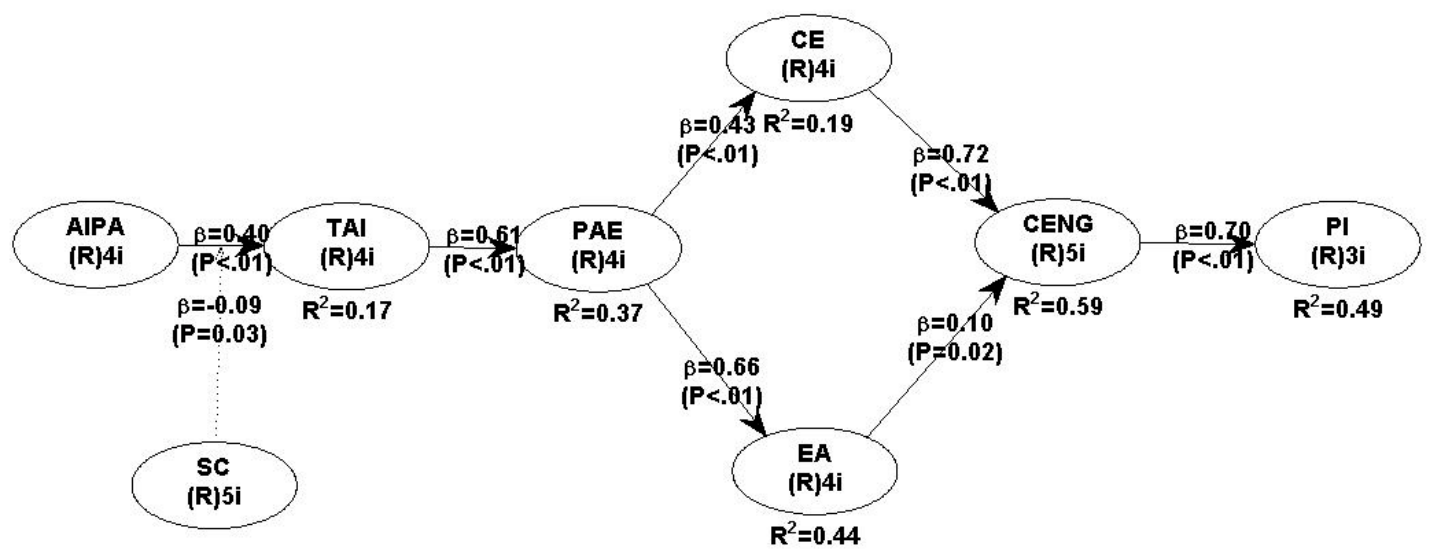
| H | From | To | β | p-Value | f2 | Decision | ||
|---|---|---|---|---|---|---|---|---|
| H1 | AIPA | → | TAI | 0.40 | p < .01 | 0.19 | Supported | true |
| H2 | TAI | → | PAE | 0.61 | p < .01 | 0.33 | Supported | true |
| H3 | PAE | → | EA | 0.66 | p < .01 | 0.44 | Supported | true |
| H4 | PAE | → | CE | 0.43 | p < .01 | 0.19 | Supported | true |
| H5 | EA | → | CENG | 0.10 | p = .02 | 0.02 | Supported | true |
| H6 | CE | → | CENG | 0.72 | p < .01 | 0.49 | Supported | true |
| H7 | CENG | → | PI | 0.70 | p < .01 | 0.49 | Supported | true |
| H8 | SC × AIPA | → | TAI | −0.09 | p = .03 | 0.02 | Partially supported (significant; direction reversed) | direction reversed |
| Indirect Path | Chain | Indirect Effect (β) | p-Value | Interpretation |
|---|---|---|---|---|
| AIPA → TAI → PAE | H1 × H2 | 0.244 | <.01 | TAI fully mediates AIPA → PAE |
| AIPA → TAI → PAE → EA | H1 × H2 × H3 | 0.161 | <.01 | Sequential mediation (affective chain) |
| AIPA → TAI → PAE → CE | H1 × H2 × H4 | 0.105 | <.01 | Sequential mediation (cognitive chain) |
| AIPA → TAI → PAE → EA → CENG | H1 × H2 × H3 × H5 | 0.016 | 0.04 | Full affective mediation chain |
| AIPA → TAI → PAE → CE → CENG | H1 × H2 × H4 × H6 | 0.075 | <.01 | Full cognitive mediation chain |
| AIPA → … → PI (total indirect) | All paths | 0.064 | <.01 | Full sequential mediation confirmed |
Disclaimer/Publisher’s Note: The statements, opinions and data contained in all publications are solely those of the individual author(s) and contributor(s) and not of MDPI and/or the editor(s). MDPI and/or the editor(s) disclaim responsibility for any injury to people or property resulting from any ideas, methods, instructions or products referred to in the content. |
© 2026 by the authors. Licensee MDPI, Basel, Switzerland. This article is an open access article distributed under the terms and conditions of the Creative Commons Attribution (CC BY) license.
Share and Cite
Tatu, C.I.; Chivu, R.-G.; Orzan, M.C.; Moise, D.; Boboc, L. Emotional Responses to AI-Powered Personalised Advertising: The Role of Perceived Empathy and Social Cognition in Consumer Decision-Making. J. Intell. 2026, 14, 98. https://doi.org/10.3390/jintelligence14060098
Tatu CI, Chivu R-G, Orzan MC, Moise D, Boboc L. Emotional Responses to AI-Powered Personalised Advertising: The Role of Perceived Empathy and Social Cognition in Consumer Decision-Making. Journal of Intelligence. 2026; 14(6):98. https://doi.org/10.3390/jintelligence14060098
Chicago/Turabian StyleTatu, Cristian Ionuţ, Raluca-Giorgiana Chivu (Popa), Mihai Cristian Orzan, Daniel Moise, and Larisa Boboc (Dumitru). 2026. "Emotional Responses to AI-Powered Personalised Advertising: The Role of Perceived Empathy and Social Cognition in Consumer Decision-Making" Journal of Intelligence 14, no. 6: 98. https://doi.org/10.3390/jintelligence14060098
APA StyleTatu, C. I., Chivu, R.-G., Orzan, M. C., Moise, D., & Boboc, L. (2026). Emotional Responses to AI-Powered Personalised Advertising: The Role of Perceived Empathy and Social Cognition in Consumer Decision-Making. Journal of Intelligence, 14(6), 98. https://doi.org/10.3390/jintelligence14060098