

The Memory Superiority Effect of Induced Insight in Semantic Versus Perceptual Levels


Abstract
1. Introduction
2. Materials and Methods
2.1. Participants
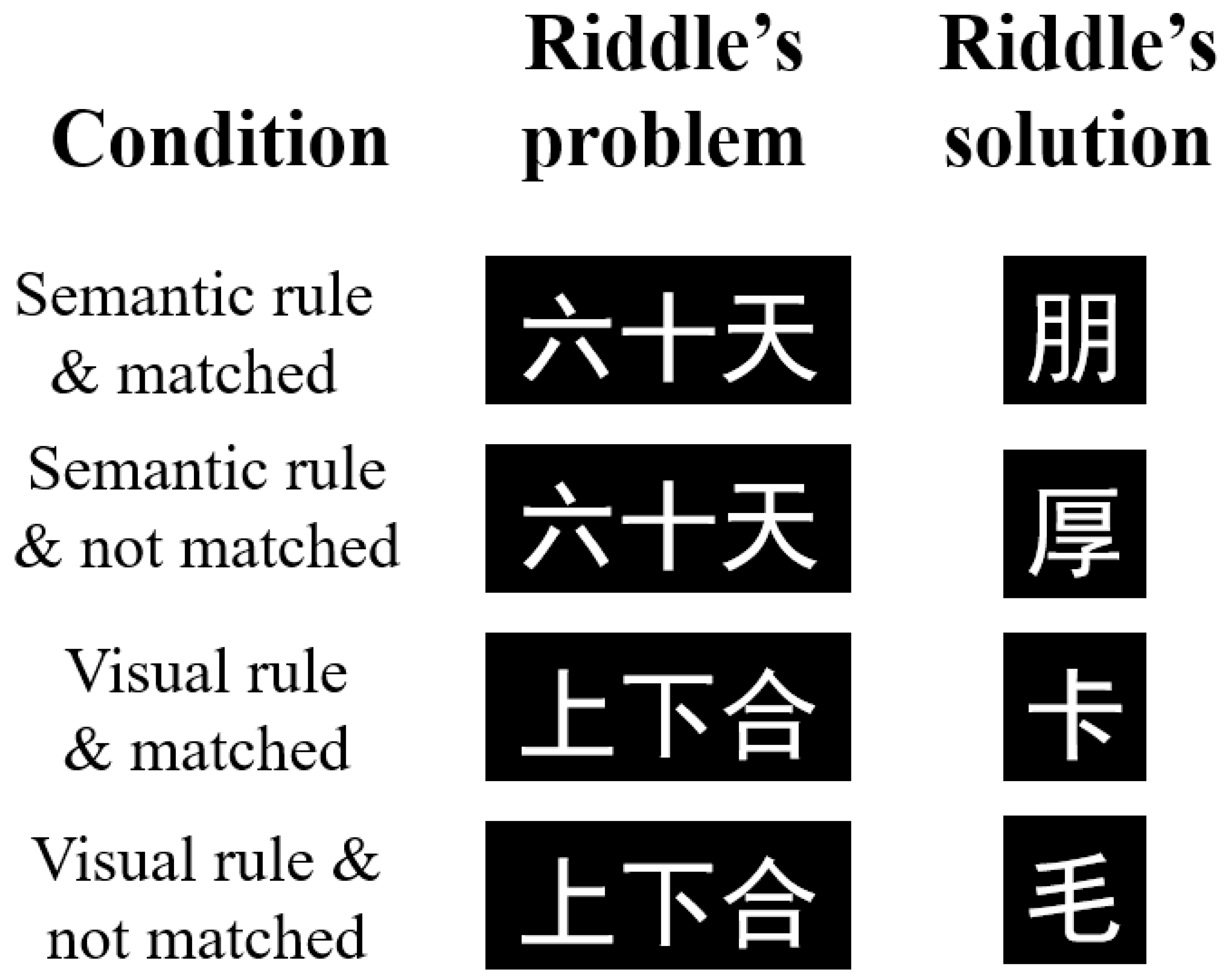
2.2. Materials
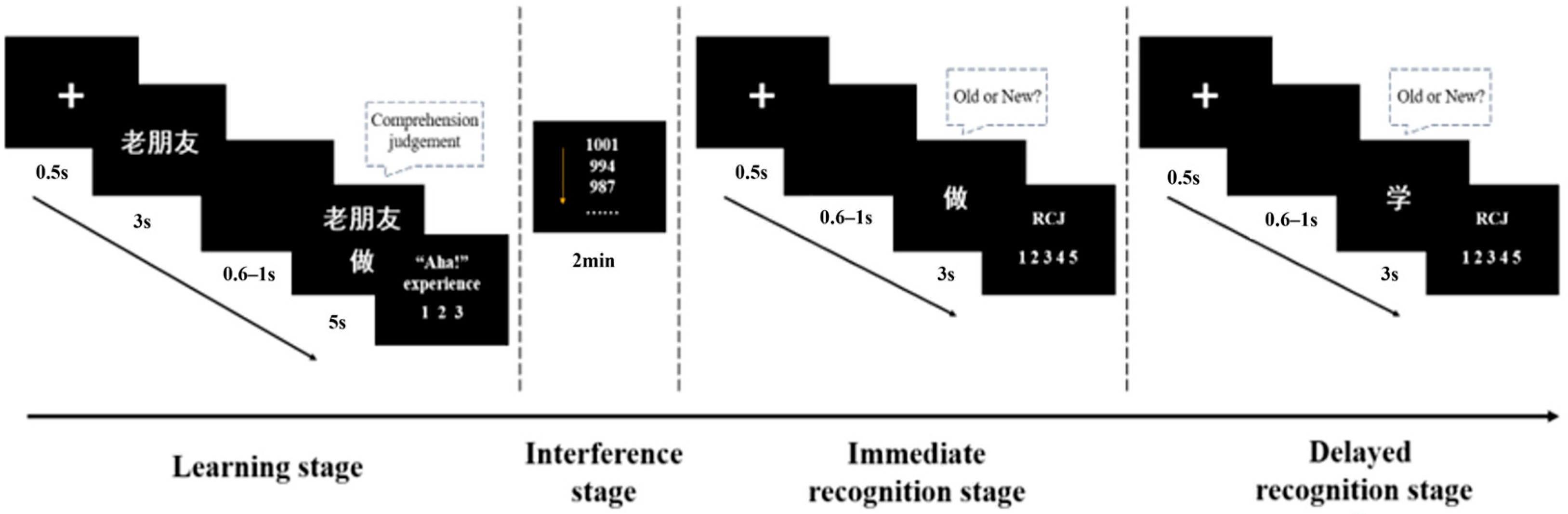
2.3. Procedure
2.4. Data Collection and Analysis
3. Results
3.1. Learning Stage
3.1.1. Solution Rate
3.1.2. Comprehension Rate
3.1.3. Response Time for Comprehension Judgment
3.1.4. “Aha!” Experiences
3.2. Recognition Stage
3.2.1. Hit Rate
3.2.2. Recognition Rate
3.2.3. RT for Recognition
3.2.4. Retrospective Confidence Judgment
3.2.5. Memory Confidence Judgment Accuracy
3.2.6. Relations Between “Aha!” Experiences and Memory Performance
3.2.7. Liner-Mixed-Model Analyses Controlling for Material Effects
4. Discussion
Author Contributions
Funding
Institutional Review Board Statement
Informed Consent Statement
Data Availability Statement
Conflicts of Interest
References
- Altarriba, J., Bauer, L. M., & Benvenuto, C. (1999). Concreteness, context availability, and imageability ratings and word associations for abstract, concrete, and emotion words. Behavior Research Methods, Instruments, & Computers, 31(4), 578–602. [Google Scholar] [CrossRef]
- Auble, P. M., Franks, J. J., & Soraci, S. A. (1979). Effort toward comprehension: Elaboration or “aha!”? Memory & Cognition, 7(6), 426–434. [Google Scholar] [CrossRef]
- Baddeley, A. D., & Hitch, G. J. (2017). Is the Levels of Processing effect language-limited? Journal of Memory and Language, 92, 1–13. [Google Scholar] [CrossRef]
- Becker, M., Sommer, T., & Cabeza, R. (2025). Insight predicts subsequent memory via cortical representational transformation and hippocampal activity. Nature Communications, 16(1), 4341. [Google Scholar] [CrossRef] [PubMed]
- Binder, J. R., & Desai, R. H. (2011). The neurobiology of semantic memory. Trends in Cognitive Sciences, 15(11), 527–536. [Google Scholar] [CrossRef]
- Bowden, E. M., & Jung-Beeman, M. (2007). Methods for investigating the neural components of insight. Methods, 42(1), 87–99. [Google Scholar] [CrossRef]
- Campbell, J. I. D., & Thompson, V. A. (2012). MorePower 6.0 for ANOVA with relational confidence intervals and Bayesian analysis. Behavior Research Methods, 44(4), 1255–1265. [Google Scholar] [CrossRef]
- Chen, J., Zhang, K., Du, X., Pan, J., & Luo, J. (2023). The neural mechanisms of the effect of spontaneous insight on re-solution: An ERP study. Journal of Intelligence, 11(1), 10. [Google Scholar] [CrossRef]
- Chen, S., Liang, Z., Li, X., Chen, Y., Zhao, Q., Yu, Q., Li, S., Zhou, Z., & Liu, L. (2021). The role of novel semantic association in the promoting effect of insight on memory. Acta Psychologica Sinica, 53(8), 837–846. [Google Scholar] [CrossRef]
- Chua, E. F., Schacter, D. L., & Sperling, R. A. (2009). Neural correlates of meta-memory: A comparison of feeling-of-knowing and retrospective confidence judgments. Journal of Cognitive Neuroscience, 21(9), 1751–1765. [Google Scholar] [CrossRef]
- Conte, N., Fairfield, B., Padulo, C., & Pelegrina, S. (2023). Metacognition in working memory: Confidence judgments during an n-back task. Consciousness and Cognition, 111, 103522. [Google Scholar] [CrossRef] [PubMed]
- Craik, F. I. M., & Rose, N. S. (2012). Memory encoding and aging: A neurocognitive perspective. Neuroscience and Biobehavioral Reviews, 36(7), 1729–1739. [Google Scholar] [CrossRef]
- Craik, F. I. M., & Tulving, E. (1975). Depth of processing and the retention of words in episodic memory. Journal of Experimental Psychology: General, 104(3), 268–294. [Google Scholar] [CrossRef]
- Cui, C., Zhang, K., Du, X. M., Sun, X., & Luo, J. (2021). Event-related potentials support the mnemonic effect of spontaneous insight solution. Psychological Research, 85(7), 2518–2529. [Google Scholar] [CrossRef]
- Danek, A. H., Fraps, T., von Müller, A., Grothe, B., & Ollinger, M. (2013). aha! experiences leave a mark: Facilitated recall of insight solutions. Psychological Research, 77(5), 659–669. [Google Scholar] [CrossRef]
- Danek, A. H., & Wiley, J. (2020). What causes the insight memory advantage? Cognition, 205, 104411. [Google Scholar] [CrossRef]
- Ding, K., Chen, Q., Yang, W., Wang, X., Yang, D., Ding, C., & Qiu, J. (2023). Recognizing ideas generated in a creative thinking task: Effect of the subjective novelty. Current Psychology, 42, 529–541. [Google Scholar] [CrossRef]
- Ding, K., He, R., Wang, X., Chen, Q., & Kenett, Y. N. (2024). Recognizing ideas generated in a creative task: The roles of the hippocampus and medial prefrontal cortex in facilitating self-generated learning. Cerebral Cortex, 34(5), bhae219. [Google Scholar] [CrossRef] [PubMed]
- Dolan, R. J., Fink, G. R., Rolls, E., Booth, M., Holmes, A., Frackowiak, R. S., & Friston, K. J. (1997). How the brain learns to see objects and faces in an impoverished context. Nature, 389(6651), 596–599. [Google Scholar] [CrossRef] [PubMed]
- Dougherty, M. R., Scheck, P., Nelson, T. O., & Narens, L. (2005). Using the past to predict the future. Memory & Cognition, 33(6), 1096–1115. [Google Scholar] [CrossRef]
- Du, X., Zhang, K., Wang, J., Luo, J., & Luo, J. (2017). Can people recollect well and change their source memory bias of “aha!” experiences? The Journal of Creative Behavior, 51(1), 45–56. [Google Scholar] [CrossRef]
- Fleming, S. M., & Lau, H. C. (2014). How to measure metacognition. Frontiers in Human Neuroscience, 8, 443. [Google Scholar] [CrossRef]
- Friedman, D., Ritter, W., & Snodgrass, J. G. (1996). ERPs during study as a function of subsequent direct and indirect memory testing in young and old adults. Cognitive Brain Research, 4(1), 1–13. [Google Scholar] [CrossRef]
- Galvin, S. J., Podd, J. V., Drga, V., & Whitmore, J. (2003). Type 2 tasks in the theory of signal detectability: Discrimination between correct and incorrect decisions. Psychonomic Bulletin & Review, 10, 843–876. [Google Scholar] [CrossRef]
- Gilhooly, K. J., & Logie, R. H. (1980). Age-of-acquisition, imagery, concreteness, familiarity, and ambiguity measures for 1,944 words. Behavior Research Methods & Instrumentation, 12(4), 395–427. [Google Scholar] [CrossRef]
- Graf, M., Danek, A. H., Vaci, N., & Bilalić, M. (2023). Tracing cognitive processes in insight problem solving: Using gams and change point analysis to uncover restructuring. Journal of Intelligence, 11(5), 86. [Google Scholar] [CrossRef]
- Hu, X., Yang, C., & Luo, L. (2022). Retrospective confidence rating about memory performance is affected by both retrieval fluency and non-decision time. Metacognition Learning, 17, 651–681. [Google Scholar] [CrossRef]
- Huang, F., Tang, S., Sun, P., & Luo, J. (2018). Neural correlates of novelty and appropriateness processing in externally induced constraint relaxation. NeuroImage, 172, 381–389. [Google Scholar] [CrossRef]
- Jung-Beeman, M., Bowden, E. M., Haberman, J., Frymiare, J. L., Arambel-Liu, S., Greenblatt, R., Reber, P. J., & Kounios, J. (2004). Neural activity when people solve verbal problems with insight. PLoS Biology, 2(4), E97. [Google Scholar] [CrossRef] [PubMed]
- Kizilirmak, J. M., Fischer, L., Krause, J., Soch, J., Richter, A., & Schott, B. H. (2021). Learning by insight-like sudden comprehension as a potential strategy to improve memory encoding in older adults. Frontiers in Aging Neuroscience, 13, 661346. [Google Scholar] [CrossRef]
- Kizilirmak, J. M., Schott, B. H., Thuerich, H., Sweeney-Reed, C. M., Richter, A., Folta-Schoofs, K., & Richardson-Klavehn, A. (2019). Learning of novel semantic relationships via sudden comprehension is associated with a hippocampus-independent network. Consciousness and Cognition: An International Journal, 69, 113–132. [Google Scholar] [CrossRef] [PubMed]
- Kizilirmak, J. M., Thuerich, H., Folta-Schoofs, K., Schott, B. H., & Richardson-Klavehn, A. (2016a). Neural correlates of learning from induced insight: A case for reward-based episodic encoding. Frontiers in Psychology, 7, 1693. [Google Scholar] [CrossRef]
- Kizilirmak, J. M., Wiegmann, B., & Richardson-Klavehn, A. (2016b). Problem solving as an encoding task: A special case of the generation effect. The Journal of Problem Solving, 9(1), 59–76. [Google Scholar] [CrossRef][Green Version]
- Kounios, J., & Beeman, M. (2014). The cognitive neuroscience of insight. Annual Review of Psychology, 65, 71–93. [Google Scholar] [CrossRef]
- Kuo, C. C. M., Liu, K. P. Y., & Chan, C. H. (2010). Memory encoding in healthy older adults using neutral, perceptual, and semantic tasks. International Journal of Psychophysiology, 77(3), 256–257. [Google Scholar] [CrossRef]
- Ludmer, R., Dudai, Y., & Rubin, N. (2011). Uncovering camouflage: Amygdala activation predicts long-term memory of induced perceptual insight. Neuron, 69(5), 1002–1014. [Google Scholar] [CrossRef]
- Luo, J., & Knoblich, G. (2007). Studying insight problem solving with neuroscientific methods. Methods, 42(1), 77–86. [Google Scholar] [CrossRef] [PubMed]
- Luo, J., Niki, K., & Knoblich, G. (2006). Perceptual contributions to problem solving: Chunk decomposition of Chinese characters. Brain Research Bulletin, 70(4–6), 430–443. [Google Scholar] [CrossRef]
- Macchi, L., Poli, F., & Caravona, L. (2025). Dissociable Effects of Verbalization on Solving Insight and Non-Insight Problems. Journal of Intelligence, 13(3), 36. [Google Scholar] [CrossRef] [PubMed]
- Mai, X. Q., Luo, J., & Wu, J. H. (2004). “aha!” effects in a guessing riddle task: An event-related potential study. Human Brain Mapping, 22, 261–270. [Google Scholar] [CrossRef]
- Maniscalco, B., & Lau, H. (2012). A signal detection theoretic approach for estimating metacognitive sensitivity from confidence ratings. Consciousness and Cognition, 21(1), 422–430. [Google Scholar] [CrossRef]
- Martín-Luengo, B., Zinchenko, O., Dolgoarshinnaia, A., & Leminen, A. (2021). Retrospective confidence judgments: Meta-analysis of functional magnetic resonance imaging studies. Human Brain Mapping, 42(10), 3005–3022. [Google Scholar] [CrossRef]
- Metcalfe, J., & Wiebe, D. (1987). Intuition in insight and noninsight problem solving. Memory & Cognition, 15(3), 238–246. [Google Scholar] [CrossRef]
- Milivojevic, B., Vicente-Grabovetsky, A., & Doeller, C. F. (2015). Insight reconfigures hippocampal-prefrontal memories. Current Biology: CB, 25(7), 821–830. [Google Scholar] [CrossRef] [PubMed]
- Modern Chinese frequency dictionary. (1986). Beijing Language Institute.
- Nyhus, E., & Curran, T. (2009). Semantic and perceptual effects on recognition memory: Evidence from ERP. Brain Research, 1283, 102–114. [Google Scholar] [CrossRef] [PubMed]
- Paletz, S., & Peng, K. (2008). Implicit theories of creativity across cultures novelty and appropriateness in two product domains. Journal of Cross-Cultural Psychology, 39(3), 286–302. [Google Scholar] [CrossRef]
- Paller, K. A., Kutas, M., & Mayes, A. R. (1987). Neural correlates of encoding in an incidental learning paradigm. Electroencephalography and Clinical Neurophysiology, 67(4), 360–371. [Google Scholar] [CrossRef]
- Qiu, J., Li, H., Luo, Y., Chen, A., Zhang, F., Zhang, J., Yang, J., & Zhang, Q. (2006). Brain mechanism of cognitive conflict in a guessing Chinese logogriph task. Neuroreport, 17(6), 679–682. [Google Scholar] [CrossRef]
- Roediger, H. L., III, Gallo, D. A., & Geraci, L. (2002). Processing approaches to cognition: The impetus from the levels-of-processing framework. Memory, 10(5–6), 319–332. [Google Scholar] [CrossRef] [PubMed]
- Rothmaler, K., Nigbur, R., & Ivanova, G. (2017). New insights into insight: Neurophysiological correlates of the difference between the intrinsic “aha!” and the extrinsic “oh yes” moment. Neuropsychologia, 95, 204–214. [Google Scholar] [CrossRef]
- Runco, M. A., & Jaeger, G. J. (2012). The standard definition of creativity. Creativity Research Journal, 24(1), 92–96. [Google Scholar] [CrossRef]
- Salvi, C., Bricolo, E., Kounios, J., Bowden, E., & Beeman, M. (2016). Insight solutions are correct more often than analytic solutions. Thinking & Reasoning, 22(4), 443–460. [Google Scholar] [CrossRef] [PubMed]
- Salvi, C., Keller, N., Cooper, S. E., Leiker, E., & Dunsmoor, J. (2024). aha! and D’oh! experiences enhance learning for incidental information-new evidence supports the insight memory advantage. Cognitive, Affective & Behavioral Neuroscience, 24(3), 505–516. [Google Scholar] [CrossRef]
- Shen, J. (2006). New compilation of rebus riddles. Zhejiang Ancient Books Publishing House. [Google Scholar]
- Shen, W., Bai, H., Ball, L. J., Yuan, Y., & Wang, M. (2021). What makes creative advertisements memorable? The role of insight. Psychological Research, 85(7), 2538–2552. [Google Scholar] [CrossRef] [PubMed]
- Shen, W., Bai, H., Yuan, Y., Ball, L. J., & Lu, F. (2022). Quantifying the roles of conscious and unconscious processing in insight-related memory effectiveness within standard and creative advertising. Psychological Research, 86(5), 1410–1425. [Google Scholar] [CrossRef]
- Smith, R. W., & Kounios, J. (1996). Sudden insight: All-or-none processing revealed by speed–accuracy decomposition. Journal of Experimental Psychology: Learning, Memory, and Cognition, 22(6), 1443–1462. [Google Scholar] [CrossRef]
- Stuyck, H., Aben, B., Cleeremans, A., & Van den Bussche, E. (2021). The aha! moment: Is insight a different form of problem solving? Consciousness and Cognition, 90, 103055. [Google Scholar] [CrossRef]
- Su, J., & Ye, H. (2025). Temporal synchrony in bodily interaction enhances the aha! Experiences: Evidence for an implicit metacognitive predictive processing mechanism. Journal of Intelligence, 13(7), 83. [Google Scholar] [CrossRef]
- Sun, Y. C. (2002). The great dictionary of Chinese character rebus. Guangdong Education Publishing House. [Google Scholar]
- Tang, X., Pang, J., Nie, Q. Y., Conci, M., Luo, J., & Luo, J. (2016). Probing the cognitive mechanism of mental representational transformation during chunk decomposition: A parametric fMRI study. Cerebral Cortex, 26(7), 2991–2999. [Google Scholar] [CrossRef]
- Tik, M., Sladky, R., Luft, C. D. B., Willinger, D., Hoffmann, A., Banissy, M. J., Bhattacharya, J., & Windischberger, C. (2018). Ultra-high-field fMRI insights on insight: Neural correlates of the aha!-moment. Human Brain Mapping, 39(8), 3241–3252. [Google Scholar] [CrossRef] [PubMed]
- Vitello, M., & Salvi, C. (2023). Gestalt’s perspective on insight: A recap based on recent behavioral and neuroscientific evidence. Journal of Intelligence, 11(12), 224. [Google Scholar] [CrossRef] [PubMed]
- Wang, Y. Z. (2021). Cognitive neural mechanisms of understanding chinese rebus riddles [Doctoral Dissertation, Zhejiang University]. [Google Scholar] [CrossRef]
- West, J. T., Dubec, L., Wagner, R. L., & Dennis, N. A. (2026). Exploring the neural underpinnings of semantic and perceptual false memory formation. Neuropsychologia, 221, 109332. [Google Scholar] [CrossRef] [PubMed]
- Wiley, J., & Danek, A. H. (2024). Restructuring processes and aha! experiences in insight problem solving. Nature Reviews Psychology, 3, 42–55. [Google Scholar] [CrossRef]
- Wills, T. W., Soraci, S. A., Chechile, R. A., & Taylor, H. A. (2000). “aha!” effects in the generation of pictures. Memory & Cognition, 28(6), 939–948. [Google Scholar] [CrossRef]
- Wong, S. S. H., & Lim, S. W. H. (2022). A mind-wandering account of the testing effect: Does context variation matter? Psychonomic Bulletin & Review, 29(1), 220–229. [Google Scholar] [CrossRef]
- Wu, C. Y., Ho, M. H., & Chen, S. H. (2012). A meta-analysis of fMRI studies on Chinese orthographic, phonological, and semantic processing. NeuroImage, 63(1), 381–391. [Google Scholar] [CrossRef]
- Wu, X., Liu, Y., & Luo, J. (2018). The mnemonic effects of novelty and appropriateness in creative chunk decomposition tasks. Frontiers in Psychology, 9, 673. [Google Scholar] [CrossRef] [PubMed]
- Zhang, Z., Deng, J., Zhang, M., Lu, Z., Zhou, Y., Lin, Y., & Xing, Q. (2025a). The involvement of conflict monitoring and rewards processing in the appropriateness evaluation of creativity: An event-related potential-based analysis. Psychology of Aesthetics, Creativity, and the Arts, 19(5), 1189–1204. [Google Scholar] [CrossRef]
- Zhang, Z., Li, Y., Zeng, Y., Deng, J., Xing, Q., & Luo, J. (2024). The involvement of decomposition and composition processes in restructuring during problem solving. Consciousness and Cognition, 121, 103685. [Google Scholar] [CrossRef] [PubMed]
- Zhang, Z., Si, Y., Wang, L., & He, K. (2025b). The superior memory effect of insightful learning: The role of associative novelty. Acta Psychologica, 255, 104901. [Google Scholar] [CrossRef]
- Zhang, Z., Su, Y., Gang, Y., & Xing, Q. (2025c). The mechanism of chunk restructuring in the memory superiority effect of Insight: Dissociating the roles of decomposition and composition. Consciousness and Cognition, 132, 103877. [Google Scholar] [CrossRef]
- Zhang, Z., Zhou, Y., Zeng, Y., & Xing, Q. (2025d). The (meta-)memory superiority effect of induced insight on item memory and associative memory: The role of association appropriateness. Psychological Research, 89(6), 157. [Google Scholar] [CrossRef] [PubMed]
- Zhao, Q., Guo, F., Chen, X., Chen, Y., Liang, Z., Yu, Q., & Zhou, Z. (2025). The advantage of novel solutions on subsequent memory in insight problems. Psychology of Aesthetics, Creativity, and the Arts, 19(5), 1111–1123. [Google Scholar] [CrossRef]
- Zhao, Q., Li, Y., Shang, X., Zhou, Z., & Han, L. (2014). Uniformity and nonuniformity of neural activities correlated to different insight problem solving. Neuroscience, 270, 203–211. [Google Scholar] [CrossRef] [PubMed]
- Zhou, X., & Marslen-Wilson, W. (1999). Phonology, orthography, and semantic activation in reading Chinese. Journal of Memory and Language, 41(4), 579–606. [Google Scholar] [CrossRef]

| Riddle Variable | Semantic-Rule Riddle (N = 60) | Visual-Rule Riddle (N = 60) | t | p |
|---|---|---|---|---|
| Frequency of riddle’s solution (%) | 0.05 ± 0.09 | 0.03 ± 0.04 | −0.85 | 0.396 |
| “aha!” experiences | 3.57 ± 0.4 | 3.34 ± 0.37 | −3.28 | 0.001 |
| Comprehensibility | 3.83 ± 0.53 | 4.14 ± 0.62 | 2.93 | 0.004 |
| Ingenuity/novelty | 3.77 ± 0.43 | 3.63 ± 0.36 | −2.00 | 0.047 |
| Appropriateness | 3.72 ± 0.48 | 4.00 ± 0.64 | 2.67 | 0.009 |
| Difficulty | 0.93 ± 0.11 | 0.59 ± 0.32 | −7.86 | <0.001 |
| Semantic conventionality | 3.51 ± 0.49 | 3.47 ± 0.49 | −0.47 | 0.641 |
| Familiarity | 3.58 ± 0.53 | 3.51 ± 0.55 | −0.71 | 0.482 |
| Concreteness | 3.38 ± 0.46 | 3.35 ± 0.55 | −0.29 | 0.775 |
| Imagery | 3.42 ± 0.36 | 3.38 ± 0.39 | −0.57 | 0.572 |
| Behavioral Variable | Semantic-Rule Riddle | Visual-Rule Riddle | ||
|---|---|---|---|---|
| Matched | Unmatched | Matched | Unmatched | |
| Solution rate | 0.05 ± 0.09 | 0.06 ± 0.11 | 0.11 ± 0.12 | 0.12 ± 0.15 |
| Comprehension rate | 0.64 ± 0.21 | 0.12 ± 0.10 | 0.77 ± 0.14 | 0.11 ± 0.11 |
| RT for comprehension judgment | 2740.35 ± 449.79 | 2756.26 ± 534.32 | 2434.09 ± 461.48 | 2765.55 ± 537.38 |
| “aha!” experiences | 2.78 ± 0.22 | 1.13 ± 0.17 | 2.70 ± 0.29 | 1.11 ± 0.17 |
| Memory Variables | Recognition Time | Semantic-Rule Riddle | Visual-Rule Riddle | ||
|---|---|---|---|---|---|
| Matched | Not Matched | Matched | Not Matched | ||
| Hit rate | Immediate | 0.92 ± 0.13 | 0.85 ± 0.15 | 0.83 ± 0.11 | 0.79 ± 0.19 |
| Delayed | 0.87 ± 0.15 | 0.76 ± 0.21 | 0.76 ± 0.22 | 0.66 ± 0.20 | |
| Recognition rate | Immediate | 0.74 ± 0.18 | 0.67 ± 0.18 | 0.65 ± 0.19 | 0.61 ± 0.23 |
| Delayed | 0.54 ± 0.21 | 0.43 ± 0.2 | 0.43 ± 0.23 | 0.34 ± 0.24 | |
| RT for recognition | Immediate | 1044.84 ± 252.23 | 1185.91 ± 311.39 | 1082.42 ± 240.65 | 1151.46 ± 276.71 |
| Delayed | 1159.13 ± 350.37 | 1262.80 ± 354.93 | 1165.02 ± 315.37 | 1295.33 ± 379.34 | |
| Retrospective confidence judgment | Immediate | 4.84 ± 0.25 | 4.51 ± 0.37 | 4.68 ± 0.35 | 4.50 ± 0.47 |
| Delayed | 4.58 ± 0.48 | 4.28 ± 0.52 | 4.32 ± 0.53 | 4.22 ± 0.56 | |
| Memory confidence judgment accuracy | Immediate | 0.75 ± 0.09 | 0.73 ± 0.09 | 0.71 ± 0.10 | 0.70 ± 0.11 |
| Delayed | 0.70 ± 0.10 | 0.68 ± 0.10 | 0.67 ± 0.12 | 0.66 ± 0.12 | |
| Conditions | r and p Value | Hit Rate | Recognition Rate | RT for Recognition | RCJ | MCJA |
|---|---|---|---|---|---|---|
| Immediate semantic rule & matched | r | −0.13 | −0.07 | 0.23 | −0.18 | 0.21 |
| p | 0.475 | 0.70 | 0.18 | 0.31 | 0.23 | |
| Immediate visual rule & matched | r | 0.19 | 0.08 | −0.01 | 0.15 | 0.03 |
| p | 0.284 | 0.67 | 0.95 | 0.38 | 0.88 | |
| Delayed semantic rule & matched | r | −0.21 | −0.02 | 0.11 | −0.01 | 0.08 |
| p | 0.237 | 0.92 | 0.52 | 0.97 | 0.63 | |
| Delayed visual rule & matched | r | −0.25 | −0.13 | 0.02 | 0.14 | 0.04 |
| p | 0.143 | 0.46 | 0.92 | 0.41 | 0.81 |
Disclaimer/Publisher’s Note: The statements, opinions and data contained in all publications are solely those of the individual author(s) and contributor(s) and not of MDPI and/or the editor(s). MDPI and/or the editor(s) disclaim responsibility for any injury to people or property resulting from any ideas, methods, instructions or products referred to in the content. |
© 2026 by the authors. Licensee MDPI, Basel, Switzerland. This article is an open access article distributed under the terms and conditions of the Creative Commons Attribution (CC BY) license.
Share and Cite
Zhang, Z.; Zeng, Y.; Yu, W.; Zheng, Z. The Memory Superiority Effect of Induced Insight in Semantic Versus Perceptual Levels. J. Intell. 2026, 14, 84. https://doi.org/10.3390/jintelligence14050084
Zhang Z, Zeng Y, Yu W, Zheng Z. The Memory Superiority Effect of Induced Insight in Semantic Versus Perceptual Levels. Journal of Intelligence. 2026; 14(5):84. https://doi.org/10.3390/jintelligence14050084
Chicago/Turabian StyleZhang, Zhonglu, Yuxin Zeng, Wenkang Yu, and Zeying Zheng. 2026. "The Memory Superiority Effect of Induced Insight in Semantic Versus Perceptual Levels" Journal of Intelligence 14, no. 5: 84. https://doi.org/10.3390/jintelligence14050084
APA StyleZhang, Z., Zeng, Y., Yu, W., & Zheng, Z. (2026). The Memory Superiority Effect of Induced Insight in Semantic Versus Perceptual Levels. Journal of Intelligence, 14(5), 84. https://doi.org/10.3390/jintelligence14050084

