User Needs and Preferences for Multimodal Interaction in Social Robots for Later-Life Support: An Exploratory Survey and Conceptual Five-Layer Architecture


Abstract
1. Introduction
2. Literature Review
2.1. An Overview of Multimodal Interaction Research
2.2. Emotional Intelligence as a Conceptual Lens for Social-Robot Emotional Support Design
2.3. Social Robot Concept and Role Positioning
2.4. Older Adults’ Needs, Acceptance, and Interaction Preferences
2.5. Research Gaps and Positioning of the Present Study
3. Multimodal Interaction Modalities for Social Robots in Later-Life Support
3.1. Visual Interaction
3.2. Voice Interaction
3.3. Affective Interaction
3.4. Somatosensory Interaction
3.5. Electromyography Interaction
3.6. Brain–Computer Interface (BCI) Interaction
3.7. Summary
4. Questionnaire Survey and Descriptive Findings
4.1. Questionnaire Design, Recruitment, and Data Collection
4.2. Sample Population Information
4.3. Data Analysis and Results
4.3.1. Analysis of User Awareness, Usage Willingness, and Perceived Barriers Across Interaction Modalities
4.3.2. User Functional Requirements Analysis
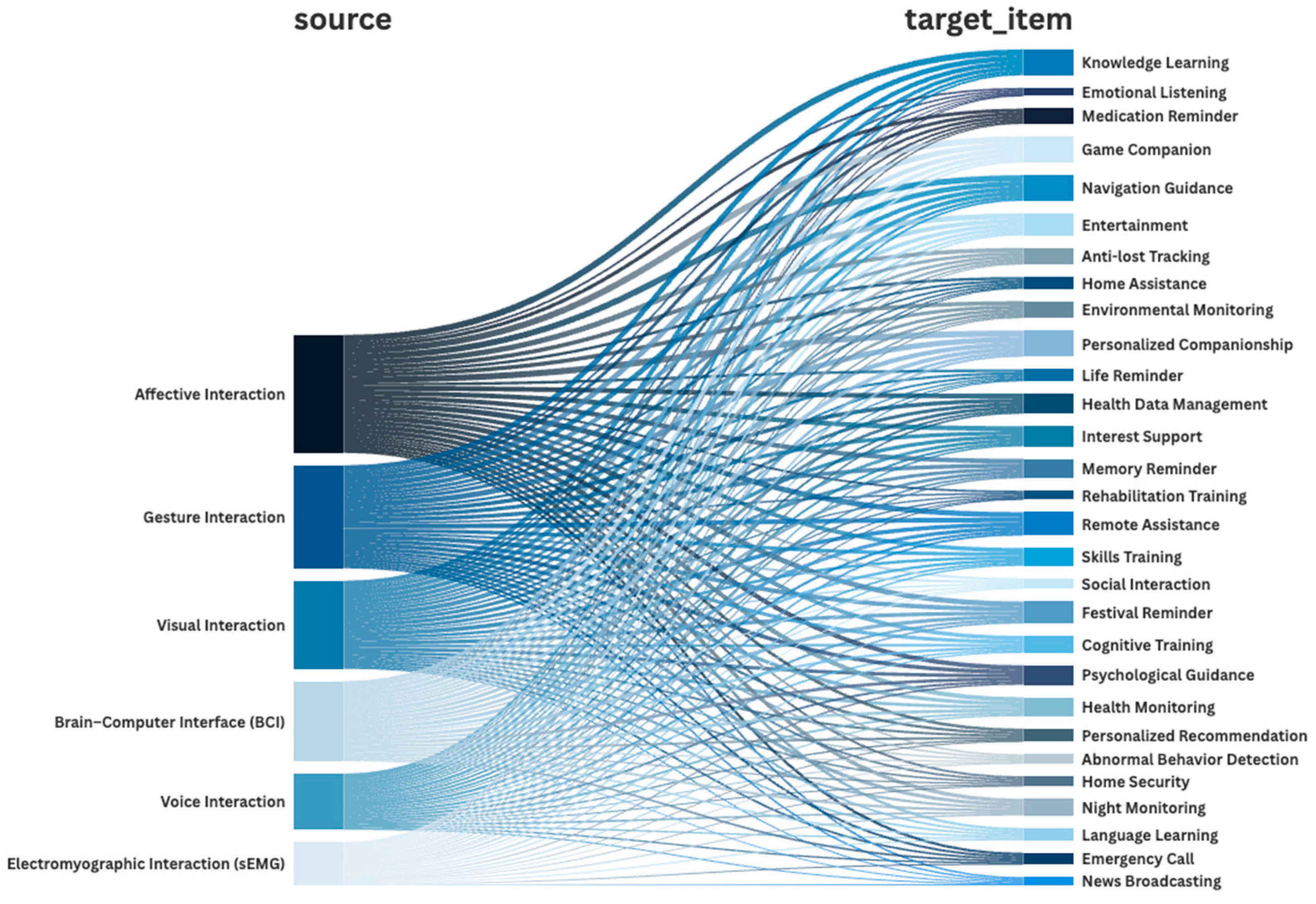
4.3.3. Correspondence Between Different Interaction Methods and Required Functions
5. Conceptual Architecture for Multimodal Social Robot in Later-Life Support
5.1. Conceptual Framework Construction
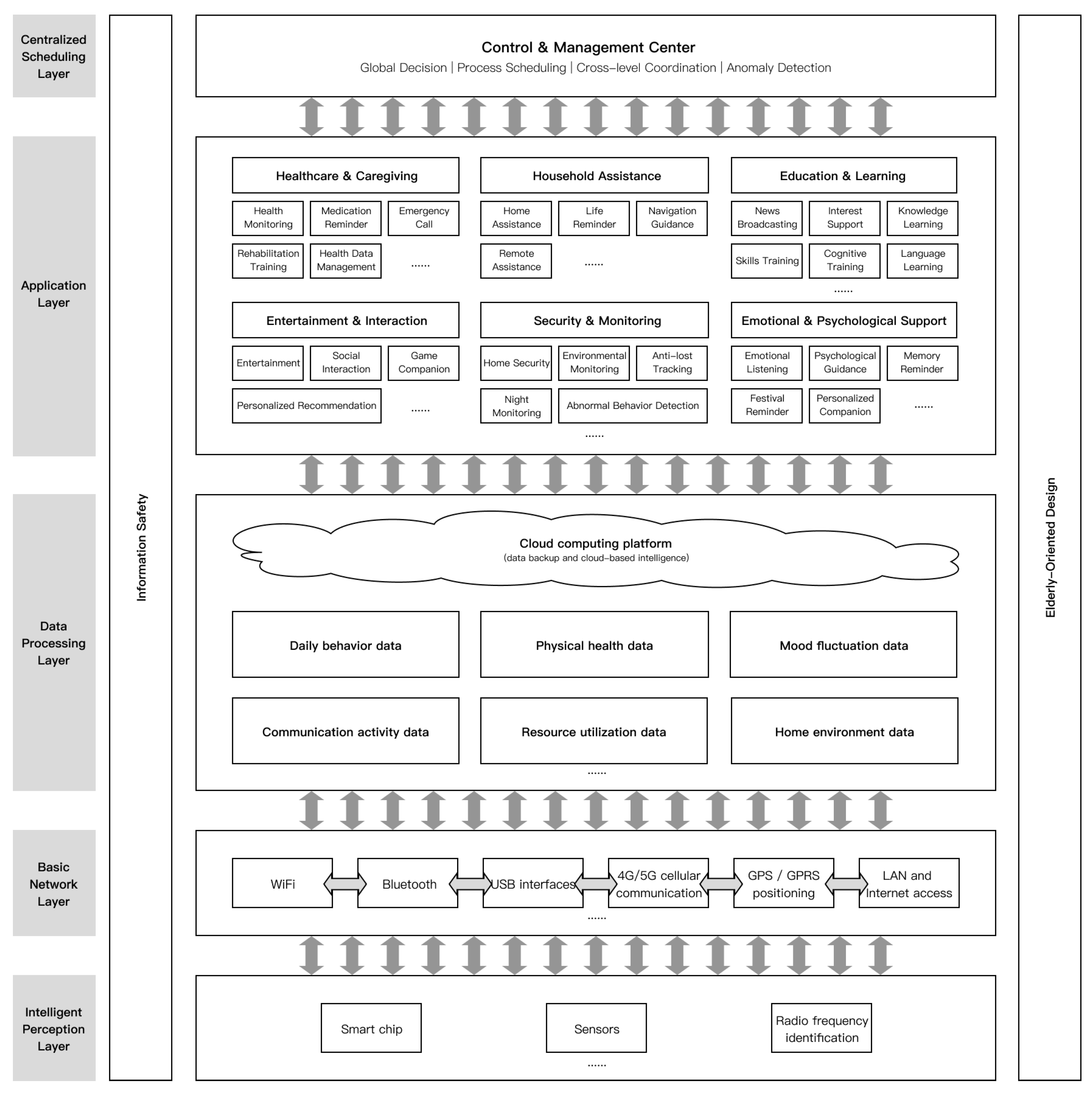
- Intelligent Perception Layer: The underlying layer is the Intelligent Perception Layer, responsible for real-time collection of multi-source information, including voice, images, motion, surface electromyography (sEMG), and electroencephalography (EEG). It supports the perception of diverse physiological and behavioral, and contextual cues from later-life users. The system gathers user status and environmental cues through microphones, cameras, depth sensors, IMU/touch, RFID, and optional sEMG/EEG devices. It performs local noise reduction, clock synchronization, and feature extraction (e.g., speech transcription and prosody statistics, pose/gesture key points, gaze vectors, scene events, low-dimensional sEMG/EEG features), where feasible, reducing or discarding raw data after feature extraction. This layer outputs structured events and features with temporal details. All sensors can be configured with visual indicators and dual hardware/software switches to prevent privacy violations and erroneous data collection. For age-friendly design, sensor placement, interaction prompts, and interface design should adhere to the principles of “large font size, high contrast, distributed guidance, and motion/timing tolerance.” During the initial user setup, provide a lightweight “demonstration-follow-feedback” tutorial to reduce the learning curve. Security measures include firmware integrity verification and local key protection to prevent device tampering.
- Transmission Network Layer: Collected data is transmitted reliably and efficiently to the upper layers via the foundational network layer, using multiple communication methods such as WiFi, Bluetooth, and 4G/5G to ensure data integrity and real-time delivery. Transmission Priority Differentiation by Business Criticality: Events such as emergency calls or abnormal falls should use high-priority channels, while routine interactions and daily activities should use low-priority channels. Link status (latency, packet loss, jitter) is continuously monitored for automatic rerouting and retransmission. In offline or high-latency scenarios, the network layer triggers local fallback: essential interactions and alerts remain functional, with synchronization occurring upon network restoration. All transmissions employ end-to-end encryption and mutual authentication. Critical control messages are signed and protected against replay attacks. Remote assistance and audio/video calls utilize point-to-point encryption with minimized metadata collection. For elderly users, this layer ensures that core services remain uninterrupted, regardless of network quality, with clear, understandable status indicators (e.g., network status alerts, offline notifications, and automatic retries).
- Data Processing Layer: The Data Processing Layer uses edge/cloud computing resources to process structured events, validate data quality, support multimodal inference, and coordinate service responses. It completes a closed-loop process encompassing streaming ingestion, quality validation, event bus, model services, and feature/log storage, while also handling multimodal collaboration and inference. Data domains align with the diagram, covering six categories: daily behavior, physical health, emotional fluctuations, communication activities, resource utilization, and home environment. Each domain is aligned with session IDs and unified timestamps to facilitate cross-modal fusion. Adhering to “edge-first, minimal collection” principles, the cloud retains only de-identified features and aggregated statistics, with defined retention periods and automated deletion policies. The collaborative strategy implemented at this layer is as follows: (1) Voice serves as the primary channel for routine interactions, (2) Vision is used for explicit confirmation and multi-step guidance, (3) Gestures/touch act as fallbacks during noise interference or reduced confidence, (4) Emotional cues function as “gentle amplifiers” for subtle adjustments to tone or reminder pacing, (5) sEMG/BCI mappings handle low-frequency, high-value commands (confirm/stop/help). From an EI-informed perspective, this layer operationalizes multimodal coordination by linking channels to emotion-relevant support processes (e.g., affective cue sensing, empathic response adjustment, and regulation-oriented prompt pacing) under confidence and safety constraints. When multiple channels trigger simultaneously or conflict, the system maintains safety through explicit confirmation and short-term revocation. If recognition confidence persistently declines, the strategy automatically switches to more reliable channels. This layer also maintains anomaly detection (e.g., behavioral irregularities, emotion-related risk cues, abnormal resource consumption) and reports alerts to central control.
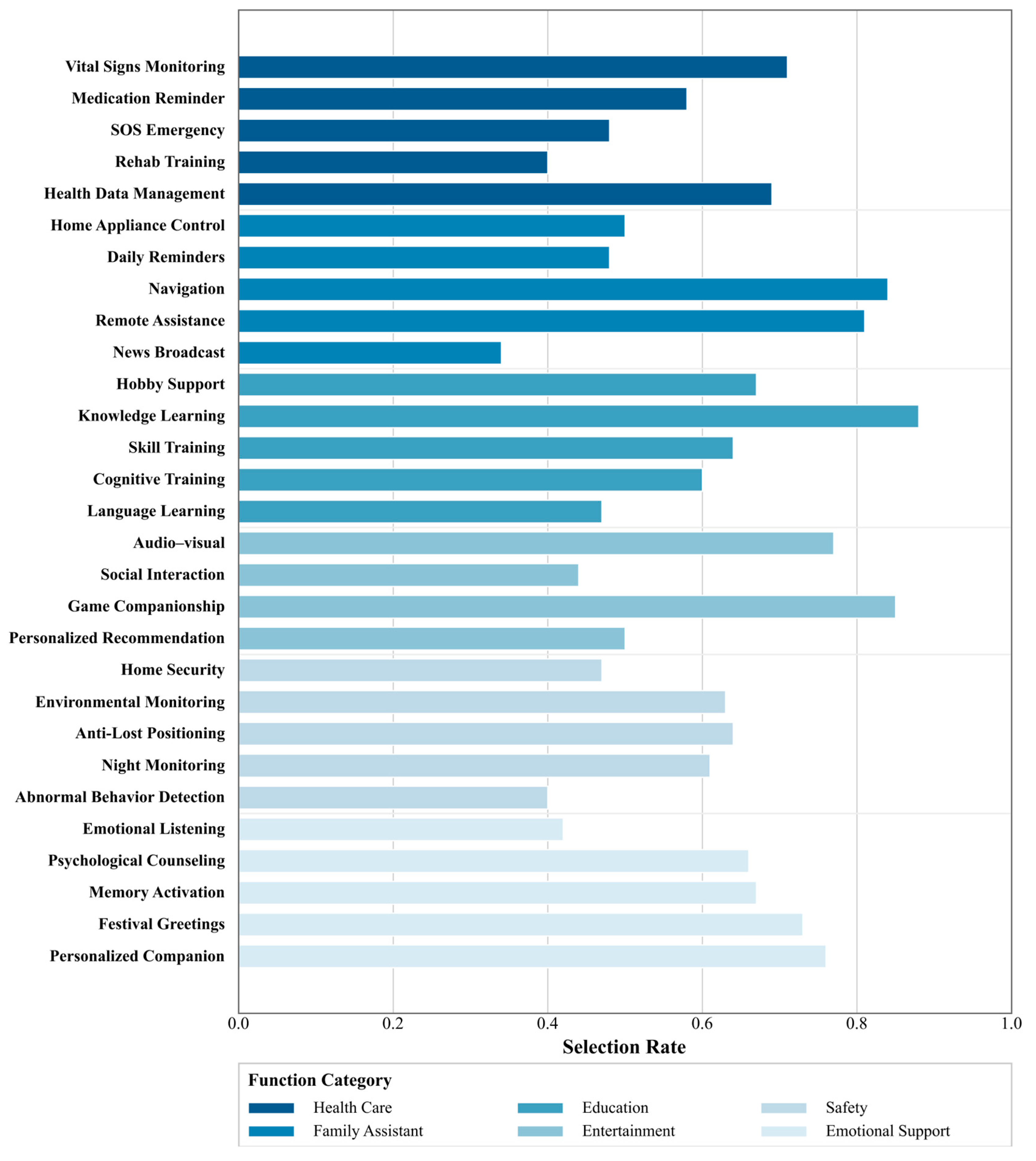
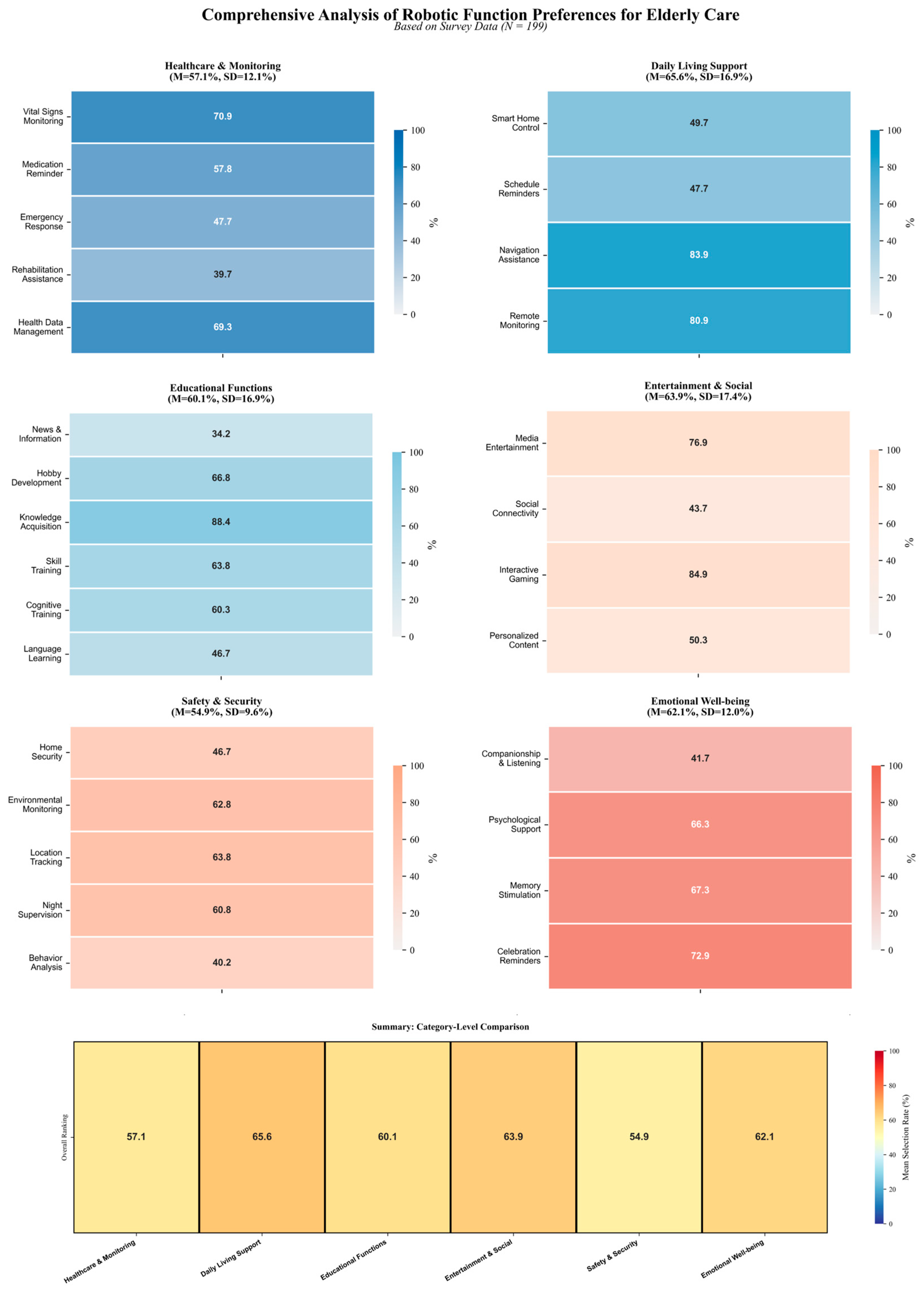
- Service Application Layer: The Service Application Layer delivers modular services across six application clusters that align with the questionnaire-derived functional priorities and the framework shown in Figure 10: (1) Healthcare & Caregiving (e.g., health monitoring, medication reminders, rehabilitation training, health data management, emergency calls), (2) Household Assistance (e.g., home assistance, daily reminders, navigation guidance, remote assistance), (3) Education & Learning (e.g., news broadcasting, interest support, knowledge learning, skills training, cognitive training, language learning), (4) Entertainment & Interaction (e.g., entertainment, social interaction, game companionship, personalized recommendations), (5) Security & Monitoring (e.g., home security, environmental monitoring, anti-lost tracking/wandering prevention, night monitoring, abnormal behavior detection), and (6) Emotional & Psychological Support (e.g., emotional listening, psychological support prompts, memory reminders/activation, festival greetings, personalized companionship).Within an EI-informed interpretation, the Emotional & Psychological Support cluster includes user-facing design-oriented components such as empathic listening, regulation-oriented support prompts, reminiscence/memory activation, and relational companionship cues. These modules are intended to support emotional-health-related interaction needs in everyday contexts, rather than to serve as standalone clinical interventions. All critical operations in these service modules should follow a double-confirmation protocol, with user-cancel options and configurable caregiver/family authorization for remote collaboration and assistance.
- Central Control Layer: The Central Control Layer is responsible for global decision-making, process scheduling, cross-layer coordination, and anomaly handling. Its core components are the strategy engine and personalized configuration: based on environmental signals such as noise, lighting, and network quality, combined with profiles of elderly users’ hearing, vision, and motor abilities, and by analyzing past user interactions, it dynamically allocates channel weights and default communication paths to balance the efficiency and reliability of multimodal interactions. When events such as suspected falls, prolonged inactivity, device malfunctions, or privacy risks occur, tiered alerts and emergency protocols are triggered: local notifications are issued first, followed by contact with family members or caregivers. In critical situations, emergency assistance hotlines are directly dialed.
5.2. Conceptual Mapping of Representative Social Robots
- Layered Correspondence and Abstraction Capacity. The mapping suggests that the proposed five-layer structure can provide a consistent descriptive scaffold for comparing heterogeneous social-robot systems.
- 2.
- Coverage of Application-Layer Functions. The Application Layer provides a structure for comparing the service orientations of different social robots.
- 3.
- Cross-Cutting Role of Design Pillars. The mapping also highlights the cross-cutting role of age-friendly design across different robot forms and service models.
6. Discussion: Limitations, Ethical Considerations, and Implementation Challenges
6.1. Limitations and Future Work
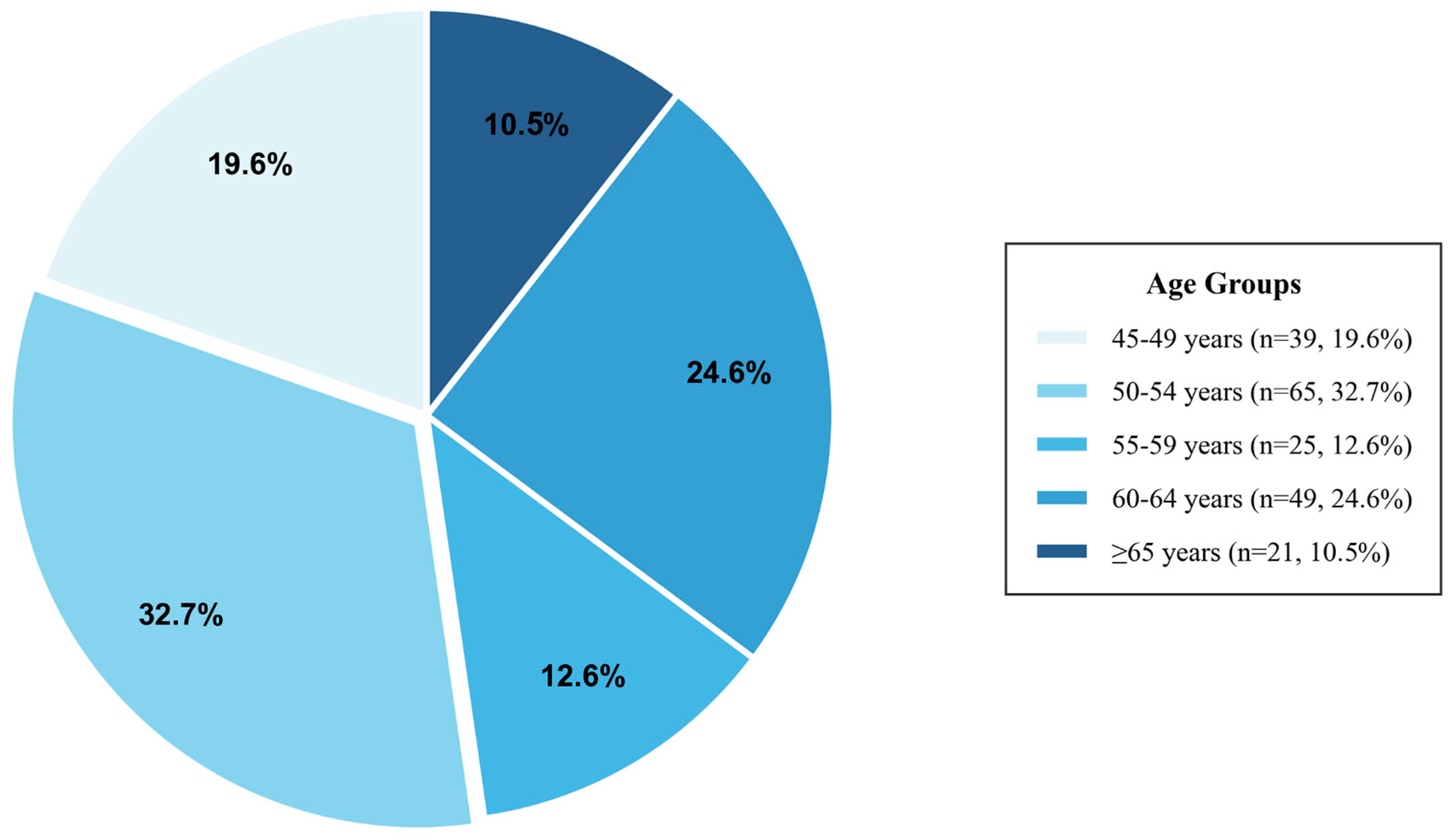
- Sample representativeness. The sample was dominated by respondents aged 45–64, while participants aged 65 and above accounted for only 10.5%. Therefore, the findings should be interpreted primarily as the needs and preferences of prospective later-life users rather than as representative evidence for the broader older-adult population. Future studies should recruit a larger and more diverse sample of adults aged 65 and above and conduct field studies in home, community, and care settings.
- Intervention scope. This study did not evaluate an emotional-health intervention or measure emotional intelligence as an empirical variable. Therefore, the proposed architecture should be understood as a conceptual design framework rather than a validated intervention model. Future work should implement prototypes and examine whether specific interaction components can support emotional well-being, companionship, usability, and sustained engagement.
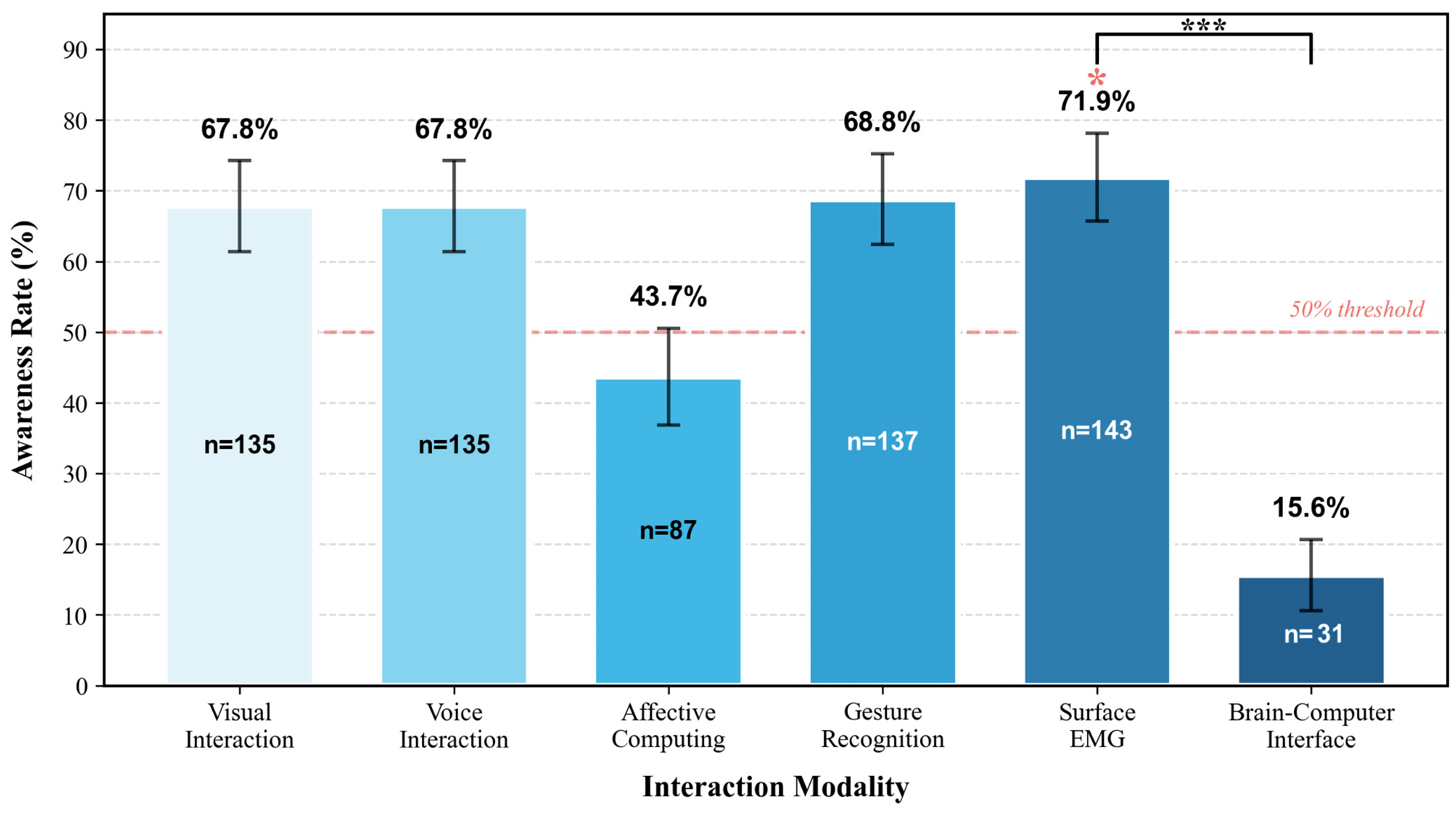
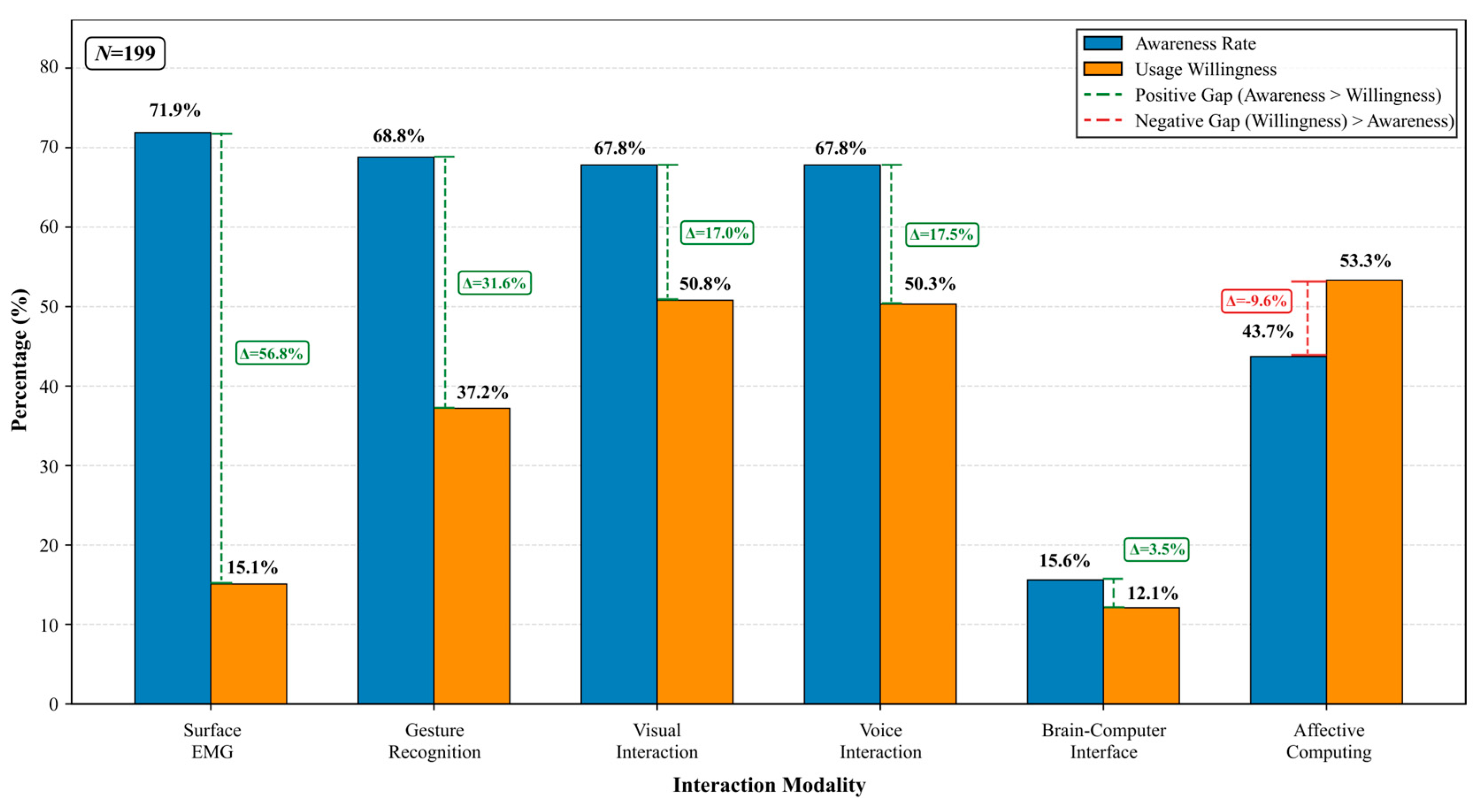
- Measurement validity concern. The study relied on self-reported questionnaire data. Measurement validity concern. The study relied on self-reported questionnaire data. The unexpectedly high awareness rate for sEMG (71.8%) may reflect confusion between sEMG and more familiar physiological sensing technologies or clinical electromyography. Future surveys should provide clearer definitions, examples, and comprehension checks for technical terms.
- Theoretical depth. The analysis was primarily descriptive. Although this study refers to the Technology Acceptance Model and emotional intelligence as theoretical lenses, it did not operationalize these constructs or test causal pathways. Future research could combine validated scales, paired repeated-measures analyses, structural equation modeling, and longitudinal prototype evaluation to examine the relationships among user characteristics, modality preferences, acceptance, and emotional-support outcomes.
6.2. Ethical Considerations and Implementation Challenges in Multimodal Human–Robot Interaction for Later-Life Support
6.3. Design Implications from an EI-Informed Perspective
7. Conclusions
Author Contributions
Funding
Institutional Review Board Statement
Informed Consent Statement
Data Availability Statement
Acknowledgments
Conflicts of Interest
Abbreviations
| AI | Artificial Intelligence |
| AU | Action Unit (facial muscle movement coding) |
| BCI | Brain–Computer Interface |
| EI | Emotional Intelligence |
| EEG | Electroencephalography |
| EMG | Electromyography |
| HCI | Human–Computer Interaction |
| HRI | Human–Robot Interaction |
| IoT | Internet of Things |
| LLM | Large Language Model |
| IMU | Inertial Measurement Unit |
| NLP | Natural Language Processing |
| RGB-D | Red-Green-Blue plus Depth |
| sEMG | Surface Electromyography |
| TAM | Technology Acceptance Model |
| TTS | Text-to-Speech |
| UI | User Interface |
Appendix A. Questionnaire
Appendix A.1. Cover Note
Appendix A.2. Part I: Demographics
Appendix A.3. Part II: Preferences for Multimodal Social Robots
Appendix A.4. Part III: Open-Ended Feedback
References
- Abdi, J., Al-Hindawi, A., Ng, T., & Vizcaychipi, M. P. (2018). Scoping review on the use of socially assistive robot technology in elderly care. BMJ Open, 8(2), e018815. [Google Scholar] [CrossRef]
- Abdollahi, H., Mollahosseini, A., Lane, J. T., & Mahoor, M. H. (2017). A pilot study on using an intelligent life-like robot as a companion for elderly individuals with dementia and depression. In 2017 IEEE-RAS 17th international conference on humanoid robotics (humanoids) (pp. 541–546). IEEE. [Google Scholar] [CrossRef]
- Ageing and health. (n.d.). Available online: https://www.who.int/news-room/fact-sheets/detail/ageing-and-health (accessed on 11 December 2025).
- Agravante, D. J., Claudio, G., Spindler, F., & Chaumette, F. (2017). Visual servoing in an optimization framework for the whole-body control of humanoid robots. IEEE Robotics and Automation Letters, 2(2), 608–615. [Google Scholar] [CrossRef]
- Agree, E. M. (2014). The potential for technology to enhance independence for those aging with a disability. Disability and Health Journal, 7(1), S33–S39. [Google Scholar] [CrossRef]
- Amabili, G., Iarlori, S., Millucci, S., Monteriù, A., Rossi, L., & Valigi, P. (2023). Emotion recognition by facial image acquisition: Analysis and experimentation of solutions based on neural networks and robot humanoid Pepper. In 2023 IEEE international conference on bioinformatics and biomedicine (BIBM) (pp. 4784–4791). IEEE. [Google Scholar]
- Biswas, P., & Samanta, D. (2008). Friend: A communication aid for persons with disabilities. IEEE Transactions on Neural Systems and Rehabilitation Engineering, 16(2), 205–209. [Google Scholar] [CrossRef]
- Blavette, L., Rigaud, A. S., Anzalone, S. M., Kergueris, C., Isabet, B., Dacunha, S., & Pino, M. (2022). A robot-mediated activity using the nao robot to promote COVID-19 precautionary measures among older adults in geriatric facilities. International Journal of Environmental Research and Public Health, 19(9), 5222. [Google Scholar] [CrossRef]
- Bradwell, H. L., Edwards, K., Shenton, D., Winnington, R., Thill, S., & Jones, R. B. (2021). User-centered design of companion robot pets involving care home resident-robot interactions and focus groups with residents, staff, and family: Qualitative study. JMIR Rehabilitation and Assistive Technologies, 8(4), e30337. [Google Scholar] [CrossRef]
- Cabibihan, J. J., Javed, H., Ang, M., & Aljunied, S. M. (2013). Why robots? A survey on the roles and benefits of social robots in the therapy of children with autism. International Journal of Social Robotics, 5(4), 593–618. [Google Scholar] [CrossRef]
- Casiddu, N., Cesta, A., Cortellessa, G., Orlandini, A., Porfirione, C., Divano, A., Micheli, E., & Zallio, M. (2015). Robot interface design: The giraff telepresence robot for social interaction. Biosystems and Biorobotics, 11, 499–509. [Google Scholar] [CrossRef]
- Chakravorti, S., Li, R., Rodriguez, W., Shults, R., Sharan, A., Englot, D. J., Konrad, P. E., D’Haese, P.-F., & Dawant, B. M. (2019). Validation of an automatic algorithm to identify NeuroPace depth leads in CT images. In Medical imaging 2019: Image-guided procedures, robotic interventions, and modeling (Vol. 10951, pp. 625–631). SPIE. [Google Scholar]
- Chen, C.-Y., Yu, D., Wen, W., Yang, Y. M., Zhang, J., Zhou, M., Jesse, K., Chau, A., Bhowmick, A., & Iyer, S. (2018). Gunrock: Building a human-like social bot by leveraging large scale real user data. In Alexa prize proceedings. Amazon Science. [Google Scholar]
- Chen, Y., Peng, Y., & Fang, P. (2016). Emotional intelligence mediates the relationship between age and subjective well-being. International Journal of Aging & Human Development, 83(2), 91–107. [Google Scholar] [CrossRef]
- Cheung, M.-C. (2021, April 5). How China is closing the digital divide for seniors. Available online: https://www.emarketer.com/content/how-china-closing-digital-divide-seniors (accessed on 5 April 2021).
- Darriba Frederiks, A., Octavia, J. R., Vandevelde, C., & Saldien, J. (2019). Towards participatory design of social robots. In Lecture notes in computer science (including subseries lecture notes in artificial intelligence and lecture notes in bioinformatics) (Volume 11747 LNCS, pp. 527–535). Springer. [Google Scholar] [CrossRef]
- Dautenhahn, K. (2003). Roles and functions of robots in human society: Implications from research in autism therapy. Robotica, 21(4), 443–452. [Google Scholar] [CrossRef]
- Dautenhahn, K. (2007). Socially intelligent robots: Dimensions of human-robot interaction. Philosophical Transactions of the Royal Society B: Biological Sciences, 362(1480), 679–704. [Google Scholar] [CrossRef]
- Del Angel, R., Contreras, C. M., Gutiérrez-García, A. G., & Montes-González, F. M. (2016). Robot. ZHUANGSHI, 1, 10. [Google Scholar]
- Delhom, I., Gutierrez, M., Lucas-Molina, B., & Meléndez, J. C. (2017). Emotional intelligence in older adults: Psychometric properties of the TMMS-24 and relationship with psychological well-being and life satisfaction. International Psychogeriatrics, 29(8), 1227–1234. [Google Scholar] [CrossRef]
- Dias, M. S., Pires, C. G., Pinto, F. M., Teixeira, V. D., & Freitas, J. (2012). Multimodal user interfaces to improve social integration of elderly and mobility impaired. Studies in Health Technology and Informatics, 177, 14–25. [Google Scholar] [CrossRef]
- El Kamali, M., Angelini, L., Lalanne, D., Abou Khaled, O., & Mugellini, E. (2023). Older adults’ perspectives on multimodal interaction with a conversational virtual coach. Frontiers in Computer Science, 5, 1125895. [Google Scholar] [CrossRef]
- ElliQ—Atlas of the future. (n.d.). Available online: https://atlasofthefuture.org/project/elliq/ (accessed on 11 December 2025).
- Feng, Y., Chcn, L., Wanjuan, S. U., & Hirota, K. (2018). Gesture intention understanding based on depth and RGB data. In 2018 37th Chinese Control Conference (CCC) (pp. 9556–9559). IEEE. [Google Scholar]
- Flandorfer, P. (2012). Population ageing and socially assistive robots for elderly persons: The importance of sociodemographic factors for user acceptance. International Journal of Population Research, 2012, 829835. [Google Scholar] [CrossRef]
- Fong, T., Nourbakhsh, I., & Dautenhahn, K. (2003). A survey of socially interactive robots. Robotics and Autonomous Systems, 42, 143–166. [Google Scholar] [CrossRef]
- Frennert, S., & Östlund, B. (2014). Review: Seven matters of concern of social robots and older people. International Journal of Social Robotics, 6(2), 299–310. [Google Scholar] [CrossRef]
- Giuliani, M. V., Scopelliti, M., & Fornara, F. (n.d.). Coping strategies and technology in later life. In Companions: Hard problems and open challenges in robot-human interaction (p. 46). The Society for the Study of Artificial Intelligence and the Simulation of Behaviour. [Google Scholar]
- Glyde, H., Hickson, L., Cameron, S., & Dillon, H. (2011). Problems hearing in noise in older adults: A review of spatial processing disorder. Trends in Amplification, 15(3), 116. [Google Scholar] [CrossRef]
- Gross, J. J. (2002). Emotion regulation: Affective, cognitive, and social consequences. Psychophysiology, 39, 281–291. [Google Scholar] [CrossRef]
- Gross, J. J., Feldman Barrett, L., John, O., Lane, R., Larsen, R., & Pennebaker, J. (1998). The emerging field of emotion regulation: An integrative review. Review of General Psychology, 2, 271–299. [Google Scholar] [CrossRef]
- Gross, J. J., & John, O. P. (2003). Individual differences in two emotion regulation processes: Implications for affect, relationships, and well-being. Journal of Personality and Social Psychology, 85(2), 348–362. [Google Scholar] [CrossRef]
- Heerink, M., Kröse, B., Evers, V., & Wielinga, B. (2010). Assessing acceptance of assistive social agent technology by older adults: The almere model. International Journal of Social Robotics, 2(4), 361–375. [Google Scholar] [CrossRef]
- Joseph, D. L., & Newman, D. A. (2010). Emotional intelligence: An integrative meta-analysis and cascading model. The Journal of Applied Psychology, 95(1), 54–78. [Google Scholar] [CrossRef]
- Kachouie, R., Sedighadeli, S., Khosla, R., & Chu, M. T. (2014). Socially assistive robots in elderly care: A mixed-method systematic literature review. International Journal of Human-Computer Interaction, 30(5), 369–393. [Google Scholar] [CrossRef]
- Koh, W. Q., Felding, S. A., Budak, K. B., Toomey, E., & Casey, D. (2021). Barriers and facilitators to the implementation of social robots for older adults and people with dementia: A scoping review. BMC Geriatrics, 21(1), 351. [Google Scholar] [CrossRef]
- Kouroupa, A., Laws, K. R., Irvine, K., Mengoni, S. E., Baird, A., & Sharma, S. (2022). The use of social robots with children and young people on the autism spectrum: A systematic review and meta-analysis. PLoS ONE, 17, e0269800. [Google Scholar] [CrossRef]
- Lala, D., Inoue, K., & Kawahara, T. (2019). Smooth turn-taking by a robot using an online continuous model to generate turn-taking cues. In 2019 international conference on multimodal interaction (pp. 226–234). Association for Computing Machinery. [Google Scholar]
- Li, S., Yerebakan, M. O., Luo, Y., Amaba, B., Swope, W., & Hu, B. (2022). The effect of different occupational background noises on voice recognition accuracy. Journal of Computing and Information Science in Engineering, 22(5), 050905. [Google Scholar] [CrossRef]
- Liao, Y. J., Jao, Y. L., Boltz, M., Adekeye, O. T., Berish, D., Yuan, F., & Zhao, X. (2023). Use of a humanoid robot in supporting dementia care: A qualitative analysis. SAGE Open Nursing, 9, 23779608231179530. [Google Scholar] [CrossRef]
- Liu, H., & Wang, L. (2018). Gesture recognition for human-robot collaboration: A review. International Journal of Industrial Ergonomics, 68, 355–367. [Google Scholar] [CrossRef]
- Liu, Y., Li, X., Zhu, A., Zheng, Z., & Zhu, H. (2021). Design and evaluation of a surface electromyography-controlled lightweight upper arm exoskeleton rehabilitation robot. International Journal of Advanced Robotic Systems, 18(3), 17298814211003460. [Google Scholar] [CrossRef]
- LOVOT—ROBOTS: Your guide to the world of robotics. (n.d.). Available online: https://robotsguide.com/robots/lovot (accessed on 11 December 2025).
- Mattingly, V., & Kraiger, K. (2019). Can emotional intelligence be trained? A meta-analytical investigation. Human Resource Management Review, 29(2), 140–155. [Google Scholar] [CrossRef]
- Mayer, J. D., Roberts, R. D., & Barsade, S. G. (2008). Human abilities: Emotional intelligence. Annual Review of Psychology, 59, 507–536. [Google Scholar] [CrossRef]
- Mayer, J. D., Salovey, P., Caruso, D. R., & Sitarenios, G. (2003). Measuring emotional intelligence with the MSCEIT V2.0. Emotion, 3(1), 97–105. [Google Scholar] [CrossRef]
- Mehrabi, F., & Ghezelbash, A. (2025). Wired for companionship: A meta-analysis on social robots filling the void of loneliness in later life. Gerontologist, 65(12), gnaf219. [Google Scholar] [CrossRef]
- Nomura, T., & Nakao, A. (2010). Comparison on identification of affective body motions by robots between elder people and university students: A case study in Japan. International Journal of Social Robotics, 2(2), 147–157. [Google Scholar] [CrossRef]
- Oudshoorn, N. E. J., & Rommes, E. W. (2004). Configuring the user as everybody. Gender and design cultures in information and communication technologies. Technology & Human Values, 29(1), 30–63. [Google Scholar] [CrossRef]
- Oviatt, S. (1999). Ten myths of multimodal interaction. Communications of the ACM, 42(11), 74–81. [Google Scholar] [CrossRef]
- Paro—ROBOTS: Your guide to the world of robotics. (n.d.). Available online: https://robotsguide.com/robots/paro (accessed on 11 December 2025).
- Pepper (robot)—Wikipedia. (n.d.). Available online: https://en.wikipedia.org/wiki/Pepper_(robot) (accessed on 11 December 2025).
- Picard, R. W. (2000). Affective computing. MIT Press. [Google Scholar]
- Preventing ageing unequally. (2017). OECD. [CrossRef]
- Pu, L., Moyle, W., Jones, C., & Todorovic, M. (2019). The effectiveness of social robots for older adults: A systematic review and meta-analysis of randomized controlled studies. The Gerontologist, 59(1), e37–e51. [Google Scholar] [CrossRef]
- Puglisi, A., Caprì, T., Pignolo, L., Gismondo, S., Chilà, P., Minutoli, R., Marino, F., Failla, C., Arnao, A. A., Tartarisco, G., Cerasa, A., & Pioggia, G. (2022). Social humanoid robots for children with autism spectrum disorders: A review of modalities, indications, and pitfalls. Children, 9, 953. [Google Scholar] [CrossRef]
- Rao, Y., Wu, L. W., Wang, Y. M., & Feng, C. R. (2018). Research progress on emotional computation technology based on semantic analysis. Ruan Jian Xue Bao/Journal of Software, 29(8), 2397–2426. [Google Scholar]
- Rusydi, M. I., Aryeni, I., Romadhon, Z., & Rusydi, A. (2019). Robot mobile control based on three EMG signals using an artificial neural network. IOP Conference Series: Materials Science and Engineering, 602(1), 12028. [Google Scholar] [CrossRef]
- Salovey, P., & Mayer, J. D. (1989). Emotional intelligence. Imagination, Cognition and Personality, 9(3), 185–211. [Google Scholar] [CrossRef]
- Sánchez-Álvarez, N., Extremera, N., & Fernández-Berrocal, P. (2016). The relation between emotional intelligence and subjective well-being: A meta-analytic investigation. The Journal of Positive Psychology, 11(3), 276–285. Available online: https://instituteofcoaching.org/resources/relation-between-emotional-intelligence-and-subjective-well-being-meta-analytic (accessed on 28 February 2026). [CrossRef]
- Segal, A. D., Lesak, M. C., Silverman, A. K., & Petruska, A. J. (2020). A gesture-controlled rehabilitation robot to improve engagement and quantify movement performance. Sensors, 20(15), 4269. [Google Scholar] [CrossRef]
- Søraa, R. A., Tøndel, G., Kharas, M. W., & Serrano, J. A. (2023). What do older adults want from social robots? A qualitative research approach to human-robot interaction (HRI) studies. International Journal of Social Robotics, 15(3), 411–424. [Google Scholar] [CrossRef]
- Sparrow, R., & Sparrow, L. (2006). In the hands of machines? The future of aged care. Minds and Machines, 16(2), 141–161. [Google Scholar] [CrossRef]
- Thomas, J., Jungst, S., & Willemsen, P. (2013). Effectiveness of commodity BCI devices as means to control an immersive virtual environment. In Proceedings of the 1st symposium on spatial user interaction (p. 97). Association for Computing Machinery. [Google Scholar]
- Villafranca, O. (2022, August 29). How a robot helps dementia patients at Minnesota nursing home: “We are taking them back in time”. CBS News. Available online: https://www.cbsnews.com/news/robot-dementia-nursing-home-minnesota/ (accessed on 29 August 2022).
- Wada, K., Shibata, T., Saito, T., & Tanie, K. (2004). Effects of robot-assisted activity for elderly people and nurses at a day service center. Proceedings of the IEEE, 92(11), 1780–1788. [Google Scholar] [CrossRef]
- Winn, Z. (2019). Robots help patients manage chronic illness at home. MIT News|Massachusetts Institute of Technology. Available online: https://news.mit.edu/2019/catalia-health-mabu-robot-1011 (accessed on 11 December 2025).
- Yen, H. Y., Huang, C. W., Chiu, H. L., & Jin, G. (2024). The effect of social robots on depression and loneliness for older residents in long-term care facilities: A meta-analysis of randomized controlled trials. Journal of the American Medical Directors Association, 25(6), 104979. [Google Scholar] [CrossRef]
- Zafrani, O., Nimrod, G., & Edan, Y. (2023). Between fear and trust: Older adults’ evaluation of socially assistive robots. International Journal of Human-Computer Studies, 171, 102981. [Google Scholar] [CrossRef]
- Zhang, N. (2024, April 14). Elderly care services: Exploration and solutions. Global Times. Available online: https://www.globaltimes.cn/page/202404/1310578.shtml (accessed on 14 April 2024).
- Zuo, M. (2025, January 8). China’s calling in humanoid robots to care for granny as needs of elderly outpace workers. South China Morning Post. Available online: https://www.scmp.com/economy/economic-indicators/article/3293883/chinas-calling-humanoid-robots-care-granny-needs-elderly-outpace-workers (accessed on 8 January 2025).



| Characteristic | Category | N | % |
|---|---|---|---|
| Gender | Male | 86 | 43.2% |
| Female | 113 | 56.8% | |
| Age Group | 45–49 | 39 | 19.6% |
| 50–54 | 65 | 32.7% | |
| 55–59 | 25 | 12.6% | |
| 60–64 | 49 | 24.6% | |
| 65+ | 21 | 10.6% | |
| Education | Primary school or below | 27 | 13.5% |
| Junior high school | 38 | 19.0% | |
| Senior high school/Vocational school | 65 | 32.6% | |
| Junior college (Associate degree) | 29 | 14.5% | |
| Bachelor’s degree | 37 | 18.6% | |
| Master’s degree or above | 9 | 4.5% | |
| Marital status | Married | 188 | 94.4% |
| Divorced | 7 | 3.5% | |
| Widowed | 4 | 2.0% | |
| Residence | Living alone | 1 | 0.5% |
| Living with spouse | 183 | 91.9% | |
| Living with children | 12 | 6.0% | |
| Living with relatives or friends | 3 | 1.5% |
| Robot | Intelligent Perception | Data Processing | Application Layer | Age-Friendly |
|---|---|---|---|---|
| PARO | Tactile response; audio interaction; posture/behavioral response | Internal state and interaction response | Therapeutic companionship; emotional stimulation | Zoomorphic seal form; soft tactile interaction |
| Pepper | Camera; microphone; sonar; tablet; gesture interaction | Communication and interaction logs; navigation/spatial awareness | Social communication; entertainment; training/exercise support | Humanoid form; multimodal feedback through voice, tablet, and gesture |
| ElliQ | Voice interaction; screen/touch interface; camera-supported interaction | Daily routine learning, wellness, and reminder data | Medication reminders; wellness guidance; aging-in-place companionship | Non-humanoid companion form; proactive prompts; simplified interaction |
| LOVOT | Thermal sensing; camera/depth sensing; tactile interaction | Presence detection; affective engagement cues | Emotional companionship; bonding; social presence | Warm body temperature; eye contact; soft embodied form |
| Mabu | Conversational interface; screen-based interaction; visual engagement | Patient self-report; symptom and medication-related data | Chronic-disease management; daily check-ins; health coaching | Personalized conversation; home-based healthcare companion |
| NAO | Speech; camera; gesture/movement; humanoid embodiment | Scenario-based interaction flow; response and engagement cues | Health-promotion education; social and cognitive engagement | Small humanoid form; demonstrative gestures; accessible verbal explanation |
Disclaimer/Publisher’s Note: The statements, opinions and data contained in all publications are solely those of the individual author(s) and contributor(s) and not of MDPI and/or the editor(s). MDPI and/or the editor(s) disclaim responsibility for any injury to people or property resulting from any ideas, methods, instructions or products referred to in the content. |
© 2026 by the authors. Licensee MDPI, Basel, Switzerland. This article is an open access article distributed under the terms and conditions of the Creative Commons Attribution (CC BY) license.
Share and Cite
Zhang, Y.; Liu, Y. User Needs and Preferences for Multimodal Interaction in Social Robots for Later-Life Support: An Exploratory Survey and Conceptual Five-Layer Architecture. J. Intell. 2026, 14, 85. https://doi.org/10.3390/jintelligence14050085
Zhang Y, Liu Y. User Needs and Preferences for Multimodal Interaction in Social Robots for Later-Life Support: An Exploratory Survey and Conceptual Five-Layer Architecture. Journal of Intelligence. 2026; 14(5):85. https://doi.org/10.3390/jintelligence14050085
Chicago/Turabian StyleZhang, Ye, and Yuqi Liu. 2026. "User Needs and Preferences for Multimodal Interaction in Social Robots for Later-Life Support: An Exploratory Survey and Conceptual Five-Layer Architecture" Journal of Intelligence 14, no. 5: 85. https://doi.org/10.3390/jintelligence14050085
APA StyleZhang, Y., & Liu, Y. (2026). User Needs and Preferences for Multimodal Interaction in Social Robots for Later-Life Support: An Exploratory Survey and Conceptual Five-Layer Architecture. Journal of Intelligence, 14(5), 85. https://doi.org/10.3390/jintelligence14050085