

Cognitive and Affective-Emotional Factors in Math Achievement: The Mediating Role of Intelligence

 , , , , , ,
Abstract
1. Introduction
1.1. Cognitive Factors in Math Achievement
1.2. Affective-Emotional Factors in Math Achievement
1.3. Aim and Hypotheses
2. Materials and Methods
2.1. Participants
2.2. Materials
2.2.1. Math Achievement Test
2.2.2. Intelligence
Crystallized Intelligence
Fluid Intelligence
2.2.3. Working Memory
Verbal Working Memory
Spatial Working Memory
2.2.4. Test Anxiety
2.2.5. General Anxiety
2.2.6. Math Anxiety
Abbreviated Math Anxiety Scale (AMAS)
Japanese Math Anxiety Scale (J-MAS)
2.2.7. Math Self-Efficacy
2.3. Analytical Approach
3. Results
3.1. Preliminary Analyses
3.2. Measurement Model
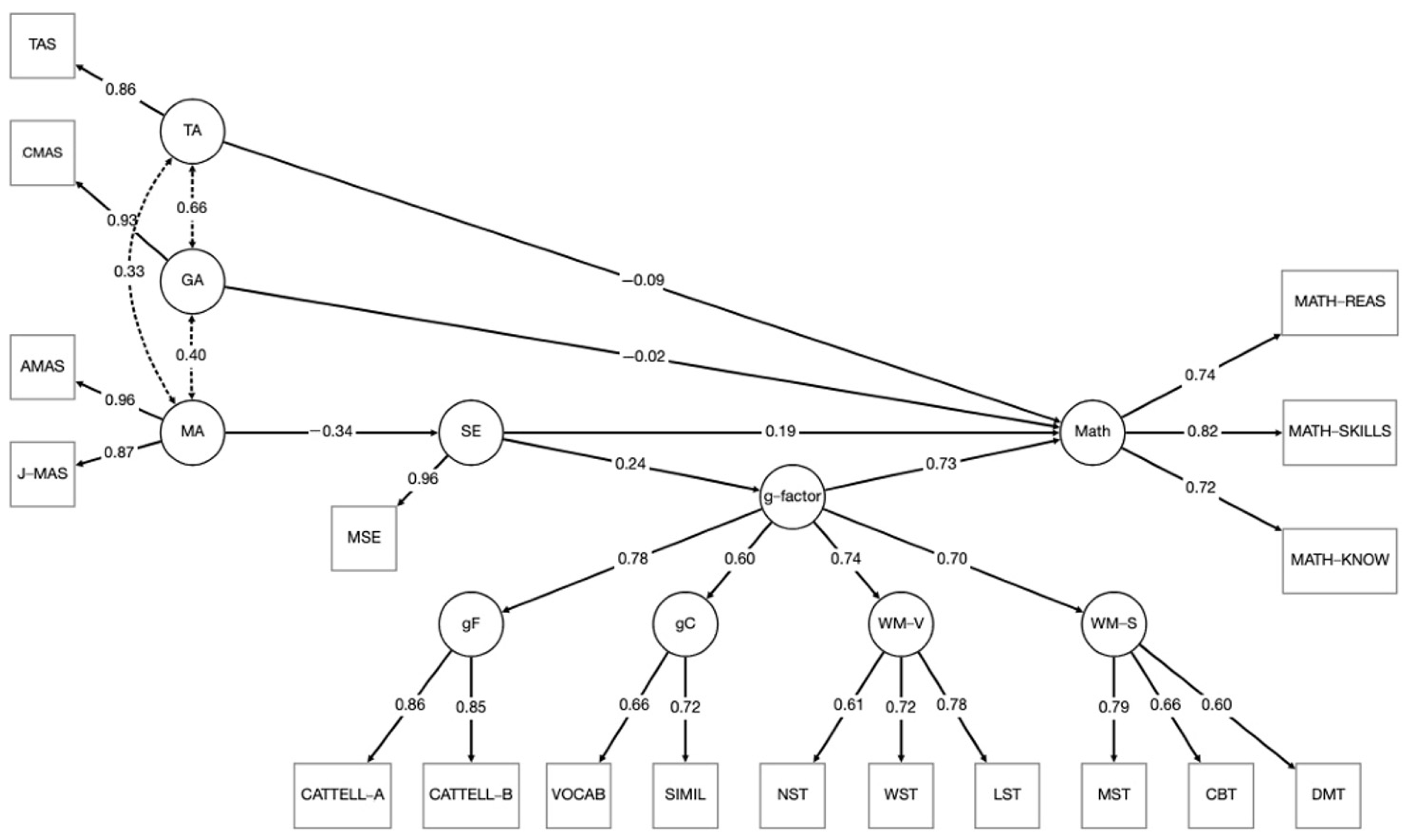
3.3. Structural Equation Models
4. Discussion
4.1. Findings on Cognitive Factors
4.2. Findings on Affective-Emotional Factors
4.3. Future Research
4.4. Practical Implications
5. Conclusions
Supplementary Materials
Author Contributions
Funding
Institutional Review Board Statement
Informed Consent Statement
Data Availability Statement
Conflicts of Interest
References
- Aiken, L. R., Jr. (1970). Attitudes toward mathematics. Review of Educational Research, 40(4), 551–596. [Google Scholar] [CrossRef]
- Akin, A., & Kurbanoğlu, İ. (2011). The relationships between math anxiety, math attitudes, and self-efficacy: A structural equation model. Studia Psychologica, 53(3), 263–273. [Google Scholar]
- Allen, L., & Dowker, A. (2022). Spatial working memory counts: Evidence for a specific association between visuo-spatial working memory and arithmetic in children. International Electronic Journal of Elementary Education, 14(3), 199–211. [Google Scholar] [CrossRef] [Scilit]
- Arens, A. K., Frenzel, A. C., & Goetz, T. (2022). Self-concept and self-efficacy in math: Longitudinal interrelations and reciprocal linkages with achievement. The Journal of Experimental Education, 90(3), 615–633. [Google Scholar] [CrossRef] [Scilit]
- Ashcraft, M. H., & Moore, A. M. (2009). Mathematics anxiety and the affective drop in performance. Journal of Psychoeducational Assessment, 27(3), 197–205. [Google Scholar] [CrossRef] [Scilit]
- Bandura, A. (1977). Self-efficacy: Toward a unifying theory of behavioral change. Psychological Review, 84(2), 191–215. [Google Scholar] [CrossRef]
- Burnham, K. P., & Anderson, D. R. (2002). Model selection and multimodel inference: A practical information-theoretic approach (2nd ed.). Springer. [Google Scholar] [CrossRef] [Scilit]
- Cargnelutti, E., Tomasetto, C., & Passolunghi, M. C. (2017). The interplay between affective and cognitive factors in shaping early proficiency in mathematics. Trends in Neuroscience and Education, 8–9, 28–36. [Google Scholar] [CrossRef] [Scilit]
- Castaneda, A., McCandless, B. R., & Palermo, D. S. (1956). The children’s form of the manifest anxiety scale. Child Development, 27(3), 317–326. [Google Scholar] [CrossRef]
- Cattell, R. B., & Cattell, A. K. S. (1960). Handbook for the individual or group Culture Fair Intelligence Test. IPAT (Institute for Personality and Ability Testing). [Google Scholar]
- Caviola, S., Toffalini, E., & Giofrè, D. (2022). Math performance and academic anxiety forms, from socio-demographic to cognitive aspects: A meta-analysis on 906,311 participants. Educational Psychology Review, 34, 363–399. [Google Scholar] [CrossRef] [Scilit]
- Choe, K. W., Jenifer, J. B., Rozek, C. S., Berman, M. G., & Beilock, S. L. (2019). Calculated avoidance: Math anxiety predicts math avoidance in effort-based decision-making. Science Advances, 5(11), eaay1062. [Google Scholar] [CrossRef] [Scilit]
- Clemente, J., Kilag, O. K., Ypon, A., Groenewald, E., Groenewald, C. A., & Ubay, R. (2024). Enhancing mathematics self-efficacy: Intervention strategies and effectiveness–A systematic review. International Multidisciplinary Journal of Research for Innovation, Sustainability, and Excellence (IMJRISE), 1(2), 274–280. [Google Scholar]
- Cowan, N. (2017). The many faces of working memory and short-term storage. Psychonomic Bulletin & Review, 24(4), 1158–1170. [Google Scholar] [CrossRef] [Scilit]
- Cragg, L., Keeble, S., Richardson, S., Roome, H. E., & Gilmore, C. (2017). Direct and indirect influences of executive functions on mathematics achievement. Cognition, 162, 12–26. [Google Scholar] [CrossRef] [Scilit] [PubMed]
- Daker, R. J., Gattas, S. U., Sokolowski, H. M., Green, A. E., & Lyons, I. M. (2021). First-year students’ math anxiety predicts STEM avoidance and underperformance throughout university, independently of math ability. NPJ Science of Learning, 6(1), 17. [Google Scholar] [CrossRef] [Scilit] [PubMed]
- Daneman, M., & Carpenter, P. A. (1980). Individual differences in working memory and reading. Journal of Verbal Learning and Verbal Behavior, 19(4), 450–466. [Google Scholar] [CrossRef] [Scilit]
- Demedts, F., Reynvoet, B., Sasanguie, D., & Depaepe, F. (2022). Unraveling the role of math anxiety in students’ math performance. Frontiers in Psychology, 13, 979113. [Google Scholar] [CrossRef] [Scilit]
- Donolato, E., Toffalini, E., Giofrè, D., Caviola, S., & Mammarella, I. C. (2020). Going beyond mathematics anxiety in primary and middle school students: The role of ego-resiliency in mathematics. Mind, Brain, and Education, 14(3), 255–266. [Google Scholar] [CrossRef] [Scilit]
- Esposito, L., Tonizzi, I., Usai, M. C., & Giofrè, D. (2025). Understanding the role of cognitive abilities and math anxiety in adolescent math achievement. Journal of Intelligence, 13(4), 44. [Google Scholar] [CrossRef] [Scilit]
- Eysenck, M. W., Payne, S., & Derakshan, N. (2005). Trait anxiety, visuospatial processing, and working memory. Cognition and Emotion, 19(8), 1214–1228. [Google Scholar] [CrossRef] [Scilit]
- Friso-van den Bos, I., van der Ven, S., Kroesbergen, E., & van Luit, J. E. H. (2013). Working memory and mathematics in primary school children: A meta-analysis. Educational Research Review, 10, 29–44. [Google Scholar] [CrossRef] [Scilit]
- Gaye, F., Groves, N. B., Chan, E. S. M., Cole, A. M., Jaisle, E. M., Soto, E. F., & Kofler, M. J. (2024). Working memory and math skills in children with and without ADHD. Neuropsychology, 38(1), 1–16. [Google Scholar] [CrossRef] [Scilit]
- Geary, D. C., Nicholas, A., Li, Y., & Sun, J. (2017). Developmental change in the influence of domain-general abilities and domain-specific knowledge on mathematics achievement: An eight-year longitudinal study. Journal of Educational Psychology, 109(5), 680–693. [Google Scholar] [CrossRef] [Scilit]
- Green, C. T., Bunge, S. A., Briones Chiongbian, V., Barrow, M., & Ferrer, E. (2017). Fluid reasoning predicts future mathematical performance among children and adolescents. Journal of Experimental Child Psychology, 157, 125–143. [Google Scholar] [CrossRef] [Scilit]
- Hair, J. F., Black, W. C., Babin, B. J., & Anderson, R. E. (2019). Multivariate data analysis (8th ed.). Cengage Learning. [Google Scholar]
- Honicke, T., & Broadbent, J. (2016). The influence of academic self-efficacy on academic performance: A systematic review. Educational Research Review, 17, 63–84. [Google Scholar] [CrossRef] [Scilit]
- Hu, L.-T., & Bentler, P. M. (1999). Cutoff criteria for fit indexes in covariance structure analysis: Conventional criteria versus new alternatives. Structural Equation Modeling, 6(1), 1–55. [Google Scholar] [CrossRef] [Scilit]
- Ikeda, Y., Kita, Y., Oi, Y., Okuzumi, H., Lanfranchi, S., Pulina, F., Mammarella, I. C., Allen, K., & Giofrè, D. (2023). The structure of working memory and its relationship with intelligence in Japanese children. Journal of Intelligence, 11(8), 167. [Google Scholar] [CrossRef] [Scilit] [PubMed]
- Ikeda, Y., Kita, Y., Takagi, R., Suzuki, K., Mammarella, I. C., Caviola, S., Lanfranchi, S., Pulina, F., & Giofrè, D. (2025). The Abbreviated Math Anxiety Scale (AMAS): Applicability and utility in a sample of Japanese elementary school children. International Journal of Psychology, 60(2), e70015. [Google Scholar] [CrossRef] [Scilit] [PubMed]
- Ji, Z., & Guo, K. (2023). The association between working memory and mathematical problem solving: A three-level meta-analysis. Frontiers in Psychology, 14, 1091126. [Google Scholar] [CrossRef] [Scilit]
- Jorgensen, T. D., Pornprasertmanit, S., Schoemann, A. M., & Rosseel, Y. (2025). semTools: Useful tools for structural equation modeling (R package version 0.5-6) [Computer software]. CRAN. Available online: https://CRAN.R-project.org/package=semTools (accessed on 27 January 2026).
- Karch, J. D. (2025). Lavaangui: A web-based graphical interface for specifying lavaan models by drawing path diagrams. Structural Equation Modeling: A Multidisciplinary Journal, 32(6), 1077–1088. [Google Scholar] [CrossRef] [Scilit]
- Kline, R. B. (2023). Principles and practice of structural equation modeling (5th ed.). The Guilford Press. [Google Scholar]
- Labong, A. L., Laum, H. D., & Yurango, C. P. (2025). The mediating analysis of self-efficacy on the relationship between anxiety and academic performance in mathematics of grade 9 students. Asian Journal of Education and Social Studies, 51(9), 968–977. [Google Scholar] [CrossRef] [Scilit]
- Lozano-Blasco, R., Quílez-Robres, A., Usán, P., Salavera, C., & Casanovas-López, R. (2022). Types of intelligence and academic performance: A systematic review and meta-analysis. Journal of Intelligence, 10(4), 123. [Google Scholar] [CrossRef] [Scilit] [PubMed]
- Ma, X., & Kishor, N. (1997). Assessing the relationship between attitude toward mathematics and achievement in mathematics: A meta-analysis. Journal for Research in Mathematics Education, 28(1), 26–47. [Google Scholar] [CrossRef] [Scilit]
- Matsunuma, M. (2004). Test anxiety, self-efficacy, self-regulated learning, and test performance: 4th grade students and an arithmetic test. The Japanese Journal of Educational Psychology, 52(4), 426–436. [Google Scholar] [CrossRef] [Scilit]
- Miura, M., Shimada, H., & Sakano, Y. (1997). Successive changes of test anxiety in junior high school students: From the viewpoint of psychological stress. The Japanese Journal of Educational Psychology, 45(1), 31–40. [Google Scholar]
- Miyake, A., Friedman, N. P., Rettinger, D. A., Shah, P., & Hegarty, M. (2001). How are visuospatial working memory, executive functioning, and spatial abilities related? A latent-variable analysis. Journal of Experimental Psychology: General, 130(4), 621–640. [Google Scholar] [CrossRef] [Scilit] [PubMed]
- OECD. (2019). PISA 2018 results (Volume I): What students know and can do. OECD Publishing. [Google Scholar] [CrossRef] [Scilit]
- Pajares, F., & Graham, L. (1999). Self-efficacy, motivation constructs, and mathematics performance of entering middle school students. Contemporary Educational Psychology, 24(2), 124–139. [Google Scholar] [CrossRef] [Scilit] [PubMed]
- Palestro, J., & Jameson, M. (2020). Math self-efficacy, not emotional self-efficacy, mediates the math anxiety-performance relationship in undergraduate students. Cognition, Brain, Behavior. An Interdisciplinary Journal, 24, 379–394. [Google Scholar] [CrossRef] [Scilit]
- Pekrun, R. (2006). The control-value theory of achievement emotions: Assumptions, corollaries, and implications for educational research and practice. Educational Psychology Review, 18(4), 315–341. [Google Scholar] [CrossRef] [Scilit]
- Peng, P., Namkung, J., Barnes, M., & Sun, C. (2016). A meta-analysis of mathematics and working memory: Moderating effects of working memory domain, type of mathematics skill, and sample characteristics. Journal of Educational Psychology, 108(4), 455–473. [Google Scholar] [CrossRef] [Scilit]
- Peng, P., Wang, T., Wang, C., & Lin, X. (2019). A meta-analysis on the relation between fluid intelligence and reading/mathematics: Effects of tasks, age, and social economics status. Psychological Bulletin, 145(2), 189–236. [Google Scholar] [CrossRef] [Scilit]
- Pintrich, P. R., & De Groot, E. V. (1990). Motivational and self-regulated learning components of classroom academic performance. Journal of Educational Psychology, 82(1), 33–40. [Google Scholar] [CrossRef]
- Primi, R., Ferrão, M. E., & Almeida, L. S. (2010). Fluid intelligence as a predictor of learning: A longitudinal multilevel approach applied to math. Learning and Individual Differences, 20(5), 446–451. [Google Scholar] [CrossRef] [Scilit]
- Putwain, D. W. (2008). Test anxiety and GCSE performance: The effect of gender and socio-economic background. Educational Psychology in Practice, 24(4), 319–334. [Google Scholar] [CrossRef] [Scilit]
- Putwain, D. W., Becker, S., Symes, W., & Pekrun, R. (2017). Reciprocal relations between students’ academic enjoyment, boredom, and achievement over time. Learning and Instruction, 54, 73–81. [Google Scholar] [CrossRef] [Scilit]
- Qi, Y., Chen, Y., Yu, X., Yang, X., He, X., & Ma, X. (2024). The relationships among working memory, inhibitory control, and mathematical skills in primary school children: Analogical reasoning matters. Cognitive Development, 70, 101437. [Google Scholar] [CrossRef] [Scilit]
- R Core Team. (2024). R: A language and environment for statistical computing. R Foundation for Statistical Computing. Available online: https://www.R-project.org/ (accessed on 27 January 2026).
- Recber, S., Isiksal, M., & Koç, Y. (2018). Investigating self-efficacy, anxiety, attitudes and mathematics achievement regarding gender and school type. Anales de Psicología/Annals of Psychology, 34(1), 41–51. [Google Scholar] [CrossRef] [Scilit]
- Ritchie, S. J., & Bates, T. C. (2013). Enduring links from childhood mathematics and reading achievement to adult socioeconomic status. Psychological Science, 24(7), 1301–1308. [Google Scholar] [CrossRef] [Scilit] [PubMed]
- Rosseel, Y. (2012). Lavaan: An R package for structural equation modeling. Journal of Statistical Software, 48(2), 1–36. [Google Scholar] [CrossRef] [Scilit]
- RStudio Team. (2024). RStudio: Integrated development environment for R. Posit Software, PBC. Available online: https://posit.co/products/rstudio/ (accessed on 27 January 2026).
- Sakamoto, T. (1965). The study on children’s manifest anxiety scale. Research Reports of Kochi University, Humanities, 14, 161–166. [Google Scholar]
- Sakamoto, T. (1989). Manual of the Japanese version of CMAS. Sankyobo. [Google Scholar]
- Sakano, Y. (1988). Successive changes of test anxiety in high school students. Waseda Journal of Human Sciences, 1(1), 31–44. [Google Scholar]
- Sarason, I. G. (1972). Experimental approaches to test anxiety: Attention and the uses of information. In C. D. Spielberger (Ed.), Anxiety: Current trends in theory and research (Vol. 2, pp. 381–403). Academic Press. [Google Scholar]
- Silverman, S., & Ashkenazi, S. (2022). The unique role of spatial working memory for mathematics performance. Journal of Numerical Cognition, 8(2), 226–243. [Google Scholar] [CrossRef] [Scilit]
- Stevens, J. P. (2002). Applied multivariate statistics for the social sciences (4th ed.). Lawrence Erlbaum Associates. [Google Scholar]
- Tanaka, M., Aizawa, M., Saito, T., Tanahashi, H., Kondo, A., Kawauchi, A., Suzuki, K., & Hirayama, Y. (2011). Development and utilization of vocabulary lists, kanji lists, and other resources based on corpora for effective language policy (Report No. LR-CCG-10-07). National Institute for Japanese Language and Linguistics. [Google Scholar]
- Tatsuno, C., & Kitao, N. (2018). The manual for Kyokenshiki criterion-referenced test (CRT–II). Toshobunka. (In Japanese) [Google Scholar]
- Taub, G. E., Keith, T. Z., Floyd, R. G., & McGrew, K. S. (2008). Effects of general and broad cognitive abilities on mathematics achievement. School Psychology Quarterly, 23(2), 187–198. [Google Scholar] [CrossRef] [Scilit]
- Watanabe, R., & Sakuma, T. (1998). A study on structures of children’s arithmetic anxiety and methods of teacher’s supports: Examination from social support. The Japanese Journal of Educational Psychology, 46(2), 184–192. [Google Scholar] [CrossRef] [Scilit] [PubMed]
- Wechsler, D., & Japanese WISC-IV Publication Committee. (2010). Japanese version of the Wechsler intelligence scale for children-fourth edition. Nihon Bunka Kagaku. (In Japanese) [Google Scholar]
- Zakariya, Y. F. (2022). Improving students’ mathematics self-efficacy: A systematic review of intervention studies. Frontiers in Psychology, 13, 986622. [Google Scholar] [CrossRef] [Scilit] [PubMed]
- Zhang, Y., Tolmie, A., & Gordon, R. (2022). The relationship between working memory and arithmetic in primary school children: A meta-analysis. Brain Sciences, 13(1), 22. [Google Scholar] [CrossRef] [Scilit]

| 1 | 2 | 3 | 4 | 5 | 6 | 7 | 8 | 9 | 10 | 11 | 12 | 13 | 14 | 15 | 16 | 17 | |
|---|---|---|---|---|---|---|---|---|---|---|---|---|---|---|---|---|---|
| 1. MATH-REAS | 1 | ||||||||||||||||
| 2. MATH-SKILLS | 0.60 ** | 1 | |||||||||||||||
| 3. MATH-KNOW | 0.51 ** | 0.62 ** | 1 | ||||||||||||||
| 4. CATTELL-A | 0.42 ** | 0.47 ** | 0.44 ** | 1 | |||||||||||||
| 5. CATTELL-B | 0.39 ** | 0.45 ** | 0.42 ** | 0.74 ** | 1 | ||||||||||||
| 6. VOCAB | 0.30 ** | 0.26 ** | 0.37 ** | 0.24 ** | 0.16 * | 1 | |||||||||||
| 7. SIMIL | 0.22 ** | 0.30 ** | 0.23 ** | 0.35 ** | 0.26 ** | 0.47 ** | 1 | ||||||||||
| 8. NST | 0.26 ** | 0.27 ** | 0.35 ** | 0.23 ** | 0.26 ** | 0.21 ** | 0.19 * | 1 | |||||||||
| 9. WST | 0.14 | 0.25 ** | 0.25 ** | 0.25 ** | 0.29 ** | 0.21 ** | 0.21 ** | 0.53 ** | 1 | ||||||||
| 10. LST | 0.28 ** | 0.32 ** | 0.39 ** | 0.41 ** | 0.44 ** | 0.32 ** | 0.33 ** | 0.42 ** | 0.56 ** | 1 | |||||||
| 11. MST | 0.32 ** | 0.29 ** | 0.31 ** | 0.33 ** | 0.36 ** | 0.15 | 0.17 * | 0.25 ** | 0.38 ** | 0.38 ** | 1 | ||||||
| 12. CBT | 0.26 ** | 0.37 ** | 0.26 ** | 0.34 ** | 0.34 ** | 0.15 | 0.14 | 0.25 ** | 0.29 ** | 0.37 ** | 0.51 ** | 1 | |||||
| 13. DMT | 0.28 ** | 0.24 ** | 0.15 | 0.27 ** | 0.27 ** | 0.06 | 0.15 | 0.16 * | 0.21 ** | 0.36 ** | 0.50 ** | 0.36 ** | 1 | ||||
| 14. CMAS | −0.17 * | −0.09 | −0.12 | −0.08 | −0.11 | −0.02 | 0.03 | 0.13 | −0.10 | −0.03 | −0.08 | −0.07 | −0.03 | 1 | |||
| 15. TAS | −0.18 * | −0.18 * | −0.10 | −0.19 * | −0.14 | −0.05 | −0.06 | 0.03 | −0.09 | −0.07 | −0.13 | −0.10 | −0.07 | 0.53 ** | 1 | ||
| 16. AMAS | −0.25 ** | −0.25 ** | −0.18 * | −0.12 | −0.18 * | −0.11 | −0.03 | −0.04 | −0.03 | −0.06 | −0.10 | −0.09 | −0.14 | 0.36 ** | 0.27 ** | 1 | |
| 17. J-MAS | −0.18 * | −0.23 ** | −0.15 * | −0.05 | −0.05 | −0.03 | −0.02 | −0.04 | −0.04 | 0.02 | −0.06 | −0.05 | −0.05 | 0.34 ** | 0.23 ** | 0.83 ** | 1 |
| 18. MSE | 0.33 ** | 0.29 ** | 0.22 ** | 0.18 * | 0.14 | 0.25 ** | 0.18 * | 0.10 | 0.08 | 0.10 | 0.10 | −0.02 | 0.10 | −0.16 * | −0.08 | −0.32 ** | −0.27 ** |
| Variable | Math | g-Factor | gF | gC | WM-V | WM-S | GA | TA | MA | SE |
|---|---|---|---|---|---|---|---|---|---|---|
| MATH-REAS | 0.725 | |||||||||
| MATH-SKILLS | 0.829 | |||||||||
| MATH-KNOW | 0.738 | |||||||||
| gF | 0.787 | |||||||||
| gC | 0.596 | |||||||||
| WM-V | 0.728 | |||||||||
| WM-S | 0.695 | |||||||||
| CATTELL-A | 0.870 | |||||||||
| CATTELL-B | 0.846 | |||||||||
| VOCAB | 0.655 | |||||||||
| SIMIL | 0.725 | |||||||||
| NST | 0.610 | |||||||||
| WST | 0.721 | |||||||||
| LST | 0.782 | |||||||||
| MST | 0.790 | |||||||||
| CBT | 0.655 | |||||||||
| DMT | 0.600 | |||||||||
| CMAS | 0.932 | |||||||||
| TAS | 0.859 | |||||||||
| AMAS | 0.958 | |||||||||
| J-MAS | 0.871 | |||||||||
| MSE | 0.964 | |||||||||
| Math | 1 | |||||||||
| g-factor | 0.786 | 1 | ||||||||
| gF | 0.619 | 0.787 | 1 | |||||||
| gC | 0.469 | 0.596 | 0.469 | 1 | ||||||
| WM-V | 0.572 | 0.728 | 0.573 | 0.434 | 1 | |||||
| WM-S | 0.547 | 0.695 | 0.547 | 0.414 | 0.506 | 1 | ||||
| GA | −0.165 | −0.101 | −0.079 | −0.06 | −0.073 | −0.07 | 1 | |||
| TA | −0.237 | −0.222 | −0.175 | −0.132 | −0.162 | −0.154 | 0.665 | 1 | ||
| MA | −0.306 | −0.163 | −0.128 | −0.097 | −0.119 | −0.113 | 0.403 | 0.324 | 1 | |
| SE | 0.375 | 0.239 | 0.188 | 0.143 | 0.174 | 0.167 | −0.174 | −0.100 | −0.336 | 1 |
| Model | χ2 | df | p(χ2) | CFI | NNFI | RMSEA | SRMR | AIC | BIC |
|---|---|---|---|---|---|---|---|---|---|
| 1 | 87.604 | 60 | 0.012 | 0.964 | 0.953 | 0.052 | 0.053 | 5528.365 | 5625.391 |
| 2 | 10.520 | 13 | 0.651 | 1.000 | 1.000 | 0.000 a | 0.024 | 3378.048 | 3450.036 |
| 3 | 149.134 | 119 | 0.032 | 0.972 | 0.964 | 0.039 | 0.050 | 7633.150 | 7795.905 |
| 4 | 153.807 | 124 | 0.036 | 0.972 | 0.966 | 0.038 | 0.056 | 7627.823 | 7774.929 |
| 5 | 157.071 | 125 | 0.028 | 0.970 | 0.964 | 0.039 | 0.059 | 7629.088 | 7773.063 |
Disclaimer/Publisher’s Note: The statements, opinions and data contained in all publications are solely those of the individual author(s) and contributor(s) and not of MDPI and/or the editor(s). MDPI and/or the editor(s) disclaim responsibility for any injury to people or property resulting from any ideas, methods, instructions or products referred to in the content. |
© 2026 by the authors. Licensee MDPI, Basel, Switzerland. This article is an open access article distributed under the terms and conditions of the Creative Commons Attribution (CC BY) license.
Share and Cite
Ikeda, Y.; Esposito, L.; Kita, Y.; Oi, Y.; Takagi, R.; Suzuki, K.; Mammarella, I.C.; Caviola, S.; Lanfranchi, S.; Pulina, F.; et al. Cognitive and Affective-Emotional Factors in Math Achievement: The Mediating Role of Intelligence. J. Intell. 2026, 14, 25. https://doi.org/10.3390/jintelligence14020025
Ikeda Y, Esposito L, Kita Y, Oi Y, Takagi R, Suzuki K, Mammarella IC, Caviola S, Lanfranchi S, Pulina F, et al. Cognitive and Affective-Emotional Factors in Math Achievement: The Mediating Role of Intelligence. Journal of Intelligence. 2026; 14(2):25. https://doi.org/10.3390/jintelligence14020025
Chicago/Turabian StyleIkeda, Yoshifumi, Lorenzo Esposito, Yosuke Kita, Yuhei Oi, Riko Takagi, Kent Suzuki, Irene Cristina Mammarella, Sara Caviola, Silvia Lanfranchi, Francesca Pulina, and et al. 2026. "Cognitive and Affective-Emotional Factors in Math Achievement: The Mediating Role of Intelligence" Journal of Intelligence 14, no. 2: 25. https://doi.org/10.3390/jintelligence14020025
APA StyleIkeda, Y., Esposito, L., Kita, Y., Oi, Y., Takagi, R., Suzuki, K., Mammarella, I. C., Caviola, S., Lanfranchi, S., Pulina, F., & Giofrè, D. (2026). Cognitive and Affective-Emotional Factors in Math Achievement: The Mediating Role of Intelligence. Journal of Intelligence, 14(2), 25. https://doi.org/10.3390/jintelligence14020025

